They Refused The Old Man At The Door, Then Learned The Hall Was Named For His Lost Command
Chapter 1: The Invitation Trembled Beside The Brass Name
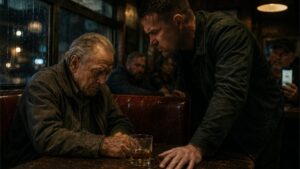
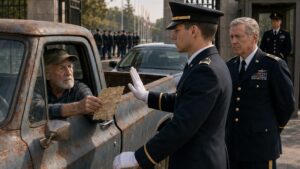
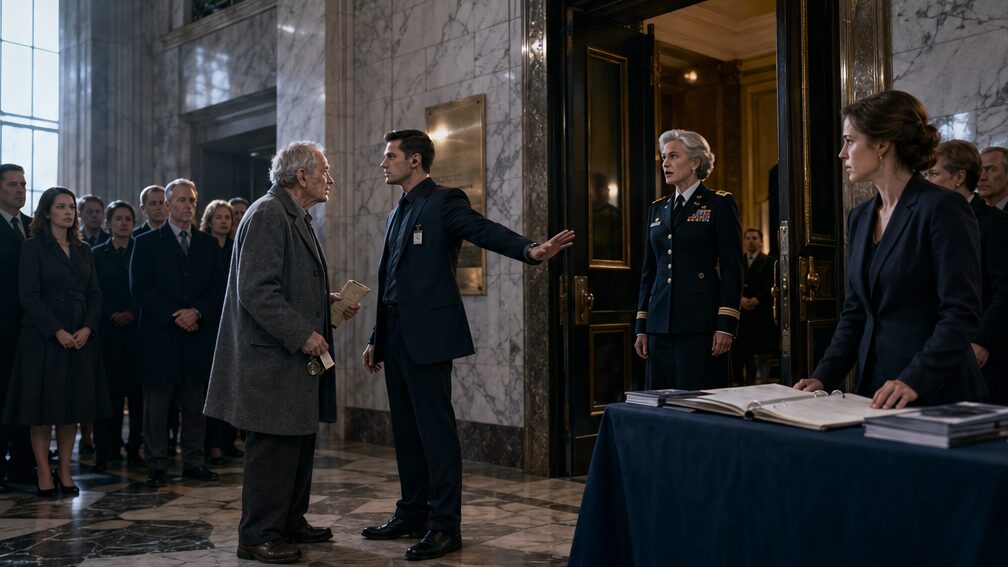
The young security manager put one hand across the doorway before Joseph Bell could step inside.
“This entrance is for honored guests only.”
Joseph stopped with one shoe on the black entry mat and one still on the pale stone outside. The motion was small, almost polite, but it sent a stiff ache through both knees. He steadied himself without reaching for the doorframe. At eighty-one, he had learned to distrust glossy floors, young impatience, and ceremonies that used words like legacy before breakfast.
“I was asked to come,” he said.
The manager’s hand did not move.
Behind him, the academy lobby shone with winter light and polished marble. Men in dark suits stood beneath portraits of past commanders. Women in pearls and wool coats waited near a registration table. A string quartet tuned somewhere beyond the tall double doors, the thin sound of a violin note rising and falling like someone testing whether the room was ready to remember.
Joseph looked smaller than the lobby seemed prepared to accept. His gray coat had been brushed clean but had not been new in twenty years. His shoes were polished, but cracks ran along the leather near the toes. The collar of his shirt sat slightly crooked beneath his scarf. In his left hand, he held a folded invitation that had been mailed to his house three weeks earlier. In his right, near his keys, hung a dented silver compass no bigger than a pocket watch.
The manager glanced at the invitation as if looking too long might encourage the old man.
“Sir, this is a private dedication,” he said. His tone was smooth, practiced, the kind used by people who wanted witnesses to hear patience. “General guests go through the west entrance. This one is for honorees, senior staff, and invited speakers.”
Joseph’s thumb moved over the compass casing. The needle inside had stopped trusting north years ago. He carried it anyway.
“My letter said this entrance,” Joseph replied.
The manager gave the paper a second glance, not enough to read the name. His badge read Andrew Price, Security Operations.
“We’ve had several people confused by the layout this morning.” Andrew smiled tightly. “The west entrance is marked with blue signs. Someone there can help you find seating.”
“I am not confused.”
A woman at the registration table looked up. She had a stack of programs in front of her and a pen tucked behind one ear. Joseph saw her eyes flick from his invitation to the brass nameplate mounted beside the tall doors.
THE BELL LEADERSHIP HALL
DEDICATION CEREMONY
Her lips parted slightly.
Andrew noticed her attention and shifted his body to block the doorway more fully.
“Sir,” he said, lower now, “please don’t make this difficult.”
Joseph looked at the brass letters. He had asked them not to do it. Twice, in fact. Once by telephone, once in a short note that he had signed only J. Bell, hoping the informality might make refusal easier. The academy commandant had answered with a longer letter, one that mentioned cadets, institutional memory, and a responsibility to teach.
Young people deserve the truth, the letter had said.
That sentence had brought Joseph here.
Not honor. Not the engraved program. Not the front seat he had not requested.
Cadets.
He looked past Andrew toward the inner doors. Somewhere beyond them, rows of young men and women were sitting straight-backed in dress uniforms, waiting to hear what leadership meant from people old enough to have turned it into a word polished smooth.
Joseph had spent half the night awake with the invitation on his kitchen table.
He had arrived early because he hated being late to memorials.
“You can check the list again,” Joseph said.
Andrew’s jaw flexed.
At the registration table, the woman reached for a binder. “Mr. Price, I can—”
“I have it handled, Amanda.” Andrew did not turn around. “Thank you.”
Amanda Lewis withdrew her hand, but her gaze stayed on Joseph. She seemed young enough to still believe that rules were meant to prevent mistakes, not preserve them after they had begun.
Andrew finally took the invitation from Joseph’s hand. He held it by one corner, as though it might be damp. Joseph’s fingers remained slightly curled after the paper left them. Cold had settled into the joints during the walk from the drop-off circle. He had declined the academy car waiting at his hotel because he did not want a driver, a greeting party, or anyone saluting at a curb.
He had wanted to enter quietly.
Andrew unfolded the invitation.
Joseph watched the man’s eyes move too quickly across the page.
“Joseph Bell,” Andrew read.
The sound of his own name, in that lobby, landed with more weight than Joseph expected. He kept his face still.
Andrew looked at him now, really looked, but only at the surface. Worn coat. Old hands. Slow posture. A plain scarf. Shoes that belonged to a man who repaired things before replacing them.
“Do you have identification?” Andrew asked.
Joseph reached inside his coat and removed his wallet. The movement took longer than Andrew seemed to think it should. A couple near the registration table turned to watch. One of the suited men beneath the portraits paused mid-sentence.
Joseph handed over his driver’s license.
Andrew compared the name, then the face, then the invitation. He frowned, not in recognition but irritation, as if the matching details had made the situation less convenient.
“This doesn’t confirm access level,” Andrew said.
“It confirms the name.”
“It confirms a name.”
Joseph looked at him for a quiet second. “How many Joseph Bells did you invite today?”
The question was not sharp. That made it worse. Amanda lowered her eyes to the binder again.
Andrew’s smile disappeared.
“Sir, anyone can print an invitation.”
“This was mailed.”
“Then perhaps it was mailed by mistake.”
There it was. Not quite an accusation. Worse, somehow. A tidy little bridge from error to blame, built so the person holding the power never had to step into doubt.
Joseph took back his license when Andrew offered it. His fingertips brushed the compass again.
The little object was cold. He remembered another cold morning, not in a marble lobby but in a place where rain made red mud out of roads and radios coughed static instead of answers. He remembered a young lieutenant pressing the compass into his palm and saying it was useless if the commander didn’t know which way home was.
Joseph closed his hand around it.
“I was asked to come,” he said again.
Andrew exhaled through his nose and glanced over Joseph’s shoulder toward the steps outside. More guests were arriving. A black sedan had just pulled up. Two older men in tailored coats were approaching, one with a polished cane, both wearing the easy impatience of people accustomed to doors opening.
Andrew’s posture changed. His hand came down, but not in welcome.
“Step aside, please.”
Joseph did not move at first.
The suited men came closer. One of them looked Joseph over and then looked past him, already dismissing him as an obstruction. Andrew saw that glance. Joseph saw Andrew see it.
“Sir,” Andrew said, louder now, “I need you to step away from the honored-guest entrance.”
The lobby had grown quieter around the edges.
Amanda’s hand rested on the binder. She looked again at the brass nameplate, then at Joseph’s invitation, then at Andrew’s stiff shoulders. Still, she said nothing.
Joseph folded the invitation along its original crease. The paper trembled, though he could not tell whether from cold, age, or the old anger he had never trusted himself to use in rooms full of young people.
“I will wait while you check,” he said.
Andrew leaned closer. “No. You will wait at the west desk.”
“That is not what the invitation says.”
“The invitation,” Andrew said, taking care with each word, “does not make you an honored guest.”
One of the suited men cleared his throat behind Joseph. The other muttered something about delays.
Joseph stepped to the side, but only enough for them to pass. Andrew opened the door at once.
“Good morning, gentlemen,” he said with relief in his voice. “Welcome. They’re expecting you inside.”
The men went in without showing papers.
Joseph watched the doors close behind them.
Amanda’s face tightened.
Andrew turned back, cheeks slightly flushed now, not with shame but with the irritation of having been observed making a choice.
“Name again?” Amanda asked softly from the table.
Joseph answered before Andrew could. “Bell.”
Andrew gave a short laugh before he could stop himself.
It was not a loud laugh. It did not echo. It did not need to. It landed cleanly in the polished lobby, close enough for the couple at the table to hear, close enough for Amanda to look down as if the binder had suddenly accused her.
“General Bell is the honoree today,” Andrew said. “Please don’t do that.”
Chapter 2: The Old Man Who Would Not Raise His Voice
“You’re making people uncomfortable,” Andrew said.
Joseph looked at the guests watching from the lobby and understood that Andrew believed discomfort was proof of Joseph’s wrongdoing. A man in a poor coat at a formal doorway was disruptive. An old hand trembling over an invitation was embarrassing. A name spoken from the wrong mouth became almost indecent.
“I did not come to trouble anyone,” Joseph said.
“Then wait outside while we verify this.”
Outside meant the stone steps, the winter air, the academy flags snapping above the entrance. Joseph’s knees had stiffened from standing still. His chest had begun to feel tight in the way it did when memory pressed too close to ceremony.
Amanda moved again toward the binder.
“Mr. Price,” she said, “there is a Joseph Bell listed under—”
Andrew turned sharply. “Amanda, please continue checking in confirmed guests.”
The word confirmed did its work. Amanda’s face colored. She lowered her hand, but not before Joseph saw the page she had opened.
Near the top, in neat printed text, was a line partly covered by her fingers:
Gen. Joseph Bell — Honored Speaker
Joseph looked away first.
Andrew did not see the line. Or if he did, pride closed the door before doubt could enter.
The couple near the registration table whispered. An elderly woman in a navy coat watched Joseph with concern but did not step forward. A photographer adjusted his camera strap and pretended not to be looking. Somewhere inside the hall, the string quartet began a measured piece that sounded too dignified for the lobby’s small cruelty.
Andrew lifted his radio.
“I’m going to have a guard escort you to the public entrance,” he said.
Joseph felt the compass bite into his palm.
“I can walk,” he said.
“That’s not the issue.”
“No,” Joseph said quietly. “It rarely is.”
Andrew paused, perhaps hearing something in the old man’s voice that did not match his coat. But the pause was brief. The lobby had become a stage, and Andrew had chosen his role on it.
“You need to understand,” Andrew said, “this academy has senior officers, donors, families of the fallen, and invited leadership present. We can’t allow anyone to wander in because he claims a name.”
Joseph’s jaw tightened once.
Families of the fallen.
The words opened a door in him he had kept braced shut for years.
A tent full of maps. Rain on canvas. A lieutenant’s wet sleeve. A young voice saying, Sir, if you pull us back now, they don’t come home. The pressure of a compass placed in Joseph’s hand. Not as a gift. Not then. As a challenge. As a trust.
Joseph drew a slow breath.
“I have waited in worse places,” he said. “I can wait here.”
Andrew’s eyes narrowed. “That isn’t helping your case.”
“I did not know I was on trial.”
A small sound moved through the lobby. Not quite approval. Not laughter. Recognition, maybe, that the old man had said something true without raising his voice.
Amanda glanced at him quickly, then back at the list. Her finger traveled down the page again. Joseph saw her hesitate on the same line.
“Mr. Price,” she said, firmer this time, “I really think—”
“Not now.”
Andrew stepped between her and Joseph, and the movement pushed the moment from mistake into choice.
Joseph saw it happen. So did Amanda. So did the woman in the navy coat. Sometimes a room knew the truth before the person in charge allowed it.
“Sir,” Andrew said, “I’m asking you one last time to move away from the doors.”
Joseph looked past him at the entrance to the hall. He did not see the polished wood or the ribbon waiting to be cut. He saw rows of cadets in clean uniforms. Young faces. Straight shoulders. He had not wanted them to learn his name. He had wanted them to learn the part no plaque could hold.
Service was not glory.
Service was weight.
But perhaps he had been wrong to come. Perhaps the academy wanted the shape of him, the clean outline of command, not the old man carrying its consequences. Perhaps the letter had been written by people who needed a symbol, and symbols were easier to manage when they did not show up in cracked shoes.
Joseph folded the invitation again and placed it inside his coat.
“That may be best,” he said.
Amanda’s head lifted.
Andrew blinked. “Excuse me?”
“I said that may be best.”
For the first time, uncertainty crossed Andrew’s face. He had expected argument. Protest. A demand to speak to someone important. He had not expected the old man to accept removal as though it confirmed something painful he already suspected.
Joseph turned slightly toward the outer doors.
At that exact moment, the tall doors to the hall opened from within.
The quartet’s music grew louder for one breath and then softened behind the closing door. A woman in uniform stepped into the lobby with urgency in her stride. Silver hair framed a face held carefully composed, but her eyes searched the room with worry.
Two stars shone on her shoulders.
“Has anyone seen General Bell?” she asked.
Andrew straightened so quickly that his radio clicked against his belt. “Ma’am.”
The woman’s gaze moved over him, past Amanda, past the couple near the table, and stopped on Joseph.
Nothing happened for one second.
Then everything did.
Her face changed first. The command in it loosened, not into weakness but into memory. Her shoulders, squared a moment before, seemed to carry another time. Rain. Mud. Orders given under fire. A younger self standing before a man who had looked at her not as a decoration, not as a risk, but as an officer whose mind mattered.
She crossed the floor.
Joseph did not move.
The compass hung between his fingers now, visible below the cuff of his worn gray coat.
The woman stopped two paces from him. Her eyes dropped to the compass, and for the first time that morning, Joseph saw someone recognize not his name, not his rank, but the burden attached to both.
Her hand rose sharply to her brow.
The lobby went still.
“General Bell,” Melissa Marsh said, her voice steady except for the break hidden under the title. “Sir. We’ve been looking for you.”
Andrew’s mouth opened slightly.
Amanda’s hand covered the line in the binder as if it had become too bright to look at.
Joseph looked at Melissa’s salute for half a heartbeat too long. He had been saluted thousands of times in his life. He had returned salutes in snow, dust, desert heat, hospital corridors, and once beside a row of covered stretchers. Most had been ordinary. Some had been ceremonial. A few had nearly undone him.
This one came dangerously close.
He lifted his hand, slower than he wished, and returned it.
“At ease, General Marsh,” he said.
Someone in the lobby whispered, “That’s him?”
Andrew’s face drained of color so completely that he looked suddenly younger. Younger, and more frightened than arrogant.
Melissa stepped forward and took Joseph’s hand in both of hers.
“You should have been brought in ten minutes ago,” she said.
“I arrived early.”
Her eyes flicked toward Andrew, then the doorway, then Joseph’s folded invitation hidden inside his coat. She did not ask the obvious question. Not yet.
“I’m sorry, sir,” she said.
Joseph looked at Andrew before answering.
Andrew swallowed. “Sir, I—I didn’t realize—”
Joseph held his gaze. His voice remained low, but the lobby strained to hear it.
“Do not apologize because of who I was,” Joseph said. “Apologize because of who you thought I was.”
The words did not strike like a shout. They settled like a judgment.
Andrew’s eyes dropped to the marble floor.
“I’m sorry,” he said.
Joseph nodded once. “Then check the next old man’s name before you check his coat.”
No one moved.
The outer doors opened behind them, letting in a cut of winter air and the sound of another arriving car. Joseph felt it at the back of his neck. He should have entered then. The ceremony was waiting. The academy had found its honoree. The embarrassing mistake had been corrected.
But Melissa was still holding his hand.
And her thumb, perhaps without knowing it, touched the dented compass casing.
Her face changed again.
“Sir,” she said softly, “they put the operation name on the first program page.”
Joseph’s hand closed around the compass.
“Which name?” he asked.
Melissa did not answer quickly enough.
Chapter 3: The Portrait Wall Remembered Before The Room Did
The lobby remained silent while Melissa Marsh held Joseph Bell’s hand, but Joseph’s attention had already moved past the apology, past Andrew’s pale face, past the guests pretending not to stare.
“Which name?” he asked again.
Melissa’s grip tightened once before she let go.
“The official one,” she said.
Joseph looked toward the tall doors. The music beyond them had stopped. A murmur had risen in its place, the sound of a room aware that something scheduled had failed to begin on time.
“The official one,” he repeated.
Melissa’s face showed the strain of someone who had commanded difficult rooms and still dreaded this smaller one. “Sir, the commandant approved the wording. I saw the draft late. I should have called you.”
“You did call.”
“You did not answer.”
“No.”
The admission sat between them with old weight.
Andrew shifted near the doorway. “General Bell, I truly apologize. I had no idea you were—”
Joseph turned to him.
Andrew stopped speaking.
Joseph did not enjoy the man’s discomfort. That was the part Andrew would not understand. The old anger had come and gone in Joseph like a match struck in wind. What remained was disappointment, and disappointment required more discipline than anger.
“I heard your apology,” Joseph said.
“Yes, sir.”
“You are still saying it to the rank.”
Andrew’s throat moved. He looked at Melissa, then Amanda, then the floor. “I was trying to protect the event.”
“From whom?”
The question had no force behind it. Andrew looked up anyway, as if it had struck.
Joseph waited.
Andrew’s mouth tightened. For a moment, the insecurity beneath the uniformed blazer showed plainly. “From mistakes,” he said. “From people getting in who shouldn’t. From something going wrong on my first major assignment here.”
Joseph studied him. That answer was not enough, but it was not nothing.
“Then remember this one,” Joseph said.
Amanda stepped from behind the registration table. “General Bell, I should have spoken up sooner.”
Joseph looked at her, and the embarrassment in her face was different from Andrew’s. It did not defend itself.
“You saw the name,” he said.
“Yes, sir.”
“And the plate.”
Amanda glanced at the brass letters beside the door. “Yes.”
“But he sounded certain.”
Her eyes lowered. “Yes.”
Joseph nodded. “Certainty is easier to borrow than courage.”
Amanda absorbed that as if she meant to keep it.
Melissa cleared her throat. “Sir, may I show you something before we go in?”
Joseph almost said no. The hall was waiting. The ceremony was already becoming a problem, and he had never liked problems that gathered spectators. But Melissa’s voice had the careful steadiness of an officer approaching dangerous ground.
He followed her across the lobby.
People parted for him now.
That, more than Andrew’s apology, made Joseph tired.
The same guests who had watched him be dismissed now stepped aside with solemn faces. One man who had passed through without showing papers inclined his head as Joseph approached. The elderly woman in the navy coat touched her hand to her chest. The photographer lowered his camera, wisely deciding against capturing the moment.
Joseph reached the portrait wall.
There he was.
Not the man in the worn coat, but a younger version in service dress, shoulders squared, jaw stronger, eyes more guarded than brave. The photograph had been taken after the operation, though the plaque did not say that. It listed his rank, his years of command, his academy advisory role, and a line about decisive leadership under impossible conditions.
In the portrait, half-hidden near his right hand, hung a silver compass.
Joseph stared at it.
He remembered wanting the photographer to remove it. He remembered being told there was no time, that the record needed the image, that the command staff was waiting. He had almost laughed then. Records always needed clean images. They had no idea what to do with broken objects.
A small group gathered behind him, careful not to stand too close.
Andrew saw the portrait and seemed to shrink.
Amanda stepped nearer to read the plaque. Her eyes moved from the younger face to the old man beside her. The recognition did not come as shock now. It came as shame.
Melissa handed Joseph a program.
The cover was heavy cream paper with an embossed academy crest. Beneath it, in dignified black type, were the words:
DEDICATION OF THE BELL LEADERSHIP HALL
HONORING GENERAL JOSEPH BELL
AND THE COMMAND LEGACY OF OPERATION NORTHPASS
Joseph’s fingers stopped moving.
Northpass.
The word had been cleanly printed. Centered. Honored. Made suitable for donors, cadets, and framed photographs. No mud clung to it. No radio static. No last message. No young officer’s hand pressing a compass into his palm.
He opened the program.
Inside, his biography had been shortened into something nearly unrecognizable. Decorated service. Strategic restraint. Preservation of personnel. Command doctrine. Academy legacy. The words were accurate in the way maps were accurate when they left out graves.
He turned the page.
The schedule listed a cadet introduction, remarks from Major General Melissa Marsh, archival presentation, dedication address by General Joseph Bell, ribbon ceremony.
There was no mention of Lieutenant Allen.
Joseph closed the program.
Melissa saw the moment his face changed.
“Sir,” she said quietly, “we planned to include the fallen in the exhibit.”
“The exhibit.”
“Yes.”
“Behind glass.”
Her eyes held his. “I know.”
“No,” Joseph said. “You remember. That is not the same as knowing what this says to people who don’t.”
The doors opened a crack, and a cadet looked out, anxious and young. His gaze found Melissa.
“Ma’am,” he said, “the commandant is asking if we should delay another five minutes.”
Melissa turned. “Tell him General Bell has arrived.”
The cadet looked at Joseph. His eyes widened with the sudden awareness of standing before a name he had studied. He straightened.
“Yes, ma’am.”
Before the door closed, Joseph saw rows of cadets inside. Their faces were turned toward the entrance. Waiting. Expecting. Ready to receive a story already printed for them.
Joseph’s chest tightened.
A different young face rose in his memory, rain-streaked and furious with hope.
If you pull us back now, sir, they don’t come home.
The compass in Joseph’s hand seemed heavier than metal had any right to be.
Andrew took a step forward, then stopped. “Sir, if there’s anything I can do to make this right—”
Joseph looked at him, then at the polished hall doors, then at the program in his hand.
“You can start,” he said, “by not making this about being caught.”
Andrew flinched.
Melissa came closer. “Joseph.”
Not sir. Not General Bell.
That made him look at her.
“We can adjust the remarks,” she said. “We can slow this down.”
“You should have slowed it before printing.”
“I know.”
He believed her. That did not fix it.
Amanda stood near the registration table, holding the binder against her chest now. Guests were still watching. The lobby had remembered him before the room did, but memory, Joseph had learned, could be another kind of forgetting when it polished away the cost.
He handed the program back to Melissa.
“I came because your letter said cadets would be here,” he said.
“They are.”
“And what are you teaching them?”
Melissa had no quick answer.
Joseph turned toward the outer doors.
The movement sent a ripple through the lobby. Andrew stepped aside immediately this time, as if making room could undo having blocked him. Amanda’s lips parted, but she did not speak. Melissa followed one step.
“Sir,” she said, and now the title sounded less formal than afraid.
Joseph paused beneath the brass nameplate bearing his name.
“If that is the story you are telling,” he said, “I should not be the one sitting in front.”
Chapter 4: The Program Left Out One Name
“Where is Lieutenant Allen?” Joseph asked.
The question stopped Melissa before she could reach for the hall door again. Behind her, the lobby held its breath in that unnatural way public rooms do when everyone pretends not to listen. Joseph stood beneath the brass nameplate with the program folded in his hand, his worn coat still buttoned to the throat, his compass chain caught against one knuckle.
Melissa did not answer in the lobby.
“This way, sir,” she said.
Joseph almost refused. He could see the outer doors from where he stood. Beyond them lay the steps, the cold air, the simple option of leaving before anyone could turn him into a lesson he did not approve. His driver had not waited because Joseph had asked him not to. There would be taxis. There were always ways out of rooms built by people who wanted to keep others in.
But Melissa’s eyes had not left the program.
And behind the hall doors, the cadets were waiting.
Joseph followed her down a side corridor, away from the portraits and polished attention. Amanda came after them without being asked, clutching the registration binder and a small stack of programs. Andrew stood frozen until Melissa looked back.
“Mr. Price,” she said, not raising her voice, “you will come as well.”
His face stiffened. “Ma’am?”
“You were part of what happened at the door. You can be part of correcting it.”
He followed with the rigid gait of a man marching toward a reprimand he believed he deserved but still hoped to survive.
The preparation room behind the hall was small, windowless, and practical. A lectern stood in one corner. Bottled water lined a table. A framed mock-up of the dedication plaque leaned against the wall under a cloth. From the hall beyond, Joseph could hear the low stir of hundreds of seated people, the occasional cough, the shuffle of programs, the contained impatience of ceremony delayed.
Joseph placed his program on the table.
Then he unclipped the compass from his key ring and set it beside the printed schedule.
The little silver casing made a soft sound against the wood.
Everyone looked at it.
Melissa’s expression changed, not with surprise, but with the controlled grief of someone seeing an old wound uncovered in public light.
Joseph touched the program with one finger. “You printed Northpass.”
“Yes,” Melissa said.
“You printed decisive leadership.”
“Yes.”
“You printed preservation of personnel.”
Her jaw tightened. “Yes.”
“But not Allen.”
Amanda’s brow furrowed. Andrew glanced between them, uncertain whether the name was something he should know. That uncertainty irritated him; Joseph could see it. Andrew had built the morning around knowing who belonged where. Now he was in a room where the most important thing had not been on his list.
Melissa drew a breath. “The formal remarks mention all fallen personnel in the operation.”
“All fallen personnel.” Joseph repeated it as if testing the weight. “That is how institutions apologize to the dead without learning their names.”
Melissa took the words without defense.
Amanda looked down at the programs in her hands.
Andrew shifted near the door. “General Marsh, the ceremony is now almost twenty minutes behind. The commandant’s aide just signaled from the hall.”
Melissa did not turn. “Then they can wait.”
Joseph looked at her.
She had been twenty-two when he first met her. A young lieutenant with mud on one cheek and a radio handset pressed too hard to her ear, trying to sound older while men twice her age looked to her for coordinates. He had seen in her the dangerous combination of courage and shame, the kind that made good officers volunteer before they understood the price of being necessary.
Now stars sat on her shoulders, and time had put silver in her hair.
But when she looked at the compass, he saw the lieutenant again.
“You remember him,” Joseph said.
“I remember all of them.”
“No,” he said. “You remember the operation. You remember the lesson they built out of it. That is not the same.”
The words came sharper than he intended. Melissa flinched, only slightly.
Joseph looked away. His own restraint had cracked, and the crack shamed him. He had endured Andrew at the door without raising his voice, but this small room, this clean program, this absent name—these had found the place in him rank had never reached.
“I am sorry,” he said.
Melissa shook her head. “Don’t be.”
Amanda set the binder on the table. “Was Lieutenant Allen under your command?”
Joseph’s hand hovered above the compass but did not touch it.
“Yes.”
Andrew’s eyes flicked to the compass. “Was that his?”
Joseph did not answer.
The room tightened around the silence.
Melissa spoke instead. “Lieutenant Allen was part of the forward communications element during Northpass.”
Joseph looked at her, warning in his eyes, but she continued carefully.
“He helped keep the rescue corridor open after the first withdrawal order came through. Without that line, a trapped field unit would have been left behind.”
Amanda’s mouth parted. “And General Bell refused the withdrawal.”
Joseph stared at the table.
The compass sat between his program and the plaque mock-up like the smallest possible accusation.
“He delayed it,” Melissa said. “Against pressure. Against the safer order. Against advice from people who were not standing where he was.”
Andrew, despite himself, leaned in.
“So the hall is named for that decision,” he said.
Joseph’s eyes lifted.
Andrew looked as if he regretted speaking, but the question had escaped because it made sense to him. A hard decision. Lives saved. A heroic line printed on a program. It was the kind of story institutions understood. The kind of story security managers understood. Proof of worth. Proof of belonging.
Joseph picked up the compass.
“The hall is named for the part of the decision that survived,” he said.
No one answered.
A knock came at the door, and it opened before Melissa could respond.
A man in his forties stepped in, breathless, coat unbuttoned over a dark suit, one hand holding his phone.
“Granddad?”
Joseph closed his hand around the compass too quickly.
Joshua Bell stopped just inside the room. His gaze took in Melissa’s uniform, Amanda’s binder, Andrew’s stiff posture, the program on the table, and his grandfather standing as if he had been caught somewhere he had not meant to be found.
“I came through the west entrance,” Joshua said. “They said the ceremony was delayed. Then someone in the lobby said you were almost turned away.”
Andrew looked at the floor.
Joseph’s face hardened with embarrassment. “You should be seated.”
“I should have picked you up.”
“I told you not to.”
“You always tell people not to.”
The sentence landed more personally than Joshua seemed to intend. Joseph’s fingers tightened around the compass until the dent pressed into his palm.
Melissa stepped toward Joshua. “Mr. Bell, I’m Melissa Marsh.”
“I know who you are.” Joshua shook her hand, distracted, still watching Joseph. “My grandfather said you were the best young officer he ever saw.”
Melissa’s face softened, then lowered. “He was generous.”
“He never is about that kind of thing.”
Joseph looked at Joshua sharply. “That is enough.”
The old command tone entered the room for the first time. It startled everyone, including Joseph. Andrew straightened automatically. Amanda froze with one hand still on the binder. Joshua’s face closed.
For a second, Joseph was not an old man in a gray coat. He was the voice from portraits, from archives, from operations rooms where decisions could not wait for anyone’s feelings.
Then the moment passed, and what remained was a grandfather who had just silenced the one person in the room who had come because he loved him.
Joseph looked down.
Joshua saw the compass.
“What is that?” he asked.
Joseph slipped it partly behind his hand. “Nothing you need to worry about.”
“That’s not nothing.” Joshua stepped closer. “I’ve seen it on your dresser since I was a kid. You used to put it in your pocket every Memorial Day, then sit in the kitchen for an hour before leaving. Mom said not to ask.”
Joseph’s throat worked once.
Amanda looked away, giving them what privacy a room with five people could.
Melissa’s voice was quiet. “Joseph.”
He placed the compass back on the table because holding it had become harder than letting others see it.
Joshua stared at the dented casing. “Whose was it?”
In the hall beyond, a microphone gave a brief squeal, then went quiet. The ceremony was waiting. The cadets were waiting. The academy was waiting with its printed story and its missing name.
Joseph opened his mouth.
No answer came.
Chapter 5: The Archive Proved Less Than They Needed
Amanda unlocked the archive drawer with a key that shook harder than the compass had.
The drawer was marked OPERATION NORTHPASS in black block letters on a narrow metal plate. It sat inside a climate-controlled records room two corridors below the leadership hall, past framed class photographs and a glass case full of donated sabers. The air smelled faintly of paper, dust, and machine-cooled dryness. It was not the kind of room where ceremonies were supposed to become complicated.
Joseph stood beside the long reading table, one hand resting on the back of a chair he had not taken.
“Sir,” Melissa said, “we can still handle this from the stage without opening old files.”
“No,” Joseph said.
Amanda paused with the drawer half-open.
Andrew stood near the door because no one had invited him closer. His radio had been turned low, but every few minutes it clicked with updates from the delayed hall. Guest movement contained. Commandant waiting. Cadets seated. Press photographer asking for revised timing.
Each message landed on Andrew like another mark against his performance.
He kept his hands clasped in front of him and tried not to look at Joseph.
Joshua did not try. He watched his grandfather with the intense frustration of family, the kind strangers cannot risk.
Amanda lifted the first folder from the drawer and set it carefully on the table. “This is the public packet,” she said. “Citation summary, academy teaching note, leadership doctrine excerpt, approved photographs.”
Joseph looked at the folder but did not touch it.
Melissa opened it.
The first page was familiar in the way old scars were familiar. Operation Northpass. Theater command. Civilian weather corridor collapse. Forward communications failure. Emergency delay of withdrawal. Personnel recovery under hostile conditions. Lives preserved: forty-three.
Forty-three.
Joseph saw each number as a face, because he had spent years refusing to let numbers replace them.
Amanda laid out the pages in order.
Andrew, despite himself, read over her shoulder. The official language had an authority that made the morning’s mistake feel even smaller and more enormous at once. General Joseph Bell had not merely been an invited speaker. He had been written into the academy’s doctrine. His decision had become a case study. His name had taught men and women who now outranked Andrew in every possible way.
Then Andrew saw another page beneath the citations.
SCHOLARSHIP ENDOWMENT — NORTHPASS FAMILIES AND VETERANS FUND
His own surname appeared halfway down a list of recipients.
Price, Andrew M. — Academy Security Leadership Fellowship
He stared.
Amanda noticed. “Mr. Price?”
Andrew’s mouth tightened. “I didn’t know where the fund came from.”
Melissa looked at the page, then at him. “Most recipients don’t.”
Andrew’s face had gone pale again, but this time it was different. Not the shock of being caught. Something quieter, more reluctant.
“My mother told me it was a veterans’ fund,” he said. “She said I should be proud to earn it.”
Joseph looked at him.
Andrew did not meet his eyes. “I was proud.”
No one answered.
The archive room hummed around them.
Amanda turned another page, eager to move the attention from Andrew’s embarrassment. A black-and-white photograph slid partly free from a sleeve. She caught it before it fell.
“Oh,” she said softly.
The photo showed a field tent, rain streaking the lens, men and women standing close beneath sagging canvas. Joseph was there, younger, face lean with exhaustion. Beside him stood a young officer with sharp eyes and a crooked grin, one hand extended toward Joseph.
In that hand was the silver compass.
Joshua moved closer. “That’s it.”
Joseph did not look away from the photo.
The room altered.
Not dramatically. No one gasped. No music rose. Yet something shifted because the compass had stopped being a sentimental object and become evidence of a human hand. Someone had held it before Joseph. Someone young. Someone standing beside him in rain.
Amanda read the back of the photograph.
“Forward relay station, Northpass staging area. Colonel Joseph Bell and Lieutenant Allen prior to final corridor extension.”
Joshua looked at Joseph. “Colonel?”
“Before the stars,” Joseph said.
It was the first answer he had given about the photograph, and it gave almost nothing away.
Melissa turned the public packet page by page, her face growing tighter. “The summary names the unit losses by number only.”
“Yes,” Joseph said.
“That was standard for this packet.”
“Yes.”
“But not enough for today.”
Joseph looked at the folder. “It was never enough. It was only easier.”
Andrew finally spoke. “Why seal the rest?”
All eyes moved to him.
He seemed to wish he could take the question back, but he did not. There was no arrogance in it now. Only confusion.
Joseph considered not answering. The old habit rose in him: close the door, carry the weight, spare the room. He had done it so often it felt like discipline. But Joshua was watching. Amanda was holding the photograph. Melissa already knew enough to be wounded by what she had helped polish.
“Because families had not all been notified,” Joseph said. “Because some names were attached to decisions people would argue over. Because commanders write reports knowing that grief reads them differently than history.”
Amanda went back to the drawer. “There’s another section.”
Melissa’s head lifted. “The addendum?”
Amanda nodded. “It’s listed here.”
The second folder lay at the bottom of the drawer, wrapped in a pale preservation sleeve with a red seal across the flap. Typed across the front were the words:
AFTER-ACTION ADDENDUM
RESTRICTED UNTIL FAMILY NOTIFICATION COMPLETE
AUTHORIZED RELEASE: J. BELL
Amanda looked at Melissa. Melissa looked at Joseph.
Joseph’s face showed nothing.
Joshua stepped closer to him. “You authorized release?”
“A long time ago.”
“Then why is it still sealed?”
“Because no one asked for the truth badly enough.”
The words were quiet, but Melissa flinched.
“That isn’t fair,” she said.
Joseph’s eyes went to her. “No.”
The admission surprised her.
He touched the edge of the sealed folder. “It also isn’t false.”
Andrew glanced toward the door as his radio clicked again.
“Price,” came the muffled voice from the device, “we need a status. Commandant wants to know whether to begin without the general.”
Andrew reached for it, then stopped. His eyes moved from the sealed addendum to Joseph. For once, he did not try to control the room.
Melissa took the radio from him.
“Tell the commandant we are locating necessary historical material,” she said into it. “The ceremony will not begin until General Bell is ready.”
The answer crackled back, tense and indistinct.
Melissa turned it off.
Amanda’s hand hovered over the seal. “General Bell, I can request formal archival approval, but that may take—”
Joseph reached out.
His fingers rested on the red seal. They were old fingers now, marked with veins and thin skin, but the room seemed to remember what those hands had once signed, ordered, refused, and carried.
Melissa’s voice lowered. “Joseph, if we open this, it may change the dedication.”
Joseph looked at the photograph of Lieutenant Allen handing him the compass.
Then he looked at Joshua, who had waited a lifetime without knowing why his grandfather disappeared into silence every Memorial Day.
Finally, Joseph looked at Amanda.
“Open it,” he said.
Chapter 6: The Sealed Addendum Changed The Ceremony
Amanda read the first line of the sealed addendum aloud, then stopped when she reached the name.
Lieutenant Michael Allen.
No one moved.
The name did not echo in the archive room. It simply appeared and stayed there, heavier than the drawer, heavier than the framed photographs upstairs, heavier than the program waiting in the hands of cadets who had been promised a clean ceremony.
Amanda swallowed and began again, more quietly.
“Addendum to after-action report, Operation Northpass. Submitted under authority of Colonel Joseph Bell. Purpose: to preserve command circumstances, personnel actions, and final communications not included in public teaching summary pending full family notification.”
Joseph stood with one hand on the back of the chair. His face remained controlled, but Joshua saw the change in his grandfather’s fingers. They pressed into the wood as if holding down something that wanted to rise.
Melissa closed her eyes for a moment when Amanda read the date.
Andrew listened from near the door, no longer looking for someone else to tell him where to stand.
Amanda continued.
The addendum did not make Northpass smaller. It made it worse. Not because the public record had lied, but because it had chosen language that could survive display cases. The full account described a weather corridor collapsing earlier than predicted, transport units stranded past the withdrawal line, communications cut between command and a forward relay team, and pressure from above to pull back before the whole operation became unrecoverable.
Joseph had delayed withdrawal by twenty-two minutes.
Twenty-two minutes had saved forty-three people.
Twenty-two minutes had also held Lieutenant Allen and the relay team in position too long.
Amanda’s voice faltered on the line that described the final transmission.
Melissa took the page from her gently.
“I can read it,” she said.
Joseph did not look at her. “No.”
He reached for the paper himself.
His hands trembled now. There was no hiding it. The tremor had nothing to do with age.
He read, not loudly, but clearly enough.
“Final relay received from Lieutenant Michael Allen at 0417. Message: ‘Corridor still open. Last group moving. Tell Bell he was right about north. Bring them home.’ Transmission ended during structural collapse. Relay position unrecoverable until 0603.”
Joshua’s face tightened.
Joseph placed the paper down.
The compass lay beside the photograph on the table. Its casing caught the archive light.
Melissa spoke softly. “He gave it to you before the final extension.”
Joseph nodded once.
“He was angry with me that morning,” Joseph said. “That is the part nobody teaches.”
Joshua looked at him. “Angry?”
“He thought command was moving too slowly. He thought I was protecting the withdrawal schedule more than the trapped unit. He was young enough to believe being right should make things simple.”
A faint, painful breath left him that was almost a laugh.
“He shoved that compass into my hand and said if I ordered people through a storm, I ought to at least know which way home was.”
Amanda looked down at the old photograph again. “And then he stayed?”
“He asked to stay.”
Melissa’s voice was low. “You approved it.”
Joseph’s eyes lifted to hers.
There it was. Not accusation. Not absolution. The hard middle ground between them.
“I did,” he said.
Joshua stepped back slightly, as if the room had shifted under him.
Joseph saw it and did not soften the truth.
“He was the best person for the relay. I knew it. He knew it. Everyone in that tent knew it.” His mouth tightened. “That is the cruelty people leave out when they tell stories about courage. Sometimes the right person is also the one you cannot afford to lose.”
For the first time since arriving, Andrew sat down. Not fully, just against the edge of a storage table, as though his legs had forgotten the rules.
“I didn’t know,” he said.
Joseph turned toward him.
Andrew flushed. “Not just this. Any of it. The fund, the hall, what the name meant.” He struggled, then forced himself not to hide behind procedure. “I saw your coat.”
“Yes,” Joseph said.
Andrew waited for more. None came.
The absence of punishment was worse than a rebuke.
A knock came at the archive door. A cadet stepped in, tall, neat, and visibly anxious. His program was folded in one hand, index cards in the other.
“General Marsh? The commandant sent me. I’m Cadet Michael Torres. I’m supposed to introduce General Bell.” His eyes moved around the room and landed on Joseph. He straightened immediately. “Sir.”
Joseph looked at the cards.
Michael followed his gaze and held them tighter. “They asked if I should continue with the prepared introduction.”
Melissa took the cards before he could offer them. She read the first line and went still.
“What does it say?” Joseph asked.
Melissa did not answer.
Michael’s face colored. “Sir, it describes Operation Northpass as a flawless command victory.”
The archive room seemed to lose air.
Joshua looked at Joseph. Amanda lowered the addendum to the table. Andrew shut his eyes briefly, as though he had just recognized another doorway where someone had failed to check what mattered.
Joseph extended his hand.
Melissa gave him the cards.
He read the young cadet’s careful handwriting. Flawless command victory. Unmatched courage. Heroic decisiveness. A model of leadership without hesitation.
The words were not cruel. That was the problem. They were admiring, polished, eager to be worthy. They were exactly the kind of words a young man might write because no one had taught him that honor could be damaged by being made too clean.
Joseph handed the cards back.
“Did you write this?” he asked.
“Yes, sir.”
“Did you believe it?”
Michael hesitated. “I wanted it to be worthy of you.”
Joseph’s expression changed, just slightly.
That answer reached him where praise could not.
He looked at the cadet’s young face and saw not Allen, not exactly. No one was owed the burden of becoming the dead. But he saw the same dangerous hunger to get command right before life had taught him the price.
“Do not use flawless,” Joseph said.
Michael nodded quickly. “No, sir.”
“Do not use victory.”
The cadet swallowed. “Yes, sir.”
“And do not introduce me as a hero.”
Michael looked down at the cards as though they had become something breakable.
Melissa stepped closer. “Joseph, we can cancel the dedication. We can reconvene with corrected materials, notify the families again, make sure the plaque is amended before—”
“No.”
The answer cut through the room.
Melissa stopped.
Joseph’s hand closed around the compass. “Canceling hides it again. Delaying lets everyone polish their sentences until no one bleeds on the page.”
Joshua’s voice came rough. “Granddad.”
Joseph looked at him.
For years, Joshua had known him as a man of quiet routines. Coffee before sunrise. Shoes polished on Sundays. A folded flag in a case never discussed. A compass on the dresser. A grandfather who attended school concerts, fixed loose porch rails, mailed birthday cards early, and never spoke more than three sentences about the war in any room where family might ask a fourth.
Now Joshua stood before the part of him everyone had been asked not to touch.
Joseph’s voice softened.
“It was easier to let you think I was private,” he said. “Easier than explaining that sometimes command means surviving people who trusted you.”
Joshua’s eyes filled, but he did not look away. “You could have told us.”
“I know.”
It was not an excuse. That made it harder to answer.
Melissa placed the addendum beside the public packet. “Then what do you want to do?”
Joseph looked at the sealed folder, now open. At the photograph. At the compass. At Andrew, who had mistaken silence for worthlessness. At Amanda, who had seen truth and hesitated. At Michael, who had written a speech too clean because the institution had handed him a clean story. At Joshua, who had inherited silence and called it distance because no one had given him another word.
From upstairs came the low roll of applause—brief, uncertain, probably someone calming the room. Then quiet again.
The ceremony had waited long enough to become a question.
Joseph picked up the compass and clipped it back to his key ring. The small click sounded final.
“Michael,” he said.
The cadet straightened. “Sir.”
“You will introduce Lieutenant Allen by name before you introduce me.”
Michael nodded.
“General Marsh,” Joseph said.
“Yes.”
“You will bring the addendum. Not all of it. Enough.”
Melissa’s eyes held his. “Yes, sir.”
“Amanda.”
She looked startled to be addressed. “Sir?”
“You will bring the photograph.”
Her hands moved carefully to the archival sleeve. “Yes, sir.”
Then Joseph turned to Andrew.
Andrew rose at once.
Joseph studied him for a long second. “You will stand where you can hear.”
Andrew’s face tightened. “Yes, sir.”
Joshua reached for the back of the chair Joseph had been using. “Do you want my arm?”
Joseph almost said no.
The old refusal rose automatically, proud and tired. He had refused help that morning at the hotel. Refused the academy car. Refused to answer calls. Refused to let his family near the part of his life that had shaped every quiet room they had shared.
He looked at Joshua’s extended arm.
Then he took it.
Not because he could not walk.
Because the boy he remembered as a child deserved to feel the weight honestly.
Together they moved from the archive room toward the stairs, the others following with the opened record, the photograph, and the corrected truth.
At the stage door, Michael waited with his index cards in both hands, already crossing out words.
Joseph paused beside him.
“Cadet,” he said.
“Yes, sir?”
Joseph touched the compass once through his coat pocket.
“Do not introduce me as a hero.”
Chapter 7: Do Not Apologize Because Of Who I Was
The room rose before Joseph reached the lectern.
It happened in uneven waves. First the front row of academy officers stood because they recognized Melissa Marsh at his side. Then the older guests stood because they recognized the man in the portrait. Then the cadets stood because everyone else had, their programs shifting like pale cards in their hands.
At the back of the hall, Andrew Price stood alone beside the entrance he had not been trusted to guard anymore.
Joseph saw him. Andrew did not look away.
That mattered, though not enough.
Joshua’s arm remained under Joseph’s hand until the aisle widened near the front row. Joseph released him there, not because he no longer needed help, but because the next few steps had to be his own.
The leadership hall was newer than the rest of the academy, all warm wood and polished brass, with a long ribbon stretched across the front and a covered plaque mounted near the stage. The portrait wall from the lobby continued inside, younger faces under old names, the institution’s memory arranged in frames.
At the lectern waited Cadet Michael Torres, his index cards in both hands.
The young man looked as if he had aged an hour since leaving the archive.
Melissa took her place near the commandant. Amanda stood just offstage, holding the sleeved photograph carefully against her chest. The opened addendum rested inside a folder under Melissa’s arm.
Joseph stopped beside Michael.
The cadet looked down at the cards. Lines had been crossed out so heavily that black ink scarred the paper. A new line had been written in the margin.
Michael swallowed.
“Ladies and gentlemen,” he began, and his voice cracked just enough for the first rows to notice. He steadied it. “Thank you for your patience. We are gathered today to dedicate the Bell Leadership Hall, and to honor the service of General Joseph Bell.”
The expected applause began, formal and careful.
Michael did not let it grow.
“But before I introduce General Bell,” he said, looking at the marked cards in his hand, “I have been asked to correct the words I prepared.”
A stir moved through the hall.
Joseph watched the cadets, not the donors, not the officers, not Andrew at the back. The cadets sat rigidly now, pulled toward the change in the room.
“I wrote that Operation Northpass was a flawless command victory,” Michael said. “That was wrong.”
The hall went still.
Michael’s throat moved. He looked once at Joseph, then at Melissa, then back at the audience.
“Operation Northpass saved forty-three lives because people stayed when leaving would have been safer. One of them was Lieutenant Michael Allen, whose name should have been spoken before now.”
Joseph lowered his eyes.
Melissa’s hand tightened around the addendum folder.
A few guests turned pages in their programs, searching for a name that was not there. The small sound of paper against paper filled the room more painfully than applause would have.
Michael continued, softer but clearer.
“General Bell asked me not to introduce him as a hero. So I will introduce him as the commander who has come today to tell us what leadership costs.”
He stepped back.
No one clapped.
Joseph preferred that.
He placed both hands on the lectern, then took the compass from his pocket and set it on the wood in front of him.
The tiny click reached the first row.
“This compass does not point north anymore,” he said.
No microphone could make the room more attentive than that simple sentence did.
“It belonged to a lieutenant who thought I was moving too slowly. He was right about several things that morning and wrong about one. He thought I needed help finding the direction home.”
A faint, sad breath moved through the hall.
Joseph looked at the cadets.
“You will hear many clean words in rooms like this. Courage. Duty. Sacrifice. Honor. They are not false words. But they are dangerous when they are made too clean.”
He touched the compass lightly.
“Northpass was not flawless. No operation that sends some home and leaves others behind deserves that word. I delayed a withdrawal by twenty-two minutes. Forty-three people lived because of that delay. Lieutenant Allen and others did not.”
A woman in the second row covered her mouth.
Joseph did not soften what came next.
“I approved his request to remain at the relay point because he was the best officer for the task. I have carried that fact longer than I carried any rank.”
Joshua sat in the front row with his hands clasped so tightly his knuckles whitened. Joseph saw him and nearly lost the thread. For decades, he had mistaken silence for protection. Yet here was the boy grown into a man, hurt not by the truth alone, but by being kept outside it.
Joseph drew breath.
“Rank ends,” he said. “Duty does not. A title can be retired. A uniform can be folded. A name can be printed on brass. But the responsibility for how you treat people does not leave you when the ceremony ends.”
His eyes moved, finally, to Andrew at the back.
Andrew stood rigid, face pale, but he did not hide behind another guest or look at the floor.
Joseph looked back to the cadets.
“This morning, I was stopped at the door. That is not the most important thing that happened today. It is only the most visible.”
Andrew flinched.
“The important thing is not that someone failed to recognize a general. The important thing is that someone believed an old man in a worn coat could be handled before he was heard.”
The hall absorbed that slowly.
Joseph’s voice remained even.
“Do not make respect something people must prove they deserve. If you do, you will eventually dishonor someone whose name you know. But before that, you will dishonor many whose names you never learn.”
He lifted the compass and held it in his palm.
“Lieutenant Allen gave me this before the final extension. He told me to bring them home. He did not live long enough to know that many came home because he stayed. So if this hall teaches anything, let it teach that command is not the art of looking strong. It is the burden of answering for what strength costs others.”
Melissa stepped forward then, not to interrupt, but to place the opened folder on the lectern. Her voice carried without needing command.
“The academy will amend today’s official record,” she said. “The full dedication file will include the addendum and the names omitted from the printed program.”
The commandant, seated beside her, stood. His face was grave.
“That will be done,” he said.
Only then did Andrew move.
He walked down the side aisle. Every step seemed to cost him more than the last, but he came forward until he stood below the stage, not quite able to lift his eyes fully to Joseph.
“General Bell,” he said, voice tight, “I owe you a public apology. I disrespected your rank, your service, and your place here today.”
Joseph let the silence hold.
Then he said, “No.”
Andrew looked up, startled.
Joseph’s face was not unkind. That made the correction harder.
“You disrespected a man before you knew whether he had rank,” Joseph said. “That is where your apology begins.”
Andrew’s mouth trembled once. He turned slightly, facing not just Joseph but the room.
“I disrespected you before I knew anything about you,” he said. “I treated your age and your coat like evidence. I was wrong before I knew your name.”
Joseph nodded.
“That is better.”
It was not absolution. It was a beginning.
Joseph turned back to the commandant and to the covered plaque near the ribbon.
“I have one request,” he said.
The commandant straightened. “Anything within my authority, sir.”
Joseph picked up the compass.
“Do not put my name alone on the first plaque. Add Lieutenant Allen beside it. Not under mine. Beside it.”
The commandant looked at the covered plaque, then at Melissa, then at the hall full of cadets whose understanding of ceremony had just changed in front of him.
“Yes, General Bell,” he said. “Beside it.”
Joseph closed his hand around the compass, and for the first time that morning, the hall did not feel as if it were waiting to honor him.
It felt as if it had finally begun to remember.
Chapter 8: The Next Old Man At The Door
The next old man reached the doorway just as Andrew Price began to lift his hand.
He was short, broad-shouldered despite his age, with a faded coat buttoned wrong and a paper program folded into a square small enough to fit in his palm. He hesitated at the same honored-guest entrance where Joseph had been stopped that morning. Behind him, the lobby had loosened after the ceremony into quiet conversations, damp eyes, and the soft scraping of chairs being moved inside the hall.
Andrew’s hand rose out of habit.
Then it stopped.
Joseph saw the pause from beside the portrait wall.
Joshua stood with him, holding the compass in both hands as though afraid it might break. Melissa was speaking with the commandant near the temporary plaque, where a maintenance worker had already removed the cloth and carried the brass plate away to be corrected. Amanda stood at the registration table, writing new instructions on academy letterhead in firm, careful strokes.
Andrew lowered his hand.
“Good afternoon, sir,” he said to the late-arriving veteran. “May I see your name, please?”
The old man blinked, as if bracing for trouble that had not come.
“Just here for the dedication,” he said. “Might be too late.”
“We can still help you.” Andrew took the program, opened the guest binder himself, and checked the list before he looked at the man’s coat again. “You’re expected. This way.”
The old veteran stared at him for a second, then nodded.
“Thank you.”
Andrew opened the door.
Not grandly. Not performatively. Just opened it.
Joseph watched the man enter.
Joshua followed his grandfather’s gaze. “He saw you watching.”
“Yes.”
“Did that matter?”
Joseph looked at Andrew, who remained at the door, quieter now, less certain, but still there. “It mattered that he stopped himself.”
Joshua turned the compass over in his palm. Its dented casing caught the lobby light. “Do you want this back?”
Joseph almost said yes too quickly.
Instead, he let Joshua hold it a moment longer.
“You used to ask about it,” Joseph said.
“Mom told me not to.”
“She was following my lead.”
Joshua’s mouth tightened. “You made all of us follow your lead, even when we didn’t know where you were going.”
The words had no cruelty in them. That made them land clean.
Joseph accepted the compass when Joshua offered it back, but he did not clip it to his keys yet.
“I thought I was sparing you.”
“I know.”
“That does not mean I was right.”
Joshua looked at him then, surprised by the plainness of the admission.
Behind them, Amanda came over with two sheets of paper. “General Bell?”
Joseph turned.
She held one page out to him. “Temporary protocol. Until the academy approves formal wording. No guest is to be redirected from an entrance without a name check, invitation check, and supervisor verification. No assumptions based on attire, age, mobility, or apparent status.”
Joseph read the page.
Amanda’s eyes were steady now, though her cheeks still held a trace of the morning’s shame.
“I should have challenged him sooner,” she said.
“Yes,” Joseph said.
She took that without flinching.
Then he added, “You are challenging it now.”
Her shoulders eased, but only a little. “I’ll make sure it isn’t just today.”
“That is the harder part.”
Melissa approached with the commandant. The folder containing the addendum was under her arm, no longer hidden. The commandant held a narrow temporary strip of engraved plastic.
“It is not the final plaque,” he said, “but it will be mounted today.”
He showed it to Joseph.
BELL LEADERSHIP HALL
Honoring General Joseph Bell, Lieutenant Michael Allen, and all who carried the cost of command in Operation Northpass
Joseph read it once.
Then again.
The academy had not solved grief with a strip of plastic. It had not repaid the dead. It had not erased the lobby or the years of silence in his own house.
But it had moved a name from absence into the room.
“That will do until brass can tell the truth,” Joseph said.
Melissa’s eyes shone, though her posture did not break. “Sir.”
Joseph looked at her. “No more flawless victories.”
“No, sir.”
“No more clean lessons from dirty ground.”
“No, sir.”
The commandant nodded, chastened. “We will revise the teaching packet.”
Joseph held the compass against his palm. “Let the cadets read the addendum.”
Melissa hesitated. “All of it?”
“When they are ready. Not before. Not after they have already learned the wrong version by heart.”
She accepted that with a small nod.
Andrew left the doorway and crossed the lobby slowly. This time, he stopped at a respectful distance but did not stiffen into performance.
“General Bell,” he said.
Joseph waited.
Andrew glanced toward the door where the late veteran had entered. “I checked his name.”
“I saw.”
“I wanted to say I understand now.” Andrew swallowed. “But I don’t think I do. Not all of it.”
Joseph looked at him for a long moment.
“That is the first honest thing you have said to me.”
Andrew’s face tightened, but he nodded. “I’m going to try.”
“Try when no one is watching.”
Andrew looked toward the lobby floor where Joseph had stood earlier, invitation trembling, coat misread, name dismissed.
“Yes, sir,” he said. Then he corrected himself. “Yes, Mr. Bell.”
Joseph did not smile, but something in his face eased. “Either will do if the respect comes first.”
Andrew stepped back.
Joshua buttoned his coat. “Are you ready to go?”
Joseph looked once more through the open hall doors. Cadets gathered near the lectern, not talking loudly, some reading the amended note Melissa had placed by the program table. Michael Torres stood with his crossed-out introduction in hand, speaking to another cadet in a low, serious voice.
On the lectern, the place where the compass had rested was empty now.
Joseph clipped it back to his key ring.
Outside, winter light lay across the academy steps. His shoes still hurt. His coat was still worn. His knees still distrusted marble floors. None of that had changed. What had changed was not as visible.
Joshua offered his arm again.
This time Joseph took it without making him wait.
At the outer doors, Joshua paused. “Will you tell us the rest when we get home?”
Joseph looked at the compass hanging from his hand. For years it had pointed nowhere and still taken him back to the same morning. He had mistaken that for punishment. Maybe it had been waiting for him to stop walking alone.
“Yes,” he said. “Not all at once.”
Joshua nodded. “That’s enough.”
Behind them, the maintenance worker carried the temporary plaque into the hall, the added name facing outward for anyone in the lobby to see.
Joseph stepped outside in the same gray coat he had worn when they refused him at the door.
This time, no one mistook his silence for emptiness.
The story has ended.