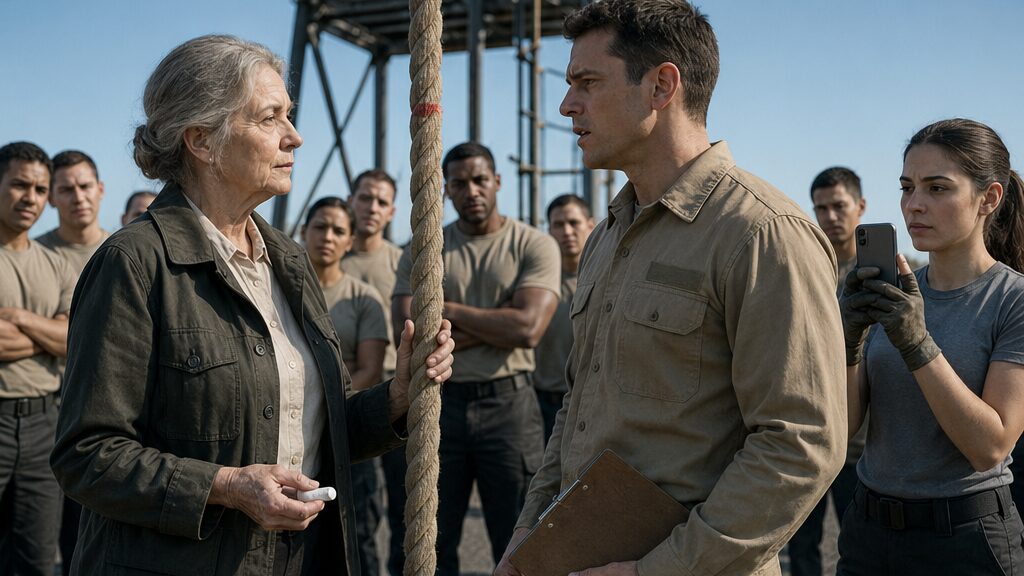
They Laughed When the Old Sergeant Stopped the Climb, Until the Rope Began to Tear
Chapter 1: The Warning Everyone Heard and Nobody Respected
Jason Roberts laughed before Virginia Mitchell had finished her sentence.
“Sergeant, that checklist retired when you did.”
His voice carried across the obstacle-course yard, clear enough for every trainee standing beneath the climbing tower to hear. A few glanced at one another. One young man lowered his face to hide a smile. Rebecca Green, waiting beside the rope in training clothes, held her phone near her hip with the camera already running.
Virginia kept two fingers against the rope.
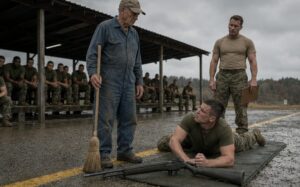
It hung thirty feet from a steel crossbeam, thick and pale against the blue morning sky. Fresh paint covered the tower supports. New rubber chips softened the ground. Everything around the rope looked recently repaired, officially inspected, and ready for photographs.
The rope itself did not.
A faded red stripe circled it below the upper splice. In the inspection photograph clipped to Jason’s board, that stripe sat directly beneath a dark seam in the wrapping. Now it rested several inches to the left.
“Stop the practice climb,” Virginia said.
Jason’s smile disappeared. “It passed its load test Friday.”
“I heard you.”
“Computer-monitored. Full operational weight.”
Virginia looked up the length of the rope. Sunlight flashed against the metal swivel above. “Who changed the upper fitting?”
The trainees had stopped pretending not to listen.
Jason stepped closer. He was broad-shouldered, clean-cut, and young enough to have learned rope systems after digital sensors became standard. His course badge was fixed squarely over his chest. Behind him, a banner announced Friday’s reopening demonstration.
“The swivel was serviced,” he said. “The system was tested. You were invited to observe, not shut down training because a stripe looks old.”
“It doesn’t look old. It moved.”
“Or the paint faded unevenly.”
“The stripe isn’t paint.”
One trainee gave a short laugh. Jason did not correct him.
Virginia released the rope and opened the small canvas bag she had carried into the yard. She took out a piece of white training chalk. The motion was slow because the joint at the base of her right thumb had stiffened overnight. She placed a clean mark across the rope and the edge of the faded stripe.
Jason folded his arms. “What exactly are you doing?”
“Giving it a reference.”
“We have digital records.”
“You have a record of vertical load.”
“And that is the load a climbing rope carries.”
“Not all of it.”
Rebecca shifted her phone upward.
Virginia noticed but said nothing. At twenty-two, Rebecca had the eager, tightened posture of someone trying to look ready before she felt ready. She had already chalked her hands. The rope climb was part of a selection assessment scheduled for the following month, and she had asked twice that morning whether her time would be recorded.
Jason pointed toward the rope. “Rebecca has completed the safety briefing. We have an assistant instructor on belay. There is no reason to stop.”
Virginia pressed the rope between her palms and turned it a fraction. Resistance gathered, then released with a faint tremor.
High above them came two sounds.
Click.
Click.
The first was sharp. The second was softer and delayed.
Virginia’s hands went still.
For a moment, the bright yard disappeared behind a darker training ground, another tower, another morning. A voice younger than Rebecca’s said, Sergeant, I heard it twice.
Virginia took her hands away.
Jason had heard the sound too, but his expression suggested annoyance rather than concern. “The swivel is designed to rotate.”
“It didn’t rotate.”
“You just twisted the rope.”
“And the fitting held the turn.”
He looked toward the watching trainees. “This is what happens when people apply old equipment habits to a modern system.”
The words were not shouted. They were worse for being calmly delivered. They invited the others to share his judgment.
Virginia removed her light coat and folded it over the rail. The sleeve of her blouse drew back, exposing the small tattoo on her forearm: two lengths of rope crossed beneath a simple knot.
Rebecca’s camera followed it.
“What are you doing?” Jason asked.
“Checking my conclusion.”
“You don’t need to prove you can climb.”
“No,” Virginia said. “I don’t.”
She gripped the rope shoulder-high, lifted her right knee, and set the line beneath one boot. Her left foot crossed over it, trapping the rope in a clean, compact lock. The technique was not fast. Her knee objected when she stood, sending a hot line through the joint, but her weight settled into the rope with almost no wasted movement.
The trainees fell quiet.
Virginia reached again, reset the lock, and rose a second time. She stopped less than eight feet from the ground. The rope carried her weight while her hands remained relaxed enough to open.
Jason looked upward despite himself.
Virginia shifted her hips slightly, introducing controlled tension.
Click.
A pause.
Click.
The second sound traveled down the rope like a tiny pulse.
She looked at the chalk mark. It had turned away from her.
“Lower,” Jason said.
Virginia descended with the same measured locks, refusing the temptation to hurry. When her boots touched the ground, Rebecca lowered the phone but did not stop recording.
Virginia pointed at the rope.
“The rope is carrying a turn it cannot release.”
Jason examined the chalk mark. His jaw tightened. “You rotated it during your demonstration.”
“A functioning swivel would have released it.”
“Or your method added a kind of load this obstacle will never see.”
“Every climber adds rotation.”
“Not enough to matter.”
“You don’t know that.”
“And neither do you.”
There it was: the strongest argument available to him, and Virginia could not honestly deny it. She had observed movement and heard resistance. She had not seen the rope’s internal fibers or dismantled the fitting. Certainty would have been theater.
“I know enough to stop the climb until the upper assembly is opened,” she said.
Jason glanced toward the banner, then toward the trainees. Friday’s demonstration would bring installation officials, recruitment staff, and the regional training director. The reopened course had already missed one funding cycle.
“We are not canceling a certification week over a chalk line.”
“I didn’t ask you to cancel the week.”
“You asked me to close the central obstacle.”
“I asked you not to put her on it.”
Rebecca’s face changed at being indicated. The phone dipped.
Jason followed Virginia’s gaze. “Rebecca, stand by.”
Virginia picked up her coat. “Call maintenance. Remove the load. Check the swivel under rotation.”
“The system has passed.”
“The rope has been tested in one direction.”
“That is the direction people climb.”
Virginia almost answered. Instead she looked at the upper splice, at the red stripe sitting where it should not have been, and heard the old double click beneath the newer one.
Jason took a damp cloth from the assistant instructor’s equipment bucket. He wrapped it around the rope and rubbed until Virginia’s white chalk mark blurred, broke, and disappeared.
Several trainees watched him do it.
“Practice on the lower wall today,” he told Rebecca. Then he faced the group. “Official rope demonstration remains scheduled for Friday morning. Full course certification continues as planned.”
The trainees began to move again, relieved to be given instructions.
Virginia stood beside the unmarked rope. She had wanted him to preserve the reference. She had not told him why the second click mattered, or why the sound had turned her hands cold.
Above them, the swivel flashed in the sun, motionless.
Chapter 2: A Ten-Second Video Erases the Warning
Virginia had not reached her car when her phone vibrated three times in quick succession.
The first message came from a former colleague she had not spoken to in nearly a year.
Is this you?
Beneath the question was a ten-second video.
Jason’s voice began the clip: That checklist retired when you did.
The image showed Virginia beside the rope, one hand on the line, her lined face turned upward. It cut abruptly to her short ascent. The angle made her pause below eight feet appear like exhaustion. Then came Jason’s command to lower, followed by Virginia stepping onto the ground.
The caption read:
RETIRED SERGEANT TRIES TO SHOW MODERN TRAINEES HOW IT’S DONE.
A laughing symbol followed the sentence.
The clip omitted the double click, the shifted stripe, and everything Virginia had said about rotation.
By the time she opened the second message, it had been shared in two local training groups. The third came from a woman who had served under her years ago.
Tell me that isn’t the whole story.
Virginia locked the phone and put it in her bag.
Across the parking area, the obstacle tower rose above the fence. The rope was visible between the beams, hanging straight enough to look innocent.
“Sergeant Mitchell.”
Rebecca had followed her from the yard. She carried her own phone against her chest now, as if hiding it could undo what had happened.
“Ma’am, I didn’t post that caption.”
“But you posted the video.”
“I sent it to our trainee group. Somebody cut it.”
Virginia opened the driver’s door.
“I thought it showed you proving him wrong,” Rebecca said.
“Did it?”
Rebecca looked toward the tower. “Not after they edited it.”
Virginia placed her bag on the passenger seat. Her first instinct was to leave. Discipline had taught her that public arguments multiplied themselves. Say less. Document the facts. Let the chain of command work.
That instinct had protected her reputation many times.
It had failed someone once.
“What did you hear up there?” Rebecca asked.
Virginia’s hand stayed on the door frame.
“You stopped before Mr. Roberts told you to. You heard something.”
“Yes.”
“What?”
“Something the test was not designed to hear.”
Rebecca waited, expecting more.
Virginia gave her nothing.
The younger woman’s shoulders lowered. “That sounds like you don’t know either.”
“It means I won’t call a defect until I can describe the mechanism.”
“But you told everyone to stop.”
“I called for inspection.”
“You made it sound dangerous.”
“A rope can deserve inspection before anyone proves it dangerous.”
Rebecca’s expression hardened in the small way of someone who felt she had been corrected rather than answered. “Friday matters to people here.”
“I know.”
“My selection packet needs an official course time.”
Virginia nodded once. “Then you need a rope whose condition is not in question.”
She got into the car. Rebecca stepped back, still holding the phone.
Virginia drove home without replaying the video. She made it as far as her kitchen before the silence became worse than the clip.
Her house was narrow and orderly. Boots she no longer wore stood polished beneath a bench. A wooden box on the table contained old inspection cards, photographs, and field manuals she had agreed to lend Alexander Jackson for the reopening display.
Alexander had invited her personally.
We want someone who remembers how these systems behave outside a laboratory, he had written.
Not someone who remembers how they used to behave. How they behave.
Virginia opened her laptop and found the video again. The view count had tripled.
She paused at the first clear frame of the rope.
The image quality was poor, but the faded red stripe could be seen above her hand. She enlarged it until the pixels softened into blocks. Behind the stripe, the dark seam of the upper wrapping appeared near the opposite side.
Virginia took out the printed photograph she had carried to the yard. It had been made during the course’s preliminary inspection six weeks earlier. In that image, the red stripe aligned with the seam.
She placed the photograph beside the laptop.
Her demonstration had not caused the original movement. The rope was already rotated before she touched it.
That fact answered one question and sharpened another.
How many load cycles had it carried since the photograph?
Virginia called the training office. The assistant instructor answered.
“I need the usage log for the rope obstacle.”
There was a pause. “Mr. Roberts said record requests should go through him.”
“Then put him on.”
Jason came to the phone after nearly a minute.
“I assume this is about the video,” he said.
“It is about the inspection photograph.”
“Virginia—”
“The stripe had moved before my demonstration.”
“You cannot determine mechanical condition from a compressed phone image.”
“I can determine relative position.”
“You can suggest it.”
“Send me the climb log.”
“The course has not officially reopened.”
“That was not my question.”
Jason exhaled. In the background, someone spoke about printing visitor packets.
“We have conducted controlled familiarization,” he said.
“How many climbs?”
“I don’t have the number in front of me.”
“Then you do not know how many rotations the rope has carried since the photograph.”
“The swivel exists to prevent retained rotation.”
“It clicked twice.”
“Metal fittings make noise.”
Virginia closed her eyes. “Preserve the rope position. Do not wipe it again.”
“I wiped chalk off training equipment. I did not destroy evidence.”
“You removed a reference.”
“There is no incident, Virginia.”
“Not yet.”
Silence followed.
She heard what the words had sounded like only after she said them. Too personal. Too certain. Jason heard it too.
“This is exactly why I need facts,” he said quietly.
“I am getting them.”
“Then send facts, not predictions.”
The line ended.
Virginia spent the next two hours sorting the wooden box. Most of the records belonged to obsolete systems and earlier versions of the course. She found inspection cards marked in her old block handwriting, diagrams of splices, photographs of trainees learning foot locks.
Near the bottom lay an envelope from the reopening survey.
Inside was a higher-resolution copy of the preliminary inspection photograph.
Virginia scanned it into the computer and magnified the upper assembly. The rope’s serial tag was visible. So was the inspection stripe, aligned beneath the splice seam exactly as she remembered.
She added arrows to both images but wrote no accusation.
At eight that evening, another message arrived from Rebecca.
I’m sorry the clip got changed.
A second message followed.
But if the rope passed the test, what did the test miss?
Virginia stared at the question.
She typed three different answers and deleted them all. The honest one was that she did not yet know. She knew what a locked turn could do over time, but not whether this rope had suffered enough of it to become dangerous.
She sent only:
Ask for the certificate. Look at what was measured, not just whether it says PASS.
Then she emailed the side-by-side photographs to Jason.
The subject line contained no accusation: REQUEST FOR ROTATIONAL INSPECTION.
His response came eleven minutes later.
The archived image does not establish a defect. The current certification remains valid.
Virginia read the sentence twice.
Then she opened a blank page and began listing everything the certificate would need to prove—and everything a simple vertical load test could not.
Chapter 3: The Test Certificate That Proved Too Little
The rope’s serial number was correct.
The swivel’s model number was not.
Virginia noticed the mismatch before Jason had finished telling her she would not be permitted to dismantle anything.
They stood in the equipment office Tuesday morning with the load-test certificate between them. Fluorescent light flattened the room into gray metal cabinets, plastic bins, and clipped forms. Jason remained on the opposite side of the desk as though the paper marked a boundary.
Virginia tapped the line with one fingernail.
“Model S-40.”
Jason glanced down. “Yes.”
“The fitting installed on the tower is an S-44.”
“They are from the same series.”
“They are not the same assembly.”
“The S-44 replaced the earlier model.”
“Then why does the certificate list the earlier one?”
“Because the system record was created before servicing. The rope serial number is what matters.”
“For a vertical pull test.”
“For the certified test.”
Virginia read the procedure again. The rope had been loaded gradually to the required weight, held for ninety seconds, then released. Electronic sensors had recorded elongation and peak force. Every measured value fell within range.
There was no rotational cycle.
No test of swivel movement under variable body load.
No repeated loading.
No notation showing whether the rope had been allowed to unwind between pulls.
“What failed on the original fitting?” she asked.
Jason’s fingers tightened around the edge of the desk. “It did not fail.”
“Why was it replaced?”
“It was serviced during winter maintenance.”
“That is not an answer.”
“It seized during storage.”
The voice came from the doorway.
A maintenance technician stood there holding a ring of keys and a folded work order. He looked from Jason to Virginia, already regretting that he had spoken.
Virginia turned toward him. “Completely seized?”
“Wouldn’t turn by hand.”
“What caused it?”
“Corrosion in the bearing, we thought. Water got into the housing.”
“And the rope?”
The technician glanced at Jason.
“Answer her,” Jason said.
“We inspected the sheath. No cuts. No glazing. No flattened sections.”
“Was it unloaded from the old fitting before the new swivel was installed?”
“It had been hanging through winter.”
“That was not my question.”
The technician rubbed his thumb along the work order. “We supported it during the change.”
“Did you let the rope relax and untwist?”
“I don’t remember.”
Jason stepped in. “The replacement fitting has a higher load rating than the original.”
“Load rating is not rotational behavior,” Virginia said.
“It is a safer component.”
“Stronger is not always more compatible.”
Jason gave a humorless smile. “There it is. Newer equipment is the problem.”
“I didn’t say newer.”
“You have been implying it since yesterday.”
“I’m saying you certified a combined system using paperwork that identifies only part of what is installed.”
“And I am saying the installed parts exceed requirement.”
Virginia took a sheet of plain paper from the printer tray. She drew a vertical line for the rope, a box for the splice, and a circle for the swivel. Beside it she sketched the faded stripe.
“If the swivel releases each turn, the stripe returns to its relative position,” she said. “If the bearing catches intermittently, the rope stores rotation. The sheath can look serviceable while the inner structure takes uneven load.”
Jason looked at the drawing but not for long. “Can you prove that happened here?”
“Not without opening the upper assembly or running a rotational test.”
“Which you are not authorized to do.”
“Then authorize it.”
“The safety officer will review your request this afternoon.”
“Friday is three days away.”
“I am aware of the calendar.”
His restraint was thinning. Behind it, Virginia could see something more than pride. Folders marked REOPENING BUDGET occupied one corner of the desk. A staffing sheet lay beneath them with three positions highlighted in yellow.
“If the event is delayed,” she said, “what happens?”
“That is not relevant to mechanical condition.”
“It is relevant to your decisions.”
Jason pulled the certificate toward himself. “If we miss Friday, regional funding may move to another site. Two contract instructors lose their positions immediately. The trainee program is reduced by half. So yes, I require more than an old photograph and a sound before I close the course.”
His answer did not excuse him. It did make him recognizable.
Virginia folded her diagram once. “Pressure does not change what the rope is doing.”
“No. But pressure does require evidence before action.”
Outside, Rebecca was practicing foot locks on a low suspended line. She saw Virginia leave the office and straightened.
“Is the certificate wrong?” Rebecca asked.
“It is accurate about what it measured.”
“That sounds like another non-answer.”
Virginia considered walking past. Instead she pointed at Rebecca’s boots.
“Show me your lock.”
Rebecca wrapped the rope around one foot and clamped it with the other. Her knees drifted apart as she stood.
“You’re squeezing with both legs,” Virginia said. “That wastes strength.”
“That’s how they showed us.”
“They showed you the shape. Not the balance.”
Virginia demonstrated from the ground. She placed the line beneath one boot, crossed the other over it, and shifted her weight until the rope held between sole and edge.
“Your hands move you. Your feet hold you. Don’t ask your arms to do both.”
Rebecca copied the position. This time, when she stood, her shoulders did not rise toward her ears.
“Oh,” she said.
It was a small sound, almost embarrassed.
“Again.”
Rebecca reset and stood more smoothly.
Jason emerged from the office while she was repeating the movement. He watched without interrupting. For a second, his face held no defensiveness—only assessment.
Then the upper rope shifted in the breeze.
Click.
Click.
The second note arrived late.
Virginia’s attention snapped toward the tower.
Patricia Baker was crossing the yard with a medical kit. She stopped too.
Unlike the trainees, Patricia did not look upward first. She looked at Virginia.
Virginia felt the old memory press against the edges of the morning: dust on a different tower, a young soldier touching an anchor line, a superior officer checking his watch.
Patricia walked closer. Her voice was low enough that Rebecca had to lean to hear.
“Does it sound like Fort Baker?”
Virginia’s folded diagram tightened in her hand.
Jason looked between them. “What happened at Fort Baker?”
Neither woman answered.
Above the yard, the swivel gave no third click.
Chapter 4: The Soldier Who Warned Her First
Virginia woke to the sound of metal clicking twice.
She was upright before she understood that the room was dark and the sound had come from memory.
For several seconds, she saw neither her bedroom nor the pale numbers on the clock. She saw a dusty tower at Fort Baker, a rope moving against a washed-out sky, and a young soldier standing beneath it with one hand lifted toward the anchor.
Sergeant, listen.
Click.
A pause.
Click.
Virginia pressed both feet to the floor. The second click still seemed to hang in the room.
On the nightstand lay the photograph from the reopened course. The faded red stripe was aligned beneath the old splice seam, clean and unquestioned. Beside it, her phone displayed the cropped video of Monday’s confrontation. The two images looked less like evidence now than an accusation.
She dressed before dawn and drove to the base medical room.
Patricia Baker was restocking bandages when Virginia entered. She did not ask why Virginia had come so early. She closed the cabinet and set the key on the counter.
“You should not have said Fort Baker in front of them,” Virginia said.
“I said it in front of Jason and Rebecca.”
“That is what I meant.”
Patricia leaned against the counter. “You heard the same sound.”
“I heard two clicks.”
“And your hands started shaking.”
“They did not.”
“They did after you folded the paper.”
Virginia looked down. The hand that held her bag was steady now.
Patricia had been a junior medic during the last months of Virginia’s active service. She had not been present at the tower, but she had treated the rope burns on Virginia’s palms afterward. She knew enough to recognize the name. Not enough to own it.
“The current fitting is a different model,” Virginia said. “Different rope. Different installation.”
“Then say that.”
“I have.”
“Say the rest.”
Virginia removed the folded torque diagram from her bag and placed it on the examination table. “The rest is not evidence.”
“No. It is the reason you look like someone is standing behind you every time that swivel moves.”
Virginia’s jaw tightened.
Patricia lowered her voice. “If Jason learns about the accident from someone else, he will use it to explain away everything you have observed.”
“He may do that anyway.”
“Then do not hand him your silence as proof.”
Virginia turned toward the window. Beyond the glass, the course tower rose above the roofs. The rope was barely visible at this distance.
At Fort Baker, the soldier had been twenty-one. He had arrived early to inspect the tower and stayed after the others left. He was careful without being timid, which made impatient people accuse him of both.
Virginia could still see his fingers against the anchor line.
“It clicked under partial load,” she said.
Patricia waited.
“The first time, no one else heard it. He asked me to check. I did.”
“What did you find?”
“Nothing visible.”
The words scraped on the way out.
The young soldier had insisted the sound came when the rope turned, not when it pulled straight. Virginia had believed him enough to request a delay. Their superior had walked the course, checked his watch, and reminded her that the unit had already lost two training days.
The soldier had looked at Virginia while the superior spoke.
Not at the officer.
At her.
She had been the training sergeant. Her answer mattered more to him.
“I said the assembly had passed inspection,” Virginia continued. “I said we would monitor it.”
Patricia’s face remained still. “And the climb continued.”
“Yes.”
“Was he the climber?”
“No. He was on the tower platform assisting the next rotation.”
Virginia’s hand moved unconsciously toward the tattoo on her forearm.
“The bearing locked,” she said. “The rope transferred its turn into the upper connection. The anchor plate had a hairline fracture no one had seen. When the load shifted, the plate failed.”
She stopped.
The official findings had used cleaner language. Component fatigue. Incomplete inspection criteria. Contributing schedule pressure. No single act determined as sole cause.
None of those phrases had looked at Virginia the way the soldier had.
“He warned first,” she said. “Not me.”
Patricia drew a breath but did not fill the silence with comfort.
“I knew enough to stop it,” Virginia said. “I chose to be reasonable.”
“You chose to obey the decision above you.”
“I was responsible for the people below me.”
The force in her own voice surprised her.
Patricia nodded once. “Then that is the part you need to say.”
“No.”
“Virginia—”
“If I tell Jason now, every measurement becomes grief. Every observation becomes an old woman reliving an accident.”
“And if you hide it, he will discover it five minutes before the meeting and call it concealed bias.”
Virginia folded the diagram along its existing crease until the paper nearly tore.
The medical-room door opened.
Rebecca stepped inside carrying a roll of athletic tape. She stopped when she saw them.
“Sorry. The assistant instructor said I could get—”
Patricia pointed toward the cabinet. “Second shelf.”
Rebecca crossed the room. Virginia watched her reach for the tape without looking at either woman.
She had heard something. The question was how much.
When Rebecca left, Patricia said, “You cannot control what people do with the truth.”
“No,” Virginia answered. “But I can control whether I give it to them before I have facts.”
At midmorning, Virginia returned alone to the empty course yard. The trainees were attending classroom instruction. A chain hung across the obstacle entrance, though the rope itself remained mounted.
She stood beneath it and looked at the crossed-rope tattoo.
The design had come from the dead soldier’s section patch. After the investigation, the surviving members of the section had each received a small cloth emblem. Virginia had carried hers in a drawer for three years before having the pattern inked into her skin.
Not as tribute.
As instruction.
She reached for the rope but stopped before touching it.
The problem was no longer whether memory had entered her judgment. It had. The real question was whether memory had sharpened her observation or distorted it.
She took out a notebook.
Present system: S-44 swivel.
Prior system: sealed bearing, older mount.
Common sign: delayed second click under rotation.
Current visible sign: stripe displacement.
Unknown: internal condition.
Facts on one side. Memory on the other.
She had spent years believing discipline meant keeping the columns separate. Yet the soldier at Fort Baker had not asked her to prove the entire failure. He had asked her to listen before proof became consequence.
Voices approached from behind the tower.
Rebecca and Jason stopped on the other side of the chain. Neither had noticed Virginia yet.
“I am not saying she invented it,” Rebecca said. “I’m saying there was an accident.”
Jason’s reply was quieter. “What kind?”
“A fatal one. At Fort Baker. She knew the person.”
Virginia remained still.
“Did she tell you that?” Jason asked.
“I overheard her with the medic.”
“Did she say the same sound was involved?”
“Not exactly.”
Jason was silent long enough for Virginia to picture him assembling the information: old accident, old sound, older veteran, public warning.
A reasonable explanation for everything he wanted to dismiss.
Rebecca said, “You should know before the certification meeting.”
“Yes,” Jason answered. “I should.”
Virginia stepped around the tower support.
Both of them turned.
Rebecca’s face lost color. Jason’s expression closed into professional calm.
Virginia looked at the athletic tape in Rebecca’s hand, then at Jason.
“The meeting is Wednesday afternoon,” he said. “Alexander will attend. So will the installation safety officer.”
“I know.”
“I will present all relevant factors.”
“All of them?”
His eyes moved briefly toward her tattoo.
“All that bear on your recommendation.”
Virginia understood then that the Fort Baker accident would enter the room whether she carried it there or not.
Jason turned away with Rebecca beside him.
Virginia remained behind the chain, the old whistle of command absent from her pocket and the new rope hanging above her.
For the second time in her life, someone else would tell the room what her silence meant unless she spoke first.
Chapter 5: The Meeting Where Caution Became a Liability
Jason began the certification meeting by playing Rebecca’s video.
He did not ask Virginia.
The ten-second clip appeared on the wall screen beneath the installation seal. His recorded voice filled the briefing room: That checklist retired when you did.
Then Virginia climbed, paused, and descended.
The clip ended before the double click.
Around the table sat Alexander Jackson, the installation safety officer, Patricia, a procurement clerk, Jason, Rebecca, and Virginia. The assistant instructor stood near the door with a folder under one arm.
Jason froze the last frame.
“This video is not technical evidence,” he said. “I am showing it because it has created public attention around what should be a routine certification question.”
Virginia looked at Rebecca. The younger woman kept her eyes on the table.
Alexander removed his glasses. At fifty-three, he carried authority without needing to advertise it, but Virginia knew his weakness: he preferred a compromise that kept every door open, even when the doors led in opposite directions.
“What is the current status?” he asked.
Jason changed the display to the load-test certificate.
“The rope passed rated vertical loading. The installed swivel exceeds the required strength rating. A visual inspection conducted this morning found no exposed core fibers, sheath cuts, glazing, or flattening.”
The safety officer nodded. “Any movement at the splice?”
“No measurable slippage.”
Virginia placed two printed photographs on the table.
“There is measurable rotational displacement.”
Jason did not look at them. “There is a stripe position difference between images taken six weeks apart. We do not have controlled camera angles, preserved chalk marks, or verified usage logs for every familiarization cycle.”
“Because you erased the first reference.”
“I cleaned unauthorized chalk from equipment.”
Alexander lifted a hand before the exchange sharpened. “Virginia, state the concern in one sentence.”
“The swivel may be binding intermittently and storing rotation in the rope below the splice.”
“Possible consequence?”
“Uneven internal loading that a straight pull test would not reveal.”
“Probability?”
“Unknown without opening the assembly or testing it under repeated rotational load.”
Jason leaned forward. “That word matters. Unknown.”
“So does consequence,” Virginia said.
The procurement clerk slid a delivery report across the table. “The replacement rope was ordered with the new swivel assembly, but the shipment was delayed.”
Virginia looked at Jason. “The rope was meant to be replaced?”
“The vendor recommendation was bundled replacement,” he said. “Not a mandatory directive.”
“When did you approve the extension?”
“Three weeks ago.”
“After the new fitting was installed?”
“Yes.”
The room changed slightly. Not enough to support Virginia, but enough to weaken the clean story of a fully unified certified system.
Alexander turned to the procurement clerk. “Why was the rope delayed?”
“Regional inventory shortage. Revised delivery date is next month.”
“And canceling Friday?”
Jason answered before anyone else. “Risks the reopening allocation. Regional observers are already traveling. We have contract staff whose positions depend on activation.”
Virginia watched his hand rest beside the staffing sheet. He was not inventing the pressure. That made his decision more dangerous, not less.
Jason advanced to another slide.
The heading read: HUMAN FACTORS AFFECTING OBSERVATION.
Beneath it was a reference to Fort Baker.
Patricia shifted in her chair.
Jason’s voice remained controlled. “For completeness, Sergeant Mitchell was involved in a prior fatal training accident that included an anchor-system noise. That history may reasonably influence her interpretation of the current sound.”
Rebecca looked at Virginia then.
Jason continued. “I am not suggesting bad faith. I am suggesting that caution shaped by trauma is not the same as evidence of present failure.”
Virginia had imagined this moment during the night. In every version, she had corrected him technically. Different fitting. Different system. Different failure path.
Those answers remained true.
They were also a shelter.
“The soldier at Fort Baker warned me first,” she said.
Jason stopped.
Virginia faced Alexander rather than the screen.
“He heard an irregular anchor sound during partial rotational load. I inspected the visible components and found nothing. My superior decided training would continue.”
The safety officer asked, “Did you object?”
“Not enough.”
No one moved.
Virginia unfolded the diagram she had drawn in the equipment office.
“I accepted a visual inspection and a straight load result because stopping training would have delayed the schedule. The anchor later failed. A soldier died.”
Jason’s posture altered. He had expected a concealed wound he could identify, not an admission placed openly on the table.
Virginia continued before he could recover.
“That history affects me. It is not separate from my judgment. It is why I recognize the danger of allowing incomplete proof to masquerade as certainty.”
Alexander studied her. “Are you certain this rope will fail?”
“No.”
“Are you certain the current certification is insufficient?”
“Yes.”
Jason turned toward the safety officer. “The new inspection found no visible damage.”
The officer opened a folder. “That is correct. We also hand-rotated the swivel unloaded. It moved freely.”
“Intermittent binding may not appear unloaded,” Virginia said.
“May not,” Jason repeated.
Alexander picked up the two photographs. One showed the red stripe aligned with the splice seam. The other, taken from Rebecca’s video, showed it displaced.
“Can ordinary use explain this?” he asked.
“It can explain rotation,” Jason said. “The swivel’s purpose is to release it.”
“Which returns us to the sound,” Virginia said.
Patricia spoke for the first time. “I heard the delayed second click yesterday.”
Jason looked at her. “You are not an equipment inspector.”
“No. I am telling you what I heard.”
The room went quiet again.
Alexander placed the photographs side by side. “Trauma does not move a stripe.”
The words were not vindication, but they stopped Jason from using Virginia’s history as a complete explanation.
Jason looked down at the table.
Then the safety officer said, “It also does not prove damaged core fibers.”
The balance shifted back.
He proposed a controlled compromise: reduce the climb height, attach a separate backup belay, limit the demonstration to one climber, and stop immediately if visible rotation increased.
Jason seized on it. “That removes fall risk.”
“It reduces it,” Virginia said.
“The backup line carries the climber if the primary fails.”
“And where will the belay operator stand?”
“Offset from the rope.”
“If the primary releases stored rotation, the hazard is not only a fall.”
Jason’s patience broke. “Then what satisfies you? Full replacement? A month-long delay? Loss of funding because a component might do something no current test shows it doing?”
“Open the assembly.”
“The safety office will not approve destructive inspection on a certified component without stronger evidence.”
“Then do not put a person on it.”
Alexander closed his folder.
Virginia knew the decision before he spoke. He wanted the course open. He wanted no one injured. The compromise gave him a way to believe he could have both.
“Friday’s demonstration will proceed at reduced height,” he said. “Backup belay mandatory. One climber. Continuous visual monitoring of the stripe and splice. Any irregularity stops the event.”
Virginia looked directly at him. “Who has authority to call the stop?”
“The course manager, safety officer, or myself.”
“Not the climber?”
Alexander hesitated.
Jason answered. “The climber may report a concern.”
“That is not the same thing.”
“We are not rewriting training policy in this meeting,” Alexander said.
Rebecca lifted her hand slightly, then seemed embarrassed by the gesture.
“I’ll do the climb,” she said.
Virginia turned toward her.
Rebecca swallowed. “I know the technique. I know what to listen for. If anything changes, I’ll say so.”
Jason nodded before Alexander could respond. “She is qualified.”
Virginia saw the hope in Rebecca’s face—the selection packet, the official time, the need to repair the damage caused by the video. Volunteering felt to her like courage.
It also trapped her inside everyone else’s decision.
Alexander authorized the plan.
Folders closed. Chairs moved. The screen went dark, taking the frozen image of Virginia with it.
As the others left, Jason gathered the photographs.
“You should have told me about Fort Baker,” he said.
“You should have asked why the sound mattered before deciding what my age meant.”
His face tightened, but he did not answer.
Across the room, Rebecca signed the demonstration roster.
Friday, 0900 hours.
One climber.
Virginia watched the pen leave the paper and understood that telling the truth had changed how the room saw her, but it had not stopped the rope from being used.
Chapter 6: The Safer Plan That Changed Nothing
The red stripe had moved again overnight.
Virginia saw it before anyone unlocked the course gate Thursday morning.
She stood outside the chain with the preliminary photograph in one hand. The stripe now sat farther around the rope than it had in Rebecca’s video, its faded edge nearly hidden behind the line.
No official climb appeared on the usage board.
Jason arrived carrying two coils of backup line. He followed Virginia’s gaze and stopped.
“Who used it?” she asked.
“No one was authorized.”
“That is not what I asked.”
He unlocked the chain and crossed the rubber surface. Virginia followed. At the rope, she took out white chalk and marked the new position with a narrow line.
Jason did not wipe it away.
He called the assistant instructor, then the maintenance technician. Both denied using the obstacle. The gate log showed no after-hours entry by staff.
Rebecca appeared near the equipment shed, already dressed for training. The moment she saw the chalk in Virginia’s hand, she halted.
Jason noticed.
“Rebecca.”
She looked toward the tower rather than at him.
“Did you climb this rope?”
“No.”
Virginia waited.
Rebecca’s answer had come too quickly. Jason heard it too.
“Did you put weight on it?” he asked.
Rebecca’s throat moved. “Just a few locks.”
“When?”
“Last night.”
“How did you enter the yard?”
“The side gate doesn’t always latch.”
Jason lowered the coils to the ground with deliberate care. “You practiced on restricted equipment after a safety concern was raised?”
“I stayed below the first marker. I had my harness.”
“Who belayed you?”
“No one.”
Virginia saw Jason’s anger gather. Rebecca saw it and began speaking faster.
“I needed to know I could do it. The video made me look like I was standing there while you two argued, and everyone thinks Friday is some kind of test of whether she’s right. I didn’t want to freeze.”
Jason stepped toward her. “You could have been removed from the program.”
“I know.”
“No, you don’t.”
The words struck harder than his public sarcasm had on Monday. Then he looked at the other trainees arriving beyond the fence and stopped himself.
“This is not going in your selection packet,” he said.
Rebecca stared at him.
“It will be documented as an internal training violation. You will not be removed from Friday solely for admitting it.”
Virginia studied Jason. He could have protected himself by making Rebecca the explanation for the stripe movement. Instead, he had removed the easiest target from public blame.
Rebecca looked close to tears, more from relief than fear.
Jason’s voice dropped. “But you will never enter restricted equipment alone again. Understood?”
“Yes.”
“Why didn’t you tell anyone you were worried?”
“I wasn’t worried.”
“You climbed after hours because you weren’t worried?”
Rebecca looked down.
Jason turned away, then back. “I have spent three months telling all of you that hesitation costs time. I suppose I should not be surprised when you decide questions cost more.”
It was not an apology, but it exposed something he had not admitted in the meeting.
Virginia touched the rope. “Her practice added a load cycle. It does not explain why the system retained the turn.”
Jason’s brief openness closed. “It proves the movement was not spontaneous.”
“I never said it was.”
“You presented it as unexplained.”
“It was unexplained.”
He looked at the new chalk mark. “We now know the cause.”
“We know who loaded it. Not why the swivel failed to release the rotation afterward.”
By noon, they had arranged a controlled ground-level test. The maintenance technician clipped a weighted training bag to the rope while Virginia photographed the stripe and splice. Jason rotated the lower line by measured increments. Unloaded, the upper swivel moved. Under partial weight, it hesitated, released, then turned.
No double click came.
Jason looked almost relieved.
Virginia was not. Intermittent faults offered confidence precisely when they wished to remain hidden.
They repeated the test twice. On the third cycle, the stripe returned close to its starting position.
“Within tolerance,” Jason said.
“What tolerance?”
“Visible alignment.”
“You just invented that.”
“And you have not provided a published limit.”
He was right. The stripe was an inspection reference, not a manufacturer-specified measurement. Virginia’s evidence showed behavior, not a formal threshold.
The procurement clerk called from the office before they could repeat the test.
The vendor’s written response arrived by email.
Virginia, Jason, and the maintenance technician crowded around the desk while the clerk read it aloud.
The S-44 swivel was compatible with the rope diameter and rated load. However, the vendor had recommended replacing the existing rope at installation due to unknown retained twist accumulated while the previous fitting was seized.
“Recommended,” Jason said. “Not required.”
The clerk scrolled. “It also says continued use should involve monitoring for sheath distortion, inconsistent swivel travel, or progressive marker displacement.”
Virginia looked at him.
Jason read the sentence himself. “We are monitoring.”
“After extending service without recording a baseline.”
“The preliminary photograph is the baseline.”
“The one you said proved nothing?”
His mouth tightened.
The email strengthened Virginia’s concern, but it did not order closure. The safety officer reviewed it and maintained the limited-demonstration approval. New safeguards were added: lower height, independent belay, helmet, two observers at the rope, and a pre-climb hand rotation of the swivel.
By late afternoon, the plan looked safer on paper than it had in the morning.
It had not changed what happened inside the rope.
Virginia found Jason alone in equipment storage, checking the backup line. He ran his hands over every foot of it, bending the sheath to expose hidden wear. His inspection was careful.
“You know how to look,” she said.
He did not turn. “I have never claimed otherwise.”
“You are looking harder at the line you trust.”
“That line does not have an unverified defect.”
“Neither did this one until I spoke.”
Jason set the belay rope down. “My father was fifty-eight when his company told him his methods were out of date. After that, every new procedure became an insult to him. Every younger supervisor was arrogant. He stopped learning because he thought experience meant he no longer had to.”
Virginia leaned against the storage shelf, taking weight off her knee.
“You think I am your father.”
“I think experience can become fear with a uniform on it.”
“And pressure can become negligence with a certificate on it.”
He accepted the sentence without flinching.
“I was wrong to mock you,” he said. “In front of them.”
Virginia waited.
“But I still believe the backup system makes injury extremely unlikely.”
“That is not the same as believing the primary rope is safe.”
“No.”
It was the first time he had separated those positions.
“Cancel it,” she said.
Jason looked at the highlighted staffing sheet pinned beside the door. “If I cancel without the safety officer’s support, this course may not reopen this year.”
“Then let that be the consequence.”
“For you, it is a consequence. For the instructors whose contracts end, it is rent. For trainees sent elsewhere, it is months.”
Virginia understood the arithmetic. She had once allowed similar arithmetic to speak louder than a young soldier.
Jason lifted the backup line. “I will stand on the belay myself.”
“You cannot compensate for every failure by placing your hands on another rope.”
“Maybe not. But I can compensate for this one.”
He walked out carrying the coil.
At home that evening, Virginia opened the bottom drawer of her desk.
Beneath old service records lay a brass whistle on a dark cord. The metal had dulled around the mouthpiece. She had used it for twenty-three years to stop exercises, clear towers, and cut through wind and shouting.
She had not carried it since retirement.
At Fort Baker, it had hung against her chest while the young soldier waited for her to use it.
Virginia held the whistle in her palm.
Friday’s authority belonged to Jason, Alexander, and the safety officer. She would be present only as an observer whose warning had been recorded and overruled.
She threaded the cord over her head.
The whistle settled beneath the crossed-rope tattoo on her forearm as she slipped it into her coat pocket.
By morning, either the rope would behave and make her look foolish, or it would show them what she feared.
Virginia no longer believed those were the only two outcomes.
Chapter 7: She Blew the Whistle Before the Rope Broke
At Rebecca’s third pull, the faded red stripe turned out of sight.
Virginia saw it disappear around the rope as clearly as if someone had drawn a curtain across a window.
Rebecca was twelve feet above the ground, her boots locked neatly against the line. The backup belay ran from her harness to Jason’s gloved hands. Alexander stood near the course boundary with the safety officer, while visiting trainees and regional observers formed a loose semicircle beyond the marked area.
The demonstration had begun without ceremony.
Jason had inspected the backup line twice. The maintenance technician had rotated the primary rope by hand. The swivel had moved freely. The white chalk mark Virginia had drawn Thursday morning remained visible beside the faded stripe.
Until Rebecca put weight on it.
First pull.
The stripe shifted less than an inch.
Second pull.
The upper fitting gave a clean metallic click.
Third pull.
The stripe rolled away from Virginia, and the swivel answered with two uneven sounds.
Click.
A pause longer than before.
Click.
“Stop,” Virginia said.
Her voice carried only as far as the people nearest her.
Rebecca looked down but held position.
Jason kept his eyes on the belay device. “Continue at controlled pace.”
Virginia stepped toward the rope. “Stop the climb.”
The safety officer raised a hand. “Hold for visual check.”
Rebecca’s weight settled deeper into her foot lock. The rope turned another fraction. The white chalk line vanished after the red stripe.
Jason looked up. “The rope is rotating under normal climbing movement. Backup is secure.”
“It is not releasing the turn.”
“We expected movement.”
“Not that much.”
The regional observers watched the exchange. One of them glanced toward Alexander, waiting to see whose authority mattered.
Rebecca called down, “I can feel it moving.”
Jason answered immediately. “That is normal. Maintain your lock.”
Virginia heard the same structure as Fort Baker: concern translated into reassurance before anyone examined it.
Rebecca reached one hand higher.
The rope gave a low internal creak.
Virginia’s fingers closed around the whistle in her pocket.
If she used it, she would be overriding the course manager, the safety officer, and Alexander in front of the people whose approval determined the course’s future. If the rope behaved normally, no explanation would make the act look measured. It would look like fear given a uniform command.
Rebecca began to shift her feet.
Virginia brought the whistle to her mouth and blew.
The sound cut across the yard.
Rebecca froze.
Jason flinched and pulled the backup line tight. “Who authorized that?”
Virginia was already moving beneath the rope.
“Rebecca, lock your feet. Do not descend.”
“I’m stable.”
“Keep both knees close. Sit into the rope.”
Jason stepped between Virginia and the belay station. “She is protected. We bring her down on backup.”
“No sudden unloading on the primary.”
“The belay is independent.”
“The rope is holding stored turn. If she drops weight off it quickly, it may release.”
The safety officer approached. “Can you confirm that?”
“No.”
Jason stared at her. “Then move back.”
Virginia looked past him at Rebecca.
The younger woman’s arms had begun to tremble, not from weakness but from the effort of holding still while people argued below.
“Rebecca,” Virginia said, “look at me.”
Rebecca did.
“You know the foot lock. Your feet hold you.”
The phrase crossed the distance between them. Rebecca’s shoulders lowered a fraction.
“Good. Keep your hands relaxed. Do not slide.”
Jason’s anger sharpened. “She cannot remain suspended while we debate theory.”
“We are not debating.”
Virginia pointed to the rope below Rebecca’s boots.
The red stripe reappeared.
Not on the side where it had begun.
It came around the opposite edge, followed by the white chalk line. The rope had carried nearly a full turn without the upper swivel releasing it.
Jason saw it.
His face changed before he spoke.
“Hold,” he called.
The command was quieter than Virginia’s whistle, but it carried.
He looked at the maintenance technician. “Clear the area beneath the splice.”
The technician moved the observers back. Alexander ordered the demonstration stopped. The safety officer reached for the primary rope, but Virginia caught his wrist before he touched it.
“Do not introduce another turn.”
He withdrew his hand.
Jason shifted his stance at the belay. “How do we lower her?”
“Incrementally,” Virginia said. “Keep the backup snug but do not take her full weight at once.”
“She has to release each foot lock.”
“One at a time. Let the primary settle between movements.”
Jason looked upward. “Rebecca, follow Sergeant Mitchell’s commands.”
The title struck Virginia harder than she expected. There was no mockery in it now, but there was no time to examine what had replaced it.
“Rebecca,” Virginia called, “lower your right hand to chest level.”
Rebecca obeyed.
“Lift your top foot just enough to release the lock. Do not kick free.”
The rope twisted beneath her boots.
Click.
The swivel moved a few degrees and stopped.
“Set the lock again,” Virginia said.
Rebecca trapped the rope.
Jason fed two inches of backup line through the device.
They repeated the sequence. Hand. Foot. Settle. Lock.
Each movement brought Rebecca down less than a foot. The process was slow enough that sweat darkened Jason’s collar despite the cool morning. The observers remained silent. No phones were raised now.
At eight feet, Rebecca’s left boot slipped off the rope.
Her body dropped several inches.
Jason caught the load on the backup line.
The primary rope snapped sideways, spinning once beneath her. The chalk mark flashed past Virginia’s eyes.
Rebecca gasped and clutched the rope.
“Do not fight it,” Virginia said. “Let Jason hold you.”
“I’ve got her,” Jason said.
Virginia moved closer. Her knee protested when she crouched, but she ignored it.
“Rebecca, release the other foot. You are coming down on backup now.”
Rebecca looked at Jason.
He nodded. “I have you.”
She opened the lock.
Jason lowered her in controlled increments until Patricia and the assistant instructor guided her boots onto the ground.
Rebecca’s knees buckled. Patricia took her arm and led her clear.
No one spoke for several seconds.
Jason kept the belay line in his hands even after it had gone slack.
Virginia looked at the primary rope. Without Rebecca’s weight, it had begun to unwind. The red stripe rotated slowly, stopped, then jerked another half turn.
The swivel gave the delayed second click.
The maintenance technician climbed the access ladder to the tower platform without touching the rope. From above, he inspected the fitting and called down.
“The bearing is binding under side pressure.”
Jason looked at Virginia.
She did not look back. “Unload it completely. Secure the lower end before it spins.”
They attached a control line and lowered the primary rope away from the climbing lane. The upper section came down gradually, the splice descending from the steel beam like an object reluctant to be examined.
At shoulder height, the outer sheath appeared intact.
Jason reached toward it, then stopped.
Virginia bent the rope carefully at the point where the stripe met the splice.
A narrow opening appeared along the sheath.
At first it looked like a crease. Then the woven surface separated with a dry tearing sound.
Inside, the load-bearing fibers were twisted into tight, uneven bundles. Some remained pale. Others had darkened from friction and compression.
The damage had been hidden beneath a surface that had passed visual inspection.
Rebecca stood beside Patricia, one hand pressed against her mouth.
The safety officer removed his helmet and stared at the exposed fibers.
Jason lowered the backup line to the ground.
No one cheered. No one apologized. The regional observers no longer looked at the banner or the course.
They looked at the rope.
Virginia touched the whistle hanging against her chest. At Fort Baker, it had remained silent until after the fall.
This time, she had blown it before certainty arrived.
Alexander ordered the entire course closed pending investigation.
Jason did not argue.
Chapter 8: The Next Climber Was Allowed to Speak
Two days later, Alexander asked Virginia what the installation should say publicly.
They sat in the same briefing room where Jason had displayed Rebecca’s cropped video. The screen now showed photographs of the opened sheath, the locked swivel bearing, and the twisted internal fibers.
Virginia looked at the prepared statement in front of her.
It praised “experienced observation” and “a coordinated safety response.” It did not name the public dismissal, the erased chalk mark, the unauthorized practice, or the decision to proceed after the vendor’s recommendation became known.
“The first statement should come from Jason,” she said.
Alexander set down his pen. “The installation accepts institutional responsibility.”
“That is necessary.”
“But not sufficient?”
“People watched him tell a trainee to continue.”
Jason sat at the far end of the table. His face had changed over the weekend. The confidence was still there, but it no longer protected him from the room.
Alexander turned toward him. “Are you prepared to address that?”
Jason looked at Virginia, then at Rebecca and Patricia.
“Yes.”
He did not use the test certificate as a shield.
He explained that the rope had passed the test it was given, but the test had not measured every load acting on the system. He admitted that he had treated a recommendation as optional because replacement threatened the reopening schedule. He acknowledged that he had mocked Virginia before investigating her concern and had created a training culture in which hesitation appeared weak.
“My decisions increased the risk,” he said. “The equipment did not force me to dismiss the warning.”
The statement contained no dramatic confession. It did not excuse Rebecca’s unauthorized practice or the incomplete maintenance record. It simply placed Jason’s choice among the causes where it belonged.
Virginia had expected satisfaction.
What she felt was quieter.
The investigation found no single act that explained the damage. The old swivel had seized during winter storage. The rope had likely retained some twist before the new fitting was installed. The replacement swivel had a higher strength rating but reacted differently under side pressure. The rope shipment had been delayed. Jason had extended service. Familiarization climbs had not all been logged. Rebecca had added an unauthorized cycle. The straight load test had measured strength without measuring accumulated rotation.
Each piece had seemed manageable alone.
Together, they had nearly placed a trainee on a failing system.
Alexander slid a second document across the table.
It proposed a new stop-work policy. Any trainee, instructor, medic, maintenance worker, or observer could halt an event by stating a specific concern. Training could not resume until someone outside the immediate chain of pressure reviewed it. No person who called a stop could be penalized merely because the concern proved harmless.
Rebecca read the page twice.
“So if I hear something,” she said, “I don’t have to ask permission to stop?”
“You report it clearly,” Alexander said. “And the stop is honored.”
Jason added, “Even if I disagree.”
Rebecca looked at him.
“Especially then,” he said.
Her phone rested on the table. The original video remained stored on it, now nearly four minutes long. She had deleted the mocking caption and the ten-second edit.
“I want to keep the full version,” she said. “For the new training brief.”
Virginia studied her. “Including the part where you recorded instead of listening?”
Rebecca flushed. “That part too.”
“Then keep it.”
Alexander offered Virginia a formal role in the rebuilt course program. The proposal called it a senior field-training appointment and included a ceremonial return during the reopening.
Virginia read the title and pushed the paper back.
Jason seemed surprised. “You don’t want it?”
“I do not need a ceremony.”
“It is more than that.”
“My knee will not tolerate daily course work. My hands stiffen in cold weather. I can demonstrate technique, but I should not pretend I can perform every task I once required from others.”
The admission felt different from the silence she had carried for years. It did not diminish her. It drew a boundary around what she could offer honestly.
Alexander folded the proposal. “What would you accept?”
“Advisory work. Inspection training. Two days each month.”
“That is less than we planned.”
“It is what I can do well.”
“And your conditions?”
Virginia looked at the stop-work document.
“Every trainee carries the authority in writing. Not buried in a manual. A card on their person.”
Alexander nodded.
“Inspection records include rotational baselines, not only vertical load results.”
The safety officer wrote it down.
“And when someone raises a concern, the first question cannot be how old they are, how new they are, or what the delay will cost.”
Jason lowered his eyes.
Alexander said, “Agreed.”
After the meeting, Jason found Virginia beside the closed course gate.
The damaged rope had been removed. Only an empty attachment point remained above the tower.
“I owe you an apology,” he said.
“You owe Rebecca safer training.”
“I owe both.”
Virginia waited.
“I was wrong before the evidence was complete,” he said. “Not because you turned out to be right. Because I decided what your warning meant before I examined it.”
That distinction mattered.
Virginia rested one hand on the gate. “I did the same thing once.”
“At Fort Baker?”
“I decided that being disciplined meant supporting the decision above me.”
Jason looked toward the empty tower. “How long did it take to stop hearing it?”
“It has not stopped.”
He accepted that without offering comfort.
Six weeks later, the course reopened without a banner.
A new rope hung from a fully matched assembly. Its red inspection stripe was bright and clearly aligned beneath the splice seam. A dated photograph of the position was fixed to the inspection board.
Beside it sat a box of white chalk.
Every trainee carried a laminated stop-work card clipped behind an identification badge.
Virginia stood at the edge of the yard in a light coat. Patricia had insisted she use a folding chair between demonstrations, and Virginia had agreed without argument. Her knee had been aching since morning.
Jason checked the backup line while Rebecca prepared for the first official climb.
This time, no one recorded the opening instructions.
Rebecca set her hands on the rope. Her foot lock was compact and balanced. She rose smoothly, using her legs to hold and her arms to move.
At ten feet, she stopped.
Jason looked up. “Problem?”
Rebecca tilted her head.
A faint metallic sound had come from the neighboring obstacle, where a loose carabiner tapped against a support plate.
It was harmless. Virginia recognized it immediately.
Rebecca did not.
“I heard something unfamiliar,” she called down.
No one laughed.
Jason raised his hand. “Climb stopped.”
The assistant instructor checked the neighboring fitting and found the loose carabiner. He secured it, inspected the rope assembly, and reported that the climbing system remained sound.
The delay lasted less than three minutes.
Jason looked up at Rebecca. “Concern resolved. Your choice whether to continue.”
Rebecca glanced toward Virginia.
Virginia gave no nod and no command. The decision belonged to the climber.
Rebecca checked her foot lock, then continued upward.
Jason stood beside Virginia as they watched her climb.
At the top, Rebecca touched the marker and descended with deliberate control. When her boots reached the ground, the trainees moved forward for their turns.
There was no applause.
Virginia walked to the inspection board and set a piece of white chalk beside the photograph of the new red stripe.
Then she stepped back, leaving it where the next person could reach it.
The story has ended.