They Tried to Send the Old Veteran Home Until One Hand Signal Changed the Room
Chapter 1: The Two Fingers Nobody in the Waiting Room Understood
“Move him out of the active line.”
The young specialist said it to the front-desk clerk as though Patrick Mitchell were an abandoned cart blocking an aisle.
Patrick heard every word.
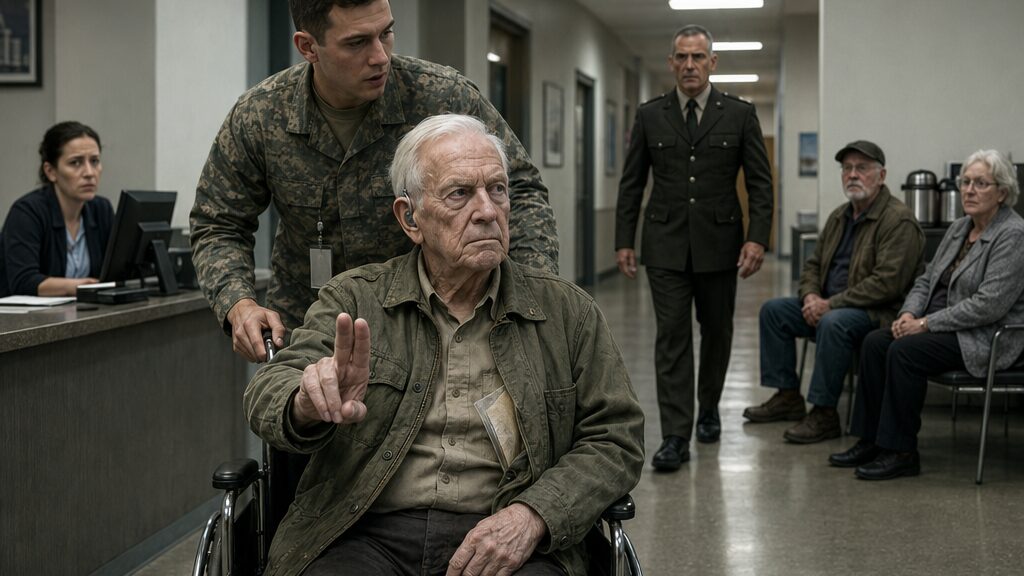
His hearing device whistled once beneath the shell of his right ear, then settled into a thin electrical hum. Around him, the veterans’ records wing carried on beneath white fluorescent panels: printers feeding paper, boots striking polished tile, a coffee dispenser coughing steam into a metal tray. Uniformed personnel crossed between doors marked FAMILY ASSISTANCE and ARCHIVAL REVIEW without looking toward the old man in the wheelchair.
The clerk glanced at Patrick, then at the queue displayed on her monitor. “He has a number.”
“He has the wrong appointment type,” the specialist said. “Historical correction requests go through written submission.”
“I submitted one.”
Patrick’s voice came out rougher than he intended.
The specialist turned. His name tape read MOORE. He was young enough that his uniform still seemed pressed by ambition rather than habit.
“Yes, sir,” Alexander Moore said, with the strained patience people used when they believed an old man had forgotten the conversation that had just occurred. “You submitted a request without supporting documentation.”
Patrick rested one hand over the inside pocket of his faded olive field jacket. The collar had been repaired with uneven green thread, the stitches smaller near the seam and wider where the fabric thickened.
“I brought documentation.”
Alexander crouched beside him, but the gesture did not feel respectful. He leaned close to Patrick’s good ear and raised his voice as if volume could replace attention.
“What you brought is an old routing slip. That does not qualify as a complete amendment packet. We have people waiting for benefits decisions, burial corrections, dependent status—”
“I know what this office does.”
Alexander’s expression tightened. Behind him, the clerk lowered her eyes to the keyboard.
Patrick had arrived forty minutes early. A hospital volunteer had pushed him from the main entrance after one wheel of his chair caught in the rubber groove of the security mat. He had waited beneath a television showing closed-captioned news, his hands folded over his knees, while three people who arrived after him were called.
He had said nothing.
Silence had served him for most of his life. It kept frightened men from hearing fear in his voice. It kept grieving families from carrying details they had not asked to bear. It kept his own memories in a place where they could not stain anyone else.
Now silence was helping Alexander erase him.
The specialist rose and reached for the wheelchair handles.
“We’ll put you near the side desk while the clerk gives you the mailing instructions.”
Patrick locked both wheels.
Alexander looked down. “Sir, I need to keep this aisle clear.”
Patrick raised his right hand.
Two fingers extended together, palm angled toward the floor.
Alexander mistook it for a vague attempt to interrupt. He smiled without warmth and kept talking.
“The written procedure is the same for everyone.”
Patrick repeated the signal.
Two fingers. Hold traffic.
The motion was smaller than it had been fifty-three years earlier. His wrist no longer turned cleanly. The knuckles had thickened, and the fingers trembled at the tips.
But the signal remained exact.
A man walking behind Alexander stopped so suddenly that the heel of his polished shoe scraped the tile.
Patrick saw the dark formal uniform first, then the silver at the man’s temples. A colonel. Tall, square-shouldered, carrying a folder beneath one arm. He had been moving with two aides toward the conference corridor, but now he stood motionless, staring at Patrick’s hand.
Alexander followed the colonel’s gaze.
Patrick lowered his hand and removed his hearing device. The room softened at once. Printers became distant clicks. Voices collapsed into movement without words.
“I asked you,” Patrick said, “to hold the line.”
Alexander’s face changed—not to understanding, not yet, but to uncertainty.
The colonel stepped closer.
His gaze moved from Patrick’s hand to the repaired collar of the field jacket. Then to Patrick’s face.
“Sergeant Mitchell?”
Patrick studied him. The features were unfamiliar. The posture was not.
“I haven’t been a sergeant in a long time.”
The colonel handed his folder to an aide and moved around the wheelchair. Instead of standing over Patrick, he bent one knee and lowered himself until they were nearly eye to eye.
The waiting room quieted in pieces. First the clerk stopped typing. Then a pair of soldiers near the coffee dispenser turned. An older veteran holding a cane lifted his head.
The colonel did not salute.
He simply said, “Colonel Stephen Nelson, sir. Fort Gordon training detachment, nineteen ninety-three. You taught field relay discipline.”
Patrick fitted the hearing device back over his ear. It squealed, and Stephen waited for the sound to settle before continuing.
“You used that signal when the radios overlapped,” Stephen said. “Two fingers down. Hold traffic. Listen before transmitting.”
Patrick remembered hundreds of young faces beneath sun-faded caps, all of them blending now into one restless generation. He did not remember Stephen.
“That was the idea.”
Stephen’s eyes dropped to Patrick’s jacket. “You wore that during instruction.”
“No.”
Patrick’s hand went to the collar.
“This one came earlier.”
The answer seemed to sharpen something in Stephen. He noticed the bulge inside the jacket pocket.
“May I ask what you brought?”
Patrick looked past him at Alexander.
The young specialist stood beside the chair with one hand still hovering near the push handle. His earlier confidence had thinned into embarrassment. The room’s attention made it worse. Patrick could see the impulse in him to straighten, explain, perhaps apologize in front of the colonel.
Patrick had no interest in being used as a lesson performed for an audience.
He reached inside his jacket and removed a folded paper sealed in a clear protective sleeve. The paper had yellowed to the color of weak tea. One corner had been softened by years of handling, and a dark brown stain spread across the upper right section.
Stephen did not take it immediately.
“May I?”
That small request unsettled Patrick more than an apology would have.
He placed the sleeve in Stephen’s open hand.
The colonel studied the faded type, the handwritten routing marks, the half-legible date. His eyes stopped at the name near the center.
ROBERT JOHNSON.
Below it, partly obscured by the stain, was a casualty classification and an incomplete service number.
Stephen looked up.
“This is original.”
“Yes.”
“Where did you get it?”
“I wrote the first routing message.”
The coffee dispenser released another burst of steam. No one moved toward it.
Alexander glanced from the slip to Patrick. “You were casualty affairs?”
“Communications first. Liaison afterward.”
Stephen rose slowly, still holding the sleeve with both hands.
“What correction are you requesting?”
Patrick looked at the doors beyond the waiting room. Somewhere behind them were gray archival boxes, scanned reports, statements reduced to indexed pages. By noon the following day, the remaining physical files from Robert’s unit would begin transfer to a federal storage facility. Once transferred, the record could still be challenged, but not quickly, and perhaps not while Patrick was alive.
“The report says there were no recoverable final communications,” he said. “That is not true.”
Alexander opened his mouth, but Stephen turned toward him before he spoke.
“Was Sergeant Mitchell’s request reviewed?”
Alexander’s jaw shifted. “The packet was incomplete, sir.”
“That wasn’t my question.”
The young man’s shoulders drew back. “I categorized it as non-actionable pending written evidence.”
“You categorized him while he was sitting here?”
Alexander glanced at Patrick. “Yes, sir.”
Stephen’s expression hardened, and Patrick felt the attention in the room gathering around the young specialist like heat.
“That will be enough,” Patrick said.
Stephen turned back to him.
Patrick pointed toward the corridor. “I didn’t come here to have him dressed down. I came to correct a record.”
The colonel’s face altered again. Not softer, exactly. More careful.
“Then let me get you into archival review.”
“No.”
The answer surprised everyone but Patrick.
Stephen remained still.
Patrick continued. “If the process is wrong, fix the process. Don’t make a private door because you recognize my hand.”
Alexander’s eyes lifted.
For the first time, he looked directly at Patrick rather than at the wheelchair, the form, or the colonel beside him.
The front-desk clerk cleared her throat. “The records supervisor is available in ten minutes.”
Stephen handed the protective sleeve back to Patrick. He did not grip the edges carelessly now. He supported it from beneath.
“We’ll wait ten minutes,” he said.
Patrick placed the slip inside his jacket.
Alexander moved a chair away from the side desk to create room, then stopped before touching the wheelchair.
“Would you like me to move you closer to the interview door?”
The question was quiet enough that only Patrick and Stephen heard it.
Patrick released the wheel locks.
“Yes.”
Alexander pushed slowly, avoiding the metal threshold strip. When Patrick’s hearing device whistled, he stopped speaking until Patrick adjusted it.
The change was small. It was not redemption. But it was behavior.
Ten minutes later, Deborah Lee entered the waiting room carrying a tablet and a stack of transfer forms. She was a broad-shouldered woman in civilian clothes, with short gray hair and the economical movements of someone who had spent years in clinical rooms.
Her gaze passed over Stephen’s uniform without hesitation and settled on Patrick.
“Mr. Mitchell?”
“Patrick is fine.”
“I’m Deborah Lee, records supervisor. I’ve reviewed the intake note and the document description.”
Alexander looked down.
Deborah continued. “Your request concerns a casualty file scheduled for transfer tomorrow.”
“Yes.”
“Do you have any corroborating statement, field log, witness affidavit, or original attachment?”
“Not with me.”
Her expression did not change. “Then we have a problem.”
Stephen stepped forward. “The routing slip appears authentic.”
“Authenticity of the slip does not authenticate the requested correction.”
Patrick almost smiled. He understood her at once. She was not impressed by rank, and she did not mistake respect for proof.
“When does the transfer begin?” he asked.
“Noon tomorrow.”
“And my request?”
Deborah turned the tablet so the screen faced him.
A red status bar crossed the top of the file.
NON-ACTIONABLE—INSUFFICIENT SUPPORTING EVIDENCE.
Patrick saw Alexander’s initials beneath it.
Deborah lowered the tablet.
“Unless you give me a lawful reason to place that record on hold before noon Friday,” she said, “Robert Johnson’s file leaves this building exactly as it is.”
Chapter 2: The Name Written Beneath the Coffee Stain
Alexander saw the words again when Deborah opened the electronic file in the interview room.
CONFUSED CLAIMANT. POSSIBLE MEMORY-RELATED INCONSISTENCY.
His own notation sat beneath Patrick Mitchell’s name, entered at 8:47 that morning.
He had typed it while Patrick was speaking.
At the time, it had felt efficient. Responsible, even. The waiting room had been full, his supervisor had warned him twice about processing delays, and an internal evaluation report was due the following week. The instruction had been simple: categorize incomplete cases quickly, keep urgent benefits claims moving, prevent unsupported historical requests from consuming staff hours.
Now the sentence looked less like categorization and more like an accusation.
Patrick sat across the narrow table, his wheelchair angled so his right ear faced the speakers. Deborah had lowered the blinds over the glass wall. Stephen stood near the door, too visibly senior for the room.
Alexander reached toward the keyboard.
“I can amend the intake note.”
Patrick looked at him. “Was it accurate when you wrote it?”
“No.”
“Then don’t amend it. Correct it.”
Alexander deleted the sentence.
The cursor blinked over the empty field.
Deborah placed the casualty-routing slip beneath a desk lamp. The coffee stain covered part of Robert Johnson’s service number, but the name remained clear. Along the lower margin were routing initials and a communications code no longer used.
Stephen said, “I can authorize an immediate command review.”
Patrick turned toward him. “That would be the private door.”
“It would preserve the file.”
“It would preserve it because a colonel asked.”
Stephen folded his arms. “Does the reason matter if the result is right?”
“Yes.”
The single word closed the matter.
Deborah examined the slip through a magnifier. “Mr. Mitchell, tell me exactly how this came into your possession.”
Patrick adjusted his hearing device before answering.
“I prepared the original transmission from the field relay. The typed copy went forward. This was the routing duplicate.”
“Why did you retain it?”
“I was told the packet was complete.”
“That does not answer the question.”
Patrick looked at the paper.
The stain seemed darker beneath the lamp.
“I found it in my field case after we rotated out.”
“And kept it for fifty-three years?”
“Yes.”
Deborah sat back. “Why?”
Patrick’s thumb moved along the seam of his jacket pocket. “Because the record was wrong.”
“Did you challenge it then?”
“No.”
“Ten years later?”
“No.”
“Twenty?”
Patrick did not answer.
Alexander watched Deborah’s expression. She was not trying to humiliate him. She was building the evidentiary wall the file required. Yet every question pressed Patrick deeper into silence, and Alexander recognized the danger of it now.
He slid a yellow legal pad across the table.
“Would it help if we did this one question at a time?”
Patrick glanced at him.
The old man’s face remained unreadable, but he pulled the pad closer.
Deborah tapped the routing code. “You said you served in communications.”
“Radio and field relay.”
“And afterward?”
“Casualty liaison. Temporary assignment that became permanent longer than I expected.”
“You notified families?”
“I carried verified information to them.”
Stephen’s gaze sharpened. “Including Johnson’s family?”
Patrick’s hand stopped on the legal pad.
“No.”
Deborah looked up. “Why not?”
“Another liaison was assigned.”
“Did you request that?”
“Yes.”
The room settled around the admission.
Alexander wrote nothing. He had begun to understand that Patrick’s pauses were not confusion. They were barriers placed with care.
Deborah asked, “What specific amendment do you want?”
Patrick spoke more slowly now.
“The existing record states Specialist Robert Johnson was killed after communication with the relay point had already been lost. It says there were no recoverable final transmissions.”
“And you say there were.”
“Yes.”
“What did they contain?”
Patrick’s gaze moved to the darkened window.
“Enough to change the report.”
“That is not sufficient.”
“It is what I am prepared to say today.”
Deborah closed the magnifier. “Then today may not be enough.”
Stephen pushed away from the wall. “There has to be an associated communications log.”
“There should be,” Deborah said. “But the digitized file index lists no surviving field log.”
Alexander turned to the computer. “What about the original unit accession?”
Deborah gave him a brief look, measuring whether the suggestion was useful or merely eager.
“Search the transfer manifest by casualty routing code, not name.”
Alexander entered the faded code from the slip. The system returned three boxes scheduled for relocation. One was already sealed. Another contained medical support records. The third listed miscellaneous communications material, condition unknown.
Deborah called the archive technician.
While they waited, Patrick removed his hearing device and rubbed the skin behind his ear. A red indentation marked where the casing pressed. Stephen noticed and lowered his voice when Patrick put it back.
“I remember your relay exercises,” the colonel said. “You made us sit in silence whenever two people transmitted at once.”
“You were probably talking too much.”
Alexander expected Stephen to laugh. He did not.
“You said a crowded frequency made cowards of people,” Stephen recalled. “Everyone wanted to speak before they had listened.”
Patrick’s eyes lifted to him.
“I said that?”
“You did.”
“Sounds like me.”
For an instant, the severity around Patrick’s mouth eased. Then the archive door opened.
The technician entered carrying a clear archival sleeve and a printed accession sheet.
“The routing slip is period-consistent,” she said. “Paper stock, typing pattern, code sequence, all correct for the unit and year.”
Alexander felt the tension in his shoulders release.
Deborah did not.
“That establishes the object,” she said. “Not the claim.”
The technician nodded. “There’s more. The original casualty statement references an attachment.”
Patrick looked up sharply.
“What attachment?”
The technician placed the accession sheet on the table and pointed to a notation at the bottom.
“Supplemental communications chronology. One page.”
Deborah leaned closer. “Where is it?”
“Not in the digitized packet.”
“Could it be in the sealed communications box?”
“Possibly. The accession description is incomplete.”
Stephen checked his watch. “Open it.”
Deborah’s head turned. “Colonel, archival chain of custody does not disappear because you are in the room.”
“I’m not asking it to disappear.”
“You are giving an order in a records process you do not supervise.”
Stephen held her gaze, then nodded once. “What is required?”
“A documented preservation basis.”
Alexander looked at the authenticated slip, then at his corrected intake field.
“The missing attachment is referenced by the official casualty statement,” he said. “Doesn’t that create a discrepancy significant enough for temporary review?”
Deborah considered him.
“It creates a basis to inspect the manifest.”
The archive technician collected the accession sheet. “I can bring the box to the temporary workroom by five.”
Patrick shifted in his chair. “And if the page is missing?”
“Then your document proves you were involved,” Deborah said. “It does not prove your memory of the transmission.”
The old man’s face closed again.
Alexander understood the small cruelty of partial proof. Ten minutes earlier, Patrick had been treated as though he had invented everything. Now the paper had confirmed his presence but brought him no closer to the truth he wanted recorded.
Deborah reopened the electronic file.
“There is another requirement,” she said.
Patrick waited.
“This amendment concerns a deceased service member and could alter the official circumstances provided to his next of kin. If an immediate family member is living, we must notify that person before substantive review.”
Patrick’s hand tightened around the wheelchair rim.
Stephen noticed. “Do you know whether Robert Johnson had surviving family?”
Patrick answered without looking at him.
“A daughter.”
Deborah searched the dependent file, then the public contact registry. The clicking of keys seemed unusually loud.
Alexander watched Patrick’s breathing change. Shallow, measured, almost invisible beneath the faded jacket.
Deborah found a result.
“Emily Torres,” she said. “Forty-eight. Lives less than an hour away.”
Patrick closed his eyes.
“Do not call her.”
Deborah’s voice remained even. “I am required to.”
“She did not ask for this.”
“Neither did the archive.”
Patrick’s two fingers rose a fraction from the armrest, then stopped before forming the signal.
Stephen stepped closer. “Patrick, what haven’t you told her?”
The old man opened his eyes.
The coffee stain concealed half of Robert Johnson’s number, but not his name.
Patrick stared at it as though the missing digits were safer than the parts they could still read.
Deborah reached for the telephone.
Chapter 3: The Daughter Who Refused a Heroic Version
Emily Torres entered the family consultation room, looked once at Patrick’s jacket, and said, “Why are you wearing something my father repaired?”
No greeting. No confusion about which man had called her there.
Her eyes fixed on the green stitching near Patrick’s collar.
Patrick’s hand rose instinctively to cover it.
Across the table, Deborah closed the file. Alexander stood beside the wall with his notebook lowered. Stephen had offered to leave, but Patrick had said nothing, so the colonel remained near the door.
Emily set her purse on the table without sitting.
“I asked a question.”
Patrick turned the wheelchair slightly so he could hear her more clearly.
“It was mine before he repaired it.”
The answer hardened her face.
“How do you know he did?”
“The thread came from his sewing kit. He carried it in a tobacco tin even though he didn’t smoke.”
Emily’s breath caught, almost too small to notice.
Patrick continued. “The lid had a dent shaped like a half-moon. He said a truck rolled over it.”
“My mother kept that tin.”
No one spoke.
Emily moved closer. She bent over the collar without touching it. The repair was crude only from a distance. Up close, the stitches formed two different patterns: tight and precise along the tear, loose where Robert had run short of thread.
“There are pictures,” she said. “He repaired everything with that same crossing stitch.”
Patrick lowered his hand.
“He said Army supply would replace a man before it replaced his jacket.”
Emily finally sat, though she kept her body angled toward the door.
Deborah spoke first. “Ms. Torres, we contacted you because Mr. Mitchell has requested an amendment to your father’s casualty record.”
“I understood that much on the phone.”
“He has presented an original routing slip and identified a missing attachment in the official file.”
Emily looked at Patrick. “And after fifty-three years, he decided today was the day?”
Patrick did not answer.
She gave a brief, humorless laugh. “That was fast.”
Alexander shifted his weight. Stephen remained still.
Deborah said, “The physical archive begins transfer tomorrow. That created the immediate deadline.”
“No. That created his deadline. I’m asking about the other fifty-three years.”
Patrick gripped the chair rim.
He had imagined this meeting in many forms. Emily as a child with Robert’s dark hair. Emily as a young woman closing a door in his face. Emily older than Robert had ever lived to be, accepting a sealed envelope without opening it.
He had never imagined fluorescent light, a plastic water pitcher, and four strangers watching.
“I should have contacted you sooner,” he said.
“That is not an answer.”
“No.”
“Then give me one.”
His hearing device picked up a burst of interference from someone’s phone outside the room. The sharp buzz became static, and for one second it was another frequency, another room, another voice broken by distance.
Patrick removed the device.
The silence that followed was incomplete. He could still hear the low shape of Emily’s voice, but not the words.
She stopped speaking when she realized.
Patrick adjusted the casing and put it back.
“Please repeat that.”
Her expression shifted—not into sympathy, but into reluctant control.
“I asked what you want changed.”
Patrick looked toward Deborah.
She nodded once, giving him the room.
“The report says your father remained at the relay point because withdrawal was impossible.”
Emily waited.
“That is not true,” Patrick said. “He had permission to leave.”
The sentence struck the room more forcefully than any raised voice.
Emily leaned back.
“My father was ordered to stay.”
“No.”
“That is what my mother was told.”
“I know.”
“You just said you weren’t the liaison.”
“I wasn’t.”
“But you knew what they told her.”
Patrick’s fingers pressed into his knees.
“Yes.”
Emily turned to Deborah. “Is this why I’m here? So the Army can change the wording from ordered to volunteered and make it sound better?”
“No,” Patrick said.
She faced him again. “That is exactly what it sounds like.”
“He was afraid.”
Stephen’s eyes moved sharply toward Patrick.
Emily went still.
Patrick forced himself to continue. “Your father said he did not want to remain at the relay. He said the position was exposed and the signal had already drawn fire.”
Alexander’s notebook remained closed.
Patrick was grateful for that.
“I told him he could withdraw,” Patrick said. “I gave him the route. He stayed anyway.”
“Why?”
“That is part of what the file should say.”
“Why did he stay?”
Patrick looked at the repaired collar.
“Because there were wounded men moving below the ridge, and without the relay, support would lose their position.”
Emily’s anger did not disappear. It changed shape.
“You’re telling me he chose it.”
“Yes.”
“And you let my mother believe he had no choice.”
Patrick’s mouth dried.
“Yes.”
Stephen stepped away from the wall. “There may have been operational reasons for the original wording.”
Patrick turned on him.
“Do not do that.”
The colonel stopped.
“Do not make the room smaller for her because you think the truth needs protection.”
Stephen’s face tightened, but he nodded.
Emily studied Patrick.
For the first time, she seemed less certain of what she wanted him to be. Not a liar exactly. Not yet. Not a man seeking praise. Something less convenient.
“You knew him well enough to know his sewing kit,” she said.
“Yes.”
“You knew he was afraid.”
“Yes.”
“You knew he had a daughter?”
“He spoke about you.”
“What did he say?”
Patrick saw Robert crouched beneath a sagging shelter line, pushing green thread through torn cloth with fingers too large for the needle. He had spoken of a little girl who refused to eat the crusts of bread, who believed every helicopter in the sky belonged to her father, who slept with one shoe on because she thought it would make morning arrive faster.
Patrick could have given Emily those details.
He gave her only one.
“He said you hated having your hair brushed.”
Emily’s face broke for a moment. Not into tears. Into recognition.
“My mother had to chase me around the kitchen.”
Patrick nodded.
The small memory did what the routing slip could not. It proved a relationship no official code could contain.
Emily sat back down fully.
“All right,” she said. “You knew him.”
The concession brought no relief.
She placed both hands on the table.
“Now tell me why you waited.”
Patrick stared at the water pitcher. Condensation had formed a ring beneath it.
He could say he had been young. He could say the report was already signed. He could say families had been protected from uncertain transmissions because uncertain words could grow into permanent wounds.
All of those things were true.
None answered her.
“I believed silence was kinder.”
Emily’s eyes narrowed. “To whom?”
Patrick did not speak.
“To my mother?”
Silence.
“To me?”
He looked at her then.
She understood.
“No,” she said. “You mean to you.”
Alexander shifted near the wall, and Patrick heard the leather of his boot move against the floor.
Emily reached into her purse and removed a clear plastic folder. The papers inside were old photocopies, softened at the folds.
“My mother kept every letter,” she said. “Every notice. Every condolence form. She used to read them when she thought I was asleep.”
She slid one page across the table.
Patrick recognized the letterhead before he could read the text.
His own name appeared at the bottom.
PATRICK MITCHELL
ACTING COMMUNICATIONS REVIEW LIAISON
The signature was his. Younger, firmer, written by a hand that had not yet begun to tremble.
Emily placed one finger beneath a sentence in the second paragraph.
Patrick read it once.
Then again.
Following review of available field materials, no recoverable final communications were identified.
Emily’s voice was quiet now.
“You didn’t just stay silent.”
Patrick felt the room close around him.
“You certified it.”
Chapter 4: Seventeen Minutes Missing from the Field Log
“The final entry before the gap is eighteen forty-two,” the archive technician said. “The next surviving entry is eighteen fifty-nine.”
Patrick did not look at the page.
He watched the second hand on the workroom clock pass over the twelve, continue toward the three, and begin another circuit. Seventeen minutes had once been long enough for a radio battery to weaken, for smoke to cover a ridge, for a frightened man to change his mind.
Now they fit inside one blank space between two typed lines.
The temporary archive workroom had been assembled from an unused conference room. Gray transfer cartons stood against one wall beneath numbered seals. A portable scanner occupied the table beside a lamp with a magnifying lens. Outside the narrow window, the hospital corridor had emptied into evening.
Emily remained across from Patrick, her mother’s letter folded beside her hand.
Deborah stood near the archive technician. Alexander had pulled a chair close enough for Patrick to see the copied pages without leaning forward. Stephen occupied the far end of the table, no longer positioned as if his uniform entitled him to the center.
The technician pointed to the recovered sheet.
“It was folded inside the backing board of the communications box. Moisture damage took the lower left section, but the timestamps and several routing marks survived.”
Deborah read from the accession note. “Field relay chronology. Supplemental attachment to casualty review.”
Emily looked at Patrick. “The attachment you certified with the report.”
“Yes.”
“And then it disappeared.”
“I don’t know when.”
“You knew what it said.”
Patrick shifted his gaze toward the page.
The paper was a copy now. The original remained under the technician’s hands in a clear sleeve. Typed entries ran in uneven rows, interrupted by pencil marks and abbreviations written by more than one person.
At eighteen thirty-eight, the relay position had received updated coordinates.
At eighteen forty, two wounded soldiers were reported below the ridge.
At eighteen forty-two, a handwritten notation appeared beside Patrick’s call sign:
HOLD TRAFFIC—MITCHELL MOVING SOUTH.
The words pressed against him harder than Emily’s accusation.
Stephen leaned closer. “That notation.”
Patrick said nothing.
Stephen touched two fingers to the tabletop, palm down.
“This is the same signal you taught us.”
“It was standard enough.”
“No.” Stephen looked at the cramped handwriting. “The wording might have been standard. The mark wasn’t.”
Beside the entry were two short parallel strokes slanting toward the margin.
Stephen continued. “You put those marks on every training log when you ordered the frequency cleared.”
Patrick remembered dry classrooms and young operators fighting to be heard. He remembered walking between desks, tapping the logs with two fingers until the room went quiet.
Alexander looked from the marks to Patrick’s hand. “So this proves he was there.”
Deborah answered carefully. “It supports that Sergeant Mitchell issued the hold instruction and departed the relay position at eighteen forty-two.”
“Why would the official report say there were no final communications?” Emily asked.
The technician adjusted the page beneath the lamp.
“Because nothing after eighteen forty-two appears in the final packet. The next surviving entry says relay contact failed at eighteen fifty-nine.”
Alexander pointed to the blank interval. “That doesn’t mean nothing happened.”
“No,” Deborah said. “It means we cannot establish what happened from this page.”
Emily turned to Patrick.
“But he can.”
The hearing device hummed. Patrick adjusted the volume, and the sound of the ventilation system surged into his ear.
He had known the missing attachment might be found. That possibility had brought him to the hospital. Yet he had imagined the page intact, the facts speaking for themselves, leaving him only the duty of confirming them.
Instead, the damage had preserved exactly enough to place him at the relay and show him leaving.
Nothing on the sheet explained why.
Deborah read the surviving entries again.
“Two wounded soldiers below the ridge,” she said. “Was that why you moved south?”
Patrick stared at the two slanted marks.
Emily’s voice cut through the room. “Did you leave my father alone?”
Stephen intervened. “The log is incomplete. We should not reach conclusions from—”
“I asked him.”
Patrick lifted his head.
“Yes.”
Emily’s face went still.
Alexander moved as though he might speak, then stopped himself.
Patrick continued. “Robert remained at the relay when I moved south.”
“Under your order?”
The question struck the place he had spent fifty-three years protecting.
“He had an assignment.”
“That was not what I asked.”
Patrick looked down at the jacket collar. Robert’s crossing stitches were worn smooth on the outside and knotted beneath the fabric where no one could see.
“He stayed,” Patrick said.
Emily pushed her chair back.
The scrape of its legs startled him. His right hand rose from the armrest, two fingers extending before he knew he had moved them.
Hold traffic.
Emily saw the gesture.
“Don’t signal me to stop.”
Patrick lowered his hand.
“That wasn’t for you.”
“Then who was it for?”
He had no answer that would make sense in this room.
Deborah stepped between the table and the sealed cartons. “We need to distinguish the historical question from the immediate procedural one. The attachment establishes a material omission in the digitized file. That may justify delaying transfer of Johnson’s record.”
“May?” Alexander asked.
“The document also creates a serious credibility issue. Mr. Mitchell’s original certification stated there were no recoverable final communications. This log places him in command of the relay shortly before contact failed.”
Stephen’s jaw tightened. “He was moving toward wounded personnel.”
“That is what we are inferring.”
Patrick looked at Deborah. She was protecting the integrity of the record even when it made him look worse. He could not fault her for doing what he had failed to do.
The archive technician scanned the surviving page at high resolution. As the image appeared on the monitor, Alexander enlarged the lower margin.
“There’s more writing here.”
The technician adjusted the contrast. A faint line emerged through the water damage.
REL—J—
The rest dissolved into gray.
“Relay Johnson?” Alexander suggested.
“Possibly,” Deborah said.
Another fragment appeared below it.
CALL RECE—
The final letters were gone.
Emily moved back toward the table despite herself. “A call was received.”
“We cannot say that,” Deborah replied. “We can say someone began writing those words.”
Patrick closed his eyes.
A voice returned to him through static.
Not whole words. Breath, clipped consonants, the drawn-out edge of a call sign. The sound had lived in him longer than Robert’s face had remained clear.
Stephen came around the table and stopped beside Patrick.
“Did you hear a call after you left?”
Patrick opened his eyes.
The colonel’s respect was still present, but something had entered beside it. Doubt. Not suspicion alone—the heavier doubt of a man discovering that someone he had admired might have hidden a failure.
Patrick had wanted the record opened. He had not wanted Stephen’s memory of him disturbed.
That, too, was cowardice.
“Yes,” Patrick said.
Emily’s fingers closed over her mother’s letter. “What did he say?”
“Not here.”
She gave a disbelieving breath. “You brought us here.”
“I know.”
“You told them the record was wrong.”
“It is.”
“And now that the wrong part points toward you, you want to stop?”
Patrick’s chest tightened beneath the jacket.
He had once told young operators that crowded frequencies made cowards of men because everyone transmitted before listening. But silence had its own form of cowardice. He knew that now. Knowing did not make speech easier.
Deborah checked the clock.
“We cannot keep the archive staff beyond twenty-one hundred without an approved evidentiary hold.”
Stephen said, “Then approve it.”
“I need a written basis stronger than an authenticated document that contradicts its own claimant.”
Alexander turned from the monitor. “What if Mr. Mitchell provides a preliminary sworn statement tonight?”
Patrick looked at him.
The young man was not trying to please Stephen now. His attention remained on Deborah.
She considered the suggestion. “A preliminary statement would permit me to request an overnight hold. The full amendment would still require review tomorrow.”
Emily asked, “And if he refuses?”
“The file transfers at noon.”
Patrick heard Robert’s broken call again. Under it came another memory: his own younger voice failing to answer, not because the radio was damaged, not because orders prevented him, but because for several seconds he had not known which life to choose.
He reached for the recovered log.
The technician moved to protect the sleeve, then stopped and allowed him to rest his fingers on its edge.
At eighteen forty-two, he had drawn two lines and cleared the frequency.
At eighteen fifty-nine, someone had declared the relay lost.
Seventeen minutes lay between those facts.
He had hidden inside them for most of his life.
Emily stood across from him, waiting.
Patrick looked directly at her.
“I left him there.”
Stephen stepped forward. “Patrick, you were moving wounded soldiers. The context—”
Patrick raised two fingers.
Stephen stopped.
This time the signal was not a relic, and it was not a display of authority. It was a boundary.
Patrick lowered his hand.
“He asked me not to leave,” he said. “And I left him there.”
Chapter 5: The Order Patrick Never Put on Paper
“Colonel Nelson cannot stay.”
Patrick spoke before Stephen had fully entered the chapel side room.
It was just after seven Friday morning. Pale light from a high window fell across stacked folding chairs and a wooden table used for private consultations. Somewhere beyond the wall, a floor buffer moved along the hospital corridor with a low mechanical growl.
Alexander held the door. Stephen stopped on the threshold.
Patrick faced him from the wheelchair.
“This concerns an operational decision,” Stephen said. “I may be able to help clarify—”
“That is why you cannot stay.”
The answer landed without hostility, which made it harder to challenge.
Stephen looked toward Deborah. She stood near the table with a recording device, a blank sworn-statement form, and a clock she had placed where everyone could see it.
“The overnight hold expires at ten,” she said. “Mr. Mitchell decides who is present for his statement.”
Stephen’s attention returned to Patrick.
“You understand I am not trying to protect the institution.”
Patrick thought of the review room the night before, of Stephen explaining context before Patrick had given it.
“You are trying to protect the man who trained you.”
The colonel’s expression shifted.
“He may not be the man you remember.”
Stephen stood still for several seconds. Then he removed his folder from beneath his arm and handed it to Alexander.
“I’ll be outside.”
When the door closed, Patrick released a breath he had not intended anyone to hear.
Emily sat opposite him. She had returned wearing the same dark sweater as the previous evening, though the sleeves were pushed higher now. Her mother’s letter rested inside a folder beside her. She had agreed to hear the statement, not to support the amendment.
Alexander set Stephen’s folder on a chair and moved toward the wall.
Patrick pointed to the empty seat beside Deborah.
“You should sit.”
Alexander hesitated. “Sir?”
“You wrote the first intake note. You should hear what it nearly closed.”
The young specialist sat.
Deborah switched on the recorder.
“State your full name.”
“Patrick Mitchell.”
“Your role at the time of Specialist Robert Johnson’s death.”
“Communications section sergeant. Acting relay supervisor.”
“And your purpose today?”
Patrick looked at Emily.
“To correct an incomplete casualty record and replace my previous certification with a full statement.”
Deborah nodded for him to continue.
Patrick rested both hands on his knees.
“The relay position was established above a withdrawal route. Robert Johnson operated the primary set. I monitored supporting traffic and moved between the relay and the aid point.”
The details came easier at first because they were procedural. Equipment placement. Call signs. Terrain. The two wounded soldiers reported below the ridge. One had a leg injury; the other could not move without assistance.
“At eighteen forty,” Patrick said, “I received word they were exposed.”
Emily’s eyes did not leave him.
“I told Robert I was going down.”
“Did he object?” Deborah asked.
“Yes.”
“What did he say?”
Patrick’s right hand began to rise. Two fingers separated.
He caught the motion and lowered them.
“He said the relay was drawing attention. He wanted both of us to relocate before the route closed.”
“Was that reasonable?”
“Yes.”
“Did you order him to remain?”
Patrick took a slow breath.
“I told him the wounded men needed the relay active. I said I would move them and return.”
Emily leaned forward. “That is an order.”
“It was.”
“You said yesterday he volunteered.”
“He did. Afterward.”
Her face tightened. “Explain.”
Patrick closed his eyes briefly.
“I gave the order. Then I saw he was afraid.”
Robert had not hidden it. His hands shook when he checked the cable. He kept licking dry lips and looking toward the slope where smoke moved between the trees.
Patrick had been thirty-six, old enough to understand fear and young enough to think command meant concealing his own.
“I told him he could withdraw with me,” Patrick said. “I gave him the route and told him the relay could be abandoned.”
“And he stayed,” Emily said.
“Yes.”
“Why?”
“He asked whether support would still have the wounded men’s position if the relay went down.”
Patrick swallowed.
“I told him probably not.”
Emily looked away.
“He said he would hold until I came back.”
The floor buffer passed beyond the wall, its vibration rising through the chair wheels.
Patrick continued. “I drew the hold mark in the log and moved south.”
He described reaching the first wounded soldier, then finding the second pinned beneath equipment. He described dragging one man by the harness while the other used his elbows to pull himself along the ground. He did not describe blood. It was not needed. The weight remained in his shoulders anyway.
“How long were you gone?” Deborah asked.
“Longer than I said.”
The clock on the table showed 7:31.
Patrick stared at it.
“At some point, Robert called.”
Emily’s hands flattened on the table.
“What did he say?”
“The first transmission broke apart. I heard my call sign. Then that the cable had been hit.”
“Did you answer?”
Patrick’s hearing device began to whistle. He removed it, adjusted the small wheel, and put it back. The interruption gave him several seconds, no more.
“Not immediately.”
“How long?” Emily asked.
Patrick looked at Deborah.
“Forty-three seconds.”
Alexander’s breath changed.
Emily stared. “You remember the number?”
“I counted it afterward from the set’s timing marks.”
“What happened during those forty-three seconds?”
Patrick’s mouth would not shape the answer.
Deborah waited.
The recorder’s red light remained steady.
“I froze.”
Emily leaned back as though distance might help her understand.
“You were carrying wounded men.”
“Yes.”
“You were under fire.”
“Yes.”
“So why call it freezing?”
“Because that is what it was.”
Patrick’s voice had dropped. He forced himself to raise it.
“Robert called again. One wounded man was slipping from my grip. The other was telling me not to leave him. If I stopped to answer, I thought I would lose them. If I did not answer, Robert had no confirmation that anyone heard him.”
“What did you choose?” Emily asked.
“For forty-three seconds, nothing.”
The answer sat between them.
Then Emily said, “And after?”
“I answered.”
“What did my father say?”
Patrick’s two fingers lifted again, palm down. The old signal formed without permission, as if some part of him still believed the room could be held outside the transmission.
Emily’s voice sharpened.
“Stop doing that.”
Patrick looked at his hand. He lowered it to the armrest.
“He said he could leave.”
Her face altered.
“He asked if he should?”
“Yes.”
“What did you tell him?”
“I told him to hold.”
The floor buffer stopped in the corridor. Silence rushed into its place.
Alexander stared at the tiles.
Deborah’s expression remained controlled, but her hand had tightened around her pen.
Emily spoke slowly. “You ordered him to stay a second time.”
“Yes.”
“After giving him permission to withdraw.”
“Yes.”
“Why?”
“The wounded men had almost reached cover. Support still needed their position. I believed I would be back in minutes.”
“But you weren’t.”
“No.”
The room seemed smaller with each answer.
Patrick continued before fear could rebuild the wall.
“Robert said he understood. Then he transmitted the coordinates again. His voice was not steady. He said he was scared.”
Emily closed her eyes.
“He said that?”
“Yes.”
“What else?”
“He said he was staying until the route was clear.”
Patrick’s throat tightened.
“He made a choice after I gave him one. But I had already shaped that choice. I was his sergeant. He knew what I needed him to do.”
Emily opened her eyes.
“And your report said there were no final communications.”
“Yes.”
“Why?”
“The recording mechanism was damaged. The words existed only in my memory and in fragments on the field log. The review officer asked whether the transmissions were recoverable. Technically, they were not.”
“That is not why you wrote it.”
“No.”
“Then why?”
Patrick looked at the recorder.
“Because the full account would have opened an inquiry into my order and my delay. I told myself it would not bring Robert back. I told myself his family did not need to know he was afraid.”
Emily’s jaw tightened. “You decided fear would make him smaller.”
“I thought it would make his death harder for you.”
“I was a child.”
“Yes.”
“My mother was not.”
“No.”
“You decided for both of us.”
Patrick had no defense left that did not repeat the offense.
“Yes.”
Emily stood and walked to the high window. She remained there with her back to him.
Alexander finally spoke.
“Two men survived because you went down the ridge.”
Patrick turned toward him.
The young specialist’s voice was careful, almost pleading.
“That matters.”
“It does.”
“And Robert chose to stay.”
“That matters too.”
Alexander looked relieved for half a second.
Patrick took it away.
“Neither fact erases the forty-three seconds. Neither erases what I certified.”
Emily turned from the window.
“Do not call forty-three seconds insignificant because other men lived.”
“I won’t.”
“You almost did. Just now. You put the number between two reasonable choices and hoped it would shrink.”
Patrick felt the truth of it.
He nodded.
“You are right.”
The words cost less than he had feared and more than they should have.
Deborah switched off the recorder.
“We need a complete signed statement, including the second order, the delay, the final transmission, and the reason for the original omission.”
Patrick looked at the form.
“And if I sign it?”
“It becomes part of the review. Permanently.”
Emily returned to the table.
“Your worst forty-three seconds will be in the file with my father’s last words.”
“Yes.”
“Can you live with that?”
Patrick thought of the alternative. Another transfer. Another year. Another carefully folded slip inside his jacket while Emily’s father remained simplified into a sentence Patrick knew was incomplete.
“I have lived with worse,” he said. “I have lived with keeping them out.”
The door opened, and Deborah’s assistant appeared with a message slip. Deborah read it, then checked the clock.
Her face hardened.
“The archive division has moved the transfer staging forward. We no longer have until noon.”
Alexander stood. “How long?”
Deborah placed the unsigned statement in front of Patrick.
“If the full declaration is not signed and entered by ten o’clock,” she said, “the hold fails and Robert Johnson’s record leaves this building unchanged.”
Chapter 6: The Statement That Proved Less Than Everyone Hoped
The board chair slid a revised statement across the table.
“We can approve this version today,” she said, “provided Mr. Mitchell removes the disputed confession.”
Alexander read the first paragraph from where he sat behind Patrick.
The amendment acknowledged that Robert Johnson had voluntarily remained at the relay point and transmitted updated coordinates after permission to withdraw. It corrected the claim that no final communication had occurred.
It did not mention Patrick’s forty-three-second delay.
It did not mention the second order to hold.
It described Patrick’s earlier certification as an administrative misunderstanding caused by damaged recording equipment.
The statement was clean, defensible, and false in exactly the way false things often were: every sentence could be supported if no one asked what had been left out.
Patrick did not touch the paper.
The records review board had assembled in a small hearing room at 9:12. Three members sat behind a curved table. Deborah occupied a side seat with the archive file open before her. Emily sat beside Patrick. Stephen stood along the rear wall, arms folded, his presence restrained but impossible to ignore.
The chair continued. “The board is prepared to recognize Specialist Johnson’s voluntary action and preserve Mr. Mitchell’s oral recollection as contextual testimony.”
“Contextual,” Emily repeated.
“It means the recollection is retained without being treated as verified operational fact.”
Patrick looked at the proposed amendment.
“What happens to my second order?”
The chair glanced at the legal adviser beside her.
“It is unsupported by surviving documentation.”
“I support it.”
“You are also the subject of the disputed conduct.”
Patrick nodded. “That does not make it untrue.”
“No. But it limits how the board may classify it.”
Stephen stepped forward. “The purpose of the review is to correct Johnson’s record, not to adjudicate Sergeant Mitchell’s actions after half a century.”
Patrick raised his hand.
Two fingers.
Stephen stopped.
Patrick lowered them.
“The actions are connected.”
The chair folded her hands. “Mr. Mitchell, this language gives the family the essential correction. Specialist Johnson was not trapped without choice. He remained to support the withdrawal route. That is significant.”
“It makes him brave,” Patrick said, “and makes me blameless.”
Emily looked at him.
The chair’s tone softened. “It avoids conclusions the surviving material cannot establish.”
“It avoids the part I came to put back.”
Alexander looked down at the intake folder in his lap.
The electronic status sheet was clipped to the front. He had printed it after correcting his note, but the original classification remained in the audit trail:
NON-ACTIONABLE.
His initials appeared beside the timestamp.
He had spent the night telling himself that he had changed. He had carried boxes, located forms, asked Patrick before moving the wheelchair. Those actions felt decent because they cost little.
The board’s proposed statement revealed what change would actually require.
Deborah said, “The archive hold expires in twenty-six minutes.”
The chair pushed the paper closer to Patrick.
“If you sign, we can enter the amendment before transfer.”
Patrick studied the signature line.
His right hand trembled slightly above his knee.
Alexander saw how easily the room could convert that tremor into evidence of confusion. He also saw how easily rank, procedure, and urgency could make a dishonest document feel merciful.
“Hold the line,” he said.
Every face turned toward him.
The words sounded foolish in his own voice, borrowed from a man he had tried to move out of a queue.
Alexander stood.
“I am requesting a procedural pause.”
The chair frowned. “On what basis?”
He opened the intake file.
“Access failure.”
Deborah’s eyes narrowed. She knew what he meant before he said it.
Alexander continued. “I classified Mr. Mitchell’s request without completing the required hearing-access checklist. I spoke toward his impaired side, failed to confirm comprehension, and entered a cognitive concern without assessment.”
The legal adviser leaned toward the chair.
Alexander’s mouth went dry.
Stephen watched him from the rear wall, but Alexander did not look for approval.
The chair asked, “Are you stating that the initial intake was procedurally defective?”
“Yes.”
“Were you instructed to classify incomplete requests quickly?”
“Yes.”
“That is not the same as being instructed to ignore access protocol.”
“No.”
The word settled over him.
He opened the electronic correction form and rotated the screen toward the board.
“I marked the case non-actionable before Mr. Mitchell finished explaining the document. That status nearly prevented the archive inspection that produced the missing log.”
The chair looked at Deborah. “Why was this not included in the review packet?”
“Because I learned the extent of the intake failure after the overnight hold was requested.”
“Does it affect the evidentiary question?”
“Not the historical evidence,” Deborah said. “It affects whether the claimant received the process required before the deadline.”
Alexander selected the original notation. His cursor hovered over the correction field.
He typed:
CLAIM PREMATURELY CLASSIFIED. HEARING ACCOMMODATION NOT COMPLETED. CLAIMANT’S ACCOUNT NOT FULLY ELICITED.
Then he signed with his identification number.
A warning box appeared, confirming that the correction would be attached permanently to his performance record.
He clicked submit.
The chair’s expression remained unreadable.
“You understand this admission may be referred to your command?”
“Yes.”
“Why are you making it now?”
Alexander looked at Patrick.
The old man did not appear grateful. He appeared attentive.
“Because I thought respect was recognizing who he used to be,” Alexander said. “It should have started with listening to who was in front of me.”
No one applauded. No expression in the room suggested absolution.
That made the admission feel real.
The chair consulted briefly with the legal adviser. Then she looked at the clock.
“The board grants a one-hour extension based on documented access failure. The archive hold will remain active until ten fifty-five.”
Deborah released a quiet breath.
Alexander sat down.
His evaluation, his promotion recommendation, and perhaps his assignment had all become uncertain. Yet the corrected notation on the screen no longer made Patrick carry the consequence of Alexander’s fear.
Patrick turned slightly.
“Specialist Moore.”
“Yes, sir.”
“You corrected it.”
Alexander nodded.
“Do not make me thank you for correcting your own mistake.”
Heat rose into Alexander’s face.
Then Patrick added, “But do not pretend it cost nothing.”
Their eyes met.
It was not forgiveness. It was recognition of a different kind.
The board chair gathered the proposed amendment.
“With the extension, Mr. Mitchell may submit a full declaration. However, the board still cannot replace the official chronology with unsupported recollection.”
Emily spoke for the first time in several minutes.
“Then do not replace it.”
The chair looked at her.
“Attach both.”
“The family may submit a statement regarding the impact of the correction.”
“I am not asking for an impact statement.”
Emily opened her folder and removed a blank sheet.
“I want my account attached beside his. I want the record to say my father was afraid, that he chose to remain, and that the Army gave us a cleaner story because clean stories were easier to file.”
The legal adviser began to respond, but Emily raised one hand.
“I will not sign anything yet.”
Patrick turned toward her.
She faced him.
“I will oppose the amendment if you cannot answer one question.”
The board chair said, “Ms. Torres, we have limited time.”
“This will not take an hour.”
Emily closed her folder and stood.
She looked toward the empty waiting room visible through the glass wall, where the coffee station lights still glowed beneath the fluorescent ceiling.
Then she addressed Patrick.
“Privately.”
Patrick’s fingers tightened around the wheel rims.
“What question?”
Emily opened the hearing-room door.
“Whether you came here to honor my father,” she said, “or to make me forgive you.”
Chapter 7: What Emily Asked Before She Signed Her Name
Emily closed the consultation-room door and switched off the recorder before Patrick could object.
The red light vanished.
Through the glass wall, the records wing looked strangely exposed. The morning queue had begun to form again beneath the fluorescent panels. At the coffee station, a hospital volunteer wiped spilled cream from the counter while two veterans waited for their numbers to be called.
Emily pulled the blind halfway down.
“We have fifty-two minutes,” she said. “I do not want an official answer.”
Patrick rested his hands on the wheelchair rims. “Then why turn off the recorder?”
“Because every time that light is on, you speak like someone is grading the damage.”
She sat opposite him.
Alexander had pushed Patrick into the room and then left without being asked. Stephen remained in the corridor. Deborah had returned to the board with the extension paperwork. For the first time since Emily arrived, no one else was present to translate Patrick into procedure.
She placed a blank sheet of paper between them.
“Did you come here to honor my father,” she asked, “or to make me forgive you?”
Patrick looked at the dark recorder.
The answer he had carried into the building was that Robert deserved a complete record. It was a good answer. It was also incomplete.
“To honor him.”
Emily waited.
Patrick heard the coffee dispenser release a burst of steam beyond the wall.
“And?”
He adjusted his hearing device, though there was nothing wrong with the volume.
“And because I am running out of time.”
“For what?”
“To do what I should have done.”
“That still does not answer me.”
Patrick’s fingers lifted from the wheel rims.
Two fingers began to separate.
He stopped the signal before it formed and placed them flat on the table.
His wife had once done that to him—covered his raised hand with hers when he tried to end a conversation before it reached the truth.
“You have held that line long enough,” she had told him.
Patrick had promised to write Emily the next morning.
He never did.
“My wife knew,” he said.
Emily’s expression changed slightly. “About the transmission?”
“Most of it.”
“You told her and not us.”
“Yes.”
“When?”
“Twenty-one years ago. After I woke her by answering a radio that wasn’t there.”
Patrick looked down at the two fingers resting on the tabletop.
“She found the routing slip in my jacket. I had moved it from one closet to another for thirty years. She asked why I kept something I would not correct.”
“What did you tell her?”
“That the record was settled.”
“And she believed you?”
“No.”
A memory rose with painful clarity: his wife seated at their kitchen table, the field jacket spread before her, the repaired collar beneath her thumb.
She had not called him a coward. That would have been easier.
She had asked what right he had to decide that another family should live inside a lie.
“She told me to contact you,” Patrick said.
Emily folded her arms. “Did you?”
“No.”
“Why?”
“I wrote letters.”
“That is not what I asked.”
“I never mailed them.”
“How many?”
Patrick could picture the envelopes. Some typed, some handwritten. One addressed when Emily still shared her mother’s surname. Another written after he found a newspaper notice about her marriage. A final one folded into the field jacket after his wife died.
“Seven.”
Emily stared at him.
“You wrote to me seven times.”
“Yes.”
“And each time you decided I was better off not knowing.”
Patrick felt the old defense approaching: her mother had been ill; Emily had young children; too many years had passed; memory without documentation could do harm.
He let none of it leave his mouth.
“Each time I became afraid.”
“Of hurting me?”
“Of what you would call me after you knew.”
The honesty seemed to anger her more than another excuse might have.
“So this is about forgiveness.”
“No.”
“You just said you were afraid of my judgment.”
“I was. I still am.”
“Then what changed?”
Patrick looked through the uncovered portion of the glass wall. Stephen stood with his back to the room, keeping others from approaching without appearing to guard the door. Alexander was at the intake desk, speaking to an elderly woman. He had turned his chair so she could see his face when he spoke.
“My wife died,” Patrick said. “I kept waiting for the fear to become smaller afterward. It did not.”
Emily said nothing.
“Then I fell last winter. Nothing dramatic. I reached for a shelf and woke on the floor. I could see the jacket hanging three feet away, and I understood that if I died there, someone would throw it out with the slip still inside.”
“That is why you came now?”
“It is why I stopped pretending there would be a better time.”
Emily’s eyes moved to the repaired collar.
“My father did not get a better time.”
“No.”
“And my mother died believing there had been no final call.”
“Yes.”
The word barely carried.
Emily picked up the blank sheet but did not write.
“What do you want me to do when this is over?”
“Whatever you choose.”
“Do you want me to forgive you?”
Patrick’s throat tightened.
Wanting was different from asking. He had hidden inside that distinction for years.
“Yes,” he said. “I want you to.”
Emily’s pen stopped above the page.
“But I did not come to require it.”
“If I refuse?”
“The statement stays the same.”
“If I tell the board you waited too long?”
“I will agree.”
“If I say your silence was another order you gave my father’s family?”
Patrick absorbed the sentence.
“I will not argue.”
Emily studied him for several seconds.
“You keep trying to make yourself the only guilty person in the story.”
Patrick frowned.
“You talk as if my father was simply brave, and you were simply weak. That is still a clean version.”
“He remained when he could leave.”
“Was he afraid?”
“Yes.”
“Did he hesitate?”
Patrick saw Robert gripping the radio handset, asking twice whether support still needed the coordinates. He remembered the silence before Robert said he would stay.
“Yes.”
“Did part of him want you to order him out so he would not have to choose?”
Patrick looked at her.
“I think so.”
“Then put that in.”
“The board may treat it as speculation.”
“Label it as your memory. But do not polish him because you feel guilty.”
Emily’s voice shook now, though she did not look away.
“I have spent my life with people telling me my father died without fear. Teachers. Veterans at memorial events. My mother, because that was what the letter gave her. Do you know what that does to a child?”
Patrick waited.
“It makes fear feel like a betrayal of him.”
She wrote one line on the blank sheet.
“I do not want another heroic version. I want the man who repaired jackets badly and complained about being cold. I want the father who was scared and stayed anyway.”
Patrick looked at the words forming beneath her hand.
“What will you write?”
“That the omission harmed us. That correcting it does not erase the harm. That my father’s choice belongs beside your order, not underneath it.”
She paused.
“And that uncertainty should not be removed just because institutions prefer complete sentences.”
Patrick felt something inside him loosen without becoming lighter.
Emily signed the bottom of her page.
She slid it toward him but kept one hand resting on it.
“I believe you came to tell the truth,” she said.
Patrick waited for the rest.
“I do not know whether I forgive you.”
He nodded.
“That is yours.”
“No.” Emily’s eyes held his. “That is the point. It was always mine.”
She released the paper.
Patrick placed his confession beside her statement on his lap. The two pages did not agree on everything. They did not make Robert flawless or Patrick innocent. They did not repair the years between them.
They were honest enough to stand together.
A knock sounded.
Alexander opened the door a few inches. “Ten minutes.”
Patrick unlocked his wheels.
Alexander stepped inside. “Would you like help?”
Patrick looked at Emily.
She moved behind the chair, then stopped before touching the handles.
“May I?”
Patrick released his grip on the rims.
“Yes.”
Emily pushed him through the waiting room. At the board-room door, Patrick took the wheels again.
He entered under his own power with two statements across his knees.
Chapter 8: Respect Became a Rule Only After Someone Finally Listened
Stephen had begun speaking when Patrick raised two fingers.
“No, sir,” Patrick said. “Let me carry this part.”
The colonel stopped in the middle of his sentence.
His prepared folder remained open on the table before him. Patrick could see several phrases underlined in blue ink: extraordinary circumstances, distinguished service, reasonable command judgment.
Words meant to protect him.
Stephen closed the folder.
Patrick rolled to the center of the review room. Emily took the chair beside him. Alexander stood near the rear wall, his corrected intake report visible on the monitor. Deborah watched the clock, but she did not hurry him.
The board chair said, “Mr. Mitchell, you have six minutes before the archive transfer hold requires renewal.”
“Then I will be direct.”
Patrick placed his signed statement on the table.
“Specialist Robert Johnson remained at the field relay after I gave him permission to withdraw. He remained because support needed the position of wounded men moving below the ridge.”
The chair nodded. “That point is reflected in the proposed amendment.”
“The proposed amendment leaves out why he needed permission.”
The legal adviser leaned forward.
Patrick continued. “I first ordered him to stay. When I saw his fear, I gave him a choice. But I was his sergeant. A choice given by the man who needs you to remain is not free of pressure.”
Emily’s statement lay beneath his.
Patrick’s hearing device gave a soft whistle. No one spoke over it. Deborah waited until he adjusted the casing.
“I left the relay to move two wounded soldiers,” Patrick said. “Robert called while I was below the ridge. I did not answer for forty-three seconds.”
Stephen’s jaw tightened, but he remained silent.
“When I answered, Robert said the relay cable had been damaged. He asked whether he should withdraw. I told him to hold until the wounded men reached cover.”
Patrick looked at Emily before continuing.
“His voice was unsteady. He said he was scared. Then he repeated the coordinates and said he would stay until the route was clear.”
The board chair glanced at the damaged field log.
“Can those exact words be independently verified?”
“No.”
“Then we cannot enter them as established fact.”
“Enter them as my sworn recollection.”
“That creates a contested record.”
“Yes.”
The answer surprised her.
Patrick pushed Stephen’s proposed language aside.
“I did not come here for a clean record. I came because the clean one is wrong.”
The board members conferred in low voices.
The legal adviser asked, “Why did your original certification state there were no recoverable communications?”
“Because the recording was damaged, the log was incomplete, and I used technical wording to conceal what I remembered.”
“Were you attempting to avoid disciplinary review?”
“Yes.”
“Were you also attempting to protect Specialist Johnson’s family?”
Patrick looked at Emily.
“I told myself I was.”
Emily placed her statement beside his.
“I ask that both documents remain together,” she said. “His account and mine.”
The chair read the first paragraph silently.
“What does your statement request?”
“That the record identify my father’s fear, his voluntary decision, Sergeant Mitchell’s order, the disputed forty-three-second delay, and the fact that the family received an incomplete account.”
“Some of those points cannot be resolved conclusively.”
“Then say that.”
Emily’s voice remained level.
“Uncertainty is part of what happened. Do not remove it to make the file easier to read.”
The clock reached ten fifty-one.
Deborah stood.
“I recommend a contested-history addendum.”
The chair looked toward her. “That classification is generally used for conflicting witness accounts.”
“We have conflicting materials, a missing attachment, authenticated period documentation, sworn recollection, and documented harm to the family. Replacing the old chronology would overstate certainty. Leaving it untouched would preserve a known omission.”
Stephen spoke from the side of the room.
“I support the recommendation.”
Patrick turned toward him.
Stephen added, “Without special consideration for Sergeant Mitchell’s former role.”
That mattered.
The board chair looked at Alexander’s corrected intake report on the monitor, then at Patrick and Emily’s statements.
“At ten fifty-four,” she said, “the board approves an immediate preservation order and creation of a contested-history addendum. The original record will remain intact, but it will no longer stand alone.”
Emily closed her eyes briefly.
The chair continued. “Mr. Mitchell’s complete declaration will be attached without removal of self-incriminating portions. Ms. Torres’s family statement will appear beside it at equal documentary level.”
“Not beneath it,” Emily said.
“Beside it.”
Deborah transmitted the preservation order.
On the monitor, Robert Johnson’s file changed from TRANSFER READY to HOLD—ACTIVE REVIEW.
No one applauded.
Patrick was grateful.
The board chair collected Stephen’s sanitized proposal and marked it superseded. The paper that would have made Robert fearless and Patrick blameless went into a temporary file, where it would remain as part of the decision history rather than the truth itself.
Emily touched the repaired collar of Patrick’s jacket.
“May I see the inside?”
Patrick removed the jacket slowly. Alexander stepped forward, then waited until Patrick nodded before helping ease the sleeve over his stiff shoulder.
Emily turned the collar back.
The knots of Robert’s green thread remained beneath the fabric, hidden for more than half a century.
She ran one finger beside them without pulling.
“He always tied too many knots,” she said.
“He did not trust one to hold.”
Patrick watched her fold the collar into place.
When she returned the jacket, she supported it with both hands.
Six weeks later, Patrick returned to the records wing for a copy of the completed addendum.
The same fluorescent panels lit the waiting room. The coffee dispenser still rattled. The same metal threshold caught the front wheel of his chair until a hospital volunteer lifted it clear.
Yet one thing had changed.
At every intake station, a small card stood beside the monitor:
PAUSE. FACE THE PERSON. CONFIRM HEARING AND UNDERSTANDING. LET THEM FINISH.
A simple two-line symbol appeared above the words.
Two fingers angled downward.
Patrick stopped when he saw it.
Across the room, Alexander sat with an elderly veteran wearing a cap pulled low over his eyes. The man’s daughter kept answering questions for him. Alexander turned the screen away from her and toward the veteran.
“Sir, I want to hear your answer first.”
The man began speaking. His words came slowly.
His daughter interrupted.
The veteran raised two fingers—not with Patrick’s precision, but close enough.
Alexander stopped immediately.
He lowered his voice, waited, and gave the man the room to continue.
Only after the answer was complete did he ask the daughter whether she wished to add anything.
Patrick watched without announcing himself.
The revised protocol had not transformed Alexander into another person. A stack of unfinished files still crowded his desk. His evaluation had been delayed, and a formal counseling notice sat in his record. He still glanced at the clock more often than patience required.
But when people spoke, he faced them.
Deborah emerged from the archive corridor carrying a thin folder.
“Mr. Mitchell.”
“Patrick.”
She handed him the copy.
Robert’s original chronology appeared first. Behind it came the recovered log, Patrick’s declaration, Emily’s statement, and the board’s explanation of what could and could not be established.
Nothing had been erased.
Nothing had been made painless.
Patrick turned to the page containing Robert’s final words as he remembered them.
I am scared.
I will hold until they are clear.
Both sentences remained.
Deborah said, “The procedure card was Specialist Moore’s proposal.”
Patrick glanced across the room.
“He borrowed the signal.”
“He credited the source.”
“That was unnecessary.”
“He disagreed.”
Stephen entered from the main corridor without aides or a formal folder. He wore his duty uniform, but there was no ceremony in his approach.
Patrick closed Robert’s file.
Stephen stopped before him.
For a moment, Patrick expected the old recognition: the straightened posture, the remembered title, perhaps the restrained salute that Stephen had wisely withheld the first day.
Instead, the colonel lowered himself beside the wheelchair.
He did not speak about Patrick’s service. He did not tell the room what kind of man Patrick had once been.
He looked at the folder on Patrick’s lap and asked, “Is it the record you wanted?”
“No.”
Stephen waited.
Patrick rested his hand over the cover.
“It is the record we can honestly keep.”
Stephen nodded.
Across the room, the elderly veteran was still speaking. Alexander had not interrupted him.
Emily had not forgiven Patrick, at least not in words. She had called twice. The first time, they discussed Robert’s sewing kit. The second, she asked whether Patrick remembered what song her father used to hum while repairing equipment.
Patrick had not remembered.
He had told her so.
That, too, had been part of learning not to fill silence with a cleaner answer.
Stephen remained at Patrick’s level.
“Where would you like to go now?”
Patrick looked once more at the two-finger symbol on the intake card.
Then he pulled the faded olive jacket closed over his chest.
“Home.”
The story has ended.