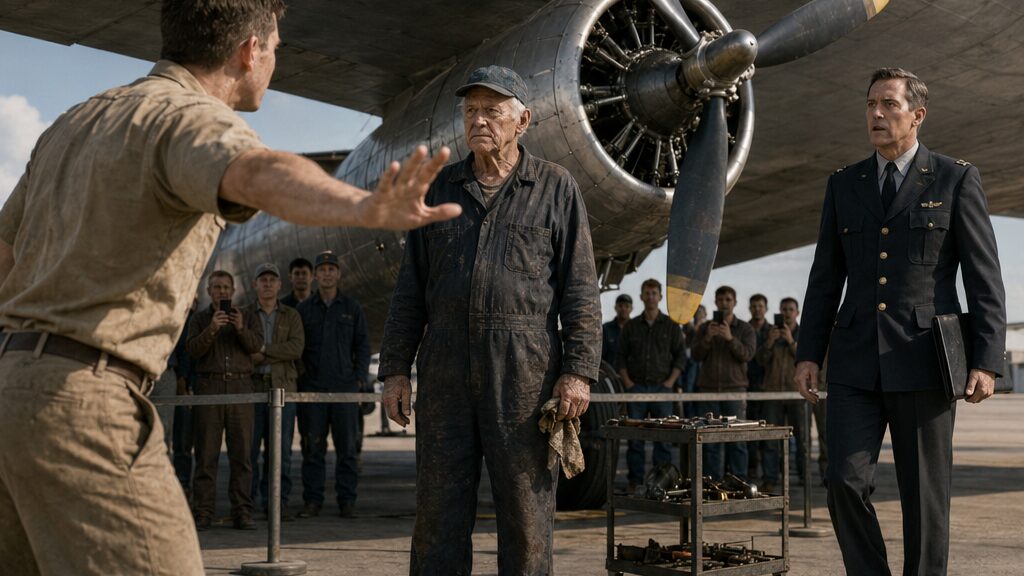
The Young Mechanic Shoved an Old Man Away From the Plane He Once Commanded
Chapter 1: The Old Man Beneath the Left Wing
The wrong sound came only once.
Anthony Clark stopped beneath the left wing as the propeller turned through another slow test rotation. Five broad blades cut the morning light into measured shadows across the concrete. The starter cart whined, gears engaged, and somewhere behind the polished cowling came a thin metallic hesitation.
Not a knock. Not yet.
A skipped beat.
Anthony raised his head.
Across the apron, two junior mechanics continued rolling a tool cabinet toward the open hangar. Neither looked up. A museum volunteer swept dust from the visitor line. Beyond the fence, a delivery truck idled beside a banner announcing the memorial flight three days away.
The aircraft looked almost too clean.
Its silver fuselage carried freshly painted markings. New glass gleamed in the cockpit. The old transport had been polished until decades of weather, smoke, and hurried repairs had disappeared beneath ceremonial shine.
Anthony disliked that more than he had expected.
He stepped closer to the engine.
His coveralls were older than some of the mechanics on the apron. The knees had been patched twice. Dark grease marked one sleeve and the front pocket. A faded blue work cap shaded his eyes. In his right hand he carried an oil-stained rag folded around something hard and narrow.
He waited through another rotation.
The beat did not return.
That was how dangerous sounds behaved. They introduced themselves politely.
Anthony moved beneath the propeller arc after confirming the ignition was cold and the ground lead attached. A red rope marked the restricted work area, but one brass hook had been left open for the tool cart. No one challenged him when he stepped through.
He had entered airfields through narrower gaps under worse conditions.
At the nacelle, he rested two fingers against the metal. The restored skin felt smooth, but the vibration from the test gear traveled through it unevenly. He followed the cowling seam toward the underside.
A rectangular patch had been painted over so carefully it looked structural.
Anthony crouched.
His left knee objected before he reached the ground. He ignored it, placed the rag beside him, and pressed his thumb beneath the lower edge of the panel.
It did not move.
He glanced toward the hangar. The mechanics were arguing over a checklist clipped to a board. No one watched him.
Anthony unfolded the rag.
Inside lay a brass timing key no longer than his middle finger. Its surface had been polished by years of contact, though a black crescent remained near one end. He fitted it into a narrow slot concealed beneath the panel lip and turned it a quarter rotation.
The latch released.
The panel dropped into his hand.
A voice behind him said, “What do you think you’re doing?”
Anthony did not turn at once.
Inside the cavity, newer wiring had been tied neatly along an old conduit. The restoration crew had replaced the accessible lines but left the deeper housing intact. A faded inspection mark remained on the inner frame, nearly covered by primer.
Two diagonal strokes. One short horizontal line.
His own notation, from another life.
He touched it with one finger.
“Sir.”
The voice had sharpened.
Anthony replaced the panel loosely, then stood with care. A young man in tan maintenance clothing approached from the hangar. He was broad through the shoulders, clean-shaven, and walking quickly enough to announce that the space belonged to him.
His name patch read CARTER.
Anthony folded the key back into the rag.
“You opened a sealed access panel,” Brian Carter said.
“It isn’t sealed.”
“It was signed off yesterday.”
“Then someone signed without opening it.”
Brian stopped a few feet away. His eyes moved from Anthony’s stained coveralls to the unlatched panel, then to the brass hook on the open barrier.
“Are you with the volunteer crew?”
“No.”
“Foundation staff?”
“No.”
“Then you’re in a restricted area.”
Anthony looked toward the engine.
“I heard something during the rotation.”
Brian followed his gaze, but only for a second. “The engine isn’t running.”
“I know.”
“That was a starter-cycle test.”
“I know that too.”
Brian’s mouth tightened. Behind him, one of the junior mechanics had stopped pushing the tool cabinet. The other pretended not to watch.
Anthony said, “Turn it through again.”
“We already completed the test.”
“Then completing it once more should be easy.”
Brian studied him with the rigid patience of a man trying not to lose his temper in front of subordinates.
“You can’t come onto an active restoration apron and start opening panels because you think you heard something.”
“I did hear something.”
“What?”
Anthony looked at the nacelle. “A delay in the left-side transfer. Very slight.”
Brian gave a short breath that was almost a laugh. “Transfer of what?”
“That depends on what was changed.”
It was the wrong answer for a young man who wanted a credential before a conclusion.
Brian stepped around him and pressed the panel shut. It clicked without the hidden latch engaging.
“You could have damaged this aircraft.”
Anthony’s fingers tightened around the rag.
The accusation itself did not hurt. The easy certainty did.
He had spent enough years giving orders to know how fear disguised itself as authority. Brian was not protecting only the plane. He was protecting a schedule, a position, perhaps some old wound Anthony could not see.
That did not make him correct.
A woman in foundation clothing emerged from the hangar carrying a stack of programs, but someone called her back before she looked toward the wing.
Anthony said, “Who installed the magneto drive?”
Brian’s expression changed by a degree.
“That isn’t your concern.”
“Who signed it?”
“You need to step behind the barrier.”
Anthony looked at the panel again. “Open it before the next powered test.”
Brian moved closer. “Sir, I’m asking once.”
“No,” Anthony said. “You’ve asked several times.”
One of the junior mechanics lowered his head, hiding a reaction.
Brian noticed.
The temporary audience hardened him.
“Identification.”
Anthony reached slowly into the breast pocket of his coveralls. Brian’s eyes followed the movement as though Anthony might produce a tool or weapon.
Instead, Anthony removed a cream-colored envelope softened at the folds.
The foundation seal was stamped in one corner. His name had been typed on the front in plain black letters:
ANTHONY CLARK.
No title. No rank. No letters after it.
Brian pulled the invitation free and read it.
“You’re here for the memorial?”
“I was invited to inspect the aircraft.”
“This says you’re invited to attend a private viewing.”
Anthony glanced at the signature. Patricia Adams had written the final line by hand.
Come before the crowds. See her as she really is.
Anthony had not answered.
Not formally.
“I came early,” he said.
“You came through maintenance access.”
“It was open.”
“That doesn’t make it public.”
“No.”
Brian held out the invitation as though returning a counterfeit bill. “There’s no inspection authorization here.”
“Call Patricia Adams.”
“She’s in a donor meeting.”
“Then wait until she leaves it.”
“We don’t stop work because an elderly guest wandered onto the apron.”
The words landed harder than Brian seemed to intend.
For an instant, the younger man’s face showed that he had heard himself.
Anthony took back the envelope.
A lifetime earlier, he might have corrected the tone before the sentence ended. Rank had once given him that privilege. Age had taken away the visible part of it and left him with the choice of what kind of man remained.
He folded the invitation and placed it in his pocket.
“The left engine needs to be checked.”
Brian turned toward the hangar entrance.
“Security to restoration apron,” he called into his radio. “Unauthorized individual inside the barrier.”
Anthony looked up at the aircraft’s left wing.
The polished metal held a faint reflection of an old man in stained coveralls, standing where no one believed he belonged.
Chapter 2: The Hand Against His Coveralls
The security cart turned onto the apron before Brian had finished returning the radio to his belt.
Two uniformed personnel rode in front. Behind them, near the visitor fence, several early-arriving foundation guests had begun lifting their phones. The scene had acquired an audience faster than Brian could contain it.
That was the danger of public work. One uncertain moment became evidence of incompetence before anyone knew what had happened.
Brian looked at the old man beneath the wing.
Anthony Clark had not moved.
He stood with his shoulders slightly bent, one hand holding the stained rag, his eyes fixed on the left engine as if the approaching security cart were less important than a machine that had not even started.
Brian felt anger rise again, but beneath it was something worse.
Doubt.
The old man had found an access latch Brian had never seen.
The restoration drawings marked the lower panel as riveted shut. Brian himself had inspected the exterior the day before. There had been no visible release.
Yet Anthony had opened it in seconds.
“Stay where you are,” Brian said.
Anthony glanced at him. “I have been.”
One junior mechanic turned away to hide a smile. Brian saw it and felt heat climb his neck.
His permanent appointment as restoration lead had not yet been approved. The foundation board would decide after the memorial flight. Patricia had called his work precise. The inspector had called it improved. Neither word meant secure.
At his previous facility, a hydraulic fitting had failed during a taxi test. Brian had not installed it, but he had signed the sequence after another supervisor pressured the crew to hurry. No one had been killed. A mechanic had broken two ribs, and Brian’s name had remained attached to the report.
Since then, he checked badges. He checked signatures. He checked every person who crossed a painted line.
His father had taught him that rules were written in the blood of someone who thought experience made him exempt.
The security cart stopped.
One officer stepped down. “Problem?”
“This gentleman entered the restricted area and opened an aircraft panel without authorization,” Brian said.
Anthony addressed the officer. “The panel was designed to open.”
“That isn’t the issue,” Brian said.
The officer looked at Anthony’s invitation. “Sir, we can take you to the viewing area while this is sorted out.”
“After they check the left engine.”
Brian folded his arms. “There’s nothing to check.”
Anthony looked at him. “You logged a soft lateral tremor during the second starter cycle yesterday.”
Brian’s arms loosened.
The junior mechanics looked up.
Brian kept his voice level. “How would you know what we logged?”
“I don’t.”
“You just described it.”
“I felt the residue through the cowling.”
“That aircraft has been sitting still for ten minutes.”
“The mount remembers longer than people do.”
One of the security officers glanced toward the engine.
Brian heard a phone camera click from beyond the barrier.
He stepped closer to Anthony. “You need to leave the work zone now.”
“Run the starter.”
“No.”
“Then open the drive housing.”
“No.”
Anthony’s gaze remained steady. Not challenging. Not pleading. That calmness made Brian feel as if he were the only person in the scene being measured.
“The vibration is low on the left side,” Anthony said. “It will disappear when the system is cold. Under load, it may return.”
Brian had not entered the tremor in the official log. A junior mechanic had mentioned feeling something through the ladder. Brian had repeated the test and felt nothing.
The old man could have overheard them.
That had to be it.
Brian pointed beyond the rope. “Behind the barrier.”
Anthony did not move.
“What exactly are you waiting for?” Brian asked.
“For someone to listen.”
“I am the lead technician.”
“Then you are the someone.”
A few feet away, the security officer shifted his weight. The phones remained raised. Brian imagined the board watching the clip later: the lead technician unable to remove a confused trespasser, the memorial schedule already under scrutiny.
He stepped into Anthony’s space.
“Sir, this is not a discussion.”
Anthony looked down briefly. Not at the ground.
At Brian’s name patch.
“Carter,” he said. “You have people watching you. That is when listening becomes most difficult.”
The words struck too near the center of him.
Brian placed his palm against Anthony’s upper chest and guided him backward.
Anthony did not stumble. He became very still.
The fabric beneath Brian’s hand was rough, the coveralls thin over the old man’s frame. For one instant, Brian became aware of the difference in their strength and of every person watching.
He should have removed his hand.
Instead, pride held it there.
“You are leaving,” Brian said.
Anthony lowered his eyes to the hand.
When he spoke, his voice carried no anger.
“You should listen to the left engine before you move her.”
Then he closed his weathered fingers around Brian’s wrist, not squeezing, merely directing. With controlled pressure, he lifted Brian’s hand from his chest and set it aside.
The gesture was so precise that Brian obeyed before realizing he had.
The rag shifted in Anthony’s other hand.
A small brass key slipped partly free.
Brian stared at it.
The tool was old, its cut unlike modern timing keys. Near the darkened tip was a stamped number almost erased by use.
47-L-3.
Brian knew the aircraft’s restoration designation.
He also knew that number did not appear in the current tool inventory.
“Where did you get that?” he asked.
Anthony folded the rag over it.
The security officer reached for Anthony’s arm.
A command came from across the apron.
“Hold.”
Everyone turned.
Colonel David Hill was walking toward them from the administration building, a dark service coat over his uniform and a portfolio tucked beneath one arm. A public-affairs officer followed several paces behind, struggling to match him.
Brian straightened automatically.
David’s expression moved from the security personnel to Brian, then to the elderly man beneath the wing.
He stopped.
The portfolio lowered to his side.
For a moment, Brian thought the colonel was angry that the restoration area had become a spectacle. Then David’s face changed in a way Brian had never seen during inspections or command briefings.
Recognition stripped the official composure from it.
“Sir?” David said.
Anthony gave the smallest shake of his head.
It was not enough.
David set the portfolio on the security cart. He brought his heels together and raised his right hand in a formal salute.
The apron went silent.
Even the phones seemed to stop moving.
Anthony stood in grease-stained coveralls with an oil rag in his hand. He returned the salute slowly, his fingers marked black at the edges.
David held his salute until Anthony lowered his hand.
Then the colonel said, “General Clark, we were told you declined the invitation.”
Brian felt the space beneath the aircraft change around him.
The old man he had pushed no longer looked smaller.
Brian did.
Chapter 3: A Salute That Solved Nothing
Everyone waited for Anthony to decide what should happen to Brian.
Anthony looked instead at the portfolio resting on the security cart.
“Are the engine test records in there?” he asked.
David lowered his hand fully. “Sir?”
“The left engine.”
A murmur passed through the people near the barrier. Brian stood several steps away, his face drained of its earlier certainty. The security officers had retreated without being told.
David glanced at the aircraft. “The restoration team has been running scheduled checks.”
“I asked for the records.”
“Yes, sir. They’re in the hangar office.”
“Then we should stop making a theater of this.”
The phones lowered reluctantly.
Anthony walked toward the hangar. His knee hurt more now, but he would not let the stiffness turn the short distance into another public event. David collected the portfolio and followed. Brian remained behind until Anthony looked over his shoulder.
“You too, Carter.”
Brian came.
Inside the office, the air smelled of paper, coffee, and machine oil carried in on work clothes. A whiteboard listed three remaining days before the memorial flight. Beneath the schedule, someone had written in red:
NO FURTHER DELAYS.
Anthony removed his cap.
Without it, the years showed more clearly in his white hair and the lines cut deep around his mouth.
David closed the door, leaving the public-affairs officer outside.
“General, I apologize for what happened.”
“You did not put your hand on me.”
Brian’s jaw tightened.
David looked at him. “Mr. Carter’s conduct will be reviewed.”
“Later.”
“Sir, he—”
“Later,” Anthony repeated. “Records first.”
Brian crossed to a metal cabinet and removed two binders. His movements had become exact, almost ceremonial. He placed them on the central table and opened the most recent test section.
Anthony read without sitting.
Starter rotation. Oil circulation. Propeller indexing. Ignition continuity. Mount inspection.
The notes were orderly. The signatures were clean.
He turned back two pages.
“Where is the lateral movement entry?”
Brian answered quietly. “It didn’t repeat.”
“That was not my question.”
“A mechanic reported a possible tremor. I reran the cycle and couldn’t confirm it.”
“So it was omitted.”
“It was unverified.”
Anthony met his eyes. “Unverified is not the same as nonexistent.”
Brian looked away.
David opened his portfolio. “Sir, Patricia Adams has been trying to reach you for weeks. The foundation understood you would not attend.”
“I did not say that.”
“You did not answer.”
Anthony touched the folded invitation in his pocket.
Silence, he had once believed, prevented false promises. It also allowed other people to build explanations that suited them.
The office door opened before David could continue. Patricia Adams entered carrying her phone and the strain of someone who had left an important meeting badly.
She stopped when she saw Anthony.
For a second, the director disappeared and a much younger expression crossed her face.
“You came.”
“You said to see her as she really is.”
Patricia looked toward the aircraft through the office window. “I meant before the guests arrived.”
“So did I.”
Her eyes moved to Brian, then to the security personnel visible outside. “What happened?”
Anthony placed one hand on the binder. “Your restoration team has no inspection entry for a lateral tremor.”
Patricia’s concern sharpened. “Is the aircraft unsafe?”
“I don’t know.”
Brian spoke quickly. “The report was never confirmed.”
Anthony turned a page. “What magneto-drive assembly was installed?”
Brian gave the part number.
Anthony frowned. “That series requires a warm-load timing check after prolonged storage.”
Brian shook his head. “Not according to the overhaul manual.”
“Not the overhaul manual. The field amendment.”
“There is no field amendment in the restoration packet.”
“There was.”
Brian went to a shelf and brought down the current technical manual. He opened the index, then the ignition section. Anthony watched him search.
Nothing.
Brian turned the book so Anthony could see. “No additional tolerance.”
Anthony read the printed procedure. It was complete enough to look authoritative.
That was often more dangerous than an obvious gap.
Patricia said, “Could the amendment have belonged to a different model?”
“No.”
“How can you be certain?” Brian asked.
Anthony unfolded the oil rag and placed the brass timing key on the table.
Brian stared at it again.
David leaned closer to the stamped number.
Anthony said, “Because I used this key on that aircraft when I was nineteen years old.”
Patricia looked from the tool to him. “You worked on her before you flew her?”
“Before I commanded anything, I turned wrenches on night shift.”
Brian’s expression changed. The general in his mind and the mechanic he had pushed had been separate men. The timing key joined them.
He opened an older inventory ledger from the cabinet. Its pages had been scanned and reprinted, the original handwriting faint beneath digital contrast.
They searched tool numbers.
On the fourth page, Brian stopped.
47-L-3. Magneto timing access key. Aircraft assignment: transport 2847.
The same digits appeared on the aircraft’s restoration plate.
No one spoke for several seconds.
Anthony picked up the key and wrapped it again.
Patricia exhaled. “That confirms you know the aircraft. It doesn’t tell us whether the current installation is wrong.”
“No,” Anthony said. “It does not.”
A knock sounded, and the flight-safety inspector entered without waiting. He had already heard enough from the apron to arrive defensive.
“I’m told someone wants to delay testing over an undocumented procedure.”
Anthony said, “I want the drive housing opened.”
“On what technical authority?”
“The aircraft’s service history.”
“Which is not in the approved packet.”
“Then the packet is incomplete.”
The inspector’s gaze flicked toward David, measuring rank and jurisdiction. “Colonel, this is a civilian foundation restoration operating under an approved inspection plan. Former service status does not amend the plan.”
David stiffened.
Anthony did not.
The inspector continued, “We can repeat the starter cycle. Unless we reproduce a fault or produce written guidance, there is no basis to suspend certification.”
Patricia said, “We could postpone the public schedule.”
“And lose the flight window, the visiting crew, and likely the insurer’s temporary authorization,” the inspector replied. “Not because of a sound one person believes he heard.”
One person.
Anthony looked through the window at the left engine.
David lowered his voice. “Sir, let me announce your presence. Once the foundation understands who you are, they’ll give us room.”
Anthony turned on him. “My name will not change the metal.”
“No, but it may make them listen.”
“That is the problem.”
David fell silent.
Anthony had spent years entering rooms where people stopped talking before he reached the table. He had mistaken that silence for attention more than once. Rank could compel stillness. It could not guarantee understanding.
Patricia touched the invitation in his pocket through the outline of the fabric. “I invited you because your history with this aircraft matters.”
“The aircraft does not care about history.”
“But you do.”
Anthony looked at her, then at Brian.
The younger man’s humiliation had not vanished. It had changed shape. Behind it now stood a dangerous possibility: that the old man might be right for reasons no one could document, and wrong for reasons no one dared challenge.
Anthony said, “Run the engine.”
The inspector nodded. “A controlled ground test.”
“Warm it fully.”
Brian gathered the binders. “I’ll prepare the crew.”
Outside, word had spread. Volunteers and foundation staff stood behind the barrier as the engine was cleared. Anthony remained near the hangar with Patricia and David while Brian supervised the test.
The starter engaged.
The propeller turned, caught, and became a silver circle. Smoke coughed from the exhaust, then thinned. The radial engine settled into a deep, layered thunder that Anthony felt through the concrete.
Brian watched the gauges.
The inspector watched his instruments.
The sound remained even.
Minutes passed.
Oil temperature rose. The engine held steady through increased power, then returned to idle without a visible tremor.
Brian looked toward Anthony.
Not triumphantly. Almost apologetically.
The inspector removed his headset. “No abnormal indication.”
David waited.
Patricia waited.
Anthony listened as the engine slowed.
For one moment, relief tempted him. The aircraft was old. So was he. Memory altered sounds, enlarged them, connected harmless things to buried places.
Then the propeller passed through its final turns.
There.
A thin hesitation beneath the mechanical decay.
Not louder than before.
Only familiar.
Anthony closed his eyes.
A dark ridge. Rain against aluminum. A young crew chief shouting over an engine that could not decide whether to live or fail.
When Anthony opened his eyes, Brian was watching him.
“What did you hear?” Brian asked.
Anthony’s hand closed around the rag and the hidden brass key.
“That,” he said quiet
Chapter 4: The Mission Missing From the Exhibit
The missing pages began at number 317 and resumed at 326.
Patricia Adams checked the archive index twice, then ran her finger down the cardboard divider as though the paper might have slipped behind it. The maintenance binders filled three shelves in the museum’s climate-controlled records room. Every folder had been cataloged during the restoration.
Nine pages had not been.
On the table behind her, a donor representative’s phone vibrated for the fourth time.
“We cannot let this become the story,” he said.
Patricia did not turn. “Which part?”
“The confrontation. The video is already circulating among volunteers.”
“The confrontation happened.”
“What happened was a misunderstanding.”
“A misunderstanding usually ends when someone checks.”
The man stopped speaking.
Through the archive-room window, visitors moved past the aircraft exhibit. The displays told a clean history: troop transport, medical evacuation, disaster relief, retirement, preservation. A backlit panel showed the silver aircraft banking above clouds beneath the words SERVICE WITHOUT HESITATION.
There was no mention of Black Ridge.
Patricia opened the digital catalog. The aircraft’s final operational period ended with a single line:
Transferred to reserve status following overseas humanitarian support.
No mission report. No loss notation. No crew roster.
She searched Anthony Clark’s name.
Photographs appeared before documents did. In one, a young enlisted mechanic stood on a maintenance stand with his sleeves rolled above his elbows. His face was lean, his dark hair cut close, and a brass tool hung from his belt on a short cord.
Patricia enlarged the image.
The stamped end of the tool was blurred, but its shape matched the timing key Anthony carried in his rag.
The next photograph had been taken years later. Anthony stood beside the same aircraft in a flight suit, one hand resting below the cockpit window. A dozen crew members formed two rows around him.
The caption identified him as mission commander.
One name on the draft display sheet beside the photograph had been crossed out so heavily the paper had torn.
Patricia lifted the sheet toward the light.
Only the final letters remained visible.
—SON.
“Who altered this?” she asked.
The donor representative came closer. “That material predates my involvement.”
“That was not my question.”
He looked at the torn paper and then at the door. “Some of the mission details were disputed. The foundation chose confirmed history.”
“Confirmed by whom?”
“We were told the final operation involved classified procedures.”
Patricia gave him a tired look. “Everything inconvenient becomes classified after enough years.”
The archive door opened. David Hill entered with Anthony behind him.
Anthony had removed his work cap, but he still wore the stained coveralls. He paused when he saw the enlarged photograph on the monitor.
Patricia watched his eyes move across the faces.
He did not search for himself.
“Who was crossed out?” she asked.
Anthony approached the table. The photograph showed twelve people smiling with the careless exhaustion of a crew that expected another day together.
He placed one finger beside the shortest man in the front row.
“The crew chief.”
“Name?”
Anthony’s hand withdrew. “It should be in the original roster.”
“It isn’t.”
David opened the file he carried. “The central archive has the same omission.”
Patricia looked toward the public exhibit. “Three crew members were lost at Black Ridge. None are named anywhere in this building.”
Anthony’s jaw tightened.
The donor representative spoke carefully. “The exhibit focuses on successful humanitarian operations.”
Anthony turned toward him. “Then it is not history.”
The man flushed. “General, with respect, public exhibits require clarity.”
“Clarity is not the same as comfort.”
David shifted the subject. “The powered test produced no recorded fault. The inspector intends to continue certification tomorrow.”
Patricia saw Anthony’s fingers close around the rag.
“What exactly happened at Black Ridge?” she asked.
Anthony looked at the crew photograph again. “Not today.”
“That answer is why someone else wrote the history.”
His eyes met hers.
She regretted the sharpness but not the truth.
For years she had written to Anthony asking him to participate in the restoration. He had declined without explanation, or failed to answer at all. The foundation had filled his silence with official summaries, donor-friendly captions, and a heroic ending that stopped before anyone became uncomfortable.
She pulled another folder from the shelf.
Inside was the disposal record from the year the aircraft had been scheduled for dismantling. A handwritten objection had been attached to the order, followed by a formal suspension from Air Force headquarters.
The signature at the bottom belonged to Anthony.
“You saved the aircraft,” Patricia said.
Anthony did not look at the page. “I delayed disposal.”
“For twenty-seven years.”
“It needed to remain intact.”
“For evidence?”
His silence answered too much.
David glanced at the donor representative. “Give us the room.”
The man hesitated, then left.
Patricia spread the records across the table. “The restoration story says a group of veterans petitioned to preserve it.”
“They did,” Anthony said.
“After you stopped the dismantling.”
“Yes.”
“Why did you never let anyone say that?”
“Because the aircraft did not belong to me.”
“No. It belonged to a history no one could tell because you would not speak.”
The words hung between them.
Anthony moved to the window. Beyond it, visitors studied the polished exhibit and read the simplified captions. A child pointed toward the old crew photograph, unaware that one name had been removed before the display was printed.
David said, “We can correct the exhibit after the memorial. Right now, the priority is controlling the event.”
Patricia turned. “Controlling what?”
“The video. The safety question. General Clark’s arrival. If we announce him as guest of honor, we establish context before rumors do.”
Anthony looked back at him. “Context for whom?”
“The families. The press. The base.”
“You want to put me on a platform so no one asks why the engine is still being questioned.”
David’s face hardened. “I want to prevent a confused story from damaging an institution that is trying to honor you.”
“Then honor the truth instead.”
“The truth is not yet complete.”
Anthony nodded toward the missing pages. “That is the first accurate thing anyone has said.”
Patricia examined the numbering gap again. Nine missing pages. Enough for a technical appendix, signatures, and distribution instructions.
She searched the catalog under the aircraft’s original maintenance designation rather than its museum number.
One result appeared.
FIELD AMENDMENT—IGNITION DRIVE TOLERANCE.
The entry had no attached scan. Its location field read: REMOVED FROM ACTIVE DISTRIBUTION.
“Here,” she said.
Anthony crossed the room.
The amendment number matched a reference written in the margin of the old tool ledger. Its withdrawal date came six months after Black Ridge.
David leaned over Patricia’s shoulder. “The physical copy may be in central technical storage.”
“Or destroyed,” Patricia said.
Anthony placed the wrapped timing key beside the catalog entry.
The same number. The same aircraft. The same vanished procedure.
Outside, the exhibit lights brightened automatically as the afternoon crowd entered.
David lowered his voice. “Sir, let us announce you tonight. We can frame this properly.”
Anthony looked at the missing pages, the crossed-out name, and his younger face in the photograph.
“No ceremony,” he said.
David blinked. “The families are already traveling.”
“I did not say cancel the memorial.”
“You are the reason many of them accepted the invitation.”
“Then they were invited for the wrong reason.”
Patricia closed the folder. “What do you need?”
Anthony rested his palm over the brass key.
“The original amendment.”
“And if we cannot find it?”
He looked through the glass at the left wing.
“Then that aircraft does not fly.”
Chapter 5: The Warning Brian Chose Not to Hear
Brian heard the skipped beat at seventy percent power.
It passed beneath the engine’s roar so quickly that no one beside the test stand reacted. The gauges remained steady. Oil pressure held. Cylinder temperatures rose evenly across the panel.
But the vibration reached Brian through the soles of his boots.
One clean pulse.
One faint absence.
Then the engine smoothed itself and continued running as if nothing had happened.
Brian stared at the digital recorder clipped beside the instrument panel. Its waveform crawled across the screen.
The junior mechanic at his shoulder shouted over the noise, “Everything good?”
Brian kept watching the gauges.
“Hold it there.”
The propeller remained a blurred disk beyond the safety line. Hot exhaust rolled across the apron. Through the hangar window, Brian could see the flight-safety inspector reviewing paperwork.
Anthony stood farther back beneath the wing, his cap pulled low.
He was not watching the gauges.
He was watching Brian.
“Reduce to idle,” Brian ordered.
The engine descended into a heavier, slower rhythm. The irregularity did not return.
Brian removed his headset.
The junior mechanic leaned toward him. “Did you feel something?”
Brian looked at the recorder. “Mount resonance.”
“Same as yesterday?”
“No.”
The answer came too fast.
The mechanic waited, then carried the test sheet toward the office.
Brian remained beside the stand.
Years earlier, at another facility, he had watched a supervisor sign off a hydraulic line after a mechanic reported moisture around the fitting. The supervisor called it residue. Brian had accepted the explanation because the aircraft was due outside and because challenging a senior man felt larger than the stain itself.
The fitting failed during taxi.
His father had been on the ground crew. A tow bar struck him when the aircraft shifted, breaking ribs and damaging one shoulder permanently.
Afterward, Brian had promised himself that uncertainty would never again be allowed to hide behind experience.
Now an old man had heard a fault Brian had not documented, and Brian’s first instinct was not safety.
It was survival.
He disconnected the recorder and carried it into the maintenance office. On the workbench lay the engine log, the current overhaul manual, and a brass timing key wrapped in an oil-stained rag.
Anthony sat in a metal chair near the wall.
Brian stopped. “How did you get in here?”
“The door.”
“You can’t leave tools on an active bench.”
Anthony looked at the key. “Yesterday you wanted to know where it came from.”
Brian set down the recorder.
“What did you hear out there?” Anthony asked.
“The engine passed.”
“That is not what I asked.”
Brian pulled the installation log toward him. “The readings were within limits.”
Anthony waited.
The silence was different now. On the apron it had felt like defiance. Here, without an audience, it felt like space Brian was being offered and did not know how to use.
He opened the parts section.
The installed magneto drive carried the correct family number, but the suffix in the restoration log ended in B. The supplier certificate listed suffix D.
Brian checked again.
The B-series used an older coupling. The D-series used a reinforced replacement. Both fit the housing. Only one matched the paperwork.
He felt his stomach tighten.
“This certificate may have been entered wrong,” he said.
“Or the part was.”
“We inspected it before installation.”
“Did you inspect the internal drive?”
Brian looked toward the closed office door. “The unit arrived certified.”
Anthony’s mouth moved slightly, not quite a smile. “Paper is very comforting when metal is inconvenient.”
“You think rank means you can walk in here and question every signature?”
Anthony’s eyes hardened.
“No. I think a missed sound gives me the right to ask what made it.”
Brian looked away first.
Anthony rose and approached the bench. He unfolded the rag, revealing the timing key.
“The young crew chief at Black Ridge carried this,” he said.
Brian glanced at him. “I thought it was yours.”
“It became mine.”
“How?”
Anthony turned the key between his fingers. “He gave it to me before takeoff because he wanted the left drive checked again.”
The office seemed to narrow.
“You ignored him?”
“I overruled him.”
Brian had expected another display of hidden expertise, another proof that Anthony had always been the wisest man in the room.
Instead, the old general placed the key on the bench between them.
“We had civilians waiting under fire,” Anthony said. “A weather front closing the pass. A command window measured in minutes. He had no written fault, only a sound he did not trust.”
“What happened?”
Anthony folded the rag once, though the key was no longer inside it. “We flew.”
The answer carried more weight than explanation.
Brian looked at the timing key. “Did the engine fail?”
“Not completely.”
“Then his warning may not have been connected.”
“That is what people said afterward.”
“And what do you say?”
Anthony’s gaze settled on the recorder.
“I say he heard something before the rest of us were willing to.”
Brian touched the device.
The informal audio file remained stored inside. He could send it to the inspector. Doing so would trigger another test, perhaps a teardown. The memorial flight would almost certainly be delayed. The foundation board would review his earlier omission and the video of him pushing Anthony.
His permanent appointment would disappear.
He thought of his father after the accident, sleeping upright because lying down hurt too much. He thought of the supervisor who had called moisture residue.
He also thought of Anthony’s hand removing his from the old man’s chest while phones recorded everything.
Brian hated that these memories had become tangled.
Anthony picked up the rag but left the key.
“Why leave it?” Brian asked.
“Because you are responsible for the engine now.”
“That doesn’t make it evidence.”
“No.”
Anthony walked to the door.
Brian said, “You cannot expect me to ground an aircraft because you remember a sound from decades ago.”
Anthony paused. “I expect you to tell the truth about the sound you heard today.”
The door closed behind him.
Brian stood alone.
He replayed the recording through headphones. At first there was only the layered thunder of the radial engine. Then, beneath the stable waveform, a brief hollow interval appeared.
He isolated the section and amplified it.
The skipped beat became clearer.
Brian opened an informal maintenance note and typed:
Possible left magneto-drive irregularity at warm power setting. Recommend—
His fingers stopped.
Through the office window, the inspector entered the hangar. Patricia followed, holding a folder marked with the missing amendment number. David walked beside her, speaking into his phone.
The decision was no longer private.
Brian deleted the sentence.
Then he deleted the audio file.
The recorder asked for confirmation.
He pressed YES.
The waveform vanished.
His pulse did not slow.
On the preliminary checklist, the line for warm-load ignition response remained blank. Brian signed it, dated it, and marked the result satisfactory.
When he looked up, Anthony stood on the other side of the office window.
The old man’s expression revealed nothing.
A minute later he entered and walked to the bench. His eyes moved from the timing key to the signed checklist.
Brian covered the line with his hand.
Anthony looked at the hand, then at him.
“Did you hear it too?” he asked.
Chapter 6: What the General Left Behind
The grease-pencil mark was still beneath the cabin panel.
Anthony found it after midnight, hidden under a strip of newly installed insulation near the left wing root. Two faded circles and a diagonal line had survived smoke, repair, storage, and restoration.
The young crew chief had drawn them there before Black Ridge.
Anthony touched the mark with the side of his thumb.
Behind him, the restored cabin sat empty except for folded memorial programs stacked on the seats. Small reading lights cast pale pools along the aisle. Through the open cargo door came the low hum of the hangar ventilation system.
David Hill climbed aboard.
“We need to talk about tomorrow.”
Anthony did not turn. “We have talked about tomorrow all day.”
“The inspector will certify the aircraft at seven unless new evidence appears.”
“Brian has evidence.”
“Brian says the test was normal.”
Anthony replaced the insulation loosely. “He heard it.”
“Did he tell you that?”
“No.”
“Then you are asking me to ground a civilian aircraft based on what you believe another man refuses to say.”
Anthony looked toward the cockpit.
“That has happened before.”
David set his portfolio on a seat. “Patricia found the withdrawal notice for the amendment. Not the amendment itself.”
“Who authorized the withdrawal?”
“The signature block belongs to a former technical command office.”
“Name.”
“It was routed through headquarters.”
“Name, Colonel.”
David’s jaw worked. “The approving officer is dead.”
“That was not the question.”
“The file was removed because the amendment was considered field-specific and potentially damaging to confidence in the drive assembly.”
Anthony gave a quiet, humorless breath. “Damaging to confidence.”
“There had been no confirmed total failure.”
“There had been Black Ridge.”
David stepped closer. “Which the official review classified as a successful extraction under hostile conditions.”
Anthony finally faced him.
“Three men did not come home.”
“One hundred and sixteen civilians did.”
The number struck with the old precision of a casualty report.
Anthony walked toward the cockpit, steadying himself on the seat backs. The aircraft smelled wrong now—new fabric, clean wiring, preserved metal. At Black Ridge, the cabin had smelled of fuel, wet clothing, blood, and fear.
He stopped at the bulkhead.
“The crew chief heard the timing drift before we launched,” he said. “He requested another inspection.”
David remained silent.
“I denied it. We had eight minutes before the pass closed. Civilians were climbing aboard while rounds struck the ridge below us. I told him we would check it after departure.”
“What was his name?”
Anthony looked at the grease mark.
“Gary Wilson.”
The name felt unused, as though speaking it required opening a sealed compartment.
“Gary stayed near the left engine station during the climb. The drive began slipping under load. Not enough to stop the engine. Enough to produce heat and vibration.”
David’s voice softened. “The report says you landed with both engines operating.”
“We did.”
“Then why were three crew left behind?”
Anthony saw the ridge again: rain cutting sideways, the aircraft overloaded, one engine coughing as they reached the temporary strip beyond the pass. Civilians stumbled down the ramp. Smoke drifted from the left nacelle. Hostile vehicles were less than ten minutes away.
“The coupling had begun to fracture,” he said. “Gary said he could stabilize it long enough for one more departure if two men helped him. We still had civilians on the far side of the strip.”
David understood before Anthony finished.
“You went back.”
“We loaded forty-three more.”
“And the crew?”
“Gary and two others stayed at the maintenance shelter to hold the repair equipment and guide us out. The strip was overrun before another aircraft reached them.”
David sat slowly on the edge of a seat.
Anthony continued because stopping would turn the confession back into memory.
“I chose the evacuees. It was the decision command required. It was also the decision that left those men on the ground.”
“My father was there,” David said.
Anthony looked at him.
David’s eyes remained on the floor. “He was seventeen. He told me about the aircraft that came back when everyone thought it would not. He said the commander walked the aisle and gave his own oxygen mask to a child.”
Anthony remembered no such act.
Small mercies rarely remained with the person who performed them. Errors did.
David raised his head. “My father lived because you went back.”
“Gary died because I did not listen before we left.”
“You could not know.”
“He told me.”
“You had minutes.”
“He had knowledge.”
The ventilation system hummed beneath them.
For years, people had offered Anthony the same absolution in different uniforms. Mission necessity. Command burden. Acceptable loss. He had accepted the words publicly and rejected them alone.
David said, “You saved lives.”
Anthony looked toward the left wing. “That sentence has been used to erase three names.”
He returned to the open panel and pointed at the grease-pencil mark.
“Gary made this notation when he heard the drift. Two circles for intermittent coupling. One slash for load-dependent. It should have gone into the field amendment.”
David examined it.
“The appendix Patricia is searching for?”
“Yes.”
David’s expression changed. “The base removed the appendix because it showed senior command approved continued use after the warning.”
Anthony said nothing.
“It was not only a technical decision,” David continued. “It protected reputations.”
“And tomorrow you want to protect the ceremony.”
David flinched.
Anthony had not meant the words as a blow, but they landed like one.
After a moment, David said, “I wanted the families to have something good.”
“So did the people who rewrote the exhibit.”
The colonel stood and closed the panel carefully.
“What do you want me to do?”
“Ground the aircraft.”
“I can request a delay.”
“Ground it.”
“The foundation owns it. The inspector holds flight authority. Your retired rank gives you no command jurisdiction here.”
Anthony looked at him.
David’s voice lowered. “I am not refusing because I doubt you. I am telling you the legal position.”
“Then use your position as base commander.”
“The aircraft is operating from a civilian lease area. If I intervene without documented cause, the foundation may lose future access, and the memorial becomes a jurisdiction dispute.”
Anthony walked down the aisle.
At the open cargo door, the hangar stretched around him in darkness. The aircraft’s polished skin reflected work lights and empty chairs awaiting families who believed they were coming to honor a successful mission.
Brian stood near the maintenance office, visible through the glass. He was alone at the desk, the brass timing key in front of him.
Anthony wondered whether the younger man understood that silence was also a signed decision.
David came to the door behind him.
“Sir, if Brian heard the fault, he has to report it.”
“And if he does not?”
“Then we need proof.”
Anthony looked back into the aircraft, at Gary Wilson’s fading mark beneath the restored panel.
Proof had existed once. Men had removed it because it embarrassed authority. Anthony had allowed the public story to remain clean because he thought silence belonged to the dead.
Now that silence was preparing an aircraft to fly.
He took the oil-stained rag from his pocket and wiped his thumb across the grease-pencil mark. A faint gray line transferred to the cloth.
“I ordered this aircraft into the air once after a mechanic warned me,” he said. “I will not watch others repeat it because I was too proud to speak plainly.”
David stood straighter, hearing command return to Anthony’s voice.
“Ground her,” Anthony said.
David did not move.
Then, with visible effort, he answered, “General, you no longer have the authority to give that order.”
Anthony looked past him toward the runway lights.
“Then tomorrow,” he said, “I will have to stop her without it.”
Chapter 7: The Flight Everyone Expected Him to Allow
The left propeller began turning while the families were still taking their seats.
Anthony heard the starter engage from behind the ceremony platform. The first blade moved past the cockpit window, slow and deliberate, then the engine coughed into life. A cloud of pale exhaust drifted beneath the wing and rolled toward the rows of folding chairs.
The public-affairs officer stepped to the microphone.
“Ladies and gentlemen, please remain behind the marked line as the flight crew completes final preparations.”
Anthony stood at the edge of the platform in the same stained coveralls he had worn on arrival. Patricia had offered him a dark suit from the museum collection room. David had arranged a reserved chair beside the podium.
Anthony had refused both.
On the front row, relatives of the Black Ridge crew held programs bearing a photograph of the restored aircraft against a clean blue sky. Gary Wilson’s name did not appear anywhere on the cover.
Brian stood near the left engine with a headset around his neck and the final checklist in his hand.
He had not answered Anthony’s question the night before.
Did you hear it too?
Now Brian watched the propeller accelerate, his shoulders rigid beneath his tan work shirt.
The flight-safety inspector approached Anthony. “The aircraft passed the morning check. Unless there is new documented evidence, we proceed.”
Anthony looked past him at the engine.
At idle, the rhythm sounded strong. The restored airframe trembled gently against its chocks. Mechanics moved through practiced signals. The pilots worked behind the cockpit glass.
No fault announced itself.
That was not the same as safety.
David came down from the platform. “Sir, the aircraft will taxi after the introduction. If you intend to object, do it now.”
Anthony touched the folded rag in his pocket.
For decades, he had waited for certainty before speaking about Black Ridge. Certainty that the crew chief’s warning had predicted the failure. Certainty that a different decision would have saved everyone. Certainty that telling the truth would serve the dead rather than relieve the man who survived them.
Certainty had become another uniform for silence.
“Stop the engine,” he said.
David’s eyes moved toward the inspector. “I cannot order it.”
“Then clear the microphone.”
The public-affairs officer was introducing the foundation board when Anthony stepped onto the platform. Patricia saw him and moved aside without being asked.
The officer covered the microphone. “General, you are scheduled after the flight.”
Anthony took the microphone from his hand.
“I need the engine shut down.”
The words carried across the apron.
Conversation stopped in sections, first among the front rows, then near the visitor fence. The propeller continued turning behind him, its roar swallowing the smaller sounds.
The inspector climbed onto the platform. “This is an authorized operation.”
Anthony faced the pilots and drew one hand horizontally across his throat.
The pilot in the left seat looked toward the inspector.
The inspector did not return the signal.
Anthony stepped down from the platform and walked onto the marked taxi lane.
A security officer moved forward, then stopped when David raised a hand.
The propeller remained a silver disk.
Anthony positioned himself well outside its arc but directly before the aircraft’s path. His old body looked small against the transport’s broad nose.
The pilot reduced power.
The engine dropped toward idle.
Patricia came to Anthony’s side with the flight manifest. “What do you need?”
He removed the oil-stained rag, unfolded it, and took out the brass timing key.
Brian’s face changed when he saw it.
Anthony laid the key across the manifest.
“This tool belonged to Staff Sergeant Gary Wilson,” he said into the microphone. “He was the crew chief on this aircraft’s final operational mission.”
The crowd remained silent.
“He heard an ignition-drive irregularity before departure. He requested another inspection. I overruled him.”
David stood below the platform steps, watching Anthony with the stillness of a subordinate receiving an order that had not been spoken.
Anthony continued.
“We had civilians waiting for extraction and minutes before the route closed. I chose the mission window. We completed the evacuation. Gary Wilson and two members of the crew did not return.”
Someone in the front row lowered a program.
“The official record called that mission successful,” Anthony said. “It was successful for the people we brought home. It was not successful for everyone who trusted my judgment.”
The inspector came closer. “General Clark, none of this establishes a present defect.”
“No. It establishes why an unwritten warning should not be dismissed merely because the person giving it lacks the authority you recognize.”
He looked toward Brian.
The younger technician gripped the checklist so tightly the paper had bent beneath his fingers.
Anthony said, “I heard the same pattern in this engine three days ago.”
The inspector answered, “The controlled tests did not reproduce a measurable fault.”
“One of them did.”
Brian lowered his eyes.
Anthony could have named him. He could have told the crowd that the lead technician had signed a false result after hearing the warning himself.
Rank had once allowed Anthony to transfer blame with a sentence.
He did not use it.
Instead, he said, “I am requesting an emergency teardown as the foundation’s invited technical witness. Not as a retired general.”
The inspector shook his head. “A teardown means canceling the flight. We need more than memory.”
Brian moved.
He crossed from the engine stand into the open lane. Every eye followed him. When he reached the platform, he removed his headset and placed the signed checklist beside the brass key.
“I heard it,” he said.
His voice did not carry.
Patricia handed him the microphone.
Brian looked at Anthony, then at the crowd.
“During yesterday’s warm-power test, I heard a skipped ignition beat. I recorded it informally.” His throat worked. “I deleted the recording and signed the response as satisfactory.”
A murmur moved through the mechanics.
The inspector’s expression hardened. “Why?”
Brian stared at the checklist.
“Because reporting it would have delayed certification. Because I had already dismissed General Clark in front of my crew. Because if he was right, then what I did to him was not just disrespectful. It put the aircraft at risk.”
The confession settled over the apron more heavily than the engine noise.
Brian continued before courage left him.
“The installed drive assembly also does not match the suffix in the restoration log. It may be a paperwork error. It may not.”
The inspector turned sharply. “You found a parts discrepancy and failed to report it?”
“Yes.”
The answer cost him something visible.
Anthony watched Brian’s shoulders lower. Not in relief. In surrender to consequence.
The inspector looked toward the aircraft and finally made the shutdown signal.
Inside the cockpit, the pilot pulled the mixture controls.
The left engine coughed.
The propeller slowed through broad, separate blades.
As it passed through the final rotations, the skipped beat came again—thin, almost shy, heard now by people who had learned to listen for it.
The engine stopped.
No one applauded.
That mattered to Anthony.
The teardown began on the apron because moving the aircraft would have required another powered cycle. Mechanics removed the cowling while families remained seated under the open sky. Patricia offered to take them inside, but none left.
Brian worked under the inspector’s supervision. He removed fasteners, tagged lines, and exposed the magneto-drive housing. Anthony stayed outside the work circle.
He would not turn a warning into permission to interfere.
After forty minutes, the housing came free.
The inspector carried it to the portable bench. At first, the coupling appeared intact. Its outer teeth showed ordinary wear. Brian’s face tightened, as though he had expected failure to reveal itself dramatically.
The inspector rotated the drive by hand.
Nothing.
He looked at Anthony. “There is no visible fracture.”
For one dangerous moment, the old doubt returned.
Perhaps memory had made a ghost inside the engine.
Then Brian reached for the coupling.
“Under load,” he said.
He fitted the approved torque tool and applied pressure.
A hairline opened along the inner collar.
The metal shifted with a dry click.
Brian stopped breathing.
The inspector increased the load by a fraction. The collar separated, revealing a fracture polished smooth along most of its depth. Only a narrow strip of fresh metal had still been holding.
Progressive wear.
Hidden until demand became weight.
Patricia covered her mouth.
David stared at the broken component, then at Anthony.
Brian removed his hands from the tool. “It could have failed in flight.”
The inspector did not soften the answer.
“Yes.”
The families in the front row could not see the fracture, but they understood the silence around the bench.
Anthony picked up the brass timing key from the manifest.
For years, he had carried it as evidence against himself.
Now it rested in his palm as evidence of something larger: a warning unheard once, nearly unheard again, and finally spoken by two men who had each allowed pride to delay the truth.
Brian stood across the bench awaiting judgment.
Anthony closed his fingers around the key.
The aircraft would not fly.
What remained was deciding what the grounding would mean.
Chapter 8: The Names Painted Beneath the Wing
Brian arrived expecting to be dismissed and found Anthony waiting beneath the left wing.
One week had passed since the memorial flight was canceled. The engine cowling remained open, and the fractured coupling sat inside a clear evidence case near the maintenance bench. No one had attempted to hide it.
The hangar was quieter than usual. The full restoration crew stood in a loose row beside the aircraft. Patricia and David waited near the revised exhibit panels.
Brian stopped several feet from Anthony.
He wore clean work clothes, but he looked as though he had not slept well in days.
“The board meets this afternoon,” he said. “I was told you requested to speak first.”
“I did.”
Brian nodded once. “Are you recommending termination?”
“No.”
The answer startled him more than anger would have.
Anthony held the oil-stained rag in one hand. The brass key was no longer inside it.
“That does not mean there is no consequence,” he said.
“I understand.”
“I am not certain you do.”
Anthony looked toward the assembled mechanics.
“What you did in front of me was wrong before Colonel Hill saluted. It did not become wrong because you learned my rank.”
Brian’s eyes lowered.
“You used your authority to decide an old man’s warning was less valuable than your schedule. Then, when you heard the same warning yourself, you hid it.”
“I know.”
“Knowing privately is not accountability.”
Brian followed Anthony’s gaze toward the crew.
“You want me to tell them.”
“I want you to tell them without blaming the deadline, the board, or me.”
The younger man stood still for several seconds.
Then he walked to the front of the group.
No microphone waited for him. No audience beyond the maintenance crew had been invited.
That made the moment harder.
Brian described the sound he had heard, the discrepancy he had found, the recording he had deleted, and the checklist he had signed. He did not mention the video of the confrontation until the end.
“I thought I was enforcing safety,” he said. “Then I protected my position instead of the aircraft. I treated someone without basic respect because I believed he had no authority over me. When I learned who he was, I became ashamed. But shame did not make me honest. It made me hide more.”
The junior mechanics listened without satisfaction.
One elderly museum volunteer stood near the back holding a box of cleaning cloths. Brian had repeatedly moved him away from the active work area during the restoration, speaking to him as though age had made every question an obstruction.
When Brian finished addressing the crew, he walked to the volunteer.
“I owe you an apology too,” he said. “I have talked over you more than once.”
The volunteer studied him. “You have.”
“I will not do it again.”
“That part takes longer than saying it.”
Brian nodded. “I know.”
The volunteer handed him the box. “Then start by carrying these where I asked yesterday.”
A few mechanics smiled, but no one laughed at Brian.
He took the box.
Anthony watched him cross the hangar with it. A week earlier, he might have mistaken punishment for correction. Command taught swift consequences because aircraft and lives rarely waited for personal growth.
But not every failure required destruction.
Some required supervision, lost trust, and the long work of earning it again.
Patricia approached with a revised ceremony program.
“The board accepted the new exhibit,” she said. “All of it.”
Anthony opened the program.
The first page no longer carried his portrait. It showed the entire Black Ridge crew beside the aircraft.
Gary Wilson’s name appeared beneath the photograph, along with the names of the two crew members who remained with him at the strip. A separate panel described the ignored ignition warning, the extraction decision, and the later removal of the field amendment.
No sentence made Anthony a hero.
No sentence made him a villain.
That was closer to truth than he had expected an institution to permit.
“The aircraft?” he asked.
“Grounded until the drive system is rebuilt, the missing procedure is restored, and the inspector approves a new test sequence.”
“And after that?”
Patricia looked toward the polished fuselage. “The families will decide whether another commemorative flight is appropriate.”
Anthony nodded.
For once, the future of the aircraft did not depend on a command he gave alone.
David joined them in service uniform. “They are ready.”
Beyond the hangar doors, chairs had been arranged beneath the wing rather than before a stage. The front row was marked for the families of Gary Wilson and the other lost crew members.
A single chair at the center bore Anthony’s name.
He removed the card.
Patricia saw him. “That seat is for you.”
“No.”
“Anthony, this institution spent years failing to recognize what you carried.”
He looked at the families entering the hangar.
“Then do not correct that by moving everyone else behind me.”
He placed the card on a side chair and guided Gary Wilson’s oldest surviving relative toward the center seat.
The ceremony began without a formal entrance.
David spoke briefly about the grounded aircraft and the restored amendment. Patricia described the changes to the museum archive. Brian stood with the maintenance team rather than near the honored guests.
When Anthony was asked to speak, he carried no notes.
He stood beneath the left wing, where Brian had once placed a hand against his chest.
“The first time I served with this aircraft,” he said, “I was a mechanic who knew more about one engine than the officers walking past me. Years later, I became one of those officers.”
He glanced toward the opened cowling.
“Rank changes who must obey you. It does not change who may be right.”
The hangar remained still.
“Gary Wilson warned me. I made a decision under pressure, and people lived because of it. People also died carrying the cost of it. Both truths belong here.”
He did not ask forgiveness from the families. That would have placed another burden on them.
Instead, he thanked them for allowing the complete record to remain.
Afterward, Patricia led the group beneath the wing.
Three names had been painted in small dark lettering along the interior surface, visible only to someone standing close enough to look upward. They were not decorative. They did not compete with the aircraft markings.
They waited where mechanics would see them whenever they worked.
Anthony took the brass timing key from his pocket for the last time.
A new exhibit case stood beside Gary Wilson’s photograph. The label identified the tool, the aircraft, and the warning it had once represented.
Anthony placed the key inside.
His fingers remained on it for a moment.
Then he closed the glass.
He kept the oil-stained rag.
In the weeks that followed, the engine was rebuilt under a revised inspection procedure. Brian remained with the project, no longer as unsupervised lead. He attended every review, repeated every disputed test, and recorded uncertainties before conclusions.
Trust returned slowly, which was the only way Anthony believed it should.
On the morning of the final ground run, Anthony stood beyond the safety line beneath the left wing.
Brian sat at the maintenance station with the log open before him. The repaired engine started, coughed once, then settled into a deep, even rhythm.
Power increased.
The sound held.
No skipped beat traveled through the concrete.
When the engine returned to idle, Brian did not sign immediately.
He looked across the apron toward Anthony.
Not toward General Clark.
Toward the old mechanic in faded coveralls, holding an oil-stained rag.
Anthony listened through one final cycle.
Then he gave a small nod.
Brian lowered his pen to the log.
The story has ended.