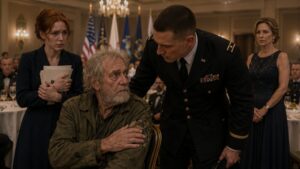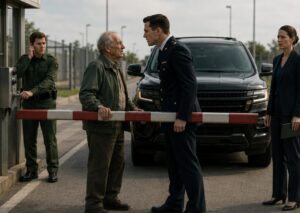
The Wallet He Carried for Forty-Three Years Was Never Really His to Sell
Chapter 1: The Tin Box Beneath His Bed
Mara found her grandfather sitting in the dark with the wallet in both hands.
The lamp beside his chair was off. So was the television. The only light came from the street through the thin curtains, laying a pale rectangle across the floorboards and catching on the cracked leather.
“Grandpa?”
Jerry did not look up.
Mara stood in the doorway with her school jacket half-zipped, one sleeve still caught beneath her backpack strap. She had expected to find him at the kitchen table, counting quarters again, or on the phone pretending not to understand the pharmacist so she could take over. Instead, he sat bent forward in his chair, his elbows on his knees, holding the wallet as carefully as if it might breathe.
“You scared me,” she said.
At that, he blinked and looked toward her. His face seemed older than it had the night before.
“Didn’t hear you come in.”
“The door stuck. I had to shove it.” She dropped her backpack quietly. “Why are you sitting in the dark?”
He gave the wallet one last pass of his thumb along the edge. “Saving electricity.”
“You’re holding it again.”
The words came out sharper than she intended. She knew it at once. Jerry’s jaw tightened, not in anger exactly, but in the way it did when something touched a place he had locked.
“I was looking at it.”
“You’ve been looking at it all week.”
He folded the wallet closed, pressing the clasp down with a careful, practiced motion. It did not catch until the second try.
Mara watched his hands. They were broad and rough at the knuckles, though the skin had thinned over the years. One finger still leaned slightly crooked from an old injury he never explained. She had seen those hands fix a radiator valve with wire, cut her sandwiches into squares when she was little, and hold her mother’s wrist in the emergency room while the nurse searched for a vein.
She had never seen them shake over anything except this wallet.
“The pharmacist called,” she said.
Jerry’s eyes moved to the kitchen counter.
The pharmacy envelope lay there, pale and stiff under the fluorescent light. His old watch rested beside it. The cracked face showed eight minutes past nine.
“I know,” he said.
“They said the new medication has to be picked up by Monday. They said if Mom misses the first dose, it might take longer to get the pain under control.”
“I know.”
“And the insurance only covers part.”
“I heard him.”
Mara crossed the room and picked up the envelope. The number was written in blue ink on the front. She had memorized it already, though she had tried not to. It looked too large for something that came in a small orange bottle.
“Grandpa,” she said, softer now, “we can call Aunt Renee.”
Jerry looked past her, toward the window.
“Your aunt has enough on her plate.”
“She said that’s what family is for.”
“She said that because she is kind.”
“That doesn’t mean we’re not allowed to need her.”
He did not answer. He reached down beside the chair and pulled the small tin box from beneath it. The lid was scratched, once painted green, now worn to gray at the corners. Mara had seen it before, but only from a distance. It usually lived under his bed. He had told her once, when she was ten and curious, that it held papers.
Now it lay open on the carpet.
There was nothing inside but an old handkerchief and the impression where the wallet had rested for years.
“You’re really going to sell it?” she asked.
Jerry’s mouth moved, but no sound came.
He had carried the wallet for as long as Mara could remember. In his coat pocket at the grocery store. Inside the drawer when he changed clothes. Beneath his pillow on the night he spent at the hospital when her mother had surgery. He never let it sit on the kitchen table. He never left it in the car. When Mara had been small, she used to ask why it looked so old.
“It’s not old,” he had told her then. “It’s mine.”
Now he nodded once.
“For Mom?”
“For the medicine.”
“Is it worth enough?”
“I don’t know.”
The answer frightened her more than anything else.
Jerry got up slowly, one hand braced on the arm of the chair. His hip had been bothering him for months, though he still refused to call it pain. He walked to the counter, picked up the envelope, and tucked it into the inside pocket of his coat. The wallet went into the other side.
Mara followed him into the kitchen.
“How much do you think you can get?”
“It’s leather. It’s old. Someone might want it.”
“That isn’t what I asked.”
He looked at her then, and the weariness in his eyes made her wish she had said nothing.
“I don’t know,” he repeated.
The flea market was held every other Saturday in the community lot behind the old library. Jerry had gone there for years, mostly to look. He liked the tables of tools and records, the old radios with missing knobs, the boxes of screws and buttons and keys that belonged nowhere anymore. Sometimes he brought home a jar of nails or a paperback with a cracked spine. He never bought much.
Today, he carried the wallet in his inside pocket as if it were a stone.
They took the bus because Jerry said parking would cost too much. The ride was quiet except for the rattle of the windows and the driver calling stops. Mara sat beside him, knees pressed together, holding the pharmacy envelope in her lap now because he had given it to her without explanation.
At one stop, Jerry checked his watch.
At the next, he checked it again.
“You know it’s working, right?” she said.
“It loses a minute now and then.”
“You got it fixed last year.”
“It still loses.”
Mara looked at the watch. The leather strap was almost as worn as the wallet. There was a thin silver line across the face where it had once cracked.
“Why don’t you get a new one?”
“It tells time.”
“That’s not really an answer.”
“It’s enough of one.”
When they reached the market, the lot was already crowded. Someone had set up speakers near the entrance, playing old songs that skipped between verses. A woman under a blue canopy arranged handmade soap in rows. A man in a knit cap shouted the price of old records as if they were fresh fish. Children moved between tables with paper cups of lemonade, and the air smelled like coffee, dust, and hot metal from a food cart.
Jerry found an empty folding table near a row of mismatched lamps.
He spread his handkerchief across the center, then placed the wallet on it.
Mara stared.
Against the bright clutter around it, the wallet looked smaller than it had in the apartment. The leather was nearly black with age. One corner had been repaired with thick brown thread, each stitch slightly uneven. It looked like an object that had already survived too much to be laid out under the sun.
Jerry wiped it once with the handkerchief.
Then again.
“Grandpa,” Mara said.
He stopped.
“You don’t have to do this.”
His gaze stayed on the wallet. “Your mother needs the medicine.”
“We can still call Aunt Renee.”
“No.”
“Why?”
He pressed his lips together.
Because he was proud, Mara thought. Because he thought needing people was the same as failing them. Because he had been carrying something for so long that he no longer knew how to set it down.
But he only said, “We came here for a reason.”
The first few people walked past without slowing. One woman glanced at the wallet and asked whether it was real leather. Jerry said yes. A man with a baseball cap turned it over but put it down after seeing the price written on a scrap of cardboard.
Seventy dollars.
Mara felt sick when she saw it.
That was all?
Jerry stood behind the table with his shoulders squared, though his fingers kept closing and opening at his sides.
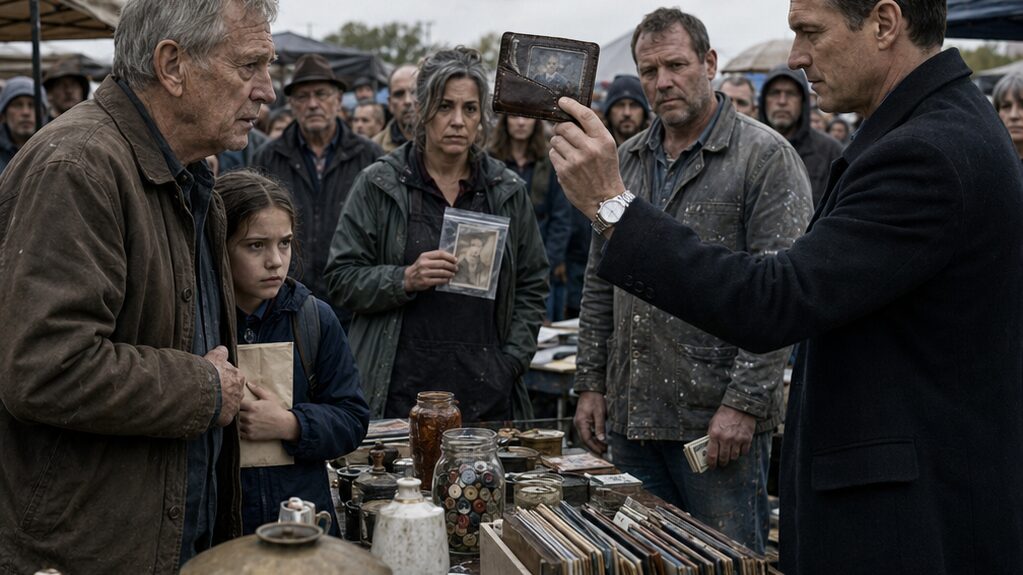
Then a man in a dark wool coat stopped in front of them.
He had a bright watch and polished shoes that did not belong in a dusty parking lot. He looked at the wallet, then at Jerry, as if measuring both.
Before Jerry could say a word, the man reached across the table and picked it up.
Chapter 2: The Man Who Called It Junk
“You want seventy dollars for that?” the man said, holding the wallet between two fingers. “It is junk.”
Jerry’s hand lifted across the table and stopped short.
The wallet hung in the man’s grip, the repaired corner dangling toward the ground. Its old clasp had come loose. When the man turned it over, the fold opened enough for a faded rectangle to show behind the cloudy plastic sleeve inside.
“It is not for you to handle,” Jerry said.
His voice was quiet. That seemed to amuse the man.
“You put it on a table,” he said. “That’s handling.”
Mara stepped closer to Jerry’s side, gripping the pharmacy envelope so hard it made a crackling sound. Around them, the market went on in pieces: a child laughing somewhere behind the lamp tables, a vendor calling out prices, a chair scraping on concrete. But the space directly in front of them felt too still.
“It’s repaired,” Jerry said. “It’s leather. That is the price.”
The man ran his thumb over the stitched seam. “It’s patched. The clasp doesn’t work. You can get better at a thrift shop.”
“It is not a thrift-shop wallet,” Mara said before she could stop herself.
The man looked at her. His smile did not reach his eyes.
“Then why is it sitting on a flea-market table?”
Jerry touched her shoulder lightly, not pushing her back, only asking her to be still.
“It has been repaired,” he said. “That is all.”
The man laughed under his breath. “It is junk.”
The word landed harder than it should have. Jerry’s fingers curled against the table edge.
Mara had heard people dismiss things before. Old furniture. Torn coats. An apartment in a bad building. She had watched adults make little faces when her mother used a cane on bad days. But this was different. The man was not only talking about leather and thread. He was looking straight at Jerry while he said it.
He reached into his coat and pulled out two twenties.
“Forty.”
Jerry did not move.
The man added another bill. “Seventy, then. You came here to sell it. Do not pretend you have a choice.”
Mara felt Jerry’s hand leave her shoulder.
He looked down at his watch.
Eleven twenty-three.
The thin second hand moved steadily across the cracked face.
“We can go,” Mara whispered. “Grandpa, we can leave.”
Jerry did not look at her. His eyes stayed on the wallet, still in the stranger’s hand.
“No,” he said.
The man’s smile sharpened. “No?”
“No,” Jerry repeated. “Not for seventy.”
A voice came from beside the table.
“I’ll give you a hundred.”
The man in the wool coat turned.
The newcomer was younger than Jerry, maybe around fifty, with paint dust on his work boots and a gray jacket marked at the cuff with dried white streaks. He held folded bills in one hand. He had been standing near the records table, though Mara had not noticed him before.
The man with the bright watch scoffed. “You don’t even know what it is.”
“Neither do you,” the newcomer said.
“I know it’s not worth a hundred.”
“You just called it junk.”
“I said what it was worth.”
The newcomer looked at Jerry, not at the wallet. “A hundred,” he said again. “And I’ll leave you alone about it.”
Jerry’s throat moved.
The medicine number was still written in blue ink on the envelope in Mara’s hands. One hundred dollars was not enough. But it was close enough to make everything worse.
The man in the wool coat frowned. “I was here first.”
“You offered him less than the price.”
“That’s called bargaining.”
“It’s called something.”
The stranger with the paint on his boots stepped closer. “A hundred and twenty.”
Mara looked at Jerry.
He had gone pale. His thumb was pressed against the pocket where his watch rested beneath the coat. The wallet was still in the other man’s hand, open just enough for the photograph to show a corner of a face.
“May I see the picture?” the newcomer asked.
Jerry’s eyes snapped toward him.
“No.”
There was no anger in the answer. Only fear.
The newcomer nodded once. “Fair enough.”
Nothing more.
No teasing. No questions. No effort to lean forward and peek.
The plainness of it seemed to catch Jerry off guard. His gaze stayed on the man for a moment, as if he had expected another kind of pressure and did not know what to do without it.
The man in the wool coat looked between them.
“One hundred and thirty,” he said.
“Now it’s worth something?” Mara asked.
Jerry gave her shoulder a small squeeze.
The man ignored her. “I collect military pieces. Old leather, field repairs, markings. It could be from anywhere, but it has a certain look.”
“It’s not a piece,” Jerry said.
The collector shrugged. “Everything is a piece once it’s for sale.”
Jerry’s jaw hardened.
The words were not loud. Still, the woman selling soap at the next table glanced over. So did an older couple sorting through glass jars nearby.
The painted-boots man held out his money. “One hundred and twenty. No picture. No questions.”
Jerry looked at the bills. His hand came up, then fell again.
The pharmacy closes at four, Mara thought.
She imagined the orange bottle behind the counter. Her mother trying to get up on Monday and not being able to. Her mother saying it was fine because she never wanted anyone to see how scared she was.
“Grandpa,” Mara said, barely audible. “It’s almost enough.”
Jerry heard her. She knew because his face changed.
For one second he looked like he might take the money.
Then the collector shifted the wallet in his hand. The plastic sleeve caught on his thumb and pulled slightly free. The faded photograph slid up just enough for more of it to show.
A young man in a heavy coat. Another beside him. Snow or pale dirt behind them.
The woman selling soap leaned forward.
“Oh,” she said.
Jerry reached across the table.
“Give it back.”
The collector held it a moment longer, perhaps because he had not expected the sudden force in Jerry’s voice. Then he dropped it into Jerry’s palm.
Jerry closed the wallet at once. He pressed it flat against his chest.
The painted-boots man lowered his bills. “I’m sorry,” he said. “I didn’t mean to pry.”
Jerry nodded, but he did not relax.
The soap seller stepped out from behind her table. She was small, with silver-streaked hair tied in a loose knot and a dark apron dusted with pale powder from the wrapped bars.
“I saw it by accident,” she said. “The photograph.”
Jerry stared at her.
“I wasn’t trying to look.” She lifted both hands a little, as if approaching a frightened animal. “But those coats. That background.”
Mara’s stomach tightened.
The woman looked toward the wallet. “My father had a picture like that.”
Jerry’s fingers tightened over the leather.
The collector gave a skeptical little laugh. “Of course he did.”
The woman did not look at him.
“There were four men in it,” she said to Jerry. “Standing in front of a barracks. One of them had dark eyebrows and a round face. My father used to point to him and say he owed him his life.”
Jerry’s eyes changed.
Mara had never seen him look afraid of a stranger before. Not truly afraid.
The woman swallowed. “I don’t know if it’s the same man. I don’t know if I’m remembering right.” She looked at the wallet again. “But the young soldier beside him—he may have been my father’s friend.”
Jerry stood motionless behind the folding table, the old wallet held against his heart as though it had suddenly become too heavy to carry.
Chapter 3: The Photograph Behind Cracked Plastic
The woman returned ten minutes later with a photograph wrapped in a clear plastic sleeve.
She had closed up the cash box at her soap table without explanation. Now she stood in front of Jerry’s folding table, breathing a little fast, one hand pressed flat over the picture as if to keep it from slipping away.
“I found it in my bag,” she said. “I bring it sometimes. I don’t know why.”
Jerry had not moved far. Mara stood beside him, still holding the pharmacy envelope. The painted-boots man had stepped back, but he remained nearby, his folded money no longer extended. The collector lingered two tables away, pretending to inspect a lamp.
The woman placed her photograph on the handkerchief beside the wallet.
“May I?” she asked.
Jerry looked at it for a long time.
Then, with a motion so slow Mara almost missed it, he opened the wallet.
The leather creaked softly.
Inside, behind the cracked plastic sleeve, the faded photograph showed two young soldiers standing shoulder to shoulder. Both wore heavy winter coats. Both looked exhausted. One had a broad face and dark brows, and the other was thinner, with a hard-set mouth that did not quite manage a smile.
The woman’s photograph showed four men in front of a low wooden building. The same broad-faced soldier stood at one end.
“There,” she whispered. Her finger hovered above the plastic but did not touch. “That’s him.”
Jerry’s breathing changed.
Mara looked from the photograph to the woman. “Who is he?”
The woman’s mouth opened, but Jerry answered first.
“James.”
It was the first time Mara had heard the name.
Jerry said it like it had been waiting behind his teeth for years.
The woman looked sharply at him. “James Bell?”
Jerry closed his eyes.
When he opened them, he was not looking at her anymore. He was looking at the younger version of himself trapped behind cracked plastic, standing beside a man who had been dead longer than Mara had been alive.
“Yes,” he said.
The woman’s hand rose to her mouth.
“My father’s name was James Bell.”
The market noise seemed to pull away from them. Mara could still hear it, but distantly now: music skipping through a speaker, someone dragging a crate across concrete, a dog barking near the food cart. None of it reached the small space around the table.
Jerry stared at the woman’s face.
She was older than her father had ever become. Mara understood that before anyone said it. She had James’s brows. Not exactly, but enough. The same dark curve above the eyes. The same way the left side of her mouth tightened before she spoke.
“You’re his daughter,” Jerry said.
The woman nodded.
“Cynthia.”
Jerry’s shoulders dropped a fraction.
Mara looked at him. “Grandpa.”
He did not answer.
Cynthia slid her photograph closer to his. “My grandmother kept this one in a drawer. She said it was taken overseas, but she didn’t like talking about it. My mother told me my father had friends there. She never knew much more.”
Jerry’s thumb rested over the stitched seam of the wallet.
“I carried him,” he said.
Cynthia went still.
“Not in the picture,” Jerry added quickly. “Later.”
The words seemed to cost him.
Mara watched him look down at the wallet. She had always thought it was just an old thing he could not bring himself to throw away. A habit. A piece of stubbornness. But now it sat open between them, holding a person she had never known and a silence she had lived beside all her life.
“Why did he give you this?” Cynthia asked.
Jerry did not answer right away.
The painted-boots man shifted his weight. The collector stopped pretending to examine the lamp.
Jerry reached into the wallet and touched the edge of the photograph through the plastic.
“James gave it to me the day before he died,” he said.
Mara felt the words move through her like cold water.
“He had a letter inside. For home. He said he had a baby girl waiting for him.”
Cynthia’s eyes filled, but she did not look away.
“He said if he didn’t make it back, I had to send it.” Jerry’s voice had gone low. “He made me promise.”
“You did?” Cynthia asked.
Jerry nodded once.
“I sent it.”
For a moment, nobody spoke.
Mara imagined a young man she had never heard of, handing this wallet to her grandfather under a gray sky. She imagined Jerry carrying it all these years through grocery stores and hospital rooms and buses, unable to tell anyone why.
“You never told me,” she said.
Jerry looked at her.
There was no defense in his face. That hurt more than anger would have.
“There are many things I never told you,” he said.
Mara pressed the pharmacy envelope against her chest. “Why?”
He looked away.
Cynthia lowered her hand from her mouth. “My grandmother got letters from a man named Ward,” she said carefully. “After the war. She kept them in a ribbon box.”
Jerry’s eyes lifted.
“She said he had been with my father. She didn’t say much else.” Cynthia glanced at the photograph between them. “But the letters stopped.”
The collector moved closer again, interest brightening his expression now that the story had a history attached to it. Jerry noticed. He closed the wallet halfway, shielding the photograph.
Cynthia saw the motion.
“I’m not asking to take it,” she said quietly. “Not today. I only wanted to know if this was real.”
Jerry looked at her for a long time.
“It’s real,” he said.
“Then why did you disappear after my grandmother wrote to you?”
Chapter 4: The Promise He Turned Into Punishment
Mara found Jerry at the far edge of the market, trying to tuck the pharmacy envelope deeper into his coat as if hiding it might make the number disappear.
A fine rain had started, not enough to send people running but enough to darken the concrete and make the canvas awnings snap overhead. Jerry stood beside a stack of empty crates near the parking lot, his back turned to the tables.
“Grandpa.”
He did not turn.
Behind her, Cynthia came slowly through the damp air, holding her photograph inside her jacket. The painted-boots man—Frank, she had heard someone call him—stayed near the market entrance, giving them space. The collector remained at the tables, his dark coat unmistakable among the bright tarps.
“I need some air,” Jerry said.
“You need to answer her,” Mara said.
He looked over his shoulder then. Rain dotted the gray hair above his collar. “Not here.”
“You’ve had forty-three years to find somewhere else.”
The words came out with more force than she had planned. Jerry flinched as if she had raised her hand.
Mara hated herself for it, but she did not take them back.
Cynthia stopped a few feet away. “You don’t owe me a clean story,” she said. “You don’t even owe me the whole story. But don’t walk away like I’m asking you for something you stole.”
Jerry’s fingers went to his watch.
The cracked face caught the weak light. He rubbed the silver line through the glass with his thumb.
“There was a bridge,” he said.
Mara waited.
The rain thickened. A market worker began calling for vendors to cover their tables. Somewhere close, metal legs scraped over concrete.
“It was winter,” Jerry said. “Cold enough that your canteen froze overnight if you forgot it by the door. We were crossing a small bridge with equipment behind us. It had been hit before. Everyone knew it was weak.”
His voice was flat, as though he were reading numbers from a page.
“James was ahead of me. He had that wallet inside his coat. He kept touching it all day. Said he’d gotten a picture sent from home. His wife had written that his baby had started smiling.”
Cynthia shut her eyes.
Jerry looked toward the road beyond the market lot.
“There was a sound under the boards. Not loud. Just a crack. Then the middle gave way.”
Mara had seen him limp after bad weather, had watched him shift his weight off one hip whenever he thought no one noticed. She had never asked where it came from. He had never offered.
“I got across,” he continued. “James didn’t. He was caught under the edge. I climbed down.”
His hand closed over the watch.
“I pulled him out. Or tried to. I don’t know which one is the right word anymore.”
The rain ticked against the plastic roof of a nearby stall.
“He was alive when I got to him,” Jerry said. “He gave me the wallet. Told me about the letter inside. Made me promise.” He swallowed once. “Then he told me not to make a face like that, because his little girl was waiting for him.”
Cynthia’s breath caught.
Jerry’s gaze dropped to the wet pavement.
“He died before morning.”
Mara said nothing. She could not. The image had formed in her mind anyway: her grandfather younger than she could picture, covered in mud or snow, holding a stranger’s father while the whole world shook around them.
“I sent the letter,” Jerry said. “I wrote one too. To his wife. I told her he was brave. I told her he talked about them.”
“That was true?” Cynthia asked.
“Yes.”
“Then why did you stop?”
Jerry’s jaw worked.
“I got letters back. From your grandmother.” He looked at Cynthia at last. “She thanked me. She asked questions. She wanted to know what he said, what he ate, whether he was afraid.”
Mara saw his face fold inward.
“I had answers,” he said. “But none of them were enough. I was the one who came home. Every letter felt like I was reminding her of that.”
Cynthia shook her head gently. “My grandmother wasn’t angry with you.”
“You don’t know that.”
“I do.” Her voice tightened. “She kept the letters. All of them. She tied them with a blue ribbon and put them in the drawer where she kept my mother’s school papers. She read them when she thought nobody was looking.”
Jerry stared at her.
“She moved twice after my father died,” Cynthia continued. “Then she got sick. The letters got fewer because life got smaller. Not because she hated you.”
The rain had begun to run in thin streams off the edge of the awning.
Jerry looked down at his watch again.
“It stopped that night,” he said.
Mara glanced at the face. “Your watch?”
He nodded.
“Water got inside it. It stopped at three seventeen.” His thumb paused over the crack. “I had it repaired years later. But I kept thinking if I wore it, maybe I’d remember what I was supposed to remember.”
“What were you supposed to remember?” Mara asked.
Jerry’s eyes went to the market tables, to the wallet under the handkerchief, to the photograph he had guarded from everyone.
“That I should have done more.”
Cynthia stepped closer.
“You carried him,” she said. “You sent the letter. You kept him with you all these years.”
“That isn’t the same as saving him.”
“No,” she said. “It isn’t.”
The honesty of it made Jerry look at her.
Cynthia’s eyes were wet, but her voice was steady. “You don’t get to turn my father into a punishment you hand yourself forever. He was a person. He had a wife. He had a daughter. He had people who loved him. And it sounds like he had a friend who tried.”
Jerry’s face tightened.
Mara watched him absorb it, not like comfort, but like something harder to bear because it might be true.
A shadow moved at the end of the aisle.
Michael stood beneath the edge of a striped canopy, his coat dry except for the shoulders. He held a thick envelope in one hand.
“I didn’t mean to interrupt,” he said, though his posture said he had been listening long enough to know better.
Jerry’s expression closed.
Michael looked at the wallet table. “I understand the value better now.”
“No,” Jerry said.
Michael’s mouth shifted, almost impatiently. “I mean its market value.”
He held out the envelope.
“Five hundred,” he said. “Cash. Right now.”
Mara looked at Jerry.
Five hundred dollars was more than the medicine. More than enough to end the argument about the pharmacy. For a second, even Jerry seemed to feel the weight of it.
Then Michael added, “But the photograph stays inside. I’m buying the wallet as it is.”
The rain ran steadily from the canopy between them.
Jerry’s hand closed around his old watch.
Chapter 5: What the Wallet Was Really Worth
Michael placed the envelope on the folding table beside the wallet.
The paper landed with a soft, final sound.
“Five hundred,” he said. “You said you needed money. There it is.”
Jerry stood behind the table without touching it. Mara could see the muscles in his jaw working.
The market had thinned under the rain. Vendors were covering boxes with plastic sheets, moving lamps and books farther from the edges of their tables. The music had stopped. Somewhere down the row, a child complained about wet shoes.
Michael rested two fingers near the envelope.
“I’m not trying to insult you now,” he said. “The wallet has history. The photograph gives it context. Without it, you have an old repaired leather case. With it, you have provenance.”
Jerry looked at him as though he had spoken another language.
“Memories matter more than medicine?” Michael asked.
Mara felt heat rise in her face.
“You don’t get to ask him that,” she said.
Michael glanced at her. “I’m asking because he is making it the question.”
“No,” Jerry said.
His voice was low, but it cut through the rain.
Michael looked back at him.
Jerry placed his palm over the wallet. “You are making it that question.”
For the first time since he had arrived, Michael seemed unsure of his footing. He looked at the envelope, then at Jerry’s coat pocket, where the pharmacy paper made a small rectangular bulge.
“You brought it here,” he said. “You put a price on it.”
“I put a price on the wallet.”
“And the photograph is in the wallet.”
“It does not belong to you.”
Michael’s eyes narrowed. “Then take it out.”
Jerry did not move.
Mara looked at him. “Grandpa.”
He kept his hand on the wallet.
The object had become the whole table now. The chipped lamps, the jars of buttons, the faded records around them might as well have vanished. There was only the leather, the damaged seam, the cloudy sleeve inside, and the envelope with enough money to make every fear smaller.
Michael gave a short breath through his nose. “You want to talk about sentiment, fine. But it’s not a crime to collect history. I’ve bought letters, medals, uniform pieces. Things people throw away because they don’t know what they have.”
“That is not what this is,” Jerry said.
“How do I know?”
“You don’t.”
The answer stopped Michael.
Mara watched the collector’s face. There was irritation there, but something else too. A need to be right. A need to make the story fit the shape of an object he could own.
Her phone began to ring.
The sound was too loud.
She looked down. The pharmacy number glowed on the screen.
Jerry saw it.
Mara hesitated before answering.
“Hello?”
The pharmacist’s voice came through faintly, professional and tired. Mara turned away from the table so no one else could hear.
“Yes,” she said. “Yes, I understand.”
Her hand tightened around the phone.
“What time?”
She closed her eyes.
“Okay. We’ll be there.”
When she ended the call, Jerry had not moved.
“They close at four,” she said. “The pharmacist said if we don’t pick it up today, they can hold it, but the next shipment isn’t certain. Mom’s prescription is already delayed.”
Jerry looked at his watch.
Three minutes past one.
The crack across its face seemed deeper than before.
Michael tapped the envelope once. “Five hundred.”
Mara turned toward Jerry. “Mom would never want this.”
He looked at her.
“She would never want you to sell his picture,” Mara said. “Not after what Cynthia told us.”
Jerry’s eyes went to the wallet.
“He stitched it,” he said.
Mara blinked. “Who?”
“James.”
His thumb found the uneven brown thread.
“The seam tore in the field. We were sitting in a storage room because the weather had us pinned down. He had a little sewing kit someone sent him from home. Kept it in a tobacco tin. He said his wife laughed at him for carrying it.”
His voice had gone quieter, but the people nearby had stopped pretending not to listen.
“He stitched it with hands that shook whenever he tried to thread the needle,” Jerry continued. “I told him it looked crooked. He said it would hold.”
Mara watched his thumb travel along the seam.
“After he died,” Jerry said, “the thread started coming loose. Years later, I repaired it. I thought if I could keep the wallet from falling apart, I was doing something useful.”
His hand trembled once.
“I never knew how to take the picture out,” he said. “It felt like opening a door I didn’t have the right to open.”
Michael’s expression shifted. He looked down at the seam, then away.
Mara stepped closer to Jerry.
“You have the right,” she said. “You were the one he asked.”
Jerry looked at her, and for a second she saw how tired he was. Not just from the day. Not from the pain in his hip or the rain or the money. Tired in a way that had been building for decades.
Frank approached from the aisle, umbrella tucked beneath one arm.
He had been watching from a distance, but now he set it against the table and pulled the folded bills from his pocket.
Jerry noticed at once. “No.”
Frank did not put them down yet.
“I know,” he said. “You don’t know me.”
“That is not the problem.”
“I figured.”
Frank looked at the wallet, then at Mara. “I had a sister who got sick. Years ago. I had money trouble too. I kept saying I’d handle it. Didn’t want help. Didn’t want anybody thinking I couldn’t take care of my own family.”
Jerry’s face remained guarded.
Frank’s mouth tightened. “I was wrong about what help meant. That’s all.”
He placed the bills on the table beside the pharmacy envelope.
“For the medicine,” he said. “No wallet.”
The rain beat harder against the awnings.
Jerry stared at the money as if it might accuse him.
Chapter 6: The Help He Could Not Accept
Frank’s bills sat beside the pharmacy envelope, untouched.
They were not stacked like Michael’s cash. They were folded unevenly, softened at the corners from being carried in a work jacket. Still, Jerry looked at them with the same alarm he had shown when Michael held up the wallet.
“No,” Jerry said.
Frank did not reach for the money. “All right.”
“I can’t take that.”
“Then don’t take it yet.”
Jerry looked at him sharply.
Frank shrugged one shoulder. “It can sit there for a minute.”
The market was almost closing now. Rain had driven most shoppers away, leaving only vendors packing boxes beneath sagging tarps. The woman at the soap table—Donna, Mara had learned—walked over with her apron tied tight around her waist.
She looked at the bills, then at Jerry.
“You don’t have to make a speech,” she said. “Nobody needs one.”
“I’m not taking money from strangers.”
Donna nodded toward the wallet. “You were about to sell part of your life to a stranger.”
“That was different.”
“Was it?”
Jerry’s face hardened.
Mara wanted to defend him, but she could not say Donna was wrong.
Donna reached into the pocket of her apron and took out a twenty-dollar bill. She set it beside Frank’s money.
Jerry shook his head immediately. “Please don’t.”
“It’s not payment,” Donna said. “It’s not pity either.”
“You don’t know me.”
“No,” she said. “But I know what it looks like when somebody thinks suffering alone is the only honest way to suffer.”
Jerry looked away.
The sentence hung between them.
A mechanic from the next row came over and placed a ten-dollar bill near the envelope. Then the older woman with the glass jars added another. Nobody announced it. Nobody smiled broadly or waited for thanks. They simply set down what they had and returned to their wet tables.
Mara watched Jerry’s discomfort grow with every bill.
He had faced Michael’s insults without raising his voice. He had faced Cynthia’s questions with a kind of wounded silence. But this was different. This kindness had nowhere for him to push.
“You don’t understand,” he said.
Frank’s eyes stayed on him. “Maybe not.”
“If I take it, then what?” Jerry asked. “Everybody gets to feel good because they saved an old man at a flea market?”
Donna’s mouth tightened. “No one is saving you.”
Jerry looked at the money again.
“You’re helping me because you heard a story.”
“We’re helping because your granddaughter is standing here holding a pharmacy envelope,” Donna said. “The story is why we stopped walking.”
Mara’s throat burned.
Jerry moved as if he might sweep the bills back across the table. She caught his wrist before he could.
His skin was cool from the rain.
“Grandpa,” she said.
He looked at her.
“Please let people do one good thing.”
His hand stayed suspended above the table.
“You don’t have to make them prove they deserve it,” she whispered.
Something in his face broke—not loudly, not all at once. His shoulders simply lowered. The hand she held stopped fighting hers.
Frank picked up the bills, straightened them, and slid them carefully into the pharmacy envelope.
Jerry watched but did not stop him.
Mara let out a breath she had not realized she was holding.
Michael stood several feet away beneath the striped canopy, his five-hundred-dollar envelope still in his hand. The market crowd had changed the shape of the day. His offer was no longer the only bridge between Jerry and the pharmacy counter.
He looked at the wallet.
Then at Cynthia, who stood near the soap table with both photographs tucked safely inside her jacket.
Michael’s expression went flat.
“That covers the prescription?” he asked.
Mara looked at the envelope. “Almost.”
Donna glanced toward the pharmacy paper. “How much short?”
Mara told her.
The mechanic took out another bill. Frank reached for his wallet again.
Jerry shook his head, but there was less force in it now.
“No more,” he said.
Frank nodded. “All right.”
It was enough. Not much more than enough, but enough to get the medicine today.
Mara held the envelope in both hands. The weight of it was strange. It had been nearly empty that morning. Now it felt warm from other people’s pockets.
Jerry looked at the wallet.
For the first time since he had taken it from the tin box, he did not pick it up.
Michael stepped forward.
“Mr. Ward,” he said.
Jerry did not answer.
Michael drew a second envelope from inside his coat.
It was smaller than the first, white and sealed.
“I want to make a different offer,” he said.
Chapter 7: The Photograph Finds Its Way Home
Michael held the second envelope out, but Jerry did not take it.
Rainwater dripped from the edge of the canopy between them. Behind Michael, vendors were folding tables and carrying boxes toward their cars. The flea market had become a place of wet concrete, loose plastic, and things being packed away.
“What offer?” Jerry asked.
Michael looked at the wallet before he answered.
“I’ll buy the wallet,” he said. “Only the wallet.”
Cynthia’s hand closed around the photograph inside her jacket.
“And?” Jerry said.
“And the photograph stays with her.” Michael nodded toward Cynthia. “That was clear enough.”
Jerry’s face did not change.
Michael glanced down at the sealed envelope. “This is a pharmacy gift card. It should cover the next refill too.”
Mara looked from him to the envelope. “Why?”
Michael let out a breath and rubbed rain from his sleeve.
“Because I was wrong about what I was looking at,” he said. “I thought it was an object with a story attached. I didn’t understand that the story was the thing.”
Donna gave him a look that made it clear she was not impressed by the wording.
Michael seemed to notice.
“I’m not asking anyone to forgive me,” he added. “I handled it badly. I know that.”
Jerry’s eyes stayed on him.
“You knew I needed money,” Jerry said.
Michael nodded once.
“Yes.”
“And you thought that meant you could decide what I had to give up.”
“Yes.”
The answer came without defense. It did not make the moment easier.
Michael held out the envelope again. “You can refuse it. You can refuse all of it. But the wallet still has value to me, even without the photograph. I would pay five hundred for it.”
Jerry looked at the table.
The wallet rested on the handkerchief where he had placed it that morning. It looked worn and ordinary now, almost small enough to disappear beneath his palm. Forty-three years of bus rides, hospital chairs, store counters, rain, and quiet rooms had been pressed into that leather.
He picked it up.
The old clasp opened with a soft click.
For a moment, he saw nothing but the cloudy plastic sleeve and the faded edge of the photograph. Then the market disappeared from his attention. He remembered a storage room with wet boots lined against a wall, a boyish laugh in a place where laughter had seemed dangerous, and James hunched over the torn seam with a needle between his fingers.
It would hold, James had said.
Jerry had believed him.
He looked down at the thread. His own repair sat beside James’s, darker and clumsier. For years, he had thought the second line of stitching was proof that he had kept something alive. Now he could see another possibility.
He had not repaired the wallet to protect James.
He had repaired it because he was afraid that, without the wallet, there would be nothing left for him to hold.
“Jerry,” Cynthia said softly.
He looked up.
She had taken her photograph from inside her jacket. She held it with both hands, careful not to bend the corner.
“I don’t want to take anything from you,” she said. “Not the picture. Not the memory. But I would like to know him.”
Jerry’s thumb rested over the plastic sleeve.
“You do know him,” he said.
“Not like you did.”
“No.” He swallowed. “Not like I did.”
Mara stepped nearer, close enough that her shoulder brushed his arm.
“You can tell her,” she said.
Jerry looked at his granddaughter. In the morning, she had stood in his apartment doorway and asked why he was sitting in the dark. He had given her almost nothing. Now she was asking him to do the thing he had avoided for most of his life.
His fingers slid beneath the edge of the photograph.
The paper resisted at first. It had been pressed inside the sleeve for so long that it seemed part of the wallet. Jerry lifted it carefully, inch by inch.
The photograph came free.
The wallet felt lighter immediately.
He held the picture between both hands. The young men in it had no idea what was waiting for them. They had been cold, tired, and trying to smile for whoever might someday look back at them.
Jerry turned toward Cynthia.
“Your father used to whistle when he was nervous,” he said. “Couldn’t carry a tune. Drove everybody crazy.”
Cynthia laughed once through her tears.
“He kept a sewing kit because he said his wife would be ashamed of him if he came home looking like he’d been dragged through a fence.” Jerry’s mouth trembled. “And he talked about you. Every day after he got that picture.”
Cynthia’s hand rose, but she did not take the photograph yet.
Jerry looked down at it one last time.
“I should have found you sooner,” he said.
Cynthia shook her head. “You found me today.”
He placed the photograph in her hands.
For a second, neither of them let go.
Then Jerry released it.
The empty wallet lay open in his other hand.
Michael reached into his coat and brought out the five-hundred-dollar envelope. He set it on the table, then placed the pharmacy gift card beside it.
“The wallet,” he said quietly. “If you’re still willing.”
Jerry closed the wallet and looked at it.
“You can have the leather,” he said. “You cannot have the story.”
Michael nodded. “I understand.”
Jerry handed it over.
Michael accepted it with both hands. He did not lift it for inspection. He did not turn it over. He simply placed it inside his coat.
Mara took the envelopes from the table and slipped them into the pharmacy packet with the other money. Her fingers shook as she checked the time on Jerry’s watch.
“It’s three twenty-two,” she said. “We have to go.”
Jerry looked toward the parking lot.
The bus stop was two blocks away. The pharmacy sat across town. His hip ached, and the rain had made the pavement slick.
Frank stepped forward with his umbrella. “My truck’s there.”
Jerry started to refuse.
Mara caught his sleeve.
He looked down at her hand.
Then he nodded.
The pharmacy was nearly empty when they arrived. The clerk had already pulled down half the metal grate at the front. Mara went to the counter with the envelope while Jerry stood a few steps behind her, rainwater darkening the shoulders of his coat.
Cynthia stayed beside him, holding the photograph against her chest.
The clerk counted the money, scanned the card, and disappeared behind the shelves.
Jerry watched Mara through the glass divider. She looked suddenly younger than she had all day.
When the clerk returned with the small white bag, Mara took it with both hands.
The receipt fed slowly from the machine.
Jerry heard the printer before he saw the words.
Paid in Full.
Chapter 8: A Promise Shared Instead of Carried Alone
The tin box looked wrong without the wallet.
Mara found Jerry at the kitchen table the next morning, holding the open box in both hands. Sunlight came through the window in a pale strip and rested across the scratched lid.
He had placed the old handkerchief inside, folded neatly. Nothing else.
“It feels heavier,” Mara said.
Jerry looked up.
He had already dressed, though he had nowhere to go. His old watch lay on the table beside a soft cloth. He had been polishing the cracked glass with slow circles.
“It shouldn’t,” he said.
“No,” Mara said. “But it does.”
He gave the smallest nod.
The apartment was quiet in a different way than it had been the day before. Not the silence of someone hiding something. More like the pause after a door had been opened and nobody had yet stepped through.
Mara sat across from him.
On the counter, the medicine bag stood beside a cup of water. Her mother was still asleep in the next room, worn out from another long night, but the prescription had been picked up. The first dose would not fix everything. Mara knew that. Still, it was there.
Jerry picked up his watch.
“I didn’t tell you the whole thing,” he said.
Mara waited.
He turned the watch over in his hand. The strap was cracked at the edges. The metal back was dull from years of use.
“When James gave me the wallet, he said something else.” Jerry’s gaze stayed on the watch. “He said, ‘Don’t make me into a sad story for my girl.’”
Mara felt her throat tighten.
“I told him I wouldn’t.” Jerry’s thumb passed over the cracked face. “But after he died, that’s all I could see. The bridge. The letter. The way he kept talking about home.”
He set the watch down.
“I thought keeping the wallet was keeping my promise. I thought carrying it meant I hadn’t left him behind.”
“And now?” Mara asked.
Jerry looked at the empty tin box.
“Now I think I used it to stay in one place.”
Mara reached across the table and touched the edge of the box.
“You didn’t leave him behind,” she said. “You brought him home.”
Jerry’s eyes lifted to hers.
“For forty-three years,” she added. “You just didn’t let anyone else meet him.”
Something moved in his expression. Not relief exactly. Relief was too simple. But the words seemed to settle somewhere he had kept bare.
A knock sounded at the door.
Jerry stiffened.
Mara got up first. On the other side was an envelope tucked beneath the mail slot, its corners damp from the morning air.
She brought it back to the table.
Cynthia’s name was written on the front.
Jerry did not touch it.
“You open it,” he said.
“No,” Mara said. “It’s for you.”
He stared at the envelope for a long time before sliding one finger beneath the flap.
Inside was a note and a photograph.
The photograph had been taken at the flea market. Donna must have taken it without anyone noticing. Jerry stood beside Cynthia beneath the striped canopy, both of them holding the old picture between them. Jerry looked tired. Cynthia looked like she was trying not to cry. In the background, Mara could see the blurred edge of Frank’s umbrella and the soap table covered in plastic.
Jerry read the note silently.
Then he read it again.
“What does it say?” Mara asked.
His voice was rough when he answered.
“She says her grandchildren know almost nothing about James. She wants them to.” He looked down at the photograph. “She says they would like to meet me.”
Mara smiled a little. “That’s good.”
Jerry did not smile back.
“It’s been a long time.”
“I know.”
“What if I don’t know what to say?”
Mara pulled out the chair beside him.
“You know what he whistled like.”
Jerry gave a quiet breath that might have been a laugh.
“You know he had a sewing kit,” she continued. “You know he wanted his daughter to know he was thinking about her.”
He looked at the note again.
Mara took the new photograph and placed it inside the tin box.
It fit there differently than the wallet had. It did not fill the whole space. It did not need to.
Jerry watched her close the lid.
Then he picked up his watch and set it beside Cynthia’s note.
“Do you think they would want to hear about him?” he asked.
Mara looked at him.
“Yes,” she said. “I think they already do.”
The story has ended.