The Ramp Her Husband Built Was Nearly Taken Before Her Mother Could Escape
Chapter 1: The Engine That Entered Before Sunrise
The engine was already backing into the driveway when Carol woke.
For one confused second she thought it was thunder, low and close beneath the bedroom floorboards. Then the window glass gave a small shiver in its frame, and she was out of bed before she had fully opened her eyes.
She crossed the room in bare feet and pulled aside the curtain.
A crane truck was reversing between the curb and the flower bed Joseph had planted the spring before his stroke. Its orange lights revolved across the neat houses of Bellwether Lane, painting the gray-blue shutters of Carol’s home in sudden flashes. Behind it, a white contractor van idled with its headlights on.
Carol’s hand tightened on the curtain.
“No,” she said, though the room was empty.
From the hall came the soft scrape of Ruth’s wheelchair.
“Carol?” her mother called. “What is that noise?”
Carol did not answer at once. The ramp lay beneath the bedroom window, sloping from the front porch to the driveway in a long, clean line. It had been painted to match the shutters, though the sun had faded the boards at the edges. The handrail had gone smooth where palms had rested on it for years.
The crane’s outriggers unfolded.
One pressed into the grass beside Joseph’s old hydrangeas.
Carol found her jeans on the chair, pulled them on, and reached for the faded green cardigan hanging behind the bedroom door. In its deep pocket, folded and unfolded so often the paper had become soft at the creases, was the envelope she had kept near the phone for months.
She went downstairs two steps at a time and then stopped herself. Ruth’s door was open. Her mother sat in the hallway, a blanket over her knees, her thin hands folded over the medical bag she carried everywhere now.
“Why is there a truck?” Ruth asked.
Carol bent to tuck the blanket more closely around her legs. “I’m going to see.”
“It’s the ramp, isn’t it?”
Carol looked up.
Ruth’s face had changed in the way it did when she already knew the answer but wanted Carol to say something gentler.
“It may be about the ramp,” Carol said.
The front door was unlocked. Carol had forgotten to latch it the night before, after taking in the mail. She opened it to the smell of cut grass, warm pavement, and charcoal smoke drifting from across the street.
Saturday had begun early on Bellwether Lane. Folding chairs were arranged on Christopher Young’s lawn. A cooler sat beside his garage. Someone had started a grill, and the smoke passed lazily through the trees, carrying the sharp scent of sausages.
Now everyone was looking toward Carol’s house.
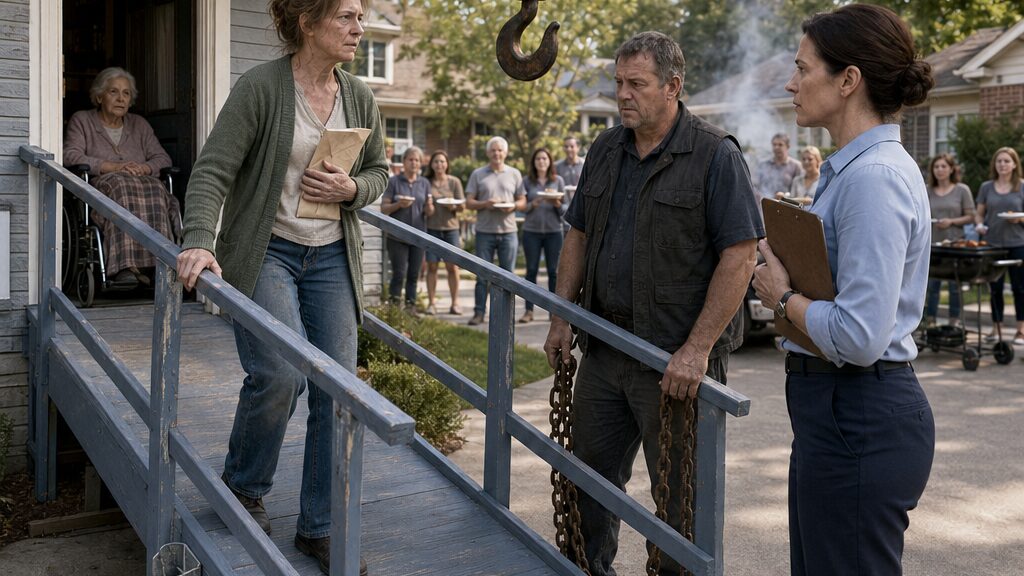
The crane truck had blocked half her driveway. Two men in work vests were lowering equipment from the back. Behind them stood Michelle Harrow in a pale blue blouse, a clipboard held against her chest.
Carol walked down the ramp, one hand sliding along the rail.
Michelle watched her approach with the composed expression she wore at HOA meetings. Not angry. Not embarrassed. Simply prepared.
“Carol,” she said. “You received the notices.”
“I received three letters in six months.” Carol stopped at the bottom of the ramp. “And I answered every one.”
“The committee found no approved variance in the current file.”
“Because the current file is missing it.”
Michelle’s mouth tightened very slightly. “That is not an appropriate conclusion.”
“It is the only conclusion.” Carol felt the envelope in her pocket, its softened corners pressing against her palm. “I sent copies of the city permit. I sent the contractor invoice. I sent the approval letter.”
“You sent materials the committee reviewed.”
“You never reviewed this one.”
The crane’s hook swung slowly above the truck bed. It made a faint metallic click each time it turned.
Michelle looked past Carol at the ramp. “The structure was installed without an approval located in the association archive. The deadline to remove it was Thursday.”
“Thursday?” Carol repeated. “You sent that letter on a Monday.”
“The original warning was sent months ago.”
“Months ago I called your office and asked where the old records had gone. I was told they were being transferred.”
“And they have been transferred.”
“Not properly.”
Michelle held the clipboard a little higher, as if it could protect her from the accusation. “We cannot make enforcement decisions based on documents that are not verifiable in the association system.”
Carol glanced toward the front door. Through the screen, Ruth’s wheelchair was visible in the dim hallway.
“My mother lives here.”
“I understand your personal circumstances are difficult.”
“No,” Carol said. “You understand that there is a ramp.”
Across the street, Christopher stood beside the cooler with a paper plate in one hand. His wife was near the grill, pretending to adjust something on the table. Children slowed their movement between the chairs and watched openly.
Carol hated that most of all. Not their eyes exactly. The ease with which people looked when they believed they were witnessing someone else’s mistake.
Michelle’s voice remained level. “The ramp has been in place for three years. That does not make it compliant.”
“It has been in place because my husband built it after his stroke.”
Michelle did not respond.
Carol could see Joseph as clearly as if he were standing at the porch beside her: pencil tucked behind one ear, one shoulder held stiffly after therapy, staring at the unfinished rails with mock disgust.
“Ugly thing,” he had said.
“It’s not ugly.”
“It’s a runway for a spaceship.”
“It’s a ramp.”
He had smiled, tired and bright at once. “It’s my runway.”
He had measured every angle twice. He had insisted on the turning space at the porch, the rail at the exact height the rehabilitation nurse recommended, the small metal bracket near the entrance for an oxygen tank. At the time Carol had told him he was planning for disasters that would not happen.
Then, after he died, Ruth had fallen in her own kitchen and begun using the chair.
The runway stayed.
A broad man in a work vest approached from the crane truck. The name J. HARTMAN was stitched above his pocket.
“Ma’am,” he said, “we need the work area clear.”
“You’re not taking it.”
He gave a brief look toward Michelle. “We have an order.”
“You have a chain,” Carol said. “That is not the same thing.”
The man’s face did not harden, but it closed. “I’m here to remove a structure.”
“You’re here to remove the only safe way my mother can leave this house.”
Michelle exhaled through her nose. “Carol, no one is preventing your mother from leaving her home.”
Carol turned and pointed toward the back of the house. “There are three brick steps at that door. Uneven ones. She fell there once.”
The words came out sharper than she intended. Across the street, Christopher lowered his plate.
Michelle’s eyes moved briefly toward the side yard, then back to Carol. “That does not change the issue before the committee.”
The contractor supervisor called to one of the younger workers. “Bring the chain.”
The younger man lifted it from the truck bed. The links dragged over the metal edge with a sound that made Carol’s stomach tighten.
He carried it toward the ramp.
Carol stepped forward.
Chapter 2: The Chain Around Joseph’s Handrail
The crane cable began to lower before Carol reached the foot of the ramp.
The hook descended with a controlled, mechanical hiss, its shadow sliding across the gray-blue boards. Carol moved into the open space between the ramp and the contractor, one arm held out without thinking.
“Stop,” she said.
The younger worker carrying the chain stopped first. He could not have been much older than Christopher’s son. His gloves were new enough that the rubber palms still looked clean.
Behind him, Jerry Hartman checked the angle of the cable. “Ma’am, you need to move away from the work zone.”
“I need five minutes.”
“You had months,” Michelle said.
Carol looked at her. “You know what this is for.”
“I know what the committee was told it was for.”
“That is not the same thing.”
The chain hung from the younger worker’s hands, coiled and heavy. He looked from Carol to Michelle and then toward the front door. Ruth’s wheelchair stood behind the screen, only half visible from where he was.
Michelle spoke as if she were reading from a letter. “The committee has no current approved variance, no verified record of an accessibility determination, and no authority to allow an unapproved exterior structure to remain indefinitely.”
“Indefinitely?” Carol repeated. “My husband built it with a permit.”
“A municipal permit is not architectural approval.”
“He had architectural approval.”
“That is disputed.”
Carol put her hand into her cardigan pocket and took out the envelope.
The paper had been folded so many times it no longer opened flat. She pulled the flap apart carefully, as though the old glue might take offense. Inside were copies of a city permit, a contractor invoice, a rehabilitation recommendation, and the letter with its faded letterhead.
“I have it,” she said.
Michelle’s face did not change. “You have submitted documents.”
“You did not submit this to yourselves. You sent me a form and then told me the attachment was incomplete.”
“The attachment could not be authenticated.”
“Because no one bothered to look at the signature.”
Jerry lifted one hand toward the crane operator. The cable stopped in midair.
Michelle turned to him. “Mr. Hartman.”
“I’m not making a decision,” he said. “I’m making sure I don’t damage something I shouldn’t.”
Carol unfolded the approval letter. Her fingers trembled enough that the page fluttered in the warm breeze. She pressed it against the rail to steady it.
The younger worker crouched near the lower section of the ramp, setting the chain down. His glove brushed the underside of the handrail.
He paused.
“There’s something here,” he said.
Carol looked down.
A faded red-and-white sticker clung to the wood just beneath the rail. The corners had lifted from rain and sun, but the words remained visible.
EMERGENCY ACCESS — KEEP CLEAR.
Beside it was the small metal bracket Joseph had bolted into place years ago.
“What’s that for?” the younger worker asked.
For a second, Carol could not answer.
The bracket was no larger than her hand. She remembered Joseph arguing with the contractor about it while his oxygen tubing rested over one shoulder. He had been embarrassed by the tank, by the portable machine that hummed beside his recliner, by the way every outing required a list.
“You don’t need it on the ramp,” Carol had told him.
“I need it where I can reach it,” he had said.
Now the worker waited, still looking at the bracket.
“It held an oxygen tank,” Carol said. “When my husband came home from the hospital.”
Jerry’s eyes shifted toward the front door.
“The ramp was built so paramedics could get him out,” Carol continued. “If he couldn’t walk.”
From inside, Ruth called, “Carol?”
Her voice was soft, but it crossed the quiet yard.
Carol swallowed. “And it is still here because my mother uses it.”
Michelle’s expression remained firm, though something in her posture changed. “The structure’s past use is not the issue.”
“It is current use,” Carol said.
“You have not established that.”
Carol let out a sound that was almost a laugh, except there was nothing in it that wanted to be heard. “She is sitting right there.”
Michelle’s gaze moved toward the screen door. For the first time, she looked directly at Ruth’s wheelchair.
Then she looked away.
“Your mother has other access,” Michelle said.
“No.” Carol’s voice lowered. “She does not.”
Christopher had crossed halfway into the street. His paper plate was gone now. He stood with his hands at his sides, watching.
Carol could feel all of them waiting for her to soften the truth into something easier. She had spent almost two years doing exactly that. She told people Ruth was “recovering.” She told visitors the chair was temporary. She said they used the ramp “sometimes.” She never said that Ruth woke at night afraid of falling. She never said that the three back steps had become a wall.
“The back door opens onto broken brick,” Carol said. “The walkway narrows at the gravel. She cannot get a chair through it. She cannot use it safely. This ramp is how she gets outside.”
The younger worker stood up slowly. The chain remained on the ground beside his boot.
Jerry reached for the letter in Carol’s hand. “May I?”
Carol hesitated, then gave it to him.
He read it with the blunt concentration of someone accustomed to paperwork that might later become someone else’s problem. His thumb moved down the page.
Michelle stepped closer. “That document is not in our archive.”
“It says medical accommodation,” Jerry said.
“It says something someone typed years ago,” Michelle replied. “There is no verified file number attached.”
“There’s a city permit number,” Carol said.
“Which does not settle HOA approval.”
Jerry looked at the letterhead again. “Who signed it?”
“Matthew Bell,” Carol said. “He was chair then.”
“Former chair,” Michelle said. “And not a current representative of this association.”
Carol felt her anger pulse behind her ribs. “You are standing in my driveway with a crane because you cannot find a piece of paper.”
“We are here because the association cannot make exceptions based on private claims.”
“Private claims?” Carol said. “My mother is inside. The emergency sticker is under your chain. What part of this is private?”
Michelle’s fingers tightened on the clipboard. For an instant, her composure thinned. “You do not understand the position this committee is in. We have had residents accuse us of ignoring violations for certain people and targeting others. We are trying to create one standard.”
“One standard,” Carol said, “would have meant checking whether a ramp marked for emergency access was needed before you sent a crane.”
Jerry handed the letter back to her.
“I’m holding the work,” he said.
Michelle turned sharply. “You do not have authority to suspend an enforcement action.”
“I have authority not to damage an accessible entrance while its status is unclear.”
“Unclear because she failed to comply.”
“Unclear because there’s a letter signed by a former chair, a city permit, and an emergency bracket on the rail.” Jerry looked at the chain. “I’m not taking that apart until someone gives me more than a clipboard.”
The crane hook hung above them, motionless.
For one long second, no one spoke.
Then a voice came from across the street.
“It establishes plenty.”
An older man was walking through Christopher’s yard with a cane in one hand and a flattened cardboard folder tucked beneath his arm.
Carol knew him after a moment.
Matthew Bell had moved two streets over after leaving the board. He looked smaller than she remembered, his shoulders bent inside a light brown jacket. But he crossed the grass without hurrying, as if he had been walking toward this moment for years.
He stopped beside Carol and looked at the letter in her hand.
“I signed that approval,” he said.
Chapter 3: The Approval Missing From Every File
“I signed that approval,” Matthew said again, before Carol could unfold the letter a second time.
Michelle’s face tightened. “Matthew, you are no longer involved in committee matters.”
“Thank goodness,” he said.
No one laughed. The barbecue smoke had thinned in the air, but the smell of it remained.
Matthew set his cane against the handrail and opened the cardboard folder. It was bent at the corners and held shut by a rubber band that had dried to a pale, brittle brown.
Carol watched his hands. They shook slightly as he pulled out several sheets of paper, but not enough to make him fumble them.
“I kept copies after the management change,” he said. “Not because I expected this. Because I have never trusted a handoff that involves three people saying someone else made the list.”
He placed the papers on the rail beside Carol’s letter.
The first was a photocopy of meeting minutes. The second was an email chain with names and dates printed across the top. The third was a photograph, faded almost yellow at the edges.
Joseph stood in it beside the unfinished ramp. He was thinner than Carol remembered. One hand gripped a cane. The other rested on the top rail, as if he had claimed it.
Her throat tightened.
Michelle picked up the minutes. “These are copies.”
“So is the document in Carol’s hand,” Matthew said. “That does not make the vote imaginary.”
“The record must be verified.”
“It was verified when we held the meeting.”
Michelle flipped the page. “There is no parcel reference in the heading.”
“There is an address in the body.”
“There is a date mismatch.”
Matthew leaned closer, squinting. “The meeting was adjourned after midnight. The clerk entered the next day’s date.”
“That is not a minor discrepancy.”
“It is a clerical one.”
Michelle held the minutes between two fingers, as though she did not want the paper to gather weight from being touched. “This is exactly why old exceptions cannot simply be accepted. There is no clean record. No indexed variance. No scanned approval. We cannot build policy on memories and partial files.”
Carol looked at Matthew.
He did not meet her eyes right away.
That frightened her more than Michelle’s clipboard had.
“Was it a recorded vote?” Carol asked.
Matthew lifted his head. “Yes.”
“Did the board approve it?”
“Yes.”
“Unanimously?”
His lips pressed together. “Yes.”
Michelle turned to him. “Was the approval ever entered into the permanent architectural archive?”
Matthew’s silence lasted only a few seconds. It was long enough.
Carol felt something shift beneath her feet, though the ramp did not move.
“The files were transferred when the management company changed,” Matthew said at last. “There were boxes. Some scanned, some not. I understood the medical accommodations were included.”
“Understood,” Michelle repeated.
“I signed the transfer acknowledgment.”
“Without checking the contents?”
Matthew looked at the photograph of Joseph.
“No,” he said quietly. “Not carefully enough.”
Carol wanted to be angry at him. He had come. He had brought proof. He had stopped the crane from becoming a memory she would never forgive. But he had also said the thing she had feared since the first notice arrived: that the approval might have existed only because someone had once meant to keep it safe.
Jerry Hartman looked from the papers to the house.
“I’ve got enough to stand down,” he said.
Michelle’s eyes snapped toward him. “This is not your determination.”
“It is my job,” Jerry replied. “And I’m not tearing out a ramp with a current medical use while the association argues over a record transfer.”
He turned toward the crane operator and lifted his hand.
The hook rose.
The chain loosened from the rail, then slid free with a hard scrape. It dropped onto the driveway in a heap.
Carol flinched at the sound.
A pale mark remained on the wood where one link had bitten into the paint.
The crane operator began retracting the cable. The outriggers stayed in the grass.
Michelle held her clipboard against her chest. “This is not resolved.”
“No,” Carol said. “It is not.”
“I will issue a temporary stay pending a compliance hearing.”
“A hearing?” Carol asked.
“The board must determine whether the alleged approval is valid, whether the structure satisfies current standards, and whether there is documented ongoing necessity.”
The last phrase was careful. It was also cruel.
Ruth’s chair shifted behind the screen door.
Carol felt herself turn toward the house. She did not want Ruth to hear the words documented ongoing necessity. She did not want those words to become something Ruth had to carry around in addition to her medical bag and the ache in her hips and the way strangers looked too quickly at the chair.
Matthew picked up his cane. “You have the letter, the minutes, the city permit, and the contractor’s statement once he writes it.”
Michelle’s eyes narrowed. “Mr. Hartman has not provided a statement.”
Jerry looked at her. “I will.”
“You were hired for removal.”
“I was hired to remove a structure under an enforceable order. I was not hired to pretend I did not see what I saw.”
A murmur moved through the people across the street. Christopher stepped forward another pace, then stopped, as though unsure he had the right to be closer.
Michelle looked over the yard, the crane, the ramp, the open screen door. Her expression settled again into control.
“The hearing is Wednesday evening,” she said. “You will receive written notice.”
She turned and walked toward her car.
The workers began packing the chain. No one spoke loudly. The barbecue resumed in small, guilty movements: a cooler lid closing, a child being called back from the curb, a pair of tongs clicking against a grill.
Carol stood with the approval letter in one hand and the old photograph in the other.
Matthew touched the edge of the rail. “Joseph was proud of this.”
“He called it his runway,” Carol said.
Matthew gave a tired smile. “I remember.”
By late afternoon the crane truck was gone. The grass where the outrigger had pressed down lay flattened and yellowed. Carol found herself staring at it from the kitchen window while Ruth dozed in the living room.
Matthew sat at the table with a cup of coffee he had barely touched. The folder lay open between them.
“There may be more,” he said.
“More what?”
“Records. The old management transition documents. I have some emails. Maybe the board office has the storage inventory.”
“You said you signed the transfer.”
“I did.” He rubbed a hand over his forehead. “I thought I was signing off on a list. I did not open every box. I had just stepped down. The new company said they were digitizing everything.”
Carol folded Joseph’s approval letter along its old creases.
“You thought someone else would remember,” she said.
Matthew looked at her.
“I did too,” she added.
The next morning, an envelope appeared in Carol’s mailbox.
It bore the HOA seal in the corner.
She opened it at the kitchen table while Ruth watched from the doorway.
The notice was only one page, but Carol read it twice.
The hearing would take place in three days. The board would review the ramp’s approval status, its compliance with exterior standards, and the evidence of present medical need.
At the bottom, in smaller type, was a sentence that made her hand go still.
Documentation of current accessibility necessity may be requested.
Ruth did not ask to see the letter.
Carol folded it once, then again, and placed it inside the old envelope with Joseph’s approval.
For the first time since the crane had arrived, she could not tell whether saving the ramp would require her to protect Ruth’s privacy—or give it away.
Chapter 4: The Privacy Carol Mistook for Strength
Ruth’s wheelchair caught against the back-door threshold before either of them said a word.
The right front wheel bumped the raised strip of wood, slipped sideways, and stopped. Beyond it waited three narrow brick steps, their edges softened by years of rain. A thin strip of gravel ran beside them, then the fence.
Carol stood behind the chair with both hands on the handles.
“Don’t,” she said.
“I’m only looking.”
“You know it won’t work.”
Ruth kept her eyes on the steps. “I know. That is why I am looking.”
The kitchen was still cool from the night. On the counter, the unopened hearing notice lay beneath the sugar bowl, as though hiding it under something ordinary could make it less official. Carol had read it twice before dawn and then a third time after making coffee, searching for a sentence that said the board had already decided.
There was none.
That made it worse.
Ruth backed the chair away from the threshold with a small, practiced movement. Carol stepped aside, then followed her toward the table.
“You should use my doctor’s letter,” Ruth said.
Carol pulled out a chair and sat down without answering.
“Carol.”
“They want paperwork. They have paperwork.”
“They want current paperwork.”
“They have eyes.”
Ruth rested both hands on the wheels. Her fingers were knotted at the knuckles, the skin thin and pale. “People can see a chair and still decide it means nothing.”
Carol stared at the sugar bowl.
“I don’t want them reading about you,” she said.
“You mean you don’t want them asking.”
“I don’t want you to have to sit there while strangers discuss whether you can leave your own house.”
Ruth’s mouth softened, though not into a smile. “I don’t want that either.”
“Then let me handle it.”
“You have been handling it.”
The words were quiet. They landed harder than if Ruth had raised her voice.
Carol opened the drawer beside the refrigerator and took out the folder where she kept the rehabilitation papers. Joseph’s records were in the back, separated from Ruth’s by a rubber band. She had not looked through them in months.
Under a stack of appointment summaries lay an envelope she recognized at once.
The first hearing notice.
It had come eight months earlier, two weeks after Joseph’s memorial service. The board had asked her to appear and explain the ramp’s approval status. Carol had mailed copies of the permit and letter instead. She had told herself that attending would only invite questions from people who did not deserve answers.
Then Ruth’s fall worsened, the chair became permanent, and every day filled itself with medications, meals, laundry, calls, bills. The hearing passed. The notices kept coming.
“You never went,” Ruth said from behind her.
Carol had forgotten she was holding the envelope.
“No.”
“Why?”
“Because I had just buried Joseph.”
Ruth was silent.
Carol turned the envelope over in her hands. “Because I knew how it would sound. A widow with an ugly ramp and a stack of excuses. I thought if I gave them the papers, it would be enough.”
“And when it wasn’t?”
“I thought they would get tired of asking.”
Ruth gave a small, humorless breath through her nose. “That is not how people like that get tired.”
By Sunday afternoon, the neighborhood had resumed its usual rhythm. Lawnmowers started and stopped. Garage doors rose. Somewhere, a dog barked each time a car passed. The crane had left only a faint square of pressed grass and a dark scuff on the rail.
Carol was wiping the kitchen counter for the second time when Christopher appeared at the front walk.
She saw him through the window before he rang the bell. He stood with his hands in his pockets, looking at the ramp as though it had become a different object since yesterday.
Carol almost did not answer.
When she opened the door, he stepped back.
“I won’t keep you,” he said.
“That would be a first.”
His face colored. “Fair.”
Carol waited.
“I wanted to say I was wrong.” He glanced toward the street. “I said something yesterday. About following the process.”
“You said it where people could hear.”
“I know.” He swallowed. “I thought the ramp had been there for your husband. I thought maybe after he passed, it was just… left.”
“Left,” Carol repeated.
“I didn’t know your mother used it.”
“You didn’t ask.”
“No.” He nodded once. “I didn’t.”
The apology did not repair anything. It did not make the chain disappear from Carol’s memory. Still, Christopher looked less comfortable with himself than he had the day before, and Carol found she had no energy to make him suffer for the lesson.
“The hearing is Wednesday,” she said.
“I saw the notice posted at the clubhouse.”
“Of course you did.”
He shifted his weight. “If you need someone to say what happened, I can.”
Carol almost laughed. “What happened?”
“That I made an assumption. That other people did too.” He looked toward the handrail, where the scrape caught the late sun. “That the truck shouldn’t have been there.”
After he left, Carol stood at the door for a long time.
Ruth had watched from the living room.
“He is trying,” she said.
“He is trying not to feel guilty.”
“Those are not always different things.”
Monday morning, Carol opened Joseph’s old file again.
The contractor invoice was tucked behind a page of measurements. She had seen it before but never read past the total. This time she noticed a handwritten note in the margin, written in Joseph’s uneven script.
Design for present and anticipated mobility needs. Rail support can be adapted. Grade selected for chair access.
Beneath it, in smaller letters: Not temporary.
Carol sat down hard in the kitchen chair.
Joseph had thought beyond himself. Beyond the stroke, beyond the tank, beyond the narrow time he knew he might have. He had built something that could change with whoever needed it.
Carol had preserved the ramp like a memorial. She had defended it like an old photograph. But Joseph had not built it to be looked at. He had built it to be used.
Her phone buzzed on the table.
An email from the HOA had arrived.
The subject line read: Compliance Hearing Materials.
Attached was a summary prepared by Michelle.
Carol opened it.
The ramp was described as an “unverified historical modification.” The words appeared three times in two pages. There was no mention of the emergency sticker. No mention of Ruth’s wheelchair. No mention of the city permit, except as an item that did not establish HOA approval.
Carol read it once. Then she turned the phone face down.
Ruth rolled into the kitchen.
“You should use the letter,” she said again.
Carol looked at the back door, at the steps Ruth could not cross, at the old invoice under her hand.
“I don’t want you turned into proof,” Carol said.
Ruth held her gaze.
“You are protecting me from being seen,” she said, “not from being hurt.”
Chapter 5: What Michelle Needed the Board Not to See
“I never checked whether the medical files made it into the transfer.”
Matthew said it without looking up from the boxes.
The records room at the clubhouse smelled of dust, old carpet, and copier toner. A single fluorescent tube buzzed overhead. Along one wall, cardboard boxes were stacked in uneven columns, each marked with years, committee names, or fading labels written in permanent marker.
Carol stood beside a folding table with Joseph’s approval letter in her purse and a notebook open in front of her.
Matthew was kneeling beside a box labeled ARCHITECTURAL 2019–2021. His cane leaned against the wall within reach.
“You signed the acknowledgment,” Carol said.
“I know.”
“You told me the files were transferred.”
“I believed they were.”
“That is not what I asked.”
Matthew looked up then. He seemed older in the weak overhead light than he had in Carol’s driveway. Not weaker. Just more exposed.
“I signed a list,” he said. “A management representative said the boxes had been inventoried. I was leaving the board. I had spent two years arguing with people about paint colors and fences and whether a basketball hoop could be seen from the street. I wanted to believe someone else had it handled.”
Carol’s hands tightened around her pen.
“And now?”
“Now I see what that belief cost.”
The sentence did not make her forgive him. But it did not sound rehearsed, either.
They opened boxes until late morning. Most held meeting agendas, exterior paint samples, invoices for landscaping, copies of notices that had been mailed years ago. Carol found no folder with her address. No medical accommodation file. No scanned variance record.
Then, in a box marked TRANSITION MATERIALS, she found a thin binder with a handwritten checklist inside.
The pages had been stapled at the corner. Each line named a category and a box number.
Architectural approvals. Logged.
Financial records. Logged.
Insurance. Logged.
Correspondence archive. Logged.
Carol’s finger stopped halfway down the list.
Medical variances and temporary accommodations — Box 12.
The space beside it was empty.
No checkmark. No notation. No receiving initials.
“Matthew,” she said.
He came to her side slowly.
For a moment he did not speak.
Then he sat down in the folding chair as if his knees had given out.
“Box 12,” he said.
“Where is it?”
“I don’t know.”
“You don’t know?”
“I don’t.”
Carol turned the page. There were three more checklists behind it. On the second, Box 12 was mentioned again, this time with a note in a different hand: pending review.
On the third, there was nothing.
“Did anyone ever ask?” Carol said.
Matthew pressed his fingers against his temple. “The new company said they would organize the exceptions separately.”
“And you believed them.”
“I did.”
Carol wanted to ask what else he had believed. How many people had received notices because a box sat in a storage room or had never arrived at all. But she could already see the answer in the blank space beside the words medical variances.
By noon, they were at Matthew’s home office.
His house was smaller than Carol remembered from neighborhood gatherings. Books leaned in uneven rows on the shelves. A framed photograph of Matthew and his late wife sat beside the computer monitor. On the desk were old external drives, file folders, and a printer that looked as though it had not been used in years.
“I kept the emails because I did not trust the transition,” Matthew said, opening a folder on the screen. “I just never did anything useful with that distrust.”
Carol sat beside him while he searched.
There were messages from the management company asking for signed acknowledgments. There were reminders about scanning. There was one email, sent by Michelle six months earlier, with the subject line: Legacy Compliance Cases.
Matthew opened it.
Michelle had requested a list of unresolved modifications associated with missing documentation. Beneath her request was a response from the management company saying several historical categories remained incomplete, including medical and hardship-based exceptions.
Carol read the message twice.
“What does this mean?” she asked.
Matthew’s face had gone still.
“It means she knew some files were missing.”
“She knew.”
“She knew the archive was incomplete,” he said carefully. “That does not mean she knew your approval was in Box 12.”
“But she knew absence from the archive did not prove absence.”
Matthew did not answer.
Another email sat beneath it, sent by a board member after a dispute about selective enforcement. The message was short and blunt: We need all old nonconforming situations resolved or formally reapproved. No more discretionary exceptions.
Carol understood then why Michelle’s voice had sounded so controlled in the driveway. It was not only contempt. It was fear dressed as procedure.
“She thinks she is cleaning up a mess,” Carol said.
“Yes.”
“And she chose to start with ramps?”
Matthew looked at the screen. “She chose to start with cases that could be closed.”
Carol felt something cold settle inside her. Michelle had not needed to hate Ruth. She had not needed to believe Carol deserved the crane. She had only needed to see a missing file, a deadline, and a case that would make the committee look decisive.
Matthew opened a document and began to type.
“What are you doing?” Carol asked.
“A statement. I will say I approved the ramp. I will say I failed to verify the transfer. I will say the record system cannot be treated as complete.”
“You should have said that before.”
“I should have.”
His voice held no defense.
Carol left him writing and returned home with copies of the checklist, the emails, and the approval letter in her purse.
Michelle was waiting on the front walk.
She wore a dark jacket this time instead of her pale blue blouse. Her clipboard was gone. In one hand she held a slim cream envelope.
Carol stopped at the bottom of the ramp.
“What do you want?”
“I came to avoid making Wednesday worse than it has to be.”
“You sent a crane to my house.”
“I acted on an enforceable order.”
“You acted before verifying whether the ramp kept my mother from being trapped.”
Michelle’s jaw moved once. “I have not said that I handled every part of this perfectly.”
Carol almost smiled at the careful language. “That must have cost you.”
Michelle held out the envelope. “The board can approve a limited accommodation while the historical record issue is reviewed.”
Carol did not take it.
“A limited accommodation?”
“The ramp remains. The case is closed. You do not need to submit your mother’s medical records in open session.”
“And?”
Michelle looked toward the street before answering. “You withdraw your request for a broad review of legacy enforcement cases.”
“I haven’t made one.”
“Not formally. But Matthew has been speaking to people. If this becomes a question about every missing file, the board will spend months reopening matters that may not have any documentation at all.”
“Then it should.”
“It will create chaos,” Michelle said. “There are residents who believe rules have been ignored for years. There are residents who believe exceptions are handed out based on sympathy. I am trying to create a process people can trust.”
Carol stared at the envelope.
“A process people can trust does not arrive with a crane,” she said.
Michelle’s face changed, only slightly. Exhaustion showed through the control.
“You think I wanted that?” she said. “I had a contractor scheduled, an order signed, and a committee that had already been accused of choosing favorites. If I stopped it because I felt sorry for you, I would have had to explain why I stopped for you and not for everyone else.”
“You stopped for no one.”
“I am trying to make sure the next board does not inherit a neighborhood full of exceptions no one can explain.”
Carol looked up at the ramp. The handrail’s scuff was dark against the gray-blue paint.
“Then explain them,” she said.
Michelle held the envelope a moment longer. Finally, she lowered it.
“You may regret making this public.”
Carol thought of Ruth at the back door, facing the steps. She thought of Joseph’s handwriting: Not temporary.
“I regret keeping it private,” she said.
Inside, Ruth was waiting in the living room.
Carol set the copied checklist on the coffee table.
“We have a hearing Wednesday,” she said.
Ruth looked at the papers, then at Carol.
“Yes.”
“I want you to come.”
Ruth’s fingers rested on the wheel rims. Her face showed fear first. Then something steadier.
“All right,” she said.
Chapter 6: The Meeting Where the Ramp Became Evidence
Michelle began the hearing by calling the ramp an “unverified exterior modification.”
Carol heard the phrase from the second row of the clubhouse and felt it land like a door closing.
The room was crowded beyond what she expected. Folding chairs filled the main floor. Neighbors stood along the back wall. Christopher sat near the aisle in a collared shirt, his hands clasped between his knees. Matthew was beside Carol, his cane hooked over one armrest. Ruth sat on Carol’s other side in her wheelchair, a navy blanket folded neatly across her lap.
At the front, the board members faced the room behind a long table. Michelle stood near the end with a stack of documents arranged in sharp, even lines.
“The question before the board,” she said, “is whether the association may recognize a structure for which no complete approval file exists in the current archive.”
Carol looked down at the handrail photograph lying in her folder.
Jerry had taken it that morning. It showed the gray-blue wood, the emergency sticker beneath the rail, and the fresh scrape left by the chain.
Michelle continued. “The committee acknowledges that the structure may have served a medical purpose in the past. However, historical use alone cannot replace documented approval or establish present necessity.”
Ruth’s hand moved slightly beneath the blanket.
Carol wanted to take it. She did not.
A board member asked Michelle whether the former chair’s records had been reviewed.
“We have reviewed copies provided by Mr. Bell,” Michelle said. “They contain inconsistencies, including an incomplete heading and an unclear archival chain.”
Matthew leaned toward his microphone.
“The date is off because the meeting ran past midnight,” he said. “The address is in the body. I signed the approval. The vote was unanimous.”
Michelle did not look at him. “Your statement has been entered into the record.”
Carol watched the board members’ faces. None seemed hostile. That was almost harder. They looked cautious, tired, interested in moving through the agenda without making the wrong kind of mistake.
Then Jerry stood from a chair near the back.
He wore the same work vest as Saturday, though it was cleaner. In his hand was a single-page statement.
“I’m Jerry Hartman,” he said. “I was hired to remove the ramp.”
His voice was plain and carried easily.
“When my crew arrived, we found an emergency-access label on the handrail and a mounted bracket for medical equipment. We also observed a wheelchair inside the residence. No site-specific safety review had been provided to us. I stopped work because I could not verify that removal would not block an accessible entrance.”
A board member asked, “Was the removal order invalid?”
Jerry shook his head. “That is not my call. But if you hire me to take down something people may need to get out of a house, I expect someone to have checked.”
The room remained quiet.
Carol took the photograph from her folder and placed it on the table when the board clerk came to collect exhibits. The scuff on the rail looked darker in the printed image than it did outside.
Then Ruth pressed one hand against the wheel and rolled herself forward to the microphone.
Carol’s first instinct was to stop her. To say she did not have to. To protect her from the room.
Ruth looked back once.
Not asking permission. Only reminding Carol that she was there.
“My name is Ruth Moore,” she said.
Her voice was softer than Jerry’s, but people leaned in.
“I live with my daughter. The ramp is how I leave the house.”
She paused, not because she had forgotten what to say but because she had decided not to hurry for anyone.
“The back door has steps. I have fallen on steps before. I do not use them now. I do not want to be carried. I do not want emergency workers having to decide how to get me over them if something happens.”
Michelle’s eyes rested on the papers in front of her.
Ruth went on. “I know a ramp does not make a house prettier. It makes it possible for me to go outside without being afraid.”
No one applauded. Carol was grateful for that.
Christopher stood before the next board member could call on him.
“I’m Christopher Young,” he said. “I live across from Carol.”
He cleared his throat. “On Saturday, I assumed she had ignored the rules. I said so. I did not know the ramp was still being used. I did not ask. I watched a crane pull into her driveway and thought that meant someone had checked.”
He looked toward Carol, then down.
“I was wrong.”
The board chair thanked him and asked him to sit.
Michelle gathered her pages into a tighter stack.
“This is precisely why the association needs a stable process,” she said. “Sympathy cannot replace it. If the board validates a structure based on incomplete records and personal testimony, we create a standard that cannot be applied fairly.”
Carol felt something inside her settle.
Not calm. Not forgiveness. A line.
She rose.
The microphone was too low, so she bent toward it.
“You keep saying sympathy,” Carol said. “No one is asking you to feel sorry for us.”
Michelle looked at her.
“We are asking you to verify before you act. You had a city permit. You had a letter. You had an emergency-access sticker under the rail. You had a wheelchair inside the house. You had every reason to pause before sending a crane.”
The room was so still Carol could hear the ventilation system clicking on overhead.
“You say the files are incomplete,” she continued. “Then the answer is not to treat people as though missing files prove they did something wrong. The answer is to admit the system is incomplete.”
Michelle’s face had gone pale.
Carol placed Matthew’s checklist on the table beside the photograph.
“Box 12,” she said. “Medical variances and temporary accommodations. No receiving initials. No confirmation it was ever logged.”
One board member leaned forward.
Michelle said, “That checklist does not establish what was in the box.”
“No,” Carol said. “But it establishes what you already knew. The archive was not whole.”
Michelle’s voice sharpened for the first time. “The committee cannot be expected to preserve every undocumented exception indefinitely.”
Carol looked at Ruth.
Then she looked back.
“This is not an exception,” she said. “It is an entrance.”
The board chair called for a recess.
People stood in slow clusters, speaking in lowered voices. Christopher moved toward the coffee urn without looking at anyone. Jerry folded his statement and slipped it into his pocket. Matthew sat with both hands on his cane, staring at the checklist.
Michelle remained at the front table.
For a moment, Carol thought she might leave.
Instead, Michelle picked up the photograph of the scuffed rail and looked at it.
Then the board members filed into the smaller room behind the main hall to vote, carrying the photograph, the checklist, the old approval, and Ruth’s words with them.
Chapter 7: The Safe Path Into the Fading Light
The letter was waiting in the mailbox before Carol had let herself look out the window.
She saw the white envelope through the glass of the front door just after nine, lying flat among a grocery flyer and a catalog she had not ordered. The HOA seal showed through the corner like a small blue eye.
For several seconds, she stood in the hallway with one hand on Ruth’s wheelchair handle.
“Go on,” Ruth said.
Carol did not move.
“It is paper,” Ruth added. “It cannot bite.”
“That has not been your experience lately.”
Ruth’s mouth lifted. “Fair.”
Carol opened the door and walked down the ramp slowly. The morning was bright but cool, the kind of light that made every flaw in the painted boards visible. Near the lower rail, the dark scuff from the crane chain caught her eye.
She had thought about sanding it out.
Now she reached the mailbox without looking at it again.
The envelope was thicker than the hearing notice. She carried it inside unopened, set it on the kitchen table, then stood beside it with both hands pressed to the chair back across from her.
Ruth waited.
Carol slid one finger under the flap.
The first page was formal and narrow in its language. The board had recognized the ramp as a protected accessibility accommodation associated with the property. The compliance action was closed. No removal, alteration, or penalty could proceed without a documented safety review and an opportunity for the homeowner to respond.
Carol read that paragraph twice.
Her breath came out unevenly.
Ruth reached for the letter. Carol handed it to her.
“Protected,” Ruth said softly.
Carol sat down.
The word should have felt like relief. It did, but not cleanly. It sat beside the memory of orange lights on the driveway and a chain hanging over Joseph’s handrail. It sat beside Michelle’s face when Ruth had spoken. It sat beside the knowledge that, without Matthew’s folder and Jerry’s refusal and Christopher’s shame, the ramp might already be in pieces.
“There’s more,” Ruth said.
A second document had been clipped behind the first.
Carol took it.
The board had voted to remove Michelle from the Walker compliance case. It had also ordered a review of historical accessibility and hardship accommodations affected by incomplete archive transfers. Residents with missing records could submit information without immediate enforcement action while files were investigated.
Carol stared at the last sentence.
Ruth watched her.
“That is what you wanted.”
“It is what should have happened before.”
“Yes.” Ruth folded the first letter along its center. “But it did not. Now what?”
Carol looked toward the window.
Across the street, Christopher was trimming the edge of his lawn. When he noticed her looking, he shut off the trimmer and raised one hand in a silent question.
Carol lifted the papers slightly.
His face changed. He nodded once, then went back to work.
On the kitchen counter, beside the coffee maker, lay the cream envelope Michelle had offered her. Carol had not thrown it away. She had placed it beneath a stack of grocery coupons and forgotten it there until now.
She took it out.
The limited accommodation offer was still inside. The ramp could remain. The case could close. Nothing else needed to be examined.
For a moment, she imagined accepting it. The street would return to normal. No more meetings. No more neighbors glancing toward the ramp and deciding what kind of woman she was. Ruth would not have to sit in a crowded room again while people discussed entrances and fear and proof.
Carol could take the protected status and disappear back into the life she had been trying to keep quiet.
Ruth saw the envelope in her hand.
“You are thinking too loudly,” she said.
Carol gave a short laugh.
“I do not want more attention.”
“I know.”
“I do not want people bringing us their stories because they think I can fix them.”
“You cannot fix them.”
“No.”
“But you can tell them they are not the only ones whose paperwork vanished.”
Carol looked at her mother.
Ruth’s hands rested in her lap. She seemed tired after the hearing, tired in the deep way that did not lift with sleep. But her eyes were steady.
“I spent a long time pretending I was less afraid than I was,” Ruth said. “It did not make me braver. It only made me quieter.”
Carol looked down at the HOA resolution.
She found a blank sheet of paper and sat at the table.
The request she wrote was short. It asked the board to notify residents of the historical review. It asked that no accessibility accommodation be treated as noncompliant solely because a transferred archive lacked a file. It asked that any future enforcement action involving an entrance, lift, rail, or mobility structure require a site review before work was ordered.
She wrote slowly, crossing out almost nothing.
When she finished, she signed her name.
By late afternoon, the light had softened over Bellwether Lane. Carol placed the board’s confirmation letter inside the old envelope with Joseph’s approval, the city permit, and the faded photograph of him standing beside the unfinished ramp.
She hesitated over the contractor invoice.
Then she added that too.
Not temporary, Joseph had written.
Carol closed the envelope and put it in the drawer by the refrigerator, not hidden behind other papers this time. Easy to reach. Easy to find.
Ruth was waiting by the front door with her shawl around her shoulders.
“Outside?” Carol asked.
Ruth nodded.
Carol opened the screen door, then guided the wheelchair onto the top of the ramp. The boards creaked under the wheels, familiar and solid. Ruth kept one hand on the rail as they began down.
At the place where the chain had scraped the paint, Ruth stopped.
Her fingers rested on the mark.
“Your husband did good work,” she said.
Carol looked at the house behind them, at the ramp stretching out from its door, at the path waiting below.
“He did,” she said.
Then she loosened her grip on the wheelchair handles.
Ruth pushed herself the last few feet, steady and careful, until she reached the sidewalk beneath the fading light.
The story has ended.