The Old Woman In The Gray Hoodie Would Not Leave The Soldiers’ Dining Hall
Chapter 1: The Cup She Would Not Put Down
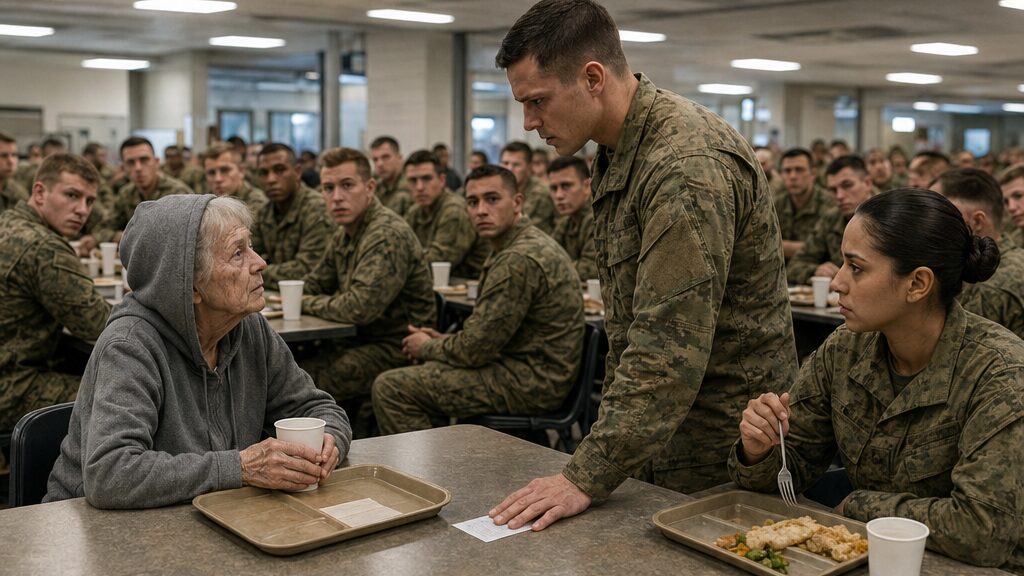
Ryan Clark’s hand came down hard beside Ruth Campbell’s tray, and the white slip fluttered once before lying flat under his fingers.
The dining hall noise thinned around it.
Forks paused over trays. A chair leg squealed and stopped. Somewhere behind Ruth, a young soldier swallowed a laugh badly enough that it turned into a cough. Ruth kept both hands around her paper cup, the same way she had held it since sitting down at the end table, though the coffee inside had cooled enough to lose its steam.
Ryan leaned over her tray without touching it.
“Ma’am,” he said, loud enough for the nearest two rows to hear, “this is not an open cafeteria.”
Ruth looked at the slip beneath his fingers. Temporary Visitor Meal Authorization, the black print said. A date, a signature, a pale square where a stamp had bled from damp air. It had been folded twice in her hoodie pocket, carried through the gate, smoothed on the counter, questioned once already, then accepted by a dining hall staff member with tired eyes and no time.
Now it looked smaller than it had at the gate.
“I was told to sit here,” Ruth said.
Her voice was quiet. That seemed to bother him more than if she had raised it.
Ryan straightened, his uniform pressed sharp across his shoulders, his jaw set in the careful way of a young man aware of being watched. “By whom?”
Ruth lifted her eyes to him. Behind his shoulder, soldiers in tan and green sat shoulder to shoulder under the fluorescent lights, some pretending to eat, some not pretending at all. A few had the soft, open faces of people new to service, still learning when to look away.
“The staff member at the line,” Ruth said.
“That staff member doesn’t override restricted access.”
“I didn’t ask them to.”
Ryan’s fingers tapped the slip. Not impatiently, exactly. More like he was marking time in front of witnesses.
“This pass isn’t scanning in the current system.”
Ruth’s tray remained untouched: chicken cut into neat pieces she had not lifted, mashed potatoes cupped beside green beans, a roll still sealed in its paper sleeve. Beside it, the paper cup warmed neither hand now. She had come hungry enough that the smell of gravy had hurt. But when Ryan first stopped at her table, appetite had gone somewhere deep and unreachable.
“The gate let me through,” she said.
“The gate lets vendors through. Contractors. Visitors with escorts.” Ryan’s gaze moved over her gray hoodie, her loose dark pants, her worn shoes, the thin plastic band around her wrist from the visitor desk. “It doesn’t mean you get to sit with soldiers during restricted lunch.”
Ruth heard the word soldiers and felt it land in the room like a claim.
She could have said many things then.
She could have said she had served breakfast in this same hall when the tiles were green and the serving line ran the other direction. She could have said she knew how to scrape burned eggs from steam trays without waking the night-shift cooks. She could have said that once, after a long convoy delay, she had kept three urns of coffee hot for men whose hands shook too badly to hold the cups.
She said none of that.
The cup bent slightly under her thumbs.
Across the aisle, a young woman with dark hair pulled tight under regulation watched Ruth’s hands. Katherine Lopez, her name tape said. Ruth noticed because names had always mattered to her. A dining hall turned people into movement: trays, boots, elbows, ranks. Names made them human again.
Katherine’s eyes dropped to the cup, then rose to Ruth’s face.
Ruth loosened her grip.
Ryan saw the movement but misunderstood it. “Ma’am, I’m going to ask you to stand up.”
“I’m seated for lunch.”
“You’re seated in a restricted dining period.”
“I have a meal authorization.”
“You have a paper slip that no one can verify.”
Ruth looked past him for a moment, toward the far end of the hall. The end table sat under the old unit photographs, the same corner where the light always seemed a little weaker. Years had changed the wall. The photographs were newer, the frames cleaner, the floor brighter than memory. But the table’s position had not changed. That had been the point of coming.
Ryan shifted, blocking her view.
“Are you listening to me?”
The room tightened.
Ruth set her cup down carefully, then picked it up again because she did not trust the table’s edge. Her hands were older now, and there were days when small betrayals came without warning: a dropped spoon, a button missed, a cup tipped over by the stiff knuckle of her right hand. She would not spill coffee in front of this room. Not today.
“I’m listening,” she said.
“Then you understand I need you to leave the dining area until your access is confirmed.”
“No.”
It was not loud.
That made it worse.
A murmur moved through the nearest tables. Ryan’s face changed in small increments: surprise first, then heat, then something harder because surprise in public had embarrassed him. He stepped closer until his shadow crossed her tray.
“No?”
Ruth drew a breath through her nose. She could smell soap from the dish room, pepper gravy, wet wool from someone’s field jacket, floor wax too sharp to belong with food. All of it folded into memory so quickly she had to keep her eyes steady.
“No,” she repeated. “Not while my tray is here.”
Ryan’s mouth tightened. “This is not a place for lost visitors.”
The cough behind Ruth did not come this time. Neither did laughter.
Katherine Lopez lowered her fork.
Ruth looked at Ryan’s name tape. Clark. Then she looked at the hand still holding down her slip.
“Soldier,” she said, and the word came out with enough shape that two men at the nearest table sat straighter before they seemed to know why. “Lift your hand from my paper.”
Ryan blinked.
For a second, she saw him not as the hard voice above her but as a young man suddenly unsure which rule had just been invoked. His hand moved off the slip. Only an inch, but it moved.
Ruth placed the cup on the tray, not the table. The paper bottom made a soft, dry sound against the plastic. Then she pushed her chair back and stood.
Slowly.
Not because she wanted the room to witness effort, but because her left knee had stiffened during the bus ride and because a body earned over seventy-four years did not rise on command like a recruit’s. She did not use the table. She did not let Ryan see her wince. She stood until she was fully upright, small in front of him, hoodie loose around her shoulders, the untouched lunch between them.
The room had gone still.
Ruth picked up the cup again.
Ryan’s eyes flicked to it.
She said, “Lower your voice.”
His eyebrows drew together. “Excuse me?”
“The room is already listening.”
A flush climbed his neck.
Behind him, someone’s plastic knife slipped from a tray and clattered to the floor. No one reached for it.
Ryan looked around, and the watchers looked down too late. His embarrassment had nowhere to go except forward.
“I’m acting under orders,” he said. “Unauthorized persons cannot remain inside during active restricted lunch.”
“I heard you.”
“Then walk with me to the office.”
“I will walk,” Ruth said. “I will not be dragged by your voice.”
That struck him. Ruth saw it. Not guilt, not yet. But impact.
Ryan collected the slip and held it like evidence. “Bring your tray.”
“No.”
“Ma’am—”
“I paid for the meal.”
“It can be held.”
Ruth looked down at the chicken, the roll, the potatoes. A complete tray. A simple tray. The kind of lunch no one remembered unless it was the last one, or the one left unfinished.
“It has been held long enough,” she said.
Ryan did not understand. That was plain on his face. He only heard refusal.
He turned toward a dining hall staff member hovering near the beverage station. “Call the office. Tell them I have a visitor with unverifiable meal access refusing removal.”
The staff member hesitated. Ruth re
Chapter 4: The Soldier Who Needed The Room To See Him
Ryan Clark found out the commander might review his report while he was standing in the training corridor with twelve soldiers waiting for him to look certain.
The administrative assistant had called his name from the office doorway, one hand over the phone receiver. “Clark. The dining hall incident is being routed upward.”
A few heads turned.
Ryan kept his face still. “For what reason?”
“Access discrepancy, witness statement pending, and closure-week visitor exception.” The assistant’s eyes flicked toward the soldiers behind him. “Commander wants everything clean before inspection.”
Clean.
The word followed Ryan down the corridor after he dismissed the group. It sat in the hollow behind his ribs while boots struck tile and voices bounced off painted walls. Clean meant paperwork that matched behavior. Clean meant no public mess. Clean meant no elderly visitor with a questionable pass and a room full of soldiers deciding, silently, whether he had handled it wrong.
He pushed into the small barracks office assigned for temporary leadership duties and shut the door harder than intended.
On the desk lay a printed copy of his incident note. Someone had highlighted two lines.
Subject resisted verbal instruction in dining area.
Subject created delay during restricted lunch period.
Ryan stared at the yellow marks until the words blurred slightly. He had not lied. Not exactly. She had refused to leave. The lunch period had been disrupted. His responsibility had been access control, and access control meant firmness before softness, especially now.
Especially after last week.
He still heard the sergeant’s voice from the inspection prep meeting: You want people to follow you, Clark? Stop asking rules for permission to be rules.
It had landed where old things already lived.
His father had been a veteran who could make a whole room adjust itself with silence. As a child, Ryan had mistaken that for strength. Later, when the man sat in a recliner with unopened mail stacked beside him and appointments missed because pride would not let him ask for help, Ryan had learned another version of silence. A house could rot around it. A son could stand in the doorway and not know whether to salute it or hate it.
Ruth Campbell had looked at him with that same guarded quiet.
He opened the report file on the computer.
A message waited from administration: Witness Lopez may be asked to clarify initial interaction.
Ryan leaned back.
Katherine.
Of course it would be Katherine. She had been close enough to hear everything, young enough to fear being noticed, ambitious enough to know the cost of crossing him. He had written her recommendation draft two days ago for a training slot she wanted. She knew that. He knew she knew.
The office felt too warm.
He stood, needing motion, and went back to the dining hall office under the excuse of retrieving the attached pass. The lunch rush had not begun yet, but staff were already setting pans into the line. Daniel Brown saw Ryan enter and did not greet him. That, more than any accusation, made Ryan’s shoulders tighten.
“I need the original slip,” Ryan said.
Daniel pulled it from a folder and handed it over. “You have copies.”
“I need the original.”
“For what?”
“Commander asked for clean documentation.”
Daniel’s eyes stayed on him. “Clean doesn’t always mean favorable.”
Ryan took the slip. “I know what clean means.”
He turned to leave and saw the trash can near the desk.
The white paper cup lay near the top, crushed slightly but not stained much, the rim bent in two places where Ruth’s fingers had held it. Someone had thrown it away after cleaning the office. It should not have mattered. It was trash. A used cafeteria cup.
He reached down and picked it out before he could decide not to.
Daniel watched him.
Ryan straightened with the cup in hand. “This should be with the incident materials.”
“No,” Daniel said quietly. “It shouldn’t.”
Ryan looked at him.
Daniel took one step closer. “That cup is not evidence. It’s just the thing she held while everyone waited to see if she would break.”
Heat moved up Ryan’s neck. “You weren’t in the dining hall when it started.”
“No. But I saw her after.”
“You saw an old woman sitting quietly. That doesn’t mean she wasn’t refusing lawful instruction.”
Daniel’s face hardened, though his voice did not. “I saw someone who knew how to keep a room from becoming worse.”
Ryan dropped the cup onto the desk. It bounced once and rolled against a stack of forms.
“She had unverifiable access.”
“Then verify privately.”
“That’s easy to say after the fact.”
“It was easy to do before it.”
Ryan gathered the pass and left before his answer could become something he could not defend.
Back in his office, he opened the report again. The cursor blinked after resisted. He changed nothing. Then he added a sentence.
Subject’s tone and refusal drew attention from surrounding soldiers, requiring immediate intervention.
He read it twice.
The sentence made him feel safer and smaller at the same time.
A knock came at the door. Katherine Lopez stood outside, cap tucked under her arm, posture too straight.
“Specialist Clark?”
“What is it?”
“They asked me to submit what I saw.”
He kept his hands on the desk so they would not move toward the keyboard. “Then submit what you saw.”
Her gaze dropped to the report on his screen before she could stop it.
Ryan turned the monitor slightly.
Katherine said, “I was seated close.”
“I know where you were seated.”
“She didn’t raise her voice.”
Ryan’s jaw set. “No one said she did.”
“The report says she disrupted the room.”
“She did.”
Katherine’s fingers tightened around her cap. “After you spoke loudly enough that everyone turned.”
For a second he saw the dining hall again: Ruth standing small and steady, the cup upright in her hand, the room listening because she had said it was. He had not liked the way she made him aware of himself. He had not liked the sudden feeling that authority could look like noise.
He stood. “Be careful, Lopez.”
Her face went blank.
He heard himself and hated the echo of someone older, someone who had taught him that warning and advice could wear the same uniform.
“I mean,” he said, forcing his voice down, “be accurate. Don’t add feelings.”
“I wasn’t going to.”
“Good.”
She looked at him for another moment, then left.
Ryan sat again. The office printer clicked awake and spat out the revised report. He clipped Ruth’s white slip to the front, the paper edges misaligned. The cup still sat on the dining hall office desk in his mind, though he had left it behind. He could feel its cheap rim against his fingers.
His phone buzzed.
A message from a senior soldier appeared, brief and practical: If Lopez is asked, keep it tight. Confirm only what was in the report.
Ryan stared at the message. He had not sent it. He did not have to. The room around him had learned what he wanted.
After a long minute, he forwarded it to Katherine.
Confirm only what was in the report.
Chapter 5: The Name Written Under The Old Table
The workers had the end table lifted sideways when Ruth reached the dining hall, its legs jutting into the air like something already dead.
One man held the taped edge against his hip. Another pushed through the aisle backward, boots squeaking on the polished floor. The orange removal strip had begun to peel from the tabletop, but the black marker slash across it still showed clear enough.
DISPOSE.
Ruth did not call out.
She crossed the room faster than her knee wanted and set her hand on the raised table edge.
The workers stopped because her hand, small and veined as it was, landed with the certainty of an order.
“Ma’am,” one said, startled, “you need to step back.”
“No.”
The word was not loud. It had weight.
Daniel came out from the office at once, wiping his hands on a towel he did not need. “Hold up.”
The worker shifted, irritated. “We were told marked pieces go to loading.”
“That one doesn’t.”
“It’s on the list.”
“Then the list is wrong.”
Ruth kept her hand on the table. The laminate was cool beneath her palm. The old bubbled corner pressed against her skin in the same place it always had, raised like a scar. She had not touched it in years, yet her hand found it without searching.
Across the room, soldiers entering for lunch slowed at the sight. A few recognized her from the incident. Their eyes moved from her hoodie to the workers, from the table to Daniel, and then toward the corridor as if expecting Ryan Clark to appear and turn confusion into command.
Ruth wished, for one foolish second, that she had stayed home.
Then one worker adjusted his grip, and the underside of the table tilted toward her.
There, beneath old gum scars and screw heads darkened by time, were two sets of scratched initials.
R.C.
D.M.
The room narrowed until only those letters existed.
Ruth’s hand left the edge and moved under the table. Her fingertips hovered beneath the marks without touching them. They were rough, uneven, cut by something dull and impatient. A kitchen knife, maybe. A bent fork. Debra had done hers too deep on the M, then laughed because she said anyone reading it upside down would think she had carved a mountain.
Ruth heard the laugh so clearly that the dining hall around her seemed to lose air.
Daniel saw the initials. “Ruth?”
She could not answer.
The worker’s expression changed. He had expected an old woman blocking a job. He had not expected grief. He lowered his side an inch. The other worker followed.
“Set it down,” Daniel said.
This time no one argued.
The table came upright with a heavy thud. Ruth flinched despite herself. Her paper cup, tucked against her side, bent under her arm. Coffee seeped through the lid seam and warmed her sleeve.
She looked down at the stain spreading into gray cotton.
A small spill. Nothing more.
But her breath caught as if something worse had broken.
Daniel stepped closer. “I can have the table moved to storage for now.”
“No,” Ruth said too quickly.
He paused.
She forced her fingers open. “Not hidden.”
“Then where?”
“Where it was.”
“That may not be possible.”
“It was possible for people to eat around it for forty years.”
“Renovation crews won’t care about that.”
“I know.”
Her voice came out rougher than she intended, and that brought silence from the nearest soldiers. She hated that silence. It was not respect yet. It was curiosity. Curiosity could strip a memory faster than cruelty if people felt entitled to answers.
A familiar voice cut in from the entrance.
“What’s going on now?”
Ryan Clark stood just inside the dining hall, uniform neat, face already set for trouble. His eyes went to Ruth’s stained sleeve, the workers, the table returned to the floor. Then he saw the watching soldiers and hardened.
Ruth felt the room tilt back toward the first day.
Daniel said, “Furniture issue.”
Ryan walked closer. “With Mrs. Campbell again?”
“Specialist Clark,” Daniel warned.
Ryan ignored him. “Ma’am, you cannot interfere with facility operations because you disagree with disposal decisions.”
Ruth looked at him. “I agree with many things I cannot allow.”
He frowned. “That doesn’t mean anything.”
“It does to me.”
The workers stood awkwardly beside the table, unsure whose authority cost them less. Ruth saw that and disliked herself for causing it. Her grief had become a burden others had to carry through a lunch rush.
She stepped back.
Ryan took that as success. “Thank you. The workers can proceed.”
“No,” Daniel said.
Ryan turned on him. “The table is marked. The dining hall is under a closure schedule. We already have one access incident tied to this visitor. You want another report?”
Ruth heard the word visitor and felt something inside her finally refuse the shape of it.
“I was not a visitor when that mark was made,” she said.
Ryan looked at her.
Daniel stilled.
Ruth bent, slowly, and pointed under the table. “There.”
Ryan hesitated before crouching enough to see. His expression changed, but not into understanding. The letters were just letters to him, small damage on old furniture.
“Initials,” he said.
“Yes.”
“Yours?”
“One set.”
“And the other?”
Ruth’s mouth opened, but the name stayed behind her teeth. For two days she had guarded it from forms, from Ryan, from Daniel’s careful questions, from the room’s appetite for explanation. Saying it here felt like laying something living on a cafeteria tray.
Daniel’s voice softened. “Ruth, you don’t have to—”
“Debra Martinez,” she said.
The dining hall did not know what to do with the name. It passed nowhere, produced no gasp, solved nothing for the soldiers watching. But Daniel Brown went utterly still.
His towel slipped from his hand to the floor.
Ruth saw recognition strike him before he could cover it.
Ryan saw it too.
“Who is Debra Martinez?” Ryan asked.
Ruth kept her eyes on Daniel, because Daniel’s silence had become the new danger in the room.
Daniel swallowed once. “She was on the old food operations memorial list.”
Ruth’s hand closed around the crushed cup.
Ryan looked from Daniel to Ruth, suddenly less certain. “Memorial?”
The workers stood with their hands empty. The marked table remained between everyone like a question too heavy to lift.
Ruth looked at the scratched initials beneath the edge, then at Ryan Clark.
“She was the one who did not finish lunch,” she said.
Chapter 6: The Lunch She Never Finished
Ruth entered the empty dining hall after hours and stopped because two trays were waiting at the end table.
They sat across from each other under the old unit photographs, each tray set with chicken, potatoes, green beans, a roll still sealed in paper, and a white cup placed above the tray line. The room lights had been dimmed except over the service counter, so the trays seemed almost staged.
Ruth did not move.
Daniel stood near the beverage station with his hands folded in front of him like he had been caught doing something wrong.
“I didn’t know what she would’ve chosen,” he said. “So I matched yours.”
Ruth stared at the second tray.
“You shouldn’t have done that.”
“I know.”
But he did not remove it.
The dining hall after closing sounded larger than it did full. Refrigerators hummed behind the line. Somewhere in the kitchen, water ticked from a faucet into a metal sink. Renovation notices had been taped to the walls. Most chairs were stacked except the two at the end table, left facing each other as if someone had stepped away and would return.
Ruth walked to the table and set down the cup she had brought with her.
Three white cups now.
Too many.
She picked up Daniel’s extra cup from the second tray and held it for a moment. The paper was clean and unbent. Nothing had happened to it yet.
“She drank coffee even when it was terrible,” Ruth said.
Daniel stayed quiet.
“She said bad coffee proved somebody expected you to stay awake.”
The words surprised her by not breaking. She set the cup back above the tray.
Daniel pulled out a chair for her, then seemed to realize the gesture might be too much. Ruth sat before he could decide what to do with his hands.
For a while neither of them spoke.
Then she touched the sealed roll on the second tray. “Debra left from this room.”
“Deployment?”
Ruth nodded. “Not straight from here. No one leaves straight from lunch. There are bags, formations, buses, too many people pretending time is organized. But this was the last place I sat with her before all that.”
Daniel lowered himself into the chair opposite her but did not touch the tray.
“She didn’t finish,” Ruth said.
Her eyes stayed on the food. Not on Daniel. Not on the room. “She was laughing at something. I don’t remember what. That bothers me more than it should. I remember the table. I remember the coffee. I remember the way she kept moving her fork through the potatoes without eating. I remember telling her she’d better not come back thinner because I wasn’t altering her uniform for free.”
A breath almost became a laugh and failed.
“She said, ‘Save my seat, Campbell. I’ll finish when I get back.’”
Daniel’s face tightened.
Ruth slid her thumb along the tray edge. “I said I would.”
The refrigerator hum filled the space after that.
“She didn’t come back,” Daniel said.
“No.”
“And you stayed away.”
Ruth looked up then. “I came back to work. I served meals. I cleaned tables. I learned to stop looking at that chair.”
“But not forever.”
“No.”
Her right hand had found the cup again. She made herself release it. The rim was beginning to soften under her fingers.
“I told myself I was honoring her by not making her into a story,” Ruth said. “People do that. They take one person’s life and turn it into something useful for a lesson. Courage. Sacrifice. Pride. They sand off the parts that were tired or funny or scared. Debra hated speeches. She hated being used to make a point.”
Daniel nodded once.
“So when your young soldier asked why I was here, I heard every answer turn into something she would’ve hated.” Ruth looked toward the second tray. “And I kept my mouth shut.”
The side door opened.
Katherine Lopez stood just inside, uncertain, her uniform jacket folded over one arm. “Mr. Brown said I could come.”
Ruth did not look at Daniel.
He lowered his eyes. “I thought you should hear her yourself.”
Katherine stepped forward, then stopped several feet from the table. “Mrs. Campbell, I’m sorry.”
Ruth looked at her.
Katherine’s throat moved. “I should have said something that day. In the dining hall. Not later. Not after they asked. Right then.”
Ruth saw the young woman from the first day again: fork lowered, eyes fixed on the cup, fear and recognition wrestling in her face. She had been silent. So had almost everyone. Ruth knew too well how rooms trained people to wait for someone else to be brave first.
“You spoke now,” Ruth said.
“That doesn’t erase it.”
“No.”
Katherine absorbed the answer.
Ruth respected her more for not asking to be comforted.
“I got a message,” Katherine said. “It told me to confirm only what was in the report.”
Daniel looked up sharply.
“From Ryan?” he asked.
Katherine nodded.
Ruth closed her eyes for a moment. There it was. Silence protecting harm, just as surely as hers had protected grief.
When she opened her eyes, the second tray waited across from her.
Katherine said, “The commander is offering to correct the access issue quietly. Restore your pass, remove the incident from review, keep the closure lunch simple.”
Daniel’s expression showed he already knew.
Ruth touched the white slip folded beside her tray. Daniel had placed it there, perhaps thinking she would want it. The paper looked tired now, worn at the creases, a poor vessel for so much trouble.
“Quietly,” Ruth said.
“It would avoid making you answer questions,” Daniel said. “And avoid a public reprimand. The commander said you don’t have to carry this further.”
Ruth almost smiled. Not because it was funny, but because the offer had the shape of kindness and the weight of disappearance.
She had wanted that once. To slip in, sit at the end table, eat the lunch, leave before anyone turned memory into ceremony. She had wanted to keep Debra safe from strangers. She had wanted to keep herself safe from the old promise that still had teeth.
But Ryan’s report had not stayed private. His voice had not stayed private. Katherine’s fear had not stayed private. The room had learned the wrong lesson in public and was being offered the comfort of forgetting it in private.
Ruth picked up one white cup and placed it across from her, above Debra’s tray. Then she picked up her own and set it down with care.
“Silence can guard what hurts,” she said. “It can also guard the person who caused it.”
Katherine’s eyes filled, but she did not look away.
Daniel asked, “What do you want to do?”
Ruth looked at the untouched tray in front of her, then at the one across the table. She did not want revenge. She did not want Ryan embarrassed into smallness while soldiers watched. She knew what public shame could do to a young person who mistook hardness for strength.
But mercy without truth was only another locked door.
“I’ll attend the review,” she said.
Daniel nodded slowly. “All right.”
Ruth folded the white slip once more, not to hide it, but to keep her hands from returning to the cup.
“And Ryan Clark will be there,” she said. “Not written about. Not spoken around. There.”
Chapter 7: The Apology She Would Not Spend
Ryan Clark stood in the same place where he had leaned over Ruth Campbell’s tray, but this time his hands were behind his back and the dining hall was waiting for someone else to speak.
Katherine Lopez noticed his boots first. He had polished them hard enough that the overhead lights showed in dull stripes across the toes. The rest of him looked regulation-perfect, but his face had the held-tight stillness of a man bracing for impact.
Ruth sat at the end table.
Not in the office. Not hidden behind the commander’s closed door. At the same table that had been marked for disposal and then returned to its corner, orange tape removed but a pale strip still showing where it had stuck. The white slip lay beside her tray. A paper cup sat near her right hand.
She had not picked it up.
That small fact made Katherine’s throat tighten.
The base commander stood near the service line with a folder in one hand. Daniel Brown waited at the edge of the room, close enough to help, far enough not to claim the moment. Soldiers had been allowed to remain because the first incident had not happened in private. No one had called it a ceremony. No one had arranged chairs. But the room knew it had been summoned to remember itself.
The commander opened the folder. “Mrs. Campbell’s meal authorization has been verified as part of the dining hall closure visitor exceptions. The missing digital scan was an administrative error.”
Ryan’s jaw moved once.
Katherine watched Ruth. The old woman’s face did not change.
The commander continued. “That error should have been handled through private verification. Instead, it became a public incident.”
The words settled over the room with uncomfortable precision.
Ryan looked straight ahead.
Katherine knew what many expected next. A reprimand. A sharp correction delivered in front of the same soldiers who had watched him humiliate an old woman. She had expected it too, and some hidden, frightened part of her had wanted it because punishment would make her own late honesty feel less lonely.
The commander turned slightly toward her. “Specialist Lopez, you submitted a statement. Is it accurate that Mrs. Campbell did not raise her voice during the initial exchange?”
Every head seemed to shift in her direction.
Katherine’s fingers pressed against the seam of her trousers. Ryan did not look at her, which was worse than if he had. She remembered the message on her phone.
Confirm only what was in the report.
She remembered how long she had stared at it, trying to find a way to obey without lying. She remembered deleting three drafts of her statement before typing the line that had kept her awake: Specialist Clark initiated the public tone of the exchange.
Now the room waited.
“Yes,” Katherine said. “She never raised her voice.”
The commander asked, “Did Mrs. Campbell create the attention in the room?”
Katherine looked at Ruth, then at the cup beside the old woman’s hand.
“No,” she said. “The room turned when Specialist Clark leaned over her table and spoke loudly about her access.”
Ryan’s face tightened, but he stayed silent.
“Did Mrs. Campbell threaten anyone, block movement, or refuse physical direction from staff?”
“No.”
“What did she do?”
Katherine swallowed. “She asked him to lower his voice because everyone was listening.”
The sentence moved through the dining hall differently this time. Not as defiance. As a mirror.
Ruth touched the cup then, only with two fingers, turning it a fraction so the bent rim faced away from the room.
The commander looked at Ryan. “Specialist Clark, your report described Mrs. Campbell as disruptive and resistant. It omitted the public manner of your approach. It also overstated the nature of her refusal.”
Ryan drew a breath. “Yes, sir.”
“Did you edit that report after learning a witness might be asked for clarification?”
Katherine felt the room sharpen.
Ryan’s gaze flicked once toward her. Not with anger. With something worse: exposed recognition.
“Yes, sir.”
“Why?”
The silence stretched.
Ryan’s answer came lower than before. “I thought the original wording made it look like I had lost control of the room.”
The commander let that stand.
Ruth finally lifted her cup. She did not drink. She simply held it, steady and white against the gray of her hoodie.
The commander said, “Mrs. Campbell, you were offered the option to have this corrected administratively. You asked to speak with Specialist Clark present. You may do that now.”
Ryan’s eyes moved to Ruth.
Katherine felt the room brace for the old woman to spend her pain.
Ruth did not stand at once. She looked down at the white slip first, then at the untouched tray in front of her. It was not the tray from the first day. That one had been lost to process, held somewhere, then thrown away. This tray had been prepared for the review because Daniel seemed to understand that some objects had to return before words could.
At last Ruth set the cup down beside the slip.
The sound was small.
Ryan flinched anyway.
“Specialist Clark,” Ruth said.
“Yes, ma’am.”
“I was angry with you.”
His throat moved. “I understand.”
“No,” she said. “You don’t. Not yet.”
The room held still.
Ruth looked at him without cruelty. “You saw an old woman in a hoodie. You saw a paper that did not scan. You saw people watching you. Somewhere between those three things, you decided I needed to be made smaller so you could look certain.”
Ryan’s face reddened.
Ruth did not press harder. “That was wrong.”
“Yes, ma’am.”
“It was also easy.”
The words found him more deeply than accusation would have.
She turned the cup again. “I did not explain myself because I thought silence was the only way to keep something private. That was my mistake. Your mistake was using that silence as room to write your own story about me.”
Ryan’s eyes lowered.
“My friend’s name was Debra Martinez,” Ruth said.
Several soldiers shifted, not because the name meant anything to them, but because of how carefully Ruth placed it in the air.
“She sat at this table before leaving for deployment. She did not finish her lunch. I promised to save the seat.” Ruth’s hand rested on the table edge. “That is all I will give this room of her.”
Katherine felt tears press behind her eyes, but Ruth’s restraint kept everyone else restrained too. No one moved toward applause. No one made a sound large enough to steal the name.
The commander closed the folder. “Mrs. Campbell, Specialist Clark’s conduct can be addressed formally.”
Ruth looked at Ryan. He stood very still, waiting for the blow he had earned.
“No public reprimand,” she said.
The commander’s brows drew slightly. “Are you certain?”
“I did not come here to teach soldiers humiliation.”
Ryan looked up then.
Ruth met his eyes. “But do not mistake mercy for a clean page.”
“No, ma’am,” Ryan said, and this time his voice had lost its polished edge.
The commander waited.
Ruth pushed the white slip toward Ryan with two fingers. “This paper caused confusion. The confusion was not the harm.”
Ryan stared at it.
“The harm was how you chose to handle a person before you understood the paper.”
He nodded once. It was not enough, but it was real.
Ruth looked toward the serving line, where the last lunch preparations had begun behind the counter. Steam lifted from pans. Trays stacked at the end of the rail. The dining hall smelled, suddenly and painfully, like the past trying to be ordinary.
“Tomorrow,” Ruth said, “I will sit here for the final lunch.”
Ryan waited as if every word had to be received before he could move.
Ruth lifted her cup, then set it down again.
“You will serve the tray yourself.”
Chapter 8: The Last Tray At The End Table
Ryan approached Ruth with a tray and no command in his voice.
That was the first thing she noticed.
Not the room, though the room had noticed him. Not the final-lunch line moving more slowly than usual because soldiers kept glancing toward the end table. Not the renovation crew waiting beyond the loading doors with carts and rolled plans, ready to take apart what the meal had not yet released.
Ryan walked carefully, both hands under the tray, white slip folded beside the cup as if it were no more dangerous than a napkin.
He stopped an arm’s length from the table.
“Mrs. Campbell,” he said.
Ruth looked up.
The tray held chicken, potatoes, green beans, and a roll still sealed in paper. The food was cafeteria-warm, plain, exact. No decoration. No special plate. Nothing made into tribute.
Good, she thought.
Ryan set it in front of her. He did not lean over her. He did not block the light. He stepped back before speaking again.
“I verified your access privately this morning,” he said. “With administration and the gate clerk. Your visitor status is clear through the end of closure operations.”
Ruth touched the folded white slip. “And after me?”
His shoulders shifted. “Daniel helped draft a change. Visitors with paper meal authorizations get verified at the office before they enter the dining area. No public challenges unless there is an immediate safety issue. Older visitors, family members, former staff—same process.”
Daniel, standing near the coffee station, pretended not to listen.
Ruth looked at Ryan. “That was not required by apology.”
“No, ma’am.”
“Then why do it?”
He glanced at the soldiers seated nearby, then back at her. “Because I would have followed my own bad example again if the rule stayed vague.”
The answer surprised her by being better than she had expected.
She unfolded the white slip once, then folded it smaller and placed it beneath the edge of the tray. Not hidden. Not displayed.
Ryan remained standing.
Ruth said, “You have something else.”
He nodded. “Yes, ma’am.”
His voice lowered so the room could not claim it. “My father was a veteran. He hated asking for anything. I used to think if someone didn’t explain themselves, they were making trouble on purpose.” His eyes dropped. “That isn’t an excuse. I’m telling you because when you stayed quiet, I filled it in with anger that wasn’t yours.”
Ruth studied him for a moment. The young man in front of her looked less polished than he had on the first day. Not weaker. Less armored.
“Did your father teach you that?” she asked.
Ryan’s mouth tightened. “Some of it.”
“And the rest?”
“I practiced.”
Ruth let the answer sit between them.
Behind Ryan, Katherine Lopez stood with a tray of her own, uncertain whether to join a table or keep distance. Ruth caught her eye and gave the smallest nod toward an empty chair two tables away. Not here. Not at Debra’s table. But not banished either.
Katherine understood. She sat.
Ryan looked as if he might say more, but Ruth placed her hand around the cup. The same kind of cup. Thin paper. Slightly too hot at first touch. Easy to crush if held too tightly.
“I accept the work you have done,” Ruth said.
His face changed, just a little.
“That is not the same as making what happened disappear.”
“No, ma’am.”
“You’ll remember the difference?”
“Yes.”
“Good.”
The room had gone quiet again, but not like the first day. This silence had edges of discipline rather than appetite. Ruth disliked being watched, but she no longer felt reduced by it. There were times a room needed to learn without being entertained.
Ryan stepped back toward the serving line, then stopped. He turned, not to Ruth but to the soldiers nearest the end table.
“Visitor verification will be handled through the dining hall office from now on,” he said, voice clear but not sharp. “No one challenges a guest across a tray unless there’s a safety concern. If paperwork is unclear, you get a manager. You don’t make a person prove themselves in front of a room because the system is slow.”
No one applauded.
Ruth was grateful.
A few soldiers nodded. One looked down at his own tray, ashamed in a private way that might become useful later. Katherine watched Ryan with an expression Ruth could not fully read, but the tightness had left her shoulders.
Daniel came over with a second cup and placed it across from Ruth.
She looked at him.
He said quietly, “Black coffee. Bad enough to keep someone awake.”
For a moment Ruth could not breathe around the ache of it.
Then she nodded.
Ryan returned to his place near the line. Daniel stepped away. Katherine lowered her eyes to her food. The room resumed slowly, forks touching trays, chairs shifting, voices returning in softened pieces.
Ruth opened the paper around her roll.
The simple sound almost undid her.
For years she had imagined this moment as a debt: sit down, face the chair, finish what Debra had not, pay the promise like an old bill. But the first bite of chicken did not feel like payment. It tasted of salt, overcooked edges, and a kind of ordinary mercy she had not allowed herself to want.
She took another bite.
Across from her, the second tray remained untouched. That was right. Debra’s lunch had never needed finishing by someone else. Ruth understood that now, slowly, with the cup warm under her palm and the white slip folded away. The promise had not been to eat for the dead. It had been to return without running from the empty chair.
The renovation crew rolled a cart past the far entrance, then stopped when Daniel raised one hand. Not yet. The workers waited.
Ruth ate the potatoes. Half the green beans. A piece of the roll. Enough.
Then she lifted her cup.
The coffee was terrible.
A laugh rose in her chest, small and rough, and she let it come. It did not become a sob. It did not become a speech. It was only one sound at the end of a long-held breath.
She stood when she was ready, not when the room expected it.
No one moved to help her. That, too, was a kind of respect.
Daniel approached with a small tool in hand. “They can remove the top panel and preserve the section with the initials. If you want that.”
Ruth looked beneath the table edge where R.C. and D.M. waited in rough scratches, hidden unless someone cared enough to bend.
“For the dining hall?” she asked.
“For the new one. Quietly. Staff side, maybe. Not a display.”
Ruth considered it.
Debra would have made a joke about finally getting her name where inspectors could not complain about handwriting. Ruth could almost hear it.
“Yes,” Ruth said. “Staff side.”
Daniel nodded and stepped back.
Ryan stood near the line, watching only long enough to receive her glance. He did not salute. He did not perform respect at her. He simply inclined his head once, like a man accepting a duty he would have to keep after she left.
Ruth picked up the folded white slip and put it in her pocket.
Then she took the white cup and placed it across the table, beside the tray that would not be eaten. Her hand lingered there only a moment. No one close enough to see the initials spoke. No one asked for the story. The cup stood upright above the scratched letters, not proof, not evidence, not a lesson for the room.
Just goodbye.
The story has ended.