The Man They Mistook for a Beggar at the University He Quietly Built
Chapter 1: The Man in the Worn Jacket
“Sir… I don’t think you can afford anything here.”
The words landed in the morning air loudly enough for several passing donors to hear.
James Mitchell stopped walking.
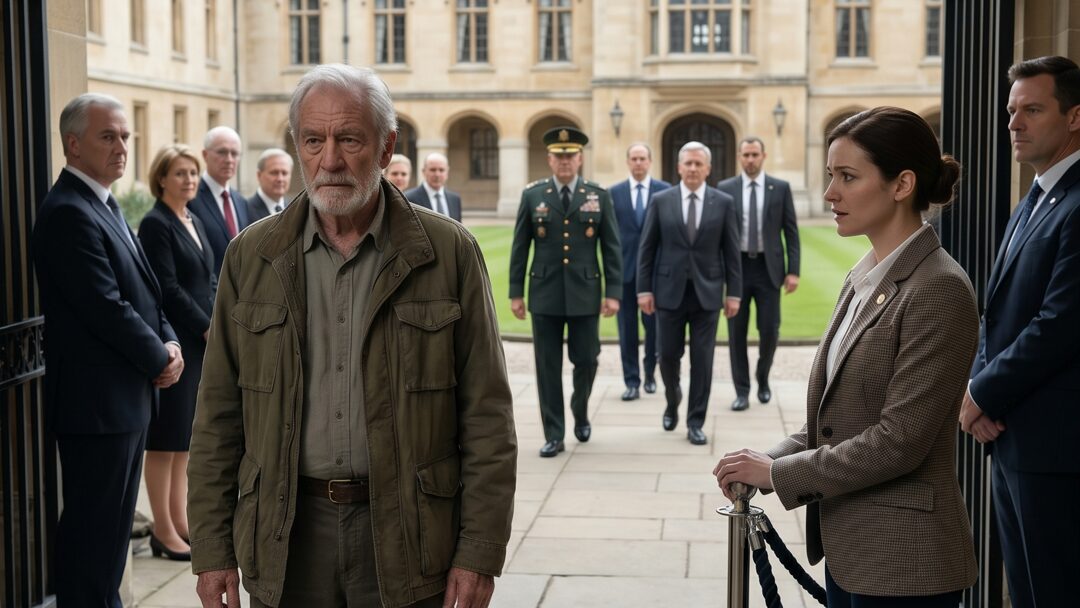
He had been heading toward the donor complex attached to the university’s historic administration building when the young woman stepped directly into his path.
The university had changed since his last visit.
The stone arches remained.
The bell tower remained.
The old oak trees remained.
But there were now velvet ropes, private lounges, donor receptions, and polished signs directing important guests toward exclusive entrances.
The woman glanced at his jacket.
It was clean but worn. The dark fabric had faded at the elbows. One sleeve had been repaired years earlier.
Her eyes lingered there before returning to his face.
“Can I help you find the public visitor center?” she asked.
The smile was professional.
The tone wasn’t.
James looked past her toward the building entrance.
“I have an appointment.”
“With whom?”
“The president.”
The smile tightened.
Around them, expensive cars rolled into designated parking areas.
Men in tailored suits entered without question.
Women carrying donor badges passed through security with welcoming greetings.
The clerk folded her hands.
“The president is in a very important meeting.”
“I know.”
“And she isn’t available to random visitors.”
James studied her for a moment.
Not angrily.
Simply carefully.
“Did you check?”
“I don’t need to.”
The answer came too quickly.
A couple walking nearby slowed down.
Not enough to stop.
Enough to listen.
James noticed.
So did the clerk.
Instead of lowering her voice, she straightened her shoulders.
“Sir, this area is reserved for invited guests.”
“Then it’s fortunate I’m invited.”
A faint laugh escaped her.
The kind that wasn’t meant to be kind.
“Do you have credentials?”
“No.”
“A donor badge?”
“No.”
“An executive pass?”
“No.”
“Then I really need you to move aside.”
James glanced toward the building again.
The bronze doors reflected the sunlight.
Thirty years ago there had been no doors there.
He remembered approving the renovation plans.
The memory arrived unexpectedly.
Not because he thought about the building often.
But because he remembered the discussion.
The architects wanted imported materials.
He had argued for local stone instead.
Students had needed scholarships more than expensive decorations.
The doors remained.
The scholarships remained too.
At least he hoped they did.
“Sir?”
The clerk’s voice pulled him back.
“Yes?”
“Are you listening?”
“I was.”
“Then you understand.”
James nodded slowly.
“I understand more than you think.”
Her expression hardened.
The answer annoyed her.
People like him, she decided, were always difficult.
Not dangerous.
Just embarrassing.
The university hosted major donors today.
Corporate leaders.
Government officials.
Military representatives.
The last thing she needed was someone wandering into a restricted area.
“Security can escort you elsewhere if necessary.”
James looked surprised.
“Escort me?”
“If needed.”
The conversation had already become larger than it needed to be.
A nearby facilities worker paused briefly before continuing down the walkway.
James recognized him.
Not personally.
But he recognized the uniform.
His corporation had funded that maintenance program years ago.
The realization produced an uncomfortable feeling.
How many things here still existed because of decisions nobody remembered?
The clerk followed his gaze.
“You seem very interested in this campus.”
“I am.”
“Did you attend here?”
“No.”
“Work here?”
“No.”
“Then why are you here?”
James hesitated.
The truthful answer felt strangely difficult.
Because he wasn’t entirely sure himself.
Officially he was there to discuss a future partnership.
A new scholarship initiative.
A major one.
Unofficially he had come for a different reason.
To see what the university had become.
To see whether the institution still remembered why it existed.
“Old habit,” he finally said.
“What does that mean?”
“I like checking on things.”
The answer made no sense to her.
A donor walking past frowned at James’s jacket.
The glance lasted less than a second.
Yet James noticed.
He always noticed.
Decades of experience had trained him to.
People saw clothing first.
Titles second.
Character last.
Sometimes never.
“Sir,” the clerk said more firmly, “I need you to leave the entrance area.”
“Why?”
“Because you’re creating a disturbance.”
The irony almost made him smile.
“I haven’t raised my voice.”
“That’s not the point.”
“Then what is?”
Her answer came after a pause.
“You don’t belong here.”
The words hung between them.
This time several people definitely heard.
James felt the familiar sting.
Not because it was new.
Because it was old.
Very old.
Older than the corporation.
Older than the fortune.
Older than the university itself.
For a brief moment he saw himself at twenty-three.
A mechanic’s son in secondhand clothes trying to convince investors that an impossible company could exist.
The same looks.
The same assumptions.
The same certainty that appearance revealed everything.
The memory vanished.
He returned to the present.
The clerk was waiting.
Perhaps expecting an argument.
Instead James nodded.
“Thank you.”
The response caught her off guard.
“For what?”
“For being honest.”
She frowned.
Before she could answer, James reached into his pocket.
A simple phone.
Nothing expensive.
Nothing flashy.
He unlocked it.
The clerk folded her arms.
“Who are you calling?”
James looked at the donor complex one last time.
Then he pressed a number he rarely used.
The call connected almost immediately.
“Benjamin?”
The voice on the other end answered before the second ring had fully ended.
“Yes, sir?”
James’s eyes remained on the closed bronze doors.
“I’m standing at the front entrance.”
A brief silence.
“And?”
“They informed me I can’t afford a table.”
Chapter 2: One Quiet Phone Call
For the first time since the confrontation began, Angela Baker felt uncertain.
Not worried.
Just uncertain.
The man’s voice had changed.
It remained calm.
But it carried something she couldn’t quite identify.
The person on the other end of the call spoke immediately.
Though Angela couldn’t hear every word, she noticed the speed of the response.
No confusion.
No hesitation.
No “Who is this?”
Only instant attention.
James listened quietly.
“No,” he said. “There’s no need for that.”
Another pause.
His expression remained unreadable.
Angela checked the entrance behind her.
Several donors were still entering.
Everything appeared normal.
Yet she found herself listening.
“I’m fine,” James continued. “Actually, this may be useful.”
Useful?
What was useful about being denied entry?
The answer didn’t make sense.
“Sir,” Angela interrupted, “if you’re arranging transportation, the public visitor center is two blocks away.”
James covered the phone briefly.
“I know where it is.”
Then he returned to the conversation.
“Yes. That’s correct.”
A longer silence followed.
His eyes drifted toward the administration building.
Not the way visitors looked at famous landmarks.
The way homeowners looked at old houses.
The thought appeared suddenly and disappeared just as quickly.
Angela shook it away.
Ridiculous.
Meanwhile, thirty miles away, Benjamin Hall had already stood from his chair.
The board meeting around him fell silent.
“Cancel everything,” he said.
Executives exchanged confused looks.
“Immediately.”
One of them frowned.
“Benjamin, we’re in the middle of—”
“Now.”
Nobody argued a second time.
Because everyone recognized his expression.
Benjamin Hall rarely looked alarmed.
At the university, James slipped the phone back into his pocket.
Angela exhaled quietly.
The strange moment was over.
“Thank you for cooperating,” she said.
“I haven’t cooperated yet.”
“What does that mean?”
“I mean I’m still here.”
Her jaw tightened.
Nearby, another university employee approached the entrance carrying a tablet.
He slowed when he sensed tension.
“What happened?”
Angela answered quickly.
“Nothing important.”
James smiled faintly.
The employee looked at him.
Then at Angela.
Then continued inside.
A few minutes passed.
Nothing happened.
Angela relaxed.
Of course nothing happened.
The man had called a friend.
Maybe a lawyer.
Maybe a relative.
Maybe nobody important at all.
The tension she’d briefly felt began to fade.
Then a phone rang inside the reception desk.
The receptionist answered.
Her expression changed almost instantly.
“Excuse me?”
She listened.
“Right now?”
Angela watched.
The receptionist looked directly toward James.
Then away.
Then back again.
After ending the call, she hurried into a side office.
A second phone began ringing somewhere deeper inside the building.
Then another.
And another.
The pattern spread like ripples across water.
Angela frowned.
Coincidence.
It had to be coincidence.
James stood patiently beside a flower bed.
Hands folded.
Not watching the chaos.
Not reacting to it.
That bothered her more than anything.
People usually enjoyed proving others wrong.
This man seemed content simply waiting.
Across campus, administrators received urgent messages.
Meeting schedules shifted.
Assistants rushed through hallways.
Several department heads were suddenly asked one unusual question.
Do you know where James Mitchell is?
Most didn’t.
Some had never heard the name.
Others recognized it vaguely.
A donor.
Maybe.
A retired executive.
Possibly.
Nobody seemed certain.
The uncertainty made everything worse.
Back at the donor complex, whispers began.
“What happened?”
“I don’t know.”
“Why is administration calling everyone?”
“Something about a visitor.”
“A visitor?”
People glanced toward James.
The rumors reached Angela.
Her confidence weakened again.
Not because she believed he was important.
Because too many people suddenly seemed interested in him.
The receptionist emerged from the office.
“Angela.”
“What?”
“The vice president’s office called.”
“So?”
“They asked if an elderly gentleman was waiting outside.”
Angela forced a laugh.
“There are elderly gentlemen everywhere today.”
The receptionist didn’t smile.
“They described his jacket.”
The silence that followed lasted only seconds.
It felt longer.
Angela turned toward James.
The worn jacket suddenly seemed impossible to ignore.
“How would they know that?” she asked.
“I don’t know.”
“Did you tell them?”
“No.”
Before she could continue, another phone rang.
This time it was hers.
Angela answered.
“Yes?”
The voice on the other end spoke rapidly.
Her expression changed.
“What?”
She listened.
“No, he’s still here.”
Another pause.
“Yes.”
Her eyes moved toward James.
“No, I haven’t done anything.”
The call ended.
Angela lowered the phone slowly.
“Who was that?” the receptionist asked.
“The administration office.”
“What did they want?”
Angela swallowed.
“They asked me not to let him leave.”
The words arrived before she fully processed them.
Not let him leave.
Moments earlier she had been trying to remove him.
Now someone wanted him kept there.
James looked amused.
Not triumphant.
Just curious.
As if he were watching an experiment unfold.
The receptionist stared at him.
“Who are you?”
James looked toward the administration building.
“I’ve been asking myself that lately.”
Before either woman could respond, movement appeared at the far end of campus.
Several administrators were walking quickly.
Not running.
Trying very hard not to run.
Which somehow looked worse.
Angela felt her stomach tighten.
Something was wrong.
Very wrong.
Then her phone rang again.
This time she answered immediately.
The color drained from her face.
“She’s doing what?”
A pause.
“Yes.”
Another pause.
“I understand.”
The call ended.
“Who?” the receptionist asked.
Angela looked toward the administration building.
“The president.”
“What about her?”
Angela stared as a group of assistants hurried across the central lawn.
“She just walked out of a board meeting.”
“Why?”
“I don’t know.”
But as she looked at the elderly man standing quietly beside the flower bed, she realized everyone else seemed desperate to find out.
Chapter 3: The Founder Nobody Recognized
The first emergency email reached the university administration wing at 10:17 a.m.
The second arrived less than two minutes later.
By 10:25, nobody was pretending the situation was routine.
Margaret Smith stepped out of the conference room with controlled urgency.
Behind her, board members exchanged worried glances.
A major donor event had been scheduled for months.
Nothing short of a crisis interrupted those meetings.
“What exactly do we know?” she asked an assistant.
“Very little.”
“That’s not helpful.”
“We know someone called James Mitchell is waiting at the donor entrance.”
Margaret stopped walking.
The name sounded familiar.
Not immediately.
Not clearly.
Just enough to be irritating.
“Why does that matter?”
The assistant handed over a tablet.
“Because the corporation’s executive office contacted us four times in the last ten minutes.”
Margaret stared.
“Four times?”
“Yes.”
“Regarding one visitor?”
“Yes.”
That was impossible.
Unless the visitor wasn’t merely a visitor.
She resumed walking.
“Find the donor archives.”
“We already started.”
“And?”
The assistant hesitated.
“That may be part of the problem.”
Across campus, James remained near the entrance.
Angela now stood several feet away.
No longer confrontational.
No longer confident.
Yet not willing to apologize either.
She wanted certainty first.
The problem was that certainty kept moving further away.
“Would you like water?” she finally asked.
James glanced at her.
“That’s kind of you.”
The answer felt worse than criticism.
Because it acknowledged the change.
A volunteer brought a bottle.
James thanked him.
The young volunteer smiled.
Then paused.
“You know,” he said, “you look like you’ve been here before.”
“I have.”
“When?”
“A long time ago.”
The volunteer laughed.
“My grandfather says that whenever he doesn’t want to answer a question.”
James laughed softly.
“So do I.”
The volunteer left.
Angela watched him go.
Something about that simple interaction bothered her.
The young volunteer had treated James naturally.
Without suspicion.
Without evaluation.
Without checking what he wore.
Meanwhile, inside the administration building, confusion deepened.
Staff searched donation records.
Construction records.
Scholarship records.
Every search produced another puzzle.
James Mitchell’s name appeared repeatedly.
Never prominently.
Never publicly.
Always somewhere in the background.
Funding approval.
Research grant.
Facility expansion.
Student initiative.
The numbers grew larger with every file.
“Why haven’t I heard about this?” one administrator asked.
Another looked up from an archive.
“Because half of these donations were anonymous.”
“Anonymous?”
“Or routed through corporate foundations.”
Margaret arrived just as a folder landed on the table.
“Tell me what we’re dealing with.”
Nobody answered immediately.
Finally an archivist spoke.
“We’re still trying to figure that out.”
She opened the folder.
Photographs.
Construction plans.
Letters.
Financial records.
A pattern emerged.
Every major improvement from the last three decades connected somehow to James Mitchell.
Not always directly.
But consistently.
Margaret felt a growing sense of unease.
“Who approved this arrangement?”
“Different presidents over the years.”
“Why wasn’t it disclosed?”
The archivist looked uncomfortable.
“Because he requested it.”
Margaret turned another page.
Then another.
The silence in the room deepened.
Outside, James watched students crossing the quad.
That part of the university still felt familiar.
Students hurried when they were late.
Lingered when they weren’t.
Dreamed larger than the institution itself.
That hadn’t changed.
A maintenance cart rolled past.
The driver waved politely.
James waved back.
Angela noticed.
“You seem to know everyone.”
“No.”
“Then why do people keep smiling at you?”
James considered the question.
“Maybe they’re having a good day.”
The answer frustrated her.
Before she could respond, a vehicle stopped near the entrance.
Two university administrators stepped out.
They approached quickly.
Too quickly.
Both looked relieved when they saw James.
The reaction sent another wave of panic through Angela.
One administrator extended a hand.
“Mr. Mitchell.”
James accepted it.
“Good morning.”
“We apologize for the inconvenience.”
“Inconvenience?”
The administrator glanced toward Angela.
“Misunderstanding, then.”
James followed the glance.
Angela looked away.
“Those happen,” James said.
The administrator visibly relaxed.
For about three seconds.
Then his phone rang.
He listened.
His expression changed.
“What?”
James noticed immediately.
“What is it?”
The administrator lowered the phone.
“The military delegation just arrived.”
“So?”
“They weren’t scheduled until this afternoon.”
A second administrator frowned.
“Why would they come early?”
Nobody answered.
Then another call arrived.
The first administrator listened again.
This time his eyes widened.
“General Adams is personally coming here.”
Silence.
Even James looked surprised.
“Donald is coming?”
The administrator stared.
“You know the General?”
James smiled faintly.
“Apparently.”
Across campus, a black vehicle turned through the main gate.
And for the first time that morning, Margaret Smith felt something far worse than embarrassment.
She felt fear.
Chapter 4: The Buildings With No Name
“Where are the original records?”
Margaret Smith slammed a folder onto the archive table.
Nobody answered immediately.
The room was packed with administrators, assistants, and archivists pulling documents from shelves that had not been opened in years.
Margaret pointed toward the stack of files.
“I want every donation connected to James Mitchell.”
An archivist hesitated.
“We’re trying.”
“Trying?”
“Some of them aren’t under his name.”
“That doesn’t make sense.”
“It does if he didn’t want credit.”
The answer silenced the room.
Margaret rubbed her forehead.
For years she had attended ceremonies celebrating major donors.
Names were engraved into stone.
Buildings carried family legacies.
Recognition mattered.
That was how universities worked.
Yet the deeper they searched, the stranger the pattern became.
A research center.
Anonymous.
A scholarship fund.
Anonymous.
A housing expansion.
Anonymous.
A technology initiative.
Anonymous.
Every trail eventually circled back toward the same man standing quietly outside.
A man wearing a repaired jacket.
A man her own staff had nearly removed from campus.
An assistant entered carrying another box.
“We found more.”
Margaret opened it.
Inside were photographs.
Dozens of them.
Construction crews.
Students.
Dedication ceremonies.
Faculty gatherings.
Most were decades old.
Then one image caught her attention.
A younger James stood beside workers in muddy boots.
No suit.
No podium.
No photographers.
He was helping pour concrete.
“What building is this?” she asked.
The archivist examined the photo.
“The Mitchell Science Center.”
Margaret blinked.
“The Mitchell Science Center?”
“The building named after another donor.”
The room fell silent.
“Excuse me?”
The archivist pulled out a second document.
“The donor who received naming rights funded approximately fifteen percent.”
Margaret stared.
“And the rest?”
The archivist swallowed.
“James Mitchell.”
The realization landed heavily.
Someone had paid for most of a building and allowed another person to receive public credit.
Not once.
Repeatedly.
The pattern appeared throughout the archives.
Margaret sat down slowly.
“Why?”
Nobody had an answer.
Across campus, James finally accepted an invitation to leave the entrance area.
Not because he wanted special treatment.
Only because standing beside flower beds while half the university panicked was becoming awkward.
Several administrators guided him toward a shaded courtyard.
Angela followed at a distance.
Nobody had asked her to come.
Yet she couldn’t leave.
Not now.
The mystery had become larger than embarrassment.
James sat on a stone bench overlooking the central lawn.
Students crossed between classes.
Some glanced at the growing crowd around him.
Most ignored it.
That made him smile.
Students remained refreshingly uninterested in power.
An administrator approached carrying coffee.
“Would you like some?”
“No, thank you.”
“Tea?”
“No.”
“Anything?”
James looked amused.
“You’ve offered me more hospitality in ten minutes than you’ve offered students in some buildings.”
The administrator laughed nervously.
Not because it was funny.
Because it was true.
A few moments later Margaret arrived.
Her pace was quick.
Her smile wasn’t.
“Mr. Mitchell.”
“Margaret.”
“You know my name?”
“You’ve been president for six years.”
She stopped.
“You’ve been following the university?”
“On and off.”
The answer felt gentle.
It also felt like criticism.
Margaret sat opposite him.
“I owe you an apology.”
“You owe several people better policies.”
The response wasn’t harsh.
That somehow made it harder to hear.
Margaret glanced toward Angela.
The clerk immediately looked away.
James followed her gaze.
“Don’t.”
“Don’t what?”
“Turn this into one employee’s fault.”
Margaret hesitated.
“She denied you entry.”
“She reflected the culture around her.”
Neither woman responded.
James looked across campus.
His eyes settled on a library tower.
“That building wasn’t supposed to exist.”
Margaret followed his gaze.
“What do you mean?”
“The project nearly died.”
“You funded it?”
“I helped.”
“Why anonymously?”
James smiled.
“I thought the building mattered more than the name.”
Margaret lowered her eyes.
Another uncomfortable silence followed.
An assistant arrived carrying additional archive materials.
“President Smith.”
Margaret accepted the folder.
The first document she opened was a photograph.
A very old one.
Her eyes widened.
“Where did this come from?”
“The storage vault.”
She examined it carefully.
The image showed a group of students standing beside a newly completed scholarship office.
At the edge of the photograph stood a younger James.
Almost hidden.
Barely noticeable.
Yet there he was.
Watching.
Not posing.
Watching.
Margaret turned the photo over.
A handwritten note covered the back.
The handwriting was unmistakably old.
She read silently.
Build opportunities, not monuments.
The words lingered.
She looked up.
“Did you write this?”
James nodded.
“You kept it?”
“No.”
“Then how did it survive?”
“Someone else must have thought it mattered.”
For the first time that day, Margaret felt genuine shame.
Not fear.
Not panic.
Shame.
Because she suddenly realized how much effort the university had invested in celebrating wealth while forgetting the values that wealth was supposed to serve.
A bell rang in the distance.
Students poured from nearby buildings.
The campus came alive.
James watched them quietly.
Margaret finally asked the question she had avoided.
“Why are you really here?”
The courtyard seemed to grow still.
Even Angela stopped pretending not to listen.
James looked at the worn sleeve of his jacket.
His thumb brushed the old repair stitch.
A faint smile touched his face.
“Because I wanted to know whether this place still recognized people who looked like me.”
The answer hit harder than any accusation.
Nobody spoke.
After several seconds James stood.
“I think I’ve found my answer.”
Margaret felt her stomach tighten.
“What exactly were you testing?”
Chapter 5: What the University Forgot
The question followed James into the historic hall.
Built nearly eighty years earlier, it had survived presidents, donors, economic crises, and generations of students.
James had always liked the room.
Not because it was beautiful.
Because it had once hosted conversations about purpose instead of prestige.
Now Margaret sat across from him at a long wooden table while senior administrators filled nearby seats.
Nobody seemed comfortable.
Angela remained near the doorway.
She knew she shouldn’t be there.
Yet nobody told her to leave.
Perhaps because everyone had forgotten she was part of the story.
Or perhaps because she was the story.
“What exactly were you testing?” Margaret asked again.
James rested his hands on the table.
“The university.”
Margaret waited.
“So you arranged all this?”
“No.”
“Then what happened?”
“I came to discuss a scholarship initiative.”
“Then why not schedule a formal meeting?”
“I did.”
Several people exchanged confused looks.
James reached into his jacket pocket.
The movement immediately drew attention.
He removed a folded letter.
Old.
Creased.
Handled many times.
Margaret accepted it.
The date stunned her.
Thirty-two years earlier.
She unfolded the paper carefully.
The signature at the bottom belonged to a university president long deceased.
“What is this?”
“A promise.”
Margaret read silently.
The letter thanked James for helping save the university during a financial crisis.
Near the end, one paragraph stood out.
This institution will always remain open to those who seek opportunity rather than status.
Margaret lowered the page slowly.
James watched her.
“That sentence mattered to me.”
“You remembered it?”
“I built a company because somebody once gave me an opportunity.”
The room remained silent.
“I never forgot that.”
Angela looked toward the floor.
The words struck closer than she wanted to admit.
James continued.
“When I arrived today, nobody asked why I was here.”
Nobody interrupted.
“Nobody asked whether I needed help.”
He glanced toward Angela.
Still not accusing.
Still not angry.
“They looked at my jacket and reached a conclusion.”
His hand brushed the worn fabric.
The gesture seemed automatic.
Margaret studied it more carefully.
“Why do you keep wearing it?”
James smiled faintly.
“Because it belonged to my father.”
The room became still.
“He wore it while working night shifts.”
James ran a finger along the repaired sleeve.
“He couldn’t afford a replacement.”
Angela felt something twist painfully inside her chest.
“My mother repaired this tear.”
His voice remained calm.
“She said good things should be fixed instead of discarded.”
Nobody spoke.
The jacket suddenly looked different.
Not worn.
Earned.
“I keep it because it reminds me where I came from.”
The silence deepened.
For the first time all day, nobody saw a billionaire.
They saw a son.
A student.
A young man who once stood outside closed doors hoping someone would let him in.
An administrator cleared his throat.
“Mr. Mitchell… we failed you.”
James shook his head.
“No.”
The answer surprised everyone.
“You failed students who don’t look important.”
The distinction landed heavily.
Angela closed her eyes.
Because she knew he was right.
The problem had never been him.
If James had arrived wearing an expensive suit, she would have welcomed him immediately.
The realization hurt.
Not because it exposed incompetence.
Because it exposed something worse.
Bias she had never acknowledged.
Margaret looked around the room.
Nobody argued.
Nobody could.
A few minutes later another administrator entered carrying documents.
His expression was strained.
“President Smith.”
“What is it?”
He handed her a folder.
Margaret opened it.
Her face changed.
“What happened?”
“The corporation’s board is requesting clarification.”
The room tensed instantly.
Everyone understood what that meant.
James’s corporation funded research programs, scholarships, infrastructure projects, and military partnerships.
Losing that relationship would be devastating.
Margaret looked at James.
“Have you made a decision?”
“No.”
“About future support?”
“No.”
The answer should have been reassuring.
Instead it wasn’t.
Because James genuinely hadn’t decided.
He stood and walked toward a nearby window.
Students crossed the lawn outside.
Laughing.
Talking.
Building futures.
Exactly as they should.
The room waited.
Finally Margaret spoke.
“Will you withdraw support?”
James didn’t answer immediately.
His reflection stared back from the glass.
An old man in a worn jacket.
A man who had spent decades staying invisible.
Perhaps too invisible.
Because somewhere along the way, the institution had forgotten the values he believed it represented.
The question wasn’t whether the university deserved funding.
The question was whether it remembered why the funding existed.
When James finally turned around, every eye in the room fixed on him.
“I haven’t decided yet.”
The answer should have ended the discussion.
Instead it made the stakes real.
For the first time all day, everyone understood that the future relationship between James and the university now depended entirely on what happened next.
Chapter 6: The Salute Across the Campus
The sound of approaching vehicles rolled across the quadrangle.
Conversations stopped.
Students paused on walkways.
Faculty members turned toward the main entrance road.
Within seconds, word spread.
Someone important had arrived.
Inside the historic hall, an assistant rushed through the doorway.
“President Smith.”
Margaret stood immediately.
“What is it?”
“The military delegation.”
“What about them?”
“They’ve arrived.”
Several administrators exchanged nervous looks.
“That was expected.”
The assistant shook his head.
“Not like this.”
James looked toward the window.
Something in the assistant’s voice had changed.
Margaret noticed it too.
“How many?”
“Everyone.”
The room fell silent.
Moments later people began moving toward the quadrangle.
Faculty.
Staff.
Students.
Administrators.
The crowd grew larger with every step.
James followed more slowly.
Angela walked several yards behind him.
Unable to stay away.
Unable to understand how a simple denial at a doorway had become this.
When they reached the quadrangle, black vehicles lined the curb.
Military officers stepped out first.
Then more.
Then more.
Their uniforms drew immediate attention.
Students whispered.
Faculty members stared.
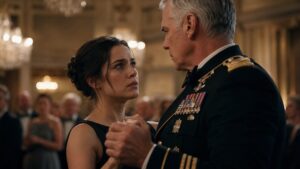
At the center of the formation stood General Donald Adams.
The moment he saw James, he started walking.
Not toward the administration building.
Not toward the president.
Toward the elderly man in the worn jacket.
The crowd parted instinctively.
James looked genuinely surprised.
“Donald.”
The General stopped in front of him.
For one brief moment neither man spoke.
Then Donald Adams raised his hand.
Every officer behind him did the same.
A sharp synchronized salute echoed across the quadrangle.
The sound seemed to freeze the entire campus.
Students stopped moving.
Faculty members stared.
Angela felt her breath leave her lungs.
Because every officer remained perfectly still.
Not for a politician.
Not for a celebrity.
For James.
The man she had nearly removed from the property.
Donald lowered his hand.
“It’s good to see you, sir.”
James sighed.
“You didn’t have to do that.”
“Yes,” Donald said quietly. “I did.”
The crowd continued growing.
Margaret watched from several feet away.
The scene felt unreal.
Years of donor ceremonies had never produced anything remotely similar.
No plaques.
No speeches.
No publicity.
Just respect.
Unquestionable and immediate.
Donald looked around the campus.
“I hear you’ve been having an interesting morning.”
James laughed softly.
“That depends who you ask.”
Several officers smiled.
The reaction alone told Margaret something important.
These people genuinely knew him.
This wasn’t ceremonial.
This was personal.
Then another convoy arrived.
Corporate executives.
Including Benjamin Hall.
The CEO crossed the quadrangle quickly.
“James.”
“You came.”
“You called.”
Benjamin glanced around.
His eyes found Angela.
Then Margaret.
Then the gathered crowd.
He understood enough.
Not everything.
Enough.
Students whispered as executives, officers, and administrators formed an increasingly strange gathering around one elderly man in a worn jacket.
The mystery was over.
The scale was not.
Angela felt sick.
Not because she feared punishment.
Because she finally understood the size of her mistake.
She had judged a person before seeing them.
The worst part was realizing she would have done it to anyone who looked like him.
James noticed her standing alone at the edge of the crowd.
Their eyes met briefly.
She expected anger.
Disappointment.
Something.
Instead he simply nodded.
The gesture felt heavier than condemnation.
Because it treated her as a person.
Not an enemy.
Meanwhile the crowd continued watching.
Waiting.
Someone would speak eventually.
Someone would explain.
Donald looked toward James.
“So what happens now?”
The question spread silently through the gathering.
Students wanted answers.
Administrators wanted answers.
Executives wanted answers.
Margaret perhaps most of all.
James looked around the campus.
The buildings.
The students.
The faculty.
The future.
Then he took a slow breath.
“I think,” he said, “it’s time we talked.”
And with that, he stepped forward toward the waiting crowd.
Chapter 7: A Different Kind of Correction
The crowd expected judgment.
James could feel it before he spoke.
Students filled the edges of the quadrangle. Faculty members stood shoulder to shoulder beneath the old trees. Administrators waited with carefully controlled expressions. Corporate executives remained near Benjamin Hall. Military officers stood beside General Donald Adams.
Everyone seemed to be waiting for the same thing.
Punishment.
Someone would be blamed.
Someone would be removed.
Someone would fall.
That was how public corrections usually worked.
James stepped onto the low stone platform near the center of the lawn.
The platform had hosted countless ceremonies over the years.
Scholarship announcements.
Graduations.
Fundraising events.
Today it hosted something else.
A reckoning.
Margaret Smith approached carefully.
“If you’d prefer privacy—”
“No.”
The answer was gentle.
“But thank you.”
Margaret nodded and stepped back.
James looked across the crowd.
Thousands of eyes seemed fixed on him.
Years ago that would have made him uncomfortable.
It still did.
He had spent most of his life avoiding stages.
Avoiding plaques.
Avoiding portraits.
Avoiding buildings named after himself.
Now there was nowhere to hide.
The realization felt strangely appropriate.
Perhaps he had hidden long enough.
Benjamin stepped forward.
“Would you like me to speak first?”
James smiled.
“That would defeat the purpose.”
A few nearby people laughed quietly.
The tension eased for a moment.
Then returned.
Because nobody knew what came next.
James rested one hand against the worn sleeve of his jacket.
The familiar fabric grounded him.
His father’s jacket.
His mother’s stitching.
A lifetime contained in a simple piece of clothing.
Finally he began.
“This morning I arrived through the same gate many students use every day.”
His voice wasn’t loud.
Yet the crowd fell completely silent.
“I came for a meeting.”
A few people shifted uncomfortably.
“I was stopped before I reached the door.”
No accusation followed.
No anger.
Only facts.
“I was told I didn’t belong.”
Across the lawn, Angela lowered her eyes.
James saw her.
He continued anyway.
“For most of today, people have focused on the wrong part of that story.”
Several administrators exchanged glances.
“The problem isn’t that someone failed to recognize me.”
The crowd listened carefully.
“The problem is that they believed they could recognize someone’s value by looking at them.”
Silence spread.
A deeper silence.
The kind that arrives when people realize they are part of the conversation.
James looked toward the student section.
“I wasn’t the person harmed most by what happened today.”
That surprised many of them.
“Because I could leave.”
He paused.
“I have resources.”
Another pause.
“I have influence.”
Nobody disputed that.
“But what about the student who arrives from a small town?”
Several students straightened.
“What about the veteran returning to school after twenty years?”
General Adams lowered his gaze.
“What about the