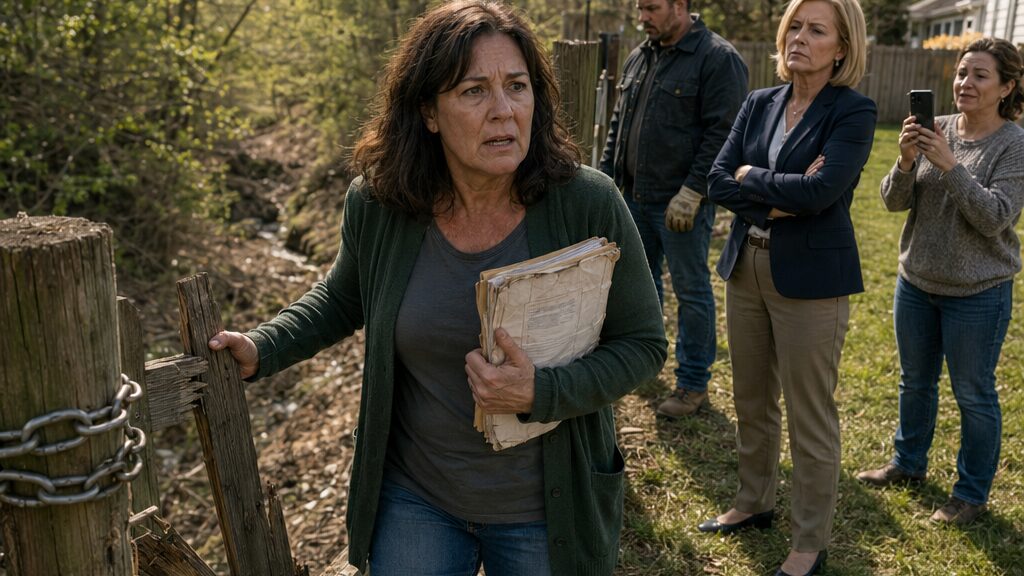
The Day They Tore Down the Fence That Protected Her Mother and Her Past
Chapter 1: The Sound of Splitting Wood
The crack of breaking wood yanked Emma Thompson awake before her alarm ever had the chance.
Another crack followed.
Then the metallic rattle of a chain.
Emma sat upright.
For one disoriented second she thought the sound had come from a dream.
Then she heard a diesel engine idling outside.
Her stomach dropped.
She threw off the blanket and rushed to the bedroom window.
A truck sat beside her backyard fence.
Three workers in bright safety vests stood near the property line.
One of them tightened a chain around a fence post.
The privacy fence shuddered.
The post groaned.
And snapped.
“No.”
Emma was already moving.
She ran down the hallway, grabbed the folder she kept on top of the kitchen cabinet, and shoved her feet into shoes without tying them.
The old approval packet nearly slipped from her hands as she burst through the back door.
“Stop!”
Nobody stopped.
The broken section of fence collapsed onto the grass beside the drainage ditch.
A worker began stacking the panels.
Another reached for the gate.
Emma sprinted across the yard.
“Stop!” she shouted again.
This time the men looked up.
The one closest to her released the gate panel.
Behind them stood Rachel Garcia.
Arms folded.
Expression calm.
Watching.
Emma hated how calm she looked.
“What are you doing?” Emma demanded.
Rachel glanced at her watch.
“The board approved emergency compliance removal.”
“You can’t do that.”
“The appeal window has closed.”
Emma held up the folder.
“I appealed months ago.”
Rachel barely looked at it.
“The fence remains noncompliant.”
The worker near the chain shifted uneasily.
Emma stepped between him and the gate.
“This fence protects my family.”
Rachel’s jaw tightened.
“Community standards apply to everyone.”
The words sounded rehearsed.
Like she’d practiced saying them.
Emma looked beyond the damaged section.
The opening already exposed a clear path toward the wooded drainage area beyond the property.
Her chest tightened.
The fence wasn’t decorative.
It never had been.
A bark came from inside.
The family dog paced nervously near the back door.
One of the workers glanced toward the house.
“Ma’am,” he said carefully. “We’re following the order we received.”
Emma pointed toward the ditch.
“Do you know what’s down there?”
The worker shook his head.
“Steep banks. Water after storms. Wildlife.”
Rachel interrupted.
“The issue isn’t the ditch.”
“The issue is safety.”
“The issue is compliance.”
Emma laughed once.
A short, bitter sound.
Rachel’s eyes narrowed.
“You were offered options.”
“No,” Emma said. “I was offered a demand.”
The chain rattled again.
Another worker moved toward the next post.
Emma stepped directly in front of it.
“Don’t.”
The worker froze.
Rachel sighed.
“Please don’t interfere with the crew.”
“You mean don’t interfere with your mistake.”
Movement near the house caught Emma’s attention.
The back door opened.
Barbara Johnson stepped outside.
Emma’s heart nearly stopped.
Her mother looked confused.
She wore slippers.
And she was walking directly toward the opening.
“Mom!”
Barbara blinked.
“I heard shouting.”
Emma hurried toward her.
The unfinished gap exposed the ditch beyond.
Barbara’s gaze drifted toward it.
For a moment she looked uncertain where she was.
The sight hit Emma harder than the sound of breaking wood ever could.
She guided her mother gently back toward the patio.
“It’s okay.”
Barbara frowned.
“Why are they taking down the fence?”
Nobody answered.
The silence felt louder than the argument.
One of the workers stared at Barbara.
Another looked away.
Rachel shifted uncomfortably.
Only briefly.
Then her expression hardened again.
“The board can’t make exceptions because of personal circumstances.”
Emma looked at her in disbelief.
“My mother could walk straight through that opening.”
“Then supervision is required.”
The answer landed badly.
Even some of the workers exchanged looks.
A voice suddenly called from across the street.
“Whoa, this is getting good.”
Emma turned.
Angela Martinez stood on the sidewalk.
Phone raised.
Recording.
A few neighbors gathered nearby.
Watching.
Whispering.
The humiliation arrived all at once.
Not just the fence.
The audience.
The assumptions.
The feeling that people had already decided who the problem was.
Angela zoomed in.
Rachel didn’t stop her.
Emma noticed that.
She remembered it.
A worker lifted another section of fencing.
The gate swung awkwardly on one remaining hinge.
Its latch dangled loose.
The familiar metal piece that Emma had locked every night for years.
Now hanging uselessly.
Christopher Brown walked toward the opening.
He was the foreman.
Older than the others.
Quiet so far.
He studied the damaged section.
Then his attention shifted to a laminated sign attached inside the fence.
He stepped closer.
Read it.
Read it again.
The sign listed emergency contacts.
Medical information.
Instructions for first responders.
Christopher looked toward Emma.
“How long has that been there?”
“Years.”
Rachel immediately answered.
“That has nothing to do with fence compliance.”
Christopher ignored her.
His eyes moved to another placard near the gate.
Then to the drainage ditch.
Then to Barbara.
Something in his expression changed.
The confidence disappeared.
He walked to the next post.
One of his workers grabbed the chain.
Christopher raised a hand.
“Hold up.”
The worker paused.
Rachel frowned.
“What are you doing?”
Christopher looked at the sign again.
Then at Emma.
Then at the open gap.
Finally he stepped directly between the crew and the fence.
“Nobody pulls another post.”
The yard went silent.
Rachel stared at him.
“We have authorization.”
Christopher nodded.
“And I want documentation.”
“You already received it.”
“Not enough.”
The neighbors stopped whispering.
Angela lowered her phone slightly.
Christopher pointed toward the signs.
“The situation described here changes liability.”
Rachel’s face flushed.
“This isn’t your decision.”
“No,” Christopher said quietly. “But safety is.”
For the first time all morning, someone besides Emma had questioned what was happening.
Christopher folded his arms.
“No more removal until somebody proves we’re supposed to be doing this.”
Emma gripped the approval packet tighter.
The crowd had come expecting a demolition.
Instead, they were suddenly staring at a question.
And standing in the middle of the broken fence, Rachel Garcia looked far less certain than she had ten minutes earlier.
Chapter 2: The Complaint Nobody Could Explain
By noon, half the neighborhood seemed to be standing outside Emma’s property.
The damaged fence remained where it had fallen.
The gate hung crooked.
The opening toward the drainage ditch stayed exposed.
Christopher’s crew sat beside their truck waiting for instructions that never came.
Meanwhile, everyone else talked.
Emma hated that part most.
People loved explanations before they had facts.
Rachel stood near the sidewalk speaking with two HOA board members.
Every so often she glanced toward Emma’s house.
Not angrily.
Calculating.
As though deciding what move came next.
Angela was still recording.
Now she had started interviewing neighbors.
Emma could hear fragments.
“Apparently there were complaints…”
“I heard the fence was built illegally…”
“They said she ignored warnings…”
The words spread faster than truth ever did.
Barbara sat inside near the kitchen window watching the crowd.
Every few minutes she asked the same question.
“Are they still taking it down?”
Every time Emma answered.
Every time her mother forgot.
The repetition exhausted her.
A knock sounded at the back door.
Christopher stood outside.
“Mind if I take another look?”
Emma nodded.
He walked toward the damaged section.
Carefully.
Like he no longer trusted what he’d been told.
“The complaint says the fence exceeds approved height and extends beyond the accepted line.”
Emma crossed her arms.
“And?”
“I’ve seen worse.”
“You’ve seen other fences here?”
Christopher pointed across the street.
“That one.”
Emma followed his finger.
A fence nearly identical to hers.
Same height.
Same style.
Same color.
Another worker joined them.
“There’s one around the corner too.”
Christopher nodded.
“Exactly.”
The observation lingered between them.
Selective enforcement.
Emma had suspected it for months.
Now someone else was saying it out loud.
A neighbor nearby overheard.
“Actually,” the woman said, stepping closer, “there are several.”
Rachel immediately approached.
“The issue isn’t other fences.”
The neighbor folded her arms.
“Then why are they still standing?”
Rachel’s answer came too quickly.
“Different circumstances.”
“What circumstances?”
Rachel didn’t answer.
The crowd noticed.
That mattered.
Emma saw uncertainty spreading.
Small.
Fragile.
But real.
For the first time, Rachel wasn’t controlling the entire narrative.
Christopher pulled a folded document from his pocket.
“The authorization references previous violation notices.”
“I responded to every one.”
Rachel spoke before Emma could continue.
“Responses don’t equal compliance.”
Emma opened her folder.
Years of correspondence.
Receipts.
Approvals.
Appeals.
Everything she’d kept because experience had taught her that paperwork mattered.
She searched for a particular page.
Then stopped.
Her fingers froze.
She searched again.
And again.
A cold feeling spread through her chest.
“No.”
“What?” Christopher asked.
Emma flipped through the packet faster.
The page wasn’t there.
The accommodation approval summary.
The page she’d referenced repeatedly.
Gone.
She stared at the empty space where it should have been.
Rachel’s expression changed.
Just slightly.
Enough.
“You lost it?” Rachel asked.
Emma looked up.
“I didn’t lose it.”
“Then where is it?”
The crowd listened.
Every eye suddenly on her.
Emma hated that feeling.
Because she didn’t know the answer.
The page had always been there.
Always.
She remembered showing it during previous appeals.
Remembered highlighting portions.
Remembered placing it back inside the folder.
Yet now it was missing.
Christopher held out a hand.
“Can I see?”
Emma passed him the packet.
He reviewed it carefully.
Then frowned.
“Looks like something’s missing.”
Rachel seized the opening immediately.
“Which means there’s no proof.”
Emma stepped forward.
“There was proof.”
“Was.”
The single word stung.
Not because Rachel said it.
Because it sounded plausible.
That was how public opinion worked.
One missing page.
One doubt.
One hesitation.
And suddenly years of certainty looked fragile.
Christopher returned the folder.
“I’m not restarting work.”
Rachel exhaled sharply.
“You don’t have authority to halt indefinitely.”
“I have authority to stop if I think there’s a problem.”
The tension between them sharpened.
Emma noticed it.
So did everyone else.
Rachel had expected obedience.
Instead she was facing questions.
A board member approached.
Quiet conversation followed.
Then Rachel turned toward Emma.
“We’ll reconvene tomorrow.”
“No.”
Rachel looked surprised.
Emma surprised herself.
“You don’t get to pause this and pretend nothing happened.”
The broken fence behind her proved that.
Rachel glanced at the damage.
Then away.
“The board will review the matter.”
“The board already reviewed it.”
Rachel’s silence lasted half a second too long.
Enough for people to notice.
Enough for doubt to grow.
The crowd slowly dispersed during the afternoon.
Christopher’s crew left without removing another section.
Angela finally lowered her phone.
Even she seemed uncertain now.
As the neighborhood emptied, Emma sat alone at the kitchen table.
The folder lay open before her.
She turned every page.
Twice.
Three times.
Still nothing.
Then she noticed something.
A tear near one binder hole.
Not natural wear.
A clean separation.
As if a page had once been removed deliberately.
Emma stared at it.
The room suddenly felt smaller.
Someone hadn’t simply misplaced the document.
Someone had taken it.
And if that page was gone from her file, where else might it be missing?
Chapter 3: The Missing Accommodation File
The HOA office door clicked shut before Emma could step inside.
The clerk behind the glass partition offered an apologetic smile.
“I’m sorry. Access to archived files requires a board review.”
Emma stared at her.
“A board review?”
“That’s policy.”
“It wasn’t policy three years ago.”
The clerk shifted uncomfortably.
“That’s what I was told.”
Emma looked past her toward rows of filing cabinets.
Somewhere inside that building was the answer.
Or what remained of it.
The missing page had occupied her thoughts all night.
Not because of what it said.
Because of what its disappearance implied.
Someone had decided it shouldn’t be found.
She pulled out her phone.
“Then I’d like copies of every document connected to my property.”
The clerk typed for a moment.
Then stopped.
“There aren’t many.”
“There should be years of records.”
Another pause.
“Those are the only ones currently listed.”
Emma’s pulse quickened.
The list was barely two pages long.
It should have been five times that.
The clerk turned the monitor slightly.
Emma scanned the entries.
Violation notices.
Responses.
Meeting summaries.
Missing were the accommodation request.
The supporting letters.
The approval packet.
Entire sections of the record had vanished.
“Who removed these?”
“I don’t know.”
The answer sounded truthful.
That made it worse.
Emma left before her frustration turned into something she would regret.
Outside, her phone buzzed.
A new email.
Subject line: FINAL COMPLIANCE REVIEW.
She opened it immediately.
The HOA had scheduled a formal enforcement meeting in six days.
Failure to resolve the violation could result in removal authorization being reinstated.
Six days.
Rachel wasn’t waiting.
Emma stopped walking.
Then changed direction.
If the records weren’t in the office anymore, she would have to find someone who remembered them.
The first person who came to mind surprised her.
Dennis Roberts.
A former board member who had stepped down years earlier.
She remembered him mostly because he had been quiet.
The kind of person who listened more than he spoke.
The kind of person people underestimated.
An hour later she stood on his porch.
Dennis opened the door holding a coffee mug.
He looked surprised.
Then concerned.
“I saw what happened yesterday.”
Emma held up the folder.
“I need help.”
Dennis invited her inside immediately.
The living room was crowded with books and old neighborhood newsletters.
The sort of place where nothing ever seemed to get thrown away.
Emma explained everything.
The missing page.
The halted demolition.
The disappearing records.
Dennis listened carefully.
When she finally finished, he leaned back slowly.
“I knew this sounded familiar.”
Emma sat forward.
“What do you mean?”
“The fence.”
“You remember it?”
Dennis nodded.
“More than that.”
Hope stirred for the first time in days.
“You approved it?”
“I voted for it.”
Emma stared at him.
For several seconds neither spoke.
Then Dennis stood and walked toward a cabinet.
He pulled open a drawer.
Removed several binders.
Flipped through them.
Eventually he found a meeting agenda from years earlier.
“There.”
Emma leaned closer.
The property address was hers.
The item description was partially visible.
The attached pages were missing.
But the reference remained.
Accommodation request review.
Her breath caught.
“It existed.”
Dennis nodded.
“Yes.”
The simple confirmation carried more weight than she expected.
For days she had begun doubting her own memory.
Now someone else remembered.
Someone who had been in the room.
“What was the accommodation?”
Dennis frowned.
Trying to recall.
“For your mother, I think.”
Emma nodded.
“Her wandering episodes were becoming worse.”
Dennis rubbed his forehead.
“I remember discussion about the ditch.”
“The safety risk.”
“The enclosed yard.”
The pieces aligned.
Not complete.
But real.
And importantly, official.
A knock interrupted them.
Dennis opened the front door.
A neighbor stood outside.
The conversation lasted only seconds.
When Dennis returned his expression had changed.
“What?”
“The contractor’s back.”
Emma stood immediately.
“What?”
“Not working.”
“Looking.”
Minutes later they arrived near the property line.
Christopher stood beside the damaged fence examining survey markers.
One of his workers held a measuring wheel.
Rachel was there too.
Watching.
The atmosphere felt tighter than before.
Christopher spotted Emma.
“Good.”
He pointed toward the property line.
“I’ve got questions.”
Rachel crossed her arms.
“The line has already been established.”
Christopher ignored her.
“The measurements don’t match the authorization.”
Emma looked from one to the other.
“What does that mean?”
“It means something doesn’t add up.”
Rachel’s expression hardened.
“The compliance deadline remains in effect.”
Christopher glanced at her.
“Maybe.”
The single word landed harder than an argument.
Rachel turned and walked away before anyone could answer.
The crowd from yesterday hadn’t returned.
But the tension remained.
Different now.
Less spectacle.
More uncertainty.
As Christopher packed up his equipment, Dennis studied the damaged fence.
Then his eyes narrowed.
“I remember something else.”
Emma looked at him immediately.
“What?”
Dennis hesitated.
The hesitation itself felt important.
“The accommodation wasn’t approved for only one reason.”
“What do you mean?”
He looked toward Barbara’s house window.
Then toward the gate.
The broken latch still hung where it had been left.
“I remember there being a second reason.”
Emma stared at him.
“What second reason?”
Dennis shook his head slowly.
“I can’t remember.”
“But I know it mattered.”
Chapter 4: The Boundary Behind the Boundary
Barbara stood beside the broken gate before Emma could stop her.
Her fingers brushed the damaged latch.
The bent metal clicked softly.
“What a mess.”
Emma hurried across the yard.
“You shouldn’t be out here alone.”
Barbara smiled.
“I was just looking.”
Looking.
That word had become dangerous lately.
Looking toward the ditch.
Looking toward the road.
Looking for places she no longer remembered.
Emma gently guided her toward the patio.
Barbara resisted just enough to show irritation.
“I’m not helpless.”
“I know.”
The answer came too quickly.
Both women knew it wasn’t entirely true.
Barbara sat.
The damaged fence stretched behind them.
Part barrier.
Part wound.
For a moment neither spoke.
Then Barbara surprised her.
“Why didn’t you tell them?”
Emma froze.
“Tell who?”
“The neighbors.”
“The board.”
Barbara’s gaze remained fixed on the gate.
“The real reason.”
Emma looked away.
Immediately.
Instinctively.
The same way she always had.
Barbara noticed.
“That’s why, isn’t it?”
Silence answered.
Years of silence.
Years of carefully edited explanations.
Years of saying just enough without saying everything.
The fence protected Barbara.
That part was true.
But it wasn’t the whole truth.
Not even close.
Barbara reached across the table.
Covered Emma’s hand.
“You don’t have to keep carrying it alone.”
The words settled heavily.
Because they touched the exact place Emma avoided.
The place behind the fence.
The place behind every explanation.
A knock at the front door interrupted them.
Relief washed through Emma before guilt followed.
She hated that relief.
The visitor was a delivery driver.
A box addressed to her.
No return name.
Inside were old security records.
Copies.
Photographs.
Maintenance invoices.
Several documents she thought had been lost years ago.
Emma spread them across the dining table.
Barbara watched quietly.
The images pulled Emma backward.
Motion lights.
Reinforced locks.
Security consultations.
A camera mounted beside the gate.
Not because of the ditch.
Not because of Barbara.
Because years earlier someone had refused to stay gone.
The memory arrived with uncomfortable clarity.
The phone calls.
The waiting.
The habit of checking windows twice.
Three times.
The inability to sleep without hearing every sound outside.
The fence had not begun as protection for Barbara.
It had begun as protection for Emma.
Barbara looked at one photograph.
Then another.
“I always wondered why you kept these.”
Emma laughed softly.
Without humor.
“I thought if I threw them away, I’d forget.”
“Did you?”
“No.”
The answer barely qualified as a whisper.
Later that afternoon Christopher arrived unexpectedly.
He carried a clipboard.
“I found something.”
Emma invited him inside.
He spread several measurements across the table.
Survey references.
Property notes.
Inspection photographs.
Christopher pointed to a notation.
“This file references a safety accommodation.”
Emma looked up sharply.
Rachel had repeatedly claimed no accommodation existed.
Yet here it was.
Not complete.
But mentioned.
Officially.
Christopher tapped the page.
“Somebody should have looked harder.”
“Or didn’t want to.”
He didn’t argue.
That bothered Emma more than agreement would have.
As he left, another vehicle arrived.
Rachel.
Emma stepped outside before Rachel reached the porch.
Neither smiled.
Rachel held a folder.
“Final notice.”
Emma accepted it.
The deadline had been moved up.
Three days.
Not six.
Three.
“You accelerated it.”
“The board voted.”
“You pushed them.”
Rachel’s expression tightened.
“You’re not the only resident affected by these decisions.”
The statement sounded sincere.
That complicated things.
Rachel truly believed she was protecting something.
Property values.
Consistency.
Authority.
Maybe all three.
But she kept choosing enforcement over understanding.
And now the consequences sat in Emma’s backyard.
Broken.
Visible.
Rachel looked toward the damaged fence.
“For what it’s worth, I don’t enjoy this.”
Emma almost laughed.
“Then stop.”
Rachel’s gaze lingered on the gate.
The damaged latch.
The opening.
Something uncertain crossed her face.
Gone almost instantly.
Then she returned to her car.
The conversation accomplished nothing.
Except revealing one thing.
Rachel intended to finish what she had started.
That night Emma opened an old storage box.
Inside sat documents she hadn’t touched in years.
Court paperwork.
Protective orders.
Security recommendations.
She stared at them for a long time.
Then began sorting.
Not because she wanted anyone to see them.
Because she might no longer have a choice.
The next morning a white truck stopped beside the property.
A surveyor stepped out carrying equipment.
Emma walked outside immediately.
The man introduced himself and pointed toward the property line.
“I’ve been asked to verify measurements.”
By whom he didn’t say.
He began setting up instruments.
Within minutes Christopher arrived.
Then Rachel.
Then neighbors.
The surveyor studied the existing markers.
Paused.
And frowned.
“That’s strange.”
Everyone looked toward him.
He pointed toward a stake near the ditch.
“This doesn’t match the historical map.”
The yard fell silent.
Chapter 5: The Stake in the Wrong Place
The surveyor knelt in the grass and brushed dirt away from the base of the stake.
Nobody spoke.
Not Emma.
Not Christopher.
Not even Rachel.
The quiet stretched until the surveyor stood again.
“I need to check something.”
He walked twenty feet closer to the drainage ditch.
Then another ten.
The measuring equipment followed.
Christopher joined him.
The two men compared maps.
Numbers.
Coordinates.
After several minutes the surveyor drove a thin probe into the ground.
Metal struck something below the surface.
A hollow click.
The surveyor crouched immediately.
Christopher did the same.
Emma watched them dig carefully through packed soil.
Then she saw it.
Wood.
Old wood.
The top of a buried survey marker.
The original stake.
The surveyor brushed away the dirt and checked his map.
Again.
Then a third time.
When he finally stood, his expression had changed.
“That’s the original property marker.”
Rachel stepped forward.
“Are you sure?”
“Yes.”
“And the current one?”
The surveyor looked toward the newer stake.
“It appears to have been relocated.”
A ripple moved through the gathering crowd.
The neighbors who had drifted over during the morning suddenly looked much more interested.
Emma’s pulse hammered.
The difference wasn’t enormous.
A few feet.
But a few feet changed everything.
Rachel crossed her arms.
“That doesn’t automatically validate the fence.”
“No,” Christopher said.
“But it changes the discussion.”
The surveyor nodded.
“The existing fence is farther inside the property line than previously reported.”
Emma stared at the broken section.
The gap.
The fallen boards.
All the damage based on measurements that might never have been correct.
Rachel looked genuinely unsettled for the first time.
Not guilty.
Not defeated.
Unsettled.
Like someone watching certainty slip away.
The surveyor continued working.
More measurements.
More notes.
The crowd grew larger.
People whispered openly now.
Not about Emma.
About the stake.
About the records.
About the missing paperwork.
The story had changed.
A week earlier the neighborhood thought it understood everything.
Now nobody seemed sure.
Christopher approached Emma while the surveyor worked.
“You okay?”
She almost said yes.
Instead she shook her head.
“Not really.”
The honesty surprised both of them.
Christopher looked toward the damaged fence.
“I should’ve asked more questions before starting.”
“You trusted the documents.”
“Maybe too much.”
He kicked lightly at the grass.
Then lowered his voice.
“I spoke with another contractor yesterday.”
Emma waited.
“He said Rachel pushed hard for emergency enforcement.”
“How hard?”
“Hard enough that people noticed.”
The information wasn’t proof of anything.
But it mattered.
Pressure left traces.
Sometimes in documents.
Sometimes in people.
The surveyor eventually packed up.
His final report would take another day.
Another delay.
Another pause.
Rachel hated pauses.
Emma could tell.
Because delays created room for questions.
Questions created doubt.
And doubt weakened authority.
As people began leaving, Angela Martinez arrived carrying her phone like a reporter chasing a story.
“You won’t believe what’s happening online.”
Emma immediately regretted asking.
“What?”
Angela showed her the screen.
Clips from the original confrontation.
Thousands of views.
Comments.
Arguments.
Opinions.
Most from people who knew nothing about the situation.
Emma looked away.
“I don’t need to see that.”
“Wait.”
Angela stopped her.
“This part.”
She played a different clip.
One Emma hadn’t seen before.
Recorded before the confrontation became public.
The camera angle was shaky.
Accidental.
Angela must have started recording before she realized anything important was happening.
Rachel stood near the contractor truck.
Speaking quietly.
The audio wasn’t perfect.
But it was understandable.
“…if we wait any longer, she’ll find another excuse.”
A man’s voice answered.
“We still don’t have the accommodation file.”
Rachel responded immediately.
“It won’t matter once the fence is gone.”
The video ended.
Angela looked up.
“I didn’t realize I had that.”
Neither had Rachel.
Emma replayed the clip.
Again.
And again.
The words weren’t a confession.
But they changed the meaning of several things.
Rachel hadn’t been responding to a completed investigation.
She’d been pushing ahead despite unanswered questions.
The distinction mattered.
A lot.
By evening the video had spread through the neighborhood.
Not everyone sided with Emma.
But the certainty was gone.
The community had split into camps.
Those who believed rules mattered most.
And those who wondered whether the wrong rule had become more important than the people affected by it.
As darkness settled over the yard, Emma stood beside the damaged gate.
She reached down and lifted the broken latch.
The metal felt cold in her hand.
Years ago that latch had represented fear.
A need to keep danger outside.
Later it became routine.
Then responsibility.
Now it represented something else.
Evidence.
Proof that the fence had never been just a fence.
Headlights swept across the driveway.
A car stopped.
Rachel stepped out.
Alone.
No board members.
No audience.
She approached slowly.
For a moment Emma wondered if she had come to apologize.
Then she remembered who Rachel was.
Rachel held out her phone.
“I’ve seen the video.”
Emma waited.
Rachel looked exhausted.
Not defeated.
Exhausted.
“There are things you don’t understand.”
“Then explain them.”
Rachel looked toward the damaged fence.
Toward the ditch.
Toward the neighbors watching discreetly from their windows.
When she finally spoke, her voice was low.
“I knew the file was incomplete.”
Emma’s breath caught.
Rachel continued.
“But I thought delaying again would make the board look weak.”
The admission hung between them.
Not malice.
Not conspiracy.
Something more ordinary.
And perhaps more dangerous.
Pride.
Rachel closed her eyes briefly.
Then opened them.
“I thought I was protecting the community.”
Before Emma could respond, Rachel turned and walked away.
But the conversation had already changed everything.
Because now the question wasn’t whether Rachel knew there were problems.
The question was how many problems she had chosen to ignore.
Chapter 6: What Everyone Refused to See
Every seat in the clubhouse meeting room was occupied.
People stood along the walls.
Others crowded near the doorway.
The damaged fence had become the neighborhood’s biggest topic, and nobody wanted to miss what happened next.
Emma sat near the front with a folder resting on her lap.
The same folder.
Thicker now.
Filled with records she had spent days collecting.
Across the room sat Rachel Garcia.
Composed.
Professional.
Prepared.
The board members arranged themselves behind a long table.
A microphone waited in the center.
The atmosphere felt less like a neighborhood meeting and more like a trial.
The HOA president opened the session.
“We are here to review the compliance dispute regarding the Thompson property.”
Murmurs moved through the crowd.
The president raised a hand.
Silence returned.
Rachel stood first.
She carried several documents and spoke calmly.
For twenty minutes she explained policy.
Architectural standards.
Property consistency.
Board authority.
The importance of equal enforcement.
Everything sounded reasonable.
That was what made it dangerous.
Because parts of it were true.
Rachel wasn’t lying about the rules.
She was describing them exactly as they existed.
The problem was everything the explanation left out.
When she finished, several neighbors nodded.
Emma understood why.
Rules were comforting.
Rules felt objective.
Rules didn’t require people to look at complicated human situations.
Rachel returned to her seat.
The president turned toward Emma.
“Mrs. Thompson?”
Emma rose slowly.
For a moment she considered saying less.
Keeping certain things private.
Protecting herself the way she always had.
The instinct was familiar.
And exhausting.
She walked to the microphone.
Before she could speak, movement near the back of the room caught her attention.
Barbara.
Her mother had quietly entered through the side door.
Emma’s heart tightened.
She had asked her to stay home.
Barbara ignored the request.
As usual.
The elderly woman settled into a chair and smiled.
The sight steadied Emma more than she expected.
She opened her folder.
“I’d like to start with a simple question.”
The room quieted.
“Why was my fence approved in the first place?”
Nobody answered.
Emma held up copies of meeting agendas.
Correspondence.
Maintenance records.
Safety evaluations.
Each document represented something the board had repeatedly claimed didn’t exist.
A board member leaned forward.
“Where did you obtain those?”
“I kept them.”
The answer landed harder than intended.
Because everyone understood what she meant.
The records existed.
Someone simply hadn’t looked very hard.
Or hadn’t wanted to.
Christopher Brown stood when called.
The contractor looked uncomfortable in front of the crowd.
“I was hired to perform compliance removal.”
He glanced toward Rachel.
Then toward Emma.
“The first day, I believed the authorization was complete.”
A pause.
“Then I saw the safety notices.”
He described the emergency information posted inside the fence.
The warnings.
The vulnerable resident notices.
The open access to the drainage ditch.
Several people exchanged looks.
The situation sounded different when described by someone who had nearly removed the fence himself.
Christopher continued.
“At that point I requested additional verification.”
Rachel remained expressionless.
The board members took notes.
Then Dennis Roberts approached the microphone.
The former board member carried an old binder.
The same one he’d shown Emma earlier.
“I participated in the original approval discussion.”
The room became noticeably quieter.
“We approved a special accommodation.”
A board member frowned.
“Why wasn’t that in the file?”
Dennis looked directly at Rachel.
Then at the audience.
“I don’t know.”
The answer created more tension than certainty.
Because nobody could dismiss Dennis as biased.
For years he had avoided neighborhood politics entirely.
The room shifted again.
The narrative Rachel had carefully built was beginning to crack.
Then everything stopped.
Barbara stood.
No announcement.
No warning.
She simply rose from her chair and began walking toward the exit.
Emma noticed immediately.
The room did too.
Barbara wasn’t causing trouble.
She looked confused.
Lost.
Like she wasn’t entirely sure why she was there.
The door opened.
Beyond it sat the parking lot.
Then the road.
Emma hurried after her.
“Mom.”
Barbara blinked.
“Oh.”
For several seconds she seemed genuinely uncertain where she had intended to go.
The silence that followed felt heavier than any testimony.
Nobody needed an explanation.
They had just witnessed one.
Emma guided her mother gently back to her seat.
No speeches.
No dramatics.
Just reality.
The kind reality rarely included in policy manuals.
When the hearing resumed, the atmosphere had changed.
People were no longer discussing a fence.
They were discussing consequences.
Rachel recognized the shift.
She returned to the microphone.
And to Emma’s surprise, she didn’t retreat.
She fought.
Not angrily.
Convincingly.
“Every community depends on consistent standards.”
She looked around the room.
“If enforcement becomes selective, those standards disappear.”
Several people nodded.
Again, because part of it was true.
Rachel wasn’t defending cruelty.
She was defending a principle.
The problem was that she’d allowed the principle to outweigh the people affected by it.
The distinction mattered.
But it wasn’t always obvious.
The hearing continued for nearly two hours.
Documents were reviewed.
Dates were compared.
Questions were asked.
Answers remained incomplete.
Then Dennis spoke again.
“There was an appeal.”
The room quieted instantly.
He opened another folder.
“The appeal wasn’t denied.”
A board member looked up sharply.
“It wasn’t?”
Dennis shook his head.
“It was never processed.”
The statement landed like a dropped stone.
Emma watched several board members exchange startled looks.
The implication was impossible to ignore.
The system hadn’t rejected her.
The system had failed her.
Rachel looked genuinely surprised.
That surprised Emma.
For the first time she wondered whether Rachel had known less than she claimed.
Or whether she had stopped asking questions once she believed she knew the answer.
Neither possibility felt comforting.
The president finally called for adjournment until the following evening.
No decision.
Not yet.
People slowly filed toward the exits.
Conversations erupted immediately.
Arguments.
Speculation.
Opinions.
The community seemed split directly down the middle.
As Emma packed her documents, Rachel approached.
For several seconds neither woman spoke.
Then Rachel said quietly, “You should have told people.”
Emma looked at her.
“Told them what?”
Rachel glanced toward Barbara.
Then away.
“The whole story.”
Emma almost replied.
Almost.
Then stopped.
Because Rachel wasn’t entirely wrong.
Emma had spent years hiding behind silence.
Not because she enjoyed secrecy.
Because secrecy felt safer.
Rachel started to walk away.
Emma called after her.
“There is a whole story.”
Rachel turned.
Emma held her gaze.
“And tomorrow you’re going to hear it.”
Chapter 7: Sometimes That Is What Love Looks Like
The final vote was scheduled for seven o’clock.
By six-thirty the clubhouse was full.
Again.
But this time the mood felt different.
Less hostile.
Less certain.
People arrived carrying questions instead of conclusions.
Emma sat alone near the front.
Her folder rested beside her chair.
The documents she had avoided showing anyone for years remained inside.
She touched the edge of the folder repeatedly.
Then forced herself to stop.
Across the room Rachel reviewed notes.
Neither woman acknowledged the other.
Christopher arrived shortly before the meeting began.
Dennis sat nearby.
Barbara remained at home with a caregiver.
For once Emma hadn’t argued when help was offered.
The realization surprised her.
The meeting opened quickly.
The president summarized the findings.
Property line discrepancies.
Incomplete records.
Unprocessed appeals.
Accommodation references.
Nothing sounded simple anymore.
Then Christopher was called forward.
The contractor stood before the room.
“I want to explain why I stopped the demolition.”
Nobody interrupted.
“I’ve removed hundreds of structures.”
His voice remained steady.
“Most compliance jobs are straightforward.”
He paused.
“This one wasn’t.”
Christopher described seeing the emergency signs.
The open path toward the drainage ditch.
Barbara’s confusion.
The obvious safety concerns.
Then he said something that changed the room.
“The problem wasn’t the fence.”
People leaned forward.
“The problem was that nobody stopped to ask why it existed.”
Silence followed.
Not dramatic silence.
Thoughtful silence.
The kind that appears when people recognize something uncomfortable.
Christopher returned to his seat.
The president looked toward Emma.
“Mrs. Thompson, you requested time to speak.”
Her throat tightened.
This was the moment she had spent years avoiding.
She carried the folder to the microphone.
Opened it.
Removed several documents.
Then stopped looking at them.
Instead she looked at the people.
The neighbors.
The board.
The people who had watched her fight without understanding what she was protecting.
“My mother isn’t the only reason the fence exists.”
The room remained completely silent.
Emma continued.
Years ago she had never imagined saying these things publicly.
Now the words came anyway.
Not perfectly.
Not dramatically.
Simply honestly.
She described a period of her life she had hidden from nearly everyone.
The fear.
The security recommendations.
The constant checking of locks.
The need to know exactly who could see into her yard.
She never named anyone.
Never made the story larger than it was.
Because it wasn’t about blame anymore.
It was about context.
The fence had started as protection.
Then become routine.
Then become part of caring for Barbara.
The meaning had changed over time.
The purpose had not.
When she finished, nobody spoke immediately.
The room felt smaller.
More human.
Dennis eventually stood.
Holding an old document.
A copy recently recovered from archived records.
The missing accommodation approval.
The room leaned forward.
The board reviewed it carefully.
Then another document surfaced.
The original recommendation.
Two justifications listed.
Protection of a vulnerable resident.
And residential security accommodation.
Dennis looked at Emma.
“The second reason.”
Emma nodded.
At last.
The missing piece.
Not hidden forever.
Just buried beneath years of assumptions.
Discussion continued.
Questions followed.
Votes were prepared.
Rachel remained silent until the very end.
When asked whether she wished to comment, she stood.
The room waited.
Rachel took a slow breath.
“I believed I was protecting the community.”
Nobody interrupted.
“I still believe standards matter.”
A few people nodded.
Rachel looked toward Emma.
Then toward the damaged fence photographs displayed on a screen.
“But I pushed for enforcement before all the facts were verified.”
The admission sounded difficult.
Because it was.
Yet even then she didn’t apologize.
Not directly.
Emma realized she wasn’t going to.
And surprisingly, she found she didn’t need one.
The vote happened minutes later.
The result wasn’t unanimous.
But it wasn’t close either.
The existing removal order was revoked.
The fence would remain.
A redesign would bring portions into updated compliance standards.
The HOA would establish a formal accommodation review process.
Future requests would require documented review rather than informal handling.
The decision felt practical.
Messy.
Real.
Not a victory parade.
A correction.
Which somehow felt more satisfying.
Several weeks later workers returned to Emma’s property.
This time with lumber instead of chains.
Christopher supervised the project personally.
New sections replaced damaged ones.
The fence looked different when finished.
Cleaner.
Slightly lower in certain areas.
More consistent with neighborhood standards.
Yet the protected yard remained intact.
The gate remained.
Most importantly, the purpose remained.
On the final afternoon Christopher installed a new latch.
Solid steel.
Smooth.
Reliable.
He tested it twice.
Then handed the gate to Emma.
“Your turn.”
She closed it gently.
The latch clicked.
A small sound.
Yet it carried years inside it.
The dog wandered across the yard.
Barbara sat safely near the patio.
The drainage ditch remained beyond the fence.
No less dangerous than before.
No closer.
No farther.
Simply there.
Protected against.
Understood.
A child from the neighboring house watched through the fence.
Curious.
The child pointed toward the gate.
“Why do you lock it?”
Emma smiled.
The question sounded innocent.
But it reached deeper than the child realized.
She looked across the yard.
At her mother.
At the rebuilt fence.
At the boundary that people had once mistaken for defiance.
Then she answered.
“Because sometimes boundaries keep people safe.”
The child considered that.
Then asked, “So it’s not to keep people out?”
Emma looked at the new latch.
The sunlight resting against fresh boards.
The yard that had survived being misunderstood.
“No,” she said softly.
“Sometimes that’s what love looks like.”
The story has ended.