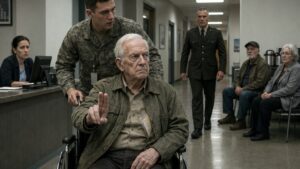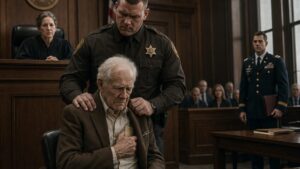
The Airman Mocked His Faded ID Until the Base Commander Saluted the Man Behind the Glass
Chapter 1: The Card Brian Refused to Believe
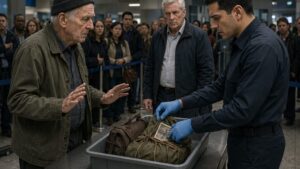
Brian Miller held the identification card toward the fluorescent light as if expecting wet ink to run from it.
“Did you print this yourself?”
The question carried through the visitor-control center, clean and sharp against the low hum of scanners. Two people waiting behind Frank Hall looked up. One shifted a garment bag from one hand to the other. The other, a retired-looking man in a veterans’ cap, glanced at Frank’s worn leather jacket and then away.
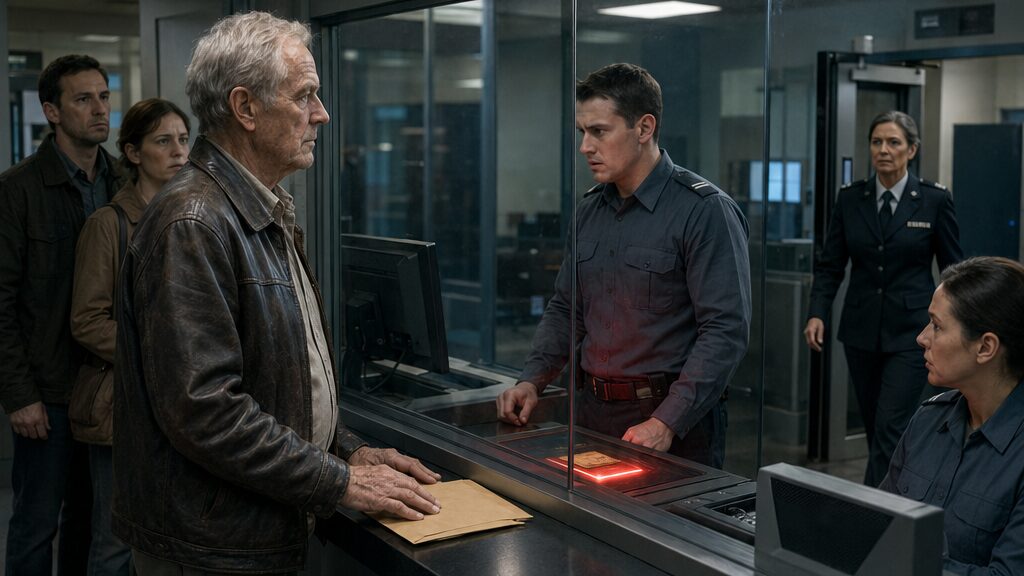
Frank kept both hands on the manila envelope resting against the counter. The glass partition between him and Brian had been replaced since his last visit, but the counter beneath it had not. The dark edge still bore a shallow dent near the left corner, made years ago by a dropped communications case.
“No,” Frank said.
Brian turned the card over. The laminate had yellowed at the edges. A crack ran through one corner without reaching the old photograph. The young face in that photograph seemed more severe than Frank remembered being.
“This expired before I was born.”
“It was never a standard access card.”
“That much is obvious.”
The woman at the next terminal gave a small, nervous breath that might have been a laugh. Her name strip read SCOTT. Nicole Scott looked younger than Brian but less certain of herself. She studied the card from the side while pretending to review a visitor form.
Frank could have ended the exchange with six words. He could have given his former rank, his old command, Catherine Wilson’s name, and the purpose of the invitation folded inside the envelope.
Instead he said, “There should be a legacy verification channel.”
Brian looked at him through the glass. “There should be?”
“There was.”
“Sir, Falcon Ridge doesn’t operate on what there was.”
Frank’s fingers tightened slightly on the envelope. The paper had softened along the edges from the train ride and the walk from the civilian gate. Catherine had offered a car, an aide, and an escort from the station. Frank had declined all three.
He had told himself he wanted to arrive as Paul’s former commander, not as an honored guest.
That was only part of the truth.
Brian tapped the card against the counter. “You have a current driver’s license?”
“Yes.”
“Then why didn’t you present it?”
“Because the invitation instructed me to bring this.”
Brian’s eyes moved to the envelope. “Invitation to what?”
Frank slid the envelope forward until it touched the narrow metal tray beneath the glass. A typed label was fixed to its front, but his hand covered the lower half.
“The heritage exhibit.”
“The opening is restricted.”
“I know.”
“Guests were pre-cleared.”
“I know.”
“And escorted arrivals use the east entrance.”
“I declined the escort.”
Brian leaned back, arms folding across his chest. “Of course you did.”
There it was—not anger, not yet. Something cheaper. A conclusion reached before the facts.
Frank had heard that tone from young officers, old senators, frightened officials, and men who mistook certainty for command. He had corrected it quickly in others. In himself, he had often called silence discipline.
Behind Brian, a shift supervisor passed through the corridor. Brian straightened without seeming to notice he had done so.
Nicole looked again at the card. “There’s a symbol under the laminate.”
Brian did not turn. “It’s damaged.”
“No. Here.” She pointed through the air without touching it. “Lower right. It looks like an old command authentication mark.”
Brian angled the card toward himself.
For the first time, his expression changed. Only slightly. His thumb stopped moving over the cracked edge.
Frank said, “The legacy reader used to be under the secondary terminal.”
Brian’s suspicion returned, sharper because it had briefly weakened. “You seem to know a lot about a system you say you haven’t used.”
“I did not say that.”
“How long ago were you stationed here?”
Frank looked past him, through the interior doors, toward a corridor that no longer led where memory expected it to. “Long enough ago that the base had another name.”
The man in the veterans’ cap behind Frank took one step closer.
Brian noticed. His voice rose just enough to turn procedure into performance. “Sir, I need you to step aside. You may have misunderstood the invitation, and we have other guests waiting.”
“I have not misunderstood it.”
“You’re carrying an invalid credential and refusing to provide a normal explanation.”
“I provided the explanation required.”
“No, you gave me a story about a legacy channel.”
Nicole shifted in her chair. “We can check it.”
Brian glanced toward the supervisor’s corridor, then back at Frank. A red mark had crept up his neck.
Three weeks earlier, an unauthorized contractor had entered through a service gate using copied credentials. Brian had not been on that gate, but Frank could not know that. He could only see a young airman measuring the room, guarding not just the base but his position inside it.
Frank softened his voice.
“You do not have to believe me. You do have to check before you decide what I am.”
The words landed differently than he intended. Nicole’s gaze dropped. Brian’s face hardened.
“I’ve decided you’re holding up a secured entry point.”
He pushed the card toward the far side of the desk and reached for the desk phone. “If you won’t step aside voluntarily, I’ll have someone escort you to the waiting area.”
Frank felt the old impulse rise—the command voice, exact and cold, capable of rearranging a room in one sentence.
He swallowed it.
Rank was not the reason Brian should listen. Rank was not the reason the man behind him deserved patience, or the woman with the garment bag, or anyone else who arrived without the right polish.
But silence, Frank knew, was doing what it had done before. It was allowing another man’s certainty to become the official version of events.
Nicole stood.
“Brian.”
“What?”
“The reader.”
She pointed beneath his terminal. A narrow black device was fixed to the underside of the counter, half hidden by cables. Its casing bore the same faint symbol embedded under Frank’s laminate.
Brian stared at it.
The supervisor appeared again at the end of the corridor. He did not approach, but his attention settled on the scene.
Brian saw him.
That decided it.
“Fine,” Brian said. “We’ll check.”
He pulled the old reader forward. Dust marked the edge where it had not moved in years. Nicole entered a maintenance code. The screen remained gray.
Brian held Frank’s card over the device.
“Last chance,” he said. “If this triggers an invalid-credential response, security retains the card.”
Frank looked at the envelope beneath his hands.
“Scan it.”
Brian slid the yellowed identification card onto the reader.
For one second, nothing happened.
Then the terminal locked with a mechanical click.
Every field on Brian’s screen vanished.
A red light flooded the counter, reflecting off the glass and across the faded photograph of Frank’s younger face.
Chapter 2: The Red Alert Behind the Glass
Brian reached for the manila envelope the moment the red light appeared.
The screen stopped him.
ASSOCIATED MATERIALS—DO NOT ALTER, OPEN, OR CONFISCATE.
The command filled the display in block letters beneath a code Brian had never seen. The terminal would not accept his password. It would not release the card. A second line appeared.
DIRECT COMMAND NOTIFICATION INITIATED.
“What did you do?” Brian asked.
Frank moved the envelope beyond Brian’s reach. “Nothing.”
“You told me to scan it.”
“You chose to scan it.”
The distinction struck Brian as evasive, and evasion now looked dangerous. He pressed the alarm key beneath the desk. It failed to respond.
Nicole leaned toward the screen. “It already initiated a response.”
“From who?”
“I don’t know.”
Brian lifted the desk phone. No dial tone. The system had isolated the terminal.
The waiting room had gone silent. Even the ventilation seemed quieter under the red glow. The retired man in the cap had taken off his glasses. The woman with the garment bag stood motionless beside the door.
Brian looked at Frank again.
The old man had not changed posture. He stood with one hand on the envelope and the other resting lightly on the counter. No satisfaction. No fear. If anything, he looked tired.
That frightened Brian more than the alert.
“Step back from the glass,” Brian ordered.
Frank did not move.
“Sir, I said step back.”
“The instruction on your screen concerns the card and the envelope. It does not classify me as a threat.”
“You can read that from there?”
“The display format has not changed much.”
Brian’s hand went to the radio on his shoulder. “Visitor control to command post. I have a legacy security alert at the main center.”
Static answered first.
Then a voice: “Hold position. Do not escalate. Command is responding.”
Do not escalate.
Brian became aware of his own breathing.
Nicole sat straighter. “The name field is opening.”
A new panel had appeared. Most of the information remained masked, but one line resolved slowly beneath the authentication seal.
HALL, FRANK—LT GEN, USAF, RET.
Brian read it twice.
Retired lieutenant general.
Three stars.
He looked at the man’s jacket, the scuffed shoes, the old envelope. Then at the photograph on the card. The younger face had the same level gaze.
Nicole whispered, “Oh.”
Brian’s first instinct was disbelief. The second was worse: memory.
His training instructor standing before a projection screen. A lesson on Falcon Ridge’s command lineage. A photograph of senior officers from the base’s former strategic wing. He had not learned the names. He had learned what would be tested.
He stepped back from the terminal.
“General—”
Frank raised one finger, not commanding, merely stopping him.
“Do not change how you speak to me because the screen did.”
Brian’s mouth closed.
The inner security door opened.
Brigadier General Catherine Wilson entered at a pace that was neither hurried nor calm. A folder remained tucked under one arm. Two officers followed, but she left them near the corridor and crossed the room alone.
Brian had seen her nearly every day for eleven months. He had never seen her face lose its practiced control.
It did now.
She stopped on the other side of the glass, looked at Frank, then at the card trapped beneath the red scanner light.
“General Hall.”
The title moved through the room like a pressure change.
Catherine came around the partition through the staff gate. She stood in front of Frank, set the folder aside, and raised her right hand.
Her salute was exact.
Frank looked at her for a long second before returning it.
No one in the waiting room moved. Brian felt his earlier words returning one by one—printed it yourself, confused, invalid credential—each uglier now that other people had heard them.
But Frank’s face offered him no rescue and no revenge. When the salute ended, Frank lowered his hand and glanced toward the people waiting behind him.
“They have been delayed,” he said. “Please clear them through.”
Catherine’s eyes shifted to Brian.
He straightened. “Yes, ma’am.”
“Specialist Scott,” Catherine said, “open the secondary station.”
Nicole moved immediately. The line began to breathe again, though everyone kept looking toward Frank.
Catherine turned back to him. “You should have called.”
“I did. Six weeks ago.”
“I mean this morning.”
“You offered an escort.”
“You declined it.”
“Yes.”
Her expression held frustration familiar enough to suggest an older argument. “And you came through the public checkpoint with that card.”
“It was listed in the access instructions.”
“That instruction was generated from an archival protocol no one expected to activate.”
Frank glanced at Brian’s frozen screen. “Someone expected it.”
Catherine followed his gaze. Her tone cooled. “Airman Miller, step away from the terminal.”
Brian obeyed.
“Ma’am, I believed—”
“We will discuss what you believed after the center is operational.”
Frank said, “He used the system available to him.”
Brian looked at him, startled.
Catherine did not. “He used contempt before he used the system.”
The words were quiet, which made them worse.
Frank’s attention returned to the manila envelope. He slid it under one arm.
Catherine noticed the typed label exposed on its front.
Her face changed again.
Brian could read only the name before Frank covered it.
PAUL JACKSON.
Catherine looked toward the two officers waiting in the corridor, then back at Frank. “Where did you get that?”
“It was returned to me when the final classification review closed.”
“That file is part of the exhibit archive.”
“Part of it.”
“Frank.”
It was the first time she used his first name. Not as familiarity. As warning.
He met her eyes.
“I came to deliver what was left out.”
The scanner gave a soft tone. The red light dimmed, but the card remained locked in place. A message appeared directing command personnel to escort the credential holder to the legacy records authority.
Catherine picked up her folder. “The opening begins in less than four hours.”
“I know.”
“The final program is already printed.”
“I know that too.”
Brian stood behind the desk, useless now, while Nicole processed visitors at the second terminal. He wanted to apologize, but every possible sentence sounded designed to help himself.
Catherine gestured toward the secured corridor. “We’ll go to the heritage wing.”
Frank did not move.
“My card.”
“The system will release it when the archive acknowledges you.”
Frank looked through the glass at Brian. Not accusing. Not absolving.
“Keep it safe.”
Brian nodded. “Yes, sir.”
Frank’s eyes held his for a moment.
“Safe is not the same as respected.”
Then he followed Catherine through the security door.
The corridor beyond had once displayed mission maps. Now it held framed photographs of aircraft and polished brass plaques. Catherine waited until the checkpoint doors closed behind them.
“You chose the most visible possible way to arrive.”
“I chose the way the invitation specified.”
“You could have prevented that scene.”
“So could he.”
Catherine’s jaw tightened. “This is not about the checkpoint.”
“No.”
She stopped walking.
The folder under her arm bore the title of the new exhibit: COMMAND UNDER FIRE.
Catherine opened it and removed the printed program. Frank’s photograph filled the inside page. Beneath it, a paragraph praised his judgment during the failed evacuation mission that had shaped Falcon Ridge’s history.
Catherine tapped the final lines.
“The program names you as the commander who prevented a regional disaster,” she said. “It names Paul Jackson as the officer whose unauthorized deviation caused the mission to collapse.”
Frank looked at the words but did not touch the page.
Catherine lowered her voice.
“If you brought what I think you brought, you did not come here to accept an honor.”
Chapter 3: The Exhibit Built Around the Wrong Hero
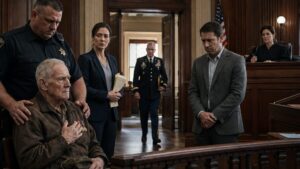
Frank entered the heritage gallery beneath a photograph of himself thirty-three years younger and twelve feet tall.
COMMAND UNDER FIRE, the wall declared.
A spotlight washed his younger face in white. The photograph had been taken two days after Paul Jackson died. Frank remembered the stiffness of the dress uniform, the questions shouted across the press room, and the aide who had whispered that the families were watching.
He had said almost nothing.
At the time, people had called that restraint.
A technician on a ladder waved him aside. “Sir, could you move past the rope? We’re focusing this display.”
Frank stepped back.
The technician adjusted the light until it centered on the three silver stars visible on the photograph’s shoulder board.
Catherine watched from several feet away. “You could tell him.”
“He is doing his job.”
“That answer has become convenient for you.”
Frank glanced at her.
She had changed since he last saw her in person. More gray at the temples, less willingness to disguise impatience. When she had been a captain under his command, she could challenge an operational plan with three facts and no wasted words. He had promoted that quality.
He had not expected to face it here.
The gallery traced the history of the former strategic wing through photographs, maps, uniforms, and salvaged equipment. Near the center stood a glass case containing a credential identical in shape to Frank’s old card. Its laminate was clear, its photograph uncracked.
The caption described the command authentication system once used to protect restricted mission records.
Frank looked toward the checkpoint beyond two secured corridors.
“My card was not included in the archive transfer,” he said.
“No,” Catherine replied. “It was tied to a sealed command index. When the system was modernized, the credential remained active in the legacy database.”
“Who ordered that?”
“You did.”
He almost smiled. “That sounds inefficient.”
“It sounds like you.”
The technician climbed down and approached them. “General Wilson, we have a problem with the mission display.”
His gaze passed over Frank without recognition.
Catherine said, “What problem?”
“The aircraft diagram doesn’t match the flight path in the caption. Public affairs says leave it, but the veterans’ group will notice.”
Frank stepped closer to the illuminated panel.
A red line showed Paul’s aircraft breaking formation over the eastern ridge. The caption called it an unauthorized turn that disrupted the evacuation corridor and forced command to reroute the remaining flight.
“The ridge line is wrong,” Frank said.
The technician looked at him. “Sir?”
“The map uses the post-expansion survey. At the time of the mission, the eastern ridge extended another eleven miles north. Jackson’s turn did not cross the evacuation corridor.”
The technician frowned. “The archived route overlay says it did.”
“The overlay was reconstructed after the terrain database changed.”
“And you know that because?”
Frank looked at the giant photograph on the wall.
The technician followed his eyes. His face emptied.
“Oh.”
Frank turned back to the display. “Captain Jackson turned south of the old ridge boundary. Move the line two centimeters east and rotate the corridor marker.”
The technician glanced at Catherine.
“Do it,” she said.
As he hurried away, Frank studied the revised space on the panel. Two centimeters. That was all it took to move Paul from reckless to almost reasonable.
Almost.
Catherine lowered the program. “The opening is in three hours. Legal review has not seen whatever is in that envelope. Public affairs has a livestream crew arriving. Retired members of the wing are already on base.”
“And Stephanie Jackson?”
Catherine hesitated.
“She confirmed attendance yesterday.”
Frank looked at her.
“She has written to the museum board three times,” Catherine continued. “She believes the exhibit uses her father’s death to strengthen your legend.”
“She is right.”
“You have not seen the final exhibit.”
“I have seen enough.”
Catherine moved closer. “Then tell me what you brought.”
Frank placed the envelope on a covered display case but kept one hand on it.
“A casualty-record correction request. Supporting mission notes. A letter Paul wrote before the final sortie.”
“To whom?”
“His daughter.”
“Why do you have it?”
“He gave it to me for safekeeping before launch.”
“And you kept it for thirty-three years?”
“It was sealed with instructions.”
Catherine’s expression sharpened. “Instructions from Paul?”
Frank did not answer.
The silence between them widened.
Around them, technicians tested lights and adjusted placards. A recorded aircraft engine started from a speaker, low enough to feel through the floor. Frank remembered another vibration, another room, voices breaking over damaged communications.
Catherine touched the envelope with one finger.
“Do you intend to give this to Stephanie today?”
“Yes.”
“Before or after the ceremony?”
“That depends.”
“On what?”
“Whether the record is corrected.”
Catherine stepped away. “A correction cannot be approved in three hours.”
“It should have been approved thirty-three years ago.”
“And whose responsibility was that?”
The question remained level, but Frank felt it like a hand against his chest.
He looked at the display dedicated to the mission.
His own section contained commendations, command notes, and a polished quotation about decisive leadership. Paul’s section was smaller. One photograph. One paragraph. The final sentence described his deviation as a tragic failure of discipline under pressure.
Frank had read similar wording in official histories for years.
He had corrected none of them.
Catherine said, “If you challenge this publicly without review, the institution will defend the existing record. Not because it is necessarily right, but because it is the only approved record it has.”
“Then review it now.”
“You are asking me to reopen a casualty finding on the morning of a public exhibit.”
“I am asking you not to display a lie.”
Her voice dropped. “And I am asking whether this is truth or guilt.”
Frank’s hand remained on the envelope.
Before he could answer, a public affairs officer entered through the side door carrying a seating chart.
“General Wilson, Stephanie Jackson called the front office. She wants confirmation that her father’s section won’t be used during General Hall’s introduction.”
The officer looked at Frank, then at the enormous photograph.
Recognition arrived slowly.
Catherine took the seating chart. “Tell her I will speak with her personally.”
“She also said that if the exhibit repeats the official finding, she intends to challenge it during the livestream.”
The officer left.
Catherine waited until the door closed.
“This is no longer only your decision.”
“It never was.”
“Then stop forcing everyone else to guess what you know.”
Frank lifted the envelope. The flap had been sealed and reopened so many times along its outer edge that the paper fibers had gone soft. Inside lay the correction request, copies of mission notes, and a smaller sealed envelope with Paul’s handwriting.
Frank opened the outer envelope just far enough to remove one folded sheet.
He did not give it to Catherine. He held it where she could read the first lines.
The paper was old, the ink faded but steady.
At the bottom of the page, one sentence had been underlined.
You gave the order, sir. I need you to remember that.
Catherine read it twice.
When she looked up, there was no reverence left in her face.
Only the question Frank had spent thirty-three years avoiding.
“Then why,” she asked, “did you let the record say he disobeyed you?”
Chapter 4: The Order That Never Reached the Record
The archive door refused Catherine’s credentials three times.
A flat electronic tone sounded after each attempt, and the access panel returned to its blank blue screen as though a brigadier general had never touched it.
Frank stood beside her without offering help.
Catherine tried once more. “My authorization includes historical operations records.”
“Not command-sealed casualty indexes.”
“You knew that before we came down here.”
“Yes.”
The restricted archive occupied a windowless level beneath the heritage wing. The air smelled of filtered dust and cold metal. Modern storage cabinets lined one wall, but the door in front of them belonged to another era: thick gray steel, a manual card slot beneath the digital reader, and the faded command symbol Nicole had noticed under Frank’s laminate.
Catherine looked at the old identification card in Frank’s hand.
The checkpoint system had released it only after her office accepted responsibility for his escort. Its cracked corner had been cleaned, though the yellowing remained. Against the archive door, it looked less like an obsolete credential than a key no one had remembered to destroy.
“Go ahead,” she said.
Frank pressed the damaged edge into the manual slot.
The reader clicked once.
A green bar moved slowly across the panel, followed by a mechanical release deep inside the wall.
Catherine did not miss the irony. “My base. Your door.”
Frank removed the card. “That was often the problem with legacy systems.”
The room beyond was smaller than she expected. No dramatic vault, no rows of forbidden secrets. Just two steel tables, a secure terminal, and shallow drawers marked with operation codes. A red status light blinked over the ceiling camera.
Catherine closed the door behind them.
Frank entered an index number from memory.
“You remembered that for thirty-three years?”
“I remembered all of them.”
The terminal opened a record set labeled with the mission date. Most files bore later review stamps. Some remained partially blocked, even after the final classification closure.
Catherine pulled out a chair. “Show me the order.”
Frank remained standing.
“There was no written order.”
“Then show me the communication log.”
He opened the sequence.
The first entries were ordinary: aircraft positions, fuel states, civilian convoy estimates, weather deterioration. Then the mission began to fracture. One relay aircraft lost power. The ground evacuation route shifted without reaching the flight crews. Paul’s aircraft reported visual contact with civilian vehicles entering the threatened corridor.
At 1421 hours, the log continued normally.
At 1428, it resumed with Paul already south of formation.
Seven minutes were missing.
Catherine leaned closer. “Where is the raw channel recording?”
“Drawer fourteen.”
The physical drawer did not respond to her credentials either. Frank used the old card again. Inside lay a sealed audio cartridge, two maintenance reports, and a handwritten transcription sheet.
Catherine examined the seal. “This was reviewed.”
“Three times.”
“And no one restored the gap?”
“The relay failure damaged the central recording. The backup captured fragments.”
Frank loaded the digitized copy into the terminal.
Static filled the room. A voice broke through—young, hurried, but controlled.
“Falcon Actual, this is Jackson Two. Civilian column is southbound. They are entering—”
The transmission dissolved.
Another fragment followed.
Frank’s younger voice: “—understood. Maintain visual. If the corridor—”
Silence.
Then Paul again.
“Confirm authority to deviate.”
Static swallowed the reply.
Catherine listened to the empty seconds between the question and the next surviving transmission. She had spent her career studying decisions made under pressure. The gap felt heavier than any recorded answer.
The audio resumed with Paul saying, “Copy, sir. Turning south.”
Catherine stopped playback.
“That confirms contact.”
“Yes.”
“It confirms he asked.”
“Yes.”
“It does not confirm what you said.”
Frank looked at the waveform on the screen. “No.”
The admission irritated her more than denial would have.
“You brought me here expecting the archive to prove it.”
“I hoped it would.”
“You hoped a damaged recording would confess for you.”
His face tightened.
Catherine opened the mission map. The corrected terrain overlay from the gallery appeared beside the original route. Paul’s deviation had placed his aircraft between the civilian column and the incoming threat. His crew transmitted warning coordinates, forcing the remaining flight to reroute.
The action had delayed the mission and exposed his aircraft.
It had also moved hundreds of civilians out of the strike path.
“He saved them,” Catherine said.
Frank’s gaze stayed on the map. “Yes.”
“And the official record calls it indiscipline.”
“It calls it an unauthorized deviation.”
“Was it unauthorized?”
Frank folded his arms. “He acted under command intent.”
“That is not what I asked.”
A secure message appeared on Catherine’s tablet. The legal-review officer had received her emergency request.
She read the response twice.
“What?”
Catherine set the tablet on the table between them.
The message advised against reopening the casualty finding without conclusive evidence. It warned that a public dispute could expose Paul’s family to renewed scrutiny, damage trust in the exhibit, and create questions about prior command testimony. Any correction should be limited to terrain data and the documented civilian outcome.
Frank read it without expression.
“They will correct the map,” he said.
“And leave the word unauthorized.”
“Yes.”
Catherine walked to the drawer and examined the handwritten transcription. Several lines had been initialed by reviewers. One margin note stated: COMMANDER’S VERBAL RESPONSE UNRECOVERABLE.
“You were interviewed after the mission.”
“Yes.”
“You gave a classified statement.”
“Yes.”
“Did you tell them you authorized the turn?”
Frank looked toward the closed archive door.
Catherine waited.
He reached into the manila envelope and removed a copy of the final report. His signature appeared on the last page, firm and dark.
The finding described Paul’s action as an independent deviation made during communications disruption. It praised the resulting civilian warning but concluded that the deviation contributed to mission failure and loss of aircraft.
Catherine touched the signature.
“They gave you this wording.”
“They gave me several versions.”
“And you signed this one.”
Frank said nothing.
She remembered being twenty-nine, watching him brief young officers after a training accident. Responsibility travels upward, he had told them. Authority without accountability is only privilege in uniform.
She had written the sentence in a notebook and carried it through every promotion.
Now she looked at the man who had taught it to her.
“Did the review board know Paul asked your permission?”
“They knew contact occurred.”
“That was not my question.”
Frank’s hand settled over the cracked identification card. His thumb traced the damaged corner.
Catherine’s anger sharpened because she could finally see what he was doing. He had brought records, a letter, a broken audio file, and an old credential. He had surrounded himself with evidence that stopped one step short of requiring his voice.
“You want the files to say it,” she said.
“The files should say it.”
“But they do not.”
“They should have.”
“And when they failed, what did you say?”
Frank lifted his eyes.
The room held no waiting crowd, no junior airman, no giant photograph. Only Catherine, the report, and seven missing minutes.
She pushed the signed page toward him.
“Did you sign that report knowing it would leave Paul Jackson responsible for an order you gave?”
Frank looked at his name beneath the finding.
He did not answer.
Chapter 5: Paul Jackson’s Daughter Opens the Envelope
Stephanie Jackson recognized Frank before Catherine finished opening the conference-room door.
“You look older than the photograph,” she said, “but not older than the lie.”
The runway stretched beyond the windows behind her. A transport aircraft moved slowly along the far taxiway, its sound muted by thick glass. Stephanie stood beside the table rather than sitting. A visitor badge hung from her dark jacket, turned backward so her name did not show.
Frank stopped just inside the room.
Catherine closed the door but remained near it.
Stephanie’s eyes dropped to the manila envelope under Frank’s arm. “Is that what finally made you come?”
Frank set it on the table.
“It is part of why.”
“Part.”
Her voice carried no raised edge. That made it harder to escape.
Frank placed his old identification card beside the envelope while he removed his jacket. Stephanie glanced at it once.
“I know who you are,” she said. “You do not need to prove it again.”
He put the card back in his pocket.
Catherine indicated the chairs. Stephanie did not move, so none of them sat.
“The exhibit opens in less than two hours,” Catherine said. “We found material that supports a correction to the mission account.”
“Supports?”
“The terrain map is wrong. The communications record is incomplete. Your father’s turn protected a civilian evacuation column.”
Stephanie’s mouth tightened. “We knew that.”
“The official record did not acknowledge it clearly.”
“My mother acknowledged it every day of her life.”
Frank looked toward the runway.
Stephanie saw the movement. “Do not look outside while I am talking to you.”
He faced her again.
Catherine stepped between them only with her voice. “The question is how much can be established from the surviving record.”
Stephanie touched the envelope but did not take it. “What is inside?”
“A letter from your father,” Frank said.
Her hand withdrew.
“To me?”
“Yes.”
“You have had a letter from my father for thirty-three years?”
“He left instructions.”
“What instructions?”
Frank turned the envelope so she could see the smaller sealed packet through the open flap. Paul’s handwriting was visible across its face.
FOR STEPHANIE. DELIVER AFTER THE RECORD IS MADE RIGHT.
Stephanie read the words without blinking.
“My father died when I was twelve.”
“I know.”
“He wrote this before the mission?”
“Yes.”
“And you decided the record was not right, so you kept it.”
“I believed the classification review would reopen the finding.”
“When?”
“At first, within months.”
“And after the first year?”
Frank did not answer.
“After ten?”
Catherine moved closer to the table. “Stephanie—”
“No. He came here with a letter that has been waiting longer than my father lived with me. I am allowed to ask him how he counted the years.”
Frank placed both palms on the chair back in front of him.
“I stopped counting them honestly.”
It was the first thing he had said that made her expression change.
Not soften. Focus.
“My mother said you visited once,” Stephanie said. “Three weeks after the memorial.”
Frank remembered the narrow living room, Paul’s flight photograph on the mantel, the folded flag, and a twelve-year-old girl sitting on the staircase where she believed he could not see her.
“I did.”
“She said you stood in our house for twelve minutes. You told her my father had acted bravely. Then you left.”
“Yes.”
“Did you bring the letter?”
“It was in my coat.”
Stephanie stared at him.
“What stopped you?”
“The record had not been finalized.”
“That is the answer an office gives.”
Frank’s fingers pressed into the chair.
“What stopped you?”
He heard Paul’s voice in the archive static. Confirm authority to deviate.
He had answered then. In the moment, he had not hesitated.
Years later, with a widow waiting and a child listening from the stairs, he had found silence easier.
“I thought giving it to you before the finding changed would make promises I could not keep.”
Stephanie gave a short, humorless breath. “So you protected us from the truth.”
“I told myself I was protecting you.”
“And who did that protect?”
Frank looked at the giant invisible shape of his own reputation—the lectures, the citations, the academy case studies, the exhibit upstairs.
“Me,” he said.
The word seemed to alter the room.
Catherine lowered her gaze.
Stephanie finally took the envelope. She held it flat against the table but did not open the smaller packet.
Frank said, “Your father saw the civilian convoy enter the threatened route. The ground update had not reached his flight. He requested authority to break formation.”
“And?”
“The relay was failing. I told him to maintain visual and divert if the corridor could not be cleared.”
“You told him to turn.”
“I gave him command authority to act.”
“That is not the same sentence.”
“No.”
Stephanie’s hand tightened around the envelope.
“Did he save those people?”
“Yes. His warning changed the route. The civilian column cleared before the strike.”
“And he died.”
“His aircraft was lost during the withdrawal.”
“While the official report said he caused the failure.”
Frank nodded once.
Catherine said, “The surviving audio confirms contact but not General Hall’s response.”
Stephanie looked at Frank. “Then the correction depends on him.”
“It may require a formal review,” Catherine said.
“The exhibit opens today.”
“We can revise the map and remove the final sentence until—”
“Until everyone goes home?”
Catherine did not answer.
Stephanie looked between them. “You brought him through a locked archive, found a broken recording, and now you want to solve this with an empty caption?”
Frank felt the accuracy of it.
“The opening can be delayed,” he said.
Catherine’s face hardened. “The livestream crew is already setting up. Families and retired personnel are inside the perimeter. Delaying without an explanation creates its own public claim.”
Stephanie turned on Frank. “Was that your plan?”
“No.”
“You came on the morning of the opening.”
“I received the final declassification notice four days ago.”
“You could have called me.”
“Yes.”
“But you wanted the institution to agree first.”
Frank said nothing.
She pushed the envelope toward him, then stopped before releasing it.
“No. You do not get to take it back.”
She pulled the smaller sealed letter free. The paper crackled beneath her fingers.
Frank saw Paul’s old notation at the bottom: delivery only after the record was corrected. Stephanie saw it too.
She did not break the seal.
“My father made this conditional,” she said. “He trusted you to make something right.”
“He did.”
“And you want this letter to speak for you now.”
“No.”
“Then speak.”
The transport aircraft outside turned toward the runway. Its engines rose, vibrating faintly through the window.
Stephanie held Paul’s unopened letter against her chest.
“Did you give my father the order?”
Catherine looked at Frank, but she did not intervene.
Frank’s throat tightened around three decades of careful language: command intent, incomplete communications, operational discretion, independent action.
He let all of it go.
“Yes.”
Chapter 6: The Correction That Protected Everyone Except Paul
The proposed correction contained twenty-three words.
Frank counted them twice.
Updated archival review confirms Captain Paul Jackson’s deviation contributed to civilian protection and occurred during a documented communications failure.
There was no mention of authorization. No mention of Frank. No mention of the report he had signed.
The legal-review officer sat at the far end of Catherine’s conference table. The public affairs officer stood near the wall with a tablet pressed against one arm. Catherine remained beside the window, looking toward the heritage wing.
“This is what they will approve immediately,” she said.
Frank placed the page down. “It clears the consequence, not the cause.”
“It removes blame.”
“It calls the turn a deviation.”
“It was a deviation from the filed route.”
“Authorized by command.”
The legal-review officer folded his hands. “We do not have recoverable evidence of the precise verbal order.”
“You have me.”
“We have your present statement contradicting a report you signed thirty-three years ago.”
Frank accepted the sentence without flinching.
Catherine did not. “That is enough.”
“It is enough to reopen the finding,” the officer said. “Not enough for an institutional declaration before review.”
The public affairs officer checked the time. “The opening begins in sixty-eight minutes. The livestream notice has already gone out.”
Frank turned toward Catherine. “Livestream?”
“It was added last week.”
“You did not mention it.”
“You did not mention that you were coming to overturn the central narrative of the exhibit.”
The officer near the wall shifted, then quietly left the room.
Catherine took the proposed correction and read it aloud. The language sounded clean. Responsible. Empty.
“We can replace Paul’s caption before the doors open,” she said. “We can remove the word unauthorized. We can state that his action protected civilians. Then begin a formal review.”
Stephanie sat near the end of the table with Paul’s sealed letter in front of her. She had not opened it.
“Will the new caption say General Hall approved the turn?” she asked.
Catherine looked at Frank.
“No,” the legal-review officer answered.
Stephanie leaned back. “Then you are correcting the part that embarrasses the museum.”
“That is not fair,” Catherine said.
“It is exact.”
Frank looked again at the twenty-three words.
They offered Paul partial vindication. They would remove the ugliest sentence from the display. They would allow Stephanie to leave with something her mother had never received.
They would also leave Frank outside the correction, untouched.
For one dangerous moment, that felt like mercy.
A knock sounded. Brian entered carrying Frank’s identification card in a clear protective sleeve.
He stopped when he saw the people around the table.
“General Wilson asked that this be returned directly.”
Catherine nodded toward Frank.
Brian approached. The sleeve had been cut carefully to fit the card. Its cracked edge was protected. The yellowed laminate now looked curated, almost valuable.
“I cleaned the reader residue off,” Brian said. “I did not alter the card.”
Frank accepted it.
“Thank you.”
Brian’s eyes moved to the proposed correction. He could not read it from where he stood.
“Airman,” Catherine said, “your shift supervisor will speak with you after the event. For now, return to visitor control.”
“Yes, ma’am.”
At the door, he paused.
“General Hall.”
Frank looked up.
Brian seemed to search for an apology and reject every version he found.
“I checked only after I had already decided,” he said.
Then he left.
Frank studied the protected card in his hand. Brian had treated it with care because he now knew what it represented. The sleeve did not undo the way he had held it between two fingers before he knew.
But his last sentence had not asked to be forgiven.
Catherine waited until the door closed. “He is on final review after a service-gate error. He believed another failure would end his career.”
“So he made certainty look like competence,” Frank said.
“Yes.”
“I have seen senior officers do the same.”
Stephanie’s gaze stayed on him. “Including you?”
Frank slid the sleeved card into his pocket.
“Including me.”
At visitor control, Brian returned to a room transformed by gossip.
Two exhibit guests stood near the secondary counter, speaking in low voices.
“That was him,” one said. “The retired general. He came through here like a regular visitor.”
“I heard security tried to detain him.”
Brian moved behind the glass.
The second guest noticed him. “Do you have the footage?”
“No.”
“Someone must. The scanner turned red, right?”
Brian logged into his terminal. “Security recordings are not public.”
“We only want to know what happened.”
“What happened concerns visitor processing.”
The first guest smiled. “He pulled rank and got the base commander down here, didn’t he?”
Brian’s hands stopped above the keyboard.
That version would spread easily. An old general challenged by a young guard, then rescued by status. It made Frank powerful and Brian foolish. It also erased what Frank had said before the scan.
You do not have to believe me. You do have to check before you decide what I am.
“No,” Brian said. “He did not pull rank.”
The guests waited.
Brian turned to the next visitor in line. “Identification, please.”
He gave them nothing else.
Upstairs, the public affairs officer returned with another complication.
“The opening remarks have been revised,” she said. “General Hall is still listed as the featured speaker.”
Frank looked at Catherine. “Remove me.”
“We cannot without announcing why.”
“Then announce why.”
The legal-review officer closed his folder. “Any unscripted statement could prejudice the formal review.”
Stephanie’s fingers moved over the sealed edge of her father’s letter.
Catherine came to the table and sat across from Frank.
“I built part of my command philosophy around that mission,” she said.
Frank looked at her.
“You taught us that the commander absorbed the uncertainty so subordinates could act. The official history said Paul broke discipline and you contained the damage. I used that case with young officers.”
“I know.”
“How?”
“I saw one of your lectures.”
Her expression hardened. “And you said nothing.”
Frank did not defend himself.
Catherine touched the twenty-three-word correction. “I can make this happen now. Paul’s name will be treated more fairly by sunset. If you speak beyond what the records prove, every part of it may be frozen for months.”
It was a real offer. Not cowardice alone. A practical correction within her power.
Frank imagined the new caption in the glass case. Paul protected civilians. Communications failed. The word unauthorized removed. Stephanie could take a photograph home.
And Frank would remain the commander who alone held the line.
The public affairs officer’s tablet chimed. “Livestream begins in forty-three minutes.”
Frank picked up the proposed statement.
He read it once more, then drew a line through all twenty-three words.
The pen hesitated above the blank space.
He thought of the archive’s missing seven minutes, the report bearing his signature, and Paul’s unopened letter waiting for truth to arrive before it could be read.
Frank wrote one sentence.
Captain Paul Jackson acted under my authority.
Chapter 7: The General Refuses the Hero’s Version
The master of ceremonies introduced Frank as “the commander who alone held the line.”
The words rolled through the heritage gallery and came back from the polished glass cases.
Frank stood behind the curtain at the side of the exhibit, holding the prepared remarks Catherine’s staff had placed in his hands. Beyond the fabric, rows of folding chairs faced the enlarged photograph of his younger self. The corrected terrain map had been installed, but Paul’s original caption remained beneath it.
Unauthorized deviation.
Thirty-three years reduced to two words.
Catherine stood beside Frank in dress uniform. Her face revealed nothing, but the paper in his hands had already been changed twice. The legal-review officer had removed every sentence that could be read as a formal admission. Public affairs had restored the approved tribute to the top.
Stephanie sat in the front row with Paul’s sealed letter on her lap.
The applause began.
Frank did not move.
Catherine looked at him. “They are waiting.”
“I know.”
“If you say what you wrote in the conference room, I cannot promise where the review goes.”
“I am not asking for a promise.”
“You may reopen every decision made after that mission.”
“They should be opened if they depend on a false account.”
Her jaw tightened. “Do not mistake my resistance for a lack of concern for Paul.”
“I do not.”
“I have officers in this room who learned command from the official version. I taught some of them that version.”
Frank looked through a narrow gap in the curtain. Retired members of his wing filled the first rows. Some wore old unit pins. Others sat with adult children who had never known the base before its new name. A small camera beside the rear wall showed a red livestream indicator.
Catherine said, “Once you begin, you cannot contain it.”
“That was the argument made thirty-three years ago.”
The applause weakened, uncertain now.
Frank folded the approved remarks in half.
Catherine watched him do it.
Then she stepped aside.
He walked onto the stage.
The room rose.
Not everyone, but enough that the movement spread. Chairs scraped. A retired officer near the aisle raised a trembling salute. Frank returned it once, then lowered his hand and gestured for the audience to sit.
The applause lasted longer than he wanted. It carried gratitude, memory, and a version of him that had grown cleaner with time.
When silence finally came, Frank placed the prepared remarks on the lectern.
“Thank you,” he said.
His voice sounded thinner through the microphone than it had in command rooms. He adjusted nothing.
“The program says I alone held the line during the final Falcon evacuation mission.”
Several heads turned toward the photograph behind him.
“That is not true.”
The sentence landed without drama. The room seemed to lean closer.
Frank looked at the first page of the approved remarks and read one line.
“‘When communications failed, decisive command prevented greater loss.’”
He stopped.
“That sentence is incomplete in a way that protects me.”
Near the rear wall, the public affairs officer shifted toward Catherine. Catherine did not signal her to intervene.
Frank set the pages aside.
“Captain Paul Jackson saw a civilian evacuation column moving into danger. His flight had not received the updated ground route. He requested authority to deviate from the filed path.”
Stephanie’s hands closed around the letter.
“The surviving recording contains his request. It does not contain my full reply.”
Frank looked toward her.
“Ms. Jackson, may I open your father’s letter?”
Every face in the gallery followed his gaze.
Stephanie did not answer at once.
The livestream camera remained fixed. The red indicator did not blink.
Frank waited without filling the silence.
At last, Stephanie gave one small nod.
It was not forgiveness. It was permission.
Frank left the lectern and crossed to her. She held out the letter but did not release it until his fingers closed around the edge.
He returned to the stage.
The seal broke with a dry sound that the microphone caught.
Inside was a single sheet written in Paul’s hand. Frank read silently first. The words were not operational evidence. They were a father’s attempt to speak to a daughter before a mission he believed would be routine.
He did not read all of it.
He read the final paragraph.
“‘Stephanie, courage is not doing whatever you want. It is knowing who depends on your decision and accepting what follows. General Hall taught us that responsibility belongs first to the person who gives the order. I believe him.’”
Frank lowered the page.
The room had become painfully still.
“Paul believed me,” he said.
His hand rested on the lectern.
“When his communications weakened, I authorized him to maintain visual contact with the civilian column and to divert if the corridor could not be cleared. His turn was made under my authority.”
A retired squadron member in the second row closed his eyes.
Frank continued.
“Paul’s action protected civilians. It also placed his aircraft at greater risk during withdrawal. After his death, the mission review produced language describing his turn as an independent deviation.”
He looked at the display case where his old identification card waited in its clear sleeve.
“I signed that report.”
A faint murmur moved through the room.
“There were pressures. Some records remained classified. Senior officials feared that reopening the command sequence would weaken public confidence and complicate a mission already under scrutiny.”
The legal-review officer stared at the floor.
“Those facts explain the room in which I made the decision. They do not sign my name for me.”
Frank’s fingers tightened around Paul’s letter.
“I told myself the truth would emerge when the files opened. Then I told myself the family should not be given an account the institution might deny. Later, I told myself that reopening the matter would cause more pain than it repaired.”
Stephanie watched him without expression.
“The longer I remained silent, the more honors gathered around that silence. My reputation became another reason not to speak.”
He turned toward his enormous photograph.
“I was not only protecting the institution. I was protecting the man that institution said I had been.”
No applause came. Frank was grateful.
He took the old identification card from the display case and placed it beneath Paul’s mission photograph.
The cracked corner caught the gallery light.
“This card opened doors today because it carried my former authority. It should not have been necessary for anyone to treat me with patience at the checkpoint. And my former authority should not protect me from responsibility here.”
His gaze found Brian near the rear entrance. Nicole stood beside him. Brian’s posture was rigid, but he did not look away.
Frank faced the room again.
“Captain Paul Jackson acted under my authority. He protected civilians. I allowed the record to leave him carrying the consequence alone.”
He placed Paul’s letter beside the card.
“I am asking that his record be corrected. I am also asking that my statement be added in full, including the report I signed and the years I failed to challenge it.”
The master of ceremonies stood uncertainly near the stage steps.
Frank stepped away from the lectern.
Catherine moved before anyone else did.
She crossed the gallery to Paul’s display. Her hands went to the metal frame beneath the mission map. The original caption had been mounted with four small fasteners. She removed them one by one.
The panel came free.
Unauthorized deviation disappeared from the wall.
Catherine handed the caption to the base historian.
“Leave the space empty,” she said, her voice carrying through the microphone Frank had abandoned. “Until we have words that tell the truth.”
Chapter 8: The Next Old Man at the Counter
Six weeks later, the glass at visitor control was exactly where Frank remembered it.
The counter still carried the shallow dent near its left corner. The legacy scanner remained beneath Brian’s terminal, but a printed instruction card had been mounted above it. The first line read:
VERIFY BEFORE JUDGING INTENT.
Frank stopped outside the entrance long enough to see Brian working with an elderly visitor whose papers were spread untidily across the counter.
The man wore a pale work shirt buttoned wrong at the collar. His hands shook as he searched a cloth wallet.
A younger security specialist behind the second terminal glanced at the growing line.
“Sir, without the confirmation number, we cannot process this.”
“I wrote it down,” the visitor said. “My daughter did. It was here.”
The specialist looked toward Brian. “We should move him to the waiting area.”
Brian did not answer from behind the glass.
He opened the staff gate and stepped around the partition.
“Let us check the invitation first,” he said.
The elderly man looked embarrassed. “I am holding everyone up.”
“We can move the line to the second station.”
Brian gathered the loose papers without taking them from the man’s reach. He found a partial event title on one page and asked two precise questions. No impatience entered his voice. No title had been discovered, no rank revealed, no red light triggered.
Frank watched until the invitation appeared in the system.
Only then did Brian notice him.
He straightened, but he did not salute inside the crowded civilian center. Instead, he finished printing the visitor’s pass.
“You are cleared, sir,” he told the man. “The shuttle stop is through that door. I will show you.”
The man thanked him twice.
Brian escorted him past the glass and returned.
“General Hall.”
“Airman Miller.”
Brian glanced at Frank’s empty hands. “No envelope today?”
“No.”
“And no card.”
Frank touched the inside of his wallet through his jacket. The old identification had left a clean rectangular space in the leather, paler than everything around it.
“The museum has it.”
Brian nodded. “General Wilson said the new display opened this morning.”
“That is why I am here.”
Nicole came from the secondary station and handed Frank a standard visitor badge. Her expression carried embarrassment that had settled into purpose.
“We revised the training module,” she said. “The checkpoint incident is included without names.”
Brian gave her a brief look. “Most of the base already knows the names.”
“Knowing them is not the lesson.”
Frank clipped the badge to his jacket.
“No,” he said. “It is not.”
Brian opened the staff gate for him, then stopped.
“I owe you an apology.”
Frank waited.
Brian did not rush to fill the space.
“I was afraid of failing again,” he said. “I had let a contractor through a service gate without completing the secondary check. I thought the only way to prove I belonged here was never to doubt my first suspicion.”
“That explains your pressure.”
“It does not excuse how I spoke to you.”
“No.”
Brian accepted the answer.
“I am sorry,” he said. “Not because of your rank. Because I decided an old man could be treated carelessly if his papers looked wrong.”
Frank looked through the glass at the waiting line.
“Then make the apology useful.”
Brian nodded. “Yes, sir.”
The heritage gallery no longer displayed Frank’s photograph as the center of the mission story.
It remained on the wall, but the spotlight had been widened to include Paul’s aircraft, the corrected route map, and a new panel titled COMMAND RESPONSIBILITY AND MORAL COURAGE.
Paul’s section was no longer smaller.
The new caption stated that Captain Paul Jackson diverted under command authority to protect a civilian evacuation column. It described the communications failure, the lives preserved, the aircraft lost, and the review that had allowed incomplete language to stand for more than three decades.
Beside it, Frank’s old identification card rested behind glass.
The crack in its corner had not been repaired.
A short caption beneath it read:
AUTHORITY EXPIRES. RESPONSIBILITY DOES NOT.
Stephanie stood in front of the display with Paul’s opened letter in her hands.
Frank stopped several feet away.
She had approved publication of the final paragraph but not the private lines above it. A facsimile showed only the portion about courage, decisions, and responsibility. The original remained with her.
“You came through the front checkpoint,” she said without turning.
“Yes.”
“I heard they offered you permanent command access.”
“I declined.”
That brought the faintest movement to her mouth. Not a smile. Recognition.
They stood together before the case.
The institution had completed the formal correction two days earlier. Frank’s full statement and signed report had been added to the archive. The revised finding did not erase Paul’s error in failing to preserve a backup transmission, nor did it describe Frank’s choice as harmless. It was less clean than either of their preferred versions.
It was true enough to bear weight.
Stephanie folded the letter along its original crease.
“My mother spent years defending him to people who thought grief had made her dishonest.”
“I know.”
“No. You know now what the sentence means. You did not live it.”
Frank lowered his eyes. “You are right.”
“The correction does not give those years back.”
“No.”
“And this display does not make us even.”
“I did not expect it to.”
She faced him then.
Part of Frank had hoped for something he had no right to request—a softening, an invitation, perhaps a sentence that allowed him to believe the debt had become manageable.
Stephanie offered none.
“I have not decided what place you should have in my life,” she said.
“You do not owe me one.”
“I know.”
She looked toward the card.
“But my father believed responsibility could travel upward. You finally proved he was not foolish to believe it.”
Frank’s breath left him slowly.
Stephanie slid the letter into a new protective folder.
“I am keeping the original.”
“It belongs to you.”
“The museum can keep the card.”
Frank glanced at the empty space in his wallet.
“Yes.”
At the entrance to the gallery, Catherine waited in service dress. When Frank approached, she saluted.
This time the gesture did not expose hidden status or reverse a public humiliation. It acknowledged a former commander who had surrendered the protection of his own legend.
Frank returned it.
Neither held the salute longer than necessary.
On his way out, he passed through visitor control again.
The elderly man in the pale work shirt was gone. Another visitor stood at Brian’s counter, an older woman with a faded appointment notice and no current identification. The younger specialist began to explain the problem.
Brian raised one hand.
He came around the glass and pulled a chair beside the counter.
“We will check before we decide,” he said.
Frank continued toward the exit without telling anyone who the woman might once have been.
The story has ended.