They Laughed When the Old Veteran Told Them to Loosen the Leash
Chapter 1: The Old Man Told Them the Leash Was Too Tight
“That leash is too tight,” Dennis Harris said.
The words were not loud, but the training yard heard them anyway.
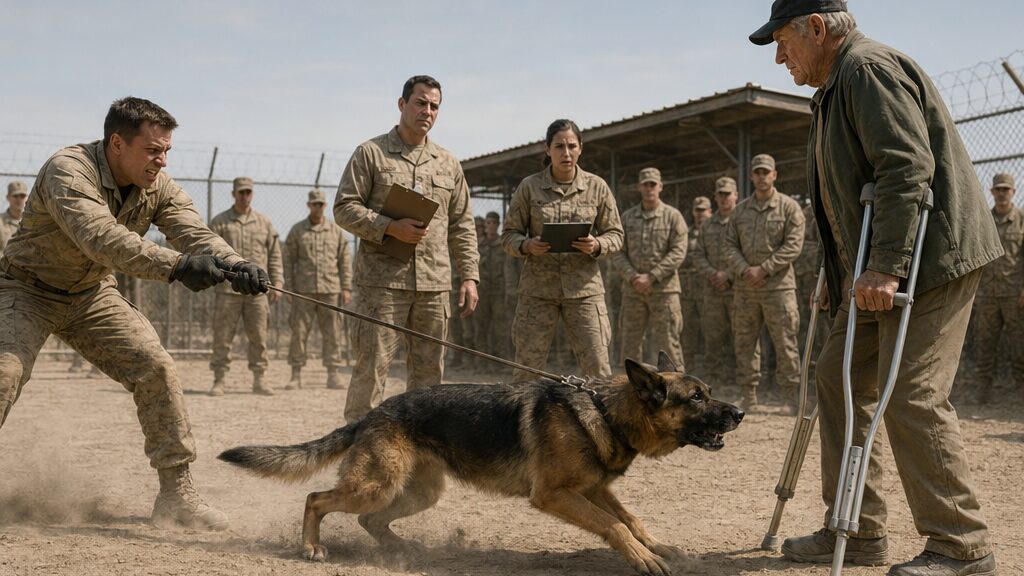
Six soldiers turned toward him as if a loose gate had swung open behind them. The German Shepherd at the far end of the dusty lane stood rigid against Kevin Carter’s grip, ears pricked, shoulders bunched, black muzzle pointed toward the bite sleeve hanging from the range pole. The leash made a straight dark line from Kevin’s glove to the dog’s collar, so tight it seemed less like equipment than wire.
Dennis stood just inside the fence with both crutches planted in the dust. He had come through the base gate ten minutes earlier to sign a paper about old storage records and leave before anyone decided to remember him. His cap sat low over his gray hair. The sun flattened the yard into white glare and brown grit. He had told the gate clerk he did not need an escort.
Now he wished he had kept walking.
Kevin glanced over his shoulder. He was young, broad in the chest, and set in that hard way young handlers got when other people were watching. His eyes moved from Dennis’s crutches to his worn green jacket.
“Excuse me?” Kevin said.
Dennis looked at the dog, not the handler. “You’re holding him past his answer.”
One of the junior handlers behind the observation line smirked. The dog’s front paws scraped once in the dust.
Mark Brown came from the shaded side of the range office with a clipboard tucked under one arm. He had the clipped walk of a man who had already decided the day had no room for interruptions. His gaze landed on Dennis, moved down to the crutches, then back up with professional patience that was not patience at all.
“Mr. Harris,” Mark said, “we appreciate visitors keeping behind the marked line.”
Dennis looked down. The painted line was nearly gone under dust. His left crutch tip rested half an inch inside it.
He moved it back.
Rachel Miller stood near the observation table with a tablet in one hand. She had been watching the dog, but now she watched Dennis. Her brow had tightened, not with annoyance, but with the effort of deciding whether she had seen the same thing he had.
Kevin gave the leash a short corrective pop. “He’s fine.”
The dog’s right shoulder twitched.
Dennis felt the old knowledge rise in him before he could stop it. Not thought. Not memory exactly. A body reading another body. Ears too forward. Weight not committed to the sleeve. Breathing shallow, then held. A dog bracing not to strike, but to refuse being forced into striking.
“Don’t correct him again,” Dennis said.
That made Mark laugh once.
It was a small sound, polished for public use, but it carried. A few soldiers shifted. Someone looked away with the uneasy smile people wore when they wanted permission to find an old man harmless.
“Old kennel talk,” Mark said. “That dog is not from your era.”
Dennis’s fingers tightened around the handles of his crutches. The rubber grips were warm and worn smooth under his palms.
Kevin’s jaw lifted. The laugh had given him room. “This is a controlled evaluation, sir.”
Sir. The word came wrapped in distance, not respect.
Dennis could have told them he had worked dogs before Kevin was born. He could have told them he knew what happened when a handler mistook pressure for communication. He could have told them he had helped rewrite the very rule they were about to misunderstand.
Instead he looked at the dog’s feet.
The left rear paw had stepped sideways. Barely. A half-moon drag in the dust.
Rachel saw it then. Dennis watched her eyes drop. Her mouth opened as though she had found a word and lost permission to use it.
Mark tapped the clipboard against his thigh. “Continue the sequence.”
Kevin faced forward again. He swallowed, then squared his shoulders. “Set.”
The German Shepherd’s body hardened.
Dennis shifted his weight. Pain moved through his left hip, an old dull nail driven deeper by standing too long. He had promised himself he would not enter another training yard and let the past mistake itself for duty. He had come to sign a paper. That was all.
The dog’s tail lowered by one inch.
“Handler,” Dennis said, and his voice cracked sharper than he meant. “Give him slack.”
Kevin’s ears reddened.
Mark did not look amused now. “Mr. Harris.”
“You’re crowding his choice,” Dennis said.
A junior handler muttered something Dennis did not catch. Another gave a short breath through his nose. The yard was no longer simply watching a test. It was watching an old man make everyone uncomfortable.
Kevin’s glove tightened around the leash. “He doesn’t get a choice during a command.”
Dennis looked at him then.
For a moment he saw another young handler, another jaw set too hard, another dog trying to speak through the only body it had. Dust. Sun. A line gone tight. A warning arriving early enough to matter and late enough to be ignored.
Dennis pushed the memory down.
“You always give him a choice before you ask him to trust you,” he said.
Mark stepped closer. “That’s enough.”
Rachel’s thumb hovered over the tablet. “Chief, his shoulder—”
“Noted,” Mark said without turning. “Run it.”
The range safety officer lifted one hand toward the course. Kevin took his stance. The bite sleeve swung slightly from the pole in the hot wind. The shepherd’s eyes did not stay on it. They flicked once toward the row of soldiers, then toward Dennis, then back to the pressure at his neck.
Dennis’s heart beat slow and heavy.
He could leave. He could step back, let rank and procedure handle their own consequences. He had done more than anyone asked by speaking once. Twice. Three times. An old man who did not belong could become a hazard as easily as a warning.
The dog inhaled.
Kevin shouted the release command.
The German Shepherd moved, but not toward the sleeve.
He came sideways first, shoulder twisting against the collar, body cutting across the lane with a burst of dust. Kevin cursed and hauled back. The leash snapped tight enough that Dennis heard the leather strain. The dog spun under the pressure, not free and not held, and the whole yard seemed to lean toward the mistake.
“Loose!” Dennis called.
Kevin pulled harder.
The dog lunged with everything in him.
Kevin’s boots skidded. Dust flew from under his heels. The leash burned through his grip as the shepherd dragged him off balance, not toward the padded target, but straight down the lane toward the old man standing with his crutches planted in the dirt.
Chapter 2: The Dog Stopped Where Everyone Expected Blood
The leash tore hot across Kevin Carter’s glove, and for one terrible second he understood he was not holding the dog at all.
He was attached to him.
The German Shepherd drove forward low and fast, claws throwing dust back against Kevin’s legs. Kevin dug both boots into the training lane and leaned with all his weight. The collar held. The leash held. His arm did not. Pain shot from his wrist to his shoulder as he stumbled after the dog, half pulled, half falling.
“Hold him!” someone shouted.
Kevin could not tell who.
The old man did not move.
That was the part Kevin’s mind could not take in. Dennis Harris stood in the open lane with the crutches under him and the dog coming at him like a released spring. His cap brim shadowed his eyes. His jacket hung loose on his narrow shoulders. He looked too breakable for that much force.
“Move!” Kevin yelled.
Dennis did not move.
Rachel’s voice cut across the yard. “Call it off!”
The range safety officer lifted both hands but did not step inside the lane. Mark Brown stood near the table, one hand still on his clipboard, his mouth open around an order that had not come out. Everyone had trained for procedure. Nobody had trained for a dog breaking toward a crippled old man who refused to be afraid.
Kevin wrapped his left hand over his right and tried to anchor the leash against his hip. The line went tight again. The shepherd choked once, coughed, then surged harder.
“No!” Kevin shouted, though he was not sure whether he meant it for the dog, Dennis, or the whole humiliating disaster.
Dennis lowered one hand.
Not quickly. Not like a man defending himself. He took his right hand from the crutch grip and held it low beside his thigh, palm turned slightly back, fingers loose.
The German Shepherd’s ears changed first.
Kevin saw it because he was staring with every part of himself. One moment the dog’s ears were speared forward, locked in drive; the next they flicked outward, uncertain. His stride shortened. Dust rolled past his chest. The leash, still in Kevin’s hands, stopped pulling like a rope tied to a truck and began to tremble.
Dennis said something.
Kevin could not hear the words over his own breathing and the blood pounding in his ears. It was not a command he recognized. It was quieter than command. Lower. Almost private.
The dog slowed three feet from Dennis.
Kevin almost crashed into him from behind.
The shepherd stopped so suddenly the leash sagged in Kevin’s hands. His hindquarters dropped into the dust. He sat beside Dennis’s crutches, chest heaving, eyes lifted to the old man’s face.
No one spoke.
Kevin’s throat burned. He stood bent forward, both fists still clenched around a leash that no longer needed him. The dog’s tail moved once, not wagging exactly, but tapping the dirt like a question.
Dennis’s hand settled on the dog’s head.
The old man’s fingers disappeared into the dark fur between the ears. His face changed then, and it made Kevin feel worse than any reprimand could have. There was no triumph in it. No satisfaction. No “I told you so.” Dennis looked as if the dog had pressed its head against an old bruise.
The shepherd leaned into him.
Kevin dropped to one knee because his legs did not trust him. “What did you do?”
Dennis did not answer at first. He kept his hand still, not petting, not praising, just giving the dog a place to rest under. The shepherd’s breathing slowed by degrees. His eyes half closed.
“What did you do?” Kevin asked again, softer.
Dennis looked at him. “Stopped asking him to fight the leash.”
Kevin flushed. “He broke command.”
“He broke pressure.”
The words landed too cleanly. Kevin wanted to reject them, but the leash lay in a shallow curve between his hands and the dog’s collar, slack as a sleeping snake. A minute earlier it had cut his glove. Now it seemed to accuse him.
Rachel approached carefully from the side, stopping outside the lane. “Is he stable?”
Dennis’s gaze returned to the dog. “For this moment.”
For this moment. Not fixed. Not magic. Not a trick.
Kevin felt the yard behind him. The eyes. The junior handlers. The safety officer. Mark. Every person who had heard him dismiss the old man now watching him kneel in the dust while the dog sat against Dennis’s leg.
He swallowed. “Does he know you?”
The shepherd pressed closer to Dennis, and Dennis’s hand paused.
For an instant Kevin thought the answer was yes. The dog knew him. That would make everything simpler and worse. Some old bond. Some hidden history. Some reason Kevin had never been told.
Dennis’s face closed before the truth could show.
“Dogs know what we give them,” he said.
Mark’s boots entered the edge of Kevin’s vision. “Handler, regain your animal.”
Kevin reached for the leash, then stopped. His hands had pulled too much already. He did not know where to put them.
Mark’s voice hardened. “Carter.”
The shepherd’s eyes opened.
Dennis felt it too. His fingers spread slightly against the dog’s head, not holding him, only reminding him of stillness.
Kevin stood slowly, humiliated by the care he had to take. He lifted the leash with two fingers instead of wrapping it around his fist. The dog did not resist. That should have relieved him. Instead it made him feel like a man carrying a tool he had misused in public.
Mark stepped between Dennis and the observation line, as though blocking the yard’s view of the old man could undo what everyone had seen.
“This evaluation is suspended,” Mark said.
Rachel lowered her tablet. “Chief, we should document the sequence exactly.”
“We will document a handler-control failure,” Mark said.
Kevin’s stomach turned.
Dennis shifted his weight back onto both crutches. The movement looked painful. The dog noticed, rising halfway, then sitting again when Dennis’s hand lowered an inch.
Mark saw that too. His jaw tightened.
“Mr. Harris,” he said, “you need to leave the active yard.”
Dennis looked toward the gate. “That was my plan.”
“Good.”
Rachel’s eyes flicked from Mark to Kevin. “Chief, with respect, he warned us before the dog moved.”
A silence opened.
Mark closed it. “With respect, Specialist Miller, visitors do not participate in evaluations. They do not cue dogs, distract handlers, or introduce unknown variables.”
“I didn’t cue him,” Dennis said.
Mark turned on him. “You touched an active working dog during a failed controlled exercise.”
“The exercise failed before he came at me.”
Kevin stared at the dog’s collar because he could not look at either man.
Mark took a breath through his nose. When he spoke again, his voice was lower, more dangerous for being contained. “Remove Mr. Harris from the yard before he contaminates the evaluation further.”
No one moved at first.
Then the range safety officer opened the gate.
Dennis gave the dog one final touch, not a pat but a quiet release. The shepherd remained seated as Dennis set both crutches forward and made his slow way through the dust. Each rubber tip left a round, dark mark beside the frantic claw tracks.
Kevin stood with the slack leash in his hand and watched the old man pass.
At the gate, Dennis paused just long enough to look back at the dog’s shoulders.
“Don’t run him again tight,” he said.
Mark’s clipboard snapped against his palm. “Out.”
Dennis went through the gate.
The dog whined once.
Kevin had never heard that sound from him before.
Chapter 3: Rachel Found the Pattern Nobody Wanted Written Down
Rachel Miller found the first “unprovoked lunge” nine minutes after Mark Brown told her to clean up the report.
It sat in the training log under a neat timestamp, bland as a supply entry: handler correction applied, dog redirected aggressively, sequence terminated. The note had been written three weeks earlier. Different course lane. Same dog. Same command phase. Same handler.
Kevin.
Rachel stood in the kennel office with the door half open to the yard, the tablet in her left hand and a paper file spread across the desk because the network kept dropping near the fence. Outside, the German Shepherd barked once from the shaded run, then went quiet. Not frantic. Listening.
Mark stood beside the filing cabinet. “Miller.”
She did not look up. “There are two previous entries like today’s.”
“We are not conducting an investigation.”
“We’re conducting an evaluation.”
“Which means we record what happened in evaluation language.”
Rachel scrolled. The second entry appeared four days after the first. Handler shortened lead before release. Dog resisted line pressure. Handler corrected. Dog lunged off target.
Her thumb stopped.
Line pressure.
Dennis Harris had not used that phrase. He had said the leash was too tight. Old words for the same thing.
“Chief,” she said, “these weren’t unprovoked.”
Mark shut the cabinet drawer. The metal click was sharp in the small office. “Careful.”
Rachel finally looked at him. “I am being careful.”
“No,” he said. “You’re being impressed.”
Heat rose into her face, but she kept the tablet steady.
The office smelled of dust, disinfectant, and old coffee. A row of clipboards hung on the wall, each with a dog’s training sheet. Beside them were laminated diagrams of handling positions, newer than most of the building and already curling at the corners. Rachel had entered the service believing procedure existed to keep ego out of danger. She still believed it. That was why the pages in front of her bothered her so much.
Procedure had recorded the incidents.
Procedure had not understood them.
Mark came around the desk. “We have an inspection window closing tomorrow. If this dog fails, I need a clean reason. If the handler failed, we retrain or reassign. If the dog is unstable, the veterinarian makes recommendations. What I do not need is a retired visitor becoming the center of a story he has no business being in.”
Rachel heard the word story and thought of the yard: Dennis standing still while everyone else made noise.
“He saw the shoulder before the lunge,” she said.
Mark’s expression changed only slightly. It became less annoyed and more guarded.
“Dogs twitch,” he said.
“Not the same way before the same correction.”
He leaned over the desk and tapped the screen with two fingers. “Then write that the handler overcorrected.”
“That leaves out the warning.”
“The warning is not a procedure.”
“No,” Rachel said. “It’s an observation.”
For a moment the only sound was the air conditioner rattling in the window.
Kevin appeared in the doorway, one glove tucked under his arm. He had washed the dust from his face, but a streak remained along his jaw. His right hand was wrapped at the base of the thumb.
Rachel straightened. “You should have medical look at that.”
“It’s fine.”
It was not fine. His fingers were swollen where the leash had caught.
Mark turned. “Carter, you’re off the yard until I say otherwise.”
Kevin’s face tightened. “Chief, I can run him.”
“You lost him.”
Kevin took the hit without blinking, which told Rachel it had landed deep.
“He didn’t just lose him,” Rachel said.
Both men looked at her.
She regretted the phrasing before the next breath. “I mean, there’s a repeated trigger.”
Kevin stepped into the office. “What trigger?”
Rachel slid the paper log toward him. “Same phase. Same correction. Same command tone. Today Dennis Harris warned about the leash before the dog broke.”
Kevin’s eyes moved across the lines. He tried to dismiss it. Rachel could see him try. Pride gathered in his jaw, then faltered under recognition.
“He said it before,” Kevin said.
Mark went still. “What?”
Kevin did not look at him. “Before the release. He said, ‘Don’t correct him again.’”
Rachel waited.
Kevin swallowed. “And before that, he said I was holding him past his answer.”
Mark’s voice dropped. “You did not include that in your initial statement.”
“I was still trying to figure out why a dog I’ve worked for two months sat down beside a stranger like he’d been waiting for him.”
Rachel looked back at the log before Mark could answer.
The dog had not waited for Dennis. Not exactly. That was the easy version, the version people in the yard would whisper by dinner. Old handler returns. Dog remembers. Young soldier humbled. A clean story with a clean lesson.
But the logs made the moment less magical and more troubling.
Dennis had seen something everyone else had been trained to record after it went wrong.
Kevin rubbed his wrapped thumb. “Is he former K-9?”
Mark’s mouth compressed. “He’s a retired veteran here on records business.”
“That’s not an answer,” Kevin said.
Mark turned fully toward him. “Your answer is that tomorrow morning you will demonstrate control in a final sequence with the base veterinarian observing. If the dog fails, he’s pulled. If you fail, I decide whether you remain on this assignment.”
Kevin went pale under the dust stain.
Rachel set down the tablet. “Tomorrow? After what happened?”
“Especially after what happened,” Mark said. “We cannot leave today’s incident hanging loose.”
Loose. The word brushed against Rachel like the leash itself.
Kevin looked toward the kennel row. “Can I work him tonight?”
“No. He rests. You write your statement. You do not speak to Mr. Harris.”
Rachel frowned. “Why?”
Mark gathered the papers into one stack with more force than needed. “Because I don’t need Carter chasing ghost advice from a man who has already interfered once.”
“Chief—”
“That is an order.”
Kevin’s face shut. He left the doorway without another word.
Rachel waited until his boots faded down the corridor. “You’re afraid Dennis Harris is right.”
Mark’s eyes came up slowly.
“I’m afraid,” he said, “of people deciding a dangerous animal is misunderstood because an old man touched its head and everyone felt something.”
The answer was too honest to be simple arrogance.
Rachel held his gaze. “Feeling something didn’t make those three entries match.”
Mark took the stack from the desk. “File the report by seventeen hundred.”
He left her with the logs, the tablet, and the dog quiet beyond the wall.
Rachel sat down.
She opened the older archive database because the paper file referenced a manual revision number beside the leash-pressure notes. Most soldiers never checked the revision history unless equipment standards changed. Rachel had done it twice during certification training and once to prove a date on a range dispute. The system was slow, gray, and stubborn.
She searched line pressure.
Too many results.
She searched slack lead.
Fewer.
She searched the exact phrase Dennis had used without thinking.
Holding him past his answer.
One scanned page appeared from an older manual, the kind with black text softened by years of copying. The section title read: Behavioral Refusal Before Aggressive Redirection. Someone had underlined a sentence in faded blue ink.
A dog resisting pressure is still communicating. A handler who ignores that answer teaches the dog to shout.
Rachel felt the hair rise on her arms.
At the bottom of the page, beneath the revision note, was a signature from a training review board long before her time.
Dennis Harris.
She printed the page with hands that were steadier than her breathing, and when the machine pushed it out, she saw two dots of fresh dust fall from the paper tray onto the signature, the same pale dust that still clung to the tips of Dennis Harris’s crutches by the gate.
Chapter 4: Dennis Refused to Turn Grief Into Authority
Rachel placed the manual page on the small metal table, and Dennis Harris knew before he looked down that she had found the part of him he had meant to leave buried.
The temporary visitor quarters were quiet except for the faint buzz of the ceiling light and the muffled barking from the kennel row across the service road. Dennis sat with his crutches leaned against the wall within reach. He had not taken off his cap. Dust still clung to the rubber tips, dried in pale rings like evidence.
Rachel stood on the other side of the table, the printed page between them.
“You signed this,” she said.
Dennis did not touch the paper.
The signature sat at the bottom in dark copied ink, younger and steadier than his hand was now. Dennis Harris. Training Review Board. A line from a lifetime ago, dragged into a room where the bedspread smelled of bleach and the window blinds would not close all the way.
Rachel waited.
Dennis looked past the page to the wall. “A lot of people signed a lot of paper.”
“This section uses the phrase you used in the yard.”
He shifted one hand on his knee. The knuckles ached. “Does it.”
“A dog resisting pressure is still communicating.” Rachel’s voice lowered. “A handler who ignores that answer teaches the dog to shout.”
The words entered him like cold water.
He could see the page as it had been then, not printed from an archive but marked in blue ink across a desk after too many days of arguing with men who thought bite work began and ended with obedience. He could see Ruth’s coffee cup beside the typewriter in the old kitchen, her thumb holding the page flat while he paced and tried to find language plain enough that a scared young handler might remember it before a dog broke.
Rachel tapped the page once. “You wrote that.”
Dennis finally looked at her. “I helped write it.”
“Then why didn’t you say so?”
Because a warning should be enough, he almost said.
Because if a man needs a name before he can hear the truth, the truth has already lost too much time.
Because he had spent years learning that people turned pain into authority faster than they turned it into wisdom.
He said none of it.
Rachel’s face softened, but she did not back away. “They’re running him again tomorrow.”
Dennis’s jaw tightened.
“With the veterinarian observing,” she added. “Chief Brown says it has to be clean.”
“Clean,” Dennis repeated.
“He wants a decision before the inspection window closes.”
Dennis reached for the paper then, but not to claim it. He slid it closer and looked at the underlined sentence. The print was faint, the scan slightly crooked. One sentence below it had been changed in the modern version. The new wording said: apply corrective lead management before escalation.
Dennis breathed once through his nose.
“That line is wrong,” he said.
Rachel leaned forward. “Which one?”
He pointed without needing to read again. “Corrective lead management before escalation. Makes it sound like the leash fixes the warning.”
“It doesn’t?”
“No.” His finger stayed on the page. “The leash only tells you how afraid the handler is.”
The room seemed to change around that sentence.
Rachel looked toward the window, as if the yard might be visible through the blinds. “Then Kevin is part of the trigger.”
Dennis let his hand fall back to his knee. “Kevin is part of the conversation.”
“That sounds kinder.”
“It’s more dangerous if you forget it.”
She sat down slowly across from him. The chair legs scraped the floor. “He thinks you blame him.”
Dennis closed his eyes for one moment. In the dark behind them, Kevin’s face became another young face, sunburned and too eager to be good at something hard. A handler standing on a gravel lot. A dog with one ear torn from old wire. A leash too short because everyone was in a hurry.
“I didn’t come here to blame anybody,” Dennis said.
“No. You came here to sign a records form and walk away.”
That touched too close. His eyes opened.
Rachel did not apologize. “I saw the file at the gate. You were here fifteen minutes before you ended up in the yard.”
“Then you know I wasn’t looking for work.”
“I know you saw something.”
Dennis rubbed his thumb along the seam of his trousers. The old habit irritated him. Ruth used to catch him doing it when he was trying not to speak.
“You want a story,” he said.
“I want to know whether that dog is going to get hurt because nobody understands him.”
The answer was the right one. It was also unfair.
A bark snapped from the kennel row, then another. A metal bowl clanged. Dennis’s shoulders tightened before he could hide it.
Rachel noticed. “That sound?”
“Bowl against concrete.”
“You knew that from here?”
“I know kennel sounds.”
“Because of the manual?”
He almost smiled at that. It did not make it to his face. “Because of dogs.”
She waited again. She was good at it. Not passive. Not soft. Just steady enough to leave a silence where a lie would sound cheap.
Dennis looked at the printed page. “There was a handler once. Young. Good hands when no one watched him. Bad hands when everyone did.”
Rachel said nothing.
“He had a dog that had been transferred too many times. Nobody abused him. Nobody meant harm. But every new handler tried to prove control before the dog had a reason to trust the voice. That dog started answering earlier and earlier. Shoulder first. Then rear paw. Then mouth closed when it should have been open.”
He stopped.
Rachel’s eyes had moved to his hands.
“What happened?” she asked.
Dennis heard Ruth then, from a kitchen years gone: Say only what helps, Dennis. Not what punishes you.
“They were running a demonstration,” he said. “Too many people. Too much noise. I saw the line go tight.”
He swallowed. It was not enough. It was never enough.
“I told myself I’d already warned them that week. Told myself the handler needed space to learn. Told myself stepping in front of a young man in public would break him worse than the dog could.”
Rachel’s voice was quiet. “And?”
“And I kept my mouth shut too long.”
The barking outside stopped.
Dennis stared at the page until the signature blurred. “A warning you keep to yourself because you’re tired of not being heard isn’t restraint. It’s pride wearing a clean shirt.”
Rachel sat very still.
The hallway outside the visitor room creaked.
Dennis turned his head.
A shadow shifted under the door.
Rachel saw it too. She rose quickly and opened it.
Kevin Carter stood in the corridor with his wrapped hand half lifted, as if he had been about to knock and changed his mind too late. His face had gone hard, but his eyes were too bright.
“How much of that did you hear?” Rachel asked.
Kevin looked past her at Dennis. “Enough.”
Dennis pushed his hand against the chair arm, but pain stopped him halfway. “Carter—”
“You think I’m that handler.”
“No.”
Kevin laughed once, sharp and wounded. “You just told her bad hands get dogs hurt.”
“I said scared hands do.”
“Same thing, coming from you.”
Rachel stepped into the doorway. “Kevin, listen to the whole thing.”
“I did listen.” He held up his wrapped hand. “I listened in the yard too. Everyone did. That’s why I’m the one they’re writing up while he gets to sit here being mysterious.”
Dennis took that without moving. Part of him knew Kevin was wrong. Another part knew the young man had found the easiest wound available and pressed on it because his own was open.
Kevin looked at the manual page on the table. His gaze caught the signature. For a moment the anger faltered. Then pride filled the space faster than understanding could.
“Tomorrow I’ll run him clean,” he said.
Dennis reached for a crutch.
Kevin stepped back. “No. I don’t need another warning after the fact.”
“It wasn’t after.”
“Then keep the next one to yourself.”
Rachel said his name, but Kevin had already turned.
By the time Dennis got both crutches under him and made it to the hallway, Kevin was at the far end, shoulders rigid, one hand still wrapped, walking toward the kennel office where Mark Brown’s light burned behind the glass.
Dennis stopped because his hip would not let him move faster, and because he already knew what a proud young handler did when he mistook shame for instruction.
Through the window, he saw Kevin enter Mark’s office.
The door closed.
A minute later, Kevin’s voice came through the thin wall, low but clear enough to change the next morning.
“I want the final evaluation without Dennis Harris anywhere near that yard.”
Chapter 5: The Final Test Began With the Wrong Silence
Kevin saw Dennis outside the fence and shortened the leash before anyone gave the first command.
It was a small movement. A wrist turn. A half wrap of leather across his palm. The kind of thing an evaluator might not mark if the dog still performed, the kind of thing Kevin had done a hundred times when he felt eyes on him.
But this time he knew what it meant.
The German Shepherd knew too.
The dog stood at his left knee in the starting box, head forward, black saddle shining under the white morning glare. His mouth was open, tongue just visible, breath steady. Not perfect, but ready. Kevin had woken before dawn and sat outside the kennel run until the dog came to the gate. He had not spoken much. He had not apologized. He had only stood there with his wrapped thumb throbbing and the leash loose between them.
For a while, it had been enough.
Then he had stepped into the yard and seen Dennis Harris beyond the chain-link fence, cap low, crutches planted in the dust beside the observation shade.
Kevin’s hand had tightened before his mind caught up.
The dog’s mouth closed.
“Handler ready?” Mark Brown called.
Kevin looked straight ahead. “Ready.”
The base veterinarian stood near the observation table with a folder under one arm. Rachel was beside him, tablet in hand, face carefully blank. Mark had arranged the morning like a clean table: evaluator, safety officer, handler, dog, result. No old man inside the line. No confusion. No story.
Kevin appreciated that more than he wanted to admit.
He needed the test to be about the work again. Not about a retired trainer. Not about a page in an old manual. Not about the way the dog had sat at Dennis’s hand as though Kevin had been the stranger.
“Begin sequence,” Mark said.
Kevin gave the heel command.
The dog moved.
For the first stretch, everything held. The shepherd matched his pace down the lane, shoulder at Kevin’s knee, leash controlled but not visibly tight. They passed the first marker. Kevin pivoted left. The dog pivoted with him. A junior handler near the fence exhaled in relief.
Kevin felt that relief and hated needing it.
“Down.”
The dog dropped.
“Stay.”
Kevin stepped away. One pace. Three. Five. The leash slipped across his fingers, not pulling now, only present. The dog remained flat against the dust, ears tracking Kevin but body still.
Mark made a mark on the clipboard.
Good, Kevin thought.
The word nearly undid him.
He glanced toward the fence.
Dennis had not moved. He was watching the dog, not Kevin. That somehow felt worse. No judgment in his face. No challenge. Just that unbearable attention to everything Kevin wished were invisible.
Kevin returned to the dog and gave the next command. The shepherd rose cleanly.
The false victory took shape with every successful movement. Kevin could feel the yard loosening around him, people deciding yesterday had been a bad moment, a fluke, a handler error corrected by rest and focus. The dog cleared the low obstacle. He ignored the swinging sleeve. He held the sit at the second marker.
The veterinarian nodded once.
Rachel’s thumb paused over the tablet.
Kevin’s chest expanded.
Maybe Dennis had been right about one moment and wrong about the dog. Maybe old experience had seen a danger without seeing the whole animal. Maybe Kevin could still bring this back without becoming the young fool in someone else’s lesson.
“Proceed to pressure phase,” Mark called.
The words struck differently.
The pressure phase was where yesterday had begun to tilt. It required the handler to hold the dog in controlled drive while a decoy sound came from the far shed and the bite sleeve dropped into view. The dog had to wait for the release. Not too soon. Not too flat. Ready but contained.
Kevin moved into position.
A gust of wind came across the yard, lifting dust into a low sheet. It rattled the loose tin on the storage shed. The sound cracked once, hard and metallic.
The dog’s ears flicked outward.
Kevin saw it.
Not fully. Not like Dennis would have. But enough.
His wrapped thumb tightened around the leash.
The dog’s rear paw shifted sideways.
Kevin’s throat closed.
Across the fence, Dennis’s crutches moved in the dust. One small scrape. Not forward. Just a sound Kevin heard because every nerve had become hungry for it.
Don’t correct him again.
Kevin could not tell if the words came from memory, from Dennis, or from the place in himself that had been trying not to understand.
“Hold,” Mark called.
Kevin swallowed. The dog’s body leaned forward, but not toward the sleeve. He was listening to the shed, to the wind, to Kevin’s breath, to everything at once.
“Steady,” Kevin said.
The word came too sharp.
The dog’s mouth closed.
Rachel looked up.
Kevin felt the whole yard on his back. Mark. The veterinarian. Rachel. Dennis beyond the fence. The junior handlers who had seen him dragged yesterday. His own future pressing down through one strip of leather.
He gave the leash a quick correction.
The dog turned his head.
Not a lunge. Not yet. Just a turn sideways, shoulder rolling, eyes cutting toward the pressure at his neck.
Kevin’s heart dropped.
There it was.
The exact posture Dennis had described without raising his voice. The one Rachel had found in the logs. The one Kevin had convinced himself he could avoid by being sharper, cleaner, better.
“Carter,” Mark warned.
Kevin did not know whether Mark was telling him to continue or stop. The difference had become too important to guess.
The shepherd’s weight shifted again. His front paws held, but his body had already chosen a different conversation. Kevin felt it through the leash: not disobedience, but argument. Not aggression, but a rising refusal.
“Release command on my mark,” Mark said.
Kevin’s hand began to sweat inside the glove.
The dog’s eyes flashed toward the shed. The wind hit the tin again. The bite sleeve swung once on its hook.
Kevin could make him do it. He knew that. He could pull him back into line, put power in his voice, drive him through the command before the dog had time to break sideways. If it worked, everyone would mark the pass. If it failed, the dog would wear the failure first.
His hand tightened.
The dog’s lips drew back, not enough for teeth, enough for warning.
Kevin’s stomach turned cold.
Yesterday he had thought Dennis’s warning was about the dog.
Now, with the leather cutting into his palm by his own choice, he understood it had been about the man holding the leash.
“Mark,” Rachel said from the table.
“Stand by,” Mark said.
The dog gave one low sound. Not a bark. Not a growl. Something trapped between.
Kevin looked through the fence.
Dennis Harris was no longer standing still.
The old man had opened the gate.
Chapter 6: The Slack Leash Was the Hardest Command
Dennis entered the yard without permission and left his crutches at the gate.
It was not bravery. Bravery was too clean a word for the hot pain that shot through his hip when he took the first unaided step into the dust. It was not confidence either. He was not sure his left leg would hold him all the way to Kevin. He only knew that the dog had made the sound before the break, and this time Dennis would not stand outside a fence measuring his silence against a young man’s pride.
“Mr. Harris!” Mark shouted.
Dennis did not look at him.
The German Shepherd stood sideways in the lane, body curved against Kevin’s hold, eyes flashing between the shed, the sleeve, and the pressure at his neck. Kevin’s face had gone pale under his cap. His wrapped hand was locked around the leash, not pulling back hard yet, but ready to.
That readiness was the danger.
“Do not enter an active evaluation,” Mark called.
Dennis kept walking.
Each step threatened to fold under him. Dust moved around his boots. His crutches stood behind him like two abandoned arguments by the gate.
“Carter,” Dennis said, low and clear, “don’t win this.”
Kevin’s eyes snapped to him. “What?”
“Don’t win.”
The dog’s ears flicked toward Dennis’s voice.
Mark came off the observation line. “Safety, remove him.”
Rachel stepped between Mark and the lane before the range safety officer could move. “Chief, if you remove him now, my report will show the first warning was ignored yesterday and the second one was interrupted today.”
Mark stopped so abruptly the clipboard hit his thigh.
Rachel’s hand trembled around the tablet, but she did not lower it. “Let him speak.”
The veterinarian said nothing. That silence mattered. Mark heard it too.
Dennis reached a point ten feet from Kevin and stopped. He could not afford to get closer. The dog needed space more than Dennis needed drama.
Kevin’s jaw worked. “He’s going to fail.”
“No,” Dennis said. “He’s answering.”
“He’s turning out.”
“He’s asking whether you heard him.”
The dog made the low trapped sound again.
Kevin flinched, and the leash tightened.
Dennis’s voice sharpened. “There. That’s you.”
Kevin froze.
“Not the dog. You.”
The words hit hard enough that anger flared in Kevin’s face. “I’m trying to keep control.”
“I know.”
“You think I don’t know what happens if he fails?”
“I think that’s the leash talking.”
Kevin looked down at his hand.
The leather was wrapped once across his palm, locked under his thumb, pulled just short enough to make the dog carry Kevin’s fear in his neck.
“Unwrap it,” Dennis said.
Mark’s voice came from behind them. “Carter, maintain control.”
Kevin’s shoulders jerked between the two orders.
The dog felt that too. His body lowered, ready either to surge or defend, whichever the next second demanded.
Dennis took one more step and almost went down. Pain lit his thigh white. He caught himself with a breath through clenched teeth and refused to reach back for the crutches. If he fell, this would become about an old man’s body. It could not be about that.
“Kevin,” he said.
The use of his first name cut through the yard more cleanly than rank.
Kevin looked at him.
Dennis did not soften the command. “Unwrap the leash.”
Kevin’s fingers opened by one degree.
The dog’s head turned.
“That’s it,” Dennis said. “Don’t give him freedom. Give him room to believe you.”
Kevin unwound the leather from under his thumb. The leash slid through his glove until it formed a shallow curve between his hand and the collar.
The shepherd’s body did not relax all at once. It lowered by fractions. Shoulders first. Then neck. Then the rear paw that had been braced sideways came back under him.
A sound moved through the observation line. Not applause. Not relief yet. Just people understanding they had been holding their breath.
Kevin stared at the dog as though seeing him from the ground up. “He’s still loaded.”
“Yes,” Dennis said. “So stop adding weight.”
The tin shed cracked again in the wind.
The dog’s ears jumped.
Kevin’s hand twitched toward tightness.
Dennis saw the panic arrive before Kevin did. “Leave it.”
Kevin breathed hard. “I can’t just leave it.”
“Yes, you can.”
“He’ll break.”
“He might.” Dennis’s throat tightened around the old truth. “But if you grab him before he chooses you, you teach him there was never a choice.”
Kevin’s eyes flicked toward Mark. Toward the veterinarian. Toward Rachel. Toward the fence where the junior handlers watched the young man who had mocked an old warning now taking instruction in public.
His pride stood there with him, visible as any uniform.
Dennis knew that shape. He had worn it. He had buried men who wore it better.
“The hardest command,” Dennis said, “is the one you give yourself.”
Kevin’s mouth tightened. “What command?”
“Wait.”
The dog’s breathing filled the space between them.
Kevin waited.
One second. Two. The wind moved dust across the lane. The bite sleeve swung on its hook, dull canvas turning in the light. The dog stared at it, then at the shed, then at Kevin.
Kevin said nothing.
The leash stayed slack.
The dog’s mouth opened.
Dennis felt something in his chest loosen and hurt at the same time.
“Now ask,” he said.
Kevin’s voice came quieter than any command he had given that morning. “Heel.”
The dog hesitated.
Mark shifted behind them, but Rachel’s tablet lifted slightly, a warning without words.
Kevin did not repeat himself. He did not correct. He did not fill the pause with fear.
The dog took one step toward him.
Then another.
He came back to Kevin’s knee and stood there, body still charged but no longer twisted against the collar.
Kevin’s eyes shone. He blinked it away. “What now?”
“Finish what you started,” Dennis said. “Not to pass. To tell him the answer changed.”
Kevin looked at the course.
The final sequence required the dog to move past the sleeve without taking it, hold at the marker, then return through the obstacle lane. Yesterday, Kevin would have driven him through it with sharp commands and a short line. This morning, that would have been faster. It would also have been easier for everyone except the dog.
Kevin walked.
The shepherd moved with him.
At the first marker, the dog’s shoulder twitched again. Kevin saw it. Dennis saw him see it. That was the small miracle, not the obedience. The seeing.
“Breathe out,” Dennis said.
Kevin did.
The leash dipped.
They passed the sleeve. The dog’s head turned toward it, then back to Kevin. Kevin’s hand lifted, then stopped before it tightened.
“Good,” Dennis said.
The word escaped him before he could decide whether it was too much.
Kevin heard it. So did the dog.
At the obstacle, the shepherd hesitated at the low barrier where dust had piled near the base. Kevin started to step forward, then remembered and shifted back half a pace instead, opening the line rather than pulling it.
The dog cleared the barrier.
A junior handler whispered something that sounded like disbelief.
Mark said nothing.
Dennis’s bad leg trembled. He pressed one hand against his thigh, hiding it as best he could. The yard blurred at the edges. He should have taken the crutches. He should have asked for a chair. Pride came in quieter clothes at his age, but it still came.
The shepherd reached the final marker.
Kevin stopped.
The dog sat.
No force. No fight. No perfect polish either. The sit was crooked, one paw half in a dust groove, the dog’s chest still working hard. But he was there because Kevin had stopped trying to drag him there.
The veterinarian made a note.
Mark’s face was unreadable.
Kevin looked back at Dennis. Not for approval exactly. For something harder to ask from a man he had wounded.
Dennis nodded once.
The final return was silent except for Kevin’s soft heel command and the steady pad of paws through dust. When they reached the start box, Kevin did not snap the dog into place. He let the leash hang loose and placed his free hand near the dog’s shoulder without touching.
The shepherd leaned, barely, into the space Kevin left him.
Rachel lowered the tablet.
The range safety officer exhaled audibly.
Dennis turned toward the gate because his leg was failing and he did not want the yard to see him fall after asking a young man to stand steady. He made two steps before the ground tilted. A hand caught his elbow.
Kevin.
The dog stood beside him, leash slack.
For a moment neither man moved.
Dennis looked at the hand on his arm, then at Kevin.
Kevin released him immediately, afraid he had offended.
Dennis almost let the silence take the moment away.
Then he said, “My crutches are by the gate.”
Kevin swallowed. “Yes, sir.”
He brought them without hurry, carrying them in one hand while the leash hung loose in the other. He did not offer an apology. Dennis was grateful for that. Words would have made the yard listen for the wrong thing.
When Dennis settled the crutches under his arms, Mark approached.
“That was unauthorized,” Mark said.
Dennis met his eyes. “Yes.”
“You interfered with an evaluation.”
“Yes.”
Rachel stepped forward. “He prevented another break.”
Mark’s jaw moved once. The veterinarian closed his folder, but still said nothing.
Kevin looked down at the dog. His wrapped thumb flexed.
“Chief,” he said, and the word carried more fear than defiance, “if you write it as interference, you’ll be leaving out why he had to step in.”
Mark turned to him.
Kevin’s face had lost its hard shine. What remained looked younger, but not weaker. “I tightened the leash after I saw the warning. He told me yesterday. I did it anyway.”
The admission hung over the dust.
Dennis looked away.
He did not want the boy’s shame as payment. He wanted the dog alive in his own body. He wanted one morning in one yard not to become a repeat of another.
Mark looked from Kevin to Rachel to the veterinarian, then back to Dennis.
For the first time since Dennis had arrived, the kennel chief seemed less angry than cornered by truth.
“The dog completed the course,” the veterinarian said quietly.
Mark’s eyes closed for half a second.
When they opened, he pointed toward the office. “All statements in writing. No one leaves until the report is complete.”
The soldiers began to move, cautious and subdued. Kevin stood in the lane with the dog beside him, holding a leash that no longer cut the air between them.
Dennis turned toward the gate.
Behind him, Mark’s voice stopped him.
“Mr. Harris.”
Dennis looked back.
Mark held the clipboard against his side like a shield he was tired of carrying. “Before this report goes upstairs, I’ll need to know exactly what you want recorded.”
Chapter 7: Kevin Returned the Leash Without Making a Speech
Mark Brown asked what Dennis wanted written in the final report while the dog was still breathing hard enough to stir dust around Kevin Carter’s boots.
The question landed wrong in the yard. Too official for the heat still hanging over the lane. Too clean for the leather mark across Kevin’s glove and the crutches standing beside Dennis like witnesses. Rachel Miller looked up from her tablet. The veterinarian closed his folder but did not leave. Even the junior handlers near the fence stayed quiet, as if the answer might decide more than one dog’s status.
Dennis settled his weight under both arms and studied Mark.
“What I want written?” he said.
Mark’s jaw tightened. “You heard me.”
Kevin stood a few feet away, one hand resting near the German Shepherd’s collar without gripping it. The leash hung in a loose curve from his other hand. It was the first time Dennis had seen him hold it as if it belonged to the dog too.
Mark glanced toward the office. “We need a complete account before this goes upstairs.”
“No,” Dennis said. “You need an honest one.”
The words did not come loud, but Mark’s eyes flicked as if they had struck him. For a moment Dennis saw the man beneath the clipped authority: tired, cornered, calculating the cost of truth against the cost of another incident. Not a villain. Not a fool. A man who had built a wall out of rules after learning that mistakes in a K-9 yard did not stay inside the fence.
Mark lowered the clipboard. “An honest account says you entered an active evaluation.”
“Yes.”
“Without authorization.”
“Yes.”
“And altered the outcome.”
Dennis looked at the dog. “The outcome needed altering.”
Rachel’s thumb moved on the tablet.
Mark heard it and turned. “Specialist Miller.”
Rachel did not stop typing. “Recording statement sequence.”
“This is not a courtroom.”
“No, Chief,” she said. “That’s why we should get it right while everyone remembers.”
Kevin swallowed. His wrapped thumb flexed once, then stilled.
Mark’s face hardened, but the anger no longer had a clean place to go. He looked from Rachel to Kevin to the dog, and finally back to Dennis. “Fine. What exactly do you want in it?”
Dennis took his time. Not to punish him. To make sure he was not answering from pride.
He could ask them to write his name. He could ask them to attach the old manual page. He could let the report become proof that Dennis Harris had walked into a yard and corrected men who had laughed at him. The thought offered a small, bitter warmth.
Ruth would have hated that warmth.
He breathed it out.
“Write that the dog displayed stress signs before redirection,” Dennis said. “Write that the handler shortened the leash after those signs appeared. Write that loosening the leash and reducing command pressure restored the dog’s ability to answer.”
Rachel’s typing slowed, then continued.
Mark stared at him. “That’s all?”
“That’s the part that helps the next handler.”
The words moved through the yard quietly.
Kevin looked down.
Mark’s shoulders shifted as though he had expected a blow and received a tool instead. “There will be questions about your involvement.”
“Then write I was present.”
“You were more than present.”
Dennis allowed himself the faintest look at Mark’s clipboard. “You can write that an old visitor made an unauthorized safety intervention if it makes the paper sit straight.”
Rachel almost smiled, then stopped herself.
Mark did not. But something in his face loosened.
“The base commander may want to recognize your assistance,” he said.
“No.”
It came too fast. Dennis knew it by the way everyone looked at him.
He adjusted his grip on the crutches, buying one breath. “No ceremony. No photo. No speech in front of young handlers who need training more than they need a story.”
Kevin raised his eyes.
Mark studied him. “You don’t want credit.”
“I want the note changed.”
“The note?”
Dennis pointed with one crutch tip toward the office. “The handling note. The one that says corrective lead management before escalation.”
Rachel’s head lifted sharply. She knew exactly which line he meant.
Dennis continued, “That sentence will get another dog hurt. It tells a scared handler to fix pressure with more pressure.”
Mark glanced at Rachel. “You found that?”
“She found what was already there,” Dennis said.
Rachel held the tablet against her chest. “The older revision says resistance is communication. The newer one turns it into a correction issue.”
The veterinarian finally spoke. “That would explain the repeated entries.”
Mark looked at him, not angry now, but weary. “You’re saying the procedure itself contributed.”
“I’m saying the procedure made it easier to misread what we saw.”
A long silence followed.
The German Shepherd sat.
It was not a command. No one had told him to. He simply folded himself into the dust between Kevin and Dennis, tongue visible, ears relaxed but listening.
Kevin looked at him as if the sit were a sentence written in a language he was only beginning to read.
Mark rubbed one hand across his mouth. “If I change the note, it admits we have been training the correction wrong.”
Dennis looked at the dog. “No. It admits you learned before the next injury.”
That was the first time Mark had no answer ready.
Rachel stepped to the table under the shade and began typing again, faster now. “I’ll attach the incident sequence, the three prior log entries, and the older manual revision.”
Mark exhaled through his nose. “Carefully.”
“Yes, Chief,” Rachel said. Then, after a pause, “Honestly.”
Kevin moved then. Not toward Mark. Toward Dennis.
He came slowly, the way he should have approached the dog that morning, leaving room for refusal. The leash lay folded loosely in his hand, not coiled tight, not presented like a trophy. When he reached Dennis, he held it out.
Dennis looked at the leather.
Kevin did not make a speech. His mouth worked once, but no apology came out dressed in big words. He only stood there, cheeks still streaked with dust, eyes lowered not in shame exactly, but in respect that had not yet learned how to stand upright.
“I don’t know how to hold it right yet,” Kevin said.
Dennis took the leash.
For a moment the old leather rested across both their hands.
“You learned one thing,” Dennis said.
Kevin nodded once. “Not enough.”
“No.”
The honesty should have stung. Instead Kevin seemed relieved by it.
He looked toward the dog, then back at Dennis. “Would you show me one more session? Not for the report.”
Mark glanced over, alert.
Kevin added, “For him.”
The yard went still again, but differently this time. Not waiting for danger. Waiting for Dennis.
His first instinct was to refuse. He felt it rise as habit, dressed in humility. He was too old. His hip hurt. He had done enough. Let the young ones carry their own work. Let the dead stay quiet.
Then the dog leaned his shoulder lightly against Dennis’s leg.
Not hard. Not needy. Just contact.
Dennis looked toward the kennel row and saw, for half a second, Ruth standing by an old chain-link gate with her arms folded, patient and unimpressed with all the ways he had mistaken leaving for peace.
Say only what helps.
He handed the leash back to Kevin. “Not today.”
Kevin’s face fell before he could hide it.
Dennis shifted one crutch forward. “Tomorrow morning. Before the yard gets loud.”
Kevin blinked. “You’ll still be here?”
“I suppose I have a records form that didn’t get finished.”
Rachel turned her face toward the tablet, but Dennis saw her smile.
Mark looked away toward the course. “I’ll clear the yard at zero seven.”
Dennis nodded. It was not gratitude exactly. It was acceptance of a door left open without anyone naming it.
When he turned to leave, his left crutch sank slightly into a soft patch of dust. His bad hip buckled just enough that Kevin’s hand came up on instinct.
This time Kevin did not grab. He offered his forearm and waited.
Dennis looked at it.
The entire yard seemed to hold its breath around the smallness of the gesture. Yesterday, help would have felt like being reduced. An old man steadied because everyone expected him to fall. Now the offer carried something else: not pity, not performance, not repayment.
Dennis set his hand on Kevin’s forearm.
“Slow,” he said.
“Yes, sir.”
They moved toward the gate together, the dog walking at Kevin’s other side without tension in the leash. Rachel stayed behind with the report. Mark stood by the observation table, reading the old manual page she had printed, his thumb resting under Dennis’s copied signature as if it weighed more than he had expected.
At the gate, Dennis stopped.
The dog stopped too.
Kevin did not pull. He waited.
Dennis looked down at the shepherd sitting in the dust between them, calm now, chest rising and falling under the morning sun. The leash lay in a soft curve across the ground, no longer a line of force, no longer a mistake waiting to happen.
Dennis touched the dog once between the ears.
Then he looked at Kevin.
“Tomorrow,” he said, “we start with nothing in your hand but patience.”
Kevin looked at the slack leash, then at the dog, then at the old veteran leaning on his crutches without hiding that he needed them.
“Yes, sir,” he said.
The dog’s tail tapped once in the dust.
The story has ended.