The Officer Pointed at Her Blue Ribbon Before He Saw the Scar She Hid
Chapter 1: The Ribbon He Told Her To Remove
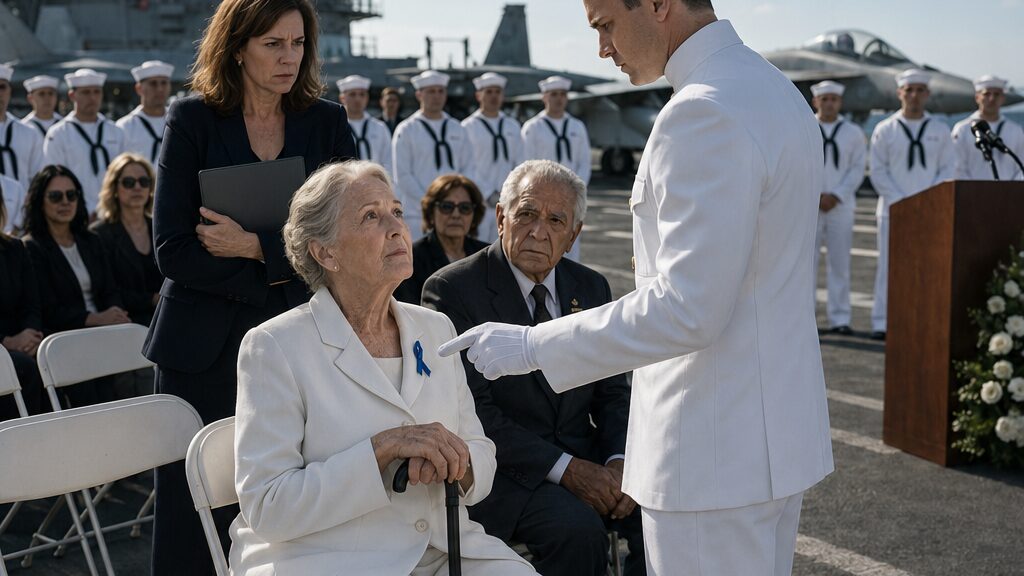
The white-gloved finger stopped less than an inch from Catherine Miller’s blue ribbon.
For a moment, the whole carrier deck seemed to narrow around it: the faded strip of cloth pinned near the collar of her white jacket, the officer’s hand hovering too close, the rows of sailors behind him pretending not to stare. Catherine kept both hands folded over the curved handle of her cane. The cane’s black rubber tip rested exactly on the painted line beside her chair.
“Ma’am,” the officer said, his voice low enough to be polite and sharp enough to carry, “that item needs to come off.”
Catherine looked up at him.
He was young enough that his face had not yet learned how much damage could be done by certainty. His dress whites were immaculate, his nameplate bright, his posture squared to the ceremony seating like he was holding back disorder by standing in its path. His eyes moved from her gray hair to her cane, then back to the ribbon.
“I’m sorry?” Rebecca Thomas said from behind Catherine’s shoulder.
Catherine did not turn. She could feel her daughter’s anger before hearing it. Rebecca had spent the morning carrying a slim folder against her chest as if documents could form a shield.
The officer did not look at Rebecca. “Reserved seating is for credentialed honorees and authorized guests. Decorations, ribbons, and insignia worn in this area must be verified.”
“It isn’t decoration,” Catherine said.
Her voice came out quiet. Not weak. Quiet.
The officer’s mouth tightened. “Then you should have no trouble explaining it.”
Across the deck, sailors stood in ranks near the aircraft, white uniforms bright against the steel-gray ship. A ceremonial wreath waited on its stand. Folding chairs had been arranged in precise rows, and every chair seemed suddenly occupied by someone trying not to witness what was happening in front of them.
Catherine had asked Rebecca for a seat near the aisle because her left hip had been unreliable since winter. Now she wished she had chosen the back.
Rebecca stepped closer. “Officer, my mother was cleared. I have the invitation packet right here.”
The officer lifted one hand without taking his eyes off Catherine. “I’ll review it in a moment.”
“No, you’ll review it now,” Rebecca said.
Catherine touched Rebecca’s wrist with two fingers. Not hard. Just enough.
Rebecca stopped, but Catherine could hear the breath she pulled through her nose.
The officer noticed the gesture. Something in his expression shifted—not softened, exactly, but confirmed. To him, Catherine understood, it looked like confusion being managed. An old woman being protected from embarrassment. A daughter doing the talking because her mother could not.
That misunderstanding was easier to bear than the other possibility.
“Ma’am,” he said again, “are you aware this ceremony includes families of the fallen?”
Catherine’s hand tightened once around the cane.
“Yes.”
“Then you understand why we don’t allow personal items that may be mistaken for official recognition.”
The blue ribbon lay against her jacket, plain and old. It had no medal attached, no polished star, no stamped seal. Time had softened it until the fabric no longer held a sharp fold. Its color was uneven, darker near the knot, pale along the edge where sun and salt had taken their share.
Catherine had almost left it in the small box beside her bed. Three times that morning, she had opened the lid. Three times, she had closed it. Rebecca had said nothing when Catherine finally pinned it near her collar. Her daughter only watched the old movement of her hands, the careful way she set the pin through fabric without looking.
“I understand more than you think,” Catherine said.
The officer’s face changed at that. Not anger. Not yet. A kind of professional discomfort, as if she had stepped outside the script he expected.
Behind him, a young female sailor glanced toward the ceremony commander near the podium, then back at Catherine. The public affairs aide beside the first row looked down at a tablet, pretending to check the program.
The officer shifted his weight. “With respect, ma’am, I need you to remove it until we can verify what it represents.”
“With respect,” Rebecca said, “you have not asked her name.”
Catherine closed her eyes briefly.
Her daughter had always believed truth should be placed on the table as soon as possible, hard and bright. Catherine had spent most of her life learning that truth could cut more than the person it was aimed at.
“My name is Catherine Miller,” she said.
The officer repeated it under his breath, as if testing it against some list in his head. “Mrs. Miller, I’m not trying to embarrass you.”
The first few rows heard that clearly. Catherine knew because several faces lowered at once.
Embarrassment was a strange word. It was too small for some things and too large for others. A child spilling milk. A woman forgetting a name. An old hand trembling while fastening a ribbon no one recognized.
“No,” Catherine said. “I don’t believe you are.”
That seemed to irritate him more than accusation would have.
He looked past her to Rebecca. “The packet.”
Rebecca opened the folder, but he held his palm up again. “Not yet. First the item comes off.”
“It stays,” Catherine said.
The cane tip clicked once against the deck as she adjusted her grip.
The sound carried through the pause that followed. A small, dry tap on Navy steel.
The officer looked down at the cane, then at the ribbon. “Ma’am, if you refuse, I’ll have to move you out of the reserved section until the matter is resolved.”
Catherine watched a gull cross above the ship’s island, white against the morning haze. She had not wanted the front row. She had not wanted reserved seating. She had wanted twenty quiet minutes in the place where names were read carefully and the dead were not interrupted.
Rebecca leaned over her shoulder. “Mom, let me handle this.”
“No,” Catherine said.
“You don’t have to sit here and let him—”
“No.”
Rebecca fell silent, but the folder shook in her hand.
The officer exhaled through his nose, then bent slightly toward Catherine’s collar. “I need to see whether there’s a backing or attachment.”
Catherine’s gaze lifted to his.
“Don’t,” she said.
It was the first word she had spoken that did not bend.
He paused. His eyes flicked across the spectators, the sailors, the ceremony commander watching now from near the podium. Catherine saw the calculation in him. Back down and look uncertain, or continue and look in control.
He chose control.
“I’m not removing it,” he said. “I’m inspecting it.”
His gloved fingers caught the edge of the ribbon before Catherine could raise her hand. The fabric tugged. Not hard, but enough to shift the lapel of her jacket and pull the collar of her blouse sideways.
Air touched the scar.
Catherine felt it before she saw anyone react. The old tightness at the base of her throat, the raised line that ran from beneath her left jaw toward her collarbone, the skin that never quite forgot heat. The morning breeze found it, and with it came the smell of metal, smoke, wet canvas, antiseptic poured too late.
Someone in the front row made a small sound.
The officer froze.
Catherine did not cover the scar. Covering it would have made it look like shame.
Instead, she planted the cane with care. One hand on the handle. One hand on the chair arm. Her left knee protested first, then her hip, then the old place in her neck where pain still woke in bad weather. She rose anyway.
Not quickly. Not dramatically. She rose the way a door opens in a room where everyone thought it was locked.
The officer straightened, but now he had to look her in the face.
Rebecca whispered, “Mom.”
Catherine did not answer. Her eyes stayed on the officer.
His hand dropped to his side. The glove that had touched the ribbon curled once, then went still.
From the row behind Catherine, a chair scraped back.
Raymond Hernandez stood with more force than his age should have allowed. His dark suit sat neatly over his shoulders, and the service pins on his lapel caught the sun, but his face had lost all ceremony. He was staring not at the ribbon now, but at Catherine’s scar.
For years, Catherine had seen him only in Christmas cards Rebecca forgot to throw away, in reunion photographs mailed by men who remembered too much and too little. He had aged, but shock made him young in one terrible way. His eyes had gone back somewhere neither of them had agreed to visit.
“Senior Chief,” the officer said, startled.
Raymond stepped into the aisle.
Catherine turned her head slightly. “Raymond.”
Her voice warned him. Begged him. Both.
He heard it, but anger had already put him on his feet.
The sailors closest to the aisle stopped pretending not to watch. The public affairs aide lowered the tablet. The ceremony commander’s hand hovered near the microphone, unsure whether to interrupt or let the moment break open on its own.
Raymond came to Catherine’s side, his jaw tight.
Then he looked at the officer and said, loud enough for the front row to hear, “Don’t touch that ribbon again.”
Chapter 2: The File That Proved Too Little
Brandon Wright placed the service printout on the briefing-room table and kept two fingers on the top edge, as if the paper might try to escape.
“This confirms prior Navy service,” he said. “It does not authorize the ribbon.”
The room had no windows. After the glare of the carrier deck, the overhead lights made everything look tired and official. Catherine sat at the table with the blue ribbon under her palm. She had removed it herself before following them below, not because Brandon had ordered it, but because the pin had bent during the incident and she did not want the cloth torn.
Rebecca stood behind her chair. She had refused to sit.
Raymond stood near the bulkhead with his arms crossed, looking at Brandon as though the younger officer were a closed hatch he intended to kick open.
Brandon’s uniform still looked perfect. That bothered Catherine more than it should have. She noticed one faint crease near his cuff where his glove had folded. She noticed the tension in his neck. She noticed he had not looked at her scar since they entered the room.
“The ceremony was delayed because of this,” Brandon continued.
Rebecca gave a short laugh. “Because of this?”
Catherine slid one finger over the ribbon’s edge. The fabric was dry, but her hand remembered it wet. It had been wet the first time, salt water and sweat and something darker. She drew her hand back.
“Rebecca,” she said.
Her daughter leaned down. “He put his hands on you in front of half the deck.”
“I know what happened.”
“Then let me say what happened.”
Brandon’s eyes moved to Rebecca. “Ma’am, I understand you’re upset.”
“No,” Rebecca said. “You understand procedure. Upset is what happens when procedure gets used like a weapon.”
His face colored, but he did not raise his voice. Catherine gave him that much. He was not careless in the way of cruel people. He was careful in the way of frightened ones.
“The front row includes Gold Star family members, distinguished service guests, and survivors listed in the ceremony program,” he said. “Mrs. Miller’s name appeared as a guest of a guest. The ribbon was not listed. When an unauthorized symbol is worn in that section, it creates confusion.”
Raymond pushed away from the wall. “You think she wore that to create confusion?”
“I think I asked a reasonable question.”
“You didn’t ask. You reached.”
Brandon’s jaw worked once.
Catherine looked down at the paper in front of him. Her name was printed there in block letters. Dates of service. Rate. Assignments stripped down to codes and abbreviations. A life reduced to lines that proved everything except what mattered.
“May I see it?” she asked.
Brandon hesitated, then slid it across.
Her eyes were not as quick as they used to be. The letters blurred at first. Rebecca moved as if to help, then stopped herself.
Catherine found the old duty station listed halfway down. Not the ship’s name. A support unit designation. A medical attachment. Paper had always been good at avoiding the smell of things.
“This is accurate,” Catherine said.
Brandon looked relieved for half a second.
“It’s also incomplete,” Raymond said.
Brandon turned toward him. “Senior Chief Hernandez, with respect, unless you have documentation—”
“I have this.” Raymond pointed at Catherine’s neck.
The room went still.
Catherine felt Rebecca’s hand touch the back of her chair.
Raymond’s voice lowered, but it did not soften. “That is not a surgical scar. That is not from a kitchen accident or a fall or whatever polite story she’s been letting people believe. That is shipboard burn trauma. Smoke inhalation damage too, if I remember what the corpsman told me after they pulled me out.”
Brandon looked at Catherine then. Not long. But long enough.
Catherine kept her chin level.
“You were injured during a casualty event?” he asked.
“Yes.”
“Which one?”
Raymond’s mouth opened.
“Don’t,” Catherine said.
He stopped as if she had gripped his sleeve.
Rebecca came around the chair now. “Mom.”
Catherine picked up the ribbon, folded it once, and set it beneath her palm again. “My service record is enough to show I was invited in good faith. It is not enough to explain this ribbon.”
“Then explain it,” Brandon said.
The words came too fast. He seemed to regret them immediately, but not enough to take them back.
Catherine studied him. There were shadows under his eyes, the kind young people got when they thought exhaustion proved devotion. His nameplate read WRIGHT. She had seen it on the deck but refused to let herself read it fully. Now the letters were there, bright and unavoidable.
Rebecca opened her folder. “We also have the invitation packet, the guest list, correspondence with public affairs, and the old casualty program from the memorial association.”
Brandon reached for the documents at last. He flipped through them with controlled movements. Invitation. Confirmation. Seating notation. Rebecca had highlighted sections in yellow. Catherine almost smiled despite herself. Her daughter had always believed highlighters could make the world confess.
Then Brandon stopped.
It was a small stop. A pause between one page and the next. But Catherine saw it. So did Rebecca.
“What is it?” Rebecca asked.
He did not answer.
Catherine’s fingers tightened around the ribbon.
The page in Brandon’s hand was a photocopy of an old casualty list from a memorial booklet. Most of the names were faded from repeated copying. One line near the lower third had been circled, not by Rebecca, but by Catherine many years before in blue ink that had nearly disappeared.
Wright, Stephen.
Brandon stared at it.
Raymond shifted beside the wall. The anger in his face changed shape. It did not leave; it became wary.
“That list is from the association,” Rebecca said. “It was included because my mother wanted to make sure the names matched the ceremony program.”
Brandon’s thumb covered part of the surname, then moved.
“You circled him,” he said.
Catherine did not answer.
Rebecca looked from the page to her mother. “Mom?”
Brandon looked up slowly. “Why is this name circled?”
Catherine heard again the first syllable shouted through smoke, or maybe not shouted. Memory changed volume over time. Some sounds grew enormous. Others vanished.
Raymond took a step toward the table. “Wright was from that night.”
Brandon’s eyes snapped to him. “You knew him?”
Raymond looked at Catherine.
The room seemed too small for the question.
“I knew of him,” Raymond said carefully.
“That isn’t what I asked.”
“No,” Raymond said. “It isn’t.”
Brandon’s expression hardened, but beneath it Catherine saw something worse than suspicion. Recognition without understanding. A family name pulled out of a sealed place.
She could have ended it there. Not the whole truth, never that quickly, but enough. She could have said Stephen’s name as she heard it last. She could have told Brandon that no ribbon ever made a man honorable, but this one had touched the hand of someone who already was.
Instead, she thought of an old promise made in heat and darkness, and of a young man who had asked only that his family not be handed his death like an accusation.
Catherine folded the ribbon once more.
“Officer Wright,” she said quietly, “are you related to Stephen Wright?”
Chapter 3: The Name Brandon Had Never Heard Spoken Right
“My grandfather died because someone left him behind,” Brandon said.
The words came out before he could dress them in rank or procedure. They struck the narrow passageway and seemed to stay there, trapped between pipes, gray walls, and the low hum of the carrier breathing around them.
Catherine Miller stood three feet away with her cane in one hand and the folded blue ribbon in the other. She did not flinch. That made it worse.
They had left the briefing room because the public affairs aide needed the space for the rescheduled ceremony plan. Brandon had intended to escort them to a temporary office, review the records, and regain control of the morning. Instead, he had spoken his grandfather’s death aloud to the woman whose name had appeared nowhere in his family’s version of it.
Rebecca Thomas stepped forward. “You don’t know that.”
Brandon turned on her. “My family knows enough.”
“Enough to accuse my mother?”
“Enough to know that Stephen Wright was trapped during a shipboard casualty and that the people who got out spent the rest of their lives writing each other into ceremonies.”
Rebecca’s face tightened. “That is not what this is.”
“Then what is it?”
His voice echoed more than he expected. A sailor carrying a coil of cable slowed at the far end of the passage, thought better of it, and kept moving.
Catherine’s eyes followed the sailor until he disappeared. She had the strange patience of someone willing to wait out another person’s anger. Brandon had seen that expression before on older guests who wanted exceptions, on widows who corrected seating cards, on veterans who arrived with stories no program could hold. Most of the time he respected it. Today it felt like evasion.
Raymond Hernandez stood just behind Catherine, silent now. That silence bothered Brandon almost as much as Catherine’s. On the deck, Raymond had looked ready to tear the rank from Brandon’s sleeve with his bare hands. Now he watched Catherine, waiting for permission.
Brandon hated that too.
“My grandfather’s name was Stephen Wright,” he said. “He was twenty-seven. He had a wife at home. He had a son he barely got to hold. My grandmother was told he died after helping others reach safety, but no one could ever tell her why he was still below when the last rescue team pulled back.”
Catherine’s gaze lowered to the ribbon.
For one suspended second, Brandon thought she would speak.
Her mouth moved slightly, forming the beginning of something.
Rebecca saw it too. “Mom?”
Catherine looked up again, but the moment had closed. “Your family was told he helped others?”
Brandon stared at her. “Don’t do that.”
“Do what?”
“Repeat pieces back like you’re deciding which parts to keep.”
Rebecca made an angry sound. “That’s enough.”
“No,” Brandon said. “It isn’t. She circled his name. She wore that ribbon over her heart in a reserved section at his memorial ceremony. And now she wants to stand there like none of us has the right to ask why.”
Catherine folded the ribbon into her palm.
The movement was small, but Brandon saw it with ugly clarity. Protective. Possessive.
“What is that ribbon?” he asked.
Catherine’s answer came after a pause. “Something I was asked to carry.”
“By whom?”
The ship hummed. Somewhere overhead, a muffled announcement began and broke off.
Raymond spoke at last. “Officer Wright, you’re stepping into water you don’t know how to swim.”
Brandon gave a short, humorless breath. “Senior Chief, with all respect, I have spent my entire career around men who use sentences like that when they want a younger officer to stop asking obvious questions.”
Raymond’s face darkened.
Catherine lifted her cane half an inch and set it down once.
Tap.
The sound cut through both men.
“That’s enough,” she said.
Brandon looked at her. “Then answer me.”
“I knew Stephen Wright.”
The passage seemed to tilt.
Brandon had expected denial, or some soft claim of remembering many young men, or another retreat into incomplete records. Not that. Not his grandfather’s name spoken plainly by the woman he had challenged in front of half a ceremony.
“How?” he asked.
Catherine’s hand tightened around the ribbon. “I was a corpsman attached to the casualty response team.”
Raymond closed his eyes.
Rebecca turned fully toward her mother. “You never said his name.”
“I know.”
Brandon’s thoughts moved too quickly to catch. His mother’s old box of photographs. His grandmother’s tight expression whenever Navy letters arrived. The folded flag. The family story that never changed because no one had enough facts to change it. Stephen helped others. Stephen was brave. Stephen did not make it out. No one could tell them more.
And here stood a woman with his name circled in faded blue ink.
“You were there,” Brandon said.
“Yes.”
“When he died?”
Catherine did not answer.
That silence was answer enough and not enough at all.
Brandon stepped back, then turned away because he did not trust his face. At the end of the passage, a temporary office had been set aside for ceremony staff. Its door was open. Inside, a table held programs, seating charts, lanyards, and a framed list of names waiting to be placed near the podium.
He walked into the office because standing in the passage felt too much like begging.
Catherine followed at her own pace. The cane tapped once at the threshold. Rebecca stayed close behind her. Raymond came last and closed the door halfway, leaving the room not private but less exposed.
On the table, the framed list lay beneath a clear plastic sleeve. Brandon picked it up. Stephen Wright’s name was there, printed in clean modern type.
Stephen Wright.
Not “Wright, Stephen,” as on the old casualty list. Not “Petty Officer Wright,” as in one letter his grandmother had kept. Just the name, stripped of the man everyone had failed to explain.
Catherine reached toward the frame, then stopped before touching it.
Brandon saw her lips move again.
“What?” he demanded.
She withdrew her hand.
“What did you almost say?”
Catherine’s face looked older in the fluorescent light. “Nothing useful.”
“Don’t decide that for me.”
Rebecca said, softer now, “Mom, he deserves something.”
The words landed differently coming from her. Not accusation. Plea.
Catherine looked at her daughter, and Brandon saw something pass between them that he could not read. Rebecca’s anger faltered. Her eyes moved to the ribbon, then to her mother’s scar, then back to Brandon with a sudden, troubled understanding.
“You already knew,” Rebecca whispered.
Catherine did not deny it.
Brandon felt heat rise in his chest. “You knew who I was on the deck.”
“I saw your nameplate.”
“And you said nothing.”
“There were sailors watching.”
“You let me put my hands near that ribbon while you knew my grandfather’s name was tied to it?”
Raymond moved. “Careful.”
“No,” Brandon said. “No, I have been careful all morning. I followed protocol. I asked for verification. I gave chances for explanation. And every time, she chose silence.”
Catherine stood very still.
It should have satisfied him, seeing her with no answer. It did not. It made him feel younger than he was, standing in a room full of paper while an old woman held the missing piece of his family’s grief and refused to hand it over.
The public affairs aide appeared at the half-open door and cleared their throat. “Officer Wright, the ceremony commander needs a seating decision. We’re holding the first row.”
Brandon looked at the seating chart. Catherine Miller’s name had been penciled beside Raymond Hernandez. Front row, aisle.
He thought of his mother watching the livestream later. He thought of the ribbon, faded and unexplained, pinned where cameras might catch it. He thought of his grandmother going to her grave with half a story while strangers carried the rest.
Then he heard himself speak in the voice he used when uncertainty had to sound like command.
“Until the ribbon’s connection to the program is resolved, Mrs. Miller is to be moved out of the front row.”
Rebecca stared at him. “You cannot be serious.”
Brandon kept his eyes on the seating chart. “She may remain as an invited guest.”
Raymond took one step forward.
Catherine’s cane touched the deck before he could speak.
Tap.
She looked not at Raymond, not at Rebecca, but at Brandon.
For the first time all day, her restraint felt less like patience and more like a door being locked from the inside.
“That is your decision, Officer Wright?” she asked.
Brandon swallowed.
“Yes,” he said. “It is.”
Chapter 4: The Scar Was Not the Whole Story
The museum display named the emergency, listed the date, praised the response team, and left Stephen Wright out entirely.
Catherine stood before the glass case with one hand on her cane and the other pressed flat against the seam of her jacket, where the blue ribbon had been pinned that morning. The ribbon itself was in Rebecca’s folder now, tucked between Catherine’s invitation packet and the old casualty list like a piece of evidence in a case no one had agreed to open.
Inside the display, a faded photograph showed a passageway filled with smoke. Another showed a row of stretchers on a deck that looked too clean to be the same deck Catherine remembered. Beneath them, a small placard described the incident in careful language.
Multiple personnel injured. Casualty response conducted under hazardous conditions. Several lives saved through coordinated medical and damage-control efforts.
Not a single line said what smoke sounded like when men tried not to cough because coughing meant breathing deeper. Not a word said how slippery a deck became when water and fuel and blood found each other in the dark.
Rebecca read the placard once, then again. “His name isn’t here.”
“No,” Catherine said.
Raymond Hernandez stood on her other side, his suit jacket unbuttoned now, his face drawn. “A lot of names aren’t.”
The carrier’s medical bay museum had been opened for ceremony guests during the delay, though no one had expected Catherine to come. The young female sailor assigned to escort them had offered a wheelchair twice, then stopped after Rebecca’s second look. Now she waited near the entrance, uncomfortable with the silence gathering around the glass.
Rebecca turned toward Raymond. “You knew this display was here?”
“I knew the ship kept one,” he said. “I don’t come look at it.”
Catherine’s cane shifted against the deck.
Rebecca looked at her mother. “Did you?”
“No.”
“Never?”
Catherine did not answer.
That answer hurt Rebecca more than a word would have. Catherine saw it in the way her daughter’s shoulders set. Rebecca could forgive old pain. She had trouble forgiving locked doors.
Behind the glass, a strip of blue medical tape had been placed beside a dented field kit, its label describing emergency triage markings used during the incident. The tape had faded almost to gray. Catherine stared at it longer than she meant to.
For a moment, the ribbon in Rebecca’s folder was not ribbon at all. It was wet cloth tied around a wrist. It was a hand shoving something into hers. It was a voice made rough by smoke saying, Not me first.
Raymond stepped closer to the case. “That’s wrong,” he murmured.
Rebecca looked up. “What is?”
He pointed, not touching the glass. “That kit. They have it labeled as belonging to the response team.”
“It didn’t?”
“It was hers.”
Catherine said, “Raymond.”
He looked at her. “It was.”
Rebecca’s gaze moved sharply to Catherine. “Your kit?”
Catherine kept her eyes on the display. “Many people carried kits.”
“Mom.”
The word pulled more from her than accusation would have. Catherine took a breath that caught against the scar.
“I was one of the corpsmen below,” she said. “That is all the display needs.”
“That is not all I need.”
The sailor at the entrance shifted, then pretended to check her radio.
Raymond’s voice roughened. “She went back after the first pullout.”
Catherine closed her eyes.
Rebecca turned to him. “What?”
“We were ordered to clear the lower compartment. Smoke was moving wrong. Heat too. I was pinned behind a warped hatch with two others. She came back.”
“I didn’t come back alone,” Catherine said.
“No,” Raymond said. “But you were the one who crawled low enough to reach me.”
His hand rose toward his chest without touching it. “I remember seeing the tape on your sleeve. Blue. I remember thinking that was a stupid thing to notice when I couldn’t breathe.”
Catherine heard water striking metal. Heard someone shouting for a line. Heard her own younger voice, steadier than she had felt, counting breaths for a man whose eyes had already started to roll.
Rebecca’s anger had gone very still. “You saved him.”
Catherine looked at Raymond. His eyes were wet, but his jaw remained locked, as if gratitude still embarrassed him after all these years.
“He was alive,” Catherine said. “We moved him.”
Raymond gave a low, bitter laugh. “You dragged me half the way before the others got hands on us.”
Catherine tapped the cane once. “You had children.”
The words came out before she could stop them.
Raymond stared at her.
Rebecca caught it. “What does that mean?”
Catherine’s fingers tightened around the cane handle until the knuckles paled.
“It means he had children,” she said.
“No,” Rebecca said. “It means something else when you say it like that.”
A group of ceremony guests entered the museum bay, talking softly. Their voices faded as they noticed the three of them by the display. One older veteran recognized Raymond and began to lift a hand in greeting, then saw his face and let the hand drop.
Catherine turned away from the glass. “We should go.”
Rebecca stepped in front of her, not blocking her exactly, but refusing the old escape. “You let that officer move you from the front row. You let him put his hand near your collar. You let him talk to you like you were trying to steal something. And now I find out there’s a display on this ship with your kit in it and you never told me.”
“It wasn’t my kit by the time they put it in glass.”
“That’s not an answer.”
“It is the answer I have.”
“No,” Rebecca said, her voice lower now. “It is the answer you use when the truth might require someone else to feel uncomfortable.”
Catherine looked at her daughter then.
Rebecca’s face changed almost immediately. Not because she regretted the words, but because she knew they had landed.
Raymond looked away.
The young female sailor at the entrance murmured something into her radio and stepped outside, giving them the small mercy of fewer witnesses.
Catherine’s scar felt tight in the museum’s chilled air. She could have touched it. She did not.
“You think I keep silent because I am polite,” she said.
Rebecca swallowed. “I think you keep silent because you don’t know how to stop.”
That struck closer.
Catherine turned back to the case. The blue triage tape lay under the glass, harmless now. No smell. No heat. No hand closing over hers.
“Stephen Wright was not listed there because the report could not hold what happened in the order it happened,” she said.
Raymond turned toward her sharply.
Rebecca barely breathed. “What order?”
Catherine saw Stephen’s face as it had been in the smoke: young, streaked black, eyes clear in a way that frightened her even then. He had not begged. That was the cruelty of it. Begging would have given her something to resist. Instead, he had looked at Raymond and made a choice Catherine had spent decades carrying as if she had made it alone.
“I made a decision below,” Catherine said. “A medical decision. A human decision. Call it what you want. One man could be moved. One could not. Not then.”
Rebecca’s voice softened. “Was Stephen the one who could not?”
Catherine said nothing.
Raymond’s face folded inward. “Catherine.”
She shook her head once. Not here. Not in front of glass and labels and a sailor pretending not to listen outside the door.
Rebecca looked between them, her eyes bright with anger and fear. “Brandon thinks someone left his grandfather behind.”
Catherine’s mouth tightened.
“And you’re afraid,” Rebecca said slowly, “that if he knows you were there, he’ll think it was you.”
Catherine looked at the display until the words blurred.
“No,” she said. “I am afraid he may be right in the only way that matters to a grandson.”
Raymond stepped toward her. “That is not true.”
Catherine turned on him with a suddenness that silenced him. “You were unconscious before we cleared the hatch.”
He stopped.
“You know what I did for you,” she said. “You do not know what I was asked to do for him.”
The museum seemed to lose its air.
Rebecca’s hand lowered to the folder at her side. Only then did Catherine notice that the old service Bible was not fully tucked inside. Its worn black cover showed above the documents, the one Rebecca had taken from Catherine’s overnight bag after the briefing room because Catherine’s hands had been shaking too badly to find her medication card.
A small folded paper slid loose from between the Bible’s pages.
Rebecca caught it before it hit the deck.
Catherine knew the paper before she saw the initials.
Blue ink. Two letters. S.W.
Rebecca looked down at them, then up at her mother.
“Mom,” she whispered, “what promise did Stephen leave you?”
Chapter 5: The Promise Folded Inside the Blue Ribbon
Catherine untied the old knot for the first time in forty-six years and found that Stephen Wright had pulled it tighter than memory allowed.
The blue ribbon lay across the narrow desk in her guest quarters, its faded length lit by the small lamp bolted to the wall. The room was hardly bigger than a storage closet, with a bunk, a chair, a metal shelf, and a round mirror that gave back only fragments: Catherine’s gray hair, Rebecca’s tense mouth, Raymond’s hands folded so tightly his knuckles shone pale.
The paper with Stephen’s initials rested beside the ribbon.
Rebecca had not opened it yet. She had asked once. Catherine had said, “Not in the museum.” After that, her daughter had carried the Bible and paper back through the ship as if moving too quickly might make the past spill out in the passageway.
Now there was nowhere left to move.
The knot resisted Catherine’s fingers. Age had thinned her skin and stiffened the joints, but it had not made the knot any less stubborn. Rebecca started to reach for it.
Catherine said, “Please don’t.”
Rebecca withdrew her hand.
Raymond stood near the closed door. He had offered to leave twice. Catherine had told him to stay twice. He had earned the burden of hearing what he had survived.
At last, the knot loosened. The ribbon unfolded in a soft, uneven line. Near one edge, a faint stitch remained where Stephen had mended a tear badly, with dark thread that never matched. A salt stain marked the center, pale and irregular.
Rebecca stared at it. “He tied it?”
Catherine nodded.
“When?”
Catherine placed one fingertip on the stain, then lifted it away. “After the first alarm. Before the smoke got thick enough that we stopped seeing faces.”
Raymond’s breath changed.
Catherine looked at the folded paper. “Stephen kept this ribbon tied around a pipe above his bunk. Said it helped him find his way when the passage lights failed during drills. It was foolish. Against regulations, probably.”
Rebecca almost smiled, but the expression vanished.
“He joked that if the Navy wanted everything gray, someone had to remember the sky,” Catherine said.
No one spoke.
She unfolded the paper.
The words inside were few. Time had browned the creases, but the writing remained legible, slanted and hurried.
If I do not get to say it clean, tell them I chose it. Tell them I was not left.
Rebecca covered her mouth.
Raymond turned away from the desk.
Catherine read it once silently, though she knew every mark. Stephen had written it with a hand that still shook from smoke and strain, pressing the paper against the wall while alarms clanged overhead. He had not known, then, that he would need the words. Or perhaps he had known better than all of them.
Rebecca’s voice was barely there. “Tell who?”
“His family,” Catherine said.
“And you didn’t?”
Catherine folded the paper back along its old lines.
Raymond turned. “Why would she? Who would have let her? The reports were sealed into summaries before anyone understood what got lost. Families were given clean sentences. Brave sentences. The kind that leave no room for what people actually had to choose.”
Rebecca looked at her mother. “But later?”
Catherine’s throat worked against the scar. “Later his wife had a baby in her arms and a folded flag on her mantel. Later every year made the truth feel more like a knife I had no right to bring to her door.”
“What truth?”
Catherine looked at Raymond.
He stood very still, as if bracing for impact.
“Stephen could hear you,” she said to him.
Raymond’s lips parted.
“He was trapped farther in. You were closer to the hatch. Your breathing was failing. He saw me calculating.”
Raymond shook his head once. “No.”
“You had two children.”
“No.”
“He asked.”
Raymond’s hand found the wall behind him.
Catherine continued before courage left her. “He said, ‘Hernandez has kids. Move him first.’ I told him I would come back. He said he knew. Then he gave me the ribbon and the paper because he understood the fire better than I did.”
Rebecca was crying now, silently and angrily, the way she had cried as a girl when she hated needing comfort.
“I did come back,” Catherine said. “Not soon enough.”
Raymond sat on the bunk as if his legs had failed without warning. He pressed both hands to his face.
Catherine looked at the ribbon, not at him. “The hatch shifted. The line fouled. Someone lost the route marker. I remember crawling until my glove melted at the seam. I remember his voice once. Then no voice.”
Rebecca whispered, “Mom.”
“When the report came, it said he died after assisting others. That was true. It said evacuation conditions prevented further recovery. That was true. Everything true enough to leave out the truth.”
Raymond lowered his hands. His eyes were wet. “You carried that alone?”
Catherine’s mouth tightened. “No. Stephen carried it first.”
Rebecca touched the note at last. “And you wore the ribbon today because of him.”
“I wore it because this ceremony was reading names from that night. Because Raymond would be there. Because Stephen’s name would be spoken on this deck and I wanted one thing of his near it.”
“Not to claim anything.”
“No.”
A sharp knock struck the door.
All three of them froze.
The door did not open. Brandon’s voice came from the passage, controlled but too close.
“Mrs. Miller?”
Rebecca snatched the note instinctively, then stopped herself, ashamed of the motion. Catherine folded the ribbon with care, but not quickly. She would not be caught hiding it like contraband.
Raymond stood. His face had changed in a way that made him look both older and more dangerous.
“What do you want?” Rebecca called.
“I need to speak with Mrs. Miller before tomorrow’s ceremony segment.”
“Now is not a good time.”
“It will take a moment.”
Catherine put the note beside the ribbon. “Let him in.”
Rebecca shook her head. “No.”
“Let him in.”
Raymond opened the door halfway.
Brandon stood in the passage without his cap, a folder tucked beneath one arm. His eyes went first to Raymond, then Rebecca, then the desk. Catherine saw the exact moment he noticed the ribbon untied, the paper, the Bible open beside it.
He did not step inside.
“I was told Senior Chief Hernandez was here,” he said.
“You were told right,” Raymond answered.
Brandon’s gaze returned to Catherine. “I reviewed the casualty file summary.”
Catherine waited.
“It confirms you were part of the response team,” he said. “It confirms my grandfather was among the fatalities. It also confirms he was not recovered during the primary evacuation.”
Rebecca’s face hardened. “You came here to accuse her again?”
“I came here,” Brandon said, “because there are inconsistencies.”
Raymond moved toward the door. Catherine lifted one hand.
Brandon saw the gesture. His jaw tightened.
“I heard enough just now to know you have information not in that file,” he said.
Rebecca went pale with anger. “You were listening?”
“I was standing in the passage.”
“That is not an answer.”
Brandon’s eyes flashed, then lowered. “No. It isn’t.”
Catherine looked at him for a long moment. “What do you think you heard?”
He looked at the ribbon. “That you made a choice.”
The words found the small room and changed its temperature.
Catherine folded the ribbon once. “Yes.”
Brandon’s throat moved. “A choice involving my grandfather.”
“Yes.”
Raymond said, “You don’t understand what that means.”
Brandon’s voice roughened. “I understand that my family spent forty-six years being told no one could explain why he did not come home. I understand that today, the woman wearing something tied to his name refused every chance to tell the truth. And now I hear there was a choice.”
Rebecca stepped toward him. “You heard pieces.”
“Pieces are what my family got.”
That silenced her.
Catherine rose slowly from the chair. Her hip protested. The scar pulled. She took the ribbon in one hand and the cane in the other.
“I was wrong to think silence would protect everyone forever,” she said.
Brandon looked at her, anger and something like fear fighting across his face.
“But I will not give you Stephen in a hallway,” she continued. “And I will not let you turn his last request into an accusation before you know what it was.”
His eyes moved to the paper.
“Then tomorrow,” he said, voice low. “Before the ceremony continues, that ribbon does not go on in his name.”
Catherine held the blue cloth without closing her fist around it.
Brandon stepped back from the doorway, but his words stayed inside the room.
“Tomorrow,” he said, “you will not wear his name.”
Chapter 6: The Ceremony Stopped Without Applause
“Before we continue,” Brandon Wright said into the microphone, “there will be a brief correction regarding unauthorized items in the reserved section.”
Catherine sat in the second row with the blue ribbon pinned once more near her collar.
The words moved across the carrier deck like a gust. Sailors in formation held their faces still. Guests shifted in folding chairs. The ceremony commander looked sideways at Brandon with the stiff expression of a man realizing that a procedural note had become something else.
Rebecca’s hand closed around the edge of her chair.
Raymond sat on Catherine’s other side. He had been placed in the front row again and refused the seat until Catherine was allowed beside him. The compromise had been second row, aisle, close enough for everyone to see and far enough for Brandon to pretend it was not a concession.
Catherine had pinned the ribbon herself that morning. The pin was still bent, so she had used a smaller one Rebecca found in the lining of her travel case. The ribbon sat slightly crooked. She had left it that way.
Brandon stood at the podium in his dress whites. From a distance, he looked composed. Catherine could see his hand tighten against the edge of the paper.
“The Navy respects the families represented here,” he said. “We also have a responsibility to ensure that symbols displayed during official ceremonies are not misunderstood.”
Rebecca whispered, “He wouldn’t dare.”
Catherine kept her eyes on Brandon.
He did not look at her. That was how she knew he dared because not looking made it easier.
Raymond pushed himself up from his chair.
Catherine’s cane crossed in front of him before he could take a step.
Tap.
The rubber tip landed on the deck between his shoes.
Raymond looked down at it, then at her.
“No,” Catherine said softly.
“He has no right.”
“I know.”
“Then let me—”
“No.”
The word was quieter than the microphone’s hum and stronger than his anger. Raymond stayed where he was, breathing hard.
Catherine stood.
It took longer than it had the day before. Pain had gathered overnight in her hip and neck, and fatigue sat behind her eyes. Rebecca started to rise with her, but Catherine shook her head once. Her daughter froze halfway out of the chair, then sank back down.
Brandon stopped speaking.
Only then did he look at her.
Catherine stepped into the aisle. The cane tapped once, then again. Sailors watched from formation. A few guests turned fully in their seats. No one applauded. No one called out. The silence was not admiration. Not yet. It was alarm.
Catherine did not walk to the podium. She stopped at the end of the front row, close enough that Brandon could hear without the microphone if he chose to.
“Officer Wright,” she said.
The microphone caught the edge of her voice anyway.
Brandon’s face tightened. “Mrs. Miller, please be seated.”
“No.”
The word passed through the speakers, small and clean.
The ceremony commander shifted behind Brandon. The public affairs aide lowered the tablet.
Catherine removed the pin from her jacket.
Her fingers trembled once. She waited until they stopped. Then she drew the blue ribbon free and held it open across her palm. In the sun, it looked even older, more cloth than color.
“This is not a decoration,” she said.
Brandon’s eyes moved from her face to the ribbon.
“It is not official recognition. It is not mine because I earned it. It is mine because a sailor put it in my hand when I could not carry him.”
The front row went completely still.
Brandon stepped away from the microphone, but it still caught his breath.
Catherine turned slightly, not toward the audience, not away from them. Toward Brandon.
“Your grandfather was not left,” she said.
His face changed.
She saw the boy in him then, hidden under the uniform. The grandson who had sat beside a woman with a folded flag and learned grief as an unfinished sentence. The officer was still there, rigid and wrong, but the boy heard first.
Catherine held out the ribbon.
“He saw Raymond closer to the hatch. He knew Raymond had children. He told me to move him first.”
Raymond made a broken sound behind her.
Catherine did not look back. If she did, she might stop.
“I told Stephen I would come back. He said he knew. Then he gave me this because he wanted his family to know one thing if the reports made it sound otherwise.”
Brandon’s lips parted, but nothing came.
Catherine took one more step. Her cane tapped against the deck. “He chose. He was not abandoned.”
The words did not heal the deck. They did not lift the years from anyone’s shoulders. They simply stood there where the incomplete story had been.
Brandon looked at the ribbon as if it might burn him.
“Why didn’t you tell us?” he asked.
The microphone barely caught it.
Catherine could have answered for the crowd. She could have given them the shape of grief and reports and a young widow with a baby. She could have explained how silence becomes easier to maintain than break, how guilt learns to sound like respect.
Instead, she answered him.
“Because your grandmother had already been handed enough pain by men in clean uniforms,” she said. “And because I was afraid she would ask me why I came back without him.”
Brandon flinched.
Rebecca stood now, but did not move forward.
Catherine’s hand remained open. “That was my fear. Not Stephen’s truth.”
The ceremony commander reached toward the microphone, then stopped. Perhaps he understood that official voices had done enough.
Brandon stepped down from the podium.
For a moment, Catherine thought he would refuse the ribbon. His pride still had a grip on him. She could see it in the angle of his jaw, the way his hand hovered at his side.
Then he removed one white glove.
The gesture was small. Almost invisible to anyone beyond the first rows. Catherine saw it clearly.
He took the ribbon barehanded.
His fingers closed around the faded cloth with a care that came too late and still mattered.
Catherine released it.
The absence at her collar felt immediate, like cold air over old skin.
Brandon looked at the ribbon in his hand. “He wrote something?”
Catherine nodded. “Not for the ceremony.”
His eyes lifted.
“For your family,” she said. “When they are ready.”
He swallowed. The microphone picked up the small sound, human and terrible.
Raymond stepped into the aisle at last, but Catherine turned her cane slightly, blocking him again without looking.
She had not spoken all these years so another man could finish the moment for her.
Brandon understood enough to look ashamed.
He turned back toward the podium with the ribbon in his bare hand and the ceremony script waiting beneath the microphone. For several seconds, he only stood there.
The next line on the page was simple. Catherine could see it from where she stood. A standard transition. An invitation to continue the roll of names.
Brandon looked at the words, opened his mouth, and could not read them.
Chapter 7: What He Changed After Giving It Back
Brandon found Catherine near the gangway instead of in the family seating area, the blue ribbon folded in both of his bare hands.
She had left before the last photograph, before the ceremony commander could locate a chair with better visibility, before anyone could decide whether she should be thanked in front of a crowd. Rebecca stood a few steps away with the folder under her arm, watching the passage behind them as if expecting the ship itself to object to her mother leaving.
Catherine had one hand on the rail and the other on her cane. The wind at the gangway worried at the edge of her white jacket. Without the ribbon near her collar, the cloth looked strangely plain.
Brandon stopped several feet away.
For once, he did not arrive with paper.
“Mrs. Miller,” he said.
Catherine turned. Raymond, who had been standing by the bulkhead, straightened immediately.
Brandon noticed. His shoulders tightened, then lowered. “I’m not here to argue.”
“No,” Catherine said. “I don’t think you are.”
That made him look down.
Rebecca stepped closer to her mother, but Catherine touched the rail once, a small signal. Stay. Let him stand there with it.
The ribbon looked smaller in Brandon’s hands than it had on Catherine’s jacket. Perhaps because he held it like something breakable. Perhaps because he now knew it was not proof, not an ornament, not a challenge to his authority. It was only cloth, and still it had carried more truth than all his forms.
“I stopped the ceremony,” he said.
“You paused it.”
“I nearly ruined it.”
Catherine’s eyes moved beyond him, toward the deck where sailors were beginning to disperse in quiet lines. “No. It was already broken in one place. You found the break.”
His face tightened. “I made it public.”
“Yes.”
He accepted that without defense. Catherine saw the effort it cost him. The young officer was still there, the man who loved rules because rules gave grief a shape. But he no longer looked protected by them.
“I called my mother,” he said.
Rebecca’s posture changed.
Catherine did not ask what Brandon’s mother had said. Some words deserved to arrive in their own time.
“She didn’t know about the note,” Brandon continued. “She knew my grandmother kept asking for details and stopped when the answers hurt too much. She said the Navy sent kind letters. She said kind letters can still leave a person alone.”
Catherine looked at the ribbon.
Brandon held it out, then stopped halfway. “I don’t know what to do with this.”
“No one does at first.”
His mouth trembled once, barely. “I wanted the rules to make it simple. Authorized or unauthorized. Correct or incorrect. Honorable or not. I thought if I could keep the ceremony clean, I could keep him clean.”
Raymond looked away.
Brandon swallowed. “But I wasn’t protecting him from you. I was protecting my version of him.”
The wind moved between them. Catherine’s hip ached from standing too long, but she did not sit. Not yet.
“Your version loved him,” she said.
“That doesn’t excuse what I did.”
“No.”
He looked relieved that she did not soften it.
Rebecca’s hand closed around the folder. “You touched her collar.”
Brandon faced her. “I know.”
“You made people look at her like she had stolen something.”
“I know.”
“You moved her out of the front row.”
His eyes dropped. “I know.”
Rebecca seemed to have more, but Catherine touched her sleeve. Not to silence her completely. Only to keep the moment from becoming a punishment when it needed to become a repair.
Brandon looked at Catherine again. “I owe you an apology. Not because of what you did that night. Not because you saved Senior Chief Hernandez. Not because of the note.” He drew a breath. “Because before I knew any of it, you were an invited guest, an elder, and a veteran, and I treated your silence like guilt.”
Catherine’s fingers shifted on the cane.
There it was. Not the grand apology people imagined. No kneeling. No audience. No music rising over the deck. Just a man standing in the wind, naming the thing he had done without trying to decorate it.
“I accept that,” she said.
Brandon’s eyes closed briefly.
“But I don’t want you making me into a correction either.”
He opened them.
“The ceremony commander came looking for you,” Rebecca said. “He wants to know if you’ll come back up. They want to say something.”
Catherine gave a faint sigh. “Of course they do.”
Raymond’s brow furrowed. “Catherine, a word in the program wouldn’t be wrong.”
“No,” she said. “It wouldn’t. But it would be easy.”
The ceremony commander appeared at the passage entrance as if summoned by his title, cap under one arm, expression careful. The public affairs aide trailed behind with a tablet already awake.
“Mrs. Miller,” the commander said, “we would be honored to recognize your service before the remaining guests depart.”
Catherine looked at the tablet. A blank field waited for language.
She imagined the words they might use. Heroism. Sacrifice. Long-overdue. The sort of phrases that turned a person into something polished enough for strangers to admire and too smooth for anyone to hold.
“No, Commander,” she said.
The aide’s thumbs froze above the screen.
Catherine turned slightly toward Brandon. “There is one correction I would like.”
“Anything,” Brandon said.
“Not anything. One thing.”
He nodded.
“Stephen Wright’s line in the ceremony card says he died during evacuation operations.” Her voice held steady. “Change it to say he gave his place in the first evacuation so another sailor with children could live.”
Brandon stared at her.
Raymond covered his mouth with one hand.
Catherine continued, “No mention of me. No mention of blame. No mention of who carried what. Just his choice.”
The ceremony commander looked to Brandon.
For the first time since Catherine had met him, Brandon did not look back to a superior before deciding.
“Yes,” he said. “We’ll change it.”
The public affairs aide typed quickly. Brandon watched the screen until the new line appeared. He read it once, and his face changed with each word, as if the sentence were giving his grandfather back one inch at a time.
Then he held the ribbon out again.
“I should give this to my mother,” he said. “But not today. Not over the phone. Not after springing a lifetime on her between ceremony calls.”
Catherine waited.
“Would you keep it,” he asked, “until she’s ready to hear the whole story from you?”
Rebecca looked at her mother, surprised. Raymond did too.
Catherine took the ribbon from Brandon’s hand.
The cloth crossed the small space between them without ceremony. When it touched her palm again, it felt different. Not lighter. Shared.
“I will keep it,” she said, “but not alone anymore.”
Brandon nodded. The words seemed to hurt him and help him at once.
Later, after the corrected card had been printed and slipped quietly into the family packet, Catherine sat near the gangway while Rebecca arranged their departure. Raymond stood beside her without speaking. His silence no longer asked to defend her. It simply stayed.
Brandon stood several yards away with his phone pressed to his ear.
Catherine did not mean to listen. The wind carried only pieces.
“Mom,” he said softly. “They corrected Grandpa’s line.”
A pause.
“No, not a mistake. Something missing.”
Another pause, longer.
Brandon turned slightly away from the others, but Catherine could still see the ribbon’s absence in his empty hand.
Then he read the new sentence aloud, quietly, to the woman who had inherited an unfinished grief.
“Stephen Wright gave his place in the first evacuation so another sailor with children could live.”
He stopped there. No speech. No explanation forced into the wrong moment.
Catherine lowered her eyes to the folded blue ribbon resting in her lap. Her thumb found the old mismatched stitch, and for the first time in years, she did not press it like a wound.
The story has ended.