The Old Amputee Brought A Letter To The Hospital, But The Family Tried To Close The Door
Chapter 1: The Letter Reached The Hospital Door
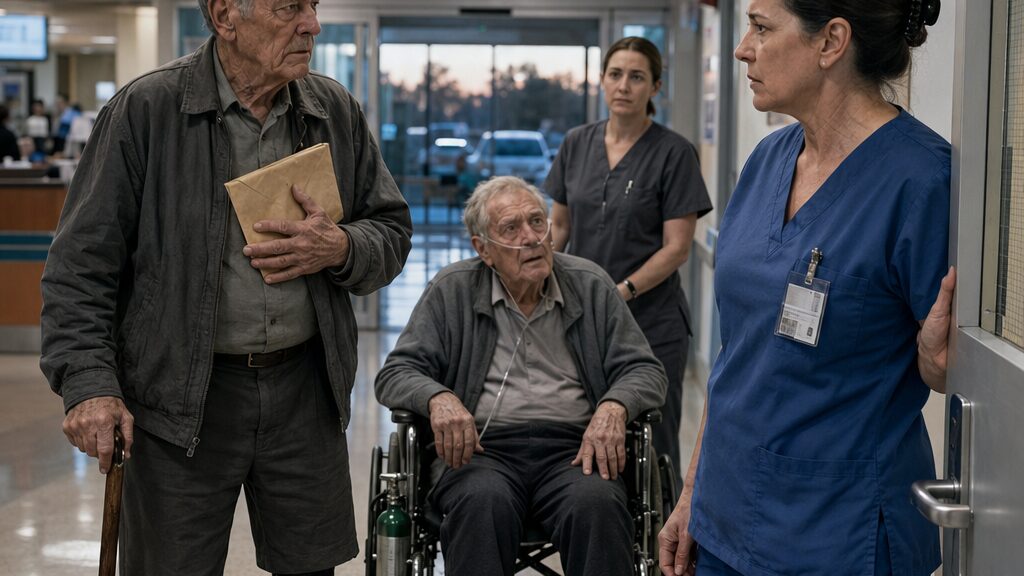
Donald Thompson had one hand under George Allen’s arm, one hand pressed flat over the inside pocket of his jacket, and no hand left for the cane slipping against the hospital curb.
The dark van’s door hung open behind them. Its warning chime kept ringing into the late afternoon like it was scolding him for taking too long. George’s oxygen tube had snagged on the seat belt latch, and the old man’s breath came thin and wet through his nose as he tried to stand.
“Hold on,” Donald said.
George’s fingers dug into Donald’s sleeve. His weight sagged forward. Donald planted his prosthetic foot hard against the curb and felt the familiar bite up through his knee. Pain flashed clean and white, but he did not let go.
The letter shifted inside his jacket.
He pressed his elbow tighter against it.
A young man near the automatic doors slowed, staring first at George’s oxygen tank, then at Donald’s stiff leg, then at the cane that had clattered sideways under the van. Nobody moved fast enough.
Donald hooked his arm around George’s back and hauled him the last few inches upright.
“Door,” George rasped.
“It’s open.”
“Not that one.”
Donald looked at him.
George’s eyes were cloudy, but they had found the hospital entrance. Past the sliding glass doors, people in scrubs moved behind the glare. A wheelchair sat folded near the wall. Somewhere beyond all that was a woman named Catherine Roberts, if the records clerk in another town had been right, if the hospice notice online had been real, if sixty years of wrong numbers and dead addresses had finally ended here.
Donald bent for the cane. The prosthetic made bending ugly, slow work. A triage nurse inside saw them through the glass and came out with the wheelchair.
“Sir, let’s get him seated.”
“I’ve got him,” Donald said, too quickly.
The nurse paused. Not offended, only alert.
George’s hand trembled on Donald’s sleeve. “Let them,” he whispered.
Donald guided him down into the wheelchair. George folded into it like his bones had been cut loose. The oxygen tube pulled tight, and the nurse adjusted it with practiced fingers.
“Name?” she asked.
Donald looked past her, into the bright throat of the hospital.
“George Allen,” he said. “He needs help breathing.”
“We’ll get him checked in.”
“And I need Angela Roberts.”
The nurse’s hand stopped on the wheelchair brake. “Angela?”
“Angela Roberts. Charge nurse. She works here.”
“You family?”
Donald did not answer fast enough.
The nurse’s face changed, the way faces changed around old men who arrived with complicated things. She looked at George, then at Donald’s jacket, where his hand still pressed the inner pocket.
“I need to give her something,” Donald said.
“Medical information?”
“No.”
The nurse waited.
Donald pulled the letter out.
It was sealed in a yellowed envelope so worn along the edges it looked cloth-soft. The flap had browned with age. One corner had been repaired with a strip of tape that had gone brittle decades ago. Across the front, in faded ink, was a name written with the force of a younger hand.
Catherine.
No last name on the front. No address. Just Catherine.
The nurse looked at it, then back at him. “Sir, let’s get your friend inside first.”
“He’s not my friend,” George said, barely above breath.
Donald put his hand on George’s shoulder.
George closed his eyes. “He’s worse than that.”
The nurse did not smile. She wheeled George through the sliding doors, and Donald followed with the cane in one hand and the envelope in the other. The hospital air hit him cold. It smelled of sanitizer, coffee, plastic tubing, old fear.
At the intake desk, the nurse spoke quietly to a desk attendant. George’s breathing grew rougher in the chair. Donald stayed behind him, palm resting where George’s shoulder bone rose sharply under his jacket.
“Mr. Allen?” the desk attendant asked. “Date of birth?”
George tried to answer and coughed instead.
Donald gave it. He knew it the way he knew the number on the last house where Catherine had not lived, the cemetery office that had no record, the county clerk who had said try Roberts with an “s,” the address returned with “unable to forward,” the winter he had decided to stop looking and then found the envelope in his drawer on Christmas morning like an accusation.
A door opened near the triage hallway.
A woman in blue scrubs stepped out, reading from a tablet. She was in her forties or early fifties, her dark hair clipped back, her expression tired in the controlled way of people who had no time to look tired. A badge swung from her collar.
Angela Roberts.
Donald knew before he saw the name.
He had imagined her younger. He had imagined a child. That was the trouble with a promise kept too late. Everyone inside it aged without permission.
The triage nurse touched Angela’s elbow and murmured. Angela glanced toward George first, professional concern crossing her face. Then she looked at Donald.
“You asked for me?”
Donald’s mouth had gone dry.
“I’m Donald Thompson.”
Her eyes did not change.
“I was with Nicholas Roberts.”
That did it.
Not belief. Not welcome. Just the smallest hardening, as if someone had shut a drawer inside her.
“My father has been dead a long time,” she said.
“Yes, ma’am.”
“Then whatever this is, it can wait.”
“It has waited.”
She looked at the envelope. “What is that?”
Donald held it with both hands. The cane leaned against his thigh. “Something he asked me to bring.”
Angela’s lips parted, then pressed closed. Behind her, a staff-only door swung open as someone passed, showing a narrow corridor beyond.
“I don’t know you,” she said.
“No.”
“My mother is a patient here.”
“Yes.”
Her face tightened. “How do you know that?”
Donald did not say: because he had read the hospice notice twice under the kitchen light; because George had called him at midnight saying if you don’t go now, you’ll bury it with yourself; because every road to Catherine had been blocked until her name appeared beside this hospital like the last flare over dark water.
He said, “I found her.”
Angela stepped closer, lowering her voice. “If you are here asking for money—”
Donald’s fingers tightened around the envelope. “No.”
“If this is about some veteran group, some interview, some story—”
“No.”
“My mother is very ill. She does not need strangers coming in with old war claims.”
George stirred in the wheelchair. “Not claim.”
Angela looked at him. “Sir, you need to be seen.”
George tried to lift his head. “He was there.”
Donald squeezed his shoulder once. Quiet.
Angela saw it. The gesture. The command inside it. The history.
But she did not soften.
“Mr. Thompson,” she said, “you need to give that to me or leave.”
Donald looked down at the envelope. For sixty years he had not let rain touch it, had not let movers pack it, had not opened it when loneliness made him cruel, had not burned it when grief made him stupid. He had carried it in shirt pockets, glove boxes, footlockers, dresser drawers, and finally here, against his heart.
“I can give it to Catherine,” he said.
“No.”
“He asked me to.”
“My mother cannot handle this.”
“He said her name.”
Angela’s eyes flashed. “You don’t get to walk in here and use my mother’s name.”
The staff-only door behind her began to close. Angela put one hand on it, her body half turned away now, the conversation already ending.
Donald’s leg ached. George’s breathing rattled. The letter shook in his hand, though he tried to still it.
Angela said, “My father died before I ever knew him. Whatever you think you brought here, we don’t want it.”
The door moved inward.
Donald stepped forward once, not enough to threaten, only enough to keep his voice from being swallowed by the corridor.
“He died asking for Catherine.”
Angela’s hand froze on the door.
Chapter 2: The Man In The Wheelchair Remembered
“Nicholas,” George whispered, and the portable oxygen monitor clipped to the chair began to beep.
Angela turned from the half-closed door. The sound pulled the nurse back into her before the daughter could answer. She crossed to George, crouched, checked the tubing, then reached for the small monitor at his side.
“Sir, slow breaths.”
George tried to laugh and failed. “If I could do that, I’d be fishing.”
Donald moved closer, but Angela lifted one hand.
“Give me room.”
The words were not cruel. That made them harder to disobey.
Donald stepped back. His prosthetic foot scraped the polished floor. The envelope remained in his left hand, exposed now under the hospital lights, and he disliked that. It had spent most of its life hidden. The light made every crease look like damage.
Angela adjusted the oxygen flow, then signaled to the triage nurse. “I need a consult room. Now.”
“Is he crashing?”
“Not if we stop talking in the hallway.”
Donald followed as they wheeled George into a small consultation room near emergency intake. It had four chairs, a rolling stool, a wall dispenser for gloves, and a print of a sailboat that looked too cheerful for anyone who had ever seen actual water. George was transferred only halfway; they decided the wheelchair was better than moving him again. Angela shut the door but left the blinds open.
Donald noticed that.
She still wanted witnesses.
Angela stood with her back to the door. “You have five minutes. Then my patient gets treated and my mother stays out of this.”
“Your mother is why we’re here.”
“My mother is why I’m still listening.”
George’s fingers worked against the blanket over his knees. “Don,” he said.
Donald bent close.
George’s eyes fixed on the envelope. “Tell her enough.”
Donald shook his head once. “Not yet.”
George’s weak hand shot out with surprising force and caught Donald’s sleeve. “Enough.”
Angela saw the grip. She saw Donald wince, not from pain, but from being pulled toward something he did not want opened.
“You said you were with Nicholas Roberts,” she said.
“I was.”
“When?”
Donald looked at George. George nodded once.
“During service,” Donald said.
“That is not an answer.”
“It’s the one I can give without making it smaller than it was.”
Angela’s expression flattened. “Mr. Thompson, I work in a hospital. People come in here every day with stories. Some are true. Some are confused. Some are cruel. You brought a very sick man to my emergency department and asked for my mother by name while holding an envelope that looks like it came from a museum drawer. You’ll forgive me if I need more than atmosphere.”
Donald almost smiled at that. Almost.
George rasped, “She talks like her mother.”
Angela looked at him sharply. “You knew my mother?”
George’s eyes closed, opened. “Knew of her.”
Donald reached into his jacket with his free hand. Angela stiffened.
“It’s not a weapon,” he said.
“I didn’t say it was.”
“You looked like it.”
He pulled out a small cloth pouch tied with a shoelace. His fingers were slower than he wanted. He untied it on his knee and tipped the contents into his palm.
A dog tag slid out, dull silver, worn thin at the hole.
Angela did not move.
Donald set it on the little table beside the sealed letter. Metal clicked softly against laminate.
ROBERTS NICHOLAS.
Angela stared at it long enough that the monitor beep seemed louder.
Then she shook her head.
“No.”
Donald said nothing.
“No, that’s not possible.”
George’s hand tightened on Donald’s sleeve.
Angela reached out, then stopped before touching the tag. “His tags came home.”
“One did.”
“Both.”
“No.”
“My grandmother kept them in a cedar box. My mother still has them.”
Donald swallowed. The room seemed to narrow around the letter and the tag, around Angela’s face, which had gone pale beneath the controlled hospital calm.
“There were mix-ups,” he said.
“Convenient.”
“No. Common.”
Her eyes lifted. “How much do you want for it?”
George made a sound low in his throat.
Donald felt the old heat rise in him, the kind that had once made him slam phones down on county clerks and tear returned envelopes in half before taping them back together. He put both hands flat on his knees until the heat passed.
“He didn’t ask me to sell it,” Donald said.
Angela looked away first.
Outside the room, wheels rattled past. Someone laughed too loudly at the desk, then stopped. Hospital life kept moving, indifferent to the dead.
Angela touched the back of a chair but did not sit. “Where did you get it?”
“From him.”
“From my father.”
“Yes.”
“When he died.”
Donald’s fingers moved toward the envelope without touching it. “After he gave me this.”
“What’s in it?”
“I don’t know.”
The answer hit her wrong. Donald saw it at once.
“You expect me to believe you carried a letter for decades and never opened it?”
“Yes.”
“Why?”
“Because it wasn’t mine.”
Angela’s mouth tightened. There was something in her then that looked less like disbelief and more like anger at being made to want belief.
George coughed hard. His shoulders folded forward. Angela moved fast, pressing the call button, checking the line, telling him to breathe in short, even pulls. Donald put his hand on George’s shoulder, thumb braced against the old bone.
“Stay,” he said.
George’s eyes found his. “Didn’t come this far for the coffee.”
The triage nurse entered, followed by another staff member with a portable vitals cart. For a few minutes the room belonged to numbers, cuffs, oxygen flow, medical shorthand. Donald stood back with the cane under one hand and the letter under the other, feeling useless in the particular way hospitals made soldiers feel useless. There was no field to cross, no weight to carry except the one everyone told him to put down.
Angela read the numbers on the monitor. “He needs evaluation. Chest films. Labs.”
George waved a weak hand toward Donald. “No time.”
“You have time to be treated,” Angela said.
“Not for that.”
“For breathing? Yes, sir, you do.”
Donald heard the daughter in her then, not only the nurse. She was angry because people kept trying to die on her schedule.
She turned to Donald. “If he was there, why does he need you to talk?”
“Because George remembers what happened after,” Donald said. “I remember what happened before.”
Angela’s eyes narrowed. “Before what?”
Donald looked at the letter.
The sealed flap had a dark crescent near the edge where Nicholas’s thumb had pressed hard before handing it over. Donald had looked at that mark in motel rooms, kitchens, parking lots, and once in a church basement where a veterans’ volunteer told him there were too many Roberts families to search without more.
“Before he stopped moving,” Donald said.
Angela folded her arms. “That sounds rehearsed.”
“It isn’t.”
“It sounds like a man choosing every word because the wrong ones will expose him.”
Donald looked at her then, really looked. She had Nicholas’s brow. Not the eyes, not the mouth, but that stubborn line when she decided fear was weakness and pushed it down where no one could see.
“He said Catherine,” Donald told her. “He said the house had a porch light that stuck in winter. He said she sang when she was nervous. He said if a child came before he did, the child should know he tried to come home.”
Angela’s face changed before she could stop it.
George’s monitor beeped once, twice.
Donald knew he had said too much and not enough.
Angela stepped back from the table. Her gaze moved from the tag to the envelope to George’s oxygen tube and finally to Donald’s hand, still resting on George’s shoulder.
“My mother,” she said, each word controlled, “can’t hear this tonight.”
Chapter 3: The Family Had Already Buried Him Twice
Angela watched the envelope through the consultation-room glass and hated herself for wanting to touch it.
Donald Thompson sat beside George Allen’s wheelchair with the stillness of a man who had learned not to waste movement. His cane rested against his knee. His hand was on George’s shoulder again, not gripping, not performing comfort for anyone watching. Just there. As if his palm had been assigned to that place a long time ago and had never been relieved.
The envelope lay on the small table.
He had not put it back in his pocket after she left the room.
That bothered her more than it should have.
If he was lying, why leave it where she could study it? If he was telling the truth, why had he waited until her mother was dying to arrive?
Angela turned away before he caught her looking.
At the nurses’ station, the triage nurse handed her the preliminary sheet. “George Allen’s pressure is low. Oxygen saturation keeps dipping. Doctor wants imaging.”
“Get it moving.”
“He keeps asking for the other man.”
“They came together.”
“Family?”
Angela looked back through the glass.
Donald had leaned closer to George. George was speaking, but the words were too faint to carry.
“No,” Angela said. “Not family.”
The triage nurse followed her gaze. “Could’ve fooled me.”
Angela took the chart and walked away before her face could answer.
Upstairs, her mother was sleeping under a knitted blanket Catherine insisted on bringing from home even after hospice had told them most personal items were optional. Catherine had made Angela promise to turn the blanket so the green stripe faced the window. Little things mattered now. The angle of the pillow. The lip balm. The photograph on the side table turned slightly away because Catherine said Nicholas looked too young in it.
Angela stopped outside the elevator and did not press the button.
Her father had always been younger than everyone else in the family.
He was twenty-three in the picture. Twenty-three in every story. Twenty-three in the cedar box with the folded flag, the official letter, and the tags her grandmother used to take out on Memorial Day. Twenty-three in Catherine’s silence when people asked if she ever remarried. Twenty-three in the blank space on Angela’s birth certificate where a living father should have signed later and never did.
Her mother had buried him once with the telegram.
Then again every year after.
Angela returned to the consultation room.
Donald looked up when she entered. He had not moved the envelope.
George’s eyes were closed, but his fingers were caught in Donald’s sleeve.
“Mr. Allen needs tests,” she said.
Donald nodded. “Do what he needs.”
“And you need to understand something.” She shut the door behind her. “My mother is not a symbol. She is not a loose end in your life. She is a woman upstairs who has spent the last year losing pieces of herself one at a time.”
Donald’s face did not change, but his hand left George’s shoulder and settled over his own knee.
“I know what she is.”
“No. You know a name on an envelope.”
He took that without answering.
Angela stepped closer to the table. The envelope’s edges were feathered from handling. There was a small stain near the corner, brown with age. Not dramatic. Not proof. Just damage that had survived with it.
“You said my mother sang when she was nervous.”
“Yes.”
“That could be a guess.”
“Yes.”
“You said something about a porch light sticking.”
Donald nodded.
“What color was the house?”
His eyes lowered.
Angela felt a bitter satisfaction. There. Too far. One detail too many.
Then he said, “White when he left. But he said Catherine wanted yellow. Pale yellow, not bright. He said she kept pointing at paint chips and saying every yellow looked like a warning sign.”
Angela stopped breathing for a second.
Her mother’s house was pale yellow.
It had not been painted until after Nicholas died.
Angela heard herself say, “Who told you that?”
“Nicholas.”
“He never saw it.”
“No.”
The room seemed to tilt. George opened his eyes.
“He knew her,” George whispered. “Knew how she’d choose.”
Angela turned on Donald because turning on George felt impossible. “You expect me to take my mother’s private memories from a stranger and call that proof?”
“No.”
“Then what do you expect?”
Donald looked at the envelope. “A chance.”
The simplicity of it angered her. A chance was not simple. A chance could undo a carefully sealed life. Catherine had survived by making Nicholas clean in memory, distant and brave and unreachable. Angela had survived by not asking why a dead man could still take up so much room.
“He never wrote,” Angela said.
Donald’s jaw tightened.
“My mother waited. She was pregnant. Young. Everybody told her letters got lost, mail was slow, records were confused. Then the official notice came, and after that, nothing. No message. No friend. No man at the door. Nothing.” She pointed at the envelope. “Now you bring that in and ask me to believe he remembered her?”
George’s eyes shone with exhaustion. “He did.”
Angela looked at him. “And you knew that all these years?”
George’s grip tightened on Donald’s sleeve.
Donald said, “George has been sick.”
“That’s not an answer.”
“No.”
“Why now?”
Donald’s thumb brushed the cane handle. “Because I found you now.”
Something in his voice made her think it was not the whole truth.
A knock came, and a staff member entered to take George for imaging. George resisted the first push of the wheelchair, weak but stubborn.
“Don,” he said.
“I’ll be here.”
George shook his head. “No. Don’t let her send you off.”
“I won’t.”
Angela stepped back to let the chair pass. George’s oxygen tank rattled softly. At the doorway, he looked at Angela, not with anger, not even accusation, but with a pleading so naked she had to look away.
“Heard him,” George whispered.
“What?”
He coughed. The staff member paused.
George forced the words out. “I heard Nicholas. Don’t let me be the last one who heard him.”
The hallway swallowed the squeak of the wheelchair wheels.
Angela stood with Donald and the envelope between them.
“My mother is upstairs,” she said finally. “Hospice wing. She’s awake some hours, asleep more. She has pain we are trying to control, and memories I do not have the right to disturb just because two old men came in with a story.”
Donald closed his eyes briefly.
“So yes,” Angela said, voice lower now, “Catherine Roberts is here. But if you try to go to her room without my permission, I will call security. Not because I think you’re evil. Because I don’t know what you are.”
Donald opened his eyes.
For the first time, she saw that her words had hurt him. Not pride. Something deeper. Something already bruised.
He picked up the envelope with both hands and held it against his jacket.
“I know what I am,” he said.
Angela waited.
Donald looked toward the hallway where George had disappeared.
“I’m late.”
Chapter 4: The Record Proved Less Than The Letter
Angela placed the casualty file beside Donald’s envelope and kept her hand on top of it as if the paper might try to run.
“The dates do not match,” she said.
Donald stood in the narrow hospital records office with his cane angled against one hip and the letter back inside his jacket, close enough that the edge of it pressed into his ribs when he breathed. It was early morning now. The lights overhead hummed without mercy. Beyond the half-open door, the chapel hallway waited empty except for a plastic plant and a row of chairs nobody had the heart to sit in.
George had been taken for imaging an hour earlier.
Donald had not liked letting him out of sight.
Angela had liked it even less when Donald tried to follow.
Now the two of them stood over copies, printouts, and old official language that made death look organized.
Angela tapped the file. “This says Nicholas Roberts died on the seventeenth.”
Donald looked at the page but did not touch it. “That’s what they wrote.”
“The letter you brought is dated the nineteenth.”
“Yes.”
“That is two days after the Army told my grandmother he died.”
Donald said nothing.
Angela’s eyes sharpened. “Do you understand why that matters?”
“Yes.”
“Then explain it.”
He could have said confusion. He could have said records were not scripture. He could have said dates got corrected all the time after men were moved, counted, miscounted, and carried through places no clerk had ever seen. All of that would have been true. None of it would have been enough.
“The seventeenth was when they listed him missing,” Donald said.
“That is not what this says.”
“That is what happened.”
Angela pushed the file toward him. “My family had this for decades.”
Donald’s mouth tightened. “So did a lot of families.”
Her voice dropped. “Do not make my mother one of many right now.”
He looked up.
The anger in her face was not only for him. It had roots. It had been watered for years by folded flags and careful silences and adults who told a little girl that her father was brave but never explained why bravery still meant absence.
Donald took that anger because some part of it belonged near him.
A hospital records clerk appeared at the door. “I found the archived admission note for Catherine Roberts. Hospice transfer came in yesterday evening. There’s a family contact form, but no visitor release beyond immediate family.”
Angela took it. “Thank you.”
The clerk glanced at Donald, his cane, the worn jacket, the stiff line of his prosthetic leg. “Do you need a chair, sir?”
“No.”
Angela looked at his leg for the first time as something other than a detail. “You should sit.”
“I’ve done enough sitting.”
“You’re swaying.”
“I’m standing.”
The clerk left.
Angela folded the new paper under the file. “My mother’s physician does not want emotional distress. I spoke to him.”
“You told him what?”
“That two strangers arrived claiming to have a letter from my father.”
Donald’s hand moved to his jacket pocket.
Angela saw it. “You keep touching it.”
“I know where it is.”
“As if someone here will steal it.”
“No.” He looked toward the hallway. “As if I might forget why I came.”
For a moment, the records office went very quiet.
Angela looked away first. She gathered the papers too neatly, aligning the corners with a nurse’s precision. “George’s oxygen levels dropped during imaging.”
Donald’s head came up.
“He’s stable,” she said quickly. “But he needs monitoring. The doctor wants him admitted.”
“No.”
“He is not leaving.”
“He didn’t come to be admitted.”
“He came because he could not breathe.”
Donald stepped toward the door.
Angela blocked him. “Don’t make me choose between my job and whatever this is.”
The words hit harder because he had already been choosing all night. George or Catherine. Witness or recipient. The man still breathing or the woman he had been searching for through the names of the dead.
“He asked to come,” Donald said.
“I believe that. I also believe sick people ask for things that can kill them.”
Donald’s fingers tightened around the cane. “He said he was running out of time.”
“He is.”
The answer stopped him.
Angela’s voice softened despite herself. “That is why I am trying to keep him alive long enough for you to decide what truth you’re actually here to tell.”
Donald looked at the file again. Nicholas Roberts, reduced to lines and stamps. A date that had never fit. A death that had been filed before the words inside the envelope were even written.
“He saved more than one man that day,” Donald said.
Angela did not move.
“Who?”
Donald could feel the letter against his chest. It seemed heavier when he stood in front of her. Not because of paper. Because of all the years he had used it as a shield. He could say Nicholas had carried messages. He could say Nicholas had gone back. He could say Nicholas had not died where the paper said he died.
But the truth had a shape, and once he spoke the first edge of it, the rest would follow.
“Men who couldn’t move fast enough,” Donald said.
“That includes you.”
He looked toward the chapel hallway. There was a small stained-glass panel at the end, nothing holy in it except colored light.
Angela stepped closer. “Doesn’t it?”
Donald felt the old phantom ache where his lower leg was not. He remembered George’s hands under his arms. Nicholas’s voice behind him. Someone laughing once, strangely, because terror made men do foolish things. He remembered not looking back quickly enough.
“I wasn’t the only one,” he said.
Angela stared at him. “But you were one.”
He did not answer.
Her face changed then. The suspicion did not disappear; it found a darker place to stand. “Is that why you came? Not because my father asked, but because you need my mother to absolve you?”
“No.”
“Did you find us before?”
Donald’s silence betrayed him before his mouth could defend him.
Angela took one step back. “You did.”
“Not like this.”
“What does that mean?”
“It means I found a Roberts address years ago. I was told she had married into another family, moved twice, didn’t want contact from anyone tied to the war.”
“Who told you that?”
“A man at a county office. Maybe he was wrong.”
“And you accepted it?”
Donald’s hand opened and closed around the cane. “I had no right to tear open her life.”
“You had a letter addressed to her.”
“I had a promise to deliver it, not a right to hurt her with it.”
“That sounds noble.”
“It wasn’t.”
Angela’s eyes fixed on him.
Donald looked down. “I was afraid.”
The admission lay between them more plainly than any document.
A sound came from the hallway—wheels, hurried steps, a portable monitor beeping faster than before. Donald turned.
George’s wheelchair appeared first, pushed by a staff member, with Angela’s triage nurse beside him. George was gray around the mouth. His oxygen mask had replaced the small tube. His eyes searched until they found Donald.
Donald moved, but Angela caught his arm.
“They’re taking him to a monitored bay.”
“He needs me.”
“He needs oxygen.”
George lifted one hand from the blanket. It shook in the air, reaching.
Donald broke Angela’s hold and went to him. He did not care who saw the limp now, or the awkward half-drag of his prosthetic when he hurried.
He caught George’s hand.
George’s fingers were cold. “Door?” he breathed behind the mask.
“Not yet.”
George’s eyes flicked toward Angela. He tried to speak again.
The nurse said, “Please, we need to move.”
Donald leaned close. “Save your breath.”
George’s grip tightened once, hard enough to hurt.
Then he was wheeled away.
Donald stood in the hallway after him, the cane under his palm, the letter against his chest, Angela at his side with the file in her hand.
When he turned, she was no longer looking at the paperwork.
She was looking at him.
“Did my father die saving you?” she asked.
Chapter 5: She Asked If He Let Her Father Die
“If you came here to forgive yourself, leave.”
Angela stood in front of Catherine Roberts’s door with both hands at her sides, not touching the handle, not letting Donald near it. The hospice wing was quieter than emergency, but the quiet felt guarded. Machines whispered behind closed rooms. A cart rolled somewhere out of sight. A television murmured from a room where no one seemed to be watching.
Donald had followed her upstairs because George was behind a curtain downstairs with oxygen forced into him and a nurse saying, “We’ll come get you if anything changes,” as if anything had not already changed.
Now Catherine’s name was printed on a small card beside the door.
Catherine Roberts.
After sixty years, the name was not on a returned envelope, not in a cold archive, not in a directory crossed out with bad information. It was here, inches from Donald’s hand.
Angela saw where he looked.
“No,” she said.
Donald stopped.
The envelope was inside his jacket again. He had put it away when George was taken, not trusting himself to hold it in the open while his last witness struggled to breathe.
“I’m not asking her to forgive me,” Donald said.
“That’s all you’ve been asking since you walked in.”
He looked at her.
“You just didn’t use the word.” Angela’s voice was low, controlled for the sake of the rooms around them. “You brought a dying man here. You brought an old letter. You brought my father’s name. But every time I ask a direct question, you hide behind the promise.”
Donald felt his jaw tighten.
“Did he die saving you?”
The hallway seemed to pull long and narrow around the question.
Donald could hear George downstairs, though there was no sound. He could see Nicholas without wanting to. Not the whole scene. Never the whole scene at once. Just pieces: Nicholas’s hand clamped around a strap, George shouting for them to move, Donald on the ground furious because his body would not obey him, Nicholas turning back when he should not have.
“Yes,” Donald said.
Angela’s face did not change, but her eyes did.
Donald forced the next words out before he could retreat into silence. “Not only me.”
“That is not what I asked.”
“I know.”
“Did you ask him to come back?”
“No.”
“Did he?”
“Yes.”
Her throat worked. “And then he died.”
Donald looked at Catherine’s door. “Later.”
“That is a soldier’s answer. I am asking as his daughter.”
The word daughter struck him harder than accusation. Nicholas had known there might be a child. Not daughter. Not Angela. Just child, said with blood in his mouth and wonder still trying to live in him.
Donald reached into his jacket.
Angela’s hand moved toward the call button on the wall.
He stopped. “I’m taking out the letter.”
“Slowly.”
He almost laughed, but there was no air for it.
The envelope came out bent slightly from the curve of his body. He held it between them, not offering it, not yet. Angela looked at it as if it might burn her.
“He wrote it before the last move,” Donald said. “Said if anything happened, it went to Catherine. Not to a commander. Not to a chaplain. Not to a file.”
“Then why didn’t it?”
“Because the man he gave it to was carried out half-conscious and woke up without part of his leg, and the world had already started putting names on forms.”
“And after?”
Donald’s hand shook. He lowered the envelope onto a narrow side table outside Catherine’s door. The paper made no sound when it landed.
Angela looked at his empty hand. “You still won’t give it to me.”
“It isn’t yours.”
“She is my mother.”
“It isn’t hers until I give it to her.”
“You don’t get to decide that.”
“I was asked to.”
The anger came back into Angela’s face, but now there was grief inside it, raw and old. “You were asked sixty years ago.”
Donald did not defend himself.
That was worse. Angela wanted him to argue, to give her something hard enough to push against. Instead he stood with his cane and his worn jacket and his prosthetic leg hidden beneath old trousers, and he looked like a man already convicted.
“My mother waited,” Angela said. “Do you understand that? She kept a porch light on every night the first year because nobody could make her stop. My grandmother said she would fall asleep in a chair facing the window. Then I was born, and everybody told her to live. So she lived. But there were parts of her that never came into the room with us.”
Donald closed his eyes.
“No,” Angela said. “Look at me.”
He opened them.
“If that letter says he loved her, she needed it then.”
“I know.”
“If it says he knew about me, I needed it then.”
Donald’s hand tightened on the cane until the knuckles blanched.
“I know.”
Angela’s voice broke at the edge and hardened to cover it. “Then why should I let you hurt her now?”
From behind the door came the faintest sound.
Not a call. Not yet. A shift, maybe. A breath with intention.
Angela turned her head.
Donald heard it too. His eyes moved to the door.
Angela lowered her voice. “She’s awake.”
He did not reach for the letter.
That surprised her. He only stood there, as if the door were not an obstacle but a judgment.
“I lived because he stopped running,” Donald said.
Angela looked back at him.
“He and George had me under the arms. I kept telling them to leave me. George was cursing at me. Nicholas was laughing like a fool. Said Catherine hated quitters, and he wasn’t about to meet her again as one.”
Angela’s lips parted.
“He knew she was expecting,” Donald said. “He didn’t know if it was a son or daughter. He said—”
The words stopped.
Angela stepped closer despite herself. “He said what?”
Donald looked at the envelope on the side table. “That part was for her.”
“For my mother?”
“For both of you, maybe.”
A small scrape came from inside the room. Then Catherine’s voice, thin but clear enough to pass through the door.
“Angela?”
Angela turned fully now. “Mom?”
Donald took one step back. The instinct to flee came without warning, so strong his prosthetic foot shifted before he commanded it still.
Angela noticed. “Don’t.”
He stopped.
Catherine’s voice came again. “Who is out there?”
Angela’s hand hovered near the handle.
Donald felt the envelope on the table like a living thing beside him. He should have picked it up. He should have put it back in his jacket. He should have waited until a better moment, as if better moments were still being made somewhere.
Angela opened the door only a crack and slipped halfway inside. “It’s me.”
“I heard a man.”
“Mom—”
“I heard Nicholas.”
The hallway lost all its air.
Angela looked back through the crack at Donald. There was no defense in her face now. Only fear.
Catherine spoke again, weaker but sharper. “Angela, open the door.”
Chapter 6: The Envelope Opened Before The Room Breathed
Catherine Roberts’s hand reached out before Angela gave anyone permission to enter.
It emerged from the dim hospital room thin and pale, the skin loose over the knuckles, the fingers angled by age but still certain in what they wanted. Angela caught it instinctively, both nurse and daughter at once.
“Mom, wait.”
“No.” Catherine’s eyes were fixed past her. “Let me see.”
Donald stood in the hallway with the envelope still on the side table between them. For a moment he could not move. He had crossed states, years, wrong addresses, returned mail, hospital parking lots, and the stubborn ruins of his own courage, but the last few feet felt like asking permission from a grave.
Angela opened the door wider.
Catherine lay propped against pillows, a green-striped blanket folded across her legs. Her hair was white and fine around her face. The room held the softened evidence of a life being narrowed: water cup, lip balm, framed photograph turned slightly away, a folded sweater on a chair, flowers beginning to droop in a vase.
Her eyes found Donald’s jacket. Then his cane. Then the letter.
She did not look surprised enough.
That frightened Angela more than disbelief would have.
“Donald,” Catherine said.
Angela’s hand tightened around hers. “You know him?”
Catherine shook her head faintly. “No.”
Donald swallowed. “Ma’am.”
Her gaze remained on the envelope. “He wrote your name.”
Donald’s breath caught.
Angela turned to him. “What does that mean?”
Donald could not answer. He looked at Catherine, and in her face he saw the old photograph changed by sixty years but not erased. Nicholas had carried that face in words. Not perfectly. Not enough. But enough that Donald had known when he finally found the right woman, she would make the room go still.
Catherine extended her hand again.
Angela stepped into the hallway and picked up the envelope. For all her earlier anger, she lifted it carefully, as if the paper might bruise. She checked Donald’s face once before carrying it to the bed.
Donald remained at the threshold.
“No,” Catherine said. “Bring him in.”
Angela did not move.
Catherine’s eyes shifted to her daughter. “Please.”
That word did what Donald’s could not.
Angela stood aside.
Donald entered slowly. The prosthetic made a soft, uneven sound against the hospital floor. He stopped at the foot of the bed, one hand on the cane, the other hanging useless at his side because the thing it had guarded most of his life was no longer there.
Angela placed the envelope in Catherine’s hands.
Catherine did not open it.
She touched the front first. One finger moved over her own name. Catherine. The faded ink had sunk into the fibers until it looked less written than remembered.
Her mouth trembled once.
“That’s his C,” she whispered.
Angela leaned closer. “What?”
“He always made it too tall.” Catherine gave the smallest breath of a laugh, and it hurt to hear because it had lived so long without being used. “I told him it looked like a gate.”
Donald stared at the floor.
Catherine turned the envelope over. There, near the sealed flap, was a tiny mark in pencil, nearly lost under time and tape. Two short strokes crossing a third.
Angela frowned. “Is that a mark?”
Catherine closed her eyes. “He put that on notes he left in the kitchen. Before he shipped out. It meant read this when you’re done being mad.”
Angela looked at Donald then.
He had not demanded belief. He had not even lifted his head to receive it. He stood as if belief were not a gift he deserved to touch.
Catherine opened her eyes. “You never opened it.”
“No, ma’am.”
“Why?”
“It wasn’t mine.”
Her fingers tightened around the envelope. “But you kept it.”
“Yes.”
“For how long?”
Donald’s throat worked. “Long enough to be ashamed of the answer.”
Angela pulled a chair close to the bed. “Mom, you don’t have to do this now.”
Catherine looked at her daughter. “I have been doing this now since before you were born.”
Angela flinched.
Regret crossed Catherine’s face at once. She reached for Angela’s hand. “Not because of you.”
“I know.”
“No,” Catherine said. “You don’t. You grew up beside a closed room and thought it was your fault there wasn’t space inside.”
Angela blinked hard, and Donald looked away because that was not his to witness, even though his failure had helped build the room.
Catherine held the envelope toward Angela. “You open it. My hands.”
Angela’s professional calm nearly held. Nearly. She slid one finger under the old flap, careful not to tear the name, careful not to destroy what time had spared. The tape gave with a dry whisper.
Donald’s chest tightened at the sound.
For sixty years the letter had been sealed.
Now the room seemed to stop breathing before the paper even came out.
Angela drew the folded pages halfway from the envelope. Catherine’s hand covered hers.
“Wait.”
Angela froze.
Catherine looked at Donald. “Before I read it, I want to know why you waited.”
Angela’s eyes lifted too. The question landed without anger, which made it worse.
Donald felt for the envelope that was no longer in his pocket and found only the worn lining of his jacket. Empty cloth. No weight. No excuse.
He had imagined this question from Catherine in a hundred forms. He had answered it in motel mirrors and church parking lots, in his kitchen while George slept in a recliner after treatment, in the dead hours when the letter seemed louder than any living voice.
All the answers had sounded better when she was not looking at him.
“I looked,” he said.
Catherine waited.
“I failed. Then I looked again.”
Angela’s face tightened, but she did not interrupt.
Donald’s hand shifted on the cane. “And once, years ago, I found a trace. Maybe yours. Maybe not. A clerk said you had moved on. Said you had a family, a different name, no good would come from dragging old grief to your porch.”
Catherine’s face did not change, but the hand over Angela’s went very still.
“I told myself leaving you alone was mercy,” Donald said. “It was easier than admitting I was afraid.”
“Afraid of what?” Angela asked.
Donald looked at Catherine, not Angela.
“Because I was afraid you’d ask why I came home.”
Chapter 7: The Promise Cost More Than One Soldier
Donald reached for the pocket where the letter had lived and found only cloth.
His fingers pressed into the empty lining before he realized what he was doing. Catherine saw it. Angela saw it. For sixty years his hand had known where to go when shame rose, when a clerk said no record, when a returned envelope landed in his mailbox, when George called and asked if he had tried again. Now there was nothing there to hold except the shape of what was missing.
Catherine’s question still hung in the room.
Why did you come home?
Donald looked toward the open door, down the hall where a nurse had promised to send word about George. He wanted George in the room. He wanted another voice to break this into pieces small enough to survive.
But George was not here.
The promise had never truly belonged to George.
Donald tightened both hands around the cane. “Because Nicholas made sure I did.”
Angela stood behind Catherine’s bed now, one hand on the rail. The opened envelope lay on Catherine’s lap, the folded pages still partly inside it. Catherine had not read them. Not yet. She watched Donald with the stillness of someone who had waited so long that impatience had burned away.
Donald drew in a breath.
“We were moving men back,” he said. “Not like in the pictures. No clean line. No one standing tall. Just noise and smoke and everybody trying to hear orders that kept changing before they reached us.”
Angela’s face tightened, but she did not stop him.
“I went down first. I don’t remember the hit right. I remember being angry because my boot was wrong.” He looked at his leg. “Foolish thing. I kept thinking somebody needed to fix my boot.”
Catherine closed her eyes briefly.
“George got one arm under me. Nicholas got the other. I told them to leave me.”
“Did they?” Angela asked, though she knew the answer.
Donald shook his head. “George cursed at me. Nicholas laughed.”
Catherine’s mouth moved soundlessly around the memory of that laugh.
“He said you hated quitters,” Donald said to her. “Said he wasn’t going to make you ashamed of him by leaving a man behind.”
A tear slipped down Catherine’s face. She did not wipe it.
Donald’s voice roughened. “He had that letter tucked inside his shirt. He’d written it the night before. He gave it to me when we got behind cover because he thought I’d be evacuated first. Told me if he didn’t get his chance, I was to find Catherine Roberts. No matter how long.”
Angela looked down at the envelope. “And then?”
Donald looked at the floor.
“Then things moved again.”
“That is not an answer,” Angela said softly.
“No.” He swallowed. “It is the way I’ve avoided one.”
Catherine opened her eyes.
Donald forced himself to meet her gaze. “Nicholas went back for another man. George tried to follow, but he was carrying me. I held on to him. I told myself it was because I couldn’t move. But I held on.”
George would have argued. George would have said Donald had been half-conscious, bleeding, fevered, not responsible for the weight of another man’s body.
George was not here.
Donald kept going.
“Nicholas came back once more. Not walking right. Still talking. Still giving orders like anybody was fool enough to obey him.” Donald’s grip slipped on the cane. “He asked if I had the letter. I said yes. He asked if I knew Catherine’s name. I said yes. He said there might be a baby.”
Angela’s hand went to her mouth.
“He knew?” she whispered.
Donald nodded. “He knew there might be. He didn’t know if you were a girl or boy. He said if the child came before him, Catherine was to say he had already loved what he hadn’t met.”
Catherine made a small sound that bent Angela toward her, but Catherine lifted one hand, stopping comfort before it could cover the words.
Donald looked toward the door again.
As if summoned, a nurse appeared there. “Mr. Thompson?”
Donald turned too quickly. Pain shot through his hip.
“Mr. Allen is asking for you. His breathing is worse. They’re moving him to a monitored room upstairs, closer to respiratory support.”
Donald took a step.
Catherine caught his sleeve.
It was not a strong grip. It did not need to be.
“Finish,” she said.
The nurse waited, uncertain.
Donald stood between the hallway and the bed, between the man still breathing and the woman who had waited through most of a lifetime.
Angela saw the split in him. For the first time, her voice held no accusation. “I’ll ask them to bring George here before they move him farther. If they can.”
Donald looked at her.
She had already reached for the call button before he answered.
When George arrived minutes later, he was in a hospital wheelchair with an oxygen mask strapped to his face and a blanket tucked around him. His eyes found Donald first, then the envelope in Catherine’s lap, then Angela behind the bed.
He tried to lift his hand.
Donald moved behind the chair and rested his palm on George’s shoulder.
George’s eyes closed at the touch.
Catherine looked at him. “You were there.”
George’s head moved once.
“You heard him?”
Another nod.
Angela crouched beside the chair. “You don’t have to speak.”
George looked past her at Donald, and Donald understood the look. Not permission. Demand.
Donald bent close. “Save it.”
George’s hand rose, caught Donald’s wrist, and pulled it from his shoulder toward Catherine’s bed.
Not me.
Donald’s throat closed.
He straightened.
“Nicholas knew about you,” he said to Angela. “Not your name. Not your face. But you. He knew enough to be afraid he had left before telling you so.”
Angela’s eyes shone, but she stood very still.
“He asked me to tell Catherine he was sorry for the mornings he left without waking her because goodbyes made him useless. Asked me to tell her he remembered the porch light, the yellow paint she hadn’t chosen yet, the way she sang when angry because she didn’t want anyone to know she was scared.”
Catherine pressed the folded letter to her chest.
“And he asked me—” Donald stopped.
George’s hand tightened around his wrist.
Donald looked down at him. George’s breathing was shallow behind the mask. His eyes were wet, fierce, almost angry.
Do it.
Donald nodded once.
“He asked me to tell the child,” Donald said, looking at Angela now, “that courage was not being unafraid. It was coming home to the people who needed you if any road in the world still led there.”
Angela bowed her head.
Donald’s empty pocket seemed to burn.
“I didn’t come home clean,” he said. “I came home because other men spent themselves getting me there. Nicholas most of all. And I have punished myself with that truth so long I mistook punishment for loyalty.”
Catherine looked at him with a grief that did not absolve him quickly.
Good, he thought. Let it be real.
George coughed behind the mask. The nurse stepped in at once. “We need to move him now.”
Donald’s hand returned to George’s shoulder. “I’m coming.”
George shook his head.
The movement was tiny, but it carried the old command.
Angela stood. “They’ll bring him back if they can.”
Donald did not move.
George’s fingers slipped from his wrist.
The nurse began to wheel him away.
Catherine unfolded the letter at last, but her eyes stayed on Donald.
“Mr. Thompson,” she said.
He turned.
Her voice was faint, but every word landed. “Say the words Nicholas could not write.”
Chapter 8: He Walked Away Holding Nothing But Air
Catherine opened the letter while Angela stood behind her the way Donald had stood behind George.
Donald saw it before either woman did: Angela’s hand resting on Catherine’s shoulder, steady and protective, fingers spread against the green-striped blanket. The sight struck him with such quiet force that he had to look away. Some gestures traveled through people without permission. Some promises changed hands before anyone named them.
Catherine unfolded the pages carefully. The paper had thinned along the creases, and Angela slid one palm beneath it so it would not tear.
Donald stood at the foot of the bed with nothing in his pocket and George no longer in the room.
For the first time since he had arrived, both his hands were empty.
Catherine began to read silently. Her eyes moved slowly. Once she stopped and touched a line with one finger. Once she smiled with such pain in it that Angela bent closer, ready to catch whatever broke loose.
Then Angela’s face changed.
“What?” Catherine whispered.
Angela pointed to the page. “That phrase.”
Donald held himself still.
Angela read it softly. “When you’re done being mad, leave the porch light on anyway.”
Catherine let out a breath that was nearly a laugh and nearly not. “I said that to him.”
“No one else knew?”
“No.”
Angela looked at Donald then, and everything left in her face had shifted. Not forgiven. Not simple. But the locked door inside her had opened enough for light to enter.
Catherine kept reading.
Donald did not ask to hear the words. The letter had never been addressed to him. He had guarded its silence for so long that listening felt like trespass.
But Catherine’s hand trembled harder as she turned the second page. Angela read over her shoulder now, tears moving unchecked down her face. They were not performing grief for him. They had forgotten him for a moment.
That was right.
Donald stepped back.
Catherine looked up at once. “No.”
He stopped.
“You still owe me the words.”
The nurse appeared in the doorway before he could answer. “They’re moving Mr. Allen to respiratory care now. He’s asking for Mr. Thompson again.”
Donald’s body leaned toward the hallway.
Angela saw it. “Go.”
Catherine’s hand tightened around the letter. “Then come back.”
Donald looked at her. “I don’t know if he has that much time.”
Catherine’s face changed, and she did not ask him to choose again.
“Then say it here,” she said. “Before you go.”
Donald nodded.
He came closer to the bed. The cane made one soft click, then another. Angela stepped aside, but not away. Catherine held the opened letter in both hands now, the envelope resting against her blanket.
Donald looked at the page, then at the woman Nicholas had carried in his last clear thoughts.
“He said,” Donald began, and his voice failed.
He waited. No one hurried him.
“He said, ‘Tell Catherine I tried to keep my promise to come home. Tell her if I don’t, it wasn’t because I turned away.’”
Catherine closed her eyes.
Donald forced the rest past the old stone in his throat. “He said, ‘Tell her I loved the child before I knew what name to pray for. Tell that child the best part of me was already waiting there.’”
Angela covered her mouth.
“And he said—” Donald gripped the bed rail, not for balance now but because the room had tilted backward sixty years. “He said, ‘If she keeps the porch light on, tell her I saw it.’”
Catherine’s eyes opened.
Donald shook his head once, because it was not sense, not fact, not a thing a dying man could have known.
“He was looking past us,” Donald said. “Past everything. He said he saw it. I told him I would tell you. I told him I would bring the letter.”
Catherine reached for his hand.
Donald hesitated.
She waited until he gave it.
Her fingers were light, papery, warm.
“You brought him as far as anyone could,” she said.
Donald’s face tightened. “Not far enough.”
“No,” Catherine said. “Not far enough. But here.”
That did what forgiveness could not have done. It left the loss standing. It did not polish it into comfort. It did not call him innocent or guilty. It only named the place where the promise had finally arrived.
Here.
Angela wiped her face with the heel of her hand and gave a small, broken laugh at herself. “I almost sent you away.”
Donald looked at her. “You were guarding your mother.”
“I was guarding myself too.”
He nodded. “Most of us are.”
A sound came from the hallway. Wheels again. Faster this time.
Donald turned.
George was being moved past the open doorway, mask on, eyes half closed. The nurse slowed when she saw Donald. Not stopping, but giving him a moment.
Donald crossed the room as fast as his leg allowed.
George’s eyes opened when Donald’s hand found his shoulder.
“Done?” George breathed behind the mask.
Donald bent close. “Done.”
George looked beyond him into Catherine’s room. Catherine lifted the letter with both hands, just high enough for him to see.
George’s eyes filled.
Angela stepped into the doorway beside Donald. “Thank you,” she said to George.
George’s gaze moved to her. His hand twitched under the blanket, searching for something he could not lift.
Angela took it.
George held on weakly for one breath, two.
Then the nurse had to move him.
Donald walked beside the wheelchair until the corridor split and a staff member told him he could not go farther without clearance. He stopped at the line on the floor. His hand remained on George’s shoulder until the last possible second.
George turned his head slightly.
Donald let go.
The wheelchair rolled away.
For a moment, Donald stood with his empty hand still raised.
When he returned to Catherine’s room, Angela was folding the letter along its old creases. She did not put it back into the envelope yet. Catherine watched every movement.
“This stays with you,” Donald said.
Angela nodded.
“Not in a box where no one talks about it.”
Catherine looked at her daughter. “No.”
Angela touched the page. “No.”
Donald picked up his cane.
Catherine said, “Will you come back?”
He looked toward the hallway where George had disappeared. “If I can.”
Angela heard the answer inside the answer. She did not press.
At the hospital entrance, evening had settled against the glass doors. The dark van waited at the curb, one door still streaked with fingerprints from where George had gripped it hours earlier. Donald stepped outside and paused under the awning.
His jacket felt wrong.
Too light.
He slipped his hand into the inside pocket one last time and found only the worn seam, the flattened place where the envelope had shaped the fabric year after year. He pressed his fingers there, not to search now, only to feel the absence.
Behind him, the sliding doors opened.
Angela stood there holding the empty envelope.
Donald turned.
“She wants to keep the pages out tonight,” Angela said. “But she said this belonged to your pocket long enough that you should decide what happens to it.”
Donald looked at the envelope.
Catherine’s name still crossed the front in faded ink.
He did not take it.
“No,” he said. “It found the right room.”
Angela held it carefully against her chest.
Donald nodded once, then looked through the glass toward the corridor where George had been taken. For a second he imagined his hand on that sharp old shoulder again, the two of them moving through one more door.
Then he lowered his empty hand.
He walked away holding nothing but air.
The story has ended.