They Laughed at the Old Man’s Burned Cigar Until the Hearing Learned Who He Had Commanded
Chapter 1: The Object They Called Worthless Evidence
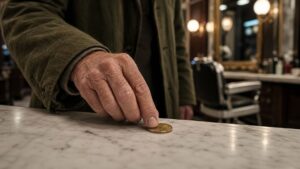
“You’ll need to remove the tobacco waste before the board enters.”
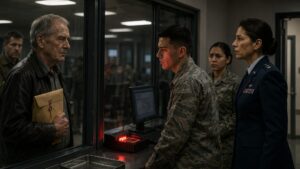
The clerk pointed at the burned cigar stub resting across the curled corner of George Walker’s photograph. Her voice was quiet, almost apologetic, but in the dark chamber it carried to the first rows of the gallery.
George kept two fingers on the photograph.
“It is listed on the evidence sheet.”
The clerk checked the clear sleeve beside him, then looked again at the blackened object. Barely two inches remained of it. The wrapper had split near one end, exposing gray fibers beneath a crust of old ash.
“It says ‘field artifact, item four.’”
“That is item four.”
A restrained laugh came from the gallery. Two cadets in dress uniforms sat behind a row of museum personnel, their faces quickly lowered when George turned his head.
He did not blame them. On the polished evidence table, beneath the brass lamps and Army seal, the cigar looked absurd. So did the photograph, perhaps: creased, smoke-stained, and held flat by an object most people would have thrown away fifty years ago.
The side door opened.
“Board entering,” the clerk announced.
George rose with everyone else, slower than he wanted, one hand touching the table for balance. Major Steven Adams took the center seat on the raised bench. At forty-one, he carried authority with deliberate neatness: uniform exact, folders squared, expression already tightened against delay. Two panel members sat beside him. The museum director and archivist occupied a lower table.
Steven struck the gavel once.
“This proceeding of the Army Historical Review Board is called to order. Petition concerns the Operation Lantern exhibit scheduled for removal and reconstruction beginning forty-eight hours from now.”
Forty-eight hours.
George had known the deadline. Hearing it aloud made the photograph beneath his hand feel thinner.
Steven reviewed the petition in a clipped voice. A request had been submitted to retain and amend the name of Command Sergeant Major Charles Taylor in the revised exhibit. The current curatorial finding held that Taylor’s inclusion in an older temporary caption lacked sufficient documentary support. Unless the board found otherwise, his name would not appear in the permanent installation.
Steven looked down.
“Mr. Walker, you are listed as the presenting representative.”
“I am.”
“Your relationship to Sergeant Major Taylor?”
“I served with him.”
“In what capacity?”
George glanced at the photograph. Charles stood on the far side of a field table, sleeves rolled, one hand spread over a map. The cigar had been between the fingers of his other hand when the camera shutter opened.
“Closely enough to know what he did.”
“That is not a capacity.”
“No.”
A few heads turned. Steven waited for more, then marked something on the paper before him.
“The petitioner of record is Mrs. Donna Taylor, the soldier’s widow. She is not present.”
“Travel is difficult for her.”
“Her affidavit may be considered if a foundation is established. At present, we have an uncatalogued photograph, an object that appears to be a burned cigar, and a statement containing recollections formed decades after the event.”
“The recollections were formed at the time.”
“Written decades later.”
“Yes.”
Steven lifted the evidence sleeve with two fingers. The cigar shifted inside it.
“This is described as a command-post artifact.”
“It was used there.”
“As tobacco?”
The museum table stirred with quiet amusement.
George watched Steven’s face rather than the gallery. “Among other things.”
Steven set the sleeve down. “We are not here to authenticate family folklore. The revised gallery will be reviewed by national accreditors next month. Every name and claim must be traceable to official evidence.”
“That is why I came.”
“The official evidence does not support you.”
“Then it may be incomplete.”
The room changed slightly. A chair creaked. One of the junior panel members stopped writing.
Steven leaned back. “You are suggesting an Army after-action report omitted a command sergeant major’s contribution?”
“I am asking the board to examine the possibility.”
“You submitted no service file, no duty roster placing Taylor at the final command post, no radio log, and no authenticated map. You submitted a photograph with no date written on it.”
“The date is visible in the grease-board sequence behind the table.”
The archivist turned toward the projected scan.
George continued. “The upper-left panel reads extraction grid Baker-Seven. Beneath it is the alternate casualty corridor, marked with the old triangular delay symbol used before the map standard changed. That combination was used only during the final Lantern withdrawal.”
The archivist enlarged the rear wall of the photograph.
Steven’s eyes narrowed. “That symbol is not identified in your petition.”
“It did not need to be when the picture was taken.”
“Yet you recognized it immediately.”
“Yes.”
“From research?”
“From use.”
One of the cadets leaned toward the other and whispered. George caught only the words old code.
Steven heard enough to notice. His mouth tightened.
“A rehearsed familiarity with obsolete symbols does not establish personal knowledge.”
“No,” George said. “But it tells you the photograph is not merely decorative.”
Steven tapped his pen against the folder. “The museum’s review found the room to be a generic forward command site.”
“The table orientation makes that impossible.”
The photograph appeared larger on the screen. George pointed without rising.
“The communications board is on the western wall. The casualty grid is opposite the generator entry. A generic site would place the radio bank away from the fuel passage. This room did not because it had been converted during the second evacuation phase.”
The archivist studied the image, then murmured to the museum director.
Steven cut across them. “Mr. Walker, expertise claimed from memory is still memory.”
George felt the first tremor begin in his right hand. He laid it over the corner of the photograph until the movement stopped.
“Then read Mrs. Taylor’s affidavit.”
“I have reviewed its summary.”
“The affidavit, Major. Not the summary.”
Steven’s gaze dropped to the insignia-free lapels of George’s plain charcoal suit, then to his worn shoes beneath the table.
“The statement claims Sergeant Major Taylor returned to the command post after the authorized evacuation and directed a rescue. The official timeline states the post had been abandoned before that hour. Her assertion is contradicted by the record.”
“She explains why.”
“She repeats something her husband allegedly told her.”
“She also identifies the photograph and the cigar.”
“Neither proves the action.”
“No. But together they justify reading the rest.”
Steven closed the affidavit folder without opening it.
“The board will determine what justifies its time.”
The words landed more sharply than the gavel had. George let the silence remain. He had spent much of his life watching men reveal themselves by what they did with silence. Some filled it out of fear. Some mistook it for surrender.
Steven spoke again. “Before we proceed further, there is a standing issue. The clerk was unable to verify your credentials or legal authority to represent Mrs. Taylor.”
“She signed the authorization.”
“The authorization lists only George Walker. No former unit, service number, professional affiliation, or documented connection to Operation Lantern.”
“She knew who she was authorizing.”
“The board does not.”
George looked past Steven to the seal mounted on the paneling. Beneath the eagle was a motto about preserving service with fidelity. He had approved similar language in another building long ago. At the time, he had believed fidelity meant protecting the institution from distortion.
He knew better now.
“I am here to present her evidence,” he said.
“You may be a collector. You may be a family acquaintance. You may simply have studied the operation for many years. The board cannot grant standing based on confidence.”
A cadet in the back row raised his eyes to George. Curiosity had replaced amusement.
George slid the photograph forward one inch.
“You may reject me. Do not remove Taylor’s name before examining what is beneath it.”
Steven turned to the clerk. “Run a final identity verification. If Mr. Walker cannot establish a direct relationship to the operation or valid representative authority beyond this incomplete form, security will remove him before the claim is heard.”
The clerk hesitated.
Steven lifted the gavel.
“Ten-minute recess for verification.”
The strike echoed through the chamber as the cigar rolled against the clear sleeve, then settled over Charles Taylor’s missing name.
Chapter 2: The Name Missing Beneath the Photograph
The new exhibit image appeared on the screen during recess, and Charles Taylor was no longer in it.
George remained seated as the archivist compared the museum’s proposed crop with the photograph on the evidence table. On the screen, the command-post scene had been tightened around three uniformed officers. The far side of the map table ended at an empty strip of wall.
Charles had stood exactly where the image now ended.
“Why was it cropped?” George asked.
The archivist glanced toward Steven, who had not left the bench. “The design team selected the clearest command figures.”
“The clearest?”
“The officers with confirmed identities.”
George looked at the older print. Charles’s body was angled over the table, his face partly turned toward someone outside the frame. The officers behind him were softer, almost blurred by motion. Charles was the clearest person in the room.
“They removed him because they did not know his name.”
The museum director adjusted his glasses. “The existing caption’s attribution could not be sourced.”
“So instead of leaving the question visible, you cut the man away.”
“We used the portion that could be verified.”
George’s fingers tightened on the photograph. In the proposed crop, he himself remained at the extreme left edge, one shoulder and part of his profile visible. He had never noticed how far from the center he stood.
Charles had occupied the center because Charles had been working.
Steven descended from the bench and approached the evidence table. “The digital crop is not the subject of this hearing unless Taylor’s presence is first established.”
George indicated the original. “His presence is established by the photograph.”
“His identity is not.”
“The cigar belonged to him.”
Steven looked at the charred stub. “According to Mrs. Taylor.”
“According to anyone who saw him carry it.”
“None of whom has provided a verified statement.”
George removed the photograph from its protective mat only after the archivist nodded permission. The paper resisted as its curled edge lifted.
“Look at his right hand.”
The archivist enlarged the uncropped scan. Charles’s fingers were spread near the map. Between two of them lay a narrow pale gap, the shape blurred but distinct.
George held up the evidence sleeve without removing the cigar.
“The width matches.”
Steven gave a breath that almost became a laugh. “A man appears to be holding a cigar, and you possess a cigar. That is not authentication.”
“No. It is a reason not to call it trash.”
The cadets had moved closer during recess. One stood behind the gallery rail, studying the enlarged image. Steven noticed them and straightened.
“The board is not guided by resemblance.”
“It should be guided by questions.”
“And protected from conclusions disguised as questions.”
The archivist opened Donna’s affidavit on a tablet. “There is one line that may relate to the photograph.”
Steven turned. “We have not admitted that statement.”
“You asked me to compare identifying details.”
The archivist read quietly. “‘Charles told me the map would not lie even if every report did. He said the burn, the circle, and the corner would remain after all of them were gone.’”
George had forgotten the exact wording. Donna’s voice seemed to enter the chamber through the archivist’s careful neutrality.
Steven held out his hand for the tablet.
“Mrs. Taylor does not claim to have witnessed the command post,” he said. “This remains hearsay.”
“She saw the cigar before he deployed,” George replied.
“That does not place it on a map.”
“No.”
“Nor does it identify the man in the picture.”
“No.”
“Then we agree.”
“We agree that one object cannot carry the whole truth. That is why she sent the photograph, the letters, and her statement.”
“The letters are personal correspondence written after the operation.”
“They refer to what happened.”
“They refer to what Taylor said happened.”
George felt the old pressure behind his ribs—the instinct to give an order clean enough to end debate. He had once been able to ask for a file and receive it before his coffee cooled. He could have ended Steven’s uncertainty with a sentence.
But Charles would disappear behind that sentence. The hearing would become a story about an elderly general unrecognized in a room he once outranked.
George had come because it was already too much a story about him.
The clerk returned from the adjoining office and whispered to Steven. Steven’s expression hardened.
“Identity verification remains inconclusive,” he announced. “There are multiple George Walkers in archival personnel records. The petitioner has declined to provide a service number.”
“I was not asked for one.”
“You were asked for documentation.”
“I brought documentation concerning Charles Taylor.”
Steven returned to the bench. “Then let us examine the document that concerns him most directly.”
The official after-action report appeared on the screen.
Operation Lantern had taken place during a chaotic withdrawal from a remote allied district. The public account described a disciplined evacuation under fire, with the command post closing at 0210 hours and the final convoy departing seven minutes later.
George knew every sentence before Steven read it.
He also knew what lay between them.
“Section nine,” Steven said. “Personnel actions after command-post closure.”
The screen showed a single paragraph. No unauthorized return. No trapped radio operators. No Charles Taylor.
“According to Mrs. Taylor,” Steven continued, “her husband remained at the site, located stranded personnel, and directed them along an alternate corridor.”
“He did.”
“The report states all command personnel had evacuated.”
“The report is incomplete.”
“It states the site was empty.”
“It was not.”
“The report’s timing is corroborated by the operations summary, the official exhibit, and three later histories.”
“All derived from this report.”
Steven paused.
That small truth moved through the room. The junior panel member looked from one document to the next. The archivist began checking citations.
Steven recovered quickly. “Even if later accounts relied on this document, that does not make the document false.”
“No.”
“Only your recollection contradicts it.”
“And Taylor’s.”
“An unavailable witness.”
“A dead one,” George said. “There is a difference.”
Steven’s jaw tightened. “The board understands that Sergeant Major Taylor is deceased.”
“I am not certain the exhibit does.”
The museum director lowered his eyes.
Steven flipped through the report until the signature page filled the screen. George looked away for the first time.
He remembered the room where he had signed it. Fluorescent light. Coffee gone cold. A security officer waiting with the classified annex. Six rescued soldiers already being separated for debriefing. Charles in a field hospital, furious that the radio operators had nearly been written off before they were even counted.
George had told himself the public record could be corrected later.
Later had become fifty-one years.
Steven leaned toward the display.
“The report was approved at command level,” he said. “It was not written by a clerk acting alone. The final page bears responsibility for its contents.”
George’s right hand trembled again. He placed it beneath the table.
Steven studied the signature, then looked toward the clerk’s verification notes.
His eyes returned to George.
“Your petition says your name is George Thomas Walker.”
“Yes.”
Steven pointed at the enlarged approval line.
“Then explain why the report contradicting your claim carries the signature ‘G. T. Walker.’”
Chapter 3: The Salute That Stopped the Gavel
“Security will escort you out unless you prove a direct relationship to this report.”
Steven’s order brought the uniformed security sergeant away from the rear wall. The man approached with professional reluctance, stopping two paces behind George’s chair.
George did not turn.
On the screen, his younger signature sat beneath the closing paragraph of Operation Lantern, dark and confident. The handwriting belonged to a man who had believed delayed truth remained truth.
Steven folded his hands on the bench.
“Are you alleging that another George T. Walker signed this document?”
“No.”
“Are you related to the signing officer?”
George looked at him. “Yes.”
“In what way?”
The gallery had gone utterly still.
George could feel Benjamin Torres’s absence without knowing why the thought came to him. Benjamin had been a captain then—young, feverish from blood loss, arguing that he could still carry a radio. He was now the installation commander, according to the letterhead on George’s hearing notice. George had not contacted him. He had not contacted anyone whose rank might bend the room.
“The relationship is direct,” George said.
“Then state it for the record.”
“Enter Mrs. Taylor’s affidavit first.”
Steven stared at him. “That is not a condition you may impose.”
“It is the only request I am making.”
“You have made an unsupported historical claim, withheld relevant identification, and challenged an official report bearing a matching name. You are in no position to negotiate procedure.”
“Then do not negotiate. Admit her statement because it concerns the man whose name you are removing.”
Steven’s control slipped by a fraction. “This proceeding is not a platform for sentiment.”
“No,” George said. “It is where sentiment has been used to decide whose memory is inconvenient.”
A murmur passed through the gallery.
Steven lifted the evidence sleeve. The burned cigar stub slid to its lower edge.
“This is what you presented as authentication. Debris. You ask us to infer a rescue from a damaged photograph, a widow’s secondhand account, and trash preserved for half a century.”
A short laugh escaped from somewhere near the museum staff. Another followed, then stopped.
George steadied the photograph with two fingers.
“Major, you may reject the object. You should still read the name beneath it.”
“There is no verified name beneath it.”
“Because your exhibit cut it away.”
Steven placed the sleeve over the photograph as though demonstrating the weakness of the claim. The cigar lay across Charles’s chest.
“Remove both items,” he told the clerk.
The clerk did not move.
Steven reached for the gavel.
“You can remove me,” George said. “Enter Mrs. Taylor’s statement first.”
The rear doors opened before the gavel fell.
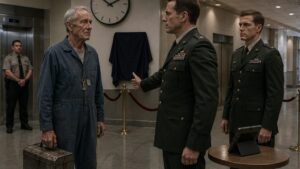
Boot heels struck the floor in a quick, measured rhythm. The public-affairs officer entered first, pale and breathless, followed by Major General Benjamin Torres in service uniform. Two aides stopped at the doorway.
Steven lowered the gavel without striking it.
“General Torres,” he said, rising. “Sir, we were not informed you would attend.”
Benjamin did not answer.
His gaze had passed over the bench, the panel, and the evidence table. It stopped on George.
For an instant, George saw the captain again—the narrow face under a field bandage, the stubborn fury, the hand refusing help into the convoy.
Benjamin walked down the center aisle.
Everyone in uniform stood. The security sergeant stepped away from George’s chair.
Benjamin reached the evidence table and halted. His eyes moved briefly to the photograph, then to the cigar sleeve lying across it. Something in his face tightened.
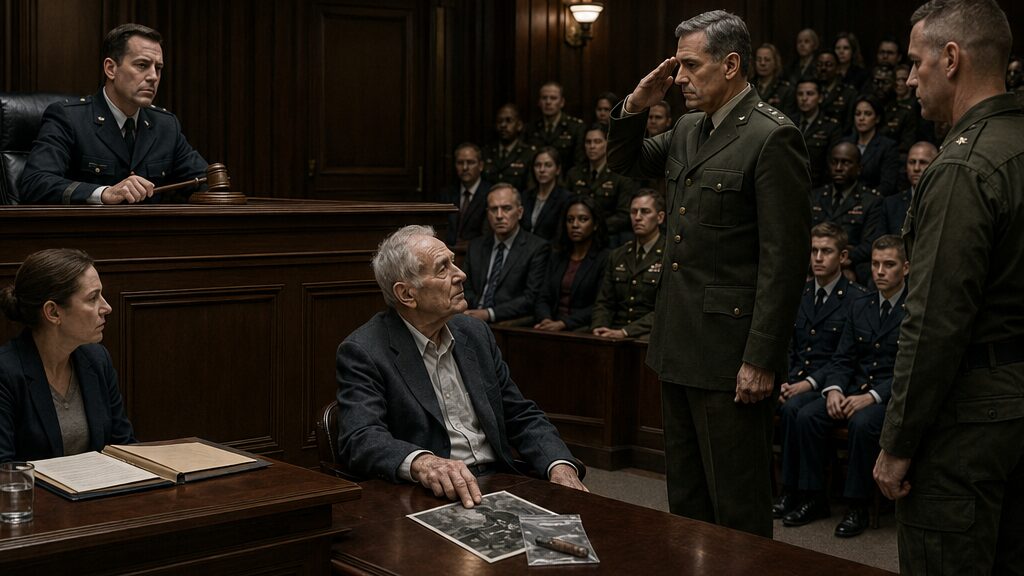
He raised his right hand.
“General Walker.”
The salute was exact.
George remained seated for one second too long, not from confusion but from grief. Then he pushed himself upright and returned it.
“General Torres.”
No one in the chamber laughed.
Benjamin lowered his hand. “I was told a petitioner was about to be removed from an Operation Lantern hearing. I was not told the petitioner was the officer who commanded it.”
Steven’s face had lost color.
The junior panel member stood straighter. The cadets stared at George as if the plain suit had become transparent, revealing stars that were not there.
The public-affairs officer whispered to the museum director. The archivist looked at the signature on the screen, then back at George.
Steven descended from the bench.
“Sir, I—General Walker, I was not aware—”
“That was apparent,” George said.
The words were not sharp, which made Steven flinch more than anger might have.
Benjamin turned toward the bench. “Major, this is Lieutenant General George Walker, retired. Former commander of Operation Lantern, former corps commander, and—”
“That is sufficient,” George said.
Benjamin stopped.
George sat again, easing his weight carefully. The room remained standing until he glanced toward the panel.
“Please.”
Chairs lowered in uneven waves.
Steven stayed beside the bench. “General, the board should have verified your identity before—”
“The board should have read Mrs. Taylor’s affidavit before deciding her grief had made her dishonest.”
Steven looked toward the unopened folder.
“Yes, sir.”
“Do not call me sir in order to repair what happened.”
A deeper silence followed.
George touched the edge of the photograph. Charles’s face remained half hidden beneath the evidence sleeve.
“The respect in this room should not have changed because General Torres recognized me.”
Steven’s eyes dropped.
Benjamin moved to George’s side. “General, your presence establishes direct command knowledge. I can testify to your position and to the evacuation.”
“You may testify to what you witnessed.”
“I witnessed enough.”
“Enough is not the same as all.”
Benjamin’s expression shifted. He understood the correction. George had given it to him often when he was young and too eager to strengthen a report.
Steven returned slowly to his seat. He looked at the other panel members, then at the signature page still projected behind them.
“For the record,” he said, “the board acknowledges the petitioner as retired Lieutenant General George T. Walker, commanding officer responsible for Operation Lantern.”
The clerk entered the identification into the record.
Steven opened Donna’s affidavit at last.
A visible change passed through the gallery. Attention sharpened. Pens moved. The same people who had regarded the photograph as an old man’s obsession now leaned forward to inspect it.
George felt no relief.
Charles had deserved their attention before the salute.
Steven read several lines in silence, then closed the folder halfway.
“General Walker, your identity establishes that you were present and that you possess relevant knowledge. It does not authenticate the object, prove Sergeant Major Taylor’s actions, or overturn the official timeline.”
Benjamin turned sharply. “Major—”
George raised one hand.
Steven continued, his voice steadier now. “Rank cannot substitute for evidence. Nor can professional reverence. If anything, the confirmed identity creates a more serious contradiction.”
The junior panel member nodded reluctantly.
George did too.
Steven looked surprised.
“You are correct,” George said.
Benjamin stared at him. “General, the report was written under conditions this board cannot possibly—”
“Then the conditions must be explained. Not used as a shield.”
Steven faced the screen. “This report bears General Walker’s approval. It states the command post was evacuated before the action attributed to Sergeant Major Taylor. General Torres may verify the commander’s identity, but he cannot make two conflicting accounts simultaneously true.”
“Charles transmitted after the closure time,” Benjamin said. “I heard his voice.”
“Did you see him at the map table?”
“No.”
“Did you witness the rescue?”
“I was wounded and already in the convoy.”
“Can you identify that cigar as Sergeant Major Taylor’s?”
Benjamin looked at the sleeve. “I remember him smoking cigars.”
“That is not authentication.”
George heard the legitimacy beneath Steven’s questions now that contempt no longer covered it. The change did not absolve him. It made the hearing harder.
Steven placed both hands on the bench.
“General Walker, you allowed this room to believe you were an unrelated civilian. You then presented a claim directly contradicted by a document you commanded and apparently approved.”
“I did.”
“Why did you not identify yourself?”
“Because Charles Taylor’s service should not require my rank to become credible.”
“And yet your rank is now part of the record.”
“Because someone else chose to make it so.”
Benjamin absorbed the rebuke without looking away.
Steven turned the report’s final page toward George, though the signature was already towering behind them.
“Is this your signature?”
George looked at the strong downward stroke of the W, the compressed final letters, the date written in his own hand. For decades, people had placed that signature beneath accounts of discipline, courage, and successful withdrawal.
No one had asked what it had removed.
“Yes, Major,” George said. “That is my signature.”
Steven waited.
George pulled the evidence sleeve away from Charles’s face.
“It is also why I am here.”
Chapter 4: A General’s Memory Was Not Enough
Benjamin remained standing beside the witness chair when Steven said, “General Walker’s identity is no longer disputed. His account still is.”
The sentence struck the room more cleanly than an apology would have. Uniformed observers who had leaned toward George after the salute now settled back, uncertain where respect required them to look.
Benjamin faced the bench. “I can certify who he is.”
Steven opened the official report. “Identity is not the historical question.”
For the first time since entering, Benjamin seemed to see Steven rather than merely the insult committed under his authority.
“You are questioning the commanding general’s knowledge of his own operation.”
“I am testing a claim against the surviving record.”
“You were not there.”
“No, sir. Which is why the board cannot replace evidence with deference to someone who was.”
George watched Benjamin’s shoulders stiffen. The young captain had once defended George with the same fierce impatience, even when George had not asked for defense.
“Sit down, Benjamin,” George said.
Benjamin looked at him.
“If you intend to testify, sit in the witness chair.”
The use of his first name softened nothing. Benjamin crossed to the chair and took the oath from the clerk.
Steven resumed his place behind the bench. His face still carried the shame of the salute, but his questions had regained their structure.
“General Torres, what did you personally witness during the final withdrawal from the Operation Lantern command post?”
“I was serving as a captain in the communications section. I helped supervise the destruction and removal of classified radio material.”
“At what time did you leave the site?”
“Shortly before the official closure time.”
“Were you wounded?”
“Yes.”
“Did that affect your awareness?”
“I remained conscious.”
“Did you see Command Sergeant Major Taylor return to the command post?”
“No.”
“Did you see him lead six soldiers through an alternate corridor?”
“No.”
Benjamin’s fingers closed around the edge of the witness table.
“But I heard him.”
Steven paused. “Explain.”
“Our convoy had halted because the lead vehicle struck debris. I still had a field receiver. After the command post was supposed to be empty, Charles transmitted on the internal net.”
“What did he say?”
Benjamin looked toward George, searching the past in his face.
“He said he had six with him. Two radio operators, three security personnel, and a driver. He said the eastern route was compromised and he was taking the drainage cut.”
“Did he identify himself by name?”
“He used his call sign.”
“Is the transmission recorded?”
“Not in any file I have seen.”
“Was anyone else monitoring?”
“Several people could have heard it.”
“Have they submitted statements?”
“No.”
Steven turned a page. “Could the voice have come from a different location?”
Benjamin hesitated.
“Yes.”
“Could Sergeant Major Taylor have been relaying information from another team rather than leading the soldiers himself?”
“It is possible.”
“Could the timing in your memory be inaccurate after fifty-one years?”
Benjamin’s jaw worked before he answered. “It is possible.”
The admission moved through the room with a nearly physical weight.
George saw what Steven had done, and saw that the doing of it was necessary. The salute had forced courtesy into the chamber. It had not altered the burden of proof.
Steven faced George.
“General Walker, do you dispute the witness’s limitations?”
“No.”
Benjamin turned sharply. “General—”
“You told the board what you knew. Do not improve it now because the truth feels insufficient.”
Benjamin looked down.
Steven picked up the evidence sleeve. “Can either of you authenticate this cigar?”
Benjamin studied the scorched shape. “I remember Charles carrying one during the withdrawal.”
“This one?”
“I cannot swear to that.”
Steven placed it beside the photograph.
“Then we have established that General Torres heard Sergeant Major Taylor’s call sign after leaving the command post. We have not established where Taylor was, what he did, or whether this object was present.”
George reached for the sleeve. As he turned it beneath the brass lamp, a flattened strip along one side caught the light. The wrapper there was not black but dark green, as if something waxy had been pressed into it.
He had seen the stain before, though not as evidence.
Grease pencil.
Charles had kept red and green pencils in the breast pocket of his field shirt. He marked routes with such force that the paper often tore beneath his hand.
George rotated the cigar again.
Steven noticed. “What is it?”
“A pressure stain.”
“From what?”
“I do not know yet.”
That answer cost him more than a false certainty would have, but he would not repeat the mistake that had brought them here.
Steven folded his hands. “Let us return to the report. You have called it incomplete. What was omitted?”
George looked at the signature on the screen.
“The final return to the command post.”
The archivist stopped typing.
Steven asked, “Whose return?”
“Charles Taylor’s.”
“Alone?”
“No.”
“Who accompanied him?”
“I cannot name everyone who went back. Charles reached the site after the withdrawal sequence had begun. The radio operators had been separated from the convoy during the first movement. He believed they had returned for a damaged code case.”
“Believed?”
“That was the information we had.”
“And did you authorize Taylor to go back?”
“No.”
The word settled harder than Benjamin’s salute.
Steven’s gaze sharpened. “Then the alleged action was unauthorized.”
“Yes.”
“Was it omitted because it reflected disobedience?”
“No.”
“Why was it omitted?”
George felt the old chamber return around him: canvas walls shaking under distant impacts, map lamps throwing yellow circles across men’s hands, voices compressed into radio static. The alternate evacuation corridor had not officially existed. Its use depended on local guides whose names could not survive capture. Six soldiers had emerged through it because Charles had ignored the sequence and marked a route no public document was allowed to show.
“The route was classified beyond the report’s distribution,” George said.
Steven leaned forward. “The route Taylor supposedly used?”
“Yes.”
“So the omission protected an operational secret.”
“At first.”
The final two words drew Steven’s attention.
“At first?” he repeated.
George did not answer.
Benjamin shifted in the witness chair. “The corridor remained sensitive for years. Disclosure could have exposed allied personnel.”
“I understand the original concern,” Steven said. “But the petition asks us to amend a public exhibit now. If the route has been declassified, where are the supporting records?”
George looked at the photograph. Charles’s hand covered the map where the corridor should have been.
“There were personal command papers.”
“Where?”
“I removed them from archival custody.”
The board clerk looked up.
Steven’s voice became careful. “When?”
“Years after my retirement.”
“Under what authority?”
“My retained-document agreement allowed review and temporary withdrawal of certain personal command materials.”
“Were they returned?”
George’s silence answered before he did.
“No.”
Steven turned to the clerk. “Check the restricted accession index for General Walker’s retained papers.”
The clerk moved quickly to the adjoining records terminal.
Benjamin rose halfway from his chair. “Major, those files may include material outside this board’s clearance.”
“Then access will stop at the index.”
George kept looking at the cigar. The flattened green mark ran along one side like a remnant of the line Charles had once drawn.
He remembered taking the packet from the archive. He remembered carrying it into Donna’s house after Charles’s funeral, though the years did not align cleanly in his mind. The funeral had come long before the declassification review. There had been another visit, another attempt, a folder on a table between them.
Then nothing.
The clerk returned holding a printed index sheet.
“Accession packet Lantern Command Personal, subsection four,” she read. “Withdrawn by Lieutenant General George T. Walker, retired, twenty-seven years ago. No return receipt recorded.”
Steven accepted the page.
“What was in subsection four?”
The clerk consulted the index. “A carbon operational map, handwritten command notes, draft casualty-routing sheets, and correspondence concerning the final evacuation.”
Every eye in the chamber turned toward George.
Steven laid the index beside the official report.
“The evidence capable of testing your claim was removed from the archive by you,” he said, “and never returned.”
Chapter 5: The Report He Chose to Sign
Donna Taylor was waiting outside the records room with a bundle of unopened letters tied in faded blue ribbon.
She held them against her coat as George came through the door. Age had narrowed her shoulders but not her gaze. He knew at once that she had been in the building long enough to hear about the salute.
Benjamin stopped behind George.
“Mrs. Taylor,” he said.
Donna looked past him to the hearing chamber. “They told me you arrived in time to make everyone stand.”
Benjamin absorbed the rebuke. “I came as soon as I heard.”
“I was speaking to George.”
George studied the envelopes. His own handwriting crossed each one. Some bore stamps from decades earlier. None had been opened.
“I thought travel was too difficult,” he said.
“It is.”
“Then why are you here?”
“Because they called me a liar without troubling me to attend.”
Her voice remained low. The corridor carried every word anyway.
Benjamin glanced toward the public-affairs officer at the far end. “Perhaps we should use a private room.”
Donna gave him a tired look. “Privacy has done enough.”
She walked into the records room. George followed. Benjamin stayed outside when George closed the door.
Metal shelves filled the room, their boxes marked with unit numbers and accession dates. A single table stood beneath cold fluorescent lights. Donna placed the letters on it.
“You kept them,” George said.
“I kept what you sent. I stopped reading what you could not say.”
He touched the top envelope but did not lift it.
“What did you hear in the chamber?”
“That Major Adams finally looked at the report.” She removed her gloves one finger at a time. “That General Torres saluted you. That you admitted the signature was yours.”
“I admitted that years ago.”
“To me. Not where it mattered.”
The old defense rose in him automatically: classification, allied lives, active operations. He had used each word honestly once. Time had thinned their truth until they became shelter.
“Charles went back because six soldiers were missing,” George said.
Donna’s hands stopped.
“The evacuation order had already been issued. The command post was taking fire. The eastern road was blocked, and the alternate extraction route had never been approved for general use. Charles returned for the radio team.”
“He told me there were six.”
“There were. Two operators were trapped in the communications dugout. Four others had gone after them. Charles found them before the site was hit again.”
“And you wrote that the site was empty.”
“I wrote that the command element completed evacuation at 0210.”
“That was not what I said.”
“No.”
“You wrote that everyone was gone.”
“I wrote enough for every later reader to believe it.”
Donna sat across from him. “Why?”
“The route Charles used passed through an allied network that was still extracting families. If the route appeared in a widely circulated report, it could have exposed them. His return also violated the sequence I had ordered. A formal inquiry would have opened the route, the guides, and the decision to leave the code case in place.”
“So you protected the operation.”
“At first.”
Her eyes sharpened at the same phrase Steven had caught.
George looked toward the rows of gray boxes.
“The corridor was declassified in stages. By then Charles was dead. The original report had become the source for every history. I requested corrections.”
“How many?”
“Three.”
“And each time?”
“The first office offered to append a note saying Charles acted under my direction.”
“He did not.”
“No. The second proposed a command commendation for me with Taylor mentioned in supporting language.”
Donna’s mouth tightened.
“The third wanted a special exhibit on my leadership during Lantern. They said Charles’s rescue could be included as an example of the culture I created.”
“You withdrew the request.”
“Yes.”
“Again.”
“Yes.”
“Then you stopped answering me.”
George looked at the letters between them. “I believed every correction would turn him into evidence of my command.”
“And leaving him nameless was better?”
“No.”
“But you behaved as though it was.”
The fluorescent light hummed overhead. Somewhere beyond the wall, a cart rolled down the corridor and stopped.
George rested both palms on the table.
“I did not know how to correct him without becoming the story.”
“You could have told the truth and endured being in it.”
The sentence entered a place no accusation had reached.
He had thought silence was a refusal of vanity. He had treated withdrawal as humility. Yet every time officials had redirected Charles’s action toward George, George had walked away—and the institution had kept the easier version.
Donna untied the ribbon.
“I asked you what Charles said that night.”
“He told me the operators had been counted as equipment before they were counted as men.”
Her expression changed, barely.
“He said something similar at home. He said a list could kill a man before the enemy did.”
George remembered Charles leaning against a field ambulance, uniform burned at one cuff, the unlit end of a cigar clenched in his teeth because the medic had forbidden smoke near the oxygen. He had been furious, not proud.
“He challenged me in front of the staff,” George said. “He said my sequence treated anyone outside the convoy as already lost.”
“Was he right?”
“Yes.”
Donna looked down at the unopened envelopes.
“Did he know you changed the report?”
“He knew it would be restricted.”
“That is not what I asked.”
George’s right hand began to shake. He closed it.
“He saw the draft. He knew his return was not in it.”
“And?”
“I told him the complete account would come later.”
Donna’s face remained still.
“Those were your words?”
“Yes.”
“He used the cigar to hold the map corner,” she said. “He told me that much. He said the generators shook the table, and the paper kept rolling over the drainage cut. He flattened his last cigar against the map and put a signal battery on the other side.”
George saw it with painful clarity: Charles pressing the cigar down, dragging the green grease pencil around the alternate route, the wrapper absorbing the mark.
Donna touched the evidence sleeve in George’s pocket.
“He brought it home in a match tin. Never smoked it. Said it belonged to the six men after that. When he died, I gave it to you because you promised the map would be found.”
“I remember.”
“No. You remember the words. That is different.”
She reached beneath her coat and placed a thick brown packet on the table.
The paper wrapping was softened at every fold. A red accession label remained attached to one edge.
George did not touch it.
“You had this?”
“You left it in my house.”
“When?”
“After the declassification review. You came with the packet and said you finally had enough. Then an official called you and said the correction would reopen your command award. You sat in Charles’s chair for an hour. When you left, this was under it.”
George stared at the packet.
He remembered rain on Donna’s window. A telephone receiver in his hand. A voice explaining that reopening Lantern would require reassessing the entire command narrative, including George’s commendation. He had believed leaving the packet was temporary.
Twenty-seven years had followed.
“I thought I returned it.”
“You thought many things that made it easier to go home.”
Donna pushed the packet toward him.
“Does it clear Charles?” he asked.
“It tells what happened.”
“And what does it say about me?”
“You still ask the wrong question.”
She stood, gathering the unopened letters but leaving the packet behind.
At the door, she looked back.
“I did not keep that all these years so you could confess to me again. Take it into the room where your signature became history.”
Chapter 6: Why the Major Refused to Believe
Steven’s private offer was waiting when George returned to the board office.
“We can add Taylor to the internal research database today,” he said. “No public finding, no reopened hearing, and no delay to the exhibit installation.”
The office door remained open, but Steven had lowered his voice. The gavel sat on a shelf behind him, removed from the chamber during recess. Without the raised bench and polished wood, he looked younger and more tired.
George placed the brown command packet on the desk.
“The public exhibit would still say the command post was empty.”
“The exhibit text can be reviewed in the next revision cycle.”
“When?”
“Three years.”
“Donna may not have three years.”
Steven’s eyes flicked toward the packet. “An internal designation would preserve the claim while specialists authenticate the materials.”
“You offered to remove me this morning without authenticating my identity.”
A flush rose above Steven’s collar.
“Yes.”
“And now you offer secrecy because you know it.”
“I am offering a correction that can survive scrutiny.”
“You are offering a place where no visitor will see the name.”
Steven closed the office door.
“The accreditation team arrives next month. Construction begins in two days. If I reopen a public hearing on evidence withdrawn from federal custody for twenty-seven years, the entire heritage program could fail review.”
“That is an institutional inconvenience.”
“It is more than inconvenience. Every exhibit could be placed under restriction. Donations could be frozen. Research access could be suspended.”
“Then examine the packet quickly.”
Steven stared at him. “You believe rank makes that simple even while insisting rank should not matter.”
“No. I believe your staff can recognize a carbon map, accession markings, and handwriting before nightfall.”
“And if the documents show you deliberately concealed Taylor’s actions?”
“Then that belongs in the record too.”
Steven leaned back.
For several seconds, the only sound was the muffled movement of observers returning to the chamber.
“You do not know what happens when a board accepts a persuasive family account without enough resistance,” he said.
George waited.
Steven opened a drawer and removed a thin folder. He did not hand it over.
“Four years ago, a decorated family petitioned to add a relative to a memorial panel. They had letters, photographs, and testimony from veterans. The story was compelling. I approved the addition before the accreditation deadline.”
“What failed?”
“One photograph had been relabeled. Two letters referred to another soldier with the same surname. The family did not fabricate everything, but they combined separate records until the account became something that had never happened.”
“And you were held responsible.”
“I was the reviewing officer.”
“Were you wrong?”
“Yes.”
The answer came without defense.
Steven’s thumb pressed against the folder’s edge. “The correction became public. Genuine names on the panel were questioned because we had allowed one doubtful one through. My office was accused of selling history to whoever carried the most emotional story. I nearly lost this assignment.”
“And your promotion.”
Steven’s eyes lifted.
George had seen the signs: the rigid performance of certainty, the accreditation timetable repeated like an order, the public correction of anyone who threatened control.
“Yes,” Steven said.
“So today you decided grief itself was suspicious.”
“I decided evidence mattered.”
“You decided that before reading it.”
Steven looked away first.
George slid the brown packet across the desk.
“Careful verification and contempt are not the same duty, Major.”
“No.”
“You knew that this morning.”
“Yes.”
The admission did not absolve him, but it prevented the room from becoming simple.
Steven untied the packet. Inside lay a carbon copy of the command-post map, several routing sheets, George’s handwritten notes, and a draft report with sections crossed out in blue pencil.
The cigar went on the desk between them.
Steven pulled on archival gloves. His handling changed immediately: no lifted eyebrow, no two-fingered disgust. He examined the accession stamp, paper fibers, fold pattern, and carbon transfer.
The archivist joined them and confirmed the packet markings matched the index. The board clerk logged each sheet. Benjamin and Donna remained in the corridor, visible through the glass panel.
George watched Steven place the map beneath a protective film.
A circular route had been drawn in green grease pencil near the lower corner. Half the line was faint. At its edge was an elongated brown pressure mark.
Steven rotated the evidence sleeve, then laid the cigar beside the mark.
The flattened side matched its length.
The green stain on the wrapper aligned with the route circle.
The archivist bent closer. “There may be transferred wax on both surfaces. Laboratory comparison could determine consistency.”
“Not ownership,” Steven said.
“No. But contact is likely.”
George looked at the map. The object Steven had called debris had once prevented the page from folding over six men’s escape route.
The small payoff brought no relief. Another sheet remained beneath the map.
Steven lifted it.
It was a draft operational summary in George’s handwriting. A paragraph described Taylor’s return, the recovery of the radio operators, and the movement through the drainage cut. Beside it, George had written:
Remove from distributable report. Route and unauthorized action not to be referenced. Substitute closure time.
Steven read the line twice.
“This is your hand?”
“Yes.”
“It is an instruction to conceal the action now under review.”
“Yes.”
The archivist looked from George to the official report.
“Was there a classified annex?” she asked.
“There was a route annex,” George said. “It identified the allied corridor but did not name Charles or describe the rescue.”
“So no complete official account exists.”
“No.”
Steven removed his gloves.
“You understand what this does to your petition.”
“It establishes why the report is incomplete.”
“It also establishes that the incompleteness was deliberate.”
“Yes.”
“And that you were responsible.”
“Yes.”
Steven stood and crossed to the window overlooking the hearing chamber. The gallery had filled again. News of George’s identity had drawn additional uniformed personnel, museum staff, and officers from the installation headquarters.
“We could continue the recess,” Steven said. “Send the materials for forensic analysis. Avoid making claims before authentication.”
“The exhibit construction begins in forty-eight hours.”
“You used that deadline against me this morning.”
“I am using it against both of us now.”
Steven turned.
“If I reopen the hearing, this instruction must be read into the public record. I cannot admit the map and suppress the order attached to it.”
“I would object if you tried.”
Benjamin entered without knocking. “General, there are ways to contextualize the instruction before it becomes public.”
George looked at him. “You mean ways to protect me.”
“I mean the route was classified. Your decision saved allied lives.”
“And what happened after it was declassified?”
Benjamin had no answer.
Donna stood behind him in the doorway. She did not look at George. Her attention remained on the map.
Steven gathered the packet and returned each document to its transparent sleeve. His movements were slower than before, stripped of theatrical certainty.
“I will reconvene the board,” he said.
The public-affairs officer appeared at the door. “Major, should the gallery be cleared?”
“No.”
“Should recording be restricted?”
Steven looked at George.
“No.”
They returned to the chamber together.
The audience rose first for Benjamin, then remained uncertain when George entered in his plain suit. George took the same petitioner’s chair. Donna sat beside him, leaving several inches between them.
Steven climbed to the raised bench and placed the gavel before him.
“The board is reconvened,” he said. “Newly produced materials have been provisionally entered pending authentication. They include a carbon operational map, handwritten routing sheets, and draft command notes removed from archival custody twenty-seven years ago.”
The map appeared on the screen. The green route circle and cigar-shaped pressure mark filled the wall.
A murmur moved through the gallery.
Steven waited until it stopped.
“The materials support the possibility that the disputed object contacted the operational map and that a route absent from the final report was marked during the evacuation. They also contain an instruction written and acknowledged by General Walker.”
George heard Donna’s breathing beside him.
Steven projected the handwritten page.
His voice did not rise. It did not need to.
“‘Remove from distributable report. Route and unauthorized action not to be referenced. Substitute closure time.’”
He looked directly at George.
“The board will now hear why the petitioner ordered the history he challenges today to be concealed.”
Chapter 7: The Truth Beneath His Own Signature
“Did you order a false report?”
Steven’s question remained on the screen behind him in George’s own handwriting.
George rose from the petitioner’s table. Donna did not look up. Benjamin sat rigidly in the witness chair, ready to intervene if George gave him the smallest opening.
George gave him none.
“I ordered an incomplete one,” he said. “Then I let it become a lie.”
The clerk’s fingers stopped above the keyboard.
Steven studied him. “Explain the distinction.”
“The original omission concealed a route that could not be exposed at the time. The later silence concealed my failure.”
“General,” Benjamin said, “the route supported an allied extraction network. Disclosure could have endangered—”
George turned toward him. “Did you know the route remained classified when Charles died?”
“Yes.”
“Did you know it was later declassified?”
“Not when.”
“I did.”
Benjamin’s defense faltered.
George faced the board again.
“Operation Lantern’s published report stated that the command post had been evacuated at 0210. That timing protected the drainage corridor by making it appear no American personnel remained near its entrance. It also concealed the fact that Sergeant Major Taylor disobeyed my withdrawal sequence.”
Steven glanced at the handwritten order. “Was the disobedience necessary?”
George looked toward Donna.
“It saved six soldiers.”
The room did not stir. The answer was too plain for reaction.
George continued. “Two radio operators had returned for a damaged code case. Four security and transport personnel went after them. They became separated from the convoy when the eastern approach was struck. Charles learned they had not been counted.”
“How?” Steven asked.
“He compared the vehicle manifests with the communications roster. The convoy report listed equipment shortages. Charles asked for names.”
George could hear him again across the field table.
Not missing radios, sir. Missing men.
“I ordered the command post closed,” George said. “Charles told me six soldiers were still outside the movement column. I believed they had already joined a secondary vehicle.”
“You were wrong,” Steven said.
“Yes.”
“What did Taylor do?”
“He returned after the final command group withdrew. He found the radio team in the communications dugout and the others near the generator trench. The main route was blocked. He brought them back through the drainage cut.”
Steven pointed to the carbon map. “This route?”
“Yes.”
The archivist placed the map under the evidence camera. Its green circle appeared on the chamber screen, interrupted by the long brown pressure mark.
George removed the cigar from its sleeve with gloved hands.
For half a century, the object had been carried in tins, drawers, packets, and finally a plastic evidence envelope. Its burned end crumbled slightly when he lifted it.
He placed the flattened side against the map.
The shape settled into the pressure mark.
The green wax stain on the wrapper met the broken grease-pencil line. The cigar lay across the curled corner exactly where it had in the old photograph.
The archivist leaned over the display.
“The contact pattern is consistent,” she said. “The transfer line continues beneath the object. The photographed position also corresponds to this corner.”
Steven looked at the enlarged photograph. Charles leaned across the table, one hand on the map, the pale space between his fingers matching the cigar’s width.
“The object authenticates contact with the map,” he said. “It does not by itself prove the rescue.”
“No,” George replied. “The routing sheets do.”
He opened the packet and withdrew three carbon forms. Each recorded radio equipment, call signs, and personnel movement. Charles’s handwriting appeared in the margins beside six abbreviated identifiers. A later sheet showed the same identifiers entered at the convoy’s western checkpoint twenty-three minutes after the official command-post closure.
The clerk compared them against the declassified personnel roster.
“All six correspond to soldiers assigned to Lantern,” she said.
Steven asked, “Were they later credited as rescued by Taylor?”
“No. The final movement log lists them as delayed arrivals.”
“On whose authority?”
George looked at the approval initials.
“Mine.”
Benjamin rose. “Major, the command had less than an hour to preserve the evacuation corridor and prevent an inquiry that would have exposed local allies. General Walker made the decision available to him.”
“Sit down,” George said.
Benjamin remained standing.
“You protected everyone there,” he said. “Including me.”
“I protected the operation.”
“You saved hundreds.”
“And Charles saved six I had already allowed the sequence to leave behind.”
“You could not account for every man personally.”
“No commander can. That is why Charles asked for names.”
Benjamin’s face tightened. His reverence had become a burden George could no longer permit him to carry.
“The original order was mine,” George said. “The classified omission was mine. So were the twenty-seven years after the route was safe to discuss.”
The junior board member leaned forward. “Why did you not return the packet?”
George glanced at Donna.
“Because each attempt to correct the record threatened to reopen my commendation and place my leadership at the center of the story. I told myself withdrawing was an act of humility.”
Donna finally looked at him.
“It was easier than allowing the truth to include you,” she said.
“Yes.”
Steven’s expression shifted at her voice, but he did not stop her.
George rested his hands on the edge of the table.
“I was afraid the Army would honor Charles only as an extension of me. When officials proposed exactly that, I walked away. I believed refusing another tribute protected him from being reduced to my subordinate.”
“And what did it do?” Steven asked.
“It erased him more completely.”
The answer stripped the chamber of its remaining ceremony.
George looked toward the gallery. The two cadets from the morning sat in the front row now. Neither appeared fascinated by his rank. They watched the map.
“Classification explains why Charles was omitted in the first report,” George said. “It does not excuse why I allowed that report to become history after the danger passed. My silence was not restraint. It was cowardice dressed as restraint.”
Benjamin lowered his eyes.
Steven lifted a separate notice from the panel table.
“General Walker, admission of deliberate omission and prolonged withholding of command material may require referral for review. Your published command history, commendation narrative, and the findings associated with Operation Lantern could be amended.”
“They should be.”
“Your own award could be reconsidered.”
“That is not the board’s present question.”
“It may become one.”
“Then I will answer it when it does.”
Steven looked at him for a long moment. “You are willing to release the entire packet?”
“Yes.”
“Without redaction beyond information still legally protected?”
“Yes.”
“And provide sworn certification that the handwriting, sequence, and command decisions are yours?”
“Yes.”
The clerk placed the oath form before George. His hand trembled as he signed. This time he did not hide it beneath the table.
Donna watched the signature form.
It was smaller than the one projected behind him. Less certain. More honest.
Steven called Benjamin again and limited his testimony to direct recollection. Benjamin described Charles’s radio call, the six identifiers, and the time he heard them. The archivist confirmed the packet’s provenance and the alignment among the map, cigar, photograph, and routing sheets. None of it stood alone. Together, the pieces formed a record strong enough to challenge the official one.
The board asked George to describe Charles.
He resisted the easy words.
Not loyal. Not fearless. Not devoted.
“Charles argued when obedience became a substitute for thought,” he said. “He violated the evacuation sequence because six soldiers had been converted into missing equipment on a form. He restored their names before he restored the radios.”
Donna closed her eyes briefly.
Steven gathered the documents. His gavel stood within reach, but he did not lift it.
“The board will withdraw to consider the amended evidence and determine whether the Operation Lantern exhibit should be revised before installation.”
The panel members began to rise.
“Major,” Donna said.
Steven stopped.
She had remained silent through the salute, the map comparison, and George’s confession. Now every face in the chamber turned toward her.
Steven looked at George first, then corrected himself.
“Mrs. Taylor?”
“If you restore Charles’s name, do not call him loyal.”
Steven waited.
“He was loyal,” she said. “But that word has hidden too many enlisted men beneath the officers they served. Say what he chose.”
Steven returned slowly to his chair.
He opened a blank findings form and placed his pen upon it.
“Mrs. Taylor,” he said, “what must the corrected exhibit say?”
Chapter 8: The Empty Space Finally Received a Name
George found his own portrait missing from the center panel when he entered the gallery three weeks later.
The vacant space had not been filled with another photograph of him. In its place stood the uncropped command-post image, enlarged across the wall.
Charles Taylor occupied the center.
He leaned over the operational map with his sleeves rolled, the cigar between his fingers, while officers at the edges of the frame watched him mark the drainage route. George remained visible at the far left, one shoulder turned away from the camera.
The arrangement was exactly as he had requested.
Donna stopped beneath the new caption.
COMMAND SERGEANT MAJOR CHARLES TAYLOR IDENTIFIES AN ALTERNATE EXTRACTION ROUTE DURING THE FINAL WITHDRAWAL OF OPERATION LANTERN.
Below it, smaller text described how Charles returned without authorization to recover six isolated soldiers, guided them through the drainage cut, and preserved the radio codes required for the larger evacuation.
The last line named George’s omission.
The action was excluded from the distributable report by order of the commanding officer and remained absent from official history after the route was declassified.
George read it twice.
Nothing in the wording protected him. Nothing exaggerated Charles.
Donna touched the lower edge of the display case.
Inside, the burned cigar rested beside the carbon map. The wrapper’s flattened green side aligned with the pressure mark beneath it. A small diagram showed how the object had held down the curling corner while Charles marked the route.
“They called it a field-expedient map weight,” she said.
“That is what it was.”
“He would have called it an expensive waste of a cigar.”
George almost smiled. “He did.”
Donna turned toward him. “You remember that?”
“He complained about it for the rest of the night.”
It was the first thing George had told her in years that belonged to Charles as a man rather than to the operation.
She faced the photograph again.
Steven approached from the opposite end of the gallery carrying a thin binder. He wore the same uniform he had worn at the hearing, but the sharpness in his posture no longer seemed designed to occupy the room.
“General Walker. Mrs. Taylor.”
George nodded. Donna waited.
Steven looked at the exhibit before speaking.
“The board’s amended finding has been entered permanently. Taylor’s personnel record now includes the rescue action. The six soldiers’ files have also been cross-referenced.”
“Did their families receive notice?” Donna asked.
“Yes. Where records allowed contact.”
“And the report?”
“The original remains unchanged as an archival document. It now carries a formal correction identifying the omission and linking to the released command packet.”
George approved. History should not be repaired by pretending the false record had never existed.
Steven held out the binder.
“This is the new preliminary review procedure.”
George took it. The first page required identity and document verification before any public hearing. Family petitioners could submit evidence privately with archival assistance. No petition could be dismissed publicly until the board had reviewed the full statement rather than a summary.
“Does it apply only to military families?” George asked.
“To all petitioners.”
“And elderly witnesses?”
“They may request recorded interviews or remote testimony before a standing challenge is raised.”
George closed the binder.
Steven’s apology seemed to gather behind his teeth before he released it.
“What I did in that chamber was wrong.”
“Yes.”
“I confused skepticism with discipline.”
“And status with credibility.”
“Yes.”
Donna studied him. “Would you have opened the packet if General Torres had not saluted him?”
Steven did not answer quickly.
“No,” he said at last. “I would likely have removed him.”
The honesty mattered more than speed would have.
George handed back the binder.
“Then the question is not whether you treat the next general better.”
Steven nodded. “It is whether the next unknown petitioner receives the attention you received only after recognition.”
“Does the procedure guarantee that?”
“No procedure guarantees conduct.”
“Good answer.”
Steven glanced toward Donna. “The board used your wording in the final finding.”
“I saw.”
“We removed ‘loyal subordinate’ from the draft.”
“Good.”
A group of museum visitors entered the gallery. Their guide began explaining the revised exhibit without announcing George’s presence. No one turned toward him. He preferred it that way, though he no longer mistook preference for virtue.
The museum director joined them near the former portrait space.
“There is one additional matter,” he said. “The heritage council voted to offer naming recognition for the gallery.”
George looked at the blank dedication strip above the entrance.
“The Walker Gallery,” the director continued. “In acknowledgment of your release of the papers and your willingness to correct the record.”
“No.”
The director seemed prepared for reluctance but not refusal.
“General, the council believed—”
“Then ask them to believe something else.”
Donna folded her arms.
George indicated the photograph. “A permanent gallery named for me would repeat the problem this correction was meant to address.”
“What would you recommend?”
“A rotating exhibition on overlooked enlisted decisions. Actions that altered operations without becoming part of command mythology.”
The museum director considered the empty dedication strip.
“That would require annual review.”
“Yes.”
“New petitions.”
“Yes.”
Steven looked at the binder in his hand. “We have a process for them now.”
The director’s hesitation gave way to something more practical. He made a note.
They moved farther into the gallery, where the amended Operation Lantern timeline no longer ended at 0210. A second line continued beneath it, marking Charles’s return, the recovery of the six soldiers, and their arrival at the western checkpoint.
George’s commendation remained on a side panel. Its caption now stated that the original award narrative relied on the incomplete report and was undergoing scholarly review.
He stopped before it.
Donna stood beside him.
“Does that trouble you?” she asked.
“Yes.”
“Good.”
He looked at her.
She did not smile, but some of the distance between them had changed.
“I spent years hoping the truth would leave me out,” George said.
“It never was going to.”
“No.”
“You were there.”
“Yes.”
“You failed him.”
“Yes.”
“And you came back.”
“Late.”
“Very.”
They stood without resolving what could not be resolved. Charles had died without seeing the caption. Donna had waited through decades that no amendment could return. George’s confession had corrected the public record but not the years in which he had permitted silence to do his work.
A shadow crossed the photograph.
One of the cadets from the hearing had entered with the other. He recognized George and began to straighten into a salute.
George met his eyes and gave the smallest shake of his head.
The cadet let his hand fall.
For a moment, he seemed unsure what remained when rank was removed from the encounter. Then he turned toward Donna.
“Mrs. Taylor?”
“Yes?”
He pointed to Charles in the photograph.
“What was he like?”
Donna looked at the image—not the caption, not the map, not the line naming the rescue.
“He hated weak coffee,” she said. “He cheated at cards and denied it badly. And whenever someone said a man was missing, Charles asked who had last called his name.”
The cadet listened.
George stepped away from them.
He left the gallery in the same plain charcoal suit he had worn to the hearing. No one stood. No one announced him. Behind him, Donna’s voice continued beneath the full photograph, filling the place where Charles’s name had once been cut away.
The story has ended.