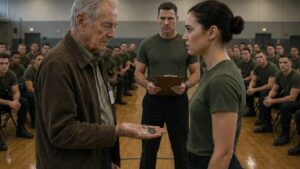
They Tried to Move the Old Man Away Until He Touched the Tent’s Forgotten Seam
Chapter 1: The Man Without the Correct Badge
“Sir, you need to step out of the lane.”
The young gate specialist held one palm toward Joseph Carter’s chest while a convoy of black ceremony vehicles rolled through the checkpoint behind him. Joseph had already moved as far as the metal barricade allowed. Its cold rail pressed against his right hip, and the rubber tip of his cane rested in a crack in the pavement.
He raised the folded invitation between two fingers.
“My name is on this.”
The specialist glanced at the paper without taking it. “General admission is through the blue gate.”
“It says field-tent dedication.”
“Yes, sir. That’s the event. Blue gate.”
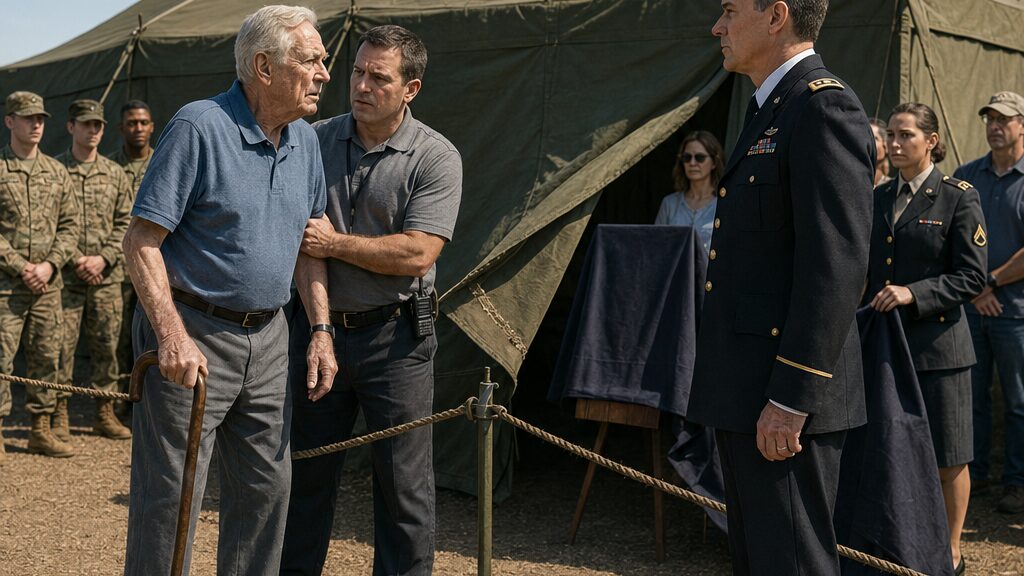
Beyond the checkpoint, an olive-green command tent stood on a trimmed square of grass. Ropes held its corners in military-straight lines. Folding chairs faced a small platform near the entrance, and a rectangular plaque waited beneath a dark cloth.
Joseph could see the tent’s right flap from where he stood.
Someone had folded it inward.
His grip tightened on the cane.
Laura stepped forward. “He was invited. We drove three hours.”
“Ma’am, I’m not saying he wasn’t invited.” The specialist pointed to the invitation. “It doesn’t have the red access stripe.”
“It has his full name.”
“So do the general invitations.”
Joseph lowered the paper. The morning heat had begun working through his blue polo, and the walk from the parking lot had left a tremor in his left knee. He disliked that the specialist kept looking at the cane whenever he spoke, as though the cane—not Joseph—was the part requiring an answer.
A civilian in a gray event polo approached, radio clipped high on his belt. He moved quickly, checking the chairs, the gate, and the vehicles in one practiced sweep.
“What’s the delay?”
The specialist showed him the invitation. “No red stripe. They say they’re part of the dedication.”
The man read the name. Nothing in his face changed.
“Mr. Carter, I’m Scott Davis, event operations. Your invitation grants open-house access. The restricted seating area requires separate clearance.”
“I don’t need a chair.”
Scott offered a professional smile that did not reach his eyes. “Everyone needs an assigned location today.”
“I need to get to that tent.”
The smile vanished. “The exhibit opens after the ceremony.”
Joseph looked past him. Two junior soldiers were adjusting the entrance flaps. One pulled the right side farther inward and clipped it against a support line.
“There,” Joseph said. “Tell him not to do that.”
Scott turned only halfway. “The restoration team approved the display configuration.”
“He’s covering the repair.”
Laura touched Joseph’s arm. “Dad.”
Joseph did not look at her.
Scott’s attention sharpened, but not with interest. “Sir, the tent has been restored by qualified personnel. Visitors can view it this afternoon.”
“The wind will come across that parking lot after noon. That corner will sag if they keep the side line that tight.”
The specialist glanced toward the tent.
Scott did not. “We had a security incident at the spring open house because someone entered a controlled area without the correct credential. I’m not repeating that mistake. You’ll need to use the blue gate.”
He gestured toward a longer route around the parade field.
Laura’s face flushed. “That’s nearly half a mile.”
“There’s a shuttle for mobility assistance.”
“I didn’t ask for mobility assistance,” Joseph said.
Scott’s radio crackled. A woman’s voice asked when the commander’s vehicle would arrive.
Scott answered, then turned to a visitor behind Joseph whose wheelchair would not fit between two barricades. His manner changed. He unlatched the nearest section himself, moved a sign, and directed the visitor through the wider opening with careful attention.
“Take the left path,” he said. “It has less grade.”
For a moment Joseph understood him. Scott was not careless with everyone. He was a man who trusted categories: cleared, uncleared; safe, unsafe; scheduled, disruptive. The trouble was that once he placed someone in a category, he stopped hearing them.
When Scott returned, Joseph said, “Check the name.”
“I did.”
“No. Check what the name is connected to.”
Scott glanced at his watch. “I have three hundred visitors entering and a live ceremony in forty minutes. I cannot investigate every guest who believes an exception applies to him.”
Laura stepped between them. “He isn’t asking for an exception.”
“Then we agree.”
“You haven’t let him finish a sentence.”
“And you’re blocking an active access lane.”
The gate specialist shifted uncomfortably. Several people in line had begun watching. Joseph felt the old, familiar pressure to end the scene by disappearing from it. He had spent years becoming good at that.
He moved toward the blue gate.
Laura followed, lowering her voice. “You could tell them.”
“No.”
“Just say you served.”
“Plenty of men served.”
“You know that’s not what I mean.”
The cane struck the pavement in measured beats. Joseph kept his eyes on the tent. It looked smaller than it had in memory and more carefully arranged. New ropes. New stakes. Freshly brushed canvas. The right entrance flap had been drawn across the only section that still belonged to the night he remembered.
He had almost refused to come.
The invitation had sat unopened for five days. Then it had moved from the kitchen table to the trash, where Laura had apparently found it. She had arrived at his house that morning with coffee, a full tank, and no patience for his excuses.
Now he wished he had left it buried.
A gust crossed the open parade field. The flags near the platform snapped once. Joseph stopped walking.
“The corner,” he said.
Laura turned.
The right rear line of the tent pulled hard. The canvas roof dipped, held, then gave a sharp report as the corner briefly folded inward. One of the junior soldiers jumped back. The support pole shifted several inches before the second soldier caught it.
Scott looked over from the checkpoint.
His eyes moved from the tent to Joseph.
Joseph continued walking before the man could speak.
At the blue gate, a volunteer handed Laura two programs. Joseph unfolded his beneath the shade of a temporary awning.
The front showed an old black-and-white photograph of the field tent. The image had been cropped closely enough to exclude the antenna brace.
Inside was a schedule, a commander’s welcome, and a short historical note.
Laura leaned close. “What does it say?”
Joseph read the heading twice.
THE JOSEPH CARTER COMMUNICATIONS POST
Below it, one sentence described a lone communications sergeant who had maintained the evacuation line under extreme conditions and refused to abandon his station.
Joseph searched the page from top to bottom.
Gary Nelson’s name did not appear.
The pressure in his chest had nothing to do with the heat.
Laura saw his face. “Dad?”
He folded the program, but his fingers could not make the edges meet.
“Coming here was a mistake.”
“Then we’ll leave.”
“No.”
He looked toward the tent. Workers were pulling the damaged corner back into shape. The right flap still covered the seam.
Joseph turned away from the blue gate and started directly toward the restricted walkway.
Laura hurried after him. “What are you doing?”
“They built the whole ceremony around the wrong man.”
Chapter 2: The Backward Stitches Beneath the Flap
Scott caught Joseph’s wrist just before the curved cane handle reached beneath the tent flap.
“Do not touch the exhibit.”
The grip was firm enough to stop the cane and public enough to turn heads. Soldiers arranging chairs looked over. A family waiting behind the rope fell silent.
Joseph stared at Scott’s hand.
“Let go.”
“Step away from the boundary first.”
“You’re holding my wrist.”
Scott released him, but immediately took Joseph by the elbow instead, steering him back from the rope as though correcting the path of a confused patient.
Joseph planted the cane.
The rubber tip held against the packed earth.
“I said let go.”
Laura came through the gap behind them. “Take your hand off him.”
Scott withdrew and raised his radio. “I need assistance at the tent entrance.”
“I’m not entering,” Joseph said. “I’m showing you something.”
“You crossed from general access into a restricted ceremony zone.”
“The gate was open.”
“That was not permission.”
Joseph looked at the young guard approaching from the platform. He could feel the attention gathering around him—not respect, not yet, merely curiosity sharpened by embarrassment.
He had hated scenes like this even when he was young enough to command them.
Scott pointed toward a line of shaded seats. “Please escort Mr. Carter to accessible viewing.”
Joseph’s jaw tightened. “You still haven’t checked the name.”
“I have asked you repeatedly to follow instructions.”
“And I have asked you once to look at the tent.”
Scott’s radio sounded again. He silenced it without answering.
Joseph lifted the cane slowly, keeping its tip outside the rope. He hooked the curved handle beneath the lower edge of the right entrance flap and raised it several inches.
A patch of darker olive canvas appeared underneath.
The repair ran diagonally, no longer than a man’s hand. Two rows of stitches crossed unevenly along its edges. From the outside, the thread seemed to reverse direction halfway through.
Scott reached for the cane.
Joseph moved it beyond his grasp.
“The inner row runs backward,” Joseph said, “because it was sewn from inside. There wasn’t room to turn the needle at the lower edge.”
The guard stopped beside Scott.
One of the junior soldiers looked at the repair, then at Joseph.
Scott’s voice lowered. “The restoration record identifies that as field damage.”
“It was a tear from the entrance ring to the side panel.”
“That information is available in the exhibit notes.”
“No. The notes say the canvas split under wind load. It didn’t.” Joseph pointed with the cane. “The ring tore first because somebody replaced the original pin with a narrow one. The pressure opened the canvas from the hardware down.”
The junior soldier nearest the flap crouched for a better look.
Joseph continued before anyone could interrupt.
“There are three kinds of thread in that seam. The dark line is repair cord. The faded line came out of a shelter kit. The last four stitches are signal wire insulation split thin with a field knife because we ran out of both.”
Scott studied the seam now.
“Anyone could have read—”
“The final knot is inside the hem,” Joseph said. “You won’t find it unless you release the lower loop. And if you do, don’t pull hard. The wire will cut the canvas.”
A new voice came from behind Scott.
“Who told the restoration team about the knot?”
The people near the rope straightened before Joseph turned.
Colonel Benjamin Roberts stood several yards away in a dark formal service uniform. He was taller than Scott, though it was the stillness in his posture—not his height—that changed the space around him. A public-affairs sergeant and two officers waited behind him.
Scott recovered first. “Colonel, we have an access issue. This gentleman entered the restricted area and attempted to handle the artifact.”
Joseph lowered the flap carefully.
Benjamin looked from the cane to the seam. “I asked who told the team about the knot.”
The crouching soldier stood. “Sir, the restoration photographs show the exterior only.”
Benjamin’s gaze settled on Joseph. “What is your name?”
Laura began, “This is—”
Joseph lifted one hand, stopping her.
“Joseph Carter.”
The colonel’s expression altered in a way so slight that Joseph might have missed it if he had not spent years reading men under pressure. Recognition arrived first in the eyes. Then came disbelief, followed by an almost immediate correction of posture.
Benjamin looked at Scott. “Did you verify his identity?”
“His credential did not include restricted access.”
“That was not my question.”
Scott’s mouth tightened. “No, sir.”
Benjamin faced Joseph again.
For one second, Joseph saw the prepared ceremony in the colonel’s face—the biographies, the citation, the photograph, the name on the covered plaque. Benjamin knew the public version of him.
Then the colonel brought his heels together and raised his right hand in a precise salute.
The field around them seemed to lose its sound.
Joseph had received salutes for rank, for duty, for formality. This one felt different because he was standing in a blue polo with sweat darkening the cloth beneath his arms, his weight resting on a cane, while a civilian event manager stared at the ground.
He did not return it. He was no longer in uniform, and he would not pretend otherwise.
He gave Benjamin a small nod.
The colonel lowered his hand.
“Sergeant Carter,” he said.
“Mr. Carter is fine.”
Benjamin accepted the correction. “Mr. Carter, I owe you an apology. You should have been met at the gate.”
Joseph looked at the covered plaque.
“That isn’t the problem.”
Around them, the people who had watched the confrontation shifted into a different kind of silence. The guard stepped back. The junior soldiers handled the tent flap as though it had become fragile in the last thirty seconds.
Scott’s face showed embarrassment, but beneath it Joseph saw something harder: resistance to being judged by a fact he had not been given. Joseph understood that, too. It did not excuse the hand on his elbow or the order to remove him.
Benjamin followed Joseph’s gaze. “We have reserved a place for you beside the platform.”
“I don’t want the place.”
“The dedication begins shortly.”
“It shouldn’t.”
The colonel’s attention sharpened. “Is there a safety concern with the tent?”
“No.”
“Then what should not begin?”
Joseph pointed with his cane toward the dark cloth covering the plaque.
“That should not be uncovered.”
The public-affairs sergeant glanced at Benjamin. Scott looked up again.
Benjamin lowered his voice. “The inscription was drawn directly from your service citation.”
“I know.”
“The records were reviewed by the installation historian and headquarters.”
“I believe you.”
“Then help me understand.”
Joseph looked at the old canvas. From the outside, the reversed stitches made the seam appear clumsy, almost careless. From inside, the pattern would look different.
That had always been the trouble.
“I need to see what you wrote.”
Benjamin hesitated. The ceremony area had begun filling. Music sounded faintly from speakers near the chairs. A camera operator tested a tripod facing the covered plaque.
“We can step inside,” Benjamin said.
Scott moved to lift the rope.
This time he did not touch Joseph.
Joseph passed him without acknowledgment.
At the entrance, Benjamin held the flap open. Joseph paused beside the repaired seam and placed two fingers against the canvas. Beneath them, the old wire stitches were hard and narrow.
“Were you inside when you made this repair?” Benjamin asked.
“For most of it.”
“During the evacuation?”
Joseph removed his hand.
Benjamin waited.
Joseph could have answered with the part they wanted: yes, under pressure; yes, while the line stayed open; yes, while men depended on the coordinates leaving that tent.
Instead he said, “Colonel, if that plaque repeats the official citation, that is exactly why you cannot show it.”
Chapter 3: A Heroic Record With One Name Missing
“The lone soldier who refused to abandon the post.”
The recorded voice filled the tent before anyone could stop it.
Joseph stood just inside the entrance, one hand braced on his cane, while the sentence moved through the canvas enclosure with the polished certainty of something repeated too many times.
An audiovisual technician lunged toward a control tablet.
The narration continued.
“Sergeant Joseph Carter maintained communications alone, directing the successful evacuation despite catastrophic equipment failure—”
“Turn it off,” Benjamin said.
The sound died in the middle of the next sentence.
No one spoke.
Inside the tent, the air carried the dry scent of old canvas and new timber supports. Display panels stood along the walls. One showed a radio set similar to the model Joseph had used, though cleaner than any working unit had ever been. Another displayed a map marked with bright routes and explanatory arrows.
At the far end, the covered plaque rested on a stand.
Joseph crossed to the repaired section. From inside, the stitches appeared nearly straight. The awkward reverse pattern visible outside disappeared into an orderly line.
Benjamin followed at a respectful distance. Scott, Laura, the public-affairs sergeant, and the base historian entered behind him. The tent flap dropped closed, cutting off most of the crowd noise.
Benjamin spoke first. “That narration can be revised.”
“The narration isn’t the only problem.”
“Then tell me specifically what is inaccurate.”
Joseph studied the seam.
“You called me the lone soldier.”
“That language comes from the citation.”
“I heard you.”
The colonel’s patience held, but effort had entered it. “We have a live dedication scheduled in less than thirty minutes. Headquarters is carrying the stream. Families have traveled here. I am willing to delay, but I need more than an objection to a word.”
Joseph turned. “Show me the plaque.”
The historian looked at Benjamin.
Benjamin nodded.
The public-affairs sergeant loosened the cloth enough to reveal the inscription without removing it from the stand.
The heading bore Joseph’s name.
Below it, the text credited him with maintaining the communication line after all other personnel had evacuated the position. It described his refusal to leave, his repair of the damaged shelter, and his transmission of coordinates that enabled the last convoy to clear the valley.
The facts were arranged neatly.
That made the lie worse.
Joseph read to the bottom.
“Where is Gary Nelson?”
The historian opened a folder. “Who?”
“Specialist Gary Nelson.”
Pages shifted.
“What unit?” the historian asked.
“Mine.”
“Was he part of the communications section?”
“He was standing on the other side of this seam.”
The historian checked the ceremony packet, then a printed roster. “I have a Nelson listed in the larger operation, but not at this position.”
“He was here.”
Benjamin looked at Joseph. “What was his role?”
“He kept the antenna brace from tearing free. He found the shelter cord. He held a lamp when the generator failed. When the first support pole shifted, he put his shoulder under it until I could reset the line.”
“Was he mentioned in the after-action report?”
Joseph’s silence answered before he did.
“Not correctly.”
The historian searched again. “There is no Gary Nelson in the materials headquarters provided for this exhibit.”
“There wouldn’t be.”
Laura moved closer. “Dad, tell them.”
Joseph’s fingers tightened around the cane. “Not like this.”
“Like what?”
“With everyone standing around waiting for me to make their schedule work.”
Benjamin glanced toward the entrance, where muted ceremony music had begun outside.
“I can clear the tent,” he said.
Joseph looked at the colonel. “Would that make the plaque less wrong?”
“No. But it may make it easier for you to explain.”
“You think ease is what’s missing?”
Benjamin’s jaw shifted. He walked to the plaque and pulled the cloth back over the exposed inscription.
“No,” he said. “I think facts are missing. And I think you are the only person here who knows which ones.”
The response was better than Joseph expected. It also made retreat harder.
The public-affairs sergeant received a message through her earpiece. “Sir, headquarters is asking why the opening shot has been delayed.”
Benjamin did not turn. “Tell them there is a technical review.”
“How long?”
“Thirty minutes.”
Scott spoke from near the entrance. “Colonel, a thirty-minute hold backs up the aircraft demonstration and the shuttle cycle. We also have visitors standing in direct sun.”
Benjamin looked at him. “Then move them to shade and adjust the shuttle cycle.”
Scott glanced at Joseph, then back to the commander. “Yes, sir.”
It was not contrition. It was compliance. Joseph trusted it more.
The historian closed the folder. “Mr. Carter, if Specialist Nelson was omitted from the original account, we can open a review. But we need documentation or testimony with enough detail to locate supporting records.”
“There were records.”
“Do you know where?”
Joseph looked again at the seam.
Gary’s hands had been quicker than his. The younger man had laughed once while threading the cord, not because anything was funny, but because the wind kept slapping the canvas against his face.
You sew like my grandmother, Gary had shouted.
Your grandmother would’ve finished by now, Joseph had answered.
The memory came without warning and left behind the sound of tearing metal.
Laura touched his shoulder.
He stepped away from her.
Benjamin noticed. “Mr. Carter, did the original investigation interview you?”
“Yes.”
“Did you tell them Nelson was present?”
“Some of it.”
“Some?”
Joseph felt every person in the tent waiting. The same silence had followed him for decades, though usually he had carried it alone.
“I told them the line stayed open. I told them the tent failed. I told them coordinates went out.”
“That describes the citation,” Benjamin said.
“Yes.”
“It does not describe Gary Nelson.”
“No.”
Laura stared at him. Hurt arrived slowly in her face, mixed with recognition.
The historian said, “There may have been an opportunity to amend the record later. Many older files were reviewed during the archive digitization project.”
Joseph looked toward the entrance.
Laura’s voice became very quiet. “There was.”
He turned to her.
She opened her purse and removed a folded photocopy. The creases were soft from repeated handling.
“I found this in the drawer with the dedication notice,” she said.
Joseph knew the form before she opened it.
A records-correction request. His name typed at the top. Spaces for supporting testimony below. A signature line left blank.
Benjamin took it only after Joseph gave the smallest nod.
“This is dated sixteen years ago,” he said.
“There were others,” Laura said. “At least three.”
Joseph’s face grew hot. “That was private.”
“You brought me here because you said the program was wrong.”
“I asked you to drive.”
“You asked me at five this morning, after throwing the invitation away twice.”
Scott looked down. The historian held her folder against her chest. Even Benjamin seemed unsure whether he was witnessing accusation or help.
Laura kept her eyes on Joseph.
“You had chances to name him,” she said. “Why didn’t you?”
The music outside changed to the ceremony prelude.
Joseph looked at the covered plaque, then at the repaired seam whose stitches appeared so clean from this side.
“Because the Army didn’t erase Gary alone,” he said.
The words left him with nowhere to hide.
“I helped them do it.”
Chapter 4: The Silence Joseph Mistook for Honor
Joseph’s left knee folded before he reached the tent opening.
The cane struck the ground sideways. Laura caught his shoulder, but his weight dragged them both toward the support rope until the public-affairs sergeant pulled a chair beneath him.
“Get the wheelchair,” someone said.
“No.”
Joseph’s voice came out sharper than he intended.
The young guard had already turned toward the medical station. Joseph gripped the chair arms and forced his knee straight.
“I said no wheelchair.”
Benjamin crouched just enough to meet his eyes without looming over him. “This is not an order, Mr. Carter. It is help.”
“The medical area is away from the tent.”
“It is twenty yards.”
“Twenty yards is away.”
The colonel watched him for a moment, then stood. “Bring the chair to the side lane. Keep him within sight of the entrance.”
Scott opened his mouth, likely to object to chairs in an equipment route, but Benjamin’s expression stopped him.
Two soldiers carried the chair beneath a narrow shade canopy beside the tent. The lane beyond it held stacked cases, folded barriers, and coils of electrical cable. Ceremony music continued on the other side of the canvas, muffled but steady.
Laura knelt in front of Joseph.
“You scared me.”
“My knee slipped.”
“You nearly went down.”
“I noticed.”
She looked toward the others. Benjamin had taken the historian and public-affairs sergeant several paces away. Scott stood near the tent entrance with his radio, watching the ceremony schedule unravel minute by minute.
Laura turned back. “Tell him why you signed nothing.”
“I didn’t sign anything.”
“That is the problem.”
Joseph rubbed the worn notch in the cane handle with his thumb. The notch had deepened over the years, its edges polished smooth by his hand. Beneath the varnish was a strip of pale wood cut from an antenna brace that had once held against a storm.
Laura had always believed the cane came from a woodworking catalog.
He had never corrected her.
“I thought the forms would fix the name,” she said. “You knew they existed. You knew Gary was missing.”
“The forms asked for a corrected statement.”
“So give one.”
“You think statements are clean.”
“I think silence is worse.”
Joseph looked at the lane. A forklift moved in the distance, its warning beep repeating at regular intervals. The sound pulled at an older memory: a field alarm chirping through interference, too faint to trust and too persistent to ignore.
Laura lowered her voice. “Did the Army tell you not to speak?”
“No.”
“Did someone threaten you?”
“No.”
“Then why?”
He rested both hands on the cane.
“Because I called him back.”
Laura did not move.
Joseph kept his eyes on the ground between them. “The first support pole went. The antenna line started pulling the roof sideways. I ordered everyone clear.”
“And Gary left?”
“For about thirty seconds.”
The memory arrived in pieces rather than sequence: Gary running bent against the wind, the radio handset slick in Joseph’s palm, the map lifting from the table despite two weights holding it down.
“The line failed,” Joseph said. “I could hear the convoy, but they couldn’t hear me. The coordinates were incomplete. I called for Gary.”
“You ordered him back?”
“I transmitted his name.”
“That is not the same answer.”
“It was enough.”
The words tasted old.
Gary had answered through static. You just threw me out, Sergeant.
Joseph had pressed the handset hard against his ear.
Need the brace held. Two minutes.
Gary’s reply had broken apart in the interference. Joseph had understood only the final words.
Coming back.
Laura sat on the edge of an equipment case opposite him.
“Did he have a choice?”
“He always had a choice.”
“That sounds like something you tell yourself.”
Joseph looked up.
She flinched, but did not withdraw the question.
“He argued with me,” Joseph said. “Earlier that night. Said I kept treating him like a boy assigned to carry tools. He knew the antenna system better than half the section. When I ordered the evacuation, he said I was sending away the one man who could keep the line standing.”
“And you still sent him.”
“Yes.”
“Why?”
“Because I was responsible for him.”
A bitter smile touched Laura’s mouth. “And then you called him back because you needed him.”
Joseph’s hand tightened around the cane handle.
“Yes.”
The admission sat between them without defense.
For years he had reduced the moment to a simple sequence: order given, soldier returned, soldier lost. Laura’s question restored what he had tried to flatten. He had believed Gary capable. He had also tried to protect him. Then, under pressure, he had used the very competence he had been reluctant to acknowledge.
A gust pressed against the field tent. Its canvas shifted, but the repaired corner held.
Laura noticed his thumb moving over the notch.
“What is that?”
“Nothing.”
“It is not nothing today.”
Joseph turned the handle slightly. The pale inlay caught the light.
“Part of the antenna brace.”
“From that night?”
“Yes.”
“Gary’s?”
“We both handled it.”
Laura reached toward the cane, then stopped before touching it. “You carried that all these years and never told me.”
“I needed a cane.”
“You could have bought one.”
“I did. It broke.”
Despite herself, she almost laughed. The sound never fully formed.
Behind them, Scott directed two volunteers to move visitors beneath a second canopy. His voice was efficient, not unkind. When an elderly woman struggled with a folding chair, he took it from her and set it down without being asked.
Joseph watched him. A man could be careful in one direction and careless in another. The contradiction did not erase either act.
Laura followed his gaze. “You defended him earlier.”
“I understood his problem.”
“He put his hands on you.”
“I didn’t say I forgave it.”
The colonel approached, stopping a few feet away. “The ceremony is on hold. Headquarters wants a reason.”
Joseph said nothing.
Benjamin looked toward Laura. “May I speak with him?”
“It’s his decision.”
That was new. An hour earlier she would have answered for him.
Joseph nodded.
Laura stood but remained nearby.
Benjamin pulled a folding chair over and sat facing Joseph. “I am not asking whether you were perfect that night.”
“You should be.”
“I am asking what happened.”
“You want enough to decide whether the plaque can stay.”
“I want enough to stop making the situation worse.”
Joseph studied him. The colonel’s uniform was immaculate, but dust had gathered at the edge of one polished shoe from the lane.
“I called Gary back after ordering the position evacuated,” Joseph said.
Benjamin’s face stayed still.
“He returned voluntarily?”
“He returned because I called.”
“That is not the same as coercion.”
“It is not the same as innocence either.”
Benjamin let the distinction stand.
Laura said, “He chose to come back.”
Joseph turned on her. “Do not make it easier.”
“I’m not.”
“Yes, you are.”
“No. I’m making him a person.” Her voice trembled, but she held it steady. “You keep talking as if Gary was only acted upon. First by you, then by the Army, then by history. You said he argued. You said he knew the equipment. You said he chose.”
Joseph looked away.
The sentence hurt because it carried truth without relief.
Laura crouched beside him again. “What would honest recognition look like?”
He had expected her to ask whether he deserved the honor. Instead she asked what truth required.
Across the lane, the historian emerged from the tent carrying a records box and spoke quietly to Benjamin.
Joseph watched the box approach.
“There was a full radio log,” he said.
The historian stopped.
Benjamin turned back. “The archive contains only the summarized transmission record.”
“There was a field log. Maintenance notes attached.”
“Do you know what happened to it?”
Joseph’s thumb settled into the notch in the cane.
He could hear Gary’s voice as plainly as the ceremony music beyond the canvas.
You’ll need more than two minutes, Sergeant.
Joseph forced himself to meet Benjamin’s eyes.
“I removed one page before the investigation closed.”
Chapter 5: The Page That Could Not Forgive Him
The archive index listed the missing sheet in black ink.
Box 14. Field Communications. Maintenance Log, pages one through nine.
Inside the folder, there were eight.
The base historian placed them in order across the table, leaving a clean rectangle where the ninth page should have been. The archive room was narrow and cold, with metal shelves rising to the ceiling. Joseph sat at one end of the table while Benjamin remained standing.
Laura leaned against the wall behind him. Scott waited by the door, holding his radio with both hands as if stillness alone might keep the event from deteriorating further.
The historian tapped the index. “This notation was made when the records were first transferred. The page was present at intake.”
Benjamin looked at Joseph. “And gone before the review?”
“Yes.”
“You took it from an active investigation file?”
“Yes.”
No one softened the word.
Scott exhaled through his nose. “Colonel, if this becomes public during a live event—”
“It already is public,” Benjamin said. “The question is whether we make it accurate.”
“The headquarters team is asking for a revised start time.”
“Tell them we do not have one.”
Scott hesitated. “Sir, they may direct us to proceed.”
“Then they can direct me.”
Scott stepped into the hall to make the call.
The historian adjusted the pages without touching the empty space. “What was on page nine?”
Joseph looked at the shelves. Thousands of records rested there in gray boxes, each one promising order. He had once believed records preserved truth. Then he had learned that paper held only what frightened men were willing to leave behind.
“Gary’s maintenance notes,” he said.
“What kind of notes?”
“Brace tension. Cable damage. Generator condition. He wrote while he worked.”
“Anything else?”
“The last line.”
Benjamin pulled out the chair opposite him. “What did it say?”
Joseph did not answer.
The historian opened another folder. “There may be supporting material. Photographs from the position were taken the morning after.”
She spread several contact sheets beneath a desk lamp. Most showed collapsed canvas, broken poles, and equipment pushed into mud. Joseph recognized the angle of the valley, though the years had drained it of sound.
The historian stopped at one image.
It showed the right entrance flap partly open. The repaired seam was unfinished. A hand reached through from inside with a length of thread. Another hand held the outer canvas flat.
Two men, mostly hidden by the tent.
Laura bent closer. “Which one is you?”
Joseph pointed to the hand inside.
“And the other?”
“Gary.”
The photograph offered no rescue. No face. No heroic posture. Only two sets of hands working on opposite sides of torn canvas.
The historian placed a magnifying sheet over the image. “This proves he was at the position.”
“It proves he held canvas.”
“It contradicts the lone-soldier wording.”
“It does not tell you what came later.”
Benjamin said, “Then tell us.”
Joseph looked at the photograph until the hands blurred.
“The generator failed first. We switched to battery. The roof started pulling loose after the antenna brace cracked. Gary cut a strip from the spare support and wedged it under the mount.”
He stopped.
The memory threatened to widen. He kept it narrow.
“I ordered evacuation when the support pole shifted. Gary objected. Said the brace would not hold without someone on it.”
“You sent him anyway,” Laura said.
“Yes.”
“And then the convoy lost contact.”
Joseph nodded.
“The transmission line dropped. I had partial coordinates and no confirmation. I called his name over the radio.”
The historian asked, “Did you order him to return?”
“I said I needed the brace held.”
“That is not a formal order.”
“He knew my voice.”
Benjamin did not interrupt.
Joseph placed one finger in the empty rectangle on the table.
“Gary came back. He wrote while he checked the line. Voltage falling. Brace splitting. Shelter cord used on entrance seam.”
“What was the final notation?” Benjamin asked.
Joseph’s finger remained on the bare tabletop.
“Going back for Carter.”
Laura closed her eyes.
The words had not changed in all the years Joseph had tried not to hear them.
The historian spoke carefully. “That could mean he chose to return for you.”
“It means my name was the reason.”
“It may mean more than one thing.”
“I removed it because I knew exactly what it meant to me.”
Benjamin leaned forward. “Why remove the whole page?”
“Because the citation draft said I remained alone after all others withdrew. The page proved Gary came back.”
“So you were trying to correct the draft?”
Joseph laughed once, without humor. “No.”
He looked at Benjamin.
“I was trying to keep anyone from asking why.”
Silence entered the room.
The admission was worse spoken plainly. He had not stolen the page to honor Gary. He had stolen it to avoid the shape of the question.
Laura folded her arms tight across her chest. “And after the citation?”
“I did nothing.”
“You received the recognition.”
“I refused the ceremony.”
“But the citation stayed.”
“Yes.”
“The story stayed.”
“Yes.”
She looked at the empty place between the records. “And Gary disappeared.”
Joseph could not answer.
The door opened. Scott returned, his face set.
“Headquarters will not authorize a cancellation without a confirmed records determination. They are allowing fifteen more minutes. After that, the livestream begins with or without the dedication remarks.”
Benjamin’s expression hardened. “They do not control whether I uncover a plaque on this installation.”
“They control the feed and the program package. If we deviate, they want a statement.”
“They will get one.”
Scott remained near the door. “Sir, I need to say this. We have visitors who traveled here, a Gold Star group waiting in the front section, and junior soldiers who spent months preparing this exhibit. If we turn the ceremony into an investigation, we may do harm we cannot contain.”
Joseph looked at him.
For once Scott was not speaking about schedules alone. He believed disorder itself could injure people.
Benjamin said, “Proceeding with a false account would also do harm.”
“Then revise one line and review the rest later.”
“No,” Joseph said.
Scott looked at him.
Joseph placed his palm over the empty space on the table. “That is how it happened the first time.”
Scott’s jaw tightened, but he did not argue.
The historian gathered the photographs. “There is one person we may be able to contact. Gary Nelson’s surviving sister is listed in an old next-of-kin update.”
Joseph’s first instinct was refusal.
He had no right to bring the day to her door after decades of silence. Yet the historian was already dialing from the office phone, and Benjamin was asking whether Joseph objected.
He did.
He also said, “Call.”
The conversation remained brief. The historian identified herself, explained that a historical record was under review, and asked whether Gary had ever written about Joseph Carter.
A pause followed.
Then she switched on the speaker.
An elderly woman’s voice filled the room.
“Joe Carter? Gary called him Sergeant Carter. He wrote about him twice.”
Joseph stared at the telephone.
“What did he say?” the historian asked.
“That Sergeant Carter was stubborn. That he checked every line twice. And that he was the first leader who trusted Gary with work that mattered.”
Joseph’s breath caught.
The woman continued. “Gary was always trying to prove he could carry more than people gave him. Our father thought the Army would straighten that out. It only gave him larger things to carry.”
Laura covered her mouth.
“Did he mention returning to a communications position?” Benjamin asked.
“He wrote that if the line went down, Carter would stay. Gary said he would not leave him there alone.”
Joseph shut his eyes.
The words did not absolve him. They made Gary larger than the sentence on the missing page. Larger than the order. Larger than Joseph’s guilt.
When the call ended, Benjamin remained seated.
“I have been asking the wrong question,” he said.
Joseph opened his eyes.
“I kept trying to determine whether you deserved the honor.”
“I benefited from the lie.”
“Yes.”
The directness steadied Joseph more than comfort would have.
Benjamin continued. “But the soldiers outside do not need a perfect man. They need the truth about what duty looks like when frightened people depend on one another.”
Ceremony music swelled faintly through the wall.
Scott checked his watch. “Five minutes.”
Benjamin looked at Joseph. “What truth do you want them to hear?”
Joseph turned to the photograph of the two hands at the seam.
He had spent years believing silence punished him. Instead it had narrowed Gary into an absence and allowed Joseph to remain polished in official memory.
Outside, the first notes of the opening march began.
The choice was no longer between speaking and protecting Gary.
It was between speaking now and erasing him again.
Chapter 6: Before They Pulled Away the Cloth
The public-affairs sergeant had both hands on the plaque cloth when Joseph stepped onto the platform.
He had not been introduced.
A murmur moved through the seated visitors as he crossed the short distance from the tent entrance. His knee resisted every step. The cane struck the boards once, twice, then a third time before he reached the microphone.
The sergeant looked toward Benjamin.
The colonel gave no signal to begin or stop.
Joseph placed one hand against the tent’s right entrance seam.
The canvas was warm from the afternoon sun.
“My name is Joseph Carter,” he said.
The speakers carried his voice farther than he expected. The crowd settled.
“I was told this tent was being named for me.”
Scott moved from the side of the platform, one hand raised toward the audiovisual technician.
Benjamin stepped into his path.
“Keep the feed live,” the colonel said.
Scott lowered his hand.
Joseph looked at the covered plaque.
“The words under that cloth say I kept a communications post operating alone during an evacuation. Some of those words are true.”
He paused, not for effect, but because the next breath would not come cleanly.
“The line stayed open. Coordinates were transmitted. Men got out.”
Faces waited beyond the platform: soldiers in uniform, older veterans in caps, families holding programs printed with Joseph’s name.
“But I was not alone.”
He pressed his palm more firmly against the seam.
“Specialist Gary Nelson stood outside this canvas while I worked inside. He held the antenna brace when the wind tried to pull it free. He found cord after ours was gone. When the cord ran out, he split insulation from signal wire so we could finish these stitches.”
The junior soldiers assigned to the tent turned toward the repaired section.
Joseph saw Scott listening from the edge of the platform. The man’s expression remained guarded, but the schedule had finally lost its authority over the moment.
“I ordered the position evacuated,” Joseph said. “Gary argued. He knew the equipment. He knew the brace would fail. I sent him anyway because I was responsible for getting him clear.”
A child shifted in the front row. Somewhere behind the chairs, a shuttle engine idled.
“Then the line dropped.”
Joseph’s voice weakened. He adjusted his stance, but did not remove his hand from the seam.
“I was afraid. Not the kind of fear people put in citations. The kind that narrows your thinking until the next necessary thing is all you can see. I called Gary back because I needed his hands on that brace.”
Laura stood near the platform stairs. She did not move toward him.
That, too, was help.
“Gary returned. He chose to return. Both things are true. I called him, and he chose.”
Joseph looked directly at the young soldiers beside the tent.
“Do not let anyone make him smaller so I can look larger.”
The crowd remained silent.
He heard the faint electronic whir of the camera adjusting focus.
“There was a maintenance page in the record. Gary’s page. The last line said, ‘Going back for Carter.’ I removed it before the investigation closed.”
A sound moved through the audience—not outrage, not yet, but surprise stripped of ceremony.
Joseph did not look at Benjamin.
“I did that. No one ordered me. I was ashamed of the question the page would raise. I told myself I was protecting Gary from being remembered only for dying. I told myself I was refusing attention.”
His fingers traced the hard line of wire hidden beneath the canvas.
“What I did was leave the easier story behind.”
The covered plaque seemed to occupy more space than before.
“I will not ask the Army to excuse that. I will not ask Gary’s family to excuse it. I am telling you because silence has already done enough work here.”
Scott took one step toward Benjamin. “Sir, headquarters is requesting—”
Benjamin held up one hand.
Scott stopped.
Joseph continued.
“The radio line did not survive because one fearless man refused to leave. It survived because two frightened men kept choosing the next necessary action. Gary held the brace. I sent the coordinates. He argued with me. I called him back. He came.”
His throat tightened.
“And he did not come out again.”
No music followed. No applause rose to rescue the audience from discomfort.
Joseph was grateful for that.
He turned slightly and indicated the repaired seam.
“From outside, these stitches look backward. From inside, they look straight. The record was built from one side.”
Benjamin’s gaze met his.
Joseph nodded toward the plaque.
“Do not replace my name with Gary’s and call that justice. Do not turn him into a cleaner hero than he was. He was talented, proud, loyal, and stubborn. He wanted work that mattered. He made his own choice. And I made mine.”
The cane trembled beneath his right hand.
“What I am asking is that this tent tell both.”
The public-affairs sergeant released the cloth.
Joseph stepped away from the microphone, but Benjamin approached before he could leave the platform.
“Mr. Carter,” the colonel said quietly, though the microphone caught him, “are you willing to provide a complete statement for the historical record?”
Joseph looked toward Laura.
She did not nod or prompt him.
The decision remained where it belonged.
“Yes,” he said. “Including the page I took.”
Benjamin faced the audience.
“This dedication will not proceed as written.”
A few people shifted. The camera stayed on.
“We will review the archive, record Mr. Carter’s testimony, contact Specialist Nelson’s family, and correct this exhibit before it is opened as a permanent historical display.”
He turned to the public-affairs sergeant. “Remove the plaque.”
She reached beneath the cloth, but the stand was heavier than expected. Benjamin took one side. One of the junior soldiers took the other.
Together they lifted the covered plaque without ever unveiling it.
No crowd salute followed. No band began playing.
The empty stand remained beside the tent entrance.
Joseph descended the platform slowly. At the bottom step, Scott stood near the rope. For a moment Joseph expected an apology shaped by embarrassment and witnesses.
Scott gave none.
He moved the rope aside and said, “The route is clear.”
Joseph passed him.
Inside the tent, the light filtered green through the canvas. The repaired seam looked orderly from this side. Joseph touched it once, then lowered himself into a folding chair.
Benjamin entered behind him carrying the covered plaque with the soldier. They set it against a storage case.
“The official program will need to be rewritten,” Benjamin said. “I would like you to remain while we do that.”
Joseph looked at the dark cloth, then toward the seam.
He had come to stop a lie. Staying meant accepting that the next version could not be made without him.
He rested both hands on the cane.
“I’ll remain,” he said.
Chapter 7: What Respect Looked Like the Next Morning
The plaque stand was empty.
Joseph stopped at the edge of the visitor lane and checked the field tent twice, as though the covered bronze might have been moved to the other side during the night.
Nothing stood beside the entrance except a low barrier, a temporary sign, and the repaired canvas seam exposed beneath a clear protective panel.
RECORD UNDER REVIEW.
The words were plain black letters on white card stock. No decoration. No replacement story prepared overnight.
Laura came up beside him carrying two coffees.
“You expected it to be back.”
“I expected someone to decide yesterday was enough.”
The base had not yet opened to the public. The folding chairs were gone, the ceremony platform had been dismantled, and the grass bore pale rectangles where equipment had rested. Without the crowd, the old tent looked less like a monument and more like something that might still be required for work.
A young gate specialist stood at the entrance with a clipboard. He recognized Joseph before looking down at the page.
“Good morning, Mr. Carter.”
Joseph waited for the wristband or stripe that would decide where he belonged.
The specialist turned the clipboard toward him. “Colonel Roberts asked that everyone connected to the review be verified by name. No special badge required.”
Joseph found his entry. Beside it was a blank for preferred assistance.
“I don’t need assistance.”
The specialist nodded. “Then I’ll leave it blank.”
No argument. No glance at the cane.
Joseph signed.
Farther along the path, Scott Davis was helping move a portable ramp into alignment with the tent entrance. He wore the same gray event polo, but no radio was clipped to his shoulder. When he saw Joseph, he stopped working.
Laura stiffened.
Joseph continued forward.
Scott walked toward them carrying Joseph’s cane.
Joseph looked down. His right hand was empty.
He had left the cane leaning against the signing table.
Scott stopped several feet away instead of bringing it directly to him.
“Mr. Carter,” he said, “where would you like this?”
The question was so careful it might have sounded rehearsed if Scott had not looked uncomfortable asking it.
“In my hand.”
Scott approached only after Joseph extended his arm. He placed the cane across Joseph’s palm without touching his wrist or elbow.
“Thank you,” Joseph said.
Scott nodded.
Neither man called it an apology.
Scott looked toward the ramp. “We adjusted the entrance because the old threshold is uneven. The historian wants the original flooring preserved, so this is temporary.”
“It should be.”
“The visitor procedure is changing too. Staff will verify names before redirecting anyone. Mobility assistance has to be offered, not assumed.”
Joseph examined him. “Colonel’s order?”
“Yes.”
“And yours?”
Scott glanced at the empty plaque stand. “I wrote the first draft.”
The answer did not make yesterday disappear. It made tomorrow less likely to repeat it.
Scott shifted his weight. “I thought I was protecting the event.”
“You were.”
Scott seemed surprised.
“You protected it from interruption,” Joseph continued. “Not from being wrong.”
Scott accepted the correction with a small movement of his head. “I understand that now.”
“You understand some of it.”
“Yes.”
That was enough for the morning.
Inside the tent, the clear panel over the seam caught the light. The restoration team had unclipped the flap that had concealed it, leaving the uneven outside stitches visible. A temporary description identified only the materials: shelter cord, field thread, stripped signal-wire insulation.
No interpretation had been added.
Benjamin stood at a folding table with the base historian and several open archive boxes. He wore a duty uniform rather than ceremonial dress.
He did not salute when Joseph entered.
“Good morning,” he said.
“Colonel.”
Benjamin indicated the seam. “We decided not to hide the repair while the review is underway.”
“You decided quickly.”
“We decided what not to do quickly. The rest will take time.”
On the table lay a draft memorandum ordering a complete review of the exhibit, the original investigation, and the citation language. Another page listed interviews to be recorded, including Gary’s surviving sister and the remaining members of the communications section who could be located.
Joseph saw his own name at the top.
The historian placed a small recorder beside an empty chair. “We can postpone if you need more time.”
Yesterday he would have accepted the opening.
“I came back.”
“Yes, sir.”
“Then we start.”
Laura set his coffee near the chair. “I’ll be outside.”
Joseph looked at her. She had driven him, argued for him, exposed what he had hidden, and then stepped away when his words had to be his own.
“You can stay.”
“Are you sure?”
“No. Sit down anyway.”
She took the chair behind him.
The historian adjusted the microphone. “Before we record, I need to explain that this account may become part of the permanent exhibit. You may review the transcript for factual corrections, but the intention is to preserve your complete statement, including the missing page and your decision to remove it.”
Joseph rested the cane against his leg. The pale inlay in its handle faced upward.
“I understand.”
Benjamin remained near the archive boxes. “Headquarters has suspended the old program package. They also requested a formal recommendation regarding the citation.”
Joseph looked at him. “Are you planning to take it away?”
“That is not my decision.”
“Would you?”
Benjamin considered before answering. “I would correct it. I would not pretend you did nothing because the record was incomplete.”
Joseph turned toward the seam.
For years he had believed only two versions were possible: the polished hero and the guilty man. One erased Gary. The other erased everything Joseph had done after Gary returned.
Both were easier than the whole account.
The historian switched on the recorder.
A red light appeared.
“Please state your full name and your role at the communications position.”
Joseph opened his mouth, but no words came.
The tent was quiet enough for him to hear the canvas settle against its supports. Beyond the entrance, Scott instructed a worker to ask before moving someone’s chair. The phrase carried softly inside.
The historian waited.
Joseph touched the notch in his cane handle.
“What happened after the evacuation order?” she asked gently.
He saw Gary as he had been, not as the final notation had reduced him. Young, impatient, skilled with his hands. Angry at being protected. Proud when trusted. Laughing at Joseph’s sewing while the tent came apart around them.
Joseph had spent decades saying Gary returned because Joseph called.
That was true.
It was not all that was true.
“Before we begin,” Joseph said, “the exhibit should identify the other man first.”
The historian glanced at Benjamin, then returned her attention to Joseph.
“All right.”
Joseph leaned toward the recorder.
“His name was Specialist Gary Nelson. He knew that antenna assembly better than anyone at the position, including me.”
The red light remained steady.
Joseph continued.
Only after Gary’s name, his work, his argument, and his choice had entered the record did Joseph give his own.
The story has ended.