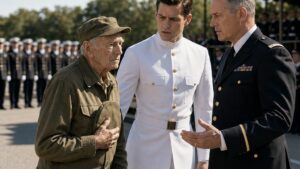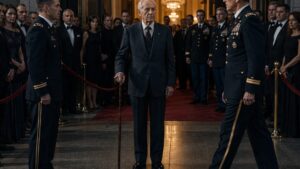
The Soldier Who Mocked the Old Woman With a Cafeteria Tray Learned Why She Stayed
Chapter 1: The Old Woman With the Tray Did Not Move
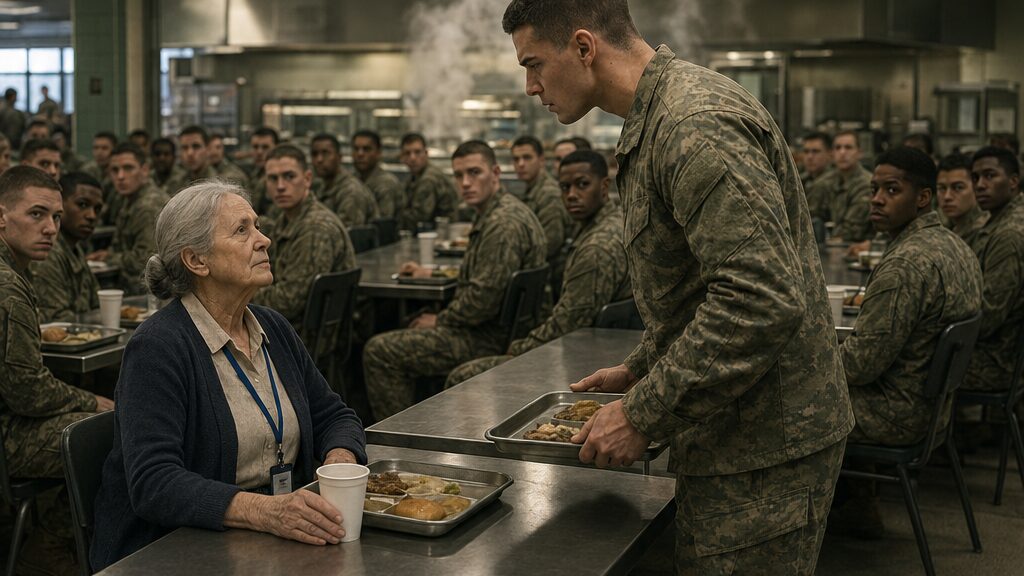
Brandon Hill’s tray struck the edge of Margaret Thompson’s table hard enough to jump her paper cup.
A brown splash of coffee climbed the inside wall of the cup and settled back down. The plastic fork beside her mashed potatoes slid an inch toward her wrist. Margaret looked at the fork first, then at the hand planted beside her tray, then slowly up at the young soldier leaning over her.
He was close enough that she could see the little nick under his chin where he had shaved too fast.
“You lost, ma’am?” Brandon asked.
The word ma’am should have softened the sentence. It did not. He said it for the room.
Around them, the lunch rush moved in its ordinary military rhythm: trays clacking, chairs scraping, boots under tables, voices bouncing off the high ceiling. Steam rose behind the serving line. Young soldiers in camouflage filled the long tables in uneven rows, eating fast because fast was what the day had taught them.
Margaret sat at the end of the third table from the drink station. She always sat there on Mondays. She always chose the seat with the wall behind it and the room open in front of her. Her dark cardigan was buttoned wrong at the middle because one of the buttons had been replaced with a smaller one. Her gray hair was pinned low at the back of her head. Her lanyard lay against her blouse, the laminated volunteer ID turned halfway around so only the barcode showed.
She placed two fingers on the base of the cup to steady it.
“No,” she said.
Brandon looked back at the soldiers behind him, as if the single word had been a joke he wanted them to hear. A few of them smirked because he expected them to. One kept chewing but stopped looking at his own food.
“This table’s for personnel,” Brandon said. “Active personnel.”
Margaret’s tray held meatloaf, potatoes, green beans, a roll, and the coffee she had not yet tasted. His tray was heavier, stacked with two cartons of milk and an extra dessert tucked beside the plate. He angled it against her table like a claim.
Margaret glanced down at the strip of blue tape at the table’s end. The tape had been there for six months, placed after the dining facility started holding one seat open for sponsored visitors and family-readiness volunteers during training cycles. Most people never noticed it because most people never needed it.
“This end is assigned for visitors and volunteers during lunch rotation,” she said quietly. “The active-duty overflow starts at the next table.”
Brandon’s smile thinned.
One soldier across the aisle lowered his spoon. Another turned his head but not his shoulders. A kitchen worker behind the serving line paused with a pan half-lifted. The noise in Margaret’s part of the dining hall did not stop, but it loosened, as if the room had inhaled and forgotten to let the breath go.
Brandon looked at the blue tape, then at her lanyard, then back at her face.
“You work here?”
“I volunteer here.”
“At the dining facility?”
“On Mondays.”
“What, handing out napkins?”
Someone gave a short laugh two tables away. Brandon’s shoulders relaxed at the sound. He leaned farther forward, lowering his voice just enough to make the disrespect look private and feel public.
“You know there are actual soldiers trying to sit down, right?”
Margaret kept her hands close to her tray. Her fingers were narrow now, the knuckles raised, the skin loose. They did not look like hands that had carried stockpots, stacked field trays, scrubbed grease out of burners, or lifted supply crates in places where meals were counted by how many people came back to eat them. They looked, Brandon seemed to think, like hands that should have stayed home.
She looked past him to the line. Three soldiers were waiting for the drink station. None lacked a seat. The far table still had four open spots.
“There’s room,” she said.
Brandon’s jaw shifted. The room had heard her. Not loudly, but enough.
He lifted his tray as if to move, then set it down again, harder this time. The paper cup trembled but did not spill.
“You don’t get it,” he said. “This isn’t a senior center.”
Margaret felt the sentence arrive in her chest before it reached her ears. It landed not as surprise, but as recognition. There were only so many ways people told old bodies to leave a room. They changed the words depending on the doorway.
She raised her right hand, not high. Only palm out, between his tray and hers. A small gesture. Enough.
Brandon stopped speaking.
For one second he looked confused, as if he could not understand why he had obeyed.
Margaret lowered her hand.
“You should eat while your food is hot,” she said.
The closest soldiers watched Brandon’s face for permission to laugh again. He did not give it. Color climbed up his neck, bright under the mess hall lights. He glanced at her lanyard, then at the watching tables, then at the blue tape he had missed.
“What’d you say your name was?” he asked.
“I didn’t.”
That got no laughter. It made the silence sharper.
Brandon picked up his tray. His ears had gone red now. For a moment Margaret thought he might simply walk away. She would have let him. She had let worse men leave rooms with their pride intact because she had learned long ago that not every correction needed a witness.
But he looked over his shoulder and saw too many faces turned toward him.
So he smiled.
It was a small, hard, embarrassed smile, the kind a young man used when he could not retreat without pretending he had meant to advance.
“Must be nice,” he said, louder now, “just showing up wherever you want and making everybody else work around you.”
Margaret’s fingers tightened once on the edge of the tray. Then she released it. Her food had begun to cool. The coffee smelled bitter.
A soldier near the wall muttered, “Hill.”
Not loud. Not a warning. Just his name.
Brandon ignored it.
Margaret looked at the young man standing over her, tray in hand, face arranged for an audience he no longer controlled. She saw his youth before she saw his cruelty. That was the trouble with living long enough. People who hurt you still looked unfinished.
“You have a full table behind you,” she said.
He turned. There it was: space, obvious and waiting.
The room saw it with him.
Brandon’s mouth opened, then closed. For half a second the boy showed through the soldier—the boy who had pushed too hard, too publicly, and found himself standing in the shape of his own mistake.
He stepped back. The tray wobbled slightly in his hands.
Margaret picked up her fork.
Only then did the room begin moving again. Chairs scraped. Spoons touched bowls. Someone coughed. The kitchen worker slid the pan into place. The spell broke in pieces, but not completely. Several soldiers still looked at her, then away, then back again.
Brandon carried his tray to the far table and sat with his shoulders high. He did not eat at first. His squadmates said something low to him. He shoved his fork into his potatoes.
Margaret cut a small piece of meatloaf. It had gone lukewarm. She chewed carefully, swallowing around the tight place in her throat.
She did not look at the empty seat beside her.
When her tray was clean except for the roll she always saved until last, she carried it to the return window. The same kitchen worker gave her the same nod he gave her every Monday, though this time his eyes stayed on her lanyard.
At the exit, Brandon stood near the drink station with his tray still half-full. Andrew Davis, the dining facility supervisor, had just stepped out of the office with a clipboard under his arm.
Brandon leaned toward him, pointing with two fingers toward Margaret’s table.
“That old woman,” he said, not quietly enough. “Somebody needs to check her access. She’s abusing the dining hall.”
Margaret heard every word.
She kept walking.
Chapter 2: The Lanyard Was Valid Until Someone Asked Questions
Andrew Davis held out his hand and said, “Margaret, I’m going to need the lanyard just while we clear this up.”
The hallway behind the mess hall office smelled of floor wax and overcooked vegetables. Margaret stood just outside the half-open door, her tray already returned, her cardigan buttoned, her paper napkin folded in her pocket because she had not found a trash can before Andrew called after her.
His hand stayed between them.
Margaret touched the plastic sleeve at her chest. The ID had warmed against her blouse. Her photo inside it was two years old, taken on a day when Carolyn Perez had told her not to look so serious and Margaret had failed to obey. Beneath the photo, the words VOLUNTEER VISITOR were printed in black.
“Has something expired?” Margaret asked.
Andrew’s face tightened. He had the careful look of a man trying to be fair without making trouble for himself.
“Not expired. Questioned.”
“By the soldier?”
“By the incident.”
“There was no incident.”
Andrew glanced over his shoulder toward the office. Through the narrow gap, Margaret saw the edge of his desk, a wall calendar, two stacked clipboards, and a computer screen filled with a form. Brandon Hill’s name was not visible, but she felt it there.
“Once someone submits a concern about access,” Andrew said, “I have to document it.”
Margaret unclipped the lanyard.
For a moment the weight of it surprised her by being almost nothing. A strip of fabric. A plastic card. A barcode. Something too small to matter until it was taken.
She placed it in his hand.
Andrew did not close his fingers right away. He looked at the card, then at her.
“This is temporary,” he said.
“Most things are.”
He sighed, not impatiently. More like the answer had made his job harder.
Inside the office, the printer woke with a soft mechanical scrape. Andrew stepped aside. “Come in for a minute.”
Margaret entered. There were two chairs in front of his desk. She chose the one closest to the door. On the wall hung framed notices about sanitation standards, food safety, visitor procedures, and restricted access. She had wiped that glass once when a kitchen worker could not reach the top corner.
Andrew sat and typed with two fingers. He had been a sergeant once, Carolyn had told her, and still carried himself as if someone might inspect his posture. His hair was trimmed close, his face clean-shaven, his wedding ring dull from years of work.
“Tell me what happened,” he said.
Margaret looked at the empty space on her cardigan where the lanyard had rested.
“A soldier wanted the seat.”
“And?”
“There were other seats.”
“He says you refused to identify yourself.”
“He didn’t ask properly.”
Andrew stopped typing.
Margaret met his eyes. She had not meant to say that much. The sentence had come out before she could fold it away.
Andrew leaned back. “Margaret.”
“I know.”
“You understand how this looks?”
“An old woman with a tray taking up space?”
His mouth pressed flat. “That’s not what I said.”
“No.”
The word sat between them.
Andrew turned back to the computer. “Your access is tied through family readiness, right?”
“Yes.”
“Carolyn Perez?”
“Yes.”
“I’ll call her.”
He picked up the phone. Margaret looked at the visitor procedures while he spoke. Authorized visitors must remain within designated areas. Sponsored volunteers must display identification at all times. Dining access subject to review. The words were clean and square. They left no room for a young man’s tone or an old woman’s patience.
Andrew’s voice changed when Carolyn answered. It softened, then stiffened, then softened again.
“Yes, ma’am, she’s here now,” he said. “No, nobody’s saying she broke anything. The concern is whether the lunch presence is still covered under the current sponsor form.”
Margaret watched his hand turn the lanyard over on the desk.
A few minutes later, Carolyn Perez arrived in person, walking fast enough that her badge swung from side to side. She was a small woman with silver in her dark hair and reading glasses pushed on top of her head. She gave Margaret one quick look that was almost apology, then turned to Andrew.
“She’s legitimate,” Carolyn said.
Andrew lifted both hands. “I didn’t say she wasn’t.”
“She has been coming Mondays for two years. Same time, same table. She helps new arrivals, she helps with family-liaison lunch days, she checks in with trainees who get referred quietly. You know this.”
“I know what the file says. The file also says volunteer access is sponsor-dependent and reviewable.”
Carolyn exhaled through her nose. “Because everything is reviewable now.”
Andrew did not argue.
Margaret sat very still. She disliked being discussed as if she were not in the room. She disliked more that Carolyn was defending the program first and her second. It was unfair to think that; Carolyn had helped her more than once. Still, unfair thoughts came to old women too.
Carolyn turned to her. “Margaret, what exactly did the soldier say?”
Margaret folded the napkin in her pocket smaller. “Enough.”
“That doesn’t help us.”
“It helped me.”
Carolyn’s face softened. “I know you don’t like making things bigger.”
Margaret almost smiled. She did not like making things visible. That was not the same.
Andrew slid a printed form across the desk. “Until I verify the sponsor renewal and review the complaint, I need to pause your access. It could be a day. Maybe two.”
“Monday is my day,” Margaret said.
“I understand.”
But he did not. Not yet.
Carolyn sat in the other chair, lowering her voice. “We can fix this quietly. The last thing we need is command asking why volunteers are getting into arguments with trainees in the dining facility.”
“I was not arguing.”
“I know,” Carolyn said quickly. “But if everyone writes statements, if it turns into some formal thing, the program gets attention. Attention makes people nervous.”
Margaret looked at her then.
Carolyn looked away first.
There it was. The small bargain people offered older women because they expected them to understand inconvenience better than injustice. Let it pass. Don’t make trouble. We know you’re right, but being right loudly costs too much.
Andrew placed Margaret’s lanyard into a clear envelope and wrote her name across the front.
The ink looked too dark.
“You’ll get this back,” he said.
Margaret stood. Her cardigan felt loose without the strap across it.
At the base access desk, the clerk scanned her visitor card and issued a temporary exit slip. The machine beeped once. Margaret watched her name appear on the screen, then vanish when the clerk cleared it.
Carolyn walked her to the outer door.
“I’ll call you tonight,” Carolyn said. “Please don’t worry.”
Margaret had learned not to answer promises made in hallways.
She nodded and stepped outside.
The afternoon light struck the concrete hard. Across the lot, soldiers moved in pairs and clusters, laughing, checking phones, adjusting caps. Brandon Hill stood near a government van with two squadmates. When he saw Margaret, his expression did something quick and ugly—relief, maybe, or victory, then something like embarrassment when she did not look away.
Carolyn touched Margaret’s elbow. “Let me handle it.”
Margaret looked down at the hand, and Carolyn removed it.
That evening, Margaret’s phone rang while she was washing her coffee cup at the kitchen sink. Carolyn’s number glowed on the small screen.
“I got a copy of the concern,” Carolyn said without greeting. Her voice was quieter than usual. “Margaret, I need you to understand what he wrote.”
Margaret dried the cup.
Carolyn hesitated. “He says you refused to identify yourself, blocked seating for active personnel, and made a dismissive gesture when challenged.”
Margaret looked at her right hand. The same hand she had raised between two trays. Palm out. Enough.
“What else?” she asked.
“He says you told him he didn’t know the rules and embarrassed him in front of the room.”
Margaret closed her eyes.
Carolyn added, “He didn’t write what he said to you.”
The kitchen clock ticked above the stove. Margaret opened her eyes and saw the cup in her hand, plain white, clean, empty.
“No,” she said. “I expect he didn’t.”
Chapter 3: Brandon Hill’s Complaint Left Out the Quietest Sentence
Brandon Hill turned the corner into the barracks hallway and saw three fingers raised in front of his face.
Not a salute. Not quite a wave.
A squadmate lifted his palm the way the old woman had in the mess hall, small and calm and impossible to fight without looking foolish.
“You should eat while your food is hot,” another said in a thin, careful voice.
The hallway broke into low laughter.
Brandon kept walking. He could feel heat moving up the back of his neck. It was worse because nobody was shouting. Nobody was calling him out. They were only replaying the part of the scene where he had stopped talking because an old woman raised her hand.
He shoved his laundry bag against his hip and pushed through the door to the common room.
“Funny,” he said.
Nobody answered. They did not need to. Their faces did it for them.
He had spent three months learning how not to be the weak link. Faster boots. Cleaner bunk. Louder answers. He had learned which jokes could be survived and which stuck to a person. He had learned that hesitation got noticed and softness got passed around.
Yesterday, in the dining hall, he had meant to clear a seat. He had meant to make a point. He had meant to look like someone who knew what belonged where.
Instead, the room remembered her hand.
His phone vibrated in his pocket.
He pulled it out, saw Dad on the screen, and let it ring until it stopped. A voicemail appeared a moment later. He did not play it.
At the training yard, the morning drills were all angles and breath. Boots struck dirt. Commands cut through the air. Brandon moved fast, corrected fast, answered fast. Speed made him feel clean again. When his hands were busy, he did not see the old woman’s paper cup jumping on the table. When someone shouted, he did not hear the quiet sentence he had left out of the complaint.
This isn’t a senior center.
He had written everything else.
He had written that the volunteer had refused to identify herself. That she had occupied seating reserved for soldiers. That she had made a dismissive hand gesture. That her presence created confusion. He had used the right words. Concern. Access. Disruption. Procedure.
He had not written that he leaned over her table.
He had not written that he asked if she was lost.
He had not written what made the nearest soldier say his name like a warning.
At lunch he avoided the mess hall and bought a sandwich from a machine that swallowed his dollar twice before giving him anything. He ate standing against a wall outside the training building. The sandwich was cold in the middle.
His phone vibrated again.
This time the voicemail played by accident when he tried to clear the notification.
His father’s voice came through small and rough.
“Brandon, it’s me. I know you’re busy. I found the visitor information you sent last month. Thought maybe I’d drive down Saturday, if that’s still all right. Hands aren’t great this week, so I might need a little extra time at the gate. Don’t worry if not. Just wanted to hear how you’re doing.”
Brandon stabbed the screen until the voice stopped.
A soldier passing by glanced at him. “You good?”
“Fine.”
The word came out too hard.
He threw half the sandwich away.
Across base, Margaret sat at her kitchen table with a blank sheet of lined paper in front of her.
Carolyn had told her she could submit a statement. Andrew had said it would be helpful. Margaret had said she would think about it, which was what people said when they wanted to postpone becoming the kind of person who put truth into files.
She wrote the date at the top.
Then: I was seated at the authorized volunteer table.
She stopped.
The sentence was true and useless. It did not say how Brandon’s tray had struck the table. It did not say the paper cup jumped. It did not say the whole room had watched the young man decide whether an old woman was allowed to take up space.
She tried again.
The soldier asked whether I was lost.
That was also true. Not enough.
She could write his exact words. She could write them cleanly and let the paper do what she would not do in the room. She could see Andrew reading them, lips tightening. Carolyn closing her eyes. Brandon being called in and made to answer.
Her pen hovered.
Then she saw another room.
Not the mess hall now. Another one, years ago, with folding chairs and a soldier sitting alone at the far end of a table while people laughed too loudly near the coffee urn. She remembered a younger version of herself seeing it, understanding it, and deciding silence would keep the morning easier.
The pen touched paper hard enough to leave a dot.
She set it down.
On Tuesday afternoon, Carolyn arrived with a folder and the look of a woman who had already argued with someone and lost.
Margaret let her in without asking whether she wanted coffee. Carolyn always said no and then held the cup with both hands if Margaret made it anyway. Today Margaret did not make it.
Carolyn placed the folder on the table.
“He revised the concern,” she said.
Margaret looked at the folder but did not touch it.
“Revised.”
“Added detail.”
“His or yours?”
Carolyn’s mouth tightened. “His.”
Margaret folded her hands.
Carolyn opened the folder. “He now says you created a scene after being asked a reasonable question. He says several soldiers felt uncomfortable. He says your access badge wasn’t visible.”
“It was turned around.”
“I know.”
“It turns around when I sit.”
“I know.”
“Then why does it matter?”
“Because he made it matter.”
Margaret looked toward the small hook by the door where her cardigan hung. Without the lanyard, it looked like any old sweater waiting for any old woman.
Carolyn sat across from her. “Andrew is trying to keep this from becoming formal, but the revised complaint means he has to send it up for review. If they decide the volunteer slot is more trouble than it’s worth, they can remove it.”
“The slot.”
“Margaret.”
“I know what you meant.”
Carolyn looked tired then. Not annoyed. Tired of balancing good intentions against offices that preferred clean forms to human mess.
“There’s something else,” Carolyn said. “The sponsor renewal was never finalized after the program moved departments. I thought it was. Andrew thought it was. It’s not gone, but it’s exposed. That means the question isn’t only what happened Monday. It’s whether you should be there at all.”
Margaret stood and went to the sink. There was nothing in it, so she rinsed her hands.
Carolyn’s voice followed her. “I can argue the paperwork. I can fix missing signatures. But if you won’t say what he actually said, they’ll treat his version as the safest version.”
Margaret turned off the water.
The safest version.
She dried her hands on a dish towel printed with faded yellow flowers. Her hands looked older against the cloth than she felt inside them.
“What do you want me to do?” she asked.
“Tell the truth.”
Margaret gave a small laugh that had no humor in it. “People say that as if truth sits still.”
“This one does.”
“No,” Margaret said. “This one has a boy attached to it.”
“He attached himself when he lied.”
Margaret looked back at her. Carolyn held her gaze, but gently.
For a moment Margaret wanted to tell her about the other table, the old laughter, the soldier she had not defended, the promise that had followed her for years. Instead she picked up the blank statement page and folded it once.
“I’ll think,” she said.
Carolyn gathered the folder slowly. At the door, she paused.
“I’m sorry,” she said. “But if this review goes badly, they may remove you from the volunteer list permanently. Not just this week. Permanently.”
Margaret remained by the table until Carolyn’s car pulled away.
Then she unfolded the blank page. The dot from her pen sat beneath the date like the beginning of a sentence she had refused to write.
For the first time since Brandon’s tray struck her table, Margaret wondered whether silence had stopped being dignity and started becoming consent.
Chapter 4: The Empty Seat Had Been Saved for Years
Margaret buttoned her cardigan for the base even though the base had no intention of letting her through.
She stood in front of the narrow mirror by her bedroom door, trying twice to fasten the small mismatched button at the middle. Her fingers missed it the first time. The second time, she caught the thread loop and pulled too hard, and the cloth puckered around it.
There was no lanyard to settle over the front.
That absence stopped her longer than the button had.
For two years, Monday had meant blue strap, laminated card, sensible shoes, early bus, gate check, dining hall. Wednesday was not her day. Wednesday was laundry, pharmacy, and the little stack of mail she ignored until the envelopes looked impatient. But Carolyn had said the review could end everything, and Margaret had woken before dawn with the uneasy conviction that if she did not go near the mess hall at least once before the decision, the place might forget the shape of her.
She took the old cafeteria tray down from the top of the refrigerator.
It was not military issue. She had bought it years ago at a discount store, beige plastic with a shallow crack near one corner. She used it when her wrists were stiff and carrying a plate and cup separately felt foolish. This morning she set it on her kitchen table and placed one piece of toast on it, then a boiled egg, then a white paper cup left over from a church luncheon.
The tray made the breakfast look official and lonely.
Margaret sat in her usual kitchen chair and looked at the empty chair across from her.
“Hot food first,” she said.
The words landed in the quiet kitchen with another man’s weight.
She picked up the toast. Set it down again. The egg cooled in its shell.
The first time Scott Allen had said those words to her, she had been thirty-seven years old and certain that everyone could see what she was failing to carry. The dining facility had smelled of coffee, disinfectant, and fried onions. She had been back stateside for three weeks, assigned to food service support while paperwork chased her from office to office. Her hands had worked fine. Her voice had not.
She had sat with a tray she could not eat from.
Scott had been older than her by maybe eight years, with one knee that clicked when he sat and a habit of putting his coffee exactly above the knife slot on the tray. He had not asked what was wrong. He had only pushed her fork closer and said, “Hot food first. Trouble waits.”
She had disliked him for saying something so ordinary when she felt anything but ordinary.
Then he had sat across from her every Thursday for six months.
Margaret touched the paper cup on her kitchen tray. It tipped under her finger and righted itself.
By ten, she was standing outside the base gate with her purse hooked over one arm and no ID except the visitor card in her wallet that had been deactivated pending review. The gate guard at the desk recognized her. That almost made it worse.
“Mrs. Thompson,” the clerk said, glancing at the screen before she even handed over the card. “I’m sorry. It still shows suspended.”
“I know.”
The clerk looked confused. “Were you trying to meet someone?”
“No.”
The young woman behind the counter waited for a better answer. Margaret had none she could offer without sounding foolish. She had come to stand near a place she was not allowed to enter. At seventy-two, she had become the sort of woman who rode a bus toward a closed door.
“I’ll only be a moment,” Margaret said.
She moved away from the desk before kindness could become pity.
Through the glass doors, the base continued without her. A van rolled past. Two soldiers crossed the walkway with their caps tucked under their arms. A kitchen delivery cart rattled along the side entrance road toward the dining facility. From where she stood, Margaret could see only one corner of the building, beige brick and high windows, nothing special unless a person had left too many years inside rooms like it.
She walked the public edge of the sidewalk, stopping by the low sign that pointed toward the dining facility. She could not go farther. No one stopped her there. No one needed to. Rules did not have to raise their voices.
A young recruit stood near the dining hall doors, shifting his weight from one foot to the other. He was tall and too thin for his uniform, with his sleeves creased more carefully than most. Margaret had seen him three Mondays in a row. He never came to her table right away. He circled the room first, picked up napkins he did not need, checked his phone, then eventually drifted to the taped seat and asked some question about bus schedules, laundry rooms, church services, or whether everyone hated the food as much as they said.
The first Monday, he had not eaten at all until Margaret slid a sealed carton of milk toward him and said, “Start with what doesn’t argue back.”
Now he stood by the entrance with an empty tray in his hands, scanning the room behind the glass.
Margaret stepped back before he could see her through the side window.
A kitchen worker came out carrying flattened cardboard. The recruit turned to him and said something. The worker shook his head and pointed toward the office.
Margaret could not hear the words, but she saw the recruit’s shoulders fall.
The kitchen worker took the cardboard to the bin. The recruit remained where he was, still holding the tray. Then he set it down on the stack beside the door and walked away without entering the dining room.
Margaret’s hand tightened around the strap of her purse.
Her absence had weight. She had not allowed herself to believe that. It had seemed vain to imagine one old woman at the end of a table could matter to anyone who did not know her name. Yet there he was, walking away hungry or ashamed or simply disappointed, because the place that had promised him noise and company had become too large again.
The bus ride home took thirty-eight minutes. Margaret counted the stops because if she counted anything else, she might make a sound in public.
At home, the breakfast tray waited on the table. The toast had gone stiff. The egg was cold. She carried both to the trash, then stopped and set the egg back down. Waste still offended her, even when grief made the rules feel small.
She washed the tray by hand. The crack near the corner had darkened over time. She dried it slowly and placed it on the table again, empty.
Then she went to the hall closet.
The old stationery box sat behind spare light bulbs and a folded tablecloth. Margaret had not opened it in more than a year. Its lid had softened at the corners. Inside were rubber-banded letters, expired warranties, old photographs, a church bulletin, and one envelope the color of weak tea.
Scott Allen’s name was written across the front in her own handwriting.
She did not open it at first. She laid it beside the empty tray and sat down.
Scott had not been a saint. That mattered. He complained about coffee, hated powdered eggs, and once told Margaret that silence could be arrogance wearing church shoes. She had snapped at him for that. He had laughed, not because it was funny, but because he knew she would rather be angry than seen.
Years later, when he had gotten sick, he had asked her for one thing that sounded too easy to be a promise.
“Keep a seat,” he had said. “Somebody always needs one before they can ask.”
She had kept it.
Not perfectly. Not bravely. Sometimes only by showing up with her cardigan and her lanyard and pretending routine was enough.
Margaret touched the sealed edge of the envelope.
For years, she had believed the promise meant sitting quietly where lonely soldiers could find her. Now she had seen a young recruit turn away because her silence had given someone else permission to remove her.
She slid one finger under the flap and opened the envelope marked with Scott Allen’s name.
Chapter 5: The Rule Protected the Room but Not the People
“You can come back if we all agree this was a misunderstanding,” Andrew Davis said.
The sentence was offered like a chair, practical and well-meant, but Margaret did not sit in it.
She stood in his office on Thursday morning with Scott Allen’s envelope folded inside her purse and her own lanyard sealed in clear plastic on the desk between them. The envelope holding the lanyard bore her name in Andrew’s blocky handwriting. The blue strap inside had twisted around itself, trapped behind the plastic like something pulled from evidence.
Carolyn Perez stood beside the filing cabinet with her arms crossed. She had not taken off her coat, though the room was warm.
“A misunderstanding,” Margaret repeated.
Andrew rubbed one hand over his mouth. “A documented misunderstanding.”
“That sounds heavier.”
“It’s lighter than the alternatives.”
Carolyn shifted. “Margaret, hear him out.”
Margaret looked from one to the other. Both of them were tired. Andrew had shadows under his eyes. Carolyn’s reading glasses hung from a chain today instead of resting on her head, which meant she had come prepared to read forms and argue over wording. They were trying, both of them, but there were different ways of trying. Some protected people. Some protected rooms.
Andrew opened a folder. “The sponsor renewal can be fixed. Carolyn found the missing approval chain. Your background check is current. Your volunteer status is legitimate.”
Margaret waited.
“But,” he said.
There was always a but. It was where institutions stored their fear.
“But the complaint still exists. The revised version makes it sound as though the volunteer seating arrangement itself caused friction. If command starts asking whether this is worth the hassle, they could decide to end informal dining-hall access for family-readiness volunteers altogether.”
Carolyn’s face tightened. “Not just Margaret.”
“Possibly not just Margaret,” Andrew said.
Margaret looked at the lanyard. “So the way to save the program is for me to agree I misunderstood being insulted.”
Andrew flinched slightly. “No. The way to save it is to say the interaction was unclear, no harm intended, procedures will be clarified.”
“Was no harm intended?”
He did not answer quickly enough.
Carolyn stepped forward. “He was wrong. No one in this room is saying otherwise.”
“But no one outside this room needs to know how.”
“Sometimes that is how things survive,” Carolyn said.
Margaret turned to her. “And sometimes that is how things rot politely.”
The words surprised all three of them.
Carolyn looked down.
Andrew closed the folder. “Margaret, I’m not asking you to lie.”
“You’re asking me to leave out the part that makes the truth inconvenient.”
His jaw moved once. He had probably said similar things to superiors in his own time and regretted it. Or wished he had.
From the hallway came the rolling clatter of stacked trays being pushed toward the serving line. Margaret heard it through the wall and felt the sound in her palms. Trays always announced themselves before meals. In every dining facility she had known, a tray cart sounded like preparation, relief, proof that people were expected.
Today it sounded like a door being locked from the other side.
Carolyn took a folder from her bag and placed it on Andrew’s desk. “I brought the volunteer notes,” she said. “Not to pressure you. To remind everyone why this started.”
Andrew did not open it. “Carolyn.”
“She should know.”
Margaret’s eyes went to the folder.
Carolyn opened it herself. Inside were sign-in sheets, referral notes with names blacked out, meal-day checklists, and handwritten comments from family-readiness staff. Margaret recognized none of them as important. She had signed where she was told. Sat where she was allowed. Listened when someone drifted close enough to pretend they were not asking for help.
Carolyn pulled one page halfway out.
“There was a trainee last winter,” she said. “No name here. Privacy. He was missing meals, then formations. Not enough to trigger the dramatic response people imagine. Just enough to disappear slowly. His squad thought he was lazy. His instructor thought he was adjusting badly.”
Margaret knew who she meant before Carolyn finished.
“He sat at your table twice,” Carolyn said. “You told me he asked where to find stamps.”
“He did.”
“He was trying to mail home but didn’t know what to say. You walked him over to the family-readiness office after lunch. That got him connected. He stayed in training.”
Margaret looked away. “He did that himself.”
“He might not have done it alone.”
The room grew too small.
Andrew opened the folder then. He read the page quickly, expression changing by degrees he probably believed he controlled. “Why wasn’t this in the renewal packet?”
“Because the program works best when it looks ordinary,” Carolyn said. “A woman at a table. A tray. A cup of coffee. No form labeled loneliness prevention.”
Andrew leaned back, the folder still open.
Margaret felt no triumph. The small payoff Carolyn had offered embarrassed her. She did not want her kindness displayed any more than she wanted her service displayed. Praise could pin a person down almost as firmly as insult.
“That boy stayed because someone noticed before the paperwork did,” Carolyn said. “Margaret notices.”
Andrew looked at Margaret. “Then help me keep you there.”
His voice had lost its administrative polish.
For a moment she almost accepted. It would be easy. The lanyard would be returned. Monday would resume. The empty seat would be filled again. Brandon Hill would carry his private version of the story, and she would carry hers, and perhaps life would be no worse than it had been.
Margaret opened her purse and touched Scott’s envelope.
Inside it was one page, folded around an old dining-hall receipt. Scott had written only four lines before his hand became too unsteady for letters.
Maggie,
Keep the seat if you can.
If they make you choose between peace and a person, pick the person.
Hot food first. Trouble waits, but it does not leave.
She had read it three times Wednesday night. The third time, she had become angry with him for dying and still giving instructions.
Now she looked at the sealed lanyard.
“What happens to Brandon Hill if I say what happened?” she asked.
Andrew folded his hands. “That depends.”
“On?”
“On whether you file a formal complaint. On whether witnesses confirm. On whether command sees disrespect, false reporting, conduct unbecoming, or a young soldier being stupid in a dining hall.”
Carolyn said softly, “You don’t have to protect him.”
Margaret smiled a little, sadly. “Everyone keeps telling me what I don’t have to do.”
Andrew waited. That was to his credit.
Margaret thought of Brandon’s face when the room saw the empty seats behind him. The flash of boyish panic. Then the choice he had made after it. He had not only been ashamed. He had tried to hand the shame back to her.
“I am not interested in having him crushed,” she said.
“No one is asking—”
“But I am also not interested in helping him lie.”
Andrew lowered his eyes to the file.
Carolyn’s shoulders loosened, but only slightly.
Margaret took the sealed lanyard from the desk. Andrew did not stop her. She held it up and studied her own photo through plastic.
“This says I can enter a building,” she said. “It does not say I belong.”
Andrew said nothing.
“I thought that was enough. For a long time.”
She placed the lanyard back on the desk, still sealed.
“What do you want?” Andrew asked.
Margaret’s answer did not come at once. She had spent a lifetime distrusting people who answered too quickly. Finally she said, “If there is a complaint hearing, I want my own statement included.”
Carolyn’s mouth parted. Andrew’s hand moved toward his pen.
“And I want to speak it,” Margaret added.
Andrew looked up. “Speak it?”
“Yes.”
“You understand that makes it formal.”
Margaret thought of the recruit turning away from the dining hall door. She thought of Scott’s receipt folded inside a letter. She thought of the sentence she had almost allowed to become official by omission.
“Yes,” she said. “I understand.”
Chapter 6: The Soldier Who Was Afraid of His Father’s Hands
Brandon’s father left a voicemail at 6:12 Friday morning, and Brandon listened to it sitting on the edge of his bunk with one boot unlaced.
“Hey,” the voice said. “It’s me again. I know you got a full day. I won’t come Saturday unless you say it’s all right. Hands are acting up, and I don’t want to make things awkward at the gate. Your mother says I’m overthinking. Maybe I am.”
There was a pause filled with faint kitchen sounds, a chair leg scraping, water running somewhere.
“I’m proud of you,” his father said. “Even if I don’t say it right.”
The message ended.
Brandon stared at the phone until the screen dimmed.
Across the room, someone threw a towel into a locker. Someone else complained about missing socks. Morning moved around him, loud and careless. Brandon bent to tie his boot. His fingers fumbled the lace twice before he yanked it tight.
Hands are acting up.
He hated that phrase. Not because it was dramatic. Because it wasn’t. His father’s hands had once fixed truck engines, cleaned rifles, opened jars without thinking, clapped Brandon on the shoulder hard enough to prove pride without saying it. Now they shook when he lifted coffee. They missed buttons. They turned simple tasks into little negotiations with the body.
The first time Brandon had noticed, he had pretended not to. The second time, he had snapped, “I can do it,” and taken a grocery bag from him too fast. His father had looked at his empty hand and laughed, but the laugh had stayed in the room after everything else went quiet.
Brandon replayed the voicemail once more, then deleted it.
At breakfast, he avoided the mess hall again. He drank coffee from a machine near the training building and burned his tongue. On the way to formation, one of his squadmates lifted a palm in front of another’s face and said, softly, “Enough.”
The other laughed.
Brandon kept walking until the squadmate called, “Hill, you coming?”
“Shut up,” Brandon said.
It came out sharp enough that the laughter died.
Good, he thought.
Then, almost at the same time: not good.
The morning drills were short because of the afternoon hearing. He had hoped the complaint would end somewhere above him, processed by people with offices and signatures. Instead, he had been told to appear. Not disciplinary, the command representative had said. Clarifying. Brandon knew enough about the Army to understand that clarifying meant someone had read two versions and found dirt between them.
Near midmorning, Andrew Davis caught him outside the mess hall corridor.
“Hill.”
Brandon stopped. “Yes, sir?”
Andrew was not an officer, but Brandon had called him sir since Monday because respect was useful when a person needed their version believed.
“You still stand by the revised statement?”
Brandon looked toward the dining room doors. Through the glass, trays moved along the rails. Soldiers joked in line. The taped end of the third table was empty.
“Yes.”
Andrew studied him.
Brandon hated that too. Being studied made him feel like his skin had gone transparent.
“You wrote that she created a scene,” Andrew said.
“She did.”
“How?”
Brandon shifted. “She made me look stupid.”
The words came out before he could dress them properly.
Andrew’s expression changed. Not much. Enough.
“That is not the same thing,” he said.
Brandon swallowed. “She refused to identify herself.”
“Did you ask for her name?”
“Yes.”
“When?”
Brandon heard the cafeteria again. You lost, ma’am? This isn’t a senior center. What’d you say your name was?
His face warmed.
Andrew looked away first, which somehow made it worse. “Hearing is at thirteen hundred. Small room by family readiness. Be there ten minutes early.”
Brandon nodded and walked off too fast.
At lunch he forced himself into the mess hall because avoiding it had become its own kind of confession. He took a tray. Meatloaf, potatoes, green beans. The same meal as Monday. He almost laughed when the serving worker set the plate down. The sound caught in his throat.
He carried the tray toward the far table, nowhere near the taped seat.
Halfway across, his phone vibrated.
Dad.
Brandon looked at the screen, and his hands did the smallest stupid thing: one tightened, the other loosened.
The tray tipped.
The paper cup slid first. Then the carton of milk. Then the fork hit the floor with a bright metal sound. He caught the tray against his chest, but not before gravy ran over the edge and down the front of his uniform.
The nearby table went quiet.
Not the whole room. Just enough.
His squadmate bent to pick up the fork, then stopped, as if unsure whether helping would insult him.
Brandon stood with gravy on his blouse and the phone still vibrating in his pocket.
For one breath, he was back at the grocery store watching his father’s hand shake over a dropped bag of oranges. He had been sixteen. He had looked around first to see who noticed. His father had seen him look.
Brandon set the tray down on the nearest table.
“I’ve got it,” he said.
No one argued.
He cleaned the spill himself. A kitchen worker brought towels and said nothing. That was worse than joking. Brandon wanted someone to laugh so he could be angry in the right direction.
His phone stopped, then buzzed with another voicemail.
He did not listen.
At twelve forty, he stood outside the family-readiness room, complaint folder in hand, stomach tight. Through the closed door he heard Carolyn Perez’s voice and Andrew’s lower answer. A command representative passed him with a tablet and gave him a professional nod that meant nothing.
Brandon opened the complaint folder.
His revised statement looked different printed out. Cleaner. More official. Less like a frightened thing he had built to cover a bad moment.
Volunteer refused to identify herself.
Volunteer made dismissive gesture.
Volunteer caused discomfort among active-duty personnel.
He imagined his father reading it. Not the words, maybe. The shape of them. The way a young man could turn embarrassment into procedure.
His thumb pressed against the edge of the paper.
He could still withdraw it.
All he had to do was step into the room and say it had gone too far. Say he had been irritated. Say he should have moved to another table. He did not have to describe the senior center line. He did not have to say why an old woman with careful hands had made him feel cornered in front of men his own age.
The door opened.
A squadmate passing down the hall glanced at him and lifted his palm, barely, with a smirk that vanished when he saw Brandon’s face.
For one second, Brandon almost walked into the room ready to tell the truth.
Then the squadmate said, “Don’t let her smoke you, Hill.”
A stupid line. A nothing line.
It landed exactly where Brandon was weakest.
He closed the folder.
Margaret arrived five minutes before one.
She wore the same cardigan, buttoned correctly this time. No lanyard. Her purse hung from her left arm. In her right hand she held a folded envelope that had browned at the edges.
Brandon straightened when he saw her. He expected her to look at him with accusation. She did not. Her eyes passed over the folder in his hand, the tightness of his jaw, the place on his sleeve where a damp spot remained from the spill.
“You got something on your uniform,” she said.
He looked down, startled.
A faint stain near the second button. Gravy.
He wiped at it uselessly with his thumb.
Margaret reached into her purse and took out a folded paper napkin. For a moment he thought she would hand it to him like a grandmother, and the thought made his shoulders lock.
She did not hand it to him. She placed it on the small table beside the door where anyone could take it or leave it.
Then she sat in the chair across the hall.
Brandon stared at the napkin.
He did not pick it up.
They waited in silence. Not comfortable silence. Not forgiving silence. The kind that made every object louder: the clock, the folder, the envelope, the unopened voicemail in his pocket.
After a moment, Margaret spoke without looking at him.
“My husband used to spill coffee on every clean shirt he owned.”
Brandon did not know whether to answer. “Okay.”
“I told him once it made him look careless.”
She looked down at her envelope.
“He said sometimes a stain only proves you were trying to carry too much.”
Brandon’s throat moved. He hated her then for not hating him openly. It would have been easier if she had come armed with anger he could resist.
“You don’t know me,” he said.
“No.”
“You don’t know my father.”
“No.”
The words left him stuck.
Margaret turned the envelope once in her hands. “I know you wrote less than what happened.”
His fingers tightened around the folder.
She looked at him then, fully.
“I also know I have spent too many years calling silence dignity when sometimes it was only fear in better clothes.”
The door opened before he could answer.
Andrew stood inside. Behind him, Carolyn waited beside a table. The command representative sat with a tablet, expression unreadable. Margaret rose slowly, folded Scott Allen’s letter once more, and tucked it inside her cardigan.
Then she walked into the hearing before Brandon did.
Chapter 7: Margaret Thompson Finally Spoke Without Raising Her Voice
Brandon Hill sat across from Margaret Thompson and looked at everything except her face.
He looked at the lanyard sealed in clear plastic on the table. He looked at the command representative’s tablet. He looked at Andrew Davis’s folded hands and Carolyn Perez’s file folder and the small water pitcher sweating near the center of the table. He looked once at the old envelope tucked against Margaret’s cardigan, then away as if paper could accuse him.
Margaret noticed all of it.
The room was not large. Six chairs, one rectangular table, a flag in the corner, a wall clock that made each second sound official. No trays. No steam from the serving line. No soldiers pretending not to listen. Yet the mess hall had followed them in. It sat between her and Brandon as surely as if his tray still blocked hers.
The command representative tapped the tablet. “We’re here to clarify the dining facility access concern filed Monday and revised Tuesday. This is not a disciplinary hearing at this time.”
At this time.
Margaret heard Brandon hear it.
Andrew said, “Mrs. Thompson has requested to give her own statement.”
“Ms. Thompson,” Margaret said.
Andrew blinked. “I’m sorry?”
“Ms. Thompson.”
A small correction. Not sharp. But it was hers.
Andrew nodded once. “Ms. Thompson.”
Carolyn looked down, hiding something that was not quite a smile.
The command representative turned to Margaret. “You may begin wherever you think is necessary.”
Margaret placed both hands flat on the table. The wood was smooth, newer than the tables in the mess hall. She missed the tray suddenly. A tray gave a person something to hold, something ordinary to arrange while deciding whether to speak.
She looked at Brandon. His jaw tightened.
“On Monday,” she said, “I was seated at the volunteer end of the third table in the dining facility. I had a tray. Meatloaf, potatoes, green beans, a roll, and coffee. I remember because the coffee almost spilled when the soldier’s tray struck the table.”
Brandon’s eyes moved to her, then away.
The command representative typed.
Margaret continued. “He asked if I was lost. He said the table was for active personnel. I told him that end of the table is assigned for visitors and volunteers during lunch rotation, and that active-duty overflow begins at the next table.”
Andrew glanced at Brandon.
Brandon said nothing.
“He asked whether I worked there. I said I volunteer there. Then he asked if I handed out napkins.”
Carolyn’s fingers tightened around her pen.
Margaret kept her voice level. “He said there were actual soldiers trying to sit down. I told him there was room.”
The command representative looked up. “Was there?”
“Yes.”
Andrew answered too, quietly. “There was.”
That was the first thing in the room that shifted.
Margaret felt it, but did not chase it. Truth was dangerous when it started feeling like victory.
“Then he said,” she continued, and here her voice roughened just slightly, not from anger but from the age of the sentence, “‘This isn’t a senior center.’”
Brandon shut his eyes.
No one spoke.
The wall clock counted three seconds, then four.
Margaret looked at the lanyard in its plastic envelope. “I raised my hand. I did not raise my voice. I told him he should eat while his food was hot.”
The command representative typed again. “Why did you not identify yourself?”
Margaret folded her hands. “Because I was angry.”
The answer surprised the room more than any accusation had.
Carolyn looked up quickly. Andrew’s eyebrows drew together. Brandon opened his eyes.
Margaret took a breath. “Not the kind of angry people recognize. I did not want to shout. I did not want to embarrass him. But I was angry. And when I am angry, I sometimes make silence look better than it is.”
The command representative waited.
Margaret touched the edge of Scott Allen’s envelope through her cardigan. “I have worn uniforms in rooms where younger people thought loudness was strength. I have also been young enough to believe that myself. I know what shame can make a person do.”
Brandon stared at the table.
“You served?” the command representative asked.
“Yes.”
The room changed again, but Margaret did not let it grow.
“I am not saying that to improve my position,” she said. “My access was valid before you knew that. I was owed basic courtesy before you knew that.”
The command representative’s mouth closed.
Andrew looked at the sealed lanyard.
Margaret continued. “I worked Army food service for many years. Later, when I came back as a volunteer, it was because a man named Scott Allen once sat across from me in a dining hall when I could not make myself eat. He did not ask for my story. He pushed my fork closer and said, ‘Hot food first. Trouble waits.’”
Brandon’s face shifted at the phrase.
“Scott is gone now,” Margaret said. “Before he died, he asked me to keep a seat when I could. Not for ceremony. Not for memory that needs a plaque. Just a seat. Because there is usually someone hungry who is pretending they are not lonely.”
Carolyn looked down at her folder. Her eyes shone, but she did not interrupt.
Margaret turned slightly toward Andrew. “The volunteer table was not meant to be special treatment for me. It was meant to look ordinary enough that a young soldier could sit down without feeling rescued.”
Andrew swallowed.
The command representative said, “Ms. Thompson, do you want to file a formal complaint against Soldier Hill for disrespectful conduct and false reporting?”
There it was. The sentence the whole room had been circling.
Brandon looked at her then. Fully. His face was pale beneath the stubborn set of his mouth. For the first time since Monday, he looked young not because he was cruel, but because he was waiting for someone else to decide what his worst moment meant.
Margaret thought of the recruit leaving the dining hall. She thought of Scott’s letter. She thought of herself years ago, silent beside the coffee urn while another soldier took a joke he should not have had to carry alone.
“I want the record corrected,” she said.
The command representative nodded. “And discipline?”
Margaret did not answer immediately.
Andrew leaned forward. “You don’t have to decide that right now.”
“Yes,” Margaret said. “I do.”
Brandon’s hands tightened under the table. She saw the movement near his sleeve.
“I do not want him publicly humiliated to balance what he did to me,” she said. “That would only teach him that power changed hands.”
Brandon looked down.
“But I will not call this a misunderstanding. He understood enough to leave out his own words.”
The command representative typed slowly.
Margaret turned to Brandon. “You did not make a mistake when you felt embarrassed. You made a choice when you wrote around it.”
His throat moved. “Yes, ma’am.”
“Ms. Thompson,” she said.
His face reddened. “Yes, Ms. Thompson.”
The correction was not cruel. It was a boundary placed carefully where a lanyard had failed.
Margaret looked back to the command representative. “If the program allows it, I want him assigned to help at the volunteer table. Not as punishment for show. No announcement. No apology tour. He can carry trays. Wipe the end of the table. Learn who sits down before he decides who belongs.”
Andrew was silent for a moment. “That can be arranged.”
Carolyn nodded. “It can.”
The command representative looked at Brandon. “Soldier Hill?”
Brandon’s voice came out low. “I’ll do it.”
Margaret did not thank him.
The hearing seemed to end in small movements. The tablet closed. Andrew collected the forms. Carolyn slid Margaret’s lanyard across the table, still sealed in plastic, as if asking permission before returning it.
Margaret opened the envelope herself. The blue strap fell into her palm. She did not put it on. Not yet.
As chairs scraped back, Brandon remained seated.
Margaret stood slowly, tucking Scott Allen’s letter into her purse. At the door, she heard Brandon speak.
“My father used to eat alone too,” he said.
She turned.
He was staring at the table, not at her. “After he got out. At home, I mean. He’d sit there after work with his plate. I used to hate it. The way he took so long with everything.”
Margaret waited.
Brandon wiped one hand across his mouth. “His hands shake now.”
The room had emptied around them without quite leaving. Andrew stood by the door. Carolyn held her folder against her chest. No one rescued the sentence from Brandon.
Margaret looked at the young man and saw the place where his shame had been hiding.
“That is not something he did to you,” she said.
Brandon’s eyes lifted.
“No,” he whispered. “I know.”
But he did not sound as if he had known before.
Chapter 8: He Carried the Tray Back Without Being Told
Margaret saw Brandon Hill enter the mess hall on Monday holding two trays.
He paused just inside the doors, and for one thin second the room seemed to remember with him. The serving line clattered. A chair scraped. Someone laughed near the drink station. The blue tape still marked the end of the third table, slightly frayed at one corner. Margaret sat behind her own tray with a paper cup beside her right hand and the lanyard resting against her cardigan again.
This time, it faced forward.
Brandon looked at the table. Then at her. Then at the second tray balanced carefully over his left forearm.
He had not come alone. An older man stood a few steps behind him, wearing a plain jacket and a cap held in both hands. His shoulders were broad but rounded, as if his body remembered strength and no longer knew where to put it. One hand trembled around the cap brim. Not violently. Just enough that Brandon kept glancing at it and then forcing himself not to.
Margaret did not look long.
The older man noticed anyway. People living with changed bodies always knew when they were being measured.
Brandon walked forward before his courage could drain away. The tray in his right hand held meatloaf, potatoes, green beans, a roll, and coffee. The tray on his arm held soup, bread, and a carton of milk. He stopped at the same table where he had leaned over her a week before.
No squadmate followed. No command representative stood watching. Andrew was near the serving line pretending to check a clipboard. Carolyn sat two tables away with a cup of tea she had not touched. They were there because repair sometimes needed witnesses, but they were wise enough not to act like an audience.
Brandon cleared his throat.
“Where should I set this?”
Not sorry. Not yet. Not because he did not owe the word, but because he had chosen the first sentence correctly. A tray had started it. A tray could begin the repair.
Margaret looked at the empty seat beside her.
“There,” she said.
He placed the tray down carefully. The paper cup did not jump.
The older man remained standing.
Brandon turned. “Dad, this is Ms. Thompson.”
The older man nodded once. “Ma’am.”
“Margaret is fine if you can manage it,” she said.
His mouth twitched. “I can try.”
Brandon pulled out the chair beside his father, then stopped himself before making too much of it. His father sat slowly, one hand still on the cap, the other braced against the table edge. Brandon’s own hands hovered, useless for a moment. Then he took them back and sat across from him.
Margaret watched that small battle and said nothing.
The older man looked at his soup. “Smells better than what they fed us when I was in.”
Brandon gave a short laugh, surprised out of him.
“It probably isn’t,” Margaret said. “You’re just older now.”
The older man laughed first. Brandon followed, softer.
For a while they ate. The mess hall returned to its Monday rhythm around them. Trays slid along rails. Forks struck plates. Young soldiers moved fast, as if time were something they could outrun. A recruit hovered near the drink station, the same thin young man Margaret had seen through the glass last Wednesday. He saw her, hesitated, then walked over with a tray held too tightly in both hands.
“You’re back,” he said.
“I am.”
He looked at Brandon, then at the older man, unsure whether the seat was still what it had been.
Margaret moved her paper cup three inches to the left, opening space. “There’s room.”
The recruit sat.
Brandon looked at him. Something in his face tightened, not with anger this time, but with recognition that arrived late and had no convenient place to go.
The recruit picked at his roll. “I thought maybe they moved the table.”
“No,” Margaret said. “Only me for a few days.”
He looked embarrassed. “I didn’t eat lunch Wednesday.”
“I saw.”
His eyes lifted.
She did not explain.
Brandon heard it. Margaret could tell by the way his fork stopped.
After a few minutes, his father’s spoon slipped. It struck the tray edge and left a small crescent of soup on the plastic. The older man froze. His hand trembled harder because he was trying to stop it.
Brandon flinched.
Margaret saw the old impulse in him—the rush to grab, fix, hide, control before anyone noticed. His shoulders moved first. Then he stopped.
He took his napkin, unfolded it, and placed it near his father’s tray without touching the spoon.
His father glanced at him.
Brandon looked down at his own plate. “There if you want it.”
The older man waited a beat, then picked up the napkin.
Margaret took a sip of coffee to give them both somewhere else to look.
Carolyn’s eyes were on the table from across the room. Andrew’s clipboard had lowered. Neither moved closer.
The recruit began talking quietly about mail. He had written a letter home and hated every version. Margaret asked whether he wanted the truth or something that would keep his family from worrying until Sunday. He considered this with more seriousness than the question usually received.
“Both,” he said.
“That takes two drafts,” Margaret told him.
Brandon’s father smiled into his soup.
When the meal ended, the recruit carried his own tray to the return window and came back to ask if next Monday was still next Monday. Margaret said it was. He nodded as if that solved more than a schedule.
Brandon remained seated after his father stood.
Margaret did too.
His father moved toward the return area slowly, carrying only his cap because Brandon had already picked up both trays. Then Brandon stopped, looked at the tray in his left hand, and turned back to Margaret.
“I’m sorry,” he said.
The words were quiet enough that no table beyond theirs could use them.
Margaret looked at him. “For what?”
His mouth tightened.
Good, she thought. Make it carry its own weight.
“For what I said,” he answered. “For hitting your table with my tray. For writing it like you were the problem because I didn’t want to be embarrassed.”
Margaret placed her fork across her plate.
“And?”
He looked toward his father, who was waiting near the tray return, pretending not to listen.
Brandon swallowed. “For thinking old meant in the way.”
The room did not go silent. No one clapped. A chair squealed nearby. Someone at the drink station complained that the lemonade was empty. Ordinary life kept moving, which made the apology feel more real.
Margaret nodded once.
“I accept that you said it,” she replied. “I will need time before I can accept all of it.”
Brandon absorbed that. To his credit, he did not argue.
“Yes, Ms. Thompson.”
She looked at the trays in his hands. “Return those before the gravy dries.”
He almost smiled. “Yes, ma’am.”
She raised an eyebrow.
He caught himself. “Ms. Thompson.”
This time, the correction held no sting.
Brandon carried the trays to the window. He moved slower beside his father on the way back, matching his pace without making a display of it. At the door, the older man turned and gave Margaret a small nod. She returned it.
When they left, the seat beside her remained empty for only a moment.
Carolyn came over and touched the back of the chair but did not sit. “You all right?”
Margaret looked at the table. Her tray was almost clear. The paper cup still held one swallow of coffee gone lukewarm.
“No,” she said.
Carolyn’s face tightened.
“Not all the way,” Margaret added. “But enough for Monday.”
Carolyn nodded. “That may be the most honest answer anyone gives around here.”
Andrew passed by with his clipboard, stopped, and placed a fresh strip of blue tape over the frayed end of the old one. He did not make a speech. He pressed the tape flat with his thumb and moved on.
Margaret watched him go.
The tape was crooked.
She liked it better that way.
She picked up her paper cup and held it for a moment at chest height. Not a salute. Not forgiveness handed out because people wanted the room to feel finished. Just acknowledgment—to Scott Allen, to the seat, to the trouble that had waited and had not left, to the young man who had finally carried a tray without needing applause for it.
Then Margaret drank the last cold swallow of coffee and stayed where she was.
The story has ended.