They Laughed When the Old Veteran Asked Why the Chair Needed a Wooden Shim
Chapter 1: The Old Man Watching the Chair Instead of the Fighters
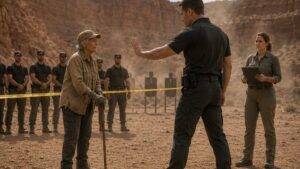
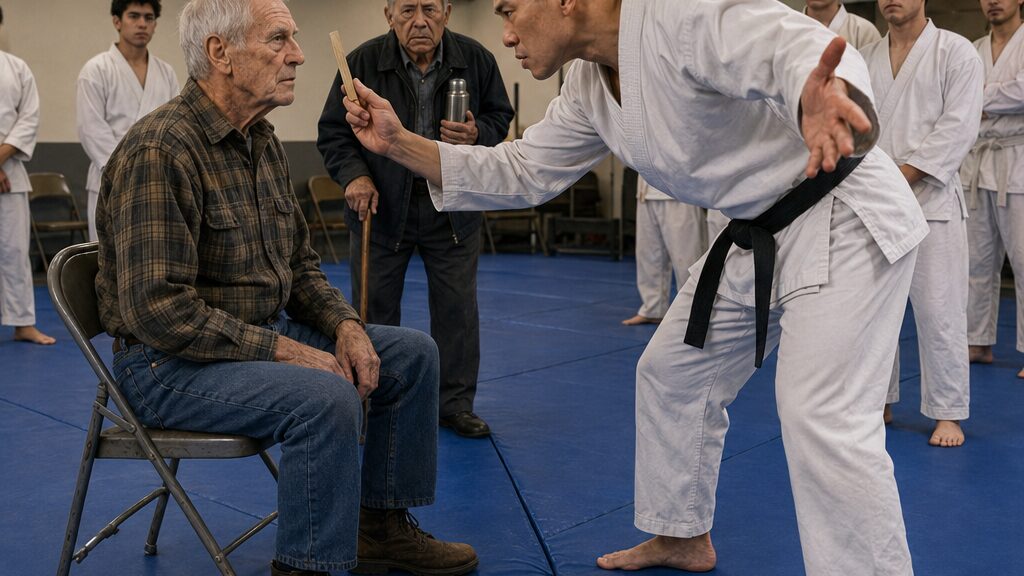
Brian Lee held the sliver of wood two inches from Samuel Adams’s face.
“Should I stop the whole class,” he asked, loud enough for every student on the blue mat to hear, “so we can get more furniture advice?”
A few people smiled because Brian was smiling. None of them laughed outright.
Samuel remained on the folding chair at the edge of the mat, his worn work boots planted evenly beneath his knees. The chair rocked when he shifted his weight. Its left rear leg was shorter than the others, and the thin wooden shim Brian had pulled from beneath it was the only thing that had kept the frame level.
Beyond Brian’s white gi, pairs of students stood frozen in half-finished grips. Fluorescent tubes hummed above them. Sweat and floor cleaner sharpened the air.
Samuel looked past the shim to the floor.
“You took that from the wrong place,” he said.
Brian’s smile tightened. “It came from under your chair.”
“Yes.”
“So the chair was the place.”
Samuel raised one hand, not toward Brian, but toward the narrow ridge where two sections of blue mat met. The vinyl had lifted into a shallow pucker no higher than a boot sole.
“That seam runs into the pivot line.”
Brian glanced over his shoulder. “It’s tape.”
“It’s movement.”
One of the adult students lowered his eyes. Another exchanged a look with his partner.
Brian leaned closer. At thirty-two, he had the balance and controlled posture of someone accustomed to being watched. His black belt was faded at the knot, though the rest of it looked newer. Samuel noticed that without deciding what it meant.
“We teach on these mats every day,” Brian said. “Nobody has had a problem.”
Samuel looked directly at him. “Then this is a good day to keep it that way.”
At the rear wall, Joseph Rivera stood with one hand wrapped around his cane and the other around a dented metal thermos. He had said little since Samuel arrived. Now his fingers tightened around the bottle.
Brian straightened and turned to the class.
“Apparently modern students need instruction in how to stand.”
That earned him two short laughs.
Samuel felt the old impulse rise: name the error, take the room, assign positions, force attention into order. Once, he had been able to silence forty soldiers with a look. The memory did not feel like power anymore. It felt like a door he had closed for a reason.
He placed both palms on his thighs.
“Who is demonstrating the outside entry?” he asked.
A lean young man near the center raised his hand. “I am, sir.”
“Jacob,” Brian corrected. “You don’t have to call every visitor sir.”
Jacob Martinez flushed. “Right.”
Samuel had watched him for twelve minutes. Fast hands. Good hips. Too much commitment in the rear foot.
“Show the first three movements,” Samuel said. “No throw.”
Brian laughed once through his nose. “We’re in the middle of class.”
“And I’m asking for six seconds.”
“You evaluating my students now?”
Samuel let the question remain where Brian had placed it. He looked at Jacob.
“Three movements. Stop before your partner’s weight leaves the floor.”
Jacob glanced at Brian.
The glance told Samuel more than the technique had.
Brian stepped aside with an open palm. “Go ahead. Let’s settle this.”
Jacob and his partner reset. Jacob stepped in, caught the arm, turned his hips, and drove his rear foot toward the pivot.
“Stop,” Samuel said.
Jacob tried. His heel clipped the raised seam. His body continued half a beat after his mind had obeyed. His partner compensated by widening his stance, and the grip tightened across his shoulder.
They staggered apart without falling.
Silence replaced the fluorescent hum.
Samuel pointed to the exact patch of mat beneath Jacob’s foot. “Again, but slower.”
Brian moved between them. “No. He stumbled because you interrupted him.”
Jacob opened his mouth, then closed it.
Samuel studied him. The young man flexed his fingers once, perhaps from embarrassment, perhaps from strain.
“The interruption is part of the test,” Samuel said.
“This isn’t basic training.”
“No.”
“We’re not drilling frightened recruits.”
“No.”
Brian’s jaw shifted. “Then stop talking like you’re in charge.”
The room had gone still in a different way now. Not attentive. Careful. The students were measuring which man could cost them more.
Samuel lowered his hand.
“The first movement was recoverable,” he said. “The second was not. His partner corrected late because the drill teaches him to finish once the entry begins. If that happens at full speed, the throw continues after control is gone.”
Joseph’s thermos gave a small metallic click against his cane.
Samuel turned his head.
Joseph was not impressed. He looked frightened.
Brian saw the glance and mistook it for uncertainty.
“You watched one repetition,” he said. “From a chair.”
“Yes.”
“You can’t even see the footwork from there.”
“I saw enough.”
Brian lifted the shim again. “You saw a bad chair and a wrinkle in the mat.”
Samuel reached out. For a moment Brian did not release the wood. Then he did.
Samuel placed the shim on the floor beside the raised seam.
“They’re the same kind of problem,” he said.
Brian folded his arms. “A chair and a student are the same problem?”
“A temporary correction mistaken for a repair.”
The words landed harder than Samuel intended. Brian’s expression changed—not wounded, exactly, but exposed.
Samuel recognized it because he had seen young officers wear the same look when a criticism reached beyond the immediate mistake.
Brian turned back to the class. “Reset. Full sequence.”
“No,” Samuel said.
The word came out with an old sharpness.
Every student faced him.
Brian took one step closer. “Excuse me?”
Samuel felt the room waiting for him to claim something. Rank. History. Authority. He could have told them why Kimberly Torres had asked him to visit, why a physical therapist from the veterans’ center had given her his number, why he had spent decades teaching people how to recognize the instant training stopped being training.
Instead he said, “Fix the seam first.”
Brian’s face hardened. “You don’t walk in here in work boots, sit at the edge of my mat, and tell me how to run a school you know nothing about.”
Joseph shifted his cane.
Samuel saw the movement and gave him a slight shake of the head.
Not yet.
Brian bent down again, close enough that Samuel could smell coffee on his breath.
“If you want to prove you understand the technique,” Brian said quietly, “stand up.”
Samuel’s right knee ached before he moved it. That was not why he stayed seated.
“No.”
A murmur passed through the students.
Brian nodded as if Samuel had confirmed everything he believed. “Then we’re done.”
The door from the front office opened.
Kimberly Torres entered carrying a canvas folder against her chest. She stopped when she saw the class standing idle, Brian over Samuel, and the thin wooden shim lying beside the mat seam.
“What happened?”
Brian stepped back. “Your visitor interrupted instruction.”
Kimberly looked at Samuel. Her eyes moved to the floor, then to Jacob, who was still rubbing his heel against the mat.
“Did you find something?”
“Several things,” Samuel said.
Brian frowned. “Find something for what?”
Kimberly’s grip tightened on the folder.
The students watched her now.
She drew a breath. “Brian, this is Samuel Adams. He’s here at the request of the veterans’ center.”
Brian said nothing.
Kimberly continued, “His assessment is required before they place the adaptive training program here.”
The silence that followed was not satisfying. Samuel saw the color change in Brian’s face and knew humiliation would only make the next decision worse.
Kimberly looked down at the wooden shim.
“Samuel,” she asked, “can this room be approved?”
He looked at the puckered seam, the unstable chair, Jacob’s guarded stance, and the students waiting for permission to notice what they had already seen.
“I haven’t finished looking,” he said.
Chapter 2: The Inspection Brian Decided Was Already an Insult
The storage shelf collapsed when Brian jerked the inspection binder from beneath a stack of striking pads.
A plastic bin tipped first. Foam blocks, frayed resistance bands, and two cracked focus mitts spilled across the floor. Then the middle shelf pulled free at one corner and dropped hard enough to send dust through the fluorescent light.
Brian stood in the mess holding a blue binder against his chest.
“There,” he said. “Current inspection records.”
Samuel looked at the rusted bracket hanging from one screw.
It was the following morning. Kimberly had closed the first class to give them time to walk the building before the adult students arrived. Brian had appeared in a clean white gi despite there being no class to teach.
Joseph, in dark work clothes, began gathering the fallen equipment with one hand while leaning on his cane.
“Leave it,” Samuel said.
Joseph looked up.
“I need to see how it fell.”
Brian gave a humorless laugh. “Of course you do.”
Samuel crouched slowly. His knee complained, and he steadied himself on the shelf frame. One screw was new. The other holes showed rings of worn wood where larger screws had once been forced in, removed, and replaced.
“Who repaired this?” he asked.
Brian flipped open the binder. “It’s not part of the training area.”
“That wasn’t my question.”
Kimberly stood in the doorway, keys looped around one finger. “My father used to handle most repairs.”
“And after he died?” Samuel asked.
She looked at Brian.
Brian turned a page. “We handle things as they come.”
Samuel rose with Joseph’s offered forearm, accepting the help without comment. Brian noticed. Samuel could tell by the quick glance toward his knee.
The binder’s first pages were clean forms in clear plastic sleeves. Fire exits. First-aid supplies. Mat sanitation. Equipment checks.
Farther back, the handwriting became hurried.
Samuel found the repair checklist from six weeks earlier. Beside “storage shelving,” “mat separation,” and “seating stability,” someone had written completed and signed Brian Lee.
Samuel carried the open binder into the training room.
The blue flooring had been cleaned. The pucker remained.
Three folding chairs stood against the wall. Samuel tested each with one hand. Two rocked. The third had folded cardboard beneath a front leg.
He opened the equipment drawer below the check-in counter.
Inside were three wooden shims cut from broken practice boards.
Brian shut the drawer. “What exactly are you trying to prove?”
“That the chair yesterday wasn’t an isolated shortcut.”
“They’re chairs.”
“One is for a man with a cane. Tomorrow it may be for someone transferring from a wheelchair.”
Joseph stopped beside the wall, thermos tucked beneath his arm. He looked at the unstable chairs without defending anyone.
Brian tapped the binder. “The mats are cleaned every night. We have a first-aid kit. We have certified instructors. You’re hunting for scraps of wood because you don’t like how I spoke to you.”
Samuel turned to him. “How you spoke to me isn’t part of the assessment.”
“It became part of it the moment Kimberly brought you in without telling me.”
Kimberly took a step forward. “I told you the veterans’ center was sending someone.”
“You said an evaluator. You didn’t say—”
He stopped.
“An old man?” Samuel asked.
Brian looked away first.
Kimberly pressed her lips together. “The municipal recreation contract includes the veterans’ class. If the trial succeeds, we get six months of guaranteed bookings.”
“How much?” Samuel asked.
She hesitated.
“Enough to keep the doors open through winter,” Brian said.
The anger in his voice had changed. It was no longer aimed only at Samuel.
Kimberly rubbed the edge of her key ring. “Enrollment dropped after my father died. The children’s classes cover utilities. Barely. The city contract covers rent, insurance, and repairs.”
“Repairs you must complete before the contract begins,” Samuel said.
“We know.”
“The checklist says you already did.”
Brian’s shoulders rose. “The city moved the review forward. The landlord raised the rent. We fixed what we could.”
“You signed for what you didn’t.”
“I signed because we had forty-eight hours to submit the packet.”
“And the seam?”
“I retaped it.”
Samuel nodded toward the ridge. “Over dirt. The adhesive never bonded.”
“We were going to redo it.”
“When?”
“Before certification.”
“That is in six days.”
Brian slapped the binder closed. “Do you think I don’t know that?”
The sound carried across the empty room.
For the first time, Samuel saw the exhaustion under Brian’s control. A faint tremor at the corner of one eye. Skin rubbed raw beneath the belt knot where he adjusted it too often. A man trying to hold a building together with the same tools used beneath the chairs.
Fear did not absolve deception. It did explain its shape.
Samuel walked to the edge of the mat and pressed the raised seam with his boot. It lifted again.
“What does the veterans’ class involve?” he asked Kimberly.
“Mobility work, controlled balance drills, safe falling where appropriate. The physical therapist designed it with the city.”
“Participants?”
“Eight to start. Ages fifty-eight to seventy-nine. Two cane users. One below-knee prosthesis. One recovering from a stroke.”
Brian said, “Which is why they won’t be doing advanced throws.”
Samuel looked at him. “A room teaches before an instructor speaks.”
Brian exhaled sharply. “That sounds good. It doesn’t mean anything.”
“It means people watch what a room tolerates. Loose seams. Unstable chairs. Students afraid to stop. Those are not separate lessons.”
Kimberly opened the canvas folder and removed the provisional assessment form. “Could we run a limited trial? No throws. No advanced class. The physical therapist present the entire time.”
Samuel did not take the form.
Brian laughed without amusement. “He’s already decided.”
“No,” Samuel said. “If I had decided, I’d have left yesterday.”
That quieted him.
Samuel pointed to the storage-room door. “The shelf stays down until it is anchored. Every chair gets tagged and checked. The seam comes up, the floor is cleaned, and it is bonded properly. Not covered. The first-aid kit gets inventoried. I want to see your stop protocol demonstrated by students, not described by instructors.”
Brian stared at him. “And if we do all of that?”
“I conduct the provisional trial.”
Kimberly’s relief appeared so quickly that she had to disguise it by looking down at the form.
Brian did not look relieved. “You make it sound like we’re careless.”
Samuel glanced at the completed checklist in his hand. “You documented repairs that did not occur.”
“You think one signature tells you who I am?”
“No. I think it tells me what pressure you were willing to pass down to everyone else.”
Brian’s face went pale.
Joseph shifted behind them, and his thermos clicked against the handle of his cane.
Kimberly stepped between the men. “We have work to do.”
For the next two hours, the room changed by inches. Bad chairs were marked with tape and removed. Joseph unscrewed the damaged shelf bracket. Kimberly called a flooring supplier. Brian inventoried the first-aid cabinet with clipped, angry precision.
Samuel watched him discard expired cold packs without being told.
That mattered.
So did the way Brian placed the signed checklist face down whenever anyone walked past.
Near noon, Kimberly left to meet the landlord. Brian carried the damaged chairs outside. Samuel remained by the mat seam, writing observations in a small notebook.
Joseph came to stand beside him.
“You were easier on him than you used to be,” Joseph said.
Samuel did not look up. “That is not praise.”
“It wasn’t meant as any one thing.”
Samuel closed the notebook.
Joseph turned the thermos in his hand until the deepest dent disappeared beneath his palm.
“You see the room,” he said. “Same way you always did.”
“No room is the same.”
“This one is close enough.”
Samuel looked toward the open door, where Brian was stacking chairs beside the alley wall.
Joseph lowered his voice.
“You walked away once because of a room exactly like this.”
Chapter 3: The Name Joseph Spoke but the Truth He Withheld
Joseph found Brian searching Samuel’s name on his phone two evenings later.
The final adult class had ended, but six students still lingered near the mat, tying shoes and talking about the upcoming certification. Brian stood by the check-in counter with his screen angled away from them.
Joseph stopped close enough to read the search results.
“Those won’t tell you what you want,” he said.
Brian locked the phone. “I didn’t ask.”
“You’ve been asking since he sat down.”
Samuel was in the storage room checking the new shelf anchors when he heard his name.
He stepped into the training room and saw the students turning toward Joseph.
Joseph rested both hands over the handle of his cane. His thermos stood on the counter beside Brian’s phone.
“He trained instructors before most of you were born,” Joseph said. “Army combatives, control systems, close-quarters judgment. Not tournament work. Not demonstrations.”
Samuel’s stomach tightened.
“Joseph.”
But Joseph continued.
“He built courses around keeping frightened people alive long enough to make a decision. Men who later ran programs of their own learned from him.”
One of the students glanced at Samuel’s plaid shirt and worn boots as if the clothes had become a disguise.
Brian crossed his arms. “So he was an instructor.”
Joseph looked at him. “He was the instructor other instructors called when their methods stopped working.”
“Joseph,” Samuel said again.
This time the room heard the warning.
Joseph’s jaw set. “They should know who they laughed at.”
“No.”
“You let him put his face inches from yours.”
“That is between him and his judgment.”
Brian’s eyes narrowed. “You could have told us.”
Samuel walked to the edge of the mat. The damaged chair had been removed, leaving a pale rectangle on the wall where its back had rubbed for years.
“What would it have changed?” he asked.
Brian gestured toward the students. “Maybe people would have listened.”
“Then they would have listened to a name instead of the problem.”
“That matters to you?”
“It should matter to anyone teaching.”
Joseph picked up his thermos. His thumb moved over the oldest dent, then he rotated it away.
“You saved my life,” he said.
Samuel’s response came too quickly to soften.
“That is not the whole account.”
The students went still.
Joseph stared at him. Something passed across his face—hurt first, then fear.
Brian noticed it.
Samuel wished the room were empty. He also knew that asking everyone to leave would turn the moment into a secret, and secrets had already done too much work.
He stepped onto the mat but stayed near its edge.
“Skill is not the same as authority,” he said. “And authority is not permission to continue.”
Brian gave a short laugh. “Continue what?”
“A technique after balance is gone. A drill after someone stops learning. A session after an instructor starts protecting the plan instead of the people.”
One student slowly untied and retied the same shoe.
Samuel looked at Jacob, who stood near the back rolling his right shoulder.
“When a person enters committed,” Samuel said, “there is a point where the body can still recover and a point where it can’t. Good instruction teaches both partners to recognize that line.”
Brian said, “We teach follow-through.”
“You reward it.”
“We teach decisiveness.”
“You punish interruption.”
“That’s not true.”
Yesterday, during the provisional veterans’ trial, Brian had done everything Samuel required. The chairs had been stable. The repaired seam had held through slow balance work. He had even knelt beside a stroke survivor and adjusted a stance without impatience.
But when Jacob had called stop during the advanced class afterward, Brian had made him repeat the sequence immediately.
Samuel had watched from the doorway.
“You asked him why he hesitated,” Samuel said. “You did not ask why he stopped.”
Brian glanced at Jacob. “He lost focus.”
Jacob’s hand fell from his shoulder.
Samuel saw it. So did Joseph.
“A stop is information,” Samuel said. “If students believe stopping costs status, they will hide information from you.”
Brian’s mouth flattened. “This school existed before you walked into it.”
“Yes.”
“Kimberly’s father built it.”
“Yes.”
“He trusted me to teach.”
Samuel waited.
Brian stepped onto the mat. “And now you show up for one week, find a loose seam, and everybody acts like I’ve been endangering people for years.”
“No one said years.”
“You didn’t have to.”
There it was: not arrogance alone, but the terror of a man who believed authority could be revoked the moment someone older entered the room.
Samuel knew that fear. He had simply worn it differently.
Joseph said, “Samuel isn’t here to take your school.”
Brian looked at him. “You just told everyone he trained half the people who mattered.”
“I said he trained instructors.”
“You said they called him when their methods failed.”
Joseph lifted his chin. “They did.”
Samuel closed his eyes briefly.
Admiration could distort as efficiently as contempt. One made a man smaller than he was. The other made him cleaner.
“Why did you stop?” Brian asked.
Joseph’s thermos went still in his hand.
Samuel opened his eyes.
Brian continued, “If you were that good, why did you walk away?”
The fluorescent lights hummed. Somewhere in the office, the old refrigerator compressor started with a rattle.
Samuel could feel Joseph waiting to answer for him.
He did not allow it.
“Because there are failures a person should not turn into credentials,” he said.
Brian watched him carefully. “What failure?”
Samuel looked at Joseph.
The older man’s fingers tightened around the thermos until the metal clicked.
“Not tonight,” Samuel said.
Brian nodded, but there was no acceptance in it. Only confirmation of whatever suspicion had begun to form.
The students left in twos. Their conversations began only after the front door closed behind them.
Jacob stayed long enough to wipe the mat. He avoided Samuel’s eyes.
When the room was empty, Joseph drove them to a diner three blocks away. They sat in a booth beneath a window that reflected more of the interior than the dark parking lot outside.
Joseph poured coffee from the thermos instead of ordering it.
“You made it sound worse,” he said.
Samuel watched steam rise from the metal cup. “You made it sound better.”
“I told them what happened.”
“You told them what you wanted remembered.”
Joseph turned the thermos again, hiding the oldest dent.
“You did save my life.”
“And before that?”
“You trained me.”
“Before the medics. Before the hospital. Before all the parts you repeat.”
Joseph looked toward the counter.
Samuel did not press. He had spent years refusing to press, then calling that refusal mercy.
At last Joseph said, “I made my own choice.”
“You were a trainee.”
“I was a grown man.”
“I was responsible for the room.”
Joseph’s eyes sharpened. “You think carrying all of it is accountability. Sometimes it is vanity.”
The sentence struck cleanly.
Samuel looked down at his hands.
Joseph leaned back. “Brian needs correcting. That does not mean you have to put yourself on trial every time you open your mouth.”
“And defending me does not mean you get to remove the part that hurts.”
Neither spoke for a while.
When they returned to the dojo, the front lights were still on.
Through the glass, Brian stood at the counter with Kimberly. A printed schedule lay between them.
Jacob’s name had been written beneath the heading CERTIFICATION DEMONSTRATION.
Brian saw Samuel at the door and taped the schedule to the wall.
“High-intensity sequence,” he said. “The municipal coordinator wants to see the advanced program as well as the veterans’ class.”
Samuel read the order of techniques.
The final throw began with the same committed pivot Jacob had stumbled through.
Brian tapped the page.
“Jacob receives,” he said. “I demonstrate.”
Samuel looked at Jacob’s name, then at Brian.
This was not proof of what Brian intended.
It was enough to make the question unavoidable.
Chapter 4: A Perfect Demonstration Built on a Hidden Failure
Jacob dropped the water bottle before the cap was fully tightened.
It struck the edge of the blue mat, bounced once, and rolled beneath the row of folding chairs. Water spread in a thin silver sheet across the vinyl.
Brian stopped mid-instruction.
Jacob stared at his right hand as if it belonged to someone else.
“You all right?” Kimberly asked from the office doorway.
“Slipped,” Jacob said.
Samuel had been watching his fingers.
The thumb and first finger had closed. The last two had not.
Jacob crouched quickly, wiped the spill with the sleeve of his training shirt, and reached beneath the chairs. When he stood, he had the bottle in one hand and the wooden shim in the other.
The repaired chair still rocked without it.
Brian glanced toward the front windows, where the municipal recreation coordinator was expected for a rehearsal walkthrough in less than an hour.
“Put it back,” he said. “I need this room to look level.”
Jacob knelt and pressed the sliver beneath the shortened leg.
Samuel felt the phrase settle in him.
Not be level.
Look level.
The mat seam had been lifted, cleaned, and bonded again. The storage shelf stood firm. The first-aid kit had been restocked. From the doorway, the dojo looked transformed.
From inside it, Samuel could still see what had not changed.
Brian clapped once. “Certification sequence from the top. Jacob receives. Everyone else watches spacing.”
Samuel stood beside the wall with his notebook closed. The adult students formed a loose semicircle around the mat. Kimberly moved folding chairs into a straighter row, stopping twice to check their alignment.
Brian began with basic entries, then progressed through controlled takedowns. His movements were clean. Jacob followed well enough that anyone unfamiliar with him would have seen only speed and obedience.
Samuel saw the slight delay each time Jacob posted with his right arm.
After the fourth sequence, Jacob rubbed the outside of his forearm against his gi.
“Stop,” Samuel said.
Brian exhaled through his nose. “For what?”
Samuel looked at Jacob. “Come here.”
Jacob glanced at Brian before obeying.
Samuel held out his hand. “Squeeze.”
Jacob gripped it.
“Again.”
The second squeeze was weaker.
Brian crossed the mat. “He’s been training for an hour.”
“Which fingers are numb?” Samuel asked.
Jacob’s face changed.
Kimberly looked up from the chairs.
“None,” Jacob said.
Samuel waited.
The young man swallowed. “Two. Sometimes.”
“Which two?”
Jacob touched his little finger and ring finger together.
“How long?”
“A couple days.”
Brian’s head turned sharply. “You didn’t tell me that.”
“I said my arm felt strange after Tuesday.”
“You said it was tight.”
“I thought it was.”
Samuel released Jacob’s hand. “No demonstration today.”
Brian stepped between them. “You don’t know what caused it.”
“No.”
“It could be sleeping wrong.”
“Yes.”
“It could be nothing.”
“Yes.”
“Then you don’t cancel a certification sequence over two numb fingers.”
Samuel looked at him. “I do not need to know the cause to know the current condition is unacceptable.”
The students watched without pretending not to.
Brian lowered his voice. “The coordinator is coming to see the full program.”
“Then show a program that can adjust.”
“We have six days of work built around Jacob receiving.”
“Choose someone else.”
“There is no one else at his level who knows the sequence.”
“That is a planning problem.”
Brian’s eyes hardened. “Everything is easy when you’re not the one keeping the doors open.”
Samuel felt the truth inside the accusation. It did not make the conclusion safer.
Kimberly came closer. “Jacob, did you tell your mother?”
“I’m nineteen.”
“That wasn’t my question.”
“No.”
Brian looked toward the clock. “We modify. No full landings. Jacob can mark the last two throws.”
Samuel opened the printed sequence taped to the wall.
The order had changed since the version he had seen two nights earlier. The most demanding rotational throw had been moved from the middle to the end, after five minutes of grip fighting and repeated breakfalls.
“You moved this,” he said.
Brian glanced at the page. “It presents better at the finish.”
“It requires the strongest grip after fatigue.”
“It requires commitment.”
“From a student losing sensation in his hand.”
“He won’t complete the fall.”
Samuel turned to Jacob. “When your hand goes numb, do you release earlier or later?”
Jacob looked down.
“Later,” he said.
Brian’s jaw tightened. “Because he compensates. We can manage that.”
Samuel pointed to the final sequence. “This entry commits his rear foot. His right arm is the post. If the foot catches or the hand fails, he cannot protect the shoulder.”
“The seam is fixed.”
“The seam was one condition.”
Brian spread his hands. “So now the floor is safe and you’ve found a new reason.”
“It is not a new reason. It is new information.”
The recreation coordinator arrived before Brian could answer.
She entered carrying a tablet, followed by the physical therapist from the veterans’ center. Kimberly moved at once to greet them.
Brian’s posture changed. The tension left his face and reappeared as professional calm.
“Welcome,” he said.
Samuel watched Jacob flex his numb fingers behind his back.
The rehearsal went forward in reduced form.
Brian omitted the final throw while the visitors watched. He demonstrated adaptive balance work with careful pacing. He explained stop signals clearly. When the physical therapist asked Jacob whether he felt safe receiving techniques, Jacob smiled and said yes.
Samuel said nothing.
That was his mistake.
He told himself Jacob was an adult. He told himself the sequence had been modified. He told himself Kimberly had heard the warning and Brian had omitted the dangerous finish.
What he did not tell himself was that he had seen this pattern before: a trainee protecting an opportunity, an instructor protecting a plan, and a room rewarding both for not disrupting it.
The coordinator seemed pleased.
“This is much more comprehensive than the packet suggested,” she said.
Kimberly’s shoulders dropped with relief.
Brian thanked her and offered to show the advanced sequence at the official certification. “Full pace,” he added. “So you can see the progression available to younger participants and family members.”
Samuel looked at him.
Brian did not look back.
After the visitors left, Jacob found Samuel in the back office.
The young man closed the door but remained standing.
“You were right about my foot,” he said.
Samuel waited.
“Tuesday. I felt it catch before I turned. I pushed because everyone was watching.”
“Why tell me now?”
Jacob pressed the numb fingers against the edge of the wooden shim he had brought from the chair.
“Because Brian says hesitation becomes a habit.”
“It does.”
Jacob looked surprised.
“So does hiding injury,” Samuel added.
“I need the assistant position.”
“You need your hand longer.”
“If I pull out now, he’ll pick someone else.”
“That may happen.”
Jacob’s expression tightened. He had come for reassurance and found none.
Samuel leaned back against the desk. “You are asking me to promise that doing the correct thing will not cost you.”
Jacob said nothing.
“I cannot.”
“Then what am I supposed to do?”
“Tell Kimberly. Withdraw from the demonstration. Get evaluated.”
Jacob stared at the floor. “Can you give me until tomorrow?”
Samuel should have said no.
He could have opened the door and called Kimberly in. He could have removed the decision from Jacob’s hands. Once, he would have.
Instead he remembered a different room, a younger Joseph, senior officers behind glass, and his own voice cutting through every objection because he believed command meant deciding for everyone.
“Until the morning,” Samuel said. “No training before then.”
Jacob closed his fingers around the shim. “Thank you.”
It was not gratitude Samuel deserved.
By late afternoon, the rehearsal had become a success in everyone’s telling but his. Kimberly spoke of corrected deficiencies. Brian spoke of professional standards. Students repeated that the coordinator had seemed impressed.
Samuel stood beside the repaired mat seam and watched the room congratulate itself for passing a test that had not actually occurred.
Kimberly entered from the office holding her phone.
Her face was pale.
“The city had a cancellation,” she said. “They moved the official certification.”
Brian looked up. “To when?”
“Tomorrow morning. Nine o’clock.”
Jacob’s hand closed around the wooden shim in his pocket.
Samuel saw the movement.
There would be no night for repair, no day for medical evaluation, and no more room left between warning and choice.
Chapter 5: The Throw That Continued After Control Was Gone
Samuel heard Jacob’s rear foot scrape twice before the demonstration began.
The first scrape came while he warmed up near the repaired seam.
The second came when Brian called him to center and the municipal coordinator raised her tablet.
Both sounds were soft enough to disappear beneath conversation. Samuel heard them anyway.
The dojo was crowded. Adult students lined the wall. Four veterans from the trial class sat on inspected folding chairs beside the physical therapist. Kimberly stood near the office door with a folder pressed to her ribs.
Joseph occupied his usual place at the rear, cane in one hand, thermos in the other.
Jacob wore a clean white gi. His right hand opened and closed at his side.
Samuel crossed the edge of the mat.
“Did you tell her?” he asked.
Jacob did not pretend to misunderstand. “Not yet.”
“Step off.”
Brian came between them. “We’re starting.”
“He is not.”
The coordinator lowered her tablet slightly.
Brian kept his voice measured. “Jacob has been cleared to participate.”
“By whom?”
“He says he’s fine.”
Samuel looked at Jacob.
The young man’s silence answered.
Kimberly moved closer. “What is this?”
“His right hand has intermittent numbness,” Samuel said. “He needs evaluation before receiving.”
Every face in the room turned toward Jacob.
Color rose beneath his collar.
Brian’s composure cracked. “He told me this morning it was gone.”
Jacob looked at him. “I said it was better.”
“You said you could do the sequence.”
“I can.”
Samuel heard the old hunger in the words. Not confidence. Need.
The coordinator asked, “Is this a safety concern?”
Brian answered before anyone else. “We have modified the demonstration. No uncontrolled landings.”
Samuel looked at the printed sequence posted on the wall.
The final rotational throw remained.
“You restored the full order,” he said.
“We’re demonstrating progression.”
“With a compromised receiving arm.”
Brian stepped closer. Not as close as he had on the first day, but close enough to make the room choose sides again.
“You are not the medical provider,” he said.
“No.”
“You are not the owner.”
“No.”
“You are not the head instructor.”
“No.”
“Then stop overruling everyone who is.”
The coordinator’s eyes moved between them.
Samuel felt the room tightening around visible authority. Brian had the belt, the gi, the floor, and the language of procedure. Samuel had a plaid shirt, worn boots, an aching knee, and an observation he had failed to force into action the day before.
He turned to Kimberly.
“You know now. Decide.”
Her face tightened. “Jacob, do you want to withdraw?”
Jacob looked at Brian.
Brian did not speak.
He did not need to.
“No,” Jacob said. “I want to continue.”
Kimberly hesitated too long, then nodded. “Modified sequence. Stop if anything changes.”
Samuel felt something inside him sink.
The demonstration began.
Brian moved with greater control than Samuel expected. He explained each entry. He paused after takedowns. He asked Jacob twice whether he was ready.
Jacob said yes.
For several minutes, the room relaxed.
The coordinator made notes. The veterans watched closely. The physical therapist asked one question about hand placement, and Brian answered correctly.
Samuel knew how danger often entered a room: not through obvious failure, but through enough success to make the next warning seem unreasonable.
Jacob’s breathing deepened.
His right hand began to lag.
Brian initiated the grip-fighting segment. Jacob resisted, released, regripped. On the third exchange, his little finger remained curled after the others opened.
Samuel stepped forward.
“End it there.”
Brian continued explaining the transition.
“Brian,” Samuel said. “Stop.”
The word carried.
The students along the wall went quiet.
Brian faced him. “We are under control.”
“His hand is failing.”
Jacob shook his head. “I’m okay.”
Samuel pointed to the hand. “Open it.”
Jacob tried.
The last two fingers moved late.
The physical therapist stood. “He should stop.”
For one second, Samuel believed that would settle it.
Then Brian looked at the coordinator, at Kimberly, at the room, and at the contract he had already spent in his mind.
“One final entry,” he said. “No throw. We show the position and release.”
Samuel stepped onto the mat.
“No.”
Brian’s voice sharpened. “Mr. Adams, step back.”
It was the first time he had used Samuel’s name in front of the class.
Samuel did not move.
Brian’s face flushed. “You do not have authority to halt this certification.”
Samuel looked at Jacob.
“You do,” he said.
Jacob swallowed.
The room waited.
Brian extended his hand. “Ready?”
Jacob looked at Samuel, then at the students, then at the coordinator’s tablet.
He took Brian’s grip.
Samuel’s failure occurred in the space before the first movement.
He could have crossed the mat. He could have physically broken the grip before momentum began. Instead, some old law inside him held: Jacob had been given the choice. Kimberly had been given the facts. The therapist had objected. Samuel had spoken.
He had done enough.
Then Jacob’s foot scraped.
Once.
Twice.
Brian entered.
Jacob’s rear heel caught the slight rise where the repaired seam met the older mat. His hips stopped, but his upper body continued. His right hand failed to post. Brian felt the imbalance and tightened his grip instead of releasing it.
“Stop!” Samuel shouted.
Brian tried to recover the demonstration.
That was the fatal half-second—not a deliberate attack, but a decision to preserve the sequence after control was gone.
Jacob’s shoulder rotated beneath him. His neck turned late. He struck the mat with a flat, ugly sound and did not complete the breakfall.
Someone screamed.
Brian dropped to one knee and reached beneath Jacob’s shoulders.
“Don’t move him.”
Samuel’s voice cut across the room.
Brian froze.
Samuel was already lowering himself beside Jacob. Pain shot through his knee, but he controlled the descent and placed one hand near Jacob’s head without touching it.
“Jacob, look at me.”
Jacob’s eyes were open.
“Can you breathe?”
“Yes.”
“Any pain in your neck?”
A pause. “Yes.”
“Do not move.”
Brian’s hands hovered uselessly. “We need to sit him up.”
“No.”
“He can’t stay flat.”
“He stays exactly where he is.”
The physical therapist came around Jacob’s other side. “I’m calling emergency services.”
Samuel nodded. “Tell them possible neck and shoulder injury, altered hand function before the fall.”
Kimberly backed into the row of chairs. One rocked against the wall.
Joseph moved forward on his cane.
In the confusion, someone’s heel struck the wooden shim beneath the repaired chair. The sliver skidded across the mat and stopped beside Jacob’s motionless right hand.
Samuel saw it.
For an instant the blue floor changed beneath him.
Not in appearance. In memory.
A different training hall. Gray mats. Boots along a wall. Joseph younger by decades, insisting he could continue. Officers watching through glass. Samuel hearing the warning in Joseph’s breathing and choosing the schedule over the man.
The old room pressed against the new one.
“Samuel.”
The therapist’s voice pulled him back.
Jacob’s breathing had quickened.
Samuel lowered his tone. “Stay with me. Name five things you can see.”
Jacob blinked. “Lights.”
“Good.”
“Your shirt.”
“Yes.”
“The sign.”
“What sign?”
“Exit.”
“Good.”
Brian sat back on his heels, face drained of color.
Samuel looked at him. “Move everyone away. Clear a path from the door. Do not touch the mats around him.”
Brian obeyed.
No argument. No visible rank. He stood and moved the students with short instructions, then dragged the folding chairs aside one by one.
The coordinator lowered her tablet and stopped recording notes.
Kimberly knelt several feet away. “Jacob, I called your mother.”
His eyes closed.
“Keep them open,” Samuel said.
Jacob opened them again.
The emergency medical technicians arrived within minutes, though the waiting made time lose its shape. Samuel gave them the sequence in precise order: prior numbness, delayed finger opening, caught foot, failed post, continued rotation, neck pain.
They fitted a collar and transferred Jacob without lifting him by the shoulders.
When the stretcher passed through the door, Jacob’s mother entered from the parking lot at a run. Kimberly intercepted her and followed outside.
The dojo fell silent.
The wooden shim remained on the mat.
Brian stood in the center of the room, his black belt hanging slightly crooked.
“I thought he could finish,” he said.
No one answered.
“He told me he could.”
The physical therapist looked at him. “You knew he had symptoms?”
Brian’s eyes moved to Samuel.
“I knew he’d complained about his hand,” he said. “He said it was better.”
“You restored the full sequence,” Samuel said.
Brian’s mouth opened, then closed.
The coordinator gathered her papers. “The certification is suspended.”
Kimberly returned in time to hear it.
“For how long?” she asked.
“Pending the medical report and an independent safety review.”
“The contract?”
“Also suspended.”
Kimberly gripped the doorframe.
Brian removed neither his belt nor his authority. He simply stood where both had failed him.
Joseph crossed the mat slowly. His cane touched down near the shim.
He looked at Jacob’s empty place, then at Samuel.
“Not again,” he whispered.
Samuel could not answer.
The words reached farther than Joseph intended. The coordinator heard them. Kimberly heard them. Brian turned.
Joseph’s face changed as he realized the room was waiting.
For years he had protected Samuel by telling only the part that inspired gratitude. Now the same silence stood beside another stretcher.
He set his thermos on the floor.
“I was the trainee,” he said.
Samuel looked at him.
Joseph’s hand tightened on the cane.
“The one he failed to stop.”
Chapter 6: The Veteran Refused the Legend They Tried to Give Him
Kimberly placed the drafted statement on the desk and pushed it toward Samuel.
The first sentence called him a decorated master instructor whose exceptional intervention had exposed unsafe modern practices.
Samuel read no further.
Outside the office, the dojo remained closed. No students crossed the blue mat. The fluorescent lights over the training area were off, leaving the room gray and flat beyond the glass.
Jacob was still at the hospital. Imaging had shown no spinal fracture, but his shoulder had been injured and the nerve symptoms required further evaluation. His mother had allowed Kimberly one brief visit and had not accepted her apology.
The city wanted a written account by the end of the day.
Kimberly folded her hands. “The coordinator asked for context. Your background matters.”
“Yes.”
“This gives it.”
“No.”
Brian sat against the far wall without his gi jacket. His black belt lay coiled on the chair beside him. Joseph stood near the filing cabinet, cane planted between his shoes, thermos untouched.
Kimberly tapped the paper. “It says you identified the risk and managed the emergency.”
“That is accurate.”
“It says your military experience gave you the judgment to intervene.”
“That is partly accurate.”
Her voice sharpened. “What do you want me to write?”
Samuel took the pen.
He crossed out decorated master instructor.
He crossed out unsafe modern practices.
He crossed out the sentence suggesting the injury occurred because Brian rejected traditional expertise.
Then he wrote beneath the first paragraph in block letters:
I observed warning signs before the demonstration and did not take sufficient action to ensure the participant was removed.
Kimberly stared at the line.
“That makes it sound like this was your fault.”
“It makes it sound like I had information and stopped short of using it.”
“You advised him to withdraw.”
“Privately.”
“You told us about the numbness.”
“This morning. After I gave him until morning.”
Brian looked up.
Joseph shifted his weight. “Samuel.”
“No.”
The word was not loud. Joseph fell silent anyway.
Samuel turned the page over.
“Years ago,” he said, “Joseph was in an advanced military course under my supervision. He had already taken a hard landing. His balance changed. His breathing changed. I saw it.”
Joseph’s jaw tightened.
“He told me he could continue,” Samuel said. “Senior officers were observing. The schedule was behind. I believed stopping the exercise would make the entire course look undisciplined.”
Brian stared at him.
Samuel continued before Joseph could interfere.
“I let him proceed. The next sequence caused damage that ended his operational career.”
Joseph struck the floor once with the rubber tip of his cane. “I insisted.”
“You were a trainee.”
“I was not a child.”
“No. You were a man under my authority in a room where stopping had become shameful.”
Joseph’s eyes shone with anger. “You gave the stop order.”
“After.”
“You got the medics there.”
“After.”
“You stayed at the hospital.”
“After.”
Each word made the office smaller.
Samuel set down the pen.
“What I did afterward mattered,” he said. “It did not correct what I failed to do before.”
Brian looked at the coiled belt beside him. “Why did you leave teaching?”
“I was removed from that course pending review. The finding was shared responsibility and inadequate safety controls. I was allowed to return.”
“But you didn’t.”
“No.”
“Why?”
Samuel looked through the office window at the dark mat.
“Because I did not trust the part of me that had wanted the room to continue.”
Joseph’s grip loosened on the cane.
Kimberly sat back. The drafted statement remained between them, covered in black lines.
“You could have told me,” she said.
“Yes.”
“When I invited you.”
“Yes.”
“Before I put you in front of Brian and the students.”
“Yes.”
“Why didn’t you?”
Samuel met her eyes. “Because I came to inspect your room instead of admitting I was also afraid of mine.”
No one moved.
The old refrigerator in the corner started with its usual rattle.
Joseph picked up his thermos and turned it in both hands.
“I thought I was protecting you,” he said.
Samuel waited.
“Every time someone asked why you stopped,” Joseph continued, “I told them you were tired of politics. Or that the Army had changed. Or that you’d already given enough.”
“You made it clean.”
“I made it survivable.”
“For whom?”
Joseph looked down at the oldest dent in the thermos. This time he did not rotate it away.
“For me too,” he said. “If you failed me, then I had to admit I helped you do it. I wanted to finish. I wanted those officers to see me finish. I kept saying I was fine because I thought endurance was the same thing as worth.”
Samuel felt the truth enter without relieving either of them.
Joseph looked toward the training room. “I kept telling the heroic version because it meant neither of us had to learn how to come back.”
The sentence remained between them.
Brian stood.
“I’ll resign.”
Kimberly closed her eyes.
Brian lifted the coiled belt from the chair. “The city wants accountability. They can have mine.”
Samuel looked at him. “Then what changes?”
Brian’s face hardened. “I’m the head instructor. It happened under me.”
“Yes.”
“So I leave.”
“And the next instructor inherits the same repair forms, the same financial pressure, and students who think stopping costs them status.”
“What do you want from me?”
“Do you want to resign because it protects students, or because you cannot bear to stand in the room after they know you were wrong?”
Brian flinched.
Samuel did not enjoy it.
Brian’s hand closed around the belt. “You think I should stay?”
“I think resignation can be another way to avoid instruction.”
Kimberly folded the false statement in half. Then again.
“The city suspended the contract,” she said. “They want an independent review. The landlord still wants rent. Jacob may not train for months.”
No one offered comfort.
Three days later, they met again in the closed dojo.
Jacob had been discharged with his arm in a sling and instructions for follow-up care. He did not attend. His mother had asked for distance, and Kimberly had respected it.
The damaged chair stood at the edge of the mat. Someone had placed the wooden shim beneath it again.
Samuel walked over, lowered himself carefully, and removed the sliver.
The chair rocked.
He held the wood between both hands.
Brian watched from across the room. “What are you doing?”
Samuel snapped the shim in half.
The sound was small but final.
He placed both pieces on the seat.
“We stop pretending temporary support is repair.”
Kimberly crossed her arms. “What does repair look like?”
“External safety review. Medical disclosure rules. Stop authority for every participant. No certification demonstration built around one irreplaceable receiver. Repairs documented by the person who performs them, not the person who needs the form completed.”
Brian’s face tightened at the last condition.
“And you?” Kimberly asked.
Samuel looked at the blue mat.
“I conduct one demonstration.”
Joseph raised his head.
Brian’s expression closed. “Against me?”
“With you.”
“What proves that?”
“Nothing, if proof means one man winning.”
Samuel moved to the stable chair beside the damaged one and sat.
“No rank privilege,” he said. “Any participant may stop the exchange. The stop is obeyed before explanation. We use the same committed entry that failed during certification.”
Brian stared at him. “You want me to throw you?”
“I want you to enter.”
“And then?”
“We stop at the first point where harm becomes unnecessary.”
Brian looked at Samuel’s knee, then at the chair.
“You’re staying seated?”
“Until movement is required.”
Brian gave a short, disbelieving breath.
Samuel rested his hands on his thighs.
“If you accept, the room is open to the independent reviewer, the therapist, and the students. No speeches. No bowing for the camera. No one loses a belt.”
“And if I refuse?”
“Then you refuse.”
Brian looked at Kimberly.
She did not decide for him.
At last he faced Samuel again.
“What is the stop signal?”
For the first time, he had asked before beginning.
Chapter 7: What Mastery Looked Like When Nobody Had to Lose
Brian began to bow.
Samuel stopped him with one raised hand.
“Do you understand the stop signal?”
Brian straightened slowly. The room was quiet enough for the fluorescent lights to sound louder than they had a week before.
“Yes.”
“Say it.”
“Open hand against the other person’s arm, or the word stop.”
“And if you think the person is wrong to use it?”
“I stop.”
“And if the movement feels safe to you?”
“I stop.”
Samuel lowered his hand. “Good.”
The repaired dojo looked almost unchanged from a distance. Blue mats covered the same floor. Folding chairs lined the same wall. The old refrigerator still rattled in the office. Joseph still stood near the back with his cane and metal thermos.
But the damaged chair was gone.
In its place stood a chair with four equal legs and a new rubber cap on each foot. Nothing had been wedged beneath it. The empty space under the rear corner caught Samuel’s eye more than the chair itself.
The independent safety reviewer stood beside the physical therapist. Kimberly had invited the adult students, the veterans from the trial class, and Jacob, who watched from a chair with his right arm supported in a sling.
His mother sat beside him.
The municipal coordinator had come but carried no tablet. The contract remained suspended. Everyone in the room knew it.
Brian wore his white gi and black belt. He had tied the belt neatly, but he no longer touched the knot every few minutes.
Samuel wore the same faded plaid shirt and work boots he had worn the first day.
He sat at the edge of the mat.
Brian looked at the chair, then at Samuel’s knee.
“Do you need more room to stand?”
“I need you to begin from where we agreed.”
Brian moved to the center of the mat.
Samuel addressed the room without raising his voice.
“This is not a contest. It is not proof that one method is old and another is new. Brian will use the same committed entry from the certification demonstration. We will stop at the first decision point where continuing no longer serves control.”
One of the students asked, “How will we know where that is?”
“You may not see it the first time.”
Brian glanced toward Samuel. “And if I don’t feel it?”
“Then that is what we examine.”
Samuel pushed himself upright.
His right knee resisted. The room saw it. He did not rush to hide the stiffness, and no one stepped forward to help before he asked.
Once standing, he placed one boot on the mat and tested the surface. The repaired seam lay flat beneath the sole.
He walked to Brian.
They stood an arm’s length apart.
The first time Brian had confronted him, he had bent until his face nearly touched Samuel’s. Now he waited at a respectful distance.
Samuel held out his left wrist.
“Take the grip.”
Brian did.
“Not carefully.”
A trace of the old defensiveness crossed Brian’s face. “You said this wasn’t a contest.”
“It isn’t. Give me the committed entry you intended to demonstrate.”
Brian tightened his hand.
Samuel felt the strength in it. Brian was faster, younger, and fully capable of putting him on the floor if Samuel misjudged the timing. Samuel’s knee would not tolerate a wide recovery step. His right shoulder had lost range years ago.
He had no intention of pretending otherwise.
“Ready?” Brian asked.
Samuel nodded.
Brian entered.
His first step was clean. His second drove across Samuel’s center, hips turning to load the throw. It was the same sequence that had carried Jacob past the point of recovery.
Samuel did not resist the force head-on.
He shifted half a step before Brian’s hips completed the turn, placed his forearm against the upper arm, and changed the angle of the grip. Brian’s momentum passed into empty space. His rear foot lifted, searching for the floor he expected to find.
Samuel opened his hand against Brian’s arm.
“Stop.”
Brian stopped.
The entire exchange had taken less than two seconds.
No one applauded.
Samuel released him immediately.
Brian remained bent at the waist, balanced but unable to complete the throw without changing his position.
“Where did you lose it?” Samuel asked.
Brian looked down at his feet.
“When you moved outside my hip.”
“Earlier.”
Brian frowned.
Samuel reset them.
“Again. Slower.”
Brian repeated the entry.
Samuel stopped him before the turn.
“Here.”
“My grip is still secure.”
“Yes.”
“My balance is fine.”
“For now.”
Samuel tapped Brian’s rear elbow.
“Your shoulder has crossed your base. You have committed to the finish before confirming my weight is where you expect it. If I resist, slip, collapse, or lose consciousness, what tells you to continue?”
Brian’s eyes shifted toward Jacob.
“The sequence,” he said.
“The sequence cannot feel the person.”
Samuel stepped back.
“That was the missed decision point. Not the seam. Not the hand. Those increased the risk. The failure was continuing because the plan still existed after control did not.”
The physical therapist nodded once.
Brian stared at the place where his foot had landed.
Samuel could have left him there. A week earlier, part of him might have wanted the room to see Brian diminished.
Instead he said, “Your entry was technically sound.”
Brian looked up.
“That is why the error was difficult to see,” Samuel continued. “Bad technique announces itself. Bad judgment often wears good technique.”
The words settled across the mat.
Jacob shifted in his chair.
His mother rested one hand over his uninjured wrist.
Brian retied nothing. Adjusted nothing. He simply stood.
“My instructor used to say hesitation gets people hurt,” he said.
Kimberly’s face tightened at the reference to her father.
“He said it to me every time I asked to lead,” Brian continued. “I taught children for six years. Cleaned the mats. Opened the building. Covered classes when he was sick. But when parents asked who would take over, he said I wasn’t ready.”
Kimberly looked at him. “He never told me that.”
“He told me every week.”
The bitterness in Brian’s voice was controlled, but no longer concealed.
“When he died, everyone looked at you because your name was on the lease. They looked at me because I was standing on the mat. I thought the contract would prove he had been wrong about me.”
Samuel listened.
Brian glanced at the suspended certification notice posted near the office.
“When you came in,” he said, “I saw another older instructor deciding I had not earned the room.”
Samuel nodded. “So you made every warning into a judgment about you.”
“Yes.”
“That explains it.”
Brian waited.
“It does not excuse it.”
“I know.”
The response carried no challenge.
The safety reviewer stepped forward after the demonstration. She did not approve the dojo. She listed conditions instead: revised reporting procedures, independent equipment inspections, instructor retraining, written stop authority, and medical clearance standards.
The municipal coordinator confirmed that the contract would remain suspended until those conditions were met.
Kimberly did not argue.
“We’ll do them,” she said.
The certainty in her voice was different from desperation. It contained cost, delay, and the possibility of failure.
After the formal review, the room loosened by degrees.
Jacob approached Samuel with his mother beside him.
“I should have told Kimberly sooner,” he said.
Samuel looked at the sling. “Yes.”
Jacob gave a nervous half-smile. “You could say something encouraging.”
“You told her now?”
“I gave the reviewer the full timeline.”
“Then that is encouraging.”
His mother studied Samuel before extending her hand.
“Thank you for what you did after he fell.”
Samuel accepted it. “I should have done more before.”
She held his gaze for a moment, then nodded.
Neither of them tried to make the sentence lighter.
Kimberly found Samuel beside the row of chairs.
“I want you to take over the program,” she said.
“No.”
She blinked. “You haven’t heard the terms.”
“I do not need them.”
“We need someone the city trusts.”
“That is not the same as building a system people can trust.”
“What will you agree to?”
Samuel looked across the room.
Brian was helping the safety reviewer photograph the repaired seam. Joseph had set his thermos on a chair and was showing Jacob how to adjust the rubber foot on his cane.
“Twice a month,” Samuel said. “Advisory role. I do not approve my own recommendations. The therapist has equal stop authority. Brian remains responsible for implementing the changes.”
Kimberly glanced toward Brian. “You want him to stay?”
“I want the choice to stay to cost him something other than pride.”
“And you?”
Samuel looked at the stable chair.
“I am learning the same condition.”
Kimberly nodded slowly. “Twice a month.”
When the room began to empty, Jacob reached for the repaired chair.
“I can get that,” Samuel said.
“I know.”
Jacob lifted it with his uninjured arm.
Samuel almost took it from him anyway. The refusal formed out of habit—not independence exactly, but the fear that accepting help would confirm what Brian had assumed on the first day.
Then Joseph held out the metal thermos.
“You can carry this,” he said.
Samuel looked at the dent Joseph no longer hid beneath his palm.
He took the thermos.
Jacob carried the chair toward the wall. Samuel walked beside him, slower but not left behind.
Brian had begun a short fundamentals class for the students who remained. No throws. No certification sequence. Just entries, balance, and release.
Samuel stopped near the edge of the mat to watch.
A student stepped forward too aggressively. His rear foot landed at an angle, heel light, knee turned inward.
Brian raised his hand.
“Stop.”
The student froze.
A week earlier, Brian would have corrected the stance and restarted the drill before asking anything.
Now he moved closer without crowding him.
“What felt wrong?” he asked.
The student looked down, tested his foot, and answered.
Brian listened before he spoke.
Samuel stood with Joseph’s thermos in one hand while the repaired chair rested level against the wall.
There was nothing beneath its legs.
The story has ended.