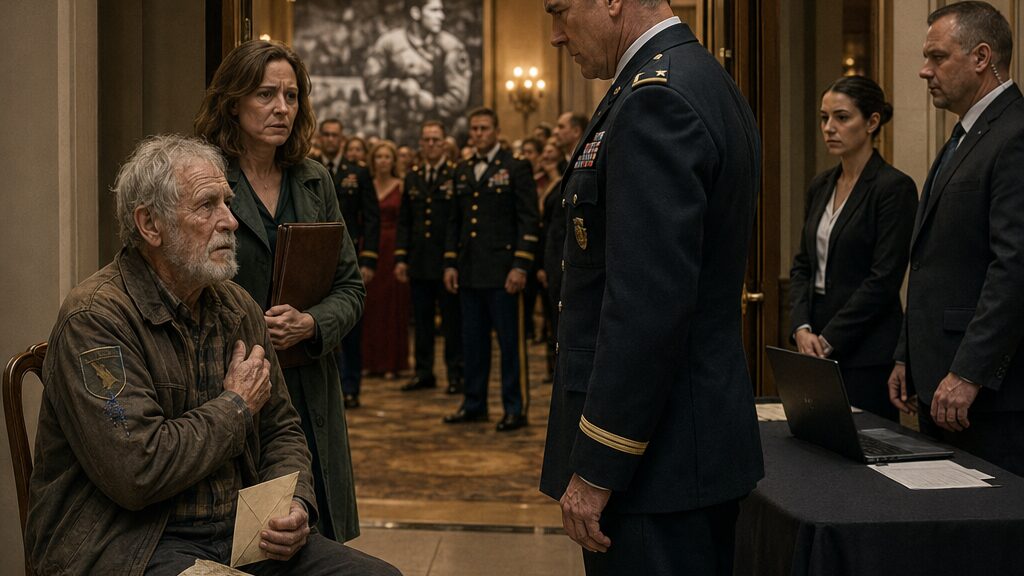
They Tried to Remove the Old Man Until the Commander Recognized His Hand-Stitched Patch
Chapter 1: The Man They Moved Away from the Door
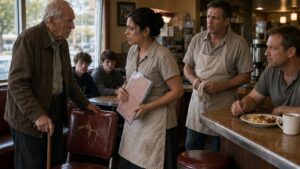
“The veterans’ meal service is in the building across the parking lot.”
The young registration specialist had already turned toward the next guest when she said it. Her finger remained on the printed list in front of her, holding Charles Allen’s place in a line that did not contain his name.
Charles stood without moving.
Behind him, officers in dark blue dress uniforms and civilians in evening clothes flowed through the hotel ballroom doors. Their polished shoes crossed the marble in quick, certain steps. A string quartet played beyond the entrance, nearly drowned beneath greetings, glassware, and the low machinery of a formal gathering beginning on schedule.
“I’m not here for a meal service,” Charles said.
The specialist looked up again. Her eyes paused on his beard, the rain marks on his faded jacket, and the frayed cuff hanging over his left wrist.
“This is a private brigade event, sir.”
“I know.”
“Do you have identification?”
Charles placed a water-softened envelope on the table. The paper had dried in waves. Half the ink on the front had bled into pale blue shadows.
The specialist lifted it by one corner.
“This doesn’t show a readable name.”
“It did when it was mailed.”
“I understand, but I can’t admit anyone who isn’t on the list.”
Charles watched her check the line behind him. A woman in a silver dress gave him a small, uncomfortable smile. Two uniformed men shifted apart to pass around him.
“My name is Charles Allen.”
The specialist typed it into a laptop. She tried again with his last name first.
“No Allen matching your information.”
“I was invited by Mary Taylor.”
“Is she with the hotel?”
“No.”
“Then I need you to step aside while I process registered guests.”
She slid the invitation back. Charles picked it up before the damp paper caught against her clipboard.
He had driven forty-three miles in a pickup that pulled to the right whenever the road dipped. He had changed his shirt in a gas station restroom and brushed dried mud from his boots with paper towels. The jacket had looked cleaner in the weak fluorescent light.
He had not expected welcome. He had expected ten minutes with the unit historian.
“Call Mary,” he said.
The specialist’s professional expression tightened. “I don’t have contact information for every guest.”
“She arranged this.”
“Sir, you’re blocking the entrance.”
Charles looked down. He was standing to the left of the doors, with more than six feet of open carpet beside him.
A security supervisor approached from the ballroom. He wore a dark suit and a clear tube behind one ear.
“Is there a problem?”
“No problem,” Charles said.
The specialist answered over him. “He has an unreadable invitation and isn’t on the guest list.”
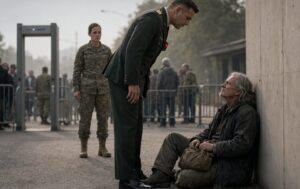
The supervisor looked at Charles’s jacket. His attention settled on the old unit patch sewn high on the left shoulder. Most of its colors had faded into the cloth. One lower corner had torn away years ago and been pulled back into place by three uneven rows of blue thread.
“Where did you get that?” the supervisor asked.
Charles’s right hand rose without thought and covered the patch.
The movement changed the supervisor’s face.
“Sir, I’m going to need you to keep your hands where I can see them.”
Charles lowered his hand but kept his palm against his upper arm.
“I’m leaving with it,” he said.
“No one said you weren’t.”
“You were looking at it like you meant to take it.”
“I was looking at what appears to be military insignia.”
“It appears that way because it is.”
Several conversations behind Charles thinned. He could feel people noticing without turning fully toward him.
The supervisor gestured to a wooden chair against the wall. It had been placed beside a service door, beyond the registration table but short of the ballroom entrance.
“Have a seat while we sort this out.”
“I can stand.”
“Please sit, sir.”
The word please did not make it a request.
Charles sat. The chair had a straight back and no cushion. From it he could see through the open ballroom doors.
Long tables stretched beneath chandeliers. Small flags stood beside place settings. Near the stage, a temporary historical display held enlarged photographs, unit maps, and a memorial table draped in white. One chair beside it remained empty.
Charles looked away.
The guests kept entering. Some glanced at him. Most practiced not seeing him. A young soldier in dress uniform stared openly until the man beside him touched his elbow.
The specialist resumed checking names.
Charles rested the damaged invitation on one knee. Inside his jacket, against his chest, the sealed note felt heavier than when he had left the motel.
He could still walk out.
Mary knew where to send the note. She had promised the historian would read it before the exhibit materials were transferred into the brigade archive. Charles had told her he did not need a place at the banquet. He had told her three times.
She had said being present mattered.
Now he sat beside the door like something the hotel had not decided where to store.
“Charles?”
Mary Taylor hurried across the lobby carrying a leather folder and wearing a dark green dress beneath her raincoat. Her hair had loosened along one side. She stopped in front of him, then looked from the chair to the registration table.
“What happened?”
“He’s not registered,” the specialist said.
“He is. I sent his information myself.”
“There’s no Charles Allen on the list.”
Mary opened her folder and pulled out her phone. “I have the confirmation.”
The security supervisor stepped closer. “Ma’am, are you responsible for this guest?”
Charles’s jaw tightened.
Mary heard it too. “I invited Mr. Allen through the county veterans office. He is not someone I’m responsible for.”
The supervisor’s expression did not change, but the specialist looked down.
Mary showed them an email. The specialist compared its reference number with a printed packet.
“This was entered under outreach contacts,” she said. “Not confirmed attendees.”
“I received a confirmation.”
“It says his request was received.”
Mary read the email again. Color rose in her face.
“I spoke to someone on the phone.”
“Who?”
“I don’t remember her name.”
The supervisor crossed his hands in front of him. “Until we verify it, he can’t enter.”
Charles stood.
Mary turned. “Give me five minutes.”
“No.”
“Charles, this is my mistake.”
“It’s a list.”
“I should have checked.”
“That doesn’t make it something you can fix by making me sit beside a door.”
The supervisor moved half a step between Charles and the ballroom. “Sir, no one is detaining you. You’re free to leave.”
The words opened a clean path toward the hotel entrance.
Charles reached inside his jacket. The supervisor’s shoulders shifted instantly.
Charles stopped with two fingers inside the lining.
“It’s an envelope,” he said.
“Remove your hand slowly.”
Charles drew out the sealed note.
A decorated officer had appeared inside the ballroom doors. He was in his early fifties, upright and broad-shouldered, with ribbons arranged in exact rows across his chest. He spoke briefly to another officer, then came toward them.
The security supervisor straightened. “Colonel Mitchell.”
The officer’s eyes moved from Mary to Charles.
“What’s holding the entrance?”
Mary spoke first. “Colonel, this is Charles Allen. I invited him to meet the unit historian. There was an error in registration.”
Scott Mitchell glanced at the line of arriving guests. “Then take his information and resolve it after the ceremony begins.”
“He needs to speak to the historian before the remembrance program,” Mary said.
Scott looked at Charles again, this time longer.
“Mr. Allen, this area has to remain clear.”
Charles glanced at the open carpet around him.
“I’m not blocking it.”
“You’re involved in an unresolved access issue in front of the main doors.”
“That sounds longer.”
Scott’s mouth tightened. “Longer than what?”
“Than saying you don’t want me here.”
Mary whispered Charles’s name, but he kept his attention on the officer.
Scott lowered his voice. “I am responsible for everyone in that room. I don’t know you, your invitation cannot be verified, and you are wearing unit insignia that security has not authenticated.”
Charles’s hand closed over the patch again.
Scott’s gaze followed it.
The blue stitching showed between Charles’s fingers.
For the first time since approaching, Scott did not look toward the doors, the line, or his watch. He looked only at the torn corner and the three crude bands of thread.
The impatience left his face so quickly that Charles almost mistrusted it more than the suspicion.
Scott stepped closer, but stopped beyond arm’s reach.
“May I see that?”
“No.”
Scott’s eyes lifted to Charles’s.
“Where did the repair come from?”
Charles folded the note once between his fingers, though it was already sealed.
“I came to give this to your historian.”
“Your name is Charles Allen?”
“That’s what I told the young lady.”
Scott stood straighter. When he spoke again, his voice was quieter.
“Mr. Allen, would you allow me to return your invitation?”
The specialist handed it to him. Scott took the damaged envelope in both hands and offered it back without looking away.
Charles accepted it.
Scott turned toward the ballroom. Through the doors, beyond the memorial table, an enlarged black-and-white photograph showed a younger soldier crouched beside a damaged vehicle.
On the soldier’s left shoulder, even at that distance, three crooked lines crossed the torn corner of a unit patch.
Chapter 2: The Photograph Did Not Tell the Whole Story
“Is that you?”
Scott Mitchell stood beside the exhibit photograph, one hand held rigidly at his side. Charles could hear the first notes of the national anthem rehearsal from the ballroom, followed by a microphone squeal that made several guests turn toward the stage.
Charles looked at the young man in the image.
The face was narrower than he remembered. Dust had turned the hair nearly white at the temples. One sleeve was black with grease. The photographer had caught him looking past the camera, toward something outside the frame.
“It is missing a man,” Charles said.
Scott’s eyes moved to the caption.
OPERATION IRON PASSAGE
SPECIALIST CHARLES ALLEN LEADS THE RECOVERY OF FIVE WOUNDED SOLDIERS FROM DISABLED TRANSPORT
Below it, in smaller print, were the words later cited in articles, ceremony programs, and a training-hall plaque Charles had never visited.
He read only the first line.
Scott motioned toward a service corridor away from the arriving guests. “Let’s speak somewhere quieter.”
Charles did not move. “Take the card down.”
“The caption?”
“The whole card.”
“We can review the wording.”
“Take it down.”
Mary stood behind Charles, holding her phone and folder against her chest. “Charles, maybe we should let Colonel Mitchell verify the records first.”
“The picture’s been verified for thirty-two years.”
Scott studied him. The respect that had entered his voice at the doors remained, but now it shared space with calculation.
“The ceremony begins in twelve minutes,” he said. “This exhibit was prepared from official brigade records. I cannot remove material because a guest disputes it at the entrance.”
“You asked if that was me.”
“Yes.”
“It is.”
Scott nodded toward the patch. “And the repair?”
Charles said nothing.
Scott drew a breath through his nose. “I have seen that photograph for most of my career. The stitching is visible in the original print. People assumed it was field damage.”
“It was a field repair.”
“Who made it?”
Charles looked toward the ballroom. “The man missing from the card.”
A hotel employee pushed a cart of covered plates through the corridor. The metal wheels rattled over a seam in the floor. Scott waited until the cart passed.
“Come with me,” he said. “We’ll verify your service record and bring in the historian.”
“I didn’t come to prove I served.”
“Right now, that is the first thing I need established.”
Charles almost laughed, but no sound came. At the door he had been too questionable to enter. Beside the photograph he had become important enough to investigate.
Scott led them to a narrow alcove behind the exhibit panels. A folding table held spare programs, archival gloves, and two closed document boxes. The unit historian, an older civilian in a tuxedo, was adjusting a frame when Scott called him over.
“Do you recognize the name Charles Allen?”
The historian stared at Charles, then at the patch.
“I recognize the name.”
“That isn’t what he asked,” Charles said.
The historian flushed. “The service file lists a Charles Edward Allen attached to the recovery section. Specialist at the time of Iron Passage.”
Scott looked at Charles. “Date of birth?”
Charles gave it.
“Last four of your service number?”
Charles recited the digits.
The historian opened a tablet, typed, and waited. His eyebrows lifted.
“That matches the archived personnel index.”
Mary released a breath.
The answer changed nothing inside Charles. Numbers had always been easy for institutions. Men were harder.
Scott extended a hand, then seemed to reconsider and let it fall. “Mr. Allen, you should have been properly received.”
“I should have been allowed to deliver a letter.”
“You will be. But this is an extraordinary situation.”
“It wasn’t extraordinary at the door.”
Mary closed her eyes briefly.
Scott accepted the blow without answering. Then he glanced toward the ballroom clock.
“We can bring you in before the opening remarks. I’ll have a place set at the command table.”
“No.”
Scott mistook the answer for discomfort. “You won’t be required to speak.”
“No.”
“We can introduce you simply as an honored veteran of the unit.”
Charles looked at the exhibit caption through the gap between panels.
“That would make it worse.”
Scott’s restraint thinned. “You have arrived at a brigade anniversary banquet wearing an artifact tied to one of the unit’s defining missions. You say the official account is incomplete but won’t explain how. I’m offering you entry and recognition while we review the issue.”
“You’re offering me the sentence on that card with a chair attached.”
The historian stopped touching the frame.
Scott lowered his voice again, but this time the softness was controlled rather than instinctive. “What exactly are you asking for?”
“Remove the claim that I led five men out alone.”
“Did you?”
“No.”
The answer came too quickly to be mistaken.
Scott looked to the historian. “What do the reports say?”
“The citation and later public summary credit Specialist Allen with organizing the recovery route and extracting the casualties.”
“Public summary,” Charles repeated. “Read the first statements.”
The historian’s expression changed. “Those files aren’t here.”
“Then don’t show the ending as if you brought the beginning.”
From the ballroom came the command to take seats. The quartet stopped. Chairs moved across carpet in a broad, muffled wave.
Scott checked the time despite himself.
“We cannot authenticate a disputed account before the ceremony.”
“Then don’t repeat it.”
“That video and display have been reviewed for months.”
“By men who weren’t there.”
Scott’s jaw flexed. “And if I remove a central part of the program based solely on your statement, I will have families asking why the brigade altered its history ten minutes before presenting it.”
“Good.”
Mary stepped between their lines of sight without physically blocking either man.
“Charles, the historian can read your letter now.”
Charles looked down at the sealed envelope in his hand. The paper had warmed beneath his fingers.
He had written the note in a truck-stop booth at three in the morning. Four pages, though he had intended one. It named dates, positions, equipment failures, and the place where the official version became easier than the truth.
He had not written what Paul’s voice sounded like in the last minute.
He handed the envelope to Scott rather than the historian.
Scott turned it over.
On the front, in Charles’s careful block lettering, were two words.
PAUL RIVERA.
The historian leaned closer.
Scott read the name once, then looked toward the memorial display as if expecting to find it there.
“Who was he?” Scott asked.
Charles’s eyes remained on the envelope.
“The reason five men came home.”
Chapter 3: The Empty Chair Beside the Memorial Table
Paul Rivera’s name was printed beneath Charles’s photograph in letters small enough to disappear from three steps away.
Charles found it only because he knew where institutions placed inconvenient men: under headings broad enough to make everyone equal and no one responsible.
SUPPORT PERSONNEL AND ADDITIONAL PARTICIPANTS.
Seven names followed. Paul’s was fourth.
Scott had permitted Charles into the ballroom through the side aisle while the historian opened the sealed note in a nearby office. Permitted was the word Charles used in his own mind because escorted sounded too generous.
Guests stood as the flags entered. Charles remained near the memorial table, partly hidden by a column. Scott had offered him a seat at the command table again. Charles had declined.
Mary stood beside him.
The empty memorial chair had been angled toward the audience. A folded jacket rested across its back. On the white tablecloth sat an inverted glass, a single red rose, and a framed list of names.
Paul’s name appeared there too, equal in size to the others.
That should have been better.
It was not.
The patch on Charles’s shoulder felt suddenly heavier than the jacket beneath it. He touched the lower corner, finding the raised ridges of blue thread with his thumb.
“Is that him?” Mary whispered.
Charles did not ask what she meant.
“Fourth line,” he said.
She read the exhibit card, then looked at the large photograph.
“They did include him.”
“As support.”
“Wasn’t he assigned to support?”
Charles turned his head.
Mary’s face tightened. “I’m asking because I don’t know.”
“He was assigned to whatever needed doing after the first vehicle rolled.”
The master of ceremonies asked everyone to remain standing for the invocation. Charles heard the words duty, sacrifice, memory, and brotherhood move through the room with practiced weight.
A waiter paused near them, uncertain whether Charles belonged to a table.
Mary pointed toward the side aisle. The waiter moved on.
Charles noticed.
“So did I,” she said quietly.
He did not answer.
After the invocation, guests sat. Scott crossed behind the stage and spoke to the command sergeant major. The older noncommissioned officer glanced toward Charles, then toward the exhibit card. His mouth formed a hard line.
A man with thinning white hair approached before Scott could return. He wore a dark suit with a small unit pin on the lapel.
“My God,” he said. “It’s Tunnel Allen.”
Charles’s back stiffened.
The man smiled broadly and seized his hand. “I knew it. Saw you from the other side of the room and told my wife nobody else ever looked that unhappy at a free dinner.”
Charles withdrew his hand.
The man either did not notice or chose not to.
“They told us you’d died years ago. Or gone up to Alaska. Stories changed every reunion.” He looked at Mary. “This man crawled through a burning passage no wider than a coffin.”
“No,” Charles said.
The man laughed. “Still hates the fuss.”
“It wasn’t burning when I went through.”
The smile faltered.
“The fuel line had ignited outside the rear axle,” Charles continued. “Smoke came through the passage. Fire didn’t.”
The man glanced at the photograph. “That’s not how I heard it.”
“You weren’t there.”
The sentence was quiet. It landed harder for that reason.
The former soldier looked from Charles to the patch. “Well. However it happened, you brought them out.”
“Some of them.”
“You always were particular.”
Charles’s thumb pressed into the blue thread.
The man’s good humor had become embarrassment. He gave Mary a polite nod and returned to his table.
Mary watched him go. “Tunnel Allen?”
“A newspaper needed something shorter than the truth.”
Scott arrived with the command sergeant major. The sergeant major carried one of the printed banquet programs.
“We have a timing issue,” he said without introduction. “The mission tribute is embedded in the final remembrance segment. Video, narration, family acknowledgment. If we pull it now, there will be a visible gap.”
Scott said, “The historian is reviewing Mr. Allen’s statement.”
“He has reviewed four pages written tonight by one participant.”
Charles looked at him. “You’ve already decided what four pages are worth.”
The sergeant major held his gaze. “I’ve decided that altering a memorial program in front of Gold Star families requires more than an allegation.”
Mary’s voice sharpened. “He isn’t alleging he was there. You verified that.”
“I’m referring to the official account.”
Charles pointed to the exhibit card. “That account says I led the recovery alone.”
“It summarizes a larger action.”
“It replaces one.”
The sergeant major glanced toward the tables. Several guests had begun watching.
“This is not the place.”
Charles looked at the empty memorial chair.
“You made it the place.”
Scott stepped closer, keeping his voice low. “We can move this discussion to a conference room.”
“And leave the card standing?”
“For now.”
The first course arrived. Servers entered in two lines, silver covers reflecting the chandeliers. Conversation rose again, giving them a thin wall of privacy.
Scott continued. “If the historian finds enough to warrant immediate action, we will decide what can responsibly be changed tonight.”
“Responsibly,” Charles said.
“Yes.”
“Meaning without embarrassing anyone.”
The command sergeant major’s expression hardened. “Meaning without telling a room full of families that the history they were given may be false before we know what is true.”
Charles looked toward the framed names on the memorial table.
“One of those families has already been told less than the truth.”
Scott followed his gaze. “Paul Rivera’s family?”
Charles said nothing.
The historian appeared at the side door, holding Charles’s letter. His face had lost the mild detachment it carried earlier.
“Colonel,” he said, “there is enough specificity here to require comparison with the original after-action statements.”
“Do you have access to them?”
“Not all of them remotely. Some were never digitized.”
The sergeant major exhaled. “Then nothing changes tonight.”
The historian looked at Charles. “The letter references an engineering log and a casualty movement sheet that do exist in the archive index.”
“Do they mention Rivera?” Scott asked.
“The index doesn’t show content.”
“Then we still cannot confirm it.”
Charles reached for the sealed note, but the historian held it carefully rather than surrendering it at once.
“Mr. Allen, may I retain this long enough to make a copy?”
“No.”
“It would help preserve your statement.”
“I came to correct theirs, not donate mine.”
The historian handed it back.
Scott watched the exchange. “You intended to leave the letter and go?”
“Yes.”
“Without speaking to anyone?”
“If the right person read it.”
“And if they didn’t believe it?”
Charles folded the note into his jacket.
“That would belong to them.”
Mary stared at him. “No. It would belong to Paul’s family too.”
Charles turned toward her.
She looked
Chapter 4: Paul’s Daughter Refused the Hero They Offered Her
Elizabeth Moore did not look at Charles’s face first.
She looked at the blue thread.
Her steps slowed beside the memorial table. The folded program in her hand bent beneath her fingers as her eyes followed the three uneven lines across the torn corner of the patch.
“Where did you get that?”
Charles had imagined this meeting in enough different rooms to know that none of his prepared answers belonged in the real one.
Scott moved forward. “Ms. Moore, perhaps we should continue this somewhere private.”
Elizabeth did not acknowledge him.
“I asked him.”
Charles lowered his hand from the patch. “It was repaired a long time ago.”
“I can see that.”
The first course was being served behind her. Silver covers lifted. Conversation rose and fell around the tables, but the space near the memorial display had gone unnaturally still.
Elizabeth stepped closer.
“My father stitched like that.”
Charles felt the old seam beneath his thumb.
“He never made the lines even,” she said. “My mother used to make him fix buttons, and he would pull the thread so tight the cloth gathered around them.”
Mary looked at Charles. Scott’s expression sharpened with attention.
Elizabeth finally raised her eyes to his face.
Recognition came slowly, without warmth.
“You’re Charles Allen.”
He nodded.
She laughed once, but it held no amusement. “Of course you are.”
Scott gestured toward the side corridor. “There’s a conference room available.”
Elizabeth looked toward the watching tables. “Is there a reason I should protect this room from hearing something it printed in the program?”
Charles saw Scott absorb the question rather than answer it.
“There are things we don’t yet understand,” Scott said.
“That has never stopped this unit from telling the story.”
Charles turned away before the anger in her voice could find a place in him. The empty chair stood inches from his knee. He did not want Paul’s daughter confronting him beside a folded jacket and an inverted glass prepared by people who believed symbols could absorb whatever truth they left out.
“Conference room,” he said.
Elizabeth followed him without thanks.
The room had beige walls, a long table, and no windows. A speaker near the ceiling carried a faint, distorted version of the banquet music. Scott closed the door. Mary remained near it, while the historian placed Charles’s letter on the table between them.
Elizabeth stayed standing.
“You disappeared,” she said.
Charles pulled out a chair but did not sit. “Yes.”
“My mother wrote to you.”
“I received the letters.”
“She called numbers that had been disconnected. She asked the unit association to find you.”
Charles watched the sealed edges of his letter.
“I knew where she lived.”
Elizabeth’s face changed. Anger remained, but disbelief opened beneath it.
“You knew?”
“Yes.”
“And you never came?”
“No.”
Mary shifted near the door. Scott stood with both hands resting loosely at his sides, no longer performing command but unable to stop carrying it.
Elizabeth pointed at Charles’s shoulder.
“You wore that all these years?”
“Not every day.”
“You kept the thing my father repaired, but you could not answer his wife?”
Charles’s throat tightened. “Your mother asked me not to contest the investigation.”
“That is not what I asked.”
“It is connected.”
“Everything is connected when you don’t want to answer the part in front of you.”
The words struck with Paul’s precision. Paul had also possessed the irritating habit of finding the one sentence Charles hoped to avoid and standing on it until Charles gave way.
Elizabeth pulled out a chair and sat, not because she was calmer but because her legs seemed to have lost patience with holding her upright.
“My mother did ask for privacy,” she said. “She did not want reporters calling the house. She did not want me growing up with strangers arguing over whether my father followed procedure.”
Charles looked at her.
“She showed me the letter she sent you,” Elizabeth continued. “After she died. She asked you not to turn his death into a public fight while the inquiry was open.”
“That is what I said.”
“No. You said she asked you not to contest it.”
“She wanted it left alone.”
“While the inquiry was open.”
Charles heard the difference. He had heard it when the letter first arrived too.
The historian slowly sat at the far end of the table.
Elizabeth leaned forward. “She never asked you to disappear from us.”
Charles gripped the back of the chair.
“I thought it was better.”
“For whom?”
He could have said for her mother. For Elizabeth. For Paul’s memory. He had used all three explanations in the silence of motel rooms and truck cabs. None survived her face.
“For me,” he said.
Elizabeth stared at him.
The admission did not soften her. It did, however, change the direction of her anger.
“You let them make you the whole story.”
“I didn’t ask them to.”
“You signed the citation.”
Scott looked at Charles. The historian’s eyes dropped to the letter.
Charles sat at last.
“The first version named Paul.”
“And the final one?”
Charles said nothing.
Elizabeth opened the program and pushed it across the table. The mission tribute occupied a full page. Charles’s younger face appeared above a paragraph describing a solitary crawl through a damaged transport corridor.
Paul’s name appeared only in the memorial list at the bottom.
“They invited me to watch them honor the man who came back,” she said. “They told me my father helped support the recovery. That was the phrase. Helped support.”
Scott’s jaw tightened.
Elizabeth looked at him. “Did you know?”
“No.”
“Would it have mattered before tonight?”
Scott did not answer quickly enough.
Charles touched the blue thread.
Elizabeth saw the movement. “Was it his?”
Charles nodded.
“What happened to it?”
“The corner tore on a loading bracket.”
“When?”
“The morning of the mission.”
Her anger wavered for the first time.
“He fixed it?”
“We were waiting on a replacement coupling. Paul said I looked unprofessional.”
A small, involuntary sound escaped her—almost a laugh, almost pain.
“He would have said that.”
“He used blue thread because it was all he had.”
“From his repair kit?”
“From a sewing card your mother put in his field bag.”
Elizabeth closed her eyes.
Charles could see Paul again, biting through the thread after the third crooked line, holding the patch at arm’s length, declaring it good enough for government work.
He had carried that ordinary moment farther than the extraordinary ones because ordinary things were harder to turn into legend.
Elizabeth opened her eyes.
“You came here to leave the patch?”
Charles did not answer.
Mary looked toward him. “Charles?”
“The historian could photograph it. Record the repair. Put Paul’s name with it.”
“And then what?” Elizabeth asked.
“Then I would go.”
Her chair scraped backward.
“No.”
Charles looked up.
“You do not get to do that again,” she said. “You do not get to decide that leaving is the honorable part.”
“It belongs with the unit.”
“It belongs to you.”
“Paul repaired it.”
“Then carry it.”
The room held the faint clink of banquet silver through the speaker.
Elizabeth’s voice lowered. “I will not help them keep the false story. But I will not help you erase yourself to fix it either.”
Charles felt cornered in a way security had never managed at the ballroom doors. There was no rule to resist, no official wording to expose. Only a woman whose father had died and who refused the shape Charles had given his own guilt.
She placed both palms on the table.
“Tell me one thing plainly.”
Charles waited.
“Did my father order you to leave him?”
Chapter 5: The Order Charles Obeyed and Never Forgave
“I obeyed him because disobeying would have killed the men already in my care.”
Charles heard his own voice before he decided to speak.
Elizabeth did not move.
Scott pulled out a chair but remained standing behind it. Mary sat near the door. The historian opened a notebook, then looked toward Charles for permission.
Charles shook his head.
The notebook stayed closed.
“The first transport had rolled onto its side,” Charles said. “The second was wedged against it. That left a passage between the frames, narrow at the rear and blocked at the front.”
The conference room walls fell away by degrees.
He did not see the whole place. Memory never returned with such generosity. It came in fragments: scorched metal under his palm, hydraulic fluid shining in dust, a boot protruding from beneath a bent seat.
“Five were alive inside the second vehicle,” he continued. “Two could move. Three could not. We had no room to turn a litter, so we passed them through on webbing.”
“Who is we?” Elizabeth asked.
“Paul and me at first. Then one of the drivers after we got his leg free.”
The speaker above them crackled with applause from the ballroom. Someone had finished an opening remark.
Charles looked at the patch.
“The corner tore before we left the staging area. Paul fixed it while we waited for parts. Said I complained too much for a man wearing a crooked insignia.”
Elizabeth’s mouth tightened.
“When the transport shifted, the passage started closing. Paul found a support bar and braced it across the frame. Every time we moved someone through, the bar slipped.”
Scott said quietly, “Why wasn’t the vehicle stabilized?”
“It was. Until the ground beneath the rear axle gave way.”
The historian spoke for the first time. “The later summary says the structure remained stable during extraction.”
“The later summary was written by people who saw the vehicle after recovery equipment arrived.”
Charles rubbed one palm against the other. He could still feel grit pressed beneath the skin.
“The first casualty came through conscious. The second had stopped breathing twice. The third had a pelvic injury. Paul kept the passage open while I pulled them toward the rear.”
“And the fire?” Scott asked.
“Fuel ignited outside the axle. Smoke came through. Not flame.”
“The account calls it a burning corridor.”
“Because burning sounds better than failing metal.”
Elizabeth watched him closely. “Where was my father when you brought out the last man?”
“Still at the front.”
“Why?”
“The support bar had shifted. He had to hold it by hand.”
The room became silent enough for Charles to hear the ventilation system ticking above the ceiling.
“I went back,” he said. “The passage had narrowed. Paul told me to stop.”
Elizabeth’s fingers closed around the edge of the table.
Charles did not look at her.
“He said the rear frame was moving again. I could hear it. He told me to take the driver and clear the area.”
“Could you have reached him?”
“Yes.”
Mary drew a quiet breath.
Charles lifted his eyes.
“I could have reached him. I could not have reached him and brought him back before the passage closed.”
Elizabeth’s face had gone still.
“He ordered you away,” she said.
“Yes.”
“Exact words?”
Charles closed his eyes.
Paul’s voice had not sounded heroic. It had sounded irritated, breathless, entirely certain.
“Get the living clear, Allen. That’s the job.”
Charles opened his eyes.
“I told him I was coming back.”
“What did he say?”
“He said I was bad at listening.”
A tear moved down Elizabeth’s cheek. She wiped it away with the heel of her hand, almost angrily.
Charles continued because stopping would turn the last minute into a wall again.
“I pulled the driver out. The frame dropped before recovery equipment reached the front. Paul was still behind the brace.”
No one asked whether he had died immediately. Charles would not have answered.
The historian leaned toward Scott. “The initial casualty movement sheet should show sequence and personnel positions.”
Scott took out his phone. “I asked the archive duty officer to search the scanned index.”
As if summoned by the words, the phone vibrated.
Scott read the message, then turned the screen toward the historian.
“There is an early field statement attached to the engineering log.”
The historian took the phone. His eyes moved quickly.
“What does it say?” Elizabeth asked.
He hesitated.
“Read it,” Charles said.
The historian did.
“Sergeant Rivera maintained manual support of the compromised passage while Specialist Allen removed casualties from the rear access point. Rivera ordered remaining personnel clear after further structural movement.”
Elizabeth’s eyes closed.
Scott looked toward the banquet program on the table. “That language is not in the public summary.”
“No,” the historian said.
“Why?”
“The investigation remained open for eleven months. There were questions about whether the recovery began before proper stabilization.”
Charles gave a humorless smile. “There were always questions after men did what the situation required.”
Scott scrolled farther. “The final citation credits Allen with independent judgment in continuing the extraction.”
“Independent,” Charles repeated.
Elizabeth looked at him. “You signed it.”
The old accusation had changed. It no longer asked whether he had taken Paul’s place. It asked why he had allowed anyone to offer it.
Charles leaned back.
“They came to the hospital with papers. The inquiry officer said the citation language would not affect findings about the vehicle failure. Paul’s wife had already received calls from reporters. She wanted the argument stopped.”
“So you signed.”
“Yes.”
“Did you read it?”
“Yes.”
Scott’s eyes lifted.
Charles’s shame did not come from being deceived. That would have been easier to carry.
“I knew it left him out,” he said. “I told myself the internal report would keep the truth. I told myself a citation was not history.”
The historian looked down.
“But it became history,” Elizabeth said.
“Yes.”
“And when my mother’s request no longer applied?”
Charles stared at the sealed letter.
“I had already been introduced at dinners. Photographed beside plaques. They called me Tunnel Allen. Every time I waited too long to correct it, correcting it became harder.”
“You could have written to us.”
“I could have.”
“You could have called.”
“Yes.”
“You could have come once.”
Charles looked at her.
“Yes.”
Her anger returned, but it had lost the certainty that he was protecting a lie for praise. What replaced it was more painful.
“You thought staying away punished you,” she said.
Charles did not answer.
“It punished us too.”
Mary looked down at her hands.
Scott walked to the wall, then back to the table. The movement was small, but it was the first time Charles had seen him lose the stillness of command.
“This display,” Scott said, “was built from the citation, the public mission summary, and later oral histories.”
“From men who heard the short version,” Charles said.
Scott nodded once.
The admission cost him something.
“We can remove the caption tonight.”
“The video says the same thing,” the historian said.
Scott turned. “How much of it?”
“The entire central narration is built around Allen entering alone and directing the recovery.”
From the ballroom, the master of ceremonies announced the evening schedule. The words came faintly through the speaker, but one phrase carried clearly.
Final remembrance tribute.
Scott checked his watch.
“How long?” Mary asked.
“Twenty minutes,” he said.
Elizabeth looked at Charles.
The official story was already loaded, timed, and waiting for a darkened room.
Scott placed both hands on the table.
“If we stop it, everyone will know something is wrong.”
Charles looked at Paul’s daughter, then at the folded program bearing his own younger face.
“If you play it,” he said, “everyone will hear what is.”
Chapter 6: The Ceremony Could Continue Only with a Lie
The first frame of the anniversary video appeared on the ballroom control monitor while Scott asked Charles what he wanted done.
A young version of Charles filled the screen, frozen beneath a title in gold lettering. The damaged patch was visible on his shoulder.
Eighteen minutes remained.
The control area occupied a narrow space behind the ballroom wall. Two technicians sat before sound boards and video equipment. Through a curtained opening, Charles could see the backs of hundreds of guests.
Scott spoke to one technician. “Hold the tribute package until I give clearance.”
“We’re scheduled after the recognition roll, sir.”
“Do not advance it.”
The technician nodded, though his eyes moved toward Charles.
The command sergeant major entered behind them. “Colonel, the Gold Star families have been given exact timing for the remembrance segment.”
“I know.”
“If we interrupt the program without an explanation, they will assume a casualty notification or security issue.”
Scott looked at Charles. “That is why we need a decision.”
Charles almost told him the decision belonged to the commander whose name appeared at the top of every program. That had been Charles’s habit for years: place the choice in another man’s hands, then blame himself for whatever followed.
Elizabeth stood beside the monitor with her arms folded. Mary and the historian waited near the door.
Scott lowered his voice.
“We can remove the video and announce a technical problem. Tomorrow, I can convene a formal historical review.”
“And tonight?” Charles asked.
“We proceed with the remaining memorial elements.”
“With the printed account on every table.”
“We cannot collect every program without drawing more attention.”
“You keep treating attention as the danger.”
Scott’s face hardened. “Because I am responsible for the room outside that curtain.”
“And Paul is in that room as six words under additional participants.”
The command sergeant major stepped forward. “Mr. Allen, no one is disputing Rivera’s service. We are discussing what can be responsibly changed with less than twenty minutes’ notice.”
Charles looked at him. “You mean what can be changed without anyone asking why it was wrong.”
Scott lifted a hand before the sergeant major could answer.
“There is another option,” he said. “We add your presence to the tribute. I introduce you, acknowledge that new information has come forward, and announce a review.”
Charles stared at him.
Scott seemed to interpret the silence as consideration.
“You would not need to speak. Your attendance would allow us to make clear that the brigade respects your account while preserving due process.”
Elizabeth’s laugh was sharp. “You want to put him beside the lie so the lie looks respectful.”
Scott turned toward her. “I am trying to prevent an unverified correction from creating a second injury.”
“The first injury has had thirty-two years.”
Charles looked at the monitor. His younger face waited patiently to become a hero again.
“Colonel,” he said, “you still think this is about adding my name.”
Scott’s eyes returned to him.
“I do not want more credit.”
“I understand that.”
“No, you don’t.”
Charles pointed to the frozen image.
“That sentence says I brought them out alone. Remove it.”
“The historian cannot confirm every detail in your letter tonight.”
“He confirmed Paul held the passage.”
“The field statement supports that.”
“Then say only what it supports.”
The historian stepped closer. “We can verify that Rivera maintained the passage during casualty removal and ordered personnel clear after further movement. We can verify that the later public summary omitted that role.”
The command sergeant major looked at him. “Can we verify why it was omitted?”
“No.”
“Can we verify Allen’s recollection of Rivera’s exact final order?”
“No.”
Charles nodded. “Then don’t use the exact words.”
Scott looked from the historian to Charles. The pressure in his face had changed. It was no longer only ceremony timing. Something else had entered it—fear of what correction implied about the institution he commanded.
“This brigade is already under external review for an access-control failure,” he said at last. “Three months ago, an unauthorized contractor entered a restricted area using outdated credentials. If tonight appears disorganized or insecure, that becomes part of the same judgment.”
Mary glanced toward the registration corridor.
“That’s why security handled Charles the way they did.”
“That is why I reinforced procedures,” Scott said. “It does not excuse how he was addressed.”
Charles heard the distinction. Earlier, Scott would have said the procedure had been followed. Now he admitted the harm without pretending the pressure did not exist.
The monitor timer changed.
Fifteen minutes.
Scott turned toward Charles’s shoulder. His hand rose slightly, then stopped in the air.
“May I look at the repair more closely?”
The question quieted the room.
Charles had refused him at the entrance because Scott had approached the patch as evidence to be authenticated. Now the officer waited.
Charles removed his hand and turned his shoulder.
Scott leaned nearer without touching the cloth. The three blue rows crossed the faded edge. One stitch had loosened and curled outward.
“The photograph could be enlarged during the correction,” Scott said.
“No.”
Scott straightened immediately.
“The patch is not proof for the room,” Charles said. “The field statement is.”
Scott nodded. “Understood.”
That single word did more than the careful return of the invitation had done. It did not ask Charles to reward respect with compliance.
The historian opened the banquet program to the tribute text. “I can draft a corrected statement limited to verified facts.”
Charles took the program from him.
The printed paragraph reduced a collapsing vehicle, five wounded men, Paul’s choice, and Charles’s obedience to four polished sentences.
He crossed out three.
Mary watched. “What remains?”
“Names,” Charles said. “Actions. Nothing about heroism.”
Elizabeth came beside him.
“Will you say his name?”
“Yes.”
“Will you say yours?”
Charles looked toward the curtain. Beyond it, people ate beneath unit colors and framed photographs. Some had known Paul. Some had known only the clean version of him. Most had never known Charles except as a young face attached to a story.
His instinct was still to correct the record and leave before anyone could turn toward him.
Elizabeth seemed to see the answer forming.
“If you walk out after this,” she said quietly, “you will make me come find you.”
Charles looked at her.
“That is not forgiveness,” she added.
“I know.”
“It is also not permission to disappear.”
The timer dropped below twelve minutes.
Scott said, “I need your authorization for whatever we present as your account.”
Charles handed him the program.
“Stop the video.”
Scott turned to the technician. “Remove the tribute package from sequence.”
The technician began typing.
The command sergeant major exhaled slowly. “What replaces six minutes of program?”
Scott looked at Charles.
Charles had spent decades believing the only alternatives were silence or spectacle. The room around him offered a third: precision.
“Bring the microphone,” he said.
Scott glanced toward the stage.
Charles shook his head.
“Not there.”
“Where?”
Charles looked through the curtain toward the white-draped memorial table and the empty chair beside Paul’s name.
“To the table.”
Chapter 7: He Corrected One Sentence and Changed the Room
The ballroom screens went black before the anniversary video began.
Conversations faltered table by table. Guests turned toward the stage, where the master of ceremonies stood with one hand pressed to his earpiece. Behind him, the gold title of the tribute vanished, leaving only dark glass.
Scott stepped through the side curtain carrying a wireless microphone.
Charles followed at a distance.
He had expected the room to feel larger from inside it. Instead, the tables seemed crowded together beneath the chandeliers, every place setting too bright, every uniform too exact. Faces turned toward his worn jacket and old boots. Some showed recognition from the photograph. Others showed only confusion about why the man from the entrance was walking beside the brigade commander.
The memorial table stood near the stage.
Its white cloth had been smoothed again. The red rose leaned against the inverted glass. Paul’s name remained framed among the dead, while the empty chair waited beside it.
Scott stopped at the front of the room.
“Ladies and gentlemen, before the final remembrance segment—”
Charles touched his sleeve.
Scott looked down.
“Don’t introduce me.”
A pulse moved in Scott’s jaw. Hundreds of people were waiting. The master of ceremonies had already stepped aside. Every instinct of command must have told Scott to explain who stood beside him and why the program had changed.
He lowered the microphone.
“What do you want me to say?”
“That the video won’t be shown.”
“And after that?”
“Give me the microphone.”
Scott faced the audience.
“The scheduled anniversary video will not be presented tonight,” he said. “Information has come forward requiring us to correct part of the record before we repeat it.”
No title. No rank. No promise of heroism.
The room grew still.
Scott walked with Charles to the memorial table. He offered the microphone without placing a hand on Charles’s back or steering him toward a marked position.
Charles took it.
The equipment amplified the small sound of his fingers shifting across the metal casing.
He looked at the crowd only once. Then he looked at Paul’s name.
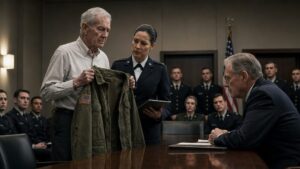
“The printed program says I independently led five wounded soldiers out of a disabled transport during Operation Iron Passage.”
His voice came back from the ballroom speakers flatter than it sounded inside his chest.
“That sentence is wrong.”
No one moved.
Charles felt the edge of the patch beneath his palm. The blue stitches were rough against his fingertips.
“Sergeant Paul Rivera held open a collapsing passage while casualties were moved through it. The first field statement recorded that. Later summaries did not.”
A chair creaked near the rear.
Charles continued.
“I removed wounded men from the rear access point. Paul maintained the opening at the front. When the structure moved again, he ordered the remaining personnel clear.”
He did not repeat Paul’s last words. They did not belong to the room.
“The five men came home because several people did their jobs. Paul Rivera did not support my recovery. I completed my part because he completed his.”
Elizabeth walked from the family table.
For one second, Charles thought she meant to leave. Instead, she came to the empty chair beside the memorial table and sat down.
The folded program remained in her hand.
Her movement changed the room more than Charles’s words had. The chair was no longer an arrangement of absence. It held the person who had lived with that absence longest.
Charles looked down at her.
Elizabeth did not smile. She gave one small nod.
He turned back toward the tables.
“The public account did not become incomplete by accident alone.”
Scott’s eyes shifted toward him.
Charles could stop. The verified facts had been stated. Paul’s action had been restored. Everything beyond that exposed a failure no archive had forced upon him.
His thumb moved over the three crooked lines of thread.
“I read the citation that named me alone,” he said. “I signed it.”
A murmur moved through the room and died.
“I told myself the internal report would keep the full account. I told myself silence would protect Paul’s family from another investigation. Later, when silence protected nothing except my own avoidance, I kept it anyway.”
Elizabeth’s gaze lowered to the program.
Charles forced himself not to turn the admission into a request for forgiveness.
“The brigade repeated what I failed to correct. That does not make the record true. It also does not make the fault belong only to people who came after.”
He held the microphone out to Scott.
The commander accepted it slowly.
Scott stood beside the memorial table, not on the stage.
“The original field statement supports what Mr. Allen has said about Sergeant Rivera’s role,” he told the room. “The brigade historian will begin a formal review of the mission record. Effective tonight, the existing video and exhibit caption are withdrawn.”
The command sergeant major stood near the side curtain. His expression remained guarded, but he did not interfere.
Scott looked toward Elizabeth.
“Ms. Moore, the brigade should have identified the discrepancy before inviting your family to this event. We did not.”
Elizabeth met his eyes. “Then correct more than the invitation.”
“Yes, ma’am.”
No applause followed.
Charles was grateful.
A few guests lowered their heads. A former unit member at a nearby table removed his glasses and rubbed the bridge of his nose. The young registration specialist stood just inside the ballroom doors, her hands clasped in front of her.
Scott asked everyone to remain seated while the historian read Paul’s verified role into the official event record.
The language was plain. No burning corridor. No solitary hero. No polished claim that suffering had arranged itself into a lesson.
Paul Rivera maintained manual support of the compromised passage during casualty removal.
Charles listened until the sentence ended.
Then he moved to step away.
Elizabeth caught the edge of his sleeve.
“Stay until they say all of it.”
The historian read the names of the recovered soldiers and the personnel involved. Charles’s name came after Paul’s.
For the first time, the order did not feel like punishment or reward.
It felt accurate.
When the remembrance segment ended, guests remained seated for several seconds. Then conversations began quietly, without the usual rush toward the doors.
The unit historian approached carrying archival gloves and a padded case.
“Mr. Allen,” he said, “the patch is now directly connected to a corrected historical account. With your permission, the brigade would be honored to preserve it.”
Charles looked at the open case.
The foam inside had been cut into a neat rectangle. The patch would lie flat beneath glass, its blue stitches photographed and labeled. Paul’s name would be attached to it. Future soldiers would read the story.
It was what Charles had believed he wanted.
He reached toward his shoulder.
Elizabeth watched without speaking.
His fingers closed over the patch.
He remembered Paul pulling the thread too tight, bunching the fabric around the torn corner. He remembered complaining that the repair looked worse than the damage. He remembered Paul telling him to find someone else with blue thread in the middle of nowhere.
The patch was not the mission. It was not proof. It was not an object the unit had to own before it could tell the truth.
Charles lowered his hand.
“The story can stay,” he said. “This comes with me.”
Chapter 8: Respect Began After Everyone Stopped Watching
After the guests left, Scott did not tell Charles where to sit.
The ballroom had emptied unevenly. Half-cleared tables stood beneath dimmed chandeliers. Hotel employees collected glasses while the last officers spoke in low voices near the doors.
Scott pulled two chairs away from a table and left them unclaimed.
“Where would you prefer?” he asked.
Charles looked toward the wooden chair beside the entrance where security had placed him earlier. It was still there, pushed against the wall like an item forgotten after use.
“Here is fine.”
He chose the chair nearest the memorial table.
Scott sat across from him rather than beside him. Mary and Elizabeth remained standing until Charles indicated the other seats.
The unit historian had taken high-resolution photographs of the patch while Charles wore the jacket. He had measured the blue stitching without touching it and recorded Charles’s description of the repair. The physical patch remained on Charles’s shoulder.
Scott placed a single sheet of paper on the table.
“This confirms that the exhibit caption and video have been withdrawn pending review. It also records tonight’s correction.”
Charles read it.
Paul’s name appeared in the first paragraph.
His own appeared in the second.
He folded the page once and put it inside his jacket with the letter he had never surrendered.
Scott watched him. “I owe you an apology for the entrance.”
“The specialist followed the system you gave her.”
“That does not remove my responsibility.”
“No.”
Scott accepted the answer.
“The guest process will change,” he said. “Invitations made through outreach programs will be verified before the event. We’ll designate someone empowered to resolve discrepancies without treating a guest as a security problem.”
“Security still has a job.”
“Yes.”
“So does listening.”
Scott nodded. “Yes.”
Mary had been quiet since the correction. Now she placed her leather folder on the table.
“I told Charles I had arranged everything,” she said. “I had an email and a phone call, and I decided that was enough.”
Charles looked at her.
“I wanted you here,” she continued. “I did not make sure you could get through the door.”
“You made the invitation.”
“I made the easy part.”
There was no appeal in her voice, no request that Charles rescue her from the admission.
He gave a small nod.
Mary opened the folder. “There is a county housing caseworker available tomorrow morning.”
Charles’s shoulders tightened.
Scott looked away, granting the conversation privacy without leaving.
“I’m not going into a shelter because of tonight,” Charles said.
“I didn’t say shelter.”
“I’m not being placed anywhere.”
“The appointment is not placement. It is information.”
“I have information.”
“You have a truck that failed inspection and a motel arrangement that ends Friday.”
Elizabeth glanced at him sharply.
Charles looked at Mary. “You had no right to tell them.”
“I told no one here. You told me last week.”
The correction irritated him more because it was true.
Mary slid a card across the table.
“Ten o’clock. You can walk out after five minutes. You can refuse every option. But refusing the meeting because you think accepting information is charity is still refusing.”
Charles did not touch the card.
Scott stood.
“My driver can take you wherever you need to go.”
“No.”
“It is raining.”
“My truck runs.”
Mary looked toward the parking lot. “It also pulls right.”
“It has done that for years.”
“That is not a defense.”
Elizabeth’s mouth moved at one corner. The expression disappeared before becoming a smile.
Charles looked from one face to another. Hours earlier, each person had wanted something from him: identification, explanation, proof, testimony, forgiveness. Now they waited while he decided.
He picked up the card.
“Ten o’clock,” he said.
Mary did not thank him.
Scott reached toward Charles’s shoulder, then stopped with his hand suspended several inches from the patch.
The question was visible before he spoke.
Charles considered it.
Then he nodded.
Scott placed his hand lightly on the jacket above the repair. The touch lasted only a moment.
“No salute?” Charles asked.
Scott’s expression shifted. “Would you want one?”
“No.”
“Then no.”
Outside, the rain had thinned to a mist. Charles declined the driver again and walked with Elizabeth beneath the hotel awning.
She stood with her coat folded over one arm.
“I still don’t forgive you,” she said.
“I know.”
“I understand more than I did.”
“That isn’t the same thing.”
“No.”
They watched hotel employees wheel the historical display cases toward a storage room. The photograph of young Charles had been removed from its frame. The empty space behind the glass looked cleaner than the false caption had.
Elizabeth glanced at the patch.
“My mother would have hated those stitches in a display case.”
“She hated his repairs.”
“She kept every shirt he ruined.”
Charles looked at her.
Elizabeth drew a slow breath. “Tell me something about him that has nothing to do with the mission.”
Charles searched through decades of memory. The dramatic moments came first because they had been rehearsed by guilt. He pushed past them.
“He cheated at cards.”
Elizabeth frowned. “My mother said he was good.”
“He was terrible. That’s why he cheated.”
“How?”
“He marked the kings with grease.”
“She would have noticed.”
“She did. She let him think she didn’t.”
Elizabeth looked down, and this time the smile came fully, though tears stood in her eyes.
Charles told her about Paul singing only the last line of songs because he never learned the rest. About the hot sauce bottle he carried in a sock. About the time he spent an entire afternoon repairing a radio and discovered it had not been plugged in.
They spoke until the hotel staff locked one set of ballroom doors.
When Elizabeth left, she did not embrace him. She wrote her phone number on the back of his damaged invitation.
“Answer once,” she said. “After that, we’ll see.”
Charles put the invitation carefully inside his jacket.
Several weeks later, the corrected mission summary arrived by mail at the weekly motel where Mary had helped extend his stay. It named Paul’s action without turning it into legend. It also named Charles without calling him Tunnel Allen.
Scott included a brief note confirming that the brigade had changed its guest-verification procedure and assigned follow-up responsibility for veterans invited through community offices.
No praise filled the page. No request for a photograph accompanied it.
Charles kept the note.
The housing meeting did not produce a miracle. The first apartment had stairs his knee disliked and rent he could not sustain. The second required documents stored in a box beneath the seat of his truck. Mary helped him request replacements but let him sign every form himself.
Elizabeth called twice before Charles answered.
On the third week, he drove to the county veterans office for another appointment. His truck still pulled slightly right, though less after a mechanic replaced a worn part at the usual price rather than as a favor.
Charles paused outside the glass doors.
His reflection showed the same beard, the same lined face, and the same old jacket. The hand-repaired patch remained on his shoulder, its blue threads visible in the morning light.
For years he had believed carrying it meant carrying Paul alone.
He opened the door.
The receptionist looked up and asked his name.
“Charles Allen,” he said.
Then he walked inside with the patch still where Paul had sewn it.
The story has ende