The Whole Yard Laughed When the Old K9 Veteran Heard the Second Click
Chapter 1: The Old Man Heard the Second Click Before the Dog Moved
Joseph Wright laughed before the dog lunged.
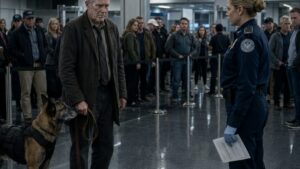
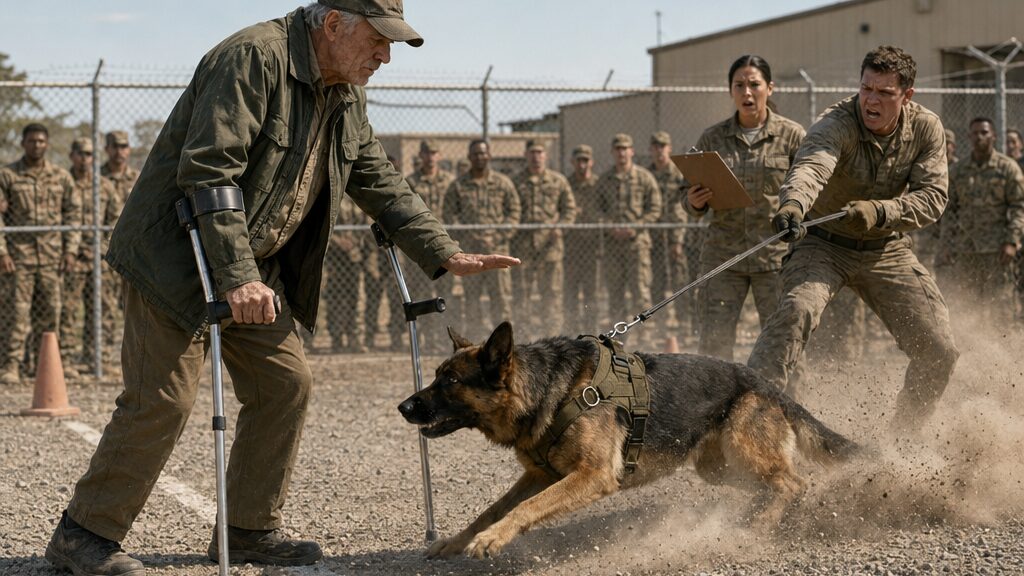
It was a short laugh, sharp enough to cut across the gravel yard and make two soldiers by the fence glance at each other. The German Shepherd at his side was already low in the shoulders, muscles bunching under the black tactical harness, yellow-brown eyes fixed past the training flags toward the old man standing near the lane marker.
Gregory Hall did not move.
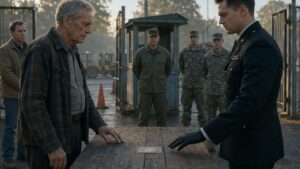
He stood with both forearm crutches planted in the dust, a worn green jacket hanging loose over tan work clothes, an old cap shading his lined face. The wind had lifted grit around his boots and into the cuffs of his pants, but he seemed less like a visitor who had wandered into the wrong place than a post that had been hammered into the earth years ago and forgotten.
“Don’t pull up after the second click,” Gregory said.
Joseph turned his head just enough for everyone to hear him answer. “Sir, this isn’t a museum demonstration.”
A few of the younger soldiers looked down quickly, hiding smiles. Someone coughed into a fist. Angela Martinez, clipboard under one arm, stepped toward the lane with the stiff controlled pace of an instructor trying to keep a bad moment from becoming paperwork.
“Mr. Hall,” she said, “you need to step back. You’re not part of the lane.”
Gregory’s eyes stayed on the dog.
The Shepherd’s ears flicked once. His mouth opened, tongue showing, not relaxed, not playful. The leash ran from Joseph’s gloved hand to the harness ring, tight as cable. Joseph shifted his grip higher, elbow rising.
Gregory felt the old warning move through him before the sound came. Not fear exactly. Something older and colder. A pattern arriving on time.
“Lower your hand,” he said.
Joseph’s face flushed. “I’ve got him.”
The first click came when the metal clip struck the harness ring as Joseph shortened the lead.
Gregory tightened his hands around the crutch cuffs.
The second click came a half breath later, smaller, almost swallowed by boot scrape and gravel. To the soldiers behind the tape, it was nothing. Hardware noise. Yard noise. The ordinary clatter of training gear.
To the dog, it was a door opening.
The Shepherd exploded forward.
Dust kicked up beneath his paws. Joseph stumbled half a step, boots skidding, both hands locking on the leash as the dog drove straight toward Gregory. Angela’s arm shot out.
“Hold!”
The word came too late and too loud. The dog surged lower, throat vibrating, tactical harness twisting under the strain. Soldiers moved but did not commit, caught between training discipline and the ugly sight of an old man on crutches standing in the path of a military working dog.
Gregory did not raise a crutch. He did not shout. He did not square up like a man trying to prove he still had strength.
He only shifted his weight, slow and careful, until both crutch tips were fixed in the gravel. Then he lowered his right hand, palm down, not over the dog, not toward the teeth, but into the empty space beside the Shepherd’s line of sight.
“Easy,” Gregory said.
The dog reached him with enough force left in the leash to drag Joseph to one knee.
The Shepherd’s paws scraped a furrow in the dirt. His head came up. For one suspended second his nose was inches from Gregory’s sleeve, breath hot against the old fabric.
Gregory kept his palm low.
“Easy,” he said again, softer.
The dog stopped.
The yard seemed to lose every sound except the Shepherd’s breathing. Dust hung around them in a pale cloud. Joseph stayed on one knee, one hand still locked around the leash, eyes wide as if the old man had stepped out of a place Joseph could not see.
The dog’s ears moved back. His mouth closed. He pressed his head forward, not into an attack, not into a command, but under Gregory’s lowered hand.
Gregory let his fingers settle on the hard skull between the ears.
A tremor moved once through the Shepherd’s shoulders and faded. Gregory felt it through his fingertips. Not defiance. Not rage. Pressure without a place to go.
“That’s it,” he murmured.
Joseph stared up from the gravel. “How did you—”
“Stand slow,” Gregory said, without looking at him. “Keep the leash low.”
Joseph’s jaw tightened. For a moment, pride nearly made him do the opposite. Gregory saw it in the wrist, the small upward twitch that would bring the clip against the ring again.
“Low,” Gregory repeated.
Angela was beside them now, clipboard pressed against her chest. Her face had gone still in the way military faces did when surprise had to be hidden under control.
“Joseph,” she said. “Ease tension.”
Joseph swallowed and let the leash slacken by a few inches.
The Shepherd sat.
No one laughed then.
The dog leaned against Gregory’s leg, careful of the crutches, as if he understood the old man’s balance better than the people did. Gregory stroked the dog once, from crown to neck, stopping before the harness strap.
A soldier near the fence whispered, “Who is that?”
Gregory heard it. He pretended not to.
Angela cleared her throat. “Mr. Hall, thank you. We’ll take it from here.”
The words were polite enough to pass inspection and hard enough to close a door.
Gregory lifted his hand from the dog’s head. The Shepherd followed the hand with his eyes. Joseph got to his feet, face still red, dust on one knee of his uniform. He gathered the leash shorter again, though not as short as before.
Gregory looked at the harness ring.
The metal sat wrong against the strap, angled outward, polished bright along one edge where it had been striking the clip again and again. He knew that shine. He had seen it on older rigs, back when certain sounds meant certain things, back when men thought speed was discipline and dogs paid for confusion first.
“Check that ring before you run him again,” Gregory said.
Joseph’s eyes narrowed. The humility that had flashed across his face a minute earlier closed behind embarrassment.
“With respect,” he said, though the respect was thin, “he stopped because everyone stopped crowding him. I don’t need a visitor diagnosing equipment from the dirt.”
Angela’s pen tapped once against her clipboard. “Mr. Hall, we do need you outside the active lane.”
Gregory looked from Joseph to Angela, then down at the dog.
The Shepherd’s gaze stayed fixed on him.
Gregory wanted to say more. The words rose and stopped where they always stopped, behind the old habit of not explaining what people had not asked to understand. A younger man might have forced the point. A prouder one might have named his years, his units, his dogs, the number of handlers he had taught to keep their hands quiet.
Gregory only nodded.
“Your yard,” he said.
He turned carefully, crutches biting into the gravel. Each step away from the lane took longer than it should have. Behind him, the quiet broke into official movement. Angela gave instructions. Joseph reset his grip. A background soldier dragged a cone back into place.
Gregory reached the fence before the sound came again.
Click.
He stopped.
The dog had not lunged. Not yet. But the Shepherd’s body changed at once: shoulders hard, mouth shut, tail low, a tremor running down the spine like a wire pulled tight under the skin.
Joseph did not see it. Angela was writing. The yard was already pretending the danger had passed.
Then the second click struck the ring.
The Shepherd began to shake.
Chapter 2: The Dog Obeyed Him, But No One Believed Why
Angela Martinez handed Gregory his visitor pass as if returning it gently could make the removal less insulting.
The plastic badge rested in her palm, clipped to a blue lanyard that had picked up dust from the yard. Gregory did not reach for it at first. Beyond the kennel office window, he could see Joseph walking the Shepherd along the fence line, leash short, shoulders stiff, jaw set against whatever had happened in front of everyone.
“Mr. Hall,” Angela said, lower this time, “I can’t have uncleared personnel stepping into active K9 lanes.”
“I didn’t step in,” Gregory said. “He came to me.”
Her mouth tightened. She was not unkind. That made it harder.
“You were inside the hazard boundary.”
“The boundary moved when the dog moved.”
Angela glanced through the window. Joseph had stopped near the gate. The dog stood beside him, but not with him. His body angled away from the handler, ears tracking the faint clink of equipment from a kennel assistant hanging spare leads on a wall rack.
Gregory took the pass.
Inside the kennel office, a wall fan ticked with every rotation. Clipboards hung in rows. A whiteboard listed training lanes, evaluation times, and one line written in red marker beside the Shepherd’s ID number: FINAL REVIEW PENDING.
Gregory read it once. He did not need to read it twice.
Angela followed his eyes. “That isn’t your concern.”
“No,” Gregory said. “It’s his.”
He nodded toward the dog.
Before Angela could answer, the office door opened and Patrick Moore entered with a folder tucked beneath one arm. He had the clean, pressed look of a man who spent enough time near working yards to smell dust but not enough to carry it on his clothes. His gaze moved from Angela to Gregory and rested briefly on the crutches.
“Mr. Hall,” Patrick said. “I appreciate your instinct to help, but we’re not going to build training decisions around a dramatic moment.”
Gregory slid the lanyard into his jacket pocket. “Wasn’t dramatic to the dog.”
Joseph came in behind Patrick, still holding the leash. The Shepherd paused at the threshold, nails clicking once on the concrete. His eyes found Gregory immediately. Joseph noticed and shortened the leash.
“See?” Joseph said. “That’s what I’m talking about. He’s locked onto him now. That doesn’t mean expertise. It means distraction.”
Gregory watched Joseph’s hand rise with the leash.
The harness clip touched the ring.
Click.
The dog’s ears flattened.
Gregory looked at Angela. “There. That sound.”
Joseph let out a breath through his nose. “Hardware makes sound. Dogs work through sound.”
“Not all sound means the same thing.”
Patrick opened the folder. “The dog has failed three control evaluations in six weeks. Two forward surges, one redirected bite on equipment, one kennel refusal. We have procedures for this.”
“Procedures can miss timing,” Gregory said.
“And memory can add meaning where there isn’t any,” Patrick replied.
The sentence landed quietly. No one laughed this time, but Gregory felt the old familiar shape of dismissal. Not cruelty. Worse, almost: efficient certainty.
Deborah Roberts entered from the exam side of the building with reading glasses pushed up on her head and a stack of behavior sheets in one hand. She stopped when she saw the room gathered around the dog.
“Are we doing the debrief in here?”
“We’re doing it briefly,” Patrick said. “The incident has been contained.”
Deborah looked at the Shepherd, then at Gregory. “This is the man from the yard?”
Joseph gave a dry half-smile. “The one he magically obeyed.”
Gregory finally looked directly at him. “He didn’t obey me.”
Joseph’s smile faded.
“He stopped fighting the mistake,” Gregory said.
The fan clicked. The dog shifted his weight.
Angela’s pen hovered over the clipboard despite herself. “What mistake?”
Gregory should have answered fully then. He knew it later. He knew it even in the moment. The clean answer stood ready somewhere inside him: ring angle, clip strike, upward pressure, old release overlap, panic correction. It would have cost him little to say it.
Except that nothing in a K9 yard cost only what it seemed to cost.
He saw another ring for one second, another dog, another young handler too eager to prove the drill could be done faster. He felt gravel under his back and weight across his legs. He heard a second click, then shouting.
Gregory’s fingers tightened around the crutch grip.
“Your clip is striking twice,” he said. “First when he loads the line. Second when the hand comes up. He’s not reacting to the man in front of him. He’s reacting before he reaches him.”
Patrick waited, as if expecting more. When more did not come, he closed the folder halfway.
“That’s an equipment note, not a behavioral diagnosis.”
“It’s both,” Gregory said.
Joseph shook his head. “He calmed because everyone froze and you put a hand down. Any dog can break focus when something unexpected happens.”
Deborah’s eyes moved from Joseph to Gregory. “You said before the lunge not to pull up after the second click?”
Gregory nodded.
“Before the lunge?” she asked.
“Yes.”
Angela wrote something down.
Patrick noticed. “Deborah.”
“I’m noting sequence,” she said. “Not endorsing conclusion.”
Joseph shifted again, uncomfortable now. The Shepherd stepped with him. The harness ring brushed the clip, a small single sound. The dog blinked hard but did not surge.
Gregory lowered his gaze to the dog’s paws. The front left paw had begun to lift and set down, lift and set down, not quite a step. A pressure leak. A small one.
“He’s trying to hold,” Gregory said.
Joseph’s voice sharpened. “You don’t know him.”
That was true. Gregory accepted it without flinching. He did not know the dog’s kennel habits, food drive, search record, bite sleeve preference, or whether he slept curled or stretched. He did not know if the Shepherd trusted Joseph in the dark.
But he knew that paw.
Patrick put the folder on Angela’s desk. “Final removal review is now scheduled for the day after tomorrow. Until then, no informal intervention, no unauthorized handling, no visitors in the active yard.”
Angela’s face changed slightly. “Sir, that timeline—”
“Was already generous,” Patrick said. “We have a dog failing in front of personnel and a handler losing confidence. I’m not risking someone getting hurt because we like a theory.”
Joseph looked down at the dog when Patrick said losing confidence. The words hit him harder than the rest. Gregory saw it, and for the first time since the laugh in the yard, Joseph looked less arrogant than cornered.
The Shepherd leaned forward half an inch toward Gregory.
Joseph pulled him back.
Click.
This time only one.
Still, the dog’s paw lifted.
Gregory placed the visitor pass on Angela’s desk. “Then don’t run the same lane the same way.”
Patrick picked up the pass and held it out again. “You’re done here for today.”
Gregory took it because refusing would only make him easier to dismiss. His pride wanted one more sentence. His guilt swallowed it.
At the door, Deborah spoke.
“Mr. Hall.”
Gregory turned.
She had taken a blank form from Angela’s clipboard and folded it in half. Not official. Not clean. Just paper.
“Write down exactly what you heard before the lunge,” she said. “Not what you think it means. Just what you heard.”
Patrick gave her a warning look.
Deborah did not look away from Gregory. “Sequence matters.”
Gregory accepted the paper. The Shepherd watched it pass from her hand to his.
Outside, the heat struck him flat across the face. He made his way along the fence, crutches sinking slightly where the gravel thinned near the posts. In the yard, Joseph walked the dog in a small circle, trying to recover what the morning had taken from him.
Gregory reached the gate and stopped long enough to unfold the paper against the fence.
First click when the dog loads forward, he wrote.
His hand paused.
Second click when the handler pulls upward.
He looked back through the chain-link. Joseph gave a command. The Shepherd obeyed, but his ears were not on the command. They were waiting behind it.
Gregory added one more line.
Dog reacts before target, not at target.
Then he folded the paper once, hard along the crease, and held it until Deborah came quietly to the fence to take it.
Chapter 3: The Harness Sound Everyone Called an Old Man’s Excuse
Gregory watched Joseph repeat the mistake through a chain-link fence that cut the yard into diamonds.
Angela had allowed him no farther than the observation shed, a narrow strip of shade beside the training lane where old traffic cones and spare bite sleeves were stacked against a plywood wall. A background soldier had set a folding chair there, but Gregory did not sit. Sitting made people soften their voices around him. Standing hurt, but it let him see.
Across the gravel, Joseph walked the Shepherd to the starting marker.
The young handler did not look toward the shed.
Angela stood halfway between them with her clipboard. Deborah waited near the kennel gate with a small recorder clipped to the top of her folder. Patrick was not in the yard yet. His absence made everyone act as if the morning were less official than it was, though Gregory knew better. Unofficial things became official the moment they embarrassed someone.
“Lane quiet,” Angela called.
Joseph gave the dog a heel command. His voice was even, almost too even. The Shepherd moved with him past the first cone, harness snug across the shoulders, leash slack enough to satisfy anyone watching for obvious pressure.
Gregory listened.
Boots on gravel. Panting. A truck backing somewhere beyond the low building. A bird on the fence. The small dull creak of Joseph’s glove as his hand adjusted.
No click.
The dog passed a hanging tarp. Nothing.
A soldier dropped a metal bowl near the kennel door by accident. The sound rang across the yard. The Shepherd’s ears flicked, but he kept walking.
Angela marked the clipboard.
Joseph’s posture eased by one degree.
Gregory did not move.
They ran the dog past a sleeve on the ground, then near a second handler standing still in padded gear. The Shepherd looked, measured, returned to Joseph. No surge. No snarl. No wild break toward a target.
Deborah glanced toward Gregory through the fence.
He kept his eyes on Joseph’s hand.
“Approach marker three,” Angela called.
Marker three sat near the same stretch of gravel where the dog had lunged the day before. The ground still showed the scraped line from Joseph’s boots. Gregory’s crutch tips rested in two shallow dents on his side of the fence.
Joseph shortened the leash.
First click.
The Shepherd’s mouth closed.
Gregory’s right hand tightened, but he said nothing. Angela had told him before the drill began that he could observe, not coach. His own silence, for once, was not avoidance. It was evidence gathering.
Joseph took another half step. The dog’s shoulders loaded forward—not lunging yet, only preparing for the possibility of it. Joseph felt the pressure and did what young handlers did when they believed the line was a contest.
His elbow rose.
Second click.
The Shepherd snapped forward so fast the chain-link seemed to jump in Gregory’s vision.
Joseph caught him with both hands. Gravel sprayed. Angela barked a command. The dog twisted against the harness, not at the padded decoy, not even directly toward Joseph, but into the pressure itself, biting air beside the line where the leash lifted.
“Out!” Joseph shouted. “Leave it!”
The dog fought another second, then locked his legs and froze, shaking.
Gregory heard the shaking before he saw it. The harness hardware trembled against the ring.
Angela lowered her clipboard slowly.
Deborah stopped the recorder.
Joseph’s face had gone pale with anger and embarrassment. “He’s anticipating this part of the lane.”
Gregory spoke through the fence. “No. He’s anticipating your hand.”
Joseph turned on him. “You want to come out here and do it?”
Angela cut in. “Joseph.”
“No, really.” Joseph’s voice rose despite his effort to keep it controlled. “Yesterday he’s in the lane. Today he’s behind a fence telling me my hand is the problem. Everybody gets to watch me fail in slow motion.”
Gregory took the words without answering at first. He looked at Joseph’s boots, then the leash, then the dog still holding himself together by inches.
“You’re not failing slow,” Gregory said. “You’re correcting fast.”
Joseph laughed once, but there was no humor in it. “That’s supposed to mean something?”
“It means he hasn’t had time to choose right before you punish him for being wrong.”
The yard went still in an uglier way than silence. It was no longer about the dog only.
Joseph’s grip flexed. “You don’t know what I’ve done with him.”
“No,” Gregory said. “I know what he’s doing with you.”
Angela stepped between their sightlines. “Enough. Reset.”
Joseph looked as if he might argue. Instead, he led the dog back to the start. The Shepherd followed, but the clean heel from earlier was gone. His head was lower. His eyes cut toward the leash hand every few steps.
Deborah came to the shed side of the fence. “Mr. Hall,” she said quietly, “if we run the same path with the leash attached lower, what do you expect?”
Gregory looked at the harness. “Depends whether he hears the second strike.”
“The sound or the pressure?”
“Both now.”
“Now?”
Gregory regretted the word as soon as it left him.
Deborah caught it. “What was it before?”
He watched Angela speak softly to Joseph near marker one. The young handler nodded without looking at anyone. His pride had been bruised in public twice now. Bruised pride made hands rougher, even when men meant to be careful.
“Before,” Gregory said, “it was probably just a cue.”
Deborah waited.
He did not give her more.
They ran the modified pass ten minutes later. Angela had Joseph lengthen the leash and keep his hand lower against his thigh. Deborah recorded from the kennel gate. Gregory stood behind the fence, chain-link shadows falling over his hands where they rested on the crutch grips.
The Shepherd moved past the tarp. Past the bowl. Past the padded decoy.
At marker three, Joseph’s jaw locked. His hand twitched upward from habit.
Gregory saw the mistake before Joseph made it.
“Don’t,” Angela said.
Joseph stopped his hand.
There was one click as the clip touched the ring. No second.
The Shepherd stiffened but did not lunge.
Angela’s pen moved across the page.
They tried again with the hand low. Again, one click. The dog’s ears moved, but his paws stayed under him.
A small payoff, Gregory thought. Not a cure. Never mistake a pause for healing.
Joseph brought the dog back, breathing hard as if he had run the lane instead of walked it. He looked toward Angela’s clipboard, then at Deborah’s recorder, then finally at Gregory.
“You happy?” he asked.
“No,” Gregory said.
Joseph’s expression tightened. “Of course not.”
“I’ll be happy when he stops waiting to be corrected for a sound he can’t explain.”
Joseph stepped closer to the fence. The Shepherd came with him, tired now, eyes softer but wary.
“You talk like you know him better than I do.”
“I talk like I’ve seen a dog blamed for a handler’s timing.”
Joseph flinched, just slightly.
Angela saw it. Deborah saw it. Gregory wished he had chosen a kinder sentence, or a clearer one. His habit of saying only the hard center of a thing made people feel struck instead of taught.
Before anyone could answer, Patrick Moore entered the yard carrying the same folder from the office. He looked at Angela’s clipboard, Deborah’s recorder, Joseph’s dusty boots, and Gregory behind the fence.
“I see we’ve started a side investigation,” Patrick said.
Angela held her ground. “We identified a repeatable trigger pattern.”
“A trigger pattern does not equal a safe dog.”
“No,” Deborah said, “but it changes the question.”
Patrick opened the folder. “The question is already scheduled. Removal hearing in forty-eight hours. We’ll review all notes then.”
Joseph looked away.
Gregory felt the paper in his jacket pocket, the folded sequence Deborah had asked him to write. It was not enough. A sound was not enough. A pattern was not enough. Not unless he said where he had heard it before.
Patrick’s gaze settled on him through the fence.
“And Mr. Hall,” he said, “until there is a formal reason for you to be here, observation ends today.”
Gregory looked down at the two dents his crutches had made in the gravel.
On the other side of the fence, the Shepherd lifted one paw and set it down again, waiting for a sound nobody else had spent a lifetime learning to fear.
Chapter 4: The Failed Test Proved the Dog Was Not the Problem
“One more uncontrolled lunge,” Patrick Moore said, “and the dog comes off the service track.”
He said it in the middle of the training lane, not in the office, not behind a closed door, but where Joseph could hear it with the Shepherd standing at his left knee and where Gregory could hear it from the edge of the gravel with both crutches sunk into the dust.
The dog heard it too, or at least heard the change in men.
His ears moved backward. His eyes stayed forward. His mouth shut.
Gregory watched Joseph’s hand tighten.
That was how fear traveled in a yard. Not through speeches. Through fingers.
Angela stood with her clipboard pressed flat against her stomach. Deborah had brought a small plastic bin from the exam room and set it near the first cone. Inside were alternate clips, a different collar, a strip of tape, and two harness rings. Gregory had noticed the rings before anyone explained them. One was dull black and rounded smooth from use. One was bright along the edge.
The bright one was on the dog.
“We’re not running a stunt,” Patrick said. “We’re running a controlled comparison. Same lane. Same handler. Same dog. One variable at a time.”
Gregory nodded once. “Then don’t call it a pass-fail test.”
Patrick looked at him. “Excuse me?”
“If the test creates the mistake, it won’t tell you whether the dog can work. It’ll only tell you whether he reacts to the mistake.”
Joseph’s jaw moved. He wanted to answer. Angela cut him off before he could.
“First pass with current equipment,” she said. “Handler maintains low hand unless otherwise directed.”
Joseph glanced at her. “Unless otherwise directed?”
“We need to see the pattern,” Deborah said.
The look Joseph gave her was brief and wounded. He had not liked being studied. Gregory understood that more than he wanted to. A handler and a dog were supposed to be a team. Today Joseph was being separated from the dog by every clipboard in the yard.
The Shepherd stepped forward when Joseph gave the command.
The first half of the lane went clean. Past the tarp. Past the dropped bowl. Past the padded decoy. Joseph’s voice stayed steady. The dog’s breathing stayed even, though Gregory saw the paw lift once after the metal clip brushed the ring.
Angela marked it.
At marker three, Patrick raised a hand. “Standard correction. Simulate control pressure.”
Joseph hesitated.
Gregory heard his own breath in his chest.
Angela’s eyes moved to Patrick. “Sir—”
“Standard correction,” Patrick repeated.
Joseph’s elbow came up.
First click.
The Shepherd’s spine hardened.
Second click.
The dog launched sideways into the leash, not toward the decoy, not toward Patrick, not toward any person standing in front of him. He drove against the place where pressure and sound met. Joseph braced and caught him, boots digging, face tight with the effort of not looking frightened.
“Hold him,” Patrick said.
“He’s holding himself,” Gregory said.
The words came out sharper than he meant.
Joseph got the dog back to heel after three hard seconds. The Shepherd stood trembling, eyes bright, breath cutting in and out.
Patrick pointed to the folder under Angela’s arm. “Record uncontrolled surge.”
Deborah stepped forward. “Record equipment-triggered surge under upward correction.”
Patrick’s face turned toward her.
Deborah did not soften. “If we’re controlling variables, words matter.”
A small silence followed. Gregory watched Joseph. The young handler was staring at the dog, not Patrick, not Deborah. There was sweat at his temple despite the mild morning, and dust on his sleeves where the leash had pulled him forward.
For the first time, Gregory saw the fear underneath Joseph’s pride clearly enough that it stopped irritating him.
Joseph was afraid the dog would be taken.
Not because Joseph wanted a perfect record. Not only that. Because the dog was still leaning into his leg even after the correction, trusting the same hand that had made the mistake.
Deborah opened the plastic bin. “Second pass. Ring removed.”
Angela took the dog only long enough for Deborah to unthread the bright metal ring from the harness strap. The Shepherd stood stiff, eyes following Joseph. Joseph kept one hand near the dog’s shoulder, not touching, just there.
Gregory looked away.
That small restraint from Joseph was better than an apology. It meant he was trying to listen with his hand.
Deborah replaced the ring with a soft loop attachment and taped the loose hardware flat so it could not strike the clip. The harness looked awkward afterward, less clean, less standard, but quiet when Joseph took the leash again.
“No upward correction this pass,” Angela said.
Patrick’s mouth flattened. “That changes two variables.”
“It removes the suspected trigger combination,” Deborah said. “We already saw what the combination does.”
Patrick did not like it, but he allowed the lane to reset.
Joseph gave the heel command.
The Shepherd moved.
Past the tarp. Past the bowl. Past the decoy. Past marker two.
Gregory listened so hard his hands began to ache around the crutch grips.
No click.
At marker three, Joseph’s shoulder rose by habit. He stopped himself. The leash remained low. The harness stayed silent.
The Shepherd’s mouth closed. His ears flicked back. For one second, every person in the yard seemed to lean toward the same breath.
Then the dog walked on.
No lunge.
No twist.
No fight against the line.
Joseph reached the final cone and stopped. The Shepherd sat beside him, not perfectly relaxed, but present. Waiting. Working.
Angela wrote on the clipboard.
Deborah let out the breath she had been holding.
Gregory did not smile. Relief was dangerous when people mistook it for proof.
Patrick closed his folder. “So he can complete a lane under modified equipment and reduced correction. That does not make him deployable.”
“No,” Gregory said. “It makes him reachable.”
Patrick turned. “Reachable dogs can still get people hurt.”
“So can rushed handlers.”
Joseph’s head snapped toward him.
Gregory regretted it immediately. He had done it again—cut to the bone and left no path back.
Angela’s voice lowered. “Mr. Hall.”
Gregory looked at Joseph. “That wasn’t fair.”
Joseph’s expression changed by a fraction. Not forgiveness. Surprise, maybe.
Gregory forced the rest out before pride could stop him. “You’re doing what you were taught to do under pressure. I’m saying pressure is the problem.”
Joseph stared at him another moment, then looked down at the dog.
Patrick walked to Deborah’s bin and picked up the bright harness ring. He held it between two fingers as if it were too small to matter.
“We cannot redesign protocol around one old piece of hardware.”
Gregory’s eyes fixed on the ring.
There was a mark stamped into the outer curve, half filled with grime, worn almost smooth by years of use. Most people would have seen only a manufacturer’s code. Gregory saw the old training line. The old procurement batch. The old rigs that had arrived when everyone wanted faster releases and cleaner transitions and nobody wanted to admit that dogs heard more than men planned.
His left leg locked before pain ran up through it.
For a moment the yard dropped away.
Another ring. Another lane. Another handler’s elbow rising. Another dog driving forward because a sound had once meant permission and now meant punishment. His own voice too late. Gravel against his back. A Shepherd screaming in confusion before men called it aggression because it was easier than saying they had taught him two truths with the same sound.
“Mr. Hall?” Deborah said.
Gregory blinked.
The ring was still in Patrick’s hand.
He had not realized he had stepped forward until one crutch tip scraped the gravel.
“That mark,” Gregory said.
Patrick glanced at the metal. “What about it?”
Gregory’s mouth went dry.
Angela stepped closer. “You recognize it?”
He did. That was the problem.
The dog was sitting at Joseph’s side, quieter without the ring. Joseph had one hand resting near the harness, careful now not to touch the wrong place. He looked younger than he had when he laughed.
Gregory had spent years telling himself silence was discipline. That not speaking of old accidents was respect for those who had carried them too. That a man did not drag yesterday’s failure into every yard just because metal sounded familiar.
But the bright ring in Patrick’s hand had crossed time without asking permission.
Gregory looked at the Shepherd, then at Joseph, then back to the mark.
“That batch should have been retired,” he said.
Patrick’s eyes narrowed. “Why?”
Gregory did not answer quickly enough.
Patrick put the ring into a clear evidence sleeve from Deborah’s bin and sealed it with two fingers. “Then bring a reason to the hearing,” he said. “Not a memory. A reason.”
Gregory watched the sleeve pass to Angela’s clipboard.
The old mark caught light through the plastic, and with it came the one piece of the past he had never managed to leave buried in gravel.
Chapter 5: The Old Wound Behind the Quiet Hand Signal
Gregory returned after dark and stood where the dog had stopped for him.
The K9 yard looked smaller without the soldiers in it. The chain-link fence held the day’s heat. The cones had been stacked near the shed. The lane markers lay in pale strips across the gravel, and the low building beyond the kennel windows hummed with fluorescent light. Somewhere inside, a dog shifted against a kennel door, nails ticking once, then stopping.
Gregory planted both crutches in the dirt.
One tap.
Then silence.
He lowered his right hand over the empty lane.
For years, the gesture had been easier than words. Palm down. Pressure gone. Permission to think. Permission not to fight. He had used it with dogs, with young handlers, with himself in hospital rooms when his legs burned and men told him he was lucky.
The kennel door opened behind him.
“You’re not supposed to be out here,” Angela said.
Gregory did not turn right away. “I know.”
Deborah was with her. She carried the clear evidence sleeve with the harness ring inside. The plastic caught the yard light. The old manufacturer mark glinted once like a tooth.
Angela stopped a few feet away. “Patrick says if there’s no documented basis by morning, the hearing goes forward with removal recommendation.”
“It’ll go forward anyway,” Gregory said.
“Probably.” Angela’s honesty was quiet. “But there’s a difference between walking in with a story and walking in with a pattern.”
Deborah held out the sleeve. “You recognized the mark.”
Gregory took it. The plastic was cool. The ring inside was small enough to hide in his palm, which was part of what made it shameful. Small things ruined lives more often than large ones. A bad angle. A delayed word. A sound repeated at the wrong time.
He handed it back.
“That line was used when some units were transitioning off older release cues,” he said. “Not everywhere. Not officially the same way. But enough.”
Angela’s eyes sharpened. “Release cues?”
“A sound sequence paired with forward permission. Clip load, ring strike, hand lift. Some handlers used the lift as part of the release rhythm.” He swallowed. “Then the equipment changed faster than the habits did.”
Deborah’s voice softened. “You saw this before.”
Gregory looked toward the dark lane.
“I caused it before.”
Neither woman answered.
The words sat in the yard with more weight than the crutches.
Gregory forced himself to stay standing. “There was a young handler. Fast. Smart. Wanted clean times, wanted to prove the dog could transition from hold to release without hesitation. I was evaluating. I saw his hand climbing early. Heard the first strike. I thought I had another second to correct him.”
He could hear it even now.
“The second strike came. Dog read permission. Handler read disobedience. He corrected upward at the same time the dog committed forward.” Gregory’s mouth tightened. “Everybody moved. I moved late.”
Angela’s clipboard was lowered now.
Deborah asked, “The dog was injured?”
“Yes.”
“And you?”
Gregory gave a short nod toward the crutches. “Enough.”
That was not the whole of it. The whole was the sound the dog made when confusion turned into panic. The whole was a young handler on his knees saying he thought he had done what he was trained to do. The whole was Gregory signing a report that used the word mishap because no word on a form could hold a dog’s eyes.
Angela looked at the ring again. “Why didn’t you say this yesterday?”
Because he had spent years believing silence was the only decent thing left.
Because speaking now felt like using an old injury as currency.
Because Joseph’s laugh had stung, and Gregory hated that it had stung.
He said none of that.
“I thought the sound would be enough.”
Deborah studied him. “It wasn’t.”
“No.”
The kennel door opened again.
Joseph stepped out with the Shepherd at his side.
He stopped when he saw the three of them in the lane. The dog saw Gregory and leaned forward, but Joseph kept the leash low this time. Low without being told. The metal stayed quiet.
Gregory noticed.
Joseph noticed Gregory noticing.
“I was told to bring him for night relief,” Joseph said. His voice was guarded. “Didn’t know there was a meeting.”
Angela glanced at Gregory. “Maybe there needs to be.”
Joseph’s jaw worked. “If this is about the ring, I already heard enough today.”
“No,” Gregory said. “You haven’t.”
The young handler’s eyes narrowed, but he did not leave.
Gregory looked at the dog instead of Joseph while he spoke. It made the words possible. He told the short version. The old release rhythm. The equipment batch. The rushed drill. The injury. The report that fixed procedures but failed to follow every piece of hardware down every supply chain.
Joseph’s face changed slowly. Defensiveness did not vanish; it lost its footing.
“So you think I’m doing what that handler did,” Joseph said.
“I think you’re being put in the same bad second.”
“That’s not an answer.”
“No,” Gregory said. “It’s the fairest one I have.”
Joseph looked away toward the dark fence. The Shepherd pressed his shoulder against Joseph’s leg, and this time Joseph did not tighten the leash. He touched the dog once, two fingers at the base of the harness, then removed his hand as if checking himself.
“I laughed,” Joseph said.
Gregory waited.
“Yesterday,” Joseph said. “In front of everybody. I laughed because you sounded like you were guessing from a lawn chair.” His throat moved. “And because if you were right, then I was the one making him worse.”
The yard held still.
Angela’s face softened only a little, but Gregory saw it.
Joseph looked back at him. “He was assigned to me after the second failed evaluation. I was told he needed confidence. Firm handling. No hesitation.” His hand curled around the leash, low but tense. “Every time he surged, I thought I was letting him become dangerous. So I got faster.”
Gregory nodded. “Fast feels like control.”
“It’s supposed to be control.”
“Sometimes it’s just fear with good posture.”
Joseph looked like he might snap back. Instead he looked down at the dog.
The Shepherd had sat without command.
Deborah crouched a little, watching the dog’s shoulders, not touching him. “He’s quieter tonight.”
“Because nobody’s asking him to choose between sound and pressure,” Gregory said.
Angela lifted her clipboard again, but not as a shield. “Can you teach Joseph the correction before morning?”
Gregory almost said no.
Not because it could not be taught. Because teaching it meant placing his memory in Joseph’s hands, then letting Joseph hold the leash in front of men who would rather call the dog unsafe than the system incomplete.
The kennel light buzzed.
Joseph looked at Gregory over the Shepherd’s head. “Can you?”
There was no mockery in it now. That made the question harder.
Gregory shifted his weight. Pain moved through his left side and settled where it always settled. He could take the leash himself. He could show them once. The dog would likely settle for him again. The yard would nod, Patrick would still question whether it mattered, and Joseph would remain a handler with a dog who only worked for an old man.
That would save Gregory from risk and fail the dog.
Before he could answer, Patrick’s voice came from near the gate.
“No one is training off-book tonight.”
He stood just inside the fence, folder under one arm, cap shadowing his eyes. No one had heard him enter over the kennel hum.
Angela straightened. “Sir, we have relevant history on the equipment.”
“I heard enough to know it belongs in the hearing, not in an unsupervised yard after hours.”
Deborah held up the evidence sleeve. “The mark ties the ring to an older cue conflict.”
“It ties the ring to a manufacturer,” Patrick said. “Not to this dog’s safe deployment.”
Gregory turned toward him. “Then delay the hearing.”
“No.”
Joseph stepped forward. “Sir—”
Patrick cut him off. “You want to help your dog? Stop letting every new explanation become an excuse. Morning demonstration. Controlled. Observed. If there is a handling correction, show it there.”
Angela’s grip tightened on the clipboard. “That gives them no time.”
“That is the time.”
Patrick left the gate open behind him when he walked out, as if the decision had entered and exited without needing anyone’s permission.
Joseph looked at the dog. Then at Gregory.
The Shepherd’s leash hung between them, low and still.
Gregory took one careful step closer. “One hour before sunrise,” he said.
Angela looked toward the gate. “Gregory—”
He kept his eyes on Joseph. “You hold the leash. Not me.”
Joseph’s fingers closed around the line, not tight, not loose.
After a long moment, he nodded.
Chapter 6: The Yard Went Silent Before the Second Click
Patrick ordered the dog into the same lane where the whole yard had laughed.
No one laughed now.
The evaluation board stood near the fence in a straight, unsmiling row. Angela had her clipboard. Deborah stood beside her with the evidence sleeve and recorder. Joseph waited at the start marker with the Shepherd sitting at heel, leash low against his thigh. Gregory stood five paces outside the lane, close enough to see Joseph’s fingers, far enough that no one could claim he was handling the dog.
The hour before sunrise had not been enough.
It had been enough to teach Joseph what to feel for in the line: the first load of pressure, the dog’s breath stopping, the tiny shoulder brace before the paw lifted. Enough to teach him that lowering the leash was not weakness. Enough to make him practice waiting through the sound instead of correcting it.
But not enough to make fear disappear.
Gregory saw fear now in Joseph’s stillness.
Patrick opened his folder. “This is not a retraining session. This is a demonstration of your claim that the prior surges were equipment and handling related.”
Gregory did not answer.
Patrick looked at Joseph. “Handler ready?”
Joseph nodded. His eyes stayed forward.
Angela’s voice cut across the gravel. “Lane quiet.”
The Shepherd’s ears moved at the command. His body was not calm, but it was collected. There was a difference. Calm could be luck. Collection was work.
“Forward,” Angela said.
Joseph stepped off.
The dog moved with him.
Gregory watched the leash more than the dog. A proud handler watched the head. A frightened one watched the teeth. A learning one watched the whole line between his hand and the animal’s spine.
Joseph passed the tarp.
No click.
The metal bowl.
No break.
The padded decoy.
The Shepherd glanced, returned, breathed.
At marker two, the dog’s shoulder came slightly forward. Joseph’s hand began to climb a fraction from old habit. Gregory felt his own palm twitch low beside his crutch.
He did not speak.
Joseph caught himself and lowered the leash.
Good, Gregory thought. Not praise. Just a fact.
Then Patrick stepped closer to the lane.
“Standard pressure at marker three.”
Angela’s eyes flashed toward him. “Sir, we discussed—”
“Demonstration means demonstrating control under the condition that produced the failure.”
Joseph heard it. The dog heard Joseph hearing it.
Gregory saw the young handler’s throat move.
Marker three waited in the gravel.
Joseph shortened the leash by two inches.
First click.
The Shepherd’s mouth closed.
Joseph’s elbow started up.
The whole yard seemed to lean toward the mistake.
Gregory spoke one word.
“Wait.”
Not loud. Not sharp. But it crossed the lane cleanly.
Joseph froze.
The second click came anyway, faint and metallic as the clip settled against the ring.
The Shepherd surged half a step.
Joseph’s hand wanted to rise. Gregory saw the battle travel from shoulder to wrist. The dog’s muscles bunched. The evaluation board shifted. Patrick’s pen lifted.
“Lower,” Gregory said.
Joseph lowered his hand to his thigh and opened his fingers just enough to remove the fight from the line.
The Shepherd trembled.
Gregory lowered his own palm at his side, where only Joseph could see it.
“Let him find the quiet,” Gregory said.
Joseph did not look at him, but he heard.
The leash stayed low.
The Shepherd’s front paw lifted, hung, then set down.
He did not lunge.
He sat.
The sound that followed was not applause. It was worse for the men who had dismissed the old warning and better for the dog: silence deep enough to make every small breath visible.
Joseph kept his hand low. His eyes shone with concentration. “Good,” he said to the dog, and the word came out rough.
Gregory let his own palm drop back to the crutch grip.
Angela wrote quickly. Deborah’s recorder light blinked red.
Patrick closed his folder halfway. “Continue.”
The second pass was harder because everyone expected it to work.
Expectation changed pressure too. Gregory had seen that ruin handlers more than fear. Joseph walked the Shepherd back to the start, and this time his shoulders carried a new burden: not to waste the proof.
At marker one, the dog drifted ahead. Joseph corrected with his body instead of the leash, slowing his own step. Gregory had shown him that before dawn. Make the dog find you, not fight you.
At marker two, the dog glanced toward Gregory.
Joseph saw it and almost followed the dog’s eyes.
“Your dog,” Gregory said.
Joseph brought his focus back. “Heel.”
The Shepherd returned to position.
Small, Gregory thought. Small mattered.
They approached marker three again. The harness ring touched once. The Shepherd braced.
Joseph waited.
No second click.
They passed.
Angela’s pen stopped moving for the first time all morning. She looked at Deborah, and Deborah gave a single nod.
Patrick did not.
“One controlled drill does not erase three failed evaluations,” he said.
Joseph’s face tightened. Gregory saw anger rise and waited for it to spill over. It did not. The young handler held his tongue, but his hand went tight on the leash.
The Shepherd felt it and stiffened.
Gregory stepped forward one crutch length. “Joseph.”
Joseph looked at him.
Gregory did not say calm down. Nothing made a man less calm than being told to perform it.
“Your hand,” Gregory said.
Joseph looked down. He loosened his grip.
The dog breathed.
Patrick watched the exchange with a guarded expression. “You’re coaching during evaluation.”
“I’m preventing the same mistake you’re evaluating,” Gregory said.
Angela drew a breath, but Patrick raised a hand, stopping her.
“Fine,” Patrick said. “If Mr. Hall believes the correction is teachable, let him demonstrate directly.”
Joseph looked at Gregory.
There it was—the easy victory. The one everyone would understand. The old veteran takes the leash. The dog obeys. The yard sees. Patrick has to admit something changed.
Gregory could feel the shape of it reaching for him.
Joseph stepped close and offered him the leash.
The Shepherd looked up at Gregory with a tired, searching trust that made the choice hurt.
Gregory did not take it.
Instead, he wrapped Joseph’s fingers back around the line and lowered the young man’s hand until the leash hung quiet beside his leg.
“He already has a handler,” Gregory said.
Joseph stared at him.
“So teach through him,” Patrick said.
“I am.”
Patrick’s eyes narrowed. “Then we need a final run. Full lane. Same equipment. No removed ring. No taped hardware. Handler only. If he passes, I’ll consider a revised plan. If he fails, removal recommendation stands.”
Angela’s pen stopped. “Sir, that’s pushing him hard.”
“It is the standard he has to meet.”
Deborah looked ready to object, then looked at the Shepherd and said nothing. Gregory understood why. At some point, safety did have to answer. A good explanation could not become an excuse to keep a dog in work he could not bear.
Joseph looked at Gregory, still holding the leash.
For the first time, he did not look like a man waiting to be rescued or exposed. He looked like a man being asked whether he would become worthy of the animal beside him.
Gregory shifted his crutches and stepped back out of the lane.
“The second click will come,” he said.
Joseph swallowed.
“When it does?” Patrick asked.
Gregory kept his eyes on Joseph’s hand.
“He waits,” Gregory said. “And gives the dog room to choose right.”
Chapter 7: He Returned the Leash Without Taking the Victory
Joseph entered the final lane with the same harness still on the dog.
Patrick had insisted on it. The bright ring was back against the strap, untaped, unsoftened, waiting to make the sound everyone in the yard now heard before it happened. The evaluation board stood near the fence. Angela held her clipboard without writing. Deborah’s recorder blinked red. Gregory stood outside the lane, both crutches fixed in the gravel, close enough to see Joseph’s hand and far enough to refuse the leash a second time.
The Shepherd sat at heel, but his eyes were not easy.
Joseph bent once and checked the harness. Not fussing. Not delaying. He slid two fingers beneath the strap, adjusted the ring so it lay flatter, then took his hand away before the hardware could chatter.
Gregory saw it.
So did Angela.
Patrick looked at his watch. “Begin.”
Joseph drew a breath. The leash hung low beside his thigh.
“Heel.”
The dog moved.
They passed the first cone cleanly. Dust rose around Joseph’s boots, faint and pale. The Shepherd’s shoulders stayed level. His mouth was open, tongue barely visible, not relaxed but working. Joseph did not look at the evaluation board. He did not look at Patrick. He watched the dog without staring him down.
At the tarp, the Shepherd’s ears flicked.
Joseph slowed his own step by half a beat. The dog came back into position without leash pressure.
Gregory felt the smallness of the correction like a blessing he had no right to claim.
The metal bowl came next. A kennel assistant had placed it near the edge of the lane, where it would catch a boot scrape or a nervous paw. The Shepherd glanced at it. Joseph kept walking. No command stacked on top of command. No tight hand. No hurry.
The dog passed.
Angela wrote one line.
At the padded decoy, the Shepherd’s head turned more sharply. Joseph’s left hand twitched toward the leash. Gregory saw the old habit rise in him like a reflex from another body. For a breath, Joseph was the handler from yesterday, the one who believed every doubt had to be corrected before it embarrassed him.
Gregory’s own hand dropped from the crutch grip.
He almost stepped forward.
Pain shot up his leg as his weight shifted, and the pain stopped him long enough to see what he was doing.
Joseph did not need the leash taken. He needed the space to choose.
Gregory put his hand back on the crutch.
Joseph opened his fingers and lowered the line.
The Shepherd looked from the decoy back to him.
“Heel,” Joseph said quietly.
The dog returned.
No one spoke near the fence. Even Patrick had stopped moving his pen.
Marker three waited ahead, the place where the yard had first gone wrong and then gone quiet. The gravel there was scuffed from two days of failure, proof, argument, and correction. Gregory’s crutch marks were still visible outside the lane, two small paired dents where he had stood while others decided whether his memory was useful enough to believe.
Joseph approached the marker.
The leash shortened by accident when the Shepherd drifted forward.
First click.
The dog’s mouth closed.
Joseph stopped walking.
For a moment, everything in the yard narrowed to his right hand.
The Shepherd braced, expecting the second sound, expecting the upward pull, expecting the old confusion to arrive dressed as command.
Joseph’s elbow began to rise.
Gregory did not speak.
He felt the word in his throat—wait—but held it there until it hurt. This was not his lane now. Not his dog. Not his chance to turn every watching face toward him and make them admit the old man had been right.
Joseph lowered his hand by himself.
The second click came anyway, light and sharp as the ring settled.
The Shepherd surged one step.
Only one.
Joseph’s shoulders tightened, but his hand stayed down. He did not fight the motion. He gave the dog the end of that single wrong thought and no more.
The leash hung low.
The Shepherd trembled.
Joseph lowered his empty left palm beside his thigh, not over the dog’s head, not dramatic enough for the board to call it a signal if they did not know what they were seeing. Palm down. Quiet. Permission without force.
“Easy,” Joseph said.
Gregory looked at the hand and felt something inside him loosen that had not loosened when the dog first stopped for him.
The Shepherd’s lifted paw set down.
He sat.
Joseph waited.
No praise came too fast. No relief broke the line. Joseph let the dog find the quiet and remain there long enough to own it.
Then he gave the next command.
The dog rose and walked forward.
Past marker three.
Past the place where the sound had once ruled him.
The final stretch of the lane seemed almost plain after that, and because it was plain, it mattered more. Joseph gave fewer words than before. The Shepherd worked closer to him, not perfectly, but honestly. When the harness ring brushed the clip once near the last cone, Joseph adjusted before the second strike. Not by yanking. By changing the angle of his hand and letting the leash fall slack for one breath.
The second click never came.
At the end marker, Joseph halted.
The Shepherd sat at heel.
Angela lowered her clipboard slowly.
Deborah stopped the recorder.
Patrick looked down at his folder as if the correct line might appear there and save him from choosing one.
Gregory watched Joseph. The young handler’s face was tight, but not with embarrassment now. With the effort of not turning this into triumph. He looked down at the dog first. He touched two fingers to the side of the harness, away from the ring, and then removed them.
“Good,” Joseph said.
The Shepherd leaned against his leg.
Patrick cleared his throat. “The removal recommendation is suspended pending a revised handling plan, equipment review, and additional observation.”
It was not warm. It was not generous.
It was enough.
Angela wrote it down before anyone could make it smaller.
Joseph unclipped the leash from the harness, then stopped with the clip in his hand. The metal swung once. He caught it before it could strike the ring again.
Then he walked toward Gregory.
For one uneasy second, Gregory thought Joseph was going to offer him the leash in front of everyone again. He prepared to refuse with less gentleness this time if he had to.
Joseph did not offer it.
He held out the clip and ring together, the hardware resting in his palm.
“I’ll log the equipment for review,” Joseph said. “Before we run him again.”
Gregory looked at the young man’s hand. There was dust ground into the glove seams. His knuckles were marked where the leash had burned him earlier in the week. He had not escaped the lesson clean. That was part of why it would stay.
“Good,” Gregory said.
Joseph nodded once, then turned back to the dog.
Angela came to Gregory’s side, not too close, not making a show of helping. “Deborah wants your notes added to the revised protocol.”
Gregory kept watching Joseph adjust the harness before leading the Shepherd toward the kennel gate.
“My notes are short,” he said.
“That may be why they work.”
He almost smiled. Almost.
Patrick approached last. He stopped far enough away that Gregory did not have to look up too sharply.
“Mr. Hall,” Patrick said, “I was wrong to dismiss the observation.”
Gregory heard the shape of an official apology and let it remain official. It did not need to become more than it was.
“You had safety to answer for,” he said.
“So did you.”
Gregory looked at him then.
Patrick closed the folder. “If you’re willing, we could use you during the equipment review. Consultant basis. Limited hours.”
The old pride stirred, wary of pity and hungrier for purpose than Gregory liked to admit.
Across the yard, Joseph reached the kennel gate. Before passing through, he paused and checked the harness ring again, turning it flat with his fingers so the clip could not strike twice. The Shepherd stood calmly while he did it.
Gregory felt the answer settle before he gave it.
“Limited hours,” he said. “And the handler stays with the dog.”
Patrick nodded. “Agreed.”
Angela looked toward the gate. “Joseph.”
Joseph turned.
For a moment he looked like he might salute, or apologize again, or say something large enough to make everyone uncomfortable. Instead, he lifted the leash slightly, showing Gregory that it hung loose and low.
Gregory lowered his palm once, small and brief.
Not command.
Not victory.
Only acknowledgment.
The Shepherd saw it from the gate. His ears softened. Joseph saw it too, and this time he did not look embarrassed to be taught by it.
He adjusted the harness before the second click could happen and led the dog inside.
Gregory remained by the fence, dust around his boots, crutches steady beneath his arms, no longer the man standing in the way of the lane.
He was the reason the lane had learned to wait.
The story has en