The Rainy Morning They Pointed a Gun at the Old Medic on His Porch
Chapter 1: The Coffee Mug Beside the Gun
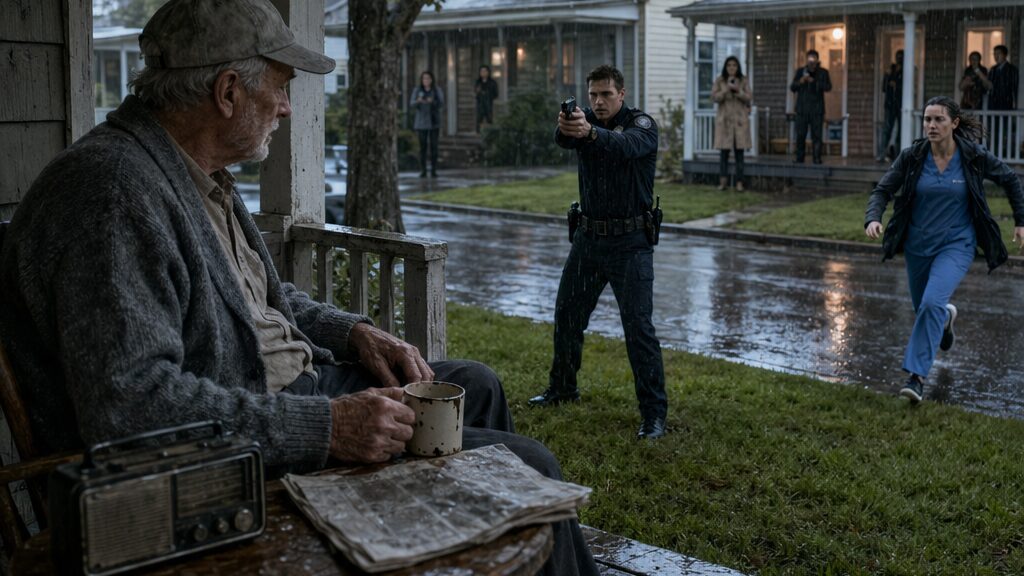
The gun was already pointed at Richard Harris before he understood why the police car had stopped in front of his house.
He sat beneath the shallow roof of his porch with the morning paper folded across one knee, his chipped brown coffee mug on the small table beside him, and the old radio resting near the porch rail where it had rested for years. Rain tapped through the gutters and ran in bright lines down the steps. Across the street, curtains moved. A neighbor’s front door opened halfway. Someone stood under an umbrella and did not come closer.
“Sir, keep your hands where I can see them.”
The young officer stood in the wet grass below the porch, both hands locked around his pistol. His uniform was dark with rain at the shoulders. His face had the tight, pale stillness of a man trying not to show that he was afraid.
Richard looked at him, then at the muzzle, then at the coffee mug.
The coffee had gone untouched since the siren chirped once at the curb. Steam still lifted from it, thin and white, disappearing into the damp air. The mug had a chip along the rim where it had struck the sink two winters earlier. Richard had kept it because the handle fit his fingers just right.
“I’m sitting,” Richard said.
“Do not reach for anything.”
Richard let the newspaper slide from his hand onto his lap. He had not raised his voice in forty years, not unless a life depended on it, and this did not feel like a moment for volume. It felt like a moment for breath. Slow in, slow out. Name the danger. Name the exits. Keep everyone alive until fear passed.
The officer’s eyes flicked to the old radio.
It was the size of a lunch box, olive-colored once, though the years had dulled it to a tired greenish gray. One corner was dented. Black tape circled the cracked battery cover. It had not worked properly in months, but Richard still brought it out each morning and set it beside the mug and paper, as if routine itself could keep the day from drifting.
“Sir, step away from the device.”
Richard frowned.
“The what?”
“The device on the railing. Step away from it slowly.”
Across the street, someone lifted a phone. The small black rectangle caught the gray sky, then angled toward Richard. Another neighbor appeared behind a window screen. Rain softened everything except the gun.
Richard’s right hand rested on the arm of his chair. His left lay open on the newspaper. His joints ached in the wet, and the porch air smelled of coffee, damp wood, and the oil he used to keep the radio’s knobs from seizing. He tried to gather the shape of what had happened. He had been reading the obituaries. He had turned the radio dial because static had come out of it after three silent days. He had said something without meaning to say it aloud.
Stay down. Don’t move.
The words had left his mouth before the police car came. Old words. Not for this street. Not for this rain.
“Officer,” Richard said, “there’s been a mistake.”
“Hands up.”
Richard looked down at his hands as if they belonged to another man. The skin was thin now, marked with liver spots and small scars that had faded until they looked like pale threads. Once, those hands had held pressure on wounds, tied bandages in the dark, found pulses under mud and blood and panic. Now they trembled when he buttoned cuffs in winter.
He raised them slowly.
The officer took half a step forward. His boots sank into the saturated strip of grass between the sidewalk and Richard’s porch. The police cruiser’s light bar flashed without siren, blue and red sliding over the wet siding of the house, over the porch column, over Richard’s face.
“Stand up.”
Richard did not move.
“I said stand up.”
“I need a second,” Richard said.
The officer’s jaw tightened. “You had your second.”
Richard looked at the steps. Three wooden steps, slick from rain blown sideways. His left knee had been unreliable since February. The railing on the right was loose where the porch repair worker had promised to come back and never had. If he stood too fast, he would reach for the rail. If he reached for the rail, the officer might see movement instead of balance.
“I’m going to use the arm of the chair,” Richard said. “Nothing else.”
“Do not reach.”
“I have to stand somehow.”
“Keep your hands where I can see them.”
Richard’s mouth went dry. The coffee mug was close enough that he could smell the bitter steam. His fingers moved an inch toward it by habit, toward warmth, toward the ordinary morning that had existed ten minutes ago.
The officer saw the movement and lifted the gun higher.
“Stop!”
Richard froze.
The porch seemed to shrink around him. The old radio sat by the rail like an accusation. The newspaper darkened where rain had reached the edge. His coffee shivered in the mug because his hand had bumped the table, and a thin brown line ran over the chipped rim and down the side.
Across the street, one neighbor whispered something. Another phone came up.
Richard felt heat rise in his face, not from fear alone. Shame came with it, sharp and surprising. Not shame for anything he had done. Shame at being displayed this way. An old man in house slippers and a gray cardigan, pinned in place while people who had accepted his quiet for years now watched to see whether he was dangerous.
“I am not trying to make trouble,” he said.
“Then do what I tell you.”
The officer’s voice cracked on the last word. Richard heard it. He heard the youth in it, the strain beneath the command. That did not lower the gun. That did not make the neighbors look away.
Richard opened his right hand wider.
“I heard you,” he said. “I was trying not to scare you.”
The officer blinked once, as if the answer did not fit the question.
Rain ran from the brim of Richard’s old cap. He had forgotten he was wearing it. He wore it in the mornings because it kept the damp off his scalp, not because it meant anything to anyone else. No insignia. No patch. Nothing for a stranger to read. Just a faded brown cap on an old head.
The officer shifted his stance. “We received a call about threats being made from this residence.”
Richard looked toward the houses across the street. Brenda King stood on her porch with one hand at her throat, face pale beneath the porch light though it was morning. She did not wave. She did not come forward. Her eyes slid from Richard to the radio and back again.
Threats.
The word landed without finding a place.
Richard thought of the sentence he had spoken to the dead air. Stay down. Don’t move. His throat tightened.
“That wasn’t a threat,” he said.
“What was it?”
Richard did not answer quickly enough.
The officer’s grip tightened. “What was it, sir?”
The rain thickened. Drops hit the coffee table hard enough to speckle the mug. Richard looked at the radio, then at the officer, then at the neighbors’ phones. The answer stood somewhere far behind him, in another country and another age, in a place where rain had smelled like metal and smoke. It did not belong in front of Brenda King’s tidy hedges and a patrol car on a suburban curb.
He closed his mouth.
The officer mistook the silence. Richard saw it happen. He saw the young man’s face harden around the empty space where an explanation should have gone.
“Stand up now.”
Richard pressed his palm against the chair arm, careful, slow.
The officer shouted again.
The coffee mug tipped.
It did not fall. It rocked against the saucer, spilled once more, and settled, but the small motion was enough to pull every eye toward Richard’s hand.
A car door slammed somewhere down the street.
“Tyler!”
The voice cut through the rain with such force that even the officer turned his head.
A woman in blue scrubs ran from the sidewalk, hair plastered to her temples, one hand raised toward the gun. She was breathing hard, not from distance but from urgency. Richard recognized the color of hospital scrubs before he recognized her face.
“Lower it,” she shouted. “Lower your weapon.”
“Ma’am, stay back.”
“No. You don’t understand who that is.”
Richard closed his eyes for half a second.
Not who.
Please, not who.
The woman came between the cruiser and the porch, close enough now that he could see her name badge turned backward on its clip, her rain-soaked shoes, the fear in her face that was not fear of him.
“Officer Martinez,” she said, voice shaking but clear, “that man is not a threat. He’s the reason someone is alive.”
Richard opened his eyes.
The gun was still up.
But for the first time, the officer looked uncertain.
Chapter 2: The Neighbor Who Made the Call
“I heard you,” Richard said after Tyler Martinez finally lowered the gun. “I was trying not to scare you.”
The words came out more tired than he intended.
Tyler stood at the bottom of the porch steps with his pistol holstered now, though his right hand still hovered near it as if habit had not caught up with the change. Heather Smith stood to one side, soaked through her blue scrubs, one palm still raised toward him and the other toward Richard. She looked like a person holding two doors open at once, afraid either one might slam.
The neighbors did not go inside.
That was the part Richard noticed. The weapon had gone down. The immediate danger had passed. Still, the doors stayed open, the phones stayed lifted, and the faces remained at windows as if the rest of him might yet become the thing they had expected.
“Sir,” Tyler said, “I need you to answer some questions.”
Richard’s hands lowered to the arms of the chair. He did not stand. Not yet. His knees had gone weak in the aftermath, and he did not want the neighbors to see him struggle. Pride was a foolish thing at his age. He knew that. He also knew it did not die simply because a man had outlived most of his reasons for keeping it.
“You can ask,” Richard said.
Heather turned toward him. “Mr. Harris, are you hurt?”
“No.”
“You’re sure?”
He gave her a look meant to settle her. It did not. She looked at his hands, his breathing, the porch steps, the spilled coffee. A nurse’s eyes. Noticing what everyone else missed.
Tyler pulled a small notebook from his pocket. Rain dotted the paper as soon as he opened it. “We received a call stating that you were making threats from the porch.”
“I was reading the paper.”
“The caller reported repeated statements. Something about not moving.”
Richard looked across the street.
Brenda King stood at the edge of her lawn now, wrapped in a raincoat too bright for the gray morning. She had not crossed over. Her face was tight, defensive before anyone accused her. She looked smaller than usual, though Richard knew her to be the sort of woman who could make a homeowners’ meeting run twenty minutes longer by correcting the order of agenda items.
“Mrs. King,” Tyler called. “Can you come over here, please?”
Brenda hesitated. Her gaze went to Richard, then away.
“You don’t have to,” Richard said.
Tyler looked back at him. “Sir, I need to establish what happened.”
“No,” Richard said quietly. “You need to decide whether you’re still afraid.”
The officer’s face flushed.
Heather lowered her hand but did not step away. “Let him breathe a minute.”
Tyler’s eyes flicked toward the neighbors watching. He seemed to remember them all at once. His shoulders squared. “I’m conducting an investigation.”
Brenda crossed the street with careful steps, avoiding puddles as though neatness could protect her from the scene she had helped create. When she reached the sidewalk below Richard’s porch, she held her raincoat closed at the collar and spoke to Tyler rather than Richard.
“I heard him say it,” she said. “More than once.”
“What exactly did you hear?” Tyler asked.
Brenda swallowed. “He said, ‘Stay down. Don’t move.’ Then he said it again. And he was sitting there with that thing.”
“The radio,” Richard said.
Brenda looked at it as though the word did not make it harmless. “It was making noise. Static. Loud static. And he was leaning over it.”
Tyler wrote something down.
Richard watched the pen move. It bothered him more than the phones. Phones captured too much and not enough. A report decided what would be remembered.
“I turned the dial,” Richard said.
“Why?” Tyler asked.
“Because it made noise.”
“What kind of noise?”
“Static.”
“And then you said, ‘Stay down. Don’t move.’”
Richard glanced at Heather. She was watching him with an expression that asked him to say more without speaking for him.
“Yes,” Richard said.
“Who were you talking to?”
No one.
A dead man.
A boy who had not been a boy, though Richard remembered him that way because grief had frozen Thomas White at twenty-three.
Richard rubbed his thumb against the chair arm. The wood was damp and rough where the finish had worn away.
“No one here,” he said.
Brenda made a small sound. Not quite a scoff. Not quite fear. “That’s what worried me.”
“I understand,” Richard said.
The answer seemed to unsettle her. She had expected anger, maybe. Or denial. Something she could hold up against what she had done.
Tyler looked at the radio again. “Is there anything inside it?”
“Dust,” Richard said. “Maybe an old battery.”
“I need to inspect it.”
“No.”
The word came before Richard softened it, and Tyler’s hand stopped over the notebook.
“No?” Tyler repeated.
Richard looked at the old radio. Rain had beaded on its dented casing. A drop hung from the cracked corner and fell onto the porch rail.
“You can look at it,” Richard said. “You can turn it over. You can see there’s nothing in it that can hurt anybody. But you don’t take it.”
Tyler’s jaw moved once. “Sir, if it’s part of a call—”
“It’s not evidence,” Heather said. “It’s a radio.”
Tyler turned on her. “You need to stop interfering.”
Heather’s face tightened. “I interfered because you were pointing a weapon at a seventy-four-year-old man reaching for coffee.”
That was when Richard saw the phone closest to them shift toward Heather. The neighbor behind it leaned in, eager for the next line.
Richard stood.
Everyone reacted. Tyler’s hand moved again. Brenda stepped back. Heather turned sharply.
Richard kept both hands visible, palms loose at his sides. He rose slowly, feeling the complaint in his knee, the damp pull of his cardigan, the humiliation of requiring permission to stand on his own porch.
“I’m going inside,” he said.
“Sir, this isn’t finished,” Tyler said.
“It is for the street.”
A quiet moved through the neighbors. Not respect. Not yet. Surprise, perhaps, that he had drawn a boundary without shouting.
Tyler looked toward the cruiser, then toward Brenda, then back to Richard. “I’ll need to file this as a high-risk response.”
Richard nodded once. “You’ll file what you think happened.”
“I’ll file what did happen.”
“No,” Richard said, looking at the coffee spreading in brown veins between the porch boards. “You’ll file what fear allowed you to see.”
Tyler’s face closed.
Brenda’s eyes dropped to the spilled coffee. For a moment, Richard thought she might apologize. Instead, she pulled her raincoat tighter and said, “I was only trying to make sure no one got hurt.”
“I believe you,” Richard said.
That made it worse for her. He saw that too.
The old radio gave a faint pop.
Everyone looked at it.
It should not have made any sound. Richard had removed the batteries the previous week after the static started waking him at night. But there it was again, a thin crackle under the rain, like breath dragging over gravel.
Richard reached to turn the knob off.
Tyler said, “Don’t.”
Richard stopped with his hand inches above the radio.
Heather stared at the old box, then at Richard’s hand. Something changed in her face. Not recognition of the radio. Recognition of the hand. The exact stillness of it. The way the fingers held above danger without trembling, waiting for panic around them to settle.
“Mr. Harris,” she said softly.
He did not look at her.
Tyler stepped onto the first porch step and leaned toward the radio without touching it. The static faded on its own.
“There,” Richard said. “You inspected it.”
Tyler glanced at him, irritated and embarrassed. “I’ll be in touch.”
“I’m usually here.”
Brenda turned away first. The neighbors followed slowly, as if the show had ended without giving them the ending they wanted. Doors closed. Curtains fell back. The cruiser lights still washed the porch, but without the gun the colors looked almost childish.
Heather waited until Tyler walked back toward his car.
Then she stepped closer to the porch. Rain dripped from her sleeves onto the steps.
“You did the same thing at the hospital blackout,” she said.
Richard looked at her then.
Her voice lowered. “With your hands. With your voice. You told everyone when to move and when not to. Nobody knew what you’d done before, but I did after about ten seconds.”
Richard’s fingers curled around the wet newspaper lying on his lap.
“Heather,” he said, though he did not remember giving himself permission to use her first name.
She looked startled that he knew it.
“Don’t,” he said.
She understood the shape of the request, but not the cost of it. He could see that in her eyes.
Behind her, Tyler’s cruiser pulled away from the curb. Across the street, Brenda King stood on her porch and watched Richard as if his quiet had become more suspicious, not less.
Heather took one step closer.
“You can’t let them make this into something it wasn’t.”
Richard folded the wet newspaper once, carefully, though the pages tore at the crease.
“It already is,” he said.
Chapter 3: The Nurse Remembered His Hands
Heather saw the video before she made it back to the clinic.
She was standing in the staff hallway with rainwater still inside her shoes when the hospital clerk held up a phone and said, “Isn’t this your street?”
The clip began with Richard already framed like a suspect.
The camera was across the road, unsteady under someone’s porch roof. Tyler Martinez stood in the rain with his weapon aimed. Richard sat beneath his own porch light, small inside the rectangle of the screen, one hand lifted, the other near the chipped mug. The caption at the bottom read: OLD MAN ON MAPLE STREET WOULDN’T DROP SOMETHING, COPS CALLED.
Heather felt the same heat she had felt running toward the porch. “That’s not what happened.”
The clerk glanced at her scrubs, still wet from the rain. “You were there?”
Heather did not answer. In the clip, Richard’s fingers moved toward the mug. Tyler shouted. Whoever filmed it gasped, delighted or horrified; the sound was too close to tell. The camera zoomed so abruptly that the mug filled the corner of the frame, brown coffee trembling inside it.
Then Heather herself entered, a blur of blue, one arm out. The clip stopped before Tyler lowered the weapon.
Of course it stopped there.
“People are saying he had some kind of device,” the clerk said. “Comments are wild.”
Heather took the phone and scrolled before she could stop herself.
He looks confused.
Why was he reaching?
Old people can be dangerous too.
The cop did what he had to do.
Then, beneath those, one comment with no profile picture: That man sits there every morning talking to a radio. Someone should check on him.
Heather gave the phone back. “Don’t share that.”
“I didn’t post it.”
“But you watched it.”
The clerk looked wounded, and Heather regretted the sharpness before the words finished landing. None of this was simple. People watched fear because fear asked to be watched. She knew that. She had seen emergency rooms fill with relatives who could not help but stare at the bed where their worst thought had come true.
“I’m sorry,” Heather said. “I just know him.”
“How?”
Heather looked down at her hands. They were pale from gripping the steering wheel too hard.
The hospital blackout had been in August, one of those brutal afternoons when the air-conditioning failed before the generator caught. The waiting room had been crowded, noisy, impatient. A man had collapsed near the vending machines. For fifteen seconds that felt like a minute, everybody shouted for someone else.
Heather had pushed through with a crash cart that did not fit cleanly around the chairs. Before she reached the man, an elderly patient in a faded cap had already lowered himself to the floor beside him. Richard Harris. She had not known his name then.
He had not announced himself. Had not said veteran, medic, trained, move aside. He had simply placed two fingers at the man’s neck, tilted his chin, and told the nearest person, “You, blue shirt, tell them we need oxygen. You, with the purse, move that chair. Nobody crowd his air.”
His voice had not been loud. People obeyed anyway.
When Heather knelt across from him, he looked at her once and gave only what mattered. “Pulse weak. Breathing shallow. He went down clean, no head strike. Sugar maybe, but don’t trust maybe.”
She remembered his hands most. Not young hands. Not steady in the way young people meant steady. They were marked by age, knuckles swollen, skin thin. But they did not waste movement. They did not perform confidence. They held the man’s wrist with a gentleness that made panic around him seem rude.
Afterward, when the man was breathing better and the lights returned, Heather had asked if Richard had medical training.
“A long time ago,” he had said.
“What kind?”
“The kind that doesn’t belong in waiting rooms.”
Then he had picked up a paper cup of water with the same careful grip she had seen that morning around the coffee mug and sat back down as if he had done nothing worth naming.
Now the internet had named him unstable.
Heather finished her shift because people needed stitches, signatures, discharge papers, and someone to tell them where the restroom was. But Richard’s porch stayed in her mind all day: the gun line, the mug, the radio, Tyler’s face, Brenda King standing across the street with fear dressed up as certainty.
At five-thirty, Heather drove back to Maple Street.
Richard was on the porch.
The rain had stopped, but the boards were still wet. His newspaper lay folded on the small table, ruined beyond reading. The chipped mug had been washed and set upside down on a towel. The old radio was gone from the railing.
Richard sat in the same chair as if returning to it quickly could prove it had not been taken from him.
“You should be inside,” Heather said.
“You sound like the discharge desk.”
She climbed the steps slowly, letting him see she would not rush him. “May I sit?”
He nodded toward the second chair.
She sat. For a moment neither of them spoke. A car passed too slowly. Richard watched it without turning his head.
“The video is spreading,” Heather said.
“I assumed.”
“They cut it before Tyler lowered the gun.”
“That’s the part people wanted.”
“No,” she said. “That’s the part people were given.”
Richard looked at her then, and she understood why he had frightened Brenda without meaning to. His eyes did not wander. They settled. Some people mistook that for emptiness because they could not bear to be fully seen by someone who was not trying to impress them.
“I can say something,” Heather said. “I can write what happened. I can tell them about the hospital.”
“No.”
“You helped save a man.”
“So did you.”
“You know what I mean.”
“I do,” Richard said. “That’s why I said no.”
Heather leaned forward. “They’re calling you unstable.”
“I’ve been called worse by better men.”
“That doesn’t make it right.”
“No.”
“Then why protect them?”
His jaw tightened, not much. Enough.
“I’m not protecting them.”
“You’re protecting something.”
Richard reached for the upside-down mug, then stopped before touching it. The habit was so small it almost hurt to see. The porch had trained him all over again in one morning: reach carefully, move slowly, expect eyes.
Heather softened her voice. “Mr. Harris.”
“Richard is fine.”
“Richard. People filled in the parts they didn’t know. They’ll keep doing it unless someone tells the truth.”
He looked toward the empty place where the radio had been. “The truth is not a bucket of water you throw on a fire. Sometimes it spreads things.”
“What things?”
He did not answer.
There it was again: not weakness, not confusion. A locked door. Heather could feel the shape of something behind it, and she knew enough not to kick at it. But the street had already started prying.
A front door opened across the way.
Brenda King stepped onto her porch holding a white envelope. She did not call out. She crossed the street with her chin lifted and stopped at Richard’s mailbox near the curb. She opened it, slipped the envelope inside, and shut the little metal door with a click that carried.
Heather stood. “Brenda.”
Brenda looked up, startled, then composed herself. “It’s just notice. For the neighborhood safety review.”
Richard remained seated.
Heather walked down two steps. “A what?”
Brenda kept her eyes on Heather, not Richard. “After an incident involving police response, we’re allowed to request one. It’s better to handle concerns properly.”
“Concerns,” Heather repeated.
Brenda’s face colored. “I’m not the only one who has them.”
Richard rose from his chair before Heather could answer. This time he used the armrest without apology. He came down the steps slowly, crossed the wet path to the mailbox, and opened it.
The envelope was already damp at the corners. He took it out and looked at the printed notice through his reading glasses, which he had drawn from his cardigan pocket with the care of a man handling something fragile.
Heather watched his face.
It did not change much. That was the worst of it.
Brenda said, quieter now, “I thought it would be better than people talking.”
Richard folded the notice once and held it beside his leg.
“People were already talking,” he said.
Brenda looked away.
Heather expected him to say more. To tell Brenda what her fear had done. To show anger, at least enough to make the woman carry some of the weight in public.
Instead, Richard turned back toward the porch.
Heather followed him with her eyes, frustration rising in her throat. His silence had protected him once, maybe. It would not protect him now.
At the top step, Richard paused and looked toward the place on the railing where the old radio had sat that morning.
Only a rectangle of dry wood remained beneath the porch roof, surrounded by rain-dark boards.
Brenda noticed it too.
“Where did it go?” she asked.
Richard’s hand closed around the notice.
For the first time all day, he looked less like a man enduring humiliation and more like a man who had misplaced something he was not ready to admit he needed.
“Inside,” he said.
Then he went in and shut the door, leaving Heather on the porch with the wet notice in his hand and Brenda King staring at the empty space where the radio had been.
Chapter 4: The Report That Left Out the Rain
The phrase was printed in the middle of the page as if it had always been true.
Subject failed to comply.
Richard stood at the police station counter with the incident report held between both hands, his reading glasses low on his nose, and the clerk waiting behind the glass for him to move along. The paper was warm from the printer. That warmth bothered him. It made the words feel newly made, still soft enough that someone could have shaped them differently if they had cared to.
Subject failed to comply with lawful commands during high-risk welfare response.
There was no rain in the report.
No coffee mug.
No wet newspaper sliding off his knee.
No old chair with the loose right arm.
No neighbor holding a phone under a porch roof while Richard tried to decide whether standing too quickly would get him shot.
“Sir?” the clerk said. “Do you need a copy envelope?”
Richard looked up.
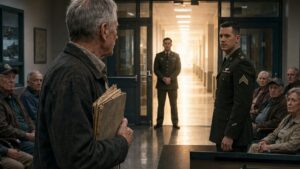
The clerk’s expression was polite in the way of people who had learned to give nothing away. Behind her, a printer hummed. Somewhere deeper in the station, a phone rang twice and stopped. A man laughed in another room, then lowered his voice.
“No,” Richard said. “This is enough.”
He folded the report once, then stopped. Folding it felt like accepting it. He opened it again and read the first page from the top, slower this time, as if the words might become more honest if given a second chance.
Call received regarding elderly male making threatening statements from residence. Reporting party concerned subject may possess unknown device. Officer arrived and observed subject seated near suspected object. Subject did not immediately follow verbal commands.
Suspected object.
Richard lowered the paper.
A door buzzed open beside the counter, and Tyler Martinez stepped into the lobby with a folder in one hand. He stopped when he saw Richard.
For a moment neither of them moved.
Tyler was not in rain now. His uniform was clean, his hair neat, his posture squared for the building around him. Without the water running down his face, without the cruiser lights cutting over him, he looked even younger. Not young enough to excuse anything. Young enough to make Richard tired.
“Mr. Harris,” Tyler said.
“Officer.”
Tyler’s eyes dropped to the report in Richard’s hands. “They gave you a copy?”
“I asked for one.”
Something crossed Tyler’s face. Irritation first, then caution. “You have that right.”
“That’s kind of you to say.”
Tyler looked toward the clerk, then back. “If you have concerns, there’s a formal process.”
Richard almost smiled. Almost. “I’m beginning to understand that everything has a process except fear.”
Tyler’s mouth tightened. “I responded to the information I had.”
Richard tapped the report lightly with one finger. “No. You wrote down the information that helped afterward.”
The clerk suddenly became very interested in her screen.
Tyler took a breath through his nose. “Sir, you were reported as making threats. There was an unknown object. You reached toward it after being ordered not to move.”
“My coffee.”
“You reached toward the table.”
“My coffee was on the table.”
“I didn’t know that.”
“You saw it.”
Tyler looked away first.
The small victory brought Richard no pleasure. He had not come to win a sentence in a lobby. He had come because the paper in his hand had turned him into someone he did not recognize, and because he had spent two days hearing car tires slow in front of his house.
Tyler said, lower now, “I had to make a judgment.”
“You did.”
“I had seconds.”
“So did I.”
The door behind Tyler opened again, and a police supervisor stepped into the lobby. He was broader than Tyler, older, with a calm official face that seemed built for rooms where nobody should raise their voice. His gaze moved from Tyler to Richard to the report.
“Mr. Harris,” he said. “I’m the supervisor on duty. Is there an issue we can help clarify?”
Richard held up the report. “It left out what made the issue clear.”
The supervisor came closer, not unkindly. “Reports summarize relevant facts.”
“Relevant to whom?”
The supervisor paused. Tyler shifted his folder from one hand to the other.
Richard unfolded the page and turned it toward him. “It says I failed to comply. It does not say I was seated. It does not say my hands were visible until I was told to stand on wet steps. It does not say the object was a radio. It does not say the neighbor was filming. It does not say the officer kept a gun pointed while I explained my knee was bad.”
Tyler’s face colored.
The supervisor glanced at him once, then returned to Richard. “I understand this was upsetting.”
Richard felt the word slide past the thing itself.
Upsetting was a broken appointment. Upsetting was a bill higher than expected. Upsetting was rain through a roof patch that had failed again.
“It was public,” Richard said.
“Yes, sir. But no one was injured.”
That was the sentence that changed the room.
Richard folded the report slowly along its original crease. When he looked at Tyler, the young officer’s eyes had lowered. Not in shame exactly. In discomfort. In recognition that the supervisor had offered him cover and that cover had its own kind of harm.
“No one was injured,” Richard repeated. “Is that where you put the bar?”
The supervisor’s official calm thinned. “That isn’t what I meant.”
“It’s what you said.”
Tyler spoke then. “I didn’t want anyone hurt.”
Richard turned to him. “I believe that.”
Tyler seemed unprepared for belief.
“I believe you were afraid someone might be hurt,” Richard said. “I believe you thought your fear gave you permission to see only what fit it.”
Tyler’s hand closed around the folder.
The supervisor said, “Officer Martinez had reason to proceed cautiously. He was criticized earlier this year for not taking control quickly enough on another call. We expect decisive response in uncertain situations.”
Tyler looked sharply at him.
There it was. Not an excuse, but a seam. Richard saw it open before Tyler could pull it shut.
“A previous call,” Richard said.
The supervisor’s expression stiffened. “I’m only saying these situations are complex.”
Tyler’s jaw worked once. “A domestic call. I waited for backup. The review said I should have acted faster.”
The lobby went quiet except for the printer behind the glass.
Richard pictured it without wanting to: a younger man standing somewhere with too much noise, too many unknowns, then being told later that hesitation was failure. He had seen men ruined by the wrong lesson. He had learned some himself.
“And yesterday,” Richard said, “you acted faster.”
Tyler did not answer.
The supervisor stepped in. “Mr. Harris, there’s a neighborhood safety review scheduled tomorrow evening. If you want to make a statement, that would be the appropriate venue.”
“Appropriate,” Richard said.
“It allows all parties to be heard.”
Richard looked at the report again. All parties. The page in his hand had already spoken before he entered the room. It had spoken with a badge behind it.
He tucked the paper under his arm. “Then I’ll hear them.”
The supervisor gave a small nod, relieved by what he thought was cooperation. Tyler did not look relieved.
When Richard reached the glass door, Tyler said, “Mr. Harris.”
Richard turned.
Tyler’s voice was quieter now. “I didn’t know it was coffee.”
Richard waited.
Tyler added, “I didn’t know what the radio was.”
“No,” Richard said. “You didn’t.”
He pushed the door open and stepped outside into a damp afternoon. The rain had stopped, but the sidewalk still held shallow mirrors of the sky. His reflection moved through them brokenly, cap, cardigan, folded paper under one arm.
At home, Richard made coffee because the day had left him cold.
He used the chipped mug. He did not choose it for symbolism. He chose it because it was his. The handle fit his fingers. The chip reminded him where to turn the rim so it did not touch his mouth.
He sat at the kitchen table with the report spread in front of him. The house was too quiet without the radio on the porch. Its absence seemed louder than static.
Subject failed to comply.
Richard took a sip and set the mug down precisely on the ring it had left that morning.
Heather had called twice. He had not answered. Brenda King had not come back across the street, but someone had slid a photocopy of the review notice under his porch mat, as though the mailbox had not made the message official enough. Tomorrow evening, the community room beside the library would hold folding chairs, a long table, people with opinions, and Tyler Martinez standing in a clean uniform while Richard’s wet porch became a topic.
He could stay home.
That thought came first, smooth and tempting. Let them talk. Let them file. Let them decide whatever helped them sleep.
He had done that all his life, in one form or another. Let the loud ones tell the story. Let the living choose their version. Keep what mattered folded where no one could stain it.
The coffee cooled. The report waited.
Richard opened the kitchen drawer closest to the back door. Inside were batteries, twist ties, a flashlight, two old keys, and a roll of black electrical tape. Beneath them, wrapped in a faded dish towel, lay the radio.
He had put it there after the incident because the porch had felt too exposed for it, as if the neighbors’ eyes could reach through the casing and touch what was inside. He unwrapped it carefully.
The dented corner caught the kitchen light. The cracked battery cover was still held by tape. Its weight settled into his palms with the old familiarity of something carried through more than distance.
He placed it beside the chipped mug.
For several seconds, nothing happened.
Then the report shifted in a draft from the heating vent, and the top page slid against the table with a dry whisper.
Richard looked from the paper to the radio.
The official version. The silent box. The coffee mug that proved nothing except that he had been trying to live an ordinary morning.
His hand moved to the radio’s dial.
He did not turn it on.
He only rested his fingers there and felt, with a force that made his chest tighten, how long he had let other people decide what silence meant.
Chapter 5: The Voice He Could Not Save
The radio gave a burst of static in the dark kitchen though there were no batteries inside it.
Richard’s hand stopped above the dial.
He had been standing there in his socks, unable to sleep, with the community review notice on the table and the chipped mug beside it, coffee gone cold hours ago. The house was dark except for the light over the stove. It made the radio look smaller than it felt, a battered green-gray box with tape around its back and one dented corner angled toward him like an old wound.
The static came again.
A thin, dry crackle.
Richard knew enough about bad wiring and old speakers to explain it if he had wanted an explanation. Moisture. Corrosion. A stored charge in a tired circuit. Houses made sounds at night, especially houses owned by men who did not fix things quickly because they were tired of asking workers to come back twice.
Still, he did not move.
Then the kitchen disappeared around the edges.
Not all at once. It never did. Memory came the way weather came through a bad roof, first a stain, then a drip, then suddenly everything you thought was solid had softened.
Rain on the porch became rain on canvas. The smell of coffee went bitter and metallic. The stove light thinned into a washed-out sky.
Stay down. Don’t move.
His own voice, younger and harsher, cut through the old radio in his mind.
Thomas White had been twenty-three and always trying to make someone laugh when the rest of them had stopped wanting to. He had carried that radio like it was more important than his rifle, tapping the side when the signal faded, calling it stubborn, calling it sweetheart, calling it everything except what it was: a machine that failed when weather, distance, and fear asked too much of it.
Richard had not known Thomas long enough to know his whole life. He knew fragments. A mother in Ohio who wrote every week. A younger sister who drew horses in the margins of her letters. A bad left ankle Thomas lied about because he did not want to be pulled from duty. A habit of humming old radio jingles under his breath when silence got too heavy.
The day Richard remembered most had no clean beginning. No single moment when danger announced itself. It was confusion first. Mud, rain, shouting, a field broken by smoke, men moving low because standing up made them visible to more than God.
The radio had cracked against Thomas’s chest as he crawled toward a shallow ditch with two others. Richard had been twenty yards away, maybe less, though memory stretched distances when guilt lived in them.
“Stay down,” Richard had shouted. “Don’t move.”
Thomas had looked back. Even then, impossibly, he had grinned.
Richard could still see that grin.
Not brave. Not foolish. Human. A quick flash of I hear you, Doc, stop yelling before the world narrowed again.
Then the noise came.
Richard closed his eyes in the kitchen, but closing them only sharpened the rest.
He remembered moving when he had been told not to. Remembered someone grabbing his sleeve. Remembered tearing loose because Thomas had stopped answering and the radio was giving out only static. He remembered the mud taking his knees. The impossible weight of another man’s body when that man was not helping you lift him. The way training entered him like a second spine.
Check airway. Find bleeding. Pressure. Talk even when they cannot answer. Especially then.
“Stay with me, White.”
Static.
“Don’t move. You hear me? Don’t you move on me.”
Thomas’s eyes had been open but not fixed yet. Richard had told himself that mattered. He had told himself a lot of things in those seconds because a medic who ran out of orders had nothing left between him and helplessness.
Thomas’s fingers had caught Richard’s sleeve.
“Radio,” he had whispered.
“I’ve got you.”
“Radio.”
“I’ve got you.”
Richard had not understood until later. Thomas had not been asking for the radio. He had been asking him to listen.
There had been a voice coming through the broken speaker. Faint. Another unit trying to reach them. Coordinates lost under static. A warning. A request. Richard had heard pieces but not enough. He had chosen the body in front of him over the voice in the box because that was what a medic did. Hands before distance. Blood before signal.
Thomas died before the rain stopped.
Others lived that day because someone else eventually heard what Richard had not answered. That was the official comfort, given in words polished by men who did not kneel in the mud afterward. Not your fault. Impossible conditions. You did everything you could.
Richard had accepted those words the way he accepted a blanket around his shoulders. For warmth, not truth.
The radio came home years later in a cardboard box with other things nobody knew where to send. Richard never learned who packed it. The battery cover was cracked then. The corner dented. Thomas’s initials scratched underneath, almost invisible unless you held it near a window.
T.W.
Richard had kept it because throwing it away felt like leaving Thomas a second time.
At first it lived in a closet. Then, after Richard’s wife died, it came to the kitchen table. Later to the porch. Morning by morning, it became part of the arrangement: newspaper, coffee, radio. The world could move on in its loud, careless way, but Thomas White would not be shut in a drawer.
Until Brenda heard the sentence.
Until Tyler saw a device.
Until Richard chose silence again and watched silence become proof against him.
The kitchen returned slowly. The stove light. The cold coffee. The review notice. The radio silent now, innocent of everything except age.
Richard sat down because his legs had begun to ache.
He pulled the mug closer and touched the chip at the rim. The coffee inside had gone bitter and flat, but he drank it anyway. Waste had always bothered him.
The notice lay beside the police report. Two pieces of paper telling him where to appear and how others had named him. Concern. Subject. High-risk. Noncompliant.
He reached for a pen.
His hand hovered.
What could he write that did not turn Thomas into a prop? What could he say that did not make the room lean forward for the wrong reason? He had seen people do that with service stories, seen their faces change as if pain became more acceptable once wrapped in uniform cloth. They wanted the clean sentence. The lesson. The heroic shape.
Thomas had not died in a lesson.
He had died wet, young, and annoyed that his radio would not work right.
Richard put the pen down.
The house creaked.
He thought of Tyler’s face in the station lobby when the supervisor mentioned the earlier call. Not innocence. But something cracked behind the certainty. Fear taught as policy. Shame converted into speed.
He thought of Brenda King standing in the rain, saying she only wanted no one hurt. He had believed her. That was the trouble. Belief made anger less useful and responsibility more complicated.
He thought of Heather, wet scrubs clinging to her shoulders, furious because the clip stopped before the truth changed.
She had wanted to defend him. He had told her not to.
Richard looked at the radio. “You hear that, White?” he murmured. “Still giving bad orders.”
The words surprised him. So did the breath after them, almost a laugh and not quite one.
He turned the radio over.
Thomas’s initials were still there, scratched into the underside with a knife tip or nail. T.W. Rough, uneven, stubborn.
Richard ran his thumb over them.
The sentence Brenda heard had been true once. Stay down. Don’t move. It had meant protection. It had meant live long enough for me to reach you. It had meant trust my voice because I am trying to get you home.
On Richard’s porch, stripped of rain and memory and Thomas’s grin, it had sounded like a threat.
Maybe that was what silence did. It removed the hands that had held the words. It left strangers to pick up the sharp parts.
Richard took up the pen again.
He did not write about medals. There were none in the drawer, and none that mattered to the question in front of him. He did not write about rank. He had spent most of his life avoiding rooms where rank made men louder than they needed to be. He did not write a speech.
He wrote one sentence.
The object on my porch was a radio that belonged to Thomas White.
He stopped.
The name looked strange on the paper. Too small. Too complete. A whole man flattened into two words.
Richard’s throat worked once.
He wrote a second sentence.
The words Mrs. King heard were words I once used to keep frightened men alive.
His hand shook before the third sentence, and this time he let it. There was no one in the kitchen to mistake it for weakness.
He wrote slowly.
What happened on my porch should not happen to the next old person who cannot explain fast enough to satisfy fear.
He set the pen down.
Three sentences. Not enough. Too much.
The radio sat beside the mug. The review notice waited beneath the report. Outside, a car passed without slowing. The old house settled again around him.
Richard folded the paper once and placed it under the chipped mug so it would not blow away if he opened the door in the morning.
Then he picked up the radio with both hands and carried it to the porch.
The air outside was cold and damp. The street was empty. Across the way, Brenda King’s porch light was on, though no one stood beneath it.
Richard set the radio back in its old place on the railing.
For a moment, he stood beside it, hand resting on the dented corner.
“Tomorrow,” he said, though he did not know whether he was speaking to Thomas, to himself, or to the street that had watched him.
Then he went inside and left the radio facing the dark.
Chapter 6: The Room Where Everyone Watched Again
The community room went quiet when Richard Harris entered carrying a chipped coffee mug in one hand and an old radio in the other.
Not silent. Quiet. There was a difference. Silence had weight and intention. Quiet was what people fell into when they were deciding what kind of face to wear.
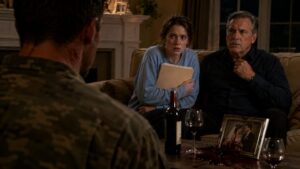
Folding chairs filled three uneven rows beneath fluorescent lights. The long table at the front held a pitcher of water, paper cups, a stack of forms, and a small recorder placed there by the city review official. Tyler Martinez sat near one end in uniform. His police supervisor sat beside him, hands folded, expression prepared. Brenda King sat in the first row with a folder pressed flat against her knees. Heather Smith stood along the wall in blue scrubs, arms crossed, watching Richard as if ready to step forward and trying hard not to.
Richard had put on a clean shirt and dark coat. No cap. He had nearly worn it, then left it on the kitchen table. He did not want the room searching him for signs.
The city review official cleared his throat. “Mr. Harris, thank you for coming.”
Richard nodded once and walked to the empty chair near the front.
The radio was heavier than it had been that morning. Or perhaps rooms made private objects heavier. He set it on the table with care. Then he placed the chipped mug beside it.
The mug made a small sound against the wood.
Every eye dropped to it.
Richard sat.
The city review official looked at the mug, then at his papers. “This meeting concerns the welfare response incident on Maple Street and related neighborhood safety concerns. We’ll allow each party to speak in turn.”
“Safety concerns,” Heather said from the wall.
The official glanced at her. “Ma’am, we’ll maintain order.”
Richard looked at Heather and gave the smallest shake of his head.
She pressed her lips together but stayed where she was.
Brenda spoke first because the official invited the reporting party to explain the call. She stood with her folder held to her chest and looked at the room rather than at Richard.
“I live across from Mr. Harris,” she began. “I’ve lived there eleven years. I know his routine. He sits outside most mornings. I didn’t call because I wanted trouble.”
No one interrupted her.
Her eyes moved to the radio on the table. “That morning, I heard static. Loud enough to hear from my porch. Then I heard him say, ‘Stay down. Don’t move.’ More than once. He was leaning over that radio. I thought he might be confused. Or talking to someone. Or…” She stopped, embarrassed by the next word before it arrived. “Or planning something.”
Heather’s arms tightened.
Richard kept his gaze on the mug.
Brenda swallowed. “My father had dementia before he passed. He would say things that sounded harmless until they weren’t. He left the stove on twice. He wandered into traffic once. I called for help then too late, and I always thought after that, if I saw signs in someone else, I wouldn’t wait.”
The room changed around that sentence.
Not enough to clear her. Enough to complicate her.
Richard looked at her then. She was not crying. He was grateful for that. Tears would have asked him for something he did not have ready to give.
“I thought I was doing the careful thing,” Brenda said. “But I also watched. I didn’t go over. I didn’t ask him if he was all right. I called from across the street.”
She sat down quickly, as if honesty had cost her balance.
The official thanked her. The supervisor spoke next.
He used words like protocol, uncertain threat environment, officer safety, and rapidly evolving circumstances. He did not sound cruel. He sounded practiced. That made Richard more tired than cruelty would have.
Tyler sat still through it, eyes down.
When the supervisor finished, the official turned to Tyler. “Officer Martinez?”
Tyler stood. His chair scraped the floor.
“I responded to the call based on dispatch information,” he said. “I observed Mr. Harris seated near an unknown object after reported threatening statements. I gave commands. He did not immediately comply. I maintained distance and control until another party arrived and provided additional context.”
Heather pushed off the wall. “Additional context? I told you he wasn’t a threat.”
The official said, “Ma’am.”
Richard lifted one finger from the table.
Heather stopped.
Tyler looked at Richard for the first time since he began speaking. “I followed procedure.”
The sentence hung there, clean and hard.
Richard touched the handle of the chipped mug.
Then he stood.
His knee complained, but he did not reach for the table. He let the room see the effort without asking it to admire him.
“Which procedure,” he asked, “required you to ignore the coffee mug?”
No one answered.
Richard picked it up. “This was on the table beside me. It was full. Hot. I had the newspaper open. My slippers were wet because the rain was blowing onto the porch. The rail on the right side of my steps is loose. When you told me to stand, I told you I needed the chair arm.”
Tyler’s face tightened, but he did not look away.
Richard set the mug back down. “I am not saying you had no reason to be careful. I am saying your caution became the only fact you trusted.”
The official shifted in his chair. “Mr. Harris, are you making a formal complaint about the officer’s conduct?”
“I’m making a formal complaint about what fear was allowed to erase.”
The room held still.
Richard unfolded the paper he had written the night before. The three sentences looked even smaller under the fluorescent lights.
He could stop there. Read them and sit. Leave Thomas mostly hidden. Keep the door only cracked.
He looked at the radio.
“This object,” he said, resting one hand on it, “is a radio. It belonged to Thomas White.”
The name entered the room without explanation. That was enough for now.
“I served as an Army medic a long time ago. Thomas served with me. The words Mrs. King heard were not threats. They were words I once used when men were scared and hurt and needed to stay still long enough to be helped.”
Brenda lowered her folder.
Richard did not look at Heather. He could feel her attention like a hand at his back, but she did not speak.
“I said them that morning because the radio made static.” He paused. “And because memory does not always ask permission before it comes through.”
The supervisor’s expression changed first. Not dramatically. His prepared calm lost its polish.
Richard folded the paper again. “I did not explain that on the porch. That is on me. I have made a habit of silence. Sometimes it has been dignity. Sometimes it has been pride. Sometimes it has made room for other people to tell the wrong story.”
Tyler’s hands were at his sides now, fingers curled slightly.
Richard faced him.
“You were afraid,” he said. “I could see that. Fear is not shameful. But when fear carries authority, it needs more discipline than you gave it.”
Tyler flinched as though the words had struck closer because they were not shouted.
The official leaned toward the recorder. “For the record, Mr. Harris, what outcome are you requesting?”
There it was. The room wanted a demand. Punishment. Money. A headline. Something simple enough to file.
Richard looked at the mug.
“I want the report corrected,” he said. “I want it to say the object was a radio. I want it to say I was seated with coffee and a newspaper. I want it to say a weapon was pointed at me in front of neighbors before anyone asked whether the caller’s fear was the only explanation.”
Tyler swallowed.
“And I want your department,” Richard continued, turning to the supervisor, “to stop treating welfare checks on old people like raids just because old people do not answer quickly enough.”
The official wrote something down.
The supervisor began, “Policy changes require—”
“Work,” Richard said. “Yes.”
A few people shifted in their chairs. Not applause. Nothing so easy. Just discomfort finding new places to sit.
The supervisor’s face hardened, then softened into something less official. “We can review guidance for calls involving elderly residents, medical confusion, and reported objects. I can’t promise tonight what the final language will be.”
“Then promise where you’ll start,” Richard said.
The supervisor looked at Tyler. Tyler looked at the radio.
Heather finally spoke, quietly enough that it did not break the room. “Start with asking what else might be true.”
Brenda nodded once, almost to herself.
The official marked another note. “We’ll include that recommendation.”
It was not victory. Richard did not trust rooms that offered victory too quickly. But something had shifted. The mug on the table no longer looked foolish. The radio no longer looked suspicious. They were ordinary objects again, which was all he had wanted from them.
The official began to close the session with a general statement about community healing.
Richard sat back down.
The supervisor reached for his folder, relieved.
Then Tyler stood.
The chair legs scraped louder than before. He did not look at his supervisor. He looked at Richard, then at the mug, then at the people in the room who had watched once from across the street and were watching again now from folding chairs.
“I need to say something before this ends,” Tyler said.
The supervisor’s hand stopped on the folder.
Tyler’s voice was rough, but steady enough to carry.
“I saw an old man and a threat,” he said. “I did not see a person.”
Chapter 7: The Apology Without an Audience
Tyler Martinez came to Richard’s porch the next morning without his uniform hat, without a partner, and without the cruiser lights.
The rain had returned before dawn, thin and steady, silvering the street and darkening the porch steps where the old wood still needed repair. Richard saw him through the front window before the knock came. Tyler stood at the bottom step with both hands visible, rain gathering on his shoulders, waiting as if the porch itself had the right to refuse him.
Richard did not hurry to the door.
The chipped mug sat on the kitchen counter, clean and empty. The old radio was back on the porch rail beneath the shallow roof, out of the rain but close enough to smell the weather. Richard looked at both before he opened the door.
Tyler straightened. “Mr. Harris.”
Richard stood inside the doorway with one hand on the frame. “Officer.”
“Tyler is fine, if you prefer.”
“I don’t yet.”
The young man accepted that with a small nod. He had circles under his eyes. Whatever sleep he had gotten had not done its work.
“I’m off duty,” Tyler said. “I didn’t come officially.”
“That can make things better or worse.”
“I know.”
Richard opened the storm door and stepped onto the porch. He did not invite Tyler up. Not immediately. The space between the steps and the chair mattered now. It had been filled once by a gun, then by neighbors’ eyes, then by a room full of official language. Richard let the space remain empty long enough for Tyler to feel it.
Tyler looked at the chair where Richard had sat that morning. His gaze moved to the small table, then to the radio. He did not stare at it as if it were suspicious now. He stared as if embarrassed that he ever had.
“I requested a correction to the incident report,” Tyler said. “The supervisor agreed to amend the description of the object. It will say radio. It will say you were seated with coffee and a newspaper.”
Richard watched rain drip from the porch roof.
“And the part where I failed to comply?”
Tyler’s mouth tightened. “That language is being reviewed.”
“That sounds like it means no.”
“It means I pushed it as far as I could this morning.”
Richard looked at him then.
Tyler did not look proud of the sentence. That helped. A little.
“I also submitted a request for additional training,” Tyler said. “Elder welfare calls. Medical confusion. De-escalation when the person is older or slow to respond. I asked for it to be department-wide, but I don’t know what they’ll approve.”
“Requests are easy.”
“Yes, sir.”
“Was that your apology?”
Tyler swallowed. “No.”
Richard let the rain answer for a moment.
Tyler took a breath. “I am sorry I pointed my weapon at you. I am sorry I kept it pointed after there were signs I should have slowed down. I am sorry I let the people watching make me more concerned about looking in control than being in control.”
The words were plain. Not polished. Richard preferred them that way.
Tyler looked down at the wet steps. “I thought if I hesitated again, someone would say I froze. I thought decisive meant fast. I thought fear meant I was seeing clearly.”
Richard leaned against the doorframe. “Fear is very convincing.”
“Yes.”
“It tells you it is wisdom.”
Tyler nodded once.
Richard opened the door wider behind him. “You can come up if you keep your hands out of your pockets. Not because I’m afraid of you. Because you should know what that feels like.”
Tyler’s face changed. He looked as if he wanted to object, then understood he had not earned that right.
“Yes, sir.”
He climbed the steps slowly, placing each foot where the slick wood was least worn. At the top, he stopped near the chair opposite Richard’s and waited.
Richard went inside and came back with two mugs. One was the chipped brown one. The other was a plain white mug from a set his wife had bought years ago, of which only three remained. He set the chipped mug by his own chair and handed the white one to Tyler.
Tyler accepted it with both hands.
The coffee was hot enough to make him adjust his grip. Richard noticed and said nothing.
They sat.
For a while, neither drank. The street was quiet except for rain and the occasional hiss of tires on wet pavement. Across the way, Brenda King’s curtains shifted once and went still.
Tyler noticed. His shoulders tightened.
Richard said, “That’s part of it too.”
“What is?”
“Knowing someone is watching and deciding not to become whatever they expect.”
Tyler looked into the white mug. “I was afraid of looking weak.”
Richard took his first sip. The chip faced away from his lip. “You were afraid of being judged.”
“Yes.”
“So was I.”
Tyler looked up.
Richard held the mug between both hands. “Not the same way. But yes.”
“I didn’t think—”
“No. You didn’t.”
The young man accepted that too. That mattered more than the apology.
Richard looked toward the radio. “When you’re old, people explain you quickly. Slow means confused. Quiet means empty. Alone means unsafe. Angry means unstable. Tired means helpless. If you resist, you become difficult. If you say nothing, you become proof.”
Tyler’s eyes moved to the radio, but he did not ask.
“That morning,” Richard said, “I could have told you more.”
“You shouldn’t have had to.”
“No,” Richard said. “But I could have. And I didn’t because I am stubborn about my own pain. That does not excuse what you did. It does explain why I am trying not to turn you into the only person in this story who was afraid.”
Tyler’s hands tightened around the white mug.
“I don’t know how to fix what people saw,” he said.
“You don’t fix the watching. You fix what you do when they watch.”
Tyler nodded slowly.
A car passed, then slowed. Richard did not turn his head. Tyler did. The habit was still there.
“Let it go,” Richard said.
Tyler faced forward again.
A minute later, movement appeared across the street.
Brenda King stood at the edge of her porch holding something against her chest. She wore a raincoat, but the hood was down, and the rain had begun to darken her hair. She looked toward Richard’s porch, stepped off her curb, stopped, then started again.
Tyler shifted as though to stand.
Richard said, “No.”
Tyler stayed seated.
Brenda crossed carefully, carrying a folded newspaper wrapped in a clear plastic sleeve. When she reached Richard’s walkway, she paused at the bottom of the steps, exactly where Tyler had stood with his weapon.
The symmetry did not escape any of them.
“I found this in my recycling bin,” Brenda said.
Richard looked at the plastic sleeve.
“It’s yours,” she added. “From that morning. It must have blown across after everything happened. I picked it up and forgot I had it.”
Richard did not move.
Brenda climbed one step, then stopped again. “No. That isn’t true. I didn’t forget. I kept it because I thought maybe I’d need to show what was on the porch. As if your newspaper proved something either way.”
Her voice shook on the last words.
Tyler stared at the porch boards.
Brenda held the newspaper out. “I’m sorry I watched from across the street before I asked if you were all right.”
Richard set his mug down.
For a second, his hand rested on the chipped rim. Then he stood and walked to the steps.
He took the newspaper from her. The plastic was damp. The front page had wrinkled inside, ink blurred where rain had gotten in before she saved it or claimed it or hid it. It was no longer useful for reading.
“You were scared,” Richard said.
Brenda’s eyes filled, but no tears fell. “I was wrong.”
“Those can both be true.”
She looked past him at Tyler. “I told people I heard threats.”
Tyler said quietly, “I wrote it that way.”
Brenda looked back at Richard. “I’m going to correct it. At the next neighborhood message. In writing. Not just to the people who ask.”
Richard studied her face. He did not see peace there. He saw shame trying to become work.
“That would be a start,” he said.
Brenda nodded, almost too quickly.
Richard stepped back and placed the wet newspaper on the small table beside his chipped mug. It lay there like a returned piece of the morning, damaged but no longer missing.
Brenda looked at the old radio. “May I ask one thing?”
Richard waited.
She seemed to think better of whatever question she had carried across the street. “No,” she said softly. “Not today.”
For the first time, Richard felt something in his chest loosen.
“Not today,” he agreed.
Chapter 8: The Porch After the Sirens Were Gone
The police cruiser slowed in front of Richard’s house one week later, and every muscle in his hand remembered the gun before his mind could stop it.
He was sitting on the porch with the chipped mug warm between his palms, the old radio on the railing, and a fresh newspaper folded beside the chair. The morning was dry but gray, the kind of sky that held rain in reserve. When the cruiser eased along the curb, Richard’s thumb found the chip in the mug and pressed there.
The driver’s window came down.
Tyler Martinez looked out from behind the wheel.
No lights. No siren. No hand near his weapon. No stopping in the wet grass. He did not call Richard’s name as if the street needed to hear it. He did not raise a hand in salute or apology.
He gave one small nod.
Richard held his gaze for a moment, then nodded back.
The cruiser rolled on.
That was all.
It should not have mattered as much as it did. But Richard sat very still afterward, listening to the tires fade beyond the corner, and felt the porch settle under him in a way it had not since the gun.
The street had changed by inches, not miracles.
Two days after the review, an amended report arrived in the mail. The new language did not become poetry. It did not undo the old page. But it said radio. It said coffee. It said newspaper. It said seated on porch. It said weapon drawn during initial contact. It removed the sentence that had sat in Richard’s chest like a stone and replaced it with slower words: Subject did not immediately stand due to stated mobility concern.
Richard had read that line three times.
Not perfect. Human enough to breathe around.
The neighborhood message came the same evening. Brenda King wrote it herself. Richard knew because she brought him a printed copy before posting it. She stood on the porch steps and waited while he read.
I made the call from fear and incomplete understanding. I described Mr. Harris’s words as threatening without asking him what was happening. That description contributed to harm. I am correcting that publicly.
She had not decorated it. She had not asked him to approve her feelings. He appreciated both.
Heather sent a message after the department announced a review of welfare-check guidance for elderly residents. Just one line.
They used the words “ask what else might be true.”
Richard read it twice, then deleted it, then regretted deleting it, then decided regret over a deleted message was a luxury he had earned.
Now, one week after the sirens, he sat with the porch arranged almost as it had been before.
Almost.
The radio was tuned not to static but to the weather band, low enough that it murmured rather than spoke. A careful voice listed temperatures in nearby towns, river levels, wind direction. Ordinary warnings. Useful ones. The kind that belonged to the living.
Richard had nearly put the radio back in the drawer that morning.
He had stood in the kitchen holding it, thumb against Thomas White’s scratched initials, and imagined the clean relief of absence. No radio, no questions. No chance that static would turn the porch into somewhere else. No object for neighbors to misunderstand.
Then he had looked at the empty place beside his mug and felt, with unexpected clarity, that hiding the radio now would not honor Thomas. It would only keep letting fear decide where things belonged.
So he carried it out.
The porch boards were drying unevenly from last night’s mist. The loose rail had finally been repaired by a porch repair worker who arrived with a toolbox, an apology for the delay, and no questions about the incident. Richard had watched him test the rail twice before leaving. Respect sometimes sounded like a screw tightened properly.
Across the street, Brenda stepped out with a watering can. She looked over, lifted her hand halfway, then seemed unsure whether that was too much.
Richard lifted his mug.
She nodded and turned to her plants.
No speech. No crossing the street with another apology. No demand that he make her feel forgiven before breakfast.
Good, Richard thought.
A car pulled into the curb two houses down. Heather got out wearing a jacket over her scrubs, carrying a paper bag. She came up the walk without rushing, though he could tell rushing was her natural state.
“I’m not here to check your pulse,” she said.
“That’s disappointing. I dressed up for it.”
She looked at his cardigan and slippers. “Clearly.”
He nodded toward the other chair. “If that bag has hospital food, keep walking.”
“Bakery.”
“That can stay.”
She sat and placed the bag on the small table between the newspaper and the mug. For a moment, her eyes rested on the radio.
“Weather?” she asked.
“Useful thing to listen to.”
“Better than comments.”
“Most things are.”
She smiled, but gently.
Heather took out two pastries wrapped in paper. She handed him one, then leaned back in the chair as if trying not to disturb the shape of his morning.
“They really are changing the guidance,” she said. “Not just reviewing. Tyler told me they’re adding questions dispatch can ask before sending it as a threat call. Medical context. Mobility. Whether anyone tried speaking to the person first.”
Richard broke the pastry in half. Flakes fell onto the napkin. “People like questions less than answers.”
“Maybe they’ll learn.”
“Maybe they’ll practice.”
The radio voice faded into a ribbon of static, then cleared again.
Richard’s hand moved toward the dial, but he stopped. The static passed on its own.
Heather noticed. She noticed too much, but she had earned some of it.
“Does it still bother you?” she asked.
“Yes.”
“Do you want it to stop?”
Richard looked at the radio, then at the chair across from him, then at the street where the cruiser had gone without stopping.
“No,” he said after a while. “I want to know what it is.”
Heather did not answer quickly. That was why he liked her.
The weather voice returned, speaking of afternoon showers.
Richard set his pastry down and picked up the chipped mug. The coffee was fresh, hot, ordinary. He turned the chip away from his mouth by habit.
“You know,” Heather said, “at the hospital, nobody knew your name after. The man you helped asked who you were. I told him I didn’t know.”
“Good.”
“He didn’t like that.”
“People don’t like debts without addresses.”
“He said if I ever saw you again, I should tell you thank you.”
Richard looked into the mug.
Heather added, “I forgot until all this.”
“No,” Richard said. “You remembered when it mattered.”
She accepted that with a small nod.
A few drops of rain began to tick against the porch roof, lightly at first, then with steadier rhythm. Heather looked out at the street. Brenda gathered her watering can and went inside. A delivery driver jogged a package up to a porch two houses over, glanced Richard’s way, and kept moving.
The world was not transformed. It was simply less eager to turn him into a warning.
Richard reached for the newspaper, unfolded it, then stopped.
The second chair beside him had pastry crumbs on the arm now. Heather’s coffee sat on the table in the plain white mug. The old radio gave weather to anyone close enough to hear.
He thought of Thomas White, young forever in the part of Richard that had refused to age around him. He thought of the last instruction he had given him, and the way words could change shape when stripped of their mercy. He thought of all the mornings he had sat alone believing silence was the only honorable guard.
Heather stood after finishing her coffee. “I should go before they decide the clinic can run itself.”
“It can’t?”
“Not for more than ten minutes.”
At the steps, she paused. “You’ll be all right?”
Richard looked at the repaired rail, the mug, the radio, the street.
“No,” he said. “Not all.”
She looked back.
“But enough for breakfast,” he added.
Heather smiled. This time it reached her eyes.
After she left, Richard remained on the porch while the rain strengthened. He did not move the radio inside. He did not cover the mug. He let the newspaper rest folded on his lap and listened to the weather voice dissolve now and then into static, then return.
The chair beside him stayed turned slightly toward the street.
Not waiting for applause. Not waiting for apology. Just open.
Richard lifted the chipped mug, felt the heat in his hands, and watched rain stitch the road silver where, one week before, fear had stood with a gun.
The story has ended.