The Old Woman With The Cafeteria Tray Never Asked The Soldiers To Know Her Name
Chapter 1: The Soldier Who Leaned Over Her Tray
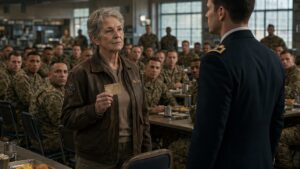
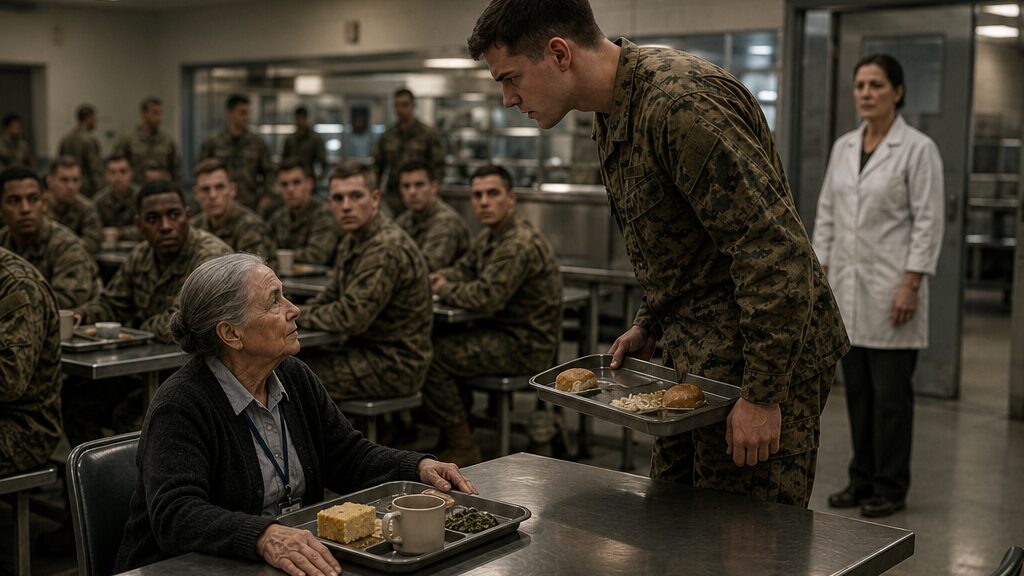
The young soldier’s hand struck the metal table hard enough to make Mary Thomas’s cup jump.
Coffee trembled against the rim. The square of cornbread on her gray cafeteria tray shifted half an inch toward the little paper cup of beans, and for one quick second Mary looked at the tray instead of the soldier. She steadied the cup with two fingers. Her hand was thin, the knuckles high under brown skin, the nails cut short the way she had kept them for most of her life.
“Ma’am,” the soldier said, but he did not say it like respect. “This section is for active-duty lunch rotation.”
His tray hovered beside her shoulder, stacked with food he had not yet eaten. He was young enough that the sharpness in his face had not learned where to rest. His uniform was clean, his boots still held the shine of inspection, and the confidence in him seemed freshly issued.
Mary looked up.
Around them, the dining facility moved in its usual hard rhythm: trays sliding along rails, metal chairs scraping, voices bouncing off painted cinder-block walls, kitchen workers calling for the next pan, soldiers in camouflage sitting shoulder to shoulder under fluorescent lights. It smelled of coffee, disinfectant, gravy, hot bread, and floor wax. The sound had once been so familiar to Mary that she could tell by the pitch of the room whether lunch was behind schedule.
The soldier leaned closer.
“You hear me?”
Mary did not move her tray. She did not lower her eyes. Her lanyard lay against her cardigan, the plastic badge turned slightly inward so the printed line could not be read from where he stood. It was an old badge, with the edges clouded and the clip rubbed silver. Her gray hair was pulled back neatly, and her dark cardigan buttoned over a pale collared shirt looked more suited to a church basement than a base dining hall.
“I hear you,” she said.
A soldier at the next table stopped chewing.
The young man gave a short laugh, not loud enough to be called a scene yet, but loud enough to invite one. “Then maybe you can explain why you’re sitting in a troop section during restricted meal hours.”
Mary’s thumb rested beside the cornbread. She had chosen the small piece because it looked closest to the way they used to cut it, not too high, not sugared, not soft as cake. The coffee was weak, but it was hot. Her beans had gone untouched.
“There were no signs on this table,” she said.
“There shouldn’t have to be signs.” His hand pressed flatter to the table. The metal gave a dull pop under his palm. “There are rules. You can’t just walk in here because you found some old badge.”
The room lost a layer of sound.
Mary felt it happen the way she used to feel an oven door opened behind her: a change in pressure, a hush pulling heat from the air. A row of soldiers near the drink machines had turned toward them. Someone at the far end of the table lowered a fork slowly. Behind the serving line, one of the kitchen workers paused with tongs in hand.
Mary kept her breathing even. She had learned long ago that a room could mistake speed for truth and loudness for command.
“What is your name?” she asked.
The soldier blinked, annoyed by the calmness of it. “Lee. Tyler Lee.”
“Mr. Lee,” she said.
His jaw tightened. “That’s Specialist Lee.”
Mary nodded once. “Specialist Lee.”
The small correction pleased him for less than a second, and then he seemed bothered that she had given it to him without flinching.
“You need to move,” he said. “There are soldiers coming in who actually need to eat.”
A few of the younger men behind him shifted. One smiled because he thought he was supposed to. Another looked down at his tray as if embarrassment could be avoided by studying mashed potatoes.
Mary looked at the empty seat across from her. No tray sat there. No cap, no folded napkin, no hand resting near the coffee. She had taken that table because she always took that table when it was free. The chair across from her had been pushed in when she arrived. She had pulled it out two inches without thinking, then left it that way.
Tyler followed her gaze and misunderstood it.
“You saving seats now?” he said. This time the laugh was sharper. “For who?”
Mary’s fingers closed once around the edge of the tray.
A staff sergeant at a nearby table turned his head. Mary noticed him because he watched differently from the others. Not with appetite for embarrassment. With caution. His name tape read Lewis, though the first name was hidden by the fold of his arm. He looked from Tyler’s hand to Mary’s badge, then to the tray.
“Specialist,” he said.
Tyler did not turn. “I’ve got it, Staff Sergeant.”
That was when Mary knew he did not. Not because he was cruel beyond repair. Because he was young enough to think being seen backing down was worse than being wrong.
She had known cooks like that. Drivers. clerks. officers. Boys barely old enough to rent apartments, standing over women old enough to remember when their mothers were girls, trying to make authority fit before it had softened around them.
Mary lifted her coffee, took a careful sip, and set it down.
Tyler’s face flushed. “Are you ignoring me?”
“No.”
“Then answer.”
Mary looked at his tray. Fried chicken, rice, greens, pudding, milk carton. Too much food balanced too carelessly. A smear of gravy had run onto his thumb.
“Do you know,” she asked, “who feeds soldiers when nobody is watching?”
A few heads lifted.
Tyler’s mouth opened, but the answer did not come. He looked irritated, as if the question had moved the ground under his boots.
“What does that have to do with anything?” he said.
“It has to do with lunch,” Mary said.
The words were not loud. They did not travel like a challenge. They settled on the table between his palm and her tray.
For the first time, Tyler’s eyes flicked properly to the food in front of her. Not to her face, not to the old badge, not to the cardigan he had already judged, but to the tray itself. Cornbread. Coffee. Beans. A simple meal, set with more care than hunger required.
Behind him, a chair leg scraped. The staff sergeant had stood halfway, then stopped when Mary glanced at him. She did not shake her head. She did not need to. He understood enough to remain where he was.
Tyler recovered by stiffening.
“Ma’am, you’re not answering the question,” he said. “Do you have current authorization to eat here during restricted hours?”
Mary reached for the lanyard. Her fingers touched the plastic sleeve but did not turn it outward. The old instinct rose in her: explain only what was required, give no more than the room had earned, keep private things private. That instinct had carried her through inspection lines, hospital hallways, late-night casualty meals, years of people assuming the kitchen was where stories ended instead of where some of them began.
“My authorization was checked at the entrance,” she said.
“By who?”
“The clerk.”
“He’s new.”
“So are you,” she said.
The nearby table went very still.
Tyler’s expression changed so quickly that Mary almost felt sorry for him. Not ashamed yet. Cornered. Young pride had a brittle sound when it cracked. He pulled his tray closer to his chest, then set it down hard on the empty space beside her food.
“You think this is funny?”
“No.”
“You think because you’re old nobody can tell you no?”
Mary looked at him then with the first true disappointment she had allowed onto her face.
“No,” she said. “I think because I am old, you believe no one has to ask before they tell.”
The words did not humiliate him. That was what made them worse. They left him standing with his hand on her table and his tray beside hers, suddenly visible in the posture he had chosen.
Someone at the drink station whispered, “Man.”
Tyler heard it. His neck reddened above his collar. He reached for his tray but did not lift it. His eyes shifted around the room and found not support, but witnesses.
At the edge of the serving line, Elizabeth King had stepped out from the kitchen entrance. She wore the white manager’s coat Mary remembered from years when the coats had been cotton instead of synthetic blend. Elizabeth’s hair was pinned back, her face composed too tightly. She was staring at Mary’s badge.
Not at Mary’s face.
At the badge.
Mary noticed the recognition before Elizabeth covered it. A small widening of the eyes. A breath caught behind professional stillness. Then the manager’s gaze dropped to the tray, to the cornbread, to the cup.
Tyler turned at last, following the direction of Mary’s attention.
“Ms. King?” he said, and his voice had lost its sharpest edge. “Do you know this lady?”
Elizabeth did not answer quickly enough.
Mary’s fingers released the tray.
The dining hall waited, and for the first time since Tyler’s hand struck the table, he looked less certain of the story he had walked into.
Chapter 2: The Badge Nobody Wanted To Read
The security guard asked Mary to step away from the dining room while her coffee was still steaming.
He did not touch her. That mattered. Mary noticed such things. He stood slightly to the side, palms visible, voice lowered as if softness could make the request less public.
“Ma’am, we just need to clear up your access status.”
Mary looked back at her tray.
Tyler’s tray was gone from the table now. He had picked it up after Elizabeth appeared, but he still stood nearby, stiff and flushed, pretending the room had not turned him into something he did not wish to be. Staff Sergeant Benjamin Lewis had moved closer, though not close enough to interfere. Elizabeth King waited near the office door with a clipboard held against her chest.
Mary lifted her cup.
“May I carry this?”
The guard hesitated, as if a cup of coffee might become evidence. “Yes, ma’am.”
She left the tray where it was. The cornbread remained on its small plate, square and untouched.
Walking across the dining facility took longer than it should have. Not because Mary could not walk, though her knees had earned their complaints, but because every table had learned silence. She felt eyes pause on her cardigan, her careful shoes, the old lanyard swaying against her shirt. She kept one hand wrapped around the coffee cup and the other near the badge so it would not swing too far.
Elizabeth opened the office door.
Inside, the room smelled of printer heat and old onions. A wall calendar showed the closure date circled in red marker. Three days away. Beside it, a laminated notice announced the transition to a civilian contractor facility, with new access procedures beginning immediately after final service.
Mary stood instead of taking the chair.
Elizabeth noticed. “Please sit, Mrs.—”
She stopped.
Mary looked at her.
Elizabeth’s mouth tightened around the unfinished name. She glanced at the guard, then at Tyler, who had followed them to the doorway with the expression of a man certain he should be included in the correction of his own mistake.
“Ma’am,” Elizabeth said, “may I see your badge?”
Mary unclipped the plastic sleeve from the lanyard and placed it on the desk. She did not slide it forward. She simply set it down between them.
The badge was old enough that the photograph had faded at the edges. Mary’s younger face looked out from behind cloudy plastic, hair dark then, eyes steady in a way the years had not changed. The line beneath the photo read: Retiree Dining Access / Volunteer Support Program. The expiration field had been covered long ago by a renewal sticker, then another, then another, until the dates looked like a history of tape.
Tyler leaned slightly from the doorway. “That doesn’t look current.”
“No,” Elizabeth said. “It doesn’t.”
Mary watched Elizabeth’s fingers hover over the badge without picking it up.
“You scanned in at the front?” Elizabeth asked.
“The clerk looked at it,” Mary said.
“Looked at it or scanned it?”
“He looked at it.”
Tyler made a small sound. “That’s what I said. We’ve had people using old dependent badges all month. The squad got warned about letting things slide.”
Mary turned her cup a quarter inch on the desk. “I am not your squad’s warning.”
The guard looked down.
Elizabeth finally picked up the badge. Her thumb moved across the plastic sleeve, not over the printed words but over the corner where the lamination had split. It was a careful touch, almost familiar. Then she set it beside a small paper receipt the clerk had printed for Mary’s meal.
One tray. Cornbread. Beans. Coffee.
“You’ve been here before,” Elizabeth said.
“Once a year.”
Tyler shifted. “Once a year doesn’t make it authorized.”
Mary did not look at him. “No.”
The answer seemed to throw him off again. He expected defense. Denial. Some insistence that age should excuse procedure. Mary gave him nothing that easy.
Elizabeth opened a drawer and pulled out a binder. The rings snapped loudly in the small office. She flipped past plastic pages of meal policy, retiree guest rules, unit reservations, contractor memoranda. Her face grew tighter with each page.
“This program was discontinued for most facilities,” she said.
“Most,” Mary repeated.
Elizabeth looked up.
“I called last month,” Mary said. “The entrance desk said the badge would be honored through closure.”
“Who did you speak with?”
“The clerk did not give his name.”
“That’s a problem,” Tyler said.
Mary looked at him then. “It seems to be yours now.”
His face hardened, but embarrassment had begun to blunt him. He no longer leaned over anything.
Elizabeth closed the binder. “Mary—”
The name came out before she could stop it.
For a moment, no one moved.
The guard’s eyes lifted. Tyler turned fully toward Elizabeth. Mary felt the old office shrink around that single word. Not Mrs. Thomas. Not ma’am. Mary.
Elizabeth took a breath. “Mrs. Thomas. I apologize. I may have seen your name on an older list.”
“An older list,” Mary said.
Elizabeth’s hand went to the badge again, then away from it. “There are records in storage. Some of them are being boxed before the facility changes over.”
“Then check them,” Tyler said.
Elizabeth’s eyes flicked toward him, sharp now. “Specialist Lee, this is not your office.”
“With respect, Ms. King, I was told to enforce restricted meal hours. If we let unauthorized people eat during troop rotation, it comes back on us.”
There it was, Mary thought. Not just cruelty. Fear dressed as order.
Tyler drew a folded form from under his tray arm. He had written quickly; the pressure of the pen had dented the paper. “I need to submit this. Incident statement. Just so there’s a record.”
Elizabeth stared at the form as if it were a spill spreading across a clean counter.
Mary set her coffee down.
“You wrote that while I was still sitting there?”
Tyler’s throat moved. “I wrote what happened.”
“No,” Mary said. “You wrote what you needed it to be.”
The guard turned his face away, not smiling, not quite hiding the truth of the sentence either.
Elizabeth took the form from Tyler. She did not read it immediately. Her eyes remained on Mary, and for the first time the manager’s professional stillness seemed less like authority than fear.
“Mrs. Thomas,” she said, “until we verify the access program, I have to ask that you not eat in the dining room today.”
Tyler straightened, but victory did not suit him as well as he had expected. The room gave him no music for it.
Mary picked up her badge. “May I take the food I paid for?”
Elizabeth looked toward the dining room. Through the small office window, the abandoned tray was visible on the table. Someone had moved around it. No one had cleared it.
“I’ll have it boxed,” Elizabeth said.
“No,” Mary said quietly. “Leave it.”
“Mrs. Thomas—”
“I came to sit with it. Not carry it out in a box.”
Elizabeth’s eyes dropped.
Mary clipped the badge back onto her lanyard with slower fingers than she wanted. The little metal clasp resisted, and for one embarrassing second she could not make it catch. Benjamin Lewis appeared at the doorway then, silent, and Mary felt Tyler watching to see whether the old woman would need help.
She did not accept any.
When the badge finally clipped, she smoothed the lanyard flat.
“How long,” she asked Elizabeth, “before the facility closes?”
Elizabeth looked at the red circle on the calendar.
The question seemed to cost her something.
“Three days,” she said. “After final lunch service, this dining room is done.”
Mary nodded once, but the motion did not reach her eyes.
Behind her, through the office window, the empty chair across from her tray sat pulled out two inches from the table.
Chapter 3: The Last Table Before The Walls Come Down
Susan Ramirez found the cornbread wrapped in a napkin at the bottom of Mary’s purse before Mary had taken off her cardigan.
It was not hidden well. Mary had tucked it beside her glasses case and the folded base visitor notice, still warm when she left the dining facility, now cooled into a square that had left a faint grease mark through the brown paper napkin. Susan stood in the narrow kitchen of Mary’s house, holding it in her palm like something more troubling than bread.
“You brought it home again,” she said.
Mary hung her cardigan on the back of a chair. “I didn’t eat lunch.”
“That’s not what I asked.”
“You didn’t ask anything.”
Susan closed her eyes for half a second, the way she did when she was trying not to sound like a daughter telling her mother what to do. She had taken off her work badge but not her shoes. Her hair had loosened from its clip, and there was a tired crease between her eyebrows that Mary recognized because she had worn one like it for thirty years.
“They called me from the base,” Susan said.
Mary turned.
“Who called?”
“Some office clerk. He said there was an access issue and asked whether I could confirm your emergency contact information.” Susan set the cornbread on the kitchen table. “Emergency contact, Mama. Because you went to lunch.”
Mary pulled out a chair. Her knees disliked the movement. She sat anyway.
“It was not an emergency.”
“Not to them, maybe.”
Mary looked toward the sink where the morning cup still sat rinsed and upside down. Not the dining hall cup. That one was in the cabinet above the stove, behind the plates Susan never used because she preferred everything newer and lighter.
Susan followed her gaze. “Don’t.”
“I didn’t say anything.”
“You don’t have to.” Susan unwrapped the cornbread. “Every year, same date. Same food. Same table if they let you. And every year you come home looking like somebody reached inside you and moved things around.”
Mary folded the edge of the napkin back over the bread.
“I go because I choose to go.”
“You go because you won’t let yourself stop.”
The words struck the kitchen wall and stayed there.
Mary stood and carried the cornbread to the counter. She opened a tin, placed it inside, and closed the lid. Her hands were steady, but her chest had gone tight with the old irritation that came when love tried to enter a room by force.
Susan softened her voice. “What happened today?”
“Someone thought I was in the wrong place.”
“And were you?”
Mary looked at her daughter.
Susan’s face changed at once. “I didn’t mean it like that.”
“Yes,” Mary said. “You did.”
A car passed outside, slow over the uneven street. The house settled around them. On the refrigerator, a grocery list hung under a magnet from a veterans’ clinic. Eggs. Soap. Coffee. Susan had added soup cups in her square handwriting.
Mary went to the cabinet above the stove. She stood on her toes, reached behind the plates, and brought down an old white cafeteria cup. It was heavier than the cups sold in stores now, thick-lipped, plain, stamped on the bottom with a number faded by years of washing. A hairline crack ran near the handle but had never opened.
Susan’s anger thinned when she saw it.
“Mama.”
Mary took the cup to the sink and washed it though it was already clean. Warm water ran over the ceramic. Her thumb moved along the crack by habit.
“He liked the chipped ones,” Mary said.
Susan did not ask who. She knew enough not to. She also did not know nearly enough, and that had been the wound between them for years.
Mary dried the cup with a towel.
“He said nobody stole chipped cups,” she added.
Susan sat down slowly. “William.”
Mary folded the towel once. Then again. The name had entered the kitchen with no uniform, no photograph, no folded paper. Just the sound of it in her daughter’s mouth.
For a moment Mary almost answered. She almost said that William Martin had once pulled twelve trays from a dish rack with one hand and balanced a coffee pot in the other. That he could cut cornbread in perfect squares without measuring. That he believed soldiers could taste resentment in food and therefore refused to cook angry. That the last time they had sat across from each other in that dining facility, he had taken the smaller piece of bread because Mary had been too proud to admit she was hungry.
Instead, Mary set the cup upright on the table.
Susan’s eyes filled, not with tears exactly, but with the frustration of being kept outside a room whose door she had never been shown.
“You won’t tell me,” Susan said.
Mary sat again. “Some things don’t need telling.”
“That’s not dignity. That’s punishing everybody who loves you.”
Mary looked down.
There it was: the part of silence that did not feel noble when someone said it plainly.
Susan pushed the cornbread tin toward her. “What did they do to you today?”
Mary touched the lid but did not open it. “A young soldier mistook his voice for the rule.”
“And the base let him?”
“The manager is checking.”
“Checking what?”
“My badge.”
Susan laughed once, without humor. “Your badge. Mama, that thing barely scans at the clinic parking lot.”
“It has been honored every year.”
“Maybe it shouldn’t be anymore.”
Mary’s hand went still.
Susan heard herself and winced. “I mean maybe you shouldn’t have to keep going back there to prove something.”
“I am not proving anything.”
“Then what are you doing?”
Mary looked at the cup. In the dining hall, the chair across from her had always been easy to pull out because the floor dipped slightly on that side. William used to complain that the table leaned toward him because it knew he would clean it.
She saw his hand for half a second, broad and brown against the metal, pushing a tray toward her.
Mary closed her eyes until the image passed.
“I am keeping a place,” she said.
Susan’s voice lowered. “For a man who is gone?”
Mary opened her eyes. “For what he gave.”
“What about what it takes from you?”
The question was fair. That made it harder to forgive.
Susan stood. “I’m calling the base tomorrow.”
“No.”
“I’m going to ask them to stop this. If they’re closing that place, then let it close. Let somebody else handle their paperwork and their old tables and their rules.”
Mary rose too fast, and the chair legs scraped the floor.
“You will not call them for me.”
Susan stared at her. “Then tell me why.”
Mary’s mouth opened.
William’s name rose, and behind it came too much: steam from dish machines, a siren in the distance, a tray left untouched, a promise made over coffee because both of them were too tired to make it beautifully. She saw the dining room on the morning after, saw herself wiping the same table until the surface shone, saw people thanking officers while kitchen workers carried out trash.
She folded the napkin instead.
Susan’s face changed. Hurt settled where anger had been.
“That’s what I thought,” she said.
The next morning, Mary went back before lunch rotation began.
She wore the same cardigan, the same collared shirt, the same lanyard. In her purse, wrapped in a clean cloth, was the old white cup. She told herself she brought it only because the dining hall cups were lighter now and did not hold heat properly. She told herself many things when the truth wanted more room than she wished to give it.
At the base gate, the clerk examined her badge longer than usual, then waved her through with a cautionary look. “They said Ms. King wants to see you if you come by.”
“When,” Mary said, not if.
The dining facility doors were propped open. Inside, the room looked exposed in the morning light. Without the lunch crowd, the metal tables seemed smaller. Workers carried boxes from the storage hall. A contractor representative stood near the serving line with a tablet, marking items for removal.
Mary walked toward the table by instinct.
Halfway across the room, she stopped.
A strip of orange tape had been placed across the tabletop.
REMOVE FIRST — LEG DAMAGE.
The chair across from hers was upside down on the table, its legs pointing toward the ceiling like something surrendered.
Mary stood with her purse against her side and the old cup inside it pressing into her ribs.
On the orange tape, someone had written the table number in black marker.
She knew the number before she read i
Chapter 4: The Record That Proved Too Little
Benjamin Lewis found Mary Thomas’s name in a personnel file that smelled faintly of mildew and scorched paper.
The folder had been wedged inside a records box marked DINING FACILITY—PRE-CONTRACTOR STAFF, its cardboard softened at the corners from years in a storage room that had never quite stayed dry. Half the label had peeled away. When Benjamin lifted the folder, a brittle edge cracked under his thumb.
He stopped breathing for a second.
THOMAS, MARY.
The last name was clean enough. The first was partly blurred, but not gone. Beneath it, another line showed duty assignment codes Benjamin had to read twice because they did not match the old woman Tyler Lee had leaned over the day before.
Food Operations Specialist. Dining Facility Shift Lead. Volunteer Support Liaison.
Benjamin looked toward the storage room door.
From outside came the hollow scrape of metal legs. Workers were dragging tables across the dining room floor, sorting them into rows: keep, repair, remove. The sound traveled through the walls like furniture being made to confess.
“Staff Sergeant?”
Elizabeth King stood in the doorway with a stack of contractor forms against her chest. She saw the open file and froze.
Benjamin did not close it. “You said there might be records.”
“I said there might be old records. Not that you had authorization to dig through every box.”
“The box was already open.”
“That doesn’t make it yours.”
“No,” Benjamin said. “But yesterday that woman was treated like she didn’t belong in this building. This says she did.”
Elizabeth’s grip tightened on the forms. “A damaged record doesn’t solve an access issue.”
“It changes the way people should have handled one.”
She looked away first.
Benjamin had seen officers do that when paperwork had become too honest. He was not old enough to remember every version of the Army, but he had served long enough to know buildings kept ghosts in file cabinets and storage shelves. The cleanest ceremonies often stood on top of the messiest boxes.
He turned a page with care.
A photocopied roster clung to the inside of the folder. Mary’s younger photograph was stapled to it, the same steady eyes from the faded badge, but the face fuller, the hair dark and tied back. Below the roster was a list of dining facility duties: breakfast shift, field meal prep, casualty-support meal rotation, holiday holdover service, ration accountability.
Then there was a gap.
The next page began with an apology for missing attachments. An incident report was referenced by number, but the report itself was gone.
Benjamin tapped the blank space. “Where’s this?”
Elizabeth’s mouth pressed flat. “A lot of records moved when the facility changed systems.”
“This one didn’t move. It disappeared.”
“That is an accusation.”
“It’s a question.”
She took two steps into the room and lowered her voice. “You need to understand something. This facility closes in two days. Every incomplete record, every exception, every old program that stayed alive because someone let it stay alive—those things are being reviewed. The contractor representative is already asking why we have informal access lists that don’t match current policy.”
“And Mary Thomas is one of those things?”
Elizabeth flinched. “Don’t make it sound like that.”
“How should I make it sound?”
She looked past him, into the shadowed shelves where old serving pans, tray racks, chipped cups, and retired menu boards waited under dust. “Like I’m trying to keep this place from closing under a complaint.”
The answer was too quick. Too rehearsed. Benjamin closed the folder halfway, keeping one finger inside to mark the page.
“Did you know her?”
Elizabeth did not answer.
Outside, a worker called, “This one’s marked for removal. Leg’s cracked.”
Another answered, “Put the orange tape on it.”
Benjamin saw Elizabeth’s eyes flick toward the sound.
He followed her into the dining room.
Mary Thomas stood alone beside the taped table.
She had not touched it. Her purse hung from one arm, and her lanyard lay flat against her cardigan. The orange strip across the tabletop looked too loud against the gray metal. REMOVE FIRST—LEG DAMAGE. The chair across from her was upside down, its feet in the air, as if someone had interrupted a meal and decided the interruption was permanent.
The workers had slowed without meaning to. Even the contractor representative lowered his tablet.
Mary looked at the table number.
Benjamin stepped beside her, file in hand. “Mrs. Thomas.”
She turned, and for a moment he felt foolish holding the folder. Not because it was useless, exactly. Because it was so thin compared with the way she looked at the table.
“I found something,” he said.
Mary’s gaze dropped to the folder but did not brighten.
Elizabeth came up behind them. “Staff Sergeant Lewis located partial personnel records.”
“Partial,” Mary repeated.
“Yes, ma’am.” Benjamin opened the folder to the roster. “It shows you served in Army food operations. It shows you worked in this facility. Shift lead. Support liaison. There are duty assignments here.”
A young worker nearby stopped coiling an extension cord.
Mary looked at the photograph, then at the paper beneath it. Her younger face regarded her from the file with a kind of plain patience.
“That was a long time ago,” she said.
“It still matters.”
“Does it?”
The question landed harder than refusal.
Benjamin looked down at the page again. He had expected relief. Maybe not gratitude, but at least release. A record had been found. A mistake could be corrected. Tyler’s complaint could be answered. The old woman could be allowed to sit where she had already earned the right to sit.
But Mary did not touch the file.
Elizabeth said, “This could help clear up the badge issue.”
Mary’s eyes remained on the table. “My badge was not the first thing he saw.”
Benjamin had no answer.
A cart rattled behind them. The worker pushing it slowed near the table and gave Mary an apologetic look. “Ma’am, we need to move this one back to storage before pickup.”
“This table?” Benjamin asked.
“Leg bracket’s cracked. It’s on the discard list unless maintenance says otherwise.”
Mary reached out then and placed two fingers on the corner. Not possessive. Not dramatic. Just enough contact to steady something no one else knew was moving.
Elizabeth watched her hand.
“Mary,” she said softly, and again the name escaped without the title.
Mary looked at her.
Elizabeth swallowed. “Mrs. Thomas. I can ask them to hold it until after final lunch service.”
The contractor representative looked up from his tablet. “If it’s marked remove, it needs to be staged today.”
“It can wait,” Elizabeth said.
“The inventory has to match the removal list.”
Benjamin could feel the room rearrange around rules again. Every person suddenly had a small authority to hide inside.
Mary removed her fingers from the table. “Let them do their work.”
The worker bent to lift one end of the table. The cracked leg gave a slight, uneven wobble. The upside-down chair slid and clanged against the tabletop. Mary did not step back fast enough, and Benjamin reached out, then stopped himself before touching her elbow. She had not asked.
She noticed that he stopped.
“Thank you,” she said, though he had done nothing.
The worker and another man carried the table toward the storage corridor. The orange tape faced outward like a warning. Mary watched it pass.
Benjamin held the folder closer. “Mrs. Thomas, if you want, I can bring this to the unit commander. Specialist Lee’s complaint won’t stand against—”
“No.”
He stopped. “Ma’am?”
“No,” she said again, quieter. “Do not make that file into my whole life.”
Elizabeth’s expression changed, but whether from shame or recognition, Benjamin could not tell.
Mary turned toward the storage corridor, following the workers at a distance. Benjamin and Elizabeth went with her. The corridor behind the dining room was lined with shelves of old equipment: steam-table pans stacked like dull mirrors, ladles wired together, tray racks on wheels, cracked menu boards with ghost letters from meals no one served anymore. Each shelf had a number stamped or painted on the side.
Mary moved slowly past them.
At the far end, the workers set the damaged table against a wall near a pile of discarded signs. A strip of old tape clung to the underside of the tabletop, half hidden by the bracket.
Mary’s eyes fixed on it.
Benjamin crouched carefully and lifted the edge of the tape. Written beneath the dust in black marker were two names, faded but still readable.
M. Thomas.
Beside it, in blockier writing:
W. Martin.
Mary’s face changed so slightly that anyone impatient would have missed it.
Elizabeth did not miss it.
Benjamin looked from the names to Mary.
“William Martin?” he asked.
Mary’s hand closed around the strap of her purse.
Behind them, Elizabeth whispered, “I thought that label was gone.”
Mary turned toward her, and the quiet in the storage corridor became sharper than any accusation.
Chapter 5: The Woman Who Fed Them In Silence
Mary entered the kitchen after hours and found the cornbread pans already packed away.
They were stacked on a rolling rack near the back door, each pan nested inside another, the worn corners silver where years of knives had scraped them clean. A strip of contractor tape ran around the rack, sealing the pans for removal. The serving line was dark. The steam wells were empty. Without the heat and noise of lunch, the kitchen looked abandoned before it was closed.
Mary stood beside the rack, one hand on her purse, and felt a foolish anger rise in her.
Not at the contractor. Not at Elizabeth. Not even at Tyler Lee.
At the pans.
They had no right to look so ordinary while leaving.
“Those are supposed to be picked up tomorrow morning,” Elizabeth said from the doorway.
Mary did not turn. “They always stored them on the lower shelf.”
“We had to clear space.”
“For what?”
Elizabeth’s shoes made a small sound on the tile. “Inventory.”
Mary almost smiled. “Inventory.”
The word had once meant counting what mattered so nothing disappeared: cups, trays, ration packets, flour, sugar, coffee, cans dented in transport, bread that could still be used if someone trimmed the edge. Now it seemed to mean proving to strangers that old things could be removed without consequence.
Elizabeth came closer but stopped before the taped rack. “I remember you showing me how to test the center without breaking the top crust.”
Mary looked at her then.
Elizabeth’s face was tired under the kitchen fluorescents. No clipboard now. No professional coat. Just a woman standing where a younger version of herself had once been taught how to feed people quickly, cleanly, and without making them feel like a burden.
“You were seventeen,” Mary said.
Elizabeth breathed out. “Sixteen. I lied on the summer form.”
Mary’s eyes moved over her, reassessing. “You dropped a tray of cups your first week.”
“I broke seven.”
“Nine.”
Elizabeth gave a small, ashamed laugh that did not last. “You told the supervisor you had stacked them wrong.”
“I had.”
“No, you hadn’t.”
Mary turned back to the pans. “You were a child.”
“I remembered you yesterday,” Elizabeth said. “As soon as I saw the badge.”
Mary’s hand tightened against the purse strap.
“But you said nothing.”
Elizabeth looked toward the dark serving line. “I told myself I wasn’t sure.”
“And were you?”
“No.”
There was no defense in it. That made Mary listen.
Elizabeth folded her arms, then dropped them as if the gesture felt too protected. “The contractor review has been ugly. Missing access logs. Old volunteer permissions. Retiree meal exceptions nobody put into the new system. If I confirm one unofficial practice, they start asking why I allowed all the others. I have kitchen workers trying to keep their jobs through transition. I have a commander who wants the closure clean. I have a young soldier filing a complaint because he embarrassed himself and needs procedure to make him look right.”
“And you had me,” Mary said.
Elizabeth nodded once. “And I had you.”
The admission sat between them, plain as a tray.
Mary reached through the tape and touched the rim of the top cornbread pan. Dust came away on her finger.
“William cut from the corners first,” she said.
Elizabeth stayed still.
“He said soldiers took middle pieces because they thought middle meant best. But the corners kept their shape. Easier to carry. Less likely to crumble into beans.” Mary drew her hand back. “He would put one on my tray before anyone saw.”
“He worked here with you?”
“For a time.”
Mary did not offer more. The old wall rose in her automatically.
Elizabeth did not push. Instead she walked to a lower cabinet, opened it, and took out a small wrapped parcel. “I held one pan back.”
Mary turned.
Elizabeth set a single square of cornbread on a paper plate. “From this morning’s test batch. It isn’t the old recipe. The flour comes different now. Everything comes different now. But I thought—”
Mary stared at the bread.
The kitchen door at the far end clicked.
Neither woman moved at first. Then Tyler Lee stepped into view, his hand still on the knob. He wore no cap, and his expression carried the strained alertness of someone who had come looking for proof and found a scene he did not understand.
“Ms. King,” he said. “I was told you were still here.”
Elizabeth’s face closed. “Specialist Lee, the kitchen is closed.”
“I know.” His eyes moved from Elizabeth to Mary, then to the cornbread on the plate. Something hardened in him, not the same arrogance from the dining room, but an uglier kind born from embarrassment trying to survive. “I came to ask about my incident statement.”
“This is not the time.”
“With respect, it keeps becoming not the time.” His gaze went to Mary. “And now she’s back here after hours?”
Mary did not answer. She had answered enough rooms in her life.
Elizabeth stepped forward. “Mrs. Thomas is here with my permission.”
Tyler’s mouth tightened at the title. “Yesterday she wasn’t authorized. Today she’s in the kitchen after closing. Which is it?”
The paper plate shook once in Elizabeth’s hand.
Mary noticed Tyler notice.
He misunderstood the tremor as weakness, or maybe guilt. “I’m not trying to be disrespectful,” he said, which meant he knew he had been. “But rules don’t stop being rules because somebody has a sad story.”
Elizabeth’s eyes flashed. “You heard nothing that gives you the right to say that.”
“I heard enough.”
Mary looked at him fully then. He was standing near the door with his shoulders squared, but there was something exposed under the posture. His anger seemed borrowed from somewhere older than this room.
“What did you hear?” she asked.
Tyler shifted. “That there’s a missing record. That Ms. King knew you. That now there’s some personal reason you come here every year, and suddenly everyone’s supposed to pretend my complaint was wrong.”
“Was it right?” Mary asked.
He looked away.
The small movement answered more honestly than his mouth would.
“My squad got warned last month,” Tyler said. “Unauthorized people eating during rotation. Dependents, retirees, contractors, people using old badges. We got told if we couldn’t manage a dining room, we couldn’t manage field discipline. Then I see you sitting there with a badge nobody can read, taking up a troop table.”
“Taking up,” Mary repeated.
His face reddened. “That’s not what I meant.”
“It is what you said.”
Elizabeth put the plate down on the prep counter. “Specialist Lee, leave.”
“No,” Mary said.
Both of them looked at her.
Mary touched the edge of the counter, feeling the old worn groove where countless trays had struck it before being carried out. She could have told Tyler then. All of it. She could have said William Martin’s name and watched his complaint could have told Tyler then. All of it. She could have said William Martin’s collapse under the weight of a grief he had no training for. She could have described years of waking before dawn to feed men who never learned her name, of heating coffee during casualty calls, of carrying trays to soldiers who shook too badly to hold forks, of William’s last lunch across from her with cornbread he had cut himself.
Instead she said, “Did your mother work food service?”
Tyler’s expression changed before he could stop it.
Elizabeth looked at him.
The kitchen seemed to shrink around the question.
“That has nothing to do with this,” he said.
Mary waited.
He laughed once under his breath, but it had no cruelty left. “She worked wherever she could. Cafeteria, hospital kitchen, school lunch line. So what?”
“So you know what it looks like when people walk past work they depend on.”
His eyes sharpened. “Don’t talk about my mother.”
“I am not.”
“Yes, you are.”
“No,” Mary said. “I am talking about you.”
For a moment, Tyler looked younger than he had in the dining hall. Not innocent. Just young. The kind of young that had mistaken shame for distance and distance for strength.
Elizabeth’s voice softened despite herself. “Specialist.”
He stepped back from it. “I want a formal review before the closure ceremony.”
Elizabeth stiffened. “What?”
“If she’s authorized, fine. Put it on record. If she isn’t, then everyone stops acting like I’m the problem because I asked a question.”
Mary looked at the cornbread on the plate. It was smaller than yesterday’s piece, cut unevenly, one corner broken.
Elizabeth said, “This does not need to become public.”
Tyler reached for the door. “It already did.”
The door swung shut behind him.
Mary stood in the kitchen with the packed pans, the paper plate, and the old silence filling her mouth like unspoken bread.
Chapter 6: The Question She Finally Answered
Mary’s tray was stopped at the serving line in front of the whole room.
The kitchen worker had already placed the cornbread on her plate. Coffee waited in a thick white cup. Beans sat in their small compartment, steam rising in a thin veil. Mary had both hands on the gray tray when the unit commander stepped near the register and said, gently enough for courtesy, loudly enough for witnesses, “Mrs. Thomas, before you sit, we need to resolve the access matter.”
The dining facility was full for final lunch service.
Not full the way it had been on ordinary days, with soldiers rushing through hunger and routine, but full with the self-conscious attention of a room that knew it was becoming a memory. Workers stood near the walls. A few old photographs had been set on a display table by the entrance. Contractor labels marked equipment for removal. The damaged table had been repaired enough to stand in its old place, though the orange tape still hung from one leg like an accusation not fully removed.
Tyler Lee stood beside the commander.
His face was pale under the lights. He did not look at Mary’s tray at first. He looked at the floor, then at the complaint form in his hand, then at the room behind her.
Elizabeth King stood near the serving line with Benjamin Lewis. Benjamin held Mary’s folder, the partial record inside it copied and clipped. Susan Ramirez stood just inside the entrance, arms folded tightly, as if she had arrived prepared to protect her mother from everyone, including Mary herself.
Mary lifted the tray.
The worker behind the line whispered, “Ma’am, I can carry that.”
“No,” Mary said. “Thank you.”
She carried it herself to the small open space between the serving line and the tables.
The tray felt heavier than food. The cup trembled in its corner, and Mary corrected the balance with a slight turn of her wrist. She had carried heavier things. Full racks. Stock pots. Coffee urns hot enough to blister carelessness. Trays to men who smiled without seeing her. Trays to men who did not smile at all.
The commander said, “We have reviewed a partial record showing prior service and facility assignment. There remains a question about current access procedure.”
“Sir,” Benjamin said, stepping forward with the folder. “The record establishes—”
Mary turned her head. “Staff Sergeant.”
Benjamin stopped.
She did not speak sharply. She did not have to. His mouth closed, and he lowered the folder.
Mary looked at Tyler. “Let him ask.”
Tyler’s eyes rose.
The room held still.
He unfolded the complaint form. The paper had been handled too many times. Its creases were soft now.
“Mrs. Thomas,” he said, and the title sounded unfamiliar in his mouth, “my concern was that you were seated in a restricted troop dining area with an outdated badge during active-duty meal rotation.”
Someone near the back shifted, but no one interrupted.
Tyler swallowed. “I asked whether you had authorization. You did not provide it.”
Mary nodded. “That is true.”
Susan’s arms tightened.
Tyler looked surprised by the admission. “You also made statements implying knowledge of dining operations but did not clarify your role.”
“That is also true.”
His voice faltered. The complaint had expected resistance. Mary was giving him facts and taking away his shield.
He glanced at the commander, then back at her. “So I requested formal review.”
“You did,” Mary said.
Elizabeth shut her eyes for a moment.
Mary carried the tray to the damaged table. The repaired leg held, though with a faint unevenness. She placed the tray down with both hands. The cup clicked softly against the tray’s rim.
Then she pulled out the chair across from her two inches.
A murmur moved through the room, small and uncertain.
Mary did not sit.
She stood beside the table and looked first at the soldiers, then at the kitchen workers, then at Elizabeth, Benjamin, Susan, Tyler, and the commander.
“I did not answer yesterday,” she said, “because I have spent most of my life knowing the difference between what people need to know and what they only want to know.”
Her voice carried less by volume than by the absence of anything wasted.
“I was assigned to food operations in this facility before many of you were born. I was not famous. I was not high-ranking. I was not the person anyone came here to see. I checked temperatures. Counted trays. Stretched coffee when supply ran late. Cut bread smaller when convoys arrived unplanned. Learned who needed to be spoken to and who needed to be left alone until his hands stopped shaking.”
The room had gone very still.
Mary looked toward the serving line. “There were men and women who fed soldiers here and were never in the photographs by the door. Cooks. dishwashers. clerks. night-shift workers. people who cleaned tables after news nobody wanted to receive. People who made sure food was waiting because sometimes a tray was the first ordinary thing a soldier saw after the world stopped being ordinary.”
Tyler’s complaint form lowered by an inch.
Mary touched the back of the empty chair.
“There was a man named William Martin. He cut cornbread from the corners because he said corners held together when hands were tired. He sat across from me at this table before a deployment support assignment. We drank bad coffee and argued about whether beans needed more pepper. We did not say goodbye beautifully. People rarely do when they think there will be another meal.”
Susan’s hand went to her mouth.
Mary did not look at her. If she did, she might stop.
“After he was gone, I came back once a year. Same table when it was here. Same food when they served it. Not because I believed the Army owed me lunch. Not because I wanted a room to know my name.” She looked at Tyler then. “Because ordinary service disappears fastest when only loud service is remembered.”
Tyler’s face changed, but Mary did not let him become the center of it.
Benjamin lifted the folder slightly, unable to help himself. “Mrs. Thomas, the record confirms—”
“No,” Mary said.
He lowered it again.
“My record confirms dates,” she said. “It does not confirm who wiped tables after midnight. It does not confirm who wrapped bread for a soldier who missed dinner. It does not confirm who stayed quiet because grief does not become more honorable when spoken into a microphone.”
The commander’s posture softened, but he did not interrupt.
Mary looked at Elizabeth. “You remembered me and were afraid.”
Elizabeth’s eyes filled. She nodded once.
“I was also afraid,” Mary said. “I thought silence kept things clean. Private. Dignified. But silence can become a broom. People use it to sweep away whatever makes the room difficult.”
Susan made a small sound. Mary finally looked at her daughter. The hurt on Susan’s face was old, but beneath it was something opening.
Mary turned back to Tyler.
“You were wrong to lean over my tray,” she said.
His jaw tightened, not in anger this time.
“You were wrong to make your embarrassment into a report. You were wrong to see age and plain clothes and think they gave you permission to speak without asking.”
The room waited for punishment.
Mary did not give it.
“But you were not wrong that rules matter,” she said. “Food matters. Access matters. Order matters. A dining facility fails when people make private exceptions no one can explain. What I should have said yesterday was simple: my badge had been honored through closure, and if that was no longer true, I would wait while it was checked.”
Tyler blinked.
Mary’s hand rested beside the tray, flat on the table now, the same way it had when he first leaned over her.
“What you should have said,” she continued, “was also simple: Ma’am, may I help verify your access?”
The words were not cruel. That was why they reached him.
Tyler looked down at the complaint form. His fingers tightened around it until the paper bent.
“I’m sorry,” he said, but his voice was too quiet for the room.
Mary heard it anyway.
She nodded once, neither accepting nor rejecting it for public comfort.
Then she looked to the commander. “If there is to be any record placed on that wall by the entrance, I do not want my name alone. I want the kitchen staff lists, if they can be found. I want support workers included. Paid, enlisted, civilian, volunteer. People who fed this room before anyone thought to thank them.”
The commander glanced at Elizabeth.
Elizabeth wiped her cheek with the heel of her hand and said, “Some lists are incomplete.”
“Then write that,” Mary said. “Incomplete is truer than forgotten.”
A silence followed, different from the one Tyler had made yesterday. This one did not watch Mary as if waiting for her to break. It stood around her as if making room.
Mary pulled the chair back and began to sit.
Her knee caught.
It was small, just a hesitation as pain moved through the joint and stole balance for half a second. But the tray sat too near the edge. Her hand reached for the table; her sleeve brushed the cup; coffee shifted, and the tray tipped.
Tyler moved before anyone else.
He caught the tray with both hands, steadying the cup before it spilled. The room drew in a breath.
He stood there, bent over the same table, his hands near Mary’s food again.
This time he did not crowd her.
He held the tray carefully, eyes lowered, waiting to see whether she would let him help.
Chapter 7: A Place At The Table After Everyone Left
Tyler Lee was waiting beside the empty table when Mary came back after the ceremony.
The dining facility had been cleared of nearly everyone. Chairs sat upside down on tables. Contractor tags hung from the serving line. The display photographs by the entrance had been taken down and boxed, except for one temporary sheet Elizabeth had taped to the wall with the words SUPPORT STAFF ROSTERS—INCOMPLETE BUT REMEMBERED printed across the top.
Tyler stood near the repaired leg of Mary’s table with his cap held in both hands.
Her tray was gone. Someone had washed it and returned it to the stack, but the faint rectangle where it had rested still showed on the metal surface, a dry outline left by heat and condensation. The cup was in Mary’s purse now, wrapped in a clean cloth. She had eaten half the cornbread. The other half was folded in a napkin for no reason she intended to explain.
Tyler straightened when he saw her.
Mary stopped a few feet away.
He looked as if he had practiced standing there and had failed at it several times. His shoulders kept trying to square themselves, then dropping again. The complaint form was not in his hands. Good, Mary thought. Some papers did not need to be carried once they had done their damage.
“Mrs. Thomas,” he said.
Mary waited.
He swallowed. “May I speak to you?”
From near the entrance, Susan shifted. She had offered to drive Mary home and had not yet decided whether waiting by the doors counted as patience or surrender. Elizabeth and Benjamin stood farther off near the temporary wall sheet, speaking quietly with the unit commander. None of them came closer.
Mary rested one hand on the chair back.
“You may.”
Tyler looked down at his cap. “I said sorry in there, but I know that wasn’t enough.”
“No,” Mary said.
He flinched slightly, then nodded. “It wasn’t.”
That small acceptance did more than his apology had.
Mary pulled the chair out and sat. Her knee complained, but not sharply. Tyler did not move to help. He noticed himself not moving. That also mattered.
After a moment, he took the chair across from her, the one she had kept two inches from the table all these years. He did not sit until she gave a small nod.
“I didn’t know about Mr. Martin,” he said.
“You did not need to know about him to speak properly to me.”
Tyler’s eyes lowered. “Yes, ma’am.”
The words were plain. No polish. No performance for the room, because the room had nearly emptied.
Mary touched the table’s edge. The repair bracket under it was new, bright against the old metal, too shiny to belong yet.
“My mother worked cafeteria jobs,” Tyler said. “School lunch first. Then hospital kitchen. Sometimes both.”
Mary did not answer. Silence, used rightly, made room.
“When I was younger, I hated people seeing her in that apron,” he said. “Kids from school would come through the line and act like she was part of the counter. Like she couldn’t hear them. She’d tell me not to mind it.” His mouth twisted. “I minded it by deciding I’d never be seen that way.”
Mary watched his fingers bend the edge of his cap.
“So I joined up,” he continued. “Worked hard. Got made squad leader. Thought if everything around me looked sharp enough, nobody could mistake where I came from.”
“And yesterday?”
“Yesterday I saw an old badge and plain clothes and a tray.” His voice thinned. “And I treated you the way I hated seeing people treat her.”
The dining room lights hummed overhead.
Mary looked toward the serving line. One of the older cafeteria workers was wiping down a counter that would be removed in the morning. Slow circles. Careful hand. Work done properly even after its audience had gone.
“Shame is a poor drill sergeant,” Mary said.
Tyler gave a small breath that was almost a laugh and almost not. “Yes, ma’am.”
“It teaches loud lessons and wrong ones.”
He nodded.
Mary took the wrapped cup from her purse and set it on the table. Tyler looked at it but did not ask.
“Respect starts before proof,” she said. “That is where you failed.”
“I know.”
“No,” Mary said. “You are beginning to know. That is different.”
He accepted that too.
Near the wall, Elizabeth removed the temporary sheet and replaced it with a cleaner board. It was not grand. No brass. No framed portrait. Just a plain board with typed names arranged in columns: enlisted food operations, civilian kitchen staff, dish room workers, volunteer support, missing records noted by year. Some lines had question marks. Some read name unknown. Some had only first initials recovered from old schedules.
At the bottom, in smaller print, someone had added: The list remains incomplete. The service was not.
Mary stared at that line long enough for Susan to leave the doorway and come to her side.
“Mama,” Susan said softly.
Mary did not look away from the names. “Elizabeth wrote that.”
“I know.”
“You helped?”
Susan’s face changed. “She asked if I knew where your old papers were. I told her I knew where you kept things, not what you kept.”
Mary almost smiled.
Susan’s eyes moved to the cup on the table, then to the empty chair across from Mary, then to Tyler sitting there with his cap in his hands. For once, her daughter did not try to protect her from the sight of grief. She simply stood beside it.
“I thought this place was taking you from us,” Susan said.
Mary turned to her then.
“It was giving me somewhere to put what I did not know how to hand you.”
Susan’s mouth trembled. “You could have handed me some of it.”
“Yes,” Mary said.
The word did not repair years. It opened a door.
Mary reached into her purse and took out the half piece of cornbread wrapped in the napkin. She placed it in Susan’s palm. Susan looked down at it as though her mother had given her something fragile and practical at once.
“He liked the corners,” Mary said.
Susan closed her fingers around it.
A week later, the old dining facility no longer smelled of coffee.
The serving line was gone, the chairs stacked for transfer, the walls patched where signs had hung for years. But near the entrance to the new dining area, the support-staff board had been mounted beside a shallow display case. Inside the case sat one gray cafeteria tray, one thick white cup, and a small empty space where cornbread could not be preserved but did not have to be forgotten.
Mary stood before it with Susan on one side and Elizabeth on the other. Benjamin had stopped by earlier, awkward in his kindness, and told Mary that more names had been found in old pay rosters. Elizabeth had said she would keep looking. Mary believed her, not because the record was now clean, but because Elizabeth no longer pretended incompleteness was the same as absence.
Mary did not put her own cup in the case. She kept it wrapped in cloth in her purse.
Some things belonged on walls. Some belonged in cabinets above stoves. Some belonged in hands.
As they left, the new dining area had begun its first full lunch service. The room was brighter than the old one, too new, too smooth, full of voices that had not yet learned how to echo there. Near the entrance, an older cafeteria worker moved carefully with a stack of clean trays. A young soldier behind him sighed and stepped too close.
“Come on,” the soldier muttered. “Some of us have to eat.”
Tyler Lee, standing near the line with his squad, turned at once.
He did not raise his voice. He did not make a scene. He simply stepped between the soldier and the worker, took half the stack of trays from the older man only after receiving a nod, and looked back at the impatient soldier.
“Ask before you rush somebody,” Tyler said. “You don’t know what they’ve carried.”
Mary heard him.
She did not stop walking. She did not turn for applause, and none came. She only placed one hand over the cup in her purse and walked beside her daughter through the open door, leaving the old table behind without leaving it forgotten.
The story has ended.