The Woman They Asked To Leave The Memorial Was The One Whose Hands Saved Their Names
Chapter 1: The Woman At The Stage Steps
“Ma’am, that area is for invited families only.”
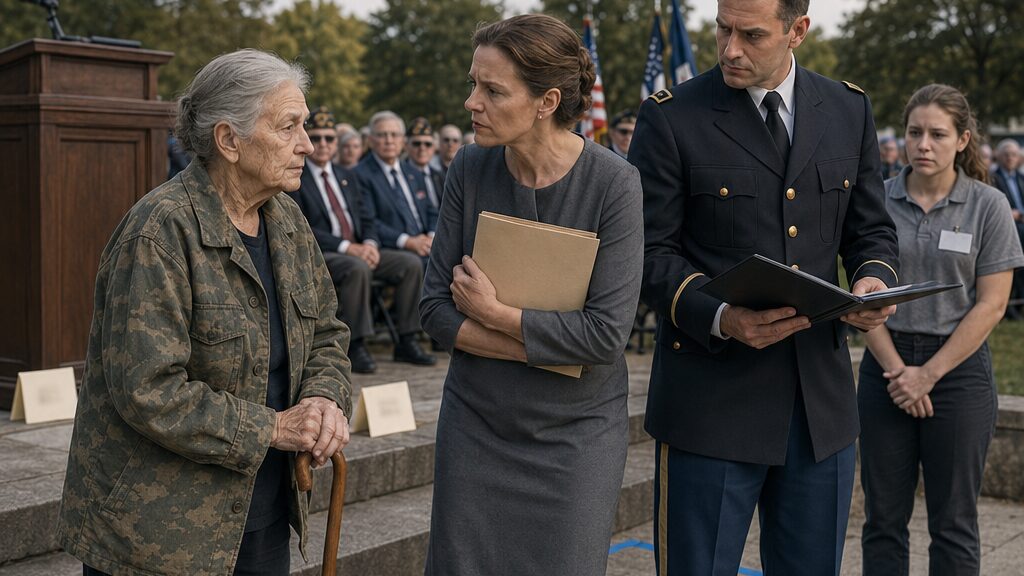
The young volunteer had said it kindly enough, but his hand was already lifted between Donna Mitchell and the short set of wooden steps leading to the stage, palm out as if stopping traffic. Behind him, the platform waited under a white canopy, clean and official: a podium with two microphones, a row of folding chairs, a flag pinned so tightly it did not move, and a temporary board of printed name cards lined across the front.
Donna looked at his hand, then at the steps.
“I won’t go up,” she said.
Her voice came out thinner than she intended. It had done that more often lately, betraying her before her face did. She set both hands over the rounded top of her wooden cane and shifted her weight until her right knee stopped threatening to buckle.
The volunteer glanced at her jacket. It was old camouflage, faded at the seams, soft from decades of washing, the left cuff frayed where her thumb had rubbed it during winters when she sat with mail she did not open. His eyes dropped to her shoes, then to the cane, then back to the laminated badge clipped to his own shirt.
“The family seats are over there,” he said, pointing toward the rows of white folding chairs. “If you’re here for someone, check-in can help you find your section.”
“I already know the section.”
“Do you have your guest card?”
Donna touched the breast pocket of her jacket, not because a guest card was there, but because her hand knew where to go when someone asked for proof. Inside was an envelope folded into another envelope, the corners soft as cloth. She had carried it through three states, two bus stations, one county shuttle, and the long walk from the gravel parking field.
“No,” she said.
The volunteer’s smile tightened. “Then I can’t let you stand here. The ceremony’s about to start.”
Rows of people were settling behind her. Metal chairs scraped against packed grass. A child asked too loudly if the soldiers were going to shoot the rifles. Somewhere near the sound table, a speaker popped and hummed. The color guard stood in formation beside the stage, faces forward, white gloves still.
Donna turned slightly so the cane would not block the walkway. She had learned a long time ago how to take up less space. In field tents, in evacuation planes, in hospital corridors, there was always someone worse off who needed the room. At seventy-nine, she still moved as if apologizing to walls.
“I’ll stand back from the tape,” she said. “I only need to hear one name.”
The volunteer looked over his shoulder at the stage, where two county workers were rearranging the name cards along the front rail. “Everyone will hear the names, ma’am.”
Not the way I need to, Donna thought.
She did not say it.
A woman in a gray dress crossed from the check-in table with a beige folder pressed to her chest. She moved quickly, not rushing exactly, but with the sharp purpose of someone who had spent the morning preventing small failures from becoming visible. Her hair was pinned back, and a thin program booklet stuck out from under the folder. She stopped twice to answer questions, once to point an older man toward the accessible seating, once to tell the sound technician that the first microphone was still cutting out.
Donna watched her without moving.
The woman had Charles Baker’s mouth.
Not exactly, not enough that anyone else would see it. But Donna saw it in the way the woman held words behind her teeth before letting them go. Charles had done that when pain rose and he did not want the others to hear it. He had kept his jaw steady as if good manners could hold a body together.
Donna’s fingers tightened on the cane until the bones showed under her skin.
The volunteer followed her gaze. “That’s Ms. Baker. She’s coordinating today. If you need something, I can ask her.”
“No,” Donna said too quickly.
He blinked.
She softened her grip. “No, thank you.”
The stage workers finished placing the name cards. Donna counted them without meaning to. Thirty-one names, printed in black block letters on cream card stock. Some belonged to men who had died before Donna was old enough to enlist. Some belonged to men and women she had never known but whose families sat in the first rows with folded hands and polished shoes.
Near the center, one card caught the light.
CHARLES A. BAKER.
Donna’s breath stopped.
Not from grief. Grief had its own rhythm by now; it came when invited and when not. This was sharper, almost practical. Wrong letter. Wrong name. Wrong man.
Her cane tapped once against the wooden edge of the walkway.
The volunteer looked down. “Ma’am?”
Donna leaned forward enough to be sure. The card did not change. It sat between two others, neat and wrong.
“His middle initial wasn’t A,” she said.
The volunteer followed her eyes toward the stage. “The families approved the program.”
“It wasn’t A.”
“Ma’am, I’m sure they checked—”
“It was R.”
The volunteer opened his mouth, then closed it. He had the embarrassed face of someone too young to know when an old person was confused and when they were absolutely certain.
Donna saw that face and hated herself for recognizing it. She had worn it once. The first week in the evacuation unit, when an old sergeant told her where to put the plasma before she had even unlatched the crate, she had thought age made him bossy. Five hours later, under shelling, she had done exactly what he said and saved two men because of it.
“I don’t want trouble,” Donna said.
“Then please come with me to check-in.”
She looked once more at the card. Charles A. Baker. A stranger’s name printed where his should have been. The beige folder woman—Lisa, the volunteer had said—stood near the podium now, speaking with a uniformed officer holding a black folder under one arm. The officer nodded at something she said, then checked his watch.
There was no time.
Donna moved one step closer to the tape.
The volunteer stepped with her. “Ma’am, I really can’t—”
“I heard you.”
The cane tip rested just inside the taped-off walkway, not blocking the stairs, not touching the stage, only claiming the smallest possible place between being absent and making a scene. The volunteer’s eyes went to it as if it had become a problem larger than wood and rubber.
People in the first row had begun to notice. A man in a dark cap turned his head. One of the seated veterans stopped unfolding his program. The low murmur around Donna shifted, not louder, just pointed.
Donna felt the old instinct rise: step away, make room, let the ceremony proceed, keep the burden where it belonged. In her pocket, the envelope seemed to gain weight. She imagined walking back across the grass, past the check-in table, past the parking field, carrying Charles’s wrong initial home with the letter she had already failed to deliver once.
Her hands trembled.
She pressed them harder into the cane.
The woman in gray turned from the podium. Her eyes went first to the volunteer, then to the cane tip inside the tape, then to Donna’s faded jacket. Something in her face closed, not anger yet, but decision.
Donna knew that expression too. It was the look of someone who believed order was the last defense against pain.
Lisa Baker shut the beige folder against her chest and walked straight toward her.
Chapter 2: The Beige Folder And The Black One
The cane was inside the taped walkway by less than four inches, but Lisa Baker saw it before she saw the woman’s face.
That was how the morning had gone: one small thing after another crossing a line. The sound technician had forgotten the second microphone cable. The printer had delivered the corrected programs with two pages slightly off-center. The county clerk had called at seven to ask whether the Gold Star family seating should include stepchildren from a second marriage. A donor wanted his wreath moved closer to the podium. A television volunteer had asked if the ceremony could “start emotional.”
And now an elderly woman in a worn camouflage jacket stood at the stage steps with no badge, no escort, and her cane tip past the blue tape.
Lisa kept the beige folder tight against her ribs as she crossed the grass. Inside it were the final roll call, the family acknowledgments, a copy of her remarks she no longer planned to read, and the old photograph of her father the committee had enlarged from a damaged wallet print. She had placed the photograph in the folder herself that morning because she did not trust anyone else to touch it.
The woman did not move as Lisa approached.
The volunteer looked relieved and guilty at once. “Ms. Baker, I was just explaining—”
“I heard.” Lisa turned to the woman. “Ma’am, I’m sorry, but this walkway has to stay clear for the color guard and the families.”
The woman’s eyes were pale and steady. Not vacant. Not wandering. That made it worse somehow. If she had seemed confused, Lisa could have softened. Instead the woman looked as if she understood every rule and had decided one of them did not apply.
“I’m not in the walkway,” the woman said.
“Your cane is.”
The woman looked down at the cane tip, then moved it back an inch.
Lisa waited for her to step away. She did not.
“Are you here with one of the families?” Lisa asked.
“In a manner.”
That answer scraped at Lisa’s patience. “Which family?”
The woman glanced toward the stage, and Lisa followed the look against her will. The name cards. The roll call. Her father’s card in the center because the veterans committee chair had insisted the newest verified name should be most visible.
Lisa felt her chest tighten around the folder.
“We can help you find your seat,” she said. “But you can’t stand here.”
“I need to hear Charles Baker’s name.”
Lisa’s fingers locked on the folder’s edge.
People said her father’s name differently depending on how they knew him. County officials used the full name, careful and ceremonial. Old men from the veterans hall said Baker, as if still calling across a motor pool. Her mother, before she died, had rarely said it at all. But this woman spoke it in a way Lisa had never heard—plainly, without ownership, yet with a small pause afterward, as if listening for an answer.
Lisa forced her voice level. “Charles Baker was my father.”
The woman looked at her then, really looked. Something moved across her face and was gone before Lisa could name it.
“I know,” the woman said.
“You know?”
The volunteer shifted beside them. Someone in the first row whispered. Lisa became aware of the uniformed officer—Captain James Hall—coming down from the stage with the black ceremony folder tucked under his arm. He had been assigned by the local reserve unit to read the roll and keep the military portion precise. Lisa had been grateful for that. Precision was what the day needed.
“Is there a problem?” James asked.
Lisa turned to him, keeping her voice low enough not to carry and sharp enough to end the matter. “This guest doesn’t have a card and won’t move from the family access point.”
James looked at Donna. “Ma’am, may I see your program?”
“I don’t have one.”
“Your name?”
The woman paused.
Lisa noticed it. Not confusion. Refusal.
“Donna Mitchell,” the woman said.
James opened the black folder and ran a finger down the guest list clipped inside. Lisa watched his expression, waiting for the small administrative mercy of certainty. Not on the list. Please escort her aside. Continue the ceremony. Let her father’s name be spoken correctly, cleanly, without another public mistake.
James turned one page, then another. “Mitchell,” he said under his breath.
Lisa frowned. “She isn’t on the family list. I checked every family packet.”
“I’m looking at the auxiliary roster.”
“The what?”
James did not answer immediately. His finger had stopped halfway down a photocopied page. The paper was older than the others, gray at the edges, the type uneven. Lisa knew that look. She had worn it herself in county offices, squinting at scans of scans, trying to find proof that her father belonged on the memorial despite a box of records lost before she was born.
James looked from the page to the woman’s jacket.
For the first time, Lisa noticed the left sleeve.
The camouflage was so faded she had dismissed it as thrift-store clothing, the kind people wore to ceremonies when they wanted to seem connected. But above the cuff, almost swallowed by wear, was a stitched patch mark where a name tape had once been. Not a decoration. Not something bought new. Something removed or washed nearly blank by time.
James closed the folder halfway, not enough to lose the page.
“Ms. Mitchell,” he said, and his voice had changed. It was not louder. It was more careful. “Were you ever attached to a medical evacuation unit?”
The old woman’s hands settled over the cane. Her thumbs met at the top, one nail slightly ridged, the skin across her knuckles thin and brown-spotted.
Lisa looked at those hands and felt irritation flare again, but beneath it was fear. The ceremony was six minutes from start. Families were seated. The local paper had sent someone. The committee chair was already watching from beside the podium with the strained expression of a man who wanted delays blamed elsewhere.
“If this is about adding someone to the roll,” Lisa said, “we can’t do that at the steps. There’s a process.”
Donna did not look away from James. “I’m not asking to be added.”
“Then what are you asking?” Lisa said.
The question came out too hard. Several heads turned.
Donna’s face did not change, but Lisa saw her hands tighten once on the cane. Not shaking. Holding.
“I told the young man,” Donna said. “The card is wrong.”
Lisa blinked. “What card?”
Donna turned her eyes toward the stage. “Charles Baker’s. His middle initial was R.”
Lisa’s mouth went dry.
“No,” she said automatically. “The county file says A. The committee verified it.”
James looked down at the black folder again.
Lisa heard the sound technician testing the microphone behind them. “Check, one. Check.” The words bounced across the chairs. People were still watching. The color guard commander glanced toward James.
Lisa stepped closer to Donna, lowering her voice. “Ma’am, I understand these ceremonies bring up things for people, but you cannot come here at the last second and challenge my father’s name in front of everyone.”
Donna’s eyes flickered at the word father.
Lisa saw it and mistook it for pity.
That was what broke her restraint.
“We have spent two years getting him recognized,” she said. “Two years of forms, missing files, corrected dates, and people telling my mother there wasn’t enough documentation while she was alive to hear this. I will not have this ceremony turned into confusion because someone thinks they remember a name.”
James said, “Ms. Baker.”
Lisa ignored him. Her heartbeat was in her throat. “Please step away from the stage.”
Donna’s shoulders lowered, a small surrender. For one terrible second Lisa thought she had won and hated that it felt like relief.
Then Donna said, “If you read it wrong, he’ll still answer to it. He was polite that way.”
The words struck Lisa with such oddness that she had no answer.
James went still.
The black folder opened fully in his hands. He flipped back to the old roster, then to the roll call, then back again. His eyes moved faster now, reading not as a ceremony officer but as a man who had found a live wire where he expected paper.
“Captain,” Lisa said, “we need to begin.”
James did not look up. “Give me one minute.”
“We don’t have one minute.”
“Then give me thirty seconds.”
The committee chair lifted his hand from the podium. The first row had gone quiet. Lisa felt the ceremony slipping out of her control, and with it the fragile shape she had built around her father’s name.
She turned to James, her voice carrying more than she meant it to. “Captain, please move her before the families stand.”
The old woman’s hand shifted on the cane. The sleeve of her jacket pulled back just enough for James to see the ghost of stitching where a name had been.
He leaned closer, not toward her face but toward the sleeve, and when he straightened, his posture had changed.
“Ms. Mitchell,” he asked quietly, “were you with the evacuation unit?”
Chapter 3: When The Officer Stopped Correcting Her
“Captain, please move her before the families stand.”
James Hall heard the words, understood the order behind them, and for one practiced second nearly obeyed. That was what procedure existed for: clean lines, clear roles, no improvisation in front of grieving families. The color guard was ready. The microphone was live. The county committee chair was staring at him as if discipline itself had taken human form and chosen James to enforce it.
Then the old woman’s sleeve shifted.
The jacket was not regulation anymore. Too faded, too soft, too altered by years of ordinary life. But James had spent enough time around old uniforms to know the difference between costume and wear. This one had not been made for a parade. The cuff had been repaired by hand. The elbow had a square of cloth patched from a slightly different camouflage pattern. Above the left breast, almost invisible, were the needle shadows where a name tape had once been.
MITCHELL, he thought before he could prove it.
The black folder felt heavier in his hand.
“Ms. Baker,” he said, keeping his voice low, “I need to verify something.”
Lisa Baker’s jaw tightened. “The ceremony starts now.”
“It can start correctly.”
That was too sharp. He regretted it as soon as Lisa flinched. She was not trying to embarrass anyone. He had watched her all morning, checking chair labels, fixing microphone cords, moving slowly when she passed the memorial wall where her father’s temporary card had been placed. Grief made people precise. He knew that. But precision without listening could still become harm.
He opened the auxiliary section again. The page had been added late by Susan Perez, who had warned him that some older records were fragmentary. Photocopied evacuation rosters, partial unit lists, service corrections, handwritten notes scanned crooked. He had skimmed them the night before, enough to know what names might come up during introductions, not enough to expect one of those names standing at the stage steps.
His finger found the line.
D. MITCHELL — MED EVAC ATTACH.
BAKER, CHARLES R. — TRANSFERRED UNDER MITCHELL CARE.
The middle initial stared back at him.
R.
James read it twice, then a third time because the world around him had narrowed to the old paper, the woman’s hands on the cane, and the wrong card on the stage.
“Ma’am,” he said to Donna, “may I ask what unit you served with?”
Donna’s eyes moved to the audience. People were watching openly now. A man in a dark veterans cap had taken off his sunglasses. The young volunteer’s ears had gone red. Lisa stood rigid, beige folder crushed slightly against her ribs.
Donna did not answer.
James understood silence differently in that moment. A minute earlier, he might have taken it as confusion, stubbornness, or pride. Now he saw the discipline in it. She was holding something back on purpose, and not for herself alone.
He lowered the black folder.
“Ms. Mitchell,” he said, quieter, “I’m not asking you to prove anything in front of them.”
Her expression changed then. Not much. Only a softening at the corners of her mouth, almost gratitude, almost warning.
“I only came for the name,” she said.
Lisa made a small sound. “My father’s name?”
Donna’s gaze stayed on James. “If you read it, read it right.”
The microphone gave a short burst of feedback. Several people winced. The color guard commander looked over again, but did not move.
James turned toward the stage. The card marked CHARLES A. BAKER sat plain as accusation among the others. He imagined reading the roll as printed, imagined Donna standing below the steps while the wrong name traveled through the speakers and settled into county memory. He imagined the ceremony ending with folded flags, polite handshakes, photographs, and another error sealed into another folder.
He looked back at Lisa. Her face was pale, but her chin remained high.
“Ms. Baker,” he said, “the roster in this folder lists your father as Charles R. Baker.”
“No,” she whispered.
James held the page so she could see without handing it to her. Lisa leaned forward, and he watched her eyes scan the old line. Her grip on the beige folder loosened, then tightened again, as if she needed something solid between herself and the paper.
“That could be a typo,” she said.
“It could,” James said.
Donna spoke before he could continue. “It isn’t.”
The three words carried no triumph. That made them harder to dismiss.
James looked at her. “How did you know him?”
Donna’s hands moved on the cane. Her right thumb rubbed once across the left knuckle. The motion was small, automatic, and old.
“I knew how he signed,” she said.
Lisa stared at her. “Signed what?”
Donna closed her mouth.
There it was: a door opened one inch and held. James had seen men do that at funerals, seen widows do it at gravesides, seen veterans stare at a name etched in stone and refuse to say the thing that had followed them home. If he pushed, he might get an answer. He might also take something that did not belong to the ceremony.
The committee chair stepped down from the stage, face strained. “Captain Hall, we need to begin the roll.”
James nodded once, but did not move immediately. He turned back to Donna. “May I correct the name from the podium?”
Lisa looked at him sharply. “You’re asking her?”
“Yes.”
Donna looked at the stage, then at the rows of seated families. For the first time James saw how tired she was. Not fragile in the way Lisa had assumed. Tired from holding herself upright against more than age.
“Correct the name,” she said.
“And your service?”
“No.”
The answer came fast.
James kept his face still. “The roster places you with the evacuation unit.”
“I didn’t come for that.”
“Ma’am, people should know—”
Her eyes met his, and he stopped.
It was not fear in her face. It was command, but not the kind that came from rank. It came from years of knowing what could and could not be carried in public.
“Not all of it,” she said.
James closed his mouth.
Lisa looked between them, confused and angry and frightened by the shape of something larger than the mistake she had prepared herself to fight.
“What does that mean?” she asked.
Donna did not answer her.
James adjusted his grip on the folder. He wanted to fix the moment. He wanted to step to the microphone, explain the record, name Donna Mitchell as a veteran, ask the crowd to stand, and let the old wrong become a visible right. It would be clean. It would feel good. It would also make the woman at the steps into proof before she had consented to being seen.
He had almost made that mistake.
Instead he stepped closer to Donna and held the black folder with both hands, not tucked under his arm anymore. “Then I’ll correct only what you allow.”
For a second, the ceremony around them seemed to hold its breath.
Donna gave the smallest nod.
James turned to Lisa. “Ms. Baker, I’m going to correct the middle initial before the roll. I will also state that the correction comes from service records.”
Lisa’s eyes shone, but her voice hardened around the hurt. “And her?”
James glanced at Donna. “Ms. Mitchell will decide what else is said.”
“That’s my father’s name.”
“Yes,” James said. “And she knew it before either of us checked.”
The words landed. Lisa looked at Donna then, not as an obstacle, not yet with respect, but with the first crack in certainty.
James climbed the stage steps.
Behind him, he heard the volunteer whisper an apology to Donna. He did not hear her answer. At the podium, the microphone waited, black and bright in the morning sun. The printed roll lay on the stand, wrong in its neatness. James opened the folder beside it to the old roster, weighing one paper against the other.
The audience settled into quiet. Lisa remained below the stage, beige folder clutched against her chest. Donna stood near the tape, both hands on her cane, faded jacket sleeve falling back over the ghost of her name.
James leaned toward the microphone.
“Before we read the names,” he said, “one record needs correcting.”
Chapter 4: The Name Lisa Thought Was Finished
Lisa heard the correction before she understood what it had done to her.
“Charles R. Baker,” James said from the podium, his voice steady through the speakers. “The printed card and program show an incorrect middle initial. The service record before me confirms the correction.”
The first row shifted. A few people looked down at their programs. Someone whispered, “R?” as if the single letter had weight enough to pass from hand to hand. Lisa stood below the stage with her beige folder pressed against her ribs, feeling the cardboard bend under her fingers.
R.
Not A.
Her mother had written Charles A. Baker on every form because that was what the county had given her after the first denial. Lisa had copied it for two years. She had argued with clerks, mailed notarized requests, driven to a records office two counties over, and insisted that her father’s name deserved to be on the memorial. She had fought for the wrong letter with all the love she had.
James did not look at her while he continued. That was its own mercy.
“We will read the roll with the corrected name,” he said. “And the printed card will be replaced before the ceremony ends.”
A small, practical sentence. Not dramatic. Not accusing. But Lisa felt it like a public hand placed gently over her mouth.
She turned toward Donna.
The old woman still stood near the tape, both hands folded over the top of her cane. The young volunteer had stepped back from her as if space itself had become a form of apology. Donna’s face remained quiet. She did not lift her chin. She did not look around to see who had noticed. She watched the stage with the composure of someone listening not for honor, but for accuracy.
The roll call began.
Each name was followed by a measured pause and the small bell the committee chair had insisted upon. Lisa had approved it because it sounded solemn in planning. Now each chime seemed to mark how little paper could carry.
When James reached the center of the list, Lisa’s vision narrowed.
“Charles R. Baker.”
Donna’s mouth moved.
Not loudly. Not enough for anyone beyond Lisa to hear. But Lisa saw it. The old woman shaped the R before James said it, then shaped the rest of the name with him, exactly in time, as if she had heard it spoken somewhere no microphone had ever reached.
Charles R. Baker.
The bell sounded.
Lisa’s knees felt unsteady. She glanced down at the beige folder, at the top page where her father’s photograph was tucked under a paper clip. His young face looked out in grainy black and white, half-smiling in a uniform that had always seemed to belong to history more than to her family. She had spent years imagining what he might have sounded like. Her mother had kept only fragments: he laughed softly, he hated boiled carrots, he wrote R with a hard little slash because his father had taught him that way.
His father.
Lisa’s head snapped up.
R had been for Raymond. Charles Raymond Baker. Her grandfather’s name. Her mother had told her once, late at night, when memory came loose from exhaustion. Lisa had forgotten. Or not forgotten—buried it under file numbers and county forms and whatever typed line the officials would accept.
Donna had not forgotten.
The ceremony moved on. Names rose and fell through the speakers. Families bowed heads. A flag rope clicked softly against the pole. Lisa could not make herself sit. She stood below the stage, folder clutched against her gray dress, while the old woman beside the taped line seemed smaller than before and somehow impossible to move.
When the last bell faded, James closed the black folder and did not ask for applause. The committee chair stepped to the microphone to thank the families. His words passed over Lisa without landing.
She moved before she had decided to move.
The volunteer saw her coming and looked as if he wanted to disappear. Donna turned only when Lisa stopped in front of her.
For a moment neither woman spoke.
Lisa had imagined apologies before. Clean ones. Useful ones. Words that put things back where they belonged. But standing in front of Donna, she could not find a sentence that did not sound like it wanted to erase what had just happened.
“My father,” Lisa said, then stopped.
Donna waited.
“You knew his middle name.”
“Yes.”
“How?”
Donna looked down at her hands, the fingers curved over the cane as if around something more fragile than wood. “He told me once.”
The answer opened the ground beneath Lisa and did not let her fall far enough to land.
“Told you?”
Donna’s thumb moved over one knuckle. “Men tell you things when they’re trying not to make noise.”
The words were quiet enough that Lisa almost missed them under the committee chair’s closing remarks. A family in the front row stood to take a photograph near the stage. The color guard remained still. A child dropped a program, and the paper slapped flat against the grass.
Lisa swallowed. “Were you there when he died?”
Donna’s eyes lifted.
There was no surprise in them. Only the look of someone who had known this question would come and had dreaded it anyway.
Lisa hated herself for asking it here, with the crowd still gathered, with the ceremony not even fully ended. She also knew she could not carry the question another minute.
Donna did not answer directly. She looked past Lisa to the card on the stage rail, still wrong for now, and then toward James at the podium.
“I was with him during transfer,” she said.
Transfer. Such a clean word. Lisa had read it in files before. Transferred. Evacuated. Declared. Words that made men pass from one column to another without skin, breath, fear, or voices.
“My mother was told he was alone,” Lisa said.
Donna’s face changed then. It was small, but Lisa saw it: a tightening around the eyes, a pain controlled so quickly that it proved how old it was.
“No,” Donna said.
The single word struck harder than the correction had.
Lisa’s grip loosened on the folder. The photograph inside slipped slightly under the clip.
Donna reached out, not for Lisa, but toward the folder as if to steady the falling picture. She stopped before touching it.
That restraint undid something in Lisa.
“You should have said something,” Lisa whispered.
Donna’s hand returned to the cane. “I tried to.”
“When?”
The committee chair announced that families could come forward after the benediction to view the corrected memorial display once the card was replaced. People began to move. Chairs scraped. The public spell broke into ordinary noise.
Donna looked at Lisa, and for the first time her composure showed its seam.
“I tried to send it once,” she said.
Chapter 5: The Letter That Came Back
“What did you send, and why did my mother never see it?”
Lisa’s question followed Donna behind the stage, past the folded chairs and the extra wreath stands, into the narrow strip of shade where the canopy ropes were tied to metal stakes. Donna had asked to step away from the crowd. Lisa had followed too quickly. James had stayed near the podium, holding the black folder, watching without approaching.
Donna stopped beside a stack of unused chairs. Her hip ached from the walk across uneven grass, but she did not sit. Sitting would make the younger woman bend over her, and Donna had been looked down on enough for one morning.
Lisa stood three feet away with the beige folder against her chest, no longer like a shield. More like something she might drop if she loosened her arms.
Donna put one hand into the inside pocket of her camouflage jacket.
The envelope had lived there since dawn, but her fingers still took time finding it. They knew the shape too well: folded outer envelope, soft edges, old flap sealed again inside a plastic sleeve she had removed before coming because she did not want it to look archived. Charles had not been archived when he gave her the words. He had been hot with fever, furious at his own fear, polite even then.
Donna drew the envelope out.
Lisa stared at it.
The paper had yellowed to the color of weak tea. Donna had written the address herself decades ago in a hand steadier than the one she had now. Across the front, stamped in fading red, were the words that had kept her silent longer than any order ever had.
RETURN TO SENDER.
Lisa’s face changed.
Donna held the envelope against the cane handle because her fingers had begun to tremble and she would not risk dropping it.
“I mailed it to the address he gave me,” Donna said. “It came back six weeks later. By then I’d been moved twice.”
“My mother was alive then.”
“Yes.”
“She stayed at that address for another year.”
Donna closed her eyes once.
There it was. Not the clean story she had told herself. Not impossible delivery. Not fate. A mistake. A wrong digit copied under bad light. A clerk’s smudge. Her own exhausted hand after too many nights writing names because no one else had time.
Lisa took one step closer. “Why didn’t you try again?”
Donna looked at the envelope rather than at Lisa. “I told myself I didn’t have enough information.”
“That’s not an answer.”
“No.”
The honesty made Lisa inhale sharply.
Behind them, the ceremony continued to dissolve. Families spoke in lowered voices near the memorial wall. The sound technician coiled cables. Someone laughed once, then stopped as if remembering where they were. The world had the nerve to keep moving.
Donna rubbed her thumb along the cane’s worn top. The wood was smooth where years of pressure had polished it. She had bought the cane after her second fall, long after she had stopped believing her body owed her obedience. At first she had hated it. Now her hands went to it the way they once went to a pulse point.
“I was twenty-three when he gave me the message,” Donna said. “I thought if I wrote it exactly, if I mailed it, that would be enough.”
“What message?”
Donna’s fingers tightened around the envelope.
Lisa saw it and stopped herself from reaching.
“Not here,” Donna said.
“My father’s words are in your pocket, and you’re telling me not here?”
“They aren’t only words.”
Lisa’s eyes filled, but anger came with it. “You don’t get to decide that for us.”
Donna flinched. Not visibly enough for most people. But Lisa saw, and Donna knew she saw.
“You’re right,” Donna said.
The admission hung between them.
Lisa seemed unprepared for it. Her mouth opened, then closed.
Donna turned the envelope slightly. “I decided once. I told myself I was sparing your mother. Then I told myself too many years had passed. Then she died, and I told myself I had lost the right.”
“You had,” Lisa said.
The words were low. Not shouted. That made them worse.
Donna accepted them. There were punishments one earned by living too long with a thing undone.
Lisa looked toward the memorial wall where families were beginning to line up for photographs beside the temporary display. “She used to sit at our kitchen table with his picture and say she hoped someone had been with him. She said it like a prayer. Not every night. Just the bad ones.”
Donna’s hand slid down the cane until she caught herself and tightened her grip again.
“I was with him,” she said.
Lisa’s face twisted. “And you kept that from her.”
“I failed to get it to her.”
“No. You kept it after that.”
Donna could not answer.
Because Lisa was right.
Not completely. Not kindly. But enough.
A uniformed shadow moved at the edge of the canopy. James had come closer but stopped several yards away, the black folder held at his side. He looked at Donna, then at Lisa, and did not interrupt.
That restraint cost him. Donna could see it. A younger version of him would have stepped in, clarified, softened, managed. Today he stood where he was and let the women carry what belonged to them.
Lisa noticed him too. She wiped under one eye with the heel of her hand, angry at the tear. “Does that folder say what happened?”
James hesitated. “Only transfer details.”
“Does it say she was with him?”
“It lists Baker under Mitchell’s care.”
Lisa looked back at Donna. “Under your care.”
Donna felt the old tent return around her: canvas snapping, boots sliding in mud, someone calling for more pressure bandages, Charles trying to apologize because his blood was making work for her. She had put one hand on his shoulder and one under the back of his head when the stretcher dipped. He had looked offended by pain, as if it were a rude guest.
Under your care.
“Yes,” Donna said.
“Then why are you standing here like a stranger?”
The question cut through every defense Donna still had.
She had come prepared to correct a letter. She had come prepared to stand at a distance, hear the name, perhaps leave the envelope with someone official if courage held. She had not come prepared for Charles’s daughter to have his mouth and his anger and his right to demand more than Donna wanted to give.
Donna opened her hand over the envelope, then closed it again.
“Because I was afraid,” she said.
Lisa stared at her.
The crowd noise thinned behind them. For one second there was only the flag rope tapping, the soft creak of chairs being folded, the breath Donna could not quite steady.
Before Lisa could answer, a woman in a committee vest hurried around the side of the stage carrying a flat archival box against her hip. Her hair had come loose from its clip, and a pencil was tucked behind one ear.
“Captain Hall,” she called, then slowed when she saw Lisa’s face. “I’m sorry. I found the roster packet from storage.”
James stepped forward. “Susan?”
Susan Perez looked from him to Donna, then down at the envelope resting against the cane handle.
Her expression sharpened, not with recognition exactly, but with the alarm of someone finding one missing piece and realizing the puzzle was larger.
“There’s more,” Susan said. “The county didn’t just leave the wrong initial on Mr. Baker. They left Donna Mitchell off more than one record.”
Chapter 6: The Record Proved Less Than Memory
“The record proves she was there,” Susan Perez said, spreading the papers across the folding table inside the temporary ceremony tent, “but not what she did.”
The sentence stopped everyone more effectively than a command.
Lisa stood on one side of the table, beige folder open at last. James stood at the end, black folder beside Susan’s archival box. Donna remained nearest the tent opening where she could see the memorial wall through the gap in the canvas. Her cane rested against her knee, both hands folded over it, as if the wood were the only thing keeping the papers from pulling her backward through time.
Susan had cleared a space between stacks of unused programs and a half-empty tray of bottled water. The tent smelled of warm plastic, cut grass, and printer ink. Outside, the ceremony was over, but people had not fully left. Their voices drifted in now and then, soft and curious.
Lisa touched the old roster with two fingers. “This is the same line Captain Hall read?”
“One copy of it,” Susan said. “This one came from a storage box that was never digitized correctly. See the margin?”
The photocopy was poor, but the handwriting in the side column was dark enough to read.
Baker transferred under Mitchell care.
Lisa’s breath caught.
Donna heard it and looked away.
Susan continued, careful but unable to hide the urgency in her voice. “There are two lists. The county used the casualty verification list for the memorial, but the medical attachment list was filed separately. Donna Mitchell appears on the medical evacuation roster, the temporary field hospital intake list, and a later commendation recommendation that was never completed.”
“I don’t need that,” Donna said.
Susan looked up. “Ma’am?”
“The recommendation.”
James lowered his eyes to the paper.
Lisa stared at Donna. “You were recommended for something?”
Donna’s hands tightened on the cane. “A lot of recommendations went nowhere.”
“That isn’t what I asked.”
Donna met her gaze. “No.”
Lisa’s cheeks flushed, but she did not press. Not yet.
Susan shifted another sheet into view. “The point is, the county display only drew from local enlistment and casualty files. It never cross-checked medical unit attachments. That’s why Ms. Mitchell wasn’t listed among county service personnel even though she was born here and served from here.”
Donna gave a quiet, almost dry breath. “I moved after.”
“That doesn’t erase you,” Susan said.
The words landed too cleanly. Donna did not know what to do with them.
For decades, erasure had been easier than correction. Erasure did not ask her to explain why she had come home without certain people. Erasure did not ask her to stand under a flag while strangers decided how grateful to be. Erasure let her buy groceries, sit in back pews, leave ceremonies early, keep envelopes in drawers.
Lisa looked from the roster to Donna. “So when my mother asked why no one knew anything, this was sitting in a box?”
Susan’s face tightened. “Some of it, yes.”
“Some of it?”
“Some records were incomplete before they reached the county. Some were misfiled. Some were never requested because the committee at the time didn’t know what to ask for.”
Lisa laughed once, a brittle sound. “That’s supposed to help?”
“No,” Susan said. “It’s supposed to be true.”
James touched the black folder but did not open it. “Ms. Baker, the records can support correcting the display. They can support adding Ms. Mitchell’s service to the county archive if she consents.”
“If she consents,” Lisa repeated.
Everyone looked at Donna.
The tent seemed to shrink around her.
Donna wanted to say yes because saying no would look like pride again. She wanted to say no because saying yes would open doors she had spent half her life keeping closed. She wanted to leave the envelope, step outside, let younger people argue with paper until the day ended.
Instead she looked at the roster.
Baker transferred under Mitchell care.
Under. As if care were a place. As if Charles had been set safely beneath her hands and stayed there.
“He asked me to write something,” Donna said.
Lisa’s whole body stilled.
Susan’s pencil stopped moving.
James lifted his head.
Donna kept her eyes on the paper. “He couldn’t hold the pencil steady. I wrote what he said. Not all at once.”
Lisa’s voice was barely audible. “For my mother?”
“Yes.”
“Then read it.”
Donna looked up.
Lisa swallowed, then straightened as if the request had become official by the force of her need. “Read it at the memorial wall. Today. People are still here. If they got his name wrong, if they left you out, then let them hear it now.”
“No.”
The word came out before Donna could soften it.
Lisa recoiled as if refused something owed. “Why not?”
“Because it wasn’t written for them.”
“It was written for my family.”
“Yes.”
“I am his family.”
Donna’s hand moved to the envelope in her jacket. “That’s why I won’t read it into a microphone.”
Lisa’s eyes filled again, and this time she did not wipe them away. “You corrected his name in front of everyone, but you won’t let anyone know he wasn’t alone?”
“That can be known without making his last words a ceremony item.”
The phrase changed the air.
James looked down. Susan closed her mouth. Lisa stood very still.
Outside the tent, a man called for someone to hold the replacement card straight while the adhesive set. The ordinary instruction pierced through the silence, almost indecent in its usefulness.
Lisa lowered her gaze to the beige folder. Her father’s photograph lay partly exposed, the paper clip biting one corner. She touched the edge of the photo but did not pull it free.
“My mother died thinking there was nothing,” she said. “No detail. No hand. No voice. Just a telegram and forms and people saying they were sorry.”
Donna’s throat tightened.
“I know.”
Lisa looked up sharply. “Do you?”
Donna accepted the anger in the question. She had earned that too.
Susan gathered the loose papers into a neater line, not to end the conversation but to keep the wind from taking them. “There’s a way to correct the public record without reading the private message,” she said. “A statement can say Mr. Baker was transferred under medic care and that surviving service records confirm he was not alone.”
Lisa did not look at Susan. “Records confirm.”
Her voice made the words sound small.
Donna understood. Records had not held Charles’s shoulder when the stretcher tipped. Records had not heard him ask whether fear counted if you kept doing what you were told. Records had not promised to make his handwriting look like his own.
Donna lifted the cane, set it more firmly beneath her, and stood straighter.
“Your father’s last words,” she said, “are not a ceremony item.”
Chapter 7: What Respect Required After The Salute
Lisa returned the beige folder with both hands.
She did not slide it across the table. She did not tuck it under her arm as she had all morning, guarding it like authority. She carried it to Donna where the older woman stood at the edge of the tent opening, and she stopped far enough away that Donna would not have to lean back from her.
“I removed the request,” Lisa said.
Donna looked first at the folder, then at Lisa’s face.
The tent had grown quieter. Most families had left the memorial grounds. A few remained near the wall, speaking softly while a worker peeled the wrong name card from the display. The adhesive made a faint tearing sound each time he lifted a corner. Lisa heard it as if it were happening inside her own chest.
“What request?” Donna asked.
Lisa swallowed. “For the message to be read publicly.”
James stood several steps behind her, near the table where the black folder lay closed. Susan was sorting copies into separate stacks, but her hands had slowed. Both of them heard. Neither stepped in.
Donna’s fingers rested on the cane, still and watchful. “Why?”
The question was not suspicious. That made it harder to answer.
“Because I asked for it like it belonged to the ceremony.” Lisa lowered her eyes to the beige folder. “It doesn’t.”
Donna said nothing.
Lisa held the folder out a little farther. “Your papers are still inside. The photograph too. I didn’t touch the envelope.”
The old woman’s gaze flicked to her jacket pocket, where the returned letter remained. Lisa had not asked for it again after Donna’s refusal. She had wanted to. Even now, part of her wanted to reach into that pocket and take back every year her mother had sat at the kitchen table with a silence where truth should have been.
But wanting did not make a right.
Donna accepted the folder. The movement was small, but Lisa noticed the care in it. Donna’s left hand stayed on the cane. Her right hand took the folder slowly, testing its weight.
“Thank you,” Donna said.
Those two words should not have hurt. They did.
Lisa looked toward the stage steps. The podium had been pushed aside to make room for cleanup. The chairs where families had sat were folded and stacked in uneven rows. Only the blue tape still marked the walkway where Donna’s cane had caused a problem less than a morning ago.
“I owe you more than that,” Lisa said.
Donna’s mouth tightened. “You owe your father accuracy.”
“I owe you an apology.”
Donna did not rescue her from saying it. That was a mercy Lisa had not earned.
“I’m sorry,” Lisa said. “For speaking to you that way. For asking Captain Hall to move you. For deciding what you were before asking why you were there.”
The old woman watched her with pale, unreadable eyes.
Lisa forced herself to stay still. She had spent years fixing things by moving: filing, calling, correcting, arranging, pushing. Standing still before harm she had caused felt like punishment, and maybe it was supposed to.
At the table, James picked up the black folder, then seemed to think better of it. He closed it again and stepped back toward the tent pole, giving the space over to the two women.
Lisa noticed.
So did Donna.
The smallest change passed over Donna’s face—not gratitude exactly, but acknowledgment. Respect was not the salute James had given her after the correction, though he had done it quietly and only after asking with his eyes. Respect was this too: a uniformed man deciding not to make himself useful where usefulness would become intrusion.
Lisa looked at Donna’s cane. “May I ask something?”
“You may ask.”
“Would you like to sit?”
Donna’s eyes narrowed slightly, not offended but measuring.
Lisa heard what she had almost done and corrected herself. “There are chairs behind you. I can bring one over if you want one. Or not.”
Donna looked at the stacked chairs, then back to Lisa. “One would help.”
Lisa carried a chair over herself. She did not call the volunteer. She did not wave to James. She unfolded it, checked that the legs were steady on the grass, and placed it beside Donna rather than behind her.
Donna lowered herself carefully. She did not hand Lisa the cane. Lisa did not reach for it.
Only when Donna was seated did Lisa sit on the edge of another folded chair across from her, the beige folder resting between them on her knees.
“My mother’s name isn’t on any of this,” Lisa said.
Donna waited.
“She was Mary Baker after she married him. Mary White before that. She kept every official letter in a cookie tin under the sink. I used to think that was strange. Important papers next to dish soap.” Lisa gave a short, fragile breath. “After she died, I opened it. Half the papers were copies of the same requests. She kept asking where he was when he died. Not where his body was. Where he was.”
Donna’s hand shifted on the cane.
Lisa watched the movement. The hands she had dismissed as frail looked different now. The knuckles were swollen. A small scar crossed the back of one thumb. The nails were clipped short. These were not hands that had only waited through old age. They had worked under pressure, held things closed, written words for men who could not.
“She thought he died alone,” Lisa said. “People told her not to imagine it. That it didn’t help. But not imagining was worse for her.”
Donna turned her face slightly toward the tent opening. Outside, the worker pressed the replacement card into place but stepped back before smoothing it, as if unsure who had the right.
“I should have tried again,” Donna said.
Lisa looked at her.
Donna’s voice remained steady, but her hands did not. “When the letter came back, I was angry. Not at the post office. Not even at myself, not then. I was angry at him for giving me one more thing to carry when I had no room left. That was the first thing I never admitted.”
Lisa’s anger, which had been sitting hot and ready beneath her ribs, faltered.
Donna rubbed her thumb once over the cane top. “Then I was ashamed of being angry. Then I was ashamed of the shame. Time made it look like privacy.”
“But it wasn’t.”
“No.” Donna looked at her. “It was cowardice wearing a clean coat.”
Lisa did not know what to do with that. She had wanted the old woman to admit fault. Now that she had, it did not feel like victory.
“My mother would have wanted to know,” Lisa said.
“Yes.”
“She might have hated you for not coming sooner.”
“Yes.”
“She also might have thanked you.”
Donna looked down.
That, Lisa realized, was the possibility Donna had feared most. Not hatred. Gratitude. Gratitude would have required her to accept that she had done something worth receiving, and maybe she had not known how.
James moved near the tent opening. “The corrected card is ready,” he said.
Lisa turned. He stood with his cap in one hand, black folder under the other arm. He did not come closer.
Susan appeared beside him with a smaller folder of copies. “The committee chair wants to know whether to announce the correction again before everyone leaves.”
Lisa’s first instinct rose instantly: yes, announce it, document it, make sure no one misses it, make the public record clean before the day ends. Then she looked at Donna.
The old woman’s face had closed slightly at the word announce.
Lisa stood. “No public announcement about the message,” she said.
Susan nodded. “About Ms. Mitchell’s service record?”
Lisa did not answer for Donna this time. She turned to her. “Do you want your name added today?”
Donna looked past them toward the memorial wall. The new card waited there, bright and clean, Charles R. Baker printed correctly. Beside it, empty space remained on the temporary display, not much, but enough to show that no list was ever as complete as it claimed.
“Not today,” Donna said.
Susan hesitated, then nodded again. “Then I’ll mark it for archival review only, pending permission.”
Pending permission. Lisa heard the phrase and felt its weight. All morning, she had acted as if permission belonged to the person with the folder.
Donna shifted forward in the chair, and Lisa instinctively reached toward the cane, then stopped before touching it. “May I?”
Donna looked at Lisa’s hand.
“Yes.”
Lisa picked up the cane and placed it within Donna’s reach, handle facing her palm. Such a small act. Such an unbearable measure of what she had failed to do earlier.
Donna took it.
The old woman’s fingers closed around the handle, but she did not stand yet. Her gaze settled on Lisa, and for the first time, it did not feel like a guarded door. It felt like a door with someone standing behind it, deciding whether to open.
“Lisa,” Donna said, using her name gently enough that Lisa almost looked away. “Do you want to hear what he said the way he said it?”
Lisa’s throat closed.
Not from the crowd. Not from the committee. Not from the need to correct a record before anyone left.
From the small, private terror of finally receiving what her mother had waited for.
She nodded.
Donna held the cane with both hands.
“Then not here,” she said. “At the wall. Just us close enough to hear.”
Chapter 8: The Hands That Held The Names
“He asked me not to make it sound brave.”
Donna said it before she took the envelope out, because that was the first thing Charles had made her promise. Not the words to his wife. Not the name of the child he hoped would grow up remembering his voice. First, that she not polish him into someone cleaner than he had felt.
Lisa stood beside her at the memorial wall with both hands empty.
That mattered to Donna. The beige folder lay on a nearby folding chair. The black folder remained with James several yards away, closed under his arm. Susan stood by the records table, pretending to straighten papers she had already straightened twice. The last few attendees had drifted toward the parking field. No one pressed close.
The corrected card had been placed at eye level.
CHARLES R. BAKER.
Donna looked at the R and felt something in her chest loosen and hurt at the same time.
Lisa did not touch the card. She stood with her shoulders drawn in, no longer the woman who had crossed the grass with a folder like a shield. She looked younger now, which made Donna feel older. Not weak. Just aware of the long distance between a mistake made at twenty-three and the woman waiting to receive it decades later.
“He said that?” Lisa asked.
“Yes.”
Donna reached into her jacket pocket. Her fingers found the envelope by memory. For a moment she could not pull it free. The paper caught against the lining, and the small resistance nearly undid her.
Lisa did not help.
Good, Donna thought. Thank you.
She drew the envelope out and held it against the cane handle. The red RETURN TO SENDER mark faced inward now, against her palm. She had shown enough of that failure for one day.
“He was angry,” Donna said. “Not mean. Just angry. At the stretcher. At the mud. At me when I told him to keep still. At himself for being scared.”
Lisa’s breath caught.
Donna looked at her. “He wanted your mother to know that part. He said if I made him sound brave, she’d know I was lying.”
A tear moved down Lisa’s face. She let it.
The memorial wall stood before them, temporary panels fixed to a wooden frame, names printed on cards until the county could approve engraving. It was not grand. It leaned slightly in the grass. One corner of the bunting had slipped loose. But Charles’s name was right now, and for the first time all day, Donna could look at it without feeling the need to brace.
“He asked if fear counted,” Donna said.
Lisa frowned through tears. “Counted?”
“If he kept doing what they told him. If he didn’t make noise. If he was afraid anyway, did it still count.”
“What did you tell him?”
“I told him fear counts twice if you keep going.”
Lisa covered her mouth.
Donna looked down at her hands. They had embarrassed her all morning with their trembling. She had wanted them to be steadier for this. But perhaps Charles deserved the hands as they were now—old, marked, unfinished. They had been young when they held the pencil. They were old now carrying the consequence.
“I wrote what I could,” Donna said. “Some of it he said more than once. Some of it I had to ask him to repeat.”
She turned the envelope over. The flap was not sealed anymore. She had opened it last night in a motel room under a yellow lamp and read the letter for the first time in years. Not because she had forgotten it. Because she had wanted to see whether the ink still accused her.
It did not.
That was worse.
“May I read it?” Lisa asked.
Donna shook her head.
Lisa went still, but did not harden. “All right.”
The words were immediate. No argument. No claim. No ceremony.
Donna closed her eyes for one second.
“No,” she said softly. “I mean not yet. Let me give you his voice first. The paper can come after.”
Lisa nodded, once.
Donna unfolded the inner sheet. Her handwriting from decades ago looked foreign to her now, small and tight, letters pressed hard enough to bruise the paper. She did not read directly. She let the page rest against the cane and spoke from the place where the words had stayed.
“He said, ‘Tell Mary I tried to keep my socks dry and failed before breakfast.’”
Lisa laughed and cried at the same time, one broken sound.
Donna waited until it passed.
“He said, ‘Tell her I was mad about the carrots because if I don’t complain about something, she’ll think I’m pretending.’”
Lisa pressed both hands to her face.
“He said, ‘Tell her I saw the picture. Tell her I kept it dry. Tell her if the baby is a girl, she should use the name she likes, not the one my mother wants.’”
Lisa lowered her hands slowly.
“My name,” she whispered.
Donna looked at her.
“My grandmother wanted Sarah,” Lisa said. “My mother told me that once. She said my father liked Lisa because it sounded like a song.”
Donna’s hand trembled against the page. “Then he got that wish.”
Lisa turned toward the wall, toward Charles’s corrected name. Her face had changed again. Not healed. Donna did not trust quick healing. But a sealed room inside her had opened, and air had entered.
“He knew about me,” Lisa said.
“Yes.”
“My mother never knew he knew.”
Donna felt the old guilt rise, ready and familiar. This time she did not hide behind it.
“No,” she said. “Because I failed her.”
Lisa looked back at her.
Donna held the envelope out—not pushing, not surrendering, offering. “I copied the address wrong or mailed it through the wrong channel or trusted someone I shouldn’t have. I don’t know anymore. But after it came back, I let shame decide for both of you. That was mine. Not the Army’s. Not the county’s. Mine.”
Lisa stared at the envelope.
Then, carefully, she took it.
She held it the way James had held the black folder after he understood. Not as paper. As something that could be damaged by careless hands.
“I’m angry,” Lisa said.
“You should be.”
“I’m grateful too.”
Donna looked away.
Lisa’s voice softened. “You don’t get to refuse both.”
The words found Donna more precisely than accusation had.
At the edge of the memorial area, James shifted as if deciding whether to approach. He did not. He stood with his cap held against his leg, eyes lowered, giving the moment its privacy. Susan stopped pretending with the papers and simply waited.
Lisa slipped the letter back into its envelope without reading the rest. “I want to take this home.”
“Yes.”
“And I want the archive corrected.”
Donna nodded.
“With your name,” Lisa said.
Donna’s fingers tightened around the cane.
There it was. The thing she had avoided beneath all the other avoidances. Not the letter. Not Charles. Herself.
“I don’t want a ceremony,” Donna said.
“I’m not asking for one.”
“I don’t want a speech.”
“I won’t make one.”
“I don’t want people clapping because they found an old woman useful.”
Lisa flinched, then nodded. “Then no clapping.”
Donna looked at her.
Lisa held the envelope against her chest, but not like the beige folder. Not as a shield. “We correct the file. We correct the display when you’re ready. We ask before using your name. And if you say no to any part, it stops.”
Donna turned back to Charles’s card.
For most of the day she had wanted only that letter fixed. R instead of A. A small correction. A safe correction. But the empty space beside the display seemed to wait without demanding. It did not ask her to become a symbol. It only asked whether the record could hold one more true thing.
“My name can go in the archive,” she said.
Lisa released a breath.
“Not on the wall yet,” Donna added.
“Not yet.”
“And Charles’s message stays with family.”
“Yes.”
Donna nodded once. Her body felt suddenly heavy, but not in the old way. More like something set down after being carried too long and badly.
Lisa looked toward the corrected card. “May I place this there?”
Donna followed her gaze to a small printed correction strip Susan had prepared and left on the chair: Charles Raymond Baker, verified service record correction. No flourish. No grand language. Just accuracy.
“Yes,” Donna said.
Lisa took the strip and stepped to the wall. She did not rush. She aligned it beneath her father’s card with both hands, smoothing the corners gently, the envelope tucked under one arm. When she finished, she stepped back, not in front of Donna, but beside her.
That was the part Donna would remember.
Not the officer’s careful voice. Not the roster. Not even the first sight of Charles’s corrected name.
She would remember Lisa Baker standing beside her at the memorial wall, leaving enough room for the cane, enough silence for the dead, and enough respect for the living woman who had finally stopped hiding behind both.
James approached only after Donna looked his way.
“Ms. Mitchell,” he said.
She braced for the salute, but he did not raise his hand. He only stood straighter.
“The archive correction will wait for your permission,” he said. “So will anything else.”
Donna studied him, then gave a small nod. “Thank you, Captain.”
Susan came next with a plain file sleeve. “For when you’re ready,” she said, and handed it to Donna, not to Lisa, not to James.
Donna accepted it. Her hands trembled, but no one pretended not to see, and no one reached to steady her without asking.
The sun had lowered behind the canopy, throwing long shadows from the folded chairs across the grass. The stage steps were empty now. The blue tape had been pulled up and wound around a volunteer’s hand. The place where Donna had been told to move was just grass again.
Lisa touched the envelope lightly. “He wasn’t alone.”
“No,” Donna said.
“And neither were you,” Lisa added, almost too quietly.
Donna closed her hand over the cane. For once, she did not correct the kindness into something smaller.
Together they stood before the card until the worker came to take down the temporary ropes. When he reached for the display, Lisa lifted one hand.
“Please wait,” she said.
The worker stopped.
Lisa looked at Donna first.
Donna nodded.
Only then did Lisa turn back to the wall and press the corrected card once more, firmly enough that it would hold until the permanent engraving could be made. Donna stood beside her, not behind her, both hands resting on the cane that had carried her to the steps and kept her there long enough for the right name to be spoken.
The story has ended.