The Day They Tried to Remove His Dog From the Train and Learned Why He Could Still Stand
Chapter 1: The Giant Dog on the Morning Train
The empty seat stayed empty.
A young man stepped into the train car, glanced at the large shepherd lying beside Andrew Anderson’s boots, and immediately moved farther down the aisle.
The train was crowded enough that people were standing shoulder to shoulder near the doors. Several passengers looked irritated at losing a seat. Nobody said anything directly.
They just stared.
Andrew pretended not to notice.
The dog rested quietly on the floor between his legs. Massive shoulders. Dark coat. Intelligent eyes that tracked movement without turning his head.
A leash ran loosely from Andrew’s hand to the dog’s harness.
To Andrew it felt ordinary.
To everyone else it looked like a warning.
The train lurched forward.
The dog adjusted instantly.
Andrew did the same.
Years ago he would have remained upright without thinking. Now every sudden movement demanded attention.
A woman holding a briefcase frowned at the dog.
“Is that thing supposed to be on here?”
Andrew kept his eyes on the window.
“Yes, ma’am.”
The woman looked unconvinced.
The dog remained perfectly still.
The conversation died there, but the attention didn’t.
People kept watching.
Andrew had learned to recognize the looks.
Fear.
Curiosity.
Suspicion.
Sometimes all three together.
The train entered a tunnel.
Lights flickered briefly against the glass.
The dog lifted his head.
Andrew felt it too.
A faint wave.
Not pain.
Not yet.
Just a momentary shift inside his skull.
A warning.
His hand tightened around the leash.
The sensation passed.
The dog lowered his head again.
Nobody noticed.
That was how Andrew preferred it.
Three years earlier, after the injury, doctors had encouraged him to ask for assistance more often.
Use designated seating.
Request accommodations.
Inform transit staff.
Carry medical documentation.
He did none of those things unless absolutely necessary.
The fewer explanations he gave, the more normal he felt.
At the next station more passengers entered.
The aisle became crowded.
A teenager stopped beside the dog and raised a phone.
His friend nudged him.
“Don’t.”
The teenager lowered it.
Andrew appreciated that.
The dog looked intimidating enough without becoming someone’s social media post.
A small child pointed.
The child’s mother immediately pulled him closer.
“Don’t touch.”
The child looked disappointed.
The dog wagged his tail once.
The mother moved away anyway.
Andrew stared at the floor.
He understood.
People saw teeth before discipline.
Size before training.
Danger before purpose.
The train rattled across a junction.
Another brief wave of dizziness swept through him.
Stronger this time.
His vision blurred around the edges.
For half a second the floor seemed farther away than it should have been.
His shoulder shifted.
Immediately the dog rose.
No command.
No sound.
Just movement.
The shepherd pressed against Andrew’s leg.
Steady.
Solid.
Grounding.
Andrew breathed slowly.
The sensation faded.
The dog sat again.
Nobody around them appeared to notice.
Nobody except a woman seated across the aisle.
Sandra Moore.
She had boarded two stops earlier with a canvas tote bag and a paperback novel.
She had been reading for most of the trip.
Now she was watching.
Not the dog.
Andrew.
Her eyes narrowed slightly.
Then she returned to her book.
The train continued.
Three stations remained before Andrew’s destination.
He hoped the rest of the ride would stay uneventful.
The universe ignored that hope.
The connecting door opened.
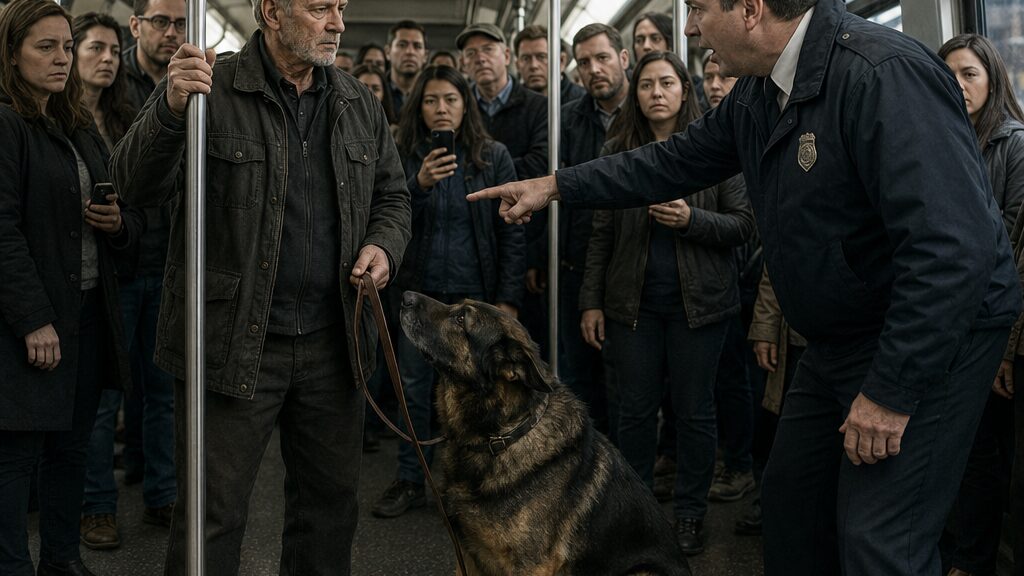
A transit manager entered the car.
Dark uniform.
Radio clipped to his shoulder.
Expression already tense.
The manager walked slowly down the aisle.
Checking bags.
Watching passengers.
Doing what supervisors often did during morning rush.
Then he saw the dog.
His pace slowed.
His eyes narrowed.
Andrew felt it before the man even approached.
The same familiar shift.
The same calculation.
The manager stopped beside them.
“Sir.”
Andrew looked up.
“Morning.”
The manager pointed at the dog.
“What’s this?”
Several nearby passengers immediately stopped pretending not to listen.
Andrew sighed internally.
Here we go.
“Service animal.”
The manager folded his arms.
The dog remained motionless.
The leash rested across Andrew’s knee.
“What kind of service animal?”
Andrew met his gaze.
The question wasn’t unusual.
The tone was.
The manager looked less curious than annoyed.
“A medical assistance dog.”
The manager glanced at the animal’s size.
Then back to Andrew.
His expression suggested he wasn’t impressed.
The train rolled deeper into the city.
Passengers began paying attention.
Phones disappeared from pockets.
Conversations faded.
Something uncomfortable had entered the car.
The manager pointed toward the doors.
“I’ll need you to remove the dog.”
For a moment nobody spoke.
Even the train noise seemed quieter.
Andrew stared at him.
The dog lifted his head.
The leash tightened slightly in Andrew’s hand.
And suddenly every eye in the carriage was fixed on them.
Chapter 2: Rules Written for Someone Else
“Remove him where?”
The manager’s voice remained firm.
“Off the train.”
Several passengers exchanged glances.
Andrew looked at the dog.
Then back at the manager.
“We’re in a tunnel.”
“Next stop.”
The answer came immediately.
As though the decision had already been made.
Andrew felt the first spark of irritation.
Not anger.
Just exhaustion.
The kind that came from having the same conversation too many times.
The dog sat quietly beside him.
Perfect posture.
Perfect discipline.
Not a sound.
Not a movement.
The manager seemed determined to ignore that.
“Sir, animals aren’t allowed to occupy passenger areas.”
“He’s a service animal.”
“You already said that.”
Andrew took a slow breath.
The train rocked gently.
He focused on remaining calm.
The dog remained calm too.
That helped.
It always helped.
A phone appeared from somewhere behind the manager.
Then another.
Passengers had started recording.
The manager either didn’t notice or didn’t care.
“I need documentation.”
Andrew shook his head.
“That’s not required.”
The manager’s jaw tightened.
A few passengers exchanged looks.
Sandra looked up from her book again.
She seemed less interested in the argument than in Andrew himself.
The way he held the seat.
The way one hand stayed fixed on the leash.
The slight tension in his shoulders.
The manager pointed toward the dog.
“People are uncomfortable.”
A woman nearby nodded.
Another passenger shrugged.
Nobody wanted responsibility for the complaint.
They simply wanted someone else to decide.
Andrew glanced around.
No one looked directly at him.
That hurt more than open hostility.
Years ago people had seen a uniform and smiled.
Now they saw a large dog and became nervous.
The manager took a step closer.
“Sir, this train is crowded. What happens if that animal gets loose?”
The shepherd didn’t react.
A child two rows away dropped a toy.
The dog ignored it.
Someone brushed against his tail.
The dog ignored that too.
The manager continued anyway.
“What if he bites someone?”
Andrew looked directly at him.
“He won’t.”
“How do you know?”
A muscle moved in Andrew’s jaw.
“Because he’s better trained than most people.”
A few passengers laughed despite themselves.
The manager didn’t.
The atmosphere shifted.
Not much.
Just enough.
The manager suddenly seemed less confident.
Which made him push harder.
Rule-focused people often did that.
“If everyone starts bringing animals onboard, we have a problem.”
Andrew nodded.
“Good thing that’s not what’s happening.”
The manager exhaled sharply.
The train entered another tunnel section.
The lights flickered briefly.
A familiar sensation rolled through Andrew’s head.
Subtle.
Dangerous.
His vision blurred for a second.
He lowered his gaze.
Waited.
Breathed.
The dog immediately turned toward him.
Sandra noticed.
Her book lowered.
Andrew ignored both of them.
The dizziness eased.
Not gone.
Just waiting.
The manager mistook his silence.
“Look.”
His voice softened slightly.
Not kinder.
Just different.
“I get that people get attached to pets.”
Andrew’s eyes lifted.
The word landed badly.
Pet.
The manager continued.
“But there are rules.”
The dog rested his chin against Andrew’s knee.
The movement was tiny.
Almost invisible.
Andrew felt it immediately.
A quiet check-in.
Still here.
Still watching.
Still working.
Sandra saw that too.
Her expression changed.
The manager didn’t.
“Next stop,” he said. “You and the dog get off.”
A passenger raised a phone higher.
The manager finally noticed.
His posture stiffened.
Nobody likes becoming the center of a video.
Especially not while enforcing authority.
For a moment uncertainty crossed his face.
Then pride won.
He doubled down.
“That’s final.”
The train slowed slightly.
The next station was approaching.
Andrew stared out the window.
His reflection looked older than he remembered.
Tired.
Gray.
Fragile in ways he disliked admitting.
The dog remained pressed against his leg.
Steady.
Reliable.
Necessary.
The manager saw only an animal.
Andrew saw the reason he could still travel alone.
The train began braking.
Metal screamed softly against metal.
Passengers shifted.
The dizziness returned.
Stronger.
This time it didn’t disappear immediately.
Andrew’s fingers tightened around the leash.
The world tilted just enough to make his stomach drop.
The dog rose.
Without command.
Without hesitation.
Sandra sat forward.
The manager noticed the movement.
“See?” he snapped. “That’s exactly—”
He stopped.
Because the dog wasn’t reacting to him.
The dog was watching Andrew.
Only Andrew.
And for the first time, uncertainty entered the manager’s eyes.
Chapter 3: What Andrew Refuses to Say
The tremor started in Andrew’s left hand.
Small.
Barely visible.
But he felt every vibration.
He immediately tucked the hand against his thigh.
Hide it.
Control it.
Move on.
That had become habit.
The dog stood beside him.
Alert.
Focused.
The train doors remained closed while passengers prepared to exit.
The manager waited nearby.
Determined.
Watching.
Sandra was watching too.
Andrew disliked that even more.
Concern often led to questions.
Questions led to explanations.
And explanations made everything feel real.
The dizziness eased slightly.
Enough for him to stay seated.
Not enough for comfort.
The dog lowered his head but remained standing.
Ready.
Andrew knew the signs.
The dog knew them better.
That was the problem.
The animal recognized weakness faster than Andrew admitted it existed.
The train pulled away from the station.
The confrontation resumed immediately.
The manager folded his arms.
“Sir, if the dog is making you uncomfortable, I’ll call someone to assist you.”
Andrew blinked.
“You think he’s making me uncomfortable?”
The manager gestured toward the shepherd.
“You seem nervous every time he moves.”
Sandra closed her book completely.
Andrew almost laughed.
The man had mistaken cause for effect.
The dog wasn’t creating a problem.
The dog was responding to one.
But explaining that would require explaining everything else.
And Andrew hated doing that.
The manager continued.
“You’re not helping your case.”
Case.
As if they were standing in a courtroom.
As if Andrew needed permission to exist.
The train swayed.
Another pulse struck.
Harder.
His vision doubled briefly.
The overhead lights smeared across his eyesight.
He closed one eye.
Waited.
Breathed.
The dog moved closer.
Sandra noticed immediately.
Her gaze shifted between them.
The pieces were beginning to connect.
Andrew could tell.
He hated that too.
Not because she seemed cruel.
Because she seemed kind.
Kindness was harder to refuse.
Several years earlier he had accepted help from everyone.
Doctors.
Therapists.
Neighbors.
Former colleagues.
Then came the looks.
The careful voices.
The concern.
The subtle assumption that he could no longer manage his own life.
One by one he stopped asking.
Stopped explaining.
Stopped sharing.
The dog never looked at him that way.
The dog simply adapted.
If Andrew slowed down, he slowed down.
If Andrew stumbled, he adjusted.
No pity.
No speeches.
Just loyalty.
Sandra finally spoke.
“Excuse me.”
The manager turned.
“So the dog is actually helping him?”
The manager shrugged.
“That’s what he’s claiming.”
Claiming.
Andrew looked away.
Sandra frowned.
The manager continued.
“We don’t know that.”
Andrew almost corrected him.
Almost.
Instead he stayed silent.
His silence had become another bad habit.
The train rattled over uneven track.
The world tilted sharply.
His stomach lurched.
For an instant he thought he might fall despite sitting down.
The dog immediately pushed closer.
Pressure against his leg.
Grounding.
Anchoring.
Sandra saw everything.
The manager saw only movement.
“Keep him under control.”
The words snapped through the car.
Several passengers looked uncomfortable.
Not because of the dog anymore.
Because of the man saying it.
Andrew rubbed his forehead.
The effort of remaining upright was growing.
He knew what was coming.
Not immediately.
Soon.
The warning signs were lining up.
The dizziness.
The blurred vision.
The shaking.
The strange floating sensation.
The same sequence every time.
He remembered a staircase six months earlier.
A grocery store parking lot before that.
A bus stop.
A sidewalk.
The dog had prevented injuries in every incident.
Nobody knew.
He had never filed reports.
Never told stories.
Never wanted attention.
The manager checked his watch.
As though waiting for compliance.
As though enough pressure would solve everything.
Sandra stood from her seat.
A decision.
Small but important.
She moved closer.
Not too close.
Just enough.
“If he’s having a medical problem, maybe leave him alone.”
The manager’s expression tightened.
“I’m doing my job.”
“I can see that.”
Not agreement.
Observation.
The difference mattered.
A few passengers nodded.
Others avoided eye contact.
The power in the carriage shifted slightly.
Not enough to end the conflict.
Enough to complicate it.
The manager looked irritated.
Andrew looked tired.
The dog looked ready.
The train entered another tunnel.
Darkness flashed across the windows.
When the lights returned, Andrew’s vision didn’t fully recover.
The edges remained blurred.
His hand tightened around the leash.
Not because he feared losing the dog.
Because he feared losing the floor.
The shepherd immediately pressed against his leg again.
Waiting.
Watching.
Prepared.
Andrew swallowed.
The next stage had begun.
And for the first time that morning, he wasn’t sure he could hide it.
Chapter 4: The Crowd Chooses a Side
“Sir, are you alright?”
Sandra’s voice cut through the noise of the train.
Andrew looked toward her, but the movement made the world sway again.
“I’m fine.”
The answer came automatically.
It was also a lie.
Sandra seemed to know it.
The manager did not.
Or perhaps he did and chose not to believe it.
“Then we’ll continue this conversation,” the manager said.
Andrew rubbed a hand across his face.
The dog remained pressed against his leg.
Steady.
Alert.
The train entered a curve.
Metal groaned beneath the carriage.
Several standing passengers shifted to keep their balance.
Andrew gripped the edge of his seat.
Nobody noticed except Sandra.
And the dog.
The manager pointed toward the animal again.
“People are uncomfortable.”
A man standing nearby finally spoke up.
“He’s got a point.”
The manager glanced toward him, grateful for support.
The man shrugged.
“That dog’s huge.”
A few others nodded.
Not aggressively.
Just uncertain.
The dog looked from face to face.
Then lowered his head again.
Perfectly calm.
The contrast made the accusations sound weaker.
Sandra folded her arms.
“The dog hasn’t done anything.”
The standing passenger frowned.
“That doesn’t mean it won’t.”
“Neither have you.”
A few people laughed.
The passenger looked embarrassed.
The manager immediately stepped in.
“This isn’t helping.”
“No,” Sandra replied. “What’s not helping is harassing someone who’s clearly having a medical issue.”
The manager’s expression hardened.
Andrew wished she would stop.
Not because she was wrong.
Because attention always made things worse.
His symptoms fed on stress.
The more eyes turned toward him, the harder it became to stay focused.
The train slowed unexpectedly.
Passengers looked around.
A mechanical announcement crackled overhead.
Minor signal delay ahead.
The train would remain stopped briefly.
A collective groan moved through the carriage.
Andrew closed his eyes.
Bad timing.
Very bad timing.
The dizziness rolled through him again.
Longer this time.
He felt disconnected from his own body.
As though the train had tilted several degrees to one side.
When he opened his eyes, the dog was staring directly at him.
Waiting.
Monitoring.
Ready.
Sandra noticed.
She leaned slightly closer.
“Does he do that when you’re not feeling well?”
Andrew hesitated.
The manager answered before he could.
“Service dogs are trained to react to all sorts of things.”
The explanation sounded dismissive.
Like a technicality.
Sandra wasn’t convinced.
Neither were some of the passengers anymore.
The train remained motionless.
The silence inside the car grew uncomfortable.
People who had originally watched the dog now watched Andrew.
His pale face.
The sweat beginning to gather near his temples.
The way he swallowed carefully before answering questions.
The manager shifted his weight.
For the first time he seemed uncertain.
Not because of the dog.
Because of the audience.
A phone was still recording.
Several, actually.
Authority felt easier when nobody questioned it.
Now people were questioning.
The manager doubled down.
“If he needs medical assistance, then he shouldn’t be traveling alone.”
The words landed harder than he intended.
Andrew’s jaw tightened.
Sandra’s eyes narrowed.
Something flickered across the manager’s face immediately afterward.
Regret.
Brief but real.
But pride prevented him from taking the words back.
Andrew stared at the floor.
Traveling alone.
The phrase touched something raw.
Because technically he wasn’t alone.
The dog shifted closer.
A familiar pressure against his knee.
Not enough for anyone else to notice.
Enough for Andrew.
He remembered hospital corridors.
Therapy appointments.
Months spent relearning ordinary confidence.
The dog had been there through all of it.
The manager saw an animal.
Andrew saw every day that came afterward.
The train lights buzzed overhead.
His vision blurred again.
Sandra noticed him blinking repeatedly.
“How long has this been happening?”
Andrew looked at her.
She wasn’t talking about the argument.
She was talking about him.
He wanted to ignore the question.
Instead he said quietly, “Long enough.”
The answer revealed more than he intended.
Sandra nodded slowly.
No pity.
Just understanding.
For some reason that felt worse.
A standing passenger spoke up.
“Maybe we should leave the guy alone.”
Another passenger answered.
“Maybe he should follow the rules.”
The argument spread.
Not loudly.
But enough.
People were choosing sides.
The dog became less important than what the dog represented.
Authority.
Exceptions.
Judgment.
Compassion.
The train car divided itself.
The manager noticed.
So did Andrew.
The situation had moved beyond a simple order.
Now everyone wanted to be right.
The signal delay ended.
The train jerked forward.
The sudden movement hit Andrew like a wave.
His stomach dropped.
The carriage seemed to tilt sharply.
He grabbed the seat beside him.
Too late.
The dizziness didn’t fade.
It intensified.
The dog stood immediately.
Several passengers gasped.
Not because the dog looked threatening.
Because Andrew suddenly looked fragile.
Sandra stepped closer.
“Andrew.”
It was the first time anyone had spoken his name.
He wasn’t sure when she had learned it.
Maybe from the transit pass clipped to his jacket.
Maybe from hearing it earlier.
It didn’t matter.
His hearing seemed distant.
The manager’s voice sounded far away.
The train blurred around the edges.
A memory flashed unexpectedly.
Concrete stairs.
A missed step.
A hand reaching for a railing.
The dog bracing beside him.
The same feeling.
The same warning.
The leash tightened inside his trembling hand.
The dog moved even closer.
Ready.
Waiting.
Andrew tried to rise.
His knees had other ideas.
Chapter 5: The Bracing Command
The moment Andrew stood, the floor disappeared.
Not literally.
It simply stopped feeling dependable.
His legs unfolded beneath him.
Then wavered.
The train aisle stretched strangely before his eyes.
Passengers blurred together.
Voices merged into distant noise.
Someone shouted.
He couldn’t tell who.
The dog already knew.
The shepherd moved before Andrew consciously understood he was falling.
One second he was trying to stand.
The next his balance was gone.
His body tilted sideways.
A collective gasp swept through the carriage.
The manager reached forward instinctively.
Too far away.
Too late.
Sandra’s hands flew to her mouth.
The dog stepped directly into position.
Precise.
Automatic.
Practiced.
Years of training compressed into a single movement.
Andrew felt solid muscle against his hip.
Then his shoulder.
The shepherd widened his stance.
Front paws planted.
Back legs locked.
A living brace.
Andrew’s weight crashed against him.
The dog didn’t move an inch.
For several seconds nobody spoke.
The train continued rolling.
Metal rattled.
Announcements crackled somewhere overhead.
But inside the carriage everything felt frozen.
Andrew gripped the harness.
His breathing sounded loud in his own ears.
Slowly he pushed upward.
The dog remained motionless.
Supporting him.
Waiting.
Helping.
Not rescuing.
Helping.
The distinction mattered.
Andrew had spent years refusing to admit how often this happened.
Now dozens of strangers were watching.
No explanations.
No paperwork.
No arguments.
Just truth.
Visible and undeniable.
The dog was not a pet.
The realization spread across the train car almost physically.
Passengers exchanged stunned looks.
The phones that had been recording for conflict now recorded something entirely different.
Nobody seemed interested in the argument anymore.
Sandra wiped at her eyes.
The manager stared.
His expression had changed completely.
The certainty was gone.
Replaced by confusion.
Then understanding.
Then something heavier.
Andrew finally managed to stand upright.
One hand remained on the harness.
The dog stayed beside him.
Ready in case another wave came.
Nobody complained now.
Nobody asked questions.
The train itself seemed quieter.
A child whispered, “He saved him.”
The mother beside him nodded silently.
The manager opened his mouth.
Closed it again.
What could he say?
The evidence stood directly in front of him.
Andrew’s face remained pale.
His hands still shook slightly.
The dog watched him constantly.
Monitoring.
Waiting.
Working.
Sandra broke the silence.
“How many times?”
Andrew looked toward her.
“What?”
“How many times has he done that?”
The question settled over the carriage.
Andrew swallowed.
He could have lied.
Minimized it.
Changed the subject.
Instead he looked down at the dog.
“A lot.”
The admission felt strange.
The manager stared at the floor.
Andrew continued quietly.
“Stairs.”
Silence.
“Parking lots.”
Another pause.
“Sidewalks.”
Nobody interrupted.
“He always knows before I do.”
The dog leaned lightly against his leg.
Andrew scratched behind one ear.
A simple gesture.
One practiced thousands of times.
For the first time all morning, nobody seemed afraid of the animal.
The manager exhaled slowly.
His shoulders sagged.
Authority had carried him through most situations in life.
Authority had no answer here.
The train slowed toward the next station.
The doors would open soon.
Passengers shifted quietly.
No one rushed.
No one argued.
The earlier tension felt distant now.
Replaced by something uncomfortable.
Recognition.
The manager finally spoke.
His voice sounded smaller.
“I didn’t know.”
Andrew nodded once.
“I know.”
Not forgiveness.
Not accusation.
Just fact.
The manager looked away.
That somehow felt more sincere than an apology would have.
The train pulled into the station.
Brakes hissed.
Doors slid open.
Nobody moved immediately.
Andrew stood with one hand resting lightly on the harness.
The leash hung between them.
No longer looking like restraint.
Looking like connection.
The dog remained at his side.
Waiting for the next instruction.
The next step.
The next challenge.
The next moment he might be needed.
And as passengers watched the pair standing together in the open doorway, silence settled across the entire carriage.
Chapter 6: Standing Because Someone Stayed
Andrew expected another confrontation when he stepped onto the platform.
Instead he heard footsteps behind him.
The manager.
For a moment Andrew considered continuing without turning around.
The dog looked back first.
Andrew followed his gaze.
The manager stopped several feet away.
Not blocking the path.
Not issuing orders.
Just standing there.
The station crowd flowed around them.
Nobody paid much attention anymore.
The spectacle had ended.
Life was moving on.
The manager cleared his throat.
“I owe you an apology.”
Andrew studied him.
The words seemed difficult for the man to say.
That made them more believable.
The manager glanced toward the dog.
“I thought I understood the situation.”
“You thought you understood the rules.”
The manager gave a short, humorless laugh.
“Maybe that’s the same thing to me.”
Andrew couldn’t argue with that.
The man looked tired.
Not defeated.
Just aware of something he hadn’t seen before.
For a few seconds neither spoke.
Then the manager nodded once.
“I hope you get where you’re going safely.”
Andrew looked down at the dog.
“We usually do.”
The manager left.
No dramatic ending.
No crowd applauding.
No grand redemption.
Just a man walking away carrying a lesson he hadn’t expected to learn that morning.
Andrew preferred it that way.
He and the dog exited the station together.
The city noise felt softer outside.
Or perhaps the train had simply been louder than he realized.
His dizziness had mostly passed.
The exhaustion remained.
That was normal.
Episodes always left something behind.
Near the station entrance sat a small public seating area.
Andrew lowered himself carefully onto the pavement beside a low concrete wall.
The dog settled immediately beside him.
Close enough that their shoulders touched.
Andrew opened his backpack.
Inside was a wrapped sandwich.
A container of water.
A few treats.
Nothing special.
Just lunch.
The dog watched patiently.
Andrew smiled faintly.
“Yeah, yeah.”
He broke the sandwich in half.
The dog accepted his portion with careful gentleness.
No grabbing.
No rush.
Just trust.
They ate together in comfortable silence.
People walked past.
Some glanced at them.
Most didn’t.
That felt nice.
Ordinary.
For once.
Several minutes later someone approached.
Sandra.
She carried her tote bag over one shoulder.
“I thought I might find you here.”
Andrew nodded.
She sat on the edge of the wall nearby.
Not too close.
The same respectful distance she’d kept all morning.
The dog accepted her presence immediately.
A good sign.
Sandra looked at him.
“Can I ask something?”
Andrew shrugged.
“You probably will anyway.”
She laughed softly.
Fair enough.
Her gaze shifted toward the shepherd.
“How long have you been together?”
Andrew rubbed the dog’s neck.
“Seven years.”
The answer came easily.
Sandra nodded.
“Long time.”
“Doesn’t feel like it.”
The dog leaned slightly into his hand.
Andrew continued scratching behind one ear.
The familiar motion settled something inside him.
Sandra looked at them both.
Then asked the question he had spent years avoiding.
“Why didn’t you tell people?”
Andrew knew exactly what she meant.
Why hide the severity?
Why argue instead of explaining?
Why stay silent?
He stared at the sidewalk.
For a long moment he said nothing.
The dog rested his head against Andrew’s knee.
Heavy.
Warm.
Present.
Finally Andrew spoke.
“When I first got hurt, everybody wanted to help.”
Sandra listened quietly.
“I appreciated it.”
A pause.
“Then after a while people stopped seeing me.”
He looked down at his hands.
“They saw the injury.”
Sandra didn’t interrupt.
“Every conversation became about what I couldn’t do.”
The words came slowly.
Carefully.
“I got tired of it.”
The dog remained still.
Listening in the only way he knew how.
“So I stopped talking about it.”
Sandra nodded.
Understanding.
Not pity.
Just understanding.
Andrew realized there was a difference.
A meaningful one.
He looked at the dog.
The shepherd’s eyes met his.
Clear.
Steady.
The same eyes that had watched over him through recovery rooms, therapy sessions, bad days, worse days, and ordinary mornings.
The same eyes that had never cared whether Andrew looked strong.
Or weak.
Or independent.
The dog only cared whether he was okay.
That simple truth landed differently now.
Perhaps because he had finally spoken it aloud.
Sandra stood.
“I should get going.”
Andrew nodded.
She smiled at the dog.
Then at Andrew.
“Take care of each other.”
After she left, Andrew sat quietly.
The city moved around him.
Cars passed.
People hurried toward appointments.
Life continued.
The dog rested his head on Andrew’s knee.
Andrew loosened his grip on the leash.
For years he had held it tightly.
As though letting go meant losing something.
Now it simply rested between them.
Not a restraint.
Not a burden.
Not proof of weakness.
A connection.
A promise.
A reason to keep moving.
Andrew finished the last bite of his sandwich.
The dog finished his treat.
Together they sat on the ground outside the station, sharing a simple meal in the middle of an ordinary day.
The world remained broken in a hundred different ways.
But in that small patch of sunlight, neither of them seemed to mind.
The story has ended.