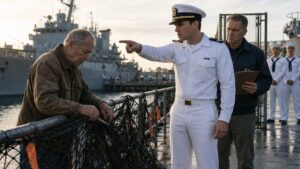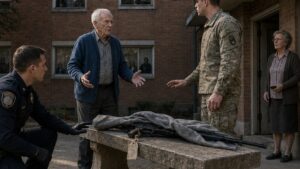
A Young Officer Tore The Star From An Old Man’s Jacket And Learned Who First Wore It
Chapter 1: The Star On The Worn Brown Jacket
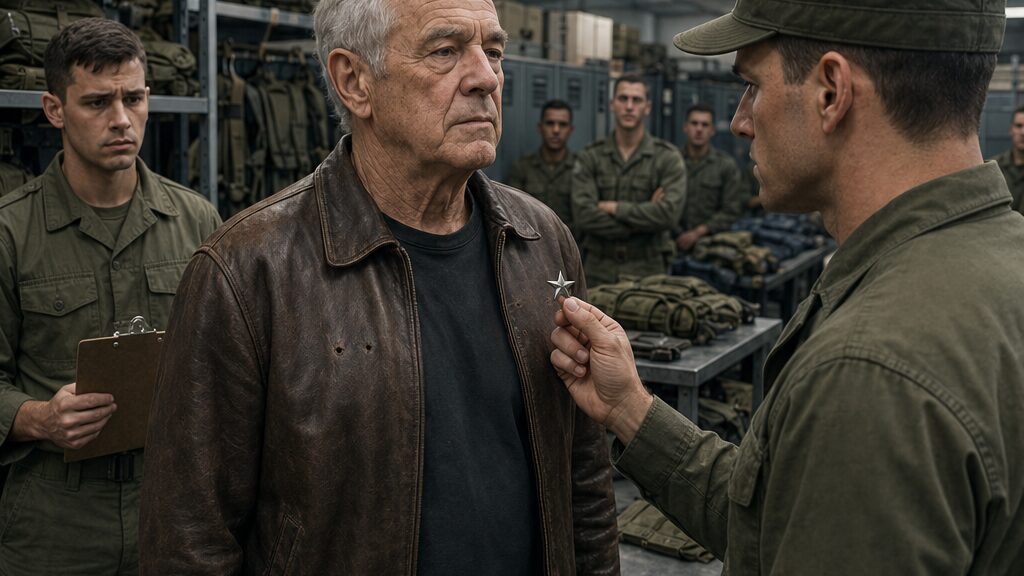
Steven Taylor’s finger stopped less than an inch from the silver star on Robert Walker’s jacket.
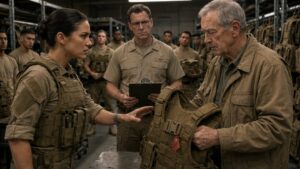
For a moment, nobody in the armory moved. A row of folded packs sat open on the metal table. Tactical harnesses hung from the steel rack behind them like empty bodies. The fluorescent lights hummed above the concrete floor, flat and white, making every face in the room look harder than it was.
Robert looked down at the finger, then at the young man wearing the uniform.
“Where did you get that?” Steven asked.
His voice was not loud yet. It did not need to be. The armory carried sound cleanly. Two soldiers by the storage lockers stopped counting magazines. A third, Justin Robinson, froze with one hand on a clipboard and the other near a shelf of field radios.
Robert had been inside the room less than five minutes.
He had entered slowly, with his right hand resting on the strap of a worn canvas bag. His brown jacket was old enough that the leather had softened at the elbows and dulled across the shoulders. The silver star pinned over his left breast was the only bright thing on him. It was not polished to show off. It had the muted shine of something handled often and carried longer than seemed reasonable.
“I was told to report here,” Robert said.
Steven’s eyes stayed on the star. “That isn’t what I asked.”
Robert took in the young man’s posture. Feet planted. Chin slightly high. Shoulders too square. A man making himself larger because the room was watching.
“I brought what was requested,” Robert said.
Steven looked past him toward the armory door, as if expecting someone official to follow. No one did. Beyond the open doorway, the corridor was bare except for a security sign and a scuffed floor stripe.
“You have a current badge?” Steven asked.
Robert’s hand moved toward the inside pocket of his jacket. Slowly. Not because he was weak, though the motion carried the carefulness of age. Because sudden movement in a military room could change the air.
Steven stepped closer. “Keep your hand where I can see it.”
Robert stopped.
The words landed harder than Steven seemed to expect. One of the soldiers by the lockers looked down at the floor. Justin’s clipboard dipped an inch.
Robert let his hand fall to his side.
“I have an invitation at the desk,” he said.
“To the heritage inventory?” Steven asked.
“Yes.”
Steven gave a short breath through his nose, almost a laugh without humor. “That’s staff and authorized guests.”
Robert did not answer.
Steven finally looked up from the star to the man’s face. Robert’s hair was white-gray and cut short, but not fresh. His cheeks were hollowed by age. There were lines around his mouth that did not suggest softness, only long practice at holding things in. He looked tired. He did not look confused.
That seemed to irritate Steven more.
“Name?”
“Robert Walker.”
Justin’s head lifted.
Steven turned slightly. “Robinson. Check the guest list.”
Justin crossed to the small computer station beside the locked cage. His boots made small sounds on the concrete. He woke the screen and typed with two fingers, glancing once toward Robert.
Steven kept his place in front of the old man.
“You understand why I’m asking?” he said.
“I understand why you think you are.”
A soldier near the magazine table looked up too quickly.
Steven’s jaw tightened. “This is a restricted room. We have weapons components, accountable gear, ceremonial inventory, and visiting cadets coming through at thirteen hundred. You don’t walk in here wearing whatever you found in a drawer.”
Robert’s eyes shifted to the hanging harnesses. For the first time since entering, something in his face changed. Not anger. Not fear. Recognition, perhaps. The kind that arrived before memory had been invited.
“I did not find it in a drawer,” he said.
“Then where?”
Robert looked back at him. “Here.”
Steven stared.
The room seemed to listen harder.
Justin turned from the computer. “There’s an R. Walker listed.”
Steven did not step back. “Rank?”
Justin checked again. “No rank shown.”
“Unit?”
“Not shown.”
“Credential?”
Justin’s face tightened. “Just says heritage inventory guest. Ten-thirty arrival.”
Steven looked at the wall clock. Ten forty-one.
Robert said nothing.
Steven pointed at the star again. “That doesn’t give you authority to wear this.”
The old man’s hand rose, not to cover the star, but to touch the edge of his jacket below it. His fingers were thick at the knuckles and faintly scarred, the nails clean but ridged. He did not touch the metal itself.
“The armory should still have my name,” Robert said.
“It has an initial and a surname,” Steven said. “That’s not the same thing.”
“No,” Robert said quietly. “It isn’t.”
The answer unsettled Justin. He had expected defense, protest, irritation, maybe the familiar embarrassed shuffle of an old visitor who had misunderstood instructions. Instead Robert spoke as if he were agreeing with a truth larger than the accusation.
Steven heard something else. Evasion.
“Do you know what this looks like?” he asked.
Robert looked at him fully. “Yes.”
“Then explain it.”
Robert’s eyes flicked once to the soldiers watching.
Steven followed the glance and mistook it for shame.
“Go ahead,” Steven said. “Explain it to everyone.”
The hum of the lights seemed to grow louder.
Robert’s mouth tightened. Not with pride. With restraint pulled so taut it had become almost visible. He could have said a title. He could have asked for a commander. He could have made the young man’s face change with one sentence.
Instead he saw another room, years earlier, full of wet boots and smoke-stained sleeves; a younger man standing too straight because someone had to; a star pressed into his palm by hands that shook more from grief than cold.
The memory left as quickly as it came.
“You can check the name again,” Robert said.
Steven’s expression hardened.
“That’s your answer?”
“It is the one I’m giving you.”
Steven took the final half-step into Robert’s space.
Justin moved without meaning to, then stopped. The two soldiers by the lockers turned completely now. One of them whispered, “Sergeant,” but not loudly enough to count as interruption.
Steven lifted his hand.
Robert saw the decision before the fingers touched metal.
“Do not,” Justin said, barely above a breath.
Steven ignored him.
He pinched the silver star between thumb and forefinger and pulled.
The old leather resisted. The pin beneath the star caught in the fabric lining, dragged, then tore free with a small dry sound that everyone in the armory heard. Robert did not move. His eyes lowered to the empty place on his jacket.
Two tiny holes remained where the pin had been.
Steven held the star up between them.
No one spoke.
The object looked smaller in Steven’s hand than it had on Robert’s chest. Less like authority. More like evidence of something mishandled.
“I’m logging this until your status is verified,” Steven said.
Robert’s gaze stayed on the holes.
“You may log what you like,” he said.
The calm in his voice made Steven’s ears heat.
“You’ll wait outside the secure area.”
Robert lifted his eyes. “I came to return something to this room.”
“You just surrendered it.”
Robert looked at the star in Steven’s hand. For the first time, grief crossed his face plainly enough that even the youngest soldier could see it. Then it was gone.
“No,” Robert said. “You took it.”
Steven’s fingers closed around the star.
That should have ended the matter. He had control of the object. He had the room. He had the uniform and the authority inside it. But as Robert stepped back from the table, none of the soldiers looked at Steven with the certainty he expected.
Justin was staring at the old man’s jacket.
Not at the missing star.
At the two small holes left behind.
Robert’s hand hovered near them, then dropped, as if touching the torn leather would have been too much. He looked at those holes like they had been made long before Steven Taylor was born.
Chapter 2: The Name That Did Not Carry A Rank
“Log it as unauthorized insignia,” Steven said, and the silver star disappeared into a clear evidence pouch.
Justin held the pouch open with both hands. He did not like the word unauthorized. He liked it less when Steven said it loudly enough for the men by the lockers to hear.
The star slid against the plastic with a thin scrape. Steven sealed the top strip, pressed his thumb along it twice, and wrote the time on the label.
10:47.
The numbers looked clean. The situation did not.
Robert Walker sat on a metal bench outside the armory cage, his canvas bag at his feet, his brown jacket still buttoned despite the warm corridor. The empty spot on his chest showed plainly now. Every time Steven glanced that way, the two holes bothered him more than the star had.
That only made him angrier.
“Robinson,” Steven said, “incident binder.”
Justin handed it over.
Steven opened to a fresh page and wrote with deliberate pressure. Elderly male entered restricted armory wearing unauthorized military-style star. Claimed invitation. No rank listed.
He paused after the word claimed.
Robert’s voice came from the bench. “The invitation is real.”
Steven did not look up. “Then the desk can confirm it.”
“The desk already did.”
“The desk confirmed a name. Not your right to walk into my armory wearing rank decoration.”
Robert said nothing after that.
That silence scraped at Steven worse than argument would have. In his experience, liars filled space. They explained too much. They reached for old stories and half-remembered unit names. They said “classified” when they meant “imagined.” They got loud when cornered.
Robert Walker did none of that.
Steven told himself that did not prove anything.
At the security desk, the clerk turned the monitor toward him. “Here. Heritage inventory guest list. Ten-thirty block. R. Walker. No escort noted.”
“Who entered it?”
“Base historian’s office.”
“Call them.”
The clerk hesitated. “They’re already in the building for the inspection prep.”
“Then find them.”
Robert remained on the bench while people moved around him as if he were a problem placed in the corridor. A pair of visiting cadets passed at the far end, their instructor steering them away before they could ask questions. Steven noticed Robert watching them, not with embarrassment, but with a faint ache that made him look older.
Steven looked back at the screen.
“No rank,” he said.
The clerk shrugged. “Not on this list.”
“That’s the point.”
A woman with a stack of folders came briskly around the corner, balancing a tablet against her forearm. Her hair was pulled back in a practical knot, and her visitor badge had flipped backward on itsarm. Her hair was pulled back in a practical knot, and her clip.
“Who requested records support?” she asked.
“I did,” Steven said. “You Jennifer Scott?”
“Yes.”
“Steven Taylor. Armory NCO for today’s heritage inventory and security support. Your office put an R. Walker on the access list.”
Jennifer’s eyes moved past him to Robert on the bench.
Something almost changed in her face. Not recognition exactly. More like she had seen a name in an old box and had not expected the person attached to it to breathe.
“Yes,” she said carefully. “We had an R. Walker confirmed for consultation on legacy materials.”
“Confirmed by who?”
Jennifer checked her tablet. “The request was pulled from a transfer sheet. Older records. Some of the guest information is incomplete.”
Steven felt the first clean edge of vindication. “Incomplete how?”
“No rank field. No current organization. Just surname, initial, and the notation ‘heritage inventory guest.’”
“Convenient.”
Jennifer frowned. “Incomplete does not mean false.”
Steven lifted the evidence pouch. The star caught the fluorescent light through the plastic. “Does your transfer sheet say he can enter a restricted armory wearing this?”
Jennifer looked at the pouch.
Her expression stilled.
“Where was that?” she asked.
“On his jacket.”
“I can see that. Where on his jacket?”
Steven almost laughed. “Left side. Where people pin things they want noticed.”
Robert’s hand tightened once on his knee, then relaxed.
Jennifer turned slightly toward him. “Mr. Walker, did you bring any paperwork with you?”
Robert looked at her with a quiet that felt older than politeness. “The armory kept the paperwork.”
Steven made a mark in the binder. “That’s what I’m talking about.”
Jennifer did not answer him. She studied Robert another moment, then turned back to the tablet. “A large portion of the pre-digital armory archive was moved to the basement after the last facility renovation. Some items weren’t cataloged correctly.”
Steven folded his arms. “So we have an old man, no ID badge, no rank, no unit, and a story that the real proof is somewhere in the building.”
“We have an invited guest whose record may be in storage,” Jennifer said.
“We have an accountability issue.”
Jennifer’s voice cooled. “You also have an inspection in two hours. I suggest you avoid creating a larger issue until we know what this is.”
Steven heard the warning inside the professionalism. Do not embarrass the unit. Do not write more than you can defend. Do not make this about your authority.
He had heard variations of that tone his whole career from people who came in after the hard calls and adjusted the language.
His father had adjusted language too. Embellished, people said later. Misremembered. Confused dates. Claimed a school he never completed, a deployment he never made, a commendation that belonged to another man with the same last name.
Steven had been seventeen when a veterans’ group asked his father to stop attending events in uniform. He remembered the folded newspaper on the kitchen table, his mother’s closed bedroom door, his father saying, “They took everything I tried to be.”
Steven looked at the star in the pouch.
No. He would not be the man who looked away.
“I’m filing a preliminary incident report,” Steven said.
Jennifer’s eyes sharpened. “Before we check the basement archive?”
“Before the inspection team walks through here and sees an unverified civilian in restricted space.”
Robert stood.
The movement was slow, but it drew every eye.
“I will wait where you tell me to wait,” he said. “But do not call that star civilian.”
Steven stepped toward him. “Then tell me what to call it.”
Robert’s gaze held steady. “Returned late.”
No one knew what to do with that.
Steven wrote the phrase in the margin without meaning to. Returned late. Then he crossed it out so hard the pen nearly tore the page.
Jennifer lowered her folders onto the security desk and opened the oldest one. The paper inside had yellowed at the edges. Inventory transfer sheets, photocopied labels, old case numbers. Her fingers moved quickly until they stopped near the bottom of the second page.
“What is it?” Justin asked.
Steven shot him a look, but Justin did not step back.
Jennifer lifted the sheet.
A typed line had been corrected by hand in faded ink.
CASE 4B — FIELD JACKET STAR — WALKER STAR — DO NOT DISCARD.
Steven reached for the page.
Jennifer did not let go.
For the first time all morning, Robert Walker closed his eyes.
Chapter 3: The Photograph Behind The Folded Harnesses
Justin saw the same star in the photograph because one of the folded harnesses slipped from the shelf.
It dropped hard enough to rattle the metal rack, and when he bent to pick it up, the old frame behind the webbing flashed silver in the corner. Not real silver. Photographic silver, faded almost white by age and dust.
He should have put the harness back and returned to the inventory table.
Instead, he moved two more harnesses aside.
The photograph had been shoved behind newer gear, its wooden frame scratched, the glass cloudy. A line of younger soldiers stood in front of the armory decades earlier, or in front of a building that looked enough like it to make Justin’s throat tighten. Their uniforms were older. Their faces were harder to read. A tall officer stood near the center, not smiling, one hand tucked behind his back.
On the left side of his field jacket was a silver star.
Justin leaned closer.
The face was younger. The jaw was fuller. The hair dark. But the eyes made him forget the years between the photograph and the bench outside the armory cage.
“Robinson,” Steven called from the aisle. “You get lost?”
Justin straightened too fast and hit his shoulder on the shelf. “No, Sergeant.”
Steven came around the end of the rack carrying the incident binder under one arm. He had the brisk look he used when uncertainty had annoyed him into action.
“What are you doing?”
Justin stepped aside.
The photograph was visible now.
Steven looked at it for half a second. “Heritage decoration.”
“Sergeant,” Justin said, “the star—”
“It’s an old picture. Old pictures have old insignia.”
“It looks like the same shape.”
Steven pulled the harness from Justin’s hand and shoved it back into place. “You know what else looks the same from a distance? Every souvenir star in every surplus store off-post.”
Justin felt heat rise into his neck. “Yes, Sergeant.”
Steven pointed toward the inventory table. “We have inspection prep, not a museum tour.”
Justin should have moved.
He didn’t.
“The man in the photo,” he said, quieter now, “looks like him.”
Steven stared at him.
That was worse than being yelled at.
“You have something official?” Steven asked.
“No.”
“Nameplate?”
Justin glanced at the bottom of the frame. A small brass strip had been removed, leaving two dark rectangles where screws had once been.
“No.”
“Then stop building a case out of dust.”
Steven turned away, but Justin saw his hand tighten on the binder.
The armory felt different after that. Every rack seemed to hide something. Every old tag seemed to mean more than its faded ink. Justin returned to the table and checked off items, but his eyes kept moving back to Robert Walker.
The old man had been allowed back inside the outer armory area under “controlled observation,” Steven’s phrase. He stood near the far wall where the display cases used to be, his canvas bag at his feet, watching Jennifer sort through transfer sheets.
Robert did not look at the photograph. That bothered Justin most.
If the man in the frame was him, why not say so?
If it was not him, why did he seem to know exactly where not to look?
Jennifer carried a small box of labels to the table. “I need access to the south storage alcove.”
Steven did not look up. “For what?”
“Legacy case references. The inventory note points to Case 4B. That predates the current shelving system.”
“Everything predates the current shelving system,” Steven said.
Jennifer ignored that and addressed Justin. “Private, do you know where the older framed materials were kept?”
Justin looked at Steven first. He hated himself for doing it.
Steven gave a slight nod, irritated but permissive.
“Behind the folded harnesses,” Justin said. “There’s at least one old photo.”
Jennifer’s eyes narrowed. “Show me.”
Justin led her there. Robert’s head turned as they passed. Not much. Just enough.
At the rack, Justin moved the harnesses aside again. Jennifer wiped the glass with the edge of her sleeve. The cloudiness smeared, then cleared across the center.
Her breath caught.
Steven heard it. “What now?”
Jennifer did not answer. She angled the frame under the fluorescent light and examined the small empty place where the brass nameplate had been removed.
“There should be a label,” she said.
“There isn’t,” Steven replied.
“No. I mean there was.” She touched the screw marks. “Someone removed it before the renovation.”
Justin pointed before he could stop himself. “That officer. The one near the middle.”
Jennifer’s eyes moved to the silver star in the photograph.
Behind them, Robert said, “That picture used to hang by the west door.”
Everyone turned.
He had not raised his voice. He stood with one hand on the canvas bag strap, his gaze fixed on the frame now that there was no pretending not to see it.
Jennifer looked from the photograph to Robert. “You recognize it?”
Robert’s face gave away nothing. “I recognize where it hung.”
Steven stepped in between them. “That’s not the question.”
Robert looked at him.
Steven tapped the frame. “Are you claiming to be in this photograph?”
Justin held his breath.
Robert’s eyes returned to the image. The tall officer in the photograph looked beyond the camera, not at it. Beside him stood men whose names Justin did not know, all of them trapped in a moment before age, loss, and renovation could rearrange the room around them.
“No,” Robert said.
Steven’s shoulders loosened, just slightly.
Then Robert added, “I am saying the photograph was taken before the wall came down.”
Jennifer went still. “What wall?”
Robert pointed past the racks, toward the far end of the armory where a newer partition held electronic locks and warning signs. “There was a cinderblock wall there. Painted twice. Cracked near the floor because the old case room below it settled in winter.”
Justin looked at the floor.
Steven did too, unwillingly.
Jennifer lowered the photograph. “There’s a basement records room under this side?”
Steven frowned. “There’s storage under the admin wing.”
“Not on the current map,” Jennifer said.
Robert said, “It was never on the visitor map.”
Steven’s irritation returned in full, but this time it had to push through something else. Uncertainty.
“How would you know that?” he asked.
Robert met his eyes. “Because I was here before the visitor map.”
The words did not reveal enough. They revealed too much.
A noise came from the corridor: wheels, voices, the sharp rhythm of people arriving with schedules. The inspection team appeared at the armory entrance with clipboards, visitor badges, and the polished patience of people who expected readiness.
Steven turned quickly. “Robinson, cover that frame. Scott, put those papers away. Mr. Walker remains under security review until command says otherwise.”
“Security review?” Jennifer asked.
Steven’s voice dropped. “Would you prefer I tell them we may have an unauthorized symbol, incomplete access records, and a civilian claiming knowledge of a hidden room under the armory?”
Robert looked at the inspection team entering the room. Then he looked at Steven, not angry, not pleading.
Only tired.
“You are choosing the wrong thing to hide,” he said.
Steven’s mouth tightened. “Sit down, Mr. Walker.”
Robert did not sit.
He looked past Steven toward the far end of the armory, where the new partition cut the room in two. His gaze settled near the floor as if he could see through concrete, dust, and twenty years of forgetting.
Then he asked the only question that made Jennifer’s folders tremble in her hands.
“Is the old basement case still locked?”
Chapter 4: The Locked Case Under The Armory Floor
The tag on the basement case still bore Robert’s surname.
WALKER.
The letters had been typed on a cream label, then covered with yellowed tape that had curled at the corners. Dust clung to the metal latches. A rust-colored scrape ran across the lid where some careless hand had dragged another crate over it years before. Yet the name remained readable, clearer than it had any right to be after all that time underground.
Robert stood over it without touching it.
Behind him, the basement records room smelled of old cardboard, machine oil, and concrete that had held damp through too many winters. The ceiling was low. Pipes crossed above the shelves. One fluorescent tube flickered in a wire cage, making the shadows jump against stacks of archive boxes.
Jennifer Scott crouched beside the case with a ring of keys in her hand. Justin Robinson stood at the bottom of the stairs, one shoulder angled toward the door as if he expected Steven Taylor to appear at any second.
“He was right,” Justin said softly.
Jennifer looked at Robert. “This case is on no active inventory sheet.”
“It was never active inventory,” Robert said.
“What was it?”
Robert’s eyes stayed on the name.
“A promise someone forgot how to finish.”
Jennifer held up the key ring. “Do I have your permission to open it?”
The question was wrong in every regulation sense. The case belonged to the armory. The armory belonged to the command. Robert Walker was, by every visible rule in the room, a guest under security review. Jennifer did not need his permission.
Still, she asked him.
Robert looked at her then. There was gratitude in the glance, but also warning.
“Once it is open,” he said, “people will try to make it simpler than it was.”
Jennifer did not pretend to understand. She chose a flat brass key, worked it into the first latch, and turned.
The latch resisted, then snapped loose with a sound like a small bone breaking.
Justin flinched.
The second latch opened easier.
Jennifer lifted the lid.
Inside lay a dark felt lining, compressed by years of weight. There were several folders tied with cotton tape, a rolled photograph in a protective sleeve, a field manual marked with handwritten corrections, and a stiff envelope sealed with brittle brown adhesive. In the center of the lining was a star-shaped blank where the felt had been shielded from dust and light.
An absence.
Robert stared at the empty shape.
His hand rose halfway, then stopped.
Jennifer’s voice softened. “The star came from here.”
“No,” Robert said. “It came back here.”
Justin stepped closer. “But it was on your jacket.”
Robert looked toward the canvas bag he had carried downstairs. “Because I took too long.”
The words were quiet enough that the basement nearly swallowed them.
Jennifer carefully lifted the top folder. The paper inside had browned along the edges. The first page showed a diagram of the old armory layout, before the renovation, before the new partition, before the electronic locks. Red pencil marked routes through storage aisles, emergency exits, staging tables. The handwriting beside the lines was firm, narrow, disciplined.
Justin bent over the page. “This looks like a training plan.”
“It became one,” Robert said.
Jennifer turned the next page. Photographs followed: soldiers moving through smoke, stretchers under tarps, flooded access roads, a line of vehicles half-submerged near a collapsed bridge. None of it looked ceremonial. None of it looked like heritage.
One photo showed a younger Robert Walker in a soaked field jacket. The same star shape was pinned at his left chest, dull with mud and rain. Men around him looked toward him the way people looked when instructions had to be trusted before they could be understood.
Jennifer did not say his name. Justin did not ask.
Robert reached into the case and touched the edge of the photo sleeve, not the image itself.
“That was the first night,” he said.
“The first night of what?” Justin asked.
Robert’s answer did not come immediately.
He saw headlights in water. Heard rotors that never landed because the ceiling was too low. Saw a hand press the silver star against his chest after the first command post went dark and every radio call began coming through him. He had been younger than Steven Taylor then, though he had felt old by dawn.
Jennifer opened the sealed envelope only enough to read the outer notation.
Command Transfer Memorandum. Emergency Field Authority. Walker, Robert.
She looked up.
Robert’s face closed.
“Please leave that sealed for now,” he said.
“It may be the record that explains this.”
“It is not the record I came for.”
Jennifer lowered the envelope back into the case.
Justin saw another page beneath it. A roster. Some names were checked. Some had dates. One name near the bottom had been underlined by hand.
Robert saw where Justin’s eyes had gone.
The basement seemed to shrink.
Justin read nothing aloud. He did not need to. The underlined name had a notation beside it: lost during extraction.
Robert’s hand found the edge of the case. For the first time all day, his balance looked uncertain.
Jennifer noticed. “Mr. Walker?”
He did not correct the address. Not yet.
“I sent him back,” Robert said.
Justin did not understand. Jennifer seemed afraid that she might.
Robert swallowed once. “There were five men trapped in the east wing. The radio was failing. We had one pass left before the water took the road. I sent him back with the guide line because he was the fastest and because I trusted him.” His mouth tightened. “He got three out.”
“And didn’t come back,” Jennifer said.
Robert’s eyes remained on the underlined name. “No.”
The quiet that followed was not the same as before. It had weight now. Justin thought of the star in the evidence pouch upstairs, flattened under Steven’s handwriting, called unauthorized by a man who had not known what his fingers were tearing loose.
Robert reached into the canvas bag and removed a folded cloth packet. His fingers worked carefully at the knot. Inside was nothing but a small old mounting card, cut to fit the star-shaped blank in the case.
Jennifer understood first. “You brought the backing.”
Robert nodded. “The star was supposed to be placed back with the names. I kept it after the memorial because I thought I had not earned the right to put it beside his.” He looked at the empty shape. “Then years became excuses.”
Footsteps struck the stairs above.
Justin turned sharply.
Steven came down fast, one hand on the railing, the incident binder tucked under his arm. He stopped on the bottom step and took in the open case, the exposed folders, the restricted-looking envelope, the old photographs, Robert standing over all of it without escort.
His face changed in a way that was almost relief. This, at last, looked like something he understood.
“What are you doing?” Steven demanded.
Jennifer stood. “This case is tied to the inventory note.”
Steven came off the step. “That case was not cleared for access.”
“You told me to verify the source of the star.”
“I did not tell you to open restricted historical materials with a civilian present.”
Robert turned from the case.
Steven looked past him to the envelope, saw the command notation, and then saw the underlined name on the roster. He did not know what any of it meant, but he saw enough to make his report seem less foolish and more urgent.
“Step away from the case,” Steven said.
Robert did.
Not because Steven had earned obedience in that moment. Because the name inside the case deserved no more raised voices.
Steven pulled out his phone.
Jennifer’s face tightened. “Sergeant, do not escalate this before—”
“It is already escalated.” Steven looked at Robert. “You entered a restricted room with questionable insignia, gave incomplete answers, led personnel to an unlisted basement records area, and accessed restricted materials.”
Justin took a step forward. “Sergeant, he knew where the case was because—”
Steven cut him off with a look. “Because he has done this before, or because someone told him enough to sound convincing.”
Robert’s face did not move, but his hand closed around the folded cloth packet.
Steven dialed.
When the command office answered, he straightened as if the phone itself could see him.
“This is Sergeant Taylor at the armory. I need to report a possible breach involving an elderly civilian with access to legacy restricted materials.”
He listened, then looked directly at Robert.
“No, sir. Identity unconfirmed. Name given as Robert Walker.”
Chapter 5: The Report Steven Wanted To Be True
Steven changed the words “questioned insignia” to “removed unauthorized insignia” because the first version sounded too uncertain.
The conference room door was closed. Through the narrow glass panel, the armory corridor looked distant and distorted, a strip of white light and moving shadows. The inspection team had been redirected to the vehicle bay. The soldiers had been told to keep working. Robert Walker had been placed in the small waiting room across the hall with Justin posted outside, though Steven had not liked the way Justin accepted that assignment with visible relief.
The incident report sat open on the table.
Steven read the first paragraph again and pressed his pen harder.
Unauthorized.
The word steadied him.
It gave shape to the morning. It put the star back where it belonged: inside procedure, inside policy, inside a category that could be controlled.
Jennifer Scott stood at the far end of the table with three folders spread before her. She had refused to sit.
“That word may be wrong,” she said.
Steven did not look up. “Then prove it before command asks why I let an unverified visitor handle restricted materials.”
“I am trying to.”
“You opened the case before clearance was confirmed.”
“I opened a heritage inventory case that was marked for review.”
“With him in the room.”
“He knew it existed.”
“That does not make him authorized.”
Jennifer pushed one page toward him. “It makes him relevant.”
Steven glanced at it only long enough to see an old photograph. Younger soldiers. Rain. Mud. A tall officer with a silver star pinned to his field jacket. The face was too blurred to prove anything. He pushed it back.
“Historical resemblance is not identification.”
“No,” Jennifer said. “But this is not just resemblance. The case liner has a star-shaped absence. The inventory note says ‘Walker star.’ He arrived with a star and backing card. The guest list says R. Walker. At some point, the reasonable thing becomes verification, not accusation.”
Steven’s pen stopped.
“You think I don’t know that?”
“I think you decided what he was before you checked.”
The sentence struck too close and too clean.
Steven closed the binder halfway. “Do you know how many times people walk onto military property wrapped in half-truths? Old jackets. Old stories. Someone else’s rank. Someone else’s grief. They learn three unit names from the internet and expect every gate to open because nobody wants to challenge a gray-haired man.”
Jennifer’s voice was careful. “Has that happened here?”
Steven looked at the sealed evidence pouch beside the binder.
The star lay inside, bright and flattened.
“Not here,” he said.
But the word here did not protect him from the memory that followed.
His father in a borrowed dress jacket at a county dinner. His father laughing too loudly with men who had done the things he only described. His father accepting a handshake meant for someone else because the room was kind and careless. Then a phone call. Then a quiet correction. Then his father sitting at the kitchen table while Steven read the article over and over until shame became a rule he could live by: symbols had to be guarded because people lied when others were too polite to stop them.
Jennifer watched him, and he hated that she seemed to see not the memory, but the damage it had left behind.
“My father wore what he didn’t earn,” Steven said before he could stop himself.
The room went still.
Jennifer said nothing.
Steven kept his eyes on the report. “People were gentle with him. Too gentle. By the time anyone checked, he had embarrassed himself, my mother, the local veterans’ post, everyone who had stood beside him in photographs.” He swallowed. “So if you’re wondering whether I enjoy this, I don’t.”
Jennifer’s expression softened, but not enough to let him go.
“That explains why you care,” she said. “It does not excuse how you handled him.”
Steven opened the binder again. “I handled a security concern.”
“You pulled the star from his jacket in front of enlisted soldiers.”
His jaw tightened.
“He refused to explain.”
“He told you to check the name.”
“That is not an explanation.”
“No,” Jennifer said. “It was trust. And you punished him for offering it quietly.”
Steven stood so abruptly the chair legs scraped the floor. “Enough.”
The word hit the glass panel and came back thinner.
A phone on the conference table rang before Jennifer could answer. Steven snatched it up.
“Taylor.”
He listened.
His posture changed after the first sentence.
Jennifer watched his grip tighten.
“Yes, sir,” Steven said. “The pouch is with me. Full name reported as Robert Walker. No middle initial available. Approximate age seventies. Civilian clothing. Brown jacket.”
He listened again.
“No, sir, he did not identify himself by rank.”
Another pause.
Steven’s eyes moved toward the corridor, toward the waiting room door.
“I understand.”
He ended the call.
Jennifer waited.
“That was the commander’s aide,” Steven said.
“What did they say?”
Steven did not answer at first. He looked down at the incident report, at the word unauthorized, at the sentence he had shaped so confidently around the old man’s silence.
Then he reached for the pouch.
Jennifer stepped closer. “Steven.”
“It has to go to Colonel King.”
“Did they say why?”
Steven took too long to respond.
“They asked for the original star, the guest list entry, and his full name. Immediately.”
Jennifer gathered the old folders. “Then we bring the basement case materials too.”
“No.” The word came sharper than he intended. “Restricted file protocol stays in place until command authorizes release.”
“Command is asking because something in that name matters.”
Steven looked toward the corridor again.
Across the hall, Justin stood outside the waiting room. He was no longer at parade-rest. He had turned slightly toward the closed door, listening to something inside or to nothing at all. The young soldier’s face carried the discomfort Steven had seen in the armory after the star came loose.
Doubt had spread. Quietly. Worse than open defiance.
Steven picked up the report and tried to read it as if someone else had written it.
Elderly male.
Unauthorized.
Removed.
The words no longer steadied him. They cornered him.
Jennifer collected the photo in its protective sleeve and slid it into a folder. “You should amend the report before Colonel King sees it.”
Steven looked at her.
“You want me to soften it.”
“I want you to make it accurate.”
“It is accurate.”
“Is it?”
The question remained between them until another phone rang, this time the wall line. Jennifer answered because she was closest.
“Conference room,” she said.
Her eyes shifted to Steven almost at once.
“Yes, he is here.”
She held the receiver out.
Steven took it.
The voice on the other end was clipped, low, and unmistakably urgent. Not the aide this time. Another staff officer, perhaps, speaking from somewhere nearer to command.
“Sergeant Taylor?”
“Yes.”
“Colonel King is en route to the armory. Until he arrives, Mr. Walker is not to be released from the building.”
Steven looked at Jennifer, then at the evidence pouch in his hand.
The voice continued.
“And Sergeant?”
“Yes?”
There was a pause just long enough for the room to tilt.
“Do not let General Walker leave the building.”
Chapter 6: When The Commander Recognized The Silent Man
Anthony King entered the armory and stopped mid-step when he saw Robert Walker without the star.
The room recognized the halt before it recognized the man. Boots stopped. Clipboards lowered. A visiting cadet near the gear table straightened without being told. Steven Taylor stood beside the evidence counter with the clear pouch in his hand, and for the first time that day, he looked younger than his uniform.
Robert was standing near the old harness rack, his brown jacket still buttoned, the two tiny holes visible on the left side of his chest. He had refused the waiting room after the call from command, not with anger, simply by saying, “If this is about the armory, I will wait in the armory.” No one had known how to make him sit elsewhere after that.
Anthony King took off his cap.
The gesture was small.
It changed the room.
“General Walker,” Anthony said.
The title moved through the armory like a dropped tool striking concrete.
Justin Robinson’s eyes widened. Jennifer Scott went very still. One of the soldiers by the lockers looked from Robert to Steven, then down at the floor. Steven did not move at all.
Robert looked at Anthony with a weariness that did not belong to the last few hours.
“Colonel King,” he said.
Anthony came forward, not quickly. Quickly would have made the moment theatrical. He walked as a commander entered a space that had already failed someone before he arrived.
When he reached Robert, he did not salute. Not yet. His eyes had gone to the empty place on the jacket.
“Sir,” Anthony said quietly, “where is it?”
Robert’s gaze shifted to Steven’s hand.
Anthony turned.
Steven held up the pouch because there was nothing else to do.
“It was secured pending verification, sir.”
Anthony’s eyes stayed on the plastic. “Secured from whom?”
The question was controlled, almost soft.
Steven’s mouth opened. Closed.
Robert spoke before Anthony could press further. “He believed he was protecting the room.”
Anthony looked back at him. “And were you threatening it?”
“No.”
“Then he protected the wrong thing.”
Steven flinched as if the words had been louder.
Jennifer stepped forward with the folder against her chest. “Colonel, the basement case confirms a Walker star reference. We also found a photo and a sealed command transfer memorandum. I did not open the sealed document fully.”
Anthony nodded once, but his eyes had not left Robert. “I know the document.”
Robert’s face tightened.
“You were not supposed to keep it in your office forever,” Anthony said.
“I didn’t.”
“No,” Anthony said. “You buried it under an armory floor.”
The room absorbed that. Not as accusation. As history between two men that had arrived too late for everyone else.
Steven looked at the pouch again. The star inside seemed suddenly impossible for his hand to be holding.
Anthony turned to Jennifer. “Show them the photo.”
Jennifer removed the protective sleeve. Her fingers were steady now, but her breath was not. She placed the old photograph on the gear table where everyone could see it: the line of soldiers, the flooded staging ground, the younger officer near the center with the star on his field jacket.
Anthony stood beside the table.
“This photograph was taken during the emergency extraction that led to the formation of this unit’s field rescue doctrine,” he said. “The officer in the center is then-Colonel Robert Walker. He assumed emergency field command after the first command post failed. The training routes you run in this building were built from his report.”
No one spoke.
Anthony continued, “He later retired as Major General Walker.”
Steven’s face drained slowly, as if each sentence removed something he had been using to stand.
Robert looked at the photograph but not at his younger self. His eyes had found the men beside him.
Anthony reached for the evidence pouch.
Steven handed it over at once.
The plastic made a small sound between their fingers. Anthony opened the seal, removed the star, and held it in his palm. Without the pouch, the metal no longer looked like contraband. It looked old, worn at the edges, touched by too many years.
Anthony turned to Robert.
“Sir.”
He placed the star into Robert’s open hand.
Robert did not pin it back on. He closed his fingers around it and held it at his side.
That was when Anthony saluted.
No one else moved until Robert returned it, and even then it was not crisp in the way the young soldiers expected. It was slower. Older. A motion with weight behind it, as if he were saluting more than the man in front of him.
When Robert lowered his hand, the room seemed afraid to breathe.
Steven took one step forward.
“General Walker,” he said.
Robert turned to him.
Steven’s voice broke on the title. He steadied it with visible effort. “Sir, I owe you an apology.”
Robert waited.
Steven swallowed. “I should have verified your identity before taking action. I should not have removed the star. I was wrong to question—”
“No.”
The single word stopped him.
Steven’s eyes lifted.
Robert’s face was calm, but not gentle. “You were not wrong to protect accountable items. You were not wrong to ask a question. You were wrong when you decided an old man without the right badge could be handled without respect.”
Steven stood as if struck.
Anthony did not rescue him from it.
Robert opened his hand. The star lay against his palm.
“When you pulled this off my jacket,” Robert said, “you did not know who I was.”
“No, sir.”
“That is the point.”
Steven’s throat moved. “Yes, sir.”
Robert looked toward the two holes in the leather, then back at Steven.
“You thought the absence of proof gave you permission to take dignity first and verify later.”
Steven’s eyes shone, but he did not look away. “I did.”
Robert’s voice lowered. “Do you know why I did not tell you my rank?”
Steven shook his head once.
“Because I have spent years trusting silence more than truth.” Robert glanced toward the old photograph. “Silence kept me from ceremonies. From plaques. From rooms like this. I told myself it was humility. Some of it was. Some was cowardice.”
The room changed again, more deeply this time. The reveal had made Robert powerful. The confession made him human.
Anthony’s face softened with grief he had clearly carried before.
Robert continued, “A soldier died after I sent him back into water with a guide line in his hand. He saved three men. I gave the order. The star should have returned here with his name years ago.”
Jennifer lowered her eyes.
Justin stared at the floor near Robert’s boots.
Steven looked at the star differently now. Not as rank. Not as a trophy. As something that had outlived one man and burdened another.
Anthony said, “Sir, the unit should have brought you back before this.”
Robert’s mouth tightened. “The unit invited a name. I allowed it to remain only a name.”
“Because you did not want the ceremony.”
“Because I did not want forgiveness from people who did not know what they were forgiving.”
No one answered that.
Then Steven spoke, quieter than before.
“My father wore things he didn’t earn.”
Robert looked at him.
Steven’s face flushed, but he kept going. “He embarrassed himself. Lied, or let people believe lies. I made that your problem today.” He looked at the holes in the jacket. “I made you pay for what he did.”
For the first time since Anthony entered, Robert’s expression changed with something like sorrow for the young man in front of him.
“That explains your fear,” Robert said. “It does not clean your hands.”
Steven nodded. “No, sir.”
Anthony looked toward the soldiers gathered near the racks. “Everyone in this room will remember what happened here accurately. Not as gossip. Not as entertainment. As correction.”
Robert closed his hand around the star again. “No.”
Anthony turned.
Robert’s voice stayed quiet, but the command in it arrived without volume. “Not correction. Instruction.”
Anthony inclined his head. “Yes, sir.”
Steven seemed to gather himself for another apology. This time he stepped closer, stopped at a respectful distance, and looked not at the star, not at Anthony, but at Robert’s face.
“General Walker, I’m sorry for what I did.”
Robert held his gaze.
Steven added, “And I am sorry for what I thought you were worth before I knew who you were.”
Robert’s eyes did not soften quickly. Forgiveness, if it came, would not come for the sake of easing the room.
At last he said, “That is closer.”
Steven’s shoulders dropped.
Anthony exhaled once, almost silently.
Robert looked at the star in his palm, then at the empty place on his jacket where it had been. He did not pin it back. He did not hand it to Anthony. He held it as if deciding, finally, whether the old burden belonged to him alone.
Then he looked at Steven.
“Do not apologize because I was a general,” Robert said. “Apologize for what you thought an old man was worth.”
Chapter 7: The Two Holes Left In The Jacket
Robert Walker arrived the next morning wearing the same brown jacket, and the star was not on it.
The armory had been cleaned before dawn. Harnesses hung straight. Packs had been stacked by size. The old photograph had been moved from behind the folded gear and set on a cloth-covered table beside the open basement case. Someone had placed the sealed command memorandum there too, unopened, as Robert had asked.
But every eye went first to the left side of his chest.
The two holes remained.
No one had patched them. No one had hidden them with a pin or ribbon or fresh cloth. They sat in the old leather like a quiet accusation, small enough to miss if a person was not looking, impossible to ignore once seen.
Steven Taylor stood near the display wall, cap tucked under his arm, face pale from a night that had clearly not given him much sleep. Justin Robinson held the old photograph with both hands, waiting for Jennifer Scott to decide its placement. Anthony King stood by the opened case, speaking in a low voice to the inspection team, though even he stopped when Robert entered.
Robert carried the silver star in his palm.
Not pinned. Not displayed. Carried.
Anthony came forward. “Sir, we prepared the case as you requested.”
Robert looked past him to the table.
The felt lining had been brushed clean. The star-shaped blank in the center remained empty. Beside it lay the mounting card Robert had brought in the canvas bag, flattened now under a glass weight. Around the empty space, Jennifer had arranged the old field photographs, the training route diagram, and a typed sheet listing the names from the original extraction team.
Robert’s gaze stopped at the underlined name.
He stood still long enough that Justin lowered his eyes.
Steven stepped forward before anyone could invite him. “General Walker.”
Robert looked at him.
The title did not make Steven’s voice steadier. If anything, it made the next words harder.
“I requested removal from the inspection detail,” Steven said. “Colonel King has not approved it yet.”
Anthony’s expression did not change.
Robert closed his fingers around the star. “Why did you request it?”
“Because I compromised the inspection.”
“No.”
Steven blinked.
“That is not why,” Robert said.
Steven’s jaw worked once. “Because I mishandled you.”
Robert waited.
Steven looked at the two holes in the jacket. His face tightened with the effort of not looking away.
“Because I treated suspicion like permission,” he said. “And I did it where younger soldiers could learn from me.”
Robert’s eyes moved briefly to Justin.
Justin stood straighter, though no order had been given.
Robert turned back to Steven. “Then leaving the detail teaches them the wrong lesson.”
Steven’s brow furrowed.
“You made an error in authority,” Robert said. “You do not repair that by disappearing from authority. You repair it by changing how you use it while people are watching.”
Steven said nothing.
Robert held out a folded sheet of paper. Steven took it carefully.
It was a blank access procedure form.
“Rewrite it,” Robert said.
Steven looked down. “Sir?”
“Not to make the armory careless. Not to make symbols meaningless. Rewrite the first page so that verification starts before humiliation. So that an old person, a confused person, a civilian, a widow, a former soldier, a contractor, anyone who crosses that threshold is questioned without being stripped of dignity first.”
Steven stared at the form as if it were heavier than the star had been.
Anthony said, “That will become the new visitor handling supplement if it meets standard.”
Jennifer looked from Anthony to Robert, then to the case, understanding the turn of the morning. This was not ceremony. Not the kind printed on programs and remembered in photographs. It was a change in the way the next door would open.
Steven’s voice was low. “Yes, sir.”
“No,” Robert said. “Not for me.”
Steven swallowed. “Yes, Mr. Walker.”
Robert accepted that with a small nod.
The room seemed to loosen around them.
Jennifer stepped to the display wall. “We can mount the photograph above the case. The star can go on the backing card in the center, with the command transfer memorandum referenced but not displayed unless you authorize it.”
Robert approached the table.
The silver star lay in his palm, dull against the lines of his skin. He had carried it through a night of no sleep, through a drive past the old front gate, through the decision not to turn back when the building came into view. It had been on his jacket when he entered yesterday because he had not known whether he had the courage to leave it behind.
Now the empty shape in the case waited.
Anthony spoke quietly. “You do not have to do this publicly.”
Robert almost smiled. “That was the argument I used for twenty-three years.”
Anthony lowered his eyes.
Robert looked at the soldiers gathered near the racks, at the inspection team standing respectfully back, at Jennifer with her folders, at Steven with the blank form, at Justin holding the old photograph like it might break if his grip became careless.
“I was asked to speak,” Robert said. “I am not going to.”
A faint ripple moved through the room. Not disappointment exactly. Adjustment.
Robert turned to Justin. “Read the names.”
Justin looked startled. “Sir?”
“From the sheet.”
Jennifer handed it to him.
Justin took the page, and the paper trembled once before he steadied it. He read the first name. Then the second. His voice was young, formal, careful. By the fourth name, the room had gone still in a way that did not belong to rank. By the time he reached the underlined name, Steven had lowered his head.
Justin paused.
Robert looked at him. “Read it.”
Justin did.
The name entered the armory without ornament. No music. No applause. No flags moving overhead. Just a young soldier’s voice carrying it across metal shelves, folded packs, hanging harnesses, and a concrete floor where the past had been walked over for years.
Robert closed his eyes.
For one moment, he was not in the cleaned armory. He was standing in brown water under a black sky, hearing a young man say, “I can make it, sir,” with a guide line looped around one wrist. He had believed him. He had needed to believe him. Command often demanded decisions before mercy could be consulted.
When Robert opened his eyes, the star in his palm had warmed from his hand.
He placed it on the mounting card.
Jennifer did not touch it immediately. She let it rest there while the room saw that Robert had been the one to put it down.
Then she secured it with two small archival pins, not through leather, not through a living man’s coat, but through the card made for its return. The star settled into the blank in the felt. It fit perfectly, as if absence had been shaped around it all along.
Anthony exhaled quietly.
Steven looked at Robert’s jacket again.
The holes were still there.
Jennifer mounted the old photograph above the case. The younger Robert in the image stood with mud on his field jacket and the star at his chest. Below him, the real star rested among the names. The distance between the two seemed both enormous and suddenly closed.
Anthony turned to the room. “This display will remain part of the armory’s permanent heritage wall.”
Robert looked at him.
Anthony corrected himself. “With General Walker’s approval.”
Robert shook his head once. “With the families’ approval.”
Anthony nodded. “Yes, sir.”
Steven stepped forward, the blank form still in his hand. “Mr. Walker.”
Robert turned.
“I’ll write it today,” Steven said. “But I don’t want it to sound like a cover for what I did.”
“Then do not write it to protect yourself.”
Steven absorbed that.
“Write it for the next person who comes in looking like they do not matter,” Robert said.
Steven’s eyes reddened, but he kept his voice steady. “I will.”
Robert studied him for a moment. “And when you question them, question them clearly. Rules matter.”
“Yes, sir.”
“Kindness is not the enemy of rules.”
Steven nodded. “No, sir.”
Robert’s gaze softened, not enough to erase the harm, enough to mark that a road back had been shown.
He turned to Justin. “You saw the holes first.”
Justin looked down at the jacket. “I didn’t know what they meant.”
“Neither did he,” Robert said, nodding once toward Steven. “The difference is what a man does when he realizes he did not know.”
Justin looked at Steven then, not with accusation, but with something more difficult: expectation.
Robert picked up his canvas bag from beside the table. It looked lighter now, though nothing visible had been removed except a burden that could not be weighed.
Anthony moved as if to escort him.
Robert stopped him with a glance.
“I know the way out,” he said.
At the armory door, he paused and looked back.
The star was no longer on his chest. It rested in the case beneath the photograph, beside the names, under the steady fluorescent lights. Steven stood near the table with the new procedure form in his hand. Justin remained by the display, reading the names silently again. Jennifer adjusted the bottom edge of the case label so it sat straight. Anthony stood behind them all, no longer trying to command the meaning of the room.
Robert touched the left side of his jacket.
His fingers found the two holes.
He did not cover them.
Then he stepped through the armory door and left them visible as he walked down the corridor, carrying no title on his chest and no star in his hand.
The story has ended.