When the HOA Sent a Crew to Tear Up the Road That Kept His Mother Alive
Chapter 1: The Machine Was Already Eating the Road
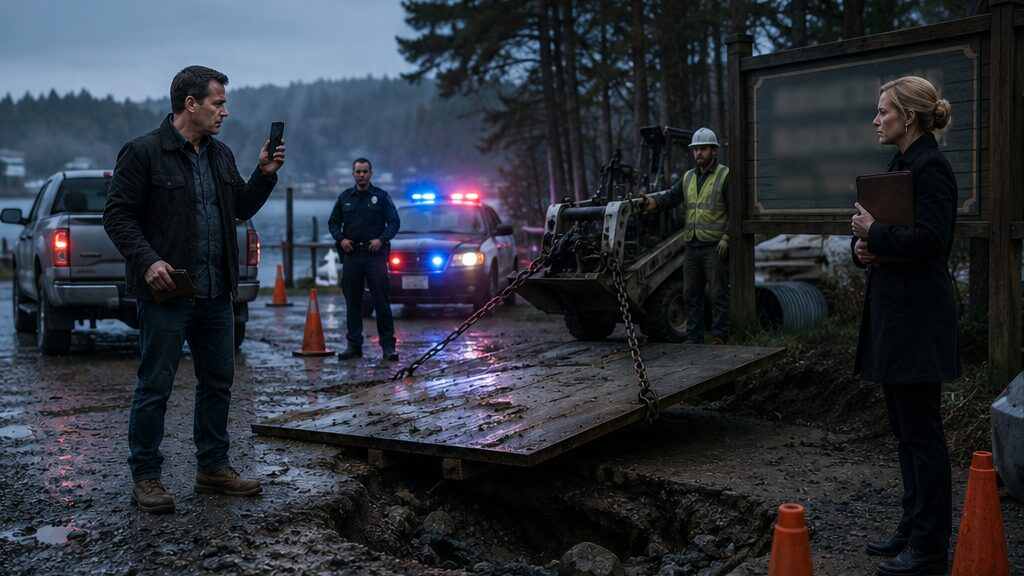
The machine had its chain hooked under the first steel road plate before Stephen Hall got his truck door open.
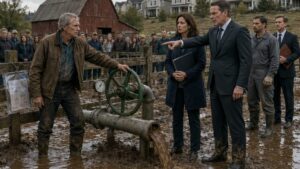
The plate screamed against gravel as the operator lifted too fast, one corner jerking up from the rutted access road like a tooth being pulled. Orange hazard cones leaned in the mud. The machine’s engine coughed and idled beneath the wooden Willow Bend HOA sign, where a painted heron looked out over the private road as if nothing ugly ever happened there.
Behind the crew truck, blue and red lights flashed against the pines.
Stephen stepped down from his pickup and stopped at the edge of the torn gravel.
“Put it down,” he said.
The worker nearest the chain looked at him, then looked past him.
Barbara Scott stood beside the HOA sign with a brown binder clutched to her chest. Her blond hair was pinned neatly back, her boots clean except for one careful line of mud near the sole. She did not look surprised to see him. That was the first thing that made Stephen’s stomach tighten. Not the machine, not the lights, not even the plate hanging crooked over the road he had paid Raymond Lee to stabilize two days earlier.
Barbara had expected him.
“Mr. Hall,” she said. “Please stay clear of the equipment.”
“That equipment is on my access road.”
“It is on association-maintained common access,” Barbara said, opening the binder as if the answer had already been laminated inside. “And the alteration was not approved.”
Stephen looked at the road plate. Beneath it, the gravel Raymond had packed in was already split open, a wet dark line showing where the culvert had been sinking since the last storm. Without the plate, the road narrowed to a crumbling strip barely wide enough for his pickup. Without the plate, the oxygen delivery truck would not risk the grade.
He did not say that. Not yet.
A sheriff’s deputy stood near the cruiser, one hand resting on his belt, watching without interfering. Stephen took his phone from his jacket pocket and began recording.
Barbara’s eyes went to the screen. “You can record if you want. The board has documented this process.”
“You sent a crew before the hearing.”
“We sent a crew after notice.”
“What notice?”
Barbara turned one page in the binder. “Violation notice was posted yesterday afternoon.”
“I was home all day.”
“It was placed at the front entrance.”
Stephen stared at her. “The front entrance is blocked by the road you’re tearing up.”
The machine idled louder. A worker shifted his gloves and stepped away from the suspended plate. The deputy’s gaze moved from Barbara to Stephen and then to the chain, as if the metal might answer for everyone.
Barbara closed the binder halfway. “The temporary plates, added gravel, and culvert work were installed without written architectural approval. They alter drainage across association property. They present liability exposure to Willow Bend.”
“They keep the road passable.”
“That is your characterization.”
Stephen felt the old pressure rise in him, the kind that tightened his jaw before it reached his voice. He had spent years learning not to explain Carol to people who heard “medical” and saw only paperwork, pity, or cost. His mother had made him promise not to turn her life into a public notice.
So he did what he always did. He narrowed the truth.
“The county authorized emergency access stabilization,” he said.
Barbara’s mouth moved slightly, not quite a smile. “The HOA has no record of approving this work.”
“The county does.”
“County permission does not override association rules.”
“It overrides you tearing it out before anyone verifies it.”
Barbara looked toward the deputy. “We requested presence only because Mr. Hall has previously refused access.”
Stephen turned sharply. “I refused a board member walking onto my property at seven in the morning with a camera pointed at my windows.”
“You refused inspection of an unauthorized modification.”
The word modification hit him wrong. It made the road plate sound like a fountain, a deck, a paint color. It made Raymond’s gravel and the exposed culvert and the delivery truck’s turning radius disappear beneath one neat administrative word.
The plate swung a few inches. Its edge shed clumps of mud.
Stephen walked toward it.
The deputy stepped forward. “Sir, don’t get under that.”
Stephen stopped three feet from the suspended metal. He held his phone steady in one hand and raised the other, palm out toward the operator.
“No more work until I see the order.”
Barbara’s posture stiffened. “The board’s enforcement authorization is in this binder.”
“I want it shown on camera.”
“That is not necessary.”
“It is if you’re taking my materials.”
The crew supervisor glanced at Barbara. She gave him the smallest nod, and he reached into the cab for a clipboard. Stephen saw the move and felt something cold settle into place. They had brought forms for removal, not for discussion.
He lowered his phone just long enough to pull his wallet from his back pocket. The small card was tucked behind his license, laminated because Carol had once spilled tea near the kitchen table and ruined three different appointment papers in the same week. He had thought laminating it was excessive. Now his thumb shook against the edge.
Barbara saw the card before she read it.
“Mr. Hall—”
Stephen held it out.
The deputy came closer. His face changed first. Not enough for the workers to see, maybe not enough for Barbara to admit, but Stephen saw it. The deputy took the card, read the county seal, then read the line beneath it.
Emergency access authorization. Temporary stabilization permitted pending inspection.
Barbara reached for it. The deputy did not hand it to her right away.
“This is current?” the deputy asked.
“Issued three days ago,” Stephen said. “After the culvert dropped another four inches.”
Barbara’s expression did not collapse. She was too disciplined for that. But the confidence thinned around her eyes.
“This authorizes temporary emergency access,” she said after the deputy finally let her see it. “It does not authorize permanent changes, drainage alteration, or construction on common property.”
“It authorizes that plate staying where it was until inspection.”
The deputy looked toward the suspended plate. “Ma’am, I think you need to set that down for now.”
Barbara drew in a measured breath. “Deputy, the HOA has a duty to prevent unapproved work from creating further damage.”
“And if that plate is part of emergency access, you don’t want to be the one who removed it before the county looks at it.”
The operator lowered the plate slowly. It hit gravel with a flat, heavy sound that Stephen felt through the soles of his boots. Not restored. Not safe. Just down.
For the first time that morning, the road was quiet enough for the lake to be heard through the trees.
Barbara slipped the card back toward Stephen, careful not to touch his fingers. “This pauses removal until the board clarifies jurisdiction. It does not resolve the violation.”
“No,” Stephen said. “It stops you from pretending there isn’t a reason.”
Her face tightened. “Reasons belong in applications, Mr. Hall.”
He almost said it then. My mother can’t get out if you cut this road. The oxygen truck can’t get in. The nurse has to park halfway up the hill and walk supplies down like we live at the bottom of a washed-out trail.
But the deputy was watching. The crew was watching. Barbara was watching with that binder open like a courtroom door.
Carol’s voice rose in his memory, dry and stubborn at the kitchen table: Don’t make me the neighborhood project.
So Stephen put the card back in his wallet. “Then schedule the hearing.”
Barbara nodded once. “Emergency session this afternoon. Clubhouse. Three o’clock.”
“And no work before then.”
“No work,” Barbara said, then added, “unless the board determines the authorization is insufficient.”
The deputy’s eyes flicked to Stephen, not unkindly, but not promising anything either.
Stephen walked back to his truck as the crew began unhooking the chain. He kept his steps even. He did not look toward his house, hidden beyond the curve and the pines, because if he did, he knew Barbara would follow his gaze and start calculating what he had not said.
His phone buzzed before he reached the driver’s door.
The text was from the home-health nurse.
Oxygen delivery driver called. Turned back at gate. Says road blocked by HOA crew. Carol has one full tank and one partial. What happened?
Chapter 2: The Binder Said Violation, Not Mother
Barbara Scott placed the violation notice on the clubhouse table before Stephen had pulled out his chair.
The paper slid across the polished wood and stopped beside the folded county card he had set down in front of him. One document looked official enough to stop a machine for an hour. The other looked official enough to start it again.
Stephen remained standing.
Outside the long windows, the lake lay bright and indifferent, dotted with private docks and covered boats. The Willow Bend clubhouse had been built to make residents feel they had bought peace. Stone fireplace, framed community maps, coffee urn in the corner, rules printed in tasteful font near the entrance. Stephen had never hated a room so quickly.
Jonathan Wright sat at the head of the table in a navy jacket, hands folded over a legal pad. Barbara took the seat to his right with her binder. Anna Johnson, the HOA secretary, sat two chairs down with a laptop open and a worried crease between her brows.
“Mr. Hall,” Jonathan said, “this is an emergency compliance meeting, not a trial.”
“Then why did you bring a violation notice before hearing me?”
Jonathan did not look at the paper. “Because the violation exists regardless of your explanation. We’re here to determine remedy and timing.”
Stephen sat slowly. His phone was on the table, recording with the screen facing up. No one told him to turn it off.
Barbara opened her binder. “On Thursday morning, unapproved steel plates, gravel fill, and excavation appeared on the lower access road leading to the Hall property. The alteration affects drainage and creates potential liability for the association.”
“Appeared?” Stephen said. “You mean after I hired a licensed contractor because the road dropped after the storm.”
“You did not receive approval.”
“I submitted the request four weeks ago.”
Anna looked up from her laptop.
Barbara turned a page. “The architectural request on file is incomplete. It mentions ‘minor access stabilization.’ It does not request steel plates, culvert work, gravel fill, or equipment access.”
Stephen leaned forward. “That’s not true.”
Barbara slid a copy across the table. Stephen recognized his own handwriting on the first page. The date. The lot number. The line where he had written temporary stabilization of lower access until drainage review. But the second page was missing. The page where Raymond had sketched the plate placement. The page where Stephen had attached the county road-safety complaint number.
He flipped the copy over. Blank.
“There was another page.”
Barbara’s expression stayed controlled. “Not in the submitted file.”
“I handed it to the office.”
“To whom?”
Stephen opened his mouth, then stopped. He had dropped the envelope through the clubhouse slot after hours because Carol’s appointment had run late and he did not want another conversation with anyone at the desk. He remembered the thump of the envelope landing inside. He remembered thinking that was enough.
Jonathan noticed the pause.
“So no staff member received it from you directly.”
“I used your drop slot.”
“Then we can only review what entered the file.”
Anna’s fingers slowed on the keyboard. “Barbara, the scan jumps from page one to the photo receipt. There’s no page two marker.”
Barbara did not turn toward her. “Because there was no page two.”
Anna’s mouth tightened, but she said nothing else.
Stephen felt the room tilt toward procedure. He had the card. He had memory. He had a road sinking toward a ditch and a mother at home counting oxygen tanks. But the binder had absence, and absence wore a suit better than desperation did.
Jonathan tapped his pen once. “Let’s be clear. Even if a second page existed, the board did not approve the installation.”
“The county authorized emergency access.”
“For temporary stabilization pending inspection,” Barbara said. “Not for permanent modification of association drainage.”
“It is not permanent.”
“It is steel plate and fill over a shared culvert.”
“It is the only thing keeping vehicles from dropping a tire into a washout.”
Jonathan leaned back. “And if your work redirects runoff into the lake? If it worsens erosion? If a delivery truck crosses your plate and the plate shifts? This association carries the liability.”
Stephen glanced at Anna. She was looking at the violation notice now, not at him.
Barbara opened a plastic sleeve in the binder and removed photographs. She spread them across the table with careful fingers. Muddy water running along the road edge. Gravel slumped into a ditch. A brown plume near the lakeshore after the storm.
“These were taken yesterday,” she said. “After your contractor’s work.”
Stephen picked up one photo. The angle was tight enough to hide the collapsed culvert mouth. Tight enough to make the gravel look like the cause instead of a bandage.
“That runoff existed before Thursday.”
“Do you have dated photographs?”
He did. Somewhere. Maybe. His phone was full of pictures of the ditch, the road, Carol’s pill bottles, tank gauges, appointment reminders. He had documented pieces, not a case. He had thought sane people would look at the road and understand.
Jonathan wrote something on his pad. “Removal remains scheduled unless county inspection changes the legal status.”
“You already tried to remove it.”
“And paused,” Jonathan said. “The board will allow twenty-four hours for documentation. After that, the crew may resume.”
Stephen looked at the card beside the violation notice. That morning, under the flashing lights, it had felt like a shield. On the clubhouse table, it looked smaller.
“My mother lives at the end of that road,” he said before he could stop himself.
Barbara’s face shifted, just slightly. Anna looked up.
Jonathan waited.
Stephen heard Carol again. Don’t make me the neighborhood project.
“She has deliveries,” he finished. “Medical supplies. Regular access.”
Barbara folded her hands. “Mr. Hall, no one is denying access to your home. We are addressing an unapproved alteration.”
“You blocked the oxygen truck this morning.”
Jonathan’s pen stopped.
Barbara turned to the crew log in her binder. “The road was temporarily closed for enforcement activity.”
“That sounds cleaner than what happened.”
Jonathan’s voice lowered. “We cannot evaluate medical claims that were not included in the application.”
Stephen’s jaw tightened because Jonathan was right in the one place Stephen had made him right. He had written access. He had written stabilization. He had not written oxygen-dependent mother. Not in the application. Not in any email. Not where Barbara could print it and quote it back to him.
Anna clicked something on her laptop. “There may be an archived maintenance map for that lower road.”
Barbara looked at her. “Not relevant to this emergency violation.”
“It might be relevant if the culvert was association-maintained.”
Jonathan’s head turned. “Anna.”
She sat back, color rising in her face. “I’m only saying the file looks incomplete both ways.”
The room went still.
For one second, Stephen saw Barbara not as a woman with a binder but as someone trying to keep a shelf from collapsing while everyone argued about the dust. Then she closed the plastic sleeve and restored the photos to order.
“The board will issue a temporary determination,” Jonathan said. “The plates may remain until county inspection, not later than forty-eight hours, unless written approval is obtained. All additional work is stopped. If the road is not restored to prior condition after the inspection period, daily fines begin immediately.”
“How much?”
Jonathan met his eyes. “Two hundred dollars per day.”
Stephen almost laughed. Not because it was funny, but because the number was so precise it pretended to be reasonable.
Barbara pushed the violation notice closer. “You may appeal in writing.”
Stephen looked down at the paper. The word unauthorized appeared three times before the first paragraph ended.
He gathered the county card, the incomplete copy, and the photos she had allowed him to keep. At the door, Anna spoke without looking up from her laptop.
“Mr. Hall,” she said quietly, “if you have anything showing that second page existed, find it before the inspection.”
Stephen turned.
Barbara was watching both of them now.
Jonathan capped his pen. “And Mr. Hall?”
Stephen waited.
“If the road is not returned to its original condition after the inspection, the fine starts Monday morning.”
Chapter 3: The Road Failed Before Stephen Touched It
The oxygen truck’s tire tracks ended twenty yards before the first steel plate.
Stephen found them in the mud just after sunrise, two wide black arcs where the driver had backed carefully away from the narrowing road. The tracks stopped beside the HOA cone Barbara’s crew had left behind, its orange plastic bright against the wet gravel. Beyond it, the plate sat crooked from yesterday’s lifting, one edge no longer seated flat. A gap had opened beneath it overnight.
He crouched and slid his fingers under the raised edge.
Water moved below.
Not a trickle. A steady hidden run, chewing soil from beneath the road.
“Don’t put your hand there,” Raymond Lee called.
Stephen stood as Raymond came down from his work truck carrying a pry bar and a level. He wore the same mud-stained work pants as Thursday, but his face looked different now, guarded. A contractor who had been hired to fix a road did not want to become the reason an HOA sent letters to every house in Willow Bend.
Raymond set the level on the plate and watched the bubble slide hard to one side.
“That moved since I left.”
“The crew lifted it.”
Raymond muttered something under his breath and walked to the ditch. He planted the pry bar near the culvert mouth, pressed down once, and the bank crumbled in a wet chunk.
Stephen felt the sound in his teeth.
“It’s undermined,” Raymond said. “Not just soft. Hollowing out.”
“How long?”
“Longer than two days.”
Stephen looked toward the bend where the HOA sign stood out of sight behind pines. “Can you write that down?”
“I can write what I see. I can’t say whose fault it is.”
“I’m not asking you to.”
Raymond gave him a look that said he did not believe that. “Stephen, I have three other jobs in this community. If the board decides I’m the guy who does unapproved work, I’m done here.”
“The county card covered emergency stabilization.”
“The card covered you. Not necessarily me.”
That landed harder than Stephen expected. He had dragged Raymond into the middle of something with a laminated card and a promise that it would be simple. Temporary plate. Gravel. Keep the access open until inspection. No drama.
He looked at the plate. Its steel surface bore a fresh scrape from the machine chain.
“I should’ve waited for written HOA approval,” Stephen said.
Raymond snorted. “Road might not have waited with you.”
Before Stephen could answer, the front door opened at the house above them.
Carol Hall stood on the porch in her robe, one hand on the rail, the clear oxygen line curving from her nose to the tank inside the doorway. She should not have been outside in the morning damp. She knew it. Stephen knew she knew it.
“Mom,” he called, already moving.
“I’m not walking down there,” Carol said. “I’m looking.”
“That’s not better.”
“It is from my perspective.”
Her voice was steady, but she gripped the rail too tightly. Stephen climbed halfway up the slope and stopped where he could see the pale exhaustion under her stubborn expression.
“The delivery didn’t come,” she said.
“I know. I’m calling them again.”
“They said the driver won’t cross until the road is cleared.”
“It will be.”
Carol looked past him toward Raymond. “Is it worse?”
Raymond pretended to examine the ditch.
Stephen said, “We’re checking.”
“Don’t do that.”
“Do what?”
“Use the voice you used when your father’s test results came late.”
Stephen looked away first.
Carol’s expression softened, then sharpened again as if softness annoyed her. “I went to the mailbox yesterday.”
His head came up. “You what?”
“Before all this.” She nodded toward the plate. “After that first storm. I wanted the electric bill before it got soaked.”
“You’re not supposed to walk down this grade alone.”
“I know what I’m supposed to do.”
“Mom.”
“The edge gave way under my cane.” She said it plainly, almost impatiently. “I caught myself on the cedar post. Tore the sleeve of my blue sweater. I didn’t tell you because I knew you’d turn the whole thing into a safety lecture.”
Stephen felt heat rise under his collar, anger looking for a place to land and finding only fear.
“That was before Raymond put the plates in?”
“Yes.”
He turned toward the road. Before. Before the gravel. Before the steel. Before Barbara’s photos.
Raymond had heard. He was looking at the ditch now with less caution and more certainty.
Carol added, “Don’t you dare tell the whole board I fell.”
“I may not have that choice anymore.”
Her mouth tightened. “Stephen.”
“They’re fining us Monday unless I prove this wasn’t just me messing with the road.”
“Then prove the road.”
He heard what she did not say. Not me.
Raymond called from the far side of the ditch. “You need to see this.”
Stephen hesitated until Carol flicked two fingers at him, a queen dismissing a guard. He went back down.
Raymond had pushed through wet brush beyond the culvert outlet, where runoff cut a brown path toward the lake. He pointed with the pry bar to two short wooden stakes half-buried near the slope. Faded orange paint clung to their tops.
“Survey markers?” Stephen asked.
“Old drainage markers, maybe. Not mine.”
Raymond cleared leaves with his boot. A third marker lay flat beneath pine needles. Its side had been stamped before the wood weathered gray. Stephen crouched and brushed mud away with his thumb.
W.B.H.O.A.
The letters were shallow but readable.
Raymond whistled softly. “That’s not your initials.”
Stephen stared at the marker.
For weeks, the board had spoken as if the road became Stephen’s problem the moment it led mostly to his house. Barbara’s binder had made the culvert sound like something he had disturbed. Jonathan’s fine had made “original condition” sound like a clean legal line.
But the old marker sat beyond his property edge, at the outlet of a drainage path someone had once measured, marked, and claimed.
Stephen took a photo. Then another. Then he stepped back far enough to capture the collapsed culvert, the steel plate, the runoff line, and the buried marker in one frame.
Raymond watched him. “If that’s part of an old HOA drainage plan, they’re going to wish they hadn’t tried to yank those plates out before inspection.”
Stephen looked toward the house. Carol was still on the porch, small against the doorway, pretending she did not need the rail.
His phone buzzed with a new email from the HOA office. The subject line read: Reminder of Pending Enforcement and Restoration Requirement.
Stephen locked the screen without opening it.
Raymond tapped the stamped marker with the pry bar.
“Question is,” he said, “who knew this was here?”
Chapter 4: The Permit Proved Less Than Everyone Wanted
Barbara Scott arrived before the county inspector and taped a fresh stop-work notice to Stephen’s temporary road plate.
She pressed the corners flat with two fingers as if she were sealing a box.
Stephen stood ten feet away with the old stamped marker wrapped in a towel in the bed of his pickup, his phone already recording. The new notice was printed on heavier paper than the first one. Bold letters across the top. Association Enforcement Action. Beneath it, the same word again: unauthorized.
Raymond Lee stood beside the culvert with his hands in his jacket pockets, saying nothing. His truck was parked uphill, facing out, as if he had decided before arriving that he might need to leave quickly.
“You’re early,” Stephen said.
Barbara smoothed the notice once more. “The county inspection concerns public access safety. It does not prevent the association from preserving its position.”
“Preserving your position means taping paper to a road plate?”
“It means making clear this remains disputed.”
“Everything is disputed with you.”
Her eyes moved to the phone in his hand. “No. Some things are documented.”
A white county vehicle rolled around the bend before Stephen could answer. Gravel snapped under its tires. The inspector stepped out carrying a tablet and wearing boots that already looked familiar with ditches. He glanced first at the HOA sign, then at the cones, then at the steel plate with the fresh notice taped across it.
“Which one of you is Stephen Hall?”
Stephen raised a hand.
“And association representative?”
Barbara stepped forward. “Barbara Scott, compliance chair.”
The inspector nodded without warmth. “I’m here for temporary emergency access authorization review. Not a full civil determination, not an HOA appeal, not a drainage redesign. Everybody understand that?”
Barbara said, “Yes.”
Stephen said nothing.
The inspector looked at him.
Stephen forced the word out. “Understood.”
It felt like losing before starting.
He handed over the laminated county card. The inspector scanned the number into his tablet, then walked the plate line slowly. He tapped the steel with his boot, crouched near the raised edge, and leaned over the washout. Water whispered under the road, hidden and constant. Raymond came closer when asked, explaining the gravel pack, the plate placement, the observed settlement, and the condition before the crew lifted the first plate.
Barbara waited until Raymond mentioned “temporary stabilization,” then opened her binder.
“The association’s concern is that the resident performed work on shared access without architectural approval, and may have altered runoff toward the lake.”
The inspector did not look up. “I heard you the first time.”
Stephen almost smiled, then stopped himself. The inspector’s tone was not friendship. It was boundary.
The man walked beyond the culvert outlet, where Stephen had found the old marker. Stephen brought it from the truck and unwrapped it.
“This was in the drainage line,” Stephen said. “Stamped with the HOA initials.”
Barbara’s head turned sharply. “That is not verified.”
The inspector took it, looked at the faded letters, then handed it back. “Interesting. Not my determination today.”
Stephen stared at him. “But it shows—”
“It shows there may be old infrastructure records worth reviewing. Today I’m determining whether the temporary access authorization was valid and whether removal creates immediate access risk.”
Barbara’s shoulders eased at the limitation.
Stephen saw it and hated that he had learned to read her relief.
The inspector took photos. He measured the drop beside the plate. He asked Raymond to stand clear while he probed the exposed edge with a rod. The rod went farther down than Stephen expected. When the inspector pulled it out, wet sand clung halfway up the shaft.
“This road should not carry heavy traffic without stabilization,” he said.
Stephen breathed for the first time in several minutes.
Barbara’s pen stopped moving.
The inspector pointed toward the plate. “The temporary plate placement is consistent with emergency access stabilization. The county authorization is valid.”
Stephen looked at Barbara.
She did not meet his eyes.
“However,” the inspector continued, and the word cut the morning cleanly in two, “the authorization does not approve permanent culvert replacement, permanent grading, drainage rerouting, or ownership responsibilities. It does not decide whether the HOA can enforce its architectural rules. It says the access should remain temporarily stabilized pending proper review.”
Barbara looked back up. “So the association retains authority over permanent conditions.”
“Over whatever your documents legally give you authority over,” he said. “That’s not my lane.”
Stephen’s hand tightened around the old marker. “Can they remove the plates Monday?”
The inspector paused long enough that the answer arrived before the words.
“I would not recommend removing stabilization while this edge remains undermined,” he said. “I’ll write that. But I cannot issue a permanent injunction against a private association.”
Barbara closed her binder gently. “A recommendation is not an order.”
The inspector looked at her. “Neither is common sense, apparently, but most people still find use for it.”
Raymond coughed once into his fist.
Barbara’s face colored, but she did not rise to it. “We will review the written report when issued.”
The inspector returned to his vehicle and printed a single-page field note from a portable printer. Stephen watched the paper emerge inch by inch, ridiculous and precious. The inspector clipped Stephen’s laminated card number to the report, noted temporary access risk, and signed the bottom.
Stephen held the page like something that might evaporate.
“There,” Raymond said quietly. “That’s something.”
It was. But not enough.
Barbara read her copy in silence. When she finished, she removed the stop-work notice from the plate, folded it once, and placed it in her binder instead of throwing it away.
“Emergency session Monday morning,” she said.
Stephen’s head came up. “You said the board had forty-eight hours.”
“And the inspector has now clarified that your permit is temporary and limited. The board will determine the association’s next step.”
“The next step is leaving the plate in place.”
“The next step,” Barbara said, “is determining how to restore compliance without increasing risk.”
“You mean remove it in a way you can defend.”
“I mean the association will not accept open-ended unauthorized work because you have a county card.”
The card was in Stephen’s hand, still warm from his palm. That morning he had expected the county inspector to draw a clean line across the dispute. Valid. Invalid. Stop. Go. Instead, the line ran through the middle of everything.
The inspector had given him truth with no teeth.
Raymond packed his level into the truck. “I’ll write a statement tonight. What I observed, what I installed, what happens if it’s removed.”
“Will you come to the meeting?”
Raymond looked toward Barbara.
She was pretending not to listen.
“I’ll think about it,” he said.
That meant no, or not unless he had no choice.
Stephen folded the field note and put it behind the laminated card in his wallet. His phone buzzed with a message from the HOA office before Barbara had reached her car.
Special meeting notice: Monday, 8:00 a.m. Agenda item: Lower Access Road Restoration and Enforcement Continuation.
A second message followed from Jonathan Wright himself.
Crew remains on standby pending board determination. Removal may resume Monday morning if compliance path is not approved.
Stephen looked down the road toward his house. The plate sat flat for now, the stop-work tape gone, the scrape from the machine chain still raw across the steel.
For the first time since the crew arrived, he understood that proof could be real and still not be enough to stop Monday.
Chapter 5: Barbara’s Rule Had a Price Too
Stephen found Barbara photographing the culvert like she was building a case against a body.
It was Saturday morning, and she stood below the road in a pair of dark rubber boots, one hand holding back cedar branches while the other aimed her phone at the muddy outlet. She had not brought the binder this time, but Stephen could see a folder tucked under her arm in a plastic sleeve.
“You’re on my side of the access,” he said.
She did not startle. “I’m on association drainage easement.”
“That depends on which file you read.”
Barbara lowered the phone. “Do you want a fight, Mr. Hall, or do you want a solution?”
Stephen stopped at the edge of the ditch. He had come down to take more photos before Monday, expecting to be alone with mud and water. Seeing her there, knees bent, boots sinking into the same ground Raymond had warned him about, unsettled him more than the binder ever had.
“I want the road left open.”
“That is not a solution by itself.”
“It is if you need to use it.”
Her mouth tightened. She looked back at the culvert. “This outlet is undercutting the bank.”
“I know.”
“If water keeps pushing this way, it can carry sediment into the lake.”
“I know that too.”
She faced him fully then. “Do you? Because once the lakefront erosion report gets triggered, everyone on this road pays. Not just you. Not just the board. Every house in Willow Bend gets assessed for remediation, and half of them will claim they had no warning.”
Stephen heard something in her voice that was not accusation. Fear, maybe. Not fear of him. Fear of numbers, letters, insurance language, people opening envelopes at kitchen counters and calling her name like she had personally emptied their checking accounts.
Barbara pulled a photograph from the plastic sleeve. It showed the same muddy plume she had brought to the meeting, but the wider angle showed three lakefront lots and a row of old retaining stones already slumping out of line.
“This came from the insurer’s site review,” she said. “Not from me.”
Stephen took the photo because refusing it would have been childish. “When?”
“Two months ago.”
“You had a drainage warning two months ago?”
“The board had a preliminary risk notice.”
“And nobody told the people on this road?”
“It was not final.”
“Barbara.”
Her name came out sharper than he intended. She looked at him, and for the first time, the careful official mask cracked enough to reveal irritation that had been living there longer than this week.
“Do you know what happens when a board announces a preliminary risk?” she said. “People panic. They demand immediate work, then refuse the assessment. They accuse us of hiding costs, then accuse us of lowering property values by admitting problems. They want the road fixed, the lake protected, the dues unchanged, and the minutes written so nobody can sue them later.”
“That doesn’t give you the right to tear up my access.”
“No,” she said. “It gives me the responsibility to stop unapproved work from making a bad situation worse.”
Stephen looked at the water moving beneath the road, patient as a saw. He hated that she had a point. Not the point she thought she had, but a point nonetheless. A wrong plate in a wrong place could shift runoff. A rushed repair could fail. A contractor doing one resident’s job could complicate a shared system.
But his mother did not have the luxury of shared systems moving at board speed.
“Raymond says the culvert was failing before I touched it,” he said.
“Raymond is your contractor.”
“He’s also the only person who looked under the plate before writing me a violation.”
Barbara glanced up the hill toward Stephen’s house. He saw the question cross her face and harden before it became sympathy.
“You mentioned medical deliveries,” she said.
“I did.”
“But you did not submit a medical accommodation request.”
Stephen laughed once, without humor. “Because I was asking to keep a road from collapsing.”
“You were asking for an exception.”
“I was asking for access.”
“Exceptions require documentation.”
“There it is.”
“What?”
“The sentence that makes people stop telling you the truth.”
Barbara’s face changed. Not softened. Changed. The words had hit somewhere she did not want to show.
Stephen should have stopped. Instead, the pressure of the week pushed him one step farther.
“Do you know why people hate boards like yours? Because by the time someone tells you what they need, they’ve already had to translate their life into forms you can reject.”
Barbara put the photo back into the sleeve with careful precision. “And do you know why boards become strict? Because residents do work first, explain later, and leave everyone else paying when it fails.”
They stood with the ditch between them.
The water kept moving.
Stephen looked at her boots, wet to the ankle. “If you believe the drainage is dangerous, why remove the plates before the permanent plan?”
“Because leaving unapproved materials in place suggests the board accepts them.”
“So this is about liability.”
“Yes.”
“Not safety.”
Her eyes flashed. “Liability is safety when you’re responsible for thirty-eight homes.”
“My mother is one person.”
“And I am responsible to more than one person.”
There it was, not cruelty exactly, but arithmetic. Thirty-eight homes on one side. Carol’s oxygen tanks on the other. The board had chosen the larger number because paper made it easier.
Stephen’s phone buzzed. A message from Anna Johnson appeared.
Can you meet at clubhouse side office at 5? Not official. Don’t tell Barbara I asked yet.
Stephen looked up.
Barbara had seen the buzz, not the message. Her gaze narrowed.
“More documentation?” she asked.
“Maybe.”
She took one step up from the ditch, then stopped. “Mr. Hall, if you have something older than the current file, bring it Monday. But understand this. If the board acknowledges that culvert as an association responsibility without an engineered plan in place, the insurer may require immediate action.”
“Good.”
“No,” she said, and now the fear was back. “Immediate action means emergency assessment, road closure, and possibly no access until the work is certified. You think I am trying to trap you. I am trying to keep this from becoming bigger than one plate.”
“It already is bigger than one plate.”
Barbara looked toward the house again. For a moment, Stephen thought she might ask the question plainly. Who is up there? How serious is it? What are you not saying?
Instead she picked up her folder.
“Then bring proof,” she said. “All of it.”
She walked past him toward her car, leaving a line of boot prints along the wet edge.
At five that afternoon, Stephen went to the clubhouse side office and found Anna waiting with the lights off except for one desk lamp. She had a key in her hand and the expression of someone already regretting her courage.
“The digital records only go back twelve years,” she said before he could speak. “But Willow Bend is older than that.”
Stephen stepped inside.
Anna closed the door behind him. “If there’s an original road file, it won’t be on the server. It’ll be in somebody’s paper copy, a closing packet, or an old board archive nobody wanted to scan.”
“Where?”
Anna looked toward the dark hallway, then lowered her voice.
“Start with your mother,” she said. “If she kept her original homeowner packet, it may have pages the HOA doesn’t.”
Chapter 6: The Missing Page Waited in Carol’s Drawer
Carol recognized the stamped marker before Stephen finished unwrapping it.
“That was down by the old drainage cut,” she said from the kitchen table, her oxygen tube shifting slightly as she leaned forward. “Your father complained about those stakes the first year we moved in.”
Stephen froze with the towel still half-folded around the muddy wood.
“You knew about this?”
“I knew there were markers.” Carol reached for her tea, missed the handle by an inch, and pretended she had meant to adjust the saucer. “I didn’t know one was still there.”
It was Sunday evening. The kitchen smelled faintly of lemon cleaner and the soup Stephen had reheated badly. On the table lay everything he had gathered: the county card, the inspector’s field note, Raymond’s written statement, photos of the washout, Barbara’s violation notice, and the old marker with W.B.H.O.A. stamped into its side like a message from a less careful time.
Stephen pulled out the chair across from her. “Anna said you might have the original homeowner packet.”
Carol’s eyes narrowed. “Anna Johnson told you that?”
“She said older records may not be digital.”
“Anna was a teenager when we moved here.”
“She’s the only person on that board who noticed a missing page.”
Carol looked toward the window, where the dark shape of the road disappeared into pine shadows. “Your father kept everything.”
“Where?”
She took too long to answer.
“Mom.”
“In the lower drawer of the dining room cabinet. Unless I threw it out.”
Stephen stood.
“I said unless.”
“You didn’t throw out Dad’s documents.”
“That is an accusation disguised as confidence.”
“It’s experience.”
The dining room cabinet had one drawer that always stuck in humid weather. Stephen pulled it open and found the familiar archaeology of Carol Hall’s life: appliance manuals, old property tax notices, a folder of warranties for things no longer in the house, his father’s handwriting on envelopes marked Keep, Check, and No Idea But Important.
At the back was a faded blue packet with a drawing of Willow Bend Lake on the cover. The paper had yellowed at the edges. Stephen carried it to the kitchen table with both hands.
Carol did not touch it.
He opened the packet. Original welcome letter. Community standards. Boat slip rules. Tree removal policy. Road maintenance schedule. A map folded into thirds.
Stephen spread the map between the tea and the county card.
Carol placed one finger on the lower access road before he found it himself. Her nail rested near a thin blue line drawn beside the gravel curve.
“Emergency and service access,” Stephen read.
His voice sounded strange in the room.
Beneath the label, smaller print listed three features: lower road culvert, drainage outlet, emergency vehicle turn radius. A notation at the bottom said maintained by association reserve schedule.
Stephen read it twice because the first time did not feel real.
Carol watched him. “Your father asked about that after the first big rain. They told him the association handled the culvert because the drainage served more than our lot.”
“Did he get that in writing?”
She tapped the packet. “That was writing back then.”
Stephen laughed under his breath, but it broke halfway.
He took photos of the map. Then he turned pages until he found a maintenance table. Culvert inspection every three years. Lower access grading after major washout. Reserve category: private road and drainage.
He laid Barbara’s violation notice beside it. Unauthorized alteration. Restore to prior condition.
“What prior condition?” he said. “Neglected?”
Carol’s expression remained guarded. “Don’t get righteous too quickly. It makes you sloppy.”
He looked at her.
“That’s what your father used to say when you argued with the cable company.”
“This isn’t cable.”
“No. This is my home.”
The room tightened around those words.
Stephen lowered himself into the chair again. “Then let me tell them why it matters.”
Carol looked down at the map.
“Not just the road,” he said. “You. The oxygen. The delivery. The fall.”
Her hand withdrew from the paper. “No.”
“Mom.”
“I said no.”
“They’re going to send the crew back tomorrow.”
“You have the map.”
“They’ll say it’s old. They’ll say the permit is temporary. They’ll say I didn’t document the need.”
“Then document the road.”
“I tried that.”
Carol pushed her tea aside with a small scrape. “I am not going into that clubhouse so neighbors can look at me and decide whether I’m sick enough to deserve a driveway.”
“It’s not a driveway.”
“You know what I mean.”
“Yes,” Stephen said. “I do. That’s the problem.”
She looked at him then, truly looked, and he saw the anger beneath her pride had fear under it. Not fear of dying. Carol had faced too many hospital rooms to pretend death was an abstraction. This was something smaller and sharper: fear of being reduced before she was gone. Fear that the woman who had hosted lake cleanups and corrected newsletters and remembered everyone’s children would become the reason people whispered about access accommodations and assessments.
“I asked you not to tell them,” she said.
“I know.”
“And you promised.”
“I promised I wouldn’t make you the neighborhood project.”
“That sounds like the same promise.”
“It isn’t if staying silent means they cut off the road.”
Her mouth trembled once, then steadied. “Your father carried me over that washout once. Did you know that?”
Stephen shook his head.
“First year here. Before the association fixed the culvert. I twisted my ankle trying to cross after a rain, and he carried me up the road cursing every board member by title. Then he went to the meeting and made them fix it without mentioning my ankle once.”
“He had the packet.”
“He had a loud voice.”
Stephen looked at the oxygen tank beside the doorway. Its gauge sat lower than he wanted.
“I don’t have his voice,” he said.
“No,” Carol said. “You have his habit of thinking if you hold enough in, people will call it strength.”
That struck him silent.
She looked back at the map. “I didn’t want them to know because once people start making room for you, they also start measuring how much room you take.”
Stephen folded his hands on the table so she would not see them shaking. “And I didn’t tell them because I thought protecting your pride mattered more than showing them the stakes. I helped them misunderstand.”
Carol’s eyes filled, but she blinked it away like an insult.
For a while, neither of them moved. The refrigerator clicked on. Somewhere outside, tires passed slowly near the upper road, then faded.
Stephen gathered the map, the maintenance table, and the old marker into a neat stack. He photographed each page again, this time with Barbara’s violation notice in frame. Carol watched him without objecting.
When he finished, she pushed herself up from the table.
“Where are you going?”
“To the drawer.”
“You should sit.”
“I should have done this yesterday.”
She returned with a small envelope, worn soft at the corners. Inside was a photograph of Stephen’s father standing by the lower road years earlier, one boot on a fresh culvert pipe, one hand raised toward whoever held the camera. Behind him, a wooden stake with orange paint stood in the same place Stephen had found the marker.
On the back, in his father’s handwriting, were the words: HOA finally fixing lower access after washout.
Stephen held the photo carefully.
Carol touched the edge of it. “Use the road,” she said. “Use the map. Use that if you have to. But don’t let them turn me into the argument.”
Before Stephen could answer, light moved across the kitchen wall.
At first he thought it was a passing car. Then another beam crossed the ceiling, slower, lower, followed by the grind of a diesel engine down by the road.
Stephen went to the window.
Headlights burned between the pines at the lower access, where no crew was supposed to be until morning. A truck backed toward the steel plates, its warning lights blinking amber in the dark.
Behind him, Carol whispered, “They came earl
Chapter 7: They Tried to Finish Before Morning
Stephen reached the road as a worker slid the second steel plate toward the truck bed.
The plate scraped over gravel with a low metallic drag, throwing sparks where one corner caught a buried rock. Amber lights blinked on the crew truck. The machine idled beside the ditch, its arm raised and waiting. The Willow Bend HOA sign stood above all of it in the dark, the painted heron washed pale by headlights.
“Stop,” Stephen said.
No one stopped.
The worker kept pulling until Stephen stepped into the edge of the headlights and lifted his phone. The crew supervisor looked over from the tailgate, saw the camera, and raised one gloved hand.
“Hold up.”
The worker let the plate drop. It hit the road with a sound that made Stephen’s shoulders tighten.
Barbara Scott stood near the sign in a dark coat, her binder tucked against one hip. Jonathan Wright was beside her, phone to his ear, speaking quietly. A sheriff’s cruiser rolled in behind Stephen’s truck before Stephen had taken ten steps farther. Its lights stayed off at first. Then the deputy switched them on, and the pines flashed red and blue like they had two mornings ago.
“You said Monday morning,” Stephen called to Barbara.
“It is Monday morning,” Jonathan answered before she could.
“It’s not even five.”
“We scheduled early removal to minimize disruption,” he said.
“To avoid witnesses.”
Jonathan lowered his phone. “To avoid spectacle.”
Stephen felt the old anger climb again, but this time he did not let it find his feet. He stayed where the headlights caught him, between the crew and the broken road, but not close enough to touch the machine.
“I want the written order.”
Barbara opened the binder. “You were notified.”
“I want the order authorizing work before the meeting.”
Jonathan’s jaw tightened. “The meeting is for ratification of enforcement already approved.”
“Then show me the approval.”
The deputy stepped between them, not blocking Stephen, just narrowing the space. “Mr. Hall, don’t interfere with the crew.”
“I’m asking for paperwork.”
“And don’t step in front of equipment.”
Stephen looked at the plate on the truck bed, then at the open gap where the first one had been. The road beneath was darker than the surrounding gravel, wet and hollowed. If the second plate went, the truck carrying Carol’s oxygen would have nowhere to cross. Neither would an ambulance.
He pulled the old blue homeowner packet from under his arm and opened it on the hood of his pickup. His fingers were clumsy in the cold. The county card, the inspector’s note, Raymond’s statement, the photo of his father by the culvert, and the original Willow Bend map lay together under the harsh work lights.
Barbara’s face changed when she saw the packet.
Jonathan saw her see it.
“Where did you get that?” he asked.
“My mother kept her original documents.”
“That packet may be outdated.”
Stephen pressed his palm against the map so the early wind would not lift it. “Emergency and service access. Lower road culvert. Drainage outlet. Maintained by association reserve schedule.”
He read each phrase slowly, not loudly, into his phone.
Barbara looked toward the crew supervisor. “Do not proceed until we clarify.”
Jonathan turned on her. “Barbara.”
She kept her eyes on the paper. “We should not remove the plate while he is reading from an original maintenance document.”
“You don’t know that it’s operative.”
“I know it should be reviewed.”
Stephen looked at her then. For one second, she was not helping him. She was protecting the association from the kind of mistake even a binder could not clean up. But the result was the same: the machine stayed still.
The deputy came closer and looked at the map without touching it. “Is that the same culvert?”
Stephen handed him the photo of his father. “Same marker. Same road. Same stamped initials. Same drainage line.”
The crew supervisor shifted his weight. “We were told this was unapproved resident work.”
“It was emergency stabilization over an HOA-maintained access road,” Stephen said.
Jonathan snapped, “That has not been determined.”
“No,” Stephen said. “Because you tried to finish before anyone could determine it.”
Jonathan stepped toward him. “Be careful.”
Stephen’s phone stayed between them. “I am.”
That seemed to anger Jonathan more than shouting would have.
Another car came down the road, slower than the others. Anna Johnson parked behind the cruiser and got out wearing a sweatshirt under a coat, hair pulled back like she had dressed in a hurry. She carried a clipboard and looked at the half-loaded plate, then at Barbara.
“You started without me?”
Jonathan’s expression hardened. “This is enforcement action, not a board meeting.”
“I’m secretary. You asked me to sign the removal log.”
“After completion.”
Anna looked at the open gap in the road. “I’m not signing that.”
Barbara closed her eyes briefly.
Jonathan said, “Anna, this is not the time.”
“That’s exactly the problem.” Anna walked to Stephen’s pickup and looked at the map. Her mouth tightened. “This matches the old index.”
“What index?” Stephen asked.
“The archive list. Lower access and drainage, pre-digital. I found the box number, but not the box.”
Jonathan’s voice dropped. “You should not be discussing internal records in the road.”
“Then you shouldn’t be removing the road before reviewing them.”
The deputy held up one hand. “Everybody slow down.”
A worker near the truck muttered that he was paid by the hour. The machine engine rattled, steady and impatient.
Stephen looked at the steel plate half on the truck. The first time they lifted one, he had felt like he was trying to stop a machine with a card. Now he had more paper, more photos, more words. But the machine still had chains.
He took one step toward the plate.
The deputy moved immediately. “Mr. Hall.”
Stephen stopped.
“Do not physically block the equipment.”
“If they remove that plate, my mother cannot receive oxygen delivery.”
The sentence came out flat. Not dramatic. Not private anymore.
Everyone heard it.
Barbara’s eyes went to the house hidden beyond the curve. Anna’s hand tightened on her clipboard. The crew supervisor looked away first, toward the open truck bed.
Stephen forced himself to continue. “Carol Hall lives at the end of this road. She is on oxygen. She has a home-health nurse. She already lost one delivery because your crew blocked the gate. She fell near this washout before the plates were installed. I left that out because she asked me to. That was my mistake. But you don’t get to use my silence to pretend this is decorative.”
The road seemed to hold the words after he finished. Even the machine sounded quieter.
Barbara looked at Jonathan. “We need to suspend removal.”
Jonathan’s face flushed. “We need to follow process.”
Stephen pointed to the open gap. “That is what your process looks like.”
A light came on uphill.
Stephen turned.
At first he thought it was the porch light. Then he saw movement near the bend beyond the damaged section. A small figure stood at the far side of the broken access road, one hand on a cane, the other holding the portable oxygen strap against her shoulder. The clear line caught the headlights when she stepped closer.
Carol had come down farther than she should have.
“Mom,” Stephen said, and his voice cracked despite everything he had been holding.
She did not look at him. She looked at the half-loaded plate, then at the people gathered under the HOA sign.
“I’d like to know,” Carol called, breath thin but words steady, “which one of you decided I could wait until the paperwork felt better.”
Chapter 8: He Asked for the Road, Not Revenge
Jonathan Wright opened the evening meeting by calling Carol’s old homeowner packet “irrelevant,” and Anna Johnson read the maintenance clause aloud before he finished the sentence.
“Lower access road culvert, drainage outlet, emergency and service turn radius,” she said, standing at the side of the clubhouse table with the faded blue packet open in both hands. Her voice shook on the first line. It did not shake on the second. “Maintained by association reserve schedule.”
Jonathan sat very still at the head of the table.
The clubhouse was fuller than Stephen had ever seen it. Residents stood along the back wall, some in lake jackets, some in work clothes, most pretending they had come for procedure when everyone knew they had come because a crew, a machine, and an oxygen line had turned procedure into something visible.
Carol sat beside Stephen near the aisle, portable tank at her feet, cane upright between her knees. She had refused the front row. She had refused to stay home. Those had been her two compromises.
Barbara sat across from Stephen with her binder closed.
That was new.
Jonathan placed both palms on the table. “The document is decades old.”
Anna set down a copy beside the newer association map. “The access road is not.”
A low murmur moved through the room.
Jonathan looked toward Barbara. “Compliance chair?”
Barbara did not open the binder. “The road is unsafe.”
Stephen waited.
Barbara’s fingers rested on the binder rings, but she still did not open them. “The county inspector’s note says removal of temporary stabilization is not recommended while the edge remains undermined. Raymond Lee’s statement says the culvert failure predates the temporary plates. The original packet appears to identify the lower culvert as part of association-maintained emergency and service access.”
Jonathan’s mouth tightened.
Barbara continued, each sentence measured and costly. “The erosion risk is also real. If the repair is done incorrectly, runoff toward the lake could worsen. That was my concern. It remains my concern.”
A resident near the back said, “So why did you try to pull the plates before checking the old file?”
Barbara looked down.
For the first time since Stephen had met her on the road, she did not answer immediately.
“Because I believed allowing unapproved work to remain would expose the association,” she said. “And because I treated the emergency authorization as incomplete rather than asking why it had been issued.”
Carol shifted beside Stephen, her oxygen tube moving against her cheek.
Barbara looked at her. Not for long. Long enough.
“The removal order was premature,” Barbara said.
The room changed around that sentence. Not with applause. Not with gasps. Just a shift, like people adjusting their weight after a floorboard creaks.
Jonathan leaned toward his microphone though he did not need one. “The board has not voted on that characterization.”
“No,” Barbara said. “But I am making it as compliance chair.”
Stephen watched the words land on Jonathan. He had expected denial. He had prepared for it. He had not prepared for Barbara to give him part of the truth and still leave the hard part on the table.
Jonathan turned to the residents. “If the association accepts responsibility for this culvert, we may face immediate engineering costs, reserve allocation, possible emergency assessment, and insurance reporting. I want everyone here to understand what Mr. Hall is asking.”
Stephen stood before anger could push him up too fast.
Carol’s hand touched his sleeve. Not to stop him. To steady him.
“I’m asking for the road,” he said. “Not revenge.”
The room quieted.
He picked up the county card and set it beside the blue packet, the inspector’s note, and the photo of his father standing by the old culvert. The card no longer felt like a shield. It felt like one piece of a longer confession.
“I should have disclosed the medical need sooner,” he said. “My mother asked me not to. I agreed because I thought privacy would protect her dignity. It also made it easier for this board to treat the road like a preference.”
Carol looked straight ahead. Her face was unreadable except for the way her thumb moved once over the handle of her cane.
“That is on me,” Stephen continued. “But the culvert did not fail because I kept my mother’s condition private. The access did not become dangerous because I hired Raymond. The road was already failing. Your own documents show it was part of a shared emergency route. The county says the temporary plates should stay while it’s reviewed. So don’t vote tonight on whether you like how I handled the paperwork. Vote on whether this community is going to remove the only safe access before it has a lawful repair plan.”
A man near the back crossed his arms. “And who pays?”
The question was not cruel. That made it harder.
Stephen looked at him. “The same way the packet says it was supposed to be paid for. Reserve line first. Engineer review. County-compliant drainage. Temporary plates stay until the permanent work is scheduled. If the reserve isn’t enough, tell people the truth before asking for more.”
Jonathan gave a small laugh. “That is not a plan. That is a wish list.”
Raymond Lee stood from the side wall.
Stephen had not seen him come in.
“It’s a plan if you let someone price it,” Raymond said. “Temporary stabilization is already there. I can submit a written scope for maintaining access without changing drainage until an engineer signs off. I won’t do permanent culvert work without approval.”
Jonathan looked irritated. “You have a financial interest.”
Raymond nodded. “Yes. I also have eyes.”
A few residents murmured again, this time louder.
Anna slid a printed sheet across the table. “There is a reserve category for private road and drainage. It hasn’t been used in years.”
Jonathan looked at the sheet but did not pick it up. “Because major repairs require board approval.”
“Then vote,” Carol said.
Everyone turned.
She did not stand. She did not raise her voice. The tank at her feet clicked softly with each breath.
“I have listened to all of you talk around the road for three days,” she said. “If fixing it costs money, say that. If reviewing it takes time, say that. But don’t call tearing it up caution. That road is how people reach my house. It is how supplies reach my house. It is how I leave if I have to. You can dislike the plate. You can dislike my son. You can dislike being responsible. But do not pretend the road is safer when the machine is carrying it away.”
Stephen looked down at the table because if he looked at her too long, he would not be able to remain composed.
Barbara opened her binder at last. She removed the violation notice and placed it face down.
“I move that the association suspend enforcement of the lower access violation, withdraw daily fines pending review, authorize temporary stabilization to remain, and obtain an engineer’s emergency recommendation for permanent repair using the road and drainage reserve where applicable.”
Jonathan stared at her. “Barbara.”
She did not look away. “I also move that no further removal occur without written board vote after review of the original records.”
Anna said, “Second.”
The room held its breath.
Jonathan could have fought longer. Stephen saw the calculation in his eyes: cost, blame, minutes, residents, insurance, Barbara’s statement, Anna’s packet, Carol sitting in plain view with her tank clicking softly beside her chair.
“All in favor,” Jonathan said.
Hands rose slowly at first. Anna’s. Barbara’s. Then another board member’s hand near the end of the table. Jonathan waited, jaw tight, then lifted his own halfway, as if height changed the meaning.
The motion passed.
No one applauded. Stephen was grateful for that.
The next morning, the machine returned to the road.
This time, Raymond stood beside it with a printed scope in his hand, and Barbara stood farther back without the binder. The same steel plate that had hung from a chain like evidence of a violation now rose carefully over the washout and lowered into place. The operator eased it down inch by inch. Gravel was packed against the edge. A temporary timber brace went near the culvert mouth. Orange cones stayed, but their line had changed. They no longer blocked access. They marked where repair had begun.
Stephen watched from beside his pickup with the county card in his wallet and the old blue packet on the seat.
Carol insisted on coming down after the crew finished the temporary reset. She moved slowly, one hand on Stephen’s arm, the cane testing gravel before each step. Raymond stood near the ditch, pretending to check the brace so he would not appear to be watching her. Barbara remained by the HOA sign, quiet.
At the edge of the steel plate, Carol stopped.
“You’re hovering,” she told Stephen.
“I’m standing.”
“You’re hovering while standing.”
He loosened his grip.
She stepped onto the plate. The metal gave no sound beneath her except a faint settled creak. One step. Then another. Her oxygen line shifted against her cheek, bright in the morning light.
Halfway across, she paused and looked down at the steel.
“Your father would have hated this plate,” she said.
Stephen smiled despite himself. “He would have complained about the grade.”
“He would have complained about everything.” She took the final step onto the far gravel and exhaled. “Then he would have made sure it held.”
Stephen looked at the plate, the new gravel, the exposed culvert waiting for proper repair, and the road no longer being taken apart piece by piece.
Behind them, Barbara approached just close enough to be heard.
“The engineer will be here Thursday,” she said. “The board will send written confirmation today.”
Stephen nodded. “Thank you.”
Barbara’s face tightened, not with pride and not exactly with shame. “It should not have taken that much.”
“No,” Stephen said. “It shouldn’t have.”
Carol turned back toward the house. “Stephen.”
He offered his arm.
This time, she took it without argument.
They crossed the repaired section together while the crew packed the gravel edges behind them, building something meant to stay.
The story has ended.