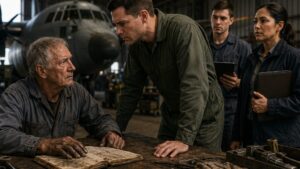
The Old Man They Stopped At The Armory Door Was Carrying A Promise No Badge Could Show
Chapter 1: The Hand Raised Under The Armory Sign
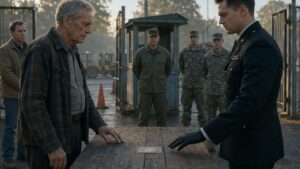
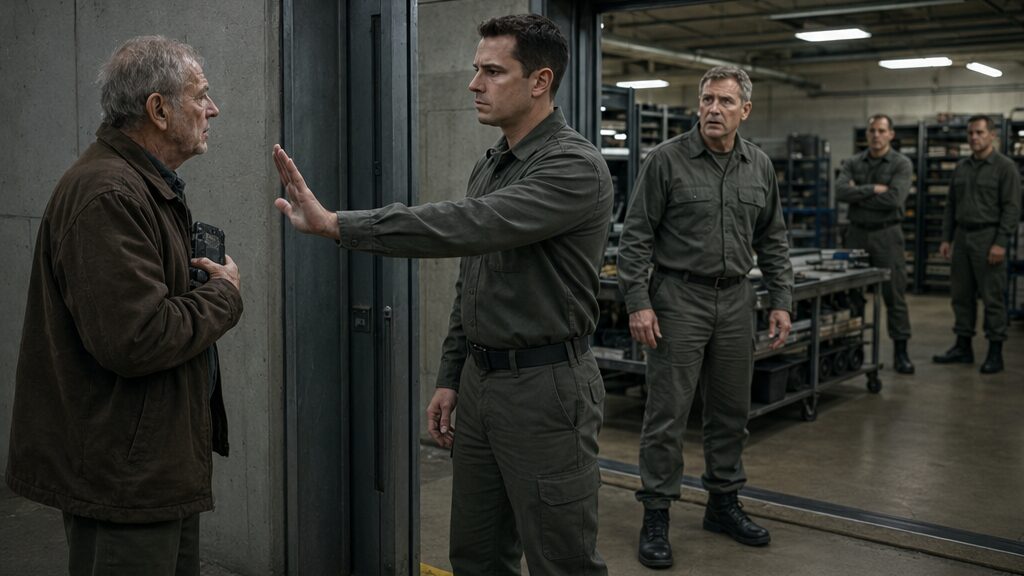
The hand came up before Richard Walker could put one boot across the painted yellow line.
It was a young man’s hand, clean and steady, palm out, fingers spread like a stop sign. Behind it, above a gray steel doorway, black letters on a white board read: ARMORY — AUTHORIZED PERSONNEL ONLY.
Richard stopped.
The tip of his boot rested just short of the line. His brown jacket hung loose on his shoulders, worn shiny at the elbows. In his right hand, he held a small black device with a cracked corner and a faded strip of tape over the battery cover. It looked too old to belong in the hands of anyone with business inside a secure facility.
The young access officer did not look at the device. He looked at Richard’s face, then at the jacket, then at the empty space on Richard’s chest where a badge should have been.
“Sir, you can’t enter here.”
Richard lifted his eyes from the yellow line to the young man’s name strip.
Hill.
The man was broad through the shoulders, still new enough to stand too straight. His olive-gray uniform was pressed sharp, his boots polished, his jaw held in a way Richard recognized from men trying not to show uncertainty.
“I have an appointment,” Richard said.
His voice came out rougher than he wanted. Morning air and age had put gravel in it. The hallway outside the armory smelled of dust, floor wax, and old metal, the same mixture he remembered from years when he used to arrive before dawn and leave after the lights had gone white and tired.
The access officer glanced toward a tablet mounted beside the door. “Name?”
“Richard Walker.”
Hill tapped the screen. His thumb moved fast. Too fast, Richard thought. Not enough pause between letters.
The armory beyond the doorway had changed and not changed. The racks were newer. The benches had been shifted. The overhead lights were brighter than they used to be, hard white instead of the old buzzing yellow. But the walls were the same gray concrete. The far corner still carried a stain shaped like a long thumbprint where a steam pipe had leaked one winter and no one had ever fully cleaned it.
Two workers inside slowed near a storage cage. One looked over, then looked away. The other kept watching.
Hill’s mouth tightened.
“No Richard Walker on today’s entry list.”
“There should be.”
“There isn’t.”
Richard nodded once, as if Hill had reported the time.
“I spoke with the installation clerk,” he said. “I was told to come at eight-thirty. Armory records review.”
Hill’s eyes narrowed slightly. Not anger. Suspicion dressed as procedure.
“Records review is by cleared personnel only.”
“I know.”
“Then you know you can’t just walk up here.”
Richard looked past the raised hand for a second. Not far. Just enough to see the row of benches along the left wall. Once, there had been a rack there marked C-17. He could not see if the tag was still on it.
“I did not just walk up here,” he said.
Hill’s palm stayed up. The gesture had begun as policy. Now it had become a decision.
Behind Hill, more workers noticed. A man carrying a tray of parts slowed near the middle aisle. Another stood with a clipboard tucked against his hip. A private denial became something larger once people had room to watch it.
Richard felt their eyes settle on his jacket, his gray hair, the slight tremor in his left hand. He tucked that hand into his coat pocket.
Hill leaned half a step closer, lowering his voice but not enough to keep it private. “Sir, this is a controlled armory. People come through here with old stories all the time. They say they used to work here, they say somebody told them to come, they say they just need five minutes. That’s not how this works.”
Richard heard the word old more clearly than the rest.
He could have told the young man that he had once known every drawer, cage, lock, receipt, rack hinge, and emergency line in that room. He could have told him about inventory nights when men twice Hill’s age waited for Richard’s count before they signed their own names. He could have said that a locked door was only as good as the memory of why it was locked.
Instead, he lowered his eyes to the black device in his hand.
The tape over the battery cover had yellowed at the edges. The number pad was worn smooth on three digits. His thumb rested near the green call button, though he had not pressed it yet.
Hill noticed the motion.
“Sir, phones aren’t allowed inside either.”
“It isn’t going inside.”
“Then put it away.”
Richard looked at him for a long second.
The hallway seemed to hold its breath. Somewhere inside the armory, a metal drawer rolled shut with a hollow clang. The sound traveled into Richard’s chest and struck an old place.
He pressed one number. Then another. Then a third.
Hill’s hand lifted higher, as if the call itself were trespassing. “Sir, I need you to step back from the entrance.”
Richard stepped back exactly one pace.
Not because Hill had won. Because the painted line still meant something.
The device clicked faintly against Richard’s ear. For two seconds there was nothing. Then a thin ring sounded from inside the armory.
Not from Richard’s device.
From somewhere beyond Hill.
The worker with the tray stopped completely.
A second ring came from an old wall unit near the back, half hidden beside a column. The sound was small, outdated, almost embarrassed to still exist. Richard did not turn toward it. He watched Hill’s face register confusion.
Inside, a middle-aged man looked up from a bench.
Richard saw recognition hit him in stages. First the ring. Then the device. Then Richard’s face.
The man set down what he was holding so carefully that the metal did not make a sound.
“Walker?” he said.
Hill turned his head. “Anderson, you know him?”
Michael Anderson walked forward, not quickly at first. He was heavier than Richard remembered, his hair cut close and graying at the temples, but his eyes were the same—alert, measuring, never comfortable until the count matched the paper.
He came to the inside edge of the doorway and stopped there, as if the yellow line held him too.
“Mr. Walker,” Michael said.
The title landed softly, but everyone near enough to hear it shifted. Not sir. Not buddy. Not old man.
Richard lowered the device from his ear.
“Michael.”
Hill looked from one to the other. His hand was still raised, but now it seemed to have nowhere to belong.
Michael’s face changed again when he saw that hand. The old worker looked at it the way an armorer looked at a missing safety pin.
“Patrick,” he said quietly, “why is your hand on him?”
“I’m not touching him.”
“You’re stopping him.”
“He’s not on the list.”
Michael’s jaw tightened. “Did you check the visitor call sheet?”
Hill pointed at the tablet. “Digital roster shows no authorization.”
“That isn’t what I asked.”
Richard said nothing. The worker with the tray had not moved. The man with the clipboard lowered it against his thigh. The armory had become still in the way rooms became still when people realized a mistake had witnesses.
Hill’s face flushed under the fluorescent lights.
“Procedure is digital first,” he said.
“And after digital first?”
Hill did not answer.
Richard could have helped him then. He could have said it was all right, that rules had changed, that young men were taught to trust screens because screens could not blush. But the words stayed behind his teeth. He had been making excuses for other people’s omissions for too long.
Michael stepped closer to the doorway. His voice stayed even, but it carried across the entry.
“You need to check who you just stopped.”
Chapter 2: The Name Missing From The Screen
Patrick Hill typed Richard Walker’s name three times and got the same empty result each time.
No match.
The tablet glowed on the security desk, cold and certain. Patrick stared at it longer than he needed to, hoping the system would correct itself before anyone noticed his jaw tightening. Behind him, the armory doorway remained open just wide enough for the workers inside to pretend they were not watching.
Richard stood to the side of the desk with the small black device resting in his palm. He had not put it away. Patrick disliked that more than he should have.
Michael Anderson leaned over the counter. “Try legacy visitor.”
“I did.”
“Try former personnel.”
“There’s no active field for that.”
“That’s because the new system was built by someone who thought history starts at login.”
Patrick looked up sharply. Michael did not smile.
Richard said, “There was supposed to be a paper sheet.”
Patrick turned to him. “Paper sheets are backup only.”
Richard nodded. “Then use the backup.”
The request was calm. That made it worse. Patrick could handle irritation. He could handle entitled contractors, retired men who came in angry about rules, civilian vendors who acted as if a badge from ten years ago should open every door. Calm gave him nothing to push against.
He tapped another menu. Nothing.
The security desk sat in the narrow area between the public corridor and the armory cage. Cameras watched from two corners. A laminated access policy hung crooked beside a sign-in shelf. A small stack of paper visitor forms lay untouched under a clear plastic cover.
Patrick knew exactly why he had not reached for them.
Three weeks earlier, a torque tool had vanished during a contractor inspection. Nobody had accused him directly, but the security supervisor had asked why he had not logged a badge handoff in the digital system. Patrick had spent forty-eight hours imagining his probationary status ending with a short email and a cardboard box. Since then, he had trusted the tablet the way frightened men trusted locked doors.
Michael reached past him toward the plastic cover.
Patrick moved the forms away. “Don’t.”
Michael’s eyes hardened. “You think he’s trying to sneak into an armory with a taped-up phone and a seventy-four-year-old knee?”
“I think my job is to verify entry.”
“And verifying means more than staring at one screen.”
Richard looked at Patrick then—not with anger, which Patrick had expected, but with something steadier and more uncomfortable. Pity would have been easier to resent. This was not pity. It was recognition of a fear Patrick had not given him permission to see.
Patrick looked back down. “Mr. Walker, who told you to come?”
“The installation clerk.”
“Name?”
Richard’s mouth paused before answering. “The clerk said Mr. Baker’s office had the appointment.”
Michael’s expression shifted.
Patrick caught it. “What?”
Michael said, “Stephen should’ve told us.”
Before Patrick could answer, a door opened inside the armory and Stephen Baker came out carrying a folder tucked under one arm. He was trim, neat, and moved with the controlled impatience of a man whose schedule had been interrupted by lesser people. His uniform shirt was rolled at the cuffs. A pen was clipped precisely at his pocket.
“What is the delay?” Stephen asked.
Patrick straightened. “Sir, this gentleman says he has an appointment for records review. Richard Walker. He’s not in the system.”
For half a second, Stephen’s eyes went to Richard.
The change was small, but Patrick saw it. Not surprise exactly. Something colder. A door closing behind the eyes.
“Walker,” Stephen said.
Richard inclined his head. “Mr. Baker.”
“You should have waited for confirmation.”
“I received it.”
“From whom?”
“The installation clerk.”
Stephen’s thumb pressed against the folder under his arm. “The clerk does not authorize armory access.”
“No,” Richard said. “But your office does.”
The quiet between them made Patrick feel suddenly behind. He looked at Michael, but Michael was watching Stephen.
Stephen turned to Patrick. “If he is not in the system, he does not enter.”
Michael stepped forward. “Stephen, this is Richard Walker.”
“I heard the name.”
“He ran this floor before half of us knew which end of a rack key to hold.”
A worker inside glanced up again. Someone near the cage murmured something Patrick could not catch.
Michael continued, voice low but firm. “He trained me. He trained Scott before Scott retired. He trained the old inspection crew. That emergency line back there still rings because he kept it alive when everyone else wanted it pulled.”
Patrick looked at Richard’s black device again. It no longer looked like junk. That annoyed him too, because objects should not change meaning without warning.
Stephen’s face did not soften. “Former experience does not equal current authorization.”
“No one said it did,” Michael said. “We’re saying check the paper sheet.”
Stephen looked at the plastic-covered forms on the desk and then at Patrick. “No unscheduled legacy access during decommissioning.”
Richard’s hand closed slightly around the device. “It is one rack row.”
Patrick caught that. One rack row.
Stephen did too. “This facility is being cleared under audit controls. Nothing is inspected, removed, or reviewed outside the approved sequence.”
“I am not asking to remove anything.”
“You are asking to reopen a closed area.”
“I am asking to look where a record was left incomplete.”
Stephen’s mouth thinned. “That is exactly the kind of language that creates problems where none exist.”
Michael stared at him. “Problems don’t disappear because the file room got cleaner.”
Stephen ignored that and looked at Richard’s jacket, his worn cuffs, the device, the empty badge clip that was not there. “Mr. Walker, I respect prior service. But this is an active controlled environment. We cannot make exceptions because someone remembers how things used to be.”
There it was again. Used to be.
Patrick felt a small relief at Stephen’s firmness. Authority had arrived and confirmed the rule. Yet the relief did not settle cleanly. He kept seeing Michael’s face when Richard’s name was spoken. He kept hearing that old phone ring inside the armory.
Richard did not argue. He simply looked toward the doorway.
For the first time, Patrick wondered whether silence could accuse a person more sharply than anger.
Michael said, “Let him sit in the records alcove. I’ll stay with him.”
“No,” Stephen said. “The decommissioning crew starts old rack prep tomorrow. Today we finalize clearance. I’m not delaying that over a memory.”
Richard’s expression changed at the word tomorrow.
Patrick noticed because he had been watching for weakness. What he saw instead was a controlled flinch, almost invisible, like a man taking a hit under the ribs and refusing to bend.
The small black device vibrated in Richard’s hand.
Everyone heard it because no one was speaking.
Richard looked at the screen. The name made his thumb hesitate.
He stepped away from the desk before answering, but the corridor carried his voice back.
“Laura.”
Patrick pretended not to listen. Michael did not bother pretending.
A woman’s voice came thinly through the old speaker, urgent enough to cut through static.
“Did you find Jonathan’s tag before they clear the racks?”
Chapter 3: The Old Phone That Still Knew The Number
“The line still rings,” Michael Anderson said, and hated the way his own voice sounded amazed.
Richard stood beside him in the parking area, facing the low concrete side of the armory as if the building were an old man who might refuse to answer if stared at too hard. The morning confrontation had left a mark on everyone except, it seemed, Richard. He held the black device with the same steady care, thumb resting near the worn green button.
“It always did,” Richard said.
“No one uses that wall unit.”
“No one uses a lot of things until the day they need them.”
Michael looked back toward the entrance. Through the narrow glass panel beside the door, he could see Patrick at the desk, speaking with someone on the phone, his posture stiff with leftover embarrassment. Stephen had disappeared into his office with the folder still under his arm.
“Why didn’t you tell him?” Michael asked.
Richard’s eyes stayed on the concrete wall. “Tell him what?”
“That you worked here. That you weren’t just some civilian wandering in.”
“You told him enough.”
“Not enough to get you inside.”
“No.”
The word was not bitter. That made Michael feel worse.
Years ago, when Michael had been young and angry and always certain the older men were slowing him down, Richard Walker had stood beside him at bench three and watched him miscount a tray of firing pins by one. Richard had not shouted. He had only pushed the tray back and said, Count again before the mistake becomes someone else’s problem.
Michael had disliked him for that. Then he had learned to trust him.
Now Richard looked smaller in the open air than he ever had under the armory lights. His brown jacket hung around him like something borrowed from a stronger season.
“Who is Jonathan?” Michael asked.
Richard’s hand tightened around the device.
For a moment Michael thought he would not answer. Then Richard said, “Jonathan Taylor. Supply transfer attached to the armory for six weeks. Twenty-two years old. Good with numbers. Bad at pretending he wasn’t scared.”
Michael searched his memory and found only pieces: a young soldier with quick hands; a jammed rack; a day when everyone stopped speaking loudly; Richard coming back from an interview with his face emptied out.
“The C row incident,” Michael said.
Richard nodded once.
“I thought that file was closed.”
“It was closed,” Richard said. “That was the trouble.”
Before Michael could ask more, Richard pressed the green button. He did not dial this time. The device called from memory.
Inside the armory, faint through wall and door, the old emergency unit rang.
Once.
Twice.
Michael felt the hair rise along his arms. It was ridiculous. It was only an old line no one had disconnected properly. But the sound carried twenty years in it. It made the building seem less cleared, less modern, less finished with what had happened there.
Richard ended the call before anyone answered.
“After Jonathan died,” he said, “they changed the rack procedure. New locks. New sign-off sequence. New emergency contact system. This was the test unit for the line before the upgrade. It should have been turned in.”
“But you kept it.”
Richard looked down at the taped battery cover. “Jonathan called from it.”
Michael swallowed.
Richard did not explain further. He did not need to. The silence made the shape of it worse: a young man at a rack, something jammed, a call made before the room understood the cost.
A side door opened and a records technician stepped out carrying a cardboard file box. Michael lifted a hand.
“Hold up.”
The technician paused, wary. “Mr. Anderson, if this is about Mr. Baker’s audit boxes, I’m supposed to take them to disposal staging.”
Michael walked over. “Any old C row files in there?”
“I don’t know. They’re marked obsolete.”
Richard came closer, slower than Michael liked. “Were any pulled last week?”
The technician looked from Richard to Michael. “A paper sign-out sheet was requested. Rack incident supplement, old format. I don’t know which row.”
“Who requested it?” Michael asked.
The technician shifted the box against one hip. “Operations office.”
Stephen.
Michael felt the name without saying it.
“Where is it now?” Richard asked.
“If it isn’t in the box, it’s in the records alcove or Mr. Baker has it.”
Michael took the box despite the technician’s protest. “We’re checking.”
Inside, the records alcove had once been a storage closet. It still smelled of paper dust and machine oil. A narrow table sat against the wall under a humming light. Boxes were stacked in three uneven columns, each labeled with a disposal category.
Richard stood at the threshold until Michael noticed.
“You can come in,” Michael said.
“Am I authorized?”
The question was quiet. Michael looked at him and felt heat rise in his face.
“For this, I’ll stand responsible.”
“That is not a small thing.”
“No,” Michael said. “It isn’t.”
Richard entered.
They worked through the first box without speaking. Old inspection forms. Disposal receipts. Rack-change logs with faded carbon copies. Michael found names he had not thought of in years and signatures from men who were gone now. Each one seemed to look back at him with the same question: What did you let them forget?
Richard’s hands moved carefully through the paper. Age had slowed him, but not made him careless. He squared each stack before setting it aside.
Near the bottom of the second box, Michael found a folder marked C-17 INCIDENT SUPPLEMENT.
His pulse kicked. “Here.”
Richard turned.
Michael opened it.
Empty.
No forms. No photographs. No tag receipt. Only the folder, its metal tabs bent from use and a pale rectangle inside where papers had rested for years.
Richard reached out but did not touch it.
Michael checked behind the folder, under the box flap, between neighboring files. Nothing.
The records technician, standing in the doorway now, frowned. “That shouldn’t be empty.”
Richard’s face gave away almost nothing. Only his thumb moved, rubbing once over the taped seam of the black device.
Michael remembered something then. Not from the incident. From after. Richard at the back bench, staring at a sealed file while a young woman cried in the hallway outside the commander’s office. He had thought Richard cold because Richard had not gone to her.
Now he wondered whether the old man had stayed away because he was afraid he would break if he took one step closer.
“Mr. Walker,” Michael said, softer than before, “what was supposed to be in there?”
Richard looked at the empty folder for a long time.
“A metal rack tag,” he said. “Jonathan’s last sign-out. And the note that said he stayed behind to secure the jam.”
The old emergency phone rang from somewhere inside the armory.
Everyone in the alcove froze.
Michael looked toward the sound, then back at the empty folder in Richard’s hand, and understood that someone else in the building had just called the past before Richard could.
Chapter 4: The Audit That Wanted No Ghosts
“Clear C row first,” Stephen Baker said, and watched two men in work gloves hesitate as if the racks themselves had heard him.
The armory floor had been arranged for decommissioning before sunrise. Red disposal tags hung from storage cages. Plastic bins lined the bench row. A rolling cart carried scanners, zip ties, and forms that needed initials in three places before anything could leave the room. The facility inspector was due the next morning, and Stephen had built the schedule tight enough that no one had room to wander into memory.
The old C row stood along the left wall under a strip of fluorescent light that flickered once every few minutes. Its gray metal doors were scratched from years of keys, elbows, and hurried hands. Someone had already removed the newer labels, leaving pale rectangles where adhesive had protected the paint.
Stephen pointed to the end rack. “Start there. Bag loose tags separately. Nothing goes into archive unless it’s on today’s list.”
Michael Anderson, standing near bench three with his arms folded, said, “C row is exactly what Mr. Walker came to inspect.”
Stephen did not turn right away. He let the workers hear the pause. Leadership, he had learned, sometimes meant making silence look like control.
Then he said, “Mr. Walker does not have clearance for inspection.”
Richard Walker stood beside the old bench, brown jacket buttoned though the room was warm. His small black device rested in his right hand, half hidden against his palm. He had not asked for a chair. He had not raised his voice. That was what made him difficult. A loud man could be removed. A quiet one made everyone else sound harsh.
“I am asking for one rack,” Richard said.
“You asked yesterday.”
“And the rack is still here.”
“For disposal sequence,” Stephen said. “Not private review.”
Patrick Hill stood at the access side of the room, close enough to hear, far enough to pretend he was only monitoring movement. His eyes kept going to Richard, then to the old emergency wall unit. Stephen noticed and disliked it.
Yesterday’s ring still bothered the room. People had laughed nervously after it, then stopped laughing when no one claimed responsibility. Stephen had claimed later that old lines sometimes misfired during system checks. The explanation had been plausible enough. Plausible was all he needed until tomorrow.
Michael stepped closer. “The folder was empty.”
“That happens in old archives.”
“Not with incident supplements.”
Stephen faced him. “Especially with incident supplements. Things get separated, scanned, misfiled, retired.”
“Or pulled.”
The word hung too plainly.
A worker at C row lowered his scanner.
Stephen looked at him. “Continue.”
The scanner beeped. The sound was sharp and obedient.
Stephen walked to the operations table and opened his folder. He had reviewed the contents three times before anyone else arrived. Audit schedule. Decommissioning checklist. Disposal approval request. And one photocopied sheet, brittle at the edges, old enough that the signature line had blurred slightly when scanned.
RICHARD WALKER.
Temporary rack safety note acknowledged.
Not final. Not complete. But enough.
Stephen had told himself that more than once since he found it in the loose files requested from archives. Enough to show the matter had been addressed. Enough to keep the decommissioning from being delayed. Enough to prevent some outside office from asking why a twenty-year-old incident supplement had a missing tag, missing note, and a living veteran standing in the way of closure.
Enough, if no one insisted on looking underneath it.
Richard came to the edge of the table. He did not reach for the paper. His eyes found the signature before Stephen turned it fully toward him.
For the first time that morning, the old man’s face changed.
Not much. Only a stillness that went too deep.
Stephen felt a brief, unwelcome pressure behind his ribs. He pushed it down. Men like Walker carried rooms with them. That did not mean rooms could be handed back whenever they wanted.
“You signed the temporary note,” Stephen said.
Richard’s eyes stayed on the sheet. “Yes.”
Michael moved in. “Temporary note for what?”
“Rack C-17 post-incident safety acknowledgment,” Stephen said. “It indicates Mr. Walker reviewed the rack after the event.”
Richard said nothing.
The worker with the scanner looked up again. Patrick took one step closer from the entrance.
Stephen continued before the silence could turn. “So you understand why I cannot reopen this on a verbal concern. We have a signed acknowledgment. We have a decommissioning timeline. We have no active hazard report attached to this rack.”
Richard lifted his gaze. “That sheet is not the report.”
“It is the sheet we have.”
“It is not the report.”
The words were the same, but the second time they carried something raw underneath.
Stephen softened his voice because he could feel the room turning against firmness. “Mr. Walker, I appreciate that this is personal.”
Richard’s fingers closed around the black device. “That is not why I came.”
“Then why did you?”
Michael looked at Richard.
Patrick looked too.
Stephen knew the old man could have changed everything then. He could have spoken a name, told the room about Jonathan Taylor, forced grief into the middle of a workday and made every form on Stephen’s table look indecent. But Richard’s mouth tightened, and the words did not come.
There it was, Stephen thought. The gap he needed.
“You see the difficulty,” Stephen said. “You are asking me to stop a controlled process based on something you will not state clearly.”
Richard’s eyes dropped to the device. For a second, Stephen thought he might call someone again. Instead he slid it into his jacket pocket.
A restrained man, Stephen had learned, could still retreat.
Stephen closed the folder. “C row clears today.”
Michael came around the table, voice low. “Stephen, one old file won’t ruin your audit.”
Stephen turned on him then, keeping his voice low enough that it felt private even though Patrick was close. “One old man cannot reopen a closed incident.”
Patrick’s head moved slightly. He had heard it.
Stephen regretted the wording at once, not because it was untrue, but because it sounded like something said by a man who feared a ghost.
Michael’s face hardened. “That old man kept this place running before your office had a door.”
“And this place now answers to current regulation.”
“Regulation doesn’t require you to bury a missing supplement.”
Stephen leaned closer. “Regulation requires chain of custody, complete logs, and evidence. What we have is a signature. What we do not have is the document Mr. Walker says should exist.”
From the left wall came a sudden metallic shriek.
Everyone turned.
A decommissioning worker had pulled open the lower section of C-17. The drawer stuck halfway out, angled slightly down. The worker stepped back, startled, one hand still on the handle.
“Jammed,” he said.
Richard moved before anyone told him not to. Slow, but direct. He crossed to the rack and looked at the drawer without touching it.
Stephen’s pulse gave one hard beat.
“Do not interfere with cleared material,” he said.
Richard stopped inches from the handle.
Michael crouched beside the rack, eyes narrowing. “Same side catch.”
Richard said, almost under his breath, “It always came down harder on the second pull.”
The worker let go of the handle.
Stephen heard the room absorb the sentence.
He opened the folder again and pulled out the photocopied sheet. “This is exactly why we follow documented procedure instead of memory. Mr. Walker reviewed this rack after the incident. His signature is here.”
Richard turned toward him.
For the first time since he had arrived, the old man looked tired in a way that was not age. He looked like someone standing in front of a door he had locked himself.
Patrick stepped from the entrance. His face was uncertain now, but uncertainty sometimes sharpened into cruelty when a man felt embarrassed.
“So you did sign off on it,” Patrick said.
Michael snapped, “Patrick.”
But Patrick was looking at Richard, not Michael. The flush from yesterday had returned, mixed with something defensive and young and ashamed.
“Maybe,” Patrick said, in front of the workers, in front of Stephen, in front of the rack that had screamed open, “maybe the system left you out for a reason.”
Chapter 5: The Signature That Proved Less Than It Seemed
Richard knew his own signature before his eyes finished reading the line.
The R leaned too far forward. The W broke at the middle because the pen had skipped. The final stroke dragged downward in the way his hand moved after long shifts, when the bones along his thumb grew stiff from counting parts and turning keys. Twenty years had passed, and still that tired mark knew him.
Stephen held the photocopy across the operations table like a man presenting clean proof.
Richard did not take it.
If he touched the page too quickly, his hands might betray him.
Behind him, C-17 sat half open, lower drawer jammed forward, metal lip angled toward the concrete floor. The decommissioning worker had backed away. Michael stood near the rack, watching Richard with worry sharpened by anger. Patrick had gone quiet after his own words, but the damage remained in the air.
Maybe the system left you out for a reason.
Richard had heard worse in his life. Louder. Crueler. From men with more power than Patrick Hill. But this one found the old bruise because part of Richard had wondered the same thing.
Stephen set the page down. “You can review it from there.”
Richard looked at the date.
He remembered the room that day. Not clearly at first. Memory did not return as a film. It came as fragments that had weight. A fluorescent tube clicking. A young soldier’s glove on the floor. Michael younger by twenty years, standing white-faced near the cage. A woman’s voice in the hall later, asking why no one had told her the last part.
Richard reached for the paper.
His fingers stopped above it.
“This is a temporary safety acknowledgment,” he said.
Stephen’s voice stayed controlled. “It bears your signature.”
“Yes.”
“Then you reviewed C-17 after the incident.”
“I reviewed the lockout condition.”
“The distinction matters to you. It may not matter to the audit.”
“It mattered to Jonathan.”
The name entered the room and changed its temperature.
Patrick’s eyes flicked from Richard to Michael. Stephen’s jaw tightened.
Michael said, “Jonathan Taylor.”
Richard looked at him.
Michael had turned toward the rack, not Stephen. His gaze had gone unfocused, hunting through the old place. “He was on the far side,” Michael said slowly. “I remember that now. We were clearing loose inventory after the catch slipped. Someone yelled to back off.”
Richard closed his eyes once.
Michael continued, voice roughening. “Jonathan stayed by the lower drawer.”
Stephen said, “This is not productive.”
Michael ignored him. “He held it because the upper track shifted. He told the other kid to move. That’s what happened, isn’t it?”
Richard opened his eyes.
The answer sat in his throat. He had carried it long enough that speaking it felt like moving something rusted.
“He stayed,” Richard said. “He had already called the emergency line. He said the catch was not holding. He stayed because there were two men inside the swing path, and he thought he had time to secure it.”
Patrick looked toward the jammed drawer.
Richard saw him understand just enough to regret too late.
Stephen tapped the photocopy. “None of that is on this sheet.”
“No.”
“Then where is it?”
“In the supplement.”
“The empty folder?”
Richard looked at the rack. “Yes.”
Stephen spread his hands, the gesture small and almost weary. “Then we are back where we started.”
No one spoke for a moment. The old armory seemed to click and settle around them, steel cooling under white lights.
Richard put his hand in his jacket pocket and touched the black device. Laura’s number was there. He had not had to memorize it; after years, his thumb knew the sequence. He imagined stepping into the hallway, calling her, telling her that the record was empty and his signature was being used as a lid.
He did not call.
The shame of that inaction moved through him with a familiar step. He had mistaken silence for mercy once before. He had stood outside a room while Laura Mitchell wept and let a commander tell her that Jonathan had been careless with equipment. Richard had told himself the official correction would come later, when the paperwork settled, when the unit had time, when grief was not so new.
Later had become years.
Michael bent beside C-17 and peered underneath the bench row. “There used to be a tag rail down here.”
Richard turned. “Yes.”
“Rack tags clipped under the lip if they were pulled for repair.”
“Temporary holding only.”
“Who knew that?”
Richard’s mouth tightened. “Anyone trained before the new system.”
Michael lay one hand on the concrete and lowered himself enough to see beneath the bench. Age had thickened him, but he still moved like a man who trusted floors more than chairs. “Light.”
Patrick hesitated, then pulled a small flashlight from his belt and handed it over.
Michael looked surprised. So did Patrick.
The beam cut under the bench. Dust shone. Old tape strips. A dead insect. Scratches in paint where boxes had been dragged too many times.
“There’s something,” Michael said.
Stephen stepped closer. “Do not remove unlogged material.”
Michael ignored him and reached under, but his arm was too thick for the gap. “Patrick.”
Patrick stared at him.
“You’ve got smaller hands,” Michael said.
For a second, Patrick looked like he might refuse simply because he had been asked in front of everyone. Then he crouched. His face came level with the rack where Richard had stood moments ago, and something about that lowered posture removed the last of his doorway authority.
Patrick aimed the flashlight with one hand and reached under with the other.
His fingers brushed metal. He pulled, but old tape held. He worked slowly, jaw clenched, and came back with a flat rectangular tag covered in dust and a strip of yellowed adhesive.
Stamped into it, still readable, was C-17.
On the back, in faded marker, were two initials and a date.
J.T.
Patrick stood with the tag in his palm.
Richard’s breath stopped in his chest. Not from surprise. From the terrible relief of seeing something real survive after all the years he had not.
Michael whispered, “Jonathan.”
Stephen’s hand moved.
Not far. Just enough toward the tag that Richard saw the choice before Stephen made it. The operations manager’s eyes were fixed on the metal rectangle, and in them Richard saw fear stripped of polish: audit delay, questions, reports, blame traveling backward through offices and landing where no one wanted it.
Patrick saw the movement too.
His fingers closed around the tag.
Stephen looked at him.
“Bag it,” Stephen said.
Patrick swallowed. “As disposal?”
“As unlogged legacy material pending review.”
Michael stood. “That tag belongs with the incident supplement.”
“There is no supplement,” Stephen said.
Richard finally touched the photocopied sheet. His signature blurred under his thumb.
“I signed that,” he said.
Everyone looked at him.
“I signed it because the rack was locked out temporarily after Jonathan was taken from this room. I did not sign the final incident summary. I did not sign anything that called him careless.”
Stephen’s voice dropped. “You allowed it to stand.”
The words struck clean because they were true.
Richard looked down at his own name. “Yes.”
The room went still again, but this time he did not hide inside it.
“I thought correcting it then would make his sister live the day twice,” he said. “I told myself I would fix it when the anger had gone out of the building. Then people transferred. Files moved. Men retired. I kept waiting for a kinder time.”
Laura’s unanswered calls seemed to gather in his pocket with the old device.
Richard looked at Patrick’s closed hand.
“There was no kinder time.”
Stephen’s face had gone pale with contained calculation. “Mr. Hill, bring me the tag.”
Patrick did not move.
Michael looked between them.
The tag remained inside Patrick’s fist, dust marking the edges of his knuckles.
Stephen’s voice hardened. “Now.”
Patrick opened his hand slowly, but he did not give the tag to Stephen. He looked first at Richard, then at the half-open rack, then at the photocopy that had seemed to prove so much less than Stephen wanted.
Before anyone could speak, Stephen stepped close enough to take it.
Chapter 6: The Stand-Down Called By A Quiet Man
The old rack tried to fall on a living man before anyone finished arguing about the dead one.
It happened the next morning with the facility inspector ten minutes away and the decommissioning crew moving too quickly because Stephen Baker had told them the schedule could not slip. A worker reached into C-17 to free the lower drawer. The jam gave with a shriek. Above it, the upper track jumped.
Richard saw the angle before the worker heard the sound.
“Back.”
The word cracked across the armory floor.
The worker froze.
Richard was already moving, not fast enough for youth but fast enough for knowledge. His left hand caught the side of the rack frame. His right pointed low.
“Step left. Not back. Left.”
The worker obeyed without understanding. The upper track slammed down against the stop with a metal blow that made every bench vibrate. A loose divider bounced out and struck the concrete where the worker’s forearm had been.
For one second no one moved.
Then Patrick Hill reached toward Richard out of instinct, palm rising, the same motion from the doorway.
Richard saw it.
Patrick saw Richard see it.
The young man stopped his hand in midair. His fingers folded slowly back toward himself.
Stephen came from the operations table, face tight. “No one authorized you to direct crew movement.”
Richard’s hand still rested against the rack frame. The vibration traveled into his bones. It felt exactly as he remembered: the hidden shudder after the visible failure, the machine pretending it was finished when it was not.
“You have the same side catch failure,” Richard said.
Stephen glanced toward the inspector’s arrival door. “The rack is being decommissioned.”
“Not safely.”
“The crew has instructions.”
“The instructions are incomplete.”
Stephen lowered his voice, but everyone was already listening. “You are interfering with a federal audit process to protect your own name.”
Michael took a step forward. “Stephen.”
“No,” Stephen said, and the polish was gone now. “We found his signature. We found an unlogged tag. We have no complete supplement. And now he wants to stop the floor on decommissioning morning.”
Patrick still held Jonathan’s tag. He had kept it through the night in an evidence sleeve after refusing to release it as disposal. The sleeve rested now on the operations table, visible through clear plastic, C-17 and J.T. facing up.
Richard looked at it.
His name on the sheet had made him feel accused. Jonathan’s initials made him feel summoned.
Stephen followed his gaze. “This ends today.”
“Yes,” Richard said.
He took the black device from his jacket pocket.
The room seemed to recognize it before anyone did. Michael’s face changed. Patrick’s hand went to his belt, then stopped again. The worker near C-17 stepped farther left, eyes fixed on Richard.
Stephen said, “Put that away.”
Richard pressed the green button.
The old emergency wall unit rang from the back of the armory.
Once.
No one laughed this time.
Twice.
The sound moved over the racks, thin and stubborn.
A records technician near the alcove whispered, “That line is still active?”
Michael walked to the wall unit and lifted the receiver. “Armory floor.”
Richard held the black device to his ear. He looked directly at the rack, not at Stephen.
“This is Richard Walker requesting formal safety stand-down on rack C-17. Mechanical side catch failure repeated during decommissioning movement. Legacy incident connection. Personnel risk observed.”
Michael’s eyes closed briefly at the words formal safety stand-down. Once said over the line, they had shape. They entered procedure. They required a record.
Stephen’s face went hard. “You do not have authority to call that.”
Richard lowered the device but did not end the call. “Any person observing immediate risk may call a stand-down.”
“Not through a retired emergency unit.”
“The line works.”
“That is not the point.”
“It was the point when Jonathan used it.”
The name held.
The facility inspector entered then, carrying a tablet and wearing the expression of someone who had walked into the wrong moment. “What’s going on here?”
Stephen turned quickly. “A misunderstanding. We had a minor equipment shift during disposal prep.”
Richard spoke before he could stop himself by thinking. “Not minor.”
The inspector looked at him. “And you are?”
Richard’s throat tightened. The old habit rose: step back, let current personnel speak, do not make yourself the center. He felt the weight of every year he had used restraint to avoid reopening pain. He felt Laura’s voice asking about the tag. He felt Patrick’s hand at the doorway and his own decision not to explain.
Then he looked at the worker who had nearly been struck.
“Richard Walker,” he said. “Retired armory specialist. I signed the temporary lockout note on C-17 after the original incident. That signature is being used as if it closed the hazard. It did not.”
Stephen said, “This is inappropriate.”
Richard kept his eyes on the inspector. “A soldier named Jonathan Taylor called the old emergency line from this rack before he died. He stayed to secure a jammed drawer so two other men could clear the swing path. The supplement noting that is missing from the folder. His rack tag was found taped under the bench yesterday.”
Patrick moved to the operations table.
Stephen saw him and said, “Mr. Hill.”
Patrick stopped.
For a moment he looked very young. Not weak. Young. A man standing between the rule that protected his job and the truth that made the rule matter.
Richard expected nothing from him.
That was part of the shame too. He had learned not to expect the young to understand what no one had taught them.
Patrick picked up the evidence sleeve.
Stephen’s voice sharpened. “Do not remove that from the table.”
Patrick carried it to the inspector.
His hand was steady, but his face was not. “It was recovered from beneath C-17. I found it. It was not logged for disposal.”
The inspector took the sleeve.
Stephen stared at Patrick as if seeing a door close.
Michael hung up the wall unit slowly. “Stand-down call is on the line log now.”
The inspector looked from Michael to the rack, then to Richard. “Nobody moves C row until I review the hazard and the records.”
Stephen drew in a breath. “This will delay the entire clearance.”
“Yes,” the inspector said.
The word landed with a simplicity no one could argue with.
Stephen’s control cracked at the edge. “Mr. Walker, you waited twenty years to bring this forward. You stood here yesterday and said almost nothing. You let everyone guess. Now you want to stop an operation because your conscience caught up with you on our deadline?”
Michael flinched. Patrick looked down.
Richard felt the words enter and settle where they belonged.
“Yes,” he said.
No defense came after it. No polished explanation. No demand that anyone excuse him.
Richard looked at the rack. “I should have corrected Jonathan’s record when the first summary left out what he did. I thought silence was kinder to his sister. I thought waiting would make it cleaner. It made it easier for the truth to be misplaced.”
He turned to Stephen.
“But I will not let another unsafe sign-off pass because I am ashamed of the first one.”
The room held still.
Stephen’s mouth opened, then closed. There were things he could still say. Procedure. Chain of custody. Scope. Authority. But the rack stood half open behind him, the divider on the floor, the worker pale beside it, the emergency line freshly rung. The language of paperwork had lost room to stand.
The inspector placed the evidence sleeve on a clean clipboard. “We correct the hazard record first. Then decommissioning continues.”
Stephen looked at Patrick. “You understand what you just did to the schedule.”
Patrick’s face tightened, but he did not step back.
He picked up the sleeve again, this time with the inspector watching, and carried it to Richard.
For a second, Richard thought Patrick meant to give it to him. Instead, the young man held it between them like something that belonged to neither of them alone.
“Then we correct it now,” Patrick said.
Chapter 7: The Door Opened Without A Speech
Patrick Hill was waiting under the same sign when Richard returned.
ARMORY — AUTHORIZED PERSONNEL ONLY.
The letters had not changed. The gray steel door had not changed. Even the yellow line on the floor looked the same, scuffed at the center where boots had crossed for years. But Patrick stood on the other side of it now with his hands down, not folded, not clipped to his belt, not raised.
Richard stopped before the line because habit still mattered.
Patrick swallowed. “Mr. Walker.”
Richard nodded once. “Mr. Hill.”
Neither of them moved for a moment.
Behind Patrick, the armory was quieter than Richard had heard it in years. C row had been taped off with red safety ribbon. The decommissioning bins had been moved away from it. A clipboard hung on the end rack in a clear sleeve, marked HOLD — SAFETY REVIEW. The old wall unit remained in place, its receiver seated properly, as if someone had finally remembered it was not decoration.
Patrick looked toward Richard’s right hand.
The small black device was there, tape and crack and all.
“I checked the paper visitor sheet this morning,” Patrick said. “Before the tablet.”
Richard looked at him.
Patrick’s face reddened, but he did not look away. “Your name was on it this time.”
“Was it?”
“Yes, sir.”
Richard let the sir pass without accepting or rejecting it.
Patrick reached for the access panel, then stopped. His hand hovered near the door release, not in command this time, but waiting for permission from a silence he had once mistaken for confusion.
“I owe you an apology,” he said.
Richard glanced through the doorway. Michael Anderson stood near the records alcove, pretending to review a box label. Stephen Baker was farther inside at the operations table with the facility inspector, both bent over amended paperwork. Nobody was close enough to turn the apology into a performance.
Patrick seemed to understand that too.
“I treated you like you were trying to get away with something,” he said. “I did it in front of people. I didn’t check what I should have checked. Then when I felt embarrassed, I made it worse.”
Richard’s fingers shifted around the black device.
Patrick’s voice tightened. “What I said about the system leaving you out for a reason—there’s no excuse for that.”
“No,” Richard said.
Patrick took the word as he should have. He did not rush to fill it.
The hallway hummed with overhead light. Somewhere inside, a scanner beeped once and then fell silent.
Richard looked at the young man’s hands. They were clean again, steady again, but not quite as sure of themselves. That was not a bad thing. Certainty had stopped Richard at the door. Uncertainty had handed him the tag.
“You were afraid for your job,” Richard said.
Patrick’s jaw moved. “That doesn’t make it right.”
“No.”
“I thought if I made one wrong call, I’d be done.”
“That is a hard way to stand watch.”
Patrick looked up, surprised.
Richard did not soften the rest. “But fear makes a poor guard if it only sees threats.”
Patrick absorbed that slowly. Then he pressed the door release and stepped aside.
The lock clicked.
This time, no hand rose.
Richard crossed the yellow line.
No one inside stopped working to stare. That was its own kind of mercy. Michael glanced over and gave a small nod, nothing more. The decommissioning crew continued sorting equipment. The worker who had nearly been struck by C-17 stood at another bench, moving more carefully than before.
Stephen looked up from the operations table as Richard approached. His face carried the strain of a man who had lost the argument but still had to live inside the paperwork. Beside him, the facility inspector slid a thin folder across the table.
“The amended safety note is attached,” the inspector said. “Legacy incident supplement reconstructed from surviving materials, witness statement, rack tag, and stand-down report. It does not pretend to be the original document.”
Richard opened the folder.
Jonathan Taylor’s name was there.
Not large. Not decorated. No speech wrapped around it. Just a corrected line in plain official language stating that he had remained at C-17 to secure a mechanical jam and warn nearby personnel before the fatal rack failure. The words were restrained, almost dry. They were also the first words in twenty years that did not make carelessness out of courage.
Richard read the line twice.
His vision blurred only at the edges. He waited until it cleared.
Stephen cleared his throat. “There is also a draft public correction if you want one released through the installation office.”
Richard looked at him.
Stephen’s eyes moved briefly toward the inspector, then back. “It would acknowledge procedural gaps in legacy record retention and clarify the corrected incident summary.”
“And your office would issue it?”
“Yes.”
“Today?”
Stephen hesitated. “After review.”
Richard closed the folder. “No.”
Michael looked over.
Stephen seemed caught between relief and offense. “No?”
“Not like that.”
“The family may want public acknowledgment.”
“The family wants him written right.”
Stephen’s mouth tightened, but this time he held back whatever first answer came to him. The inspector watched without helping him.
Richard tapped the folder once. “Put the correction where the wrong record was. Attach the tag photograph. Attach the safety note. Train the next person who stands at that door to check more than one screen.”
Patrick, near the entrance, lowered his eyes.
Richard continued, “If Ms. Mitchell wants more, she can ask for it. Do not use Jonathan to make this office look clean.”
Stephen’s face colored faintly.
The inspector said, “That can be done.”
Stephen nodded once, stiffly. “It will be done.”
Michael came to Richard’s side when Stephen turned away to sign. For a moment neither man spoke. They stood in the narrow space between the old bench row and the records alcove, where dust still clung to the floor under C-17.
“I thought you were cold back then,” Michael said quietly.
Richard kept his eyes on the folder. “I was afraid.”
Michael breathed out. “You?”
Richard almost smiled. It did not reach his mouth, but it loosened something in his face. “Most quiet men are.”
Michael looked toward the old wall unit. “You leaving that thing with the record?”
Richard looked down at the black device in his hand.
For twenty years it had sat in a drawer, then a box, then the pocket of the jacket he wore when he did not want to explain himself. It had become less a tool than a weight. He had told himself he kept it because Jonathan’s last call should not be thrown away. But part of him had kept it because as long as he carried the unfinished thing, he did not have to admit he had failed to finish it.
He set the device on top of the folder.
The tape on the battery cover looked small and shabby under the armory lights.
“It belongs with the call,” he said.
The records technician brought an evidence envelope. Richard watched the device slide inside, watched the flap seal, watched Jonathan’s corrected supplement, the rack tag photograph, the stand-down report, and the old phone become one record instead of scattered pieces waiting to disappear.
Only then did he take out his personal phone.
Laura answered on the second ring.
Richard turned slightly away from the room. “Laura.”
She did not ask if he had found it. Perhaps she heard enough in the way he said her name.
Richard looked at the folder as the records technician wrote Jonathan Taylor across the tab.
“They wrote him right this time,” he said.
On the other end, Laura made one small sound, not quite a sob, not quite a breath. Richard closed his eyes and let her have the silence he had once been too afraid to share.
When the call ended, Patrick was still by the door.
He opened it before Richard reached the yellow line.
Richard paused beneath the sign. He looked once back at C row, at Michael beside the records alcove, at Stephen signing what should have been signed long ago, at the old wall unit still mounted to the concrete.
Then he stepped through the open door.
He moved slower than the men working behind him. His knee caught slightly on the turn into the corridor. His hand brushed the wall once for balance.
No one reached out to hurry him.
No one raised a hand to stop him.
The story has ended.