They Laughed When The Old Veteran Asked Them To Check The Range Flag First
Chapter 1: The Old Veteran Lowered The Rifle Before Firing
Daniel Scott laughed before the rifle ever spoke.
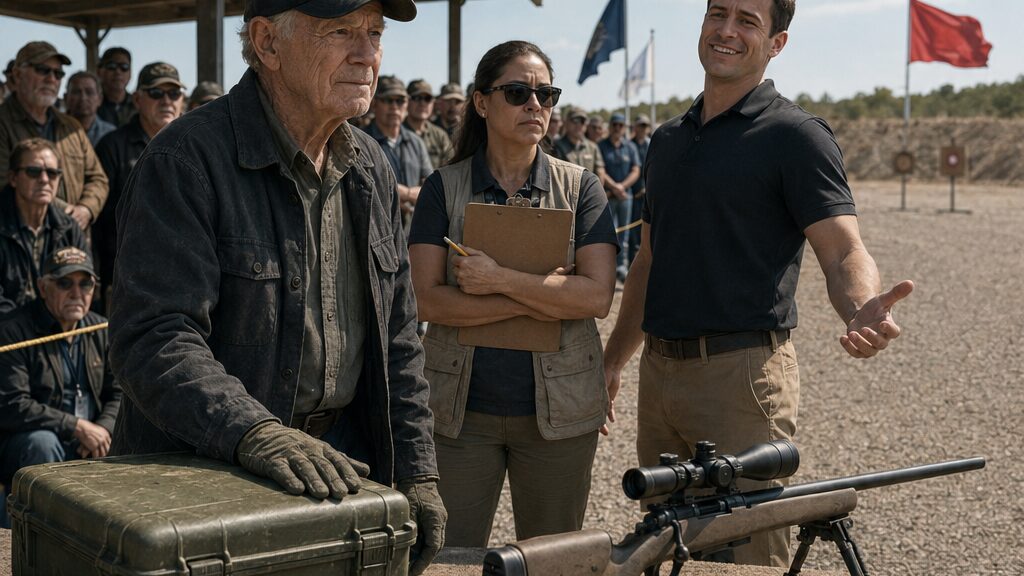
It was not a loud, cruel laugh at first. It was the kind meant to invite the crowd to join him, a quick breath through a smile, a tilt of the head toward the sponsor tent, a small performance for the people lined behind the rope. But it carried cleanly across the firing line, past the folding chairs, past the service flags snapping over the gravel, past the table where Virginia Flores stood with her clipboard.
Larry Carter heard it through his left ear more than his right. The right one had been unreliable since long before anyone at this charity event had been born.
He had lowered the rifle only halfway from his shoulder. His finger was straight and high along the stock, nowhere near the trigger. The optic still held a pale reflection of the range flag, red cloth twitching beside lane seven like something trying to get loose.
Daniel stepped closer, palms open, polo shirt bright under the late-morning sun. His name was stitched above his chest, along with the logo of the event sponsor.
“Everything all right there, Mr. Carter?” Daniel asked. “We haven’t even started the clock.”
A few people behind the rope shifted. Someone gave a small chuckle. Larry felt it travel, not as sound but as attention.
He kept his eyes on the flag.
It had not moved like the other flags. That was the first thing. The service flags behind the line snapped in the same gust, clean and broad, all direction and no hesitation. The range flag downfield gave a hard jerk, dropped, then flicked sideways as if a different hand had touched it. Not wind alone. Not steady.
Larry drew one slow breath through his nose.
“Need lane seven checked before you score it,” he said.
Daniel blinked once, then smiled wider.
“Lane seven?” he repeated, turning slightly so the crowd could hear. “We checked all lanes before opening. You’re good.”
Virginia looked up from her clipboard. Her sunglasses hid her eyes, but Larry saw her pencil pause over the score sheet.
Larry placed the rifle down across the bench with care, muzzle pointed safely downrange. He rested his gloved left hand on the old green equipment case at his side. The case had once been smooth, before years of dust, rain, and cargo straps had worn it dull. Its metal corners were dented. One latch had been replaced with a mismatched steel hasp.
“Check lane seven,” Larry said again.
Daniel gave the crowd another look, this time with an almost apologetic expression, as if he were handling a delay everyone else was too polite to name.
“Sir,” he said, “old habits are fine. We all respect them. But old habits are not official scoring criteria.”
The laughter came easier then.
Not from everyone. Larry noticed that too. Some faces stayed still. A bearded man near the second row leaned on a cane and watched the flag, not Daniel. A boy in a ball cap looked from Larry to the downrange berm, unsure which adult was right. But enough people laughed for the sound to settle over Larry’s shoulders.
He did not look at them.
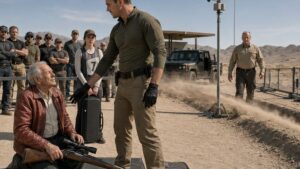
The range had been set up on the wide edge of a county veterans’ park, with temporary firing benches bolted to long wooden platforms and lanes marked by white-painted posts. Beyond the targets, the backstop rose in a high dirt wall patched with dry grass. A public-address speaker crackled every few minutes with sponsor names, relay numbers, reminders to hydrate. Flags marked each branch of service behind the rope, lifting and dropping above rows of folding chairs where veterans, families, and local officials had gathered for the charity shoot.
Larry had come because the invitation had said quiet relay, open category, proceeds for adaptive housing. He had not come to be introduced as a symbol. He had not come to correct anyone.
He had brought one rifle, one case, one box of ammunition, and the old habit of looking downrange before he touched anything else.
“Mr. Carter,” Virginia said, stepping nearer. “Can you tell me what you’re seeing?”
Daniel answered before Larry could.
“He’s seeing wind. Everybody’s seeing wind.” He tapped the brim of his cap. “We compensate for that. That’s why we have a modern scoring system, clear spotters, and range staff.”
Larry finally turned his head toward him.
Daniel was maybe thirty-five, maybe younger. Strong arms. Clean beard. Confident shoulders. The sort of man who knew how to stand so cameras liked him. He had probably worked hard to become good. Larry did not doubt that. Good enough to be dangerous in the way good men became dangerous when they stopped listening.
“The flag is wrong,” Larry said.
Daniel’s smile thinned. “Flags move, sir.”
“That one is catching late.”
A silence followed, not because anyone understood, but because the words were strange enough to slow the laughter.
Virginia looked downrange. “Catching late?”
Larry did not want to explain it in front of everyone. Explanation sounded like pleading when people had already decided. He had learned that too many years ago, in rooms where a younger voice with more certainty could flatten an older one with less volume.
He looked back through the optic without shouldering the rifle. The reticle sat near the pale square of the target. A faint shimmer moved through the sight picture, but that was not the problem. The target frame on lane seven had given the smallest tremor when the flag snapped, not enough for most people to catch. A twitch at the edge. A delayed shiver.
“Target frame needs a hand on it,” Larry said. “Or the backing.”
Daniel exhaled, still smiling, but the smile was now for himself.
“Virginia, we’re live on the local feed. We have six relays to get through before lunch. If we stop every time somebody feels a breeze, we’ll still be here after dark.”
That got another chuckle, softer this time.
Virginia glanced toward the sponsor tent. A man there held a phone on a stabilizer, camera pointed at the firing line. Beside him, another volunteer waved to keep the crowd’s view clear.
Larry saw the calculation move through her face. Safety first, always. But event flow mattered. Sponsor promises mattered. A harmless delay, written wrong, became a complaint. A complaint became a problem. Problems had a way of attaching themselves to whoever first acknowledged them.
“Mr. Carter,” she said carefully, “do you feel unsafe firing?”
Daniel looked pleased with that wording.
Larry’s jaw tightened.
That was not the question. Unsafe was not a feeling. It was a condition. But he had already become the old man delaying the relay, and every additional word from him would give Daniel more room to dress the warning as nerves.
He could say more. He could say that wind did not make a target frame quiver after the flag moved. He could ask who had checked the backing pins. He could tell them that the old way was not nostalgia; it was sequence. Read the range. Check the frame. Confirm the lane. Then shoot.
Instead, he heard a different room in his memory. Fluorescent lights. Young faces waiting. A rushed schedule. His own voice stopping one sentence too early.
He pushed that memory down and rested two fingers on the case latch.
“I will fire when lane seven is checked,” he said.
Daniel’s expression hardened beneath the charm.
“Then we’ll mark it as a requested delay.”
Virginia’s pencil moved before Larry could answer.
The graphite made a dry scrape across paper. Larry watched her write beside his name.
Delay requested.
Not warning given. Not lane check requested. Not possible target-frame issue.
Delay requested.
The words sat there, small and official, while the range flag downfield snapped once, dropped, and flicked sideways again.
Chapter 2: The Clipboard Did Not Record The Real Warning
Ashley Taylor saw Daniel lean close to Virginia and say, “Keep the old man moving,” as if Larry Carter were a jammed folding chair instead of a competitor.
She had been standing behind the scoring table with a stack of fresh target cards pressed against her stomach, trying not to look as uncertain as she felt. It was her first year volunteering for the charity shoot. The morning had already taught her that confidence moved faster than rules. Daniel had it. Virginia had it when she was calling relays. The sponsor had it when he pointed cameras. Ashley, so far, had a pencil, a lanyard, and the anxious wish not to be the person who wrote something wrong.
Virginia did not answer Daniel right away. She stared down at the clipboard, lips tight.
Daniel tapped the paper with two fingers. “We can’t let one lane stall the whole feed. Put him at the end if we have to.”
Ashley looked over at Larry.
He stood beside the bench where he had set his rifle down, not touching it now. One hand rested on the weathered green equipment case. The other hung at his side. He was not glaring at anyone. That almost made it worse. If he had looked angry, if he had argued, Ashley could have placed him into the simple category Daniel seemed to want: difficult old man, nervous shooter, delay.
But Larry was watching downrange with the focused stillness of someone listening to a sound no one else could hear.
The public-address speaker crackled.
“Ladies and gentlemen, we appreciate your patience on relay one. We’ll continue shortly with lane adjustments.”
Daniel looked toward the sponsor tent and made a slicing gesture under his chin. The announcement stopped before saying anything else.
Virginia turned to Ashley. “Bring me the relay order sheet.”
Ashley handed it over.
Virginia crossed out a small notation, then wrote Larry Carter at the bottom of the relay. The pencil paused once over the word delay, then moved away.
Ashley saw the problem before she understood why it troubled her. The page made Larry look like the source of the interruption. The paper did not contain his actual sentence. It did not say check lane seven before you score it. It said delay requested, and now his name had been moved to last, where everyone could see that an accommodation had been made.
“Should I write down what he said?” Ashley asked.
Daniel turned his head.
It was not a harsh look. That made it harder to resist. He smiled as if Ashley had asked something sweet and impractical.
“We don’t transcribe every comment from the line,” he said. “We’d need a court reporter.”
“I just mean—”
“I know what you mean.” His voice stayed friendly. “But if you start writing down every old-timer’s wind theory, Virginia will never get to the actual scores.”
Ashley felt heat rise in her face. Virginia did not defend the wording. She only clipped the relay sheet beneath the score grid.
Behind them, the crowd had settled into a low murmur. A few competitors checked their rifles. Families moved closer to the rope. Someone near the back said, “Is that the gentleman who stopped the relay?” and someone else answered, “Guess he got nervous.”
Ashley looked for Larry again.
He had opened his equipment case.
Inside, everything seemed too orderly to belong to a nervous man. Foam inserts held small tools, cloth, a cleaning rod, a taped ammunition box, and a folded card yellowed at the creases. He touched nothing quickly. Each movement had a beginning and an end.
A voice beside Ashley said, “You see it?”
She turned.
The bearded man with the cane stood just beyond the scoring table, one shoulder lower than the other, his cap pulled low. His beard was gray except for a darker line beneath his lower lip. He had a folded program in his free hand.
“Sir?” Ashley said.
“The flag,” he said.
Ashley glanced downrange, then back at him. “I saw it moving.”
“That ain’t what I asked.”
She looked again.
The red range flag near lane seven moved in small, uneven jerks. Farther back, the service flags rose together in the gust, then fell together. The lane flag should have followed the same rhythm, more or less. Instead, it seemed to hesitate, pull hard, and then go slack.
“I don’t know what I’m looking for,” she admitted.
The man nodded once, as if that answer counted in her favor. “Most don’t. But he does.”
“Do you know him?”
“Know of him.”
Ashley waited, but he said nothing more.
Daniel’s voice cut through the line again, bright and amplified now. He had taken the small handheld microphone from the announcer and turned toward the spectators.
“Folks, we’re going to keep this moving. Mr. Carter will shoot at the end of the relay so our range staff can give him all the time he needs.”
The words sounded kind. The crowd accepted them that way. A few people nodded. Someone clapped lightly, then stopped when no one joined.
Ashley looked toward Larry.
He had heard. She could tell because his hand stopped on the case latch. Only for a second. Then he lowered the lid halfway, not closing it, and stood with the same quiet posture.
Daniel continued, “We love having our senior veterans out here. That’s what this event is about. Safety and respect.”
Safety and respect.
Ashley wrote the next competitor’s score in the margin because her hand needed something to do. The pencil point broke.
Relay one resumed without Larry. Shots cracked down the line in clean sequence. Each one made the crowd flinch less than the one before. Daniel moved between benches with practiced ease, correcting a shoulder angle here, murmuring encouragement there. He was good at the performance of care. Ashley could see why people trusted him.
Still, every time lane seven’s flag snapped wrong, she looked at Larry.
He did not say anything.
The first competitor’s target came back clean enough. The second drew a whistle from the crowd. Daniel pointed toward the camera and grinned. Virginia recorded scores without looking again at the earlier notation.
Ashley replaced her broken pencil and forced herself to focus on the numbers.
Then the wind shifted.
Not much. Enough for the service flags to lift, all of them at once, bright against the pale sky. The red lane flag jumped late, pulled sideways, and seemed to tug the thin target backing behind lane seven. Ashley blinked. For half a second she thought she had imagined it.
The bearded man’s voice came low from beside her.
“There.”
She swallowed.
“Was that the frame?”
He did not answer directly. “Ask yourself why the old man said lane seven, not wind.”
Ashley’s mouth went dry.
Daniel was near the sponsor tent now, laughing with the man holding the phone. Virginia had moved to the far end of the table to settle a question about score stickers. No one was looking at the clipboard except Ashley.
She turned back the top page.
Delay requested.
The phrase seemed smaller now, and worse.
A shot cracked from lane five. Applause followed. Ashley flinched and looked toward Larry’s bench.
His equipment case remained half open.
From where she stood, she could see the folded yellowed card tucked inside the foam pocket. It had faint pencil marks along one edge, and beside a small printed diagram, three faded marks had been drawn next to a number.
Lane seven.
Chapter 3: Three Faded Marks Inside The Equipment Case
Ashley Taylor’s shadow fell across Larry’s open equipment case before she found the nerve to ask him what the three faded marks meant.
Larry knew she was there. He had heard her stop two careful steps behind the bench, heard the target cards shift against her lanyard, heard the small false start of breath people took when they had a question they had been told not to ask. He kept his hand on the cleaning cloth a moment longer than necessary.
Then he closed his fingers around the old range card and folded it once along the softened crease.
“You need something from me?” he asked.
Ashley did not answer right away.
Down the line, another relay finished to polite applause. Brass tinkled into collection trays. Daniel’s voice moved through the crowd in confident bursts, explaining scores and sponsor prizes. The range flag near lane seven gave its strange sideward snap, then dropped as if nothing had happened.
“I saw the marks,” Ashley said.
Larry slid the card partly under the cloth.
“That case is older than you,” he said.
“I didn’t mean to pry.”
“No,” Larry said. “You meant to understand.”
She looked embarrassed by how accurate that was.
Larry could have shut the lid. It would have been easy. One hand, one latch, conversation over. He had closed harder doors on kinder people than this girl. Curiosity was not always respect. Sometimes it was just another way of making an old man perform his usefulness.
But Ashley was not smiling. She was not holding a phone. Her eyes went from the card to the flag and back again.
“That was lane seven on the card, wasn’t it?” she asked.
Larry looked toward the firing line.
His rifle lay where he had left it, bolt open, empty chamber visible. Some people handled rifles like instruments. Some handled them like props. Larry had spent half his adult life teaching the difference to young men who arrived believing confidence could substitute for sequence.
Read. Confirm. Breathe. Then act.
“It was a training habit,” he said.
Ashley moved a little closer, stopping before the bench as if it had a boundary. “From the Army?”
Larry gave a small nod.
“Did you teach shooting?”
“I taught soldiers not to shoot before they knew what they were looking at.”
That held her quiet.
He regretted the sentence as soon as it left him. It sounded heavier than he meant it to. The past had a way of stepping into his voice when he gave it an opening.
Ashley glanced toward Daniel, who was showing a younger competitor how to adjust a rear bag. “He made it sound like you were guessing.”
Larry ran the cloth once along the side of the case. “Daniel talks loud enough to make guessing sound like policy.”
A surprised smile touched Ashley’s mouth and disappeared.
The old card lay partly visible beneath the cloth. Larry should have pushed it fully away. Instead, he lifted it again. The paper had been laminated once, badly, long ago. Moisture had crept along the edges. Pencil marks remained where ink had faded. Three small slashes beside a diagram of a firing lane.
“Those marks were for reminders,” he said.
“What kind?”
“The kind you make when men are young and impatient.” He tapped the card once. “Lane flags don’t tell the whole story. They tell you where to start looking.”
Ashley followed his gaze downrange. “So when you said the flag was catching late—”
“The flag tells you what the target won’t.”
He had not meant to say it aloud.
The sentence landed between them with more force than he intended. It had been one of his own, repeated enough in training that younger soldiers used to mimic it under their breath. Some had rolled their eyes, then learned. Some had learned too late.
Ashley looked at the target line again, this time longer.
Larry lowered the card into the case. His right hand did not quite obey. The tremor started at the base of his thumb, small but visible, a faint uncommanded flutter that moved the edge of the paper.
He stilled his hand by pressing it flat against the foam.
Ashley saw. He knew because she looked away too quickly.
He did not blame her. People noticed age the way they noticed cracks in concrete: not always unkindly, but always as proof of weakening.
“Does that happen when you shoot?” she asked softly.
There was no insult in it. That almost made it harder.
“Sometimes,” Larry said.
“Then how do you—”
“By not lying to myself about it.”
The answer seemed to surprise her.
Before she could ask more, Daniel’s voice came from behind them.
“That’s exactly the concern.”
Larry closed the case halfway, but not fast enough. Daniel had seen the hand. He had seen the card too, maybe not clearly, but enough to understand that Ashley had stepped outside the path he had laid for her.
Daniel came around the bench with a practiced look of concern.
“Mr. Carter,” he said, lower than before but still loud enough for nearby ears, “nobody wants to embarrass you. If your hand is giving you trouble, there’s no shame in withdrawing.”
Ashley stiffened. “He didn’t say that.”
Daniel did not look at her. “Safety applies to everyone.”
Larry let his hand rest on the case until the tremor softened. He could feel eyes turning again. Not the whole crowd this time, but enough. Competitors waiting nearby. A volunteer with a stapler. Virginia at the scoring table, pencil paused.
“You concerned about safety now?” Larry asked.
Daniel’s face changed for only a second. It was brief, but Larry saw it: irritation under the polish.
“I’m concerned about a seventy-two-year-old man with a visible tremor insisting the equipment is wrong,” Daniel said.
There it was. Age, made official. Concern shaped into a weapon.
Larry rose slowly. His knee objected. He ignored it.
“I did not say the equipment is wrong,” he said. “I said lane seven needs checked before it is scored.”
Daniel held up both hands. “And we heard you. But the range staff has already checked it. At some point, we have to trust the process.”
Larry looked at Virginia.
She had walked closer, clipboard against her chest. Her expression was measured, but he could see the burden in it. She wanted this clean. Everyone wanted this clean.
“Virginia,” Larry said, “who checked the backing pins?”
Daniel answered again. “The maintenance crew completed inspection before opening.”
“I asked who checked them.”
Virginia shifted her grip on the clipboard. “The morning sheet says lanes cleared.”
“That’s not who.”
The air tightened.
Daniel’s smile was gone now. “Sir, you’re turning a charity event into an interrogation.”
“No,” Larry said. “I’m trying to keep it from becoming a correction after the fact.”
For the first time, Daniel looked away.
It was only toward the sponsor tent, only for a heartbeat. But Larry saw it. So did Ashley, judging from the way she turned her head.
Virginia looked down at her clipboard. “There was nothing marked on my active sheet.”
Daniel’s jaw tightened. “Because there’s nothing active.”
Larry heard the extra word.
Active.
Not nothing.
A range maintenance volunteer crossed behind the scoring table carrying a stack of fresh paper targets. Daniel’s eyes flicked toward him, then back.
Larry felt the old pressure rise in his chest: the invitation to go quiet, to stop before the room decided he was the problem. He had accepted that invitation once, years ago. He could still remember the taste of the coffee in the training room, burned and metallic, while a young lieutenant said they were already behind schedule.
He had raised one concern. Softly.
Then he had let it pass.
Larry closed the equipment case with a controlled click.
Daniel stepped closer to Virginia and lowered his voice, though not enough.
“There was already a note about lane seven,” he said. “But it was handled.”
He stopped when Ashley moved into view beside the bench.
Virginia looked up sharply.
Larry kept his hand on the closed case, feeling the old metal latch beneath his palm.
Ashley’s eyes moved from Daniel to the clipboard.
“What note?” she asked.
Chapter 4: The Shot That Made The Crowd Stop Smiling
Daniel introduced Larry as if he were doing the old man a kindness.
“All right, folks,” he said into the handheld microphone, his voice carrying bright and smooth over the firing line. “We’re going to let Mr. Carter take his attempt now. We appreciate everyone’s patience while we make sure our senior competitors feel comfortable.”
Larry stood beside lane seven with the rifle cradled in both hands and did not look at him.
The words found the crowd anyway. A soft ripple passed behind the rope, not quite laughter this time, not quite sympathy either. It was worse than both. It was the sound of people preparing to be gentle with failure.
Larry set the rifle on the bench and checked the chamber though he already knew it was clear. His hands did not hurry. Hurry made men careless. Hurry made a room decide that a schedule mattered more than a warning. Hurry made a small wrong thing grow teeth.
The range flag hung loose for three seconds.
Then it snapped sideways.
Larry saw the motion reflected in the optic, a red flicker crossing the glass like a warning flare. Downrange, the target on lane seven looked still to anyone watching directly. Through the optic, with the reticle settled and his breathing slowed, he saw the frame give a small delayed quiver.
Not wind on paper.
Movement at the backing.
Virginia stood behind his right shoulder with the clipboard clutched against her vest. Daniel had taken up a position a few steps farther back, close enough to advise and far enough to look blameless. Ashley stood at the scoring table. Benjamin Hill watched from behind the rope, both hands now resting on the top of his cane.
“You are clear to fire when ready,” Virginia said.
Larry did not move.
The public-address speaker buzzed and died. The whole range seemed to wait on the shape of his back.
He lowered his cheek toward the stock, not fully mounting the rifle yet, and looked again.
The flag kicked once, then fell wrong.
Larry lifted his head.
Daniel shut his eyes for half a second, as if asking patience from heaven. “Sir.”
Larry kept the rifle pointed downrange. “Lane seven is still moving.”
Someone behind the rope muttered, “Again?”
Daniel stepped forward. “The target is visible. The lane is clear. The official has cleared you. At this point, Mr. Carter, you either take your shot or you withdraw.”
Larry felt the old invitation again. The pressure to make himself smaller for the comfort of the room. If he fired and the score went bad, they would call it age. If he fired and the backing shifted, they would call it an excuse. If he refused, they would call it fear.
He glanced once at Virginia. “Do you want this scored?”
Virginia’s jaw tightened. “Yes.”
“Then check it before I fire.”
Daniel spread his hands toward the crowd. “There it is.”
The sponsor near the tent lowered his phone, irritation crossing his face. A few spectators shifted in their folding chairs. One of the younger competitors stared down at his shoes.
Larry heard the judgment forming around him, but he also heard something else: the faint wooden tap downrange after the last gust, too small for most ears, too familiar for his.
Virginia looked toward the target line. For a moment Larry thought she might stop everything. Then the sponsor called her name from the tent, sharp enough to cut.
She looked back at Larry. “Mr. Carter, I have no active fault marked on lane seven.”
There it was again. Active.
Larry took one slow breath. Then he nodded once, not in agreement, but in acceptance of what the room had chosen.
“Understood.”
He settled behind the rifle.
The crowd quieted quickly now. Even Daniel stopped speaking. Larry placed his shoulder, adjusted his cheek weld, and let his body find what remained of old memory. His right hand did not shake on the grip. It wanted to. He felt the tremor waiting under the skin, a small trapped bird. He did not fight it. Fighting gave it rhythm. He let the hand rest until the tremor thinned into the larger stillness of his breath.
The optic narrowed the world.
Target. Reticle. Flag reflection. Breath.
He did not chase the crosshair. Young shooters chased. They corrected every wobble and made the wobble larger. Larry waited for the movement to pass through its pattern. The range flag snapped, dropped, and tugged sideways. The target frame answered a fraction late.
There.
He waited through it.
Daniel’s voice came low from behind him. “Any day now.”
Larry did not hear the crowd after that. He heard the inside of his own breath. In. Hold at the natural bottom. Not forced. Not dramatic. Just quiet enough to let the shot leave clean.
The rifle cracked.
The recoil was familiar, brief, honest.
For one heartbeat, nothing happened.
Then the target spotter called from downrange, voice strained by distance. “Impact.”
A murmur lifted behind the rope.
Virginia raised her binoculars. Daniel took two quick steps toward the spotting scope, his confidence returning before he even looked. Larry kept the rifle steady, bolt open now, eyes still downrange.
The spotter called again. “High center. Clean.”
The murmur changed shape.
Larry heard one person whisper, “That’s a good shot.”
Then another voice said, “That’s more than good.”
Daniel bent over the scope. His shoulders stiffened.
Virginia looked through her binoculars for several seconds longer than necessary. Ashley had moved halfway from the scoring table without seeming to realize it. Benjamin did not smile, but his chin lifted a little.
Larry straightened slowly and set the rifle down.
He did not feel triumph. Triumph was too loud for what had just happened. He felt the fading thump of his heart, the ache in his knee, the old tremor returning now that the work was done.
Daniel lifted his head from the scope.
“Well,” he said, and the word tried to become a laugh but failed. “That’s a respectable placement.”
Virginia lowered the binoculars. “It may be a ten.”
The crowd reacted before Daniel could stop them. Not applause exactly. More like a sudden intake, a shift from pity to attention. People leaned forward. The sponsor raised his phone again.
Daniel’s hand went to the back of his neck.
“Hold on,” he said. “The frame moved.”
Larry looked at him.
Daniel pointed downrange. “After the shot. I saw it. The target backing shifted. If that frame moved on impact, the score may not be reliable.”
Ashley’s face changed. Virginia turned slowly toward Daniel.
Larry said nothing.
The same target frame he had asked them to check was now important because Daniel needed it to be.
“That would mean the lane is compromised,” Virginia said carefully.
Daniel shook his head. “It means the shot disturbed the target. That happens. We need to inspect before we score it.”
“Before we score it,” Ashley repeated from near the table, too softly for most of the crowd but loud enough for Larry to hear.
The sponsor walked over with the phone still in hand. “Are we counting the shot or not?”
Virginia did not answer him. Her eyes stayed on Daniel.
Larry opened the bolt again, though it was already open, and stepped back from the bench. “Check lane seven,” he said.
No one laughed this time.
A range maintenance volunteer jogged down the side path with Virginia following behind, clipboard pressed to her ribs. The crowd watched them move toward the target line. Daniel stayed near the firing line, arms crossed now, jaw locked tight.
Larry put the rifle back on the bench and rested one hand on the old equipment case. The metal latch was warm from the sun.
Minutes stretched.
The maintenance volunteer reached lane seven, bent behind the frame, and lifted one corner of the backing board. Virginia crouched beside him. They spoke too quietly to hear. Then Virginia stood.
She turned toward the firing line with something small held between her fingers.
A backing pin.
Even from the bench, Larry could see it had not been seated right.
Virginia looked down at it, then at the clipboard in her other hand, and her face lost the last of its official calm.
Chapter 5: The Score Everyone Wanted To Move Past
Virginia found the earlier maintenance note clipped behind the score sheets, exactly where it should not have been.
It was not hidden well. That almost made it worse. A half sheet of yellow paper, folded once, tucked beneath the sponsor copy of the relay order. The corner had been trapped under the metal clip all morning, visible if she had lifted the stack instead of trusting the active sheet on top.
Lane 7 backing pin loose. Re-seat before scored relay. Recheck if wind picks up.
The note was written in block letters by the range maintenance volunteer, time marked before the opening announcement.
Virginia stood at the scoring table with the loose pin in one hand and the note in the other while the event tried to continue around her. Downrange, the service flags lifted in the same gust that sent the red lane flag into its wrong sideways snap. Behind the rope, people whispered. At lane seven, Larry Carter sat on the bench beside his closed equipment case, rifle empty and untouched.
He had not asked for the score.
That unsettled Virginia more than if he had demanded it.
Daniel came toward her fast, but not so fast that the crowd would notice panic. He still had the careful walk of a man who believed posture could solve most things.
“Virginia,” he said quietly. “We need to handle this clean.”
She held up the note. “Did you see this before the relay?”
Daniel glanced at the paper, then toward the sponsor tent. “It was a preliminary maintenance note.”
“That is not what I asked.”
His mouth tightened. “Yes. I saw it.”
The answer struck harder because it was calm.
Virginia looked at the loose pin lying against her palm. Small. Ordinary. The kind of object no spectator would understand. The kind that did not look important until a target frame shifted and an old man had to be laughed at for noticing.
“Why wasn’t it on my active sheet?” she asked.
“Because it was handled.”
“The pin was loose.”
“It may have loosened again.”
“The note says recheck if wind picks up.”
Daniel leaned closer. His voice dropped. “And if we stop the event now, what do you think happens? The sponsor pulls the feed. The county liaison asks why we ran a charity shoot with bad equipment. Families who came here to feel proud go home talking about a safety dispute.”
Virginia looked past him toward Larry.
Ashley had walked to his bench and stood a few feet away, not speaking. Benjamin remained near the rope, watching the scoring table with the fixed patience of a man who had seen official discomfort before.
“This is not about embarrassment,” Virginia said.
Daniel gave a short, humorless laugh. “Everything public is about embarrassment.”
There it was. Not cruelty. Fear.
For the first time that day, Virginia saw the strain under his polish. Daniel had built the event’s face around himself—the sponsor interviews, the safety demonstrations, the camera-ready confidence. If lane seven became a failure of judgment, it would not fall on an unnamed process. It would land on him.
But it had already landed on Larry.
Virginia set the loose pin on the table beside the note. “He warned us before firing.”
Daniel’s eyes sharpened. “He said the flag looked wrong.”
“He said check lane seven before you score it.”
“And we are checking it.”
“After he was mocked.”
Daniel looked away. “I didn’t mock him.”
Virginia did not answer.
The sponsor arrived with his phone lowered now, no longer filming. “Can someone tell me whether we have a winner or a delay? People are getting restless.”
Virginia folded the note once, then unfolded it again. She needed her hands occupied so they would not shake.
“We have a disputed lane condition,” she said.
The sponsor stared at her. “Meaning?”
“Meaning we may need to reshoot lane seven under corrected conditions.”
Daniel cut in. “Or score the shot as exhibition and proceed with the clean lanes.”
Virginia turned to him. “That would erase his attempt.”
“It would avoid making a charity event look incompetent.”
Ashley’s voice came from behind them.
“It already looks worse if you erase it.”
All three turned.
Ashley stood with her pencil still in hand. She looked pale but steady. Larry remained behind her at the bench, not encouraging her, not stopping her.
Daniel’s face hardened. “Ashley, this is not your decision.”
“No,” she said. “But I wrote the scores. And I saw what was written about him.”
Virginia felt the clipboard suddenly heavy against her side.
Ashley stepped closer to the table. “The sheet says delay requested. It doesn’t say he warned you about lane seven.”
Daniel sighed. “Because that was not the official language.”
“He said it out loud.”
“A lot of things are said out loud at a firing line.”
Ashley looked at Virginia then, and that was worse than if she had looked at Daniel. There was no accusation in her face, only a question Virginia did not want to own.
Virginia flipped back to the relay sheet.
Delay requested.
She remembered writing it. She remembered choosing the safer words, the words that would not slow the day, the words that turned a specific warning into a personal inconvenience.
A public-address speaker crackled again.
“Ladies and gentlemen, we’ll have final scoring shortly. Please remain behind the safety rope.”
The sponsor gave a tight nod toward the tent. “We need a clean announcement in five minutes. The county rep has to leave.”
Daniel seized on it. “There. We announce current standings, mark Mr. Carter’s shot under review, and keep goodwill intact.”
Virginia looked at the maintenance note.
Under review. Delay requested. Senior competitors. Comfortable.
Soft words could do hard damage.
She walked away from the table before Daniel could stop her and crossed to Larry’s bench. He looked up only when her shadow touched the equipment case.
“Mr. Carter,” she said, “I found a note.”
“I figured you would.”
The answer irritated her for half a second. Then she understood the restraint in it. He was not saying he had known the paper existed. He was saying the condition had existed whether anyone named it or not.
“Why didn’t you press harder?” she asked.
Larry looked past her at the range flag. “I pressed once.”
“You repeated yourself.”
“That is not the same as being heard.”
The words stayed with her as she returned to the scoring table.
Daniel was talking to the sponsor in a low voice. Ashley stood at the edge of the table, staring at the two papers. The relay sheet. The maintenance note.
Virginia placed both documents flat.
The phrase delay requested sat above Larry’s name. The maintenance note sat beside it, plain and stubborn.
Lane 7 backing pin loose.
Ashley took out her phone, not to film the crowd, but to photograph the papers on the table. Her hands shook once, then steadied.
Daniel saw the movement and stepped toward her.
“What are you doing?”
Ashley looked up, eyes no longer uncertain.
“Keeping the record,” she said.
Daniel held out his hand. “You don’t need to make this bigger.”
Ashley did not give him the phone. She turned the relay sheet slightly so both notes were visible side by side.
“Then answer the small part,” she said. “Why did you change his warning into a delay?”
Chapter 6: The Warning Was Never About Winning
Daniel waited until the firing line was empty before he asked Larry why he had not just taken the win.
The question came at sunset, when the crowd had thinned to scattered volunteers folding chairs and collecting brass from the gravel. The service flags had been lowered halfway in the calmer air. Downrange, the red lane flag hung tired and still, as if all day it had been trying to tell them something and had finally run out of strength.
Larry sat on the bench with his equipment case open beside him.
He had not packed quickly. The rifle was clean, the chamber flag inserted, the ammunition box closed. The old range card lay visible in its foam pocket. His right hand rested on the case edge, the tremor moving faintly through two fingers now that no one needed them steady.
Daniel stopped on the other side of the bench. Without the microphone, without the sponsor nearby, he looked younger.
“You had them,” Daniel said.
Larry lifted his eyes.
Daniel nodded toward the scoring table, where Virginia and Ashley were still speaking over paperwork. “The shot was good. The pin was loose. You could’ve let them count it and made me look like an idiot.”
Larry looked down at the case.
“I didn’t come here to make you look like anything.”
“That’s convenient.”
“It’s true.”
Daniel laughed once under his breath. There was no audience to invite into it now, so the sound fell flat. “You know how many months went into this event? Permits, insurance, sponsors, county people, veterans’ groups, livestream setup. Everybody wants a clean story. Brave old heroes. Young volunteers. Community support. Nobody wants to hear that a target frame had a bad pin.”
“Then somebody should have fixed the pin.”
Daniel’s jaw worked. “It was supposed to be fixed.”
Larry did not answer.
“That note was from before opening,” Daniel said. “The volunteer said he reseated it. I checked the active sheet. Nothing was red-tagged.”
“You saw the note.”
“I saw a lot of notes.”
Larry closed one latch on the equipment case, then stopped before closing the second. “You saw enough to know what I meant when I said lane seven.”
Daniel’s face flushed. “I knew you might be talking about something that had already been handled.”
“Then why laugh?”
The question made Daniel look away.
A cart rattled near the sponsor tent as a volunteer loaded boxes of unused programs. Somewhere behind them, Ashley’s voice rose briefly, then lowered. The event was ending in pieces, not with ceremony but with small practical noises.
Daniel rubbed both hands over his face.
“Because I had a camera on me,” he said. “Because the sponsor was already complaining about the schedule. Because every time these events run long, people act like it’s my fault. Because if I let one old guy stop the first relay over a flag, I look like I don’t have control.”
There was the truth, or part of it. Not noble. Not monstrous. Human enough to disappoint.
Larry watched the lane flag.
“One old guy,” he said.
Daniel closed his eyes. “I didn’t mean—”
“You did.”
Daniel’s shoulders dropped.
For a while neither of them spoke. The quiet pressed differently now. During the relay, silence had felt like the crowd holding its breath. Now it felt like a room after everyone had left, with only the damage remaining.
Larry reached into the case and lifted the old range card. He held it by the edges so the tremor would not bend it too badly.
“I used to tell young soldiers the rifle was the last thing,” he said.
Daniel looked at the card despite himself.
“They hated that,” Larry said. “They wanted the trigger. They wanted the score. They wanted the proof they were good. I made them read wind, frame, light, dirt, bolts, straps, mood. Everything that could lie to them before the target did.”
Daniel’s voice was quieter. “That what those marks are?”
Larry nodded. “Reminders.”
“Of lane seven?”
“Of not assuming a checked box means a checked thing.”
Daniel took that in without speaking.
Larry could have stopped there. It would have been enough. More than he usually gave. But the lowered flag downrange had pulled open something he had kept latched for years, and the day had already proven what soft warnings became when the wrong people translated them.
“There was a training day once,” Larry said. “Long time ago.”
Daniel looked up.
Larry kept his eyes on the card. “We were behind. Heat coming up off the ground. Young lieutenant wanted the rotation moving. I saw something wrong with a target carriage. Not dramatic. Just wrong enough.”
His thumb moved over one faded slash mark.
“I said it once. He said it had been checked. I let that be the end of it.”
The tremor in his hand grew stronger. He set the card back into the case before it could show too much.
Daniel did not ask what happened. Maybe he was afraid to. Maybe he already understood that the exact details mattered less than the fact that Larry still carried them.
“Nobody died,” Larry said after a moment. “That’s what people like to know first. Nobody died. A young man got hurt bad enough to remember my face when he left the range. That was enough.”
Daniel swallowed.
Larry looked at him then. “I learned something that day. A warning you make easy to ignore is not much of a warning.”
The words seemed to land somewhere Daniel could not defend.
“I thought you were trying to embarrass me,” Daniel said.
“No,” Larry said. “You thought I was trying to need something.”
Daniel’s mouth opened, then closed.
Larry did not soften the silence. Some lessons needed room.
From the scoring table, Virginia approached with a document in her hand. Ashley followed a step behind, arms folded, phone tucked away now. Virginia looked tired in the way officials looked tired when procedure no longer protected them from judgment.
“We’re drafting an incident statement,” she said.
Daniel straightened too quickly. “Good.”
Virginia’s eyes moved to him. “It will note the loose backing pin, the pre-event maintenance note, and the disputed score.”
Daniel nodded. “And that Mr. Carter’s shot is under review.”
Ashley looked ready to object, but Larry raised one hand slightly. Not to silence her. To slow the moment.
Virginia handed the paper to Larry. “I need your signature verifying your part.”
Larry took it and read.
The statement was careful. Too careful. It said he had requested additional time before firing. It said lane seven was later found to have a loose backing pin. It said the match official determined further review was appropriate.
It did not say he warned them before the relay.
It did not say he named lane seven.
It did not say Daniel had known there was already a note.
Larry looked up. “This is missing the thing that matters.”
Daniel’s expression tightened again. “It covers the facts.”
“It covers the comfortable ones.”
Virginia held still.
The tremor moved in Larry’s fingers as he held the paper, but his voice did not move with it.
Daniel stepped closer. “Mr. Carter, if this gets too specific, it becomes a public blame document. That hurts the event. It hurts the charity. It hurts people who weren’t part of this.”
Larry folded the statement once along the blank signature line.
“You’re asking me to make the warning quiet after the fact,” he said.
Daniel said nothing.
Larry set the unsigned paper on top of the open equipment case.
“I will sign when it says the warning was given before the relay,” he said. “Not after. Not under review. Before.”
Chapter 7: The Range Flag Moved Before Anyone Spoke
Virginia began the closing announcement by saying the score sheet was incomplete, and the crowd went quiet in a way it had not gone quiet for any rifle.
The next morning had brought fewer people back to the veterans’ park. The folding chairs were still there, but gaps opened between families. The sponsor tent had been moved farther from the firing line. The livestream tripod stood folded against a cooler, unused. Downrange, lane seven’s target frame had been rebuilt before anyone arrived, and the red range flag hung on a fresh clip, waiting.
Larry Carter stood near the same bench with his equipment case open at his feet.
He had not planned to come back. At home before sunrise, he had sat at his kitchen table with the unsigned statement beside his coffee and considered letting the whole thing settle without him. The charity would survive. Daniel would learn or he would not. Virginia would correct the paperwork or she would find language that made correction sound unnecessary. Larry had spent many years learning how little the world changed when one old man insisted on a precise sentence.
Then he had looked at the blank signature line and heard his own words from the night before.
Before.
Not after.
So he had come back.
Virginia stood now in front of the scoring table, clipboard in both hands. Her voice did not have its event-day brightness. It carried because it was plain.
“Before we recognize yesterday’s competitors,” she said, “I need to correct the record from the opening relay.”
Daniel stood several feet behind her, arms at his sides. He wore the same branded polo, but without the microphone clipped to his collar. Without the camera on him, his face looked stripped of its usual finish.
Ashley stood near the score table with fresh sheets clipped to a new board. She did not look at Daniel. She looked downrange first, toward the flag, then back to Virginia.
“The original relay sheet marked Mr. Larry Carter as having requested a delay,” Virginia continued. “That wording was incomplete.”
A murmur passed through the chairs.
Larry felt it without turning. His right hand moved once against the edge of the equipment case, and he pressed his fingers flat until the tremor eased.
Virginia lifted a second page. “Mr. Carter gave a specific warning about lane seven before firing. A pre-event maintenance note also identified a loose backing pin on that lane. That note was not transferred properly to the active sheet.”
Not transferred properly.
Larry recognized the carefulness. It was not perfect. It was not nothing.
Daniel looked toward the ground.
The sponsor shifted near the tent but said nothing.
Virginia took a breath. “The lane has been repaired. Mr. Carter’s shot from yesterday will not be scored as a standard competitive shot because the target condition was compromised. However, his warning was accurate, timely, and should have been acted on before the relay continued.”
The crowd did not clap.
Larry was grateful for that.
Applause would have made the moment too easy. It would have let everyone turn discomfort into noise and go home feeling generous. Instead, the quiet held them in place. A few people looked toward lane seven. Others looked at Daniel. Benjamin Hill stood behind the last row with both hands folded over his cane, his face unreadable except for the smallest nod when Virginia lowered the paper.
Daniel stepped forward before anyone else could speak.
Larry had not expected that. He saw Virginia turn slightly, surprised. Ashley’s pencil stopped over the new score sheet.
Daniel did not take a microphone. He did not raise his voice more than necessary.
“I saw the maintenance note yesterday morning,” he said.
The sponsor’s head snapped toward him.
Daniel kept going. “I believed it had been handled. When Mr. Carter raised the concern, I treated it like a delay instead of a warning. I shouldn’t have done that.”
The words came stiffly, as if each one had to be lifted before it could be set down. But he did not stop.
“I was worried about the schedule and the sponsor feed. That doesn’t excuse it. The lane should have been checked when he asked.”
He looked toward Larry then.
Not long. Long enough.
“I apologize, Mr. Carter.”
Every face seemed to turn at once.
Larry disliked the weight of that many eyes. He had disliked it yesterday when they doubted him, and he disliked it now when they expected him to become something useful for the shape of their guilt.
A hero. A lesson. A forgiving old man with a clean sentence that would let everyone breathe again.
He looked down at his open equipment case. The old range card lay in its pocket, the three faded marks beside lane seven visible in the morning light. Beside it were the cloth, the small tools, the taped ammunition box, everything in its place. For years, he had kept the card half-hidden because he had not wanted questions. Now it sat uncovered, not as proof of who he had been, but as a reminder of what had almost been ignored.
Larry closed neither latch.
He looked at Daniel. “Apology accepted.”
Daniel’s shoulders loosened, but only a little.
Larry added, “Don’t waste it.”
The words were not loud. They did not need to be.
Virginia’s expression changed first, then Ashley’s. Daniel swallowed and nodded once.
The sponsor cleared his throat, perhaps hoping to recover the shape of a ceremony. “Well, we appreciate everyone’s commitment to safety and—”
Larry bent to lift his equipment case.
Ashley moved before he had it fully off the ground. “Let me help.”
His first instinct was to refuse. It rose in him sharp and familiar. The case was his. Its weight belonged to him. Accepting help in front of people felt too close to being handled.
But Ashley did not reach for it as if taking it away. She placed one hand under the far end and waited for him to decide.
Larry looked at her hand, then at the range flag downfield.
The flag lifted in a mild breeze. This time it moved cleanly with the others.
“All right,” he said.
Together they carried the case to the bench instead of away from it.
Ashley seemed surprised. “You’re not packing up?”
“Not yet.”
Virginia turned from the sponsor. Daniel looked over too.
Larry opened the case wider and took out the old range card. He held it flat on the bench with two fingers so the tremor would not curl the edge. Ashley leaned in, careful not to crowd him.
“You asked yesterday what the marks meant,” Larry said.
Ashley nodded.
He pointed downrange. “Before the rifle, you read what’s already talking. Flags. Frame. Ground. Light. People too, sometimes. People tell you plenty before they mean to.”
Daniel looked at the dirt.
Benjamin gave a dry little sound that might have been a laugh, but it carried no mockery.
A small group had begun to gather again, not because an announcement told them to, but because the old man at lane seven had started speaking softly over an open equipment case. A younger competitor stepped closer. The range maintenance volunteer came from the shed and stopped at the edge of the group, hands still dirty from the morning repair.
Larry did not raise his voice for the ones farther back.
He pointed to the red flag. “Ashley, tell me when it moves.”
She looked downrange.
For a moment, nothing happened. The crowd waited with a different kind of attention now, not waiting to see whether the old man would fail, not waiting for a shot, not waiting for a trophy.
Waiting before acting.
The flag stirred.
Ashley said, “Now.”
Larry shook his head once. “That’s the service flags. Watch lane seven.”
She narrowed her eyes.
Another breath of wind passed over the range. The service flags lifted, and a heartbeat later the red lane flag followed, clean this time, no sideways catch, no delayed tug.
“Now,” Ashley said again, quieter.
Larry nodded. “Now.”
Her face changed with the small discovery. It was not awe. It was better than awe. It was attention becoming responsibility.
Daniel stepped nearer, stopping on the opposite side of the bench. “Would you be willing,” he said, the words awkward but honest, “to go over that with the junior volunteers before the next event?”
Larry looked at him for a long moment.
Yesterday, he might have made the answer a silence. He might have let Daniel stand there with his request hanging, unpaid for but not refused. He might have protected his dignity by withholding what he knew.
Instead, he looked at Ashley, then at the open case, then downrange where the repaired flag moved with the morning.
“I’ll show whoever wants to learn,” he said. “But they check the range before they touch the rifles.”
Ashley smiled, not broadly, not for the crowd. Just enough.
“I’ll make that the first line on the sheet,” she said.
Larry handed her the old range card.
Her fingers took it carefully, as if it were not fragile because it was old, but because it still had work to do.
The story has ended.