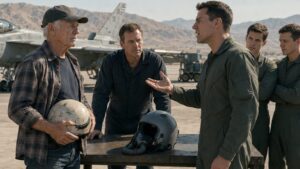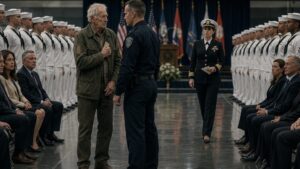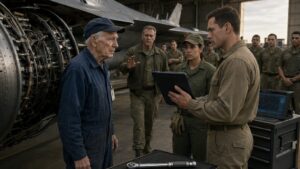
The Old Janitor Picked Up the Fallen Sign While Soldiers Watched in Silence
Chapter 1: The Sign Fell Before Anyone Spoke
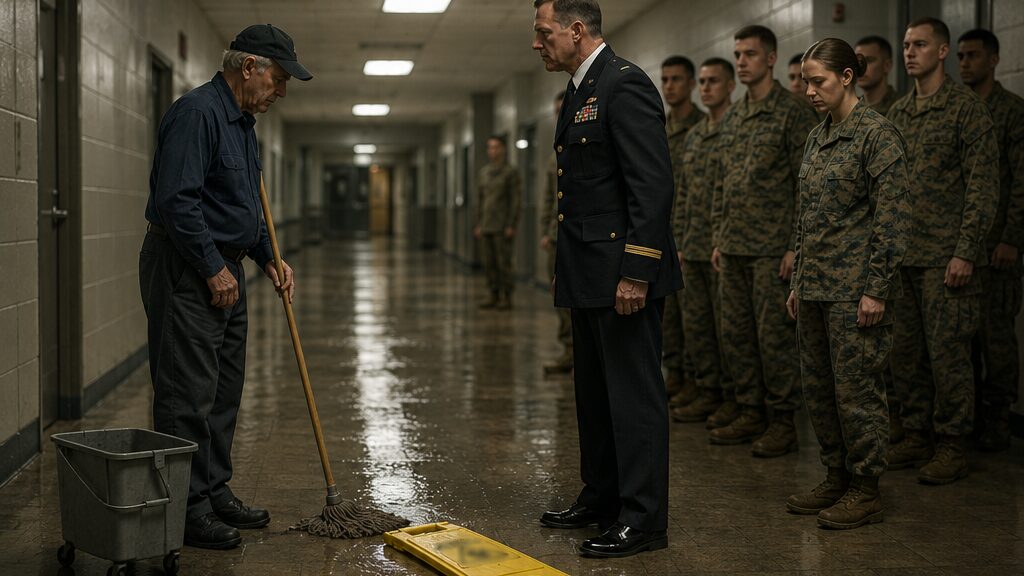
The polished toes of Justin Green’s shoes stopped less than an inch from Edward Nelson’s mop water.
Edward saw the reflection first. Black leather, straight creases, a dress uniform darkened in the wet shine of the hallway floor. The shoes stood inside the pale line where Edward had not yet pulled the mop back. A younger man would have warned him. A louder man would have said, Careful, sir, it is still wet.
Edward only tightened his hand around the wooden handle.
Behind the officer, a line of recruits in camouflage had gone quiet. Their boots had been tapping a loose rhythm a moment earlier, restless from early formation and too little sleep. Now they stood still beneath the fluorescent lights, watching the old man in the dark blue work shirt and cap as if he had become part of their lesson.
Justin Green looked down at the floor, then at the mop bucket, then at Edward.
“This corridor was supposed to be clear by zero six hundred.”
Edward glanced at the wall clock. One minute past six.
“Yes, sir,” he said.
He had started at the far doors at 5:12, the way he always did. First sweep, then spill check along the baseboard, then water line along the drain, then the caution sign set just before the tile changed color. Not in the middle where people ignored it. Not against the wall where it looked decorative. Just before the reflection broke, where a boot might still choose another path.
He had done it that way for nine years.
Justin’s jaw tightened. His decorations were sharp and clean across his chest, each one catching the overhead light. He was younger than the lines around his eyes wanted him to be, and he carried command like a weight he expected other people to notice.
“There are recruits moving through this hall,” Justin said. “You see that?”
Edward looked at the recruits. Most of them looked away. One young woman near the end of the row did not. Her name tape read DAVIS. Her mouth was set in the careful line of someone trying not to react.
“I see them,” Edward said.
“And you thought a wet floor in the main training corridor was acceptable?”
Edward lowered his eyes to the mop strands resting in the gray water. He had not left the floor wet because he was careless. The drain near the center seam had sweated again. It did that when the building heat kicked on early and the pipes under the old tile warmed faster than the slab. A patch no bigger than a folded newspaper would return even after he dried it twice.
That was why the sign was out.
Justin turned his head slightly, enough for the recruits to hear him better. “This is exactly how accidents happen. Somebody decides their small job does not matter.”
The words crossed the hallway without needing to be loud. Edward felt them land, one by one, on the old places inside him that no uniform had ever protected.
Small job.
He moved the mop back half a step, keeping the bucket behind him so no recruit would have to step around both. The yellow caution sign stood near Justin’s right side, bright as a warning flare against the wet tile. Edward had wiped it clean fifteen minutes earlier. The hinge stuck unless opened fully. One corner had been repaired with clear tape after a recruit cracked it the previous winter.
Justin took a step closer.
His heel caught the edge.
The sign rocked once.
Edward saw it tilt and knew, before it fell, exactly how it would sound. Cheap plastic clapped against wet tile, louder than it should have been. The black letters flashed: CAUTION WET FLOOR. Then they lay faceup beneath the officer’s shadow.
No one moved.
The recruits stared. A few eyes dropped to the sign, then flicked back to Edward. The hallway seemed to hold its breath.
Justin looked at the fallen sign as if it had confirmed something. “Pick it up.”
The order was not necessary. Edward was already bending.
His knees did not like the motion anymore. The left one locked halfway down, sending a small spark of pain up his thigh. He kept his face still. One palm touched the floor for balance. The water was cold under his skin.
A memory tried to rise with the smell of detergent and old tile, but Edward pressed it back. This hallway. This morning. These children in uniform. That was enough.
He lifted the sign by its taped corner. A smear of black polish marked the edge where it had skidded. He wiped the plastic once with his sleeve, opened the hinge until it locked, and set it not where it had fallen, but two inches forward, slightly angled toward the flow of boots.
The young woman at the end of the line watched his hand.
Edward straightened slowly. His back complained, but he did not touch it. He returned his fingers to the mop handle and stood beside the sign, not behind it.
Justin’s eyes narrowed. “You understand why this is a problem?”
“Yes, sir.”
“You understand that if one of my people goes down in this hallway, that is not a mop-bucket problem. That is a readiness problem.”
Edward could have told him about the drain. He could have told him about the work order that never became a work order because the maintenance desk had changed systems and nobody wanted another noncritical repair before inspection. He could have said that the sign had been upright until a polished heel made it otherwise.
He saw the recruits waiting for his answer. Young faces, tired faces, faces still learning which silences were discipline and which were fear.
“I understand,” Edward said.
Justin stepped back, but not far enough to clear the water. “Your name?”
Edward looked at him then. Not sharply. Not proudly. Just enough.
“Edward Nelson.”
Justin repeated it toward a recruit holding a clipboard near the front. “Nelson. Civilian custodian. Add him to the incident notes.”
The recruit hesitated.
Justin turned. “Now.”
The pencil moved.
Edward did not look at the clipboard. He looked at the yellow sign, because the recruits still had to pass, and two of them were shifting their weight as if the hallway had become a place they wanted to escape quickly.
“Line moves left,” Edward said, his voice low.
Justin looked back at him.
Edward pointed with the mop handle, not at the officer, but at the dry strip along the wall. “Left side is dry.”
For a second, no one seemed sure whether the old janitor had permission to direct them. Then the first recruit stepped left. The others followed, boots passing along the narrow dry lane Edward had left for exactly that reason.
Samantha Davis passed last.
She slowed near the sign, not enough to break formation, just enough for her eyes to drop. Edward saw what she saw: a dark boot print in the thin film of water beside the spot where the sign had fallen. Not his old rubber sole. Not the broad recruit tread. A polished officer’s print, sharp at the heel, pointed toward the sign’s taped corner.
Her eyes lifted to Edward’s.
He gave her nothing. No nod. No plea. No invitation.
She kept walking, but her face had changed before she turned the corner.
Chapter 2: The Report Made Silence Look Guilty
Karen Mitchell placed the incident report beside Edward’s timecard before he had taken off his cap.
The paper lay too cleanly on the metal desk, squared with the edge, the way people arranged things when they did not want to touch them twice. Edward stood in the doorway of the facilities office with his lunch pail in one hand and the damp cuff of his work shirt cold against his wrist.
Karen did not sit.
“That came over from training command twenty minutes ago,” she said.
Edward looked at the top line first. INCIDENT: UNSAFE WET FLOOR CONDITION IN MAIN TRAINING CORRIDOR. Then his own name beneath it. NELSON, EDWARD. CIVILIAN CUSTODIAL STAFF.
He set his lunch pail on the chair instead of sitting in it.
Karen was in her fifties, with a clipped voice and reading glasses that spent most of the day on top of her head. She had managed three buildings, two budget cuts, and more complaints than the base commander would ever hear about. She was not unkind. She was tired in the way people became tired when every problem had to be solved with one less person than it required.
“There’s a photo attached,” she said.
Edward turned the page.
The yellow sign lay flat on the hallway floor.
In the picture, it looked abandoned. No boot print showed clearly. No angle explained how it had fallen. The mop bucket sat behind him, half visible at the edge of the frame. Edward himself was caught bending toward the sign, cap low, one hand braced on the tile.
He looked smaller in the photograph than he had felt.
Karen watched his face. “They’re saying the sign was not properly positioned.”
Edward did not answer.
“Edward.”
He lifted his eyes.
“I know you,” she said. “You label spare mop heads by wing and replace frayed cord on vacuum cleaners nobody else notices. You are not sloppy.”
The word struck him more sharply because she meant it kindly.
He folded the report back to its first page. “Recruits got through.”
“That is not what they’re asking.”
“What are they asking?”
Karen let out a breath through her nose and finally sat. “Whether your procedure created a slip hazard during training movement. Whether you failed to secure the area. Whether we have civilian staff working around recruits without adequate supervision.”
Edward’s mouth tightened. “That last part is not about the floor.”
“No,” Karen said. “It is about inspection week.”
Through the thin office wall came the squeal of a cart wheel from the storage bay. A maintenance crew member cursed softly at a stuck drawer, then went quiet. Edward kept his eyes on the report, on the box where someone had written: CAUTION SIGN OBSERVED DOWN.
Observed down. Not knocked down. Not stepped into. Observed.
Karen slid another page from a folder. “I looked for your drainage notes.”
Edward knew what was coming before she said it.
“You wrote them on shift logs.”
“Yes.”
“Not formal repair requests.”
“I gave them to the desk.”
“The old desk,” Karen said. “Before they moved everything to the digital system.”
He remembered the announcement about the new system. A young technician had come through with a tablet and a smile and said it would make everything faster. Edward had asked whether the old handwritten logs would be entered. The technician had said, “Eventually,” which on a base meant no one would look at them unless something broke.
Karen rubbed the bridge of her nose. “I found two notes from last month. Main corridor, center seam sweating after heat cycle. You wrote that?”
“Yes.”
“And before that?”
“Plenty.”
“But not where command will count them.”
Edward looked past her to the shelf where the old binders leaned against a box of replacement bulbs. Their spines had curled from years of hands and dust. He had trusted those binders because paper stayed where it was put. He had been wrong about that before and had apparently decided to be wrong again.
Karen softened her voice. “You should write a statement.”
“I can write that the floor was wet.”
“That is not enough.”
“It is true.”
“Truth can be too small,” she said.
Edward looked at her then.
Karen seemed to regret the words, but she did not take them back. She tapped the photo with one finger. “This picture tells a story. If you do not tell the rest, they will use this one.”
In the photo, his hand was inches from the sign. He could almost feel the cold water again. The strain in his knee. The recruits watching. Justin Green’s voice cutting through the corridor.
Somebody decides their small job does not matter.
Edward put the page down.
Karen leaned back. “Did Captain Green touch the sign?”
Edward did not move.
Her eyes sharpened. “Edward.”
“He was close to it.”
“That is not what I asked.”
“No.”
“Did he knock it over?”
Edward picked up his cap and turned it once in his hands. The brim had a thread loose along the edge. He pressed it flat with his thumb.
“Man had recruits in front of him,” he said.
Karen gave a humorless laugh. “That is exactly when a man ought to be careful.”
Edward did not smile.
She pushed the report toward him. “If you will not say it for yourself, say it because this could come back on my department. We have three custodial slots open and two people doing five routes. If they decide civilians are a liability around training movement, I lose more than a hallway.”
There it was: not cruelty, not even blame. Pressure. A building full of people pushing weight downhill until it reached the oldest man with a mop.
Edward took the pen from her desk. His fingers rested on it, but he did not write.
“I set the sign where it needed to be,” he said.
Karen waited.
“The drain sweated again. I dried it twice. Put the sign forward of the seam.”
“Write that.”
He wrote it. Slowly. In block letters.
He did not write that Justin’s boot had marked the tile near the taped corner. He did not write that the officer had ordered him to pick up what the officer’s own step had disturbed. He did not write that every recruit in the hallway had learned something in that silence, though he did not yet know what.
Karen read the statement when he finished. Her expression fell before she could hide it.
“This does not protect you.”
“It says what I did.”
“It does not say what happened.”
Edward capped the pen. “Sometimes those are different.”
Before Karen could answer, her computer chimed. She turned toward the screen. The message opened in the reflection of her glasses, and Edward saw her shoulders stiffen.
“What is it?” he asked.
Karen read it once, then again.
“Captain Green is requesting you be removed from recruit-occupied corridors until the inspection is complete.”
Edward looked through the open office door toward the hallway where his cart waited, the mop handle leaning against it, the yellow sign folded on the lower shelf.
Karen’s voice dropped. “He wants you off your route by tomorrow morning.”
Chapter 3: A Recruit Remembered the Wrong Detail
“The mop guy got benched.”
Samantha Davis heard it before she saw who said it. The words bounced off the barracks corridor between the scrape of locker doors and the thump of boots hitting tile. Someone laughed with a mouth full of toothpaste foam. Someone else added, “Guess the sign was too advanced.”
Samantha kept tying her boot.
The lace went tight across her knuckles, then tighter. She forced herself to loosen it before she cut off feeling in her foot. Around her, recruits moved with the nervous speed of people who had learned that being late could turn one mistake into everyone’s punishment.
“He just stood there,” another recruit said. “Captain Green lit him up and he froze.”
Samantha pulled the lace through the final loop.
Froze was not the right word.
She had seen people freeze in training. Their faces emptied. Their hands forgot what hands were for. The old custodian had not done that. He had lowered himself to the wet floor as if every inch mattered. He had picked up the sign by its damaged corner, wiped the scuff with his sleeve, opened the hinge all the way, and set it at an angle no one else would have chosen unless they knew exactly where the danger began.
But Samantha said nothing.
A recruit by the sink slapped a towel over his shoulder. “I heard they put his name in the report.”
“Good,” someone said. “That floor was slick.”
Samantha stood too quickly. Her locker door snapped shut louder than she meant it to.
The talking stopped for half a second. Not because she outranked anyone. She did not. Because silence could be a weapon in a room full of people trying not to be noticed.
She grabbed her cap. “Formation in four.”
That was all she said.
Outside, morning light had not fully reached the training wing. The hallway where it had happened was blocked by a temporary rope, though the rope sagged in the middle and did nothing a sign would not have done better. A maintenance cart stood near the wall, but not Edward’s. This one had no taped handle, no neatly coiled extension cord, no yellow sign wiped clean enough to shine.
Samantha’s squad slowed as they approached.
Captain Justin Green stood near the center seam with a clipboard. His dress uniform was gone; today he wore duty fatigues, sleeves exact, jaw already set for inspection. Beside him, another officer held a tablet.
“We are documenting statements from personnel present yesterday morning,” Justin said. “Brief, factual, no speculation.”
The squad arranged itself along the wall. Samantha ended up third from the front.
Justin began with the recruit who had carried the clipboard. “You observed the caution sign down?”
“Yes, sir.”
“You observed wet floor conditions?”
“Yes, sir.”
“You observed Mr. Nelson in the immediate area?”
“Yes, sir.”
The answers came fast. Clean. Safe.
Samantha looked at the floor.
The tiles had dried overnight, but a faint dull patch remained near the center seam. The overhead lights reflected in long white bars except where the patch interrupted them. Yesterday, Edward had placed the sign just before that break in the reflection.
Not beside the mop bucket.
Not where the photo showed it after it fell.
Before the patch.
Her pulse gave one hard beat.
Justin moved down the line. “You saw the sign down?”
“Yes, sir.”
“You saw the custodian pick it up?”
“Yes, sir.”
“Did you observe anyone else handling the sign?”
“No, sir.”
Samantha’s turn approached with the steady pace of a closing door.
She remembered the boot print. The polished heel mark in the water near the taped corner. She remembered Edward’s eyes meeting hers and giving her nothing to hold onto. No plea. No signal. No permission.
Justin stopped in front of her. “Recruit Davis.”
“Yes, sir.”
“You were present when the corridor was halted?”
“Yes, sir.”
“You observed the caution sign down?”
Her mouth went dry.
Every answer before hers had made the hallway smaller. Every yes had turned the photograph into truth.
“I observed it down after you stepped in, sir.”
The corridor changed.
Not loudly. No one gasped. No one looked around like civilians in a movie. The change came in the way shoulders locked and eyes fixed forward too hard.
Justin’s expression did not move. “Repeat that.”
Samantha swallowed. “The sign was upright when I first saw it. It was down after you stepped in closer to Mr. Nelson.”
The officer with the tablet looked at Justin.
Justin’s voice stayed even. “Are you stating that I touched the sign?”
“I’m stating what I saw, sir.”
“That is not an answer.”
“It was upright,” Samantha said, and hated how small her voice sounded. “Then it was down.”
Justin watched her for a long second. She could not tell whether he was angry at her, at Edward, or at the fact that the hallway had begun refusing to stay simple.
“Did you see my foot make contact with the sign?” he asked.
Samantha saw the boot print again. The edge of it. The direction.
“No, sir,” she said.
Something like relief passed behind his eyes, but it hardened immediately into command. “Then keep your statement to what you directly observed.”
“Yes, sir.”
He moved on.
The squad breathed again, but Samantha did not. Her answer had not saved anyone. It had only opened a crack wide enough for pressure to get through.
After formation, the recruits were sent toward the side stairwell to avoid the roped corridor. Samantha should have followed. Instead, she slowed near the bend where the hallway turned toward storage.
A faint squeak came from beyond the rope.
Not the wheel of the replacement cart. This sound was lower, uneven, familiar after only one morning: a cart with one bad caster being guided carefully so it would not rattle near offices.
Samantha stepped around the corner.
Edward Nelson stood in the restricted hallway with a mop in his hands.
He had no bucket beside him, only a folded towel, a small spray bottle, and the yellow sign opened at his feet. The rope that was supposed to keep people out was tied behind him. He was working close to the center seam, drying a patch of tile that had appeared again though no one had walked there.
He looked up and saw her.
For a moment neither of them spoke. Then Edward placed the mop head exactly over the dull break in the reflection and drew it back in one slow line.
“You’re not supposed to be here,” Samantha said.
Edward looked down at the wet tile, then at the sign.
“No,” he said. “But they are.”
Chapter 4: The Hallway Had Been Warning Them
Edward opened the storage cabinet with the key he was no longer supposed to use.
The lock gave its familiar dull click, and the narrow metal door shuddered against his hand. Inside, five yellow caution signs leaned in a careful row, each one wiped clean, each one marked with a strip of tape and black block letters.
MAIN CORRIDOR.
EAST STAIRS.
MESS HALL ENTRY.
GYM THRESHOLD.
LAUNDRY TURN.
The signs were not new. One had a cracked hinge. One had a corner repaired with two neat layers of clear tape. One had a faded shoe mark across the word CAUTION that Edward had never been able to scrub away. They looked, in the cabinet’s weak light, less like equipment than like old sentries waiting for orders.
Karen Mitchell stood behind him with her arms folded.
“You are supposed to be off this route,” she said.
Edward took the sign marked MAIN CORRIDOR and set it against the wall. “I know.”
“And yet here you are, opening my storage cabinet before breakfast.”
“You gave me the key.”
“Before Captain Green told command he wanted you out of recruit areas.”
Edward looked at the key in his palm. The brass had worn smooth around the hole where it hung from his belt each morning. “Do you want it back?”
Karen exhaled, frustrated because he had given her the one answer she did not want to say yes to.
“No,” she said. “I want to know why Recruit Davis found you in a restricted hallway with a mop.”
Edward closed the cabinet but did not lock it. “Floor was wet.”
“That corridor was roped off.”
“Rope does not dry tile.”
Karen stared at him for a moment. Then she stepped past him, took the sign he had set down, and turned it so she could read the taped label.
“You labeled them by hazard point,” she said.
“By where people stop seeing.”
“What does that mean?”
Edward picked up a folded towel from his cart. “People see a sign in the middle of a hallway. They walk around it once. After that, it becomes furniture.”
He moved toward the main corridor. Karen followed, her shoes clicking sharply against the dry tile until they reached the bend where the reflection changed. The rope still hung across the entrance, tied to two rolling stanchions. Behind it, the hallway looked clean enough to embarrass anyone who had complained.
Then Karen saw the dull patch.
It sat near the center seam, not a puddle, not a spill, just a slick breath of water where the tile lost its shine. Edward stepped around it without looking down, as if his feet knew the place better than his eyes.
Karen crouched, touched two fingers to the floor, and rubbed them together.
“It came back again?”
Edward nodded.
“No one has used this hallway since yesterday.”
“No.”
She stood slowly. “Then it is not cleaning water.”
“No.”
Karen looked toward the ceiling, then the wall, then the floor again, as if the building might confess if she looked in the right corner.
“You said heat cycle,” she murmured.
“Steam line runs under this section. Drain does not pull right when the slab warms.”
“How long?”
Edward took the towel, pressed it flat over the wet seam, and set his palm on top. “Long enough.”
“That is not an answer.”
“It is the one I have.”
Karen’s face tightened. She turned back toward storage. “Show me the logs.”
Edward did not move.
“Edward.”
He lifted the towel. A darker rectangle remained beneath it.
Karen lowered her voice. “If you have notes, I need to see them now.”
He knew where they were. Bottom shelf of the storage cabinet, behind the box of mop heads no one ordered anymore because the replacement model had plastic clips that snapped in winter. He had kept the old binders there after the desk changed systems because he hated throwing away anything that still told the truth.
He went back for them.
The first binder came out with a cough of dust. Then another. Then a stack of loose shift sheets clipped together by month. Karen cleared a space on the worktable with one sweep of her forearm, pushing aside a cracked soap dispenser, a box of gloves, and two rolls of caution tape.
Edward placed the binders down.
Karen opened the top one.
The pages were filled with block letters, dates, initials, supply counts, spill notes, burned-out bulbs, backed-up sinks, loose screws, and small repairs done before anyone could complain. Edward watched her turn past years of his handwriting. He did not like seeing it under someone else’s eyes. Writing things down had always felt safer than saying them, but safer did not mean private once the paper was needed.
Karen stopped.
“Main corridor seam damp after morning heat,” she read. “Sign placed forward of break in reflection. Recommend drain check.”
She flipped back.
“Same note. Three weeks earlier.”
Another page.
“Again.”
Edward stood with both hands resting on the cart handle.
Karen’s lips thinned. “Why did you keep putting recommend instead of submitting an emergency repair?”
“Was not an emergency.”
“A recruit almost slipped.”
“Almost.”
“That is not the standard.”
“It used to be.”
Karen looked up.
Edward said nothing more.
She searched another folder. A loose pink form slid out and fluttered to the floor. She picked it up, then froze.
“This one has my initials.”
Edward looked away.
Karen read the date. “Eight months ago.”
“You had a meeting that morning.”
“I told you I would enter it later?”
“You said you would look at it.”
Karen sank into the metal chair by the worktable. The paper shook once in her hand before she flattened it with her palm.
“I forgot.”
Edward did not correct her. Forgot was too simple. The facilities office ran on triage. Roof leaks beat hallway seams. HVAC failures beat cracked tile. Command complaints beat old men with handwritten notes. Karen had not thrown the warning away. She had done something more ordinary. She had put it in a pile.
Karen found two more forms with her initials. One had a coffee ring across the corner. One had a sticky note still attached: ENTER AFTER INSPECTION.
Her face changed as she read it.
“This was not all on you,” she said.
Edward picked up the MAIN CORRIDOR sign and wiped the already clean face with his sleeve.
Karen stood. “Listen to me. This matters. They are using one photo to say you made a dangerous hallway. These logs show the hallway has been warning us for months.”
Edward’s thumb paused over the taped corner of the sign.
The hallway had been warning them.
He did not like the way the sentence entered him. It found old ground.
Karen gathered the forms. “I am taking these to command.”
“No.”
She turned. “No?”
“Make copies.”
“Fine. I will make copies.”
“Copies for facilities. Originals stay here.”
“This is not about your filing preference.”
“No,” Edward said. “It is about papers disappearing when people do not like what they say.”
Karen did not answer immediately. The anger in her face shifted, not gone, redirected partly at herself.
“Edward,” she said, “why did you not push harder?”
He looked past her to the roped hallway. A pair of recruits appeared at the far end, saw the rope, and turned back. One of them stepped close to the wet seam before noticing the sign. Edward’s body moved half a step before his mind caught up.
Karen saw it.
“You act like that floor is alive,” she said.
Edward rested the sign just forward of the slick patch. “No. Just patient.”
A voice sounded behind them.
“Mr. Nelson.”
Justin Green stood beyond the rope, clipboard under one arm. He looked first at the sign, then at Karen, then at the open binders on the worktable visible through the storage doorway.
His expression tightened.
Karen straightened. “Captain Green.”
“I was told Mr. Nelson had been removed from recruit corridors.”
“He was showing me a recurring facilities hazard.”
Justin stepped around the rope but stopped before the wet patch. Edward noticed that he did not look down until after he had stopped.
“A safety review has been scheduled,” Justin said. “Tomorrow morning. Training room B. Facilities, command, and involved personnel.”
Karen held the forms closer to her chest. “That seems fast.”
“Inspection team arrives the day after. Command wants the matter settled.”
Edward looked at the yellow sign. Settled meant a piece of paper would be written clean enough for someone else to stop asking.
Justin’s eyes fixed on him. “Mr. Nelson will answer publicly this time.”
The word publicly moved through the hallway like a second rope being tied across Edward’s path.
Karen began, “Captain—”
Edward lifted one hand. Not to silence her. To stop her from spending words he had not yet earned.
Justin turned to leave, then glanced once at the sign labeled MAIN CORRIDOR.
“For everyone’s sake,” he said, “bring whatever records you think matter.”
After he walked away, Karen set the copied forms on top of the binder and looked at Edward with something sharper than concern.
“What happened to you,” she asked, “that made a wet floor feel like this?”
Edward kept his eyes on the sign until the reflection broke around it.
Chapter 5: The Old Warning Was Never About Floors
Edward stopped at the memorial alcove before he touched the mop.
The training wing was almost empty, but the alcove light stayed on all night. It shone over a narrow glass case holding unit photographs, folded ceremony programs, challenge coins, and a small row of names etched into a dark plaque. Most people passed it quickly unless they had visitors to impress or time to waste before a briefing.
Edward did not look at the whole plaque.
He looked at one name.
His hand went to his shirt pocket, then stopped. The folded paper inside had softened at the creases over years of being opened and closed, though he rarely opened it anymore. He had told himself that carrying it was habit. A man his age had plenty of those. Keys on the left, pen in the right chest pocket, towel folded twice, sign checked before bucket moved.
But habits were only memories that had learned to work with their heads down.
Behind him, a shoe squeaked on tile.
Edward turned.
Samantha Davis stood at the edge of the alcove, cap in her hands, as if she had entered a room she was not sure she was allowed to breathe in.
“I didn’t mean to follow you,” she said.
Edward waited.
She swallowed. “That’s not true. I did. I just didn’t mean to get this close.”
He almost smiled. Almost.
“You should be with your unit.”
“They released us after evening prep.” Her eyes moved to the plaque, then quickly away. “Captain Green said there is a review tomorrow.”
“Yes.”
“He asked whether I had been talking to you.”
Edward’s hand left his pocket. “What did you say?”
“I said no.”
He looked at her.
Samantha’s face colored. “I mean, not about the report. Not really. You said, ‘But they are.’ That was it.”
“That was enough to be misunderstood.”
“I know.”
The quiet after that was not empty. It held the hum of lights, the distant thud of a door, the soft settling noise of an old building trying to cool itself.
Samantha nodded toward his pocket. “Is that about the hallway?”
Edward looked down. A corner of the folded paper showed above the fabric.
“No.”
“Then I shouldn’t have asked.”
“No,” he said. “You shouldn’t have followed.”
She took the correction without flinching. That made him like her less comfortably than he wanted to. Young people were easier when they were careless. You could keep them at a distance by fixing what they overlooked. It was harder when they started seeing.
He pulled the paper out before he could change his mind.
It was not a medal citation. Not a commendation. Not a photograph of a young Edward in uniform, though one existed somewhere in a box he had not opened since his wife’s sister mailed it to him after a funeral.
It was a maintenance warning.
The paper had once been white. Now it was yellowed along the folds. The top line was faded but still readable: TEMPORARY WALKWAY MARKER REQUIRED NEAR SOUTH VEHICLE BAY.
Samantha read it without touching.
“Vehicle bay?”
Edward folded the paper once along its old crease. “Long time ago.”
“During your service?”
He did not answer.
Her eyes went to the plaque again, and this time she found the name he had been avoiding. Her expression changed carefully, the way a recruit’s face changed when a drill instructor dropped a joke and everyone had to decide whether laughing was safe.
“You knew someone there,” she said.
Edward looked at the plaque.
The name was not large. None of them were. That was the mercy and cruelty of plaques. They made all losses the same size.
“He was nineteen,” Edward said.
Samantha’s hands tightened around her cap.
The memory did not come all at once. It never did. It came in pieces that had no respect for order.
A motor pool before dawn. Steam off concrete. A temporary walkway shifted aside because equipment needed moving. A warning marker folded and leaning where nobody would see it in time. A young soldier laughing at something someone had said behind him. Edward’s own voice telling a sergeant the route needed to be blocked, then letting the answer stand when the sergeant said they were running late.
Running late. Always the cleanest excuse.
“It was not my order,” Edward said.
Samantha said nothing.
“That is what I told myself first.”
The lights hummed above the plaque.
“I saw the marker was wrong. I reported it. Man above me said leave it until after movement. I had rank enough to make noise, not enough to make it easy. So I let it be someone else’s call.”
He could feel the old concrete under his boots again. Not this tile, not this polished hallway, but rougher ground, colder air, engines too loud, one shouted warning swallowed by metal.
“He slipped?” Samantha asked softly.
Edward folded the paper smaller. “He stepped where he should not have stepped because the warning was where it did no good.”
She looked down at the yellow caution sign sitting beside his cart near the alcove entrance.
“That is why you place them that way.”
Edward’s throat tightened in a way he did not permit to reach his face.
“That is why I do not place them wrong.”
Samantha looked back at him. “And why you went into the hallway after they told you not to.”
He slid the paper into his pocket. “A rope tells people the hallway is closed. People trust ropes until they need to get through.”
“And signs?”
“People ignore signs unless they are where the decision happens.”
She was quiet for a moment. Then she said, “You should tell them tomorrow.”
Edward picked up the mop handle from the cart. “Tell them what?”
“That you warned them. That the drain was bad. That the sign was up. That Captain Green stepped near it before it fell.”
His grip tightened.
Samantha noticed. “I’m not saying you have to attack him.”
“Words do not care what you meant after they leave your mouth.”
“Neither does silence.”
The sentence surprised both of them.
Samantha looked as if she might apologize. Edward almost let her.
Instead, he set the mop head down and pushed it across the already dry tile. “Who taught you that?”
She gave a small, uneasy breath. “You did, I think.”
The mop strands whispered over the floor.
For a moment, Edward imagined handing her the folded warning, letting someone else carry it into the review room, letting a younger voice say what his had never learned to say without opening old ground. Then he saw the cost of it in her face. A recruit standing between an officer and an old man’s memory, trying to make herself large enough for both.
No.
He had done that once too. Let the younger one stand where the warning should have stood.
Edward leaned the mop against the wall.
“You speak only what you saw,” he said.
“But—”
“What you saw. Not what you think. Not what you feel sorry for. Not what you want fixed.”
She stiffened at that, hurt flashing before discipline covered it.
“I’m not doing this because I feel sorry for you.”
“No,” he said. “You are doing it because you are angry. That can trip you same as water.”
Samantha looked toward the main hallway. “Then what are you going to do?”
Edward touched the pocket where the old paper rested.
He had carried it through wars that had ended on calendars but not in his hands. He had carried it through jobs where men younger than his son called him chief until they learned he had no rank anymore. He had carried it into this base, this hallway, this quiet work where he could put warnings where decisions happened.
“I am going to answer what they ask,” he said.
“That may not be enough.”
“No.”
The honesty of that one word seemed to unsettle her more than any story he had told.
A door opened at the far end of the wing.
Both of them turned.
Justin Green stood under the exit sign, one hand still on the push bar, his eyes moving from Samantha’s face to Edward’s pocket, then to the mop leaning unused against the wall.
For once, he did not speak immediately.
Samantha snapped upright. “Sir.”
Justin walked toward them with slow, measured steps. His gaze flicked to the memorial plaque, then away as if he did not want whatever meaning it held to enter the conversation.
“Recruit Davis,” he said, “you seem to spend a great deal of time near restricted hallways.”
“I was on my way back, sir.”
“From a private conversation with involved civilian staff before a command review.”
Edward stepped forward before Samantha could answer. “She followed a question. Not me.”
Justin’s eyes settled on him. “And did you answer it?”
Edward could feel the folded paper against his chest like an old burn.
“Not all of it,” he said.
Justin looked from one of them to the other, and Edward saw the decision forming in his face: not certainty, but suspicion hardening because it had nowhere else to go.
“Then save the rest for tomorrow,” Justin said. “Both of you.”
Chapter 6: The Review Asked the Wrong Question
The yellow sign sat on the training room table like evidence against a man who had spent his life setting it upright.
Edward saw it before he saw the chairs, before the base commander at the far end, before Karen Mitchell with a folder pressed flat beneath both hands, before Samantha Davis standing near the wall with her eyes forward and her jaw tight. The sign had been cleaned, folded, and placed in the center of the table. Its taped corner faced Edward.
Someone had wiped away the boot scuff.
He did not know why that bothered him more than the report.
“Mr. Nelson,” the base commander said. “Take a seat.”
Edward sat at the end of the table nearest the door. Not because anyone told him to, but because old habits chose exits. Justin Green sat across from him, uniform exact, notebook open, pen squared with the page. He did not look at Edward at first. He looked at the commander, then at the safety inspector, then at the report, as if the right order of attention could keep the room orderly.
Karen slid a copy of the maintenance notes toward the center.
The base commander glanced at them but did not pick them up. “We are here to determine whether the corridor condition on Tuesday morning resulted from custodial procedure, facilities failure, training movement, or a combination of factors. Keep answers brief and factual.”
Brief and factual.
Edward placed his hands on his knees beneath the table.
Justin began first, as if the room had leaned toward him without being asked.
“At approximately zero six hundred, I encountered Mr. Nelson in the main training corridor with an active wet floor. A caution sign was down. Recruits were present. I halted movement and instructed the hazard be corrected.”
He did not lie. That was the shape of the trouble. He arranged true pieces until they pointed at someone else.
The safety inspector made a note.
Karen pushed the maintenance folder farther forward. “The corridor has a documented recurring moisture issue along the center seam.”
The inspector opened the folder, scanned one page, then another. “These are handwritten shift logs.”
“Yes,” Karen said. “And internal facilities notes.”
“Were formal work orders entered?”
Karen’s mouth tightened. “Not consistently.”
Justin’s pen stopped.
Edward looked at Karen then. She did not look away. Shame had made her face pale, but she held her place.
The base commander turned to Edward. “Mr. Nelson, did you place the sign before recruits entered the hallway?”
“Yes.”
“Where?”
Edward pointed to the folded sign. “Forward of the seam. Angled toward traffic.”
“Why?”
“Because that is where they decide where to step.”
The safety inspector looked up.
Justin leaned back slightly. “The question is whether the sign was properly securing the wet area, not philosophy.”
Edward’s hands remained still on his knees.
The commander glanced at Justin. “Let him answer.”
Edward looked at the table, not at Justin. “Wet spot returns at the seam. People walking from the east doors see shine too late if the sign sits beside the bucket. It has to sit before the reflection breaks.”
The inspector wrote something down.
Karen’s eyes flicked to Edward, surprised perhaps that he had said that much.
Justin opened his notebook. “When I entered, the sign was on the floor.”
“Yes,” Edward said.
“Then it was not securing anything.”
“No.”
“Mr. Nelson, did you or did you not have responsibility for that sign?”
Edward looked at the taped corner. “Yes.”
Justin’s voice stayed controlled, but there was pressure under it. “And when observed by command personnel, it was down.”
“Yes.”
The room accepted the answer too quickly. Edward felt it, the way a floor could seem dry until the wrong angle of light found the slick. His silence had always been useful to someone. Sometimes even to him.
The commander turned toward Samantha. “Recruit Davis, step forward.”
Samantha moved to the table’s edge. She did not look at Edward. Good, he thought. Speak to the room, not to me.
“You were present in the corridor?” the commander asked.
“Yes, sir.”
“You observed the sign down?”
“Yes, sir.”
Justin’s pen moved once, a small mark of confirmation.
The commander continued. “When did you first observe it down?”
Samantha’s throat worked.
Edward looked at the table.
“It was flat after Captain Green stepped in,” she said.
The pen stopped.
The safety inspector looked up fully now. Karen’s fingers tightened on her folder.
Justin turned toward Samantha. “Recruit, be precise.”
“I am trying to be, sir.”
“Did you see my foot strike the sign?”
“No, sir.”
“Then you cannot state causation.”
“No, sir.”
“What can you state?”
Samantha stood so straight her shoulders seemed painful. “That the sign was upright when I first saw Mr. Nelson. Captain Green moved closer. The sign was down after that.”
Justin’s face did not change, but Edward saw his hand close around the pen. It was not rage. Not exactly. It was a man watching control leak out through a seam he had insisted was sealed.
The base commander asked, “Did anyone else observe this?”
No one answered.
There were other recruits in the room, but none stepped forward. Edward did not blame them. A young life could be shaped by one morning of being too noticeable.
Justin’s voice cut in. “With respect, sir, a recruit’s uncertain visual impression does not change the fact that Mr. Nelson’s department failed to process known facility concerns through proper channels.”
Karen flinched because part of that was true.
The safety inspector lifted the handwritten notes. “There were warnings.”
“Warnings not entered into the system,” Justin said. “Which means training command had no actionable notice. I am responsible for recruit movement. I cannot manage hazards that facilities keeps informal.”
Karen’s jaw set. “You had a visible sign in front of you.”
“And it was down.”
The room went quiet.
There it was again. The photograph’s story. The short truth. The easy one.
The commander rubbed one hand over his chin. “Mr. Nelson, why were these warnings not pushed through formal channels?”
Edward had expected the question. That did not make it easier.
He could have said the system changed. He could have said the desk lost forms. He could have said Karen was overworked, the building old, the repair budget thin, the inspection calendar louder than common sense. All true. All incomplete.
“Because I thought noting them was enough,” he said.
Justin looked at him quickly, as if the admission proved what he needed.
Karen whispered, “Edward.”
He did not turn.
The commander leaned forward. “You understood the condition repeated?”
“Yes.”
“And still relied on a caution sign?”
“I relied on drying it. Then the sign. Then watching movement.”
“Were you assigned to watch movement?”
“No.”
“Then why were you there after being removed from that corridor?”
The room waited.
Edward saw again the old vehicle bay, the marker folded wrong, the sergeant saying after movement, the young soldier stepping where the warning should have stopped him. He felt the folded paper in his shirt pocket now, though no one in the room could see it.
“Because the floor was wet,” he said.
Justin exhaled through his nose.
The commander’s voice cooled. “Mr. Nelson, that answer is not sufficient for this review.”
Edward looked at the yellow sign.
Not sufficient. He had built years out of insufficient answers because they were clean, and because clean answers did not ask him to remember too much.
The safety inspector turned one of the forms around. “Captain Green, your report states the corridor was unsecured on arrival. Did you observe the sign before it was down?”
Justin’s eyes moved to Samantha, then to Edward, then back to the inspector.
“I observed an active hazard,” he said.
“That was not my question.”
Justin’s jaw shifted. For the first time since Edward had known him, the officer looked less like a man issuing correction than a man trapped inside one.
“I do not recall seeing it upright,” Justin said.
Samantha’s face fell slightly, not because she was surprised, but because the words had the slippery neatness of something made to survive paperwork.
Karen pushed the photo forward. “This image was taken after the sign was already down. It proves nothing about placement before that.”
“It proves the condition when command personnel intervened,” Justin said.
Edward heard the word intervened and something tired inside him finally refused to stay seated.
He placed one hand on the table.
Not hard. Not loud.
But everyone looked.
The yellow sign was within reach. He did not touch it yet. His fingers rested on the table beside its taped corner.
“Before anyone signs that paper,” Edward said, “I need to correct one thing.”
Chapter 7: Edward Chose Truth Without Revenge
Edward touched the sign instead of the report.
The room waited for him to accuse someone.
He could feel that waiting as clearly as he felt the taped corner beneath his fingers. Karen had turned toward him with the tight hope of someone who needed the truth to come out clean. Samantha stood with her hands at her sides, eyes forward, but her face had gone pale with the effort of not looking at Justin. The safety inspector’s pen hovered over the page.
Justin Green sat across from Edward, still as a man bracing for impact.
Edward opened the yellow sign.
The hinge clicked once. It was a small sound, plastic on plastic, but it carried across the training room. He set the sign upright on the table between them. The black letters faced no one directly. They stood at an angle, warning the whole room without choosing a side.
“This sign was not placed beside my bucket,” Edward said. “It was placed before the wet seam.”
The base commander leaned back. “Go on.”
Edward looked at the sign, not at the commander. “The floor does not show danger the same from every direction. Recruits coming from the east doors see light on the tile. They do not see the slick until they are already on it. So the sign goes where their choice happens.”
Justin’s mouth tightened. “That does not explain why it was down.”
“No,” Edward said. “It does not.”
The room shifted around the word. Edward felt Samantha’s eyes move to him, quick and startled.
He reached into his shirt pocket and took out the folded paper. He did not open it yet. He set it beside the sign, careful to keep his hand flat so no one would see it shake.
“I had written warnings before,” he said. “Some here. Some long before here.”
Karen’s face changed. She knew the first part. Not the second.
The safety inspector pointed gently toward the paper. “Is that related to this facility?”
“No.”
“Then we may not need—”
“We do,” Edward said.
It came out firmer than he expected. Not loud. Firm enough that the inspector stopped.
Edward unfolded the paper. Its old creases resisted, then gave. TEMPORARY WALKWAY MARKER REQUIRED NEAR SOUTH VEHICLE BAY. The words looked weaker beneath the fluorescent light than they had in his pocket, but they were still there.
“This was not from this base,” Edward said. “It was from when I wore a uniform.”
Justin looked up fully then. Edward saw the flash of calculation, then discomfort, as if the officer had just remembered the old man in front of him had existed before the mop.
Edward did not give him rank. He did not offer a unit. He did not turn the paper into proof of worth. He only placed one finger below the top line.
“There was a marker placed wrong near a vehicle bay. I reported it. Man above me said we would move it after equipment passed through. We were behind schedule.”
The room was so quiet he could hear the air vent.
“A young soldier stepped where the marker should have stopped him.” Edward folded the paper once, then stopped. “I told myself I had done my part because I had said something. That was easier than admitting I knew saying something was not always enough.”
Samantha’s eyes lowered.
Edward kept his voice steady with effort. “Since then, I place warnings where they are useful. Not where they look neat. Not where they make the hallway pretty. Where the next person still has time to choose.”
The base commander studied him. “Mr. Nelson, are you saying your actions Tuesday were shaped by a prior service incident?”
“I am saying I know the cost of a warning that does no good.”
No one wrote for several seconds.
Then Justin spoke. His voice had lost some of its edge, but not all of it. Pride was not a switch a man turned off just because shame entered the room.
“Mr. Nelson, no one here questions your concern for safety.”
Edward looked at him. “You did.”
Justin’s face flushed.
The words had been plain, not sharp, which made them worse.
Edward let the silence hold only a moment before he continued. “You saw me as a problem in your hallway. I let you.”
Justin’s eyes narrowed in confusion.
“I did not correct you when you made it smaller than it was,” Edward said. “That is on me.”
Karen drew in a breath, but Edward did not look at her. He had not said it to protect Justin. Not entirely. He had said it because it was true, and because he was tired of handing parts of the truth to other people while keeping the heaviest piece for himself.
The commander asked, “What exactly needs correction in the report?”
Edward turned the old warning facedown. “The report says the corridor was unsecured. It was not. The sign was placed before the seam. The floor had a recurring moisture problem. Facilities had informal notice. I dried it twice before formation movement.”
The safety inspector wrote quickly.
“And the sign falling?” the commander asked.
Edward’s fingers rested near the taped corner.
This was the place where he could have done it.
He could have described Justin’s polished heel catching the edge. He could have repeated the officer’s order to pick it up. He could have told the commander how the recruits watched, how the room learned to treat an old man by the way a younger one spoke to him. He could have made Justin feel, for one minute, the public smallness he had handed to Edward.
Justin knew it. Edward saw that he knew. The officer’s gaze had fixed on the old sign, and his throat moved once.
Edward said, “The sign was upright before Captain Green stepped close. It was down afterward. Recruit Davis saw that. I did not see the exact contact.”
Samantha looked up.
Justin stared at Edward.
“That is what can be written,” Edward said. “No more than that.”
The safety inspector’s pen paused, then moved again.
Karen’s face softened with something like pain. She understood what he had left out. Maybe everyone did.
Justin’s hand opened slowly around his pen.
The commander turned to him. “Captain Green, did your report include the possibility that the sign was upright before you approached?”
“No, sir.”
“Why not?”
Justin looked at the report in front of him. For the first time, Edward saw the younger man not as a uniform, not as a voice in a hallway, but as someone trapped beneath his own need to appear certain. The inspection team was coming. A recruit had almost slipped. The building had failed. Facilities had failed. His formation had been delayed. And he had found the one person in the corridor with no rank to push back.
Because he was afraid, Edward thought. Not of me. Of looking like he did not have control.
Justin’s answer came slowly. “Because I believed the essential issue was the active hazard.”
The commander did not speak.
Justin’s eyes lifted toward Edward, then away. “And because Mr. Nelson appeared unwilling to explain.”
Karen’s jaw tightened.
Edward said, “I was unwilling.”
Justin looked back at him, startled again.
“That did not make your report complete,” Edward said.
The words landed without anger. Justin lowered his eyes.
“No,” he said. “It did not.”
The commander folded his hands. “Should the report be amended?”
Justin sat still.
The room waited again, but differently now. Not for Edward to accuse. For Justin to decide whether truth had to be dragged out of him or could still be carried.
His fingers moved toward the report. He pulled it closer. The pen in his hand left a small dot of ink where it touched the page too hard.
“Yes, sir,” he said.
The word did not redeem him. It only opened the first narrow door.
“What should be amended?” the commander asked.
Justin looked at the photo of the fallen sign. Edward could see the moment he stopped seeing evidence and began seeing a cut-out piece of a larger failure.
“The statement that the corridor was unsecured on arrival should be revised,” Justin said. “It should reflect that a caution sign may have been properly placed before my approach. The recurring moisture issue should be included. Facilities logs should be attached. Recruit Davis’s observation should be added.”
The commander waited.
Justin’s face tightened again, but he did not retreat. “And my report should not imply Mr. Nelson was careless.”
The room held still.
Edward looked down at his hands. The fingers were old, the nails cut short, a half-moon of floor wax caught near one thumb. They had held rifles, tools, railings, folded papers, mop handles, and once, years ago, the shoulder of a young soldier he could not keep from shaking. Today they held nothing.
That felt strange.
The base commander nodded to the safety inspector. “Make those changes.”
Karen closed her eyes briefly.
Samantha let out a breath so small only Edward seemed to hear it.
The commander turned to Edward. “Mr. Nelson, the drainage issue will be reviewed separately. Until then, the corridor remains restricted except for necessary safety maintenance.”
Edward nodded.
Justin’s pen moved across the report. One line, then another. He crossed out the phrase UNSAFE CONDITION CAUSED BY CUSTODIAL PROCEDURE with a hard, deliberate stroke.
Edward watched him do it.
The sound of the pen scraping paper reminded him, unexpectedly, of a mop head drawing water back from the edge of a seam. Not fixing the floor. Not yet. But changing where the danger could hide.
Justin slid the amended report toward the commander, then looked across the table.
“Mr. Nelson,” he said, and the title sounded awkward in his mouth because this time it was not a correction. “I should have asked before I wrote.”
Edward did not give him absolution. That was not his to hand out so cheaply.
“Yes,” he said.
Justin accepted the answer with a small nod.
Then he reached for the report again, crossed out one more sentence, and wrote above it in careful block letters: SIGN PLACEMENT DISPUTED; PRIOR HAZARD LOGS ATTACHED.
Chapter 8: No One Stepped Over the Sign Again
Edward found the hallway dry before his shift began.
For a moment, that bothered him.
He stood at the east doors with his cart beside him, one hand on the mop handle, looking down at the center seam where the shine usually broke. The tile reflected the overhead lights in clean white bars from wall to wall. No dull patch. No sweating line. No small, patient warning rising out of the building before anyone else arrived.
A temporary work order sleeve had been taped to the wall near the drain.
DRAINAGE INSPECTION SCHEDULED. ROUTE MONITORING REQUIRED UNTIL REPAIR.
Karen had underlined REQUIRED twice.
Edward touched the paper with two fingers, then let it be. He had already read it three times in the facilities office. He had read the corrected incident report too, though Karen pretended not to watch him while he did. His name still appeared in it. So did Justin’s. So did Samantha’s careful statement. The photograph remained attached, but now it was no longer the whole story.
That should have been enough.
Still, Edward opened the yellow sign.
The hinge clicked.
He placed it forward of the seam.
Old habits did not surrender just because paper caught up with them.
He had just reached for the mop when footsteps approached from the west end. Measured, not hurried. Edward looked up.
Justin Green came down the corridor in duty uniform, clipboard under one arm. Two recruits followed several paces behind him carrying training binders. Samantha Davis was not with them.
Justin slowed before the sign.
Edward watched the choice happen.
There was plenty of room to step over it. Officers stepped over things all the time: cords, buckets, quiet workers, warnings that seemed meant for someone else. Justin’s foot started forward, then stopped. He shifted left, took the dry lane along the wall, and walked around the sign.
The recruits followed the same path without needing instruction.
Justin stopped beside Edward, leaving the sign between them but not like a barrier.
“Morning,” he said.
Edward nodded. “Morning.”
The word hung there, plain and unadorned. No apology wrapped inside it, no ceremony, no performance for the recruits behind him.
Justin glanced at the work order on the wall. “Inspector says the repair crew will open the seam Monday.”
“So I heard.”
“They want the corridor monitored until then.”
“Yes.”
Justin looked at the dry floor. “Training movement will reroute unless you or facilities clear it.”
Edward turned the mop handle once in his hands. The old instinct rose: say little, keep work simple, do not let conversation become another floor to slip on.
But silence had cost too much when he used it as a wall.
“Good,” he said.
Justin accepted the small answer. Then, after a pause, he added, “If my people need to cross before repair, they will wait for your call.”
One of the recruits behind him glanced at Edward, then at Justin, as if checking whether he had heard correctly.
Edward did not look away from the officer. “My call?”
“For the floor,” Justin said.
The words were not grand. They were not enough to erase the hallway, the sign on the table, the report written too cleanly at first. But they changed the shape of the morning.
Edward looked down at the yellow sign. “Then they wait until I say left side is dry.”
Justin nodded once. “Understood.”
He moved on.
This time, no one stepped over the sign.
Later that morning, Karen came by with a tablet in one hand and a paper folder in the other because she still did not trust either system by itself.
“They offered me an extra temp for two weeks,” she said.
Edward wrung out the mop. “Take it.”
“I did.”
“Good.”
She stood near the wall, watching him work. “They also said you can transfer to the administrative wing until the repair is complete. Less foot traffic. No recruits. No Captain Green.”
Edward pushed the mop along the dry tile, though there was nothing left to pull back. “Administrative wing has carpet.”
“That is your objection?”
“Hard to mop carpet.”
Karen gave him a look over the top of her glasses. “Edward.”
He rested the mop in the bucket.
She lowered her voice. “You do not have to stay in the hallway to prove anything.”
“I know.”
“Do you?”
He looked toward the center seam. “I am not staying to prove.”
“Then why?”
Before he could answer, a group of recruits approached from the east end, slowing automatically when they saw the sign. Samantha Davis was at the front of the line. She carried a second yellow caution sign under one arm.
Karen stepped back.
Samantha stopped before the seam, not crossing into Edward’s work area. “Facilities said this one was for the west approach.”
Karen raised an eyebrow. “Facilities said?”
Samantha’s face colored. “The maintenance crew member by the storage room said it was spare.”
Edward looked at the sign. It had no tape label yet. Its surface was scuffed, but the hinge held.
Samantha offered it with both hands, not like a gift, not like tribute, but like equipment that belonged where it could do good.
Edward took it.
“West approach,” he said.
“Yes, sir.”
He looked at her when she said sir. She seemed to realize it a second after it left her mouth. Her posture stiffened as if she had made a mistake.
Edward only turned the sign around and inspected the hinge. “Needs tape on the corner.”
“I can get some.”
“Storage cabinet. Second shelf.”
Karen made a small sound that might have been protest, but she let it go.
Samantha returned with the tape. Edward tore off a strip and handed it to her. She knelt near the sign and smoothed the tape over the cracked corner carefully, pressing the edge flat with her thumb the way she had seen him do.
The other recruits waited without complaint.
Edward placed his sign forward of the seam on the east approach. Samantha placed hers on the west.
For the first time, the hallway was warned from both directions.
That afternoon, the repair crew marked the tile with blue tape. The safety inspector came through, took measurements, asked Edward where the moisture first appeared, and listened when he answered. Not politely pretending. Listening. Karen stood nearby with the tablet open and entered the formal work order while the inspector watched.
Justin passed once more near the end of Edward’s shift. He was alone this time.
He stopped at the sign.
“I spoke to the squad this morning,” he said.
Edward rinsed the mop head in the bucket.
“About what?”
“About reports. About not making facts fit pride.”
Edward squeezed the mop through the wringer. Dirty water ran down in gray ribbons.
Justin looked at the floor. “I did not mention you.”
“Good.”
That made Justin look up.
Edward set the mop aside. “It was not a lesson about me.”
Justin’s face worked around something he was not used to saying. “No. I suppose it wasn’t.”
He stood a moment longer, then stepped around the sign again and walked on.
Edward watched until he turned the corner.
Near the end of the day, Karen returned with the transfer form. She held it out without pushing.
“Administrative wing is still available.”
Edward read the first line. TEMPORARY ROUTE REASSIGNMENT. His name beneath it, typed correctly. For years he had believed being unseen was safer. Then the hallway had shown him what unseen warnings became.
He handed the form back.
“After the repair,” he said.
Karen studied him. “You are sure?”
“No.”
That surprised her into a laugh, soft and short.
Edward looked at the two yellow signs standing at opposite ends of the seam. “But I am staying.”
The building settled around them. Recruits moved through the side lane when cleared. A maintenance crew member rolled a toolbox past and waited until Edward waved him through. No one made a joke about the signs. No one kicked one aside to save a step.
When the hallway emptied, Edward took one last pass with the mop.
The floor was dry. The seam was marked. The work order was official. Still, he moved slowly, pulling the mop toward himself, checking the reflection for breaks. At the west end, Samantha’s repaired sign stood squarely in place. At the east, his old taped sign faced the doors.
Edward returned the mop to the bucket and rested both hands on the handle.
For a moment he saw another marker in another place, folded wrong, waiting too far from the decision. The old paper in his pocket seemed lighter than it had that morning. Not gone. It would never be gone. But lighter.
He walked to the east sign and adjusted it two inches left.
Then he stepped back.
A recruit approaching from the far end slowed, saw the sign, and chose the dry lane without being told.
Edward waited until the young man had passed. He waited until the sign remained standing.
Only then did he set the mop aside.
The story has ended.