The HOA Chairman Brought Machinery To Crush My Child’s Treehouse, But He Crossed The Wrong Line
Chapter 1: The Notice Nailed Beside The Child’s Ladder
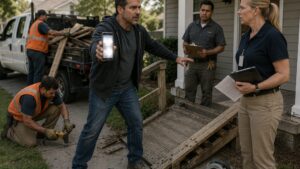
The orange tag was nailed through the lowest rung of the ladder.
Samuel White saw it before he saw the split in the wood, before he saw the bent nail head glinting in the early light, before the words on the paper made sense. The tag fluttered against the tiny treehouse he had built three summers ago, its corner tapping the ladder like a finger that had come to accuse him.
VIOLATION NOTICE.
The letters were black and too large for something attached to a child’s ladder.
Samuel stood in the wet grass with his coffee cooling in one hand and his work gloves tucked under his arm. He had come outside to tighten the railing where the left post had loosened after a week of wind. He had already laid out the small wrench, the sandpaper, the replacement screws, and the tin of weather sealant on the bottom step. His plan had been quiet. Half an hour before the neighborhood woke. Fix the railing. Oil the hinge on the little trapdoor. Pull the grass away from the edge of the metal gate where it always grew too thick.
Instead, someone had driven a nail into the treehouse.
The treehouse was barely taller than Samuel’s shoulder. It sat on four posts at the edge of the front lawn, tucked behind the hand-forged metal gate that framed the narrow walkway. The roof was patched from cedar scraps. The tiny porch rail was crooked in a way Samuel had never had the heart to correct because the child had helped hold it while he drilled. A blue wind chime hung from a hook near the ladder, made from bottle caps, beads, and two bent spoons that rang softly whenever the breeze moved through.
The orange tag covered half of it.
Samuel set his coffee on the grass.
He did not pull the notice free. Not at first. He read it where it hung.
Unauthorized exterior structure. No HOA building permit. Failure to remove within forty-eight hours will result in mechanical removal at homeowner expense.
Mechanical removal.
His eyes stopped there.
Behind the treehouse, half-hidden by trimmed boxwood and a strip of white gravel, the small gray relay box sat at the lawn edge. Most neighbors thought it belonged to utilities. Some did not notice it at all. Samuel noticed it every Saturday when he cut the grass, because he trimmed around it by hand and kept the line clean where the lawn met the narrow strip beyond the gate.
He had always known where that line was.
The front door opened behind him.
“Samuel?” Ruth White stepped onto the porch in house shoes and a faded cardigan, her hair pulled back without care for neatness. “What is it?”
He did not answer quickly enough.
She crossed the porch, then the walkway, then stopped where the wet grass would soak her shoes. Her gaze moved from Samuel’s face to the orange tag.
“Oh no,” she said.
Samuel took the hammer from the tool bag by the ladder and slid its claw under the nail head, moving carefully so he would not tear the rung worse than it already was.
“Don’t yank it,” Ruth said, too sharply. “Take a picture first.”
“I did,” he said.
She looked at his empty hands.
“With my eyes.”
“Samuel.”
He exhaled through his nose, set the hammer down, took out his phone, and photographed the notice, the nail, the split wood, the whole treehouse, and the gray relay box in the background. Then he pulled the nail with slow pressure. The tag came away stiffly. Under it, the wind chime swung loose and gave one thin, trembling sound.
Ruth wrapped her cardigan tighter.
“Anthony?” she asked.
Samuel turned the paper over. At the bottom, above the printed HOA seal, was the signature of Anthony Hill, chairman of the community association.
Ruth shut her eyes for a second. “Of course.”
The child’s bedroom window was still dark upstairs. Samuel looked toward it before folding the notice. It had been months since the child had woken from bad dreams and asked if the house was locked. Months since Samuel had found small toys lined against the bedroom door as if they could hold trouble back. The treehouse had been his answer when words stopped working. A place visible from the porch. A place high enough to feel like an adventure, low enough to be safe. A place where the child could pull up the little trapdoor and decide who came in.
Ruth had painted the door yellow. Samuel had pretended not to notice when the paint ran down one hinge.
“It’s small enough to move,” Ruth said.
Samuel looked at her.
“I’m not saying he’s right,” she added. “I’m saying he’s Anthony. You know what he does when people embarrass him.”
“The treehouse isn’t embarrassing him.”
“It is if he says it is.”
Samuel held the notice between his fingers. The paper was damp at the edges. “It’s a child’s treehouse.”
“It’s on the front lawn,” Ruth said. Her voice softened, which somehow made it worse. “He fined Debra for a birdbath because it was visible from the sidewalk. He made the Taylors repaint their mailbox twice. He doesn’t stop because something is cruel.”
Samuel glanced across the street. Debra Jones’s curtains shifted and then stilled. She had seen. Of course she had seen. In this neighborhood, a garbage can left out past nine was a public event by noon.
Ruth stepped into the grass despite her shoes. “We can move it to the backyard today. We’ll tell the child it’s getting upgraded.”
“No.”
“Samuel.”
“No.”
The word came out quiet, but Ruth heard the weight inside it.
She looked at him for a long moment. “I don’t want the child watching men tear it apart.”
“Then they won’t.”
“You can’t just say that.”
“I’m not just saying it.”
Ruth’s eyes went to the relay box. Then to the gate. Then back to him. “Is this about that old folder again?”
Samuel folded the notice along its printed crease.
“Anthony has papers,” she said. “He always has papers. And people believe papers when they’re loud enough.”
“I have papers too.”
“You’ve never shown anyone.”
“That was the point.”
Her mouth tightened. “No. The point was supposed to be peace. We were supposed to be done with strangers at the door and raised voices in the yard.”
Samuel’s jaw shifted. He could still see the child sitting on the porch three summers ago, knees pulled under a too-large shirt, watching him dig the first post hole. He had promised no one would take that little place away once it stood. He had said it lightly then, with sawdust on his arms and a pencil behind his ear. He had not known how serious a child could become while accepting a promise.
Ruth touched the split rung.
“He nailed it to the ladder,” she said.
Samuel nodded.
“That’s not a notice,” she said. “That’s a message.”
He slid the orange tag into his back pocket and picked up the nail. He did not throw it away. He placed it on the porch rail beside the coffee, point facing inward.
From somewhere down the block came the faint squeak of a measuring wheel.
Ruth heard it too. Her shoulders sank.
Samuel turned toward the garage and pulled open the side door. Inside, the air smelled of oil, wood dust, and old cardboard. He passed the lawn mower, the paint cans, the bicycle with a flat tire, and the long steel crowbar leaning against the workbench where he had left it after resetting a stone border.
He did not touch the crowbar.
He reached instead for the metal file box on the top shelf.
Its latch stuck, as it always did. He worked it loose with his thumb. Inside were tax papers, old inspection receipts, a yellowing survey, and a brown folder with a handwritten label in black marker.
Relay box parcel / USPS strip.
Samuel carried it to the workbench and opened it beneath the bare bulb.
The first page was older than the HOA, older than Anthony’s chairmanship, older than half the houses on the street. A deed copy. A narrow marked strip. A boundary description most people had skipped because it was inconvenient and dull and seemed to belong to another time.
Ruth stood in the doorway behind him.
“What are you going to do?” she asked.
Samuel looked at the map, then through the garage window at the tiny treehouse with the yellow door and the blue wind chime moving lightly in the morning air.
“This time,” he said, “I’m going to make him read the line.”
Chapter 2: The Chairman Measures A Kingdom In Inches
Anthony Hill arrived at eight-thirty with a clipboard, a measuring wheel, and the smile he wore when he wanted witnesses.
He stopped at the edge of Samuel’s driveway and looked at the treehouse as if it had insulted him first.
“There it is,” Anthony said, loudly enough for the nearest porches to hear. “A structure pretending to be a toy.”
Samuel was kneeling beside the gate, tightening the small decorative hinge that had begun to sag. He did not stand immediately. He turned the screw one last half turn, tested the gate, then rose and wiped his hands on a rag.
Anthony’s shoes were polished black, too formal for a sidewalk inspection. His polo shirt was tucked with military care. The HOA badge clipped to his belt was not official in any meaningful sense, but Anthony wore it where people could see it. Behind him, two committee volunteers lingered with tablets, trying to look busy and invisible at the same time.
Across the street, Debra Jones stood near her mailbox with a watering can she had no reason to hold. Another neighbor slowed while walking a dog. A garage door halfway down opened, stopped, and remained open.
Anthony noticed every pair of eyes and enjoyed them.
“Mr. White,” he said, “you received the notice.”
“I received the tag you nailed into my child’s ladder.”
Anthony glanced at his clipboard. “The association uses approved posting methods for noncompliant structures.”
“You split the rung.”
“The rung is attached to the violation.”
Samuel felt Ruth behind the screen door more than he saw her. He kept his voice level. “You could have put it in the mailbox.”
“That would imply this is correspondence.” Anthony’s measuring wheel clicked as he pushed it one slow rotation along the sidewalk. “This is enforcement.”
The wheel made a crisp little tick for every inch. Tick. Tick. Tick. It moved past the edge of Samuel’s driveway, along the strip of grass, toward the hand-forged gate.
Samuel watched the wheel more than Anthony. It crossed the sidewalk seam, reached the first uneven patch near the relay box, and bumped lightly against a raised root.
Anthony lifted it over the root as if granting the ground permission to continue.
“Front-lawn structures require approval,” Anthony said. “Exterior modifications require approval. Decorative gates require approval. Visible play equipment requires approval. And anything that alters neighborhood appearance requires approval.”
“It’s three feet off the ground.”
“It has a roof.”
“It has a child’s name scratched under the railing.”
Anthony’s smile thinned. “Sentiment is not a permit.”
A murmur moved across the street. Debra lowered her watering can but said nothing.
Samuel looked at her. She looked down at her flowers.
Anthony followed the glance. “Mrs. Jones understands the value of compliance. Don’t you, Debra?”
Debra’s hand tightened around the can handle. Her yard still had two pale circles where the birdbath used to stand. She had removed it after Anthony fined her for “unapproved ornamental water display.” Everyone knew it. No one mentioned it.
“I don’t want any trouble,” Debra said.
Anthony nodded as if she had agreed with him instead of confessed fear. “That is what keeps a community healthy.”
Samuel stepped from the gate to the grass. The relay box sat behind Anthony’s left shoulder, dull gray, waist-high, with peeling service stickers and a tiny metal lock. Samuel had painted around it years ago when he restored the gate. He had never touched the box itself.
Anthony pointed at the treehouse. “You have until tomorrow morning to remove it voluntarily.”
“The notice said forty-eight hours.”
“I expedited it.”
“You can’t expedite your own notice.”
“I can when the homeowner displays contempt.”
Samuel let that settle in the air. A few more neighbors had drifted out now, drawn by Anthony’s voice. Ruth opened the screen door but stayed on the porch.
Anthony began rolling his measuring wheel across the edge of Samuel’s lawn. “Six feet from sidewalk. Four feet from common-control strip. Two feet from utility access. No variance. No application. No review. No approval. It’s almost impressive how many rules you fit into such a small eyesore.”
The word touched something in Samuel, but he kept his hands open.
“It isn’t an eyesore,” Ruth said from the porch.
Anthony did not turn toward her. “Mrs. White, this is between the association and the deeded homeowner.”
Ruth’s cheeks colored.
Samuel took one step forward. “You’ll speak to her with respect.”
Anthony finally looked pleased. There it was. A crack. Something he could point to later.
“I’m simply stating procedure.”
“You’re standing in my yard insulting my family.”
“I’m standing on association-managed frontage documenting a violation.”
“No,” Samuel said. “You’re not.”
The measuring wheel stopped.
Anthony looked down at it, then at Samuel. “Excuse me?”
Samuel pointed to the gatepost. Not the treehouse. Not the notice. The gatepost. “Your measurement is wrong. The managed frontage doesn’t start where your map says it does.”
Anthony laughed once. “I expected this.”
“You expected the line to move?”
“I expected delay tactics. Every owner who thinks rules are personal eventually discovers paperwork.” He tapped his clipboard. “We have the community plat.”
“And I have the original deed.”
That produced the first real pause.
Debra looked up.
Anthony’s volunteers stopped pretending to type.
Samuel saw the calculation move behind Anthony’s eyes. Not fear. Not yet. Annoyance that the scene had left the path he had prepared.
“The deed does not override association standards,” Anthony said.
“It does when you’re measuring land the association doesn’t control.”
Anthony’s face tightened. “That front strip has been maintained by the HOA for twenty years.”
“Maintained isn’t owned.”
A neighbor’s dog barked once and was hushed.
Anthony lowered his voice, but only slightly. “You are making a public mistake.”
“No. I made a private one. I should have corrected you months ago.”
Ruth shifted on the porch. Samuel felt the sentence land there too. Months ago, when Anthony fined Debra. Months ago, when the mailbox colors became a streetwide warning. Months ago, when Samuel watched Anthony turn small rules into public obedience and told himself his own papers were enough if the trouble ever came to him.
Anthony raised the clipboard again, regaining height through posture. “Mechanical removal has been scheduled.”
The words moved through the neighbors like a cold draft.
Ruth stepped down one porch step. “Mechanical?”
“You’re bringing equipment?” Samuel asked.
Anthony clicked his pen. “Since the structure is unauthorized and the homeowner has indicated refusal, the board has approved removal by licensed crew. Costs billed to your account. Additional fines may apply for obstruction.”
“The board met?”
“Emergency authority.”
“Who voted?”
Anthony’s smile returned, smaller and harder. “You can raise procedural questions at the next open meeting. By then, the violation will be corrected.”
Debra took one half-step forward. “Anthony, maybe if there’s a deed issue—”
Anthony turned his head.
That was all.
Debra stopped. The watering can tipped, spilling water onto her shoe.
Samuel saw her humiliation and hated himself a little for how familiar it felt.
Anthony turned back to him. “I’m not doing this because I dislike children, Mr. White. I’m doing it because one exception becomes ten. Ten become a street full of homemade structures, bad paint, leaning sheds, plastic slides, broken fences. Then buyers notice. Values drop. People ask what the board is doing. Order has to be visible.”
“That’s what this is?” Samuel asked. “Visibility?”
“It is accountability.”
“It’s a treehouse.”
“It is a test.” Anthony looked toward the watching neighbors now, making no effort to hide the lesson. “And tests must be answered.”
Samuel looked at the wind chime. One of the bent spoons turned in the breeze and flashed.
“Then answer this,” Samuel said. “Before you bring equipment anywhere near this yard, review the deed.”
Anthony tucked the clipboard under his arm. “No.”
“You’re refusing to look at the boundary?”
“I’m refusing to reward obstruction.”
Samuel’s voice dropped. “That line matters.”
Anthony stepped close enough that Samuel could smell mint on his breath. “By tomorrow, your kid’s little fort is landfill.”
The street went still.
Ruth made a small sound behind the screen door, not quite a gasp, not quite his name.
Samuel held Anthony’s stare until the chairman turned away first. The measuring wheel clicked back toward the sidewalk, counting inches Anthony believed were his.
Chapter 3: The Map That Proved Less Than It Promised
Samuel laid the HOA map over the deed and watched the lines refuse to become one line.
The kitchen light hummed above him. A roll of transparent drafting paper curled at one corner beneath a coffee mug. Ruth stood on the far side of the table with her arms folded, not because she was angry, though she was that too, but because folding them kept her from touching the papers and making the problem feel more real.
On top was the HOA community plat Anthony had emailed three minutes after leaving, probably to prove he was generous with evidence. The front strip was shaded pale green and marked COMMON-CONTROL LANDSCAPE MAINTENANCE. Under it, Samuel’s older deed showed a narrow, stubborn rectangle at the street edge labeled in formal language that did not care about neighborhood politics.
Reserved federal postal relay access parcel.
The two lines overlapped near the gate.
Not a lot. Not enough for most people to care.
Enough for a machine.
Samuel slid the transparent paper half an inch, checking the gatepost, the sidewalk seam, the relay box, the front corner of the treehouse. The HOA map swallowed them into its green shading. The older deed cut a clean strip around them like a blade.
Ruth leaned closer. “Why does his look newer?”
“Because it is.”
“That’s not comforting.”
“Newer doesn’t mean correct.”
“It does to people who arrive with uniforms and machines.”
Samuel looked up. “They won’t be uniforms.”
“You know what I mean.”
He did. A clipboard could become a uniform if everyone agreed to fear it.
Ruth reached for the photo album on the counter, the one she had pulled from the hallway cabinet while he printed the HOA map. It had fallen open to a picture from three summers ago: Samuel in the yard, younger by exhaustion rather than years, holding a post level while the child sat on the porch steps in striped socks. The treehouse behind him was only a frame then. No roof. No yellow door. No chime.
The child’s face in the picture was serious, almost suspicious, as if joy had become something that needed inspection before acceptance.
Ruth turned the photo toward him.
“You remember that week?” she asked.
Samuel did not need the picture.
He remembered sleeping in pieces. He remembered checking locks twice because the child asked, then a third time because Ruth’s face said she needed it too. He remembered the silence after the hard family season they did not name unless they had to, the way fear could remain in rooms after the reason for it was gone. He remembered buying cedar scraps with money they should have saved because the child had drawn a house in a tree on the back of a grocery receipt and said, almost too quietly, “Could this one have a door that shuts?”
So Samuel built one.
He built the door small and painted it yellow because Ruth said yellow did not look afraid. He hung the blue chime because the child wanted to know when the wind came in. He placed the posts where he could see them from the porch. He measured everything. Especially the line.
“I told the child nobody would take it,” Samuel said.
Ruth’s expression changed. The anger did not vanish, but it lost its sharpest edge.
“You told me you would keep us out of fights too,” she said.
“I tried.”
“You hid.”
The word landed harder because she did not raise her voice.
Samuel looked down at the maps. “I waited.”
“For what?”
“For him to stop before he crossed something he couldn’t uncross.”
Ruth stared at him. “That is not the same as protecting us.”
His phone buzzed. An email from the HOA office. Samuel opened it and found the same plat again, this time with a message from Anthony.
Association records are controlling for enforcement purposes. Your objection is noted and rejected. Any further interference will be considered obstruction.
Samuel typed back with two fingers.
I am requesting review of original deed and federal relay access parcel before any action. Do not bring machinery onto disputed land.
He sent it before Ruth could tell him to soften it.
A reply came less than a minute later.
Denied. Removal proceeds.
Ruth whispered, “He didn’t even read it.”
“No.”
“You need to go there.”
“The HOA office?”
“You need to put the paper in his hand.”
Samuel gathered the deed copy, the plat, the parcel note, and the old service letter that had come with the house closing. He put them into the brown folder and drove three blocks to the community office, a converted model-home garage with a flagstone path and a sign that said WELCOME OWNERS in letters Anthony had approved himself.
Anthony was at the doorway when Samuel arrived, speaking to George Mitchell, a heavyset man in a faded company cap who stood beside a pickup marked only with a magnetic contractor sign. George held a work order. His boots were dusty. His face was not cruel, only tired in the way men looked when a job had already become more trouble than it paid.
Samuel parked and stepped out with the folder.
Anthony saw him and smiled without warmth. “Hand delivery. How dramatic.”
George glanced between them.
“This is the original deed,” Samuel said. “The strip near the relay box is not yours to enforce.”
Anthony did not take the folder.
George frowned. “Relay box?”
“Not your concern,” Anthony said.
“It is if I’m putting equipment near it.”
“You are removing an unauthorized structure from association-managed frontage.”
Samuel held the folder toward George now. “Look at the boundary before you unload anything.”
Anthony stepped between them. “Do not harass my contractor.”
“I’m warning him.”
“You are inventing federal drama to save a playhouse.”
Samuel’s hand tightened on the folder. “You know it isn’t just a playhouse.”
Anthony’s eyes flicked toward the office window where one of his volunteers was watching. His voice lowered, not out of respect, but strategy. “I know exactly what it is. It is a visible refusal. You think if you wrap it in fatherhood, the rules bend.”
“The rules don’t reach it.”
“The association map says otherwise.”
“The map is wrong.”
“Then file an appeal.” Anthony leaned closer. “After removal.”
George shifted his work order. “Mr. Hill, I’d rather not get into a property dispute.”
Anthony turned on him, all chairman again. “You were hired for a cleared enforcement action. Are you declining the job?”
George’s jaw moved. Money, schedule, reputation—Samuel saw them pass across the man’s face. Then George looked away.
“No,” he said. “Just asking.”
“Then ask less.”
Samuel felt the old habit rise in him, the one that told him to take the folder home, make another copy, send another email, let the paper speak when everyone had calmed down. But the folder suddenly felt too light. Paper did not stop men who had decided not to read.
“You bring machinery to that line,” Samuel said, “you’ll be responsible for where it lands.”
Anthony’s smile returned for the benefit of the office window. “There. Threatening language. That will be useful.”
Samuel left before his hands betrayed him.
At home, the child was not in the yard. Ruth had kept the blinds half-closed upstairs. The treehouse stood untouched in the low light, small and yellow-doored, with the blue wind chime turning slowly.
Samuel placed the folder on the kitchen table and sat beside it.
Ruth came in holding her phone. “Samuel.”
He knew from her face it was not Anthony this time.
She turned the screen toward him.
A crew confirmation notice had arrived from the contractor scheduling system, copied to the HOA and homeowner account.
Mechanical removal authorized. Equipment arrival: 9:00 a.m. Plasma cutter. Compact excavator. Gate access required.
Samuel read it twice.
Then he looked through the kitchen window at the gate, the relay box, and the treehouse beyond it.
The line he had wanted Anthony to read was now a place a machine was coming to cross.
Chapter 4: Sparks Before The First Cut
The excavator’s left track stopped so close to the blue wind chime that one of the bent spoons trembled from the engine’s breath.
Samuel stood on the grass between the machine and the treehouse, the brown folder tucked under his arm and the steel crowbar lying behind him beside the porch steps. He had put it there before sunrise, not because he wanted to use it, he had told himself, but because tools belonged where they might be needed.
Now the whole street knew it was there.
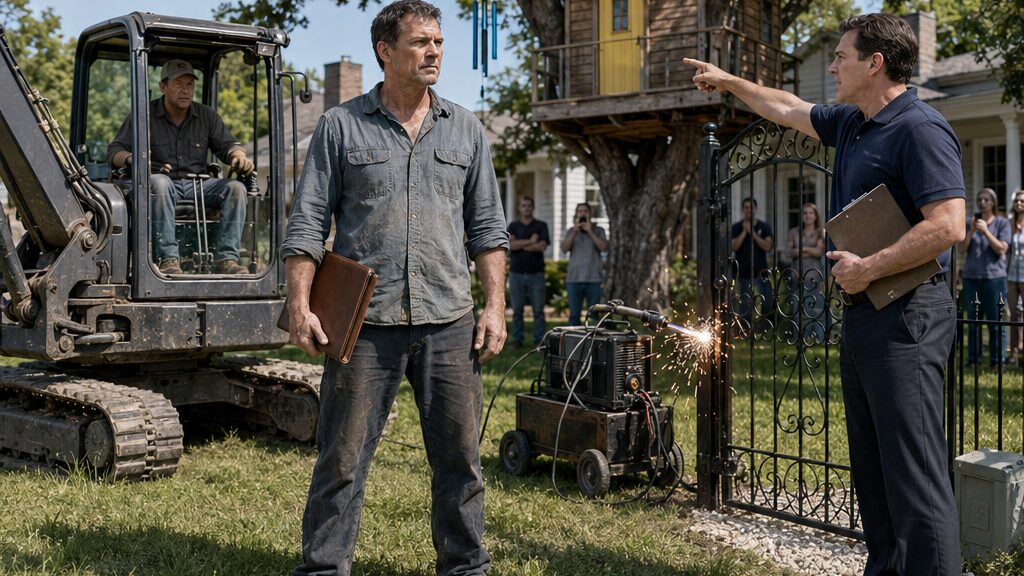
The compact excavator crouched at the curb like a yellow animal, its bucket raised and its hydraulic lines shivering. Behind it, a trailer carried the plasma cutter rig, a tank, hoses, and a wheeled cart with a metal arm folded inward. George Mitchell sat in the excavator cab with both hands on the controls and his jaw tight under the brim of his cap.
Anthony Hill stood beside the gate in polished shoes, untouched by mud, clipboard held flat against his chest. He had brought two crew members, one committee volunteer, and the expression of a man arriving not to solve a problem but to stage an ending.
Ruth stood on the porch. She had taken the child to the back bedroom before the machinery arrived, but Samuel had seen the curtain move upstairs. He did not look again.
“Mr. White,” Anthony called over the engine, “step away from the violation.”
Samuel did not move.
The treehouse looked smaller with the excavator in front of it. Its yellow door seemed almost ridiculous against the machinery, like something drawn by a child on a wall that was about to be painted over. The repaired ladder rung held firm where Samuel had glued and clamped it before dawn. The nail hole was still visible.
George leaned out of the cab. “Sir, I need you clear of the work area.”
“This isn’t cleared,” Samuel said.
Anthony smiled toward the gathering neighbors. “You hear that? He’s decided he outranks the work order.”
Debra Jones stood by her mailbox again, empty-handed this time. Her face was pale. More neighbors had come out than yesterday. Some stood with coffee cups. Some held phones low at their sides, pretending not to record. The street had the hushed energy of people watching something they could later claim they had not encouraged.
Samuel lifted the folder. “George, before you unload anything else, read this.”
George looked at the folder. For one second, Samuel thought he might climb down.
Anthony stepped into the line between them. “The contractor is not here to litigate a homeowner tantrum.”
“He’s here to put a machine on disputed land.”
“Association-managed frontage.”
“Federal relay access strip.”
Anthony’s nostrils flared. “You keep saying that as if repetition changes jurisdiction.”
“You keep ignoring it as if volume changes ownership.”
The committee volunteer gave a small nervous cough and stared at his tablet.
George cut the excavator throttle slightly. The engine lowered from a growl to a rough idle. “Mr. Hill, you said the city cleared this.”
“I said the removal was cleared.”
“With who?”
“With the board.”
“That’s not the city.”
Anthony turned, and the look he gave George was not loud, but it had weight. “Are you refusing the job on the morning of service?”
George’s fingers tightened around the control sticks. “No. I’m saying if there’s a relay box—”
“There are utility boxes in every neighborhood,” Anthony snapped. “If we stopped for every homeowner pointing at gray metal, nothing would get done.”
Samuel opened the folder, pulled the deed copy halfway out, and held it up. The paper moved in the exhaust wind.
“Look at the marked strip,” he said. “It runs from the sidewalk seam to the gatepost. The box is not decorative. Your track is already touching the edge of it.”
George’s eyes flicked down to the grass. The track had pressed a dark, flattened mark into the lawn just inside the white gravel border. Samuel had trimmed that border with hand shears for years. He knew the shape of it better than his own driveway.
Anthony reached for the folder.
Samuel pulled it back.
“You don’t touch it unless you’re going to read it.”
“I’ve read enough,” Anthony said.
“You haven’t read anything.”
Anthony’s gaze swept the neighbors. He lowered his voice, but not enough. “You are making me do this publicly.”
Samuel almost laughed. “You brought the public.”
“I brought procedure.”
“You brought a plasma cutter to a child’s treehouse.”
The cutter operator shifted by the trailer, suddenly interested in checking a valve.
Anthony’s face hardened. “The gate blocks access.”
“The gate opens.”
“It is unapproved decorative metalwork attached near association frontage.”
“My father helped me forge that gate.”
“Then your father should have filed the proper application.”
The sentence moved through Samuel before he could stop it. His father had been dead six years. Anthony might not have known. It did not matter. There were men who used whatever blade their hand found.
Ruth stepped off the porch. “Anthony, enough.”
He turned toward her with official patience. “Mrs. White, please return inside. Heavy equipment presents risk.”
“You are the risk,” she said.
For the first time that morning, the neighbors did not hide their reaction. A low murmur broke, then scattered.
Anthony’s neck reddened above his collar. He lifted the clipboard and spoke to the crew. “Begin with the gate. Open access. Then remove the structure.”
George looked down from the cab. “You want the cutter first?”
“Yes.”
The cutter operator hesitated. “That gate’s pretty close to the box.”
“It’s close to the sidewalk,” Anthony said. “Proceed.”
Samuel walked to the gate and placed one hand on the cool black metal. It was not expensive work. The scrolls were uneven where he and his father had bent them by hand. One side dipped slightly lower than the other. A small leaf shape near the latch had been hammered too thin and still carried the mark of a mistake they had laughed about in the garage.
The cutter operator wheeled the rig forward. The hose dragged across the sidewalk with a rubber scrape. He pulled down his face shield, then paused again.
“Sir,” George called, “maybe we should wait for someone to verify—”
Anthony spun toward him. “The only reason this neighborhood is still worth buying into is because someone enforces standards when other people get sentimental. You were hired to work, Mr. Mitchell. Work.”
George’s mouth closed.
Samuel looked at him. “You heard my warning.”
George would not meet his eyes.
The cutter sparked to life.
A white-blue arc snapped at the end of the torch, bright enough to make several neighbors flinch. The sound was sharper than the excavator, a tearing hiss that seemed to cut the air before it touched metal. The operator raised the torch toward the gate hinge.
Samuel felt the porch behind him, Ruth behind that, the child upstairs where the curtain had moved. He felt the folded deed in his hand and the old habit in his chest telling him to wait one more second, try one more sentence, stay calm enough that no one could call him dangerous.
Anthony stepped close and pointed past Samuel’s shoulder at the little yellow door.
“Your kid’s treehouse doesn’t have an HOA building permit,” he shouted over the cutter. “Crush it!”
The cutter arm dipped toward the hinge.
The excavator engine revved.
Samuel’s hand opened on the gate, and behind him, on the porch step, the crowbar waited.
Chapter 5: The Crowbar In The Track Gears
The plasma cutter’s flame lowered toward the gate just as the excavator track rolled across the white gravel line.
Samuel saw the crossing before anyone else reacted. One steel cleat bit into the trimmed edge of the grass, grinding the border flat, pressing a black track mark into the narrow strip beside the relay box. The machine had moved less than a foot, but that was all it took. The line was no longer an argument on paper. It was a scar in the lawn.
“Stop,” Samuel said.
The cutter kept hissing.
George eased the excavator forward another inch.
“Stop!” Samuel shouted.
Anthony threw one arm toward the crew. “Proceed.”
The torch touched the gate hinge.
Sparks burst outward in a white spray. They bounced off the black metal, scattered across the walkway, and died in the damp grass near the treehouse ladder. Ruth cried out from the porch. The blue wind chime jerked in the hot gust and rang once, thin and wrong under the roar of machinery.
Samuel stepped toward the cutter, but the excavator bucket swung slightly, not at him, not quite, only enough to remind him of mass. George’s face was tight inside the cab. He looked like a man driving through fog, hoping the road was where someone promised it would be.
“George!” Samuel shouted. “That track is on the relay strip!”
George looked down.
Anthony shouted first. “I don’t care whose box that is. Cut the gate.”
The words snapped through the engine noise.
Across the street, Debra raised her phone. Not halfway. Not hidden. Fully raised, both hands around it, recording.
Anthony saw her too late.
“Debra,” he barked.
She flinched, but the phone stayed up.
Samuel looked from her to George, from George to the cutter, from the cutter to the child’s ladder where the orange tag had split the rung. The scene narrowed. The neighbors blurred into color and movement. The engine thudded inside his ribs. The deed folder was under his arm, useless against metal. His voice had run out of places to go.
The cutter bit deeper into the hinge. A glowing line appeared.
Samuel turned and walked to the porch.
Ruth grabbed his sleeve as he passed. “Samuel—”
He pulled free, not roughly but without stopping.
The crowbar lay where he had left it. Heavy steel. Dark, scuffed, practical. A tool for prying roots, lifting stone, breaking what could not be moved by hand.
He picked it up.
The weight steadied him.
Anthony’s mouth moved, but the words were swallowed by the excavator’s rev. Samuel stepped off the porch and crossed the grass. The cutter operator saw him coming and lifted the torch, sparks trailing away. George’s eyes widened.
“Shut it down,” Samuel said.
George froze.
Anthony stepped between Samuel and the excavator track. “Drop that right now.”
Samuel kept walking.
“You threaten my crew with a weapon and you’ll be arrested,” Anthony shouted.
Samuel stopped two paces from him. The crowbar hung at his side. “Move.”
Anthony’s face had lost its performance polish. Up close, Samuel saw sweat at his temple. Fear, maybe. Or anger at being disobeyed where everyone could see.
“You think this proves you’re a father?” Anthony said. “Breaking equipment in front of your child’s window?”
Samuel’s grip tightened.
There it was. The story Anthony would tell. Angry homeowner. Unstable father. Dangerous man with a metal bar. Samuel had feared that shape for years, feared the moment his own anger would become someone else’s proof against him.
He looked up at the bedroom window.
The curtain was still.
Then Ruth stepped into the yard.
“Samuel,” she said, voice shaking but clear. “The line.”
Not stop. Not calm down. Not please come inside.
The line.
Samuel turned from Anthony and ran toward the excavator.
George jerked back in the cab. “Hey! Hey, don’t—”
Samuel did not swing at the glass. He did not swing at a person. He aimed low, at the exposed track assembly where the moving cleats fed under the drive wheel. He had repaired enough machines in his garage, enough belts, enough jammed gears, to know that force at the wrong point could stop a stronger thing.
The excavator lurched another inch.
Samuel planted his foot in the torn grass and hurled the crowbar with both hands.
The steel bar struck the track gears with a sound like a bell being crushed.
For one impossible second, nothing happened.
Then the excavator screamed.
The track seized around the crowbar. Metal teeth climbed, caught, and locked. The cab shuddered violently. George slammed the controls back. The engine revved against itself, coughing hard. A black belt snapped somewhere inside the housing with a flat crack. The machine bucked, dropped one side, and belched thick black smoke from the lower panel.
Neighbors scattered backward.
The cutter operator killed the torch. The white-blue flame vanished, leaving the gate hinge glowing dull orange.
Smoke rolled across the lawn, bitter and oily. The wind chime swung wildly now, ringing and clacking as if shaken by invisible hands.
George threw the cab door open and stumbled down, coughing. “It’s jammed! It’s jammed!”
Samuel stood in the grass with his hands empty.
Anthony stared at the dead machine, then at the neighbors, then at Samuel. His face rearranged itself around opportunity.
“You all saw that,” he shouted. “He attacked the equipment. He attacked a licensed crew.”
Debra lowered her phone only an inch. “Anthony, you told them to ignore the box.”
“I told them to enforce a removal order.”
“You said you didn’t care whose box it was.”
Anthony pointed at her. “Careful.”
That single word did what fines and notices had done before, but this time Debra did not lower her eyes. Her hand trembled around the phone, yet she kept it raised.
Ruth came to Samuel’s side. Smoke drifted around them. She looked at the jammed crowbar wedged deep in the track, then at the black mark carved across the grass.
“You crossed it,” she said to Anthony.
Anthony pulled out his phone.
“No,” Samuel said quietly.
Anthony stabbed at the screen. “Yes. Police. Now.”
George bent near the track, not touching it, staring at the crowbar as if it had appeared from nowhere. “Mr. Hill, you told me the land was cleared.”
“It was.”
“He warned us.”
“He threatened us.”
Samuel picked up the brown folder from where it had fallen near the gate. One corner was bent, but the papers were still inside.
Anthony spoke loudly into his phone. “I need police at Briar Lane immediately. A homeowner has vandalized contracted equipment and threatened an HOA enforcement crew with a steel bar. Yes, he’s still here.”
Ruth looked at Samuel. “Are you all right?”
He did not know how to answer. His shoulders felt too light without the crowbar. His hands had begun to shake, so he folded them around the folder until the tremor disappeared into paper.
From the upstairs window came the smallest movement of the curtain.
Samuel looked away before the child could see his face.
Anthony ended the call and lifted his chin, regaining the shape of authority by force. “You just made this very simple.”
Smoke thickened beside the machine. The dead excavator ticked and hissed. The gate hinge glowed where the first cut had scarred it. The track mark lay across the narrow strip like a signature.
Samuel looked at the relay box, then at the crowbar buried in the gears.
“No,” he said. “You did.”
Down the street, sirens began to rise.
Chapter 6: The Relay Box No One Wanted To Notice
“Step away from the crowbar.”
Officer Andrew Lee’s hand rested near his belt, not on his weapon, but close enough that Samuel understood the first story Andrew had been given.
The excavator still smoked behind them. The steel crowbar remained wedged deep in the track gears, its hooked end jutting out at an ugly angle. The lawn smelled of burned rubber, hot oil, and scorched metal from the gate hinge. The plasma cutter sat silent on its wheeled cart, face shield flipped up, hose coiled like something waiting to strike again.
Samuel stepped back with both hands visible.
Anthony moved at once. “Officer, that’s the man. Samuel White. He attacked the machine after refusing a lawful HOA removal order.”
Andrew held up a hand without looking away from Samuel. “I’ll speak to everyone.”
“He could have killed someone.”
“I said I’ll speak to everyone.”
Anthony’s mouth tightened. He was not used to being paused by a voice that carried actual authority.
Andrew looked at Samuel. “Are you injured?”
“No.”
“Anyone else injured?”
George, standing near the curb with smoke smudged on his cap, shook his head. “No. Machine’s hurt more than me.”
Andrew glanced at him, then at the track. “You operated it?”
George nodded. “Yes, sir.”
“And you?” Andrew asked Samuel. “You threw the crowbar?”
“Yes.”
Ruth made a small sound beside him.
Samuel did not look away from Andrew. He had spent too long being careful to ruin the truth now by decorating it.
Andrew’s expression did not change. “Why?”
Anthony spread his hands. “Because he’s been unstable since yesterday.”
Samuel opened the brown folder. “Because the excavator crossed onto protected land tied to that relay box after they were warned not to.”
Andrew followed his point toward the gray box near the grass edge.
Anthony gave a short laugh. “Protected land. He’s been saying that all morning. It’s homeowner theater.”
He reached for the folder.
Samuel pulled it back.
Andrew stepped between them. “Do not grab documents out of his hand.”
“I’m not grabbing. I’m preventing him from wasting your time.”
“You’re not preventing anything right now.”
For the first time, Anthony had no immediate answer.
Samuel handed the folder to Andrew. Not the whole thing at first. Just the deed copy and the old parcel description. His fingers resisted letting go, and he hated that Andrew might see it as fear rather than care. Those papers had lived in his garage for years, private insurance against public nonsense. Now they were smudged with smoke and grass.
Andrew read the first page. Then the second. His brow drew in slightly.
Anthony watched him and changed tactics.
“Officer, I respect procedure,” he said. “I really do. But you’re looking at an old closing document from a homeowner who just disabled expensive machinery. The association map is current. The board has maintenance control over that frontage.”
“Maintenance control isn’t always ownership,” Andrew said.
Samuel felt Ruth look at him.
Anthony’s lips pressed together.
Andrew crouched near the track mark. He did not touch the machine. He studied the flattened white gravel, the torn strip of grass, the relay box, and the gate. Then he stood and looked at George.
“Did Mr. White warn you about this boundary before the machine moved?”
George wiped one hand down his face. He looked toward Anthony.
Anthony’s stare sharpened.
George looked away. “Yes.”
“More than once?”
“Yes.”
Anthony snapped, “He made vague claims. That is not a legal stop order.”
Andrew turned slightly. “Let him answer.”
George swallowed. “He said the strip by the relay box wasn’t HOA land. He asked me to read the deed. I didn’t.”
“Why not?”
George’s face flushed. “Because Mr. Hill told me it was cleared.”
“It was cleared,” Anthony said.
Andrew’s eyes stayed on George. “Cleared by who?”
George hesitated. “I thought local authorities. But this morning he said the board.”
The neighbors heard that. Samuel could feel the shift behind him. A rustle of bodies, a phone moving, someone whispering and then stopping. The public that Anthony had brought was still there, but it no longer belonged to him.
Anthony stepped closer to Andrew. “The HOA board has emergency enforcement authority. The homeowner was notified. The gate blocked access to the violation. My contractor began authorized removal. Mr. White escalated.”
Ruth said, “You nailed the notice into the ladder.”
Andrew looked at her.
Ruth pointed to the porch rail, where the nail still lay beside Samuel’s cold coffee. “You split the rung. Then you brought that machine.”
Anthony’s jaw tightened. “Mrs. White is emotional.”
Samuel felt his own anger rise again, sudden and clean. He took one step toward Anthony.
Ruth touched his wrist.
Not a grab. A reminder.
Samuel stopped.
Andrew saw it. His eyes moved from Ruth’s hand to Samuel’s face, then back to the folder.
“Mr. White,” he said, “do you have anything showing the relay box is tied to this parcel? Not just a marked strip?”
Samuel removed the old service letter from the folder. It was creased along the same folds it had held since closing. The letterhead was faded, but the route access note remained readable. Federal postal relay equipment. Access strip reserved. No private obstruction or alteration without authorization.
Andrew read it once, then again more slowly.
Anthony laughed too quickly. “That’s a service note. It doesn’t criminalize HOA maintenance.”
“You weren’t maintaining,” Samuel said. “You were cutting a gate.”
“It blocked removal.”
“It stood beside the relay strip.”
“It stood in my jurisdiction.”
Samuel pointed to the track mark. “No. That’s what you wanted everyone to believe.”
Anthony lunged half a step toward the folder. “Give me that.”
Andrew’s hand came up fast. “Back up.”
Anthony stopped, breathing hard.
The street went quiet except for the ticking excavator.
Andrew took his radio from his shoulder. “Dispatch, I need parcel confirmation for a federal postal relay access strip at Briar Lane, near the residential frontage and marked utility relay box. Possible property damage involving contractor equipment. Also request supervisor review.”
Static answered, then a voice.
Andrew stepped closer to his cruiser to hear. Anthony immediately turned on Debra.
“You were recording private enforcement activity,” he said.
Debra held the phone against her chest now, but she did not hide it. “You were in the street.”
“You are opening yourself to board action.”
Her face paled. “For recording my own mailbox?”
“For interfering.”
Samuel looked at Debra. “Send it to Ruth.”
Debra blinked.
“Now,” Samuel said.
Anthony turned. “Do not coordinate evidence.”
Andrew looked back from the cruiser. “Mr. Hill.”
“What?”
“Stop talking to witnesses.”
The word witnesses landed hard.
Debra’s thumb moved across her screen.
Samuel’s phone buzzed in Ruth’s hand a moment later.
Anthony saw it happen. Something desperate crossed his face, gone almost before it arrived. For a second, Samuel saw the man beneath the chairman’s posture: someone who had built himself out of rules because he did not know what he was without people obeying them.
Then Anthony chose the armor again.
“This neighborhood has standards,” he said, loud enough for everyone. “People move here because someone is willing to enforce what others are too weak to confront.”
Samuel looked at the treehouse. The yellow door had not been touched. The chime had finally stopped swinging. Under the ladder, sparks had burned two tiny black dots into the grass.
Andrew returned from the cruiser with his radio lowered.
Anthony stepped toward him instantly. “Good. Then you can have him arrested and we can move forward after documentation.”
Andrew did not look at Samuel first.
He looked at the relay box.
Then the track mark.
Then the scarred gate hinge.
Finally, he looked at Anthony.
“Do not move that equipment,” Andrew said.
Chapter 7: Permit Denied, Power Revoked
A tow crew hooked chains to the smoking excavator while Anthony Hill stood beside it insisting, to anyone still willing to listen, that he was the authority there.
The first chain clanged against the track housing, and the sound made Anthony flinch. He recovered quickly, smoothing the front of his polo as if wrinkles were the emergency. The excavator sagged on one side where the crowbar had locked its gears. Black smoke had thinned to a greasy haze, but the smell still clung to the lawn and the gate and Samuel’s shirt.
“This equipment is part of an active HOA enforcement action,” Anthony said. “You cannot impound it based on a homeowner’s theatrical paperwork.”
Officer Andrew Lee did not raise his voice. “The equipment is not moving until the property issue and damage report are documented.”
“The property issue is fabricated.”
Andrew looked at the relay box. The small gray cabinet stood exactly where it had always stood, dull and unnoticed until that morning, with its peeling service label and its little metal lock. Now two strips of marking tape ran from the sidewalk seam to the gatepost, following the narrow boundary Samuel had traced with his finger across the deed. The tape fluttered low in the grass, a plain bright line separating Anthony’s claims from the place where his machine had gone.
A second patrol car had arrived. A property official stood near Andrew with a tablet, comparing records. He did not look impressed by Anthony’s clipboard.
Samuel stood under the treehouse porch, one hand resting lightly on the ladder rung Anthony’s notice had split. Ruth had come down from the porch and stood beside him. She had not said much since Andrew told Anthony not to move the equipment. Her silence now was different from fear. It had edges.
George Mitchell sat on the curb with his cap in his hands. He had given his statement twice. Each time, he said the same thing: Samuel warned them. Anthony told him to proceed. The relay box was mentioned before the machine crossed the strip.
Anthony had stopped looking at George after the second statement.
Debra Jones crossed the street slowly, holding her phone as if it might burn her.
“Officer Lee?” she said.
Andrew turned.
Debra glanced at Anthony, and for a moment Samuel thought she would fold again. Anthony’s eyes fixed on her with the old pressure, the one that had emptied birdbaths and repainted mailboxes and kept curtains moving without doors opening.
Debra swallowed.
“I have the recording,” she said.
Anthony’s face changed. Not much, but enough.
Andrew held out his hand. “May I see it?”
Debra tapped the screen, found the clip, and handed him the phone. The sound came through thin but clear: Samuel warning about the relay strip; George asking about the box; Anthony’s voice cutting over both of them.
I don’t care whose box that is. Cut the gate.
No one moved while it played.
The property official looked up from his tablet.
Ruth’s hand closed over the ladder rung.
Anthony laughed once, dry and forced. “That is being taken completely out of context.”
Andrew handed the phone back to Debra. “The context is the smoking machine on the marked strip.”
“I was managing an obstruction.”
“You ordered a cutter toward a gate after being warned about a federal relay access parcel.”
“The homeowner provoked this entire situation.”
Samuel looked at him then. Really looked. Under the performance, under the polished shoes and the clipped badge and the voice trained to fill meetings, Anthony looked cornered by something smaller than the law. He looked like a man who had needed this morning to end with obedience because he could feel obedience slipping elsewhere.
The property official lowered his tablet. “The postal access record is confirmed. This strip is not under HOA ownership. Maintenance history does not grant removal authority. No alteration should have been attempted without authorization.”
Anthony’s mouth opened, then closed.
A few neighbors exhaled as if they had been holding the same breath for years.
Andrew turned to Anthony. “Mr. Hill, who authorized the crew to cut the gate?”
“The board authorized enforcement.”
“That is not what I asked.”
Anthony looked toward his volunteer, but the volunteer had stepped back near the curb and was staring hard at the tablet in his own hands.
“I authorized access,” Anthony said. “Under emergency compliance provisions.”
“After being shown a conflicting deed?”
“After being shown an old document by an owner trying to avoid a valid rule.”
Andrew’s expression remained steady. “And after being warned the equipment was approaching federal property?”
Anthony’s throat moved. “I am not a surveyor.”
“No,” Samuel said quietly. “But you were certain enough to bring a plasma cutter.”
Anthony turned on him. “You think this makes you right? You damaged machinery in front of the whole street.”
Samuel felt the old shame rise, the fear of being made into the angry man with the crowbar. His hands had started shaking now that the roar was gone. He could hide them behind the ladder or fold them into fists. Instead, he let them hang where everyone could see.
“I stopped it,” he said. “There’s a difference.”
Ruth stepped away from him and crouched by the ladder. The split rung had held through all of it, but it was rough where the nail had gone through. She touched the wood, then looked back toward the porch.
“Hand me the small screwdriver,” she said.
Samuel blinked.
“It’s on the step.”
He brought it to her. She tightened the little bracket under the rung with careful turns while police, neighbors, crew, and HOA volunteers stood around the wreckage of Anthony’s morning. It was such a small act that Samuel had to look away.
The tow crew pulled the excavator chain tighter. Metal groaned. The crowbar shifted in the jammed track but did not come free.
Anthony took a step toward the machine. “That belongs to the contractor. You can’t just—”
Andrew blocked him. “Do not interfere.”
“I am the HOA chairman.”
“Not here.”
The words were plain. That made them worse.
Anthony looked toward the neighbors then, searching for the old arrangement: his certainty, their silence. Debra held her phone against her chest and did not look down. George remained on the curb, eyes fixed on the pavement. The volunteer had moved another step away.
A second officer approached Andrew and spoke softly. Andrew listened, then nodded.
“Anthony Hill,” Andrew said, “you are being detained pending investigation for unlawful property damage, abuse of enforcement authority, and ordering equipment onto restricted property after warning.”
Anthony stared at him. “You’re not serious.”
“Turn around.”
“This is absurd.”
“Turn around.”
For one wild second, Samuel thought Anthony might refuse. His shoulders lifted. His chin rose. His whole body seemed to reach for the version of himself that could still command the scene.
Then the second officer stepped closer, and Anthony turned.
The handcuffs clicked shut.
The sound was smaller than the excavator, smaller than the cutter, smaller even than the wind chime. But it traveled farther. It crossed the lawn, the sidewalk, the driveways, the porches where people had watched Anthony measure their lives in inches.
No one applauded.
That was better.
Anthony was led past the treehouse. He did not look at Samuel. He looked at the yellow door, at the crooked porch rail, at the blue wind chime, as if the smallness of it had become impossible to understand.
The tow crew loaded the damaged excavator. Its tracks left torn marks in the grass, but the treehouse still stood. The gate hinge was scarred, not severed. The relay box remained untouched behind the bright tape, ordinary again and somehow not ordinary at all.
When the police car door closed behind Anthony, Ruth finished tightening the bracket and stood. She brushed wood dust from her hands.
“You should have told me all of it sooner,” she said.
Samuel nodded. “Yes.”
“I thought you were just waiting for him to get tired.”
“I was waiting for him to choose.”
“That almost cost us the treehouse.”
Samuel looked at the little yellow door. “I know.”
Ruth’s face softened, not into forgiveness exactly, but into something that could become it. “Next time we don’t wait alone.”
He nodded again.
Andrew returned the folder to Samuel. The pages were slightly bent, the top one marked by his thumbprint and a smear of soot.
“You’ll need to provide copies,” Andrew said. “There will be follow-up.”
“I will.”
Andrew glanced at the treehouse. “For what it’s worth, I’m glad the cutter stopped where it did.”
Samuel looked at the scar in the gate hinge. “Me too.”
By afternoon, the street had thinned. Neighbors went back inside carrying versions of the story they would tell differently depending on how brave they wanted to sound. Debra paused at Samuel’s mailbox before leaving.
“I should have spoken sooner,” she said.
Samuel looked at the pale circles in her yard where the birdbath had been. “So should I.”
She gave a small nod and crossed back home.
When the last patrol car pulled away, Samuel walked to the damaged strip of grass. The mark from the excavator track ran dark across the boundary tape. He crouched and pressed his fingers into the torn soil. For years he had kept that edge neat and quiet. He had believed a line respected in private could protect them.
Behind him, Ruth opened the treehouse door. The child remained inside the house, still not ready to come out, but Ruth set the little door swinging anyway, letting it show yellow against the afternoon light.
Samuel went to the excavator track mark and pulled the crowbar free from where the tow crew had left it on the grass after cutting it loose. The steel was scraped bright in two places. He carried it back to the treehouse and laid it beside the ladder, not hidden in the garage, not raised in anger, just placed where the promise had nearly broken.
The wind moved through the front lawn.
The blue chime rang softly over the untouched treehouse.
The story has ended.