The Quiet Recruit Who Refused to Become the Barracks’ Newest Weapon
Chapter 1: The Recruit Who Never Looked Away
The metal locker door slammed less than an inch from Thomas Allen’s face.
The impact cracked through the crowded barracks, cutting across shouted conversations, music leaking from a phone speaker, and the clatter of boots on concrete. The thin steel trembled beside his cheek.
Thomas did not blink.
Ryan Hall held the locker shut with one broad hand. He was older by only three years, but he wore those years like rank no one had officially given him. His sleeves stretched around his arms. Sweat darkened the collar of his training shirt, and a half circle of Marines watched him with the familiar attention of men who knew when entertainment had begun.
“You deaf, rookie?”
“No.”
Thomas stood beside his assigned bunk, back straight, hands at his seams. His duffel remained unopened on the mattress behind him.
Ryan leaned closer. “Then when a senior Marine tells you to clear the aisle, you clear it.”
Thomas glanced down. His boots were inside the painted line beside the bunk. The aisle was open.
“I’m not blocking it.”
A few men laughed, then stopped when Ryan looked over his shoulder.
Ryan’s smile widened without warmth. “You correcting me?”
“No.”
“You just did.”
Thomas kept his eyes level. He had learned long ago that looking down encouraged some men and staring too hard challenged others. The safest point was the bridge of the nose. Calm, direct, empty of invitation.
Ryan stepped around him slowly. “What are you supposed to do when a senior Marine addresses you?”
“If it’s an instruction, follow it.”
“And if it isn’t?”
Thomas took half a breath before answering. “Listen.”
That earned another uncertain ripple from the room.
Ryan picked up Thomas’s folded undershirt from the mattress and let it fall onto the floor. “Pick it up.”
Thomas looked at the shirt.
The order was small. Obeying would cost almost nothing. That was the trick of it. Men like Ryan rarely began with something large enough to resist cleanly. They started with a shirt, a meal tray, a bunk inspection no one else received. By the time the demand became ugly, everyone could pretend it was only one more step in a routine.
Thomas bent, retrieved the shirt, and placed it back on the mattress.
Ryan knocked it down again.
“Slower,” he said. “Maybe you’ll learn to respect your gear.”
Thomas did not move.
The room narrowed around the silence. Someone turned down the music. A locker door thudded once on the far side, then again, a slow rhythm that spread from one set of hands to another.
Ryan tilted his head. “Problem?”
“That isn’t an instruction about my gear.”
“What is it, then?”
Thomas met the bridge of his nose. “Something else.”
The locker pounding stopped.
For one second, Ryan’s face showed nothing. Then he laughed, loud enough to invite the room back in.
“Listen to him. First night here and he’s already an expert on what counts.”
He kicked the shirt beneath the bunk.
Thomas remained still.
Across the aisle, a narrow-shouldered recruit named Richard Campbell watched from beside an open footlocker. He had been watching since Thomas entered, though he had not introduced himself until they were assigned adjacent bunks. Richard’s eyes moved constantly: Ryan’s hands, the exits, the older Marines who laughed first.
Ryan noticed him.
“You got something to say, Campbell?”
Richard dropped his gaze. “No.”
“That’s what I thought.”
Ryan turned away as though the moment had ended. Conversation resumed in broken pieces. Thomas waited until Ryan reached the center aisle before kneeling and pulling the shirt from beneath the bunk.
A heavy equipment bag slid from the upper rack behind him.
Thomas heard the canvas scrape before anyone shouted. Without looking, he lifted one hand, caught the falling strap, and absorbed the weight through his shoulder. The bag stopped inches above Richard’s head.
Thomas set it on the floor.
The room went quiet again.
Richard stared at him. The bag held enough gear to drag an unprepared man sideways. Thomas had caught it with one hand and had not shifted either foot.
Ryan looked back.
Thomas released the strap.
“Loose rack,” he said.
The owner of the bag hurried over and lifted it without comment. Thomas returned to his bunk, but Richard kept studying him.
Later, after lights-out had been announced and the barracks settled into restless darkness, Richard whispered from the next bunk.
“You should report him.”
Thomas lay on his back, hands folded over his chest. Metal frames creaked around them. Somewhere near the showers, someone coughed into a towel.
“For what?”
“You know for what.”
“He dropped a shirt.”
“That’s not all he does.”
Thomas turned his head. Richard’s face was barely visible in the blue light from an emergency fixture.
“What else?”
Richard hesitated. “He tests people.”
The word carried too much practice.
“How?”
“Makes them do things. Fight each other. Carry his gear. Give up weekend passes. Says he’s teaching them not to be soft.”
“And nobody reports it?”
Richard gave a small, bitter laugh. “Report it and you live in this room afterward.”
Thomas looked toward the dark shape of Ryan’s bunk at the opposite end. Even asleep—or pretending to be—Ryan occupied the room. His boots were placed where no one would step over them. His locker had extra space on both sides. The nearest bunks belonged to men who laughed whenever he did.
Richard lowered his voice. “Duty officer comes through tomorrow. I could tell him you were there.”
“No.”
Richard stared. “Why?”
“It’ll get worse if you feed it.”
“For who?”
Thomas did not answer quickly enough.
Richard rolled onto one elbow. “You think ignoring him makes him stop?”
“I think giving him a fight gives him what he wants.”
“That bag nearly hit me.”
“It didn’t.”
“And next time?”
Thomas saw an old kitchen under a flickering bulb. A broken chair leg. A younger boy pressed behind him, breathing through his teeth. Men who grew larger when fear looked back at them.
He shut the image away.
“Get some sleep,” he said.
Richard lay down, but the space between the bunks felt different now. Thomas had offered calm and heard, for the first time, how much it resembled abandonment.
The following evening, the barracks filled early.
Men drifted in from the showers and recreation rooms before off-hours had properly begun. They sat on lower bunks or leaned against lockers. Someone moved a bench against the wall to clear the center aisle.
Ryan entered last.
He walked to the middle of the room and clapped his hands once.
“Tomorrow night,” he announced, “we’re going to have a little demonstration. Since some of our new arrivals think discipline means standing still and looking pretty, I’ll show them what happens when weakness gets tested.”
Locker doors began to pound.
Ryan pointed across the aisle.
Directly at Thomas.
Chapter 2: The Demonstration Ryan Needed to Win
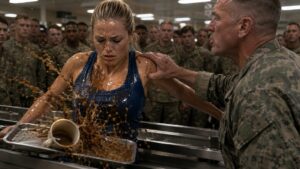
Ryan dropped the meal tray at Thomas’s feet and stepped back before the cup stopped rolling.
Food scattered across the mess-hall floor. Rice spread beneath the table. A metal fork spun twice and came to rest against Thomas’s boot.
“Kneel down,” Ryan said. “Clean it.”
The room did not go silent this time. It grew quieter by degrees as nearby conversations died and faces turned without appearing to turn.
Thomas looked from the spilled meal to Ryan.
“You dropped it.”
Ryan spread his hands. “And you’re the closest recruit.”
“I’ll get a mop.”
“I told you to kneel.”
Thomas felt Richard watching from two tables away. Raymond White sat beside Ryan’s abandoned seat, his expression caught between amusement and concern.
Thomas stepped around the food.
Ryan blocked him.
The muscles in Ryan’s jaw tightened, but his voice remained light for the audience. “You keep doing that.”
“Doing what?”
“Making simple things difficult.”
Thomas did not answer.
Ryan moved closer. His weight settled too heavily over his front foot. Right shoulder half an inch forward. Chin high. He believed size could erase balance.
Thomas saw the opening automatically: wrist control, outside step, shoulder turn. Ryan would strike the floor before he understood he had been moved.
Thomas let the thought pass.
“Attention,” Ryan said.
Thomas came upright.
The posture made Ryan smile. To him it was surrender. To Thomas it was a wall—straight spine, still hands, nothing offered.
Ryan pointed toward the spill. “Clean it.”
“That isn’t your order to give.”
A chair scraped behind them.
Before Ryan could answer, Alexander Smith entered the mess area carrying a folder beneath one arm. He was the senior duty officer for the barracks rotation, a man who noticed untucked shirts from across a parade ground and seemed personally offended by disorder.
His gaze moved from Ryan to the tray.
“What happened?”
Ryan smiled easily. “Accident. Allen was helping.”
Alexander looked at Thomas. “Were you?”
“I was going to get a mop.”
“And instead?”
“I was delayed.”
Ryan’s eyes hardened.
Alexander studied Thomas for a moment longer than necessary. “Then stop being delayed.”
Thomas retrieved the cleaning equipment. By the time he returned, Ryan had taken another seat and was speaking loudly about the advanced training selection scheduled for the following month.
“I’ve already passed the physical benchmarks,” Ryan said. “Just waiting for them to make it official.”
Raymond glanced down at his food.
Thomas cleaned the floor without kneeling.
During afternoon drills, the wind drove dust across the training ground. Teams rotated through movement exercises while Alexander observed with a clipboard.
Thomas kept his pace exact. Not fast enough to be noticed. Not slow enough to invite correction.
A larger recruit lost footing during a lateral sprint and crashed toward him.
Thomas shifted before the man’s shoulder made contact. One hand guided the elbow, the other redirected the hip. The recruit passed around him instead of through him, stumbled once, and recovered.
To anyone farther away, it looked accidental.
Alexander was not farther away.
“Allen.”
Thomas stopped.
“Where did you learn that?”
“Learn what?”
Alexander’s expression tightened. “Don’t make me name what you just did.”
Thomas looked toward the next training marker. “I moved out of the way.”
“You moved him out of your way.”
The larger recruit rubbed his arm. “Didn’t feel like much, sir.”
“That’s the point.” Alexander faced Thomas again. “Combat sports?”
“Some.”
“What kind?”
“Grappling.”
“How much?”
Thomas saw Ryan at the edge of the formation, listening.
“Enough to know I don’t need it here.”
Alexander’s mouth flattened. “That answer is more evasive than reassuring.”
He marked something on the clipboard.
Ryan smiled.
At the water station, Raymond approached Thomas while the others rotated back onto the field.
“You heard about Ryan’s last evaluation?”
Thomas shook his head.
“He missed the endurance mark. Barely. First time he’s ever been outside the top group.”
“That explains the speeches.”
Raymond gave him a warning look. “He trains harder than anyone here.”
“That doesn’t explain the rest.”
“You think he enjoys pushing people?”
“Yes.”
Raymond’s face closed. “He thinks weak links get people hurt.”
“So he creates weak links to prove they exist?”
“You don’t know him.”
Thomas capped his canteen. “I know he needs the room watching.”
Raymond stepped closer. “Tomorrow, when he gives you a chance to show what you’ve got, don’t embarrass him.”
Thomas almost laughed, but Raymond was serious.
“He’s arranging a fight,” Thomas said.
“A demonstration.”
“There’s no difference when only one person agreed.”
Raymond lowered his voice. “There will be a difference afterward.”
That evening, Ryan made sure the story reached every bunk before Thomas returned.
According to Ryan, Thomas had approached him near the training sheds and questioned whether his fighting ability matched his reputation. Ryan claimed he had tried to let the insult go, but Thomas had insisted on proving it.
The lie was careful. It made Ryan patient, Thomas arrogant, and the demonstration inevitable.
“You challenged him?” Richard asked when Thomas entered.
“No.”
Several faces turned.
Ryan sat on the edge of his bunk, wrapping cloth around one hand. “Now he’s backing out.”
“I never agreed.”
“You said you knew enough grappling not to need it here.”
“To Alexander.”
“You said I needed an audience.”
Thomas looked at Raymond. Raymond looked away.
Ryan stood. “Sounds like a challenge to me.”
“It sounds like you were listening to conversations that weren’t yours.”
A few men smiled before remembering not to.
Ryan took one step forward, then stopped himself. “Tomorrow. Off-hours. No excuses.”
Thomas walked past him.
As he did, he noticed the faint tremor in Ryan’s wrapped hand. Not fear. Fatigue. The kind that followed too many late repetitions after everyone else had stopped training.
For the first time, Thomas understood that Ryan was not only defending his control of the room. He was defending the version of himself that might earn selection. Every recruit who submitted became proof that one failed benchmark had been meaningless.
That did not make him less dangerous.
It made retreat harder for him.
When Thomas returned from the showers the following night, his bunk was no longer against the wall.
It had been dragged into the center aisle.
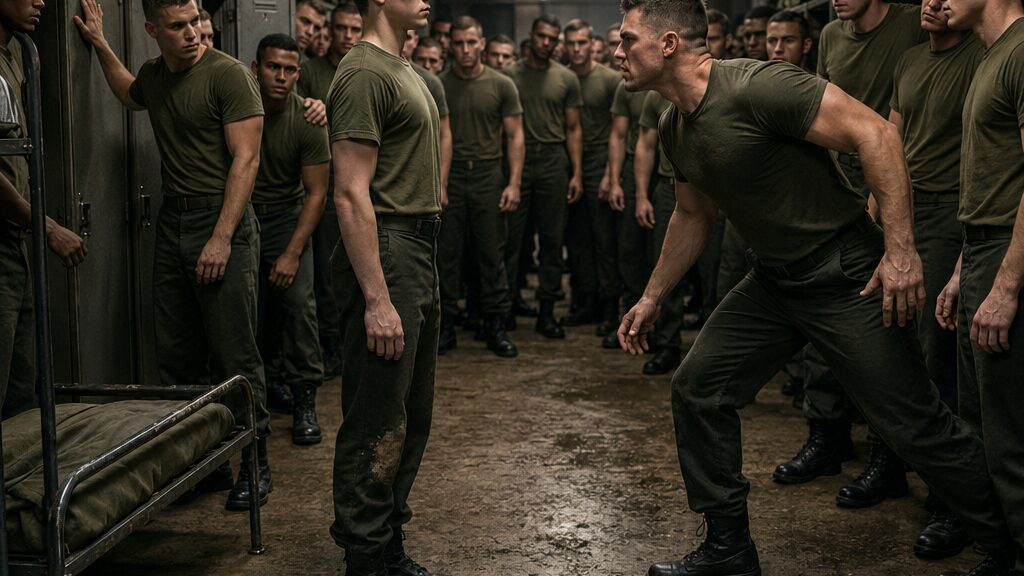
The other bunks formed a rough ring around it. Boots lined the edges. Marines sat shoulder to shoulder, waiting. The packed dirt tracked in from the training field marked the floor beneath the lights.
Ryan stood on the far side of Thomas’s mattress.
He opened both hands as though welcoming a guest.
“We saved you a place.”
Chapter 3: The First Time Thomas Hit the Floor
Ryan’s boot struck behind Thomas’s ankles before Thomas finished saying he would not fight.
His legs vanished beneath him.
The ceiling snapped into view. Then his shoulder and hip hit the dirt-streaked concrete hard enough to drive the air from his lungs.
The barracks erupted.
Boots stamped. Locker doors crashed in uneven rhythm. Someone shouted for Ryan to do it again.
Thomas lay still for one breath.
Ryan stood over him, grinning down as if the fall had settled every question.
“What happened, grappler?”
Thomas’s right hand rested inches from Ryan’s supporting ankle. The knee above it was nearly locked. A pull, a turn, pressure driven across the joint—Ryan would fall badly. If Thomas continued through the motion, the damage could last longer than the laughter.
His fingers flexed.
Then withdrew.
Thomas rolled to one knee and stood.
The noise faltered.
Ryan’s grin changed. He had expected anger or embarrassment, perhaps a wild swing he could punish. Thomas gave him neither.
He brushed dirt from his trousers and returned to attention.
Heels aligned. Hands at his seams. Eyes level.
A pulse beat low in his shoulder where it had struck the floor.
Ryan circled him. “That’s it?”
Thomas said nothing.
“You get dropped in front of the whole room and stand there like somebody turned you off?”
“Leave it.”
The words were quiet, but several men heard them.
Ryan stopped directly in front of him. “You giving me orders now?”
“No.”
“Sounded like one.”
“It was a choice.”
A phone appeared in Raymond’s hand near the lockers. He raised it chest-high and began recording.
Too late.
Thomas saw the black lens pointed toward the center aisle and understood exactly what it would show: him upright and uninjured, Ryan facing him, the crowd waiting. Nothing of the kick. Nothing of the refusal that came before it.
Richard stood behind Raymond, eyes fixed on Thomas.
“Choice?” Ryan asked. “What choice?”
“Stop.”
Laughter broke around them, but it was thinner now.
Ryan spread his arms toward the crowd. “He thinks he can scare me with one word.”
Thomas watched the placement of Ryan’s feet. The way he rolled his shoulders for effect. The quick glance toward Raymond’s phone.
Everything Ryan did pointed outward. Even his anger needed witnesses.
“You wanted a demonstration,” Thomas said. “You got one.”
Ryan’s smile vanished. “I haven’t started.”
“You attacked someone standing at attention.”
“I swept a weak recruit who wasn’t ready.”
“I was ready.”
The answer escaped before Thomas could contain it.
The room heard the difference.
Ryan heard it too.
For the first time, uncertainty passed over his face. Small, almost invisible, but Thomas recognized it. Men in fights often revealed fear through movement. Ryan revealed his through stillness.
Then Raymond shifted the phone, and Ryan remembered the audience.
“Ready?” he said. “You hit the floor.”
“I chose not to hurt you.”
The locker pounding stopped one door at a time.
Ryan looked around the ring. Pride closed over his uncertainty.
“You hear that? He chose.”
He shoved Thomas in the chest.
Thomas absorbed it without stepping back.
The movement was small, but Ryan felt it. His eyes dropped to Thomas’s feet.
Thomas wished he had moved.
A stumble would have given Ryan what he needed. A small submission. A way out that did not require admitting he had misjudged the man in front of him.
Instead, Thomas had shown him a locked door.
Ryan shoved again, harder.
Thomas remained in place.
“Fight back.”
“No.”
“You challenged me.”
“You lied.”
The words struck harder than Thomas intended.
Raymond lowered the phone slightly. Richard looked toward the barracks entrance, perhaps hoping Alexander would appear.
Ryan’s face darkened. “I’ve carried men like you through every stage of training. Quiet little shadows who think keeping their heads down makes them disciplined. Then pressure comes, and they freeze.”
Thomas felt the old kitchen rise behind his eyes again. A smaller boy trapped between the refrigerator and the wall. A man reaching past Thomas because he had mistaken silence for permission.
He forced the image down.
“I’m not frozen.”
“Then prove it.”
“I don’t owe you proof.”
Ryan stepped so close that their shirts nearly touched.
“This isn’t about me.”
“It has always been about you.”
A sound passed through the crowd—not laughter, not yet, but recognition.
Ryan heard it.
His eyes moved toward the men who had gathered for him. Thomas watched his need harden into decision.
Ryan drew back his right shoulder.
Thomas saw the punch before the fist formed. Saw the hips load, the chin lift, the left hand drop. There were a dozen ways to end the exchange. Most would leave Ryan conscious. Some would leave him standing.
Thomas could still step away.
He glanced toward the door. No duty officer. No clear path through the ring without turning his back.
“Last chance,” Thomas said.
Ryan laughed once. “For you?”
“For both of us.”
Ryan’s hand opened and closed.
Behind him, Raymond raised the phone higher. The red recording light reflected faintly against the locker.
Thomas understood then what his silence had done.
It had not starved Ryan. It had fed him space. Every insult unanswered had become permission for the next. Every private warning dismissed had taught Richard and the others that Thomas would protect only himself—and perhaps not even that.
Refusing violence was not the same as stopping it.
Ryan shifted his weight forward.
Thomas let his arms hang loose.
“You already had your warning,” he said.
Ryan charged.
Chapter 4: Four Seconds of Terrible Control
Thomas crossed the distance before Ryan’s fist completed its path.
He dropped beneath the swing, drove his shoulder into Ryan’s middle, and locked both arms behind his knees. Ryan’s feet left the floor.
For one startled instant, the larger Marine hung across Thomas’s back with his arms spread wide.
Then the concrete struck him.
The impact shook the nearest bunks. Ryan’s breath burst from his chest. Before he could turn, Thomas climbed over his hips, pinned one arm across his own neck, and settled his weight low.
The barracks went silent.
Thomas’s movements had contained no anger. That frightened the room more than rage would have.
Ryan bucked beneath him, using strength where position had already failed. Thomas moved with him. His right arm slid beneath Ryan’s neck. His head pressed tight against the trapped shoulder. His hands joined.
Arm-triangle.
Ryan’s free hand clawed at Thomas’s back.
“Get off,” he rasped.
Thomas tightened only enough to close the space.
Ryan twisted toward the lockers. Thomas followed. The movement made the hold smaller, not looser.
Somebody whispered, “Do something.”
No one did.
Raymond’s phone remained raised, its lens aimed directly at Thomas. The recording would show a slight recruit pressing down a larger man whose face had begun to darken. It would not show the kick. It would not show the warning.
Thomas heard Ryan’s breath change.
The barracks vanished.
He was sixteen again, kneeling on broken pavement behind a row of shuttered stores. His cousin was crying near a chain-link fence. Beneath Thomas, another teenager fought with the same frantic violence, scratching at his wrists, refusing to stop even after the danger had passed.
Thomas had held on because he was afraid to let go.
Then the scratching had ceased.
He remembered the sudden weight of the body. The silence after. Someone screaming that the boy was not breathing.
Ryan’s resistance weakened.
Thomas knew the precise moment consciousness began to slip. He had felt it through hundreds of controlled repetitions and once through a mistake he still woke remembering.
Release now.
His hands did not open.
Not because he wanted to hurt Ryan.
Because, for one terrible fraction of a second, Thomas was no longer sure which body lay beneath him.
The teenager’s face flickered over Ryan’s. Gray lips. Empty eyes.
Release.
Thomas tore his grip apart.
Ryan’s arm fell limp across the dirt-streaked floor.
Thomas rolled him onto his side, braced his head, and placed two fingers beneath his jaw. There was a pulse. Breathing followed—shallow, then rough.
“Ryan.”
No response.
Thomas checked the airway, repositioned him, and watched his chest rise again.
Only then did he stand.
The room recoiled from him.
Men who had crowded inward now pressed against bunks and lockers. No one laughed. No one pounded steel. The phone speaker that had been playing music hissed softly from somewhere beneath a mattress.
Thomas returned to attention.
His breathing remained measured, but his hands felt cold.
Raymond lowered the phone. His mouth had gone slack.
Richard stared at Ryan’s body and then at Thomas. There was no relief in his face. There was awe, and beneath it something more dangerous: the first shape of dependence.
Ryan coughed.
The sound broke the room open.
He dragged one knee beneath himself, failed to rise, and fell onto an elbow. His eyes streamed. Dirt clung to the side of his face.
“What—” He coughed again, harder. “What did you do?”
Thomas moved one step toward him.
Ryan flinched.
The reaction passed through the barracks like a current.
Thomas stopped.
“You blacked out,” he said. “Stay down until you’re steady.”
Ryan tried to push himself upright. His arms shook. When his weight reached his feet, his knees folded and he caught the bunk frame with both hands.
No one moved to help him.
The same men who had stamped and shouted now watched him struggle in complete silence.
Ryan looked from face to face, searching for the room he had controlled.
It was gone.
His breathing broke. Whether from the choke, humiliation, or panic, Thomas could not tell. Tears ran down his cheeks as he coughed, and the sight did not feel like victory.
It felt like a door opening behind Thomas—the one he had enlisted to close.
Boots sounded in the corridor.
The crowd shifted too late.
Alexander Smith entered and stopped inside the doorway.
His gaze took in the displaced bunk, the ring of Marines, Ryan groveling near the floor, and Thomas standing at attention in the center aisle.
“What happened?”
No one answered.
Alexander’s eyes settled on Raymond’s phone.
“You. Bring that here.”
Raymond hesitated.
“Now.”
He crossed the room and handed it over.
Alexander replayed the recording.
Thomas watched his expression harden as the video began with Ryan charging. There was no audio clear enough to catch the warning beneath the crowd. Thomas disappeared under the frame for an instant, then drove forward. Ryan hit the floor. Thomas mounted and locked the choke.
Four seconds later, Ryan stopped moving.
Alexander replayed it.
The video proved speed, precision, and control.
It did not prove innocence.
“Allen,” Alexander said, “step away from the center.”
Thomas obeyed.
“Hall, medical room.”
Ryan tried to straighten. “He attacked me.”
Alexander looked at the crude fighting circle. “You can explain after you can stand.”
Raymond reached for Ryan’s arm, but Ryan slapped the hand away and staggered toward the door.
Alexander faced the room.
“No one leaves. No one deletes anything. No one decides what story sounds best before I ask the questions.”
His voice remained level, which made the threat sharper.
He looked at Thomas last.
“You’re confined to the duty office until this is reviewed.”
Thomas’s jaw tightened. “Understood.”
Alexander glanced at the frozen image on the phone: Thomas above Ryan, hands locked, face empty.
“By morning,” he said, “someone may be removed from training.”
Chapter 5: The Video That Began Too Late
Alexander placed the phone on the desk and played the four seconds that could end Thomas’s military future.
There was no locker pounding in the recording now. No shouting. Alexander had muted it.
Without sound, the violence looked cleaner and worse.
Ryan lunged into the frame. Thomas dropped, lifted, and drove him down. The image jerked as Raymond adjusted his grip. Then Thomas was mounted above Ryan, compressing his neck while the watching Marines formed a wall behind them.
The video ended before Thomas checked Ryan’s breathing.
Alexander tapped the screen back to the beginning.
“Again,” he said.
Thomas stood at attention opposite the desk. His shoulder had stiffened from the fall, but he kept it level.
“I know what it shows.”
“I want to know what happened before it.”
“Ryan kicked my legs out.”
“Witnesses?”
“The whole room.”
“The whole room is currently discovering gaps in its memory.”
Alexander set the phone down. A fluorescent light buzzed overhead. Through the duty-office wall came the occasional ring of a desk telephone and the faint movement of boots in the corridor.
“Hall says you arranged this.”
“I didn’t.”
“He says you questioned his ability in front of other Marines.”
“I said he needed an audience.”
“So you provoked him.”
“I described him.”
Alexander leaned back. “Those are not always different things.”
Thomas looked past him at the duty roster pinned to the wall.
“Eyes here, Allen.”
Thomas complied.
Alexander opened a medical note. “Hall lost consciousness for several seconds. No airway damage. No significant neck injury. The examiner believes the hold was technically controlled.”
Thomas’s shoulders loosened by a fraction.
Alexander noticed.
“Control doesn’t prove justification.”
“No.”
“It proves you knew exactly what you were doing.”
“Yes.”
“How much experience?”
Thomas said nothing.
Alexander waited.
The silence that had protected Thomas inside the barracks felt different here. Under the office light, it did not look disciplined. It looked calculated.
“Enough,” Thomas said.
“That answer won’t survive a formal review.”
“I never struck him.”
“You rendered him unconscious.”
“After he attacked twice.”
“The recording begins with you taking him down.”
“He was throwing a punch.”
“Not visible.”
Thomas looked at the phone. “Because the video began too late.”
Alexander closed the folder.
“Did you know Hall had been targeting recruits?”
Thomas felt the question land before he answered.
“Yes.”
“How long?”
“Since I arrived.”
“And you reported nothing.”
“No.”
“Why?”
Thomas almost said because it would have made things worse.
Richard’s question returned instead.
For who?
“I thought ignoring him would stop it.”
Alexander’s expression changed, not into sympathy but disappointment. “You thought wrong.”
Thomas’s hands tightened at his seams.
“You had enough information to recognize a pattern,” Alexander continued. “You had enough skill to know what escalation looked like. You chose not to involve anyone until a man was unconscious on the floor.”
“I didn’t choose the fight.”
“You chose silence before it.”
The words stayed with Thomas when Alexander sent him to a chair outside the medical room.
Ryan was behind the closed door. His voice rose once, accusing, then dropped when someone told him to sit still. Raymond waited farther down the corridor with his elbows on his knees.
He did not look at Thomas.
After several minutes, Ryan emerged supported by the wall rather than another person. His face had regained color, but his steps remained uncertain.
He stopped when he saw Thomas.
“You planned that.”
Thomas stayed seated.
“You wanted the room.”
“No.”
Ryan laughed, but the sound cracked into a cough. “They looked at you like you were something.”
Thomas’s stomach tightened.
“I saw them,” Ryan said. “You think I didn’t? You stand there all quiet, let everybody think you’re harmless, then you do that.”
“You attacked me.”
“You were waiting for it.”
Thomas could not deny that he had seen every opening from the first night.
Ryan read the hesitation as confession.
“You’re worse than me,” he said. “At least they knew what I was.”
Alexander opened the duty-office door. “Hall.”
Ryan turned.
“Your statement.”
Before entering, Ryan looked back at Thomas. “He wanted my place.”
The door shut behind him.
Raymond finally lifted his head.
“That isn’t true,” he said.
Thomas looked at him.
Raymond rubbed both hands over his face. “But the video makes it look true.”
“You started recording after the kick.”
“I didn’t know he was going to kick you.”
“You knew there was going to be a fight.”
Raymond’s eyes hardened defensively. “So did everyone.”
“That doesn’t make it less yours.”
Raymond stood and walked away before Alexander could call him.
Near dawn, Thomas was escorted back to the restricted barracks to collect clean clothes. Most of the bunks were occupied, but no one slept. Conversations stopped as he entered.
The displaced bunk had been returned to the wall. Dirt still marked the center aisle where Ryan had fallen.
Richard waited beside Thomas’s locker.
When the escort moved toward the far end of the room, Richard spoke under his breath.
“I have another video.”
Thomas looked at him.
“I started before Raymond.”
“Then give it to Alexander.”
Richard’s eyes moved toward the occupied bunks. “I need something first.”
“What?”
“You protect me.”
Thomas felt the same coldness that had moved through his hands while Ryan lay unconscious.
“From Ryan?”
“From everybody who helped him.”
“You want me to threaten them.”
“I want them to know I’m with you.”
There it was—the room rebuilding itself before Ryan had even returned. Not around rules. Around the strongest body still standing.
“I’m not taking his place.”
Richard’s face tightened. “Easy for you to say. Nobody’s going to touch you now.”
“Give Alexander the video.”
“And then what happens to me?”
“The truth happens.”
Richard gave a bitter shake of his head. “Truth doesn’t sleep in this room. We do.”
He pulled a phone halfway from his pocket. On the screen, Thomas saw the beginning of the gathered crowd and Ryan moving into the aisle.
Complete evidence.
One gesture could save Thomas.
All he had to do was accept the bargain Ryan had taught Richard to offer.
Thomas stepped back.
“No.”
Richard stared at him. “You could be removed.”
“I know.”
“You could lose everything.”
“I know.”
“And you still won’t help me?”
“I won’t own you.”
Pain flashed across Richard’s face, quickly replaced by anger.
“That’s not what I asked.”
“It’s what you learned to ask.”
The escort called Thomas’s name.
Richard slid the phone back into his pocket.
For a moment, Thomas thought he might surrender it anyway.
Instead, Richard turned and walked between the bunks, carrying the only complete recording with him.
Chapter 6: What Silence Had Already Cost Them
“How many times have you used that hold outside training?”
Alexander’s question emptied the hearing room of every other sound.
Thomas stood at attention before a long table. Ryan sat to his right with a medical restriction band around one wrist. Raymond occupied a chair behind him. Several recruits had been brought in as witnesses, though Richard’s seat remained empty.
Thomas looked at Alexander.
“Twice.”
Ryan turned sharply.
Alexander folded his hands. “The incident in the barracks was one. Tell me about the other.”
Thomas had spent three years avoiding sentences that began there.
“It was before I enlisted.”
“How old were you?”
“Sixteen.”
“Organized competition?”
“No.”
The room seemed to contract.
Thomas could feel the recruits watching the back of his neck. He had wanted them to believe he was ordinary. Now every word made that impossible.
Alexander waited.
Thomas broke attention.
Not dramatically. He moved only his head, looking past the table toward the recruits whose silence had filled the barracks before the fight.
“My cousin was twelve,” he said. “We lived with people who fought often. He learned to hide when voices changed.”
No one shifted.
“One night, a man came after him. I stopped the man. Later, some older boys found me outside. One of them had a blade.”
Ryan watched him differently now—not with sympathy, but with the alertness of someone discovering hidden terrain.
Thomas continued. “I got behind one of them and used the same hold. He stopped fighting. I didn’t release.”
“Why not?” Alexander asked.
“I was afraid he would get up.”
“How long was he unconscious?”
“I don’t know.”
“Did he survive?”
“Yes.”
The answer came too quickly.
Thomas forced himself to add, “Because someone else made me let go.”
The fluorescent lights hummed above them.
Alexander looked toward the medical note. “Last night, you released Hall without anyone intervening.”
“Yes.”
“Why?”
“Because I knew where the line was.”
Ryan leaned forward. “And we were supposed to trust that?”
Alexander raised one hand, but Ryan continued.
“He came in hiding combat experience. Watched everybody. Let me think he couldn’t defend himself.”
Thomas faced him.
Ryan’s voice strengthened under the attention. “You want to call me dangerous because I pushed recruits. What do you call someone who can shut a man down in seconds and tells nobody?”
The accusation struck closer than Thomas wanted it to.
Alexander saw that too.
“Answer him,” he said.
Thomas drew a breath. “Dangerous.”
Murmurs moved through the witness chairs.
Ryan’s mouth opened, surprised.
Thomas kept his eyes on him. “Hiding it was wrong.”
Ryan sat back as though Thomas had taken away the argument he intended to win.
“But that didn’t give you the right to attack me,” Thomas continued. “Or anyone else.”
“I was testing you.”
“You were performing.”
“I was proving you’d freeze under pressure.”
“You kicked me while I stood at attention.”
Ryan glanced toward Raymond.
Alexander followed the glance. “White.”
Raymond stood reluctantly.
“Did Hall kick Allen first?”
Raymond swallowed. “Yes.”
Ryan’s chair scraped.
“You said he moved at me.”
“After,” Raymond said.
“After what?”
“The kick.”
Ryan stared at him. “You told me you didn’t see it clearly.”
“I saw it.”
“Then why wasn’t it in your statement?”
Raymond’s eyes dropped. “Because I started the video after.”
“That isn’t an answer.”
“No,” Alexander said. “It isn’t.”
Raymond’s breathing quickened. “Ryan said Allen wanted the fight. Everybody was already there. I thought—”
“You thought what?” Alexander asked.
“That if I made it look like Ryan started it, I’d be turning on him.”
Thomas watched Ryan absorb the phrase.
Turning on him.
Not telling the truth. Not correcting a statement. Loyalty in the barracks had become agreement with whatever protected the strongest man.
Alexander’s voice stayed controlled. “Did Allen warn Hall before the second attack?”
“Yes.”
“What did he say?”
Raymond looked at Thomas. “He told him he’d already had his warning.”
Ryan’s face tightened.
“You were supposed to be with me,” he said.
Raymond flinched, but did not retract the answer.
Alexander turned to Thomas. “You understood Hall was escalating before that night.”
“Yes.”
“You saw it happening to other recruits.”
“Yes.”
“You discouraged Campbell from reporting it.”
Thomas looked toward Richard’s empty chair.
“Yes.”
Ryan seized on the admission. “There. He let it happen because he wanted a reason.”
“No,” Thomas said.
“Then why stay quiet?”
The old answer rose automatically: because speaking made things worse.
This time Thomas heard its weakness before he said it.
“Because I was afraid.”
Ryan gave a short laugh. “Of me?”
“Of what I would do if you didn’t stop.”
The laughter died.
Thomas looked toward the recruits again. “I told myself silence was control. It wasn’t. It left everyone else inside the same thing I was avoiding.”
Alexander studied him for several seconds.
“That does not make you responsible for Hall’s attack,” he said. “It does make you responsible for withholding what you knew.”
“I understand.”
“Do you?”
Thomas looked at the empty chair.
Not fully, he thought. Not yet.
The hearing-room door opened.
Richard Campbell entered with his phone gripped in both hands.
A guard started to stop him, but Alexander lifted one finger.
Richard’s face was pale. He looked first at Thomas, then at Ryan, then at the rows of witnesses behind them.
“I have the beginning,” he said.
Alexander extended his hand.
Richard did not move.
“I’ll surrender it,” he said, his voice trembling, “but not in here.”
Ryan leaned forward. “What are you doing?”
Richard’s fingers tightened around the phone.
“I’m speaking in front of everyone.”
Chapter 7: The Room That Chose Another Leader
Richard projected the missing beginning of the fight onto the same locker Ryan had used as his stage.
The image shook across gray steel. Marines crowded between the bunks, their faces washed pale by the video. Alexander stood near the barracks entrance with his arms folded. Ryan sat on the end of a lower bunk, one wrist still marked by the medical band. Thomas remained at attention beside the center aisle.
On the locker, Ryan’s recorded voice rose above the crowd.
“You backing out now?”
The video showed Thomas refusing to fight. It showed Ryan circling him, drawing the room tighter. It showed Thomas standing motionless while locker doors pounded around him.
Then Ryan kicked his legs away.
A few men looked down.
The recorded crowd roared as Thomas struck the floor. Richard’s phone dipped, then steadied. From the low angle, Thomas’s hand could be seen reaching toward Ryan’s supporting ankle.
It stopped.
His fingers withdrew.
Thomas rose and returned to attention.
The recording captured what Raymond’s had missed: the warning, the shove, the second shove, and Ryan drawing back his fist.
“You already had your warning,” Thomas said from the locker.
Then Ryan charged.
The image blurred through the takedown. Ryan hit the floor. Thomas climbed into position, held him, released him, and immediately checked his breathing.
Richard ended the video.
No one spoke.
The room looked almost exactly as it had before the fight—same metal bunks, same open lockers, same dirt scar along the aisle—but the order inside it had broken.
Alexander held out his hand.
Richard crossed the room and gave him the phone.
“Why didn’t you surrender this earlier?” Alexander asked.
Richard glanced at Thomas. “I wanted him to promise I’d be safe.”
“Safe from whom?”
Richard looked around the barracks. “Whoever came out on top.”
A movement passed through the room. Men shifted their weight, uncomfortable with hearing their system described so plainly.
Alexander turned to Thomas. “And you refused?”
“Yes.”
“Even though this recording could clear you?”
“Yes.”
“Why?”
Thomas broke attention enough to face Richard.
“Because he wasn’t asking for help. He was asking to belong to the strongest person.”
Richard’s jaw tightened, but he did not look away.
Alexander examined the room. “Is that how this barracks has operated?”
Silence answered.
Ryan pushed himself to his feet. His balance was steadier now, though one hand remained close to the bunk frame.
“This proves he knew how to destroy me,” he said. “It doesn’t prove he wasn’t waiting for the chance.”
Raymond looked at him. “You kicked him.”
“I was testing him.”
“You threw the second attack.”
Ryan’s eyes flashed. “You were cheering.”
Raymond absorbed the accusation.
“Yes,” he said. “I was.”
That answer cut deeper than denial.
Alexander moved into the aisle. “Hall initiated the physical confrontation. The recording confirms it. Allen warned him, retreated, and responded only after the second attack.”
A breath moved through the room.
Thomas felt no relief yet.
Alexander looked directly at him. “That clears you of initiating the assault. It does not clear you of withholding a pattern of harassment you recognized.”
Thomas nodded. “Understood.”
“You discouraged Campbell from reporting.”
“Yes.”
“You believed silence would contain the problem.”
“Yes.”
“It did not.”
“No.”
The words settled between them without excuse.
Alexander turned toward Ryan. “You will be removed from the advanced selection process pending disciplinary review. You will also be reassigned from any informal training authority immediately.”
Ryan’s face emptied.
The selection had been more than an opportunity. Thomas saw that now. It had been the last structure holding Ryan’s idea of himself together. The strongest Marine. The man others followed. The one being chosen for more.
“You’re taking his word over mine,” Ryan said.
“I’m taking your actions over both.”
Alexander faced the others. “Every Marine who organized, encouraged, or concealed this demonstration will provide a revised statement before morning.”
No one protested.
Ryan sat down slowly.
The decision should have ended the night. Instead, something changed in the room the moment Alexander stepped aside.
A locker door struck once.
Thomas turned.
Another answered from across the aisle.
Then a third.
The old rhythm returned, but it was no longer for Ryan.
Men looked toward Thomas.
Richard moved first, stepping away from the wall. Raymond followed more cautiously. The recruits who had kept their eyes down for days began closing around the aisle, not threatening him, but waiting.
Someone dragged Thomas’s bunk fully back into place.
Another man lifted Thomas’s equipment bag and set it neatly on the mattress.
“Allen,” a recruit near the showers said, “what do we do now?”
Thomas stared at him.
The question sounded practical. It was not.
Ryan sat in the background, abandoned beside the bunk. Every face that had once turned toward him now turned toward Thomas.
Thomas shifted one foot.
The men nearest him moved with it.
A path opened between the bunks.
He began walking because standing still felt too much like accepting what they were offering. Richard fell in behind him. Then Raymond. Boots joined one after another, creating a measured rhythm along the concrete.
Thomas stopped.
The footsteps stopped with him.
He looked over his shoulder.
The sight tightened something in his chest. They were not following because they understood him. They were following because they had watched him win. His restraint, his warning, even his admission at the hearing mattered less to them than four seconds on the floor.
Ryan had ruled through the promise of violence.
Thomas was being crowned through proof of it.
He turned fully.
“Back inside,” he said.
No one moved.
Thomas’s voice sharpened.
“Every man. Back into the barracks. Now.”
Chapter 8: No One Stands Behind Me Now
The dirt still held the shape of Ryan’s fall.
It was only a broken outline where boots had ground training-field dust into the concrete, but the room had begun walking around it. Thomas stepped into the mark before morning formation and stood at attention.
The barracks was quieter than he had ever heard it.
Richard sat on the edge of his bunk, watching. Raymond polished the same boot for the third time. Ryan was on the far side of the room, packing equipment into a duffel for temporary reassignment.
No one pounded a locker.
Ryan pulled the zipper shut and approached Thomas.
“Can we talk?”
Thomas lowered his hands from his seams.
Ryan glanced toward the others. “Not with everybody listening.”
“They listened when you attacked me.”
Ryan’s mouth tightened. “I’m trying to apologize.”
The room remained still.
Thomas stepped toward the narrow space beside the lockers, far enough to offer privacy but not secrecy.
Ryan followed.
For several seconds, he stared at the floor.
“I shouldn’t have kicked you.”
“No.”
“I shouldn’t have arranged the demonstration.”
“No.”
Ryan exhaled through his nose. “You could say something else.”
“What do you want me to say?”
“That you understand.”
Thomas looked at the packed duffel.
“Understand what?”
Ryan rubbed the medical band around his wrist. “I failed the endurance benchmark. Everybody knew. Raymond knew. Men I used to beat were closing the gap.”
“So you needed to beat someone they thought was weak.”
“I needed them to know one bad score didn’t change anything.”
“It changed something for you.”
Ryan looked up sharply.
Thomas continued. “You were afraid they’d stop following.”
Ryan’s eyes shifted toward the barracks. “You saw how fast they did.”
There was no self-pity in the words. Only shock.
“They never followed you,” Thomas said. “They stayed close to whoever they thought could hurt them.”
Ryan gave a hollow laugh. “And now that’s you.”
“That’s why I sent them back.”
Ryan studied him as if trying to decide whether the refusal was another form of performance.
“The review can end my career,” he said quietly.
Thomas understood then that the apology had arrived carrying a request.
Ryan stepped closer. “Tell Alexander it was a misunderstanding. Say I lost my balance when I kicked you. Say the second charge was part of the demonstration.”
“No.”
“I’m not asking you to lie about everything.”
“You’re asking me to hide the part that matters.”
Ryan’s jaw worked. “I admitted I was wrong.”
“You admitted enough to ask for protection.”
Color rose in Ryan’s face, but he controlled it.
“What do you want, then? To see me gone?”
“No.”
“Then help me.”
Thomas looked toward Richard.
The same bargain. Different voice.
“I won’t ask for extra punishment,” Thomas said. “I won’t use what happened to humiliate you. But I won’t conceal it.”
Ryan stared at him.
“That’s not mercy.”
“It’s the only kind I have.”
Ryan returned to his bunk and lifted the duffel without another word.
Alexander entered a few minutes later carrying a single sheet of paper.
“All of you, center aisle.”
The recruits formed two uneven lines. Thomas began at attention with the others.
Alexander read the new rules without ceremony. Reports of coercion, forced personal tasks, or unsanctioned fighting would go directly to the duty office. No recruit would conduct physical instruction without supervision. Witnesses who withheld known harassment would face review alongside the person responsible.
“This came from Allen’s statement,” Alexander said.
Every face turned toward Thomas.
Thomas disliked the attention, but he did not retreat from it.
Alexander folded the paper. “Rules only work when people use them. Silence is not neutrality.”
Thomas felt the words settle where his old defense had been.
After Alexander left, the formation dissolved slowly.
Several recruits remained in the aisle.
One of them asked, “Who takes Ryan’s place?”
Thomas looked at him. “No one.”
“We still need somebody keeping order.”
“That is what the duty structure is for.”
Another recruit shook his head. “You know that isn’t how a room works.”
Thomas did know. Rooms made their own rules in the spaces official ones did not reach. Someone louder filled the gap. Someone stronger claimed the aisle.
Richard stood.
“You could do it differently,” he said.
Thomas faced him. “That’s what every replacement tells himself.”
Richard’s expression fell.
Thomas saw the mistake immediately. He had answered from fear and called it wisdom again.
He stepped out of attention.
The movement was small, but the room noticed.
Thomas crossed the aisle and stopped shoulder-to-shoulder with Richard.
“I won’t decide everything,” he said. “I won’t decide who gets reported, who gets protected, or who is allowed to speak. Neither will any one of you.”
Raymond set his boot aside.
“What happens when somebody starts this again?”
“We speak before it becomes a circle around a bunk.”
“And if speaking doesn’t work?”
“We speak together.”
The answer was not dramatic. No one cheered. That made Thomas trust it more.
Ryan lifted his duffel and moved toward the door.
He paused beside the dirt mark.
For a moment, Thomas thought he might say something. Instead, Ryan looked at the recruits spread through the aisle, then continued out.
No one laughed at him.
No one followed him either.
The room began preparing for formation. Bunks were straightened. Lockers closed softly rather than slammed. Thomas collected his equipment and started toward the exit.
Footsteps sounded behind him.
He stopped.
The others stopped too.
For one breath, the old pattern returned: Thomas in front, the room arranged behind his strength.
He turned.
“Not behind me.”
Richard looked uncertain.
Thomas moved to one side of the aisle, leaving space beside him.
Richard stepped into it first.
Raymond took the other side. The remaining recruits spread across the width of the barracks until no single man stood at the head and no one disappeared at the rear.
Together they walked between the bunks.
The room stayed deliberately quiet.
The story has ended.