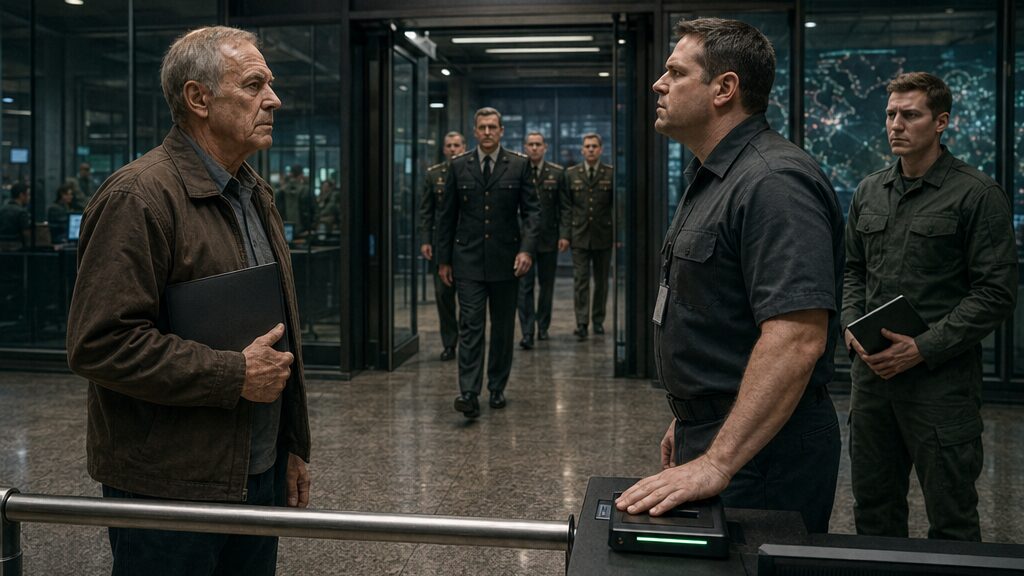
The Contractor Who Blocked an Old Civilian From Briefing the Plan That Could Save Them
Chapter 1: The Barrier Closed Before the Old Man
The metal barrier snapped shut so close to Ronald Harris that the moving arm brushed the edge of the folder tucked beneath his hand.
He caught the folder before it slipped. The barrier locked with a heavy mechanical click between him and the checkpoint scanner.
“Stop there.”
The man behind the security desk did not raise his voice. He did not need to. The lobby of the Joint Operations Center was built to amplify authority: polished stone, reinforced glass, low ceilings, and radios murmuring from every station.
Ronald looked across the barrier.
The contractor wore a dark security uniform with no military insignia. His plastic badge identified him as Donald Miller. He sat behind two monitors, a biometric scanner, and a row of switches that controlled the glass doors leading deeper into the facility.
“I have an appointment,” Ronald said.
Donald examined him before examining anything else.
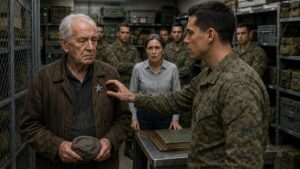
Ronald was sixty-eight, though the years sat more heavily in the lines around his mouth than in his posture. His jacket was faded at the shoulders, the sort of brown field coat that could have belonged to a retired mechanic or a man who spent his mornings repairing fence posts. Beneath it, he wore a plain gray shirt. No ribbons. No rank. No pin suggesting that anyone inside should be expecting him.
“You crossed the yellow line before clearance,” Donald said.
“I stopped when the barrier closed.”
“You should have stopped before it closed.”
Ronald glanced down. The yellow line had faded beneath years of boots and cleaning machines. He stepped back half a pace.
Donald held out his hand. “Identification.”
Ronald passed his credential over the barrier.
Donald inserted it into the reader. A green band moved across one monitor. Ronald heard the scanner confirm the embedded security certificate.
VALID FEDERAL CREDENTIAL.
Donald’s expression did not change.
He checked the daily visitor list, then entered Ronald’s name manually.
“No appointment.”
“It may be under restricted advisory access.”
“That would still generate a checkpoint entry.”
“It was arranged through the director’s office.”
Donald searched again, this time with exaggerated care. A pair of uniformed personnel waiting at the neighboring lane watched without appearing to watch.
“Your name isn’t on the daily visitor log,” Donald said, “and I don’t make exceptions for anyone.”
“I’m not requesting an exception.”
“That’s what everyone says when the system tells them no.”
Ronald kept one hand on the folder. The cover bore no classification stamp, only the date written in black ink. He had removed every unnecessary label before leaving home.
“Contact the briefing room,” he said. “They can verify me.”
Donald leaned back slightly. “Which briefing room?”
“Secure Room Four.”
The answer made one of the uniformed personnel look over.
Donald noticed. His fingers paused above the keyboard.
“And what time is this supposed appointment?”
“Zero seven hundred.”
The digital clock above the reinforced doors showed 6:52.
Donald looked again at the screen, as though eight minutes might produce a name that had not been there before.
“Purpose of visit?”
“Operational review.”
“For which section?”
“Joint Intelligence.”
Donald’s mouth tightened. “That’s not an answer.”
“It is the answer I’m authorized to give in this lobby.”
The contractor removed Ronald’s credential from the reader but did not return it. He set it beside his keyboard.
“You understand that possessing valid identification does not entitle you to enter any room you choose.”
“I understand.”
“And knowing room numbers does not establish clearance.”
“I understand that too.”
The calmness seemed to irritate Donald more than an argument would have. Ronald had seen that reaction before. Some men needed resistance to justify the force they intended to use. Without it, their authority had nowhere to land.
Donald turned to the second monitor. “There is no Harris scheduled through this checkpoint.”
“Then call the director’s office.”
“We don’t telephone classified rooms because someone in the lobby claims to have an appointment.”
“You have a secondary verification procedure.”
Donald’s eyes lifted.
Ronald regretted the words as soon as he saw their effect. He had intended to be helpful. Instead, Donald heard a civilian telling him how to perform his job.
“You seem unusually familiar with our procedures.”
“I’ve worked in buildings like this.”
“That isn’t what I asked.”
Ronald said nothing.
Behind the glass wall beyond the checkpoint, staff members were entering Secure Room Four. A technician adjusted the large wall display. Officers took places around a long table. Ronald could not hear them through the sealed glass, but he knew the sequence: communications check, compartment confirmation, intelligence summary, operational assumptions.
Then the first map appeared.
Even from the lobby, he recognized the pale route lines crossing a dark terrain grid.
His hand tightened on the folder.
The map should not have been on the screen yet. More importantly, that version should not have been on the screen at all.
Two days earlier, Ronald had drawn a heavy line through the eastern approach after updated surveillance showed that the movement window was no longer reliable. He had supplied a replacement page with three contingent routes.
The display beyond the glass still showed the eastern approach in solid white.
Donald followed his gaze.
“You know someone in there?”
“They’re using the wrong slide.”
The contractor gave a short, humorless breath. “Now you’re evaluating classified material through a wall?”
“I’m telling you the briefing requires correction.”
“You’re telling me a great deal for a man with no appointment.”
Ronald looked toward the digital clock. 6:55.
The director would expect him to enter through the command-access corridor. Ronald had declined the escort when Thomas Lee offered it. He had said he would use the ordinary visitor entrance. If a procedure worked only for people surrounded by aides, he had argued, it did not work.
Now the barrier remained between him and the room.
“Mr. Miller,” Ronald said, “please contact Secure Room Four and tell them their adviser is at the checkpoint.”
Donald placed one palm beside the barrier controls.
“No.”
The answer was no longer procedural. It contained satisfaction.
One of the waiting officers shifted his weight. Donald straightened in his chair.
“I will not interrupt a classified session because an unidentified visitor believes he recognizes a map,” he said. “You can return to the public reception area and contact whoever invited you.”
“My phone cannot reach the briefing room through the public directory.”
“Then perhaps you were not meant to reach it.”
Ronald studied him. Donald’s concern had begun in a legitimate place. A missing entry in a secure building was not a detail to overlook. But the contractor had crossed an invisible line of his own. Verification was no longer his goal. Control was.
Ronald could have ended it.
He could have said his former rank. He could have named the operation, the command staff, the officers who had served beneath him. He could have asked Donald to search a database where the result would have changed the man’s posture before the screen finished loading.
He did none of those things.
The process should have worked without a title.
Behind the glass, the route map enlarged. A red timing marker appeared beside the eastern corridor.
Ronald’s guarded concern hardened.
Donald noticed the date on the plain folder.
His gaze moved from the handwritten numbers to Ronald’s face.
“That date,” Donald said. “It matches today’s briefing.”
Ronald did not answer.
Donald tapped the folder with one finger, still keeping the barrier between them.
“How does a civilian standing outside my checkpoint know the code date of a classified operation?”
Chapter 2: A Name Missing From the List
Donald slid Ronald’s credential farther away from the barrier.
“This card proves who you are,” he said. “It does not prove you are authorized to be here.”
Ronald looked at the credential beside Donald’s keyboard. The reader had validated it twice. A small blue symbol remained illuminated on the screen—a restricted advisory designation that should have triggered another verification path.
Donald minimized the result.
“I would like my identification returned.”
“You’ll receive it when we conclude the security inquiry.”
“There was no inquiry until you decided to create one.”
The neighboring lane had cleared, but two junior personnel remained near the elevators. Their conversation had stopped. Ronald could feel their attention settle on the faded shoulders of his jacket and the locked barrier in front of him.
Donald could feel it too.
He lifted Ronald’s credential as though displaying evidence. “Last month a subcontractor arrived with a legitimate federal card and a believable story. He had been removed from the project three days earlier. If I had relied on the card, he would have entered a restricted communications corridor.”
Ronald had heard about the incident. The man had not been hostile, only angry over unpaid work, but the breach would have been serious.
“You stopped him,” Ronald said.
“I did.”
“You followed secondary verification.”
Donald’s jaw shifted. “I refused entry.”
“After calling the control office listed in the system.”
For the first time, uncertainty crossed Donald’s face. It vanished quickly.
“That situation was different.”
“The procedure was not.”
Donald set the credential down. “You don’t know enough about this station to tell me what is different.”
A uniformed lieutenant entered from the side corridor. He was younger than Donald, trim and composed, with a tablet held against his chest. The name strip on his uniform read THOMPSON.
“Problem?” Kevin Thompson asked.
“Unscheduled visitor,” Donald said. “No log entry. Claims access to Secure Room Four.”
Kevin looked at Ronald, then at the credential on the desk. “Did it validate?”
“Identity validated. Appointment did not.”
Kevin leaned toward the monitor. Donald reopened the credential record. The blue advisory symbol appeared again.
Kevin’s eyes lingered on it.
“Restricted adviser,” he said.
“Self-described,” Donald replied.
“The designation is embedded.”
“It doesn’t say which office.”
Kevin glanced through the glass at the briefing room. The map glowed behind several seated officers.
“Sir,” he said to Ronald, “who arranged your visit?”
“Director Thomas Lee.”
The lieutenant’s posture changed almost imperceptibly. “The Director of Joint Intelligence?”
“Yes.”
Donald folded his arms. “Anyone can know his name.”
Ronald reached inside his jacket slowly. Kevin’s hand moved toward his belt before he checked himself.
Ronald withdrew a cream-colored invitation envelope, worn at one corner from having been opened and closed. He placed it on the narrow shelf before the barrier.
“The contact code is printed inside.”
Donald did not pick it up.
Kevin did.
The card inside contained no title and no summary of the meeting. It listed the building, time, room number, and a six-digit command verification code.
Kevin compared it with something on his tablet.
“This prefix belongs to the director’s office,” he said.
Donald’s face hardened. “Or belonged. Printed material can be copied.”
“Call it,” Ronald said.
Donald looked at Kevin. “Contract protocol says the visitor must appear on the daily list.”
“It also says discrepancies involving restricted advisers go to command verification,” Kevin said.
“After supervisory authorization.”
Kevin was the supervisor. Ronald watched the realization settle over him.
A call would resolve the matter, but it would also mean overruling Donald in front of the personnel nearby. Kevin studied the monitor, the invitation, and Ronald’s plain clothing. He was not convinced Ronald was false. He was afraid of appearing uncertain.
“Mr. Harris,” Kevin said, “do you have another point of contact?”
“The number on that card is the point of contact.”
“Could you call it from your phone?”
“I could. But a secure facility should verify an arriving visitor through its own line, not accept a call placed by the visitor.”
Kevin nodded slowly. The answer was correct enough to make his hesitation less defensible.
Donald reached for the invitation. “This still doesn’t put him on the list.”
“No,” Ronald said. “It tells you where to check when the list is incomplete.”
Donald looked at the watching personnel, then pushed the envelope back under the barrier.
“I am not dialing a restricted code supplied by an unscheduled civilian.”
The words landed with a finality Donald seemed to enjoy.
Ronald felt an old, familiar resistance rise inside him. It was not anger. It was the stubborn belief that no person should receive proper treatment only after displaying importance.
He could say, I commanded the unit whose history is mounted on your west wall.
He could say, Thomas Lee once delivered briefings while standing at the end of my table.
Instead, he said, “The briefing has already begun.”
“Then you missed it.”
“I arrived early.”
“You arrived without authorization.”
Kevin shifted. “We could hold him here while I contact operations.”
Donald turned to him. “And if the code is part of an attempt to map our response procedures? We have an active session underway. He knows the room, the time, and what appears on the display. That increases the concern. It doesn’t reduce it.”
The logic was not empty. That was what made Kevin step back from the decision.
Ronald saw it happen.
“Sir,” Kevin said quietly, “perhaps it would be better if I escorted you to public reception. We can investigate from there.”
“No,” Ronald said.
It was the first word he had spoken with command in it.
Kevin’s eyes sharpened.
Ronald lowered his tone. “The material in that room is time-sensitive. Moving me farther from the people who can verify me would not improve security.”
Donald gave a thin smile. “You don’t determine what improves security here.”
Beyond the glass, the lights inside Secure Room Four dimmed. The wall display brightened.
Ronald saw the title slide appear, then the operation date—the same date written on his folder.
Thomas Lee entered the room from an interior door. Even at a distance, Ronald recognized the deliberate speed of his walk. Thomas took the head position at the table, checked the empty chair reserved near him, and said something to an aide.
The aide shook his head.
Thomas looked toward the briefing-room entrance, but not far enough to see beyond the angled glass to the checkpoint.
Ronald had insisted there be no biography in the materials. No former title. No list of decorations. The plan was supposed to stand without the weight of his name.
Now the empty chair looked less like humility and more like absence.
Kevin noticed Ronald watching.
“You know the director personally,” he said.
“Yes.”
“From where?”
Ronald paused too long.
Donald stepped into the silence. “That’s what I thought.”
A control tone sounded inside the briefing room. The personnel around the table faced the screen.
Thomas spoke, his voice inaudible through the glass.
The first tactical slide appeared.
Ronald recognized his own route geometry, his spacing intervals, even the small notch he used to distinguish confirmed terrain from modeled terrain.
But the contingency warning was not visible.
Thomas lifted a hand toward the eastern approach and began the briefing without the man who had drawn it.
Chapter 3: The Plan Behind the Glass
The route Ronald had abandoned two days earlier stretched across the briefing-room display in a clean white line.
It looked convincing from a distance.
That was the danger.
Ronald moved one step closer to the glass. The barrier stopped him at the edge of the checkpoint lane, but from there he could see the timing bands arranged beneath the map. The eastern movement window remained marked as eighteen minutes.
It was no longer eighteen.
The latest surveillance reduced it to eleven, perhaps nine if the weather cleared over the ridge. The difference was enough to trap the lead element between two monitored crossings.
“That slide is obsolete,” Ronald said.
Donald’s chair rolled back.
“You need to leave the viewing area.”
“I submitted a corrected version.”
“You are now claiming you submitted classified briefing materials?”
Ronald looked at Kevin. “Call the room.”
Kevin’s uncertainty deepened. He glanced at the display, though the symbols meant little without context.
“Sir, lower your voice.”
“My voice is not the problem.”
Inside Secure Room Four, a young analyst stood near the lower end of the table. Her badge was too distant to read, but Ronald recognized the posture: shoulders held still, one hand resting on a tablet, eyes moving repeatedly between the data and the officers who outranked her.
She raised two fingers.
Thomas stopped speaking.
The analyst pointed to the timing band under the eastern route. A senior officer beside her leaned over the table and answered. She looked down at her tablet, then back at the screen.
Even through glass, Ronald could see that she was not satisfied.
“Someone in there sees it,” he said.
Donald came around the desk and positioned himself beside the barrier. “You have been denied entry. Continuing to observe the session may constitute an unauthorized attempt to obtain classified information.”
“It is my information.”
Kevin stared at him.
Donald’s face changed, not toward belief but triumph, as though Ronald had finally said something outrageous enough to justify everything.
“Your information?”
Ronald kept his eyes on the analyst. She spoke again, more cautiously. The senior officer answered with a short gesture toward the title block on the slide.
The source line contained no author’s name. Ronald had requested that omission himself.
Thomas had objected when Ronald proposed it.
People need to know why the framework carries weight, Thomas had said.
Then let the reasoning carry the weight, Ronald had answered.
Now the reasoning was incomplete, and the missing name had become a shield rather than an invitation to question.
Donald stepped between Ronald and the glass.
“Back away.”
Ronald met his eyes. “The route on that screen places personnel inside a closing surveillance window.”
Donald’s confidence flickered at the specificity, but only for a moment.
“Lieutenant Thompson, I’m documenting this as a possible access attempt.”
Kevin did not respond immediately.
Donald turned toward the security terminal and opened an incident form. “Subject possesses valid federal identification, no corresponding visitor authorization, knowledge of active compartmented session, and claims ownership of displayed materials.”
“Donald,” Kevin said, “hold the report.”
“Why?”
“Because if the advisory designation is authentic—”
“It is authentic,” Ronald said.
Donald pointed at him without looking away from Kevin. “He does not participate in this discussion.”
Ronald almost smiled. The contractor’s little domain required everyone to remain in assigned places: visitor outside, uniformed supervisor uncertain, contractor controlling the terminal. The arrangement mattered to him more than the purpose of the checkpoint.
Kevin lowered his voice. “Use the verification code.”
“And accept liability for calling a restricted line supplied by him?”
“I’m instructing you.”
The words came late and without force.
Donald heard that too.
“Put it in writing,” he said. “Confirm that you are overriding the missing entry and directing contact based on visitor-provided information.”
Kevin looked at his tablet.
The request was procedurally defensible. It was also a trap. If the contact proved improper, Kevin’s name would stand alone on the override.
Ronald watched the lieutenant’s thumb hover over the authorization field.
Then Kevin lowered the tablet.
“We’ll relocate him first,” he said.
Donald’s mouth tightened with satisfaction.
There it was—the moment when everyone chose the barrier because opening it required responsibility.
Ronald looked again through the glass.
The young analyst had resumed her seat, but she was typing rapidly. A small data box appeared beside the eastern route. New numbers populated the timing band. The eighteen-minute marker shifted briefly, then returned.
Someone had rejected the update.
Ronald placed the plain folder on the checkpoint shelf.
“Open it,” he told Kevin.
Kevin looked at Donald.
“It has not been screened,” Donald said.
“The cover has passed the trace sensor,” Ronald replied. “You can inspect it without moving it beyond the barrier.”
Donald pulled on thin gloves. “If this contains controlled material, your possession of it becomes another issue.”
“It contains the issue you should be worried about.”
He opened the folder.
The first page showed the operational date and three alternate route diagrams covered with Ronald’s narrow handwritten corrections. A yellow tab marked CONTINGENCY WINDOW. Beneath it sat the missing surveillance update, time-stamped forty-six hours earlier.
Kevin leaned closer.
Donald’s gaze moved over the diagrams, unable to interpret them but recognizing their official formatting.
“Where did you get these?”
“I wrote them.”
Donald shut the folder.
“You expect us to believe that?”
“No. I expect you to verify it.”
Kevin reached toward the folder. Donald placed his gloved hand over it.
“This material stays here until security responds.”
“Security is already here,” Ronald said.
Donald’s cheeks reddened.
Inside the briefing room, Thomas moved to the next slide. A countdown clock appeared at the upper corner of the display: fifty-four minutes until preliminary authorization.
Ronald had expected the review to last most of the morning. Thomas was accelerating.
The young analyst rose once more. This time she walked two seats closer to the head of the table and spoke directly to him. Thomas listened, then asked a question. She pointed toward the eastern route.
A senior officer answered before she could finish.
Ronald saw her stop.
Not because she had been persuaded.
Because the room had told her whose judgment mattered.
The recognition struck harder than Donald’s contempt.
Ronald had spent years removing the visible signs of command from his advisory work. No uniforms. No official biography. No decorations mentioned before a briefing. He had believed anonymity would free younger minds to disagree.
But the room had created a legend around the unnamed author anyway. His absence had not reduced deference. It had made challenge impossible because no one could question a person who was not there.
Donald reopened the incident form.
“I’m adding suspected possession of improperly obtained operational documents.”
Kevin said, “We haven’t established that.”
“We haven’t established anything because he refuses to identify his role.”
Ronald looked at his credential, still lying beyond the barrier.
Donald was right about one thing.
Ronald had refused.
Not because he lacked a way to resolve the situation, but because he wanted the process to recognize him without privilege. He had allowed that test to continue after the cost moved beyond his own dignity.
The error belonged partly to him now.
“Return my phone,” Ronald said.
Donald glanced at the tray beside the scanner. Ronald’s phone had been placed there during the initial screening.
“You’re not making calls from this lane.”
“A command alert is waiting.”
A vibration rattled softly against the metal tray.
The screen illuminated with a secure notification. No message text appeared, only a red command symbol and a shrinking authorization clock.
Kevin saw it.
“What does that mean?”
“It means the briefing is moving faster than planned.”
Donald lifted the phone but kept it out of reach.
“Or it means someone outside is prompting you.”
Ronald’s patience thinned into something colder.
“Give me the phone.”
Donald hesitated, then placed it beside the folder on Ronald’s side of the barrier.
The device vibrated again.
Behind the glass, Thomas turned toward the empty chair near him. The analyst stood beside the display, her objection reduced to a small blinking data box no one had accepted.
Donald pointed toward the public corridor.
“You’ve been given every opportunity to leave voluntarily. You don’t have the rank to hear whatever plan they’re discussing.”
Ronald picked up the vibrating phone.
The red command symbol filled the screen.
Chapter 4: The Rank He Chose to Hide
Ronald dismissed the command alert without opening it.
The red symbol vanished, revealing the folder beneath his phone. Donald had closed it carelessly, leaving one page slightly misaligned. Ronald drew it toward him and lifted the cover.
The first sheet was not a map.
Six names appeared in a narrow column beneath a date from seventeen years earlier. Beside each name was a short medical notation, written without decoration: fractured pelvis, spinal trauma, severe burns, permanent hearing loss.
No one had died.
That fact had once been offered to Ronald as comfort.
The operation had met its objective. The extraction had succeeded. The official review had called the injuries an acceptable consequence of changing ground conditions.
Ronald had never accepted the phrase.
A junior intelligence analyst had seen the ground change hours before the team crossed it. He had written a warning, revised it twice, then removed it from the final briefing because Ronald had already approved the route.
The young man confessed during the review.
“I thought if it mattered, sir, you would have seen it.”
Ronald could still remember the analyst standing before a room crowded with uniforms, unable to lift his eyes above Ronald’s ribbons.
Ronald had not ordered him to remain silent. He had not threatened him, mocked him, or dismissed a concern.
He had merely occupied the room so completely that the young man believed disagreement required permission.
Afterward, Ronald had changed how he worked. He stopped wearing his decorations to advisory meetings. Then he stopped using his title. When biographies were requested, he reduced them to one line. He asked Thomas to remove his name from the tactical framework so analysts would test it instead of trusting it.
But names survived in other forms. Reputation leaked through institutions. Unnamed sources became legends. Men who feared visible rank also feared whatever senior officers called unquestionable.
The barrier’s metal arm reflected across the page of injuries.
Ronald closed the folder.
Kevin Thompson approached from the side, no longer holding his tablet against his chest.
“Mr. Harris,” he said quietly, “I can escort you out without filing the access report.”
Donald remained at the desk, entering notes with sharp, deliberate keystrokes.
Kevin continued, “You can contact the director’s office from reception. We’ll retain your credential temporarily, but this doesn’t have to become a formal matter.”
He believed he was offering mercy.
Ronald studied the lieutenant’s face. Kevin was uncomfortable, but not cruel. He wanted the problem removed before it required a decision from him. The easiest version of Ronald was an elderly civilian who had wandered too close to something important.
“You saw the advisory designation,” Ronald said.
“Yes.”
“You saw the command contact code.”
“I did.”
“And you chose not to verify either.”
Kevin lowered his voice further. “I’m trying to prevent this from escalating.”
“It has already escalated. You’re trying to move it somewhere less visible.”
Kevin glanced at the personnel near the elevators. One had turned away, pretending to read a wall display.
“We cannot take every claim at face value.”
“No one asked you to.”
“Then help me understand your role.”
Ronald looked through the glass. The authorization clock now showed forty-seven minutes.
“The plan in that room is incomplete.”
Kevin’s eyes moved toward the folder. “How would you know?”
“Because the contingency page is here.”
Donald stopped typing.
Kevin waited for the rest—for the rank, the title, the sentence that would release him from uncertainty.
Ronald did not give it.
“Who are you?” Kevin asked.
The question sounded less accusatory than tired.
Ronald placed his palm on the closed folder. It felt suddenly heavier than its few pages should have allowed.
He could tell Kevin everything. The lieutenant would unlock the barrier before the sentence ended. Donald would return the credential, perhaps with shaking hands. The humiliation would collapse beneath the weight of Ronald’s history.
But then the process would have failed exactly as he feared: not because the credential was invalid, not because the invitation was false, but because proper action had required an important name.
He had spent years refusing that bargain.
The phone vibrated a third time.
This alert displayed more than a symbol.
PRELIMINARY AUTHORIZATION SEQUENCE ADVANCED.
ADVISER CONFIRMATION REQUIRED.
TIME REMAINING: 00:42:18.
Thomas had moved the decision forward.
Ronald’s first reaction was irritation. Thomas knew the revised surveillance report had arrived late. He knew Ronald intended to challenge the eastern route before any authorization.
Then Ronald saw the empty chair beyond the glass.
Thomas had likely assumed Ronald was delayed. Perhaps he believed the handwritten corrections had already entered the briefing packet. Perhaps he believed staff would challenge the assumptions without their author present.
Ronald had made the same assumption.
Inside the room, Amanda Garcia stood beside the display. Her tablet was held against her ribs now. She watched the red timing marker advance along the eastern route.
Ronald remembered another analyst holding another report against his chest.
The memory was not a flash of battle. It was quieter than that: paper bending under nervous fingers, eyes fixed on a polished table, one objection swallowed because a room had already decided.
Ronald looked at Kevin.
“There is a verification number in your hand,” he said. “There is a restricted designation on my credential. There is an authorization clock running behind that glass. What additional fact do you need before you act?”
Kevin’s mouth opened, then closed.
Donald answered for him. “A legitimate appointment.”
Ronald turned.
Donald had come around the desk again. His certainty was thinner now, supported less by evidence than by the need not to retreat.
“You have documents you cannot explain, knowledge you should not possess, and a credential that does not match the visitor system,” Donald said. “If anything, your behavior justifies more caution.”
“The system instructed you to perform secondary verification.”
“It displayed an advisory marker.”
“And what did the marker instruct?”
Donald did not answer.
Kevin looked at the monitor.
Ronald saw the truth in their silence. A prompt had appeared. Donald had minimized it.
The contractor’s initial refusal had been caution. Everything after the prompt was choice.
Kevin said, “Donald, reopen the credential result.”
Donald remained still.
“That’s an order,” Kevin added.
Donald returned to the terminal and restored the record. The blue advisory symbol expanded. Beneath it, a line of text appeared:
CONTACT COMMAND CONTROL. DO NOT RELOCATE VISITOR UNTIL STATUS IS RESOLVED.
Kevin read it twice.
“You saw this?”
“I saw an advisory notice attached to an unscheduled individual.”
“It says not to relocate him.”
“It does not say admit him.”
“No,” Ronald said. “It says verify him.”
Donald’s face tightened. “And if the command code has been compromised?”
“Then command control will tell you.”
For the first time, Kevin reached toward the secure phone.
A tone sounded from the briefing room.
The authorization clock changed from white to amber.
Ronald looked through the glass. Thomas was standing. Several officers turned to a new data panel. Amanda remained seated, her objection buried somewhere in the system.
Kevin lifted the secure receiver.
Before he could dial, Donald pressed the cancel key on the terminal.
The advisory record disappeared.
Kevin stared at him. “Why did you do that?”
“You were about to initiate contact from data supplied by the subject.”
“It came from the credential system.”
“The code came from his envelope.”
Ronald felt the last of his patience settle into decision.
His silence had not protected the process. It had tested it beyond the point where testing was responsible. He had allowed Kevin’s fear and Donald’s pride to consume minutes that belonged to people preparing to act on his work.
That was not humility.
It was absence.
He picked up his phone and entered the secure number from memory.
Donald stepped forward. “Calls are prohibited at the barrier.”
Ronald raised one hand. Not sharply. Not threateningly.
Donald stopped anyway.
The line connected.
A soft electronic click sounded from the phone, followed by the open hiss of an active command channel.
Thomas answered on the second pulse.
“Lee.”
Ronald watched the eastern route glowing behind the glass.
“General,” he said. “I’m outside the briefing room. Your lieutenant says I don’t have the rank to hear my own tactical plan.”
Chapter 5: Every Radio Carried His Voice
Ronald’s final words came back through every radio speaker in the lobby.
His own voice sounded flatter through the command system, stripped of age and patience.
Your lieutenant says I don’t have the rank to hear my own tactical plan.
The checkpoint froze.
A radio clipped to Kevin’s shoulder repeated the sentence a fraction of a second after the ceiling speaker. The same words carried from the security station, the elevator alcove, and the corridor beyond the sealed doors.
Inside Secure Room Four, every head turned toward the communications panel.
Thomas Lee stood motionless at the end of the table, one hand still resting on the back of his chair.
“Sir?” he said into the open channel.
“The eastern route is still on your screen,” Ronald replied.
Thomas looked at it.
The color left his face.
“Where are you?”
“At the primary checkpoint.”
Thomas’s gaze shifted toward the glass wall. From his angle, the barrier structure blocked Ronald from view.
“Why weren’t you brought in?”
Ronald looked at Donald.
The contractor’s hand rested on the edge of the desk. His fingers had gone pale.
“My name is not on the daily visitor log.”
Silence passed through the channel.
Then Thomas said, “Hold authorization.”
The command was repeated immediately by an operations officer inside the room. The amber clock stopped at thirty-nine minutes and twelve seconds.
Thomas left the briefing room at a near run.
Several senior officers followed him. Chairs scraped back. The sealed interior door opened, and the quiet pressure of the center broke into boots, radio calls, and personnel moving aside.
Donald lowered his tablet.
Kevin stood straighter, but the movement only made his uncertainty more visible.
The barrier unlocked with a heavy mechanical thud. Its arm lifted halfway, stopped, then rose fully under command override.
Ronald did not move.
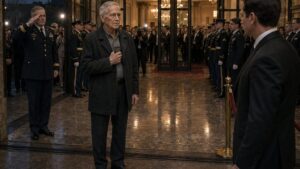
Thomas crossed the lobby with three officers behind him. He wore a dark service uniform without ceremonial decoration, but the stars at his shoulders needed no explanation. He stopped on the opposite side of the now-open barrier.
For one second, his expression held only disbelief.
Then he came to attention and saluted.
The officers behind him did the same.
The watching personnel near the elevators straightened instinctively.
Ronald returned the salute.
Donald’s tablet slipped against the desk with a dull plastic knock.
Thomas lowered his hand. “General Harris, I was told you hadn’t arrived.”
“I arrived at 6:51.”
Thomas turned toward Kevin. “Why was he not verified?”
Kevin looked at the floor, then forced his eyes up. “His name was absent from the contractor log. His credential carried a restricted advisory marker. We did not complete command verification.”
“We?”
Kevin glanced at Donald. “I supervised the checkpoint.”
Donald drew a breath. “Sir, the visitor did not identify himself as a retired general.”
Thomas’s head turned slowly.
Ronald saw the moment Donald understood that the explanation had made the situation worse.
Thomas stepped toward him.
“This ‘civilian,’” he said, pointing once toward Ronald, “is the most decorated operator in the history of this unit. He designed the tactical framework being briefed in that room.”
Donald’s face lost what little color remained.
A younger officer behind Thomas looked at Ronald’s faded jacket as if it had transformed before his eyes.
Ronald disliked the attention immediately.
The barrier was open, but his credential still lay on Donald’s desk.
He held out his hand.
“Mr. Miller.”
Donald stared.
“My identification.”
Donald grabbed the card too quickly, nearly knocking it against the monitor. He carried it around the desk rather than sliding it beneath the raised barrier.
“Sir, I—”
Ronald took the credential.
“We have thirty-nine minutes.”
Thomas’s anger did not ease. “Lieutenant Thompson, remove the contractor from duty. Have security take statements from everyone present.”
“No,” Ronald said.
The word quieted the lobby more effectively than a shout.
Thomas looked at him. “Sir?”
“Hold him here.”
Donald’s eyes lifted, uncertain whether that was mercy.
Ronald placed the credential in his jacket pocket. “The briefing is the urgent matter. This can wait long enough to be understood correctly.”
“He ignored an advisory instruction,” Kevin said. His voice carried the strained honesty of a man stepping into blame before it was assigned. “I saw the designation and failed to enforce verification.”
Thomas looked from Kevin to Donald, then toward the ordinary visitor terminal.
“This access was entered through my office,” he said. “Command-compartment channel.”
Kevin frowned. “That channel does not populate the contractor list.”
“It was supposed to generate a sealed confirmation flag.”
“It generated only the advisory marker.”
Thomas’s anger shifted. Not away from Donald, but outward, widening to include the system.
Ronald watched him recognize his own part.
Thomas had created the arrangement to spare Ronald administrative inconvenience. A hidden route for a hidden adviser. No visible name, no ordinary record, no explanation at the checkpoint.
Respect had built another barrier.
A radio crackled from inside the briefing room.
“Director, new surveillance package received. Eastern corridor timing has changed.”
Amanda’s voice followed, faint but urgent. “Recommend immediate review before authorization resumes.”
Ronald looked through the open barrier.
The map remained on the wall.
Thomas stepped aside. “General, the room is yours.”
“No,” Ronald said. “The problem is.”
He crossed the threshold.
Donald flinched as Ronald passed, perhaps expecting a rebuke. Ronald stopped beside him.
“You were right not to admit someone whose access could not be confirmed,” he said.
Donald swallowed.
“You were wrong when you stopped trying to confirm it.”
Ronald continued toward the secure door.
Behind him, Thomas told Kevin to preserve every checkpoint record and instructed Donald to remain at his post under supervision.
Donald’s terror shifted into confusion. He had expected punishment to arrive in one clean blow. Instead, Ronald had left him standing inside the consequences.
At the entrance to Secure Room Four, Ronald paused.
Amanda stood by the display with the new surveillance package open on her tablet. The officers who had rushed into the lobby were returning behind him, their salutes replaced by uneasy attention.
Ronald entered carrying the unmarked folder.
The room came to its feet.
“Sit down,” he said.
They obeyed.
He looked at the eastern route, at the eighteen-minute window that should have been removed two days earlier, and at the amber authorization clock frozen above it.
Then he placed the folder on the table.
“Take the route off the screen,” Ronald said. “It should never have survived this morning.”
Chapter 6: The Question Nobody Wanted to Ask
“Who first noticed the timing discrepancy?”
Ronald stood beside the display while the eastern route vanished from the screen.
No one answered.
The briefing room held twelve people, most of them senior enough to issue orders across multiple commands. Their tablets glowed on the dark table. The frozen authorization clock remained in the upper corner, counting nothing.
Ronald looked from face to face.
Amanda sat near the lower end. Her fingers rested on the edge of her tablet. She did not look away, but she did not speak.
Thomas closed the secure door behind the returning officers and took his position at the head of the table.
Ronald asked again.
“Who saw it first?”
A senior officer cleared his throat. “The updated surveillance package arrived only minutes ago.”
“That was not my question.”
The officer’s jaw tightened.
Amanda moved one hand.
“I saw a variance in the earlier feed,” she said.
Her voice was controlled, almost too controlled.
“When?” Ronald asked.
“Before the briefing began.”
The room grew still.
“What variance?”
“The modeled surveillance sweep was recalculated at eleven minutes. The presentation retained eighteen.”
“Did you report it?”
“I raised the mismatch.”
Ronald glanced toward the senior officer beside her.
The man spoke before being asked. “The source framework had already been validated at command level. We understood her concern to involve a preliminary model.”
Amanda’s hand closed around the tablet.
Ronald saw the gesture and remembered paper bending beneath another analyst’s fingers.
“What did you understand?” he asked her.
She hesitated.
“Say it plainly.”
“I understood that the eastern route could close before the lead element cleared the second crossing.”
“Then why didn’t you insist?”
The question sounded harsher than Ronald intended. Amanda’s shoulders drew back.
“Because we were told the framework came from someone whose field judgment had never been successfully challenged.”
A faint movement passed around the table.
Ronald looked at Thomas.
Thomas did not defend himself.
Amanda continued, “The author’s name was compartmented, but everyone knew the reputation. I thought the discrepancy might be mine.”
There it was.
Ronald had removed his name, his rank, and his decorations. The institution had filled the empty space with mythology.
He opened the folder and laid every page across the table.
“No author is beyond challenge,” he said. “Especially this one.”
He slid the surveillance update toward Amanda.
“Show us where the framework fails.”
The senior officer beside her shifted. “General, with the decision window—”
“The decision window is why we do this now.”
Amanda looked at Ronald, unsure whether the invitation was real.
He moved away from the display and took an empty chair halfway down the table instead of the seat beside Thomas.
“Start with my first assumption,” he said.
She stood.
At first, her explanation came in clipped phrases. The surveillance pattern had been modeled using cloud cover that no longer existed. The eastern corridor’s terrain masked movement only while the ridge remained under shadow. Updated weather exposed the second crossing earlier. If the lead element slowed for any reason, the rear team would enter after the surveillance sweep had begun.
Ronald interrupted once.
“Why would the lead element slow?”
Amanda opened a terrain layer. “The route grade is based on dry conditions.”
“It rained overnight,” someone said.
“Forty minutes at the northern ridge,” Amanda replied. “Enough to increase the vehicle interval.”
She changed the timing model.
The eleven-minute window dropped to nine minutes and twenty seconds.
No one spoke.
Ronald leaned forward. “Continue.”
Amanda moved to the alternate routes. Ronald’s contingency notes provided three options, but the western approach depended on communications coverage that had not been confirmed. The central route offered more concealment but forced the teams through a narrow passage with no room to recover from mechanical failure.
“The southern route?” Thomas asked.
Amanda shook her head. “Longer exposure before entry.”
Ronald studied the diagrams. He had designed the alternates under different assumptions. None survived unchanged.
A secure phone pulsed at Thomas’s elbow.
He answered, listened, then covered the receiver.
“The external decision window has narrowed. We have fifty-three minutes to submit a viable recommendation or the operation is deferred.”
“Deferred for how long?” Ronald asked.
“Unknown. The opportunity may not reopen.”
The room’s attention turned toward him.
Ronald knew what they wanted. A commander’s answer. One firm route, delivered with enough certainty to quiet the clock.
Years earlier, he would have given it.
He looked at Amanda instead.
“What are we missing?”
She studied the map. “A route that assumes the surveillance pattern is fixed.”
“It isn’t?”
“It’s responsive. It shifts when the ridge sensors detect traffic.”
Ronald saw the idea form before she finished.
“Then we don’t race the window,” he said. “We move it.”
Amanda enlarged the northern sector. A service road crossed far outside the operational corridor. Controlled traffic there could trigger the responsive sweep away from the actual movement route.
The senior officer beside her leaned in. “That creates a false pattern.”
“It creates a legitimate maintenance signature,” Amanda said. “No fabricated signal. No unauthorized interference.”
Thomas looked at Ronald. “Would it hold?”
“Not by itself.”
Ronald pulled the central-route contingency page from the folder and placed it beside her model. “Use the northern traffic to shift the first sweep. Move the lead element through the central passage during the gap. Hold the rear team outside until the sensors reset.”
Amanda adjusted the sequence.
A new window appeared: fourteen minutes for the lead element, a protected delay, then twelve for the rear.
The room began working.
Questions came faster now. Communications coverage. Recovery positions. Weather drift. Vehicle spacing. Ronald answered some and redirected others. Twice, Amanda rejected his timing estimates. The first time, several officers went silent.
Ronald said, “Show me.”
She did.
She was right.
The second time, Ronald challenged her model and found an omitted elevation factor. She corrected it without apology. The exchange changed the room. Rank remained visible, but it no longer sealed the discussion.
Thomas watched from the head of the table.
Thirty minutes later, the revised recommendation filled the display. It was not elegant. It contained pauses, contingencies, and conditions for immediate withdrawal. It lacked the clean confidence of the route Donald had seen through the glass.
It was safer because everyone in the room could see where it might fail.
Thomas read the final authorization criteria aloud.
No objections remained.
“Submit,” he ordered.
The amber clock disappeared.
For a moment, the room was silent with relief.
Ronald gathered none of the pages. He left the folder open on the table.
Amanda sat down slowly.
“You should have insisted earlier,” he told her.
Her expression tightened.
Then Ronald added, “And we should have built a room where insisting did not require courage.”
The senior officer beside her looked down.
Thomas removed his glasses. “I approved the command-channel visitor arrangement. Your access was deliberately kept out of the contractor system.”
“You were trying to protect my privacy.”
“I created a verification gap.”
“Yes.”
Thomas accepted the answer.
Ronald looked toward the secure door, beyond which Donald and Kevin remained at the checkpoint.
“The man outside chose humiliation over verification,” Thomas said. “That choice is his.”
“It is.”
“Then why did you stop me from removing him?”
“Because his failure is the easiest one to see.”
Ronald touched the open folder.
“I refused to use the authority that could have stopped the delay because I wanted the ordinary process to prove itself. Kevin saw the advisory marker and avoided responsibility. You built a special channel without ensuring the checkpoint could confirm it. This room treated an unnamed author as unquestionable.”
Thomas’s face hardened with discomfort rather than resistance.
Ronald closed one page but left the folder itself open.
“If this ends with one contractor losing his badge,” he said, “everyone else gets to call the system sound.”
Thomas glanced at the accepted plan on the screen.
“What do you want?”
Ronald stood.
“The checkpoint records preserved. The verification prompt restored. Every decision documented—including mine.”
“And Miller?”
“He answers for the moment caution became contempt.”
Ronald looked through the narrow glass panel in the door. Donald stood behind the desk beneath the raised barrier, waiting for someone else to decide what he had become.
“But this cannot end with one contractor being blamed.”
Chapter 7: The Door Opened Without an Applause
Donald was removing his checkpoint badge when Ronald returned to the lobby.
The barrier had been lowered again. Its metal arm divided the lane exactly as it had that morning, but the monitors behind it now displayed a yellow training banner instead of the visitor list.
A security officer stood beside Donald with an evidence envelope open.
“Pause that,” Ronald said.
The officer looked toward Thomas.
Thomas nodded. “Leave the badge on the desk.”
Donald placed it beside the scanner. He did so carefully, as if sudden movement might be interpreted as another offense.
Kevin stood at the adjacent terminal with the preserved access record open. His uniform remained neat, but the certainty had gone from his posture. Amanda had joined them with a copy of the revised verification sequence on her tablet.
No crowd had been summoned. The personnel who had witnessed the confrontation had returned to their duties. Radios carried ordinary traffic again.
That suited Ronald.
Thomas stepped beside him. “The contractor’s management has been notified. Formal review begins this afternoon.”
Donald’s eyes remained on the badge.
“I followed the visitor list,” he said.
Ronald approached the barrier. “At first.”
“My responsibility was to prevent unauthorized entry.”
“Yes.”
Donald looked up, surprised by the agreement.
Ronald placed his open folder on the narrow shelf between them. The injury page was no longer visible. On top lay a printout of the checkpoint record.
“The credential validated at 6:53,” Ronald said. “The advisory prompt appeared eight seconds later. What did it instruct you to do?”
Donald’s mouth tightened.
Kevin answered. “Contact command control. Do not relocate the visitor until status is resolved.”
“I asked him,” Ronald said.
Donald looked toward Thomas. “The command code came from his envelope. It could have been compromised.”
“What did you do to determine whether it was compromised?” Thomas asked.
Donald said nothing.
Amanda scrolled down the record. “The system offered an internal directory lookup. It was closed without being opened.”
Donald’s gaze shifted toward her.
Ronald waited.
The contractor’s first answer came slowly. “I had already searched the daily log.”
“That was not the secondary procedure.”
“No.”
“Why did you close it?”
Donald rubbed his thumb against the side of his hand. The gesture was small and repetitive.
“Because the last time someone tried to talk his way through, I stopped him. Everyone said I had done exactly what security needed.”
“That man’s status was verified through command control,” Kevin said.
Donald turned on him. “After I refused him. That’s the part people remembered.”
His voice had sharpened, but the anger was not aimed entirely outward.
He looked at the badge on the desk.
“My contract evaluation says I need to demonstrate independent judgment. Uniformed personnel come through here and treat contractors like furniture until they need someone blamed for a delay. This morning people were watching. He knew room numbers. He knew the procedure. He stood there correcting me.”
Ronald said, “So you decided I was pretending to matter.”
Donald’s jaw worked once.
“Yes.”
The word changed the air more than any defense had.
Donald continued before anyone could interrupt. “I thought if I made the call after he told me to, everyone would see that he had pressured me into it. I wanted them to see I couldn’t be pushed.”
Kevin looked down.
“And when I directed you to verify?” he asked.
“You didn’t direct me until you were afraid he might be important.”
Kevin absorbed the accusation without rejecting it.
“That’s true,” he said.
Donald looked at him then, perhaps expecting denial.
Kevin turned to Ronald. “I saw the designation. I knew it required escalation. I let his confidence substitute for my supervision because overruling him would have put my name on the decision.”
Thomas rested both hands on the edge of the desk.
“And I created a command-only entry that did not populate the system used by the people responsible for admitting the visitor,” he said. “I assumed my office’s arrangements would explain themselves.”
Ronald looked at the printout.
“My phone was in reach before the briefing began,” he said. “I could have called Thomas immediately.”
Donald gave a bitter glance. “Then why didn’t you?”
“Because I wanted the ordinary process to recognize valid access without being frightened by my title.”
“And it didn’t.”
“No.”
Ronald lifted his eyes.
“When the delay threatened the briefing, I still waited. I told myself I was defending principle. In truth, I was testing all of you with time that did not belong to me.”
Thomas began to object.
Ronald stopped him with a small movement.
“Responsibility is not divided until no one has enough to carry,” he said. “Each of us keeps our part.”
Amanda placed the revised sequence on the main monitor.
Three steps appeared beneath the validation screen: ordinary log check, embedded-status verification, direct command escalation. Beside each was the person responsible and the maximum time permitted before the next step became mandatory.
Kevin read it aloud.
“No visitor admitted without confirmation. No validated advisory visitor dismissed or relocated without command review.”
Donald stared at the second line.
“That would have kept him here,” he said.
“It would have kept you from deciding his value,” Amanda replied.
Thomas looked toward the security officer. “Mr. Miller will still face formal review. This procedure does not erase his conduct.”
Ronald added, “And the review should not begin with a conclusion already chosen.”
Donald studied him. “You’re asking them not to fire me?”
“No.”
The answer struck harder than reassurance would have.
“I’m asking them to examine what you did, why you did it, and whether you can be trusted to make a different choice next time. Forgiveness is not a substitute for judgment.”
Donald nodded once. The movement was almost imperceptible.
Thomas placed the barrier in training mode.
A warning tone sounded, and the metal arm descended between Ronald and Donald.
Kevin moved to the terminal. “Run the sequence from the beginning.”
Donald picked up Ronald’s credential. His hands were steadier now, though his face remained drawn.
He inserted the card.
The system validated the identity. The blue advisory symbol appeared.
This time Donald opened it.
“Restricted adviser,” he read. “No ordinary visitor entry. Remain at checkpoint while command control is contacted.”
Kevin initiated the internal call. Thomas’s secure device rang immediately.
“Verification confirmed,” Thomas said.
Donald pressed the release control.
The barrier lifted.
No one saluted. No one applauded. The lobby offered only the hum of ventilation and the soft click of the mechanism reaching its upper lock.
Ronald took his credential and placed it in his pocket.
Donald remained on the far side, awaiting the security officer who would escort him to the review room.
Ronald picked up the unmarked folder. For years he had carried it tight beneath his arm, as though concealing its author could protect everyone from the authority attached to him.
He held it openly at his side.
Then he stepped to the raised barrier and kept one hand beneath its edge.
Donald hesitated.
Ronald looked at him.
“After you,” he said. “You know the procedure.”
Donald walked through first.
Not absolved. Not publicly broken. Required only to cross the boundary he had misused and account for the choice he had made there.
Ronald followed him through the open checkpoint, carrying the plan where everyone could see it.
The story has ended.