The Man Whose Name Was Missing From the Ledger But Written Into the Nation’s Highest Command Memory
Chapter 1: The Ledger That Refused His Name at the Entrance
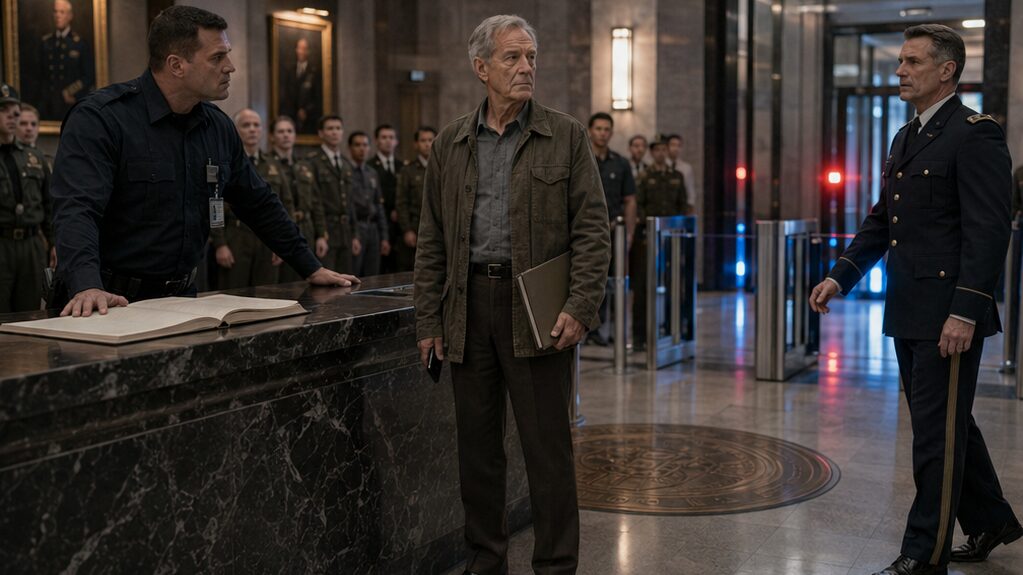
The security contractor brought his palm down on the visitor ledger hard enough to make its metal rings jump.
“Your name isn’t on the daily visitor log,” he said, “and I don’t make exceptions for anyone.”
The sound traveled through the academy’s polished entrance hall. A pair of cadets crossing beneath the portraits of former commanders slowed without meaning to. At the reception counter, a staff member stopped sorting identification cards. Even the young officer waiting near the security gate glanced over.
The older man on the opposite side of the desk did not move.
He wore a faded field jacket over a gray shirt, dark trousers, and shoes polished more from habit than display. A slim document folder rested beneath one arm. His other hand held a plain black phone. There was no badge clipped to his coat, no ribbon bar, no pin announcing a unit or rank.
Nothing about him appeared to justify the volume Tyler Miller had chosen.
“My understanding,” the man said, “is that I’m expected upstairs.”
Tyler turned the ledger around as if presenting evidence in court. He ran one finger down the printed column, then tapped the blank space beneath the final scheduled visitor.
“Expected people are listed.”
“The arrangement may have been made outside the daily schedule.”
“Then whoever made it should have informed security.”
The older man looked past him toward the interior gate. A bronze academy seal had been set into the marble floor beyond it. Past the seal, a corridor led toward a wall of framed photographs and, farther still, the memorial wing.
His gaze rested there for only a moment.
“Would you call the commandant’s office?” he asked.
Tyler leaned back. He had spent four years at the desk, long enough to know how people behaved when stopped. Some became apologetic. Some became angry. Others whispered a title or dropped a name, hoping privilege would open what procedure had closed.
The calm ones irritated him most.
Calm suggested they did not understand that he controlled the next door.
“If the commandant expected you,” Tyler said, “you’d be on this page.”
The older man lowered his eyes to the ledger. “Systems can be incomplete.”
“Not this one.”
A few more cadets had begun watching. Tyler noticed them, and his shoulders squared. Earlier that month, a supervisor had warned the security staff that a failed access audit could cost the contractor its academy assignment. Tyler had been the one who caught two expired vendor passes the inspectors had planted as tests. He had received no praise for it, only a memorandum reminding him that one mistake could compromise the campus.
He would not be the man who waved an unidentified stranger through because the stranger spoke softly.
“Government identification,” Tyler said.
The older man produced a driver’s license.
Tyler examined it. “Ronald King.”
“Yes.”
“No military credential?”
“Not one relevant to this desk.”
“Appointment confirmation?”
“Not on my phone.”
“Escort instructions?”
“I was told to arrive alone.”
Tyler gave a small, humorless laugh. “You were told to arrive alone for a meeting with academy leadership, but nobody put you on the list.”
“That appears to be the situation.”
The answer held no sarcasm, which somehow made Tyler feel mocked.
He slid the license back across the desk. “Then the situation is that you don’t enter.”
Ronald placed the card in his wallet with careful fingers. He had arrived fifteen minutes early because he disliked making others wait. He had also chosen the front entrance instead of the secured service approach offered in the meeting instructions. The academy belonged to the cadets during the day, and he had not wanted black vehicles, protective details, or closed corridors turning his arrival into a ceremony.
Now cadets were watching a different kind of lesson.
Tyler pointed toward the glass doors.
“You’ll need to leave the building.”
Ronald’s eyes shifted toward the nearest group of cadets. One had a notebook tucked under his arm. Another carried a ceremonial belt in a clear garment bag. They were trying not to stare and failing.
He remembered young operators standing in a cramped briefing room decades earlier, listening while a senior man insisted that an order mattered more than the changing facts outside. Ronald had known the order was wrong. He had waited too long to challenge it because he believed discipline required restraint.
Names from that day were now etched into stone.
He looked back at Tyler.
“I don’t want you to ignore security,” Ronald said. “I’m asking you to verify.”
“I already did.”
“You checked one page.”
“This page is the verification.”
“Call the commandant’s office.”
Tyler’s jaw tightened. “Sir, you don’t get to instruct me how to perform my job.”
Ronald’s silence lasted a fraction too long.
Tyler stepped around the end of the desk, not close enough to touch him but close enough to make the direction unmistakable.
“Perhaps you’re at the wrong building,” he said, raising his voice. “Or perhaps someone gave you information you misunderstood. Either way, you cannot remain in the secure lobby.”
The suggestion settled differently than the refusal. The cadet with the notebook looked down. The young officer by the gate shifted his weight but did not intervene.
Ronald felt no urge to defend his memory. What troubled him was the satisfaction in Tyler’s tone—the small expansion of a man who had discovered that a rule could make another person smaller.
He could have ended it then. A name, a title, one number entered into the desk phone.
Instead, his old habit held him still. He had spent years avoiding the use of rank as a personal weapon. He had watched lesser men demand recognition in restaurants, airports, and offices, turning service into a debt strangers were required to pay.
He would not become one of them.
But as he glanced at the cadets, he understood that silence was no longer protecting only his dignity. It was allowing Tyler’s conduct to stand as an example of authority.
“Then I won’t trouble you,” Ronald said.
Tyler gestured toward the exit again.
Ronald stepped away from the desk. He did not go outside. He moved to the edge of the lobby, beside a display case containing an old academy uniform, and set the slim folder beneath his arm more securely.
Tyler watched with visible impatience.
“You need to cross the doors, sir.”
Ronald unlocked his plain phone and selected a number stored without a title.
The call connected on the second ring.
“I’m at the perimeter,” Ronald said, his voice low but clear in the attentive lobby. “Could someone come out?”
He looked once at the open ledger beneath Tyler’s hand.
“Apparently, I don’t exist in the base system.”
Chapter 2: The Quiet Phone Call That Should Not Have Mattered
There was a brief silence on the other end of the call.
Then a voice asked Ronald one question.
“Front entrance?”
“Yes.”
“We’ll handle it.”
Ronald ended the call.
The entire exchange took less than ten seconds. No title had been spoken. No threat had been made. He slipped the phone into his jacket pocket and remained beside the display case as though waiting for a delayed ride.
Tyler stared at him.
“That was your solution?”
“It was a request.”
“To whom?”
“Someone attending the meeting.”
Tyler glanced at the cadets and gave a dismissive shake of his head. “Important meetings don’t send participants to collect unidentified visitors from the lobby.”
Ronald said nothing.
Tyler had expected an argument. The absence of one left him with nowhere to direct the energy he had built. He returned behind the desk and pulled the ledger closer, making a show of reviewing the page again.
“Ronald King,” he said. “No entry. No notation. No escort.”
The young officer near the gate took one cautious step toward the desk. “Mr. Miller, perhaps central protocol—”
“I’ve already checked the authorized list.”
“I only meant there may be an amendment.”
“Then it would appear here.”
The officer retreated. Tyler’s voice had gained the clipped certainty of someone defending more than a procedure.
Ronald watched the exchange. He had asked for help only after Tyler refused every reasonable path to verification, yet he felt the old discomfort of escalation. Somewhere beyond the lobby, schedules would be interrupted. People would hurry. His attempt to arrive without spectacle had already failed.
That failure belonged partly to him.
He could have identified himself at once. He could have called Alexander Davis before entering. Instead, he had trusted that a calm request would meet competent judgment. When it had not, he had continued testing the limit, perhaps because the failure felt too familiar.
The cadet with the notebook looked at Ronald, then at the ledger.
“Sir,” he asked quietly, “should I find someone from administration?”
Tyler answered before Ronald could.
“You should continue to your assignment.”
The cadet hesitated.
Ronald gave him a slight nod. “Do as you were instructed.”
The cadet moved on, but slowly.
Tyler folded his arms. “You see? That’s how a secure institution functions. People follow directions.”
“Sometimes,” Ronald said, “they also report what doesn’t make sense.”
“This makes perfect sense. You aren’t listed.”
Ronald looked at the thick ledger. “Does the academy keep every name in there?”
“Every person authorized to enter through this lobby today.”
“Every instructor?”
“Permanent staff use credentials.”
“Every cadet?”
“They’re enrolled in the access system.”
“Every invited official?”
“If they require visitor entry.”
Ronald’s gaze settled on the last phrase.
Tyler mistook the pause for defeat. “You called somebody. Fine. When they arrive with proper authorization, we can begin again.”
A faint burst of radio traffic sounded from the security station behind him. Tyler turned his head.
The transmission was too distorted to understand, but its rhythm was different from routine traffic—short codes, repeated acknowledgments, a request for confirmation.
One of the desk monitors flickered from the visitor management screen to a blue security banner, then returned.
Tyler frowned and tapped the keyboard.
The staff member at the reception counter picked up a ringing telephone.
“Yes, front lobby,” she said. Her expression changed. “No, we haven’t been notified of—”
She listened.
Her eyes moved toward Ronald.
“I understand.”
She lowered the receiver without hanging it up.
Tyler noticed. “What is it?”
“They asked whether the principal had arrived.”
“What principal?”
“They didn’t say.”
“Then call back.”
Before she could respond, the magnetic locks inside the academy released in sequence. The sound traveled down the corridor: one heavy click, then another, then another, approaching the entrance hall like measured footsteps.
The young officer by the gate straightened.
Tyler checked his monitor again. “That could be a system test.”
“No test is scheduled,” the officer said.
Tyler’s radio crackled.
“Front station, confirm lobby status.”
He lifted it. “Front station secure. One denied visitor awaiting escort verification.”
A pause followed.
“Describe visitor.”
Tyler looked at Ronald. “Elderly male, civilian clothing, faded green jacket, document folder. Identification reads Ronald King.”
The response came so fast that Tyler almost missed it.
“Do not remove him.”
Tyler pressed the transmit button. “He has already been denied access.”
“Repeat: do not remove him. Maintain position.”
The radio went silent.
A low shift passed through the lobby. The cadets who had begun to disperse stopped again. A staff member near the stairs closed the folder in her hands. The young officer moved away from the gate and stood straighter, though no order had been given to him directly.
Tyler placed the radio on the desk.
“That doesn’t authorize entry,” he said, but the statement was weaker than his earlier refusals.
Ronald studied him. For the first time, he saw fear beneath the condescension—not fear of Ronald, but of becoming the point where a system failed. Tyler’s need for control had not begun solely in arrogance. It had grown from the knowledge that institutions punished the visible mistake more readily than the invisible failure of judgment.
That did not excuse what he had done.
But it explained why he kept reaching for the ledger even as the building changed around him.
“Mr. Miller,” Ronald said, “you still have time to call the commandant.”
Tyler’s hand stopped over the page.
The offer was genuine. Ronald was giving him one final chance to turn enforcement into judgment before someone else made the correction for him.
Tyler looked at the watching cadets. If he called now, it might appear that the old man had forced him to surrender procedure. If he did not, he could still claim he had maintained the perimeter until formal orders arrived.
He chose the appearance of control.
“I will act when the chain of command instructs me,” he said.
A red light began flashing above the interior security doors.
It pulsed once, went dark, then pulsed again.
The staff member at reception rose from her chair.
“That isn’t a test,” she whispered.
A tone sounded throughout the lobby—low, sharp, unmistakably official. Blue banners replaced the ordinary displays on every desk monitor.
DISTINGUISHED VISITOR PROTOCOL.
The young officer’s face changed first. He turned toward the corridor.
Far inside the academy, radios erupted at once.
Chapter 3: When the Entire Academy Stopped Moving at Once
The second alarm tone had not finished when boots began striking the corridor floor.
Not marching boots. Running boots.
The academy entrance hall, orderly a moment before, shifted into controlled urgency. Interior doors unlocked. Staff stepped away from passageways. Cadets moved instinctively to the walls as military police came through the security gate at a run.
Tyler stood behind the desk with both hands braced against the ledger.
“Why was this protocol activated?” he demanded.
No one answered him.
A military police sergeant reached the lobby, scanned the glass doors, the reception area, and the older man beside the display case.
His attention fixed on Ronald.
“Sir, are you secure?”
“Yes.”
“Were you approached physically?”
“No.”
“Were you directed outside the protected area?”
“I was directed toward the doors. I remained inside.”
The sergeant glanced at Tyler, then back to Ronald. “Understood.”
Tyler stepped forward. “I need clarification. This individual had no authorization in the daily log.”
The sergeant touched his radio. “Principal located. Front lobby. Secure.”
The word principal passed through the room like another alarm.
Ronald disliked it. The term reduced a human being to the center of a protection pattern, a moving point around which corridors closed and people hurried. He had spent enough years inside such patterns to know how quickly they could become theater.
“I don’t need a security ring,” he told the sergeant.
“With respect, sir, that decision is above my station until command arrives.”
“That is a better answer than pretending your station is higher.”
The sergeant’s eyes flickered toward Tyler but his expression remained professional.
More personnel emerged from the corridor. A communications officer spoke rapidly into a headset. Two staff members pulled open the ceremonial doors leading toward the administrative wing. At the far end of the hall, cadets who had not witnessed the original confrontation were being redirected from the entrance.
Tyler looked from one moving uniform to another.
He had expected, at most, an administrative aide carrying a printed confirmation. Even after the radio order, he had imagined a scheduling error—a visiting donor, perhaps, or a retired official whose escort had been delayed.
Distinguished Visitor Protocol was different. It did not activate for donors. It did not activate for routine retired officers. It synchronized security, command, communications, and movement control throughout the academy.
Yet the man who had triggered it remained in a worn jacket with a folder under his arm.
Tyler pulled the ledger closer and searched again.
Ronald King.
The name was not there.
He flipped backward through supplementary pages, then checked the handwritten amendments clipped inside the cover. Catering vendors. Maintenance technicians. A congressional staff delegation. Two family members attending a private cadet review.
No Ronald King.
The absence had been his certainty. Now it looked like an accusation.
The reception telephone rang again. Tyler reached for it before the staff member could.
“Front security.”
A voice spoke with such force that he pulled the receiver slightly away.
“No, sir,” Tyler said. “The visitor has not entered the interior academy.”
He listened.
“Yes, sir. I understand the alert designation.”
Another pause.
“No, sir. I did not contact the commandant’s office because the visitor lacked—”
The voice cut him off.
Tyler’s eyes shifted toward Ronald.
“Yes, sir,” he said finally.
He replaced the receiver.
The young officer stood near the desk. “Who was it?”
“Central operations.”
“What did they say?”
Tyler did not answer.
Ronald could read the answer in his face. Someone had told him that the absence of a name on a local ledger did not overrule a national command movement. Someone had likely also asked the question Tyler had refused to ask himself: why had he not verified?
A group of cadets gathered beyond the marble seal, held there by an instructor. Their posture was formal, but their attention remained fixed on Ronald.
He felt the weight of their eyes more than the alert.
If this became only a revelation of status, they would learn the wrong lesson in a new form. They would learn that Tyler’s disrespect was objectionable because he had chosen an important target. They might conclude that ordinary people could still be diminished safely, provided no commandant came running.
Ronald walked toward the desk.
The MPs shifted with him until he raised one hand.
Tyler watched him approach.
“You should remain where security placed you,” Tyler said, then seemed to hear his own words.
“No one placed me there.”
Ronald stopped on the other side of the ledger.
Up close, he saw a sheen of perspiration along Tyler’s hairline. He also saw a thin white scar across the contractor’s thumb and the faint indentation left by a wedding ring. Ordinary details. Human details. The kind that disappeared when a person became only an obstacle or an enemy.
“You were right to stop someone you could not verify,” Ronald said.
Tyler swallowed.
“You were wrong to refuse verification because you enjoyed the stopping.”
The words were quiet enough that only those nearest the desk heard them. Tyler’s face tightened, not in anger now, but in recognition.
“I followed procedure.”
“Until procedure asked you to think.”
“The log was empty.”
“So you decided the man in front of you must be empty too.”
Tyler looked down at the open page.
The military police sergeant turned slightly as another transmission reached his earpiece.
“Command party entering the administrative corridor.”
The phrase transformed movement into formation. Staff cleared the center of the lobby. Officers arriving from side passages arranged themselves without discussion. The cadets beyond the seal straightened until their shoulders formed a rigid line.
Tyler remained behind the desk because there was nowhere else for him to go.
Ronald looked toward the corridor.
He knew who was coming. Alexander Davis had been a young operations officer when Ronald first noticed that he asked questions other men avoided. Years later, Ronald had recommended him for command not because Alexander obeyed well, but because he understood when obedience required the courage to report changing facts.
That recommendation had never appeared in Alexander’s public record.
Nor had most of Ronald’s own work.
The academy displayed portraits of commanders whose careers could be summarized beneath frames. Ronald’s service had unfolded largely outside such captions—missions without public names, units reorganized after their work was done, decisions sealed into files most officers would never read.
His absence from the visitor ledger was not a deliberate test. The meeting had been arranged through a compartmented defense channel, and someone had assumed command notification would flow downward. It had not.
A structural failure, not a conspiracy. One gap above had met one man’s rigidity below.
Ronald had seen far worse consequences emerge from smaller gaps.
The running boots grew louder.
Tyler straightened the ledger as though tidiness might restore its power. “I was protecting the academy.”
Ronald’s gaze moved toward the memorial corridor visible beyond the gathering officers.
“Protection without judgment can become another kind of danger.”
Tyler opened his mouth, but the interior doors swung wide.
Senior officers entered first, moving quickly enough to break the academy’s usual ceremonial pace. Behind them came administrative staff and a protective detail. At the center was Commandant Alexander Davis, still fastening the top button of his uniform coat as he crossed the threshold.
He was issuing instructions over his shoulder.
“Confirm the Secretary’s party remains in place. Tell central operations we have located—”
Then Alexander saw the older man standing beside the visitor ledger.
His sentence stopped.
For one suspended second, the commandant of the academy did not move at all.
His gaze passed over Ronald’s faded jacket, the slim folder, and the plain phone now visible in his hand. Recognition struck with a force that stripped the urgency from Alexander’s face and replaced it with something deeper.
He brought his heels together.
Every officer behind him halted.
Alexander Davis raised his hand in a rigid salute.
Chapter 4: The Name That Never Appeared in Any Public Record
Alexander Davis held the salute as if lowering his hand too soon would deepen the mistake already made.
Ronald stood beside the open ledger, the faded sleeve of his jacket nearly touching the page that did not contain his name. For an instant, neither man spoke.
Then Ronald returned the salute.
The movement was economical, almost private. Yet every uniformed person in the lobby followed Alexander’s lead. Hands rose from brow to brow in a widening wave—from the senior officers at the corridor doors to the military police near the entrance, then to the cadets standing beyond the academy seal.
The lobby that had echoed with alarms became still.
Tyler remained behind the desk.
He had seen salutes exchanged thousands of times, but never one that seemed to rearrange the entire room. Moments earlier, the older man had occupied the lowest position in the entrance hall: unlisted, unescorted, and denied. Now the academy commandant stood rigid before him while officers waited for Ronald to decide when the silence could end.
Ronald lowered his hand.
Alexander did the same.
“General King,” Alexander said. “Sir, I apologize.”
Tyler’s fingers tightened around the edge of the ledger.
General.
Ronald glanced toward the cadets. Their attention was no longer disguised. The change in their faces troubled him more than Tyler’s disbelief. Awe could become another form of carelessness. It encouraged people to judge conduct by the status of its recipient rather than by the conduct itself.
“I came early,” Ronald said. “The notification appears to have arrived late.”
Alexander’s jaw shifted. He understood the offered mercy and did not take it.
“The command channel confirmed your arrival window this morning. It should have reached the entrance station.”
“It did not.”
“No, sir.”
The protective detail commander approached, speaking quietly. “The Secretary’s party has been advised. They are holding in the secure conference room.”
Ronald nodded. “They can hold a few minutes longer.”
Alexander looked toward Tyler.
The contractor stood straighter, though his face had lost color. “Commandant, I followed the authorized visitor list. His name wasn’t entered.”
Alexander crossed to the desk.
He did not raise his voice. That made Tyler’s defense sound louder than it was.
“Did he request that you contact my office?”
Tyler hesitated. “He lacked credentials appropriate to the facility.”
“That was not my question.”
“Yes, sir. He requested contact.”
“And you refused.”
“The ledger showed no appointment.”
Alexander turned the book toward himself. His gaze moved down the printed entries and stopped at the blank line beneath the final name.
He had seen Ronald King’s name in places Tyler never would.
Not in public biographies. Not beneath official portraits. Not on the academy’s visitor schedules. Alexander had seen it in restricted after-action histories kept inside secure reading rooms, where pages could not be copied and notes had to be surrendered before leaving. He had seen it attached to recommendations for operations whose public versions omitted entire units. He had read decisions Ronald had made under conditions so compressed that most people would have called survival a success.
Ronald had demanded more than survival.
He had demanded that those with authority remain answerable for every person placed beneath it.
Alexander closed the ledger halfway.
“General King’s visit was transmitted through a restricted command channel,” he said. “His name was withheld from ordinary distribution because the meeting concerns protected operational doctrine.”
Tyler’s eyes moved to Ronald’s slim folder.
The folder suddenly looked heavier.
Alexander continued. “That explains why his name was not on your page. It does not explain why you refused to verify his request.”
Tyler swallowed. “I was told during the last audit that no unlisted person was to pass the desk.”
“He did not ask to pass.”
“He said he had a meeting.”
“He asked you to call me.”
Tyler looked toward the watching cadets and then away. “People claim things every day.”
“Yes,” Alexander said. “That is why telephones exist.”
The rebuke traveled through the room without force or flourish. Ronald saw Tyler absorb it, but he also saw the contractor’s eyes moving toward the security cameras. Tyler was calculating how the scene would appear later: the denied general, the alarm, the commandant’s questions, the witnesses.
His fear was no longer about the academy.
It was about what the academy might do to him.
Ronald understood that fear. Institutions often preached judgment but punished deviation so severely that people learned to hide behind process. A man could begin by fearing a mistake and end by enjoying the power that fear gave him over others.
Tyler had crossed that line when he suggested Ronald was confused. He had crossed it again when he refused the final opportunity to call.
But he had not built the line alone.
Ronald stepped closer to the desk.
“Mr. Miller was correct to stop an unverified person,” he said.
Alexander looked at him. “Sir—”
“He was not correct afterward.”
Tyler lifted his eyes.
Ronald placed two fingers on the edge of the ledger.
“This book did not fail because my name was missing. It failed because you treated it as the end of your responsibility.”
Tyler’s mouth opened, but no answer came.
The cadet with the notebook had returned to the edge of the group. Ronald recognized him and wondered how much of the encounter he had seen. Enough, probably, to remember the reversal. Ronald needed him to remember something harder.
Alexander drew a measured breath. “The Secretary is waiting to discuss the doctrine review you authored.”
A slight murmur moved among the cadets before discipline suppressed it.
Ronald’s work had not been presented under his name in their classrooms. The academy taught fragments of it: distributed judgment when communication failed, responsibility under conflicting orders, protection of personnel when written instructions no longer matched the field. The principles had passed into training manuals after their original context was classified away.
Tyler stared at him as though trying to connect the man in the faded jacket to something too large to fit inside the lobby.
Alexander faced the assembled cadets.
“For those who do not know the name,” he said, “General Ronald King commanded the operations group from which much of this academy’s modern field doctrine was developed.”
Ronald’s expression tightened.
Alexander saw it but continued, more carefully.
“His awards cannot all be discussed here. His assignments cannot all be listed publicly. But I can tell you this: no operator in the history of that unit has been entrusted with more, and none has returned more people home.”
The words struck Ronald where praise always did—not in pride, but in the spaces occupied by those who had not returned.
He looked toward the memorial corridor.
Alexander’s voice lowered.
“This ‘civilian’ is the most decorated operator in the history of this unit.”
No one looked at Tyler.
That was worse than staring.
Ronald closed his phone in his palm and turned from the ledger. The room waited for him to accept what had been restored.
Instead, he looked directly at Alexander.
“Before anyone decides what happens next,” he said, “the cadets need to understand why this was wrong.”
Chapter 5: The Lesson Hidden Beneath Every Forgotten Name
The declaration of Ronald’s identity had ended the argument, but it had not answered him.
The cadets remained in two rigid lines near the academy seal. Senior officers stood behind Alexander. Tyler was still at the desk, one hand resting beside the blank line in the ledger as though he feared moving it would be interpreted as guilt.
Ronald stepped away from the officers and faced the cadets.
Alexander began, “Sir, we can address the personnel matter privately.”
“That is where punishment belongs,” Ronald said. “The lesson does not.”
Tyler looked up sharply.
Ronald did not enjoy the position Alexander had placed him in. Public attention stripped away context. It turned complicated failures into clean scenes with heroes on one side and fools on the other. He had spent much of his life resisting that simplification, sometimes so stubbornly that his silence had allowed the wrong lesson to survive.
He would not repeat that mistake before these cadets.
“Mr. Miller stopped a man without visible credentials,” Ronald said. “That was his duty.”
Some tension left Tyler’s shoulders.
“Then the man offered identification, explained that he was expected, and asked for verification through the commandant’s office.”
The tension returned.
Ronald’s gaze moved across the cadets.
“A secure institution needs rules. It also needs people capable of recognizing when a rule has reached the edge of what it can answer.”
The cadet with the notebook glanced toward the ledger.
Ronald noticed.
“A list can tell you whether a name was entered,” he continued. “It cannot tell you why it was omitted. It cannot tell you whether an instruction failed to travel. And it cannot decide whether a person requesting verification deserves contempt.”
Tyler’s face hardened slightly. “I did not use contempt.”
Ronald turned toward him.
“You suggested I was confused because I was old.”
Tyler’s eyes dropped.
“You raised your voice when you noticed an audience. You refused the call because making it would have reduced your control of the encounter.”
The accuracy of the words left Tyler with no procedural defense.
Ronald paused.
“But I also allowed the encounter to continue longer than necessary.”
Alexander frowned. “Sir, you made repeated reasonable requests.”
“And when those failed, I remained silent because I did not want to use rank as a weapon.”
The cadets watched him more closely now.
“That sounds principled,” Ronald said. “Sometimes it is pride wearing a cleaner uniform.”
Alexander’s expression changed. He had not expected the correction to turn inward.
Ronald looked at the blank ledger page.
“I knew I could end the situation. I delayed because I wanted judgment to appear without being forced. While I waited, cadets watched authority become humiliation. That part belongs to me.”
Tyler stared at him.
The contractor had prepared himself for dismissal, anger, or a controlled public crushing delivered by men whose careers towered over his own. Ronald’s admission unsettled him more than punishment would have. It removed the refuge of resentment.
Alexander stepped closer. “Responsibility is not equal here.”
“No,” Ronald said. “But it is rarely absent.”
A radio transmission broke the stillness. The protective detail commander listened through his earpiece, then approached Alexander.
“The Secretary’s office requests confirmation that the meeting can proceed.”
Alexander looked to Ronald.
“In five minutes.”
The commander relayed the answer.
The deadline restored motion around the edges of the lobby, but the center remained fixed on Ronald and Tyler.
Alexander said, “Mr. Miller will be removed from duty pending review.”
Tyler’s face went pale again.
Ronald studied him. “Is that required for immediate security?”
Alexander understood the distinction. “Not if he is reassigned away from access control.”
“Then do that.”
Tyler looked up. “General, I’m not asking you to protect my position.”
“I’m not protecting it.”
The words were not cruel, only exact.
“You should not control this desk today,” Ronald continued. “You stopped protecting the entrance when you began protecting your pride.”
Tyler absorbed the sentence without answering.
“But firing a man in a lobby teaches very little,” Ronald said. “Especially when the institution trained him to fear discretion and then left him alone with a checklist.”
Alexander glanced at the security supervisor standing near the interior doors. The supervisor’s discomfort confirmed the truth in Ronald’s observation. The academy had emphasized zero-failure compliance after the audit. No one had spent equal time teaching escalation, verification, or respectful uncertainty.
The system had rewarded Tyler’s rigidity until it became embarrassing.
That did not erase his choices. It made the correction larger than one man.
Alexander addressed the supervisor. “Suspend Mr. Miller from entry authority. Preserve the security recordings and audit instructions. I want the verification procedures reviewed before tomorrow morning.”
“Yes, sir.”
“And add a mandatory escalation step when identification is credible but the daily log is incomplete.”
“Yes, sir.”
Tyler’s hand withdrew from the ledger.
Ronald turned back toward the cadets.
“The person at a checkpoint may be important,” he said. “He may be ordinary. Your judgment should not depend on which truth is revealed later.”
No one moved.
“You do not owe every stranger entry. You do owe every person discipline in how you deny it.”
The cadet with the notebook lowered his eyes and wrote something.
Ronald saw the motion and felt no satisfaction. Lessons written quickly were often forgotten quickly. What endured was the memory of how power had felt in the room—first in Tyler’s hand striking the ledger, then in officers raising their salutes, and finally in the choice not to answer humiliation with more humiliation.
Alexander moved beside Ronald.
“The meeting route is ready.”
Ronald nodded, but before leaving he looked at Tyler.
The contractor stood without his radio now. The security supervisor had taken it quietly. Without the device, the desk, and the certainty of the ledger, he appeared less powerful but more present.
“Mr. Miller,” Ronald said, “why didn’t you make the call?”
Tyler’s first answer rose automatically. “The procedure—”
He stopped.
Everyone waited.
Tyler stared at the open page.
“Because he asked me to,” he said at last.
The admission came out rough.
Ronald said nothing.
Tyler continued, quieter. “I thought if I called after he told me to, everyone watching would think I didn’t know my job.”
“And now?”
“Now they know I didn’t.”
“No,” Ronald said. “Now they know what you chose. What you learn from it is not yet visible.”
Tyler’s eyes moved toward the cadets. Shame settled into his posture, but it no longer looked like fear of losing status alone.
Alexander gestured toward the administrative corridor.
Ronald picked up his slim folder.
“Keep the review private,” he told Alexander. “Correct the procedure publicly. Do not turn him into a ceremony.”
Alexander gave a single nod.
Ronald passed the desk without looking at the ledger again.
Behind him, Alexander issued the order that would determine Tyler’s next weeks, not his next minutes.
“Remove him from the post,” he said. “Then have him report tomorrow—not to security administration, but to the academy ethics review.”
Tyler looked up.
Alexander’s expression remained severe.
“You will explain to cadets where your duty ended and your pride began.”
Chapter 6: The Man Who Closed the Phone and Opened History Instead
Ronald had crossed the bronze academy seal before he realized the officers were following him.
Their footsteps formed a restrained rhythm behind his own. Alexander walked at his right shoulder. The protective detail kept several paces back, leaving the corridor ahead clear.
Ronald slowed.
“I asked for no procession.”
“You triggered a national protection protocol,” Alexander said. “Some consequences are not optional.”
“I made a phone call.”
“To the Secretary of Defense.”
“I called the person waiting for me.”
Alexander almost smiled, but the expression disappeared when he saw Ronald glance back toward the entrance desk.
Tyler was no longer behind it. The security supervisor had guided him into a side office. Another contractor stood in his place, studying the ledger as if it were a damaged instrument.
The book remained open to the blank line.
“That page will be in every review packet by evening,” Alexander said.
“It shouldn’t become evidence that the system worked.”
“It will be evidence that notification failed.”
“And that a man failed after it.”
Alexander considered the distinction. “You think we are preparing to blame him for everything.”
“I think institutions prefer failures with faces.”
They entered the administrative corridor. Framed photographs of academy classes lined one wall. On the other hung extracts from operational doctrine in dark wooden cases. Ronald passed the first without looking, then stopped at the second.
Behind glass was a page titled DECENTRALIZED JUDGMENT UNDER COMMUNICATION LOSS.
His own phrasing had been revised over the years, stripped of references to the operation that produced it, but the central sentence remained:
When instructions no longer match the conditions, responsibility does not disappear with communication.
Alexander watched him read it.
“Cadets study that in their first term,” he said.
“Do they know where it came from?”
“The source operation remains restricted.”
“Then they study the clean version.”
Alexander lowered his voice. “There is no clean version.”
Ronald looked at him.
That answer was why he had once supported Alexander’s advancement.
The doctrine had begun with an error. During a remote operation, a team received orders based on information already hours out of date. Communications failed before the correction reached them. A young officer recognized the mismatch but delayed acting because he feared violating the written plan. Ronald, commanding from another position, had also delayed overriding the chain because he believed another channel might reopen.
It had not.
Men died during the space between recognition and decision.
The doctrine later taught thousands of others to act sooner. That did not redeem the delay. Ronald had never allowed the academy to present it as a triumph.
“The Secretary wants your approval to expand this section,” Alexander said. “Decision ethics, not only tactical judgment.”
“That is why I came.”
“And why your name was withheld.”
Ronald resumed walking.
The meeting had been arranged through a restricted defense office because several examples remained classified. Academy administration had received only a protected arrival window and instructions to prepare a secured route. Someone had assumed the commandant’s staff would inform the entrance desk without adding Ronald to the general visitor list.
Alexander’s office had assumed central security would handle it. Central security had assumed the protective detail would escort him. The detail had expected him at the service entrance.
Ronald had chosen the front doors without notifying anyone.
That choice weighed on him now.
“I changed the arrival route,” he said.
Alexander glanced at him. “Yes.”
“You knew?”
“Central operations reconstructed it during the alert.”
“I was offered the service entrance. I chose this one.”
“Why?”
“I didn’t want cadets displaced for my arrival.”
Alexander stopped walking.
The officers behind them halted in sequence.
“You came through a public entrance during a restricted visit without telling the security team.”
“I did.”
“That omission matters.”
“Yes.”
Alexander’s tone remained respectful, but not soft. “Then when the contractor challenged you, you withheld the fact that special access had been arranged.”
“I asked him to call you.”
“You also knew he was operating without information you had chosen not to provide.”
Ronald met his eyes.
There it was: the judgment he had expected from Alexander years ago and had chosen him because he could deliver.
“I believed a competent system would verify uncertainty,” Ronald said.
“Perhaps. But you created some of the uncertainty.”
The corridor remained silent behind them.
Ronald looked again at the doctrine under glass. Responsibility did not disappear merely because another person committed the more visible wrong.
“I did,” he said.
Alexander nodded once. “Tyler’s conduct remains his own. Your choice does not excuse it.”
“No.”
“But if we revise the procedure without acknowledging that distinguished visitors sometimes resist the very protocols designed to prevent confusion, we will write another clean version.”
Ronald drew a slow breath.
The hardest correction was rarely the one delivered by an enemy. It was the one spoken by someone who had learned from you and no longer needed your approval to be honest.
“Add it to the review,” Ronald said.
Alexander’s eyebrows lifted.
“My route change. My failure to notify. My delay in identifying the access arrangement.”
“That will complicate the report.”
“It should.”
They continued toward the memorial corridor.
The officers behind them no longer felt like a procession. They felt like witnesses to a record being made less convenient.
Near the junction, the cadet with the notebook stood beside an instructor, waiting for permission to cross. When he saw Ronald, he came to attention.
Ronald stopped.
The cadet’s eyes flicked toward Alexander, then returned forward.
“You wrote something in the lobby,” Ronald said.
“Yes, sir.”
“What?”
The cadet hesitated, then opened the notebook. On the top line of the page were the words: A LIST CAN CONFIRM A NAME, NOT A PERSON.
Ronald read the sentence.
“That is not what I said.”
“No, sir. It’s what I thought you meant.”
“Then write the rest.”
The cadet waited.
“A person can also be wrong about himself.”
The cadet wrote it beneath the first line.
Ronald nodded toward the notebook. “Keep both.”
They moved on.
At the entrance to the memorial corridor, the polished brightness of the academy changed. The walls narrowed. The lighting softened. Names appeared in long, ordered columns cut into dark stone.
Alexander stopped several feet behind Ronald.
The Secretary was still waiting. The doctrine folder remained beneath Ronald’s arm. Officers stood ready to escort him to a meeting where policy would be revised and his judgment formally requested.
But Ronald did not enter.
His eyes had found a cluster of names near the center of the wall—men from the operation whose failure had shaped the doctrine now displayed outside.
For decades he had avoided speaking publicly about the source of that lesson. Classification provided the reason. Guilt provided the habit.
Alexander waited.
Ronald took the plain phone from his pocket and closed its protective cover. The small click echoed faintly between the stone walls.
“The academy teaches the doctrine,” he said.
“Yes, sir.”
“But not the cost.”
“Not beyond what is cleared.”
Ronald looked at the slim folder under his arm. Inside was the proposed revision and a request for him to approve a sanitized historical case study.
He had intended to do so.
Now he removed the folder and held it toward Alexander.
“Tell the Secretary the meeting begins here.”
Alexander did not take it.
Ronald faced the memorial wall.
“And tell the records officer to bring the sealed operational history. If they want my approval, these names enter the lesson with me.”
Chapter 7: The Ledger Was Never the Measure of a Man
The sealed operational history arrived in a gray case with two locks and no title.
A records officer carried it into the memorial corridor while the Secretary’s party gathered at a respectful distance. No one tried to move Ronald toward the conference room again. A narrow table was brought from a nearby alcove, and the case was placed beneath the names cut into the dark stone.
Alexander opened one lock. The records officer opened the other.
Inside lay a file Ronald had not seen in more than twenty years.
The paper had yellowed at the edges. Classification markings crossed the cover in red. Beneath them was an operational code that meant nothing to the cadets passing the corridor each day and everything to the men whose names waited above it.
The Secretary stood beside Alexander but offered no greeting speech. Ronald was grateful for that.
“You requested the complete history,” the Secretary said.
“I requested the cost.”
The records officer opened the file to the first cleared summary. Ronald turned several pages without reading. The clean language was familiar: communications degradation, command uncertainty, deviation delay, personnel losses. Each phrase contained just enough truth to survive review and not enough to make anyone feel responsible.
He stopped at the casualty appendix.
The names on the paper matched the names on the wall.
Alexander watched Ronald place one finger beside the first entry.
“This is where the doctrine began,” Ronald said.
The cadet with the notebook had been allowed into the corridor with his instructor. He stood near the doorway, far enough away to preserve the meeting’s privacy, close enough to hear what was authorized.
Ronald looked at the assembled officials.
“The current proposal calls this a successful adaptation following communications failure.”
No one interrupted.
“It was not.”
The Secretary’s expression tightened. “The adaptation later prevented losses.”
“Later.”
Ronald moved his finger down the page.
“These men did not die because a handbook lacked a paragraph. They died because several people recognized that conditions had changed and waited for permission to say so with enough force.”
His hand stopped beside one name.
“I was one of them.”
The admission entered the corridor without ceremony.
For years, classification had protected the operation from public scrutiny. Ronald had told himself it also protected the families, the surviving team, and the methods still in use. All of that was true.
It was also true that secrecy had allowed his guilt to remain shapeless. He could teach the lesson without standing beside the mistake. His name could disappear from the history while his authority remained inside the doctrine.
A different kind of blank line.
Alexander rested both hands on the edge of the table. “You issued the override.”
“Too late.”
“You acted before communications were restored.”
“Too late.”
“You brought the remaining team out.”
Ronald looked at him. “That does not place the dead back in the column of the living.”
The Secretary turned toward the memorial wall. “What change are you asking for?”
Ronald had expected resistance to the classified details. He had prepared arguments about institutional memory, ethical instruction, and controlled access. The question’s simplicity forced him past all of them.
“Do not teach cadets that judgment is what saves them after systems fail,” he said. “Teach them that judgment is part of the system.”
He closed the casualty appendix.
“And when you use this operation, do not remove the delay. Do not remove my part in it. Keep the names attached.”
The records officer shifted uneasily. “Some details cannot be released beyond a restricted classroom.”
“Then teach it there.”
“The general academy population would still receive the sanitized version.”
“Not sanitized,” Ronald said. “Limited. There is a difference.”
Alexander glanced toward the cadet at the door.
“What would the limited version say?”
Ronald considered the blank language on the summary. Then he looked at the names carved into stone.
“It would say that written authority did not match changing conditions. Several leaders recognized the conflict. They delayed challenging the plan. People died during that delay. The survivors changed the doctrine because obedience without judgment had proved insufficient.”
“And your role?” the Secretary asked.
Ronald’s instinct was to leave it out.
He felt the old resistance immediately: rank should not become confession performed for effect; grief should not be converted into biography; the dead should not be used to make the living appear humble.
Then he remembered Tyler’s hand striking the ledger. He remembered remaining silent while cadets watched because he wanted judgment to emerge without his interference. He remembered Alexander telling him that he had created some of the uncertainty himself.
“My role should say that the senior commander also waited too long,” Ronald answered.
The Secretary nodded once. “I will approve the review.”
Ronald did not feel relieved. Relief would have been too easy.
Behind them, footsteps approached and stopped at the corridor entrance.
Tyler stood there without his radio or security jacket. He had changed into a plain shirt provided by the contractor’s office. The supervisor remained several paces behind him.
Alexander’s expression hardened. “Why is he here?”
The supervisor answered. “He asked permission to return his access badge personally.”
Tyler held the badge in one hand.
Ronald looked toward the memorial wall, then at the file on the table. Tyler had no clearance to hear more. The records officer began closing the case.
Tyler noticed and stayed beyond the threshold.
“I won’t enter,” he said.
He placed the badge on a small shelf beside the corridor entrance.
“I only wanted to say I understand the review order.”
Alexander gave no response.
Tyler looked at Ronald. “I thought the worst thing I could do was let someone through who didn’t belong.”
Ronald waited.
“I never considered that I could fail by refusing to ask whether I was wrong.”
The words lacked polish. That made them useful.
Tyler glanced toward the cadet with the notebook.
“I liked being the last answer at that desk,” he said. “That wasn’t security.”
“No,” Ronald said.
Tyler accepted the judgment.
“Will you attend the ethics review tomorrow?” Ronald asked.
“Yes, sir.”
“Do not tell them you failed because I was a general.”
Tyler looked confused.
“Tell them why the same conduct would have been wrong if no one had come for me.”
Understanding reached him slowly.
“Yes, sir.”
Ronald turned to Alexander. “That is enough for today.”
Tyler nodded and left the badge where he had placed it. The supervisor followed him from the corridor.
No apology had erased the lobby. No title had made Tyler wise. He would face review, lose authority, and perhaps rebuild a different understanding of duty. The outcome remained unfinished because people were not corrected as cleanly as procedures.
That, too, belonged in the lesson.
The gray case was locked again. The Secretary and records officer carried the proposed changes toward the conference room. Alexander stayed beside Ronald.
“You still have a meeting,” he said.
“We just had the important part.”
Alexander looked at the memorial names. “They will be included.”
“Make sure they remain more than the cost of my lesson.”
Then Ronald approached the wall.
He touched no name. He simply stood close enough to read them without the distance required by ceremony.
For years, he had believed that refusing recognition kept faith with the men who had not lived to receive it. Now he understood the flaw in that silence. When he removed himself entirely, he also removed the chain of choices connecting authority to consequence. The history became cleaner, and therefore less true.
His name did not need to stand above theirs.
But it could no longer vanish from the part where he had failed them.
Behind him, the cadet closed his notebook.
“What did you write this time?” Ronald asked without turning.
The cadet read softly. “A system is only as honorable as the judgment people are willing to take responsibility for.”
Ronald looked over his shoulder.
“Keep working on it.”
“Yes, sir.”
Alexander accompanied Ronald back toward the entrance hall. The alert lights had been extinguished. The officers had dispersed. Ordinary movement was returning to the academy.
At the security desk, the new contractor had closed the visitor ledger.
Ronald stopped.
“Open it,” he said.
The contractor obeyed at once, turning to the page for that day. The blank line beneath the last scheduled visitor remained untouched.
“Should I add your name, sir?”
Ronald considered it.
Then he took the pen and wrote in the space himself:
Ronald King — arrived through front entrance.
No title. No rank. No list of awards.
He returned the pen.
The entry did not prove that he belonged. It recorded only that he had been there, that the system had missed him, and that people had been forced to decide what responsibility required after the page ran out.
Ronald walked through the interior gate with Alexander beside him.
Behind them, the ledger remained open—not as the measure of the man who had crossed the lobby, but as a record of the day the academy learned where a list must end and judgment must begin.
The story has ended.