They Mocked the Old Veteran’s Rifle Until the Qualification Board Went Silent
Chapter 1: The Old Man Beside the Damaged Names
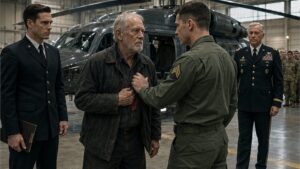
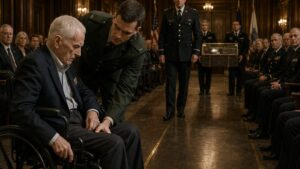
The first burst of fire shook dust from the memorial plaque just as George Hernandez saw that Steven Williams’s name had split through the middle.
The sound came from beyond the reinforced wall—three controlled shots, a pause, then the mechanical clack of the indoor target system resetting. The barracks corridor trembled faintly beneath George’s shoes. A gray thread of dust slid down the engraved brass and caught in the crack that ran through Steven’s surname.
George stood motionless.
The replacement plaque rested inside a cardboard sleeve under his left arm. In his right hand, he carried a faded canvas rifle bag whose leather handle had been repaired twice with dark thread. His fingers tightened around it until the tremor in them became less noticeable.
A young soldier behind the security desk looked from the bag to George’s visitor badge.
“Sir, you can’t remain in this corridor during live fire.”
“I’m here for the plaque.”
“What plaque?”
George nodded toward the damaged memorial.
The soldier glanced at it as though seeing it for the first time. “Maintenance request?”
“No.”
“Work order?”
“No.”
The soldier’s patience narrowed. “Then who authorized you?”
George took a folded letter from his jacket. The paper carried signatures from families scattered across four states, but no current base stamp. The soldier read the first lines, turned it over, and frowned.
“This isn’t an authorization.”
“It is what I was given.”
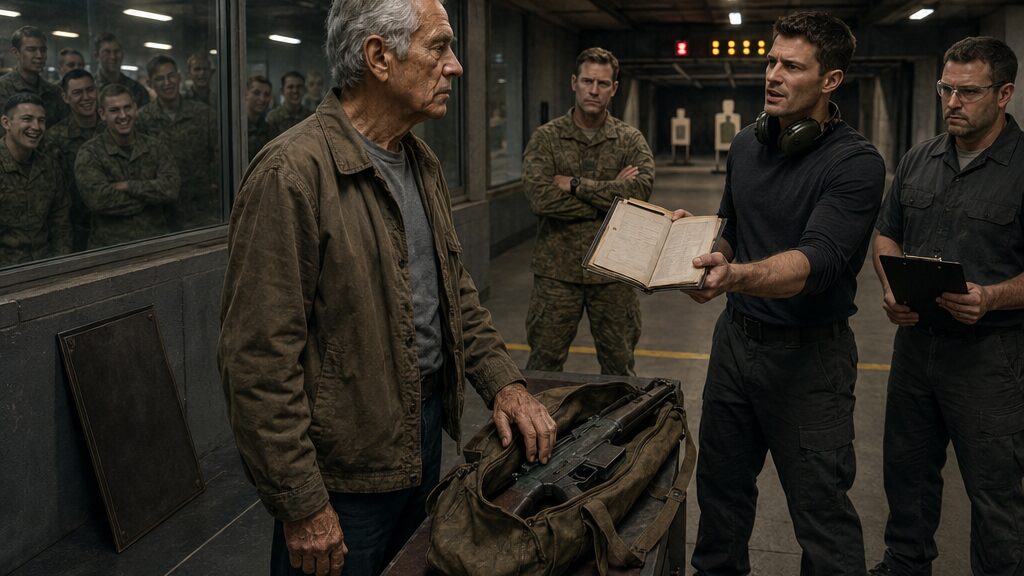
Behind the wall, another firing string began. Red numbers flashed through the observation window at the end of the corridor. A platoon stood in rows beyond the glass while a tall civilian shooter demonstrated transitions between electronic targets.
The soldier handed the letter back. “You’ll need to wait outside until an officer can verify this.”
George looked at the cracked plaque again.
The old brass had been mounted beside the simulator entrance when the barracks was renovated. Someone had drilled new holes through the original border. One corner had bent away from the stone. The unit crest above it was polished; the names beneath it were not.
George lowered the cardboard sleeve onto a bench. His knees protested when he bent, but his hands knew the measurements. He opened the sleeve, lifted the new plaque, and placed it over the old one.
The edges matched exactly.
So did the bolt holes.
The young soldier stared. “How did you know the size?”
George removed the plaque and returned it to the sleeve. “I measured it.”
“When?”
“Last winter.”
The soldier seemed ready to ask how George had entered then, but a door opened beside the observation area.
Paul Carter came through carrying an armorer’s clipboard and a tray of chamber flags. He was broad through the shoulders, with oil darkening the seams of his fingers. His eyes passed over George, paused on the rifle bag, and moved back to it.
The bag bore almost no visible markings. Only a faded block of stencil remained beneath one strap.
Paul looked at it twice.
“Problem?” he asked.
“Unverified visitor with a firearm case,” the desk soldier said. “Says he’s replacing the memorial plaque.”
Paul’s attention shifted to the cardboard sleeve. “That request’s been sitting for months.”
George said nothing.
Paul stepped closer to the bag, but before he could speak, applause broke out inside the simulator.
The civilian shooter emerged through the range door with his hearing protection hanging around his neck. Jack Allen wore an expensive competition belt and a fitted shooting jersey without military insignia. His smile was broad enough to include the platoon following him.
“Two ninety-eight,” he announced. “That’s the number you’re chasing. Anyone below two eighty buys the instructors coffee.”
A few soldiers laughed.
Jack noticed George near the memorial and slowed.
“Well,” he said, “someone bring the museum exhibit in early?”
The soldiers’ laughter weakened into uncertain smiles. George kept his eyes on the crack through Steven’s name.
Jack approached the rifle bag. “What have you got in there, sir? Flintlock?”
“It remains closed,” Paul said.
Jack raised both hands. “Range rules. I’m not touching.”
His gaze dropped to George’s right hand. The tremor had returned, small but visible in the fingers wrapped around the handle.
Jack’s smile sharpened.
“You planning to qualify with that hand?”
George looked at him then. Jack’s face held the practiced brightness of a man accustomed to deciding whether a room laughed.
“I came for the plaque,” George said.
“That’s probably safer.”
Several soldiers laughed this time. Their officer had entered behind them without George noticing. David Hall was younger than George expected, perhaps late thirties, with the restless posture of someone measuring every moment against a schedule.
“What’s delaying the next relay?” David asked.
The desk soldier explained. David listened while looking through George rather than at him.
“We have an inspection cycle in four days,” he said. “The corridor has to remain clear.”
“The plaque fits,” George said. “It needs four bolts.”
“Facilities handles memorial fixtures.”
“They have not.”
David’s jaw tightened. “That doesn’t change the process.”
George could have said the families had submitted three requests. He could have named the widow who paid for the engraving or the son who found the original unit roster. Instead, he placed one hand over the cardboard sleeve.
David took the silence as surrender.
“Escort him back to the visitor area.”
Jack leaned toward the worn bag. “Careful with that. Might be older than the building.”
Paul’s gaze remained fixed on the faded stencil.
“What unit was that case issued to?” he asked.
George did not answer.
Jack laughed softly. “Maybe he forgot.”
A thin ripple went through the platoon. George saw one soldier glance toward David before joining in. Permission traveled quickly through a room. It needed no order.
David reached for the clipboard at the security desk. A yellowed personnel copy had been clipped behind George’s visitor form—the old service record the families had included to establish his connection to the memorial.
Jack saw the date first.
He pulled the sheet free before George could stop him.
“Now this,” Jack said, turning toward the platoon, “should settle whether we need a gunsmith or an archaeologist.”
George’s hand lifted from the rifle bag.
Then stopped.
Jack held the old record high and cleared his throat for an audience already waiting.
Chapter 2: The War Where They Used Muskets
“What war was this from?” Jack called. “The one where they qualified with muskets?”
Laughter struck the glass wall and came back flatter than before.
George moved one step toward him, but his knee stiffened and forced him to pause. Jack noticed. His eyes brightened with the small triumph of a man who mistook delay for defeat.
David held out a hand. “Give me the file.”
Jack glanced at him.
For a moment, George thought David might stop it. Instead, the officer looked toward the platoon and said, “If you’re going to read it, read it accurately.”
That was permission enough.
Jack scanned the page with theatrical seriousness. “Infantry replacement course. Manual range estimation. Fixed-position qualification. Listen to this—‘automatic rifle team support.’ They wrote everything like a field manual back then.”
The platoon laughed again.
George looked past them to the qualification board. Jack’s score glowed at the top: 298. Below it, the soldiers’ scores stepped downward in uneven rows. Some were strong. Too many were not.
David watched the numbers while Jack performed. His expression carried no pleasure, only calculation. He wanted the soldiers loose before the next relay. He had mistaken humiliation for energy.
Jack continued. “No digital course history. No current tactical certification. Nothing after—”
His voice slowed.
The last line on the record ended with an operation code and an evacuation date. Beneath it, an administrative stamp marked George as reassigned pending medical review. There was no return-to-duty notation on the copy.
“No later qualification record at all,” Jack said. “That explains the bag.”
George could have told them the later pages had been lost when records were transferred. He could have explained that qualification sheets did not follow a man through every decade of civilian life.
He said nothing.
Silence had once kept Steven’s name from becoming a story told over drinks. It had kept strangers from asking George which man died first, which one called for his mother, which one George had carried, and which one he had obeyed when obedience felt like cowardice.
Now his silence belonged to Jack.
The civilian shooter paced toward the memorial, reading fragments aloud.
“Operation—Calder Ridge.”
One soldier near the back stopped smiling.
His eyes moved from the paper to the old plaque. He stepped closer and found the same operation beneath the engraved unit designation. Then he traced the names until he reached the one split by the crack.
Jack read it incorrectly.
“Steven Will-yams.”
“Williams,” George said.
The single correction cut across the room.
Jack looked up.
George’s face had not changed, but his hand had closed around the repaired handle of the rifle bag.
“Steven Williams,” George repeated.
The soldier beside the plaque lowered his eyes.
Jack shrugged. “Williams, then. Assigned automatic rifleman. Missing from this gentleman’s later file, apparently.”
Paul Carter stepped forward. “That’s enough.”
David’s head turned. “You have a relay to prepare.”
“I also have an undeclared case inside the controlled corridor.”
George looked at Paul. The armorer’s tone was official now, but not unkind.
“What’s in it?” Paul asked.
“A rifle.”
The room sharpened.
David stared at the desk soldier. “You let him enter with an undeclared weapon?”
“The case was tagged at the gate,” George said. “The declaration is in the outer pocket.”
The desk soldier opened the bag’s side flap without touching the main zipper. He found a red transport card, folded registration copies, and an inspection seal.
Paul examined them. “Transport is lawful. Entry tag is valid.”
“But not range authorization,” David said.
“No.”
Jack tilted the service record toward the soldiers. “So he brought an antique rifle to an active qualification without authorization.”
“I brought it to the memorial,” George said.
“Why?”
George’s gaze moved to Steven’s broken name.
The answer pressed against his teeth. Steven’s sister had asked that the rifle be present when the new plaque went up. Not displayed. Not photographed. Present. She had said some objects remembered who they belonged to better than institutions did.
George had agreed because saying no to her had always felt impossible.
He did not give Jack that truth.
David mistook the silence for obstruction. “We’re done. Military police will escort you to the gate. The plaque can be submitted through facilities.”
An MP had already appeared at the corridor entrance, drawn by the raised voices. He was younger than Paul and carried himself with careful neutrality.
“Sir,” he said to George, “I’ll take you back to the visitor center.”
He did not reach for the bag. That small courtesy almost persuaded George to go.
Jack folded the record against his palm. “Probably best. These courses move faster than volley fire.”
A few soldiers laughed automatically.
George heard how tired it sounded.
He looked at the young soldier beside the plaque—the one who had stopped laughing. The soldier was watching David now, not Jack, learning where responsibility rested. Around him, others waited to see what their officer would permit next.
George had come to repair four bolts and one broken name. He had believed that was enough.
His refusal to speak had turned Steven into Jack’s punch line and the platoon into Jack’s audience.
The MP gestured toward the exit. “This way, sir.”
George did not move.
Instead, he looked at the digital board and then at David.
“Is this qualification restricted to the platoon?”
David frowned. “It is a controlled military event.”
“Your civilian fired.”
“Mr. Allen is an approved guest instructor.”
Jack smiled. “And current.”
George bent slowly, set the replacement plaque against the bench, and stood with the rifle bag in his hand.
“Does your qualification apply,” he asked, “to every cleared rifleman in the room?”
No one laughed.
Chapter 3: The Rifle the Armorer Remembered
Paul saw the notch before the zipper reached the bottom.
“Everyone away from the bench.”
His command cracked through the simulator floor with enough force to move the nearest soldiers two steps back.
George had opened the worn bag only far enough to expose the underside of the rifle’s receiver. Beneath the dark steel, almost hidden by the stock line, was a shallow hand-filed mark shaped like an uneven crescent.
Paul lowered his clipboard.
Jack leaned for a better view.
“I said away.”
This time, Paul looked directly at him.
Jack stepped back, irritation replacing amusement.
David folded his arms. “What is it?”
Paul did not answer immediately. He pulled on inspection gloves and approached the equipment bench. George stood between him and the open case.
“I need to clear the weapon,” Paul said.
“You may inspect it.”
“Then release the case.”
George’s fingers remained on the zipper flap.
For a moment, neither man moved.
The tremor in George’s hand had worsened. It traveled through the tendons of his wrist and made the canvas whisper against the bench. Paul watched it without comment.
Finally, George drew the flap back.
The rifle lay within a lining worn smooth by decades. Its steel was dark, not polished. The faded grip bore scratches that had been sealed rather than sanded away. A pale scar crossed the receiver where heat or impact had altered the finish.
Paul reached toward it.
George caught his wrist.
The motion was faster than anyone expected.
The room went still.
George released him at once. “Clear it while it rests.”
Paul studied his face, then nodded.
He checked the chamber without lifting the weapon, verified the inserted flag, and examined the action, bore, controls, and serial documentation. George followed every movement. When Paul asked him to orient the muzzle toward the clearing fixture, George did so with economical precision, keeping his finger indexed and the action visible.
The tremor remained in his hand.
It did not enter his muzzle control.
Paul removed his gloves. “Mechanically sound. Legally documented. No ammunition in the case.”
Jack gave a short laugh. “Congratulations. The museum piece won’t explode.”
Paul ignored him.
He turned the rifle just enough to read the serial number, then checked it against a photograph stored on his tablet. His thumb stopped moving.
David saw the change. “What?”
“I need a word.”
“We’re already behind.”
“A private word, sir.”
David followed Paul toward the control booth. Through the glass, George watched Paul enlarge an old armory image. Racks of rifles filled the screen. One weapon had the same pale receiver scar and the same crescent notch beneath it.
Paul pointed from the photograph to the memorial plaque.
David’s mouth tightened.
They returned less than a minute later.
“This rifle appears in preserved unit inventory photographs associated with Calder Ridge,” Paul said. “The modification and receiver damage are consistent.”
A murmur moved through the platoon.
Jack looked from the rifle to George. The discovery had not humbled him. It had simply forced him to search for a different weakness.
“So it’s authentic,” he said. “That doesn’t mean it’s his.”
Paul checked the transport documents again.
His eyes settled on the original issue line.
“It isn’t.”
The words changed the room.
David took the paper. “Assigned soldier?”
Paul hesitated.
George stared at the broken name on the plaque.
“Steven Williams,” Paul said.
The young soldier beside the memorial looked down sharply.
Jack’s smile returned in a colder form. “There it is.”
George closed his eyes for half a second.
David read the issue record, then looked at George as if a problem had finally simplified itself. “You brought another man’s service weapon onto an active range.”
“I brought it to the memorial.”
“You allowed everyone here to assume it was yours.”
“I allowed nothing.”
“You refused to answer.”
George’s jaw hardened. It was true in the way partial truths often were. He had refused because every answer seemed to turn Steven into evidence. Yet the refusal had given David room to accuse him of something worse.
Paul said, “Possession records are valid. Transfer was authorized after decommissioning.”
“By whom?” David asked.
“The surviving family and the unit disposition officer.”
Jack tapped George’s old file against his leg. “Then he inherited a legend.”
George looked at him.
Jack spread his hands toward the platoon. “That’s what this is, isn’t it? Carry the famous rifle. Stand beside the names. Let people assume the rest.”
Paul’s expression darkened. “You don’t know what you’re talking about.”
“Then he can tell us.”
George said nothing.
Jack stepped toward the qualification board. His score still burned above the others.
“I’ll give him my next firing slot.”
David shook his head. “This is not happening.”
“Why not? He asked whether cleared riflemen could qualify. The weapon passed inspection. Put him through the same course.”
“He has no current certification.”
Paul looked at the paperwork. “His civilian clearance is valid. Medical declaration is self-attested. Range commander discretion applies.”
David turned on him. “You are not the range commander.”
“No, sir.”
The answer carried enough restraint to expose the rebuke.
Jack faced the platoon. “One standard run. No special timing. No reduced sequence. If he came here for a plaque, he can still leave with it. But if he wants to carry Steven Williams’s rifle in front of active soldiers, he should prove he has the right.”
The words struck deeper than the musket joke.
George’s hand settled on the open bag. Beneath his fingers, the rifle’s receiver scar caught the overhead light.
He remembered it blackened with smoke. He remembered Steven pressing the weapon into his hands only long enough to clear a stoppage. He remembered giving it back.
He also remembered the last order Steven had ever given him.
Not yet, George thought.
He pulled the case flap halfway over the rifle.
Jack mistook the movement for retreat.
“I’m offering my slot,” he said loudly. “Same rules I used. Same targets. Unless that rifle’s history is the only thing in this room that can still shoot.”
George looked at Steven’s name, split beneath the old plaque’s crack.
Then he looked at Jack.
The challenge no longer concerned skill. It concerned who had the right to use the dead, and George understood with sudden bitterness that his silence had allowed Jack to ask the question first
Chapter 4: The Order George Never Forgave
The MP lowered his voice so the platoon could not hear.
“You can leave through the side corridor, sir. I’ll make sure the case is returned to your vehicle. No detention. No report unless the range commander insists.”
George looked toward the exit.
It was close enough that he could see daylight under the outer door. He could take the rifle home unopened. He could send the plaque back to Steven’s sister with another explanation about procedures, signatures, and waiting lists. No one beyond this room would need to know what Jack had said.
The offer was dignified.
That made it harder to refuse.
Behind him, Jack spoke to one of the soldiers in a voice meant to carry. “Smart choice. Knowing when not to compete is a skill too.”
George bent over the bag.
His fingers found the pale scar crossing the receiver. The steel was cool beneath them, but his hand trembled harder than before, the knuckles tapping lightly against the stock.
The scar had not come from age.
It had come from stone, heat, and a fall down the side of a ridge while the weapon was still in Steven Williams’s hands.
George closed his eyes.
The simulator’s ventilation faded beneath another sound: rounds striking rock above a narrow trail, men shouting through dust, someone coughing behind him. He remembered Steven crouched at the bend, feeding a fresh magazine into the rifle while George tried to lift a wounded soldier whose legs would not hold.
“Take them down,” Steven had said.
George had looked toward the ridge. “We move together.”
“No.”
“There’s another route.”
“There isn’t.”
Steven’s voice had been calm. That was what George had never forgiven. Not the order itself, but the calmness with which Steven had made it sound reasonable for one man to stay while the others left.
George had grabbed his shoulder.
Steven struck his hand away and shoved the rifle toward him. “Clear that.”
A damaged cartridge had jammed the action. George worked it free, saw the pale scrape appear when the receiver struck the stone, then thrust the weapon back.
“Now go.”
George had obeyed.
He had carried two wounded men down the lower route with another soldier helping between them. He had gone far enough to reach the evacuation point. Then he had turned around.
By the time he climbed back, the ridge had gone quiet.
The rifle lay several yards from Steven, half covered in dust.
George opened his eyes.
Paul stood near the inspection bench, watching without pressing him.
“You said this weapon was transferred legally,” David said. “That does not establish current range eligibility.”
George’s hand remained on the receiver. “I did not ask for special eligibility.”
“You asked to qualify.”
“I asked whether the same rule applied to every cleared rifleman.”
David’s expression hardened. “You are trying to turn a memorial visit into a challenge.”
“No,” George said. “That was done for me.”
Jack shifted his weight. The answer had landed, but he masked it with a smile.
Paul looked toward the cardboard sleeve beside the cracked plaque. “Sir, there’s something you should know.”
David gave him a warning glance.
Paul continued anyway. “The replacement request was legitimate.”
George turned toward him.
“I found the original facilities entry,” Paul said. “Families submitted the specifications twice. The second request reached the barracks office.”
“Then why wasn’t it installed?” the young soldier near the memorial asked.
David’s gaze snapped toward him, and the soldier straightened.
Paul answered carefully. “No serving officer signed responsibility for removing the original fixture. Facilities would not alter a memorial without unit approval.”
George looked at David.
The officer’s face revealed only that this was information he did not want discussed in front of the platoon.
“It was an administrative delay,” David said.
“For nine months?” Paul asked.
“We had readiness priorities.”
The words settled against the damaged plaque.
George understood then that the neglect had not been deliberate cruelty. It was something more ordinary and therefore more persistent. No one wanted to own the decision. The old plaque remained because replacing it required a signature, and signatures carried responsibility.
He had done the same thing with Steven’s rifle.
He had kept it cleaned, documented, wrapped, and untouched. He had called that preservation. Some part of him had known it was also avoidance.
Steven’s sister had asked him to bring the rifle because she understood what he had refused to admit: an object could be protected so completely that it became another form of burial.
Jack stepped closer to the firing line. “Are we doing this or not?”
David looked relieved to return to rules. “We are not. Mr. Hernandez has declined to demonstrate current proficiency. His property will be removed, and the plaque will be resubmitted correctly.”
George looked at him. “I have not declined.”
“You have stood there for five minutes holding up training.”
“I was thinking.”
“An active range is not the place for that kind of hesitation.”
Jack gave a quiet laugh.
David turned toward the MP. “Escort him out. Take the rifle case and the plaque to security until transport is arranged.”
The MP did not move immediately. “Is the weapon being seized, sir?”
“It is being removed from the controlled area.”
“By the owner or by us?”
David’s impatience sharpened. “By whichever method ends this disruption.”
George heard several soldiers shift behind him.
David was no longer merely removing an elderly visitor. He was performing control for the room, and the room was learning from him.
George looked at Jack’s score on the board. Then he looked at the younger soldiers beneath it. One rubbed his thumb against the seam of his trousers. Another stared at the floor. The soldier beside Steven’s name had not looked at George since the truth about the rifle emerged.
They were embarrassed, but not yet for the right reason. David could still turn that embarrassment into resentment—against George, against Paul, against anyone who complicated the day.
Silence would not protect them from that.
George lifted the rifle from its bag.
Every soldier in the room went still.
He kept the muzzle toward the clearing fixture, opened the action, verified the chamber, and presented it for Paul’s inspection without being asked.
His hand shook through each movement.
His procedure did not.
Paul placed a qualification waiver on the bench.
David stepped forward. “Do not facilitate this.”
Paul’s voice remained level. “Range commander discretion applies. You can deny the attempt in writing.”
Jack looked from Paul to David. “Let him do it. Unless all that talk about equal standards stops when someone inconvenient asks for them.”
The challenge was aimed at George, but it trapped David too.
David saw it. His eyes moved to the platoon, to the score board, then to the observation camera fixed above the lane.
“One run,” he said. “Standard timing. No accommodation.”
George reached for the pen.
The signature line blurred until he steadied the paper with his left hand. He wrote his name slowly, each letter deliberate.
Paul took the waiver.
“Have you fired this weapon recently?” he asked.
George looked at the receiver scar.
“No.”
“How long?”
George’s throat tightened.
“Since Steven Williams died.”
No one spoke.
Jack’s expression changed first. The performance left his face, replaced by uncertainty he could not hide quickly enough.
George lifted Steven’s rifle and placed it on the firing bench.
The old steel touched the modern surface with a small, final sound.
Chapter 5: One Turn Under Their Own Rules
The first target rose before George had fully shouldered the rifle.
A black silhouette snapped into view twelve yards downrange. A timer sounded. Red digits began counting.
George did not fire.
A murmur moved behind the reinforced glass.
He seated the stock against his shoulder, established his grip, and drew one measured breath. The target dropped before his sights settled.
Jack folded his arms.
“Already missed one.”
Paul stood at the control station. “The course is running.”
George heard him, but his attention had narrowed to the lane. White boundary lights marked the permitted arcs. Three target ports stood dark ahead of him. Overhead projectors cast doorways, furniture, and partial walls onto movable panels.
It was nothing like Calder Ridge.
That helped.
The rifle felt heavier than it had in memory. His right shoulder resisted the angle. A dull line of pain ran from his neck into his upper arm. The tremor remained at the edge of the sight picture.
The next two targets appeared together.
George fired twice.
The old rifle recoiled against him with a force he had remembered incorrectly for years. Not stronger. More intimate. The mechanism cycled beneath his cheek, and the smell of heated oil rose from the receiver.
Both targets dropped.
Green confirmation lights flashed.
The platoon fell quiet.
The course shifted. A narrow target appeared behind a projected doorway, followed by another at the far edge. George moved without haste, firing only when the angles cleared. His feet found positions his knees disliked but still understood.
Jack’s smile had disappeared.
George had studied the current qualification course before coming. Not because he expected to shoot. The memorial request required sponsorship from someone attached to the active unit, and an administrative note had listed current qualification as one path by which a visiting former member might establish formal participation.
He had printed the rules.
He had told himself it was only preparation.
The targets accelerated.
George’s first magazine ran dry. His left hand reached for the replacement on the bench. The fingers missed it once.
A soldier behind the glass inhaled sharply.
George found the magazine, seated it, and resumed before the next exposure. His pace was slower than Jack’s had been, but there was no wasted movement. He did not chase the timer. He let the sequence come to him.
A shape rose at center mass.
George’s sight settled.
His finger took pressure.
Then stopped.
The silhouette held a weapon-shaped object, but a pale band crossed its torso. George recognized the no-shoot marker described in the course update.
He lowered the muzzle a fraction.
The target remained visible long enough to tempt him, then disappeared.
Jack turned toward Paul. “That’s a lost score.”
Paul watched the control screen. “Continue.”
The next target emerged low and right. George fired. Another appeared behind it. He shifted and fired again.
The board updated.
The unengaged target registered not as a miss, but as a correct judgment. A green indicator appeared beside the no-shoot symbol.
One of the soldiers whispered, “He saw the band.”
Jack said nothing.
George had not.
Not at first.
He had seen a different shape overlaid on the projection: a young soldier crossing his line of fire while George carried the wounded downhill. Steven had been behind them, firing past their shoulders into the ridge.
Never shoot faster than you can know, Steven had once told him.
George had resented the memory for decades because it sounded too much like another order.
Now it kept his score clean.
The course entered its final phase.
Four targets. Staggered intervals. Short exposure.
George drew the rifle tighter.
The first rose.
He fired.
The second followed before the first dropped.
He fired again.
A spasm seized his right shoulder.
The stock shifted. Pain flashed through his chest and down his arm. The muzzle dipped toward the floor boundary.
George released the trigger and forced his elbow inward.
The third target appeared.
For one second, he could not lift the rifle high enough.
Behind the glass, Jack leaned forward.
George heard the ridge again—the cough of the wounded soldier, Steven’s voice, the weight of a man slipping from his grip.
Take them down.
He had spent years hearing that command as an accusation.
But Steven had not ordered him away because George was weaker. He had trusted him with the living.
George stopped trying to fire as the man being judged by Jack Allen.
He became the soldier Steven had believed would finish the movement.
His shoulder settled beneath the pain. His breath shortened. The tremor vanished, not because age had left him, but because every part of him had only one task.
The third target was nearly gone when he fired.
Green.
The fourth rose at the far edge of the lane.
George cycled, shifted, and fired once.
The timer stopped.
Silence followed so completely that the cooling rifle sounded loud in his hands.
George kept it shouldered until Paul called the lane safe. Then he opened the action, removed the magazine, cleared the chamber, and set the rifle on the bench.
Only after it was down did his hand begin shaking again.
The score board processed the run in sections.
Accuracy: complete.
Judgment targets: complete.
Safety penalties: zero.
Jack stared upward.
His own score remained at 298.
George’s total appeared one line above it.
No one applauded.
The number needed none.
George looked at it only once. Then he looked toward the memorial alcove, where the replacement plaque still leaned against the bench.
Jack stood beneath the board with his arms hanging at his sides. The platoon no longer watched him for permission to react.
David moved first.
“Freeze that score.”
Paul turned from the control station. “The result is logged.”
“I said freeze it. No one leaves. No one records anything further.”
The MP glanced at the camera above the lane.
David stepped onto the simulator
Chapter 7: The Path Cleared Without Applause
David did not write the detention order.
He stood beneath the frozen score board with the MP’s open notebook held between them, his mouth set in a narrow line. The platoon waited. Paul remained beside the control station. Jack had moved away from the firing lanes, as though distance might separate him from what he had helped create.
At last, David looked at George.
“I can resolve this without further disruption,” he said. “I’ll introduce you properly to the platoon. We’ll explain the memorial connection, acknowledge the qualification, and arrange an official photograph after the plaque is installed.”
The offer came too quickly.
George recognized what it was: not surrender, but an attempt to regain control of the story.
“No photograph,” he said.
David’s expression tightened. “This is an opportunity to correct the misunderstanding.”
“It was not a misunderstanding.”
The words left no room for him.
George lifted the worn rifle bag from beside the bench. His shoulder protested under the weight, but he kept it close to his leg.
“I was warned about the file only after it was taken,” David said. “Mr. Allen exceeded his role. Procedures were unclear. Several people made poor decisions.”
George looked toward the soldiers.
They were standing in formation now, but the neat rows could not restore what had changed. Some watched David. Others watched the plaque leaning against the bench. The young soldier nearest the memorial kept his eyes on Steven’s divided name.
George understood the temptation to accept David’s version. A formal introduction would turn the day into a mistake corrected by ceremony. The soldiers could applaud, David could speak, and everyone could leave believing respect had been restored.
But applause would make the rifle a trophy.
And ceremony would hide the choice that had caused the harm.
“I came to replace four bolts,” George said. “Let me do that.”
Paul picked up the boxed plaque. “I can install it.”
David started to object, then stopped when the MP’s pen touched the notebook again.
A tone sounded from the control booth. One of the range monitors had received an official message. Paul glanced at the screen.
“The command duty office has requested preservation of the simulator log and camera record,” he said.
David’s face changed by a fraction.
“Who contacted them?”
“The system automatically flagged the frozen qualification and interrupted relay. Security also reported the detention question.”
The MP closed his notebook. “A senior review officer is on the way.”
Jack looked toward the exit.
No one stopped him, but he did not leave. The corridor beyond the door was visible to the entire room, and walking out alone would have been another kind of admission.
George carried the rifle bag to the memorial alcove.
Paul opened the cardboard sleeve and removed the replacement plaque. Its brass face was clean but not polished to a shine. The engraved names were deep, even, and complete.
Steven Williams appeared in the fourth line.
Unbroken.
Paul compared the new mount with the old bolts. “The lower anchors are stripped.”
“I brought replacements,” George said.
He took a small paper envelope from the sleeve. Inside were four dark bolts, washers, and sleeves matched to the stone. Paul looked at him.
“You planned all of it.”
“Someone had to.”
The young soldier beside the memorial stepped forward. “May I help?”
George studied him. He was the same soldier who had laughed once and stopped.
“Hold the lower edge,” George said.
Two others joined without being asked. One supported the old plaque as Paul removed the first bolt. Another collected the hardware so nothing struck the floor.
There was no speech. The work created its own order.
When the old plaque came free, dust marked its outline on the stone. George ran one finger across the empty space. For years, the names had remained mounted while the institution around them changed—new walls, new electronics, new procedures, new people who passed without reading.
Paul positioned the replacement.
Before he set the first bolt, George said, “Wait.”
The soldiers looked at him.
George opened the rifle bag just enough to reveal the dark stock inside. He did not remove the weapon.
“Steven’s sister asked me to bring it when the plaque was replaced,” he said. “Not to show it. Not to fire it.”
His hand rested on the canvas.
“She wanted it here because he carried it when those names were still living men.”
George closed the bag again.
“I promised it would never become a trophy.”
Jack lowered his eyes.
George felt the weight of what he had done on the range. For years, he had believed firing Steven’s rifle would break that promise. Now he understood the promise differently. A trophy existed to raise one man above others. What he had done had not raised him. It had stopped the room from lowering the dead and teaching the living to follow.
Paul tightened the first bolt.
The new plaque settled against the stone.
David remained near the simulator entrance. His score board still glowed behind him, George’s 300 suspended above Jack’s 298. The numbers no longer seemed like the most important record in the room.
When the final bolt was secured, George faced the platoon.
David stepped forward. “Mr. Hernandez, I still believe a formal introduction would help restore confidence.”
George looked at the soldiers, not at him.
“Before your next qualification,” he said, “read every name.”
No one moved.
“Not because they were perfect. Not because the past was better. Read them because this room belonged to people before it belonged to scores.”
The young soldier nearest the plaque nodded once.
George turned to David.
“The review officer will ask what I recommend.”
David’s face was rigid. “And?”
“I will recommend nothing.”
A flicker of relief appeared, but George had not finished.
“I will give a factual statement. I will say Jack took the file. I will say you allowed him to continue. I will say Paul warned you. I will say you ordered collective punishment after the score was posted.”
The relief disappeared.
“That is not the full context.”
“It is the part I witnessed.”
George’s voice held no anger. That made the boundary firmer.
He had spent decades fearing that speaking truth about Steven would turn memory into self-praise. He saw now that silence could become its own distortion. Truth did not require performance. It required accuracy and the willingness to let consequences belong to the people who caused them.
Paul handed George the empty cardboard sleeve.
The MP opened the corridor door.
He did not touch George’s arm. He did not direct him toward security. Instead, he stepped into the hallway and moved two waiting soldiers aside, clearing a path wide enough for the worn rifle bag.
George paused beside the new plaque.
His fingers touched Steven’s name once.
Then he walked.
The soldiers parted without applause. Some looked at the plaque. Some looked at George. None looked to Jack for permission.
At the far end of the corridor, George adjusted the bag on his shoulder. It was still heavy. His hand still trembled around the repaired handle.
He no longer tried to hide either fact.
Behind him, Paul began reading the first engraved name aloud to verify the installation. The young soldiers followed the lines in silence.
David remained inside the simulator beneath the frozen perfect score, waiting for the senior review officer and facing a record he had created himself.
George passed through the outer door carrying Steven’s rifle, not as proof of who he had been, but as something he was finally willing to remember in the open.
The story has ended.