The Lieutenant Who Blocked an Old Man at the Pentagon Never Examined His Pass
Chapter 1: The Old Man Outside the Field-Grade Briefing
“This briefing is strictly for field-grade officers. You need to step back.”
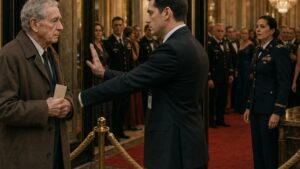
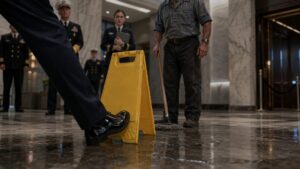
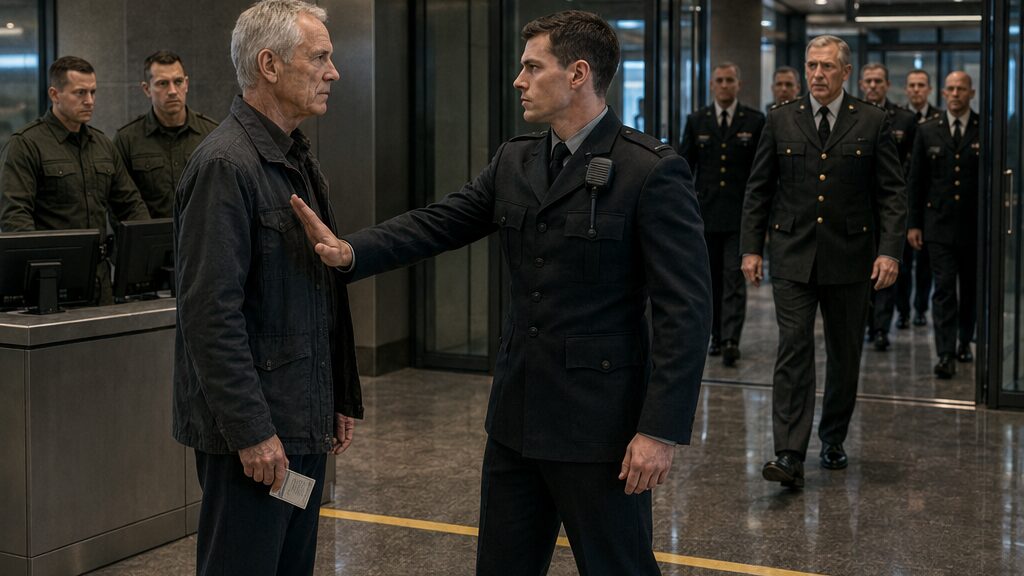
Lieutenant Nicholas Davis moved into Samuel Walker’s path so quickly that the old man had to stop with one shoe touching the yellow boundary line painted across the Pentagon lobby floor.
The words carried farther than necessary.
Two enlisted guards looked up from the credential station. A cluster of officers approaching the secured glass doors slowed just enough to notice the faded charcoal field jacket, the silver hair, and the lieutenant standing squarely between the older man and the checkpoint.
Samuel glanced down at the line beneath his shoe, then back at Nicholas.
“I believe I’m expected in Conference Room Four,” he said.
Nicholas was young enough that his dress uniform still seemed to wear him rather than the other way around. Every seam was exact. His shoes reflected the ceiling lights. A radio rested high on his shoulder, close enough to his mouth that he barely needed to turn his head to use it.
“This entrance is restricted.”
“Yes.”
“Then you understand the problem.”
Samuel’s gaze moved briefly beyond him. Through the glass doors, uniformed personnel crossed the inner corridor carrying briefing folders marked with the emblem of the joint exercise. Farther inside, someone tested a brass instrument, producing one low, unfinished note before falling silent.
Samuel had asked Frank Lewis not to arrange an escort.
He had also asked that no announcement be made before his arrival.
Neither request had included a desire to become the morning’s entertainment.
He reached inside his jacket slowly. Nicholas’s hand shifted toward his radio.
Samuel noticed.
So did the guards.
He removed a hard credential case and held it out.
Nicholas accepted it between two fingers. The front showed Samuel’s name, photograph, and government identification number. It did not show him in uniform. The photograph had been taken recently: plain dark shirt, expression neutral, silver hair cut close.
Nicholas compared the image to Samuel’s face.
“Who scheduled you?”
“Commander Frank Lewis.”
One of the guards looked up again.
Nicholas did not.
“Commander Lewis is conducting a closed operational briefing.”
“Yes.”
“For Exercise Iron Meridian.”
“Yes.”
That finally made Nicholas lift his eyes.
Samuel continued, “The opening assessment was moved from 0700 to 0730 because the allied communications team arrived late last night. Conference Room Four was substituted for the main auditorium because the secure display system failed its inspection.”
The enlisted guard nearest the scanner turned fully toward them. Her name tape read HILL.
Nicholas’s jaw tightened.
Information could prove access. It could also sound like rehearsed information. Samuel knew the distinction. He had spent too much of his life around guarded doors not to respect it.
Nicholas held the credential toward the scanner but stopped short of passing it beneath the reader.
“You’re not on the visible attendee roster.”
“I would not be.”
“That isn’t how briefings work.”
“Some of them.”
A colonel waiting behind Samuel shifted his folder from one hand to the other. Nicholas noticed the movement and raised his voice.
“Sir, you cannot approach a restricted entrance in civilian clothing, provide no appointment confirmation, and expect us to overlook procedure because you know a few details.”
“I haven’t asked you to overlook anything.”
Nicholas’s expression hardened at the calm correction.
Samuel nodded toward the credential. “Verify it.”
The guard named Hill stepped closer. “Lieutenant, may I?”
Nicholas hesitated, then handed her the case.
She turned it over.
Samuel watched her eyes pause on the code printed along the lower edge of the reverse side. It was a short prefix followed by a clearance sequence. Most guards would see only letters and numbers. She saw enough to become careful.
Hill carried it to the terminal beside the scanner and entered the first sequence.
A yellow message appeared on the monitor.
Her shoulders straightened.
“Lieutenant.”
Nicholas remained facing Samuel. “What?”
“This access prefix isn’t standard visitor authorization.”
“I can see that.”
“It says supervisory verification required.”
Nicholas turned at last. “Does it say cleared?”
“No, sir. It says the credential must be—”
“Then he isn’t cleared.”
Hill lowered her voice. “It should be verified before we deny entry.”
The second guard stared determinedly at his station.
Nicholas walked to the monitor. For a moment he read the message in silence. Samuel saw the smallest change in his face—not recognition, but uncertainty.
It should have ended there.
A call to the supervisory desk. A controlled delay. A secure verification out of public hearing. Nothing unusual, nothing embarrassing.
Nicholas looked over his shoulder at the officers waiting behind Samuel.
Then he shut the credential screen.
“Return to your lane, Hill.”
She did not move immediately. “Sir, the procedure for this prefix—”
“I said return to your lane.”
“Yes, sir.”
She handed the case back to Nicholas and stepped away.
Samuel felt the nature of the encounter change.
Before, Nicholas had been cautious. Perhaps overly rigid, perhaps eager to establish control, but still within the broad shelter of duty.
Now he had been given a correct option by someone junior to him.
He had rejected it because she had offered it in front of witnesses.
Nicholas pointed beyond Samuel, toward the public side of the lobby. “Step behind the line while we determine whether you have any legitimate business here.”
Samuel looked at the painted boundary beneath his shoe.
A few yards away, officers continued through the adjacent lane. Their rank was visible. Their purpose was assumed. Their badges were checked with quick, practiced movements.
Samuel stepped back.
The yellow line lay between him and Nicholas.
“Thank you,” Nicholas said, with the brittle satisfaction of a man who believed he had restored order.
Samuel could have ended it with five words.
He could have spoken his rank, named the authority attached to it, and watched the entire checkpoint reshape itself around him. Nicholas would have apologized. The guards would have stiffened. The waiting officers would have found somewhere else to look.
But Samuel had learned that people behaved differently once they knew who had power.
So he said nothing.
Nicholas opened the credential again.
He studied the photograph, the identification number, then the unfamiliar prefix on the reverse. His thumb hovered near the terminal keyboard. For one second, his eyes narrowed with the knowledge that the pass might be exactly what Hill had warned him it was.
Then he glanced toward the guards.
Samuel saw the decision happen.
Nicholas placed the credential facedown on the security desk.
Chapter 2: The Pass Nicholas Chose Not to Read
A colonel arrived at the adjacent lane, flashed the front of his badge, and passed through without anyone examining the reverse.
Samuel’s credential remained facedown beside Nicholas’s hand.
The colonel gave Samuel a brief look as he crossed the yellow line. His gaze touched the faded jacket, the old man waiting outside the secure doors, and the lieutenant standing guard over him. Whatever question occurred to him, he carried it inside.
Nicholas noticed Samuel watching.
“His authorization was visible.”
“You didn’t scan it.”
“I know the personnel assigned to this briefing.”
“You don’t know me.”
“That,” Nicholas said, “is the issue.”
Behind the security desk, Emma Hill kept her eyes on her monitor. Her fingers moved with deliberate restraint, one entry at a time. Samuel could not see the screen from where he stood, but he recognized the posture of someone searching without wanting to be seen searching.
Nicholas slid the credential farther from Samuel.
“You said you would determine whether I have legitimate business here,” Samuel said. “The determination requires verification.”
“Do not tell me what security requires.”
“The message on your terminal already did.”
A faint flush climbed Nicholas’s neck.
The second guard looked down so sharply that his chin nearly touched his chest.
Nicholas stepped to the yellow line. He did not cross it. He stood close enough that Samuel could smell starch and coffee.
“I have a restricted exercise beginning in less than twenty minutes. We have international personnel moving through this corridor. My responsibility is to prevent unauthorized access, not debate procedure with a civilian who has learned enough terminology to sound convincing.”
Samuel held his gaze.
The lieutenant’s concern was not invented. Sensitive briefings did attract misplaced confidence, mistaken appointments, and people who believed familiarity with an organization entitled them to enter it. A cautious officer might reasonably stop an unescorted civilian.
But a cautious officer verified.
An insecure officer performed.
Samuel looked toward Hill. “What did the prefix return?”
Her fingers stopped.
Nicholas answered for her. “You will address me.”
“I did. You chose not to answer.”
Nicholas turned. “Hill, remain focused on your assigned station.”
“Yes, sir.”
Her screen reflected faintly in the polished divider. Samuel could make out a block of text and a red-bordered instruction box.
She had found something.
A group of civilian analysts approached carrying matching blue folders. Nicholas waved them toward the second lane. One of them, an older woman with a cane, fumbled with her badge case. The other guard waited without comment while she opened it.
Nicholas glanced at Samuel as though expecting him to notice the contrast.
Samuel did.
The older analyst crossed after her badge scanned green. Nicholas’s attention returned to Samuel with renewed certainty.
“People with proper authorization are entering without difficulty.”
“My authorization has not been checked.”
“It was checked.”
“It was looked at.”
A trace of amusement appeared on Nicholas’s face. “You seem very familiar with the distinction.”
“I’ve stood at enough checkpoints.”
“In what capacity?”
Samuel considered the question.
It was the first useful one Nicholas had asked.
“Several.”
“That isn’t an answer.”
“No. But it is a reason to verify rather than assume.”
Hill cleared her throat. “Lieutenant, the supervisory table says the prefix belongs to protected command credentials.”
Nicholas’s head turned slowly.
She continued before fear stopped her. “It says not to process through the public roster. We’re supposed to contact the Sergeant of the Guard through the internal channel.”
For the first time, the second guard looked directly at Nicholas.
Samuel saw the lieutenant become aware of every eye around him.
“Did I authorize you to search that code?” Nicholas asked.
“No, sir.”
“Then why did you?”
“Because the terminal directed us to supervisory verification.”
“You left your assigned workflow.”
“I remained at my station.”
Nicholas’s voice lowered. “Do you want to discuss your duty assignment in front of the entire lobby?”
Emma’s face went still.
“No, sir.”
“Then stop creating confusion.”
Samuel had known officers who shouted when frightened. Nicholas did something more controlled. He made disobedience sound like embarrassment and embarrassment sound like misconduct.
The technique was effective because it required no raised voice.
Emma minimized the instruction window.
Samuel felt an old discomfort move beneath his ribs. He had seen that same silence settle over rooms decades earlier. Young people learning that the safest answer was the one a superior wanted. Experienced people deciding that a small wrong did not justify professional risk.
He had once benefited from that silence.
The memory arrived without detail, as it usually did: an older civilian’s rough hands resting on a map table, a warning dismissed, a senior officer later closing a door and ensuring the mistake went no farther.
Samuel pushed it away.
Not now.
Nicholas tapped the facedown credential with one finger. “Where did you get this?”
“It was issued to me.”
“By whom?”
“The Department of Defense.”
A guard at the far desk coughed, disguising what might have been a laugh.
Nicholas did not find the answer amusing.
“Fraudulent credentials are a federal offense.”
“So is mishandling protected identification.”
The lieutenant stared at him.
Samuel’s tone had not changed, but the words landed differently. For the first time, Nicholas looked less like a man removing an inconvenience and more like a man standing near a door he had chosen not to open.
Samuel offered him a way back.
“Call the Sergeant of the Guard. Use the internal channel. Read the prefix exactly as printed. Nothing else is required.”
Nicholas glanced at Hill’s minimized screen.
Then at the officers passing through.
“If you knew the procedure,” he said, “you could have memorized it.”
“Yes.”
“You could have obtained information about the exercise.”
“Yes.”
“You could be attempting to pressure junior personnel into bypassing access controls.”
“Yes.”
The blunt agreement unsettled him.
Samuel added, “That is why verification exists.”
Nicholas’s mouth tightened.
For a moment, Samuel thought the young officer might take the credential, make the call, and accept the small discomfort of having been corrected by a guard under his supervision.
Instead, Nicholas picked up Samuel’s pass and held it out without crossing the line.
Samuel reached for it.
Nicholas drew it back slightly.
“Your presence is becoming disruptive.”
“My presence is stationary.”
“You are challenging checkpoint authority.”
“I am asking you to use it correctly.”
The second hand on the lobby clock moved toward 0720.
Beyond the secure doors, personnel began taking their seats. Samuel could see Frank’s operations staff moving past the corridor glass, unaware that the officer responsible for evaluating their exercise stood ten yards away.
The delay now had consequences beyond embarrassment.
Samuel’s own choice had helped create them.
He had wanted to observe. He had wanted to see what the checkpoint did with a person whose value could not be read from a uniform. Now he had his answer, and still he waited.
Nicholas lifted his radio.
“This is your last opportunity,” he said. “Leave the controlled area voluntarily, or I’ll call the Sergeant of the Guard and have you removed.”
Emma looked at Samuel.
Not with recognition.
With apology.
Samuel studied Nicholas’s face and saw, beneath the rigid confidence, the desperate calculation of a young officer who believed retreat would be witnessed more clearly than error.
For one instant, Samuel saw himself at twenty-eight.
That recognition should have made him speak sooner.
Instead, it made him hesitate.
Nicholas pressed the radio switch.
Chapter 3: The Quiet Call That Stopped the Lobby
Samuel reached inside his faded jacket and removed his phone.
Nicholas kept his thumb on the radio. “Sir, I strongly advise you not to contact anyone in an attempt to interfere with security personnel.”
Samuel found the number and pressed it.
Frank answered before the second ring.
“Lewis.”
“Hey, son.”
There was a brief silence on the line.
Samuel watched Nicholas’s expression shift at the familiar address. The lieutenant mistook it for performance.
Samuel continued, “Your new checkpoint guard is threatening to call the Sergeant of the Guard on me. Thought you should know.”
Nothing moved beyond the glass for half a second.
Then Frank said, “Where are you?”
“Main lobby. Field-grade entrance.”
“Stay there.”
Samuel looked at the yellow line. “That appears to be the current arrangement.”
He ended the call.
Nicholas gave a soft laugh.
It was not cruel so much as relieved. The call had sounded ordinary. No title, no demand, no name announced loudly enough to impress the room. Just an older man speaking to someone he called son.
Nicholas lowered his radio.
“I gave you a chance to leave without making this worse.”
Samuel returned the phone to his jacket. “You did.”
“And now?”
“Now we wait.”
“For whom?”
“The person you should have contacted.”
Nicholas glanced toward the secured corridor. Nothing had changed. Officers still moved behind the glass. The briefing clock continued its silent advance.
He smiled at the guards.
“There’s a common tactic,” he said, loud enough for them to hear, “where an unauthorized person pretends to know senior leadership. They use first names. Family language. Anything that creates hesitation.”
Emma did not respond.
“Hill?”
Her posture had changed. Her heels were together. Her shoulders were square. She was no longer pretending to work at the terminal.
She stood at attention.
Nicholas noticed.
“What are you doing?”
Emma looked toward the inner corridor. “Sir.”
The secure doors opened.
A staff officer emerged at a run, one hand holding his briefing folder against his side. Two more officers appeared behind him. They did not walk with the controlled speed of personnel managing a schedule. They moved with the urgency of people who had just discovered that the schedule itself was standing outside.
Nicholas turned toward them.
The first officer scanned the lobby, saw Samuel behind the yellow line, and stopped so abruptly that the officers behind him nearly collided with his back.
He pivoted toward the interior.
“Call them to position.”
The instruction carried through the open doors.
Farther inside, chairs scraped. Voices cut off. Footsteps multiplied across the polished corridor.
Nicholas’s hand fell away from his radio.
Samuel watched his face drain of certainty by degrees.
Not yet recognition. Not fully.
But fear had entered.
The distant brass instrument sounded again.
This time it was not a test note.
A drum struck once, deep and precise. Brass followed in a formal rising phrase that filled the secured corridor and poured into the lobby through the open doors.
The Flag Officer march.
Every uniformed person in the lobby reacted before thought could interfere. Conversations stopped. Backs straightened. Heels shifted into position. The colonel who had passed Samuel with barely a glance reappeared inside the glass and turned toward the checkpoint.
Nicholas stared through the doors.
“No,” he whispered.
Samuel heard him.
The march grew louder.
Commander Frank Lewis came through the corridor at a near run, followed by senior officers from three services. Frank was broad-shouldered, graying at the temples, and normally incapable of appearing hurried in public. Now his expression held the contained alarm of a commander who knew that one unexpected phone call had altered the meaning of his entire morning.
He reached the checkpoint, stopped on the secure side of the yellow line, and looked at Samuel.
His gaze dropped briefly to the facedown credential still in Nicholas’s hand.
Then to Emma standing at attention.
Then back to Samuel.
Frank came to full attention and raised a rigid salute.
“General Walker.”
The words seemed to empty the lobby of air.
Every senior officer behind Frank saluted.
The colonel near the doors saluted.
The guards saluted.
Emma’s hand rose with such force that her fingertips nearly struck the edge of her cap.
Nicholas did not move.
His radio slipped from his fingers, caught by its cord, and struck his chest with a plastic crack.
Samuel looked at him.
The young lieutenant’s mouth had opened, but no words came. The terror in his face was complete—not because he had allowed an intruder through, but because he had denied entry to someone powerful enough to reorder the room merely by being named.
Samuel felt no satisfaction.
That troubled him more than he expected.
For years, he had believed moments like this revealed truth cleanly. Remove the insignia. Remove the escort. Let character emerge. Then restore the hidden fact and allow consequence to teach what concealment had exposed.
But Nicholas was not learning yet.
He was only afraid.
Samuel raised his hand and returned the salute.
“At ease.”
Arms lowered throughout the lobby. Bodies did not relax.
Frank stepped forward. “Sir, I was told you would arrive through the south entrance.”
“I changed my route.”
“Yes, sir.”
“I also asked for no reception.”
Frank glanced toward the band still playing inside. “The ceremonial detail was already assembled.”
“Clearly.”
The march ended on a hard final beat.
Silence followed.
Nicholas found his voice. “General, I—”
Samuel held out his hand.
Nicholas looked down and realized he was still holding the credential. He placed it in Samuel’s palm with both hands.
Samuel turned it over. The protected prefix was visible. Unmarked. Legible. Exactly where Emma had said it would be.
Frank’s expression sharpened.
“Lieutenant Davis,” he said, “you are relieved of this post effective immediately. Sergeant Miller will take control. You will report—”
“No.”
Frank stopped.
Samuel slipped the credential into its case.
“Sir?”
“He remains here for the moment.”
Nicholas stood as if the floor beneath him had become uncertain.
Samuel looked at Emma. “You recognized the verification instruction?”
“Yes, General.”
“You told him?”
Her eyes flicked toward Nicholas. “Yes, General.”
“And then?”
“I returned to my station.”
Samuel nodded once.
He looked at the second guard. “You heard her?”
“Yes, General.”
“Did you support the verification request?”
The guard swallowed. “No, General.”
Samuel turned to Frank.
The elite-unit commander had once led personnel through conditions far more dangerous than a Pentagon lobby. Samuel trusted his operational judgment. That was why the question forming now mattered.
Frank seemed to understand that before it was spoken.
“Sir,” he said quietly, “we can continue this inside.”
Samuel looked through the open doors. Beyond them waited the exercise briefing, allied officers, classified assessments, and a schedule already slipping.
Then he looked back at the checkpoint line.
The yellow paint divided the lobby neatly. On one side stood an old man in a faded jacket. On the other stood rank, access, and the machinery of command.
A few minutes earlier, the distinction had appeared absolute.
Now everyone knew it had been false.
Samuel stepped forward until his shoes touched the line again, but he did not cross.
“When you received my call,” he said to Frank, “you knew exactly where to find me.”
“Yes, sir.”
“You also knew enough to run.”
Frank held his gaze.
Samuel’s voice remained quiet.
“How many times has this happened before?”
Chapter 4: The Complaint Frank Never Put Forward
“Lieutenant Davis is relieved,” Frank said. “Sergeant Miller will take the checkpoint, and Davis will report to my office.”
“No,” Samuel said. “He stays until we understand who taught him this was leadership.”
Nicholas flinched as if the words had struck harder than the removal order.
The officers behind Frank remained motionless. The lobby had gone silent except for the soft electronic chirp of credentials passing through the adjacent lane. People were still entering the building, still following schedules, while the command group stood gathered around the yellow line.
Frank lowered his voice. “General, the briefing is already delayed.”
“Then we should avoid wasting the delay.”
Samuel crossed the line at last.
No one stopped him.
He walked through the secure doors with Nicholas, Frank, Emma, and the second guard behind him. Sergeant Raymond Miller arrived from the supervisory station as they entered the inner corridor, his pace controlled but his face alert. Frank gave him a short instruction to assume the checkpoint and join them afterward.
A small conference room stood beside the main lobby, intended for private credential disputes and security interviews. Frank opened the door.
Samuel entered first.
He removed his faded jacket.
Beneath it he wore a dark service uniform, the four stars on his shoulders plain and unmistakable. Nicholas looked at them once, then away.
Samuel placed the jacket over the back of an empty chair rather than hiding it. The worn cloth hung among the polished uniforms like evidence.
Frank remained standing. “Lieutenant Davis made a serious error. I’ll handle it.”
“That is not what I asked.”
Frank’s jaw shifted. “How many times has what happened?”
Samuel looked at Emma.
She stood near the wall with her hands clasped behind her back. Her face had recovered its discipline, but the tension in her shoulders remained.
“How many times,” Samuel said, “has someone at that checkpoint been treated as a problem because they didn’t look important?”
Emma’s eyes moved to Frank.
Nicholas answered first. “General, I stopped an unescorted civilian from entering a restricted briefing. That was my responsibility.”
“The stop was legitimate,” Samuel said. “What followed was not.”
Nicholas swallowed. “I had no confirmation of your identity.”
“You had a protected credential.”
“I had an unfamiliar credential.”
“And a guard who told you how to verify it.”
Nicholas looked toward Emma. “She conducted an unauthorized search.”
Samuel turned to Raymond as he entered and closed the door behind him.
“Sergeant Miller, what is the required action when a credential displays that prefix?”
Raymond did not need to inspect the pass. “Private supervisory verification through the protected command registry, General. The holder remains outside the secure boundary until identity is confirmed.”
“Is the holder to be ordered from the lobby?”
“No, General.”
“Threatened with removal?”
“No, General.”
“Accused of fraud before verification?”
Raymond paused. “No, General.”
Nicholas’s hands tightened at his sides.
Samuel nodded. “So the original stop protected the briefing. The refusal to verify protected something else.”
No one spoke.
Frank looked toward the clock mounted above the door. “We can address this after the operational session.”
“Can we?”
“Yes, sir. We have allied personnel waiting, and the communications assessment affects tomorrow’s field phase.”
Samuel studied him.
Frank was not wrong. That was what made the moment difficult. The exercise mattered. Delays had consequences. A commander who treated every personnel failure as more urgent than the mission could paralyze a unit.
But a commander who always postponed character problems until the mission allowed time would never address them at all.
Emma shifted slightly.
Samuel noticed.
“Specialist Hill,” he said, “was this the first time Lieutenant Davis dismissed a verification concern?”
Nicholas turned sharply. “General—”
“Let her answer.”
Emma’s mouth opened, then closed.
Frank said, “You will not face retaliation for speaking truthfully.”
She looked at him with an expression so brief he might have missed it.
Samuel did not.
It was not relief.
It was doubt.
“No, General,” Emma said.
Nicholas’s face hardened. “That is misleading.”
Samuel raised one hand. “Continue.”
Emma drew a breath. “Two weeks ago, a civilian communications analyst arrived with an authorization mismatch. Lieutenant Davis told him the technical briefing was not a retirement club and sent him to the public information desk.”
Frank’s attention sharpened.
“The analyst was cleared later,” Emma continued. “He missed the first half of the session.”
Nicholas said, “His name was not on the roster.”
“And last week?” Emma asked quietly.
He looked at her.
She lowered her eyes but continued. “A junior officer from the medical planning team had the wrong entrance listed. The lieutenant made her repeat her unit in front of the lane because he said she was probably lost.”
“That officer was out of position.”
“She was embarrassed.”
“She was corrected.”
Emma fell silent.
Samuel looked at the second guard. “Did you witness those incidents?”
“Yes, General.”
“Did you report them?”
“No, General.”
“Why?”
The guard glanced at Nicholas. “They didn’t seem serious enough.”
Samuel turned to Emma. “Did you report them?”
Her face tightened. “I submitted a concern through the anonymous command channel.”
Frank looked at her.
The room changed.
Samuel saw it in the way Frank’s shoulders settled, not with surprise but with recognition.
“When?” Samuel asked.
“Two weeks ago.”
Frank said nothing.
Samuel faced him. “You received it.”
Frank took one breath before answering. “Yes.”
Nicholas stared at his commander.
“What did it say?” Samuel asked.
“That checkpoint supervision had become demeaning toward civilian specialists and junior personnel. It did not identify Lieutenant Davis by name.”
“But you knew his duty rotation.”
“I knew several officers had covered that entrance.”
“What action did you take?”
“I directed the security office to review procedures after the exercise.”
“After.”
Frank’s voice became firmer. “The complaint described conduct, not a security breach. We were six days from a multinational evaluation. Replacing personnel or opening a command inquiry at that point could have disrupted preparation.”
Samuel looked at the faded jacket hanging from the chair.
Frank had not ignored the complaint entirely. He had categorized it, scheduled it, placed it behind the mission. The logic was recognizable because good officers used it every day.
It was also how harm became routine.
Raymond spoke. “General, I was told to review the post after the field phase. I did not know the concern involved repeated public treatment.”
“You did not ask?”
“No, General.”
Nicholas looked from Raymond to Frank, then back to Samuel. Some of the terror had left his face. In its place came anger.
“So this was a test.”
Frank said, “Lieutenant, choose your words carefully.”
Nicholas did not look at him. “General Walker arrived unannounced, without an escort, in civilian clothing, using a credential that does not appear on the normal roster. He knew there had been a complaint. He wanted to see what we would do.”
Samuel felt every person in the room waiting for his denial.
He could have said the route change was incidental.
It was not.
Frank had mentioned the complaint during a secure call. He had called it minor, probably exaggerated, something to address after the exercise. Samuel had chosen the main lobby because he wanted to observe the checkpoint without ceremony.
Nicholas continued, his voice unsteady but no longer submissive. “You could have identified yourself at any point. You watched Specialist Hill get corrected. You watched me make the wrong decision. You let the briefing stop. And now everyone in this room is supposed to act as if only I crossed a line.”
Frank stepped toward him. “That is enough.”
“No,” Samuel said.
Frank stopped.
Nicholas’s accusation was self-protective. It shifted attention away from the facedown credential and the deliberate refusal to verify.
But it was not entirely false.
Samuel looked at Emma.
She had warned Nicholas once. When he silenced her, Samuel had remained quiet because he wanted to see what came next. He had told himself observation would reveal the truth.
It had.
It had also required Emma to stand alone while he possessed the power to end it.
Samuel pulled out the chair beneath his jacket but did not sit. He rested one hand on its back.
“When you denied verification,” he told Nicholas, “you chose pride over procedure.”
Nicholas’s face tightened.
Samuel continued, “When Specialist Hill was made to doubt what she knew, I chose observation over intervention.”
Frank looked at him. “Sir, those are not equal failures.”
“No. They are not.”
Samuel touched the faded sleeve.
“But they grow from the same dangerous belief—that because we can explain our reasons, we are no longer responsible for the harm.”
The clock above the door clicked forward.
Samuel looked at Nicholas, then at Frank.
“I have stood on his side of that line before.”
Chapter 5: The Mistake Samuel Never Entered in His Record
“The worst mistake of my career began with the thought that a man did not look important.”
Samuel’s hand remained on the faded jacket.
No one in the conference room moved. Beyond the wall, the Pentagon continued its morning rhythm—doors opening, shoes crossing tile, distant announcements flattened by concrete and glass.
Nicholas had expected punishment.
He had not expected recognition.
Samuel sat and drew the jacket across his knees. A pale repair ran along one cuff where the fabric had torn years ago.
“I was twenty-eight,” he said. “A captain attached to a field command preparing for an exercise larger than anything I had handled before. We were behind schedule. Every delay felt like a threat to my future.”
Nicholas lowered his eyes.
“An older civilian specialist came into our planning room carrying weather reports and handwritten calculations. His clothes were worn. His papers were not in the standard format. He asked us to move a convoy route because ground conditions would fail under the projected load.”
Samuel rubbed the repaired cuff between his fingers.
“I told him the route had been approved by officers who understood operational requirements.”
Emma watched him carefully.
“He tried again. I asked security to remove him from the room.”
“What happened?” Nicholas asked.
The question came quietly.
“The route failed during rehearsal. Two vehicles were damaged. Several people were injured badly enough to leave the exercise. No one died.”
Samuel let the final sentence settle without turning it into relief.
“The specialist had been correct. The charts supporting him arrived through official channels the next morning. My commander called me into his office, closed the door, and explained exactly what I had done.”
Frank’s gaze rested on the table.
“He also kept it out of my formal record,” Samuel said. “He believed private correction would preserve a promising officer.”
“Did it?” Emma asked.
Samuel looked at her.
“It preserved my career.”
“That wasn’t what I asked.”
Frank’s head turned toward her, but Samuel almost smiled.
“No,” he said. “It was not.”
The room held its breath.
“I became more careful,” Samuel continued. “I listened longer. I learned not to confuse polish with competence. But because the failure remained private, the institution learned nothing. The next officer had to make his own version of the same mistake.”
He looked down at the jacket.
“This belonged to that specialist.”
Nicholas’s eyes lifted.
“He gave it to me years later when I visited him. Not as forgiveness. He said I looked cold.”
A small sound escaped Raymond, almost a breath.
Samuel had rarely told the story. Never in an official setting, never with the jacket present. He wore it because it reminded him that authority could be concealed inside ordinary cloth.
He had believed the reminder made him wiser.
This morning had shown him its limit.
Nicholas shifted his weight. “General, I did not know who you were.”
“That is the least important fact in this room.”
Nicholas looked at him.
“You knew the credential required verification,” Samuel said. “Didn’t you?”
The lieutenant’s face changed.
Frank leaned forward. “Answer him.”
Nicholas’s eyes moved toward Emma, then Raymond, then the closed door.
“I knew it might.”
“Might?” Samuel asked.
“The prefix was unfamiliar. The terminal message was not a clearance confirmation.”
“But Specialist Hill read the instruction.”
“Yes.”
“And you understood that calling Sergeant Miller would resolve it.”
Nicholas’s jaw worked.
“Yes.”
The admission was almost inaudible.
Samuel waited.
Nicholas’s shoulders dropped a fraction. “If I had stopped and called after she corrected me, everyone at the post would have seen that I didn’t know the procedure.”
Emma said nothing, but the hurt in her face sharpened.
Nicholas looked at her. “I was placed over guards with more time at that checkpoint than I had. Every time I asked a question, I could feel them measuring me.”
The second guard looked away.
“I thought if I hesitated,” Nicholas continued, “I would lose control of the post. When she spoke up in front of the line, I thought—”
“You thought the danger was not the credential,” Samuel said. “It was being seen changing your mind.”
Nicholas nodded.
That confession did not erase the conduct. It made it worse in one way and more human in another. He had not simply misunderstood. He had recognized uncertainty and chosen dominance.
Frank stood. “Lieutenant Davis will be transferred from security duty today. We can conduct a formal review without delaying the exercise further.”
Nicholas looked at him as if the decision were both feared and welcome.
Samuel studied Frank.
“To where?”
“A staff assignment outside the checkpoint chain. Temporary, pending findings.”
“So the exercise proceeds. The complaint disappears into personnel channels. The young officer is removed from sight.”
Frank’s expression tightened. “I am trying to protect the mission and maintain accountability.”
“You are trying to prevent the two from touching.”
“They should not have to.”
“They already have.”
Frank came around the table. “Sir, allied commanders are waiting. We have a live-field phase tomorrow. If this becomes the focus of today’s briefing, months of preparation could be compromised.”
Samuel heard the genuine pressure behind the words. Frank was responsible for hundreds of people and an exercise whose failures could carry consequences beyond reputation. He was not hiding Nicholas out of friendship. He was trying to isolate damage.
That instinct had made him effective.
It had also led him to postpone Emma’s complaint.
Nicholas spoke before Samuel could answer. “A transfer is appropriate.”
Samuel turned toward him.
Nicholas straightened. “I failed at the post. Commander Lewis should not have to risk the exercise because of me.”
It sounded like responsibility.
It also sounded like escape.
“You want to leave this room with your error reduced to a bad assignment,” Samuel said.
Nicholas’s face reddened. “I want to accept the consequence.”
“No. You want a consequence that ends quickly.”
Silence returned.
Samuel rose and put on the jacket over his uniform. The four stars disappeared beneath the faded cloth.
Frank watched him close the front.
“I will not destroy a lieutenant in front of his peers to prove that rank matters,” Samuel said. “And I will not move him quietly so the command can pretend the problem left with him.”
“What do you intend?” Frank asked.
Samuel picked up the credential Nicholas had failed to read.
“We begin the briefing.”
Nicholas looked startled.
Samuel opened the door.
The corridor beyond had been cleared, but the senior officers waiting near the main briefing room turned as he emerged. Their attention went first to the faded jacket, then to Frank behind him, then to Nicholas.
Samuel walked toward Conference Room Four.
Inside, allied officers and civilian specialists sat around a long table facing a secure display. The first slide showed the exercise title over a map of the operational area.
Samuel stopped beside the projection console.
A staff officer rose. “General, we are ready for the communications assessment.”
“Not yet.”
Samuel removed his phone and opened the photograph he had taken before leaving the lobby: the empty yellow checkpoint line, Samuel’s credential lying facedown on the security desk, the secure doors visible beyond it.
He connected the device to the display.
The exercise map vanished.
The yellow line filled the wall.
Samuel placed the faded jacket over the chair beside the lectern and faced the room.
Chapter 6: The Briefing That Became a Command Reckoning
“Before anyone knew my rank, who in this command would have challenged Lieutenant Davis?”
Samuel’s question crossed the briefing room without force.
No one answered.
The yellow checkpoint line remained projected behind him. Enlarged across the wall, the strip of paint looked less like a security marker than a division running through the entire command.
Senior officers sat nearest the table. Civilian analysts occupied the second row. Along the wall stood junior personnel who had expected to take notes on encrypted communications and multinational coordination.
Frank remained beside the door.
Nicholas stood near the back under Raymond’s supervision. Emma waited outside until Samuel asked that she be brought in.
When she entered, every officer in the room looked at her.
Her steps slowed.
Samuel pointed to an empty seat near the front. “Specialist Hill, sit there.”
She obeyed, visibly uncomfortable.
A general from an allied delegation cleared his throat. “General Walker, I understand there was an access issue. We have a field sequence to certify before noon.”
“So do I,” Samuel said. “This is part of it.”
The officer’s expression remained polite. “With respect, command climate is not on today’s schedule.”
“Neither is failure.”
Samuel touched the console. The photograph shifted to a close view of his credential and the protected prefix on its reverse.
“A security officer stopped an unknown civilian at a restricted entrance. That was correct. A junior guard identified the mandatory verification process. Her officer dismissed her, ignored the procedure, and turned uncertainty into humiliation.”
He looked around the table.
“Then senior leaders arrived, saluted the civilian, and everyone understood the mistake.”
Several officers lowered their eyes.
“That is not the problem,” Samuel said. “The problem is that the treatment became unacceptable only after my rank was visible.”
The room remained still.
A civilian analyst in the second row adjusted his glasses. Samuel recognized him from Emma’s account, though no one had named him.
“Have any of you,” Samuel asked, “withheld a concern because you expected the person receiving it to care more about position than information?”
No hands rose.
Samuel waited.
The silence stretched beyond comfort.
Then the analyst lifted one hand halfway.
A junior medical officer near the wall did the same.
Two guards followed.
Others did not raise their hands, but their faces changed.
Frank stepped forward. “General, may I address the room?”
Samuel nodded.
Frank faced the officers. “Two weeks ago, my command received an anonymous complaint concerning conduct at the checkpoint. I deferred formal action until after the exercise.”
A murmur moved through the room and stopped.
“I judged the complaint noncritical,” Frank continued. “That judgment was mine. It was also wrong.”
Samuel watched Nicholas.
The lieutenant had expected Frank to isolate him. Hearing the commander accept responsibility seemed to unsettle him more than anger would have.
Samuel called Emma forward.
She stood beside the projected credential.
“Explain what the terminal instructed you to do,” he said.
Her voice was tight at first. “The access prefix triggered protected command verification. The holder was supposed to remain outside the secure boundary while the checkpoint contacted the Sergeant of the Guard through an internal channel.”
“Did you know that during the incident?”
“Yes, General.”
“Did you insist?”
“No, General.”
“Why?”
Emma looked toward Nicholas.
Then toward the officers seated in front of her.
“Because Lieutenant Davis had already ordered me back to my lane. I thought if I challenged him again, I would be written up for insubordination.”
“Was that fear reasonable?”
She hesitated.
Samuel turned to Frank. “Commander?”
Frank answered without evasion. “Given the environment we allowed at that post, yes.”
Emma’s shoulders loosened slightly.
Samuel faced the room. “Specialist Hill knew the procedure. Lieutenant Davis controlled whether her knowledge mattered. Sergeant Miller assumed uncertain credentials would be escalated. Commander Lewis assumed a complaint could wait. I assumed silence would reveal character without causing harm.”
He let the sequence stand.
“This was not one officer’s failure.”
Nicholas stepped away from the wall. “General.”
Raymond moved as if to stop him, but Samuel raised a hand.
Nicholas came forward until he stood beside Emma. His uniform remained immaculate. His face did not.
“I request permission to resign my commission.”
Frank’s expression hardened. “This is not the place.”
“It is exactly the place,” Nicholas said. “I cannot supervise those guards again. I cannot walk back to that checkpoint and expect anyone to trust my judgment.”
Emma looked at him.
Samuel said, “You believe resignation is accountability?”
“I believe I have lost the right to lead.”
“Perhaps you have lost the right to lead in the way you were leading.”
Nicholas’s jaw tightened. “General, every person in this room saw what happened.”
“Good.”
The word struck him silent.
Samuel continued, “Private protection allowed my mistake to become a secret I carried instead of a lesson the institution shared. I will not repeat that favor for you. But neither will I make your removal the proof that everyone else is innocent.”
Frank studied Samuel. “What are you proposing?”
“Lieutenant Davis is removed from unsupervised checkpoint command. He remains assigned to security under Sergeant Miller. He will participate in rebuilding the verification and escalation process.”
Nicholas stared at him. “You want me to train guards after this?”
“No. I want you to learn beside them. Specialist Hill and the experienced checkpoint personnel will identify where procedure has been replaced by performance. Sergeant Miller will supervise. Commander Lewis will review every complaint that was postponed.”
Frank nodded once.
Samuel looked at Emma. “You will not be made responsible for reforming the officer who silenced you. Your role is procedural, and you may decline it.”
Emma considered Nicholas.
“I’ll participate,” she said. “But I want the reporting channel to go outside the checkpoint chain.”
Frank said, “Approved.”
Samuel looked toward the civilian analysts. “And access disputes involving technical personnel will be handled privately. No public questioning of competence unless security requires it.”
The older analyst who had raised his hand nodded, but did not smile.
There was no applause.
Samuel preferred it that way.
The allied general leaned forward. “And the exercise?”
Samuel changed the display. The operational map returned, but the photograph of the yellow line remained in a smaller window at the corner.
“The exercise proceeds,” Samuel said. “With one amendment. Every command element will include a dissent procedure in tomorrow’s field phase. Information from the lowest visible rank will be evaluated before the source is judged.”
A staff officer began taking notes.
Frank moved to the head of the table, but Samuel stopped him with a glance.
“One more matter.”
He turned to Nicholas.
“You asked to resign because you believe your credibility cannot recover. That may be true. Credibility is not restored by assignment order.”
Nicholas met his eyes.
“It is restored, if at all, through repeated conduct when no one important appears to be watching.”
Samuel picked up the faded jacket and laid it beside the lectern where everyone could see it.
“In three weeks, I will return to that checkpoint without ceremony. Sergeant Miller will not announce the time. Commander Lewis will not prepare the post.”
Nicholas looked toward Emma.
Samuel closed the exercise file and opened the communications assessment.
“When I return,” he said, “I will not be testing whether you recognize me.”
The yellow line remained in the corner of the screen.
“I will be watching how you treat the person before me.”
Chapter 7: Character at the Same Painted Line
The older civilian’s pass flashed red, and every guard at the checkpoint turned toward Nicholas Davis.
Three weeks earlier, he would have felt their attention as a challenge.
Now he heard only the scanner’s second warning tone and saw the man’s hand tighten around a worn leather document case.
The visitor looked to be in his seventies. His brown coat was too heavy for the heated Pentagon lobby, and the laminated badge hanging from his neck had curled at one corner. He had already tried the scanner twice.
“I was told this entrance would work,” the man said.
Nicholas stood on the secure side of the yellow boundary line. Emma Hill occupied the verification terminal beside him. Sergeant Raymond Miller watched from the supervisory desk farther down the lobby, close enough to intervene but not close enough to make the decision for them.
The other guards waited.
Nicholas moved aside so he was no longer blocking the visitor’s path with his body.
“Let’s check the credential before we decide what the problem is,” he said.
The words felt plain. They were supposed to.
He held out his hand. “May I see it, sir?”
The visitor gave him the badge.
Nicholas examined both sides.
The photograph matched. The department marking was legitimate. The access date, however, showed the previous month.
“Specialist Hill,” Nicholas said, “would you begin secondary verification?”
Emma accepted the credential without looking surprised by the request.
“Yes, Lieutenant.”
There was no edge in her voice, but there was no warmth either. Their work had become precise over the past three weeks. She challenged decisions when procedure required it. Nicholas listened, asked questions, and recorded corrections. Neither of them pretended this had repaired what happened before.
At first, every exchange had felt like walking through a room full of tripwires.
Then repetition had made the correct behavior less theatrical.
Emma entered the badge number into the terminal.
The visitor glanced toward the officers passing through another lane. “I’m supposed to meet a systems team at nine. They said my old access would be renewed.”
“We’ll check the appointment and the credential office record,” Nicholas said. “You’ll need to remain outside the secure line while we do.”
The man looked down at the yellow paint.
Nicholas saw the moment of embarrassment before the visitor concealed it.
A month earlier, he might have filled that silence with authority. He might have pointed toward the public lobby, spoken loudly enough for nearby guards to hear, and made the man’s uncertainty part of the checkpoint’s entertainment.
Now Nicholas lowered his voice.
“You’re not in trouble. We just can’t admit you until the record is current.”
The man nodded once.
Behind him, the morning crowd moved in measured currents through the Pentagon lobby. Uniforms, civilian suits, contractors carrying equipment cases. Among them stood another older man in a faded charcoal field jacket.
Samuel Walker had arrived ten minutes earlier through the public entrance.
No band had played.
No officers had run to meet him.
He stood beside a directory display with his credential case in one pocket and watched the checkpoint from a distance.
Frank had offered to send Samuel the revised training reports. Raymond had provided daily summaries. The new procedures were detailed, the reporting route independent, the complaint reviews underway.
None of that could answer Samuel’s only remaining question.
Documents showed what people promised to do.
A checkpoint showed what they did when a line formed behind someone inconvenient.
At the verification terminal, Emma frowned.
“The appointment is valid,” she said. “The badge renewal was approved but never activated.”
Nicholas looked toward Raymond. “Can we authorize a temporary escort?”
Raymond came closer and reviewed the screen.
“Not under that department code. Credential office has to activate it.”
The visitor’s face fell. “That office is on the other side of the building. My meeting starts in twelve minutes.”
Nicholas checked the time.
The easiest mistake now would have been to confuse kindness with permission. Respect did not make an expired pass valid. Samuel had insisted on that distinction during the reforms: dignity could change the manner of a denial, not the security requirement behind it.
Nicholas returned the credential.
“I can’t let you through this entrance,” he said.
The man’s mouth tightened. “So I’ve wasted half an hour.”
“Yes, sir. And I’m sorry the renewal failure wasn’t caught before you arrived.”
The apology drew a glance from one of the guards.
Nicholas continued, “I can contact the systems team and tell them you’re delayed. A guard can escort you to the credential office through the public corridor. Once the badge is activated, you can return without restarting the appointment check.”
The visitor studied him, perhaps searching for impatience.
“Will that actually work?”
Nicholas looked at Emma. “Can you attach the verified appointment to the activation request?”
“Yes.”
“Do it.”
Emma entered the note.
The second guard stepped from his lane. “I can escort him.”
Nicholas nodded. “Thank you.”
The visitor placed the badge back around his neck. “I suppose rules are rules.”
“They are,” Nicholas said. “But delay doesn’t have to become disrespect.”
The sentence came out before he could judge whether it sounded rehearsed.
Emma looked at him.
Not approvingly. Not critically.
Simply taking note.
The guard led the visitor toward the credential office. Nicholas watched until they disappeared into the public corridor.
Then the next person approached.
It was Samuel.
Nicholas saw the faded jacket first.
His posture changed by instinct, but he stopped himself before snapping to attention. Samuel was not yet across the line. The checkpoint remained active. Two visitors waited behind him.
Nicholas met his eyes.
“Good morning, sir.”
“Lieutenant.”
No one announced the general’s rank.
Emma knew him. Raymond knew him. The guards who had been present three weeks earlier knew him. They continued their duties.
Samuel took out his credential case and offered it.
Nicholas accepted it.
For the briefest moment, the old fear returned—the memory of the march, the salutes, the radio striking his chest. He could have waved Samuel through without reading anything. No one in the lobby would have questioned it.
That would have been another form of the same failure.
Nicholas examined the photograph, turned the credential over, and read the protected prefix.
He placed it beneath the scanner.
The terminal displayed the supervisory-verification message.
Nicholas turned to Emma. “Protected command credential. Please initiate private verification.”
“Yes, Lieutenant.”
Samuel remained outside the yellow line.
Nicholas did not apologize for making him wait. He did not offer special treatment. He did not ask whether the general had come to judge him.
Emma completed the registry check and rotated the screen toward Nicholas.
Identity confirmed.
Access authorized.
Nicholas returned the credential with one hand.
“Your pass is verified, General Walker. You may proceed.”
Samuel accepted it but did not cross.
His gaze moved toward the public corridor where the older visitor had disappeared.
“You denied him entry,” Samuel said.
“Yes, General. His badge had not been activated.”
“And yet he left with an escort rather than an accusation.”
Nicholas glanced at the waiting line.
“The rule required denial. It did not require humiliation.”
Samuel’s eyes settled on him.
Three weeks earlier, Nicholas had stood in the same place believing command meant never allowing others to see him reconsider.
Now he turned toward Emma.
“Specialist Hill, add the renewal failure to the morning discrepancy report. Recommend automatic activation confirmation before external specialists receive appointment instructions.”
Emma nodded. “Already drafted.”
Nicholas almost smiled. “Submit it under both our names.”
For the first time since the incident, something in her expression softened.
Samuel stepped forward until his shoe touched the yellow line.
Nicholas waited.
Samuel crossed only after the terminal showed green.
Chapter 8: The Uniform Was Never the Lesson
Nicholas returned Samuel’s credential and said, “You may proceed, General,” without lowering his eyes or searching the lobby for witnesses.
Samuel slipped the pass into its case.
The old impulse was to say nothing more.
Silence had long been his preferred tool. It prevented vanity, restrained anger, and gave others room to reveal themselves. But silence had also allowed Emma’s warning to be dismissed. It had allowed Frank’s complaint review to wait. It had allowed Samuel to stand behind his own hidden authority while a junior guard absorbed the cost of challenging a superior.
He opened the faded jacket.
The four stars beneath it became visible, not as a surprise but as an acknowledged fact.
Nicholas straightened.
Samuel glanced toward the guards, then back at him.
“One correct morning does not erase the last one.”
“No, General.”
“It does not restore trust by itself.”
“No, General.”
Samuel waited until Nicholas stopped bracing for the next blow.
“But it proves the last morning does not have to define every one after it.”
Nicholas breathed out slowly.
“Understood.”
Emma stood beside the terminal holding the discrepancy report. Nicholas turned toward her.
“Specialist Hill.”
“Yes, Lieutenant?”
“I dismissed your correct instruction because I was afraid of looking uncertain.”
The guards nearby became still.
Nicholas continued without raising his voice. “The revised escalation process came from your recommendation. The report should reflect that.”
Emma looked down at the form. “It currently lists the checkpoint review team.”
“Change it.”
She studied him for a moment. “I’ll list everyone who contributed.”
Nicholas nodded. “That is more accurate.”
It was not forgiveness.
Samuel saw that clearly.
Emma did not absolve him. Nicholas did not ask her to. They returned to the work with the measured distance of people building something professional where trust had been damaged.
That was more honest than a handshake.
Frank appeared through the secure doors, accompanied by two staff officers.
He had agreed not to prepare the checkpoint, but he had known Samuel would come to the building that morning. The commander’s uniform was immaculate. His face carried less tension than it had three weeks earlier, though the lines around his eyes had deepened.
He stopped several feet from Samuel.
“Good morning, sir.”
“Frank.”
“The review team is waiting. I arranged an escort to the briefing room.”
Samuel looked at the officers behind him.
“Cancel it.”
Frank’s expression shifted almost imperceptibly. “Sir?”
“Walk with me.”
The staff officers withdrew without comment.
Frank fell into step beside Samuel as they moved toward the inner corridor. Neither man walked ahead.
Behind them, the scanner sounded again.
Samuel turned.
A civilian woman stood outside the yellow line holding a stack of folders against her chest. Her credential had produced an amber warning.
Nicholas stepped away from her path rather than into it.
“Let’s verify the restriction,” he said. “Specialist Hill?”
Emma examined the screen. “The badge is active. One folder is marked for a compartment not authorized through this entrance.”
Nicholas lowered his voice and asked the woman to place the folders on the inspection surface. There was no performance in the exchange. No glance toward his squadmates. No pleasure in possessing an answer she did not.
Samuel watched until Raymond took over the document review.
Frank followed his gaze.
“He has improved,” Frank said.
“He has behaved correctly for three weeks.”
“That is not the same thing?”
“Not yet.”
They resumed walking.
Frank accepted the distinction. “The anonymous reporting channel now routes outside the security section. We reopened six complaints. Two involved poor communication. Three involved conduct. One identified a training gap in civilian credential processing.”
“And the exercise?”
“The dissent procedure exposed a communications assumption during the field phase. A junior specialist caught it before the allied teams moved equipment.”
Samuel glanced at him.
Frank gave a restrained nod. “You were right to change the briefing.”
“We were late because I allowed the checkpoint encounter to continue.”
Frank looked ahead. “You have said that in every written review.”
“It belongs there.”
They reached the corridor where the military band had assembled three weeks earlier. The chairs were gone. The brass instruments, the march, and the wall of saluting officers existed now only in memory.
Frank slowed.
“Would you make the same unannounced arrival again?”
Samuel touched the edge of his open jacket.
“No.”
Frank seemed surprised.
“I would still come without ceremony,” Samuel said. “But I would not let a subordinate stand alone merely to learn what another man might reveal.”
They approached Conference Room Four.
A security panel beside the door requested Samuel’s credential. He scanned it himself. The light turned green.
Frank reached for the handle, then paused.
“What happens to Davis?”
“Sergeant Miller continues the assessment. You decide his assignment when the record shows a pattern, not a performance.”
“And if trust does not recover?”
“Then he serves somewhere that does not require it.”
Frank nodded.
Samuel looked back one last time.
At the distant checkpoint, Nicholas was returning the civilian woman’s approved folders. Emma pointed to a notation on the screen. Nicholas leaned closer to read it rather than dismissing her from across the desk.
The yellow line remained exactly where it had always been.
It still separated public space from secured space. It still had to be enforced. People would still arrive with wrong badges, expired access, confused appointments, and urgent reasons they believed rules should bend.
The lesson had never been to remove the line.
It was to remember that the person standing beyond it could not be measured by clothing, age, visible rank, or the convenience of their request.
Frank opened the briefing-room door.
Samuel buttoned neither his jacket nor his uniform beneath it. The faded cloth and the four stars remained visible together.
Before entering, he heard Nicholas address the next visitor.
Not loudly.
Not softly from fear.
Simply with respect.
Samuel walked into the briefing beside Frank.
The story has ended.