The Lieutenant Mocked the Old Mechanic Until His Digital Artillery System Died in the Mud
Chapter 1: The Harness Twisted Before Anyone Jumped
The safety harness snapped tight before Lieutenant Kevin Hall’s boots reached the ground.
One moment he was dropping from the side step of the artillery support vehicle. The next, the twisted webbing cinched beneath his ribs and swung him backward into the muddy steel hull. His shoulder struck first. The impact rang across the staging line like a hammer hitting an empty fuel drum.
Daniel Mitchell had raised a hand an instant earlier.
“That harness is twisted,” he had said. “If you jump, it’s going to lock around your ribs.”
Now Kevin hung half a foot above the ground, one arm trapped against his chest while the strap crushed the air from him. His face tightened, more from the platoon’s sudden silence than from pain.
Daniel moved toward him.
“Hold still.”
Kevin kicked for the step. The motion pulled the webbing tighter.
“I said hold still.”
Daniel reached for the release buckle, but Kevin shoved his wrist away.
“Don’t touch me.”
The words came out thin. Kevin braced one boot against the hull and forced himself upward until the strap loosened enough for him to wrench the buckle free. He dropped into the mud, landed badly, and caught himself on the wheel well.
No one laughed. That made it worse.
A dozen soldiers stood beside ammunition racks and equipment cases, pretending to check straps, tablets, and hearing protection. Their attention remained fixed on the lieutenant without their heads turning.
Kevin straightened slowly. He was young enough that the academy polish had not yet worn from his movements. Even covered in wet clay at one elbow, he arranged his face into the hard, measured expression of an officer correcting somebody else’s failure.
“Defective clasp,” he said.
Daniel looked at the harness hanging from the side rail. The left shoulder webbing crossed beneath the right chest strap, folding the load path inward.
“The clasp worked.”
Kevin’s eyes found him.
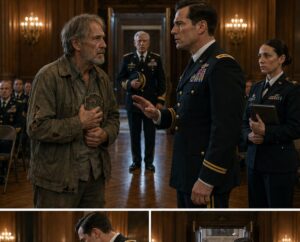
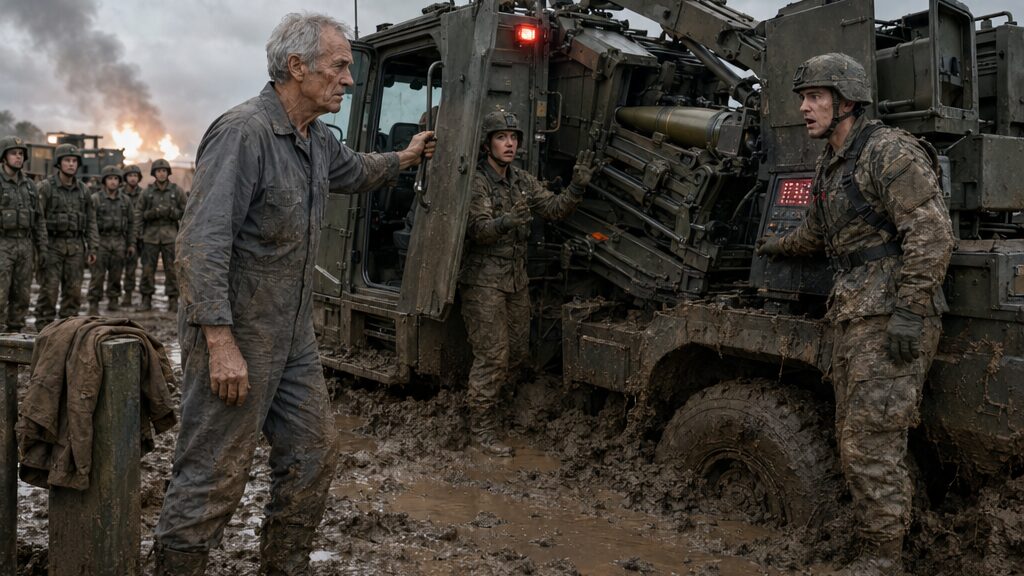
Daniel wore a faded brown coat over his contractor’s coveralls. The coat had been patched twice at the elbows and darkened along the shoulders by years of grease and rain. Beside the armored vehicle and the platoon’s clean equipment, he looked like something left behind after an earlier army had packed up.
Kevin pulled the harness off and thrust it toward him.
“Then show us.”
It was meant as a challenge. Daniel accepted it as a task.
He laid the webbing across his hands, rolled the crossed strap once through the rear guide, and pulled the buckle flat. The harness opened into its proper shape immediately.
Katherine Allen, standing near the loading control case, glanced from the straightened webbing to Kevin’s face.
Daniel handed the harness back.
“You fed it through the guide backward.”
Kevin took it without looking down.
“Your job is vehicle maintenance.”
“Range maintenance.”
“Then stay in your lane.”
Behind them, a diesel engine coughed awake. The heavy support vehicle vibrated against its suspension while its onboard diagnostic screen ran startup checks. Green indicators marched across the display inside the open cab.
Kevin lifted the harness.
He saw the soldiers watching now. Daniel saw him see them.
“Listen carefully,” Kevin said, raising his voice enough to include the platoon. “Nobody outside this crew touches assigned equipment without my authorization. We use standardized checks, not roadside tricks remembered from forty years ago.”
Daniel’s jaw shifted once.
There were several answers available to him. None would make the soldiers safer. None would make Kevin listen.
He stepped back.
Benjamin Wright approached from the control shelter with a tablet under one arm. The senior range safety officer moved without urgency, but people cleared space for him. His evaluation badge was clipped beside his identification card.
“What stopped movement?” Benjamin asked.
Kevin fastened the harness again. “Minor equipment issue. Corrected.”
Benjamin’s gaze settled briefly on the mud streak across Kevin’s shoulder.
“Any injury?”
“No.”
Daniel watched the harness. Kevin had corrected the rear guide, but in his haste he had drawn the lower strap beneath the waist loop. It would not lock the same way, though it would pull unevenly if he had to dismount fast.
Katherine noticed too. Her eyes lifted toward Daniel, then dropped when Kevin turned.
Benjamin checked his tablet.
“This is your first full automated cycle under field evaluation, Lieutenant. Your schedule shows movement to the lower lane in twenty minutes.”
“We’ll beat that.”
“This is not a speed trial.”
“The system is designed to reduce cycle time.”
Benjamin studied him for a beat. “The system is designed to deliver ammunition safely.”
Kevin’s expression did not change, but his thumb pressed hard against the harness buckle.
Daniel walked toward the rear axle. The vehicle had arrived before dawn after crossing a service route already softened by overnight rain. Mud packed the tire grooves and clung in thick shelves around the lower suspension.
He crouched beside the rear wheel.
The traction sensor housing sat above the hub, nearly hidden beneath wet clay. A narrow gap should have remained around its face. Instead, mud filled the recess and pressed against the cable collar.
Daniel scraped a line through it with one gloved finger.
The clay beneath the surface was slick and dense. It did not crumble. It folded.
He looked toward the lower lane. The route dipped beyond the staging berm, where repeated vehicle passes had churned the ground into a dark basin. From this angle the surface appeared firm. Daniel knew what lay beneath that skin.
Kevin came around the vehicle.
“I gave you an order.”
Daniel rose, slower than he once would have, and wiped his glove against his coveralls.
“You told me not to touch platoon equipment.”
“You were touching the sensor.”
“I was touching the mud covering it.”
Kevin stepped closer. “Stop touching my vehicle. Your generation couldn’t even spell diagnostic software.”
The platoon went still again.
Daniel looked past him at the diagnostic display glowing green in the cab.
Years ago, another officer had spoken with that same clipped certainty. Different vehicle. Different range. Same impatience with anything that could not be entered into a form.
Daniel had offered one warning then, too.
He pushed the memory away before it acquired faces.
“The software knows what the sensor tells it,” he said. “That one can’t feel anything through the clay.”
“The system reports operational.”
“The system is wrong.”
Kevin’s mouth tightened.
Benjamin was near enough now to hear them. “What’s the issue?”
Daniel pointed toward the lower lane rather than the sensor.
“Ground has a crust over churned clay. Rear axle is carrying more weight because of the loader assembly. If the traction reading comes late, automatic correction will spin the wheels before it shifts torque.”
Kevin gave a short breath through his nose.
“We have route mapping, wheel-slip monitoring, and predictive load adjustment.”
Daniel looked at him. “You also have mud.”
A soldier near the equipment cases lowered his face to hide the beginning of a smile. Kevin noticed.
“This demonstration will proceed according to the approved plan,” he said. “Mr. Mitchell can return to whatever inspection brought him here.”
Benjamin glanced at the lower lane, then at the green vehicle-status display.
“Was the route checked this morning?”
“Yes,” Kevin said.
Daniel waited.
Kevin did not mention who had checked it or from where.
Benjamin tapped something into his tablet. “Keep the recovery team on alert. No unnecessary acceleration in the basin.”
“Understood.”
The exchange was finished in the language of authority. Kevin turned away, calling his crew into position.
Daniel remained beside the rear wheel.
He could walk to Benjamin and request a formal ground inspection. He could insist the manual loading controls be tested before movement. He could make enough noise that someone would have to record his objection.
Instead, he remembered Kevin’s hand knocking his away and the soldiers watching an old contractor challenge their lieutenant.
One warning was advice.
A second was interference.
That was what Daniel had taught himself to believe.
The engine settled into a steady idle. Beneath it, he heard a faint uneven note from the transmission housing, a small search in the gearing that vanished whenever the revolutions stabilized.
Kevin climbed into the cab.
Daniel placed one palm against the muddy hull. The vibration traveled through steel and bone.
Then he looked directly at Kevin.
“This truck should not enter the lower lane.”
Chapter 2: The Lieutenant Needed a Perfect Demonstration
“Why hasn’t the vehicle moved?”
Benjamin Wright’s question carried from the staging shelter before Kevin had finished tightening his gloves.
The platoon stood in assigned positions around the support vehicle. The automated loader had completed its dry initialization, the artillery platform waited beyond the lower lane, and the range clock above the shelter counted down toward the first firing window.
Kevin glanced at Daniel.
The old contractor was still beside the rear wheel, his hand resting near the clay-packed sensor without touching it.
“We had an objection from maintenance,” Kevin said.
Daniel heard the word objection sharpen as it left him.
Benjamin approached. “Ground or equipment?”
“Mr. Mitchell believes the route is unsuitable.”
“I said the lower basin needs checking.”
“The route was surveyed yesterday,” Kevin replied. “The vehicle reports full traction readiness this morning.”
Daniel nodded toward the mud on the sensor housing. “Yesterday’s route is under today’s clay.”
Kevin pulled himself into the cab and woke the main display. A green silhouette of the vehicle appeared, each wheel marked within normal limits.
“There. Four operational sensors. Stable load distribution. No traction fault.”
Daniel climbed onto the step but did not enter.
The display was clean, bright, and confident. The vehicle beneath it gave a faint shudder every few seconds as the transmission adjusted at idle.
“Readings are equal because the rear sensor is packed,” Daniel said. “Equal isn’t always accurate.”
Kevin turned in the seat. “Do you have a current certification on this diagnostic package?”
“No.”
“Then you are interpreting equipment outside your qualification.”
“I’m interpreting the truck.”
Benjamin’s gaze moved between them. He did not look amused now.
“Lieutenant, what cycle time did you submit for today’s evaluation?”
“Seventeen minutes from movement order to loading completion.”
The previous unit record was twenty-four.
Benjamin lowered the tablet slightly. “You reduced the planned time again?”
“The automation allows it.”
“Provided nothing interrupts the automation.”
“That is why it has redundancies.”
Daniel climbed down. He understood now.
Kevin did not merely want the exercise completed. He had promised a number. A clean, measurable number that could be carried into an evaluation report and compared against every officer who had run the lane before him.
A delay for mud would remain in that report longer than a bruise around his ribs.
Daniel walked toward the loader assembly mounted behind the cab. Its panels were shut, indicator lights steady. Near the manual access compartment, a thin inspection seal crossed the latch.
He bent closer.
The seal was unbroken.
It carried a date from six weeks earlier.
Katherine stood at the loading control station with a tablet pressed against her chest. Daniel pointed toward the seal.
“When was the manual drive last cycled?”
She looked at Kevin before answering.
“We run automated diagnostics before every exercise.”
“That wasn’t my question.”
Her grip tightened around the tablet. “I don’t know.”
“You’re ammunition crew.”
“Yes.”
“Have you operated the manual transfer?”
“We covered it.”
“Where?”
Katherine hesitated.
Kevin came around the vehicle. “Is there another problem?”
Daniel kept his attention on Katherine.
“Where did you cover it?”
“In the classroom,” she said. “On the training model.”
“Live load?”
“No.”
“Full crew sequence?”
“No.”
Kevin stepped between them.
“The loader has two independent control paths and an emergency isolation system. Manual transfer is a tertiary procedure.”
“Then why is the inspection seal still intact?”
“Because breaking sealed access during routine training creates unnecessary maintenance.”
Daniel looked at the young soldiers stationed around the vehicle. They knew screens, sequence codes, sensor warnings, automatic interlocks. Their equipment was newer than anything he had operated in uniform.
None of them knew what the machinery demanded after its intelligence disappeared.
“The backup you never touch isn’t a backup,” Daniel said.
Kevin’s voice dropped. “You are not evaluating this platoon.”
“No. He is.” Daniel nodded toward Benjamin. “That’s why you’re rushing.”
Color rose above Kevin’s collar.
“You think this is about impressing him?”
“I think seventeen minutes matters more to you than what happens in minute eighteen.”
Katherine looked down.
Benjamin stepped closer. “Lieutenant, was a manual loading block included in the original exercise schedule?”
Kevin answered too quickly. “It was not required for today’s objectives.”
“That is not what I asked.”
A pause opened between the diesel pulses.
“It was included in an earlier draft,” Kevin said. “I removed it to prevent duplication. The crew completed the academic module.”
Daniel watched Benjamin’s face. The safety officer’s expression stayed controlled, but his thumb stopped moving across the tablet.
“Academic completion does not equal field proficiency,” Benjamin said.
“The automated system is the field standard.”
“And if it fails?”
Kevin gestured toward the display. “It reports no fault.”
The certainty in his voice had begun to sound rehearsed.
Daniel looked again at the lower lane. Another vehicle had crossed the upper edge, leaving a shallow rut. Water seeped slowly into it from below.
He could request the halt now.
The range contractor badge on his chest gave him authority to report unsafe infrastructure. It did not give him command over the platoon, but a formal objection would force Benjamin to inspect the basin before movement.
Daniel inhaled.
An older memory pressed against the present: a warning light that had flickered only once, a hydraulic line trembling beneath his fingers, a captain telling him to stop frightening the crew.
He had argued then.
Once.
After the captain dismissed him, Daniel had stepped away and told himself responsibility followed rank.
The sound that came later had never left him.
He opened his mouth.
Kevin spoke first.
“You’ve made your point in front of everyone. Is that what you wanted?”
Daniel’s words stopped behind his teeth.
Kevin moved closer, keeping his voice low enough that only Daniel, Benjamin, and Katherine could hear.
“You arrive on evaluation morning, question my equipment, question my training plan, and undermine orders before the crew. Then you call it concern.”
“I called it mud.”
“You called me unprepared.”
Daniel looked at the harness across Kevin’s chest. The lower strap had twisted again where it passed beneath his arm.
Kevin saw his gaze and tugged the webbing flat with an angry motion that folded it tighter.
Benjamin stepped between them.
“I will note the incomplete manual rehearsal. I will also require reduced speed through the lower basin.”
Kevin nodded. “That is acceptable.”
Benjamin turned to Daniel. “Will reduced speed address your concern?”
It would reduce one risk. It would not clean the sensor. It would not teach the crew the manual controls. It would not change the weight over the rear axle.
Daniel knew the correct answer.
“No,” he should have said. “Inspect the lane.”
Instead he looked at Kevin’s rigid face and the platoon waiting behind him.
“It helps,” Daniel said.
The answer tasted familiar.
Benjamin studied him for a moment, as though hearing what had not been said. Then he returned to the shelter to authorize movement.
Kevin took a digital route sheet from the cab and opened the ground-condition report. He entered surface wetness, visibility, slope, and load status.
Daniel stood close enough to read the screen.
Under supplemental hazard observations, Kevin typed: No significant obstruction. Route passable at controlled speed.
Nothing about the sensor.
Nothing about Daniel’s warning.
Katherine saw it too.
“Sir,” she began, “should we note the lower—”
“The report reflects current conditions,” Kevin said. “Take your station.”
She obeyed.
Daniel could still stop it. He needed only to call Benjamin back and state plainly that the report omitted a known concern.
Kevin transmitted the form.
A confirmation tone sounded from the tablet.
“Crew mount,” he ordered. “We move to the lower lane.”
The soldiers climbed aboard. Katherine paused beside Daniel, her face tight beneath her helmet.
“The classroom model stopped when we made a mistake,” she said quietly.
Daniel looked at the live shells secured behind the loader shield.
“This one won’t.”
Kevin called her name.
She climbed onto the vehicle.
Daniel stepped away as the engine rose from idle. The support truck rolled forward, its heavy rear tires pressing deep patterns into the staging mud.
At the lane entrance, Kevin raised one hand from the cab and signaled the driver onward.
The vehicle crossed the warning markers and descended toward the basin.
Daniel remained behind the boundary rope, watching the first twist form in its tracks.
Chapter 3: The Warning Buried Beneath the Mud
The rear of the vehicle slid three feet sideways before the driver understood that the road beneath him was moving.
A distant artillery blast struck the air. Mud shook loose from the truck’s hull while its right rear wheel dropped into the rut it had just carved. The cab tilted, recovered, then lurched forward under automatic torque correction.
“Reduce throttle,” Daniel said into the range radio.
Kevin’s answer came at once.
“Maintain assigned channel discipline.”
Daniel stood beside Benjamin at the edge of the lower lane. From there, the vehicle looked steady enough to anyone watching only its upper frame. Daniel watched the tires.
The tread was no longer biting. It was polishing the clay.
Inside the cab, the diagnostic display remained green. The route guidance projected a blue line several yards ahead, bending slightly left toward the artillery platform.
The truck’s actual path was drifting right.
Katherine gripped the loading-station rail behind the cab. She looked down at the right wheel, then toward Daniel.
He pointed left with two fingers.
The vehicle slid right again.
Her eyes widened.
“Rear deviation,” she called through the crew channel.
Kevin leaned from the cab opening. “System shows correction in progress.”
“The system is late,” Daniel said.
Benjamin lifted his radio. “Lieutenant, reduce movement to crawl speed.”
“We are at crawl speed.”
The engine note rose.
Daniel felt the change through the ground before the wheels spun. A low vibration traveled up his boots, uneven and searching, as the transmission shifted down, changed its mind, then shifted again.
“Hunting gears,” he said.
Benjamin glanced at him.
“Stop the truck,” Daniel called.
Kevin looked back from the cab. His face was visible beneath the helmet, composed except for the hard line around his mouth.
“The automatic load controller is redistributing torque.”
“It’s searching because the sensor can’t read the wheel.”
The driver eased the accelerator.
The traction software responded to measured slip by increasing power to the wheels it believed had grip. Both rear tires spun faster. Mud sprayed against the loader shield and struck Katherine’s boots.
“More throttle,” Kevin ordered. “Carry momentum through.”
Daniel stepped to the boundary rope.
“No. Stop now.”
Kevin’s voice snapped over the radio. “Driver, continue.”
The truck advanced half a yard and sank nearly the same distance.
Its rear axle settled into the clay with a slow, heavy motion. The mud rose past the lower rims. The vehicle’s frame tipped backward beneath the weight of the loading assembly.
The engine strained.
Daniel heard a thin whine beneath it as the transmission moved between ratios without finding purchase.
He had heard that sound before, years earlier, followed by an officer saying the machine would correct itself.
His hand closed around the radio.
“Neutral. Brakes. Do not spin again.”
This time the driver hesitated.
Kevin reached toward the central console. “Manual input override.”
The engine dropped briefly, then surged as he selected another recovery mode.
Benjamin caught Daniel’s arm before he crossed the rope.
“You are outside the active lane team.”
“If he keeps doing that, he’ll bury the housing.”
Benjamin raised his radio. “Lieutenant Hall, cease wheel movement.”
Kevin stared at the display. A yellow symbol had replaced one of the green wheel indicators.
“Give me ten seconds.”
“You have none. Cease movement.”
The wheels stopped.
Silence did not return. The firing range held too many distant engines, warning horns, and concussions for silence. Yet around the trapped vehicle, every soldier seemed to hear the mud settling beneath the axle.
Kevin climbed down.
His boots sank to the ankles. When he pulled one free, the twisted harness dragged across his ribs and forced him to turn sideways.
He ignored it.
“The route surface collapsed,” he said.
Daniel remained behind the boundary rope. “The surface did exactly what it was going to do.”
Kevin wiped mud from the diagnostic port and checked the display through the cab opening.
“Recovery mode can lift us out.”
“Not with the loader extended.”
“It isn’t extended.”
Daniel pointed toward the artillery platform ahead. The automated loader had begun its alignment sequence when the vehicle reached the programmed transfer zone. Because the truck now sat lower at the rear and several degrees off-axis, the transfer arm had moved partway toward a position the platform no longer occupied.
A warning light flashed amber on the loader panel.
Katherine saw it.
“Alignment error,” she called. “Transfer arm outside tolerance.”
Kevin climbed back into the cab and canceled the sequence.
The amber light turned red.
A sharp alarm began pulsing from the rear assembly.
Katherine opened the control tablet. “Automatic retraction unavailable.”
“Reset the position reference,” Kevin said.
She entered the command.
The hydraulic system answered with a short metallic knock.
Daniel’s body went still.
It was not loud. Most of the crew barely reacted. But the pulse came unevenly—one clean stroke followed by a shortened second beat.
The arm was pressing against something.
“Don’t reset it again,” he said.
Kevin looked toward him. “We are correcting a lost position index.”
“The vehicle shifted under the loader. The cradle isn’t where the computer thinks it is.”
“The interlocks prevent contact.”
“They prevent contact they can detect.”
Kevin turned back to Katherine. “Run secondary alignment.”
She hesitated.
“Sir, the first reset returned a pressure discrepancy.”
“Within tolerance.”
Daniel looked at the shell rack. The crew had begun the live sequence before entering the basin. One round had already moved from secure storage toward the transfer cradle.
“Is the cradle loaded?” he asked.
Katherine did not answer immediately.
Kevin did.
“The ammunition is secured.”
“That wasn’t the question.”
Katherine checked the status column. The red light reflected across her visor.
“One round transferred from rack position two,” she said. “Cradle confirmation incomplete.”
Benjamin stepped over the boundary rope.
“Freeze all loading controls.”
Kevin raised a hand. “The shell remains inside the protected transfer path.”
“And you do not know where inside that path,” Benjamin said.
The lieutenant looked around at his crew.
Their confidence had changed shape. They were no longer waiting for his next instruction because they trusted it. They were waiting because no one else had authority to speak.
Katherine held the tablet out.
“Sir, the system recommends a full loader reset.”
Daniel moved close enough to hear the hydraulic pump laboring beneath the alarm.
“Do that and the arm may try to return through the shell.”
Kevin’s eyes flashed. “May?”
“Yes.”
“So you don’t know.”
“I know the pulse is short. Something is carrying pressure before the piston reaches its mark.”
“The sensors show no obstruction.”
Daniel looked at the mud-covered rear assembly.
“The sensors also said you had traction.”
For a moment Kevin had no answer.
Benjamin took the tablet from Katherine.
“Exercise suspended. All personnel clear unnecessary positions.”
Across the range, a horn sounded twice. The artillery platform’s status lights changed from ready to hold. Crews farther up the line turned toward the stalled truck.
Kevin saw them watching.
His perfect seventeen-minute demonstration had stopped in the center of the active lane, buried to its axle with an alarm broadcasting the failure across the range.
He stepped toward the cab.
“I can restore the index manually through the diagnostic interface.”
Daniel moved to the rope.
“First you find the shell.”
“I know where it is.”
“Then say where.”
Kevin looked at the status display.
Rack position two was empty. The cradle indicator had not confirmed. The transfer arm showed neither loaded nor clear.
A machine built to account for every movement had lost one object that could not safely be misplaced.
Katherine’s voice dropped.
“Lieutenant, the cradle lock is cycling.”
A hard click came from inside the loader.
Then another.
The transfer arm jerked several inches and stopped.
The warning light changed from steady red to a rapid flash.
On the tablet, three words appeared beneath the alignment fault.
LIVE LOAD POSITION UNKNOWN.
The automated loader locked halfway through its cycle, holding the shell somewhere inside its steel throat.
Chapter 4: When the Diagnostic Screen Made It Worse
The reset command hit the vehicle like a kick.
Both rear wheels spun at full power, throwing black sheets of mud against the loader housing. The truck dropped several inches before Kevin killed the command. Its rear frame settled with a wet, grinding sound, and the transfer arm shuddered around the trapped shell.
Daniel heard the hydraulic pulse shorten again.
“Do not touch that screen,” he said.
Kevin stood in the cab doorway, one hand braced against the frame. The diagnostic display washed his face in red light.
“It executed the manufacturer’s recovery sequence.”
“It buried the axle.”
“The ground shifted during the cycle.”
“The wheels made the ground shift.”
Benjamin raised his radio. “All batteries, hold fire. Lower lane is suspended until further notice.”
The order traveled across the range. Warning horns answered from the control points, and the distant machinery began falling quiet. Every suspended minute would be entered into the evaluation record.
Kevin stared at the display as though it had betrayed him personally.
A recovery menu filled the screen with three options. Automatic extraction. Load recalibration. Full system restart.
Daniel pointed to none of them.
“The vehicle is leaning backward and right. The loader still believes it’s level with the platform. Every correction it makes is based on a position that no longer exists.”
“The inertial unit updates continuously.”
“Then why doesn’t it know where the shell is?”
Kevin’s fingers curled around the edge of the screen.
Katherine remained at the rear control station, reading pressure values aloud. “Transfer pressure rising. Cradle lock status intermittent. Main arm position at forty-three percent.”
“Isolate the loading circuit,” Kevin ordered.
She entered the command.
The loader knocked once.
Then came the smaller, incomplete pulse Daniel had been listening for.
“Stop,” he said.
Katherine lifted her hands from the controls.
Kevin looked at her. “I did not tell you to stop.”
“The pressure jumped, sir.”
“Within the emergency threshold.”
Daniel stepped closer to the housing. He did not touch it. One palm hovered near the steel as if warmth alone could tell him what was happening inside.
“Run it again,” Kevin said.
“No,” Benjamin said.
The single word carried farther than the alarms.
Kevin turned. “The isolation sequence has to complete before recovery.”
“You have attempted two automated corrections. One buried the vehicle deeper. The other raised pressure around an unidentified live load.”
“The system still recommends isolation.”
“The system also reports that it does not know where the shell is.”
Kevin climbed down into the mud. His boot sank nearly to the top. He pulled it free with an angry jerk.
“Then we access the manual procedure.”
For one second, Daniel thought the young officer had finally yielded.
Katherine went to the emergency compartment beneath the loader controls and pulled the latch. It did not move. She wiped mud from the edge and tried again.
“There should be a breakaway tab,” she said.
Daniel looked toward the inspection seal he had noticed earlier.
Katherine broke it and opened the narrow door.
Inside were two locking handles, a mechanical pressure gauge, a folded restraint strap, and an empty metal clip.
She searched the compartment again.
“The checklist is missing.”
Kevin joined her. “It will be in the digital technical library.”
“The loader computer is in fault lock,” Katherine said. “The tablet can’t open the restricted procedure without system verification.”
“Use the crew reference device.”
“It synchronizes through the same vehicle network.”
Kevin turned toward another soldier. “Get the printed emergency binder.”
The soldier hurried to the cab, opened two storage boxes, then checked beneath the passenger seat.
“No binder, sir.”
Daniel looked at Katherine. “Have you ever opened that compartment before?”
She glanced at Kevin.
“Answer him,” Benjamin said.
“No.”
“Have you ever performed manual transfer on this vehicle?”
“Only on the classroom trainer.”
“With an inert shell?”
“Yes.”
“Did the trainer have a tilted cradle under pressure?”
Her silence answered.
Kevin stepped in front of her. “The automated loader has redundant control channels. Manual operation was classified as low-probability contingency training.”
Daniel’s eyes moved to him.
“Who classified it that way?”
Kevin said nothing.
Benjamin lowered his tablet. “Was the field rehearsal removed from today’s schedule?”
“It duplicated the academic requirement.”
“That is not an answer.”
“I removed it.”
The admission seemed to reduce the lieutenant’s size without changing his posture.
“Why?” Benjamin asked.
Kevin looked toward the control shelter, where the range clock continued counting through the delay.
“The manual block added nine minutes. The objective was to demonstrate the improved automated cycle.”
“You submitted seventeen minutes.”
“Yes.”
“You could not reach seventeen with the backup rehearsal included.”
Kevin’s jaw tightened. “The loader had passed all automated checks.”
Daniel listened to the machine. Beneath the rapid warning tone, a pump engaged, stopped, and engaged again. Each cycle ended in the same clipped hydraulic beat.
He stepped beside the rear housing and placed two fingers against an unpainted bolt head.
The vibration traveled through his hand.
The first stroke was smooth. The second struck resistance too early. The cradle was trying to settle, but the trapped round was carrying part of the load.
“The shell is forward of the cradle lock,” he said.
Kevin looked at him. “You cannot determine that through the housing.”
“The return pulse is short.”
“That could be pressure compensation.”
“Compensation would taper. This hits.”
Daniel tapped the bolt once with his fingernail. “Metal is meeting weight before the piston reaches home.”
Katherine checked the mechanical gauge inside the emergency compartment.
“The needle jumps on the second pulse.”
A small payoff passed through her expression—not relief, but recognition. Daniel had heard what the gauge now showed.
Benjamin raised his radio. “Range control, confirm next scheduled battery.”
A reply crackled through the speaker.
“Twelve minutes to movement authorization on the upper route.”
Benjamin looked at the trapped truck. “They cannot enter while this vehicle occupies the lower safety corridor. If we cannot clear it, the entire firing schedule is canceled.”
Kevin wiped mud from his gloves. “We can recover the truck first, then service the loader.”
“No,” Daniel said. “The transfer arm is under load. Move the chassis without securing it and the shell can shift inside the path.”
“So we secure it.”
“Manually.”
Kevin’s eyes went toward the empty checklist clip.
Daniel continued. “Release the residual pressure, pin the transfer arm, bring the cradle back by hand, and confirm the shell before the vehicle moves.”
“You just told us the shell is forward of the lock.”
“That’s why you don’t pull the cradle blind.”
The platoon had gathered beyond the marked safety distance. They were listening now without pretending otherwise.
Kevin noticed.
His voice lowered. “What would you do?”
The question was so quiet Daniel almost believed it had been meant only for him.
Then Katherine turned toward them. A second soldier did the same.
Kevin’s face changed.
He straightened and addressed Benjamin instead. “I can direct the procedure once we obtain the technical reference.”
Daniel saw the retreat happen in real time. Kevin had reached for help, felt the platoon watching, and pulled his hand back.
Benjamin looked at Daniel.
“You said the loader can be secured.”
“Yes.”
“And the truck recovered?”
“Yes.”
“How?”
Daniel pointed toward the cab. “Mechanical override beneath the driver’s console. Traction control must be cut completely, not reset. Gearbox has to be held below the automatic shift point. Then you rock the weight out without spinning.”
Kevin shook his head. “The override is restricted to depot recovery.”
“It’s restricted because using it wrong can break the driveline.”
“You expect me to authorize an uncertified contractor to bypass a safety system with live ammunition aboard?”
Daniel met his eyes.
“No. I expect you to keep issuing commands until the next reset wedges that shell tighter.”
The loader gave another hard knock.
Katherine looked at the gauge. “Pressure is still climbing.”
Benjamin stepped between Daniel and Kevin.
“Can you do this safely?”
Daniel did not answer at once.
He listened to the pump. Felt the angle of the vehicle beneath his boots. Looked at the mud line around the axle, the tilted loader, the empty checklist clip, and the young crew waiting for instructions no one had taught them to carry out.
“I can secure the arm,” he said. “I can free the truck.”
Benjamin nodded toward Kevin. “Under whose command?”
Daniel’s gaze stayed on the lieutenant.
“Not his.”
Chapter 5: The Accident Daniel Never Stopped Hearing
“Did you know this could happen before the truck entered the lane?”
Benjamin asked the question beside the trapped vehicle, close enough that the loader alarm cut between every few words.
Daniel looked at the mud packed around the axle.
“I knew it could lose traction.”
“That is not all I asked.”
Kevin stood several yards away with Katherine and the crew. He had stopped issuing orders, but he had not agreed to relinquish command. His silence held the emergency in place almost as firmly as the clay.
Benjamin stepped nearer.
“You found the untouched manual controls before movement. You knew the backup had not been exercised. Why did you not submit a formal stop recommendation?”
Daniel rubbed mud from his glove with his thumb.
“I warned him.”
“You advised him. Those are not the same thing.”
“He was the officer in charge.”
“You are the range-maintenance contractor. Unsafe ground is within your authority.”
Daniel looked toward the lower basin. Tire ruts twisted across it, deepening toward the truck like tracks made by something dragged unwillingly forward.
“I said the vehicle should not enter.”
“And when he ignored you?”
Daniel gave no answer.
Benjamin’s expression hardened. “You stepped back.”
The hydraulic pump engaged again. One full pulse. One shortened knock.
For an instant, the active range disappeared.
Daniel saw an older vehicle beneath hard white sun. A hydraulic hose trembling against a bracket. A warning lamp blinking once, then clearing. Two young crewmen leaning against the loading rail, waiting while an impatient officer checked his watch.
Daniel had laid a hand on the line and felt pressure striking where it should have flowed.
He had told the officer to halt.
The officer had called it a transient reading.
Daniel had argued once.
Then the order came: step away from the vehicle.
He had stepped away.
The line ruptured during the next cycle. The loader dropped crooked, throwing one crewman clear and pinning the other beneath the support frame. One returned to duty months later. The other never wore the uniform again.
For years Daniel had remembered the sound as an explosion.
It had not been one.
It had been a short metallic knock, followed by men screaming.
The current loader struck again.
Daniel’s fingers closed.
Benjamin watched him. “You have heard that before.”
“Yes.”
Kevin had moved close enough to listen.
Daniel did not look at him.
“Different system,” Daniel said. “Same kind of pressure fault. I warned the officer. He told me to stand down.”
“What happened?” Katherine asked.
Daniel saw the question frighten her as soon as she spoke it.
“Two men were hurt.”
The range horn sounded in the distance, marking ten minutes before the upper battery’s movement window.
Benjamin kept his voice low. “And afterward?”
“Afterward, everyone wrote that procedures had been followed.”
“Had they?”
“The officer had authority to continue.”
“That is not what I asked.”
Daniel’s jaw tightened. “No.”
The answer sat between them.
Kevin shifted his weight. The harness across his chest had twisted tighter under one arm, but he seemed unaware of it.
“You believed one warning cleared your responsibility,” Benjamin said.
Daniel looked at him then.
“I believed if I kept forcing the issue, I became the old man who thought no one else knew their job.”
Benjamin’s gaze did not soften. “And today?”
“Today I did the same thing.”
Kevin’s face changed slightly. Perhaps he had expected Daniel’s story to end with blame placed entirely on another officer. Instead, the old contractor stood in the mud and named his own failure.
Daniel looked toward the crew.
“I saw the manual seal. I saw the sensor packed. I knew the lower lane was wrong for that load.” He paused. “I should have stopped movement through range control.”
Kevin spoke at last. “I would have challenged it.”
“You should have.”
“I would have said you lacked current certification.”
“You did say that.”
“And you still should have filed it?”
Daniel met his eyes. “Yes.”
Katherine stepped away from the crew line.
“Your warning was the only instruction this morning that turned out exactly right.”
Daniel shook his head. “A right warning that changes nothing is only noise.”
The loader alarm shifted pitch.
Katherine turned toward the mechanical gauge. Its needle had moved beyond the mark she had read moments earlier.
“Pressure is rising faster.”
Kevin went to the control station. “We need to isolate the pump.”
“No more software commands,” Daniel said.
“If pressure continues, the system may attempt an automatic relief cycle.”
“That is why we secure it manually now.”
Kevin’s hand hovered above the controls.
The old conflict had narrowed. There was no platoon reputation left to protect, no seventeen-minute record, no clean demonstration. Only a trapped live shell and a decision that could not be hidden inside a report.
Still, Kevin did not move away.
“This remains my vehicle,” he said.
Daniel glanced toward the loader.
“No. Right now it belongs to physics.”
Benjamin’s radio crackled. Range control asked for a recovery estimate.
He answered, “Stand by.”
Then he addressed Kevin. “Lieutenant, relinquish operational control of the recovery.”
Kevin stared at him. “My crew is responsible for that ammunition.”
“Your crew will remain involved.”
“Under a civilian contractor?”
“Under the person who knows how to keep the vehicle from tearing itself apart.”
Kevin looked at the soldiers beyond the line. Some lowered their eyes. Katherine did not.
“Sir,” she said, “we don’t know the manual sequence.”
The statement was not defiance. That made it harder to reject.
Kevin’s face reddened beneath the mud streaks.
Daniel unfastened his faded coat.
His shoulders felt smaller without it, more visibly aged beneath the gray coveralls. He folded the coat once and placed it across the boundary post.
Benjamin noticed the care in the gesture. “What are you doing?”
“What I should have done before the truck moved.”
Daniel checked that the crew had cleared the wheels, then stepped over the boundary rope.
Mud swallowed his boots above the ankles. The cold weight of it pulled against his knees as he crossed toward the cab.
Kevin moved to block him.
“I have not authorized this.”
Daniel kept walking.
“Mr. Mitchell.”
The pump cycled behind them.
One full stroke.
One clipped strike.
Daniel stopped close enough that Kevin had to look directly at him.
“Years ago, a man with bars on his chest told me to step away,” Daniel said. “I listened.”
The loader knocked again.
“I’m not listening twice.”
He passed Kevin, gripped the muddy cab rail, and began climbing.
Chapter 6: Driving by Feel Through the Active Lane
Daniel killed the traction control, and every warning alarm in the cab came alive.
The central display flashed red. A mechanical buzzer sounded beneath the electronic tones. Steering assistance dropped into fallback mode, the automatic gearbox released its selected ratio, and the vehicle shivered as if startled awake.
Kevin climbed onto the step behind him.
“What did you disable?”
“What was lying to the wheels.”
“You removed stability management.”
“I removed automatic correction.”
“With the vehicle tilted and the loader under pressure.”
Daniel reached beneath the driver’s console and found the guarded mechanical switch by touch. The cover resisted, stiff from disuse. He forced it open and turned the override until it locked.
The transmission gave a low clunk.
“That bypass isn’t in the crew interface,” Kevin said.
“It isn’t supposed to be used by accident.”
Daniel rested his left hand on the steering wheel and his right on the gear selector. He did not look at the display.
Outside, Benjamin positioned the crew beyond the tires while Katherine stood near the emergency loader compartment.
Daniel called through the open door. “Nobody touches the cradle until the chassis is level enough to take pressure off the arm.”
Katherine nodded.
Kevin remained on the step. “You said the truck cannot move until the shell is secured.”
“It cannot leave the lane. It can move six feet if those six feet reduce the load.”
“And if they don’t?”
“Then we stop before the machine tells us to.”
Daniel pressed the brake and selected the lowest manual ratio. The lever vibrated against his palm.
He eased off until the driveline took weight.
The truck did not move.
The engine note deepened. Through the floor, Daniel felt the rear tires begin to load. He pressed the clutch control just enough to release strain, then took it up again.
Once.
Twice.
The vehicle rocked less than an inch.
Kevin watched the display. “Wheel slip at twelve percent.”
“Watch the ground.”
“I can see more from the sensors.”
“The sensors put you here.”
Daniel tried again. This time the front tires climbed the shallow ridge ahead, but the rear axle settled harder into the mud.
He stopped before the wheels spun.
Outside, Katherine called, “Loader pressure dropped two points.”
“That’s what we need,” Daniel said.
Kevin looked from the gauge report to Daniel’s hands.
“You knew rocking forward would unload the arm.”
“I knew the frame was twisted backward. The machine is telling you three separate failures. The truck is telling you one.”
Another distant horn marked the approaching battery window.
Daniel shifted into reverse.
Kevin’s hand closed around the door rail. “The marked edge is behind us.”
“I know.”
“The right rear is less than a yard from it.”
“I know.”
Daniel took the slack out of the driveline. The truck eased backward, not enough to climb free, only enough to compress the mud behind the tires. He stopped, selected forward, and let the vehicle settle into the hollow it had made.
The movement was slow, almost unimpressive.
Then the rear tires found the packed edge.
Daniel fed in power.
The truck rose several inches.
Katherine shouted, “Pressure falling.”
The loader arm shifted with a dull metallic groan.
“Hold,” Daniel said.
He stopped the vehicle at the top of the movement.
For one second, it balanced.
Then the right rear tire slid sideways.
The cab lurched toward the red boundary markers.
Kevin grabbed the frame. “Brake!”
Daniel did not hit the pedal. A hard brake would lock the wheels and let the vehicle’s weight drag them down the slope.
He turned into the slide and gave the engine a narrow pulse.
The truck moved closer to the boundary.
“Daniel.”
Kevin’s voice had lost rank and gained fear.
Outside, Benjamin raised one hand toward the emergency stop signal.
Daniel felt the steering resistance change. The front tire had reached firmer ground, but the rear still floated in clay.
He needed one more second.
Kevin reached toward the control panel.
Daniel struck his hand away.
“Choose,” he said.
“What?”
“Either take command or let me drive.”
The red marker disappeared beneath the edge of the windshield.
Kevin looked at the ground, then at the crew waiting beside the loader. His breathing tightened against the twisted harness.
Daniel held the wheel steady.
“Now, Lieutenant.”
Kevin lifted his radio.
“All personnel follow Mitchell’s instructions. He has operational control.”
The words traveled across the range.
Daniel gave the engine one measured push.
The front tires pulled. The rear swung toward the boundary, caught the compressed ridge, and climbed. Mud tore free in heavy slabs.
The truck straightened.
Daniel stopped it on firmer ground six feet ahead of the pit.
No one cheered.
The alarms continued screaming, but beneath them the chassis vibration had changed. The frame no longer carried the loader’s weight at an angle.
Katherine checked the gauge. “Pressure down fourteen points.”
Daniel looked at Kevin. “Loosen that harness.”
Kevin glanced down as if noticing it for the first time. The lower strap had folded beneath his ribs. He pulled at it, but the twist held.
“Feed it back through the loop,” Daniel said. “Don’t fight the buckle.”
Kevin followed the instruction. The webbing loosened.
Daniel climbed down.
Mud covered him to the knees. He went directly to the emergency compartment and checked the mechanical gauge.
“Transfer arm first,” he said. “Katherine, take the restraint strap. Pass it through the lower guide and around the fixed rail.”
She reached inside.
“Not over the hydraulic line.”
She adjusted.
“Good. Leave two fingers of slack.”
Kevin stood beside them. “Why slack?”
“So the arm can settle onto the strap instead of striking it.”
Daniel pointed to the first locking handle.
“Turn until resistance. Do not force it.”
Katherine gripped the handle and rotated it. Halfway through, it stopped.
“Resistance.”
“Hold.”
Daniel placed his fingertips against the housing and listened.
The pump pulse had softened. The cradle was no longer carrying the full weight, but the shell remained forward of the lock.
“Second handle one quarter turn,” he said.
Kevin reached for it.
Daniel stopped him. “Katherine.”
The lieutenant’s face tightened.
Daniel saw it and understood. A few hours earlier he might have enjoyed making Kevin stand aside. Now there was no satisfaction in it.
“She is assigned to the loader,” Daniel said. “She needs to know what it feels like.”
Katherine turned the second handle.
A heavy click sounded inside.
The restraint strap tightened.
“Cradle weight on the rail,” she said.
“Now relieve pressure.”
“There’s no digital confirmation.”
“Use the gauge.”
She opened the relief valve by degrees. The needle descended.
The loader arm lowered less than an inch onto the strap.
A narrow inspection port became visible beneath the cradle cover.
Daniel shone a work light through it.
The shell sat forward, held between the transfer guide and the incomplete cradle lock. Its casing appeared undamaged.
“There,” he said.
Katherine exhaled.
Kevin leaned close. “Can we retract it?”
“Not automatically.”
Daniel looked at both of them.
“We bring the cradle back by hand. Katherine controls the relief valve. Kevin, you take the manual drive.”
The lieutenant stared at the crank fitting.
“You said she needed to learn.”
“She needs to manage pressure. You need to feel what your loader does when the screen goes dark.”
Kevin fitted the crank.
Daniel placed his hand over Kevin’s wrist before he turned it.
“Slow. When the shell seats, resistance will change before the lock clicks. If you chase the click, you’ll drive it too far.”
Kevin nodded.
He began turning.
At first the crank moved smoothly. Then its resistance increased.
“Stop,” Daniel said.
“I haven’t reached the lock.”
“Feel it.”
Kevin held the handle. The mechanism trembled faintly against his palm.
“The load changed.”
“That is the shell entering the cradle.”
Katherine eased the pressure another fraction. Kevin turned again.
A clean metal click came from inside the housing.
“Cradle lock confirmed mechanically,” Katherine said.
Daniel checked the port. The shell was seated.
Only then did he allow the crew to pin the transfer arm and secure the ammunition path.
The range-control horn sounded again.
“Five minutes,” Benjamin called.
Daniel returned to the cab.
With the loader secured and the chassis aligned, the truck no longer needed to be coaxed. He held the gearbox in manual low, rocked the rear tires once against the packed ridge, then shifted by feel as the engine reached the point just before wheel spin.
The vehicle climbed out of the pit smoothly.
Mud peeled from the tires. The axle cleared the rut. Daniel guided the truck onto the firm recovery lane and stopped beside the artillery loading position.
He shut down the alarms one system at a time.
The sudden quiet felt larger than the noise had.
Katherine climbed onto the loading platform. The crew took their stations, no longer arranged around a machine they expected to think for them.
Daniel looked at Kevin.
The lieutenant’s face was streaked with mud, his harness finally loose and flat across his chest.
“The shell is secure,” Kevin said.
“Yes.”
“The vehicle is clear.”
“Yes.”
Benjamin approached from the safety line. “The firing window can reopen once the final loading check is completed.”
Kevin looked toward Daniel, waiting.
Daniel could have given the order. Every soldier there would have obeyed him now.
Instead, he stepped aside.
“You will give the final loading order,” he said.
Chapter 7: The Lesson Was Not Their Laughter
The first laugh came from somewhere behind the ammunition rack.
It was brief and poorly hidden, but another soldier answered it. Then a third. Within seconds, nervous relief spread through the platoon as laughter, sharpest whenever someone looked at Kevin standing beside the recovered vehicle.
Mud covered him from his boots to his elbows. His face had turned bright red. He kept his eyes on the ground while the harness hung crooked across his chest.
Daniel watched the laughter reach him.
It would have been easy to let it continue.
Kevin had mocked him, ignored two warnings, concealed the condition of the lane, and driven an unprepared crew into a failure that could have injured them. Public embarrassment seemed like a smaller consequence than he deserved.
Daniel had once believed pain taught what words could not.
He knew better now.
“Enough.”
He did not shout. The word still cut through the platoon.
The laughter stopped in uneven pieces.
Daniel stepped between Kevin and the soldiers. Mud dripped from his coveralls onto the firm ground beneath the loading platform.
“If all you learned was that your lieutenant looked foolish,” he said, “then you learned nothing.”
No one moved.
He pointed toward the ruts carved across the lower lane.
“Every person here saw something wrong before that truck stopped. Some of you saw the harness. Some saw the mud. One of you knew the manual checklist was missing. Nobody carried the warning far enough.”
Katherine lowered her eyes.
Daniel did not spare himself.
“Neither did I.”
Kevin looked up for the first time.
Benjamin stood a short distance away, holding his evaluation tablet. The display showed a suspended exercise, a blocked firing window, and enough recorded faults to end Kevin’s command evaluation before the day was over.
“The vehicle is secure,” Benjamin said. “The next battery has been rerouted. We will conduct the final safety check before any decision about continuing.”
He looked at Kevin.
“Lieutenant, report what happened.”
Kevin’s throat moved.
“Traction automation failed after the lower lane surface collapsed.”
Daniel’s expression did not change, but Kevin saw it.
He looked toward the twisted tracks, then at Katherine and the rest of the crew.
“No,” Kevin said. “That is not the whole report.”
Benjamin waited.
Kevin took off his helmet. Mud had dried along his hairline.
“I received a warning that the rear sensor was obstructed and the ground might not support the loaded vehicle. I did not include that warning in the condition report.”
The soldiers remained silent.
“I also removed the field manual-loading rehearsal from the exercise plan. I wanted the automated cycle under seventeen minutes.”
Benjamin’s fingers rested against the edge of the tablet.
“Why?”
Kevin stared at the lieutenant bars on his muddy collar as though they belonged to someone else.
“Because this evaluation determines whether I retain the platoon.”
He drew a slow breath.
“I thought asking for more preparation would prove I was not ready. I thought a delay would look worse than uncertainty.”
“And when the vehicle began sliding?” Benjamin asked.
“I followed the display because reversing the order would have meant admitting Mr. Mitchell was right in front of the crew.”
Daniel heard no excuse in the statement now. Only the shape of the fear beneath the arrogance.
Benjamin entered several lines into his report.
“You placed appearance above safety.”
“Yes, sir.”
“You may be removed from the remainder of the exercise.”
Kevin’s face tightened, but he nodded. “Understood.”
Benjamin turned to Daniel.
“I will need your written statement. Include every warning you gave, every response you received, and your recommendation regarding Lieutenant Hall’s command.”
Kevin stared at the ground again.
There it was: the clean opportunity to finish him.
Daniel could describe the insult, the shove, the altered report, and every order Kevin had given after the truck began sinking. All of it would be true. All of it belonged in the record.
But truth did not require Daniel to hide his own part.
“My statement will include that I saw the untouched manual seal before movement,” he said.
Benjamin studied him. “It should.”
“And that I did not file a stop recommendation.”
Kevin looked at Daniel.
“You warned us,” Katherine said.
“I advised you. Then I stepped away.”
“You were not in command.”
“No.” Daniel glanced toward Kevin. “That made speaking harder. It did not make silence right.”
Benjamin’s tablet lowered slightly.
Daniel continued. “Lieutenant Hall should answer for his decisions. So should I.”
The words cost him more than climbing into the mud had.
For years he had carried the old accident as proof that authority caused the harm. It had. But he had used that truth to avoid the other one: after being dismissed, he had chosen obedience over insistence. Today, he had nearly made the same choice because wounded pride felt cleaner than confrontation.
Benjamin nodded once.
“The statement will reflect both.”
He looked toward the crew.
“Before this platoon leaves the range, it will complete a manual safety check. Lieutenant Hall will lead it.”
Kevin raised his head. “Sir?”
“You removed the training. You will now perform it without the automated prompts.”
Benjamin’s gaze moved to Daniel.
“Mr. Mitchell will observe.”
Kevin fastened his helmet beneath one arm and approached the loader. He opened the emergency compartment. The broken inspection seal hung from the latch.
“Crew to manual stations,” he ordered.
His voice lacked its earlier polish, but it carried.
Katherine took position beside the pressure gauge. The others gathered at the mechanical locks and restraint points.
Kevin began.
“Verify transfer power isolated.”
“Verified,” Katherine said.
“Confirm arm restraint seated through the fixed guide.”
A soldier checked the strap. “Seated.”
“Confirm mechanical pressure below recovery threshold.”
Katherine read the gauge, then hesitated.
“Below threshold,” she said, “but you skipped visual confirmation of cradle position.”
Kevin stopped.
The entire platoon waited.
Hours earlier, correction had made him angry. Now his eyes went to the inspection port.
“You’re right,” he said.
He bent, shone the work light inside, and confirmed the cradle.
“Position secured. Continue.”
The sequence moved slowly. No one touched a control without naming it. No screen approved their work. They relied on eyes, hands, repeated answers, and the permission to correct one another.
When they finished, Kevin faced Daniel.
“Manual safety check complete.”
Daniel examined the restraint, gauge, locks, and cradle port.
“Complete,” he said.
Benjamin closed the evaluation screen.
“You will not resume the timed demonstration today. Lieutenant Hall remains responsible for securing the equipment line. His command status will be reviewed after the incident report and remedial training.”
Kevin accepted the decision without argument.
Benjamin turned to Daniel. “This range needs a manual-recovery block. Not a classroom model. Real vehicles, failed sensors, dead displays, uneven ground.”
Daniel looked toward his faded coat hanging over the boundary post.
His first instinct was to refuse. He had come to inspect equipment, not inherit younger soldiers or their mistakes.
Then Katherine asked, “Would you teach it?”
The question held no flattery. Only need.
Daniel picked up his coat and brushed dried mud from one sleeve.
“Yes,” he said. “But everyone attends without rank privileges.”
Kevin met his eyes. “Including me.”
“Especially you.”
A few soldiers smiled, but no one laughed.
Near the vehicle, Kevin’s discarded safety harness lay partly in the mud. Daniel lifted it and found the same lower strap folded beneath the waist loop.
He worked the webbing backward through the guide, flattened the crossed section, and pulled until every strap carried its load in the proper direction.
Then he handed it to Kevin.
Kevin accepted it with both hands.
“I should have listened the first time,” he said.
Daniel looked at the straightened harness between them.
“I should have made sure you did.”
Kevin fastened it slowly. Before closing the last buckle, he checked the path and allowed Katherine to inspect it.
Daniel put on his coat.
“Software can’t fix what you refuse to learn,” he said. “But neither can experience you refuse to teach.”
The story has ended.