An Elderly Husband Brought Hospital Papers To The Bank And Exposed The Manager Who Froze Senior Accounts
Chapter 1: The Folder He Carried Like A Promise
The hospital called while John Davis was sliding Linda’s surgery papers into the blue folder for the fourth time.
His thumb stopped on the edge of the bill. The old paper cut there had reopened from all the handling, a thin red line against the pale fold. He looked toward the bedroom before he answered, because Linda had finally stopped coughing.
“This is John Davis.”
The voice on the phone was careful in the way people sounded when they had bad news but not enough authority to change it.
“Mr. Davis, this is hospital billing. I’m calling about the payment authorization for Linda Davis’s procedure this afternoon.”
John pressed the phone closer to his ear. “Yes. I submitted it. The bank said it was processing.”
There was a pause, keys clicking faintly in the background.
“That authorization failed again. If payment is not confirmed today, the surgical slot may have to be released.”
The kitchen clock made a small dry tick above the stove.
John looked down at the folder. On top was the hospital estimate, the bank card receipt, the transfer form, the account statement showing more than enough money. Beneath it was the note he had written for himself in thick block letters: LINDA SURGERY — DO NOT LOSE.
“There is money in the account,” he said.
“I understand, sir.”
“No, I mean there is enough. More than enough. I checked with the branch.”
“I’m not saying there isn’t. I’m saying the authorization failed on our end. We need confirmation before the procedure can move forward.”
John’s chair scraped the linoleum as he stood too fast. His knee caught, and his hand went to the back of the chair instead of the cane leaning against the table.
“What time?”
“The file needs to be clear before early afternoon. I’m sorry.”
He almost said Linda’s name. He almost asked the woman on the phone if she had ever promised someone she would handle everything while knowing she could not even understand the bank’s phone menu. Instead, he thanked her because she was not the person who had frozen anything, and because politeness was what he still knew how to do when the room tilted.
After he hung up, he stood in the kitchen with the phone in his hand until Linda called from the bedroom.
“John?”
He put the phone face down on the table and wiped his thumb on a napkin. “Just confirming the paperwork.”
“You sound like you’re standing in the middle of the road.”
“I’m standing right here.”
“That’s what worries me.”
Linda was propped against two pillows when he came in. Her hair had gone thin after the last round of treatments, and she had tied it back with a scarf that used to be bright blue. The morning light made her look smaller than she allowed herself to be. She had one hand resting over the blanket where the pain sat hidden under cotton and pride.
John tucked the folder under his arm as if she might see through the cover.
“I’m going to the branch,” he said. “Face to face is better.”
“You already went last week.”
“They told me temporary delay.”
“And Tuesday.”
“They said the same thing. I probably didn’t have the right department.”
Linda studied him. Fifty-two years of marriage had made some lies useless before they finished leaving the mouth.
“Is it the payment?”
“It’s the bank.”
“John.”
“I have the papers. The statement. The authorization form. The hospital bill. The card slip.”
“You shouldn’t have to carry all that around like you’re proving you exist.”
He tried to smile. “That’s what folders are for.”
He turned toward the dresser before she could answer and opened the top drawer. The folder had been his daughter’s once, back when school papers came home with gold stars and crooked drawings. The corners were soft now, and the plastic along the spine had split. He had reinforced it with clear tape that had yellowed, but the metal prongs inside still held.
The bank card was in the front pocket. Behind it, three copies of the hospital estimate. Behind those, the printed account statement from the branch, marked with a small blue check by a teller who had promised him there was no issue with funds. The checkmark had been meant to comfort him. Now it looked childish.
He added the latest frozen-account notice.
He had opened that envelope after breakfast and read it three times, then put it under the sugar bowl as if hiding it would make it less official. It said: ACCOUNT TEMPORARILY RESTRICTED PENDING REVIEW. But last week, the assistant at the branch had told him the transfer was simply waiting for final release. Tuesday, someone on the phone had said the hospital charge was delayed because John had not approved something in the app.
He did not have the app.
He had tried. The neighbor’s son had helped him put it on the phone. It asked him for a password, then a code, then a question about his first car. John knew the car, a rusted green pickup he had bought before marrying Linda, but the app told him the answer was wrong. After the third try, it locked him out for twenty-four hours.
He had not told Linda that part.
He returned to the bedroom doorway. “I’ll get it handled.”
Linda looked at the folder under his arm, then at his cane.
“Come here.”
He did, slow enough that she would not hear the catch in his knee. She reached for his hand. Her fingers were cool.
“You’ve always been good at keeping promises,” she said.
That was worse than if she had begged him. It put the weight back where he had tried to keep it.
“I promised,” he said.
“I know. But don’t let them make you feel small.”
He lowered his eyes. “I’m only going to ask them to read the papers.”
“Sometimes that’s the hardest thing to get people to do.”
On the bus, John kept the folder flat on his lap with both hands on top. Every bump in the road shifted the stack inside, and every time it shifted, he opened the cover to make sure the documents were still in order. Hospital bill. Payment authorization. Bank statement. Frozen-account notice. Card receipt. Copy of Linda’s identification. Copy of his.
Across the aisle, a woman in work shoes glanced at him once, then at the folder, then looked away. A child behind him kicked the seat twice before a parent whispered. John smoothed the front page again.
He had spent his life believing in counters. Factory pay windows. Clerk desks. Municipal offices. Insurance windows. You brought the right document, waited your turn, stated your need, and someone on the other side stamped or signed or pointed you to the next place. It was not kindness, exactly. It was order. He had trusted order.
But the frozen-account notice did not fit with the bank statement. The hospital failure did not fit with the teller’s blue checkmark. The branch delay did not fit with the app message. None of it fit, and he had lost three days trying to make himself the reason.
Maybe he had clicked something wrong. Maybe he had misunderstood. Maybe he had missed a call. Maybe, because he was old enough to prefer paper, people saw confusion before they saw him.
The bus stopped two blocks from the bank. He stood carefully, cane first, folder pressed against his chest. The driver lowered the step without being asked, and John gave him a nod.
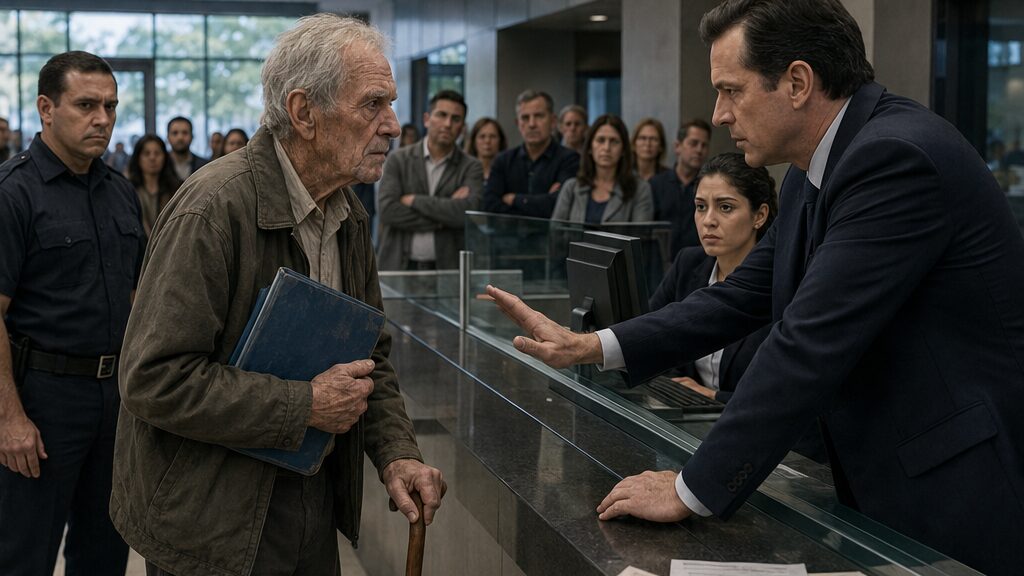
By the time he reached the bank, his shirt had dampened beneath his jacket. The branch’s glass front reflected him back: thin shoulders, white hair combed flat, cane in one hand, folder in the other. Behind the glass, customers stood in a neat line under bright lights. Tellers moved behind their stations. The place looked smooth and sealed.
Then the office door near the back opened.
A man in a dark suit stepped out with one hand raised in dismissal. Gregory King, the branch manager, wore his authority like a polished watch. In front of him stood an elderly woman clutching a beige folder with both hands. She was speaking quickly, but John could not hear her through the glass.
Gregory leaned closer, said something short, and pointed toward the exit.
The woman’s mouth closed. Her folder sank against her coat.
John stopped with his hand on the door handle.
For one second, he considered turning around and calling the hospital to say he had tried. Then Linda’s voice came back to him, quiet from the pillow.
Don’t let them make you feel small.
John opened the door and stepped into the bank just as Gregory turned away from the other elderly customer without reading a single page.
Chapter 2: The Manager Would Not Read One Page
“Your wife’s hospital bill isn’t our problem.”
Gregory King said it loud enough for the customers in line to hear and low enough to make it sound like discipline rather than cruelty.
John stood at the counter with his blue folder open between his hands. The first page was Linda’s hospital estimate, flattened by his palm. The second was the failed authorization notice. The third was his account statement. He had arranged them exactly the way he had rehearsed on the bus.
Gregory had not looked at any of them.
“I’m not asking the bank to pay it,” John said. “I’m asking to release my own funds. The money is there.”
Gregory glanced at the line behind John. Three people shifted their weight. Someone sighed. The elderly woman with the beige folder had taken a chair near the wall but had not left. She watched John as if his answer might also become hers.
“We’ve explained this,” Gregory said. “Your account is restricted.”
“You told me it was processing.”
“I personally told you your case required review.”
“You didn’t speak to me before today.”
Gregory’s face changed only around the eyes. Not surprise. Irritation at being corrected.
Emily Flores, the young teller two stations over, looked up from her screen. Her fingers paused above the keyboard.
John reached into the folder and pulled out the printed bank statement. “This was given to me here. There’s a check mark by the balance. The teller said the funds were available.”
Gregory did not touch the paper. “Available funds do not override security restrictions.”
“What security?”
“Suspicious activity.”
The words seemed to please him. They made the problem larger than John, colder than Linda, safer for the bank.
John swallowed. “The activity is a hospital payment.”
“Large withdrawal attempts by elderly customers are often flagged.”
“I’m not confused.”
“I didn’t say you were.”
The silence after that did the saying for him.
A man behind John muttered, “Come on.”
John felt heat climb into his neck. He lowered his eyes to the folder, not because he had done anything wrong, but because shame always seemed to find the oldest place in the body.
“I have the authorization form,” he said. “The hospital needs confirmation today.”
Gregory folded his hands on the counter. “Sir, waving paperwork does not change the system.”
“I’m not waving it.”
“You don’t have app verification.”
“I do not use the app.”
“That is part of the issue.”
John looked up. “I was told to come in person if the app locked me out.”
“By whom?”
“I don’t remember her name.”
“That makes it difficult.”
Emily moved closer, pretending to adjust something near the receipt printer. Her screen showed the customer lookup page. John’s bank card lay on the counter beside the folder; the last four digits were visible. Emily’s eyes flicked from the card to the hospital payment slip.
Gregory noticed.
“Emily,” he said without turning, “take the next customer.”
She hesitated. “I can help verify the payment numbers.”
“That won’t be necessary.”
John pushed the statement gently forward. “Please. Just read one page.”
Gregory looked at the page as if it were something wet. “I have already told you the account requires manager approval.”
“You’re the manager.”
“And my approval is not available until review is complete.”
“When?”
“That depends.”
“On what?”
Gregory leaned in, lowering his voice, but not enough. “On whether you stop interfering with the process.”
John’s hand tightened around the edge of the folder. The plastic spine bent under his thumb.
“I have called. I have come in. I have waited. The hospital called this morning.”
“That is unfortunate.”
“My wife is on the schedule today.”
“I understand you are upset.”
“No.” John’s voice cracked, and several heads turned. He steadied it. “You understand I am old. That’s what you understand.”
Emily looked down quickly, but not before John saw something in her face. Not pity. Recognition.
Gregory’s jaw set. “You need to be careful, Mr. Davis.”
“Careful?”
“Accusations will not speed this up.”
“I’m asking you to look at the papers.”
“The papers are not sufficient.”
“You haven’t looked at them.”
Gregory reached out then, not to read, but to push the folder back across the counter. The motion was small and practiced. The top papers slid loose, one corner slipping over the edge.
John caught them with his fingertips.
A woman in line whispered, “He has documents.”
Gregory heard it. His posture straightened.
“Let me make this clear,” he said. “This branch has protocols for senior-account activity. We cannot release money simply because someone arrives emotional with a folder.”
John stared at him. “Someone?”
“Mr. Davis.”
“My name came after the insult.”
The line grew very still.
Emily stepped closer again. “Mr. King, the hospital merchant ID matches the authorization request in the pending activity.”
Gregory turned his head. “You are with the next customer.”
“I know. I just saw—”
“You just saw a partial screen.”
Emily’s lips closed.
John seized the small opening. He took out the payment form, the authorization slip, the hospital estimate, and the bank statement, laying them one by one on the counter.
“This is the bill. This is the authorization. This is the failed payment. This is the money. This is the notice that says frozen. They don’t match. I need someone to explain why they don’t match.”
For the first time, a few people in line looked at the papers instead of at John.
Gregory’s expression hardened.
“That is enough.”
John kept his hand on the statement. “No. It is not.”
Gregory looked past him toward the front of the branch. “Security.”
John did not turn, but he heard the movement near the door. A chair leg scraped. The elderly woman with the beige folder clutched her purse.
Emily said quietly, “Mr. King, we can run an account history.”
Gregory’s voice snapped. “Do not process anything on Mr. Davis’s account without my approval.”
The sentence landed with a strange weight. Not just refusal. Instruction. A line drawn around John in full view of the room.
John looked from Gregory to Emily. Her face had gone pale.
“What does that mean?” he asked.
Gregory buttoned his suit jacket. “It means you are done here for now.”
John felt the folder under his hands. The old tape. The softened corners. Linda’s name on every page.
His shame did not vanish. It changed shape. It became fear sharpened by time.
“If I leave,” he said, “my wife may lose her surgery.”
Gregory lifted one hand toward the approaching guard. “You are holding up real customers.”
The security guard stopped beside John’s elbow.
Chapter 3: The Cane Sounded Across The Lobby
The security guard reached for John as if the decision had already been made.
Not roughly at first. Two fingers near the sleeve of John’s jacket, a practiced touch meant to guide an old man away without making it look like force. But John saw the line of customers watching, saw Gregory’s open palm signaling toward the door, and felt something inside him recoil.
“Sir,” the guard said, “let’s step aside.”
John kept his cane planted. “I am not finished.”
“Manager says you need to come back later.”
“My wife does not have later.”
Gregory exhaled as if John had embarrassed him by repeating himself. “This is exactly the kind of scene that delays everyone.”
“I did not make the scene.”
“You raised your voice.”
“You called security.”
The guard shifted, uncomfortable now. His hand brushed the cane. It was not much of a push, but the rubber tip slid half an inch on the tile. John’s balance broke for one ugly second. His hip struck the counter, and the folder slipped from under his arm.
The blue folder hit the floor open.
Papers burst out and skidded across the polished tile.
A hospital estimate slid under the rope barrier. The frozen-account notice flipped face up near a customer’s shoe. Linda’s identification copy landed in the pale light beneath the teller window. The payment authorization sheet drifted almost gently before settling against the base of Gregory’s polished shoe.
No one moved.
John stared at the papers as if a private room had been torn open in public.
Gregory bent first, but not to help. He picked up the authorization sheet between two fingers and held it out toward John.
“You see?” he said. “This is why we ask customers to remain calm.”
John reached for the page. Gregory did not release it immediately.
Behind the counter, Emily stepped around her station. “I can help gather them.”
“Stay where you are,” Gregory said.
The words stopped her, but her eyes stayed on the floor.
The security guard lowered his hand from John’s sleeve. “Sir, I didn’t mean to—”
John bent slowly. Pain ran from his knee into his back. His cane wobbled in one hand while he tried to reach the frozen-account notice with the other.
A customer moved before anyone else did. A middle-aged woman from the line crouched and picked up Linda’s medical page. She read just enough to understand and quickly turned it facedown, as if protecting it from the room.
“This has a surgery time on it,” she said.
The murmurs shifted. They no longer belonged to impatient customers. They belonged to witnesses.
Gregory’s face tightened. “Please do not handle another customer’s private documents.”
“She’s helping me,” John said.
His voice was quiet, but it cut.
The woman handed him the page. “I’m sorry.”
John nodded once. He could not trust himself to say more.
Then his phone rang.
The sound was small and cheap in the wide bank lobby. Every eye seemed to follow his hand as he pulled it from his pocket. The hospital number was on the screen.
He answered with the folder half-gathered against his chest.
“This is John Davis.”
“Mr. Davis, this is hospital billing again. I’m sorry to call twice, but the surgical team is asking whether the payment authorization will clear before noon.”
John looked at the bank clock above the teller stations. The black minute hand pointed too close to the top.
“I’m at the bank now.”
“Were they able to release it?”
He looked at Gregory.
Gregory looked away.
“Not yet,” John said.
“We do need confirmation as soon as possible. If the payment cannot be authorized, the slot may be reassigned.”
The word reassigned went through him colder than the air-conditioning.
“How long?” he asked.
“I can note that you’re at the bank, but the file needs action before early afternoon.”
“Please don’t give away her place.”
“I can only note the account, sir.”
After the call ended, John stood with the phone in one hand and Linda’s papers in the other. The bank had grown louder and quieter at the same time: the machines humming, a printer clicking, people breathing carefully around him.
Gregory spoke first. “As you can see, the hospital has its own policies. That is not something this branch controls.”
John placed the phone in his pocket.
“I need my account history.”
Gregory’s brow lifted. “No.”
“I need to see when the payment was accepted and when it was reversed.”
“That information is not available at the counter during an active review.”
Emily said, “It can be printed.”
Gregory turned on her. “Emily.”
She looked down, then at John’s scattered papers. Her hands curled once at her sides.
John knelt again to pick up the last few pages. One receipt had slid halfway beneath the counter’s lower panel. He pulled it free and paused.
It was the stamped bank slip from his visit three days earlier.
The ink was faint but clear enough: PAYMENT AUTHORIZATION RECEIVED. Under it was a time stamp. Beneath that, in smaller print: PENDING RELEASE.
Accepted, not rejected.
He held it up, first to himself, then to Gregory.
“This says received.”
Gregory barely glanced. “Received is not completed.”
“It was accepted before it failed.”
“Many transactions enter pending status before being declined.”
“Then show me where it declined.”
Gregory extended his hand. “Give me the folder.”
John held it closer. “Why?”
“So I can close the file properly and schedule a review.”
“You mean take it away.”
“I mean stop this disruption.”
The security guard looked between them. His mouth tightened. He had seen the surgery page now. So had the woman in line. So had Emily.
John could feel the old training inside him telling him to obey. Hand over the folder. Apologize for the mess. Ask for an appointment. Go home and wait for someone younger, faster, more digital to explain what he should have done.
Linda’s voice rose against it.
You’ve always been good at keeping promises.
He had thought the promise meant bringing the right papers.
Now he understood it meant not letting the wrong hands close them.
Gregory reached again, fingers closing around the folder’s edge.
John pulled back.
The motion was sharper than he intended. A few papers fluttered again. Gregory’s eyes flashed with satisfaction, as if John had finally become the difficult old man he had been describing.
“There,” Gregory said. “That is enough.”
“No,” John said.
His cane was in his right hand. He lifted it, not high, not like a weapon, but like a man claiming the one sound he had left.
He struck the rubber tip hard against the tile, then the counter’s wooden base.
The crack rang through the branch.
Every teller stopped. The printer stopped after one final stutter. Even Gregory took one step back.
John’s hands shook. His voice did not.
“I want my full account history,” he said. “I want to see who froze my money. I want to see it now, in front of everyone, before my wife loses her surgery because you would not read one page.”
Emily looked at her screen.
Gregory looked at Emily.
And for the first time since John had entered the bank, fear crossed the manager’s face before he could hide it.
Chapter 4: The Hidden Note On Emily’s Screen
“There’s a note here that shouldn’t be on a medical payment.”
Emily did not say it loudly. She barely moved her mouth. But the lobby had gone so still after John’s cane struck the counter that the words carried just far enough.
Gregory’s head turned.
John saw Emily’s face change the moment she realized he had heard her. She looked young then, not because of her age, but because fear had made her eyes too open. One hand hovered over the keyboard. The other rested near the receipt printer as if she might need to prove she was only doing ordinary work.
Gregory stepped toward her station. “Close that screen.”
Emily did not close it.
John held the folder against his chest, the papers bent against his jacket. “What note?”
“Mr. Davis,” Gregory said, “employees are not permitted to discuss internal review markers with customers.”
“What note?” John asked again.
Emily swallowed. Her eyes moved from Gregory to John, then to the security guard standing between them.
“It says manager release only,” she said. “No teller override. No phone authorization.”
Gregory’s voice sharpened. “Emily.”
She flinched but kept looking at the screen. “It was added after the hospital transaction entered pending.”
John felt the words before he understood them. After. Not before. Not because the payment had been suspicious from the beginning.
“The payment was accepted first?” he asked.
Emily’s fingers moved quickly now, tapping through a menu. “It looks like it entered pending release at 10:14 on Tuesday.”
“That’s when I came in,” John said. “They told me it would go through.”
Emily nodded once. “Then a restriction note was added at 10:31.”
Gregory reached the side of her station. “You are looking at a partial activity list, and you are mischaracterizing it in front of customers.”
“I’m reading the timestamps.”
“You are creating liability for the branch.”
The word liability seemed to restore some of Gregory’s control. A few customers shifted again, uncertain. John could see it happening: the room stepping backward from simple human facts into the fog of official language.
He opened the folder and pulled out the stamped payment slip he had found on the floor. His hand was still trembling, but he placed the slip flat on the counter.
“This is 10:14,” he said. “That matches.”
Emily looked at the slip. Something in her face steadied. “Yes.”
Gregory leaned over the counter. “Mr. Davis, you do not understand how transaction holds work.”
“Then explain this one.”
“I don’t owe a technical explanation in the lobby.”
“You owe me my wife’s surgery payment.”
A low murmur passed through the line.
Gregory pointed to the folder. “That is exactly the emotional pressure that makes these situations dangerous. Fraudsters use urgency. Hospitals, grandchildren, emergencies. We have protocols because seniors are targeted.”
John stared at him. “I’m the senior.”
“And that means we have to be careful.”
“With my money.”
“With the bank’s responsibility.”
Emily clicked again. A printer behind her woke with a soft mechanical whine, then stopped when she canceled it quickly.
Gregory noticed. “What did you print?”
“Nothing.”
“What did you try to print?”
John saw Emily’s hand slide over a single page that had already fed halfway from the small station printer. She pulled it loose and turned it facedown beside the keyboard.
Gregory held out his hand. “Give it to me.”
Emily did not move.
“Emily,” he said, quieter now, “you are a teller. You are not compliance. You are not audit. You are not going to understand what you’re looking at well enough to make accusations.”
“I’m not making accusations.”
“You just told a customer an internal note shouldn’t be there.”
“Because it shouldn’t be on a hospital payment that already had funds.”
Gregory’s face tightened. He looked briefly toward the glass office behind him, then toward the customers. John understood then that Gregory was measuring the room, not the truth. Who had heard what. Who might repeat it. Who could still be made to doubt.
“Print it,” John said.
Emily looked at him.
“My account history,” John said. “Print the part that shows the payment and the note.”
Gregory gave a short laugh without humor. “You do not direct my staff.”
“No,” John said. “But I am asking for my own record.”
“You can submit a request.”
“I am submitting it now.”
“That is not the process.”
John set his cane across the counter edge. The rubber tip left a faint smudge on the polished wood. “Then write down the process on paper and sign it with your name.”
For the first time, Gregory did not answer immediately.
Emily looked back at her screen. “Mr. Davis had enough funds in the account at the time of the payment request.”
The words entered the lobby like a small opening in a locked room.
“How much?” Gregory said.
Emily hesitated.
John answered before she could. “Enough.”
Gregory smiled thinly. “That is not a banking term.”
“Enough to pay for what my wife needs.”
Emily said, “The balance exceeded the requested amount.”
The woman who had picked up Linda’s medical page whispered, “Then why didn’t it go through?”
No one answered.
Gregory’s hand came down on the side of Emily’s station, not hard, but final. “Close the customer profile.”
Emily’s fingers stayed on the keys.
John saw the struggle in her. It was not the kind that belonged in dramatic movies. There was no sudden blaze of courage, no raised chin. She looked like a person calculating rent, references, health insurance, and whether one man’s folder was worth losing all of it.
Gregory saw it too.
“I will not have insubordination in this branch,” he said. “You have already gone beyond your role.”
Emily’s mouth pressed together. Her gaze dropped to the facedown printout beside her keyboard.
John almost looked away. He hated needing her bravery. He hated that the truth of Linda’s surgery might depend on a young woman risking her job while he stood there with old paper and a cane. He had spent too many years trying not to be a burden. Even now, some part of him wanted to apologize to Emily for putting her in Gregory’s path.
Then he remembered the elderly woman outside the manager’s office, her beige folder sinking in her hands.
He turned to the security guard. “Did you hear her say the money was there?”
The guard shifted. “I heard.”
“Did you hear her say the note was added after?”
The guard’s eyes moved to Gregory. “I heard that too.”
Gregory snapped, “You are not part of this review.”
The guard’s face went still. He did not step back, but he did not step forward either.
Emily turned the printout over.
It was not long. A clean white sheet, sharp black lines, nothing like the soft worn pages in John’s folder. She placed it beside his hospital bill on the counter.
“There,” she said.
John leaned close. The bank words were hard for him to follow, but the timestamps were plain. Pending medical payment. Available balance. Manager release note. Restriction marker.
The note line held a code John did not know.
Gregory King moved faster than John expected. He reached across the counter toward the printout.
Emily snatched it back just in time.
“You are done,” Gregory said.
“No,” John said.
His own voice surprised him. It was not loud now. It did not need the cane. He placed one hand on the hospital bill and one on the bank printout.
“These two pages belong together,” he said. “One says my wife needs surgery. One says my money was there. You will not separate them.”
Gregory’s eyes flicked to the screen behind Emily.
John followed the look.
There was another window open behind the account summary, smaller, with rows of time stamps and user IDs. At the edge of one row, before Emily moved the cursor, John caught only a few letters.
GKING.
Gregory reached past Emily’s shoulder toward the mouse.
Emily pulled back.
“Don’t touch that,” she said.
The words were quiet, but they changed the room more than John’s cane had. Gregory’s hand stopped in the air.
Then he reached again, harder, across Emily’s station, aiming for the audit-log window before anyone else could read it.
Chapter 5: The Freeze Was Not A Mistake
Emily saw the three matching hold codes before Gregory’s hand reached the mouse.
They appeared in a narrow column on the left side of the audit screen, each attached to an account holder over seventy, each marked with the same internal tag: MANAGER RELEASE ONLY. For one disorienting second, the rows looked less like bank data than like names on a waiting-room clipboard, people sitting somewhere with folders on their laps, being told to come back later.
Then Gregory’s sleeve crossed the screen.
Emily pulled the mouse away. “Stop.”
Gregory’s hand struck the counter instead. A plastic pen holder tipped, scattering pens near John’s folder.
“You are violating access policy,” Gregory said.
“I’m in the customer’s account history.”
“You opened audit views.”
“Because there’s a manual hold.”
“Because there is a fraud review.”
John heard the word again—fraud—and this time he felt the room lean toward it. It was a strong word. It carried fear. It made ordinary people uncertain about defending him.
Gregory knew that.
He turned toward the customers with controlled frustration, as if he were the one being tested. “This is why we do not conduct internal reviews in public. Elderly clients are often vulnerable to scams. Large urgent transfers must be handled carefully. If Mr. Davis cannot verify through the app, if he cannot answer security prompts, if he cannot explain all recent activity, then we must protect him and the institution.”
The security guard’s eyes shifted to John’s phone. The woman in line lowered Linda’s medical page closer to her purse, uncertain again.
John felt his ears burn.
He wanted to say he could explain. But could he? He could not unlock the app. He had forgotten the password twice. He had written answers on scraps of paper and lost them. He had asked the neighbor’s son for help and then felt foolish when the boy said, “It’s easy, Mr. Davis.”
Gregory had found the soft place.
“I don’t use the app,” John said.
Gregory turned back to him. “That is part of the risk profile.”
“I came in person.”
“Which is exactly why we’re reviewing.”
“I brought identification.”
“Paper identification can be misused.”
“My wife is not a scam.”
“No one said she was.”
John stared at him. Again, the insult hid in what had not been said.
Emily looked from John to the screen. Her face had gone pale, but something in it had hardened.
“Mr. King,” she said, “there are similar holds on other senior accounts.”
Gregory’s eyes cut to her. “You have no context.”
“There are delayed refunds and removed complaint notes.”
“You opened other profiles?”
“The audit log previews them in the linked exception queue.”
“You had no authorization.”
“I didn’t open the files. They’re tied by the same hold code.”
Gregory stepped closer. “You are making a career-ending mistake because a customer raised his voice.”
John saw Emily flinch at the word career. Not much. Just enough to show the threat had landed.
He looked down at his folder. The papers were no longer neat. Corners bent. One page had a gray shoe mark across Linda’s printed name. He had brought order because he believed order would protect him. Instead, Gregory had made his inability to use a phone into suspicion and his wife’s surgery into pressure tactic.
“I waited,” John said.
No one seemed to understand at first.
He lifted his eyes. “I waited because I thought I was the problem.”
Gregory gave an impatient sigh. “Mr. Davis—”
“No. You used that. You said app verification, and I thought maybe I should have learned it. You said review, and I thought maybe I missed something. You said suspicious, and I wondered if I had done something wrong by being old and slow and afraid to click the wrong button.”
The lobby had gone quiet again, but differently now. Not frozen. Listening.
John touched the folder’s split spine. “I should have come sooner. I should have demanded this Tuesday. But I was embarrassed.”
Emily’s eyes lifted from the screen.
John looked at Gregory. “You counted on me being too ashamed to ask.”
Gregory’s expression shifted, not into guilt, but into anger sharpened by exposure. “I counted on customers following security procedures.”
“Then show the procedure that lets you freeze hospital money after it is accepted.”
Gregory’s jaw worked once. “Emily, step away from the terminal.”
She did not.
“Step away now, or I will have you removed from customer systems pending review.”
Emily’s hand hovered over the keyboard. The threat had weight because it was ordinary. No police, no shouting, no movie drama. Just a job disappearing in a sentence.
John wanted to tell her not to risk it. He had no right to ask a young woman to stand between Gregory and whatever he was hiding. Linda would tell him that too, he thought. Linda, who was always soft toward people with less power.
But Emily’s eyes were on the screen now, scanning.
“There are three other recent accounts with the same code,” she said. “All senior profiles. One refund reversal. One retirement transfer delay. One complaint note deleted.”
Gregory’s face lost color at the edges.
The security guard noticed. So did John.
“Deleted by who?” John asked.
Emily shook her head. “I can’t see the full deletion detail from here.”
Gregory seized on it. “Exactly. You cannot see it. You’re speculating.”
“But the link is there.”
“You are building a story from fragments.”
“Then let compliance review it.”
Gregory’s voice dropped. “If you send incomplete information outside this branch, you will be the one reviewed.”
Emily’s fingers curled.
John thought of the woman with the beige folder. He turned. She still sat against the wall, lips pressed tight, clutching her folder like it might be taken. Her eyes met his for a second, then dropped.
He wondered how many times she had been told “temporary.” How many had gone home. How many had apologized.
His phone rang again.
This time, the sound made several people visibly tense.
John answered with the folder under his arm and one hand braced on the counter. “John Davis.”
“Mr. Davis, hospital billing again. I’m sorry. We still do not have authorization.”
“I’m trying.”
“I understand. I need to tell you that we have been asked to move forward with the schedule. If payment cannot be confirmed within the next hour, the slot may be reassigned.”
The room narrowed around the word hour.
John looked at the bank clock. One hour. Less, by the time forms moved through whatever invisible hallway money traveled.
“Please,” he said, and hated that the word went to the hospital instead of the man standing in front of him. “Please hold it.”
“I’ll mark that you are actively working with your bank. But I cannot guarantee—”
“I understand.”
He did not, not really. He understood only the shape of loss approaching with paperwork in its hand.
When he lowered the phone, Gregory looked almost relieved. A deadline could pressure John out faster than security.
“You should go handle your hospital arrangements,” Gregory said. “We will contact you when the review is complete.”
John placed the phone on the counter.
“No.”
Gregory blinked. “Excuse me?”
“My wife has one hour because this bank would not release my money. I am not leaving so you can tell me tomorrow what you refuse to show me today.”
Gregory turned to the guard. “Remove him.”
The guard did not move immediately.
Gregory’s voice sharpened. “Now.”
Emily clicked once. The screen changed. John saw a new line open in the audit view.
The same user ID appeared again.
GKING.
Gregory saw it too.
For half a second, no one spoke.
Then Gregory lunged toward Emily’s station. “Close that.”
Emily pulled back, but not before John saw her hand hit two keys in quick succession. The printer began to hum.
Gregory pointed at her. “You are suspended effective immediately.”
Emily’s face went white.
The printer kept feeding paper.
Chapter 6: The Account History Became Public
“Remove him and that folder from the counter.”
Gregory’s voice cracked on the word folder.
The security guard looked at John, then at the old blue plastic pressed beneath his hand, then at Emily’s screen where the audit window still glowed. The printer behind her was working slowly, line by line, as if the machine itself had decided to become stubborn.
“Sir,” Gregory said to the guard, “do your job.”
The guard stepped toward John.
John did not move. He did not raise the cane this time. He laid the folder flat on the counter instead, opened to Linda’s hospital bill. Beside it, he placed the bank printout Emily had given him. The two pages looked absurd together: one pleading in medical codes and surgery estimates, the other hiding harm behind neat columns.
The guard stopped before touching him.
“I see the papers,” he said.
Gregory stared at him. “You see an agitated customer interfering with branch operations.”
“I see a hospital bill.”
“You are not qualified to assess banking risk.”
“No,” the guard said. His voice was quieter than Gregory’s, but it carried. “I’m qualified to decide whether I’m putting hands on an old man holding medical papers. I’m not doing that again.”
The lobby reacted in a breath. No applause. No cheer. Just the sound of people realizing a command had failed.
Gregory’s face flushed. “Then stand aside.”
Emily reached for the printout as it emerged. Gregory moved toward her, but the guard shifted just enough to block the path.
“I’m sending this to compliance,” Emily said.
“You are sending nothing.”
“It’s Mr. Davis’s account history.”
“It includes internal data.”
“It includes a manual freeze on an emergency medical payment.”
Gregory pointed at her station. “If you transmit that, you will be terminated for unauthorized disclosure.”
Emily’s fingers shook over the keyboard.
John saw the tremor and knew it. His own hands had shaken over the app, over the phone, over every official page that made him feel too old for the world he was trying to survive in. Fear could make a person obedient even while they were watching something wrong happen.
He leaned toward her. “Emily.”
She looked at him.
“I can’t tell you what to risk,” he said. “But I can tell you I asked for my account history.”
Gregory snapped, “He does not understand what he’s asking for.”
John turned slowly toward him. “I understand more than you wanted me to.”
For once, Gregory had no immediate answer.
Emily pressed the keys.
A small notification appeared on her screen. She did not read it aloud, but John saw the word SENT reflected faintly in her eyes before she looked down.
Gregory saw it too.
His expression flattened. The anger drained into something more dangerous: calculation.
“Fine,” he said. “Then we will document that this employee accessed audit material outside her authorization under pressure from a distressed customer.”
Emily’s mouth opened, then closed.
Gregory turned to the watching customers. “This is exactly why we have procedures. A branch cannot be run by emotion. It cannot be run by spectacle. It cannot be run by a crowd deciding what security standards apply.”
His voice had regained its polish. John could feel the room wavering again, not because they trusted Gregory, but because institutions always sounded most powerful when they were explaining why ordinary people had misunderstood them.
John picked up the stamped slip from Tuesday.
“I came here Tuesday,” he said.
Gregory ignored him.
John raised the slip. “This says payment authorization received at 10:14.”
“Pending,” Gregory said.
“At 10:31, a manager-only restriction was added.”
Emily looked at him sharply. She had not expected him to hold the times.
John placed the slip down between the hospital bill and the audit printout. “I am asking for the release code.”
Gregory gave a short, disbelieving laugh. “You are not entitled to a release code.”
“I am entitled to my money.”
“You are entitled to review.”
“My wife is entitled to treatment.”
“That is not a banking category.”
The cruelty of it landed without volume. Even Gregory seemed to realize it had sounded too plain.
John’s fingers pressed into the counter edge. “Then make it one today.”
The elderly woman with the beige folder rose from her chair. She did not come forward, but she stood. The woman in line still holding one of Linda’s pages placed it carefully on the counter beside the folder. A man near the door lifted his phone, then lowered it when the guard looked at him. The room was not a crowd yet. It was something quieter and harder for Gregory to manage: witnesses who had stopped pretending not to hear.
Emily leaned toward her screen. “There’s a manager credential on the freeze.”
Gregory spun. “Do not say another word.”
Emily’s face was pale, but she spoke anyway. “User ID GKING. Tuesday, 10:31. Manual restriction. Reason entered: senior fraud review.”
John looked at Gregory.
The manager’s lips thinned. “That is my credential, yes. Managers apply holds every day. That proves nothing improper.”
“Then release it,” John said.
“I cannot while there is a review.”
“You created the review.”
“I applied a security protocol.”
“After the payment was accepted.”
“Because the payment triggered review.”
Emily shook her head. “The trigger was manual.”
Gregory pointed at her. “You have already compromised yourself. Nothing you say now is reliable.”
The words struck her harder than his earlier threat. John saw it in the small collapse of her shoulders. Gregory knew where to press. With John, it was age. With Emily, it was authority.
John placed his cane on the counter beside the folder, a careful, deliberate act.
“Look at me,” he said.
Gregory did not.
“Look at me.”
Slowly, Gregory did.
“You can review me after my wife is treated. You can ask me every question. You can make me sit in an office and prove my first car, my wedding date, my address, whatever you need. But right now, you have my money behind a code you put there, and there is one hour left. Give me the release code.”
Gregory’s nostrils flared.
The branch phone rang.
No one moved at first. The sound cut through the lobby in sharp bursts from Emily’s station.
Emily glanced at the caller ID. Her face changed.
“It’s compliance,” she said.
Gregory held out his hand. “I’ll take it in my office.”
Emily did not lift the receiver.
Gregory stepped toward her. The guard stepped with him. Not aggressively. Just enough.
Emily answered on speaker before Gregory could stop her.
“This is Emily Flores at the branch.”
A clipped voice filled the teller area, tinny through the speaker. “This is internal compliance. We received an urgent account-history escalation regarding customer John Davis. Is Gregory King present?”
Gregory’s jaw tightened. “This is Gregory King. This matter involves an employee exceeding access authority and a disruptive customer.”
There was a pause. Papers shuffled on the other end, or keys. When the compliance voice returned, it was colder.
“Mr. King, before we address employee conduct, explain why your manager credentials were used to place a manual senior fraud review hold on an emergency medical payment after available funds were confirmed.”
John did not look away from Gregory.
For the first time all morning, Gregory King had been asked to explain himself by someone he could not order out of the room.
Chapter 7: The Money Was His All Along
“Process the emergency medical release now,” the compliance officer said.
The voice came through Emily’s speaker thin and metallic, but it cut through Gregory’s polished silence with the force of a locked door opening.
Emily’s fingers moved before anyone else spoke. She pulled John’s account back onto the screen, then paused at a prompt. “I need manager approval or compliance override.”
“Compliance override issued,” the voice said. “Use code sent to your terminal. Mr. King is not to touch that account while this review is open.”
Gregory’s mouth tightened. “This is an overreaction to incomplete information.”
“Mr. King,” the compliance officer said, “step away from the teller station.”
For a moment, John thought Gregory would refuse. The manager’s hand hovered near the counter, close enough to the printout that John slid the medical folder toward himself. The movement was small, but Gregory saw it. His eyes flicked down to the blue plastic, the bent hospital papers, the bank slip that had started to curl at one corner.
Then the security guard shifted his weight.
Gregory stepped back.
Emily typed in the override code. The printer woke again, but this time the sound was different to John. Not evidence. Not threat. Something being allowed to move.
“Mr. Davis,” Emily said, her voice careful, “I’m releasing the payment authorization to the hospital merchant account.”
John nodded, though he did not trust his throat.
On the speaker, the compliance officer continued. “I am placing a preservation order on all records connected to this account activity. That includes audit logs, complaint notes, senior fraud review markers, and any linked exception queue entries.”
Gregory gave a sharp breath. “You are treating a standard protective hold as misconduct.”
“We are treating a manual freeze on an emergency medical transaction after available funds were verified as requiring immediate review.”
“It was a risk decision.”
“Then your documentation will support that.”
Gregory’s face did not move, but John saw his fingers curl once against his palm.
Emily glanced toward the side of her screen. “The authorization is pending transmission.”
“How long?” John asked.
“Seconds,” she said. “Maybe a minute.”
A minute.
John had spent three days being told to wait. Now a minute felt both merciful and unbearable.
The lobby remained still around him. No one pretended to check their phone anymore. The elderly woman with the beige folder stood near the chairs, her eyes fixed on Gregory as if she were memorizing the shape of his authority while it cracked.
Gregory noticed her.
“This is exactly why public handling of these matters is inappropriate,” he said. “People see fragments and imagine patterns.”
Emily’s hands stilled above the keyboard.
The compliance officer said, “The system already surfaced linked patterns, Mr. King.”
“I want that noted,” Gregory said. “A junior teller accessed linked records outside her role.”
“I accessed the exception preview tied to Mr. Davis’s account,” Emily said, her voice smaller but steady.
“You do not know what those cases were,” Gregory said. “You don’t know whether those clients were being protected. You don’t know how often families pressure elderly relatives to move money. You don’t know how many scams come through these counters every week.”
For the first time all morning, John heard something under Gregory’s words that was not performance. Frustration, maybe. Fear wrapped in policy. Gregory believed some part of what he was saying. He had seen enough danger to build himself a shield, then used that shield like a weapon.
The compliance officer said, “Protection does not require deleted complaints.”
The lobby seemed to inhale.
Gregory’s face changed.
Emily looked at the screen again. “There were deleted complaint notes?”
“Do not answer that over an open branch speaker,” Gregory snapped.
“That instruction is inappropriate,” the compliance officer said. “Mr. King, you are to proceed to your office and remain available. The branch camera record and terminal activity are being preserved.”
Gregory turned to John then, and the mask slipped for one clear second.
“You have no idea what you’re doing,” he said.
John looked down at the folder. The top page had Linda’s name on it. A shoe mark still crossed the lower half where it had touched the floor. He thought of Linda telling him not to let them make him feel small. He thought of himself on the bus, checking the same papers again and again, believing exactness would save him if only he was patient enough.
“No,” John said. “I didn’t. That’s what you counted on.”
Gregory’s lips parted, but Emily’s printer interrupted him with a final click.
She tore off the page.
“Payment authorization released,” she said.
John stared at the words before he understood them. RELEASED. CONFIRMED. HOSPITAL MERCHANT TRANSMISSION COMPLETE.
He did not reach for the paper right away. His hand would not obey. The cane under his palm felt suddenly too thin to hold up the relief moving through him.
Emily slid the confirmation across the counter.
“This is yours.”
John touched the page with two fingers.
His phone rang.
He fumbled for it, nearly dropped it, and answered before the second ring finished.
“This is John Davis.”
“Mr. Davis, hospital billing. We just received the authorization.”
John closed his eyes.
The voice on the phone softened, just slightly. “Linda Davis’s procedure remains on the schedule.”
He gripped the counter with his free hand. “Thank you.”
“She’ll be taken back as planned.”
He wanted to speak. Wanted to ask whether Linda was afraid, whether someone had told her he was still coming, whether she had asked for him and been told he was handling paperwork somewhere under fluorescent lights. But the words crowded too tightly.
“Please tell her,” he said, then stopped.
“What would you like us to tell her?”
John looked at the folder, at the confirmation page, at Emily’s hand still resting near the printer as if she did not yet believe she had kept her job.
“Tell her I kept the promise.”
“I’ll note it,” the caller said.
When John lowered the phone, the bank looked different but not better. The counters were still glass. The floor was still too bright. The people were still watching. Gregory was still there, though now the security guard stood closer to him than to John.
The compliance officer’s voice returned. “Ms. Flores, please print a full customer copy of the release confirmation and preserve the audit materials as instructed. You will receive a written protection notice for this escalation.”
Emily’s shoulders lowered by a fraction.
Gregory laughed once, under his breath. “You’re rewarding her for breaching chain of command.”
“No,” the compliance officer said. “We’re documenting that she escalated an emergency account irregularity.”
Gregory looked toward the elderly woman with the beige folder. Then toward the customers. The calculation came back, but there were fewer places for it to go.
“This branch has handled dozens of senior fraud reviews,” he said. “You will find delays. You will find complaints. That does not make them misconduct. These clients forget instructions. They lose paperwork. They bring emotion instead of verification.”
John lifted his head.
Emily had another sheet in her hand now, the confirmation copy. She placed it on top of his hospital papers. The clean page covered the shoe mark across Linda’s name.
“Confusion is not consent,” John said.
Gregory turned to him.
John did not raise his voice. “Being old is not permission.”
The words settled between them.
No one clapped. No one needed to. The room had moved past performance.
The compliance officer instructed the guard to ensure Gregory did not access customer terminals while the hold review remained active. The guard nodded before seeming to remember the officer could not see him, then answered aloud. Gregory protested again, but the protest had thinned. It sounded procedural now because there was nothing else left for it to be.
Emily printed two more pages and tucked them into John’s folder with careful hands. “The hospital has confirmation. This copy is for you. This one is the branch receipt.”
John looked at the blue folder. A few minutes earlier, it had been scattered across the floor, each page exposed to strangers. Now the payment confirmation sat on top, crisp and undeniable.
“Will the others be checked?” he asked.
Emily looked toward the speaker.
The compliance officer answered. “All linked senior-review holds under the identified code will be audited. Affected customers will be contacted.”
The elderly woman near the chairs pressed her beige folder to her chest. Her eyes filled, but she did not make a sound.
John looked at her and understood that his relief was not the end of the harm. It was only the first door forced open.
His phone buzzed with a text he did not know how to open quickly. Then it rang again from the hospital number. He answered with both hands around the device.
“Mr. Davis,” the hospital caller said, “we’ve confirmed with the surgical desk. Your wife’s procedure is still scheduled. She has not been moved.”
John looked down at the confirmation page on top of the folder.
For one moment, he could not stand straight under the weight of almost losing what had been his all along.
Chapter 8: The Papers Were Lifted From The Floor
John knelt to gather the last page himself, even after Emily came around the counter and said, “Please, Mr. Davis, let me get that.”
The page had slid beneath the lip of the counter, half-hidden in shadow. It was only a copy of his identification, not the payment confirmation, not the hospital bill, not the stamped slip that had cracked open the morning. Still, he lowered himself slowly, one hand braced on the counter, one knee complaining, because he needed to lift at least one thing from that floor with his own hand.
Emily stopped beside him but did not take over.
The lobby watched differently now. Not with the hunger people had for a scene, and not with the impatience of customers losing time. They watched as if an old man’s papers had become something heavier than paper.
John pinched the corner and pulled it free.
For a second, he remained crouched there, looking at his own copied face on the page. The photo was several years old. He looked stern in it, almost annoyed, because the clerk at the motor office had told him not to smile after he had already smiled. He had thought that was a foolish rule, but he had obeyed it.
So many rules. So much obedience.
“Mr. Davis,” Emily said softly.
He put the page into the folder.
When he tried to rise, his knee locked.
Emily’s hand came under his elbow. She did not pull. She waited until he leaned into the help. That small patience mattered more than she could have known.
He stood.
“Thank you,” he said.
Her eyes were damp, but she blinked it away. “Your demand for the account history made it possible. If you had left, I don’t know if I would have checked far enough.”
John looked toward Gregory’s office. The door stood open. Gregory was inside, visible through the glass wall, speaking into the branch phone with his back turned while the security guard stood outside the doorway. The manager’s suit still fit perfectly. His hair was still neat. But the room around him had changed. His office no longer looked like a place from which orders traveled outward. It looked like a place holding someone in.
“I should have demanded it days ago,” John said.
Emily shook her head. “He made it hard to ask.”
“No.” John closed the folder carefully. “I helped him. By being ashamed.”
She did not argue. He was grateful for that.
The security guard approached with John’s cane held horizontally in both hands. He had retrieved it from where it had been left against the counter after John placed it there. He stopped at a respectful distance, then offered it handle first.
“Sir,” he said.
John took it.
The guard looked at the floor, then back up. “I’m sorry I moved it. Earlier.”
John’s fingers tightened around the cane grip. The apology was not large. It did not fix the scene. It did not undo the moment his balance had slipped and Linda’s papers had scattered under strangers’ shoes.
But it was specific. That made it real.
John nodded. “Don’t do it to the next one.”
The guard swallowed. “I won’t.”
Near the chairs, the elderly woman with the beige folder stepped forward only when John turned toward the exit. She did not ask for help directly. She lifted her folder a few inches, then looked toward Emily.
Emily saw her.
“I’ll be right with you,” Emily said.
The woman’s mouth trembled into something like relief. John wondered what appointment, refund, bill, or family promise she carried in that folder. He wondered how many people had sat where she sat and gone home believing they had failed to understand their own lives.
His phone buzzed again.
This time he managed to open the message. It was from the hospital system, an automated confirmation he would have dismissed on any other day as cold and impersonal.
Payment received. Procedure remains scheduled.
He read it twice.
Emily slipped the final printed pages into the folder in a new order. Payment confirmation on top. Hospital bill beneath it. Bank history after that. She aligned the corners without making a show of it, then handed the folder back.
“The confirmation is first,” she said.
John looked at the blue plastic cover. The tape along the spine had lifted again. A corner was dirty from the floor.
“It used to belong to our daughter,” he said.
Emily smiled faintly. “It held up.”
“Yes,” John said. “It did.”
At the door, he turned once more. The customers had begun to move again, but more slowly. The line re-formed. A teller called the next person. The bank resumed its sounds: keyboards, low voices, receipt printers, the soft open and close of drawers.
Yet something had been left altered in the air. Not victory. Not even justice, exactly. A witness mark.
Through the office glass, Gregory saw John looking and turned away.
John did not need to watch him be led anywhere. The investigation would move with signatures and calls and locked screens. Other people would decide what happened next. That was right. John’s work had never been to punish him.
John’s work had been to keep the promise.
He pushed open the branch door and stepped outside. The daylight felt too bright. Cars moved past. A bus groaned at the stop down the block. For a moment, the ordinary world seemed almost insulting, continuing like nothing had nearly happened.
He held the folder against his chest on the ride to the hospital.
This time he did not open it every few minutes to check whether the papers were there. He knew they were. The confirmation rested on top.
At the hospital, the corridors smelled of disinfectant and warmed plastic. A nurse at the desk asked his name. He gave it. She typed, checked a screen, and nodded.
“The payment is confirmed,” she said. “She hasn’t gone back yet. You can see her for a minute.”
John followed the nurse down the hall, cane tapping softly against the floor. The sound no longer embarrassed him. It announced each step.
Linda was in a curtained pre-op space with a blanket pulled to her chest and a small cap covering her hair. Her face turned toward him before he reached her. She looked first at his eyes, then at the folder.
“You got it?” she asked.
John pulled the confirmation page from the folder. His hand shook, but he did not hide it this time.
“They read it,” he said.
Linda reached for the paper, then changed her mind and reached for his hand instead. “You look tired.”
“I am.”
“Did they make it hard?”
He looked at the confirmation page. The words were clean, official, final. They did not show the floor. They did not show Gregory’s voice. They did not show Emily’s hands shaking over the keyboard, or the guard returning the cane, or the elderly woman waiting with the beige folder.
“Yes,” he said.
Linda’s fingers tightened around his. “But you made them read it.”
John placed the confirmed payment paper beside her hand on the blanket. The top edge lifted slightly in the draft from the vent, then settled.
“They read it this time,” he said.
The story has ended.