When the Donor Mother Tried to Take the Scholarship Girl’s Award in Front of Everyone
Chapter 1: The Certificate Was Already on the Table
Maria Thompson found Emily Rivera’s name missing from the bold line of the ceremony program six minutes before the auditorium doors opened.
Not misspelled. Not misplaced.
Missing.
Her thumb stopped halfway down the glossy page where the private school had printed tonight’s award categories in expensive black ink. The top prize for the Innovation Scholars Showcase was supposed to read:
Grand Award Recipient: Emily Rivera — Community Water Mapping Project
Instead, the line read:
Featured Finalist: Joshua King — Urban Resource Mapping Initiative
Emily’s name appeared three rows lower, in smaller type, under a pale gray heading marked Additional Recognition.
Maria stood beside the trophy table, surrounded by polished wood, white orchids, donor plaques, and the soft glow of stage lights that made every surface look more honest than it was. On the table in front of her lay a clean cream-colored certificate inside a navy folder. Emily Rivera’s full name was printed across it in gold.
The certificate knew the truth.
The program did not.
“Maria?” Sharon Johnson’s voice came from behind her. “The parents are lining up.”
Maria turned with the program still pinched between her fingers. Sharon held a clipboard against her chest like a shield. As school board secretary, she always looked composed from a distance. Up close, Maria could see the tightness around her mouth.
“Why was Emily moved?” Maria asked.
Sharon looked toward the auditorium entrance, where families were beginning to gather under the donor wall. “Moved?”
“Don’t do that.”
Sharon’s eyes flicked down to the program. For one second, her professional calm slipped.
“I printed what I was given,” she said quietly.
“Given by whom?”
Sharon swallowed. “Donald’s office sent the final file this morning.”
“This morning?” Maria lowered her voice. “The award committee approved Emily last week.”
“I know.”
“Her project won. Not Joshua’s.”
“I know that too.”
A burst of laughter rose near the entrance. Patricia King had arrived.
Maria knew it before she looked. Patricia had the particular kind of presence that made other adults rearrange themselves without realizing it. She moved through the lobby in a fitted cream jacket, one hand resting lightly on Joshua’s shoulder, smiling at parents who smiled back too quickly. Behind her, the donor plaque bearing the King family name shone under a small spotlight.
Joshua, tall for his age and stiff in a navy blazer, kept his eyes on the floor.
Emily sat in the front row with her father, Thomas Anderson, two seats from the aisle. She wore a simple blue dress and had braided her hair tightly back. Her hands rested flat on her knees, fingers pressed together as if she were keeping herself from taking up too much room. Thomas sat beside her in his work shirt, clean but worn at the cuffs, his shoulders held in the careful posture of a man trying not to seem uncomfortable among people who would notice.
Emily looked at the trophy table only once.
Then she looked away.
Maria folded the program and tucked it under her arm before walking toward her.
“Ms. Thompson,” Emily said, standing too fast. “Do I go up when they call finalists, or when they call the award?”
“You go up when they call your name,” Maria said.
Emily’s eyes searched her face. She had always been good at noticing when adults chose words too carefully.
“Did something change?”
Maria glanced at Thomas. He was watching her with the same quiet question, but he did not ask it aloud. That was one of the first things she had learned about him. He did not raise his voice in places like this. He asked fewer questions than he had the right to ask. He thanked people before they helped him.
“Your certificate is ready,” Maria said, and reached for the navy folder on the table. She opened it just enough for Emily to see her name in gold. “That matters. It records the work. Nobody can take away what you did.”
Emily’s mouth moved into something almost like a smile, but her eyes stayed uncertain.
Thomas leaned forward. “We appreciate everything, Ms. Thompson.”
The words landed wrong in Maria’s chest. Appreciate. As if the award were a favor. As if Emily had not spent ten weeks building maps from public water-quality records, city maintenance reports, and survey forms she had translated herself for neighbors who did not trust official paperwork.
Maria remembered Emily hunched over the classroom laptop after school, eating crackers from a paper sleeve, refining one flawed graph again and again because she said the first version made one neighborhood look safer than it was. She remembered Joshua King visiting the classroom once, asking careless questions about “data sources” while Patricia waited in the hallway, checking her phone.
Maria had noticed the way Joshua looked at Emily’s screen.
She had noticed.
But she had filed it away as ordinary academic pressure, the kind that happened when wealthy students realized effort did not always belong to them.
That had been her mistake.
“Maria,” Sharon said, touching her elbow. “Please don’t push the program issue tonight.”
Maria turned slowly. “Why?”
“Because Donald wants a smooth ceremony.”
“Donald wants a false ceremony.”
Sharon’s grip tightened on the clipboard. “I’m not defending it.”
“Then help me fix it.”
“I have a mortgage,” Sharon whispered, then seemed ashamed of the sentence as soon as it left her mouth. “And Patricia King has been in and out of Donald’s office all week. That’s all I know.”
“All week?”
Sharon looked toward Patricia, who had stopped near the front row. “Please. Not here.”
Patricia’s voice cut cleanly through the low auditorium noise.
“Donald told me seating would be adjusted.”
Maria turned.
Patricia stood beside Emily’s row, her smile still in place but no warmth behind it. Joshua remained half a step behind her, staring now at the stage curtains. Donald Lewis, the principal, came down the side aisle in a dark suit, his ceremony cards in one hand. He moved quickly, but not like someone surprised. Like someone arriving late to a problem he already knew about.
Patricia looked at Emily, then at Thomas, then at the front-row seat marked with a small reserved card.
“Why is she still sitting here?” Patricia asked.
Emily’s shoulders drew inward.
Thomas stood. “Ma’am, this is where the school told us—”
“I’m speaking to the staff,” Patricia said, still smiling.
Maria stepped into the aisle before Thomas could apologize. “Emily is seated here because she is receiving the Grand Award.”
Patricia’s eyes landed on the folded program under Maria’s arm. “Is she?”
Donald reached them, breath controlled, expression bright for anyone watching from a distance. “Let’s keep the entry area clear, please. We have guests coming in.”
Maria held up the program. “Emily’s award listing has been changed.”
Donald’s smile did not move. “There were formatting adjustments.”
“Her name was removed from the winning line.”
“Maria,” he said softly, “not now.”
“When?”
His gaze shifted toward the parents entering the auditorium. Phones, pearls, dark suits, school blazers. The room was filling with witnesses, which should have made truth safer. Instead, it made everyone more afraid of it.
Patricia gave a quiet laugh. “Perhaps the final program reflects a final review.”
Maria looked at Joshua. His face had gone pale around the mouth.
“What final review?” Maria asked.
Donald’s voice lowered. “We can discuss anything complicated after the ceremony.”
Emily heard the word. Complicated.
Maria saw it hit her. Not as confusion. Recognition. The old lesson: when adults called you complicated, they were preparing to make you smaller.
Thomas placed one hand lightly on Emily’s shoulder. “Maybe we should sit somewhere else,” he murmured.
“No,” Maria said, too quickly.
Donald’s eyes sharpened.
Maria made herself breathe. Calm professionalism. That was how she had survived fifteen years in schools that loved scholarship brochures more than scholarship children. Document, witness, escalate properly. Never give them the excuse to call you emotional.
But the certificate was already on the table, and Emily was already shrinking in front of it.
Donald leaned closer, his voice almost kind. “Maria, if anything becomes complicated tonight, Emily may need to step aside until we clarify the record.”
“The record is clear.”
“Then you have nothing to worry about.”
Patricia adjusted Joshua’s collar without looking at him. “Exactly.”
The auditorium lights dimmed once, a gentle warning that the ceremony was about to begin. Families moved toward their seats. The murmur softened into expectation.
Maria looked past Donald to the trophy table. The navy folder sat closed again, Emily’s certificate hidden but waiting.
Donald touched Maria’s arm just above the elbow. Not hard. Not openly threatening. Just enough to remind her who signed contracts.
“Smile,” he said. “Tonight is about the students.”
Then he walked toward the stage with the altered program in his hand.
Chapter 2: Scholarship Kids Don’t Belong Here
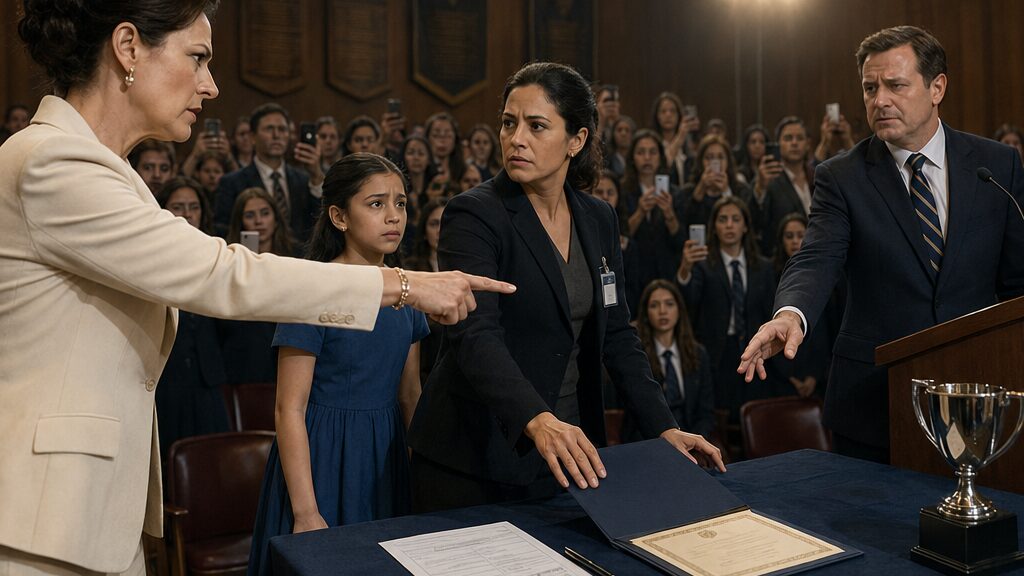
Emily’s name was called, and Patricia King stood before the girl could take a single step toward the certificate.
For half a second, the room did not understand the interruption. Applause had just begun. The school orchestra recording still played softly through the speakers. Donald Lewis stood behind the podium with his ceremony smile fixed in place, one hand extended toward the trophy table as if the evening could continue if nobody acknowledged the woman rising from the front row.
Then Patricia turned to face the auditorium.
“I’m sorry,” she said, not sounding sorry at all. “But this award cannot be presented.”
The applause collapsed in uneven pieces.
Emily stood frozen beside her chair. Maria was three rows back near the side aisle, where faculty had been placed out of sight of the donor families. She moved before Donald spoke.
“Mrs. King,” Donald said into the microphone, his voice too smooth, “we can address any concerns after—”
“No,” Patricia said. “Not after another child is publicly rewarded for dishonesty.”
The word moved through the room faster than sound. Dishonesty. Parents leaned toward one another. A student in the second row turned with wide eyes. Two phones rose. Then five.
Emily’s hand found the back of her chair.
Thomas stood beside her. He did not speak. Maria saw the muscles in his jaw tighten, saw his fingers curl and uncurl at his sides. He looked like a man who had spent his life learning that anger cost more when you had less money to defend it.
Maria reached Emily and positioned herself slightly in front of her.
“Patricia,” she said, keeping her voice low, “this is not the place.”
Patricia’s eyes flashed. “That’s exactly the problem. People like you always want these things handled quietly.”
“These things?”
“Fraud.”
A sound came from Emily, small enough that only Maria heard it. Not a sob. More like breath leaving a body that had been struck without being touched.
Donald left the podium and came downstage. He did not look at Emily first. He looked at Patricia.
“Let’s pause the presentation,” he said.
“No,” Maria said.
The microphone caught the word. It rang through the auditorium, clearer than she intended.
Donald turned.
Maria felt every face swing toward her. She had trained herself for public rooms: keep your hands still, voice even, eyes level. Never let wealthy anger make you look unstable. Never hand frightened administrators an excuse.
But Emily was behind her, and the certificate lay on the table with its gold lettering still hidden inside the navy folder.
“She earned that award,” Maria said.
Patricia laughed once. “Based on work she could never have produced alone.”
Emily flinched.
The first phone flash went off.
Maria glanced toward Joshua. He sat stiffly at the end of Patricia’s row, eyes fixed on his shoes. His hands were clasped so tightly that his knuckles had gone white.
Donald reached the trophy table. His fingers hovered over the navy folder.
“Step down, Emily,” he said, not unkindly. That made it worse. “Don’t make this worse.”
Maria turned her head slowly. “She is not making anything worse.”
Patricia stepped into the aisle. “This school has standards. Families invest in those standards.”
Thomas finally spoke. “My daughter worked for that.”
Several heads turned toward him with the peculiar surprise reserved for people they had not expected to hear.
Patricia looked him over. Work shirt. Worn cuffs. Shoes polished but old.
“I’m sure she worked very hard,” she said. “But effort is not authorship.”
Maria felt Emily’s fingers brush the back of her sleeve. A silent plea. Not to fight, maybe. Not to make everyone look. Not to risk making the label stick.
Maria knew that fear. Years ago, another student had sat in her classroom with a transfer form folded into quarters, saying it was easier to leave than to keep being discussed. Maria had followed procedure then. Filed concerns. Requested review. Waited for the school to be decent in the language it claimed to value.
The girl had disappeared by winter break.
Donald picked up the navy folder.
Maria’s hand came down on it first.
The room went still.
Donald’s eyes widened just enough to warn her. “Maria.”
“No,” she said, quieter this time, but the microphone still carried it. “She earned that.”
Patricia’s smile vanished.
“Scholarship kids don’t belong at this school,” she said.
The sentence did not echo. It landed.
It landed on the donor plaques. On the blue-and-gold banners. On the families holding phones. On Emily’s bowed head. On Thomas’s still hands. On every brochure in the lobby showing smiling children under words like opportunity and excellence.
Maria heard someone gasp. Sharon stood near the side wall, clipboard clutched to her chest, eyes fixed on Donald as if waiting for him to become the man his title required.
He did not.
“Mrs. King,” Donald said, voice strained, “please.”
“Oh, let’s stop pretending,” Patricia said. “We paid for excellence, not pity. My son’s project was reviewed for weeks, and suddenly this girl appears with the same concept and wins because it looks good for the scholarship fund?”
Joshua whispered, “Mom.”
Patricia did not turn.
Maria did. “Joshua?”
The boy’s face closed instantly.
Patricia moved nearer to the stage steps. “I am asking formally, as a board donor and parent, that the certificate be withheld until a disciplinary review is completed.”
Donald nodded once, small and miserable. “That is reasonable.”
“No,” Maria said.
Donald’s voice hardened. “Emily should step aside while we review.”
Emily looked at Maria. Her eyes were glossy but dry. “Ms. Thompson,” she whispered, “maybe I should.”
The words were careful. Trained. A child making herself easy to remove.
Maria stepped fully between Emily and the trophy table.
“You do not have to leave the stage because an adult insulted you.”
A rustle passed through the crowd. More phones rose. Patricia saw them and lifted her chin, as if an audience made her stronger.
“You are confusing sentiment with standards,” she said. “That project was taken from Joshua.”
Maria looked at Donald. “Then show the review record.”
His mouth tightened.
“Show the submission dates,” Maria said. “Show the project logs. Show the committee notes.”
“That is not appropriate in this setting,” Donald replied.
“But accusing a child is?”
A murmur moved through the back rows.
Patricia reached into a leather folder held by the man seated beside her and pulled out several stapled pages. She walked to the trophy table and laid them down with a controlled slap.
The top page faced upward.
Student Disciplinary Report.
Emily Rivera.
Maria saw the typed paragraph before she fully understood what she was seeing. Unauthorized project assistance. Misrepresentation of independent work. Faculty witness: Maria Thompson.
Her own name sat near the bottom beside a blank signature line.
The auditorium blurred at the edges.
Donald did not look surprised.
Patricia placed a pen across the report and slid it toward Maria with one polished fingernail.
“Sign it,” she said, low enough for the front row to hear but not the whole room. The phones caught her anyway. “Or lose your job.”
Maria looked from the report to Donald.
He said nothing.
Emily’s certificate remained under Maria’s hand. The false report lay beside it now, both papers touching at the corners: one made from work, the other from power.
Patricia tapped the signature line.
Maria read the sentence again, the one claiming Emily had admitted to help she had never received.
Then she looked up.
“Who wrote this before the accusation was made?” she asked.
Donald’s face changed, and in that change Maria saw the answer was worse than she feared.
Chapter 3: The Report They Wanted Signed
Donald closed the conference room door while the ceremony music continued on the other side of the wall, bright and cheerful enough to make the room feel cruel.
The applause track had restarted for the audience, some automated playlist meant to fill awkward transitions. It leaked through the paneling in soft waves. On the table between Maria and Patricia lay Emily’s certificate, now facedown in its navy folder, with the false disciplinary report placed squarely on top of it.
Honor under accusation.
Maria remained standing.
“Sit down,” Donald said.
“No.”
His face tightened. Without the stage lights, he looked older. Not guilty, exactly. Tired in the way people looked when they had chosen the easier wrong thing and resented being made to see it.
Patricia sat at the head of the small table as if she chaired the meeting. Joshua was not with her. Emily and Thomas had been left outside in the hall with Sharon, a phrase Donald had used as though waiting were not its own punishment.
“We need to contain this,” Donald said.
Maria looked at the report. “This was typed before Patricia stood up.”
“Mrs. King,” Patricia corrected.
Maria did not look at her. “Who prepared it?”
Donald folded his hands. “A preliminary form was drafted in case concerns arose.”
“In case?”
“There had been questions.”
“From whom?”
Patricia leaned back. “From a parent with a serious interest in academic integrity.”
“From you.”
“From someone whose child’s work may have been copied.”
Maria picked up the report. Donald’s eyes followed the paper as if it were fragile.
The language was careful, administrative, bloodless. It claimed Emily had “acknowledged receiving unauthorized conceptual assistance.” It said Maria Thompson had “confirmed irregularities in the student’s independent process.” It recommended temporary revocation of award recognition pending final board review.
Maria took the pen Patricia had pushed at her.
For one second, Donald’s shoulders lowered, mistaking movement for surrender.
Maria drew one straight line through the sentence that put words in Emily’s mouth.
Patricia sat forward. “What do you think you’re doing?”
“Correcting a lie.”
Donald reached for the paper. “Maria, stop.”
She drew a second line through the sentence that used her as a witness.
“You cannot alter an official disciplinary document,” Donald said.
“It is not official without a true witness.”
“It becomes official when the administration files it.”
“Then file it without my name.”
Patricia’s expression cooled into something harder than anger. “You are making this personal.”
“It became personal when you accused a child in front of an auditorium.”
“That child,” Patricia said, “is not the only child in this school.”
“No. But she is the one you just tried to erase.”
Donald exhaled sharply. “Enough. Both of you.”
Maria finally sat, not because he had told her to, but because her knees had begun to tremble and she refused to let Patricia see it. She placed the crossed-out report on the table facing Donald.
“Emily never admitted to unauthorized help,” she said. “I never confirmed irregularities. Her project drafts are on the classroom laptop. Her submission logs are in the portal. Her notebook shows her process.”
Patricia’s eyes flickered at the word notebook.
Maria noticed.
Donald rubbed one hand across his forehead. “The issue is not whether Emily worked hard.”
“The issue is whether she cheated. She did not.”
“The issue,” Patricia cut in, “is that Joshua developed a similar project under much more advanced guidance. Then Emily, who had access to classroom discussions and faculty sympathy, submitted a version positioned to win a scholarship-facing award.”
Maria stared at her. “Scholarship-facing.”
Patricia’s mouth tightened, but she did not retreat. “This school uses children like Emily to advertise generosity. I’m simply asking whether standards were adjusted for optics.”
“You called her dishonest.”
“I called the process compromised.”
“You said scholarship kids don’t belong here.”
Donald’s hand struck the table, not loud enough to be violent, but enough to jolt the pen. “Maria.”
The old habit rose in her automatically. Calm down. Reframe. Use policy language. Make the administrator comfortable enough to do the right thing.
She hated how close she came to obeying it.
Outside the door, a chair scraped. Emily’s voice murmured something Maria could not hear. Thomas answered, low and steady.
Maria looked at the facedown certificate. She imagined Emily standing in the hallway, hearing pieces through the wall, learning again that adults discussed her future in rooms where she was not allowed.
“What do you want?” Maria asked.
Donald’s relief was immediate and ugly. “We want a temporary statement. You sign that concerns were raised about independent authorship. Emily’s award is withheld for review. We resume the ceremony without further disruption.”
“And after?”
“We investigate.”
Patricia picked up the pen and held it out. “And you apologize for escalating in front of families.”
Maria almost laughed. “I escalated?”
“You placed yourself between a parent and a school decision.”
“I placed myself between a child and a public lie.”
Patricia’s voice dropped. “Listen carefully. My family funds half the Innovation Scholars equipment. The lab tablets, the competition travel grants, the summer program seats everyone praises at open house. If this school chooses to humiliate my son to protect your favorite student, those funds will not continue.”
There it was. Not hidden. Not even whispered now.
Donald looked at the table.
Maria waited for him to object.
He did not.
Something inside her trust cracked cleanly, almost quietly. It was not surprise. Surprise would have been easier. This was recognition arriving late.
“You heard that,” Maria said to Donald.
“I heard a donor express concern.”
“She threatened the scholarship program.”
“She reminded us of practical realities.”
Maria felt heat rise behind her eyes and forced it down. Anger would help them. Tears would help them. Anything uncontrolled would become evidence.
She pulled the report back and read the final line.
Faculty witness signature required before award revocation.
That was why they needed her. Not because truth mattered. Because Maria’s name could make the lie look compassionate, procedural, educational. A teacher’s signature could turn prejudice into paperwork.
She crossed out the signature line too.
Donald stood. “If you refuse to cooperate, I may have to treat this as insubordination.”
Patricia smiled faintly.
Maria set the pen down. “Then treat it honestly.”
“Do not force my hand.”
“You already put my name on a false report.”
Donald’s face flushed. “Because you supervised the project.”
“Then you know where the evidence is.”
The room went very still.
Maria leaned forward. “Bring the classroom laptop. Open the submission portal. Pull the timestamps. Pull the committee notes. If Emily copied Joshua, the records will show it. If Joshua copied Emily, they will show that too.”
Patricia’s fingers tightened around the arm of her chair.
Donald said, “The portal is not available tonight.”
Maria watched his eyes.
Not unavailable. Dangerous.
“Then use the laptop,” she said. “Her local drafts are saved by date.”
“We are not turning an award ceremony into a technical review.”
“You turned it into a disciplinary hearing.”
“That is enough.”
“No. Enough is when Emily gets back the certificate you put under a lie.”
Donald gathered the report, then seemed to think better of taking it with Maria’s black lines across the page. He left it on the table, stained now with refusal.
A knock came at the door.
Sharon opened it a few inches. Her face was pale. “The audience is asking what’s happening.”
Patricia stood and smoothed her jacket. “Tell them the school is handling an academic integrity matter.”
Maria reached for the navy folder before Patricia could touch it.
Donald’s voice stopped her.
“Leave the certificate.”
Maria looked at him.
His eyes were not kind now. They were administrative. Final. Afraid.
“Until this is reviewed,” he said, “the award materials remain with the school.”
Maria kept her hand on the folder. “Then review it.”
“I told you. The laptop and submission logs are not available tonight.”
Through the half-open door, Maria saw Emily sitting on a hallway bench, hands folded so tightly that her fingers looked bloodless. Thomas sat beside her, staring at the floor, his whole body held in check.
Maria looked back at Donald.
For the first time that evening, she stopped trying to sound polite.
“Why are you blocking records that should prove the truth either way?”
Donald did not answer.
Patricia did.
“Because some truths are too damaging to parade in front of children.”
Maria lifted the crossed-out report from the table and held it between them.
“No,” she said. “Some lies are too useful to let go.”
Donald stepped toward the door. “We are resuming the ceremony.”
“With or without Emily?”
He did not meet her eyes.
That was the answer.
Maria picked up the navy folder and the false report together. Donald reached out, but she was already past him, already in the hallway, where Emily looked up as if bracing for the next instruction that would make her smaller.
Maria held the folder against her chest.
“I need my classroom laptop,” she said.
Donald’s voice came from behind her, low and sharp.
“Maria, if you walk away with that certificate, you are making your choice.”
She turned back once.
“No,” she said. “You made yours.”
Chapter 4: The Laptop in the Locked Classroom
Maria found her classroom door already unlocked.
The silver latch hung loose in the frame, not broken, not forced, just turned by someone with a key. The hallway behind her was empty except for the distant spill of ceremony music and the muffled rhythm of Donald’s voice returning to the auditorium microphone. He was resuming without them. She could hear it in the smooth lift of his tone, the practiced warmth of a man guiding donors away from discomfort.
Emily stood two steps behind Maria, still holding herself small. Thomas stayed close to his daughter, one hand near her shoulder but not touching now, as if afraid even comfort might be judged.
“Did you leave it open?” Emily whispered.
“No.”
Maria pushed the door with her fingertips.
The classroom lights were off, but the last gray of evening came through the tall windows and glinted on the rows of desks. Posters of past student projects lined the walls. A cart of tablets stood near the whiteboard. In the corner behind Maria’s desk, the cabinet where she kept the classroom laptop was shut.
For a moment, everything looked normal.
That made it worse.
“Stay by the door,” Maria said.
Thomas nodded. “We’re not going anywhere.”
Emily’s eyes drifted toward the back table where she had spent so many afternoons. Her project notebook had lived there for weeks, swollen with sticky notes and hand-drawn maps. Maria remembered the way Emily used to tap her pencil twice before correcting a data point. Tap, tap. Think. Then write.
Now the table was clean.
Too clean.
Maria crossed the room, unlocked the cabinet, and exhaled when she saw the laptop inside. The black case had a strip of masking tape on the corner with Room 214 written in Maria’s handwriting. She lifted it out and set it on her desk.
Behind her, Emily made a small sound.
“What?” Maria asked.
Emily pointed toward the back table. “My folder.”
Maria looked again. The physical project folder Emily had kept beside her notebook was gone.
“Was it here today?” Maria asked.
Emily nodded. “I brought it after lunch because you said the judges might ask about the source surveys.”
Maria closed her eyes once, briefly. Another mistake. She had told Emily to bring everything, believing thoroughness protected students. In a room like this, thoroughness only gave adults more things to take.
“Your digital drafts are still here,” Maria said, opening the laptop. “That’s what matters tonight.”
The machine took too long to wake. Every second stretched. From the auditorium came a burst of polite applause, then Donald’s amplified voice: “We appreciate everyone’s patience as we continue celebrating excellence across our community.”
Emily flinched at the word excellence.
Maria entered her password. The desktop appeared.
She opened the student project folder. Inside were subfolders labeled by class section, then by student names. Emily’s folder was still there.
Maria clicked.
Draft_1_Water_Map_Rivera.
Draft_2_with_survey_notes.
Final_submission_backup.
The dates sat beside them, neat and indifferent. Weeks before tonight. Weeks before Joshua’s final entry had appeared in the showcase portal.
“There,” Emily breathed.
Maria felt a sharp, clean relief. Not enough to solve everything. Enough to stand on.
She copied the folder to the desktop, then opened the final backup. Emily’s map filled the screen: colored zones across city blocks, warning markers where public records and resident reports did not match, a sidebar explaining why official reports could miss patterns in low-income neighborhoods.
Thomas stepped closer despite himself.
“That’s the one,” he said quietly. “She made me drive her to three library branches for those old city notices.”
Emily looked embarrassed. “Dad.”
“What? You did.”
The small exchange steadied the room for one fragile second.
Then the classroom phone rang.
All three of them froze.
Maria looked at the wall phone near the door. It rang again, shrill in the dim classroom. She crossed to it and picked up.
“Room 214.”
Donald’s voice came through, clipped and low beneath the public softness he must have put aside to call. “Return to the auditorium now.”
“I have the laptop.”
“You do not have authorization to remove school equipment during an event.”
“Then come verify the files here.”
“Maria.”
“I have Emily’s dated drafts.”
A pause. She could hear people speaking behind him, the rustle of a program, a microphone being tapped.
“The local file dates are not official submission records,” he said.
“They support her process.”
“They prove nothing without portal verification.”
“Then open the portal.”
“That requires administrative review.”
“You are the administrator.”
Another pause, longer this time.
“The portal is restricted for student privacy,” he said.
Maria gripped the receiver. “Student privacy did not stop Patricia from accusing Emily in front of three hundred people.”
“Bring Emily back. Leave the laptop.”
“No.”
His voice dropped. “You are putting yourself in a position I cannot protect you from.”
The sentence might have sounded like concern to someone who did not know better.
Maria hung up.
Emily stared at her. “Are you going to get fired?”
Thomas said, “Emily.”
“No,” Maria said. Then she corrected herself, because she could not make another child a promise the institution could break. “I don’t know. But I know what I’m not going to sign.”
She closed the laptop only halfway and tucked the false report into the navy folder with the certificate. The papers pressed together like two versions of the same night.
They stepped into the hallway.
At the far end, near the trophy case, Joshua King stood alone.
He should have been in the auditorium. He should have been sitting beside his mother, receiving the careful sympathy of people who believed he had been wronged. Instead, he was staring at the floor with both hands shoved into his blazer pockets.
When he saw Emily, his face tightened.
Maria stopped. “Joshua.”
He looked toward the auditorium doors, then back. “I didn’t know she was going to say it like that.”
Emily’s lips parted, but no words came.
Maria kept her voice even. “What did you know?”
Joshua’s throat moved. “I knew Mom was mad.”
“About what?”
His eyes flicked to the laptop under Maria’s arm. “The first version.”
Emily stepped forward. “What first version?”
Joshua looked at her then, really looked, and shame passed over his face so plainly that Maria almost felt sorry for him.
“I only looked at it because—”
“Joshua.”
Patricia’s voice snapped from the side corridor.
She stood near the stairwell, phone in hand, cream jacket bright under the hallway lights. Donald was behind her, moving quickly, his face tight with controlled panic.
Joshua closed his mouth.
Patricia came to him and placed a hand on his shoulder, too firm to be comforting. “Go inside.”
“Mom, I—”
“Inside.”
He obeyed.
Emily watched him go, and something changed in her expression. Not relief. Not proof. A sharper confusion.
Patricia’s gaze landed on the laptop.
“You removed school property,” she said.
Maria ignored her and looked at Donald. “Open the submission portal in the auditorium.”
“No.”
The bluntness stopped even Patricia for a moment.
Donald adjusted his tie. “We are not conducting a public audit because you refuse to follow direction.”
Maria lifted the laptop slightly. “You said the records weren’t available. They are.”
“I said the official logs aren’t available.”
“Then make them available.”
“Enough.”
His voice cracked against the hallway tile.
A door opened behind Maria. Sharon stepped out from a small administrative office with her clipboard hugged to her ribs. She looked at Donald first, then Patricia, then Maria. For once, she did not vanish into procedure.
“Maria,” Sharon said, barely above a whisper.
Donald turned. “Sharon, return to the auditorium.”
Sharon’s fingers tightened around the clipboard. “The program revision trail.”
Patricia’s face went still.
Maria felt the hallway narrow.
“What about it?” she asked.
Sharon looked as though she had to push each word past fear. “The final program file came from Donald’s office last night. Not this morning.”
Donald’s color rose.
“I told you to return to the auditorium,” he said.
Sharon did not move. “Emily’s award line was changed after the board packet was finalized.”
“Sharon.”
“And the file name included ‘King revision.’”
The words hung under the fluorescent lights.
Thomas stepped closer to Emily. Emily stared at Donald with an expression Maria had never seen on her face before. Not shock. Calculation. A child rearranging all the adults in the room, realizing where each one had stood before she ever walked onstage.
Donald’s jaw tightened. “You are misrepresenting an administrative formatting issue.”
Sharon looked down at the clipboard as if ashamed of her own courage. “Maybe.”
Maria’s grip on the laptop hardened.
“Or maybe Patricia had already threatened you,” she said.
Donald did not answer.
Patricia smiled then, thin and cold, but her hand remained on Joshua’s empty shoulder as if he were still there to hold in place.
From the auditorium, the microphone popped.
A parent’s voice called out, faint but clear through the closed doors: “Where is Emily Rivera?”
Donald looked toward the sound, and for the first time that night, Maria saw real fear break through his polish.
Chapter 5: Three Weeks Before Joshua’s Copy
Donald announced that Emily’s award would be temporarily withheld before Maria reached the microphone.
The words were already floating over the auditorium when she pushed through the side door with the laptop under one arm and the navy folder under the other. “In the interest of fairness,” Donald was saying, “the school will conduct a private review of questions regarding authorship before final recognition is issued.”
Private review.
Questions.
Authorship.
Maria saw the effect at once. Parents leaned back as if the matter had become respectable. A few phones lowered. The false shape of order returned to the room, softening Patricia’s public cruelty into something that sounded almost procedural.
Emily stopped at the edge of the stage stairs.
Thomas stood behind her, his face tight with restraint.
“Ms. Thompson,” Emily whispered.
Maria looked at the trophy table. The certificate should have been there, waiting. Instead it was pressed under Maria’s arm because the table had become unsafe.
She walked toward the stage.
Donald saw her and stopped mid-sentence.
The microphone caught the silence.
Patricia rose from the front row. Joshua stayed seated, shoulders hunched, eyes fixed on his hands.
Maria climbed the stage steps slowly enough that no one could call it a rush. She set the laptop on the podium beside Donald’s ceremony cards. Then she placed the navy folder next to it, certificate inside, report beneath.
“Before the school withholds anything,” she said, “it should verify what it already has.”
Donald covered the microphone with his hand. “Step away.”
Maria did not. “Open the submission portal.”
A murmur traveled through the auditorium.
Donald’s smile reappeared for the audience, strained at the edges. “As I just explained, proper review procedures cannot be conducted in this setting.”
“You allowed an accusation in this setting.”
Patricia’s voice cut in from below. “Because the integrity of the award was compromised.”
Maria opened the laptop.
The projector cable lay coiled near the podium, ready for student slides. Maria connected it before Donald could move. The screen behind them flickered blue, then displayed the laptop desktop, large enough for the back row to see.
A wave of sound rose.
Donald reached for the cable. Maria placed one hand over the port.
“Do not touch it,” she said, softly enough that only he heard.
His eyes sharpened. “You are crossing a line.”
“No. I’m showing one.”
She opened Emily’s folder. The file names appeared on the auditorium screen.
Draft_1_Water_Map_Rivera — created April 3.
Draft_2_with_survey_notes — created April 9.
Final_submission_backup — modified April 26.
Maria clicked the first draft. A rough version of Emily’s map appeared, incomplete and uneven, with several blocks highlighted in the wrong color. Notes filled the margins in Emily’s careful abbreviations.
“This is a local draft,” Maria said. “It was created in my classroom weeks before the showcase deadline.”
Patricia laughed, but the sound was too quick. “A teacher-managed file on a teacher-controlled laptop proves nothing except that Ms. Thompson has been involved in this student’s work.”
Maria felt that one land. Not because it was true, but because it was plausible enough for people looking for permission to doubt.
Donald seized it. “That is precisely why this needs private review.”
Emily stood at the bottom of the stage steps, looking up at her own work projected behind Maria. Her face had gone pale, but her eyes were fixed on the screen.
Maria opened the second draft.
More detail appeared. Survey categories. Hand-entered notes. A messy legend.
Patricia turned toward the audience. “You are watching a faculty member coach a scholarship student through a public defense to save her own judgment.”
A few people shifted. Someone whispered.
Maria’s flaw rose like an old reflex: withdraw to procedure. Ask for a meeting. Protect the child by lowering the temperature. Do not make the room uglier.
But the room was already ugly. It had simply been trained to call ugliness order when the right people spoke.
“Emily,” Maria said.
Emily startled.
Maria turned from the microphone. “You don’t have to say anything. But if you want to, can you tell me what this note means?”
Emily looked at the screen.
In the margin of the second draft, beside a cluster of red blocks, she had written: check valve reports, south line maybe false safe.
Her throat moved. “The city report said that section had been inspected, but the resident surveys didn’t match. I thought maybe I entered it wrong.”
Maria nodded. “What did you do?”
Emily stepped up one stair. Then another. “I checked the maintenance records again. The valve inspection was for the north line, not the south line. I fixed the zone later.”
Donald’s hand hovered near the projector cable.
Maria clicked the final backup. The corrected map appeared. South line marked in orange. North line in green.
Emily’s voice steadied, not loud, but clear. “That mistake stayed in my early draft for two weeks.”
Joshua’s head lifted.
Maria saw it from the corner of her eye.
Patricia saw Maria seeing it.
“Convenient,” Patricia said.
Emily looked at her. The girl’s hands trembled, but she did not step back.
“Joshua’s final project had the same mistake,” Emily said.
The auditorium changed.
Not loudly. More like breath catching across rows.
Joshua closed his eyes.
Patricia turned on him. “Do not react.”
But it was too late. The reaction had been seen.
Donald said into the microphone, “This is becoming inappropriate.”
Maria faced him. “Then open the official portal and show the submission dates.”
“I will not expose student records on a public screen.”
“You are exposing Emily’s reputation on a public stage.”
“That is not the same thing.”
“No,” Maria said. “One is easier to hide.”
Donald stepped toward the laptop and reached for the trackpad. Maria caught his wrist. Not hard. Just enough to stop him.
The room went silent.
She let go immediately.
“I’m asking you,” she said, “as the administrator responsible for this award, to verify the official records.”
Donald’s face had turned red. “I am ending this portion of the ceremony.”
He pulled the microphone closer. “Families, we apologize for this disruption. We will take a brief recess while staff address an internal matter.”
He reached for the projector switch.
Before he could press it, Sharon’s voice rose from the side aisle.
“Donald.”
Everyone turned.
Sharon stood half in shadow, clipboard held against her chest. Her voice shook, but it carried.
“The portal can be accessed from the administrative console.”
Donald stared at her.
Patricia’s face tightened.
Maria looked down at the laptop screen. Donald’s ceremony tablet was still open on the podium beside the microphone, logged into the school’s administrative dashboard. He must have used it to manage the event schedule. A small notification banner slid into view at the upper corner of the screen.
From: Patricia King
Subject: Tonight
The preview line appeared beneath it, clear enough for Maria to read.
If this goes public, so does my donation.
Maria did not touch the tablet. She did not need to.
Donald saw her see it.
So did Sharon.
So did Patricia, whose eyes moved to the screen and then back to Maria with the sharp panic of someone watching a locked door swing open.
Maria felt the entire room waiting behind her. Emily stood on the stage steps, no longer hidden behind Maria’s body. Thomas had come to the aisle below, one hand resting on the railing, his face carved still by the effort not to interrupt his daughter’s moment.
Donald reached for the tablet and flipped it facedown.
Too late.
Maria looked at him, then at Patricia.
“What exactly did that email demand before the ceremony?” she asked.
Chapter 6: The Donation That Bought Silence
Donald grabbed for the laptop with both hands, and the auditorium finally stopped pretending this was a ceremony.
Maria pulled the laptop back against her body before he could close it. The projector screen behind them still showed Emily’s dated drafts, large and bright above the trophy table. Donald’s tablet lay facedown beside the microphone, hiding nothing now. The preview had been seen. Patricia stood in the front row with one hand gripping the back of Joshua’s chair hard enough that the wood creaked.
“This is confidential school communication,” Donald said.
His voice no longer sounded like the voice from brochures or welcome nights. It was raw at the edge, stripped of its polished warmth.
Maria kept one hand on the laptop. “Emily’s humiliation wasn’t confidential.”
“You are exposing private administrative material.”
“You exposed a child.”
Patricia stepped into the aisle. “Do not twist this. That email concerned donor confidence in a compromised process.”
Maria looked at her. “Then say the rest of it out loud.”
Donald leaned toward the microphone. “This event is now paused. Families, please remain seated while—”
“No.”
The word came from Thomas Anderson.
It was not loud. It did not need to be.
He stood in the aisle below the stage, shoulders squared, one hand still on the railing as though he had to hold the building steady. Every face turned toward him. Maria saw the fear pass across his expression when he realized he had the room. Then she saw him refuse it.
“No,” Thomas said again, quieter. “You don’t get to make everyone watch you shame my daughter and then tell us to wait quietly.”
Emily turned toward him. “Dad.”
He looked at her, and his face softened for one second. Then he looked back at Donald.
“Was my daughter ever safe here?”
The question reached places Maria’s evidence had not. It moved through the parents with a different weight. No technical term. No policy language. Just a father asking whether the school had ever intended to protect his child.
Donald opened his mouth.
Nothing came out.
Patricia recovered first. “Mr. Anderson, no one is attacking your daughter’s safety.”
Thomas’s eyes moved to the false report in the navy folder. “You put her name on that paper before she stood up.”
Patricia’s expression flickered. She had not expected him to know what was in the folder.
Maria did not look away from Donald. “Open the email.”
“Absolutely not.”
Sharon moved from the side aisle toward the front, each step appearing to cost her. “Donald.”
“Do not,” he said.
She stopped, but she did not retreat.
“I can confirm the program revision came after Mrs. King’s email,” Sharon said.
Patricia snapped, “You cannot confirm anything without context.”
Sharon’s face paled, but she kept going. “The file was renamed ‘King revision’ at 9:43 last night. Emily’s award line was changed after that.”
The room rustled. Phones lifted again, not as quietly this time.
Donald pointed toward the side doors. “Sharon, leave this auditorium.”
She held the clipboard against her chest. “No.”
The word trembled, but it stood.
Patricia turned on Maria then, abandoning Sharon as too small a target. “This is what you wanted. A performance. A poor little scholarship student, a noble teacher, a villain with a checkbook. You coached this entire scene.”
Maria almost answered too quickly.
Because some part of the accusation found the bruise beneath her ribs. She had been careful with Emily. Extra careful. Extra present. Had she praised her more because she knew the room would not? Had she watched Patricia more closely because she expected cruelty from wealth? Had her own old guilt shaped the way she stood here now?
Donald saw the pause.
“Maria,” he said, softer, trying a different door. “You care about Emily. Everyone sees that. But caring can cloud judgment.”
There it was. The reasonable tone. The bridge back to obedience.
Patricia moved closer to the stage. “You blurred boundaries. You gave her access. You built the narrative. And now you are risking every scholarship student in this program because you cannot admit your favorite may have crossed a line.”
Emily lowered her eyes.
That was the damage. Not that Patricia convinced the room. That she made Emily wonder, for even one second, whether being helped meant she had done something wrong.
Maria looked at Emily and saw the old lesson trying to settle again: take the blame, stay grateful, survive.
No.
Maria opened the laptop’s browser. The administrative console login page filled the screen. The projector mirrored it behind them.
Donald lunged toward the power switch.
“Touch that,” Maria said, “and every parent recording this will know exactly which screen you tried to hide.”
He froze.
The audience froze with him.
Maria turned to Sharon. “Can the console show the official submission dates if Donald logs in?”
Sharon nodded once. “Yes.”
Donald laughed without humor. “I am not entering confidential credentials in front of an auditorium.”
“Then read the dates yourself.”
“No.”
“Because of privacy?”
“Yes.”
“Or because Emily submitted first?”
His silence held too long.
Joshua stood suddenly.
Patricia spun toward him. “Sit down.”
He did not. His face was pale, his eyes wet but not crying. “Mom, stop.”
The room took that in.
Patricia’s expression changed, not into remorse, but into fear so sharp it looked almost like pain. “Joshua, sit down.”
He looked at Emily. “I didn’t think it would go this far.”
Patricia grabbed his wrist. “That is enough.”
Maria watched the boy pull back, not dramatically, just enough to free himself.
Donald used the distraction to reach for the tablet.
Maria got there first.
She did not open it. She only placed her hand flat on top of it, feeling the hard rectangle under her palm. The email sat beneath her hand like a pulse.
“Donald,” she said, “you can still choose to verify the project records without making this worse.”
His eyes were bright with anger now. “You have no idea what you are risking.”
“I know exactly what you put at risk.”
“You think the scholarship program runs on ideals?” he said, the words slipping out before he could polish them. “You think those lab seats, those travel stipends, those tuition gaps close themselves? One major donor pulls out, and children like Emily lose opportunities you claim to care about.”
Patricia looked satisfied, as if he had finally spoken the language of the room.
Maria felt the force of it. Not because it excused him, but because it explained why weak people could sound practical while doing harm. Donald had built a cage and named it funding.
“So you chose one child to sacrifice quietly,” she said.
His face closed.
Patricia’s voice sharpened. “This teacher should be terminated immediately.”
Several parents murmured. A board member near the front shifted in his seat.
Donald seized on it. “Maria Thompson, you are directed to leave the stage.”
Maria looked at Emily.
The girl stood with one hand on the stage railing, no longer shrinking, but not yet free of fear. Thomas watched from below, waiting, trusting Maria because he had run out of other adults to trust.
Maria thought of the student who had left years ago. The folded transfer form. The polite email from administration. The empty desk after winter break.
Back then, Maria had followed every procedure.
Every procedure had led to silence.
She opened Donald’s tablet.
He said her name like a warning.
The email preview expanded under her finger. Patricia’s message filled the screen, and because the tablet still connected to the projector system, it appeared behind them before Donald could stop it.
Maria read only the first lines before the auditorium began reading for itself.
Donald, if Joshua is embarrassed tonight, the King family’s donation will not be renewed. Emily Rivera’s recognition must be delayed, and Maria Thompson should be the faculty basis for the concern.
Patricia made a sound behind her, breath and fury tangled together.
Donald stepped toward the tablet.
Maria turned the laptop and tablet fully toward the projector, side by side: Emily’s dated drafts on one screen, Patricia’s email on the other, the certificate in its navy folder between them.
“Then let the record show,” Maria said, her voice steady at last, “who wrote the lie.”
Chapter 7: The Room Finally Saw the Truth
The donor threat email filled the auditorium screen before Donald could cut the projector.
For a second, nobody moved.
The words stood above the stage in clean black type, larger than any plaque on the wall, larger than the school crest behind the podium. Donald, if Joshua is embarrassed tonight, the King family’s donation will not be renewed. Emily Rivera’s recognition must be delayed, and Maria Thompson should be the faculty basis for the concern.
Maria heard the room reading it.
Not all at once. In pieces. A soft intake of breath from the front row. A whispered “Oh my God” near the center aisle. The scratch of chair legs as someone stood to get a clearer view. Phones rose again, but differently now. Not to preserve Patricia’s accusation. To preserve the evidence of it.
Donald lunged toward the projector control.
A board member in the front row stood. “Donald, don’t touch that.”
The command stopped him more effectively than Maria’s hand had.
Patricia turned, face flushed with anger and something close to terror. “That email is being shown without context.”
Maria kept her palm near the laptop, not touching anything unnecessary. Her hands were cold now, but her voice held.
“Then provide the context.”
Patricia looked toward Joshua.
Joshua was standing beside his chair, one hand gripping the seatback. He looked younger than he had all evening, his blazer too stiff, his face pale under the stage lights.
“Joshua,” Patricia said quietly, dangerously, “sit down.”
He did not sit.
Donald seized the microphone. “This situation has escalated beyond appropriate boundaries. Ms. Thompson is suspended effective immediately pending investigation into professional misconduct and unauthorized disclosure of confidential communications.”
The words should have struck harder.
Maria felt them, but they did not move her. Not yet. They fell somewhere behind the certificate, behind Emily, behind Thomas’s question that still hung in the air.
Was my daughter ever safe here?
“Donald,” the board member said again, stepping into the aisle, “you are not removing her while that screen is up.”
Donald’s face tightened. “This is an administrative matter.”
“It became a board matter when a donor email instructed you to alter an award.”
Patricia’s voice sharpened. “You people are reacting to one line.”
“One line was enough to ask questions,” the board member said.
The auditorium murmured.
Emily stood near the stage steps, eyes fixed not on Patricia, not on Donald, but on her own project files still open beside the email. The dated drafts remained there, stubborn and ordinary. April 3. April 9. April 26. Work done on afternoons when no one had clapped, no one had filmed, no one had called it inspiring. Just work.
Maria turned to the administrative console on Donald’s tablet. The email window had been opened; behind it, the dashboard remained logged in.
Donald saw what she was about to do. “Do not access student records.”
“Then you do it,” Maria said. “Right now. Search the submission log.”
His mouth pressed into a line.
The board member walked closer. “Donald.”
Donald’s hand shook as he took the tablet. He tapped twice, too hard. The screen changed to the school’s showcase portal, mirrored behind him on the large screen. Search fields appeared. Student name. Project title. Submission date.
“Search Emily Rivera,” Maria said.
Patricia said, “This is humiliating my son.”
Emily’s father answered before Maria could. “Your son still has a seat.”
Patricia’s head snapped toward him.
Thomas did not raise his voice. He did not need to. “My daughter had to stand there while you called her a thief.”
Joshua closed his eyes.
Donald entered Emily’s name.
The portal loaded.
Emily Rivera — Community Water Mapping Project
Initial Submission: April 10
Final Submission: April 27
Faculty Advisor: Maria Thompson
Review Status: Approved
Award Committee Score: 96
For the first time all night, Emily’s achievement appeared on the wall exactly as the school had recorded it before adults touched the story.
Maria heard Thomas breathe out.
“Now Joshua,” she said.
Patricia stepped forward. “No.”
The board member turned to her. “Mrs. King.”
“You have no right to put my child on display.”
Maria looked at her. “You put Emily there first.”
Patricia’s face hardened, but her eyes moved toward Joshua. For a moment, something human cracked through her polish: fear, real and sharp. Not for Emily. For the child she had protected so fiercely that she had harmed another.
Joshua looked at the screen.
“Search it,” he said.
Patricia froze.
“Joshua.”
He shook his head once, barely. “Search it.”
Donald typed his name.
Joshua King — Urban Resource Mapping Initiative
Initial Submission: May 1
Final Submission: May 3
Faculty Advisor: Independent Extension
Review Status: Pending Revision
Award Committee Score: 82
A low sound passed through the room.
Emily’s file had been submitted three weeks before Joshua’s final version.
Three weeks.
Patricia’s mouth opened, but no argument came quickly enough.
Maria clicked back to Emily’s early draft and zoomed in on the mistaken zone marker. “Emily mentioned the south-line error. It stayed in her early draft before she corrected it.”
She turned to Joshua.
The boy’s throat moved. His mother stared at him so intensely it seemed to hold him in place.
Maria did not soften the question, but she kept it quiet. “Was that error in your submitted project?”
Joshua nodded.
Patricia made a wounded sound. “Joshua, don’t answer under pressure.”
He looked at her then, and the look was not rebellion. It was exhaustion.
“You said it wasn’t stealing if the idea came from a classroom display,” he said.
The auditorium went silent again, but this silence had edges.
Patricia’s face lost color.
Joshua continued, words coming faster now because stopping would be worse. “I told you I saw her draft on the back table when we came to ask Ms. Thompson about the showcase. You said concepts can overlap. Then you had someone help me make it look more advanced.”
“Stop,” Patricia whispered.
“I didn’t know you were going to say she cheated.”
Maria watched Emily absorb it. The anger came late to the girl’s face, after confusion and hurt. Not loud anger. A straightening of her spine. A small lift of the chin.
Patricia turned toward the audience, fighting to regain the shape of authority. “My son is a child. He is confused and being pressured in public by adults who should know better.”
Maria felt the truth of one part of that. Joshua was a child. Patricia had used him too, though differently. She had taught him that reputation mattered more than repair, then looked shocked when he nearly broke under it.
Maria looked at Emily. “Would you like to explain the correction?”
Emily stared at her.
“You don’t have to,” Maria said.
Emily looked at the screen, then at the crowd, then at her father. Thomas gave a small nod. Not urging. Permission.
Emily climbed the last step onto the stage.
The microphone stood too high. Maria lowered it.
Emily’s hands trembled once before she clasped them in front of her.
“The south-line section was wrong in my first map,” she said. “I marked it green because the city file said inspected. But when I compared it with the resident surveys, most complaints were still from that area.”
She pointed to the old draft. “That note says ‘maybe false safe’ because I didn’t understand why the official record and the neighborhood reports were different.”
Her voice steadied with each technical word. This was not performance. This was the place where she knew the ground.
“I found the inspection record was filed under the wrong line. So I changed it to orange in my final version. Joshua’s project kept it green but used my note category. That’s how I knew it came from my early draft.”
She stepped back.
No applause came at first. Good. Maria was glad. Applause would have made it too easy, would have let the room feel forgiven before it had looked closely at what it allowed.
Then the board member walked to the trophy table.
Donald shifted. “We need formal process.”
“Yes,” the board member said. “We do.”
He picked up Emily’s certificate.
Patricia moved as if to object, then stopped when she saw three phones following her hand.
The board member opened the navy folder and read the name silently. Then he turned to Emily.
“This certificate should never have left your hands tonight.”
Emily did not reach for it immediately.
Maria understood. A paper could be turned into a weapon so quickly. A folder could hold honor one minute and accusation the next.
Thomas stepped to the foot of the stage. “Emily.”
She looked at him.
He swallowed, eyes bright. “It’s yours.”
Emily took the certificate.
The auditorium seemed to exhale.
Donald gripped the podium. “This does not resolve Ms. Thompson’s misconduct.”
The board member turned toward him. “No. It begins the review of yours.”
Donald’s face went slack.
Sharon came forward from the side aisle with her clipboard. She did not look triumphant. She looked shaken, but she handed the board member a printed revision log.
“The program change is here,” she said. “Time, file name, office account.”
Donald whispered, “Sharon.”
She did not answer him.
Patricia gathered her purse, but Joshua stayed where he was.
“Come,” she said.
He looked at Emily, then down. “I’m sorry.”
The words were small. They did not fix anything. Emily did not tell him it was okay.
She only said, “You knew.”
Joshua nodded.
Patricia’s eyes flashed. “He is a child.”
“So am I,” Emily said.
The sentence stopped Patricia harder than any accusation had.
Two staff members approached the long board table at the side of the auditorium. One of them lifted the small brass nameplate that read Patricia King and slid it into a box with other event materials. It was not dramatic. No speech. No announcement. Just a quiet removal of metal from polished wood.
Patricia saw it.
For the first time that night, she seemed to understand that the room no longer rearranged itself around her.
Emily stood under the stage lights, certificate held against her chest, Maria beside her but no longer in front of her. The donor plaque on the wall still shone, but the nameplate was gone from the table.
And every phone in the room had seen who tried to take the award, and who had earned it.
Chapter 8: No Apology for Belonging
The school’s apology draft did not contain the words false accusation.
Maria noticed before anyone finished sitting down.
One week after the ceremony, the same auditorium had been rearranged for a corrective public statement. The trophy table was gone. The white orchids were gone. The donor banners had been pulled from the side walls, leaving faint rectangular shadows where the frames had shielded the paint from sunlight. On a small easel near the podium sat Emily’s restored certificate, now framed in simple dark wood without the school’s donor logos printed around it.
The board chair handed Maria a copy of the prepared statement.
She read the first line and felt the old familiar anger return, quieter now, but no less sharp.
Recent events have caused concern within our school community.
Concern.
Not harm.
A misunderstanding occurred during the Innovation Scholars Showcase.
Misunderstanding.
Not accusation.
A student’s recognition was delayed while questions were reviewed.
Delayed.
Not taken.
Maria looked across the auditorium. Emily sat in the front row between Thomas and Sharon. She wore the same blue dress, but her hair was loose today, falling over her shoulders instead of pulled tight. Thomas held the program in both hands, though there was no program to follow. His thumbs worried the fold until the paper softened.
Donald was not there.
His office door had been locked since Monday. The board had announced an investigation into administrative conduct, award records, and donor influence. Patricia King’s name had been removed from the board page on the school website two days later. No one had used the word expelled for Joshua, and Maria was grateful for that. He had done harm, but he was still a student. Accountability did not need to become a performance of cruelty.
Still, the school had tried to make the apology small.
Maria folded the statement once and placed it on the chair beside her.
The board chair noticed. “Ms. Thompson?”
“I won’t stand behind that.”
The nearby board members went still.
The board chair lowered his voice. “We’ve worked carefully with counsel.”
“I can tell.”
“This statement protects the school while acknowledging distress.”
“It protects the school from naming what the school did.”
He glanced toward the front row, where Emily watched them with an expression that was no longer uncertain, only attentive.
“We do not want to expose Emily to more attention than necessary,” he said.
Maria almost smiled at the familiar shape of it. Protection as silence. Dignity as disappearance. The same old polished cage, rebuilt with softer language.
“Emily was already exposed,” Maria said. “In this room. By adults. With microphones.”
The board chair looked down at the statement. “There are liability issues.”
“There was a child issue first.”
His jaw tightened. “We are trying to move forward.”
Maria turned toward the framed certificate. “Then start from the truth.”
Behind her, a chair shifted.
Emily stood.
The movement was small, but it drew every eye. Thomas half rose beside her, then stopped when Emily touched his sleeve. Not because she needed him to sit. Because she was telling him she could stand.
“I want to speak,” Emily said.
The board chair blinked. “Emily, that isn’t necessary.”
“I know.”
Her voice was quiet, but the room heard her.
Maria felt something loosen in her chest. Not relief. Something steadier. The thing she had wanted for Emily was not that no one ever looked at her. It was that being seen would stop meaning being judged by someone else’s fear.
The board chair looked at Thomas. “Mr. Anderson?”
Thomas folded the paper in his hands once more, then set it on the seat. “Ask her.”
So they did.
Emily walked to the podium under the same lights that had once made her look trapped. Maria stood near the side steps, close enough if needed, not close enough to block her.
The microphone had already been lowered.
Emily noticed. Her mouth moved into the smallest smile before it vanished.
She placed both hands on the sides of the podium. For a moment she looked at the empty space on the wall where Patricia’s donor plaque had hung during the ceremony. The paint there was slightly brighter around the edges, a clean absence outlined by dust.
Then she looked at the room.
“I read the apology,” she said.
The board chair closed his eyes briefly.
Emily continued. “It says my award was delayed because of questions. But everyone here knows what happened. I was called dishonest before any records were shown. My teacher was asked to sign something false. My father had to sit there and listen while people talked about me like I should be grateful to be allowed in the building.”
Thomas looked down.
Maria saw his shoulders shake once, then still.
Emily’s fingers tightened on the podium, but her voice did not break.
“I used to think being a scholarship student meant I had to be easier than everyone else. Quieter. More polite. More careful. Like if I caused one problem, people would decide I was the problem.”
She glanced toward Maria.
Maria remembered Emily in the hallway, asking if maybe she should step down. She remembered how close she herself had come to making the fight smaller, safer, more procedural. She had thought she was protecting Emily from spectacle. Part of her had also been protecting herself from the cost of refusing.
Emily looked back at the room.
“I did not cheat. I did not steal Joshua King’s project. My award was not delayed because of questions. It was delayed because adults chose not to accept the answer they already had.”
No one moved.
The words were plain enough to leave no shelter.
Sharon stood near the aisle, hands clasped, eyes wet. She had given her statement to the board two days earlier. The program revision trail. The file name. The office account. She had looked terrified afterward, then lighter.
The board chair stepped toward the podium, but Emily was not finished.
“I don’t want an apology that makes everyone comfortable,” she said. “I want one that tells the next scholarship student they won’t have to be quiet to be safe.”
Maria felt the sentence find its place in the room.
Not loud. Not dramatic. Exact.
The board chair looked at the statement in his hand. Then he folded it.
It was not enough. Maria knew that. One folded statement would not remake a school. One exposed email would not end the reflex that made wealthy anger sound like policy. One restored certificate would not remove the caution Thomas had learned or the vigilance Emily had needed.
But it mattered who spoke the next words.
The board chair stepped to the second microphone.
“Emily Rivera was falsely accused,” he said.
A small sound left Thomas, almost a breath, almost grief.
The board chair continued, slower now, abandoning the paper entirely. “Her award was improperly withheld. A faculty member, Maria Thompson, was pressured to support a report that did not reflect the truth. Administrative actions related to this matter are under investigation. The King family no longer holds board influence at this school. The school apologizes to Emily Rivera, to her family, and to every student who watched belonging made conditional.”
Emily lowered her head for one second.
Maria saw her wipe one tear with the heel of her hand, quick and almost irritated, as if she had no time for it.
Then the board chair turned toward her. “Emily, your scholarship status is secure. Your award stands.”
He gestured toward the framed certificate.
Emily left the podium and walked to the easel. She lifted the frame carefully. The glass caught the auditorium light, and for a moment the gold of her name flashed so brightly that the rest of the stage seemed dim.
Thomas stood.
This time, he did not look around to see whether standing was appropriate.
He simply stood for his daughter.
Others followed, but the applause that came was not the important thing. It rose, uneven and human, but Emily did not seem to need it the way the school seemed to need giving it. She held the certificate against her chest, not as proof for them, but as something returned to its rightful owner.
Maria stayed beside the steps.
Emily turned toward her.
For a second they were back in the hallway: the false report, the navy folder, Donald’s warning, Maria’s fear that choosing rightly might still not be enough.
“You didn’t let them take it,” Emily said.
Maria shook her head. “You made it worth protecting.”
Emily looked at the certificate. “I think I made it.”
Maria smiled then, tired and full. “Yes. You did.”
The auditorium lights hummed softly overhead. Behind Emily, the wall still showed the pale empty rectangle where Patricia King’s plaque had been removed. No replacement hung there. No donor name filled the space. Just absence, visible and honest.
Emily stood beneath it with her restored certificate in her hands, her father at one side, Maria at the other, and for once the room did not ask her to shrink before it made space.
The story has ended.