The Lieutenant Called Her Too Afraid to Shoot Until One Hole Exposed His Command
Chapter 1: The Lieutenant Kicked Her Shooting Mat
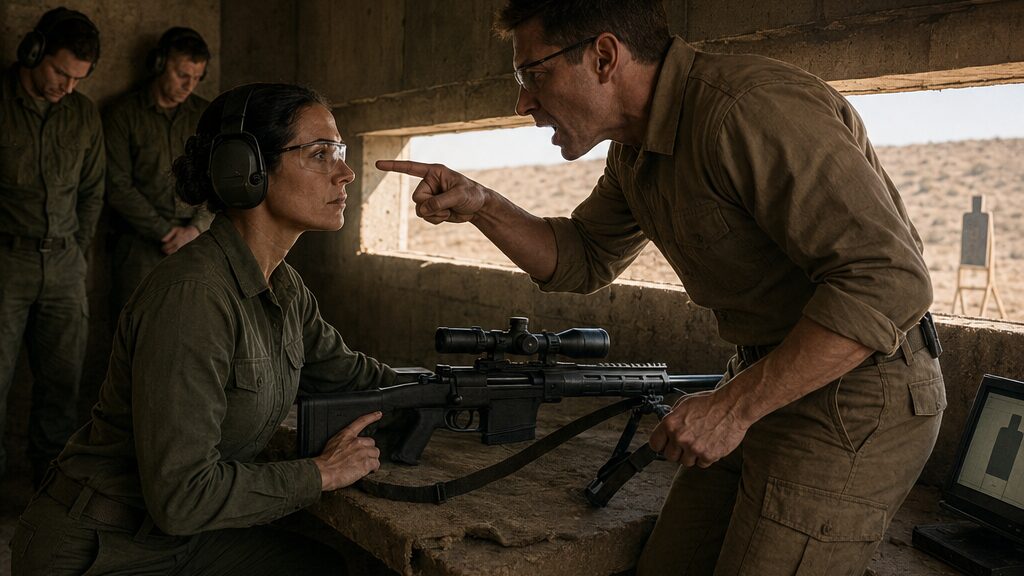
The boot struck Katherine Walker’s shooting mat while her right eye was still aligned behind the SR-25’s optic.
The jolt shifted the rifle half an inch across the packed floor of the sniper hide. Katherine lifted her cheek from the stock before the movement could carry her finger anywhere near the trigger. Her finger had been straight along the receiver already, but she made the safety visible.
Only then did she look up.
Lieutenant Daniel Roberts stood over her with one polished boot planted beside the mat’s curled edge. Sunlight from the narrow firing slit cut across his uniform and left his face in shadow.
“You planning to shoot today,” he asked, “or are you waiting for the enemy to die of old age?”
Behind him, three members of the range team stared at separate pieces of equipment. No one looked directly at Katherine.
She returned her attention to the scope.
The steel silhouette downrange stood against a pale rise of sand. Heat had begun to lift from the desert floor, bending the target’s edges. A red center-mass circle showed clearly enough at two hundred yards, but a torn range flag beyond it snapped in uneven bursts. The wind was crossing left to right, dropping, then returning harder.
“Wind isn’t stable,” she said.
Daniel gave a short laugh.
“It’s a qualification lane, Walker. Not a weather seminar.”
Katherine checked the chamber indicator, the selector, the magazine seating, and the lane marker. She had performed the same sequence twice already, slowly enough to appear cautious but not so slowly that an experienced observer would call it uncertainty.
Daniel was not an experienced observer.
He had spent the morning correcting details that did not require correction. He adjusted elbows that were already planted properly. He interrupted shooters midway through safety confirmations. Twice, he had called the line clear before the target-control technician completed his response.
Katherine had noted each event without reacting.
The range log inside her breast pocket recorded times, commands, witnesses, and deviations in compressed handwriting. It contained no judgment. Judgment came later, when patterns could no longer be dismissed as personality conflict.
Daniel crouched beside her.
“Your breathing is too shallow.”
“It’s controlled.”
“Your shoulder is loose.”
“It isn’t.”
His jaw tightened at the second contradiction.
The junior technician, Jacob Moore, stood near the warning panel mounted beside the rear entrance. A yellow light flashed twice. He looked downrange, then wrote something on the maintenance board.
Daniel glanced toward him.
Jacob erased the line immediately.
Katherine watched him rewrite it in smaller letters.
“What was the warning?” she asked.
Jacob’s marker stopped.
“Nothing.”
“Then why did the system flag?”
Daniel rose. “You ask a lot of questions for someone who hasn’t fired a round.”
Katherine kept her eyes on Jacob. Sweat had darkened the fabric beneath his headset. He wrote operational beside the target-control system and capped the marker without meeting her gaze.
Daniel stepped into her line of sight.
“This is the problem with soldiers who think procedure will save them. In combat, nobody gives you perfect wind, perfect light, and a written invitation.”
“I requested confirmation, not perfection.”
“And I confirmed it.”
“You interrupted target control.”
The hide went still.
Daniel looked back at the range team, measuring who had heard. Everyone had.
He bent until his face was level with hers.
“I am the range safety officer. When I say the lane is clear, the lane is clear.”
Katherine’s pulse remained steady, but something cold moved beneath her ribs. She knew that sentence. Not the exact voice, not the exact hide, but the logic was identical.
When I say it’s clear, it’s clear.
A different officer had once spoken those words over a radio thick with static while dust swallowed the ridge below. Katherine had given the wind shift, the visibility loss, the incomplete movement count. The answer had come back hard and impatient.
Engage.
She brought herself back to the narrow room, to the smell of warm oil and canvas, to Daniel’s boot beside her mat.
“Confirm target trench,” she said.
Daniel’s expression sharpened.
“Target trench clear,” Jacob answered too quickly.
Katherine turned to him. “Who confirmed it?”
Jacob swallowed. “Control did.”
“Name the call sign.”
Daniel slapped the side of the wooden shooting bench. The report cracked through the hide.
“You don’t have the killer instinct to pull that trigger.”
For the first time that morning, Katherine’s breathing changed.
Not enough for anyone else to see. Just one breath held a fraction too long before she let it out.
The phrase did not belong to Daniel. It belonged to men who confused urgency with courage and fear with disobedience. It belonged to a voice that had ordered her team forward into shifting sand and collapsing visibility. It belonged to the silence after the radio stopped answering.
Daniel mistook her pause for injury.
He raised his voice.
“You hear me? You can memorize every manual ever printed, but when pressure hits, you freeze. People like you get better soldiers killed.”
Katherine lowered her eyes to the rifle.
She could have ended his performance in several ways. A precise explanation of his procedural failures. A demonstration of how quickly she could clear, shoulder, and fire. A badge placed on the bench between them.
All three would be premature.
She removed the magazine, locked the bolt to the rear, inspected the chamber, and set the weapon down with its action open.
“I will fire when the lane is independently confirmed.”
Daniel stared at the cleared rifle as though it had insulted him.
Then he smiled.
It was not amusement. It was relief. Her refusal had given him a visible enemy.
“Fine,” he said. “We’ll make this official.”
He turned toward the range team.
“Bring the recording unit up here. I want her qualification witnessed. Every command, every hesitation, every excuse.”
Jacob looked at Katherine for the first time. The fear in his face was not for her.
Daniel pointed through the firing slit.
“Move the steel to three hundred.”
One of the soldiers near the rear wall hesitated. “Sir, the automatic warning gave a fault.”
Daniel did not look at him.
“Moore.”
Jacob straightened.
“Reset the panel.”
“The fault may need—”
“Disable the automatic cease-fire warning and put the target at three hundred yards.”
Jacob’s face emptied.
Katherine looked from him to the yellow light, which had begun flashing again.
Daniel leaned closer to her and spoke quietly enough that the others had to strain to hear.
“Now we find out whether you belong on a combat range.”
Chapter 2: The Warning Buried Beneath Clean Paperwork
The screw head on the warning relay had been stripped less than an hour earlier.
Katherine found the bright crescent of exposed metal beneath the panel cover, too fresh to have gathered the fine desert grit coating everything else in the target-control shelter. Someone had forced the cover open with the wrong tool, removed the relay from the automatic circuit, then tightened it in place for appearance.
She touched nothing.
Jacob stood at the shelter’s doorway, holding a clipboard across his chest.
“You’re not authorized in here.”
“Neither is whoever bypassed that relay.”
“It wasn’t bypassed.”
“The contact bridge is open.”
He glanced over his shoulder toward the access trench.
“Lieutenant Roberts said the system was producing false warnings.”
“He also said it had never malfunctioned.”
Jacob’s grip tightened around the clipboard. “Then maybe you should ask him.”
“I’m asking the technician whose initials are on the board.”
A whistle sounded from the firing line above them. Daniel was accelerating the next rotation, pushing two shooters through a drill that normally required separate lane confirmations. His voice carried over the sand berm in clipped bursts.
Jacob stepped inside and lowered his voice.
“You need to leave.”
“Did you open the relay?”
“No.”
“Did you record the fault?”
“The system is operational.”
“That wasn’t my question.”
His eyes flicked toward the camera dome in the corner. Katherine had already noticed its dark lens and the cut power cable hanging behind it.
She closed the panel without fastening it.
“Where are the maintenance records?”
“Operations.”
“The originals.”
“That is the original record.”
“No. It’s the clean copy.”
Jacob’s face changed. Not much, but enough.
Daniel’s whistle sounded again.
Jacob moved aside. “You should get back to the hide.”
Katherine walked past him without answering. Silence could invite disclosure when pressure had room to work. But Jacob’s silence was not opening. It was hardening around fear.
The medical station occupied a reinforced container near the base of the range. Pamela Lee was replacing supplies when Katherine entered. She looked up once, took in the dust on Katherine’s knees and the rifle case in her hand, then closed the cabinet.
“No visible injury,” Pamela said.
“I need the record from the shoulder case.”
Pamela’s expression remained neutral. “Which shoulder case?”
“The shooter Daniel classified as personal error.”
The medic’s eyes moved to the open doorway.
Outside, the range fell abruptly quiet.
Daniel had entered the lower compound.
The change was immediate enough to be measured. Conversation stopped. A tool was set down rather than dropped. One soldier who had been laughing near the water point lowered his cup without finishing.
Pamela pulled the door shut.
“He came in with swelling across the joint and numbness in two fingers,” she said. “Said the lieutenant kept resetting his position because he was ‘milking the pain.’”
“Was he removed from the line?”
“After the seventh repetition.”
“By Daniel?”
“By me.”
Pamela opened a locked drawer and removed a thin medical folder. She did not hand it over. Instead, she turned one page so Katherine could read the notation.
Repeated unsupported firing continued after reported pain. Supervising officer advised subject to complete drill.
Below it, another form summarized the same event as improper weapon seating caused by shooter anxiety.
The first bore Pamela’s signature.
The second bore Daniel’s.
“The dates match the warning faults,” Katherine said.
Pamela studied her more carefully. “You already knew about those?”
“I knew there were inconsistencies.”
“Who are you?”
Katherine looked at the closed door. “Someone documenting them.”
“That isn’t an answer.”
“It’s the answer I can give.”
Pamela shut the folder. “Then here’s what I can give you. That soldier is still carrying the blame. Daniel told him a complaint would look like weakness on his deployment record.”
“And you filed no command report.”
The accusation landed harder than Katherine intended.
Pamela’s mouth tightened. “I recorded the injury accurately.”
“You stopped at the part that protected your own signature.”
“And you’re standing here in a borrowed role watching him do it again.”
For several seconds neither woman spoke.
Daniel’s boots passed outside the container. The handle shifted once, then stopped. His shadow moved across the frosted window and disappeared.
Pamela released the breath she had held.
Katherine understood the rebuke because it was true enough to hurt. Evidence required time. Time exposed people.
Her pocket receiver vibrated once.
A coded logistics message appeared on the small screen.
CONTINUE OBSERVATION. DIRECT COMMAND OVERRIDE REQUIRED. PRESERVE COVER.
Samuel King’s instruction contained no greeting and no qualification. He needed proof Daniel could not explain as stress, misunderstanding, or personality conflict. The larger review involved more than one range and more than one officer. Removing Daniel too early might warn the others.
Katherine read the message twice.
Pamela watched her. “Your command?”
“Yes.”
“They telling you to wait?”
Katherine put the receiver away.
“They’re telling me what will hold.”
“That isn’t the same as what’s right.”
“No,” Katherine said. “It isn’t.”
When she returned to the hide, the firing line had been reset. Daniel was lecturing the team about speed while Jacob stood beside the rifle rack, pale and rigid.
Katherine placed her case beneath the bench.
Something inside shifted.
She opened it just enough to see a narrow paper strip beneath the foam lining. Printed across the top was the target-system diagnostic code. The status line read: UNSAFE PENDING INSPECTION.
A boot scraped behind her.
Daniel entered the hide.
“What have you got there?”
Katherine lowered the lid.
“Cleaning cloth.”
Daniel looked toward Jacob.
The technician’s face had gone white.
“Moore,” Daniel said, “did you put anything in her case?”
Jacob stared at the floor.
“No, sir.”
The lie came out cleanly.
Daniel held his gaze for another moment, then turned back to Katherine.
“Good. Because somebody misplaced an original diagnostic report.”
Katherine closed both latches on the case.
Daniel smiled without warmth.
“And until I find it, nobody leaves this range.”
Chapter 3: The Soldier Who Changed One Line
Daniel locked the range before the dust storm reached the outer berm.
The order went out over the internal radio: all personnel would remain at their assigned stations while equipment records were checked. No one was to carry bags, cases, or loose paperwork between buildings. At the sniper hide, Daniel personally inspected the rifle benches, the waste bin, and the storage shelf.
He did not ask to search Katherine’s case.
Not yet.
The wind struck the armored firing slit in heavy bursts, rattling the metal frame. Sand hissed through the narrow gaps and gathered in pale lines across the floor.
Katherine waited until Daniel descended toward operations, then took the protected corridor beneath the hide to the ammunition shed.
Jacob was inside counting sealed magazines he had already counted twice.
She shut the door behind her.
“You changed the maintenance status.”
He kept his eyes on the ammunition ledger. “I don’t know what you’re talking about.”
“The diagnostic in my case says unsafe pending inspection. The board says operational.”
“I didn’t put anything in your case.”
“You risked enough to preserve the strip. Don’t waste that risk by lying now.”
His pencil stopped.
Katherine stepped closer. “Did Daniel order the alteration?”
Jacob slammed the ledger shut.
“What happens if I say yes?”
“That depends on what happened.”
“No. It depends on who you are.”
She said nothing.
He laughed once, bitterly. “That’s what I thought.”
“Answer the question.”
“You stand there like none of this touches you. You let him kick your mat. You let him scream at people. You watch every time he cuts off a safety call, and you say just enough to make him angry, then you go quiet again.”
“I’m collecting evidence.”
“For who?”
“I can’t tell you.”
“So you’re not better than him. You just threaten people more quietly.”
The words struck with unexpected force.
Katherine had approached him as a compromised technician, a link in an evidentiary chain. She had not considered how she appeared from his side of the room: another person with hidden authority demanding that he step into danger first.
She lowered her voice.
“What did he threaten you with?”
Jacob looked away.
“Three weeks ago, the target carrier faulted during a qualification cycle. The relay was giving intermittent trench warnings. I wrote unsafe pending inspection and shut the lane down.”
“What did Daniel do?”
“He said the base had missed two readiness targets already. Said another delay would make the unit look incapable of sustaining deployment training.”
“That explains his pressure. Not your altered line.”
Jacob’s jaw worked.
“He told me the relay was overly sensitive. He said if I left the status in place, he’d report that I had failed to maintain mission-essential equipment. He said the delay would belong to me.”
“And you changed it.”
“One line.”
“One line reopened a live-fire lane.”
“I know what it did.”
His voice broke on the last word, and anger immediately covered it.
“You think I don’t know? I’m the one who hears that warning in my sleep.”
Katherine looked at the sealed magazines stacked between them. Each one bore a count, date, and signature. Clean numbers. Clean boxes. The appearance of control.
“Why keep the strip?”
Jacob rubbed a thumb across the pencil’s edge. “Because I knew he was wrong.”
“But you obeyed.”
“Yes.”
The answer held no defense.
Katherine recognized more in it than she wanted to.
“Listen to me,” she said. “I will not ask you to take a risk I refuse to take myself.”
He looked at her then.
“What does that mean?”
“It means when this becomes public, I will be standing where you can see me.”
Before he could answer, the shed door opened.
Daniel filled the doorway with two range soldiers behind him.
“There you are.”
His gaze moved from Katherine to Jacob, then to the closed ledger.
“I ordered personnel to remain at assigned stations.”
“The hide’s warning panel is compromised,” Katherine said. “I was confirming its maintenance history.”
“You are not an investigator.”
“No, sir.”
The answer was technically false and operationally necessary.
Daniel studied her face.
“Routine drills are canceled,” he said. “We’re doing one final stress qualification before sunset.”
The storm pressed sand against the shed walls.
“Wind is outside the normal limit,” Katherine said.
“That’s why it’s called stress qualification.”
“Who authorized the change?”
“I did.”
He stepped inside.
“You’ve spent all day hiding behind checks, warnings, and other people’s decisions. Now there will be no crowd to distract you and no rotation schedule to slow us down.”
Katherine looked at the soldiers behind him. Both avoided her eyes.
“Who will witness?”
“Moore. Two lane personnel. Me.”
“Medic?”
“Not required.”
“Target control?”
“Moore can handle it.”
Jacob’s shoulders stiffened.
Daniel noticed and smiled.
“You wanted operational experience, Moore. Now you’ll get it.”
He turned back to Katherine.
“Sunset. Three hundred yards. You either complete the course or I document refusal of a lawful order.”
The significance was clear. He was narrowing the witness pool to people he controlled and creating paperwork before she could create proof.
Katherine nodded once.
Daniel had expected resistance. Her acceptance unsettled him.
“That’s it?”
“That’s the order you gave.”
He searched for mockery and found none.
“Be in the hide in forty minutes.”
When he left, Jacob whispered, “He’s going to search the case.”
“Then the strip can’t remain there.”
“I can hide it.”
“He’ll expect that.”
Katherine removed the diagnostic strip and slid it inside the rigid backing of the ammunition ledger. She handed the ledger to Jacob.
“Return it through normal inventory.”
His eyes widened. “If they find it on me—”
“They won’t, unless someone tells them where to look.”
“You said you wouldn’t ask me to take a risk you wouldn’t take.”
“I’m not.”
She removed the compact receiver from her pocket and placed it in the same backing beside the strip.
“That device identifies my assignment. If the ledger is found, my cover ends with yours.”
Jacob stared at her.
For the first time, the silence between them did not belong to Daniel.
A hard knock sounded from the corridor. Pamela entered without waiting.
Dust coated her sleeves, and she carried a transfer folder sealed in clear plastic.
“They’re moving the injured shooter at first light,” she said.
Jacob frowned. “Why?”
Pamela placed the folder on the ammunition crate and opened it to the final page.
The transfer order included a disciplinary notation for failure to follow weapons instruction and negligent self-injury. Once entered into the deployment record, it would follow the soldier beyond the FOB.
“Daniel signed it this morning,” Pamela said. “Medical review closes at midnight.”
Katherine read the page.
The stress qualification would begin before sunset. The false record would become permanent before dawn. Samuel still required a direct override, and Daniel was now arranging the exact confrontation that could provide one.
But waiting for proof no longer endangered only the people still on the line. It would condemn someone already injured for obeying too long.
Katherine closed the folder.
“Get me the original medical notation,” she said.
Pamela searched her face. “Are you ending your cover?”
“Not yet.”
“Then what are you doing?”
Above them, Daniel’s voice came over the range speaker.
“Walker to the hide. Final qualification begins in thirty minutes.”
Katherine looked at Jacob, then at the ledger containing both the diagnostic strip and the receiver that could expose her.
“I’m making sure he gives the order where no one can erase it.”
Chapter 4: The Order That Sounded Like the Past
The shape behind the steel target moved just as Daniel Roberts declared the range clear.
Katherine caught it through the SR-25’s optic: a shoulder, a helmet, then the upper edge of a tool case disappearing into the target trench. The movement lasted less than a second. Heat shimmer blurred the sand behind it, but not enough to mistake a person for debris.
She lifted her cheek from the stock.
“Movement behind target three.”
Daniel stood beside the firing bench with the recording unit angled toward her. “Target three is clear.”
“I saw personnel in the trench.”
“Moore confirmed the lane.”
Jacob’s voice came through the hide speaker, thin beneath the crosswind. “Target system shows—”
Daniel pressed the transmit switch before Jacob finished.
“Lane clear. Proceed.”
Katherine kept her trigger finger straight along the receiver. The sun was dropping behind the hide, throwing its shadow farther across the range, but the wind had strengthened instead of settling. It struck the firing slit from the left, reversed in the shallow basin below, then lifted sand around the steel silhouette in short spirals.
The automatic warning panel remained dark.
Pamela stood near the lower access point, one hand resting against the medical bag at her hip. She had reached the range before Daniel closed the lane, but he had refused to let her enter the hide.
Two soldiers waited along the rear wall. Neither spoke.
Daniel leaned toward Katherine.
“You asked for three hundred yards. You have it.”
“I did not ask for this drill.”
“You accepted the order.”
“I accepted attendance.”
His mouth tightened. “This is why units fail under pressure. Every simple command becomes a negotiation.”
Katherine looked through the optic again.
No movement now.
That did not make the lane clear. It meant the person behind the target had stopped where she could no longer see them.
“Confirm the trench by voice,” she said.
Daniel folded his arms. “I already confirmed it.”
“You announced it. You did not confirm it.”
The soldiers at the wall shifted without looking at each other.
Daniel saw the movement and raised his voice.
“This is a live-fire qualification, not a committee meeting. The shooter receives a lawful command, verifies her weapon, and engages.”
“The range safety officer verifies the range.”
“And I have.”
“Then provide the trench response.”
For a moment, only the wind answered.
It rattled the armored slit with a metallic tapping that struck Katherine’s memory in the rhythm of distant rotor blades.
The hide around her narrowed.
Not this hide.
Another ridge. Another wall of dust. A radio pressed hard against her ear while visibility collapsed across an approach route. She had reported the shifting wind, then the lost movement count. A voice above hers had come back impatient and absolute.
I said the corridor is clear.
Her team leader had looked at her for confirmation. Katherine had looked at the rank patch beside the radio and nodded.
They had moved.
The first blast had lifted the lead vehicle sideways. The second had buried the rear route in smoke and debris. By the time Katherine found a path through the broken wall, every voice behind her had gone silent.
She had walked out alone because she had obeyed after knowing better.
“Walker.”
Daniel’s voice pulled the room back into place.
He was watching her closely now. He had seen the pause.
“There it is,” he said. “That hesitation.”
Katherine inhaled once through her nose and let the breath leave slowly.
“Range is not clear.”
Daniel stepped closer to the bench. “You don’t get to decide that.”
“The shooter can refuse an unsafe command.”
“The shooter can refuse if a hazard exists. You have imagined one because pressure makes you uncertain.”
“I saw movement.”
“You saw heat distortion.”
“I know the difference.”
“You think combat waits for your confidence?”
“No. That is why procedure exists before confidence matters.”
The reply drew a flicker of uncertainty across his face. It vanished when he remembered the recording unit.
He turned toward the soldiers at the wall.
“This is what fear looks like when it learns vocabulary.”
Neither soldier smiled.
Daniel faced Katherine again. “Shoulder the rifle.”
She did not move.
“That is a direct order.”
“Confirm the trench.”
“Shoulder the rifle.”
The air inside the hide seemed to compress around the command.
Katherine looked toward the speaker. “Jacob, status of target trench?”
Static answered.
Then Jacob’s breathing.
Before he could speak, Daniel crossed the room and reached for the SR-25.
Katherine caught the rifle at the handguard and rotated it away from him, keeping the muzzle through the firing slit and the bolt locked open.
“Do not touch the weapon.”
His hand froze above the receiver.
“You are refusing to engage,” he said.
“I am preventing an unconfirmed shooter from taking control of a weapon on an uncleared range.”
Color rose along his neck.
“I am the range safety officer.”
“Then act like one.”
The words left more sharply than she intended.
Daniel’s eyes changed. The uncertainty disappeared, replaced by a decision.
He moved to the control box mounted near the bench.
Katherine knew what he meant to do before his fingers reached it.
“Do not activate the line.”
He flipped the protective cover upward.
“Lieutenant.”
He pressed the firing signal.
A red lamp illuminated above the slit. Outside, the range horn gave one hard tone.
Pamela looked up from the access point.
The soldiers at the wall straightened automatically.
Daniel pointed toward the target. “The range is hot.”
Katherine rose from the mat.
“Cease fire. Cease fire. Cease fire.”
She projected the command through the hide, using the exact cadence drilled into every person who had ever worked a live-fire lane.
No one repeated it.
The silence that followed was worse than Daniel’s shouting.
One soldier looked at the floor. The other looked toward Daniel for permission.
Pamela’s hand tightened around the strap of her medical bag.
Katherine saw the system clearly then. Daniel’s control did not depend on people believing he was always right. It depended on them believing that only he was allowed to name danger.
Her refusal, technically perfect and emotionally sealed, had not taught them how to resist. It had only shown them that she could.
Daniel heard their silence as victory.
“You see?” he said. “No one else sees your hazard.”
“No one else wants your attention.”
“You are finished on this range.”
“Then end the drill.”
“You will fire first.”
He reached for the rifle again, faster this time.
Katherine stepped between him and the bench.
“If you touch that weapon before clearance, I will remove you from the firing position.”
His face went still.
“Is that a threat?”
“It is a safety action.”
“You don’t have that authority.”
She almost answered.
The badge was not in her pocket. It remained concealed in the rigid document sleeve inside her vest, one movement away. Samuel’s instruction echoed with bureaucratic precision: direct command override required. Preserve cover.
She already had the override. The activated signal. The interrupted confirmation. The reach for the weapon.
But the recording unit faced only the mat. Daniel had positioned it to capture her hesitation, not the warning panel or the trench response. He could claim she had staged the confrontation after the fact.
The larger case still needed witnesses willing to speak.
Daniel looked past her toward the western horizon.
The sun’s lower edge touched the desert ridge. In minutes, shadow would climb the target face and change the sight picture.
He opened the range microphone.
“Final command,” he said, making sure every station could hear. “Shooter will engage target three before the sun drops below the line.”
Katherine looked through the slit.
At the far end of the range, the shape behind the target appeared again.
This time, a hand rose above the trench wall.
Someone was still downrange.
Daniel pointed at the rifle.
“Fire.”
Chapter 5: One Metallic Clack Ended His Performance
Daniel’s hand closed around the SR-25’s pistol grip.
Katherine trapped the bolt open with one hand, caught his wrist with the other, and turned him away from the firing slit before he could pull the rifle from the rest.
“Off the weapon.”
The movement was fast enough to leave him bent against the bench, but controlled enough that his shoulder never struck the wood. Katherine released him the instant his hand opened.
The rifle remained pointed downrange, action open, magazine seated but no round chambered.
Daniel straightened slowly.
Every face in the hide had turned toward them.
“You assaulted an officer,” he said.
“I stopped an unsafe weapons transfer.”
“You put your hands on me.”
“You reached for a loaded system on a range with personnel downrange.”
“There is nobody downrange.”
A voice broke over the speaker.
“Hold.”
Jacob.
The single word came faintly, almost swallowed by static.
Daniel stepped toward the transmit switch.
Katherine moved first and pressed the public address control.
“Cease fire. Cease fire. Cease fire. Personnel observed in target trench.”
Daniel reached for the switch, but one of the soldiers at the rear wall spoke.
“Cease fire.”
The second soldier stared at him, startled.
Then he repeated it louder.
“Cease fire.”
Outside, Pamela turned toward the access lane and raised one arm.
“Cease fire!”
The words traveled down the range. A lane worker near the berm repeated them. Then another voice answered from target control.
For the first time all day, the command moved without passing through Daniel.
His authority did not vanish dramatically. It thinned, one repeated phrase at a time.
Katherine removed the magazine, verified the chamber, and stepped back from the rifle.
“Jacob, establish manual clearance.”
There was a pause.
Daniel leaned toward the speaker. “Moore, disregard that. I am the range officer.”
Jacob’s reply came stronger.
“Negative. Cease fire is active.”
Daniel stared at the speaker.
Katherine saw the fear in Jacob’s voice, but she also heard the decision beneath it.
“Begin from the trench,” she said.
A runner was sent through the protected access route. Pamela moved to the lower checkpoint. One soldier remained inside the hide to watch the rifle while the other verified the intermediate berm.
Daniel paced near the rear wall.
“This is theater,” he said. “You’ve turned a routine qualification into a panic because you saw a shadow.”
Katherine did not answer.
She watched the process he should have initiated.
The manual clearance took eleven minutes.
At minute four, the runner reached the target trench and found a maintenance worker crouched behind the steel carrier with a jammed tool case. The worker had entered under an earlier cold-range status and never received the warning that Daniel had reheated the line.
At minute seven, Pamela confirmed the worker was uninjured.
At minute nine, Jacob verified all target personnel had withdrawn through the access gate.
At minute eleven, each station answered in sequence.
Daniel stood silent as the confirmations reached the hide.
Katherine turned toward him. “That was the movement.”
His expression hardened. “And now the range is clear.”
No apology. No recognition of what the shot would have done.
Only a rapid calculation of how to reclaim the room.
He pointed to the rifle.
“You wanted independent confirmation. You have it. Complete the drill.”
Katherine studied him.
The sun had dropped lower, but enough light remained. The crosswind was still strong, though its pattern had become readable: a hard push across the hide, a shallow reversal in the basin, then a weaker drift at the target face.
The warning relay remained disabled. The manual chain, however, was intact.
She could refuse again. The record already contained enough to end the range session.
But refusal alone would allow Daniel to reshape what had happened. He would say the worker’s presence resulted from a communication error. He would say his order had never been executed. He would present Katherine as technically obstructive, frightened, and unable to perform after the hazard was removed.
More importantly, the soldiers watching him needed to see the difference between recklessness and control.
Daniel spread his hands.
“What now, Walker? The target is clear. The wind is measurable. Or was safety never the real problem?”
Katherine lifted the magazine and inspected it.
He mistook the movement for surrender.
“That’s what I thought.”
She seated the magazine, kept the muzzle through the slit, and settled behind the rifle.
Her body became still in stages.
Boots anchored.
Hips aligned.
Shoulder set behind the stock.
Cheek resting against the comb.
The optic framed the steel silhouette at three hundred yards. The red center-mass circle sat inside the wavering air.
Daniel moved closer.
“Let’s see the killer instinct.”
Katherine ignored him.
She read the torn flag beyond the target, the dust curling at the berm, the lighter drift near the steel. She adjusted the optic, then returned one click.
Her breathing slowed.
The hide quieted with her.
Even Daniel stopped speaking, though only because he expected failure.
Katherine pulled the charging handle and released it.
The metallic clack struck the room like a door slamming shut.
She confirmed the sight picture.
Exhaled.
Pressed.
The first shot cracked through the slit. The rifle settled back into her shoulder. She corrected before the steel’s impact reached them and fired again.
Then again.
A rapid controlled volley, each recoil absorbed and returned through the same mechanical path.
The steel target rang once, then seemed to hold a single sustained note beneath the rifle fire.
Katherine stopped.
Three seconds had passed.
She engaged the safety, removed the magazine, locked the bolt open, and visually checked the chamber.
No one in the hide moved.
The silence after the shots did not belong to fear. It belonged to recalculation.
Jacob’s voice came through the speaker.
“Target inspection requested.”
Daniel found his voice first.
“Three hundred yards in that wind. She spread them.”
Katherine rose from the mat.
They waited while the target camera was manually restored. The monitor flickered, rolled, then steadied on the steel silhouette.
The red center-mass circle was gone.
In its place was one jagged opening, scarcely wider than a thumb, every round driven through nearly the same point.
One of the soldiers near the wall whispered, “That isn’t possible.”
Katherine heard him.
Daniel did too.
His face had lost color, but he stepped closer to the monitor as though proximity might reveal a trick.
“Pre-damaged target.”
Jacob answered through the speaker. “Target face was replaced this morning.”
“Then the camera froze.”
“The impact sensors recorded every round.”
“Sensor fault.”
Katherine collected the brass nearest the mat and placed it in a neat line on the bench.
Daniel turned on her.
“Where did you learn to shoot like that?”
There was no admiration in the question. Only accusation and a deeper fear that everyone else could hear.
Katherine finished clearing the rifle and handed it to the soldier assigned as weapons custodian.
Then she removed the rigid sleeve from inside her vest.
The federal audit badge rested behind a transparent panel, beside credentials marked for Pentagon command-climate and range-safety oversight.
She placed it on the bench next to Daniel’s hand.
His eyes dropped to it.
Katherine spoke quietly.
“You were never evaluating me.”
The soldiers at the wall looked from the badge to Daniel.
“You were being observed.”
His mouth opened, but nothing came out.
Katherine tapped the recording unit, then the dark warning panel.
“Your interruption of target confirmation, order to bypass the cease-fire relay, decision to heat an occupied range, and attempt to take control of the rifle have been documented.”
Daniel stared at the badge as if it were a weapon he had failed to notice.
Then his expression shifted.
Not surrender.
Calculation.
He straightened his uniform and looked toward the range team.
“Documented by whom? An undercover observer who manufactured a confrontation and then fired outside her assigned authority?”
The room changed again.
He pointed at Katherine.
“You exceeded your instructions. You provoked personnel, interrupted operations, and staged a demonstration to support a conclusion you had already reached.”
The argument was fast, coherent, and dangerous because parts of it were true.
Katherine had chosen to fire.
She had not been authorized to perform a live-fire demonstration.
Daniel saw that she knew it.
His color began to return.
“Call Commander King,” he said. “Let’s see what that badge proves when the paperwork arrives.”
Chapter 6: The Badge Proved Less Than Expected
Daniel laid the signed range certification on the operations table before Samuel King had removed his gloves.
“Fully operational,” Daniel said. “Inspected, cleared, and signed by the assigned technician. Walker was the only person who refused lawful commands.”
The emergency review room was too small for everyone Daniel had summoned into it. Katherine stood opposite him. Pamela and Jacob remained near the door, with two range soldiers against the rear wall. The SR-25 had been secured elsewhere. The federal badge sat on the table between the clean certification and Pamela’s medical folder.
Samuel read the first page without expression.
He was a broad-shouldered man in his fifties whose restraint made other people lower their voices. Dust clung to the hems of his trousers from the walk across the compound.
Daniel did not lower his.
“She disclosed an investigative identity during a qualification she deliberately disrupted. She physically restrained me, assumed control of range personnel, and fired a demonstration not included in any audit authority I’ve seen.”
Samuel turned to Katherine. “Is that accurate?”
“I restrained his hand after he reached for the rifle on an uncleared range.”
“Did you fire?”
“Yes.”
“Was live fire part of your authorization?”
“No.”
Daniel spread one hand toward the others.
“There it is.”
Samuel continued reading.
The pages presented a range without conflict. Daily checks complete. Warning relay operational. Target trench clear. Instructor conduct within standards. At the bottom of the final page, Jacob’s initials appeared beside the maintenance status.
Samuel looked toward him.
“Are these yours?”
Jacob stared at the paper.
“Yes, sir.”
“Was the system operational?”
A long pause followed.
Daniel did not look at Jacob. He did not need to. His signed version of events lay on the table like a barrier.
Jacob swallowed. “The board reflected operational status.”
“That is not what he asked,” Katherine said.
Samuel raised a hand without looking at her.
“Let him answer.”
Jacob’s eyes moved to Daniel, then back to the floor.
“Yes, sir. It was recorded as operational.”
Daniel exhaled through his nose.
Pamela stepped forward and placed her medical record beside the certification.
“A previous shooter was injured after reporting pain during a repeated firing drill.”
Samuel opened the folder.
“The injury is documented,” he said. “The command connection is not.”
“My notation states the supervising officer ordered the drill continued.”
Daniel leaned over the table. “It states what the patient reported. The official review found improper weapon seating.”
“Because you wrote the review,” Pamela said.
“And because that was the cause.”
The exchange sharpened, but Samuel’s attention returned to Katherine.
“Outside.”
She followed him into the narrow corridor connecting operations to the lower range shelter. The walls vibrated faintly under the wind. Through a small reinforced window, the last light had faded from the target lane.
Samuel closed the door.
“You were told to preserve cover until direct override was established.”
“It was established.”
“You were not told to fire.”
“The range had been manually cleared.”
“That answers whether the shot was safe. It does not answer whether it was necessary.”
Katherine held his gaze.
He waited.
Her usual instinct was to reduce everything to sequence and procedure: Daniel reached for the rifle. Cease-fire initiated. Trench worker recovered. Manual all-clear completed. Shot conducted under controlled conditions.
The facts were sound.
They were also incomplete.
“You believe the volley strengthened the case,” Samuel said.
“It demonstrated that his assessment of me was false.”
“Your competence was never under review.”
“It was to the people inside that hide.”
“And that mattered to you.”
The question was quiet enough that she could not treat it as accusation.
Katherine looked through the window at the dark line of the berm.
“Yes.”
Samuel’s expression did not change.
“Why?”
She could have said morale. Witness confidence. Command credibility. Each answer contained truth.
None contained enough.
“He used language from a prior operation,” she said.
“What language?”
“Killer instinct. Immediate obedience under pressure. He dismissed an environmental warning and framed hesitation as cowardice.”
Samuel knew the outline of her history. He did not know the part she had never put into the formal account.
“Did the past affect your judgment?”
“Yes.”
The word cost more than the volley had.
Samuel folded his arms.
“Explain.”
Katherine kept her voice level. “Years ago, I reported deteriorating visibility and an incomplete movement count. The officer in control ordered engagement and advance. I knew the conditions were wrong. I obeyed anyway.”
Samuel said nothing.
“My team did not come back.”
“And you did.”
“Yes.”
“Did you fire today because Daniel reminded you of him?”
“No.” She stopped. “Not only because of that.”
The correction hung between them.
Samuel nodded once. “Then your report will include it.”
Katherine’s jaw tightened.
“It is not relevant to his relay order.”
“It is relevant to your decision to turn an audit into a demonstration.”
He opened the door.
Inside the review room, Daniel stood beside the table with renewed confidence. Jacob had moved farther into the corner.
Samuel resumed his place.
“Medic Lee’s record proves an injury occurred,” he said. “It does not prove Lieutenant Roberts knowingly caused it. The target worker proves the range was heated prematurely. That establishes serious failure, but responsibility still depends on the command sequence.”
Daniel nodded quickly. “Exactly.”
Samuel turned to Jacob.
“Did Lieutenant Roberts order you to alter the maintenance status?”
Jacob’s face tightened.
“No, sir.”
Pamela looked at him.
Katherine felt the room close around the lie.
Daniel did not smile. He lowered his eyes, performing relief rather than victory.
Samuel asked, “Were you threatened with disciplinary action if the range remained closed?”
“No, sir.”
Katherine could see Jacob’s hands trembling against his trousers.
Evidence had brought him to the room. It could not make him speak.
Daniel gathered the certification pages into alignment.
“I regret that today became disorderly. But combat training cannot function if every subordinate can halt operations based on subjective discomfort.”
Katherine looked at Jacob.
“You preserved the original strip.”
His head lifted sharply.
Daniel turned.
Samuel’s eyes narrowed. “What strip?”
Jacob said nothing.
Katherine could reveal the ledger. She knew where the evidence had been placed. But doing so would expose Jacob’s action for him, repeating the same demand she had made in the ammunition shed: step into danger because someone with hidden power needed the record completed.
She left the decision with him.
The silence stretched.
Daniel mistook it for collapse.
“There is no strip,” he said. “There is only an investigator trying to pressure a junior technician into supporting her narrative.”
Katherine faced Jacob.
“Years ago, I knew an order was wrong and obeyed because everyone around me stayed quiet. I told myself rank carried responsibility. It did not carry the consequences.”
Daniel scoffed. “This is irrelevant.”
Katherine continued without raising her voice.
“I walked out. The others didn’t. For a long time, I called my silence discipline because that was easier than calling it fear.”
Jacob’s breathing changed.
She did not tell him what to do.
“I will include what I did today in my report,” she said. “The safe choices and the wrong ones. No one here is required to protect me from them.”
Pamela moved away from the door, leaving the exit clear.
Jacob looked at Daniel.
“You said the delay would be mine.”
Daniel’s head snapped toward him.
Jacob’s voice shook, but it did not stop.
“You said if I left the system unsafe, you’d report that I failed to maintain mission-essential equipment. You told me to change one line.”
Daniel stepped forward. “Think carefully.”
“I have.”
Jacob crossed to the ammunition shelf built into the room’s side wall. From behind a row of inventory binders, he removed the ledger Katherine had given him.
He opened the rigid backing and withdrew the original diagnostic strip.
UNSAFE PENDING INSPECTION.
Samuel took it.
Daniel pointed at Jacob. “He falsified the board. That proves his misconduct, not mine.”
Jacob reached into the ledger again.
This time he removed the warning relay’s metal cover.
A grease-pencil authorization mark ran along the inside edge, beside Daniel’s initials and the date of the first bypass.
Jacob placed it on top of the clean certification.
“I need to amend my statement,” he said.
Chapter 7: What Discipline Meant After the Rifle Fell Silent
Samuel placed Daniel’s relief order on the same shooting mat Daniel had kicked the day before.
The paper lay flat beneath a brass weight, its lower edge aligned with the faded seam where Katherine’s elbow had rested. Beyond the firing slit, dawn exposed the range in hard, colorless detail: the repaired warning panel, the empty target trench, and the steel silhouette with one jagged opening through its center.
Daniel stood near the rear wall without his range headset.
Two armed guards waited at the entrance.
Samuel faced the assembled team. “Effective immediately, Lieutenant Roberts is relieved of all range authority pending formal investigation.”
Daniel looked at Katherine rather than Samuel.
“This is based on a frightened technician changing his story.”
“It is based on your authorization mark inside a bypassed safety relay,” Samuel said, “your signed certification of equipment you knew was restricted, corroborated medical records, witness statements, and your decision to activate a live-fire line before target personnel were clear.”
“The readiness schedule was collapsing.”
“That explains the pressure. It does not excuse your decision.”
Daniel’s jaw tightened. “Every commander on this base demands results, then acts shocked when someone removes an obstacle.”
Samuel let the accusation settle.
“You believed the warning system was an obstacle?”
“I believed it was oversensitive.”
“You ordered it bypassed because shutdowns were damaging your readiness figures.”
Daniel said nothing.
That silence answered more clearly than denial.
Samuel signed the acknowledgment line and turned the order toward him.
Daniel did not pick up the pen.
For the first time, Katherine saw something beneath his anger that was not performance. Fear—not of the guards, but of becoming exactly what he had spent months trying to conceal: an officer whose authority had exceeded his judgment.
He looked toward the soldiers.
“I was preparing you for combat.”
No one answered.
Katherine remembered how easily that silence had belonged to him the day before. Now it belonged to the people deciding whether his explanation deserved their agreement.
Samuel nodded to the guards.
Daniel signed.
As he was escorted from the hide, his shoulder brushed the firing slit’s metal frame. He stopped beside Katherine.
“You fired because you wanted them to see what you were.”
Katherine met his eyes.
“Yes.”
The admission appeared to surprise him.
“And that makes you different?”
“No. What I do next does.”
The guards led him down the access path toward the compound.
Samuel remained beside the mat until Daniel disappeared below the berm. Then he lifted the relief order and replaced it with Katherine’s preliminary report.
A blank section waited beneath the heading: Factors Affecting Investigator Judgment.
“You still have to complete this,” he said.
“I know.”
“Not only the procedural sequence.”
“I know.”
He looked through the slit at the damaged target.
“The audit office wants that steel plate preserved. It would make a strong presentation.”
“No.”
Samuel turned.
“The grouping establishes your competence and discredits his assessment.”
“My competence was never the safety failure.”
“It may help people understand the reversal.”
“It will teach them to trust the best shooter instead of the procedure.”
Samuel considered that.
Katherine continued. “Replace the plate. Keep the relay cover, the records, and the witness statements. Those prove what matters.”
“The target will be photographed.”
“That is sufficient.”
He nodded once. “Then it will not become a trophy.”
Below the hide, Pamela waited with the corrected medical file. The injured shooter’s disciplinary notation had been removed before the transfer convoy departed. His record now described a training injury under command review rather than negligent self-harm.
Jacob stood beside the repaired warning panel while a maintenance specialist tested the automatic circuit. Samuel had declined to refer Jacob immediately for punishment. The altered entry would remain part of the investigation, but so would the coercion behind it and his decision to preserve the original diagnostic.
Nothing had vanished cleanly.
That felt more honest than vindication.
Pamela’s medical warning procedure had also changed. Any injury linked to continued training after reported pain would now trigger an independent review outside the range chain. The new form was not dramatic. It was one page longer and required a second signature.
It might prevent someone from being told that pain was cowardice.
Katherine sat on the edge of the shooting mat with her report balanced on one knee.
She wrote the date of the operation first.
Her pen stopped.
For years, her official account had described visibility, command sequence, route failure, and casualty recovery. It had never described the moment before the order, when she knew the conditions were wrong and searched the faces around her for someone with higher rank to say so.
No one had.
Neither had she.
Katherine wrote:
I recognized the same escalation pattern during this audit before the final incident. I delayed direct disclosure because I believed evidence without personal context would be stronger. That judgment also protected me from acknowledging why the conduct was familiar. My silence increased the time others remained exposed to an unsafe command climate.
The words looked less controlled than the rest of the report.
She left them.
When she returned to the hide, the replacement target had been mounted at three hundred yards. The firing line was ready for its first qualification under temporary supervision.
Katherine did not take the rifle.
She stood behind Jacob, Pamela, and the two lane soldiers who had repeated her cease-fire.
“Begin the check,” she said.
Jacob looked toward her as if waiting for the correct words.
Katherine remained silent.
After a moment, he turned to the panel.
“Automatic warning circuit?”
“Operational,” a technician answered.
“Target trench?”
“Clear.”
“Intermediate berm?”
“Clear.”
Pamela checked the access gate and gave her response.
Each voice followed the one before it. No one rushed. No one looked toward Katherine for permission to name a problem.
A yellow indicator blinked once during the sequence.
Jacob raised his hand immediately.
“Hold the line.”
Every person repeated it.
The test fault was minor, a loose sensor connection near the lower gate. It took less than two minutes to correct. No one insulted the delay. No one treated caution as weakness.
When the full clearance was complete, Katherine stepped beside the firing slit.
Across the compound, Daniel walked between the guards toward the departure vehicle. Sunlight followed him without shade or cover. He did not turn back.
Inside the hide, the replacement steel waited untouched.
Katherine gripped the armored shutter and drew it closed. The opening narrowed until the desert became a single bright line, then disappeared with a solid metallic impact.
She turned toward the range team.
“Again,” she said. “This time, I want every one of you to call the cease-fire before you think you need permission.”
The story has ended.