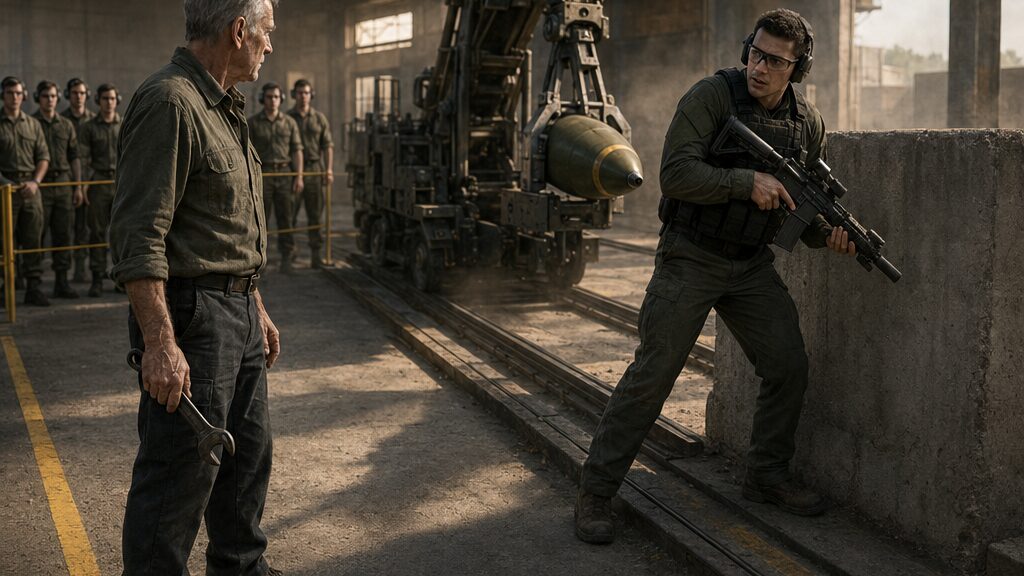
The Special Ops Trainee Mocked the Old Mechanic Until One Wrench Strike Saved His Life
Chapter 1: The Warning Beneath the Artillery Thunder
The suspended shell shuddered before the engine sound changed.
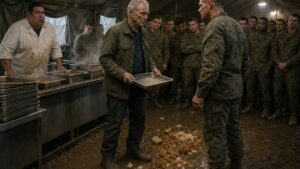
It was no more than an inch of movement, a heavy practice round trembling in the loader’s steel cradle, but Jonathan Lewis stopped with one boot inside the yellow maintenance line. Around him, the loading zone kept moving. Diesel engines growled. Hydraulic arms rose and folded. Men in hearing protection signaled through dust while a distant artillery piece struck the morning with a flat, body-deep concussion.
Jonathan placed his scarred wrench against the loader housing.
The steel carried the machine’s pulse into his palm.
Three steady beats.
A pause.
Then a faint double knock where there should have been one.
Brian Clark leaned out of the operator’s compartment. “You lose something?”
Jonathan kept the wrench pressed beneath the engine mount.
“Load angle changed?”
“Half elevation. Practice weight.”
“Do it again.”
Brian glanced toward the control station. The drill clock had not started, but crews were already staging equipment for the first rotation.
“We ran it twice before you got here.”
“Run it once with the rack turned left.”
Brian’s mouth tightened. He had worked with Jonathan long enough to obey strange requests, but not long enough to enjoy explaining them. He lowered the practice shell, rotated the loading assembly, and raised it again.
The engine held.
Then coughed.
The suspended shell quivered against its restraints.
Jonathan felt the wrench jump in his hand.
At the next lane, rifle fire cracked in a fast, hard sequence.
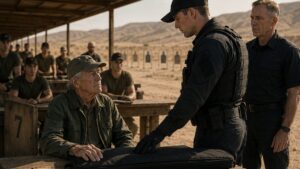
A young trainee moved between barriers with an optic-covered rifle pulled tight against his shoulder. Brandon Davis wore enough equipment to make every movement look deliberate: electronic sight, side-mounted module, pressure switches, reinforced sling, compact range finder. He struck each position as though he meant to punish it.
His shots landed.
Fast.
Close enough to center that two trainees behind the boundary exchanged impressed looks.
Jonathan watched Brandon leave the kneeling barrier. The trainee drove forward with his shoulders locked and his jaw clenched. He protected the rifle’s optic with the care of a man shielding something expensive, but each time he turned, his left side opened toward the loading track.
The loader coughed again.
Jonathan took the wrench from the housing.
“Shut it down,” he told Brian.
Brian’s eyes moved to the schedule board. “It passed yesterday.”
“It hesitated under angle.”
“Once.”
“Twice.”
Before Brian could answer, a whistle sounded from the rifle lane.
Brandon cleared the final barrier and slapped a fresh magazine into place. Michelle Ramirez stood near the timer station with a tablet against her chest. She watched the trainee reset, then checked the loader crews preparing behind him.
“Two-minute practice window,” she called. “After that, the lane goes live.”
Jonathan walked toward the boundary.
Brandon drove the rifle up and fired three more shots. The first struck center. The next two landed low and left.
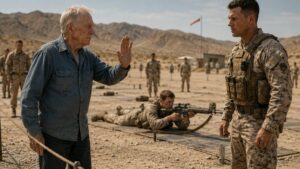
“You’re striking with anger, not focus,” Jonathan said. “You’re leaving your left side completely open.”
The lane went quiet except for the loader engines.
Brandon turned slowly.
Up close, he looked younger than his posture suggested. Sweat darkened the edge of his helmet liner. His breathing came fast, though he tried to hide it by lifting his chin.
“You talking to me?”
Jonathan pointed with the wrench, not at the target but at Brandon’s stance. “Your feet outrun your eyes. Every time you protect the optic, you turn your ribs toward the track.”
Brandon glanced at the watching trainees. “This isn’t a conventional firing line.”
“No.”
“You ever run an assessment course like this?”
“No.”
The answer drew a brief laugh from behind the barrier.
Jonathan let it pass. “The machine behind you doesn’t care what course you’re running.”
Brandon looked at the loader, then back at Jonathan’s faded work shirt and the wrench marked by years of impacts.
“Save the history lesson.” He tilted the rifle enough for the attachments to catch the hard white light. “I have five grand worth of tech on this rifle. It doesn’t miss.”
“The rifle isn’t the side I’m warning you about.”
Brandon’s expression changed by a fraction. Not confusion. Injury.
Then he smiled for the audience.
“Understood, museum relic.”
Michelle stepped between the lanes before the laughter could spread.
“Davis, reset at the first marker. Lewis, maintenance boundary.”
Jonathan did not move.
“The loader needs to come off rotation,” he said.
“Was a fault recorded?”
“Not yet.”
“Was there a warning code?”
“No.”
“Fluid loss?”
“No.”
Michelle lowered her voice. “Then document what you found. I have four crews, command observers arriving before noon, and one available loading track. I cannot shut it down because you felt something through a wrench.”
Jonathan looked past her.
Brandon had already returned to the first marker. He planted his left foot, brought up the rifle, and corrected the exact opening Jonathan had identified.
For one pass, he moved cleanly.
The timer sounded.
Brandon cut through the course with controlled bursts. Steel targets rang in sequence. He pivoted away from the loader track, kept his left side covered, and finished nearly two seconds under the practice standard.
A trainee slapped the barrier in approval.
Brandon looked directly at Jonathan while the final target still swayed.
The message was clear: the old man had warned him; the modern rifle had answered.
Michelle pointed toward the maintenance lane. “Now, please.”
Jonathan stepped back.
The movement felt familiar in a way he did not permit himself to examine. A young face turning away. A warning rejected. His own hands deciding that silence was discipline.
He returned to the loader and pressed the wrench against the housing again. The machine idled smoothly now, almost mocking him.
Brian climbed down from the compartment. “Maybe it was the restraint settling.”
“Maybe.”
“You don’t believe that.”
Jonathan looked toward the rifle staging mat. Brandon was replacing his magazine, working quickly as Michelle reviewed the official drill order.
The bolt moved forward.
A thin scraping sound crossed the distance between them.
Most people would have lost it beneath the engines.
Jonathan heard it.
At the same instant, the loader coughed—one broken beat followed by a metallic knock.
Rifle and machine.
Two faults answering each other across the lane.
Chapter 2: The Machine That Passed Every Inspection
The diagnostic tablet showed a field of green boxes while the loader engine stumbled hard enough to shake dust from its frame.
Brian stared at the screen.
“No active faults,” he said.
Jonathan stood beneath the partially raised rack, one hand against the housing. The machine had hesitated only when Brian rotated the assembly left and lifted the practice weight past half elevation. Once the rack returned to center, the engine smoothed and every sensor reported normal operation.
Michelle arrived before the vibrations had fully faded.
“What happened?”
“Momentary drop in revolutions,” Brian said.
“How much?”
He checked the tablet. “Not enough to log.”
Jonathan removed his hand from the warm steel. “Enough to feel.”
Michelle looked at him, then at the green diagnostic display. “Can you reproduce it?”
“Under load and left rotation.”
“Do it.”
Brian cycled the controls again. The rack rose. The engine note deepened, held steady, and settled into a clean idle.
Nothing shook.
Jonathan studied the mounting points. One bolt head carried a polished crescent where dust had been rubbed away. He fitted the jaw of his wrench against the housing beneath it. The tool sat naturally in a shallow outline worn into the paint from years of testing the same place.
“Again,” he said.
Brian repeated the cycle.
The machine behaved perfectly.
Michelle exhaled through her nose. “It passed a full inspection yesterday.”
“Inspections test what’s written,” Jonathan said.
“They also keep us from grounding equipment because someone has a feeling.”
“It isn’t a feeling.”
“What do I put in the report?”
Jonathan looked at the mounting crescent. He could describe the uneven vibration. He could describe the delay under angled load. What he could not do was point to a code, a leak, or a failed component.
Michelle waited.
Behind her, the first artillery crew moved toward the staging area. Command observers had begun gathering on the elevated platform. Their uniforms were clean, their hearing protection new, their attention divided between the course and the schedules on their tablets.
Brian lowered his voice. “We can switch loaders after the first rotation.”
Michelle considered that. “How long?”
“Twenty minutes to clear the lane. Longer if the reserve machine needs calibration.”
“We don’t have twenty minutes now.”
Jonathan met her eyes. “Then delay the start.”
A muscle moved in Michelle’s jaw. “The command review is tied to this rotation. A delay becomes the first line in the report. An undocumented vibration becomes the second.”
“So write the second line first.”
“And if we strip the loader and find nothing?”
“Then you lost an hour.”
“And the crews lose their assessment window. The trainees lose theirs. The exercise rolls into tomorrow, when the range is already assigned.”
She was not dismissing him. That made the decision worse. Jonathan could see the arithmetic operating behind her controlled expression: safety, schedule, credibility, promotion review. She had built a compromise before reaching them.
“One rotation,” she said. “No full load until it completes. Then we replace the machine.”
Jonathan looked toward the rifle lane. Brandon stood with his back to them while a weapons assistant examined the outside of his rifle.
“One rotation is enough.”
“For what?”
Jonathan did not answer.
Michelle’s voice hardened. “If you believe this loader is unsafe, mark it unsafe. Sign your name under that declaration, and I will shut the lane down.”
Brian looked away.
The form was open on the tablet. Jonathan knew exactly what the declaration meant. The machine would be impounded for inspection. The exercise would stop. If technicians found nothing, every future concern he raised would arrive already weakened by this one.
Years earlier, he would have signed without hesitation.
Years earlier, before he had learned how quickly people stopped listening to the man who saw danger everywhere.
Brian waited until Michelle walked back toward the control station.
“You were right about the number-three feed arm,” he said quietly.
Jonathan wiped dust from the wrench.
“And that hydraulic seal last winter. Both times the sensors missed it.”
“You argued with me both times.”
“I was hoping I’d be right.”
Brian glanced at the contract badge clipped to his shirt. “If we pull this machine and they cut the rotation, some of us don’t get the extra shift. That matters.”
“I know.”
“My daughter’s tuition payment doesn’t care what the engine sounds like.”
Jonathan looked at him. Brian’s embarrassment was sharper than any excuse.
“I know,” he repeated.
They returned to the maintenance desk. The advisory form offered three categories: monitor, restricted operation, remove from service.
Jonathan selected restricted operation.
Under findings, he typed: Intermittent vibration during angled lift. Further inspection recommended after initial rotation.
He read the sentence twice.
It was true.
It was also less than what he believed.
He signed.
The green authorization bar appeared across the screen.
Brian released a breath. “We’ll watch it.”
Jonathan handed back the tablet. “Watching isn’t stopping.”
“No.”
The official drill horn sounded.
At the rifle staging area, Brandon crouched over his weapon. He pulled the charging handle, caught the returning bolt, and frowned at something inside the receiver. When the weapons assistant approached, Brandon rotated his body, blocking the view.
Jonathan started toward him.
Michelle intercepted him at the lane entrance.
“The advisory is filed.”
“There’s something wrong with his rifle.”
“Did you inspect it?”
“I heard the bolt scrape.”
“You heard it from twenty yards away with three diesel engines running?”
“Yes.”
Her expression showed the cost of believing him again. “I’ll have the weapons assistant check it.”
“He already hid it from him.”
“Lewis.”
Jonathan stopped.
Brandon looked over. Their eyes met. The trainee’s mouth curved slightly, as if Jonathan’s concern were another attempt to reclaim a lost argument.
Michelle gestured toward the maintenance boundary. “You submitted your findings. Let me do my job.”
Jonathan could have raised his voice. He could have crossed the lane and taken the rifle from Brandon’s hands. Instead, he returned to the staging mat after the trainees moved toward the live course.
An empty magazine box lay on its side. Dust marked the places where boots and equipment had rested.
Something bright caught the light near the corner of the mat.
Jonathan bent and picked it up.
A metal shaving no longer than a fingernail lay across his palm, one edge blackened, the other freshly scored.
He looked toward the live course.
Brandon was already at the first marker, rifle shouldered, waiting for the timer.
Chapter 3: Five Thousand Dollars of False Confidence
Brandon’s first round chambered a fraction too slowly.
The delay was nearly invisible. The bolt traveled forward, hesitated against resistance, then locked with a muted scrape. To the trainees behind the barrier, it looked like an ordinary loading motion.
Jonathan saw Brandon’s thumb press quickly against the receiver.
Then the trainee lifted the rifle and pretended nothing had happened.
Jonathan closed his fingers around the metal shaving.
“Hold the course,” he said.
Michelle was checking the timing system. “On what basis?”
He opened his hand.
She examined the fragment without touching it. “Where did you find that?”
“His staging mat.”
“That could be from anything.”
“It matches the scrape.”
Brandon heard them. “My rifle was checked.”
The weapons assistant turned toward him. “I checked the exterior and optic mount.”
“You told me it was good.”
“I asked whether you’d had a feed issue.”
“And I said no.”
Jonathan stepped closer to the boundary. “Because you changed the ammunition setting before he reached you.”
Brandon’s eyes narrowed. “You watching my equipment now?”
“I’m watching a man hide a fault.”
A few heads turned on the observation platform.
Michelle lowered her tablet. “Davis, clear the weapon and hand it to the assistant.”
Brandon did not move.
The timer display glowed behind him. His name occupied the final qualification slot. Beneath it, a red notation marked a previous failed rotation.
“If I step off this lane,” he said, “the attempt counts.”
“That is not your concern right now.”
“It becomes my concern when they remove me from the assessment.”
Michelle’s silence confirmed it.
Brandon looked toward the elevated platform where the command observers waited. His posture changed—not louder, not more aggressive, but tighter. Jonathan recognized fear when it dressed itself as control.
“The bolt dragged once,” Brandon said. “New magazine. Dust in the feed path. It’s cleared.”
Jonathan held up the shaving. “Metal doesn’t come off because of dust.”
“You want this rifle to fail.”
“No.”
“You’ve been circling me since sunrise because I made you look wrong.”
The accusation struck closer than Brandon knew. Jonathan felt the old impulse to step back, to let the younger man own his mistake and carry its price.
Michelle raised one hand. “Enough. Davis, you have thirty seconds to declare the weapon fit or withdraw.”
The weapons assistant moved forward.
Brandon pulled the charging handle. The bolt cycled cleanly this time. He showed the open chamber, inserted a fresh magazine, and released it.
No scrape.
He looked directly at Jonathan.
“Fit.”
Michelle studied him. “Any prior feed hesitation?”
“No, ma’am.”
It was a clean lie.
She entered the declaration into the tablet. “Take your position.”
Jonathan could have challenged it. The shaving pressed into his palm, small and sharp.
He said nothing.
The horn sounded.
Brandon launched from the first marker.
He was excellent.
The first two targets rang almost as one. He dropped behind a concrete barrier, fired through the lower opening, rose, and moved before the steel had stopped swinging. The timer numbers fell rapidly.
Behind the boundary, the trainees watched in concentrated silence.
At the loading track, Brian guided the loader forward with a weighted rack. The engine note remained steady.
Brandon reached the third station four seconds ahead of the qualifying pace.
Someone behind Jonathan murmured, “That’s Special Ops speed.”
Another voice answered, “Old man picked the wrong trainee.”
Jonathan watched Brandon’s feet.
The rifle was not missing. The expensive optic was doing exactly what Brandon had claimed. It fed him distance, alignment, and a bright aiming point through the dust.
But his shoulders were rising.
His transitions were shortening.
At the fourth barrier, Brandon cut left before his eyes cleared the corner.
“He’ll overrun the next marker,” Jonathan said.
Michelle glanced at him.
Brandon reached the line, planted too hard, and had to drag his rear foot back inside the painted boundary. The correction cost him less than a second.
It also turned his left side toward the loading track.
Jonathan pointed. “There.”
Michelle saw it this time.
“Davis, square your position.”
Brandon adjusted without looking at them and fired. The target rang.
His pace increased.
The rifle gave another faint scrape between shots.
At the control station, a message appeared on Michelle’s tablet. She read it, then called across the lane.
“Davis, command confirms this is your final assessment rotation.”
Brandon’s next shot landed outside center.
“If you do not meet standard,” she continued, “you are removed from the qualification course.”
His jaw tightened.
Jonathan saw the change immediately. Brandon stopped moving through the course and began attacking it.
Every barrier became something to defeat. Every trigger press became a blow. His left side opened wider as he tried to protect the rifle from contact with the concrete.
“Slow him down,” Jonathan said.
Michelle lifted the radio. “Davis, reduce pace. Maintain control.”
Brandon accelerated.
The loader entered the parallel track behind him. Its rack now carried a live artillery shell secured in the steel cradle. Brian’s hands were visible through the compartment window, steady on the controls.
The engine knocked once.
Jonathan felt it through the soles of his boots.
He gripped the wrench at his belt.
Brandon fired at the sixth target.
The bolt traveled back, stripped the next round, and stopped halfway forward.
He struck the receiver with his palm.
The bolt closed.
“Stop the drill,” Jonathan said.
Michelle raised the radio. “Davis, cease—”
Brandon fired again.
The shot hit center.
A fraction of triumph crossed his face.
Then the rifle made a sound like a steel tooth breaking.
The bolt slammed crooked inside the receiver. Brandon’s body jerked with it. He pulled the trigger.
Nothing.
Behind him, the ammunition loader rolled into the lane carrying the suspended live shell.
Brandon yanked the charging handle.
It did not move.
The engine coughed.
He struck the rifle again as the loader came toward his completely exposed left side.
Chapter 4: When the Rifle Went Dead
Brandon pulled the trigger again.
The rifle answered with a dead click.
The timer kept running.
For half a second, he stood perfectly still, as if the weapon had violated an agreement between them. Then he ripped the charging handle backward.
It moved less than an inch.
“Davis, cease fire,” Michelle called over the radio. “Weapon down. Move right and clear the loading track.”
Brandon struck the receiver with the heel of his hand.
The bolt stayed crooked.
Behind him, the ammunition loader rolled forward with the live shell secured in its cradle. Its diesel engine dragged through one uneven cycle, recovered, then coughed again.
Jonathan moved to the edge of the red safety line.
“Leave the rifle,” he shouted. “Move right.”
Brandon looked toward the next target instead.
The glowing timer reflected in his optic. He twisted the rifle, pulled harder on the charging handle, and drove the stock against his thigh.
“Davis!” Michelle’s voice sharpened. “The drill is stopped. Clear the track now.”
The range siren began to pulse.
Brandon took one step right, then stopped when the sling caught against his chest rig. Instead of releasing it, he bent over the weapon and fought the buckle.
The loader closed the distance behind him.
Brian leaned forward inside the operator’s compartment and pulled the control lever into neutral. The machine slowed, but the suspended weight kept the drive system loaded. The engine note fell into the same broken rhythm Jonathan had felt beneath his wrench.
Three beats.
A pause.
A double knock.
“Do not brake it there,” Jonathan called.
Brian’s head snapped toward him.
The loader was entering the angled section of track. Its rack had rotated left to align with the artillery position, placing the live shell over the edge of Brandon’s lane. If Brian killed the engine under that load, the worn mount could shift before the hydraulic locks seated.
Michelle heard him. “Brian, maintain motion. Clear the trainee.”
“I’m losing power,” Brian answered through the external speaker.
Brandon finally freed the sling. He should have dropped the rifle and moved.
Instead, he crouched beside the barrier and drove his fingers toward the ejection port.
Jonathan saw the angle of the trapped cartridge. Its base sat low beneath the bolt, the casing crushed where the feed mechanism had forced it against metal already shedding fragments.
“Don’t put your hand in there.”
Brandon glanced up.
For the first time that morning, the confidence had left his face.
“Move right,” Jonathan said. “Now.”
Brandon’s gaze shifted toward the observer platform. Men stood behind the railing, their attention fixed on him. The timer had stopped, but its final number remained visible.
Failure recorded in red.
He looked down at the rifle again.
Pride held him in place more firmly than the sling had.
The loader engine coughed hard enough to send a tremor through the track.
Brian pulled the emergency control.
The machine lurched.
The shell cradle swung several inches toward Brandon’s exposed left side.
He stumbled away from it, but the barrier blocked his retreat. The only open route lay beneath the outer edge of the loader arm, and he had already moved too far into its operating arc.
Michelle hit the full-stop signal.
The siren changed pitch.
“All personnel freeze positions.”
Brian’s voice came through strained. “Engine is not holding revolutions.”
The loader slowed to a crawl. The rack remained raised. Its hydraulic system gave a high, thin whine beneath the diesel rattle.
Jonathan drew the wrench from his belt and set its jaw against the maintenance rail.
The steel vibrated instantly.
The fault had worsened.
He felt the uneven impact travel through the tool and into his wrist, not from the engine itself but from the mounting point beneath it. The worn bracket was shifting under angled weight. Each engine stumble let the assembly settle a fraction farther.
Michelle stepped beside him. “What is it?”
“Mount is binding against the control linkage.”
“Can Brian retract?”
“Not if the engine dies.”
“Can he lower the rack?”
“Not with Davis under the arm.”
Brandon heard his name and looked toward them. Dust had collected on the sweat along his face. His right hand still held the jammed rifle. His left hovered near the receiver.
Jonathan pointed with the wrench. “Put the rifle down.”
“I can clear it.”
“No.”
“I know this system.”
“Then you know the round is trapped under the bolt.”
Brandon looked at the ejection port.
That hesitation told Jonathan he had already understood the problem. He simply had not accepted it.
“Drop it,” Jonathan repeated.
The loader engine lost another beat.
The shell rack dipped.
Brandon flinched and struck the rifle once more, harder than before.
The sound was small beside the machinery, but Jonathan felt it like an old blow.
A different loading lane.
A younger face beneath a dust-streaked helmet.
A warning about the unprotected side.
A laugh.
Then Jonathan stepping back because the young man had made it clear that help was not wanted.
He saw none of it fully. Only pieces that arrived with the same mechanical cough.
Michelle gripped his arm. “Lewis.”
Jonathan realized he had stopped breathing.
Across the red line, Brandon stared at him.
Not mocking now.
Waiting.
But still unable to ask.
Jonathan knew that look too.
He had once waited for a request that never came.
The old memory tightened around his chest.
Michelle raised the radio. “Emergency recovery team is moving.”
Jonathan looked toward the far gate. The recovery vehicle had not yet entered the loading zone. Even at full speed, it would take minutes to position safely.
The loader did not have minutes.
A dark line of hydraulic fluid appeared near the rack pivot.
Jonathan’s mouth went dry.
“Tell Brian to keep the engine alive.”
“He’s at full manual control.”
“Tell him not to touch the rack.”
Michelle relayed the order.
Brandon shifted his weight beneath the arm.
“Stay still,” Jonathan shouted.
“I can get under it.”
“You move left, the rack follows the grade. You move right, you hit the mount.”
“So what am I supposed to do?”
It was the first honest question he had asked.
Jonathan stepped closer to the red line.
Michelle blocked him with one arm. “You cross that boundary, I have to stop you.”
“If that engine stalls, the rack settles before your recovery team arrives.”
“You do not have protective equipment.”
“I have the clearance path.”
“You cannot know that.”
Jonathan looked at the angled arm, the barrier, the distance between Brandon’s shoulder and the lower hydraulic line. He knew every inch because older versions of the machine had forced men to learn by touch, sound, and scars.
“I do.”
The engine coughed.
The wrench trembled in his hand.
That same sound had once preceded a death while Jonathan stood at a safe distance and called restraint wisdom.
He pulled his arm free of Michelle’s grip.
“Lewis.”
He stepped over the red line.
The loader gave another violent shudder as he moved toward Brandon beneath the suspended shell.
Chapter 5: The Wrench He Never Put Down
The shell rack dropped three inches as Jonathan reached Brandon.
The hydraulic lines snapped taut. Dust burst from the barrier where the steel cradle scraped its edge. Brandon threw up one arm and pressed himself backward, pinning the jammed rifle between his chest and the concrete.
“Don’t move,” Jonathan said.
“It’s coming down.”
“I know.”
Brandon’s eyes tracked the live shell above them.
Jonathan caught the rifle near the magazine well and pushed the muzzle toward the dirt berm.
“Let go.”
“I can carry it.”
“Let go.”
The younger man’s grip tightened.
The loader engine stuttered behind them. Every broken beat passed through the raised arm and into the steel above their heads.
Jonathan saw another pair of hands around another weapon. Younger hands. Dust in the knuckles. A man refusing to surrender control because Jonathan had waited too long to sound like someone worth trusting.
For one second, the present disappeared.
A shell rack angled wrong.
A warning laughed away.
Jonathan standing beyond reach while a young artilleryman struck at a jammed mechanism and exposed the side Jonathan had told him to protect.
Then the machine lurched.
The memory ended where it always ended.
With Jonathan moving too late.
The wrench felt heavy against his palm.
Brandon jerked the rifle toward himself. “I said I’ve got it.”
Jonathan froze.
The words were not identical, but the anger was.
He saw the same opening at Brandon’s left side, the same narrow path where machinery and panic were about to meet.
The rack slipped another fraction.
Jonathan drove his shoulder into Brandon’s chest and forced him flat against the barrier.
“Release the rifle.”
Brandon stared at him.
Jonathan did not soften his voice.
“That is an order.”
Something in the words reached beneath the panic. Brandon opened his hands.
Jonathan pulled the weapon free, lowered it to the ground with the muzzle downrange, and kicked it beyond the loader arm.
“Now listen to me,” he said. “When I move you, you move. Not before.”
Brandon nodded once.
Jonathan looked toward the engine housing. The path to it ran beneath the outer edge of the arm, past a hydraulic line trembling under pressure. If Brandon remained against the barrier, Jonathan could reach the mount. But the rack would continue settling unless Brian kept enough power in the system.
Jonathan raised one hand toward the operator’s compartment and rotated his fist.
Brian understood. He increased the throttle.
The engine roared, faltered, then caught.
The arm lifted half an inch.
“On my hand,” Jonathan told Brandon.
He placed his palm against Brandon’s shoulder and pushed him down and right, beneath the safest gap.
Brandon began to rise too soon.
Jonathan shoved him back.
“Focus.”
The word cut through the engine noise.
Brandon lowered himself again. Jonathan guided him past the hydraulic line and into a narrow pocket between the barrier and the loader wheel.
“Stay there.”
“What about you?”
Jonathan was already moving.
The engine housing radiated heat. He placed his wrench against the lower mount and felt the familiar double impact. The bracket was not merely loose. It had shifted sideways under the angled load, pressing the linkage against the casing. Each vibration drove it deeper.
The polished crescent he had seen earlier marked where the assembly had been rubbing for weeks.
Brian’s voice came through the speaker. “Controls aren’t responding.”
“Hold throttle.”
“I’m near maximum.”
“Hold it.”
Jonathan crouched beside the wheel and reached toward the manual ignition linkage.
The metal shook beneath his fingers.
He pulled.
Nothing happened.
The engine coughed and nearly died.
Above him, the shell rack settled lower.
Michelle’s voice came from beyond the red line. “Recovery team is entering.”
“They won’t reach us in time,” Jonathan called.
Brandon shifted in the pocket. “What can I do?”
“Stay where you are.”
“I can help.”
“By staying where you are.”
Jonathan reset his grip on the manual linkage and pulled again. The mount pressed harder against it. The normal ignition sequence could not overcome the bind.
He looked at the wrench.
Its handle was dark with old oil worked into the steel. Near the base, beneath years of scratches, two initials had been stamped by a young man proud of owning his first proper tool.
Jonathan’s thumb passed over them.
The wrench had not originally been his.
It had belonged to the soldier whose warning he had repeated too quietly, then abandoned when the young man mocked him. After the machine failed, Jonathan had found the tool in the dust beside the wrecked loading mechanism.
He had carried it ever since.
Not as a memorial. He had never allowed himself that gentler word.
As evidence.
The loader shuddered.
Brandon’s shoulder struck the barrier.
Jonathan looked toward him and saw that the younger man had finally stopped fighting everything around him. His hands were open. His breathing was fast, but he was watching Jonathan instead of the rifle, the observers, or the timer.
Trust had come late.
Late was not the same as too late.
Jonathan pressed the wrench against the mount and listened through the steel.
Three impacts.
A pause.
The double knock.
The binding point was not where the crescent showed. That mark was only the path. The pressure had gathered farther back, at the narrow junction between the mount and linkage collar.
He slid the wrench along the housing.
The vibration sharpened.
“There,” he whispered.
He raised the tool.
Michelle saw the motion. “Lewis, what are you doing?”
“Freeing the mount.”
“With a strike?”
“Specific one.”
“If you damage the linkage—”
“It is already locked.”
Brian’s throttle surged. The engine gave one strong revolution, then collapsed into a weak rattle.
Jonathan had one chance while the mount was still carrying tension. Strike too high and he would deform the housing. Too low and the wrench would hit the hydraulic coupling. Too softly and nothing would move. Too hard and the collar could break.
Brandon watched from beneath the arm.
“What happens if it doesn’t work?”
Jonathan set his feet.
“Then we find out fast.”
The younger man gave a short, breathless sound that was almost a laugh, then stopped himself.
Jonathan drew the wrench back.
For an instant, the old loading lane returned around him. The young artilleryman bent over the mechanism. Jonathan beyond the line. The space between warning and action widening until it could no longer be crossed.
This time, Jonathan had crossed it.
He struck the side of the housing.
The impact rang cleanly through the loading zone.
The engine died.
Silence opened beneath the alarms.
The shell rack dipped.
Brandon flinched.
Then the mount released with a deep metallic snap.
The linkage jumped back into alignment. Brian hit the control.
The engine roared to life so suddenly that black exhaust rolled from the stack. Hydraulic pressure returned with a heavy surge. The rack rose away from the barrier and began retracting toward the track.
Jonathan stayed crouched until the shell cleared Brandon’s position.
Only then did he breathe.
Brian reversed the loader several yards and lowered the rack into its safety cradle. The siren dropped from emergency pulse to a steady warning tone.
Michelle crossed the line with the recovery team behind her.
“Both of you out,” she ordered.
Jonathan reached for Brandon.
The younger man took his hand without hesitation.
They moved clear of the loader together.
Beyond the danger arc, Brandon bent forward with both palms on his knees. His expensive rifle lay where Jonathan had kicked it, coated in dust, its bolt still trapped halfway forward.
The weapons safety officer approached it carefully and peered into the receiver.
“Do not touch the charging handle,” Jonathan said.
The officer used a light to inspect the feed path.
A crushed cartridge sat beneath the bolt, its casing deformed against a sharp metal edge. The live primer was intact.
The officer looked at Brandon. “You hit this weapon after it locked?”
Brandon straightened slowly.
“Yes.”
“You could have set the round off inside the receiver.”
Brandon’s face lost what little color remained.
Michelle looked from him to Jonathan, then toward the loader now idling in the distance.
Jonathan bent and picked up his wrench.
The initials near the handle were visible beneath the dust.
He had saved Brandon from the machine.
The rifle was still waiting.
Chapter 6: Clear the Weapon With Your Own Hands
The safety officer found a split along the crushed cartridge and immediately stepped back.
“No forced extraction,” he said. “Any twist against the primer could ignite it.”
Brandon stood behind the marked clearance table, staring at the rifle as though it belonged to someone else. The optic had gone dark. Dust covered its lenses, and the damaged bolt held the receiver open at an uneven angle.
“Take it,” Brandon said to Jonathan.
Jonathan set the scarred wrench on the table beside the rifle.
“No.”
Brandon looked up. “You know what’s wrong.”
“So do you.”
“I know it’s trapped.”
“You know more than that.”
The loading zone had been secured. The live shell sat lowered in its cradle, and the damaged loader was surrounded by recovery personnel. The command observers had left the platform, but the trainees remained behind the outer barrier in uneasy silence.
Michelle stood several feet away with her tablet. “The safety officer can perform the clearance.”
Jonathan kept his eyes on Brandon. “He can. Then Davis learns that someone else takes over when his equipment stops obeying him.”
Brandon’s jaw tightened.
The old reaction tried to return. Jonathan saw it forming and pointed to the rifle.
“That reaction is what put you under the loader.”
“You want me to clear a damaged live round after telling me not to touch it?”
“I want you to clear it under instruction.”
The safety officer considered the weapon. “Slow manipulation. Magazine out first. No pressure on the charging handle until the feed path is relieved.”
Brandon reached forward.
His fingers shook.
He pulled them back and closed his fists.
Jonathan said nothing.
Brandon glanced toward the watching trainees. Shame pulled his shoulders high.
“Look at me,” Jonathan said.
Brandon did.
“Where is your left side?”
The question seemed to anger him until he understood it was not about the lane.
He checked his stance. His left hip was pressed close to the table, leaving no room to move if the weapon shifted.
“Exposed,” he said.
“Correct it.”
Brandon stepped back and angled his body. He gave himself space to release the rifle rather than hold it at all costs.
“Now breathe.”
“I am breathing.”
“No. You are waiting between panic and the next mistake.”
Brandon inhaled through his nose. The first breath broke halfway in. The second reached deeper.
Jonathan watched his hands settle.
“Remove the magazine.”
Brandon pressed the release. The magazine did not fall.
His eyes flashed.
“Don’t strike it,” Jonathan said.
Brandon stopped.
He supported the rifle, eased the magazine downward, and felt where the deformed round had put pressure against the feed lips. With a controlled rocking motion, he drew it free.
“Set it down.”
He did.
The safety officer inserted a narrow support tool beneath the bolt to take pressure off the cartridge. Jonathan made Brandon identify every contact point before he moved anything.
The optic remained dark above the receiver, useless now.
“Your sight cannot tell you where the pressure is,” Jonathan said.
Brandon leaned closer without touching. “The casing is pinned against the lower feed edge.”
“And the bolt?”
“Loaded against the rear shoulder.”
“What happens if you pull hard?”
“The case rotates toward the primer.”
Jonathan nodded. “So don’t pull hard.”
Brandon used a small clearance tool to press the feed edge away from the casing. His hand trembled once. He stopped on his own, breathed, and resumed.
The cartridge shifted.
The safety officer caught it in a padded tray.
Brandon eased the bolt back and locked it open.
The rifle was clear.
No one applauded.
The silence was better than applause. It forced the lesson to remain where it belonged.
Brandon stared at the damaged cartridge in the tray. “I knew the feed was dragging.”
Michelle’s tablet lowered.
“How long?” she asked.
“Before the drill.”
“You declared no prior hesitation.”
“Yes.”
“Why?”
Brandon looked toward the dead timer display. “Because it was my final rotation.”
Michelle’s expression remained controlled, but her disappointment showed in the pause before she entered the admission.
Jonathan picked up his wrench.
“You knew the loader was wrong too,” she said.
He met her eyes.
“I filed the vibration.”
“You filed a recommendation after rotation. You believed it was more serious than that.”
“Yes.”
Brian stood near the recovery crew, close enough to hear. He did not look away from the machine.
Michelle tapped the tablet once. “Davis concealed a weapon fault. You crossed an active safety boundary. And your advisory did not reflect your actual assessment.”
“I know.”
“You may both face formal review.”
Brandon glanced at Jonathan, perhaps expecting resistance.
Jonathan gave none.
The old version of him would have accepted blame silently and called it dignity. The newer truth was less comfortable.
“I should have marked the loader unsafe,” he said. “I was more concerned with being dismissed than with making the decision clear.”
Brian stepped closer. “I told him we needed the shift.”
Michelle looked at him.
“I minimized the hesitation,” Brian said. “That goes in the report too.”
For the first time since the emergency, no one had anywhere to hide.
Brandon removed the optic from the rifle. The mount resisted, then released with a small metallic snap. He set the expensive device beside the crushed cartridge.
Jonathan wiped dust from the wrench handle.
Brandon’s gaze settled on the steel.
Two stamped initials showed near the base.
His face changed.
He reached toward the tool, then stopped before touching it.
“Where did you get that?”
Jonathan’s hand closed around the wrench.
Brandon leaned closer.
“I’ve seen those initials.”
Jonathan said nothing.
“In a photograph,” Brandon continued. “My father kept it in his artillery box.”
The loading zone seemed to narrow around them.
Brandon looked from the initials to Jonathan’s face.
“My father was Joseph Davis.”
Jonathan’s grip tightened until the old stamped letters pressed into his palm.
Chapter 7: The Side Neither Man Could See
Brandon placed a faded photograph on the maintenance bench beside Jonathan’s wrench.
The picture had been folded twice and flattened so many times that pale cracks crossed the faces. Five artillerymen stood beside an older ammunition loader, their uniforms dusty, their sleeves rolled. Joseph Davis was near the center, younger than Brandon had ever known him.
Jonathan stood at the far edge.
Beside him was a thin soldier with one hand resting on the same wrench.
Brandon touched the initials stamped near its handle. “Those are his.”
Jonathan did not ask how Brandon had found the photograph. The old artillery box had probably been opened after years of being avoided, its contents searched because one familiar mark had appeared where Brandon least expected it.
The maintenance shelter was quiet except for cooling metal outside. The disabled loader sat beneath portable lights, its engine housing open while Brian documented the worn mount. The rifle lane beyond it had been cleared and locked.
Jonathan drew a cloth along the wrench.
He cleaned the dust from the initials but did not turn them away.
“What was his name?” Brandon asked.
“Justin Thomas.”
“My father talked about him?”
“Not to me after we came home.”
“He kept this photograph.”
Jonathan folded the cloth once. “Your father kept more than he said.”
Brandon studied Joseph’s younger face. “He used to tell me to protect the side I couldn’t see.”
Jonathan’s hand stopped.
“He said it when I learned to drive. When I played football. Any time I got angry.” Brandon gave a humorless breath. “I thought it was one of those phrases fathers repeat because they don’t know how to explain what they mean.”
“He knew exactly what it meant.”
“Then tell me.”
The demand was quieter than Brandon’s words on the range. That made it harder to evade.
Jonathan looked through the shelter opening at the red safety line he had crossed. The distance appeared ordinary now. A strip of paint over concrete. In memory, another line had stretched farther every year.
“Justin was good with machines,” he said. “Fast hands. Faster temper. He believed hesitation was fear.”
Brandon glanced at the wrench.
“We were moving ammunition under pressure. One loader had a linkage problem. I heard it before anyone else did.”
“The same failure?”
“An older system. Same family of mistake.”
Jonathan placed the wrench flat on the bench.
“Justin was beside the mechanism. His left side was open to the arm. I warned him, but I warned him like a man asking permission. He laughed. Told me to worry about my own station.”
“And you backed off.”
“Yes.”
The word landed without defense.
Jonathan could have explained the noise, the confusion, the chain of command, the seconds involved. Each detail was true. None changed the distance between knowing and acting.
“The loader stalled,” he continued. “Justin tried to force the release. I saw what would happen. I called again.”
“But you didn’t go to him.”
“Not until the machine moved.”
Brandon’s face tightened.
Jonathan did not look away.
“When I reached him, I tried to take control of everything at once. The tool. The mechanism. Him. By then he didn’t trust my voice. I had been quiet when it mattered, then suddenly expected obedience when panic had already taken hold.”
“What happened?”
“The arm shifted.”
The cooling loader outside gave a small metallic tick.
Jonathan’s thumb moved across the wrench handle.
“Justin died before we got him clear.”
Brandon stared at the photograph.
“My father was there.”
“He pulled the other crewman out. Then he came back for us.”
Joseph had never been the loudest man in the section. He had worked methodically, spoken little, and remembered everything. Afterward, he had repeated the lesson until it became habit: protect the side you cannot see.
Jonathan had carried the wrench.
Joseph had carried the words.
Neither had found a clean way to carry the man.
Brandon lowered himself onto the bench opposite Jonathan. “My father wanted me to join artillery.”
“I know.”
“He made it sound like enough. One crew. One machine. Do the job right and go home.”
“That was not how he meant it.”
“I thought he had settled.” Brandon rubbed one thumb over the photograph’s broken edge. “He never talked about combat. Never talked about anyone he saved. He worked at the same depot for twenty-six years and came home tired. I looked at him and thought he had stopped wanting more.”
Jonathan remembered Joseph refusing a promotion that would have moved him away from the crews. At the time, Jonathan had understood it as loyalty. A son watching from outside could have seen surrender.
“He was afraid ambition without discipline would eat you alive,” Jonathan said.
Brandon’s mouth hardened. “So he stayed silent and expected me to understand.”
“Yes.”
The agreement surprised him.
Jonathan leaned back. “Silence was his mistake too.”
Brandon looked up.
“He loved you,” Jonathan said. “That does not mean he gave you what you needed.”
The shelter door opened.
Michelle entered carrying her tablet. She placed it beside the photograph but did not touch either object.
“The initial findings are complete,” she said. “The loader mount had progressive wear. Brian documented the vibration pattern and the angled-load condition.”
“Was the inspection wrong?” Brandon asked.
“It was incomplete.”
Michelle looked at Jonathan.
“So was the advisory.”
He nodded.
“Davis’s concealment will be reviewed separately. Your boundary crossing will also be reviewed, but the preliminary finding is that it prevented greater harm.”
Jonathan waited.
Michelle turned the tablet toward him. An offer filled the screen: temporary civilian advisory assignment, focused on translating field-based equipment recognition into formal inspection procedures and trainee instruction.
“You want me in a classroom,” he said.
“I want you wherever people are still mistaking data for judgment.”
“I am a mechanic.”
“You are a mechanic who saw three failures before the systems saw one.”
Jonathan’s first instinct was refusal. Advisory roles meant meetings, questions, people watching him work. It meant telling the story behind the wrench when silence would be easier.
Brandon lifted the failed optic from his gear bag and set it on the bench. He had removed its battery and mounting hardware. The rifle itself had been reduced to its basic configuration for inspection.
“My reassessment is in four days,” he said.
Michelle looked at him. “That depends on the review.”
“If I get one.”
He turned to Jonathan.
“I could use an adviser.”
The request contained no mockery and no attempt to erase what had happened.
Jonathan looked at Justin’s initials, then at Joseph’s photograph.
For years he had believed carrying the wrench was enough. Keep the tool working. Remember the failure. Avoid repeating it by staying careful and unseen.
But unseen warnings did not stop machines.
He signed the advisory acceptance.
Chapter 8: The Salute Beside the Silent Loader
Brandon stopped the reassessment timer before firing the first shot.
The electronic tone had barely begun when he raised one hand and stepped away from the rifle.
“Feed resistance,” he called.
A murmur passed through the observers.
Four days earlier, Brandon would have forced the bolt closed and trusted speed to hide the hesitation. Now he locked the weapon open, set it safely on the staging table, and waited while the weapons assistant inspected it.
Jonathan stood beside the reopened loading track with the scarred wrench hanging openly from his belt.
He did not move toward Brandon.
That was part of the lesson too.
The assistant removed the magazine and found a slightly bent feed lip. The defect was minor, correctable in less than a minute. It would still cost Brandon his opening advantage.
Michelle stood at the control station. “You may replace the magazine and restart.”
Brandon checked the replacement himself before inserting it.
“No fault,” he said.
“Confirmed,” the assistant answered.
The timer reset.
Behind the rifle course, the repaired ammunition loader idled with a practice shell in its cradle. Its mounting point now carried a visible inspection mark. Brian had converted Jonathan’s tactile test into a written procedure: angled lift, left rotation, wrench contact at the lower housing, vibration measured against a documented baseline.
What had once been dismissed as an old man’s feeling now had steps another worker could follow.
Brian stood in the operator’s compartment and raised two fingers toward Jonathan.
The engine was clean.
Jonathan returned the signal.
Brandon took his position.
His rifle looked different without the dead optic and extra attachments. Iron sights ran along the top. The weapon seemed lighter, but nothing about Brandon’s posture suggested he believed that made the task easier.
The timer sounded.
He moved.
His first shots were slower than those from the earlier drill. Each landed near center. He cleared the first barrier, checked the loading track, and advanced with his shoulders low.
At the third marker, his old habit returned.
His lead foot struck too aggressively. His body began to rotate around the rifle, opening the left side.
Jonathan’s fingers touched the wrench handle.
He did not call out.
Brandon caught the movement himself.
He stopped, reset his feet, and widened his awareness beyond the sights. The correction cost him a second and a half.
Then he continued.
The loader began its parallel run.
Its rack turned left under partial elevation. The engine held a steady rhythm while Brandon passed the fourth station.
Three beats.
No pause.
No double knock.
At the fifth barrier, dust struck Brandon’s face. His next shot landed outside the center ring.
The trainees watched for the acceleration that had destroyed his control before.
It did not come.
Brandon lowered the rifle, took one breath, and checked his left side.
The timer numbers kept falling.
He accepted the lost seconds.
His next round rang steel.
Jonathan felt something inside him loosen—not relief exactly, but the absence of an old repetition. The younger man was not becoming cautious. He was becoming complete.
Brandon reached the final marker. The top qualifying time was still possible if he rushed the last sequence.
He looked at the targets.
Then at the loader.
The machine was clear, but one crewman had stepped closer to the edge of the marked lane while checking a restraint.
Brandon lowered his rifle.
“Personnel near track,” he called.
Michelle stopped the timer.
The crewman moved behind the boundary and raised an apologetic hand.
Brandon reset for the final sequence.
When the timer resumed, the chance at first ranking was gone.
He fired three controlled shots.
Three targets rang.
The final time appeared on the board.
Qualified.
Fourth place.
No one spoke for several seconds.
Michelle recorded the result. “Course complete.”
Brandon cleared the rifle and presented it for inspection. The weapons assistant confirmed the chamber empty.
One of the trainees near the barrier looked at the scoreboard. “You had first.”
Brandon glanced at the final time.
“No,” he said. “I had a fast mistake.”
He removed the magazine and slung the rifle across his chest.
Brian lowered the loader rack into its cradle. The engine shut down without a cough, leaving the zone suddenly broad and quiet.
Michelle approached Jonathan.
“The review board accepted the revised inspection protocol,” she said. “Your advisory assignment begins Monday.”
Jonathan looked at the classroom building beyond the maintenance yard.
“Monday,” he repeated.
“You can still refuse.”
He touched the wrench.
“No.”
Brandon walked toward them.
Four days earlier, his approach had carried the hard rhythm of a man entering every space as a challenge. Now he stopped at a respectful distance.
“The lower score stands?” he asked Michelle.
“It does.”
“Good.”
She studied him, perhaps checking for bitterness.
He gave her none.
Brandon turned to Jonathan. “I protected the left side.”
“You protected more than that.”
The younger man looked toward the repaired loader, then at the wrench on Jonathan’s belt.
“My father would have liked you teaching.”
“He spent years trying to make me do it.”
Brandon gave a small nod. “He spent years trying to teach me too.”
Jonathan started across the loading zone.
He had taken several steps when he heard Brandon’s boots come together behind him.
Jonathan turned.
Brandon stood at attention with the once-jammed rifle resting safely against his chest. The expensive optic was gone. Dust marked his uniform, and his final score remained fourth on the board behind him.
He raised his hand in a deep, precise salute.
No officer had ordered it.
No crowd applauded.
Jonathan looked at the young man, at the silent loader beyond him, and at the side neither of them could afford to ignore again.
Then he returned the salute.
The scarred wrench rested against his hip as he walked toward the place where people were waiting to learn.
The story has ended.