The HOA Called His Mother’s Safety Ramp a Violation While the Work Boat Was Still Running
Chapter 1: The Notice Arrived After the Lift Had Started
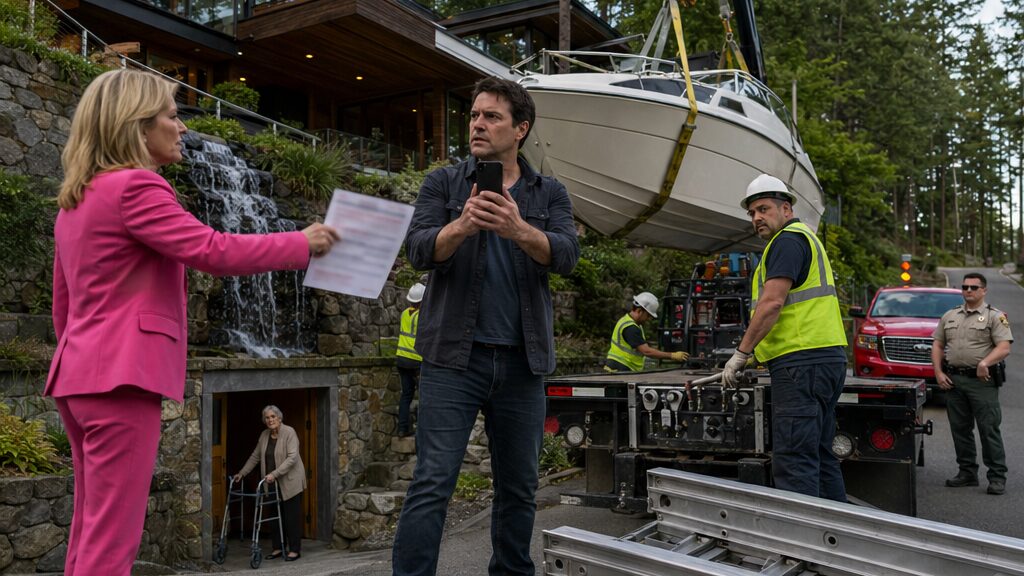
The lift engine was already running when Raymond Wright stepped out of the lower door with his phone in one hand and a wrench still in the other.
At first, he thought Frank Garcia had come back early from the marina side with the second load of brackets. Then the white work boat rose six inches off the gravel, straps groaning against its hull, and Raymond saw the workers were not unloading anything.
They were taking it away.
“Hey,” Raymond called, crossing the driveway fast. “Stop that lift.”
Two high-vis workers turned. One froze with his hand on a strap. The other looked past Raymond, toward the woman in the hot-pink suit standing at the edge of the stone retaining wall like she had arrived for a ribbon cutting instead of a removal.
Melissa Adams held a paper in the air.
The words were thick and black across the top.
VIOLATION NOTICE.
Raymond stopped just before the flatbed. The boat hung between the truck and the half-built lower platform, its white hull swinging slightly over the stacked ramp sections that were supposed to be bolted down before noon. Behind it, the hillside house rose in glass and wood, bright and exposed. Water ran through the decorative falls beside the stone wall, pretty enough for the HOA brochure, loud enough to cover the first few seconds of Raymond’s breathing.
“Mr. Wright,” Melissa said. “You were instructed not to continue unauthorized exterior modifications.”
“I wasn’t instructed anything.” Raymond lifted his phone and tapped record. “Who authorized you to remove my equipment?”
Melissa’s eyes flicked to the phone. She did not step back. The suit was the kind of pink that wanted distance to fail. “This association has an enforcement right under Section 7.4 and 9.2 of the exterior standards.”
“That’s not what I asked.” Raymond moved closer to the ramp sections. “Frank, lower the boat.”
Frank Garcia stood near the flatbed controls, face tight under his hard hat. He was a broad man with sun-browned hands and the tired caution of somebody who had learned that paperwork could hurt more than tools. “Raymond, I was told this was cleared through the board.”
“It is not cleared through me.”
Melissa snapped the paper once, the sound sharp as a slap. “The board does not require your permission to abate a continuing violation after notice.”
“What notice?”
She held the page toward him. “This notice.”
Raymond looked at the paper, then at the running lift, then at the red official vehicle parked near the road with its lights blinking softly against the morning glare. A township code officer stood beside it, arms folded, not interfering. Two neighbors had slowed at the bend; one had a phone chest-high, pretending to check messages.
“This notice is dated today,” Raymond said.
“It was served this morning.”
“This morning when?”
Melissa’s mouth tightened. “Before the removal began.”
Frank’s hand left the controls.
Raymond angled his phone so it caught the suspended boat, the notice, the flatbed, Melissa’s face, and the workers standing on his gravel. He kept his voice low because anger would give her the kind of scene she knew how to use.
“Melissa Adams, compliance chair,” he said, not looking away from her. “You are on my property with a crew removing materials for an emergency access repair. I want the removal order, your authority to enter, and the legal basis in writing before that lift moves another inch.”
Melissa stepped toward the phone until the notice nearly filled the screen.
“Rules are rules, Mr. Wright.”
The words came out polished, confident, almost practiced.
Raymond did not lower the phone. “Medical access is not a boat dock.”
Her gaze shifted for half a second toward the white hull. “You have marine equipment staged on a residential lot. You have installed nonconforming platforms visible from the common trail. You began structural work without final approval. You ignored written standards.”
“I submitted the emergency packet four weeks ago.”
“You submitted an incomplete request.”
“You didn’t answer the request.”
“It was incomplete.”
“Then you should have told me before sending a crew.”
Melissa’s chin lifted. Behind her, water sheeted over the stone channel, clean and artificial, dropping into a basin that fed along the retaining wall. The same channel that had overflowed during the storm. The same slope that had buckled the old lower path. Raymond forced himself not to look toward the lower doorway. He had promised Virginia he would not make her the center of this.
Not in front of neighbors. Not in front of Melissa. Not in front of phones.
“The association is not required to allow visible exterior alterations because an owner decides they are urgent,” Melissa said.
Frank cleared his throat. “Melissa, he’s saying medical access.”
Melissa did not look at him. “And I am saying we have a procedure for that.”
Raymond stepped between the flatbed and the stack of aluminum ramp sections. One worker shifted as if to move around him, then thought better of it.
“Do not touch those,” Raymond said.
The code officer finally took two steps closer from the road. “Sir, let’s keep this calm.”
“It is calm.” Raymond kept recording. “Are you here to enforce a township order?”
The officer’s expression changed just enough to matter. “I’m here at the association’s request to keep the peace.”
“Do you have an order requiring removal?”
“No township removal order, no.”
Melissa cut in. “This is HOA enforcement, not municipal demolition.”
“Then say that on camera,” Raymond said.
For the first time, her confidence showed a hairline crack.
Frank leaned toward the lift controls and shut the engine down.
The sudden silence made the water sound louder.
Melissa turned sharply. “Mr. Garcia, you were hired to complete removal.”
Frank looked at the boat, then at Raymond standing in front of the ramp sections. “I’m not moving suspended equipment with him in the work zone.”
“He put himself there.”
“And now the work zone is unsafe.”
Raymond lowered the phone only enough to meet Frank’s eyes. “Five minutes. That’s all I’m asking. Let me get the packet.”
Melissa’s laugh was small and humorless. “Your packet has already been reviewed.”
“No,” Raymond said. “It has been used. That’s different.”
A neighbor’s phone was definitely recording now. Raymond could feel the driveway turning into something that would leave his control the moment it hit the group chat. The glass balcony above them reflected the workers, the pink suit, the suspended boat, and him standing like a stubborn man defending a luxury toy.
That was what they would see if he stayed silent.
A wealthy homeowner angry about his boat.
A rule-breaker trying to talk his way out of a notice.
A son keeping his mother’s name out of strangers’ mouths and losing the story because of it.
Melissa folded the notice against her clipboard. “Every minute this crew stands down may be billed to your account. The association can also assess daily fines for obstruction.”
“Then bill me in writing.”
“You are making this worse.”
“I’m making it documented.”
Her eyes hardened. She looked past him toward Frank. “Five minutes. Then removal continues.”
Frank nodded once, but not to her. To Raymond.
Raymond backed away from the ramp sections without turning his back on them. His phone stayed up until he reached the lower walkway.
Inside the open lower doorway, the threshold sat crooked where the old path had shifted. The temporary plate he had laid across it was still unfastened because the ramp sections were outside, half removed from the stack. He had meant to fix that first, before Virginia tried to come down.
From inside the house came the scrape of metal on tile.
Then Virginia’s voice, strained and too close to the floor.
“Raymond?”
Chapter 2: The Boat Was Never the Point
Virginia’s walker caught on the lip of the lower threshold before Raymond reached her, one front leg wedged against the raised metal strip where the temporary plate had shifted.
“Don’t move,” he said.
“I was not planning to dance over it.” Virginia’s voice was dry, but her knuckles were white around the grips.
Raymond set the phone on the narrow entry table, screen still lit from the recording. Outside, the flatbed sat in the driveway like a threat on pause. Through the glass beside the door, he could see Melissa standing with her arms folded, the violation notice tucked against her clipboard, and Frank speaking quietly to the workers near the suspended boat.
Virginia looked past him. Her silver hair was pinned back the way she wore it when she wanted to look more capable than she felt. She had changed from house slippers into shoes with rubber soles because the home health aide had told her the lower entry would be safer once the ramp was finished.
It was not finished.
“Are they leaving?” she asked.
“No.”
“Are they taking it?”
“Not yet.”
That was the most honest answer he had.
He crouched and freed the walker leg from the threshold. The metal scraped again, a small ugly sound that made Virginia flinch. He hated that sound. It had become the sound of their house arguing with her body.
“Raymond,” she said. “You did not tell them everything.”
He looked up.
“You used the word access,” she said. “You did not say why.”
“They don’t need your medical history to stop trespassing on my property.”
“Apparently they think they do.”
He stood too quickly, anger moving through him without a place to go. “I filed the accommodation request. I included the contractor letter, the repair estimate, the storm photos, the note that the lower entry had to be stabilized.”
“And not the rest.”
He said nothing.
Virginia’s face softened in a way that made it worse. “I asked you not to.”
“Yes.”
“Then do not wear my pride like it was your mistake.”
He turned toward the door because if he kept looking at her, he would say the thing neither of them wanted spoken: that pride had not gotten her safely through a doorway in weeks.
The old lower path had been a gentle slope when he bought the house six years earlier. Virginia had loved it because she could come in from the garden without using the main stairs. After the storm, runoff from the upper channel had spilled past the decorative falls, washed under the pavers, and cracked the platform at the lower entry. The temporary aluminum ramp and reinforced threshold were supposed to be in place until the permanent drainage repair and access path could be completed.
The boat was not the point. It never had been.
The contractor needed it because the hillside dropped too sharply behind the house for standard equipment, and the lake-side platform gave them a safe line to move materials along the lower grade. It looked ridiculous from the road: a white work boat beside a luxury home, a lift truck, workers in vests. Raymond had known it looked bad. He had underestimated what people would decide before asking.
His laptop sat open on the kitchen island upstairs. He helped Virginia back into the sitting room, then returned to the screen with the urgency of someone reaching for a rope already fraying.
The HOA portal still showed his emergency exterior modification request.
Status: INCOMPLETE.
He clicked it.
The upload history opened: contractor access plan, storm damage photos, temporary ramp specifications, drainage repair diagram, insurance note, dated four weeks earlier. Under medical accommodation documentation, the line was marked: Insufficient detail.
Raymond stared at it.
No email alert. No phone call. No request for clarification beyond the portal line buried under attachments.
His jaw tightened. He opened the message center.
There it was, three weeks old, sent from the compliance office at 5:42 p.m. on a Friday.
Please provide complete resident necessity documentation for any accommodation-related exterior alteration. Until complete approval is granted, no visible exterior modification may begin.
He had seen the subject line then. He remembered opening it while Virginia sat across the kitchen table, pretending not to watch him read.
“Do they need my diagnosis?” she had asked.
“No,” he had said too fast.
“Do not give them that.”
“I won’t.”
He had closed the message and sent only the contractor note. He had told himself they would understand enough. He had told himself no reasonable person would force a delay over wording while the threshold sat unsafe.
Outside, an engine coughed, then stopped again. Frank was keeping them paused. For now.
Raymond printed the portal page, the upload history, the contractor diagram, and the email. Each page came out warm and useless-feeling in his hand. He carried them downstairs, where Virginia sat with the walker in front of her like a fence.
“The hearing is tomorrow morning,” he said.
Her eyebrows lifted. “There is a hearing now?”
“Formal violation review. Melissa just sent it.”
Virginia closed her eyes briefly.
“I can send the full note,” Raymond said. “Just enough. Mobility limitations. Fall risk. Need for lower-entry access.”
“You make it sound tidy.”
“It can be.”
“No, Raymond. It can be worded tidy. It will not feel tidy when Janet Nelson tells someone at the mailbox that I cannot manage my own stairs.”
He looked toward the window. Across the driveway, Melissa was speaking into her phone now. The pink suit stood out against the gray stone and green trees, bright as a warning flag. Near the flatbed, the boat hung still, suspended between being useful and being taken.
“I’m not letting them remove it,” he said.
Virginia’s mouth tightened. “And I am not letting you turn my body into the neighborhood’s argument.”
The words landed harder because he understood them. This community treated illness as information. Somebody’s surgery became a meal train, then a whispered timeline. Somebody’s walker became a theory about whether the house would sell. Virginia had heard enough of it in the first month after she moved in.
Raymond sat across from her. “Then tell me what I can use.”
She looked at the uneven threshold.
“What keeps me from being carried,” she said at last. “Use that.”
A small release moved through him, not relief exactly, but direction.
He gathered the pages again and went back outside. The five minutes were long gone. Melissa checked her watch as if time itself belonged to the board.
Before Raymond could speak, water splashed hard below the stone wall.
He turned.
A thin sheet of runoff was spilling from the decorative waterfall channel, not into the basin where it belonged, but through a side seam darkened by old stains. It ran down the back of the retaining wall, disappeared under the pavers, and surfaced again beside the cracked lower access path.
Exactly where the platform had buckled.
Chapter 3: A Pink Suit at the Board Table
Melissa began the hearing by playing a still frame of Raymond standing in front of the flatbed with one hand raised and the white boat hanging behind him.
The image filled the clubhouse screen.
From that angle, he looked exactly like the man she wanted him to be.
Defiant. Obstructive. Wealthy enough to have marine equipment in his driveway and annoyed that anyone had questioned it.
Raymond sat at the end of the board table with his folder closed under his palm. He had trimmed the packet down three times before leaving the house. Contractor plan. Emergency request. Upload log. Threshold photos. One medical note, redacted to the narrowest possible wording Virginia would allow.
Melissa stood beside the screen in the same pink suit, the violation notice lying on the table in front of her now instead of waving in the air. Without the driveway noise, without the lift engine and waterfall and neighbors’ phones, her voice sounded calmer. More dangerous.
“This image was captured yesterday during authorized abatement of an ongoing exterior violation,” she said. “Mr. Wright physically entered the work zone, delayed removal, and refused compliance.”
A board member shifted in his chair. Janet Nelson sat near the center, glasses low on her nose, pen aligned with the edge of her folder. She had not looked at Raymond since he walked in.
Melissa clicked to the next slide.
A photo of the white work boat.
Another of the temporary platform.
Another of the ramp sections stacked along the driveway.
“Visible marine equipment,” Melissa said. “Unapproved structural materials. Nonconforming exterior alteration. Potential liability exposure. These are not minor issues.”
Raymond felt the old instinct rise in him—the need to keep his face unreadable, to let the documents speak because people could make a mess of anything spoken aloud. He pressed his thumb against the folder edge and waited.
The board chair, a role-only man with a tired voice, turned to him. “Mr. Wright, you’ll have a chance to respond.”
“I’d like to respond to the phrase authorized abatement first,” Raymond said. “Who authorized it?”
Melissa’s eyes narrowed. “The compliance office issued the notice under board policy.”
“Before or after the crew arrived?”
Janet’s pen stopped.
“The notice was served yesterday morning,” Melissa said.
“The crew was on my property before I was handed it.”
Melissa looked down at her paper. “The timing does not change the underlying violation.”
“It changes whether I was given a chance to comply.”
A small silence opened. Not wide enough to help him yet, but wide enough for someone to notice.
Janet leaned forward. “Mr. Wright, let’s not pretend this is only about timing. Why does a residence need marine equipment for a ramp?”
There it was. Said with polite disbelief, almost clean.
Raymond opened his folder and slid the contractor diagram across the table. “Because the lower grade behind my house cannot be reached safely by standard lift equipment. The boat is not being stored. It is a work platform. The contractor staged it to move materials along the lake side while the drainage and lower-entry access are repaired.”
Janet glanced at the diagram but did not touch it. “Your home already has a front entrance.”
“My mother cannot safely use the main stairs.”
The room changed, but not enough.
Melissa folded her hands. “That is exactly why the association requires complete documentation before an accommodation-related exterior change. We cannot have owners self-certify need and begin visible construction.”
“I submitted the request four weeks ago.”
“Incomplete.”
“I submitted six attachments.”
“None included adequate resident necessity documentation.”
Raymond took out the redacted medical note. He kept it face down for one moment longer than necessary. It felt like a betrayal even with half the words removed.
Then he turned it over.
The board chair pulled it closer. Melissa did not.
“This note states lower-entry access is medically necessary,” Raymond said. “It states unstable threshold conditions increase fall risk. It states temporary access should remain in place until permanent repair is completed.”
Melissa’s expression did not change. “This is dated this morning.”
“Because you sent a removal crew yesterday.”
“It does not cure the fact that work began before approval.”
“The work began because the access path failed after storm runoff.”
Janet looked up then. Not at the note. At him.
Raymond saw it and felt something settle coldly in his chest.
She knew the word runoff mattered.
He continued before she could interrupt. “The temporary ramp sections were not a design choice. They were there to keep the lower entry usable while the contractor repaired drainage damage and stabilized the platform.”
Melissa clicked off the screen. “The board has sympathy for personal circumstances. But sympathy does not waive procedure.”
Raymond almost laughed, but it would have cost him. “I’m not asking for sympathy.”
“No,” Melissa said. “You are asking us to retroactively approve work after ignoring a documented request for more information.”
“I didn’t ignore it. I refused to give my mother’s private medical details to an HOA portal when the contractor documentation showed the safety problem.”
“That was your choice.”
“Yes,” he said. “And sending a removal crew before speaking to me was yours.”
A board member cleared his throat. “Could the temporary access remain while documentation is reviewed?”
Janet answered before Melissa could. “That creates exposure. If we allow one unapproved structure because the owner says it’s urgent, every owner will claim urgency. We also have lake-view standards. The equipment is visible from the common trail.”
“The common trail?” Raymond repeated.
Janet’s face colored slightly. “Yes. Owners have complained.”
“About the boat?”
“About the visual disruption.”
Raymond looked at the still image frozen dark on the blank screen. The boat. The ramp sections. Him, looking like the problem.
“How many complained about the lower path being unsafe?” he asked.
“That is not the question before us,” Melissa said.
“It is the only question before me.”
The board chair read the medical note again. “Mr. Wright, the note helps, but the packet was incomplete at the time work began. We may need to continue this.”
“And the removal?”
Melissa’s answer came quickly. “The violation remains active. Removal of nonconforming equipment and materials should proceed unless the board votes otherwise.”
Raymond closed his folder. “Then I want the vote recorded with the medical note attached.”
Janet’s pen moved again. “The association does not attach private medical documents to open minutes.”
“You were willing to attach photos of my property.”
“That is different.”
“Yes,” Raymond said. “It makes me look worse.”
For the first time, Melissa looked tired. Not sorry. Not uncertain. Just aware that the clean version was getting harder to keep clean.
The board continued the decision for forty-eight hours but left the violation active. It was not a win. It was not even a pause he trusted. Raymond walked out of the clubhouse with the notice copy in his folder and the sense that every document he had brought proved less than it should have.
In the parking lot, his phone buzzed.
The voicemail was from Frank.
Raymond played it once, then again, holding the phone close as Frank’s lowered voice came through.
“Raymond, it’s Frank. Listen, I don’t want to get pulled into board politics, but something felt off. We were told the removal had to happen before the drainage report surfaced. I don’t know what report they meant. But somebody wanted that boat gone fast.”
Chapter 4: The Report Hidden Behind the Waterfall
The phrase appeared halfway down an old meeting agenda in gray, ordinary type, as if it were not the sentence Frank had warned him about.
Deferred drainage expense — upper cascade channel and lake-side retaining wall.
Raymond stood in the HOA records room with one hand on the copier lid and the other gripping his phone so hard the case creaked. The room was barely more than a converted storage closet behind the clubhouse office, lined with banker boxes, extra folding chairs, and a locked cabinet labeled ARCHITECTURAL REVIEW. The clerk at the front desk had let him in after he requested records related to his own property boundary and exterior maintenance area. She had warned him he could not remove originals.
He did not need originals.
He photographed the agenda first, then the attached maintenance note: visible seepage behind cascade wall, possible subgrade washout, recommend inspection before winter storm season.
The date was eight months old.
Raymond read it again, slowly. Eight months ago, before Virginia moved into the lower suite. Before the storm. Before the platform cracked and the threshold lifted just enough to catch her walker. Before Melissa called his repair a violation and Janet asked why his residence needed marine equipment.
Behind him, the records room door clicked.
Raymond turned.
Janet Nelson stood in the doorway, one hand still on the knob, her expression already arranged into polite alarm. “Those files are not general circulation.”
“They were given to me by the clerk.”
“For property records. Not internal maintenance planning.”
“This says the cascade channel behind my house needed inspection eight months ago.”
Janet’s eyes dropped to the paper in his hand. The smallest pause gave her away.
Raymond lifted his phone and took another photo.
“Mr. Wright,” she said, “I would be careful about photographing partial records without context.”
“I’m done being careful with things that only protect the board.”
“That is not what this is.”
“What is it?”
“A budget item. One of many.” She came fully into the room now, closing the door behind her as if privacy could turn the paper harmless. “The community has multiple drainage features. Maintenance gets deferred when there is no immediate hazard.”
“There was seepage behind the wall.”
“There was a recommendation to inspect.”
“Was it inspected?”
Janet’s mouth tightened. “I would have to check.”
Raymond almost smiled, but it would have been the wrong kind. “You’re the treasurer.”
“And you are not entitled to every internal discussion because you chose to begin exterior work without approval.”
The sentence snapped into the narrow room between them. There it was again: chose. As if the lower path had cracked out of his vanity. As if Virginia could wait at a broken threshold while people debated view lines and procedure.
He folded the copied agenda and slid it into his folder.
Janet’s voice lowered. “If you are trying to make this about the association’s drainage system, you should understand what you are implying.”
“I understand exactly what I’m implying.”
“No. You understand your situation. I understand what happens to every homeowner here if one property issue becomes an association-wide claim. Insurance reviews. Special assessments. Reserve shortfalls. People on fixed incomes hit with bills they cannot absorb.”
It was the first honest thing she had said to him.
It did not make the rest less wrong.
“My mother is on a fixed body,” Raymond said. “She does not get to defer the step she cannot cross.”
Janet looked away first.
He left the clubhouse with photocopies under his arm and drove straight home, not because he expected an answer there, but because he needed to see the wall again with the report in his hand. The road curved through the wooded community, past stone mailboxes and expensive landscaping trimmed to look natural. Every house sat apart, private until the HOA wanted proof of sameness.
At his driveway, the flatbed was gone. The absence of it should have been relief. Instead, the stacked ramp sections near the lower entry looked abandoned, as if they had already lost.
Raymond walked down the side path toward the waterfall channel. The decorative cascade spilled over stone shelves and into a basin designed to look like a mountain stream. From the patio, it was beautiful. From below, where he crouched beside the retaining wall, the underside told a different story.
A rust-colored stain cut through the mortar line. Dark moss grew where the water should not have reached. At the seam Janet’s agenda had called the upper channel, a thin stream leaked behind the face stone, disappeared, then reappeared near the base where the pavers had lifted.
Raymond photographed it all.
The channel. The stain. The cracked paver line. The lower platform pulled slightly away from the house. The empty bolt marks where he had loosened the temporary ramp after Melissa threatened removal. Every image felt like evidence of something that had been visible the whole time if anyone had wanted to see it.
A voice came from above.
“You are making this larger than it needs to be.”
Janet stood on the upper walkway, one hand resting on the railing, her cardigan pulled close against the wind off the lake. She looked less polished outside the clubhouse, more like a neighbor who had slept badly.
Raymond did not stand. He took one more photo of the water slipping where it should not.
“You followed me?”
“I came to see the condition myself.”
“You had eight months.”
Color rose in her face. “You do not know what we had. You do not know the bids we rejected because they were inflated, or the owners who accuse us of wasting dues every time we repair something they cannot see.”
“Virginia can see it every time she tries to get out of the house.”
Janet’s mouth opened, then closed. For a moment, he thought she might ask about Virginia as a person. Not as a complication. Not as a liability. As the woman sitting behind the glass with a walker and too much pride.
Instead, she looked toward the ramp sections.
“You should remove the temporary materials until the board resolves the accommodation request.”
“If I remove them, she cannot use this entrance.”
“Then use the front entrance.”
“She cannot use the stairs.”
“Then wait for approval.”
Raymond stood then. The folder hung at his side, heavy with paper that proved too much and not enough. “That is the problem, Janet. You keep speaking as if waiting is neutral.”
Her phone buzzed. She checked the screen, and her face hardened into board-treasurer again.
“You will receive formal notice by email,” she said.
“Of what?”
She did not answer.
By the time Raymond reached the kitchen, the email had already arrived. Melissa’s name sat in the sender line. The subject read: SECOND NOTICE — IMMEDIATE REMOVAL REQUIRED.
He opened it with Virginia watching from the sitting room.
All temporary access materials, marine equipment, and related unapproved exterior structures must be removed within twenty-four hours. Failure to comply may result in daily fines, cost recovery, and further enforcement action.
Raymond read it twice. The house seemed to narrow around him.
“Is it bad?” Virginia asked.
He looked at the doorway between them, at the walker positioned within her reach, at the pride in her shoulders and the fear she thought he did not see.
“It’s official,” he said.
That evening, while he was upstairs scanning the drainage report, he heard the walker scrape once against the lower tile.
Then a sharp sound, small but final.
Metal hitting stone.
Raymond ran down the stairs and found the lower door half open, the walker tilted against the threshold, and Virginia on one knee beside the crooked plate, one hand pressed to the wall as if she could hold the whole house steady by force.
Chapter 5: The Fall No One Wanted Reported
Virginia was sitting on the kitchen floor by the time Raymond got her upstairs, her back against the cabinet, refusing the ambulance with the same calm voice she used to refuse overwatered coffee.
“I am not having flashing lights in this driveway,” she said.
“You don’t get to vote on that if your hip is hurt.”
“My hip is not hurt.”
“You fell.”
“I lowered badly.”
Raymond stared at her.
Virginia looked down at the towel he had wrapped around her scraped knee. Blood had spotted through in two places. Her hands trembled now that she was no longer using them to prove she was fine.
“Mom.”
“Do not use that tone.”
“What tone?”
“The one where you have already decided I am furniture that needs moving.”
The words stung because he had been reaching for his phone again. He set it on the counter instead of dialing.
For several seconds, the kitchen held only the hum of the refrigerator and the far-off sound of water moving through the decorative falls outside. The violation notice lay on the table beside his folder, pink-highlighted by the setting sun through the glass. He had thrown it there earlier because he hated touching it. Now it seemed to be watching them.
Raymond crouched in front of Virginia. “I need to get you checked.”
“I will go to urgent care. Quietly.”
“You may need more than that.”
“I need my life not discussed at the next mailbox cluster.”
He looked away.
That was the bargain they had been making since she moved in. She would accept help if he made it invisible. He would repair, adjust, lift, drive, arrange, and quietly remove every obstacle he could before anyone saw it. At first it had felt like respect. Now he wondered how much of it had become fear wearing respect’s clothes.
He helped her into the passenger seat twenty minutes later, after she changed into clean slacks and made him promise not to post, send, or say anything without asking her first. Her pain showed only once, when she lowered herself into the car and gripped the door handle until her fingers went pale.
At urgent care, the clerk asked what happened.
Virginia answered before Raymond could. “I tripped.”
The word sat there, flat and insufficient.
Raymond kept his mouth shut because he had promised. He hated himself for it by the time they reached the exam room.
The clinician inspected the knee, rotated the ankle, asked about dizziness, pain, medications, previous falls. Virginia answered precisely and left out anything that would invite pity. Raymond watched the pen move across the chart and felt the story shrinking again.
When the clinician asked if the home had stairs or uneven entry points, Raymond finally spoke.
“The lower threshold is unstable because an access repair was stopped.”
Virginia turned her head.
He did not apologize. Not yet.
The clinician looked from him to Virginia. “Stopped by whom?”
“HOA,” Raymond said. “They’re treating the temporary ramp and work platform as unapproved exterior structures.”
Virginia closed her eyes.
The clinician’s face did not change much, but the pen moved differently. “Do you need a note documenting access risk?”
Virginia opened her eyes. “Not my diagnosis.”
“No diagnosis,” the clinician said. “Functional limitation and safety risk only.”
Raymond exhaled for the first time in what felt like hours.
In the parking lot afterward, Virginia sat with the folded note in her lap. The bandage on her knee showed below the hem of her slacks. She did not look at him.
“You broke your promise,” she said.
“I did.”
“You should not admit it so quickly. It leaves me with nothing to argue.”
“I’m sorry.”
She rubbed one thumb along the edge of the note. “No, you are not sorry you said it. You are sorry you had to.”
He could not deny that.
Back at the house, the kitchen light made the violation notice look even more artificial. Raymond placed the urgent care note beside it. Two pieces of paper, both official in their own way. One said the ramp should come down. The other said the entry was unsafe without it.
Virginia lowered herself into a chair and looked at them.
“What exactly does it say?” she asked.
He read it aloud. Functional mobility limitations. Unsafe lower-entry threshold. Temporary access support recommended until permanent repair completed. Fall risk increased by removal or delay of access modification.
No diagnosis. No private details. No words she had not permitted.
Virginia’s shoulders loosened, barely.
“That,” she said, “is what is necessary.”
Raymond sat across from her. “Melissa offered a compromise.”
“I heard your phone.”
“She said if I remove everything, I can reapply with the note.”
Virginia laughed once, softly and without humor. “Remove the way in so we can ask permission to have a way in.”
“She wants the property clean while they review.”
“She wants the picture clean.”
Raymond looked at her.
Virginia touched the violation notice with two fingers, then moved it away from the medical note as if the papers should not share space. “I used to think privacy meant nobody got to look at the weak parts of you. But maybe privacy is choosing exactly what they are allowed to see.”
He felt something in his chest shift painfully.
“What are you saying?”
“I am saying you may send that note. Not the diagnosis. Not the history. Not the things I told you at two in the morning because I was scared. That note.”
“And the fall?”
Her jaw tightened.
“That is what they caused by waiting,” he said.
“That is what I caused by being stubborn.”
“No.”
“Yes.” She looked at him then. “Do not take all of it. I tried to cross because I did not want to call you. I am not a symbol, Raymond. I make foolish choices too.”
The truth of it quieted him. It also made the note stronger, in a way no perfect victim ever could. This was not a story about helplessness. It was about a house that had stopped letting a proud woman move through it safely.
He opened his laptop and drafted the email with Virginia sitting across from him.
Attached are updated functional necessity documentation, photographs of the unstable lower threshold, and photographs of runoff at the HOA-maintained cascade channel. Removal of temporary access materials would make the lower entrance unsafe for a resident with documented mobility limitations.
He paused.
Virginia nodded.
Raymond continued.
Before any further removal is attempted, please identify in writing the person or entity accepting responsibility for loss of safe access and any resulting injury.
He attached the urgent care note. The threshold photos. The drainage images. The old agenda item. The video still of Melissa holding the violation notice while the boat hung behind her.
His finger hovered over send.
Virginia reached across the table and touched his wrist.
“Not everything,” she said.
“Only what is necessary.”
He sent it.
Less than three minutes later, Melissa replied.
The association maintains its position that unapproved exterior structures must be removed prior to reconsideration. Your request will be reviewed after compliance is restored.
Raymond read the sentence aloud.
Virginia’s face went very still.
He opened a new reply and typed with both hands steady.
Removal will make the home unsafe. Please state in writing whether the HOA is ordering removal despite the attached medical access note, the urgent care documentation, and the drainage evidence. Please also identify who will accept responsibility if access is removed and another injury occurs.
This time, he did not wait before sending.
Chapter 6: Rules Are Rules Until Someone Signs Them
The red official vehicle returned before nine the next morning, but the township code officer stepped out with empty hands.
No clipboard. No posted order. No orange tag for the door.
Raymond noticed that before Melissa did.
She arrived behind him in a dark coat over the pink suit, her heels clicking against the gravel as if the driveway were a hallway she controlled. Frank’s flatbed idled at the road with two workers inside the cab. The white boat was not on it this time. The empty space where it should have been made the truck look ready for whatever it was told to carry away.
Melissa held a folder against her chest. “Mr. Wright, we are here to confirm compliance.”
Raymond stood between her and the lower entry with his own folder in one hand. “Are you here with a township order?”
The code officer glanced at Melissa. “I’m here because there was a request for standby during a civil property dispute.”
“Do you have authority to order demolition or removal of my temporary access materials?”
“No,” the officer said. “Not from the township.”
Melissa’s jaw tightened. “No one said this was a township demolition.”
Raymond looked at the code officer, not her. “If they instruct a crew to remove access materials after receiving medical documentation, are you ordering me to let them?”
The officer shifted his weight. He did not look comfortable, but he answered. “I’m not ordering you to do anything. I can’t adjudicate HOA covenants.”
“Thank you.”
Melissa opened her folder. “The association’s rights are separate.”
“Then we’re back where we were.” Raymond turned his phone screen toward her. It showed his email from the night before and her reply beneath it. “I asked who accepts responsibility if removal makes the home unsafe. You didn’t answer.”
“The association does not accept liability for owner-installed unapproved structures.”
“That wasn’t my question.”
“It is the relevant answer.”
“No. The relevant question is whether you are ordering removal after being told removal creates a documented access hazard.”
Frank had walked up from the road during the exchange. He wore no hard hat yet. That, too, mattered.
Melissa saw him and snapped, “Mr. Garcia, please prepare your crew.”
Frank did not move. “Before I do, I need the signed removal authorization.”
Melissa turned slowly. “You have the work order.”
“I have the work order from the management office. I don’t have proof the owner was notified before we arrived yesterday, and I don’t have anything acknowledging the medical access issue he sent last night.”
Raymond looked at him.
Frank kept his eyes on Melissa. His voice stayed respectful. “I’m not saying who’s right. I’m saying if somebody gets hurt because we take out the access, my company’s name is on the truck.”
Melissa’s face changed at the word company. Liability was a language she respected even when people were not.
“The board has confirmed enforcement,” she said.
“Then the board can sign the updated authorization,” Frank said.
The code officer looked down at the gravel, but Raymond saw the corner of his mouth tighten as if he were trying not to react.
Melissa pulled out her phone and stepped away toward the stone wall. Raymond could hear only pieces: refusal, contractor concern, medical note, no, not a warrant. Her posture stayed straight, but her free hand pressed hard against the folder.
Frank came closer to Raymond.
“I should’ve asked more yesterday,” he said quietly.
“You shut it down.”
“After it got ugly.”
“You kept it from getting worse.”
Frank looked toward the lower entry. The temporary plate was visible through the glass, with Virginia’s walker waiting just inside. “I didn’t know somebody was using that door.”
“That was the point of the repair.”
“I was told it was a view violation. Boat, platform, exterior alteration. They made it sound like you were building a private dock.”
Raymond let that sit between them.
“Who told you the removal had to happen before the drainage report surfaced?” he asked.
Frank’s mouth tightened. “Management office relayed it. Said it came from board direction. I heard Janet’s name, but not as a formal order.”
It was not proof. It was not enough to win. But it was another crack in the clean wall.
Melissa returned with a different expression: less public authority, more private calculation.
“The board will hold an emergency executive vote this evening,” she said. “Until then, the violation remains active, and daily fines may begin.”
“How much?”
“Two hundred fifty dollars per day.”
Raymond heard Virginia move behind the door. The walker’s rubber tips tapped once against the tile.
Melissa continued, “If you remove the materials voluntarily before the vote, that will be considered a good-faith step.”
Frank looked away.
The code officer took a breath as if he wanted to be anywhere else.
Raymond opened his folder and removed a single page. He had printed it before dawn: a timeline. Request submitted. HOA incomplete notice. Storm photos. Crew arrival. Notice served. Medical note sent. Melissa’s reply. Code officer confirmation of no township order. Frank’s request for updated authorization.
He handed copies to Melissa, Frank, and the code officer.
“I am not removing access materials until the board states in writing that it has reviewed the medical note and accepts responsibility for ordering removal anyway.”
Melissa did not take the page at first.
Raymond held it there.
Finally, she pulled it from his hand. “You understand this could become expensive.”
“It already has.”
“For you.”
“For everyone if the board keeps pretending the water behind that wall isn’t part of this.”
Her eyes flicked toward the cascade channel.
There. Not surprise. Recognition.
Raymond saw it and knew the drainage report existed somewhere beyond the agenda page. A fuller version. A bid. A warning. Something Janet did not want attached to his ramp.
Melissa put the page into her folder. “The vote is at six.”
“Public or closed?”
“Executive.”
“My property and my mother’s access are not executive session topics.”
“The board can discuss liability privately.”
“And I can send the record publicly.”
He went inside before she could answer, not because the conversation was finished, but because he had learned that restraint worked best when it had a paper trail waiting behind it.
At the kitchen table, Virginia sat with her bandaged knee under the chair and the laptop open in front of her. The urgent care note was already scanned. The drainage photos were in a folder. The video still showed Melissa’s pink notice in the foreground, the boat suspended behind her like an accusation nobody had meant to make honestly.
“You heard?” Raymond asked.
“I heard enough.”
“I’m sending it to every board member before the vote.”
Virginia’s fingers rested on the table. “Use the note. Use the fall risk. Use the threshold. Not the rest.”
“Not the rest.”
“And Raymond?”
He looked up.
“If they are going to decide whether I can leave this house safely, they can know I exist.”
He sat beside her and built the email carefully.
No speeches. No insults. No begging.
Attached please find the submitted timeline, functional access documentation, urgent care note, photographs of the unstable lower entry, evidence of runoff at the HOA-maintained cascade channel, and contractor clarification regarding the work boat as temporary repair equipment.
He added Melissa’s written reply. He added the agenda item labeled deferred drainage expense. He added a single sentence at the end.
Before tonight’s vote, please confirm whether the board is ordering removal of temporary access materials despite this documentation.
Raymond entered every board address he had.
Then he copied Melissa.
Then Janet.
Then Frank, so the crew could not be told another version in the morning.
He pressed send, and the laptop made the smallest sound in the room.
Outside, the waterfall kept running behind the stone wall, carrying water through the same hidden seam that had started all of it.
Chapter 7: The Vote That Could Not Stay Private
Melissa read the violation into the record as if the room had not already seen the photograph.
“Unapproved exterior alteration,” she said, standing beside the clubhouse table with the pink notice flattened under her fingertips. “Visible marine equipment. Temporary platform materials. Nonconforming access structure. Failure to comply after notice.”
Raymond sat three chairs away with his folder open and his phone face down beside it. The room was fuller than the last hearing. Not packed. This community did not pack rooms unless dues were rising or trees were being cut. But enough board members had come in person that executive privacy had lost its shape. A neighbor stood near the back wall. The township code officer sat in the last row, invited by no one and acknowledged by no one. Frank Garcia leaned against the side wall with his cap in both hands.
Janet Nelson sat at the table, her lips pressed tight, a printed copy of Raymond’s email in front of her.
Virginia had refused to come.
“You are not putting me in a chair at the front like an exhibit,” she had said.
Raymond had not argued. He had driven to the clubhouse with her words in his pocket, heavier than the folder.
Melissa finished reading and looked toward the board chair. “The compliance office recommends continued enforcement unless and until all unapproved materials are removed and a complete application is submitted for review.”
Raymond raised his hand.
The board chair sighed. “Mr. Wright.”
“I want one sentence answered before this goes any further.”
Melissa’s expression warned him not to perform.
He looked past her to the board members. “Will the board put in writing that Virginia Wright must lose temporary lower-entry access while you review the aesthetics of the repair?”
No one moved.
The word Virginia seemed to enter the room differently than medical note or resident necessity. It was harder to file. Harder to reduce to a line item.
Janet picked up her pen. “That is an unfair framing.”
“It is the practical framing.”
“No one has ordered your mother to lose access.”
“You ordered the materials removed.”
“Because they were installed without approval.”
“And without them she cannot safely use the lower door.”
Melissa placed one palm on the notice. “The association has not received full medical documentation.”
“You received functional documentation. You received an urgent care note. You received photos of the threshold. You received the contractor’s explanation that the boat was temporary repair equipment.”
“After work began.”
Raymond nodded once. “Yes. After I tried to protect my mother’s privacy and hoped common sense would cover the gap. That was my mistake.”
The admission drew Janet’s eyes to him.
He did not let the room soften around it. “But my mistake does not give the board permission to make the house unsafe.”
A board member near the end of the table pulled Raymond’s packet closer. “The urgent care note says removal or delay of the temporary access support increases fall risk.”
Melissa’s shoulders stiffened. “It says that based on the owner’s representation of conditions.”
“It says it after examining the resident,” Raymond said.
The board member looked at Melissa. “Have we reviewed accommodation rules with counsel?”
Janet answered before anyone else. “Counsel will tell us not to admit responsibility for owner-initiated work. That is the issue. If we approve this under pressure, we create a precedent where any owner can begin construction and then produce a personal hardship.”
Frank shifted against the wall. His cap twisted once in his hands.
Raymond saw Melissa notice him.
“Mr. Garcia,” the board chair said. “You were invited only to clarify contractor staging, correct?”
Frank straightened. “Yes.”
“Then clarify.”
Frank looked at Raymond first, a quick apology in the glance, then at the board. “The boat was not being stored. It was a work platform. We used it because the lower grade and lake edge made standard equipment risky. The ramp sections were temporary access materials while we stabilized the threshold and drainage side.”
Janet’s pen tapped once. “Were you aware work had not received final approval?”
“I was told emergency approval was pending and that the owner had submitted documents.”
“Pending is not approved.”
“No, ma’am.”
“Thank you.”
She made it sound finished.
Frank did not sit. “I was also told to remove materials before the drainage report became an issue.”
The room changed so sharply Raymond heard it in the silence before anyone spoke.
Janet’s pen stopped tapping.
Melissa looked at Frank now, fully. “That is not a contractor matter.”
“No,” Frank said. “But it’s why I asked for a signed updated authorization. I don’t want my crew used to clean up a paperwork problem that isn’t really about a ramp.”
Janet’s face flushed. “That is speculation.”
Raymond opened his folder and took out the agenda copy. Then the maintenance note. Then the photos of the rust stain behind the cascade channel and the water bleeding through the stone seam.
He placed them beside the violation notice.
“Eight months ago,” he said, “the association had a recommendation to inspect the upper cascade channel and lake-side retaining wall because of seepage and possible subgrade washout. That channel runs behind my lower access path. After the storm, the path cracked. My mother’s threshold shifted. I filed for emergency access repair. The first physical response from the HOA was a removal crew.”
Janet leaned forward. “You are implying causation from a maintenance note.”
“I’m showing why your board wanted my repair framed as a violation before the drainage issue surfaced.”
“That is not why enforcement proceeded.”
“Then why did it?”
Melissa answered quietly. “Because the property was visibly out of compliance.”
The room turned toward her. The certainty was still there, but it had lost its shine.
Raymond looked at her. “You saw a boat.”
“Yes.”
“You saw ramp materials.”
“Yes.”
“You saw me refusing removal.”
“Yes.”
“Did you ask who needed the access before you ordered the crew to proceed?”
Melissa’s jaw tightened. “Your packet did not provide complete information.”
“That isn’t what I asked.”
For a moment, she did not answer.
Janet inserted herself into the silence. “The board cannot operate on emotional pressure. We have responsibilities to every owner. If that drainage feature is implicated, approval may be interpreted as an admission, and that affects insurance, reserves, resale disclosures—”
“My mother fell,” Raymond said.
He had not meant to say it that bluntly.
The room went still again, but this silence felt different. Not procedural. Human.
Raymond heard Virginia’s voice in his head: what is necessary, not everything.
He kept to that line.
“She fell at the lower threshold after the temporary access was loosened because removal was threatened. She refused an ambulance because she did not want this room discussing her body. I am not asking you to review her diagnosis. I am asking whether the board will order removal of the one thing that lets her enter safely while you debate responsibility for water damage you were warned about months ago.”
The board member at the end put down the packet. “I will not vote on fines tonight without counsel reviewing accommodation exposure.”
Janet turned sharply. “Delaying enforcement sends the wrong message.”
“No,” the board member said. “Removing access after this record sends the wrong message.”
Melissa looked down at the pink notice. Her fingers rested on the word VIOLATION. She did not defend Janet. She did not defend Raymond either.
The board chair called for a recess.
Chairs scraped. The neighbor at the back lowered their phone. Frank stepped into the hall. Raymond stayed seated because his knees felt less reliable than he wanted anyone to know.
Melissa came around the table while Janet spoke in a tight whisper to the board chair.
When Melissa reached Raymond, she did not look like the woman in the driveway. Without the notice in her hand, without the lift engine behind her, she looked older and more tired, as if the suit had been armor and the room had found the seam.
“I did not know she had fallen,” Melissa said quietly.
Raymond looked up at her. “You knew enough to stop.”
Her face tightened, not with anger this time. With something closer to impact.
“I knew the packet was incomplete.”
“You knew a person was behind it.”
Across the room, Janet’s voice rose just enough for both of them to hear.
“If we concede the drainage point, we open the association to a claim.”
Melissa’s eyes shifted toward Janet, then back to the notice on the table.
The recess ended with no vote on fines. No apology. No approval.
But Melissa did not pick up the violation notice when the board chair asked her to return to the table.
Chapter 8: The Ramp Went Back Before the Notice Came Down
Frank’s flatbed came back the next morning carrying the white work boat, but this time Raymond stood in the driveway holding an approved emergency work order instead of a phone.
The lift engine started low and steady. The sound still put his shoulders tight for the first few seconds. Then Frank climbed down from the cab, took the paper from Raymond, read it twice, and nodded toward the workers.
“Unload it,” he said. “Careful with the lower rails.”
The boat rose from the flatbed into the pale morning light, the same white hull, the same straps, the same workers in high-vis vests. Only the direction had changed. Nothing was being taken away. The ramp sections were coming off the truck instead of going on it, and the brackets Raymond had set aside two days earlier were stacked beside the lower entry like tools again instead of evidence.
Virginia watched from inside, out of sight of the road.
Raymond had left the lower blinds angled so she could see the driveway without being seen. It was her condition, stated plainly the night before.
“I want to know when it is safe,” she had said. “I do not need an audience for the process.”
The emergency work order had arrived at 7:12 a.m., signed by Melissa Adams as compliance chair and marked temporary safety accommodation pending final review. It allowed the lower-entry ramp, threshold stabilization, and drainage-related access work to proceed immediately under contractor supervision. It did not admit fault. It did not mention Janet. It did not apologize.
Raymond had read it once, then forwarded it to Frank.
At 8:03, the flatbed turned into the driveway.
At 8:17, the first ramp section was back on the ground.
At 8:26, Melissa arrived.
She came alone, not in pink this time, but in a gray coat, with a folder tucked under one arm. She parked at the road instead of in the driveway. For a while, she stood beside her car and watched Frank’s crew set the boat against the lower grade.
Raymond waited until she walked down.
“No crew to remove it today?” he asked.
Her face accepted the sentence without flinching. “No.”
She opened the folder and removed a paper.
The violation notice.
This copy had the same heavy black words across the top, but below them, a diagonal stamp had been added in red.
WITHDRAWN PENDING ACCOMMODATION REVIEW.
Melissa held it out.
Raymond did not take it immediately. “Pending?”
“Temporary approval is active. Final approval still requires specifications for the permanent rail, surface treatment, and drainage tie-in.”
“You mean the visible railing you still dislike.”
“I mean the railing must meet safety code and exterior standards where possible.”
“Where possible,” Raymond repeated.
Melissa’s mouth moved slightly. Not quite a smile. Not quite surrender. “That phrase was added deliberately.”
He took the notice.
The paper felt different now. Less like a weapon. More like something that had failed at being one.
Melissa looked toward the lower door. “How is your mother?”
“Angry.”
“That seems fair.”
“And sore.”
Melissa nodded once. She did not ask to see her. She did not offer a public apology loud enough for the workers or the neighbors. Raymond found that he preferred it that way.
“The board is scheduling an inspection of the cascade channel,” she said. “Independent contractor. Not the maintenance company that gave the first note.”
“What about Janet?”
Melissa’s eyes shifted to the waterfall. “The board will review why the inspection was deferred.”
“That’s not an answer.”
“It is the answer I can give before the review.”
Raymond folded the withdrawn notice. “You could have stopped it sooner.”
“Yes,” she said.
The word landed plainly between them.
No defense followed.
Frank called from the lower platform before Raymond could respond. “Raymond, I need your eyes on this threshold.”
He went down to the lower entry with Melissa staying where she was. The workers had reset the temporary plate, shimmed the edge, and were aligning the first ramp section to meet it without the little raised lip that had caught Virginia’s walker. Frank held the level against the seam.
“Try the walker before we bolt it,” Frank said.
Raymond stepped inside.
Virginia sat near the doorway with both hands on the walker grips. She had dressed carefully: dark slacks, pale sweater, hair pinned back. The bandage on her knee was hidden now, but Raymond knew exactly where it was.
“Is she out there?” Virginia asked.
“Yes.”
“Is she looking in?”
“No.”
“Good.”
Raymond held the door while Virginia stood. He did not reach for her elbow. He wanted to. His hand twitched with it. But she saw the movement and lifted one eyebrow.
“I am not a piano,” she said.
He stepped back.
Virginia guided the walker forward. The front legs crossed the threshold without catching. The rubber tips touched the temporary ramp with a quiet, even sound. She paused there, half inside and half outside, looking down at the seam that had betrayed her.
Then she took another step.
Frank watched from the side, silent. One of the workers turned away, suddenly interested in a bracket.
Virginia reached the first flat landing and stopped. The lake wind moved lightly across her sweater. From the driveway above, the white boat hung over the lower grade, carrying materials instead of taking them. Behind the stone wall, water still ran through the decorative falls, but now Raymond could hear it differently. Not as scenery. As something that had been speaking through the wall before anyone listened.
Virginia looked at the ramp, then at Raymond.
“This will do,” she said.
It was the closest she would come to crying.
Raymond nodded because speaking would have made her regret giving him the moment.
By the end of the day, the temporary rail was in place. It was visible from the common trail. There was no pretending otherwise. A clean aluminum line cut across the lower side of the house, practical and plain against wood and glass and stone. The HOA would never love it. Raymond no longer needed them to.
Three days later, the independent drainage contractor marked the cascade channel with orange flags and chalk lines. Janet Nelson did not come outside when the crew inspected the seam behind the waterfall, though Raymond saw the curtain move at her house up the road.
The report did not say the HOA had caused everything.
It said deferred inspection likely contributed to water migration behind the retaining wall. It said the lower access path required stabilization. It said temporary accommodation should remain during repair.
That was enough.
A week after the first removal crew arrived, Virginia crossed the lower entry without Raymond standing beside her. He watched from the kitchen window, unseen, as she moved down the ramp to the landing where the home health aide waited. No neighbors filmed. No one clapped. No one turned her into a lesson.
She reached the bottom, stopped, and looked back at the house.
Then she lifted one hand—not a wave to the street, not a performance, just a signal to Raymond in the window.
I made it.
He lifted his hand back.
Later that afternoon, Melissa emailed the final temporary approval conditions. The permanent repair would need a darker railing finish, added grip texture, and a drainage tie-in inspected before the first freeze. Raymond could accept all of it. Not because the HOA had won the aesthetic argument, but because the conditions no longer erased the reason the work existed.
He printed the approval and carried it to the cabinet in the small office off the kitchen. The folder had grown thick: request forms, portal screenshots, urgent care note, contractor diagrams, drainage photos, Frank’s clarification, board emails, the independent report.
At the front, he placed the withdrawn violation notice.
For a moment, he looked at the red stamp across the page.
WITHDRAWN PENDING ACCOMMODATION REVIEW.
Not justice, exactly. Not forgiveness. Not the kind of ending people wanted when they watched a pink-suited official wave paper in front of a running lift.
But the ramp was down. The boat had been used for what it was meant to do. The lower door opened safely. Virginia’s name was in the record only as much as necessary.
Raymond closed the folder and wrote on the tab in black marker:
LOWER ACCESS — KEEP.
He slid it into the cabinet beside the approved plan, not as revenge, and not as memory.
As protection.
The story has ended.