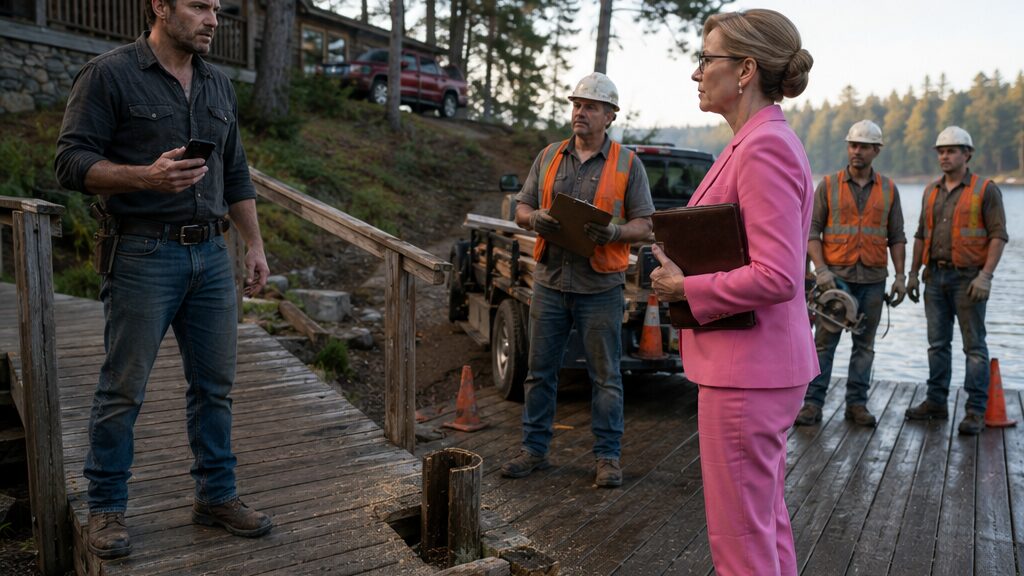
When The HOA Patrol Tried To Tear Out The Ramp That Kept His Mother Home
Chapter 1: The Ramp Was Already Coming Apart
The saw started before Edward Campbell found the notice.
At first, half awake in the upstairs bedroom, he thought the sound was a boat engine crossing the lake too close to shore. Then came the sharper bite of metal teeth through treated pine, a short scream that stopped, caught, and started again.
Edward was out of bed before he was fully dressed.
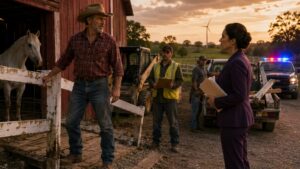
He pulled on jeans, missed one belt loop, and took the back stairs two at a time. Through the kitchen window he saw orange cones on his dock, a white pickup backed halfway down the slope, and two workers in yellow vests standing over the ramp he and John Lewis had finished bracing only yesterday evening.
One of the workers had already cut through the lower handrail.
The loose board hung crooked over the lake, one end pointing toward the water like a broken arm.
Edward pushed through the back door. “Stop.”
Neither worker heard him over the saw.
He ran across the dew-wet grass, boots sliding near the slope where the yard dipped toward the dock. The cabin behind him sat quiet, its wide windows catching the first gray line of morning. Beyond the dock, the lake looked falsely peaceful, green-blue and still against the mountain ridge.
“Stop the saw,” Edward said, louder.
The worker bent over the ramp lifted his face shield. The saw whined down. The second worker froze with a pry bar wedged under a post plate.
Edward stepped onto the first dock board and held out one hand, palm flat. “Nobody cuts another piece.”
The crew supervisor came around the truck with a clipboard tucked against his chest. He was not much older than Edward, but he had the practiced blankness of a man paid not to know too much. “Sir, you need to stand clear of the work area.”
“This is my dock.”
“We have a removal order.”
“From who?”
The supervisor looked toward the road before answering. “Association compliance.”
Edward stared past him at the ramp. The upper section still held, but the lower support post had been loosened. Silver bolts lay in a plastic tray. Two fresh holes showed where the first brace had already been pulled out. On the truck bed, stacked against a toolbox, were the handrail caps John had sanded smooth because Nancy hated splinters.
Edward felt the heat climb into his throat, but he kept his voice low. “Put those back.”
“Can’t do that.”
“You can if you took them off my property without speaking to me first.”
The supervisor’s eyes flicked to the phone in Edward’s hand. Edward had not realized he had grabbed it until then. He opened the camera and started recording.
“State your name and who authorized you to remove this ramp.”
The supervisor shifted his weight. One of the workers lowered the pry bar.
“Sir, I’m not comfortable being recorded.”
“You were comfortable cutting before sunrise.”
“We knocked.”
“No one knocked.”
“We were told notice was posted.”
Edward looked back toward the cabin. From the dock he could see the front porch only in pieces through the trees. No white paper on the back door. No call. No email. No warning that a crew would arrive while the house was still dark.
The supervisor took a breath. “The structure is noncompliant. That’s all I know.”
“It’s a ramp.”
“It’s attached to a dock.”
“It’s attached to a home.”
The man’s face tightened, not with cruelty but with irritation at being pulled into something bigger than his clipboard. “I need you to clear the area.”
Edward moved one step forward until his boots stood between the pry bar and the remaining post. He kept the phone up, chest-high, steady. “Show me a court order.”
The supervisor blinked. “It’s an HOA enforcement order.”
“That is not a court order.”
A motor sounded on the road above the cabin. Not a boat this time. An engine rolling slowly down gravel, tires crunching, then stopping where Edward’s driveway widened near the pines.
A red SUV came into view through the trees.
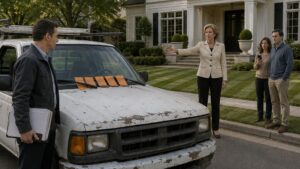
For a second, Edward did not understand what he was seeing. The vehicle had a narrow light bar flashing amber and white on top, and black block letters across the side panel: HOA PATROL. It looked close enough to an official vehicle to make the body react before the mind corrected it.
A woman stepped out in a bright pink suit, one hand smoothing the front of her jacket, the other holding a leather folder. She closed the door without hurry. Her hair was pinned tight. Her glasses caught the rising light as she looked down toward the dock and saw Edward standing in front of the half-dismantled ramp.
Kathleen Wright did not raise her voice when she approached. She did not need to. She walked like a person used to being obeyed before she finished a sentence.
“Mr. Campbell,” she said. “You were instructed not to interfere with association enforcement.”
Edward kept the phone recording. “Your crew started cutting my ramp before I was notified.”
“The notice was delivered.”
“When?”
Kathleen opened the folder. “This morning.”
Edward let the words hang there.
The supervisor looked away.
“This morning,” Edward repeated, “while the crew was already here?”
Kathleen’s mouth tightened. “The structure was installed without final architectural approval. It violates shoreline appearance standards and creates a potential insurance exposure for the association.”
“It is not decorative.”
“That is not the issue.”
“It is exactly the issue.”
Kathleen glanced at the phone. “Recording does not change the violation.”
“No,” Edward said. “But it changes what you can deny later.”
For the first time, something moved behind her expression. Not uncertainty. Calculation.
She looked past him at the ramp, at the cut handrail and the loosened support. “Mr. Campbell, you submitted an incomplete request.”
“I submitted drawings.”
“You submitted drawings after beginning construction.”
“I began temporary safety work because the old steps were not safe.”
“You do not get to decide unilaterally what is temporary, safe, or permitted under community rules.”
Edward almost said Nancy’s name.
He could feel it rise, the truth that would make the scene harder for Kathleen to flatten into a form number. He saw Nancy’s hand gripping the rehab bed rail, the way she had looked away when the therapist said the word transfer, the way she had told Edward she would rather crawl than have the neighbors pitying her.
He swallowed it back.
“Your rules don’t reach this far,” he said instead.
Kathleen’s eyes sharpened. “They reach every exterior alteration visible from common shoreline.”
“This is my deeded access.”
“That claim has not been verified.”
“I have the survey.”
“Then you should have submitted it during review.”
“You never completed the review.”
“We are completing enforcement.” She turned to the supervisor. “Continue with removal.”
The worker with the face shield did not move. His gloved hand rested on the saw handle.
Edward stepped backward until his heel touched the ramp threshold. Behind him, the remaining boards creaked. “That ramp is not coming out today.”
Kathleen closed the folder. “Do not make this more difficult than it needs to be.”
“You brought a crew onto my property before breakfast.”
“You created the violation.”
“I fixed a hazard.”
“You installed an unauthorized structure.”
The two phrases sat between them, both true in their own narrow way, neither touching what mattered.
Kathleen looked toward the road. “I can request county assistance if you continue obstructing the work.”
Edward lowered the phone just enough for her to see his face clearly. “Then request it. And when they get here, bring the order that says you can tear out a safety ramp on private land without a hearing.”
The supervisor exhaled through his nose.
Kathleen held Edward’s stare for another moment. Then she turned, walked a few steps up the dock, and spoke quietly into her phone.
Edward did not move. The lake lapped against the posts beneath him. Behind his boots, the ramp shuddered once in the wind where the cut rail no longer braced it. On the truck, Nancy’s smooth handrail caps waited in a pile like scrap.
When Kathleen returned, she had regained the clean, hard calm she had arrived with.
“The crew will pause for now,” she said. “Not withdraw. Pause.”
Edward said nothing.
“At noon,” she continued, “we will return with an officer present. If you still refuse access to the removal area, the association will file obstruction fines in addition to the structural violation.”
Edward looked at the torn post holes, then at the phone still recording in his hand.
Kathleen stepped around an orange cone, careful not to let her pink heel touch the sawdust. “You have until noon to prove that ramp is allowed to exist.”
Chapter 2: The Notice Left After The Saw Started
The notice was taped to the front door so neatly that Edward nearly missed the insult of it.
It sat centered at eye level, sealed in a plastic sleeve, the paper still flat and clean except for one damp corner where morning mist had touched it. The timestamp at the top read 6:42 a.m.
Edward checked his phone.
7:18.
By 6:42, the lower handrail had already been cut. By 6:42, bolts were already in the tray. By 6:42, the supervisor had already told him the removal order was active.
Edward pulled the sleeve off the door and carried it into the kitchen without opening it. Sawdust clung to the cuffs of his jeans. His hands smelled like wet pine and metal even though he had not touched the tools.
The cabin kitchen was still half-prepared for Nancy’s return. A pill organizer sat beside the coffee maker. A folded walker waited near the hallway wall. He had moved the small table two feet closer to the window because she liked looking at the lake in the mornings, even before the stroke, even before she needed someone to count the distance between chair and counter.
He set the notice on the table and took photos of it before breaking the seal.
VIOLATION AND REMOVAL AUTHORIZATION.
The words were bold enough to feel proud of themselves.
Below them, the letter cited shoreline uniformity, exterior alteration rules, unapproved attachment to dock infrastructure, and potential liability exposure. It ordered removal of the noncompliant structure and warned that interference with approved enforcement activity could result in daily fines.
Edward photographed every page.
Then he walked back outside and photographed the door, the tape mark, the path from the door to the dock, the tire tracks in the gravel, the sawdust on the lower boards, the orange cone left behind near the ramp. He took close-ups of the cut rail and the empty tray of bolts the crew had forgotten beside the post.
He was kneeling near the ramp when his phone rang.
The rehab center number appeared on the screen.
Edward stood too fast. “This is Edward.”
A nurse’s voice came through first, cheerful in the way people sounded when reading from a schedule. “Calling to confirm transport details for Nancy Campbell.”
His eyes went to the ramp opening. “For Friday.”
There was a pause. Paper shifted on the other end. “For tomorrow morning.”
“No,” Edward said. “Her discharge was Friday.”
“It was moved up after yesterday’s evaluation. The note says family was informed.”
Edward closed his eyes.
Nancy had been informed. Of course she had. And Nancy, who hated fuss and hated being discussed like furniture being delivered, had decided he did not need one more thing to worry about.
“Is she there?” Edward asked.
“One moment.”
He heard muffled voices, the low beep of medical equipment, then a rustle close to the receiver.
“You sound like you’re standing outside,” Nancy said.
Edward looked down at the fresh cut in the rail. “I am.”
“Is the ramp finished?”
He turned away from the dock as if she could see his face through the phone. “Mostly.”
“That is not an answer.”
“It needs a little adjustment.”
“Edward.”
He stared across the water. On the far side of the lake, morning sun had touched the opposite ridge. The kind of view people bought into the community for. The kind Kathleen probably thought she was protecting.
“The HOA showed up,” he said.
Nancy was quiet for a beat. “About the ramp?”
“Yes.”
“I told you not to fight them.”
“You told me not to make you the subject of neighborhood gossip.”
“That too.”
“They started removing it.”
Her breathing changed. Not much. Just enough.
“How much?” she asked.
“Enough that I stopped them.”
“Edward, I can use the steps if I take my time.”
“No, you can’t.”
“You don’t decide what I can do.”
“I watched the therapist decide yesterday.”
“That therapist is twenty-six and thinks everyone over sixty is made of glass.”
“You grabbed the rail with both hands and still nearly missed the turn.”
Silence.
He regretted the words as soon as they left him. Not because they were false, but because they were the kind of truth Nancy stored away and bled over later.
When she spoke again, her voice had thinned. “I am coming home tomorrow.”
“I know.”
“I am not going to a facility because some board woman dislikes lumber.”
“You’re not going anywhere but home.”
“Then fix it.”
He almost laughed, not because anything was funny, but because those two words were Nancy in full: no speech, no pity, no permission asked from the world.
“I’m trying,” he said.
“Try harder before you start sounding noble.”
The line clicked off.
Edward held the phone a moment longer.
Then he called John Lewis.
John answered on the third ring over background noise that sounded like a jobsite radio. “Tell me they didn’t touch it.”
“They cut the lower rail.”
A sharp word came through the receiver, swallowed halfway. “I told them that thing was temporary bracing.”
“They say you built without approval.”
“I built after you showed me the email saying they had everything they needed.”
“They’re saying the request was incomplete.”
“It was not incomplete.” John’s voice hardened. “I sent measurements, material specs, slope ratio, fastening plan, everything they asked for.”
“Do you have copies?”
“I have the whole chain.”
Edward stepped back into the kitchen and opened a drawer where he kept old utility bills, tape measures, batteries, and receipts he always meant to sort. “Send them.”
“I’ll forward it now.”
“And John?”
“Yeah?”
“Did anyone from the HOA tell you removal was scheduled?”
“No. Yesterday afternoon, Kathleen asked whether I had a permit number. I said it was repair work on private property and a temporary access accommodation. She said she would review the file.”
Edward looked at the notice again. “She reviewed fast.”
“Fast is not the word I’d use.”
Emails started arriving before John finished speaking. One after another. Attachments. Drawings. Photos. A message from John to the architectural review inbox sent four weeks earlier. A follow-up two weeks later. Another from three days ago, marked urgent because of medical discharge timing.
Edward opened the latest one.
No reply.
He forwarded everything to himself again, then saved the files in a folder named RAMP. His hands were steady now, which worried him more than shaking would have. Anger, once sorted into tasks, became something he could stand inside for hours.
At 9:06, another email arrived.
This one came from the HOA.
NOTICE OF EMERGENCY COMPLIANCE INSPECTION.
Scheduled for 12:00 p.m. same day. Attendance: compliance chair, enforcement contractor, county officer if required.
Edward read the line twice: continued obstruction may result in fines and removal costs charged to owner account.
He printed it. The old printer in the corner coughed and dragged the paper through slowly, one pale line at a time.
On the counter, Nancy’s pill organizer caught his eye again. Monday through Sunday. Morning, noon, night. Ordinary plastic squares waiting for an ordinary life to resume. He had promised her that. Not in a dramatic way. Not beside a hospital bed with music swelling. He had promised while adjusting her blanket and pretending not to see her cry.
You’ll come home, he had said. I’ll make it work.
He had not said, I’ll ask the HOA.
He had not said, I’ll tell the neighbors.
He had not said, I’ll let strangers decide whether you can reach your own door.
The phone rang again.
This time it was Nancy’s personal number.
Edward answered softly. “Mom?”
“I forgot to tell you,” she said, and her voice was too casual. “Transport is at nine tomorrow. They changed it because someone else needed the Friday slot.”
“I heard.”
“You sound angry.”
“I’m handling it.”
“That is what you say when you are not handling it.”
He looked through the kitchen window at the broken ramp.
“I need you to tell me exactly what the discharge paperwork says about steps,” he said.
Nancy did not answer.
“Mom.”
“They wrote supervised transfers. Rail support. No uneven surfaces.” She let out a small, bitter laugh. “Very flattering.”
“I need that in writing.”
“No.”
“It matters.”
“No, Edward. I am not having my medical papers passed around a boardroom.”
“I didn’t say boardroom.”
“You didn’t have to.”
He pressed his knuckles into the counter. “They’re coming back at noon.”
“Then show them your survey. Show them your emails. Show them you did the paperwork.”
“I will.”
“That should be enough.”
Edward looked at the ramp again, at the missing rail, at the narrow old steps beside it that Nancy was pretending she could still manage.
“It should,” he said.
But when the call ended, the word should stayed in the kitchen like a weak board under too much weight.
At 9:32, a final message arrived from the rehab center confirming tomorrow’s discharge.
Edward opened it and read the transport line three times.
Nancy Campbell will be released to home care tomorrow at 9:00 a.m.
Outside, the cut handrail shifted in the breeze and tapped once against the dock post, a hollow sound like someone knocking from the wrong side of a locked door.
Chapter 3: The Pink Suit At The Property Line
The red SUV blocked the driveway before Edward could finish taping the survey folder shut.
It stopped sideways across the gravel, the words HOA PATROL facing the cabin like a warning sign. The light bar flashed in the noon glare, unnecessary and theatrical. Behind it, a county vehicle rolled to a slower stop near the pine trees.
Edward’s phone buzzed on the kitchen counter.
TRANSPORT CONFIRMATION: Nancy Campbell pickup scheduled tomorrow at 9:00 a.m. Please ensure safe access at residence.
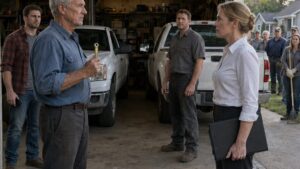
He read the message once, then looked through the window at Kathleen Wright stepping out of the SUV in the same pink suit, the same folder under her arm, the same careful posture that made every movement look official.
This time, she had brought an officer.
Edward picked up his phone, the printed email chain, and the old survey he had not yet had time to verify. Then he walked outside.
The crew was already near the dock, but the saw was still off. The supervisor stood with his arms folded, looking relieved to have someone else in charge. The two workers kept their distance from the ramp. The orange cones had been moved wider, as if widening the work area made the order more legitimate.
Kathleen met Edward halfway down the slope.
“Mr. Campbell,” she said, “we are here for the emergency compliance inspection.”
“You’re here to remove the ramp.”
“We are here to complete an enforcement action you obstructed.”
Edward turned the phone camera on. “Officer, I want it clear on record that I am not threatening anyone and I am not touching the crew. I am refusing to let them remove a safety ramp without legal authority.”
The officer, a broad man with tired eyes, glanced from Edward to Kathleen. “Let’s slow down.”
Kathleen’s expression did not change, but her jaw moved once. “The association has authority under its governing documents to remove unapproved exterior structures after notice.”
“The notice was posted this morning after the crew arrived,” Edward said.
Kathleen opened her folder. “The notice was posted before this inspection.”
“Not before demolition.”
The officer looked toward the dock. “Work was started before he saw the notice?”
The supervisor cleared his throat. “We were told notice had been posted.”
“That is not what I asked,” the officer said.
Kathleen stepped in smoothly. “The timing of delivery does not change the owner’s underlying violation.”
“It changes whether you had the right to start cutting,” Edward said.
Kathleen turned to him. “You are focusing on procedure because the structure itself is indefensible.”
Edward held up the first page of John’s submission. “Four weeks ago, my contractor sent measurements and materials.”
“Architectural review was incomplete.”
“You never said that.”
“We requested additional clarification through the portal.”
“No one answered the emails.”
“Owners are responsible for monitoring official channels.”
Edward almost laughed. “You can send a crew to my dock before sunrise, but you can’t reply to an email?”
The officer raised one hand. “Everyone take a breath.”
For a moment only the lake moved, small waves ticking against the dock posts. Edward could see the old steps beside the ramp, narrow and uneven from years of freeze and thaw. Before the stroke, Nancy had complained about them every spring and refused to let him replace them because they still worked. That had been her standard for everything. If it still worked, you did not make a production out of it.
Now the old steps looked like a dare.
Kathleen followed his gaze. “The existing steps remain available.”
Edward turned back to her slowly. “Available to whom?”
“To the property.”
“The property does not walk.”
The officer’s eyes shifted toward Edward, but Kathleen was already speaking.
“The association cannot permit every owner to build visible alterations based on personal preference. Lakefront structures affect sight lines, drainage, maintenance access, and insurance. Last year, an unapproved dock addition failed during a gathering and caused an injury claim. Our insurer has since flagged unauthorized shoreline modifications as a community-wide liability concern.”
There it was. Not cruelty. Fear dressed as policy.
Edward looked at the crew supervisor, who stared down at his boots. Then at the officer, who was listening now with the wary patience of someone who knew civil disputes could become messes no report wanted to hold.
“Kathleen,” Edward said, using her first name because the situation had already become too personal for titles, “you are talking about a party deck. This is a ramp.”
“It is attached to the dock structure.”
“It is braced to the dock because the grade from the house to the water drops six feet.”
“And it was not approved.”
“It was submitted.”
“It was built.”
“Because it was needed.”
Kathleen’s eyes sharpened. “Needed for what, specifically?”
Edward felt the trap and the shame at the same time.
He could say it. He could say stroke, supervised transfer, walker, discharge, fall risk. He could turn Nancy into the argument Kathleen could not step around. He could also hear Nancy’s voice from the morning: I am not having my medical papers passed around a boardroom.
He held up the survey instead.
“This ramp sits on my deeded access strip.”
Kathleen glanced at the paper but did not reach for it. “That has not been established.”
“It’s on the survey.”
“That survey is old.”
“It’s recorded.”
“Recorded does not mean exempt from community standards.”
The officer took the paper from Edward when Kathleen would not. He scanned the faded lines, then looked toward the shoreline. “I can’t rule on property boundaries standing here.”
“I’m not asking you to,” Edward said. “I’m asking whether an HOA order is the same thing as a court order.”
“No,” the officer said.
The single syllable landed hard enough that even the crew supervisor looked up.
Kathleen closed her folder halfway. “Officer, with respect, the association has contractual enforcement rights.”
“And he has the right not to have people keep cutting while there’s a dispute about notice and access,” the officer said. “I’m not here to litigate your bylaws.”
Edward let out a breath he had not meant to hold.
Kathleen looked at the officer, then at Edward. For the first time, irritation broke through the polished surface. “So any owner can stand in front of a contractor and stop enforcement by claiming a private exception?”
“No,” the officer said. “But I’m not forcing him off his own dock for an HOA removal order. You want that, you need the proper civil process.”
Edward should have felt victory.
Instead he saw tomorrow morning at nine. A transport van. Nancy in a wheelchair at the top of the slope. The old steps waiting.
Kathleen turned to the supervisor. “Pack up for now.”
The man nodded too quickly.
“For now,” she repeated, looking at Edward. “This matter goes before the board tonight. Until then, the existing violation remains. The owner’s interference will be documented.”
“Document all of it,” Edward said.
“I intend to.”
She took a form from her folder, wrote with quick hard strokes, tore off the top copy, and held it out.
Edward did not take it at first.
Kathleen extended it another inch. “Notice of obstruction fine. Effective today.”
The officer sighed quietly but said nothing.
Edward accepted the page. The fine amount was printed in a neat box near the bottom. Daily accrual possible. Removal costs chargeable to owner. Board review pending.
Behind Kathleen, the crew loaded the saw back into the truck. The ramp remained half-standing, half-wounded, one rail missing and one support loosened enough to make the whole lower turn unsafe.
Kathleen walked back toward the red SUV. Before getting in, she paused beside the driver’s door.
“You have until tonight to bring whatever documents you believe matter,” she said. “But understand this, Mr. Campbell. The board cannot govern by exception.”
Edward folded the fine notice once.
On his phone, Nancy’s transport confirmation still glowed.
He looked past Kathleen to the dock, where the gap in the handrail opened toward the lake.
“Then tonight,” he said, “you can explain what kind of rule makes a house impossible to enter.”
Kathleen got into the SUV without answering.
The light bar flashed once across Edward’s kitchen windows as she turned around in the drive, and when the red vehicle disappeared up the road, the fine notice was still in his hand, making official what the saw had already
Chapter 4: The Survey Nobody Wanted To Read
“This parcel has an exception attached.”
The county clerk said it without looking up, as if exceptions were ordinary things and not the difference between Edward’s mother coming home or being carried through a yard like luggage.
Edward stood on the public side of a scratched counter, the obstruction fine folded in his back pocket and the old survey open under both hands. The county records office smelled like dust, toner, and damp coats. A plastic sign warned visitors not to lean on the counter. Edward was leaning anyway.
“What kind of exception?” he asked.
The clerk adjusted her glasses and tapped at her keyboard. “Private access strip. Deeded with the original lakeshore subdivision. It looks like your lot carries a retained easement from the cabin grade down to the waterline.”
Edward stared at the faded survey lines. He had seen them before. His father had kept the original in a metal tube in the hall closet, rolled tight with old tax maps and yellowed septic permits. Edward had looked at it the way people looked at heirlooms they did not understand—important because someone older had said so, not because the lines could someday matter.
“Is that HOA common shoreline?” he asked.
The clerk gave him a look over the top of her glasses. “Not according to this.”
The words should have loosened something in him. Instead they tightened everything.
“Can I get certified copies?”
“You can. It may take a few minutes.”
“I need them now.”
The clerk’s fingers paused above the keyboard. She looked at his jeans, the sawdust still clinging to one knee, the folded papers under his arm, the phone he kept checking every few minutes. Her voice softened only a little. “Emergency?”
“Access.”
She did not ask for whom. Edward was grateful and ashamed of being grateful.
While the printer behind her warmed up, he stepped away from the counter and called John Lewis. The contractor answered with wind in the background.
“You find anything?” John asked.
“Maybe. The dock strip may be private.”
“That explains why your father always said the HOA hated that old map.”
Edward looked down at the survey. “He said that?”
“Once. Years ago. I was replacing boards on your lower steps. He told me, ‘They can complain about the color, but they don’t own the dirt.’ I thought he was just being himself.”
Edward rubbed the bridge of his nose. His father had been dead six years, and still the man was leaving him instructions in sentences Edward had not taken seriously enough.
“Can you meet me at the house after the board notice comes through?” Edward asked.
“I can. But Edward, if the ramp is for a medical access issue, boundary may not be enough.”
“I know.”
“Do they know?”
Edward did not answer.
John let the silence sit only a second. “That’s what I thought.”
“She doesn’t want people knowing.”
“Nancy doesn’t want help carrying groceries either. That doesn’t mean you let her carry a fifty-pound bag up wet stairs.”
Edward looked toward the clerk, who was pulling warm sheets from the printer. “I’ll call you back.”
He hung up before John could say anything else.
The certified copies came out in a neat stack with an embossed seal pressed into the corner. The clerk highlighted the parcel exception and slid the papers through the gap in the glass. “This does not settle association rules,” she said.
“I know.”
“It may settle who owns what.”
“That’s enough for now.”
“Sometimes enough for now becomes expensive later.”
Edward met her eyes. “Expensive already showed up with a saw.”
For the first time, the clerk almost smiled.
In the truck, he spread the new copies across the passenger seat and compared them to the old survey. The highlighted strip ran from the cabin property line down the slope, narrowing near the dock, then widening at the lower platform where the ramp turned. It passed directly through the area Kathleen had called common shoreline.
He photographed each page, then sent copies to himself, John, and the HOA board email address. His message was brief.
Certified county survey attached. Removal order is disputed. Ramp sits within deeded private access strip. Do not resume removal.
He hesitated before sending one more line.
Medical necessity documentation available upon proper accommodation review.
His thumb hovered over the screen.
Available. Not attached. Not public. Not enough.
He hit send anyway.
The reply came faster than he expected, not from Kathleen but from the HOA’s automated mailbox.
Your message has been received.
No promise. No pause. Just a digital hand extended to take documents no person might read.
Edward sat behind the wheel, engine off, while people crossed the county parking lot with folders and coffee cups, each carrying some private version of urgency. He opened Nancy’s discharge email again. Safe access at residence. The phrase looked mild, almost polite. It did not show her right hand trembling when she tried to grip too quickly. It did not show the way she stared at her left foot as if it had become someone else’s. It did not show the old steps by the dock, narrow and slick at the turn.
He had built the ramp because Nancy had asked him not to tell people why she needed one.
No. That was not the whole truth.
He had built it because telling people would have meant admitting the stroke had changed more than one week of their lives. It would have meant answering neighbors’ careful questions. It would have meant seeing Nancy’s pride flinch in public and feeling his own helplessness exposed beside it.
He told himself he was protecting her privacy.
But part of him had been protecting the version of their life where he could fix things with lumber, bolts, and silence.
His phone rang.
Lisa Rivera’s name appeared on the screen.
Edward let it ring twice before answering. “Lisa.”
“I saw your email.”
He straightened. Lisa lived two houses up from the bend in the shoreline, close enough to see the dock from her breakfast porch if the trees were thin. She had been on the board three years and had the kind of cautious voice that never revealed how she would vote until the motion was already passing.
“Did anyone else read it?” Edward asked.
“I can’t speak for everyone.”
“That sounds like no.”
“It sounds like Kathleen has called an emergency meeting for six.”
Edward closed his eyes. “Tonight?”
“Yes.”
“She told me board review. She didn’t say a vote.”
“There is a proposed motion for permanent removal if the structure remains noncompliant.”
“Permanent removal of a ramp they already damaged before notice.”
“I’m not arguing with you.”
“Then what are you doing?”
Lisa was quiet for a moment. “Trying to understand what you’re not saying.”
Edward looked at the county seal on the survey copy. “The survey says the access strip is mine.”
“I saw.”
“Then the HOA had no right to send a crew.”
“The survey complicates the property question. It doesn’t answer the exterior alteration question.”
He gave a short laugh. “You sound like Kathleen.”
“I sound like someone who knows how the board will frame it.”
“And how will you frame it?”
Another pause.
“I’ll ask why removal began before the notice period,” she said.
“That’s all?”
“That may be more than you think.”
Edward stared out through the windshield. “My mother comes home tomorrow.”
The words left him before he could narrow them into something safer.
Lisa did not speak.
He gripped the phone. “That ramp was not for a boat cart. It was not for furniture. It was so she could get from the driveway to the cabin and from the cabin to the lower entrance without using those old steps.”
“Edward,” Lisa said, and her voice changed.
He hated that change. The softened edge. The instant translation of his household into community concern.
“Don’t,” he said.
“Don’t what?”
“Don’t turn her into a sympathy item.”
“I wasn’t.”
“She doesn’t want that.”
“What does she want?”
“To come home.”
“Then bring what proves that.”
He looked at the folded discharge email on the seat. “She told me not to.”
“Then bring enough to protect her without making a spectacle.”
“There may not be such a thing with Kathleen running the room.”
Lisa exhaled. “There will be if you keep your temper.”
“My temper stopped a saw.”
“And tonight it could cost you votes.”
Edward hated that she was right.
At the house, the damaged ramp looked worse in the afternoon light. The lower rail was gone completely. The loosened post leaned by half an inch. The orange cones were still there, bright and stupid against the wood. Edward tucked the certified survey into a folder beside John’s emails and the obstruction fine.
Then he went to the hall closet, took out Nancy’s discharge instructions, and stood with them in his hand for a long time.
The phone buzzed again.
Lisa had sent one line.
Board vote is at six. Kathleen is asking for immediate permanent removal.
Edward looked through the window at the half-broken ramp, then down at the medical papers he was still not ready to show anyone.
Chapter 5: The Board Called It A Structure
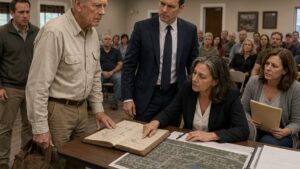
Edward walked into the clubhouse and saw his mother’s handrail lying on the board table.
For a second he forgot the room, the folding chairs, the framed lake rules on the wall, the small crowd of residents pretending not to watch him too directly. All he saw was the smooth length of pine John had rounded at the edges because Nancy’s grip had weakened and splinters would catch her palm.
A white evidence tag had been tied around one end.
Unauthorized shoreline attachment.
Edward stopped just inside the doorway.
Kathleen Wright stood at the front of the room in her pink suit, papers arranged in clean stacks before her. She had not raised her voice all day, and somehow that made the damage feel more deliberate. Beside her sat three board members. Lisa Rivera sat at the far end, hands folded, face unreadable.
Kathleen looked at Edward’s folder. “Mr. Campbell. You may sit.”
He stayed standing. “Why is part of my ramp on your table?”
“It was removed as part of the enforcement process before you obstructed further work.”
“It was cut off before notice.”
A murmur went through the room.
Kathleen tapped one paper straight. “We will maintain order.”
Edward walked to the front row and sat, placing his folder across his knees. The handrail remained in view, not a piece of wood now but a public accusation. It made him look reckless. It made the ramp look like a thing dragged in from a violation scene, not a path built for his mother’s unsteady hand.
Kathleen began with procedure.
She read the section numbers. Exterior alterations. Shoreline appearance. Unapproved construction. Insurance exposure. Owner responsibility. She did it with the calm of a person stacking bricks into a wall.
Edward listened until she reached the word structure for the third time.
“It is a ramp,” he said.
Kathleen looked up. “You will have time to respond.”
“You keep calling it a structure because structure sounds optional.”
“It is structurally attached to the dock.”
“It is attached so someone does not fall.”
A board member shifted in his chair. Someone in the back whispered.
Kathleen’s eyes moved toward the room, measuring the noise. “Mr. Campbell, the board is not evaluating personal preference tonight. We are evaluating whether an owner built a visible alteration without approval.”
Edward stood. He did not mean to, but once he was up, sitting again would look like surrender.
“I submitted the contractor’s drawings. Four weeks ago. Follow-up emails. Material specs. Slope, rails, bracing. No one answered.”
Kathleen lifted a printed page. “The portal reflected incomplete documentation.”
“The portal never emailed me.”
“Owners are responsible for reviewing their account status.”
“And the HOA is responsible for not cutting before notice.”
Lisa finally moved. She leaned forward. “Kathleen, I would like the timeline clarified before we go further.”
Kathleen turned her head slowly. “The timeline is in the packet.”
“I read the packet. It says notice delivered at 6:42 this morning. Mr. Campbell’s video appears to show removal already underway before 6:42.”
The room changed. Not loudly. Just the subtle rearrangement of attention when people realized one board member was not staying in line.
Kathleen’s voice remained even. “The contractor was staged for removal pending notice.”
“Staged with a saw running?” Edward asked.
Kathleen looked at him. “Again, you will have time.”
Lisa did not look away. “Did the board approve same-day removal before the owner had a chance to appeal?”
“The compliance office authorized emergency action under the insurer’s advisory.”
There it was again. Insurer.
Edward opened his folder. “What advisory?”
Kathleen hesitated.
It was small. Anyone not watching her closely might have missed it. Edward did not.
“After last year’s dock injury, our carrier requested stricter review of all owner-installed shoreline additions,” Kathleen said.
A man in the second row muttered, “That was the Jackson rental deck.”
Kathleen’s face tightened. “The specific property is not relevant.”
“It is relevant if you are using someone else’s party deck to tear out my ramp.”
“The board cannot govern by emotion.”
“No,” Edward said. “Apparently it governs by fear.”
That landed badly. He knew it as soon as he said it. The room stiffened, and Kathleen’s expression cooled into something almost grateful. He had given her a cleaner version of him to oppose.
“Mr. Campbell,” she said, “this is exactly the concern. You have treated the association’s review process as an inconvenience rather than a requirement. You built first, argued later, and now you are asking the board to excuse a violation because you personally believe your reasons are sufficient.”
Edward felt the folder bend under his grip.
Lisa glanced at him, a warning in her eyes. Keep your temper.
He opened the folder and placed the certified survey on the table. “This is the deeded access strip. The ramp sits inside it. Not on common shoreline.”
Kathleen took the copy but did not look at it long. “Property ownership does not automatically override exterior standards.”
“It should override your right to enter and cut.”
“Perhaps. That can be reviewed.”
“Reviewed after you finish removing it?”
A few residents murmured again.
Edward put John’s emails beside the survey. “Here are the contractor submissions. Four weeks of unanswered messages.”
Kathleen picked up the email chain. “These show attempted communication. They do not show approval.”
“They show I did not ignore the process.”
“They show you proceeded without completion of the process.”
The words were maddening because they were partly true. Edward had told John to begin after the rehab therapist called about Nancy’s discharge schedule. He had convinced himself no reasonable person would object to temporary safety work. He had not waited for the portal to bless common sense.
Kathleen turned to the board. “This is why exceptions are dangerous. If every owner may decide that their alteration is urgent, our standards become suggestions. Then enforcement becomes selective. Then the association carries liability for structures it did not approve and cannot verify.”
For the first time that day, Edward heard the fear under her voice. Not sympathy. Not doubt. Fear of being the person blamed when something failed. Fear of a rulebook losing its grip. Fear, maybe, of standing in a room after an accident and having everyone ask why she had let one exception pass.
Lisa folded her hands tighter. “Was there any attempt to inspect the ramp for safety before removal?”
Kathleen looked at her. “The issue is approval.”
“That is not what I asked.”
A board member beside Kathleen cleared his throat. “Maybe we should hear why the ramp was urgent.”
The room turned toward Edward.
He felt the medical papers inside the folder like a weight he had carried all day and refused to set down. Nancy’s discharge instructions. Fall risk notes. Supervised transfer. Rail support. No uneven surfaces. Words written by professionals who had seen what Edward still wanted to keep private.
Kathleen watched him. “Mr. Campbell, is there a documented medical necessity for this ramp?”
The room became too quiet.
Edward saw Nancy in the rehab bed, chin lifted, telling him no. He saw the old steps, the cut rail, the transport van scheduled for morning. He saw the handrail on the table with the evidence tag around it like a label on someone else’s mistake.
He opened the folder.
His fingers found the medical papers.
Then stopped.
“My mother is coming home tomorrow,” he said.
Kathleen waited. “That does not answer the question.”
Edward looked at the faces in the room. Neighbors. Board members. People who had waved from docks, borrowed tools, complained about boat noise. People who would know by breakfast that Nancy Campbell could not manage her own steps.
“She needs safe access,” he said.
“Is there documentation?”
The paper edge pressed into his thumb.
Lisa’s voice was quieter. “Edward.”
He could not tell whether she was urging him forward or warning him there was no way back.
He pulled out the discharge instruction sheet halfway, saw Nancy’s name printed at the top, and stopped again.
Kathleen looked from the paper to his face. “Without documentation, the board has only an owner’s statement after an unauthorized build.”
Edward slid the paper back into the folder.
His mother’s pride stayed hidden.
The ramp stayed condemned.
Kathleen turned to the board. “Then I move that the violation remain active, that removal be completed pending final review, and that daily obstruction fines continue until compliance is restored.”
Lisa’s chair scraped the floor. “I object to voting tonight without resolving the notice issue.”
“Your objection will be noted.”
Edward looked down at his folder, at the documents that proved land but not need, process but not enough, effort but not permission.
Kathleen faced him across the table, the handrail between them.
“Mr. Campbell,” she said, “one last time. Is anyone in the home under a documented medical restriction that requires this specific ramp?”
Edward’s hand closed over the folder until the corners buckled, and for the first time all day, he had no answer he could give without betraying someone.
Chapter 6: What The Ramp Was Really Holding
The transport van arrived with its lift lowered and nowhere safe to set Nancy down.
Edward stood at the edge of the driveway as the driver looked from the van to the broken ramp, then to the old steps descending toward the cabin’s lower entrance. The morning air smelled of lake water and sawdust. The orange cones were still near the dock, tipped slightly from wind. The lower handrail was gone. The post holes gaped dark in the boards.
Inside the van, Nancy Campbell sat upright in a wheelchair with a gray blanket over her knees and her chin raised as if posture alone could repair the path home.
The driver stepped closer to Edward and lowered his voice. “Sir, I can bring her to the driveway, but I can’t take her down those steps. Not with that turn.”
Edward looked at the steps. Narrow. Damp. Uneven at the third tread. He had known it. The driver saying it aloud still felt like a door closing.
“I can carry her,” Edward said.
Nancy heard him through the open van door. “You will not.”
The driver shook his head. “We’re not allowed to assist with carrying over unsafe terrain.”
“I’m not asking you to.”
“I’m telling you I can’t release her into a fall hazard if there’s no safe access.”
Nancy’s hand tightened on the wheelchair arm.
Edward stepped to the van. “Mom.”
“Do not use that voice.”
“What voice?”
“The voice that thinks I am not in the conversation.”
He swallowed. “The ramp is damaged.”
“I can see that.”
“I’m working on it.”
“You said it needed adjustment.”
“It did.” He looked at the cut rail. “Then they made sure it needed more.”
Her eyes moved from the ramp to the cones, to the empty places where the posts had been, to the handrail gap opening toward the lake. Her mouth pressed into a line Edward knew well. Pain held behind pride.
A car slowed on the road above.
Edward turned.
Lisa Rivera pulled into the shoulder near the pines and got out before the engine fully quieted. She wore jeans and a dark jacket, not board-meeting clothes. Her face changed when she saw the van lift down, the wheelchair, the driver standing with his tablet, and Nancy looking at the broken ramp as if it had betrayed her personally.
“I came to check the notice posting,” Lisa said, then stopped. “Edward.”
He almost told her to leave.
Nancy’s eyes narrowed. “Who is that?”
“Lisa Rivera,” Edward said. “HOA board.”
Nancy’s head turned sharply toward him. “You brought the board here?”
“No.”
Lisa lifted both hands slightly. “Mrs. Campbell, I’m sorry. I didn’t know transport was already here.”
“I am not Mrs. Campbell to people who send crews to my house.”
Lisa accepted that without flinching. “Fair.”
Edward moved between the van and the broken ramp, though he was no longer sure whom he was protecting from whom.
The driver checked his tablet again. “I need a decision. I can wait a few minutes, but I can’t block the schedule long.”
Nancy reached for the wheelchair brake. “Unlock this.”
“Mom,” Edward said.
“Unlock it.”
The driver looked uncertainly at Edward.
Nancy did not raise her voice. “I said unlock it.”
Edward stepped into the van and released the brake himself. If he refused, she would remember that longer than she remembered any fall.
He guided the chair onto the lift. The platform lowered with a mechanical hum that seemed too loud in the still morning. Nancy kept her eyes on the cabin, not on Lisa, not on the ramp. When the wheels reached gravel, she pushed at the chair arms.
“What are you doing?” Edward asked.
“Standing.”
“No.”
“Move.”
The word was quiet enough that only he heard the tremor in it.
Edward set the chair brakes and crouched in front of her. “You don’t have to prove anything.”
Her eyes flashed. “That is exactly what people say when they have already decided you cannot.”
Lisa looked away, but not soon enough.
Nancy pushed herself up.
For one second, it almost worked. Her right hand found Edward’s forearm. Her left foot planted. Her body leaned forward with stubborn memory of strength. Then the gravel shifted under her shoe, and the missing rail at the turn below seemed suddenly not like property damage, not like a compliance dispute, but like an absence waiting to hurt her.
Her fingers clamped around Edward’s arm hard enough to hurt.
The driver stepped forward. Edward caught her weight before she could tilt, one hand at her elbow, one at her back. Nancy made no sound. That was worse. Her face drained of color, but her chin stayed lifted, fighting the humiliation harder than the weakness.
“Chair,” Edward said.
The driver rolled it closer.
Nancy sat because her legs made the decision before she could argue.
No one spoke.
The lake moved below them, bright and indifferent. A gull cut across the water. Somewhere down the slope, the loosened ramp board tapped once against a post.
Lisa’s voice came carefully. “That ramp was the only safe route?”
Edward looked at her. “Yes.”
Nancy turned on him. “You told them?”
“No.”
“You did. Last night.”
“I didn’t show the papers.”
“You think that matters?”
“I was trying to protect what you asked me to protect.”
Her laugh was small and bitter. “By letting them tear out the thing I needed?”
Edward had no defense.
Lisa stepped closer, her eyes on the gap where the rail had been. “Mrs. Campbell, I owe you an apology.”
Nancy looked at her. “I need a way into my house, not an apology.”
Lisa nodded. “Then that’s what I’m going to work on.”
Edward did not trust the sudden shift. “What does that mean?”
“It means Kathleen told the board this was an unapproved shoreline structure. She did not tell us removal had already made access unsafe for a resident being discharged today.”
“She asked me for documentation.”
“And you didn’t give it.”
Nancy’s face tightened.
Edward said, “That was my choice.”
“No,” Nancy said. “It was mine.”
Lisa looked between them, and for once there was no board caution in her face. Only the discomfort of seeing a private bargain collapse in public.
The driver cleared his throat. “I can bring her back to the rehab center temporarily.”
“No,” Nancy said.
Edward closed his eyes.
“Mom.”
“I am not going backward.”
“Then we need a safe path.”
She looked at the broken ramp. “We had one.”
The sentence landed harder than anger.
Edward crouched beside her chair. “I should have told them enough. Not everything. Enough.”
Nancy’s eyes shone, but she did not let the tears fall. “I asked you not to make me a case.”
“I know.”
“And you promised me home.”
“I know.”
“Those promises are fighting each other now.”
He looked down at his hands. Sawdust still lived under one fingernail from yesterday. He had thought the work was the promise. Boards, bolts, rail height, slope. If he built it right, no one would need to know why. If he worked fast enough, Nancy could come home into a version of life that looked almost unchanged.
But the missing handrail had told the truth for him.
Lisa’s phone rang. She looked at the screen, frowned, and stepped away to answer. Edward heard only pieces.
“No, not adequate access… I’m standing here… because the condition changed when removal began… Kathleen, I understand the motion…”
Nancy’s eyes followed Lisa. “That woman is talking to the pink suit?”
“Yes.”
“Do not let them discuss me like I’m not sitting here.”
“I won’t.”
“You already did.”
Edward took that because it was true.
Lisa returned with her phone still in hand. Her expression had hardened, not against Edward now, but toward something beyond him.
“Kathleen has called a final enforcement vote for sunset,” she said.
Edward stood. “She saw this and still wants a vote?”
“She has not seen this.”
“Then send her a picture.”
Lisa looked at Nancy before answering. “I will not send your image without permission.”
Nancy studied her for a long moment. “Good.”
Lisa continued, “But I can report that the current condition creates an access barrier. I can also request that removal remain suspended pending accommodation review.”
“Request?” Edward said.
“I’m one board member.”
“Then what do I do?”
Lisa looked at the ramp, then at the van, then at Nancy’s hands folded tightly in her lap. “Bring the survey. Bring the timeline. Bring the medical restriction if she allows it. And bring a repair plan that shows this is not just allowed, but safer than what they left.”
Nancy stared toward the cabin. “And if I don’t allow it?”
Edward waited.
Lisa’s answer was quiet. “Then they will keep calling it a structure.”
Nancy closed her eyes.
Edward heard the van lift creak in the breeze. He heard the hollow tap of the cut ramp below. He heard, beneath both, the thing he had avoided all week: pride could keep a secret, but it could not hold a railing.
Nancy opened her eyes and looked at him. “Not the whole file.”
“No.”
“No details they don’t need.”
“No.”
“Only what proves the steps are unsafe.”
Edward nodded.
“And Edward?”
“Yes.”
“If they talk about me like I’m not a person, you stop them.”
He placed his hand over hers, lightly enough that she could pull away if she wanted. She did not.
Lisa glanced toward the road, phone already buzzing again. “Sunset,” she said. “Kathleen is making it final before anyone can slow it down.”
Chapter 7: My Land Was Never The Whole Answer
Edward placed the certified survey on the board table first, then Nancy’s discharge restriction beside it, then the damaged handrail across both documents like a piece of evidence that had finally chosen a side.
The clubhouse room went quiet before anyone asked him to sit.
The handrail still had the white tag tied to one end, but Edward had turned it so the tag faced down. The smooth side faced up, the side Nancy’s hand would have held if the crew had not cut it loose before breakfast the day before.
Kathleen Wright looked at the papers without touching them. “Mr. Campbell, this is not how evidence is submitted.”
Edward kept his palm on the handrail. “It was submitted four weeks ago. Then it was ignored. Yesterday it was cut off my dock. Tonight I’m putting it where everyone can see what you voted on.”
A board member shifted in his chair. Lisa Rivera sat at the far end again, but this time her folder was open, pages marked with yellow tabs. John Lewis stood near the back wall in work boots and a clean shirt, holding his phone and a roll of plans. The county officer from the previous day leaned beside the door, not part of the board, not fully outside it either.
Kathleen’s face was composed, but Edward could see the strain around her mouth. “The board is here to determine whether the structure remains in violation.”
“No,” Edward said. “The board is here to decide whether it will keep pretending that ramp is just a structure.”
Lisa looked up.
Edward opened Nancy’s discharge restriction. He had covered the details she did not want shown with folded paper and tape, leaving only the necessary lines visible: supervised transfer, rail support, no uneven surfaces, fall risk on stairs.
He slid it forward. “This is all you need. No diagnosis. No private history. Just what affects the house.”
Kathleen finally reached for the paper. She read it once, then again more slowly.
“Is Mrs. Campbell present?” she asked.
“No.”
“Then the board cannot question the accommodation request directly.”
Edward felt the old anger rise, sharp and ready. He pressed his fingertips into the handrail until the edge grounded him. “You are not questioning my mother like an applicant for permission to enter her own home.”
“Mr. Campbell—”
“You asked whether there was documentation. There is.”
Lisa spoke before Kathleen could answer. “The relevant issue is whether the modification is necessary for safe access, not whether Mrs. Campbell can be cross-examined.”
A low murmur moved through the room.
Kathleen turned toward Lisa. “We still have to evaluate compliance.”
“Then evaluate the actual ramp,” Lisa said. “Not the one described in yesterday’s motion.”
John stepped away from the wall. “I can answer construction questions.”
Kathleen looked displeased. “You are not on the agenda.”
“You put my work on the table last night,” John said. “That made me part of it.”
Edward almost smiled, but did not.
Lisa nodded toward him. “Let him speak.”
Kathleen hesitated. The hesitation mattered. Yesterday she had moved like the room belonged to her. Tonight, every pause showed a seam.
John unrolled the plans on the end of the table. “The ramp was temporary only because we were waiting for final finish approval. The slope meets access recommendations for the grade available. The handrails were installed because the existing steps are too narrow at the turn. The lower bracing was attached inside the Campbell deeded access strip.” He tapped the certified survey. “Here.”
Kathleen folded her hands. “You began work without final architectural approval.”
“I began after four weeks of unanswered submissions and after Mr. Campbell showed me discharge timing.”
“You were aware approval had not been granted.”
“I was aware no one had answered.”
“That is not the same thing.”
“No,” John said. “But neither is staging a crew and calling it notice.”
The county officer’s eyes moved toward him.
Lisa turned a page in her folder. “That brings us to timing.”
Kathleen’s jaw tightened.
Lisa lifted a printed still from Edward’s video. “This image shows the lower handrail already cut. Metadata from Mr. Campbell’s phone places it at 6:39 a.m. The notice photograph shows posting at 6:42 a.m. John, did your crew receive any instruction to wait until after notice was posted before starting removal?”
John shook his head. “My crew didn’t remove it. That was the enforcement contractor. But I spoke with the supervisor afterward. He said he was told the notice had been handled before they arrived.”
The board member beside Kathleen leaned forward. “Do we have the supervisor’s statement?”
Lisa slid another page across. “Text message. He confirms the saw was running before he personally saw the posted notice.”
Kathleen reached for the page. “This was not included in the packet.”
“It arrived after the packet because the packet was assembled before anyone asked the contractor what happened,” Lisa said.
For the first time, Kathleen looked at the county officer.
He straightened from the wall. “I’m not advising the board. But if the association entered disputed private access and began removal before proper notice, that is not a clean civil position.”
Kathleen’s voice cooled. “Are you giving a legal opinion?”
“No. I’m telling you what I’d put in a report if this escalates.”
The room held its breath.
Edward looked down at the survey. The highlighted strip ran under the handrail, under the post holes, under the place where Kathleen’s crew had treated his mother’s path like association property. Yesterday he had wanted that line to be the whole answer. My land. My rules. A clean phrase, hard enough to throw back at a red SUV.
But the paper beside it mattered more now.
The survey showed where the HOA stopped.
Nancy’s restriction showed why Edward could not.
Kathleen picked up the medical page again. Her expression changed, not dramatically, not enough for anyone looking for a villain’s collapse. It changed like someone finding a number in a column that did not fit the total.
“I was not provided this yesterday,” she said.
Edward met her eyes. “I know.”
“You were asked.”
“I know.”
Nancy’s voice lived under his answer: Not the whole file. No details they don’t need.
“I should have brought enough sooner,” Edward said. “I didn’t. That is on me. But you did not need her medical paper to know you had no right to cut before notice. You did not need her diagnosis to look at a survey before sending a crew. You did not need a private document to ask whether removing a ramp might hurt someone.”
Kathleen looked away first.
Not far. Only to the handrail.
“Last year,” she said, “a dock platform failed. A guest was injured. The insurer questioned every shoreline alteration after that. We were told inconsistency would expose the association.”
No one interrupted.
“When owners build first,” she continued, “we lose control of safety review. When we lose control, people get hurt. That is what I was trying to prevent.”
Edward’s voice stayed quiet. “People got hurt because you tried to control the wrong thing.”
Kathleen closed the folder in front of her.
Lisa leaned forward. “I move that the board withdraw the current violation, suspend fines, reimburse replacement of removed materials, and approve the Campbell access ramp subject to a final safety inspection and minor finish conditions consistent with the submitted plans.”
Another board member said, “And the Patrol program?”
Lisa looked at the red vehicle visible through the clubhouse window, parked under the amber light of sunset. “Suspend enforcement patrol use pending policy review. No more light bars at private homes.”
That brought a sound from the room—not applause, not celebration, but the release of people realizing something had gone too far and could not be quietly filed away.
Kathleen’s face tightened. “The motion is broader than necessary.”
“It is exactly as broad as yesterday morning,” Lisa said.
The vote was not unanimous.
Kathleen voted no.
But enough hands rose.
Edward did not feel triumph when the motion passed. He felt tired in a place deeper than his shoulders. He gathered the survey, the medical paper, and the handrail. Kathleen did not stop him this time.
At the door, she spoke his name.
He turned.
“I should have read the survey before authorizing removal,” she said.
Edward waited.
“And I should have confirmed notice before the crew began.”
Still he waited.
Kathleen’s eyes moved to the handrail under his arm. “Your mother should not have been put in that position.”
It was not enough. It did not repair the cut post, the morning in the van, Nancy’s face when her body failed in front of strangers. But it was the first sentence Kathleen had spoken that did not hide behind a section number.
“No,” Edward said. “She shouldn’t have.”
Outside, John was already looking at the ramp plans under the fading light. “I can get the lower rail temporarily safe tonight,” he said. “Full rebuild tomorrow.”
“Use the same height?”
“Same height. Better anchors.”
Edward looked toward the cabin. Nancy was inside, seated near the kitchen window where she could see the lake but not the clubhouse. She had refused to come to the meeting and refused to wait in bed. When Edward had left, she had told him, “Bring back a path, not a speech.”
By the next afternoon, the cut boards were replaced. The post holes were filled with new anchors. The handrail went back last.
John set it in place carefully, lining up the smoothed pine so the repaired section did not announce itself unless someone knew where to look. Edward held the far end while John tightened the final bolts.
Nancy came out just before sunset.
She used the walker at the upper turn, Edward beside her but not touching until she asked. At the first rail, her fingers closed around the pine. She paused there, feeling the smoothness John had restored, the steadiness beneath it, the slope that carried her weight without asking her to prove she deserved it.
Edward watched her take one step, then another.
No neighbors gathered. No one cheered from the shoreline. The red SUV was nowhere on the road.
At the lower landing, Nancy stopped and looked across the lake. “This rail is smoother than before.”
“John sanded it again.”
“He worries too much.”
“So do I.”
She gave him a sideways look. “You talk too much now, too.”
Edward smiled faintly. “I’m learning balance.”
Nancy held the rail a moment longer. “Did they see everything?”
“No.”
“Enough?”
“Yes.”
She nodded once, accepting the bargain after the fact.
Edward looked down at the ramp boards, at the replaced section where the saw had opened the first wound, at the survey folder tucked safely inside the kitchen now, no longer enough by itself and still necessary. He had thought the fight was about where his land began and the HOA’s authority ended.
But the ramp did not stop at a property line.
It stopped where Nancy could stand without fear.
She took the last step to the landing and released the rail only when she was ready.
The story has ended.