The Neighbor Who Called His Sabotage a Safety Inspection Livestreamed His Own Ruin
Chapter 1: The Wrench Fell Before the Warning Ended
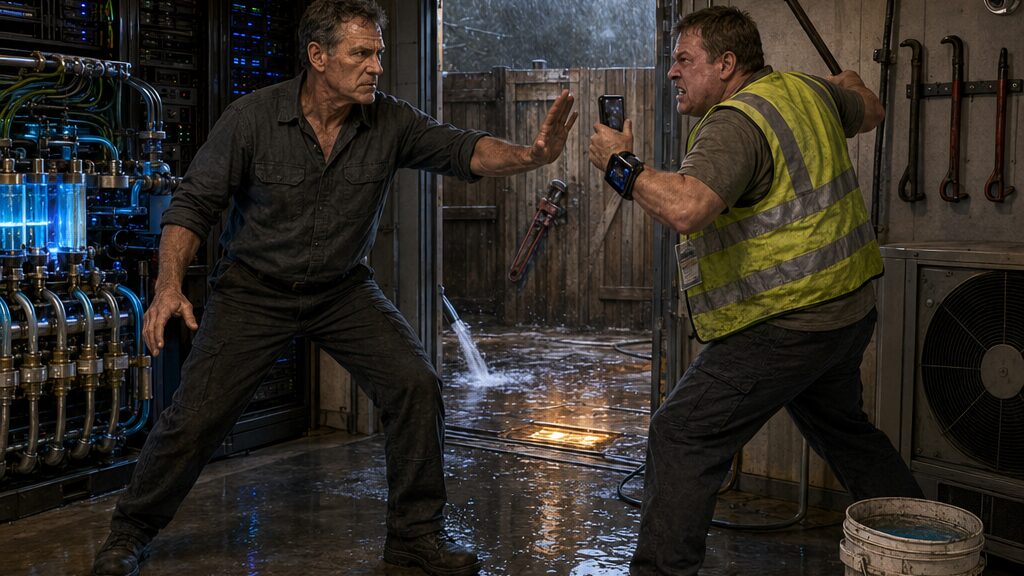
Jack Robinson’s bare hand closed around the steel pipe wrench inches above the glowing coolant manifold.
The impact drove pain through his palm and up his forearm. The wrench stopped, but the liquid-filled tubes beneath it trembled in their clamps, blue coolant shivering under the workshop lights.
Eric Carter stared at him from the other end of the handle.
For half a second, neither man moved.
Then Eric twisted his phone toward Jack and shouted, “You all saw that! He attacked an authorized safety officer!”
The phone was mounted in a plastic grip strapped to Eric’s wrist. A red LIVE icon glowed beside a climbing viewer count. Across Eric’s chest hung a laminated badge with block letters reading NEIGHBORHOOD WATCH COMMANDER.
Behind him, water rushed through the open workshop door.
It spread across the side yard in a bright sheet, carrying grit and dead leaves toward the solar battery enclosure. A high-pressure hose bucked beside the cut gate. Warning lights flashed on the purification control cabinet as the system tried to compensate for a backwash valve forced beyond its programmed limit.
Jack tightened his grip on the wrench.
“Let it go.”
Eric’s face was red with effort. “This equipment is a combustible threat. I’m preventing a neighborhood disaster.”
“You brought water to an electrical installation.”
“I brought suppression equipment.”
“You brought a garden hose.”
“It’s industrial pressure.”
The wrench handle jerked again.
Jack rotated his wrist, turning the steel away from the manifold. Eric stumbled sideways, surprised by how little movement Jack needed. The wrench head struck the edge of a workbench with a hard metallic crack.
On the floor near Eric’s boot sat a white chemical bucket. Its lid had been pried open. A sour, biting smell rose from it.
Jack’s eyes shifted to the bucket.
Eric saw him look and reached down with his free hand.
At the same moment, a warning tone changed pitch.
Jack knew every sound in the workshop. The low breath of the ultra-quiet HVAC. The soft pulse of purification pumps cycling filtered rainwater through an isolated cooling loop. The layered hum of server fans maintaining pressure and temperature inside the sealed racks.
That new tone did not belong.
Water had reached the buried junction trench.
Jack could not see the junction under the pavement, but he saw the reflection of its amber hazard lamp flickering across the moving water. The automatic isolation system had not tripped yet.
“Eric,” he said, “step away from the bucket.”
Eric grabbed its metal handle.
“Don’t threaten me.”
“I’m warning you.”
“You’ve been warning everybody for months. No trespassing. Restricted equipment. Private property.” Eric leaned toward his phone. “That’s how men like him operate. Secrecy. Intimidation. They make normal people afraid to ask questions.”
Jack pulled the wrench toward himself.
Eric held on, using both hands now. His fake badge swung against his shirt.
The water reached the painted boundary around the junction access plate.
A server alarm sounded once.
Then the familiar fan hum stuttered.
Jack’s breath caught.
For an instant the workshop disappeared. There was only another room, years earlier, and a bank of monitors going black one after another. A technician’s voice saying one rescue district had no backup. Jack’s own hand above a shutdown control. The silence afterward had been so complete that he could hear someone breathing behind him.
The present returned in a rush of water and Eric’s voice.
“I’m shutting down the matrix!”
Eric wrenched the tool upward, trying to pull Jack off balance.
Jack stepped inside the arc, drove his shoulder into Eric’s chest, and turned. Eric spun away from the workstation. The bucket slipped from his fingers but remained upright.
Jack ripped the wrench free.
Eric staggered into the doorframe. His phone swung wildly, capturing the coolant tubes, the flooding yard, and Jack standing between him and the server racks.
The viewer count jumped.
Comments scrolled too quickly to read.
Eric pointed at Jack. “Assault. That was assault on a community official.”
“You are not an official.”
“I have documentation.”
“You printed a badge.”
“I was appointed.”
“By whom?”
“The block.”
“There is no block election.”
Eric’s mouth tightened. For the first time, fear showed beneath the performance—not fear of Jack, but fear that the people watching might believe him.
He stepped backward into the side yard and raised his voice.
“You heard him admit he’s outside neighborhood oversight. You see the batteries. You see the industrial cooling. Nobody installs this in a house unless they’re hiding something.”
The hose snapped against the pavement, spraying the lower edge of the battery enclosure.
Jack moved toward the emergency cutoff panel.
Eric darted sideways, blocking him.
“Stay where you are.”
“If that junction energizes the water, you’ll be standing in it.”
“That’s another scare tactic.”
The amber light flickered faster.
Jack looked at Eric’s shoes, then at the widening sheet of water between them.
He could reach the cutoff in four steps. Eric could reach the chemical bucket in two.
The server hum faltered again.
Jack chose.
He lifted the wrench, pivoted, and threw it past Eric.
The steel crossed the yard in a flat blur and struck the wooden fence with a splintering crash. The wrench head buried itself between two boards, leaving the handle vibrating in the air.
Eric froze.
The phone continued recording.
Jack pointed toward the gate. “Leave.”
For one breath, the only sound was the hose.
Then Eric’s expression changed. Humiliation hardened it. He looked at the buried wrench, at the livestream, and finally at Jack.
“You think that proves you’re in control?”
He lunged toward the maintenance wall and tore an iron crowbar from its brackets.
Jack moved toward the cutoff.
Eric raised the bar in both hands.
“The server will be dead before the authorities get here.”
Chapter 2: The Badge Printed on Ordinary Paper
Five days earlier, Jack found a red notice glued across his electrical permit.
COMBUSTIBLE THREAT, it said in black capital letters.
Below that, someone had printed IMMEDIATE COMMUNITY HAZARD and stamped the page with a circular seal that looked official until Jack noticed the city name was misspelled.
The glue had soaked through the laminated permit posted inside his front gate.
Jack stood there with his morning coffee cooling in one hand while the purification pumps whispered behind the privacy fence. The notice had been positioned carefully enough to hide the inspection number, contractor license, and approval date underneath.
He peeled one corner.
Paper tore.
Across the street, a phone camera lifted.
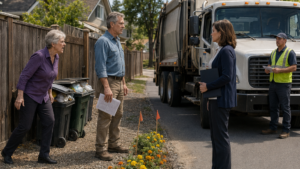
Eric Carter stood beside his mailbox wearing a bright vest and the laminated badge Jack had seen twice that week. He was recording.
“Destroying evidence?” Eric called.
Jack pulled the rest of the notice free. “Damaging a posted permit is an offense.”
“That isn’t a permit. It’s camouflage.”
Jack held up the exposed city approval. “The number is public. Look it up.”
“I have looked into your operation.”
“You watched online videos.”
“I conducted research.”
“You sent three different complaints describing three different hazards.”
Eric crossed the street. The badge bounced against his vest. Its border had been cut unevenly, and the words NEIGHBORHOOD WATCH COMMANDER were printed over a stock image of a shield.
Two neighbors stopped near the sidewalk. Deborah Lee remained by her front steps, a folded sheet in one hand.
Eric raised his voice for them.
“The danger profile keeps changing because Mr. Robinson keeps changing the equipment. First the solar battery bank. Then the industrial pumps. Now an oversized cooling unit running day and night.”
“The HVAC is quieter than your lawn mower.”
“That’s the point,” Eric said. “You wouldn’t hear a leak.”
“A leak of what?”
Eric gestured toward the fence. “Whatever those servers emit.”
“Heat.”
“And radiation.”
“Heat is radiation.”
Eric turned triumphantly toward the neighbors. “You heard him.”
Jack stared at him.
It was the kind of exchange that invited correction and punished anyone foolish enough to provide it. Jack knew that. He corrected him anyway.
“Visible light is radiation. Radio signals are radiation. The heat from your driveway is radiation. That does not make my cooling system dangerous.”
Eric’s cheeks darkened.
Jack continued, unable to stop the precision once he had begun. “Your notice cites a municipal code for underground fuel storage. I have no underground fuel tank. The seal is fake. The city name is misspelled. The claim about cancer waves has no unit of measurement, no source, and no meaning.”
A man at the curb hid a smile.
Eric noticed.
He stepped closer to the gate. “Open it.”
“No.”
“As block captain, I am requesting a visual inspection.”
“You are not block captain.”
“I was asked to coordinate safety.”
“By yourself.”
“By concerned residents.”
Jack looked toward Deborah.
She did not meet his eyes.
Eric saw that too. “People are afraid to speak because you intimidate them with technical language.”
“I gave them permit numbers.”
“You gave them numbers because you refuse to give answers.”
The pumps behind the fence cycled to their next stage. Their vibration was almost too low to hear. Water passed through filters, ultraviolet treatment, and a sealed storage line before feeding a nonpotable cooling reserve.
Eric tilted his head toward the sound.
“Listen to that.”
Jack nearly laughed. “To what?”
“That hidden machinery.”
“It’s a pump.”
“For what?”
“Rainwater processing.”
“And why does a private homeowner need enough processed water to cool a warehouse?”
Jack’s fingers tightened around the torn notice.
He could have said the system reduced demand during outages. He could have explained that the battery enclosure had thermal sensors, fire barriers, and automatic isolation far beyond residential code. He could have offered a limited truth that answered the fear without touching the sealed purpose.
Instead he said, “It passed inspection.”
Eric smiled as if Jack had confessed.
Deborah came down her walkway.
“Jack,” she said, “I shared one of Eric’s notices.”
He looked at the paper in her hand. It was another copy of the combustible-threat warning.
“Why?”
“Because last year, when the water pressure failed during the storm, you ran a line from your reserve tank to three houses. You helped us without being asked.” She glanced at the fence. “But now there’s more equipment. Delivery trucks at night. That cooling unit. People want to know whether something here could affect their homes.”
“It cannot.”
“That’s an answer,” Deborah said. “But it’s the first one you’ve given.”
“I posted the permits.”
“Permits don’t talk to people.”
Eric folded his arms. His satisfaction was almost visible.
Jack turned to Deborah. “There are electrical storage systems on my property. They are isolated, monitored, and legally installed. The cooling unit serves equipment inside my workshop. The pumps serve water systems permitted under municipal code.”
“What equipment?” she asked.
“Private equipment.”
The distance returned to her face.
Eric lifted his phone higher. “There. That’s the pattern. He admits industrial systems exist, then hides behind privacy.”
“I live here,” Jack said. “Privacy is not evidence.”
“Secrecy becomes evidence when the risk crosses the property line.”
“It does not.”
“You expect us to take your word.”
“No. I expect you to take the inspectors’ word.”
Eric tapped his badge. “That is why I’m organizing an independent review.”
Jack looked closely at the laminated card. A tiny printer alignment mark remained at its lower edge.
“You made that last night.”
Eric’s hand covered it.
“You used ordinary office paper,” Jack said. “The laminate is peeling. There is no issuing organization, no serial number, and no authority attached to it.”
The neighbor who had smiled earlier looked away, embarrassed now.
Eric lowered his phone for a moment.
The silence between them was more damaging than Jack’s words.
When Eric raised the phone again, his voice had changed. It was louder, polished, meant for an audience beyond the street.
“Official channels have failed. Residents have been ignored. When institutions refuse to protect ordinary families, responsible citizens have a duty to act.”
Deborah shook her head. “Nobody asked you to enter his property.”
“Not yet.”
Jack stepped to the gate. “Any entry without permission will be trespass.”
Eric backed toward the street, filming the permit, the fence, and the top of the quiet HVAC unit visible above it.
“If the city refuses to act,” he said, “I’ll conduct the emergency inspection myself.”
Chapter 3: The Inspection That Proved Too Little
Amanda Garcia held the altered inspection notice beside the original and said, “One of these came from my office. The other one could get somebody charged.”
Eric stopped talking.
They stood at Jack’s front gate three days before the attack. Amanda wore a municipal identification card clipped to her jacket and carried a tablet loaded with the property’s permit history. Eric had arrived in his bright vest and commander badge before her vehicle had fully stopped.
The original notice read EXTERIOR SAFETY VERIFICATION.
The copy Eric had distributed read MANDATORY SHUTDOWN—IMMEDIATE PUBLIC DANGER.
The added words used a different typeface.
Eric recovered quickly. “I received that version from a concerned resident.”
“You handed it to me ten minutes ago and said the city sent it to you.”
“I may have misunderstood the source.”
Amanda turned the page over. “Your printer code is on the margin.”
Eric looked toward the neighbors gathered across the street.
Jack watched his posture change. Shame never made Eric smaller. It made him expand.
“The wording reflects the seriousness of the complaint,” Eric said. “Maybe your office should ask why residents feel forced to clarify weak government language.”
Amanda slid both pages into a clear evidence sleeve. “Do not alter another city document.”
Then she looked at Jack.
“Open the gate.”
He entered the code.
The lock released with a quiet click.
Amanda walked the equipment yard slowly. She examined the drainage channels around the solar battery enclosure, checked the fire-rated separation, photographed the emergency disconnect, and compared serial plates with approved plans.
Eric followed until Jack blocked him at the threshold.
“The inspection is not public access,” Jack said.
“I filed the complaint.”
“That gives you no right to enter.”
Amanda glanced back. “He stays outside.”
Eric held up his phone. “Then I’m documenting from here.”
The yard’s systems ran with their usual discipline. Purification pumps moved collected rainwater through sealed filters. The battery cabinet gave off almost no sound. The heavy-duty HVAC unit breathed evenly against the workshop wall, quieter than the traffic at the end of the street.
Amanda placed her hand near an exhaust vent.
“Temperature is stable.”
“It remains within two degrees under full load,” Jack said.
“What load?”
“Permitted computing equipment.”
“That isn’t a use classification.”
“It was accepted during plan review.”
“Plan review approved power, cooling, and occupancy. It did not establish what the equipment does.”
“It does not need to.”
Her eyes narrowed. “You answer every question as if the person asking has already accused you.”
Jack said nothing.
Amanda moved to the rainwater controls. “Backflow protection?”
He opened the inspection panel and pointed.
“Secondary containment?”
He showed her.
“Manual isolation?”
He demonstrated the valve without turning it.
Eric spoke through the gate. “Ask him about the radiation field.”
Amanda ignored him.
Within twenty minutes, she had confirmed what Jack already knew. The equipment exceeded code requirements. The battery bank was thermally monitored. The cooling system used sealed loops. The rainwater assembly could not feed into the municipal drinking supply. Every component had inspection labels and maintenance records.
It should have ended there.
Then Eric held up a delivery manifest.
“He swapped the dangerous equipment before you arrived.”
Amanda turned.
The page showed a refrigerated freight delivery to Jack’s address the previous evening. The item description had been redacted by the shipper, but the weight was substantial.
Eric pushed the manifest through the bars. “New hardware came after complaints were filed and before inspection. Convenient.”
Amanda read it twice.
Jack recognized the shipping reference. A coolant distribution module had been replaced under routine maintenance. The old unit had developed a pressure variance too small to violate specification but large enough to concern him.
“It was a replacement component,” he said.
“For what?” Amanda asked.
“The cooling loop.”
“Can I see the replaced part?”
“It has been returned.”
“Can I see the installed component?”
Jack looked toward the workshop.
The sealed inner room lay beyond it. Access required credentials Amanda did not possess and Jack was not authorized to extend.
“No.”
Eric laughed softly. “There it is.”
Amanda handed the manifest back to him. “This proves a delivery. Nothing more.”
“It proves concealment.”
“It proves you know how to read a shipping label.”
She turned to Jack. “But his conclusion being reckless does not make your answer useful.”
“The installation is outside your inspection scope.”
“That may be true. I need the authority responsible for the interior equipment.”
“I cannot provide that.”
“You cannot or will not?”
Jack heard the pumps, the fans, and the measured circulation of coolant beyond the wall. All of it operated in synchronization, a system designed so no single public utility failure could silence what stood inside.
“I am not authorized,” he said.
Amanda studied him for several seconds.
At the gate, Eric’s phone remained raised.
“So there is another authority,” Eric said.
Jack regretted the sentence as soon as it left his mouth.
Amanda closed her tablet. “My exterior findings are straightforward. No municipal code violation. No imminent hazard. I’ll issue that in writing.”
Eric’s expression hardened. “You haven’t inspected the server room.”
“I do not have grounds to force entry.”
“And if it catches fire tonight?”
“The monitoring and containment systems meet code.”
“You’re trusting him.”
“I’m trusting verified infrastructure.”
Amanda walked to the gate and faced Eric directly.
“You are not an inspector. You are not authorized to enter this property. The document you altered did not grant you emergency powers. If you cross this gate after being told not to, you will be trespassing.”
Eric looked past her at Jack.
“You hear how carefully she phrases that? She still can’t tell us what’s inside.”
Amanda’s voice dropped. “Do not make me repeat the warning.”
For once, Eric stepped back.
Jack’s phone vibrated in his pocket.
The secure display showed one name: Stephen Adams.
Jack moved into the workshop before answering.
Stephen’s image appeared against a dark office wall. “We received a visibility alert.”
“The inspection found no violations.”
“The inspection found attention.”
“The site is secure.”
“A neighbor is livestreaming the perimeter of a protected installation.”
“He doesn’t know what it is.”
“He knows there is something you won’t identify.”
Jack looked through the workshop window. Amanda was showing Deborah the legitimate findings. Eric stood apart, filming the roofline.
“I asked for approved public language months ago,” Jack said.
“And the request was denied.”
“You left me with permit numbers.”
“You were selected because you understand discretion.”
“Discretion is becoming exposure.”
Stephen’s jaw tightened. “Then reduce the exposure.”
“How?”
“Demonstrate physical security. Document the threat. Stop engaging with him.”
“I barely speak to him.”
“That may be part of the problem.”
Jack glanced at the sealed relay cabinet. Its indicator lights pulsed behind smoked glass.
Stephen continued, “If the site cannot remain inconspicuous, operations will be suspended.”
“That defeats the redundancy.”
“It protects the network.”
“By turning it off.”
“Temporarily.”
Jack felt an old resistance rising in him, hard and familiar. Systems survived when people followed boundaries. Hardware survived when emotion did not dictate procedure.
Yet outside, Eric was turning every unanswered question into proof.
“When?” Jack asked.
“You have forty-eight hours to prove the site is secure.”
“And if I can’t?”
Stephen’s gaze did not shift.
“We disable the relay remotely.”
Chapter 4: The Night the Network Went Silent
The test message arrived at 11:17 p.m. bearing the identifier Jack had spent years trying not to remember.
RD-7 RESCUE COORDINATION.
The letters appeared in amber on the relay console, followed by a routine sequence of time stamps and verification codes. Nothing in the message suggested danger. It was an automated readiness test, one of dozens the system processed each month.
Jack’s hand stopped above the keyboard.
Behind him, the server racks maintained their steady hum. Coolant moved through transparent tubes in measured pulses. The HVAC drew warm air from the sealed room so quietly that the rainwater pump outside seemed loud by comparison.
RD-7 had once gone silent for forty-three minutes.
Jack opened the test packet and watched the relay acknowledge it in less than a second.
The system had worked exactly as he designed it to work.
That did not change what had happened before it existed.
His secure terminal flashed a reminder from Stephen Adams.
SITE SECURITY ASSESSMENT DUE: 35 HOURS.
Jack dismissed it and pulled up the old incident archive.
He had not opened the files in nearly two years. The access screen warned that retrieval would be logged. He entered his credentials anyway.
Maps filled the monitor. A storm front. Flooded substations. Fiber routes turning red one after another. The regional network had been failing in sections, each damaged node pushing corrupted traffic toward the few machines still operating.
Jack had been the senior systems engineer in the control room.
The hardware temperature had risen six degrees in twelve minutes. Cooling pressure had become unstable. If the central equipment burned out, the region could lose communications for days instead of hours.
Protocol had been clear.
Isolate the network. Protect the core. Restore service after the cascade passed.
Jack had authorized the shutdown.
The old recording began playing without sound. People moved across the control room beneath emergency lights. Jack recognized his younger posture: rigid shoulders, one hand braced on the console, eyes fixed on graphs while everyone else looked at one another.
He enabled the audio.
A technician’s voice emerged through static.
“RD-7 hasn’t confirmed secondary routing.”
Jack remembered the sentence before it finished.
“The district has mobile backup,” his recorded voice replied.
“Not all of it. Their eastern rescue corridor is still on fixed relay.”
“The network cannot hold partial traffic.”
“We could keep one channel open.”
“At what risk?”
“Unknown.”
Jack’s younger face turned toward the technician.
“Then no.”
The shutdown sequence began.
On-screen, green indicators changed to amber, then black. One bank after another went quiet. The room filled with the mechanical ticking of cooling metal.
In the present, Jack reached for the pause control.
He stopped before touching it.
The recording continued.
Twelve minutes after shutdown, RD-7 attempted to transmit a bridge-collapse alert. The message remained queued until limited service returned. By then, rescue crews had been rerouted through a longer road. No one died because of the delay, but two injured motorists waited nearly half an hour longer than they should have.
The investigation concluded that Jack had followed protocol.
That sentence had protected his career and poisoned every quiet room afterward.
His secure line chimed.
Stephen appeared on the wall monitor, jacket off, sleeves rolled to his elbows.
“You opened the archive,” he said.
“You monitor my reading now?”
“I monitor access to a protected incident file.”
Jack closed the recording. “The relay passed its readiness test.”
“That is not the question in front of us.”
“It should be.”
“The site is attracting public attention. A municipal inspector has documented altered notices. Your neighbor is filming physical access points.”
“And the system is still secure.”
Stephen leaned closer to his camera. “You keep saying that as if security is only locks and temperature controls.”
Jack looked toward the sealed door.
“What do you want me to do? Invite the block in for a tour?”
“I want you to document the threat and request support.”
“Support means vehicles, personnel, more attention.”
“It also means you are not carrying the site alone.”
“I have carried it alone for four years.”
“Yes,” Stephen said. “That was a mistake.”
The words landed harder than Jack expected.
Stephen glanced away, then back. “We chose this property because you could maintain independent water, cooling, and power. We chose you because you don’t miss deviations.”
“You chose me because nobody else wanted protected infrastructure inside a residential perimeter.”
“That too.”
Jack waited.
Stephen’s expression shifted, not quite apology.
“We also chose you because of RD-7.”
Jack’s jaw tightened.
“You knew what failure sounded like,” Stephen said. “We believed that made you reliable.”
“You believed guilt would keep me awake.”
“It did.”
The server hum seemed louder.
Jack turned toward the racks. Every indicator remained green. The purification reserve sat full. Battery charge held at ninety-two percent. The relay could survive loss of grid power, municipal water, and external network service.
He had made sure no ordinary failure could silence it.
Stephen said, “That vigilance built a strong system.”
“You used the worst decision I ever made as a staffing advantage.”
“We used your experience.”
“Call it what it was.”
Stephen did not answer.
Jack rested both hands on the console. In the old control room, he had trusted protocol because protocol did not tremble, accuse, or demand judgment. Now he trusted hardware for the same reason. Machines gave him faults he could measure. People brought uncertainty.
Eric had brought questions, then accusations. Deborah had brought fear. Amanda had asked for an authority Jack could not name.
Jack had treated all of them as interference.
“Send me the support request,” he said.
Stephen studied him. “You’ll file it?”
“I’ll review it.”
“That is not the same thing.”
“It is what I said.”
Stephen’s mouth flattened. “The remote suspension remains scheduled.”
The call ended.
Jack stayed at the console until the test packet closed automatically.
A soft motion alert appeared in the corner of the monitor.
SIDE ACCESS—CAMERA FOUR.
The feed showed Jack’s narrow service lane under infrared light. The side gate stood between the equipment yard and the alley. A figure moved beside it.
Jack enlarged the image.
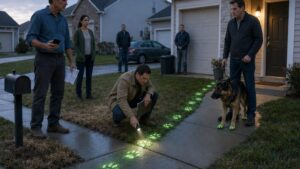
Eric wore dark clothes instead of his bright vest. He crouched near the latch, pressed one hand against the gate, and tested its movement. Then he photographed the hinges.
Jack’s hand moved toward the secure incident-report icon.
On-screen, Eric walked along the fence to the exterior hose connection. He took another photograph, then bent close enough to read the valve label.
Jack opened the support form.
Requesting physical protection would trigger a site review. The vehicles would be visible. The relay could be suspended before Stephen’s deadline. Once inactive, it might never return to this location.
Eric tugged the gate a second time.
Jack selected the camera archive and marked the footage for retention.
The incident-report form remained open beside it.
He could hear the old technician’s voice: We could keep one channel open.
Jack closed the report without submitting it.
On the monitor, Eric photographed the hose connection one final time and disappeared into the alley.
Chapter 5: A Safety Campaign Built from Envy
Deborah found the city’s inspection report in Eric’s trash beneath fifty newly printed emergency notices.
The bin stood at the curb with its lid partly open. A breeze had lifted one corner of the report, revealing Amanda Garcia’s signature and the words NO IMMINENT HAZARD.
Deborah pulled it free.
The pages were creased but readable. Amanda had approved the exterior battery enclosure, drainage, cooling unit, and rainwater system. She had also recorded her warning that no resident had authority to enter Jack’s property.
Under the report lay red sheets bearing a different message.
EMERGENCY COMMUNITY INTERVENTION.
Deborah looked toward Eric’s garage.
The door was open. He stood inside facing a work light, his company phone clamped to a tripod.
“We are not trespassing,” he said to the camera. “We are exercising the natural right of every community to neutralize an immediate threat.”
He stopped the recording and frowned.
“Neutralize,” he muttered. “Too technical.”
Deborah stepped into the driveway holding the report.
“You knew.”
Eric turned.
For a second, he looked less angry than tired. His bright vest hung over a chair. The paper commander badge rested on a workbench beside a laminator and a stack of blank cards.
“Knew what?”
“That Amanda cleared the equipment.”
“She cleared what he allowed her to see.”
“You told everyone the city ordered a shutdown.”
“The city should have.”
“That isn’t the same thing.”
Eric took the report from her, folded it once, and placed it on the bench.
“You remember the battery fire across town?”
“I saw the news.”
“Flames went through the roof before the family woke up. Fire crews couldn’t put it out for hours.” He pointed toward Jack’s property beyond the fence. “Now imagine something larger, hidden behind walls, with industrial cooling and enough stored power for half the street.”
“Jack’s enclosure is inspected.”
“Inspections miss things.”
“So your answer is a wrench?”
His eyes shifted toward the far side of the garage.
A heavy steel pipe wrench lay in a utility cart. Beside it sat a crowbar, a coiled hose, and a white bucket with a hazardous-material label partly scraped away.
Deborah’s stomach tightened.
“What is in that bucket?”
“Cleaning agent.”
“For what?”
“To neutralize biological buildup if his water system is contaminated.”
“You don’t know that it is.”
“I know he won’t tell us what he’s doing.”
“He told us it was safe.”
“He told us to trust paperwork.”
Deborah held his gaze. “You hid the paperwork.”
Eric looked toward the tripod. Its screen displayed a paused image of him framed beneath the words COMMUNITY SAFETY LIVE.
His voice lowered.
“Do you know what people said after I was demoted?”
Deborah had heard. Eric had supervised a field crew for his employer until an internal reorganization moved him into inventory coordination. He still wore company shirts on weekdays, but the truck no longer came home with him.
“They said the company needed somebody calmer,” he continued. “Somebody who listened. What they meant was younger. Easier. Someone who would let problems slide.”
“This is not your workplace.”
“No. This is where I still have a responsibility.”
“Who gave it to you?”
His face tightened.
Deborah regretted the question, not because it was unfair, but because she saw how deeply it struck.
Eric picked up the laminated badge and rubbed its edge with his thumb.
“When the storm knocked out water pressure, everybody waited for somebody else. Jack opened his reserve line and suddenly he was the hero. Since then, equipment arrives, walls go higher, and no one asks who gave him permission to build a private utility station.”
“The city did.”
“The city signs forms. It doesn’t live here.”
“You are scared,” Deborah said. “That does not make you commander.”
Eric placed the badge over his heart and clipped it to his shirt.
“It makes me the only one willing to act.”
“No.” Deborah lifted her phone and photographed the discarded inspection report. “It makes you someone who knows the truth and plans to lie anyway.”
His expression hardened.
“Jack has been talking to you.”
“He has barely spoken to me.”
“That is how intimidation works. He doesn’t need to say it directly.”
Deborah sent the photograph to Amanda.
Eric saw the movement of her thumb.
“Who did you send that to?”
“The person whose report you hid.”
He stepped toward her. “Delete it.”
She backed into the driveway.
“Do not come to Jack’s property tomorrow.”
“I didn’t tell you when.”
“You printed a date at the bottom.”
Eric glanced at the notices, realizing his mistake.
Deborah continued backing away. “I will not stand beside you. Neither will the others.”
“You speak for them now?”
“I speak for myself.”
His company phone chimed on the tripod.
A message appeared across the screen before dimming.
FINAL WARNING: COMPANY DEVICES MAY NOT BE USED FOR PERSONAL BROADCASTS OR COMMUNITY ACTIVISM.
Eric snatched the phone from its clamp.
Deborah saw enough.
“You have already been warned at work.”
“They monitor everybody.”
“Then use your own phone.”
“My account has better reach through this one.”
“That is what matters to you?”
“What matters,” Eric said, “is that people see someone take responsibility.”
Deborah looked at the cart again.
“Leave the tools here.”
He smiled without warmth. “You still think this is about tools.”
She walked out of the driveway.
Behind her, Eric restarted the recording.
“Tomorrow,” he said in a measured voice, “the neighborhood will witness what officials were too afraid to do.”
Deborah did not look back.
By the time Amanda replied that she was returning the next afternoon, Eric had moved the livestream forward by three hours.
At dawn, he loaded the steel wrench, the crowbar, the chemical bucket, and his company phone into the utility cart.
Across the front, he taped a new sign.
FIRE RESPONSE.
Chapter 6: Water Reached the Buried Power Line
Water was flowing uphill.
Jack saw it on Camera Four before the first alarm sounded: a silver sheet crawling against the slight grade toward the buried electrical junction.
That should have been impossible.
Then he saw the purification backwash valve locked open and the high-pressure hose coupled to the service connection.
Eric had studied the labels.
Jack left the server room at a run.
The side-gate camera showed the chain hanging in two pieces. Eric pushed his utility cart through the opening while narrating into the company phone strapped to his wrist.
“We have entered under emergency necessity,” he announced. “The property owner has refused lawful community oversight, and active fire conditions may exist inside the concealed installation.”
There was no smoke.
Only water, bright morning sun, and the controlled hum of Jack’s equipment beginning to strain.
Jack reached the side yard.
“Shut the valve.”
Eric swung the phone toward him. “The owner has arrived.”
“You are flooding energized infrastructure.”
“I am establishing a firebreak.”
“With a hose?”
“The public can see your aggression.”
Jack stepped into the yard and stopped.
Water covered the direct path to Eric. The amber lamp beside the buried junction flickered beneath the surface. The automatic isolation relay should have tripped when conductivity rose, but Eric had forced the backwash system into a cycle that kept changing the readings.
The pumps vibrated against their mounts.
Jack could cross the water and reach Eric in seconds.
He could also place both of them over an uncertain electrical fault.
Eric pointed toward the solar battery enclosure.
“These units are known to explode. He has placed them within lethal range of neighboring homes.”
“The enclosure is not burning.”
“Because I arrived in time.”
“Turn off the hose and leave.”
Eric reached into his cart and raised one of the red notices. “Community emergency authorization.”
Jack did not bother reading it.
The warning tone rose.
He turned toward the manual isolation cabinet.
Eric laughed into the livestream. “Watch him run to hide the evidence.”
Jack opened the cabinet and pulled on insulated gloves. A row of status lights showed grid power, battery reserve, pump load, and cooling demand. The flooded junction connected the purification system to the main distribution panel. If he isolated it incorrectly, the server room would lose both cooling pumps at once.
Water touched the outer edge of his boots.
He selected the secondary loop, transferred cooling demand to reserve, and reached for the mechanical disconnect.
Behind him, cart wheels rattled over the workshop threshold.
Jack looked back.
Eric had left the hose running. He was pushing the chemical bucket toward the open door.
“Eric.”
The neighbor turned the phone toward himself. “He is attempting to prevent containment.”
“That bucket does not contain fire suppressant.”
“It contains industrial neutralizer.”
“It contains corrosive cleaner.”
“For contaminated systems.”
“You do not know what is contaminated.”
“I know what secrecy looks like.”
Jack pulled the disconnect.
A blue flash snapped inside the cabinet. The purification pumps stopped. The hose continued pouring water across the yard, but the buried junction went dark.
For one heartbeat, every fan in the workshop slowed.
Then the battery reserve engaged.
The server hum returned at a lower pitch.
Jack’s design had worked. No energized line remained beneath the water, and the relay had shifted to its isolated cooling reserve.
A small victory.
It cost him the distance between himself and Eric.
Eric rolled the bucket into the workshop and moved toward the HVAC intake.
Jack tore off the gloves and splashed across the now-safe water.
The livestream voice carried through the doorway.
“Here we have the concealed cooling apparatus. If this system were harmless, the owner would not be attempting to stop a lawful inspection.”
Jack entered as Eric lifted the bucket by its handle.
The lid had been removed.
Fumes curled from the opening, sharp enough to sting Jack’s eyes from several feet away.
“Put it down.”
Eric held it near the intake grille. “Tell them what the machines do.”
“No.”
“Then I neutralize them.”
“You pour that into the intake, the vapor will spread through the cooling system.”
“Exactly.”
“It can injure both of us.”
Eric hesitated.
Jack saw the genuine fear return. Eric had never fully understood the tools he had brought. He had imagined damage from a safe distance, a dramatic act followed by vindication.
But the phone was still recording.
The viewer count had crossed four thousand.
Eric looked at the screen, then at Jack.
“You always do that,” he said.
“Do what?”
“Make everyone else feel stupid.”
“I am telling you to put down acid.”
“You use words nobody understands. You post numbers. You build walls. Then you look at us like we’re beneath you.”
Jack moved one step closer.
Eric raised the bucket.
“Stop.”
“Say what the server is for.”
“I cannot.”
“There. You admit it.”
“I am not admitting what you think.”
“Then explain it.”
The server fans deepened as the reserve cooling loop took full load. The sound filled the room, calm and relentless.
Jack thought of the unfiled security report. Eric testing the gate. Photographing the hose connection. Jack had possessed evidence of intent and chosen silence because reporting it might have shut down the relay.
He had protected the system by leaving it exposed.
The same mistake in a different shape.
Outside, a car door slammed. Someone shouted from beyond the cut gate, but the fan noise swallowed the words.
Eric glanced toward the yard.
Jack moved.
He closed the distance and seized the bucket handle with one hand, keeping the opening angled away from both of them.
Eric jerked back.
The chemical sloshed against the rim.
Jack forced the bucket downward and set it on the concrete.
“Leave it.”
Eric stumbled into the workbench.
For an instant, Jack believed the confrontation had ended.
Then Eric saw the pipe wrench lying on the cart beside the door.
He grabbed it.
Jack stepped between him and the cooling equipment.
Eric’s breathing changed. The polished livestream voice disappeared.
“You’ve made me look like a fool.”
“You did that yourself.”
The words came too quickly.
Eric’s face twisted.
He raised the wrench.
Jack could have backed away. The workstation sat behind him, its liquid-cooled manifold exposed through a maintenance panel. One strike could rupture the lines, spill conductive coolant across the power bus, and force the relay into emergency shutdown.
Jack looked at the wrench head.
He heard, impossibly, the old technician’s voice through static.
We could keep one channel open.
Eric swung.
Jack reached into its path.
Chapter 7: The Moment All the Noise Stopped
Jack caught the wrench head inches above the workstation.
The steel struck his palm with enough force to numb his fingers. The handle kept moving, twisting Eric off balance as Jack stepped inside the swing and turned his shoulder.
For one suspended instant, all sound vanished.
The hose outside, the alarms, the server fans, Eric’s livestream voice—everything narrowed to the pressure of steel against Jack’s hand and the sharp smell rising from the open chemical bucket.
Then Eric grunted and pulled backward.
Jack did not let go.
He rotated the wrench until Eric’s wrists crossed. The neighbor stumbled into the edge of the workbench, knocking his phone against a metal drawer. The livestream image spun, but the red indicator remained lit.
“You saw that!” Eric shouted. “He grabbed me! He’s attacking me!”
Jack tore the wrench free.
Eric retreated toward the doorway, cradling one wrist. The confidence had left his face, but the need to perform remained. He angled the phone so Jack and the exposed coolant manifold appeared behind him.
“This is what happens when citizens question secret infrastructure.”
Jack pointed outside. “Leave the property.”
Eric looked at the viewer count. More than six thousand now.
Comments streamed over the screen. Some demanded that he get out. Others accused Jack of hiding military equipment, illegal surveillance, or experimental batteries. Each new theory seemed to steady Eric.
He lifted the phone closer to his face.
“I am not leaving until the threat is neutralized.”
Jack heard the sentence and understood that reason no longer had a place in the room.
He stepped through the doorway and threw the wrench.
It crossed the flooded yard and struck the wooden fence with a splitting crack. The head buried itself deep between two boards. The handle vibrated like a struck tuning fork.
Eric flinched.
Jack faced him with empty hands.
“It is over.”
The hose continued to roar across the pavement. Beyond the cut gate, Deborah stood near the street, waving two children away from the water. Amanda’s municipal vehicle had stopped crookedly at the curb. She was already speaking into her radio.
Eric saw them.
He also saw his badge hanging sideways from its clip and the phone still recording every second.
“You don’t decide when it’s over.”
He lunged toward the maintenance wall and pulled the iron crowbar from its brackets.
Amanda shouted from the gate. “Drop it!”
Eric swung before Jack could answer.
The bar came toward the coolant pipes rather than Jack’s head.
That choice told Jack everything.
Eric was no longer defending himself, no matter what he said into the phone. He was trying to destroy the system because walking away would mean admitting that the danger had always been him.
Jack caught the crowbar with both hands.
The impact drove him back one step. A monitor toppled from the workbench and struck the floor. Eric shoved forward, teeth clenched, trying to force the hooked end toward the exposed tubing.
“You made them laugh at me,” he said.
Jack looked at him across the iron.
“No. You kept going after you knew.”
Eric’s eyes flickered.
Jack drove the bar downward, trapping it against his thigh. He twisted, wrenched it free, and stepped back.
Eric raised both hands as if expecting to be struck.
Jack could hear Amanda approaching through the water. He could hear Deborah calling that the electrical line had been isolated. He could hear the livestream comments sounding faintly from Eric’s phone where it had fallen against the bench.
He placed the center of the crowbar across his knee.
The iron resisted.
Jack pulled harder.
A low metallic groan filled the workshop. The bar curved visibly until the hook pointed toward the floor. Jack let the warped metal drop beside Eric’s fake badge, which had come loose and landed faceup on the wet concrete.
Eric stared at it.
The paper inside the laminate had begun to bleed red ink.
Jack did not touch him again.
“Outside,” he said.
Eric backed toward the yard. “I was protecting people.”
No one answered.
His phone chimed.
The screen had cracked, but a notification spread across it.
SECURITY EVENT DETECTED—STREAM ARCHIVED.
Another followed.
CONTENT FLAGGED FOR PROTECTED-INFRASTRUCTURE REVIEW.
Eric snatched up the device.
“What did you do?”
“My cameras mirrored the footage when you crossed the gate.”
“You sent private surveillance of me?”
“You broadcast yourself.”
Eric looked toward the black domes mounted above the workshop door, then toward the battery enclosure. Each camera carried a small status light.
“You can’t send that anywhere without consent.”
“You displayed your employer’s identification on a company device during an active intrusion.”
Eric looked down at his shirt. Beneath the homemade badge, a stitched company logo was visible on the pocket.
His phone chimed again.
This time he read the message silently.
His lips moved once.
Amanda reached the edge of the workshop but did not enter. “Put the phone down and step away from the chemical container.”
Eric turned the screen toward her as though she might undo what it said.
EMPLOYMENT TERMINATED EFFECTIVE IMMEDIATELY.
The message cited unauthorized broadcasting, misuse of company property, threats, and conduct creating substantial legal exposure.
“They can’t do this,” he whispered.
Amanda’s attention remained on the bucket. “Move away from it.”
“I was acting in an emergency.”
“You manufactured the emergency.”
Eric looked at Deborah.
She stood beyond the gate holding her own phone. The photograph of the discarded inspection report was still open on its screen.
“You knew the equipment had passed,” she said.
Eric’s face collapsed—not into remorse, but into the stunned vacancy of someone whose story no longer had an audience willing to repeat it.
Then the server alarm changed.
Jack turned.
A yellow warning spread across the workstation display.
AIR QUALITY SENSOR—CORROSIVE VAPOR DETECTED.
The open bucket had remained near the HVAC intake long enough for fumes to enter the sensor chamber.
Automatic shutdown initiated.
A countdown appeared.
00:30.
Jack moved toward the cooling controls.
Eric caught his sleeve. “Tell them this is your fault too.”
Jack looked at the hand.
Eric released him.
Amanda said, “We have the yard. Go.”
It was the first time anyone had offered Jack help without demanding entry, explanation, or authority over the system.
He hesitated only once.
Then he turned his back on Eric.
“Keep everyone beyond the painted line,” he told Amanda. “Do not let that bucket tip.”
To Deborah he said, “The water is de-energized, but keep the street clear.”
Both women moved without asking what stood behind the sealed racks.
Jack entered the server room and opened the manual cooling panel.
Outside, engines approached from opposite directions.
Dark vehicles without markings blocked both ends of the street. Doors opened before they had fully stopped.
On the console, the shutdown timer reached twenty seconds.
Jack pulled the bypass lever.
Nothing happened.
The relay fans began dropping out one bank at a time.
Ten seconds.
He opened the lower panel and reached for the mechanical circulation valve.
Beyond the workshop wall, heavy footsteps crossed the flooded yard.
Five seconds.
The deep hum weakened to a thin, failing breath.
Three.
Chapter 8: The Hum Returned Without Hiding Him
At three seconds, Jack forced the mechanical valve past its stop.
The handle moved less than an inch.
Coolant pressure surged through the reserve loop.
The shutdown timer froze at two.
For a moment, the server room remained almost silent. Then one cooling bank restarted. Its fans rose unevenly, caught, and settled into a low hum.
A second bank followed.
Jack kept both hands on the valve until the pressure graph stabilized.
The countdown disappeared.
RELAY AVAILABLE—DEGRADED COOLING MODE.
He exhaled.
Through the open workshop door came the clink of metal restraints.
Eric’s voice rose over the yard. “I was protecting everyone. Ask the neighborhood. They know what I was trying to do.”
The first restored fan bank deepened, swallowing half the sentence.
Jack isolated the contaminated intake, sealed the vapor sensor chamber, and initiated a controlled reboot of the affected systems. Green indicators returned one by one.
When he stepped outside, two security officers stood beside Eric. Heavy steel handcuffs circled his wrists. His soaked trousers clung to his knees where he had slipped in the yard.
Amanda held the legitimate inspection report inside a clear sleeve. Deborah stood near the gate, keeping the remaining neighbors back.
An officer approached Jack.
“Are you injured?”
“My hand will bruise.”
“Medical assistance is available.”
“Later.”
The officer glanced toward the server room. “The relay?”
“Operational. One cooling channel is isolated.”
A dark vehicle door opened, and Stephen Adams stepped into the yard.
He took in the cut chain, the water, the open chemical bucket, the wrench buried in the fence, and the bent crowbar beside the ruined paper badge.
“You kept it online,” he said.
Jack looked toward the server display through the doorway. “Barely.”
Stephen lowered his voice. “The mirror archive captured the full intrusion. His livestream gave us intent, timing, warnings, and tool use. Amanda’s report establishes prior notice. Deborah’s photograph establishes concealment.”
Eric heard his name and twisted toward them.
“I didn’t know what it was.”
Stephen faced him. “You did not need to know. You were told not to enter.”
“It could have been dangerous.”
“You brought acid into an HVAC intake.”
“It was neutralizer.”
“It was corrosive industrial cleaner.”
Eric looked at Jack. “Tell them you refused to explain.”
Jack did not deny it.
Stephen turned back to him. “We need your incident statement.”
“I’ll give it.”
“And the footage from last night.”
Jack’s silence lasted too long.
Stephen’s expression changed.
“You saw him test the gate.”
“Yes.”
“You retained the footage.”
“Yes.”
“You did not report it.”
“No.”
Amanda looked from Stephen to Jack.
Eric seized on the admission. “There. He knew. He let this happen.”
Jack met his eyes. “I knew you tested the gate. I did not know you would bring weapons and chemicals.”
“But you knew I was concerned.”
“You knew the inspection cleared the site.”
Eric looked away.
Stephen spoke quietly. “Saving the relay does not erase the security failure.”
“I know.”
“You could have requested protection.”
“I thought visible support would expose the site and trigger suspension.”
“It might have.”
“So I decided I could contain the threat myself.”
Stephen looked toward the warped crowbar. “And could you?”
Jack flexed his injured hand. Pain moved across the palm where the wrench had struck.
“Not without putting everyone at risk.”
The answer seemed to surprise Amanda more than Stephen.
One of the officers guided Eric toward the vehicle. Eric resisted only enough to keep talking.
“My employer fired me because of him. He sent them everything.”
“The notification was automated,” Jack said.
“You designed it.”
“I designed the security system to preserve evidence.”
“You ruined my life.”
Jack looked down at the paper badge lying in shallow water. The red letters had dissolved into faint streaks. Nothing remained of the word COMMANDER but the last three letters.
“You were warned,” he said. “You kept going.”
Eric’s shoulders folded.
“I was protecting everyone,” he repeated.
The next cooling bank started.
Its deep, steady hum rolled through the open workshop and across the yard, drowning his final words as the officers placed him inside the vehicle.
No one applauded.
The neighbors watched from behind the gate, uncertain what they had witnessed and aware that they would not be told all of it.
Stephen opened a secure tablet.
“The simplest report,” he said to Jack, “would attribute the exposure entirely to Carter’s intrusion.”
“That would be incomplete.”
“It would also be defensible.”
Jack looked at the side gate. The cut chain lay half submerged beside the hose coupling Eric had photographed. Jack had seen the preparation. He had closed the form.
“Record that I identified pre-entry surveillance and failed to escalate it.”
Stephen held his gaze. “That may remove you from site custody.”
“It should be reviewed.”
“You saved the relay.”
“I also left it vulnerable because I believed only I could protect it.”
Stephen entered the statement.
Amanda stepped closer. “For what it is worth, your equipment was never the part the neighborhood understood least.”
Jack waited.
“You gave us nothing but boundaries,” she said. “Eric filled the space with whatever frightened people most.”
Deborah stood beside her. “That doesn’t excuse what he did.”
“No,” Jack said.
“But your silence helped him,” Deborah added.
Jack looked toward the server room. For years, the hum had been enough. It told him temperatures were controlled, messages were moving, and no human uncertainty had entered the loop.
Machines had never asked why he shut down RD-7.
“I made a decision during an emergency years ago,” he said. “It followed procedure. It still delayed help.”
He did not describe the relay or the messages it carried. He did not name the agency or the districts linked through the racks.
He told them enough.
“The system here exists so that kind of silence does not happen again.”
Deborah’s expression softened, though not into forgiveness. “You could have said it supports emergency continuity.”
“Yes.”
“Why didn’t you?”
Jack listened to the fans.
“Because the full truth was restricted,” he said. “And because that became a useful excuse not to say anything.”
By morning, the hose had been removed, the chemical bucket sealed, and the damaged intake marked for replacement. The wrench remained in the fence until investigators finished photographing it. The bent crowbar and dissolving badge were taken as evidence.
Stephen confirmed that Jack would remain custodian during review, with temporary remote supervision and a new mandatory reporting protocol.
Amanda agreed to serve as the municipal contact for nonclassified safety concerns. A plain notice would be posted at the gate explaining that the property contained permitted emergency-support infrastructure, inspected under both municipal and restricted standards.
No titles. No dramatic warnings. No invitation to enter.
Just enough truth to leave less room for fear.
Deborah returned after the last vehicle departed.
Jack stood inside the workshop, checking coolant pressure. The server-room door remained open behind him.
She stopped at the threshold.
“Is it safe to stand here?”
“Yes.”
He could have left the answer there.
Instead he showed her the painted boundary line and explained what it meant, which alarms required evacuation, and which number to call if she saw water, smoke, or a damaged gate.
He did not show her the relay.
He did not hide behind it either.
The cooling fans rose together into their full, controlled rhythm.
On the pavement beyond the doorway, a pale rectangle marked where Eric’s badge had lain beside the warped iron.
Jack listened to the hum return.
This time, he left the door open.
The story has ended.