She Put A $350 Bridge Fine In His Hands And Said The Creek Was Hers
Chapter 1: The Woman In Red Put The Fine On The Bridge
“It’s my property, and he damaged it.”
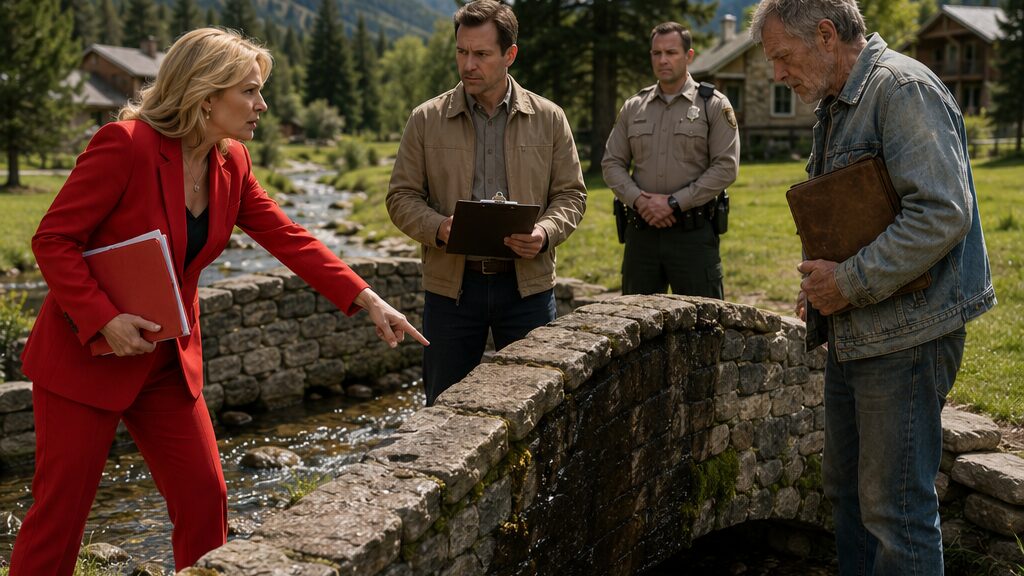
Samantha Campbell’s voice carried over the creek before William Carter had even reached the bridge.
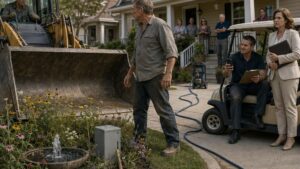
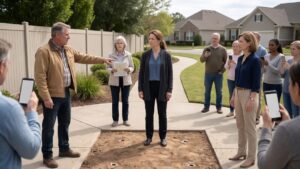
She stood on the grass in a red suit bright enough to look wrong against the pines, one hand gripping a packet of papers, the other pointed toward the old stone arch as if she could nail blame to it with her finger. A sheriff’s deputy stood a few feet from her. Ryan Hall from county property code was beside him, holding a clipboard and looking at the bridge with the tired caution of a man who had hoped this would be simpler.
William stopped at the edge of his lawn.
The creek moved below the bridge, shallow and bright over gray rocks. One side of the bridge wall had bowed after last week’s storm, the stones near the base dark with damp moss. William had seen it the morning after the rain. He had also seen two loose capstones sitting crooked enough for someone to trip over. So he had done what he had done for years: lifted them, set them aside, and made the crossing safe until proper work could be done.
Now Samantha was talking like she had caught him stealing the creek itself.
“There he is,” she said, turning toward him. “Ask him. Ask him why he was on my side of the bridge.”
William looked at the deputy first, then at Ryan Hall. “Morning.”
Ryan gave a small nod. “Mr. Carter.”
The deputy shifted his weight. “We’re trying to sort out a complaint.”
“It’s not a complaint,” Samantha snapped. “It’s damage. And I’m not paying for it.”
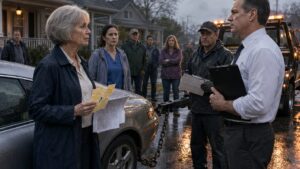
She crossed the grass in short, hard steps and slapped the red packet onto the flat middle stone of the bridge. The sound made William’s shoulders tighten.
On top was a printed notice with the county seal. Beneath it was an estimate from David Garcia’s stonework company. The number at the bottom was larger than William expected. But the number Samantha had circled in blue pen was smaller and angrier.
$350.
“County filing and emergency site review,” she said. “That’s before repairs. I expect him to cover it today.”
William did not touch the papers.
He had come out with his denim jacket unbuttoned and the old brown folder tucked under his arm because something in Samantha’s first phone call had told him not to come empty-handed. She had not asked him what happened. She had said, “You need to come down here before I make this official.”
It seemed she had made it official anyway.
Ryan glanced at the estimate. “Mrs. Campbell says you altered stones on the bridge wall after the storm.”
“I moved two loose capstones,” William said.
Samantha gave a sharp laugh. “He admits it.”
William kept his eyes on Ryan. “They were on top. Not in the wall. One was tilted into the walking path.”
“Did you have permission to move them?” Ryan asked.
William looked over the creek, toward the place where the bridge touched both lawns. “I’ve maintained this crossing for twenty years.”
“That’s not an answer,” Samantha said. “And he does this. He says things calmly so everybody thinks he’s reasonable.”
The deputy lifted a hand. “Ma’am.”
“No, because that’s exactly how this started.” Samantha pointed at William now. “He wanders over, touches what isn’t his, and then when damage appears, he acts like he’s just some helpful neighbor.”
William felt heat rise in his face. Not anger first. Embarrassment. The kind that came when people stared before they knew enough to stare fairly.
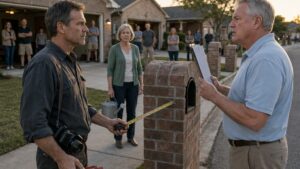
Two neighbors had paused near the road. One leaned on a mailbox. Another pretended to look at the creek while watching everything.
William shifted the folder lower under his arm.
Ryan stepped onto the bridge and crouched near the bowed section. “Mr. Carter, besides the two capstones, did you move anything else?”
“No.”
“Did you use tools?”
“A pry bar to lift one stone. It was wedged.”
Samantha turned to Ryan, triumphant. “There. A pry bar. He just said it.”
William’s jaw tightened. He should have called someone. He knew that now. He should have taken a picture first, sent a message, asked Ryan or the road crew to come out. Instead he had trusted the fact that anyone looking at the creek after that storm would understand why he had acted.
Obvious facts, his wife used to tell him, still need a witness.
Ryan stood. “Mrs. Campbell, the estimate says displacement along the side wall, not just top cap movement.”
“And who displaced it?” Samantha asked.
“That’s what we’re determining.”
“It’s my bridge,” she said. “My side. My property. I’m trying to sell a house with a damaged creek crossing because he couldn’t leave things alone.”
That was new.
William looked at her more carefully. Under the clean makeup and polished hair, her mouth was tight with something beyond anger. Her house sat beyond the lawn, tall windows turned toward the mountains. A real estate sign had gone up two weeks earlier and come down after the storm. William had noticed but said nothing. He said nothing about many things.
Ryan picked up the county notice and held it out. “Mr. Carter, this is not a final determination. It’s notice that a complaint has been filed and the site review fee has been assessed pending responsibility.”
Samantha reached over and took it from him before William could. “He needs to sign acknowledgment.”
She pulled a second sheet from the packet and pressed it against the bridge stone with a pen. There was a blank line at the bottom. William saw his printed name above it.
William Carter acknowledges responsibility for disturbance of creek bridge wall and agrees to cooperate with repair assessment.
The words seemed too neat for what they were trying to do.
“Sign that,” Samantha said, “and we can stop wasting everyone’s morning.”
William looked at the pen. Then at the old bridge. The center stones were the same ones his wife had photographed every spring because the moss changed color in April. He could still see her kneeling near the bank, writing dates on the backs of pictures at the kitchen table, telling him that memories were sweetest when they could prove where they belonged.
He touched the edge of the folder under his arm.
“No,” he said.
Samantha blinked. “Excuse me?”
“I won’t sign that.”
The deputy’s eyes moved to him. Ryan’s did too.
William kept his voice low. “I moved two loose stones out of the walking path. I did not damage that wall. And I’m not paying for damage I didn’t cause.”
Samantha’s face hardened. “So you refuse to cooperate.”
“I refuse to accept blame.”
“That’s the same thing when the damage is on my property.”
“It isn’t just yours.”
The words came out before William had decided to say them. The creek filled the silence afterward, water ticking around stone.
Samantha stared at him. “What did you say?”
William opened the folder just enough to see the top sheet inside, an old copy folded along soft white lines. He did not pull it free. Not yet. The paper was old, incomplete, and he knew better than to wave half a thing in front of people already eager to call it nothing.
“The crossing has been shared since before either of us owned these houses,” he said.
Samantha turned to Ryan. “That is not true.”
Ryan’s expression changed slightly, not agreement, not doubt. Attention. “Do you have documentation of that, Mr. Carter?”
“Some.”
“Some?” Samantha repeated. “This is exactly what I mean. He keeps scraps and stories and expects everyone else to pay.”
William closed the folder.
He could have opened it. He could have shown the faded easement copy, the receipts, the photographs. But standing there with Samantha’s red packet on the bridge and neighbors watching from the road, he felt the old reluctance close around his ribs. He did not want to turn his wife’s careful handwriting into ammunition. He did not want to make the bridge a courtroom.
Ryan tapped the clipboard against his palm. “Here’s where we are. The county has a complaint. There’s visible damage. There’s an admission that stones were moved after the storm. There may also be an easement question.”
“May be?” Samantha said.
Ryan ignored that. “Mr. Carter, if you have records showing shared responsibility or preexisting damage, I need them by Friday. Otherwise, the county may have to keep the claim active and proceed based on the complaint and the site report.”
William looked at the paper with his name still waiting for a signature.
Friday was three days away.
Samantha picked up the pen and clicked it shut, the small sound sharper than the creek. “Then I suggest he find whatever scraps he thinks will save him.”
William tucked the folder tighter under his arm, and for the first time that morning, the bridge felt less like a crossing than a line someone had drawn under his feet.
Chapter 2: The Folder His Wife Told Him Not To Throw Away
Emily Carter found the demand letter before she hugged him.
It was lying on the kitchen table beside William’s untouched coffee, Samantha’s red packet opened just enough for the county seal and the $350 circle to show. Emily stopped in the doorway with her purse still on her shoulder, looked at the papers, then looked at him.
“Dad,” she said, “why is there a bill with your name on it?”
William was at the sink, washing mud from his hands though the mud had been gone for an hour. He turned off the tap. “It’s not a bill yet.”
“That is not comforting.”
“She wants it to be one.”
Emily crossed the kitchen and picked up the top page. Her eyes moved quickly, the way they had when she was a girl reading instructions before building something too complicated for her age. She had her mother’s focus and his temper, though she would have denied both.
“Three hundred fifty dollars is just the review fee?” she said. “What’s this estimate?”
“Bridge wall repair.”
She flipped to the second page and her mouth tightened. “This is thousands of dollars.”
“Likely more once they start.”
“Dad.”
He dried his hands slowly on a dish towel. “I didn’t cause it.”
“I didn’t say you did.”
But fear had already stepped into the room and taken a chair.
Emily pulled one out and sat. “Tell me exactly what happened.”
So he did. He told her about the storm, the loose capstones, Samantha on the grass in that red suit, Ryan Hall with his clipboard, the deputy watching the road, the neighbors pretending not to listen. He told her about the paper Samantha wanted signed.
Emily held very still at that part.
“You didn’t sign.”
“No.”
“Good.” Then, after a beat, “But you moved stones.”
“Two.”
“With a pry bar.”
“One needed it.”
Her fingers pressed against the page. “That’s what they’ll use.”
“I know.”
“Did you take pictures before you touched anything?”
William looked toward the back window. From there, he could see the top of the bridge beyond the willow branches. “No.”
Emily let out a breath and stood. “Okay. Then we need everything else. Receipts. Photos. Anything from the county. You said Mom kept a folder.”
William did not answer quickly enough.
Emily turned. “Dad.”
“It’s in the hall cabinet.”
“Then get it.”
He did not move.
The folder had lived in the lower shelf since his wife died, tucked between appliance manuals and a box of Christmas cards she had bought too early. He had opened it twice since the funeral. Once to find the name of the mason who repaired the bridge in 2011. Once by accident, when a photograph slipped out and showed his wife’s hand resting on the bridge rail, her wedding ring bright against the old stone.
“It may not be enough,” he said.
“It doesn’t have to be enough by itself. It has to be better than nothing.”
Emily went to the cabinet before he could stop her. She knelt, moved the manuals, and pulled out the brown folder. Dust marked the front where his wife had written in black marker: Bridge / Creek / Easement.
Emily’s face changed when she saw the handwriting.
For a moment, neither of them touched it.
Then she carried it back to the table and opened it carefully.
The first photograph was from April, fifteen years earlier. The bridge looked nearly the same, only the willow smaller and the stone edges cleaner. On the back, in his wife’s neat script, was a date and a note: Shared crossing after spring melt. West side damp but stable.
Emily turned it over and stared at the bridge in the picture. “This was before Samantha moved in.”
“Yes.”
“How long before?”
“Years.”
Another photograph showed the creek low in late summer. Another showed a county road crew truck parked near the culvert upstream. Another showed William younger, standing on the bridge with a shovel, annoyed at being photographed.
Emily almost smiled. “She really documented everything.”
“She said people remember what suits them.”
“She was right.”
William sat down across from her. The chair creaked under him. Emily sorted the photographs into small piles, then unfolded a thin copy of an old property record. The paper had been copied so many times that some lines were faint.
“There,” William said, pointing. “Shared access.”
Emily leaned closer. “It says pedestrian and maintenance access across existing creek crossing for parcels—” She stopped. “The parcel numbers are cut off.”
“I know.”
“Where’s the next page?”
“I don’t have it.”
“Dad.”
“That’s what they gave us when we bought the place.”
Emily rubbed her forehead. “So we have proof, but not complete proof.”
“We have history.”
“History doesn’t always win against paperwork.”
The words struck harder than she meant them to. William looked down at his wife’s handwriting. He had spent years believing that if he kept quiet and did things properly, the world would remain mostly fair. Not generous. Not easy. Just fair enough that a man did not have to defend every decent act like a crime.
Emily softened. “I’m not saying you should pay. I’m saying you need to think like they’re going to make you.”
His phone buzzed on the table.
They both looked at it.
A text from Samantha filled the screen before William picked it up.
Insurance adjuster will inspect tomorrow at 9. You need to be present. If you refuse, I’ll note that too.
Emily read it over his shoulder. “She’s moving fast.”
“She has a sale.”
“What?”
“Sign came down after the storm. Ryan said she’s trying to sell.”
Emily’s eyes sharpened. “So she needs the damage explained before a buyer sees it.”
William folded the easement copy along its old crease. “Maybe.”
“Not maybe.”
He did not answer.
Emily gathered the photographs again. Near the bottom of the folder, a small envelope slid loose. It was sealed but not glued, the flap tucked in. On the front, his wife had written: If creek wall is questioned, start here.
William stared at it.
Emily’s hand hovered above the envelope. “Have you opened this?”
“No.”
“Why not?”
Because he had not wanted to need it. Because some things in a house became sacred not because they were beautiful, but because opening them meant admitting the person who made them had known more about the future than you did.
Emily untucked the flap only after he nodded.
Inside were three photographs and a note. The first photo showed Samantha’s property before the landscaping: rough grass, open drainage, the culvert mouth clear. The second showed new stone edging along her side yard. The third showed water pooling near the base of the bridge after a hard rain.
The note was short.
Bill, if anyone ever argues the bridge belongs to one side, check the county record before you argue back. The creek never cared about property lines.
Emily read it and went quiet.
William took the note from her, holding it by the edges. For the first time all day, the folder did not feel like a box of old paper.
It felt like his wife had left a hand on his shoulder.
Then his phone buzzed again.
A second message from Samantha appeared.
The adjuster will expect a statement. If you won’t sign today, be ready to explain tomorrow why you interfered with my property.
Emily looked from the phone to the folder. “Dad,” she said, “tomorrow morning, you bring all of this.”
William looked out at the bridge, where the late light sat on the stones like a warning.
“All of it?” he asked.
Emily closed the folder and pushed it gently toward him.
“Especially the parts you don’t want to show.”
Chapter 3: The Estimate Was Written Before He Was Asked
David Garcia arrived with the blame already printed.
William saw the words before David said good morning. They were clipped to the front of his contractor board in black type under a rough photo of the damaged bridge wall.
Probable neighbor-caused displacement following unauthorized stone movement.
Samantha stood beside him on her lawn in a cream coat this time, but the red suit jacket was folded over one arm like a flag she had not fully lowered. The insurance adjuster knelt near the creek wall with a tablet, taking pictures from angles that made the bowed stones look worse than they had yesterday. Ryan Hall stood back from the bridge, waiting.
William came down the path with the folder under his arm.
Samantha noticed it immediately. “More scraps?”
William did not answer.
David looked uncomfortable. He was a broad-shouldered man with dusty boots and careful hands, the kind of contractor who knew how to touch stone without making it seem disturbed. He had repaired chimney caps for William once and rebuilt Samantha’s garden steps the year after she moved in.
“Morning, Mr. Carter,” David said.
“David.”
The insurance adjuster stood. “We’re here to document site condition and statements. No one is determining final liability this morning.”
Samantha gave a short laugh. “You have his statement. He admitted moving the stones.”
The adjuster looked at William. “You did move stones?”
“Two capstones on the walking surface,” William said. “After the storm.”
“With tools?”
“One pry bar.”
The adjuster typed.
William heard each tap as if it were a small nail.
Ryan stepped closer. “Mr. Carter has also stated he believes the crossing is shared.”
“Believes,” Samantha said.
William opened the folder and removed a photocopy of the easement page. He did it slowly, mostly to keep his fingers steady. “This is what I have so far.”
Ryan took it, read, and frowned at the cut-off parcel line. “This isn’t complete.”
“No.”
Samantha’s mouth curved. “Convenient.”
“It’s old,” William said.
“Old and incomplete.”
David’s gaze flicked toward the paper, then away.
The adjuster walked to the bridge wall and pointed. “Mr. Garcia, based on your estimate, where did the displacement begin?”
David cleared his throat. “Visible movement is along the west side base course and the lower retaining stones. Top cap disturbance alone wouldn’t usually cause that.”
Samantha turned sharply. “But it could.”
“Could contribute,” David said. “If the lower wall was already compromised.”
William looked at him.
Samantha did too, but with a different kind of attention. “That’s not what your estimate says.”
David adjusted the clipboard. “The estimate was for repair scope.”
“It says neighbor-caused displacement.”
“That was based on the information provided.”
The creek sounded suddenly louder.
William watched Samantha’s fingers tighten around the red jacket. “Information provided by whom?” he asked.
No one answered right away.
The insurance adjuster looked up from the tablet. “Mrs. Campbell submitted the initial description.”
“I submitted what happened,” Samantha said. “He moved stones. The bridge failed.”
William looked at the estimate again. The date at the top was two days before Samantha had called him. Two days before she had stood on the grass with the deputy and demanded his signature. He stepped closer, careful not to cross onto the wet stones.
“David,” he said, “when did you come look at this?”
David’s eyes moved to Samantha, then back to William. “Monday afternoon.”
William nodded once. “Before she notified me.”
Samantha cut in. “I was under no obligation to notify you before getting an estimate on my own property.”
“If it was only your property,” William said.
The adjuster typed again.
Ryan looked at the estimate date. “Mrs. Campbell, when did you first contact Mr. Carter?”
“Tuesday morning,” she said. “After I had enough information to confront him properly.”
William almost smiled at the word properly, but it would have looked like disrespect, and he had given Samantha enough room already to call his calmness an act.
He walked to the edge of the bridge and looked down.
The wall bulged outward at the base, but the damp line did not begin where the capstones had shifted. It ran from Samantha’s side of the lawn, below the new stone edging, down toward the creek wall in a faint dark stripe. He had seen wet ground before. He had spent enough years clearing culverts and resetting rocks after meltwater to know when water had traveled where it wanted and when it had been sent there.
“Has that always been wet?” William asked.
Samantha followed his eyes. “Don’t change the subject.”
“I’m asking about the wall.”
“The subject is what you touched.”
He crouched without asking permission. The grass near Samantha’s stone edging gave slightly under his boot. Water pressed up around the sole.
The adjuster noticed. So did Ryan.
William stood. “That ground is saturated.”
“We had a storm,” Samantha said.
“Three days ago.”
“It’s mountain property. Things stay wet.”
David said nothing, but his eyes had gone to the same place.
Ryan stepped off the bridge and pressed his own boot near the edging. His face did not change, but he wrote something down.
Samantha saw it. “That has nothing to do with him moving stones.”
David exhaled through his nose. “Water pressure can loosen a wall from behind.”
“You told me his movement could have caused it.”
“I told you,” David said carefully, “if a wall was already loose, movement at the top could finish what water started.”
The words settled badly.
William felt Emily’s warning from the night before return to him. That’s what they’ll use.
“So my touching the capstones gives her enough to blame me,” he said.
David did not answer quickly. “It gives people something to point at.”
Samantha seized on that. “Exactly.”
William looked at David, not Samantha. “But it doesn’t tell them what weakened the wall.”
“No,” David said.
The adjuster lowered the tablet. “I’ll need statements from all parties. Mr. Carter, will you sign an acknowledgment that you performed work on the bridge without written authorization?”
William looked at the page offered to him. It was not Samantha’s form. It was cleaner, more neutral, and somehow more dangerous because of that.
“Does it say I caused the damage?” he asked.
“It says your work may have contributed and that you agree to cooperate with liability review.”
Samantha’s voice sharpened. “Which is reasonable.”
William read the first paragraph. Cooperate. Review. Possible contribution. Words that could be used gently in the morning and harshly by afternoon.
“I’ll provide a written statement,” he said.
The adjuster’s expression cooled. “Refusal to sign may be noted as non-cooperation.”
Emily would hate that. His bank account would hate it. The quiet part of him, the part trained by years of keeping peace with neighbors and weather and grief, wanted to take the pen just to stop all their eyes from resting on him.
Instead he closed the folder against his chest.
“Then note this too,” he said. “I moved two loose stones so no one would fall. I did not damage that wall. And I won’t sign a paper that lets someone turn one truth into another.”
For a moment, nobody moved.
Then the adjuster tapped the tablet and said, “Refusal to sign acknowledgment recorded.”
Samantha looked satisfied, but not relieved.
William noticed that.
As everyone began gathering their papers, David lingered by the bridge. He did not come close enough to be accused of taking sides. He only looked down at the saturated strip of grass and then at the folder under William’s arm.
“You should check old drainage records,” David said quietly.
Samantha turned from the lawn. “What was that?”
David raised his clipboard. “I said I’ll revise the repair scope if the county asks.”
But William had heard him.
The adjuster walked past William toward the road. “You’ll receive the notation by email,” the adjuster said. “For now, your refusal is part of the file.”
William stood beside the bridge as the words landed exactly where Samantha wanted them.
Non-cooperation.
By noon, that would sound like guilt to anyone who wanted it to.
Chapter 4: The Creek Remembered The Storm Better Than They Did
“The page that matters isn’t in this file,” the county clerk said.
William stood at the counter with his bridge folder open between his hands, the incomplete easement copy lying under the clerk’s finger. Behind her, metal shelves held decades of property records in gray boxes with fading labels. The fluorescent lights made every paper look tired.
“It has to be there,” William said.
The clerk shook her head, not unkindly. “This packet references an attachment. The attachment isn’t scanned with this parcel record.”
“Can you find it?”
“I can request the physical archive, but not before Friday.”
Friday was tomorrow.
William looked down at the cut-off parcel numbers, the blank edge where proof became absence. Samantha had a repair estimate, a county complaint, and an insurance file that now marked him as refusing to cooperate. He had photographs, memory, and a missing page.
The clerk slid the copy back toward him. “There may be other ways to establish shared use.”
“What kind?”
“Maintenance records. County work orders. Storm reports. Anything that shows the bridge was treated as common access instead of private property.”
William folded the easement page carefully. “How far back?”
“As far as you can stand to look.”
By noon, the folder had grown heavier.
He found a road maintenance note from six years earlier about clearing debris upstream of “shared pedestrian crossing near Carter/Campbell parcels.” The clerk printed a storm report from the week before, showing two inches of rain in less than an hour and a warning for runoff near the mountain road. Neither paper said Samantha had caused anything. Neither paper freed him. But together they said the creek had been busy before he touched a stone.
On his way home, William stopped at the roadside culvert above the bridge.
The ditch was still wet.
He crouched beside the grate and pulled at a tangle of pine needles caught against the metal. Mud sucked at his boot. Water seeped through slowly, more sluggish than it should have. Downhill, the land tilted toward Samantha’s side yard, where her new stone edging curved cleanly along the lawn. It looked expensive and solid from a distance. Up close, the ground below it held the dark shine of water that had nowhere proper to go.
A road maintenance worker slowed his truck on the shoulder.
“You Carter?” the worker called.
William stood. “Yes.”
“County told us there was a complaint down there.”
“There is.”
The worker leaned an arm out the window. “That culvert’s been a nuisance since somebody changed the grade on the west side.”
William wiped his hands on his jeans. “Do you know when?”
The worker shrugged. “I just clear what they tell me to clear. But I remember seeing landscaping trucks there last fall. After that, runoff started hugging the wrong side.”
“Did anyone file that?”
“Might be a note. Might not. Depends who was on shift.”
The truck rolled on before William could ask more.
At home, he stood on the bridge and looked at Samantha’s house. Her real estate agent’s car was in the driveway. Through the wide glass doors, Samantha moved quickly from room to room with a phone at her ear. Even from across the creek, William could see the urgency in her posture.
His own phone rang as he reached the porch.
Emily.
“Are you home?” she asked.
“Just got back.”
“Dad, Samantha posted something.”
He closed his eyes briefly. “Where?”
“Neighborhood message thread. She didn’t name you, but she might as well have.”
Emily read it aloud, her voice tightening with every sentence.
Property damage at creek crossing has delayed buyer inspection. Some neighbors believe shared spaces mean they can alter private structures without permission. Please respect boundaries.
William looked at the bridge folder tucked under his arm.
“She’s saying I’m sabotaging her sale,” he said.
“She’s making sure everyone thinks that before you say anything.”
That was what Samantha understood better than he did. The first version of a story did not have to be true. It only had to arrive early.
“I’m going to talk to Nancy,” William said.
Emily went quiet. “Nancy Nelson?”
“She’s lived here longer than any of us.”
“She doesn’t like conflict.”
“No,” William said. “She likes quiet almost as much as I do.”
Nancy’s house sat uphill, half-hidden by aspens, with wind chimes on the porch that sounded even when there was barely wind. She opened the door before William knocked twice, as if she had been watching him come up the drive.
“I wondered when you’d come,” she said.
William held the folder against his side. “Then you know why I’m here.”
Nancy stepped out but did not invite him in. That told him enough.
“I saw the message,” she said.
“Do you remember the bridge easement?”
Her eyes moved past him toward the creek below. “Everybody remembers until remembering costs them something.”
“Nancy.”
She sighed. “Yes. It was shared. The old owners used it. You and your wife used it. Samantha’s side used it. That bridge was never treated like one person’s decoration.”
“Would you tell Ryan Hall that?”
Nancy looked down at her hands. “Samantha is selling. People are tense enough. If I get in the middle, I still have to live here after she leaves. Or after she doesn’t.”
“She’s asking me to pay for damage I didn’t cause.”
“I know.”
“Do you know what did?”
Nancy’s jaw worked once. “I remember trucks last fall. Landscaping. Stone edging. Men digging near the culvert after a rain. I told myself they knew what they were doing.”
“Did you see the culvert blocked?”
“I saw straw matting and gravel washed against it after the first storm.” She looked ashamed before she looked defensive. “I thought someone would clear it.”
“Would you say that?”
“Not yet.”
The answer landed like a door left half-closed.
William nodded because he did not trust himself to speak without sounding hurt. He had come asking for truth and found fear instead. It was familiar. Too familiar to condemn quickly.
Nancy touched the porch rail. “Find records first. People believe paper before neighbors.”
At home, Samantha was waiting by the bridge with her phone in hand.
“I hear you’re visiting people,” she said.
William stopped on his side of the creek. “I’m checking facts.”
“You’re trying to interfere with a buyer inspection.”
“No.”
“You know what a delayed sale costs?” Her voice thinned. For the first time, the polish cracked enough for him to see panic under it. “Do you know what happens when an inspector writes up structural damage next to water?”
William looked at the bowed stones. “I know what happens when water is sent where it shouldn’t go.”
Her eyes flashed. “Careful.”
The word was not loud. It did not need to be.
“I was,” he said. “That’s why I moved the stones.”
She laughed once, bitterly. “You really do think sounding calm makes you right.”
He let that pass. A week ago, he would have let all of it pass. Now he understood that silence did not make accusations smaller. It made them easier to carry.
Inside the house, Emily was at the kitchen table with photographs spread in rows. She did not look up when he entered.
“I found something,” she said.
William came close.
She held out a picture from the envelope his wife had marked. It showed the bridge six months earlier, before the storm, before his two capstones, before Samantha’s complaint. The creek wall on Samantha’s side was already bowed slightly, the lower stones pushed outward in a shallow curve.
Emily turned it over.
On the back, in his wife’s handwriting, was the date.
Before Samantha’s estimate. Before the complaint. Before the morning on the bridge.
William sat down slowly.
Emily placed the photo beside the storm report and the maintenance note. “It helps,” she said. “But Dad?”
He looked at her.
“They’re still going to ask why you touched it after this was already there.”
Chapter 5: Half The Bill Still Meant Taking The Blame
“Pay half today and I’ll stop making this official,” Samantha said.
She stood inside William’s kitchen like she had bought the right to enter with the papers in her hand. Emily had opened the door because Samantha had knocked only once before trying the handle, and now the red packet was on the table beside William’s bridge folder, bright and accusing against the worn wood.
William remained standing.
“You’re already making it official,” he said.
“I’m offering you a way to keep it from becoming worse.” Samantha pulled out a form and placed it between them. “Half the emergency review cost. Half my initial contractor fee. I’ll absorb the rest until insurance completes the claim.”
Emily reached for the page. Samantha slid it toward her, not William, as if she had decided the daughter was the easier doorway.
“I know you’re trying to protect him,” Samantha said. “So protect him. This gets him out from under the most immediate part.”
Emily read without sitting down. Her eyes stopped midway through the first paragraph.
William watched her face.
Only yesterday she had looked at him with the fear of someone calculating what legal trouble could do to a man on a fixed income, to a house with old pipes, to a bank account kept tidy but not deep. He had not blamed her. Fear was practical. Fear paid bills before pride could object.
But her mouth hardened now.
“What is this?” Emily asked.
“A no-contest responsibility acknowledgment,” Samantha said. “It’s not an admission of intentional damage.”
“But it is an admission of responsibility.”
“It allows the claim to proceed.”
“Against him.”
“With his cooperation.”
Emily set the paper flat on the table and tapped a line near the bottom. “It says he agrees not to dispute connection between his work and the wall damage in any county or insurance review.”
Samantha’s eyes flicked to William. “It’s standard language.”
“No,” Emily said. “It’s a trap with a discount.”
The room went still.
William felt something in his chest ease and hurt at the same time.
Samantha gathered herself. “I came here trying to be reasonable.”
“You came here trying to get him to sign what you couldn’t get him to sign at the bridge,” Emily said.
“I came here because if this keeps dragging, my buyer has every right to walk.” Samantha’s voice sharpened, then caught. She looked toward the window, where the bridge was visible through the willow branches. “You think I want this? You think I want strangers walking my property, photographing damage, asking whether the crossing is safe?”
William heard the truth under the performance. Not innocence. Pressure.
“When is the inspection?” he asked.
Samantha looked back at him. “Monday.”
“That soon?”
“It was supposed to be yesterday.” Her fingers pressed against the back of a chair. “They delayed because of this.”
Because of this. Not because of him. Not exactly. But she had decided there was no difference worth protecting.
William sat down at last. “Who told you to use this form?”
“My agent advised me to clear any responsibility questions before inspection.”
“By putting responsibility on me.”
“By resolving uncertainty.”
“The uncertainty is yours,” William said. “You’re trying to make it mine.”
Samantha’s face flushed. “I watched you out there with a pry bar.”
“You watched me move two loose stones.”
“You touched the structure.”
“I made a crossing safer after a storm.”
“You had no right.”
William opened the bridge folder. He did not pull out the photograph yet. Instead, he placed his palm on the folder the way he might steady a gate in wind.
“Samantha,” he said, “why was David’s estimate written before you called me?”
She blinked once. “Because I needed to know what the damage was.”
“Why did it already say neighbor-caused?”
“Because you were the neighbor who caused it.”
“You hadn’t asked me what I touched.”
“I didn’t need your permission to describe what I saw.”
Emily leaned over the form again. “Dad, if you sign this, they don’t need to prove the cause the same way. You’ll have agreed not to fight the connection.”
Samantha turned on her. “He can either cooperate now or explain himself at the county meeting. But I promise you, once this becomes a public agenda item, it will not look better for him.”
William looked at the form.
His name was typed cleanly. William Carter. As if someone had already decided where his hand belonged.
He thought of all the times he had let small things pass because making them larger seemed worse. Samantha’s landscapers leaving gravel near the culvert. Her real estate agent parking half across his drive for a showing. Her guests posing on the bridge and calling it charming while stepping over the damp stones his wife used to worry about.
Peace had seemed like a fence he could mend from his side.
Now Samantha had carried the broken boards into his kitchen and asked him to pay for the whole thing.
“No,” William said.
Samantha’s lips parted slightly.
He pushed the form back across the table with two fingers. “I won’t pay half to pretend half a lie is true.”
Emily stood beside him, silent but steady.
Samantha looked from one to the other. For the first time, she seemed to understand that Emily was not there to soften him.
“Then I’ll bring it before the county,” Samantha said. She gathered the pages too quickly, bending one corner of the form. “And when the insurance file shows you refused every reasonable chance to cooperate, don’t say I didn’t try.”
“You tried,” William said.
She stopped.
He did not raise his voice. “Just not to find out what happened.”
Samantha’s face changed in a way that nearly made him regret the line. Not because it was cruel. Because it landed near something true. Her anger returned fast to cover it.
“You don’t get to judge what I’m trying to save,” she said.
Then she left, heels sharp on the porch boards.
Emily stayed still until Samantha’s car door closed outside. Then she picked up the bridge folder and hugged it against her chest as if it were something alive.
“I almost told you to sign,” she said.
“I know.”
“I’m sorry.”
“So am I.”
“For what?”
“For making it easy for people to think I won’t answer.”
Emily looked toward the window. “You’re answering now.”
His phone buzzed before he could reply.
Unknown number. Voicemail.
William played it on speaker.
David Garcia’s voice came through low and rushed, with wind in the background. “Mr. Carter, it’s David. I shouldn’t be calling, but ask her who approved the drain extension. Don’t ask about the wall first. Ask about the drain extension. And if county pulls my old work note, make sure they pull the one from last October, not just this week’s estimate.”
The message ended.
Emily lowered the folder.
William stared at the phone, then at the window where the bridge sat between two houses and two versions of the truth.
“Drain extension?” Emily said.
William picked up his keys.
This time, he did not wait for someone else to tell him where to look.
Chapter 6: The Missing Page Was Under Another Address
“The attachment wasn’t missing,” the county clerk said. “It was filed under the other parcel.”
William gripped the counter edge before he could stop himself. “Samantha’s?”
The clerk lowered her voice, though no one else was close enough to hear. “Campbell parcel history. The shared crossing language was duplicated when that lot transferred. Whoever scanned your side didn’t include the continuation page.”
She slid the paper across.
William did not touch it at first.
The page was plain, stamped, and more powerful than anything Samantha had put in red ink. It listed both parcels. It described the stone bridge as an existing shared creek crossing for maintenance and pedestrian access. It did not make the bridge solely his. It did not make it solely hers. It made Samantha’s sentence from the creek bank smaller than she had meant it to be.
It’s my property.
Not all of it.
“Can I get a certified copy?” William asked.
The clerk was already reaching for the stamp.
By the time Emily arrived, he had spread the new page across the hood of his truck beside the storm report, the maintenance note, and the dated photograph of the bowed wall.
Emily read the page twice. “This changes everything.”
“It changes the part she said loudest.”
“But not the cause.”
“No.”
She looked at him. “David’s note?”
William lifted another sheet.
The clerk had found that too, not in the property file but in a permit comment tied to Samantha’s landscaping work from the previous October. David Garcia had written it in careful contractor language after reviewing proposed stone edging near the creek-side lawn.
Existing drainage path should remain open. Proposed extension may increase runoff toward shared bridge wall unless culvert clearance and grade correction are maintained.
Emily read the line and slowly looked toward the road. “He warned her.”
“He warned somebody.”
“Dad.”
William folded the note. “I know.”
They drove back without speaking much. At the bridge, the creek looked harmless, which felt almost insulting. A thing could be gentle on a clear day and still remember exactly where it had been forced during a storm.
David was waiting near his truck when they pulled in.
“I saw you at records,” he said.
William got out with the folder. “You told me to look.”
“I told you enough to make trouble.”
“For who?”
David glanced across the creek. Samantha’s blinds were open, but the house looked still. “Maybe everybody.”
Emily crossed her arms. “Did you warn her about the drain extension?”
“I warned her agent and the landscaping crew lead. Samantha was copied on the email. She told me later the grade was fine and she didn’t want delays.”
“Why didn’t you say that yesterday?” Emily asked.
David looked at William, then at the bridge. “Because contractors who call clients wrong don’t stay contractors long in small towns.”
William understood fear when he heard it, even dressed as practicality.
“You wrote the estimate she used against me,” he said.
David’s face tightened. “She asked for repair scope and told me you had moved stones. I wrote based on what she gave me. That phrase should’ve been softer.”
“Neighbor-caused displacement.”
“I know.”
“That phrase put my name in a file.”
“I know,” David said again, quieter.
Emily looked ready to answer for both of them, but William raised a hand. Not to stop her. To ask for space.
“Will you say what the note means at the meeting?” William asked.
David looked toward Samantha’s house again.
The bridge folder felt heavy under William’s arm, not with paper now, but with the cost of asking other people to stand where he had avoided standing for years.
“If Ryan asks me directly,” David said, “I won’t lie.”
“That isn’t what I asked.”
David rubbed a hand over his jaw. “I’ll be there.”
It was not courage exactly. But it was movement.
Nancy Nelson gave him less.
She opened her door with her sweater pulled tight around her shoulders and listened while William showed her the certified easement page and David’s permit note. Her face grew older as she read.
“I remember the trucks,” she said. “I remember thinking that water would have to go somewhere.”
“Will you tell them?”
Her fingers pressed the page. “William, I am tired of rooms where people decide who they’ll punish before they decide what happened.”
“So am I.”
“That doesn’t mean I want to sit in one.”
He could have pushed. Maybe a younger version of him would have. Maybe his wife would have known the right sentence, one that turned Nancy’s fear without shaming it.
Instead William took the paper back.
“I’m speaking either way,” he said.
Nancy looked up.
He surprised himself by continuing. “I spent three days hoping the folder would talk for me. It won’t. If you come, come because you remember. Not because I asked well enough.”
The wind chimes moved behind her, one clear note after another.
Nancy’s eyes dampened, but her voice stayed controlled. “If you speak first,” she said, “I’ll answer what Ryan asks.”
William nodded.
That was enough. It had to be.
The county meeting was held in a low room behind the administrative building, with stackable chairs, a flag in the corner, and a long table where Ryan Hall sat with a folder of his own. The sheriff’s deputy stood near the back wall. Samantha arrived ten minutes late in the red suit.
Not the jacket folded over her arm this time. Wearing it.
Several neighbors turned when she entered. She gave them a small, strained smile and sat on the opposite side of the aisle from William. Her real estate agent sat behind her, whispering once before Samantha shook her head.
Emily sat beside William, close enough that her shoulder touched his when he opened the bridge folder.
David sat two rows back.
Nancy came in last.
William heard her cane before he saw her. She did not look at him as she took a seat near the aisle, but she gave the smallest nod toward the folder in his lap.
Ryan called the item without drama.
“Creek crossing complaint between Campbell and Carter parcels. We’re here to review responsibility for reported bridge wall damage, access questions, and pending site fee assignment.”
Samantha stood before he finished.
“I’d like to make one thing clear,” she said, voice polished and carrying. “This entire issue began because Mr. Carter interfered with a structure on my property without permission.”
Ryan lifted a hand. “Mrs. Campbell, you’ll have time.”
“It’s my property,” she said.
The room quieted around the sentence.
William looked down at the folder. His wife’s handwriting showed on the top tab, steady as a handrail.
Ryan turned toward him.
“Mr. Carter,” he said, “we’ll hear from you next.”
Chapter 7: The $350 Fine Went To The Other Side Of The Creek
“Mr. Carter,” Ryan Hall said, “do you accept responsibility for the damage to the bridge wall?”
The room turned toward William as if the answer were already sitting in his lap and only needed to be lifted.
Samantha remained standing on the other side of the aisle, one hand resting on the back of her chair, her red jacket bright beneath the flat county lights. The sheriff’s deputy watched from the rear wall. David Garcia sat two rows behind William with his contractor board held against his knees. Nancy Nelson looked down at her hands.
Emily did not touch the folder. She only shifted slightly beside him, giving him room to stand.
William rose with the bridge folder in one hand.
“Yes,” he said, “I touched the bridge.”
A murmur moved through the room.
Samantha’s chin lifted.
William let the sound settle before he continued. “I moved two loose capstones from the walking surface after the storm. I used a pry bar on one because it was wedged. I did not move the lower wall. I did not alter the creek side. And I did not cause the wall to bow.”
Ryan watched him carefully. “You understand the distinction you’re making may affect liability.”
“I do.”
Samantha gave a tight laugh. “He’s trying to admit just enough to sound honest and deny the rest.”
William turned toward her for the first time. Not sharply. Not with the anger he had carried home and polished alone at the kitchen table. Just enough to show he had heard.
“I should have called the county before I touched anything,” he said. “That was my mistake.”
Samantha opened her mouth, but Ryan raised a hand.
William placed the first certified page on the table. “But my mistake is not the cause of your wall failure.”
Ryan picked up the page. His eyes moved over the stamp, the parcel numbers, the shared crossing language.
Samantha’s posture changed. Not much. Just enough.
“That document is old,” she said.
“It is,” William answered.
“Old records don’t prove current damage.”
“No,” William said. “They prove the bridge was never only yours.”
The room quieted differently this time.
Ryan placed the certified easement page beside his own notes. “This establishes shared crossing rights between both parcels.”
Samantha stepped forward. “Shared access doesn’t mean shared permission to repair.”
“No one has said it does,” Ryan replied.
William opened the folder again. His fingers found the photograph Emily had sorted to the top. He placed it below the easement page.
“This was taken before Mrs. Campbell’s estimate,” he said. “Before her complaint. Before I moved the stones.”
Ryan leaned over it.
The photo showed the creek wall on Samantha’s side already bowed, subtle but visible, the lower stones pushed outward in the same shallow curve that had become the center of the complaint.
Samantha looked at it and shook her head. “A picture from some angle does not prove structural damage.”
“It proves the wall had moved before she said I caused it,” William said.
His voice sounded steadier than he felt. Inside, each sentence had to pass through the old habit of silence, the one that kept asking whether this was worth the trouble. Whether dignity might be easier if he sat down and let paper speak.
But the paper would not speak unless he did.
He placed the storm report next to the photo. “This shows the storm runoff warning from last week.”
Then the road maintenance note. “This shows debris and water flow issues at the culvert upstream from the bridge.”
Then David’s old permit comment.
He did not read it aloud yet.
Samantha saw the page and reached toward the table. “Where did you get that?”
Ryan intercepted the motion by picking it up himself. “This is from the county file.”
“It’s not relevant.”
Ryan read silently.
William watched David shift in his chair.
Ryan looked up. “Mr. Garcia, this appears to be your note from last October.”
David stood slowly. “Yes.”
“Can you explain it?”
David’s mouth tightened. He looked once at Samantha. Whatever was between them—work, reputation, future referrals—passed across his face and did not leave easily.
“The proposed landscape extension on the Campbell side changed how water would move near the creek bank,” he said. “I noted that the existing drainage path needed to remain open. If the culvert wasn’t kept clear and the grade wasn’t corrected, runoff could increase pressure toward the shared bridge wall.”
Samantha’s voice sharpened. “Could. Not did.”
David nodded once. “Could.”
Ryan tapped the dated photograph. “And if the wall already showed bowing before Mr. Carter moved capstones?”
“Then the lower wall had likely been under pressure before he touched the top stones.”
“You said his movement could have finished what was already loose.”
“I said it could contribute if the wall was already compromised,” David said. “Not that it created the underlying failure.”
Samantha gripped her chair back again. “This is ridiculous. He was seen with a pry bar. He admitted it.”
William looked at her hands. The knuckles were pale. For the first time, he saw less of the woman who had pointed across the creek and more of someone cornered by a date on a calendar, a buyer waiting, a house she needed to leave behind clean.
It made what she had done understandable.
It did not make it true.
Ryan turned to Nancy. “Mrs. Nelson, you asked to be available if needed. Do you have information about the bridge or drainage?”
Nancy stood with effort.
The room waited.
“I remember when the bridge was maintained by both sides,” she said. Her voice was thin, but it carried. “I remember William’s wife keeping photographs because she didn’t trust memory once property changed hands. And I remember landscaping work last fall on the Campbell side. After that, water started pooling differently near the culvert.”
Samantha looked at her as if betrayed. “Nancy.”
Nancy’s gaze dropped. “I should have said something sooner.”
“That doesn’t mean he didn’t touch it,” Samantha said.
“No,” Nancy said. “It means you knew the creek had more than one story.”
The words landed softly, but William felt them.
Ryan gathered the pages into two stacks. His face remained official, but the direction of the room had changed. Samantha was no longer standing above a simple accusation. She was standing inside a timeline.
“The county will correct the access record to reflect shared crossing status,” Ryan said. “Based on the documentation presented, there is insufficient basis to assign bridge wall damage liability to Mr. Carter. The insurance file will be updated with the drainage and preexisting-condition materials.”
Emily exhaled beside William, almost silently.
Samantha stared at Ryan. “And the site review fee?”
Ryan looked at the original notice. The same $350 that had been circled in blue. “The site review fee was initiated under a complaint asserting private-property damage by unauthorized neighbor work. Given the shared access record and incomplete complaint basis, that fee will not be assigned to Mr. Carter.”
William did not move.
Ryan continued. “There is also a separate issue. Blocking or materially altering drainage near a shared crossing without maintaining required clearance may trigger a county correction notice. The initial administrative citation is three hundred fifty dollars pending inspection.”
Samantha’s face went still.
No one applauded. No one laughed. The room did not give William the easy comfort of a public victory. It only gave him the sound of paper being turned and a woman in a red suit realizing the number she had carried to his bridge had crossed the creek.
Samantha’s voice dropped. “You’re fining me?”
Ryan’s answer was measured. “I’m issuing notice for review and correction. The amount matches the administrative fee schedule. You’ll have an opportunity to respond.”
She looked at William then.
For a moment, he expected the same anger. Instead, something more tired appeared. “You could have told me all this before.”
William closed the folder halfway. “I tried to tell you the bridge was shared.”
“You didn’t show me everything.”
“No,” he said. “I didn’t.”
Emily looked at him, but he kept his eyes on Samantha.
“My wife kept these records,” he said. “I didn’t want to use them like a weapon.”
Samantha swallowed. Her real estate agent leaned forward, whispering urgently, but Samantha did not seem to hear.
William continued, quieter. “But you handed me a form that would have made a lie permanent. I couldn’t let that stand.”
Ryan marked the file. The meeting moved on after that because county rooms always did. There were other complaints, other fences, other people waiting for paper to decide the shape of their lives.
Outside, Samantha stood near the steps with the red folder pressed against her side. William came out with Emily, Nancy behind them and David farther back.
Samantha did not apologize. William had not expected her to.
She only said, “The buyer may still walk.”
William looked toward the mountains beyond the parking lot. “Maybe.”
“You think I deserve that?”
“No,” he said. “I think the creek deserved to be listened to before I was blamed for it.”
Her face tightened, but she had no ready answer.
David stopped beside William after Samantha left. “I should have been clearer earlier.”
“Yes,” William said.
David accepted it with a nod. “I’ll send Ryan the full note tonight.”
“Thank you.”
Nancy touched William’s sleeve before she passed. “Your wife was right to keep the folder.”
William looked down at the worn brown cover. “She usually was.”
The next morning, he went to the bridge alone.
The creek moved clear beneath it, thin sunlight breaking across the water. On Samantha’s side, a county marker had been placed near the saturated strip of grass. On his side, the two capstones he had moved lay where he had left them, waiting for proper hands and proper permission.
William carried one back only after checking its seat. He did not force it. He did not pry. He set it safely away from the walking path and marked the spot with a small wooden stake so no one would mistake care for repair again.
Across the creek, Samantha’s house was quiet. No real estate agent’s car. No red jacket at the window.
Emily came down from the porch carrying two mugs of coffee. She stopped when she saw the folder tucked under William’s arm.
“You bringing that back inside?” she asked.
“In a minute.”
He crossed the lawn and set the folder on the porch table, not hidden in the cabinet, not open for battle. Just there, where a thing could be reached when truth needed it.
Emily handed him a mug.
For a while they stood without speaking, watching the bridge hold both sides of the creek without belonging completely to either.
William looked at the closed folder, then at the water moving under stone.
Peace, he understood now, was not the absence of argument. Sometimes it was the refusal to let a false thing stand quietly just because quiet was easier.
He took one slow drink of coffee and left the folder in the morning light.
The story has ended.