She Was Washing A Rusty Movie Car When A Tech Executive Leaned On The Million-Dollar Fender
Chapter 1: The Rusty Car In The Cleanest Bay
Angela Walker caught the foam brush six inches from the front fender as if it were a knife.
The brush swung there, dripping pink soap in slow ropes onto the wet concrete, its nylon bristles trembling in her hand. Someone in the next bay had left it hanging from the wall, harmless to anyone else, but Angela had seen the grit caught in the base of the bristles. Road sand. Brake dust. The kind of invisible dirt that could carve a bright wound through old paint before the person holding it even felt resistance.
She set the brush back into its holder without using it.
The coin timer above her head clicked down in red numbers. Water hissed from another bay. A vacuum whined near the exit. The car wash smelled of soap, hot rubber, and old pennies, the same way it always did at late morning when the rush had thinned and only the people with time to be careful remained.
Angela had chosen Bay Three because its drain was clean, its hose didn’t kick, and its overhead light flickered less than the others. She had parked the car slightly crooked on purpose, leaving more room on the driver’s side where the front fender curved outward in a tired, uneven line.
To anyone passing by, the car looked like something that had missed its appointment with the scrapyard by stubbornness alone.
Its paint was sun-blasted in places, dull as old bone. Brown-orange freckles scattered near the seams. The hood wore a long scrape that had gone pale at the edges. One rear quarter panel looked as though smoke had once kissed it and never fully let go. The body did not shine. It held light strangely, catching it in scars and dents and shallow waves beneath the skin.
Angela knew every one.
She filled a white bucket from the rinse hose and dipped in a folded cloth so soft it sagged under its own weight. No sponge. No brush. No pressure washer at close range. She wrung the cloth once, gently, then laid it against the roof and pulled in a single straight line.
Not circles. Never circles.
A man walking toward the vending machine slowed and looked over. He had a towel over one shoulder and the bored confidence of someone waiting for wax to dry.
“Ma’am,” he called, not unkindly, “you know the automatic wash down the road is eight bucks, right?”
Angela kept her hand moving.
The man chuckled. “Might be cheaper than whatever therapy this is.”
She let the cloth glide over a seam and lifted before reaching the edge. One second too long in the wrong spot, and water could sit beneath trim that had no business being disturbed. She rinsed the cloth in the bucket, watching fine dust cloud the water.
“Could buy a better one for the money you’re putting into soap,” he added.
Angela did not answer.
She had learned that most people did not want explanations. They wanted permission to keep seeing what they had already decided was true.
The man lost interest after a moment and went back to his own vehicle. Angela took a second cloth from the plastic bin near her feet. The bin had no label. Nothing around her had labels if she could help it: not the cloths, not the small pump bottle of mild cleaner, not the soft detailing swabs wrapped in an old towel. Branded things invited questions. Questions invited stories. Stories turned into hands reaching.
She opened the driver’s door only wide enough to take out a fresh towel from the footwell. Inside, beneath the plain rubber mat on the passenger side, the corner of a sealed document sleeve showed for half a breath. Angela nudged it back under with her shoe before closing the door.
The glovebox held the rest.
She preferred knowing it was there and not needing it.
A high-pressure wand clanged against tile in Bay One. A child laughed somewhere near the vacuums. The coin timer above Angela’s bay gave a warning beep.
She fed more quarters into the machine and returned to the front fender.
That fender was why she had come.
A fine gray film had settled over it after three dry days of road construction on the county route. Dust collected differently there, along the hand-formed lip where no factory stamp had ever pressed metal into obedience. The aluminum beneath that paint was thin in a way newer people did not understand. It had been shaped by hands, hammered and rolled and corrected by eye. Its imperfections were not failures. They were fingerprints.
Angela wet the cloth again and bent close.
Her sleeve slipped down. She pushed it back with her wrist. Water ran from her elbow into the cuff of her shirt. She ignored the chill.
Across the lot, the car wash owner, Charles Green, stepped out of the small office with a roll of receipt paper in one hand. He paused when he saw her in Bay Three. His face did what it always did: recognition first, then confusion, then a careful politeness that never quite became a question.
“Morning, Angela,” he called.
“Morning, Charles.”
“Machine ate your quarters again?”
“No.”
He nodded at the bucket, the towels, the car she had brought to his wash twice a month for years without ever letting his attendants touch it. “Let me know.”
“I will.”
He went back inside, still holding the receipt paper. Through the office window, Angela saw him glance once more toward the bay camera mounted under the awning. The black dome pointed at the row of wash stalls, dull and patient.
Angela returned to the fender.
She was cleaning the underside of the lip with a detailing swab when the first low electronic chirp came from the entrance lane. It was followed by a smooth artificial hum and the soft squeal of tires turning too sharply on wet concrete.
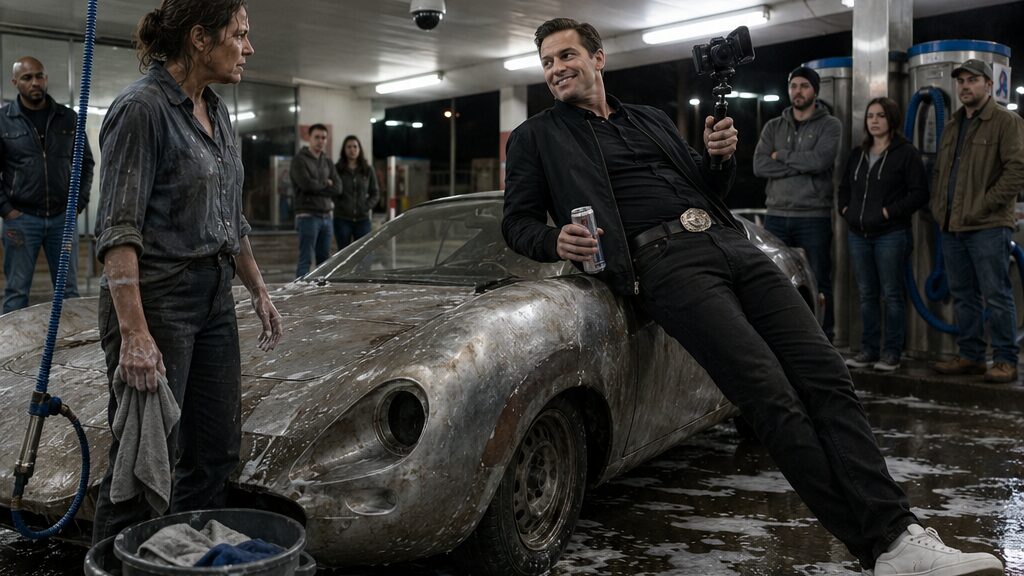
A spotless white EV rolled into Bay Four like it had been lowered from a showroom ceiling. Its glass roof reflected the fluorescent canopy. Its wheels were clean enough to show the gray sky. The car stopped with a theatrical little bounce as the driver braked.
Angela did not look up until she heard the voice.
“All right, we found a live one.”
The driver stepped out holding a heavy digital camera mounted on a metal vlogging stick. He was younger than Angela by a decade or so, maybe early forties, with close-cut hair, expensive sneakers, and a zip jacket that looked designed to imply exercise without requiring any. A silver belt buckle flashed at his waist when he swung the camera around.
He smiled into the lens before he looked at her.
“Community car wash content,” he said. “This is why I love real-world user behavior. You think you’ve seen inefficiency, and then someone spends half a day hand-washing a barn find that should’ve been recycled during the last administration.”
Angela folded the wet cloth once and set it over the bucket rim.
Not fear. Not yet.
Just calculation.
The camera lens turned toward the car. Its black glass eye caught the fender, the dead paint, the soap bucket, Angela’s rolled sleeves.
The man looked at his own EV, then at Angela’s car, then back into the camera.
“You guys ask me all the time why I say nostalgia is the most expensive form of denial,” he said. “Here’s your answer.”
A couple near the vacuums turned their heads. The man with the towel over his shoulder smirked, pleased that someone louder had taken over the joke he had started.
Angela picked up the rinse hose.
“Careful,” she said.
The man laughed. “With what? The archaeological site?”
She sprayed water along the lower rocker, not toward him. The stream stayed low and controlled. Her jaw did not move.
He angled the vlogging stick higher, getting the car and his EV in the same frame. “I’m Jason Clark, and today’s lesson is simple. Some people polish the future. Some people water the past and call it character.”
Angela watched water bead on the dull paint, each droplet catching light without shine.
Jason stepped closer to the dividing line between bays.
“This,” he said, pointing his camera at the front fender, “is exactly what’s wrong with old car culture.”
Chapter 2: The Belt Buckle Against The Fender
The scrape was so small no one else reacted.
A soft metal kiss. A dry, narrow sound beneath the water hiss and vacuum whine. Jason Clark had leaned back against the front fender as if the car were a counter at a bar, and the silver buckle at his waist pressed into the aluminum with the full lazy weight of his body.
Angela heard it in her teeth.
“Move,” she said.
Jason kept smiling at the camera. “And here we have the protective owner response. Watch this. They always act like the decay is sacred.”
“Move away from the fender.”
He turned enough to glance down, but not enough to remove his weight. His jacket lifted slightly over the belt. The buckle sat against the faded paint where the fender’s curve thinned toward the wheel arch.
It was not just paint. Not to Angela.
That shallow wave in the metal had been there since before she knew the car. The old scrape near the arch matched a production still folded in a folder at home. The dull patch above it had once been lit by studio lamps. The body line Jason was using as furniture had been shaped by a man who did not sign his work because the car had been made for motion, not reverence.
Angela put the hose down.
Water struck the concrete, writhing like a loose cable.
Jason’s camera hovered inches from his face. It was too large for casual filming, all black casing and glaring glass, bolted to a metal stick that made every gesture look like a weapon being politely aimed.
“Relax,” he said. “My EV costs more than this whole thing.”
Someone behind him laughed.
Angela’s eyes moved once to the belt buckle.
“Last time,” she said. “Step away.”
His smile thinned. For half a second, something less polished showed underneath it. Irritation. Maybe embarrassment. A man who had expected a flustered woman and found a locked door.
He pushed off the fender, but slowly, as if granting a favor. The buckle dragged with him.
Angela did not blink.
Jason looked toward the lens. “You see the posture? This is what happens when identity gets welded to junk. It becomes personal. You can’t even ask basic questions.”
“You didn’t ask one,” Angela said.
That got a sharper laugh from the man by the vending machine.
Jason heard it. His face tightened, then brightened again too quickly.
“I ask questions for a living,” he said. “I run product strategy for people who build the future. And the question is, why are we romanticizing machines that leak, rust, pollute, and sit around as status objects for people who can’t move on?”
Angela picked up a clean cloth. She wanted to check the fender. She wanted to kneel, breathe on the surface, tilt her head until the light showed whether the buckle had broken anything new. But she would not give Jason the pleasure of seeing where to look.
A woman near the vacuums lifted her phone. Angela noticed because the woman’s hand shook slightly before she steadied it. Dark hair pulled back. Gray shirt. Someone who did not want trouble but wanted the record of trouble.
Jason noticed too.
“Good,” he said, louder. “Film it. Maybe we’ll crowdsource the appraisal.”
Angela’s fingers tightened around the cloth.
He stepped closer to the car again, no longer leaning, but circling. He moved the camera along the hood, over the worn paint, close to the seam Angela had just cleaned.
“Look at this texture,” he said. “People call it patina because rust sounds too honest.”
“It isn’t rust,” Angela said before she could stop herself.
Jason froze in delight.
“Oh, it speaks.”
Angela hated herself for giving him that.
He brought the camera closer. “What is it, then? Heritage oxidation? Premium decay? Limited-edition neglect?”
She folded the cloth once, twice, until the edges aligned. “It’s original.”
The word left too much exposed.
Jason’s eyes flicked to the car again. For the first time, he studied it not as an object but as an opportunity. “Original,” he repeated. “That’s perfect.”
The woman with the phone, Sarah Lee, shifted to get a better angle. From where she stood, Angela knew what the image would show: her wet sleeves, her rigid face, Jason’s bright confidence, the ugly old car between them. Sarah could not see the fender curve. She could not see where the buckle had touched. She could not hear the scrape anymore because Jason’s voice had filled the space where the sound had been.
Angela moved between Jason and the front fender.
“Film your car,” she said. “Leave mine alone.”
“My audience likes comparisons.” Jason glanced back at his EV. “Standard platform, clean interface, full electric, zero drama. This?” He tapped the air above the hood, close enough that Angela’s shoulders tightened. “This is emotional hoarding.”
“Don’t touch it.”
“I’m not touching it.”
His free hand dropped to his side. In it was a tall aluminum energy drink can, already opened, its bright sticky smell cutting through the soap. He had brought it from his car without Angela noticing.
He caught her looking and smiled.
“You need to calm down,” he said. “Hydrate, maybe.”
Then he reached toward the hood.
Not fast. That was the insult of it. He moved lazily, making a show of the harmlessness, setting up the shot so the can would sit on the dull paint while his camera caught her reaction. The can tilted slightly in his grip. A bead of syrupy liquid gathered at the rim and slid down.
Angela saw the drop before it fell.
Her hand closed around his wrist.
The bay went quiet in a way crowds go quiet when everyone realizes a line has been crossed but no one knows who will pay for it.
Jason looked down at her hand, then at the camera.
“Are you grabbing me?”
Angela’s voice came out low. “Don’t.”
He tried to move his wrist another inch toward the hood.
She took the can from him.
There was no flourish in it. She simply twisted it out of his fingers, stepped back, and closed her fist around the middle.
The aluminum folded with a violent crack.
Foam and yellow liquid burst between her knuckles and sprayed down onto the concrete. The can collapsed flat, edges splitting, syrup running over her hand. The sound bounced off the tile walls and silenced the vacuums, the jokes, even Jason’s practiced breathing.
Angela opened her hand.
The crushed metal dropped into her palm like a dead thing.
Jason stared at it. His camera dipped.
“You psycho,” he said, but his voice had lost its shine.
Angela threw the dripping can at his shoes.
It struck the wet concrete, skittered once, and came to rest against the clean white edge of his sneaker.
Chapter 3: The Appraisal Nobody Wanted To Believe
Angela opened the glovebox with wet hands before Jason could find his voice again.
The latch stuck, as it always did. For one terrible second, it held. Behind her, Jason was already backing away from the crushed can and lifting the camera again, remembering himself, remembering the shape of an audience that was not here yet but would be.
“You saw that,” he said, sweeping the lens across the bay. “Everyone saw that. She put her hands on me and destroyed my property over a junk car.”
The glovebox dropped open.
Angela reached past the folded microfiber towel, past the old registration sleeve, past the soft cotton gloves she never used in public because they made people curious. Her fingers found the sealed appraisal packet and pulled it free.
The plastic sleeve was thicker than most people expected. Clear, rigid, bordered in black. Inside it were photographs, signatures, condition notes, insurance language, a valuation page, and a chain of custody summary she could recite without looking. Water from her wrist ran across the outside, but the seal held.
She shut the glovebox with her hip.
Jason saw the packet and laughed too quickly. “Oh, fantastic. She has paperwork. You printed your emotional support certificate?”
Angela faced him.
For a moment she could not speak. Not because she had nothing to say, but because saying it here, under buzzing car wash lights, in front of strangers and a man who had just used the car like a prop, felt like dragging something private across gravel.
The man with the towel came closer. Sarah Lee still held her phone up, lower now, her expression uncertain.
Charles Green pushed out of the office door. “What happened?”
Jason turned to him immediately. “Your customer attacked me. I have it on video.”
Angela held up the packet. “He leaned on the fender. Metal buckle. Then tried to put a drink on the hood.”
“I did not attack a car,” Jason said. “Listen to the language.”
Charles stopped at the edge of Bay Three, eyes moving between Jason’s camera, the crushed can, Angela’s wet hand, and the old car.
Angela slid one page halfway upward in the sleeve, enough for the appraisal header to show. She did not angle it toward Jason’s camera. She angled it toward Charles.
“Do you know this company?” she asked.
Charles squinted. His face changed before he answered. Not understanding, exactly. Recognition of seriousness.
“I’ve seen that name on collector policies,” he said slowly.
Jason snorted. “Collector policy. For that.”
Angela looked at him. “Screen-used.”
The words landed strangely. Not loud. Not dramatic. They seemed to take a second to find the room.
Sarah lowered her phone another inch.
Jason’s smile twitched. “Screen-used what? In a local commercial for engine sludge?”
Angela drew the valuation page up just enough for the number line to appear. She covered the vehicle identification details with her thumb.
Charles took one step closer, then stopped himself as if distance had become a legal requirement.
“Angela,” he said softly, “is that insured value current?”
“Yes.”
His mouth opened, closed. He looked at the fender.
Jason kept laughing, but now the laugh had edges. “Anyone can print a number. There are websites. You type in whatever fantasy you want.”
Angela slid the page back down. “It’s verified.”
“By who? Your cousin?”
“Mary Scott.”
Charles looked up sharply at that. “The film-car appraiser?”
Jason rolled his eyes. “Of course there’s a film-car appraiser. There’s always a specialist when someone wants an old thing to feel expensive.”
Angela could have said the title then. The movie. The scene. The production year. The archive still. She could have said the part that made people stop smirking and start calculating proximity. She could have watched Jason’s face collapse in real time.
Instead she put the packet against her chest.
“No more filming,” she said.
Jason’s eyebrows lifted. “You don’t get to decide that in public.”
“You filmed the car after being told to stop. You touched it. You tried to put a drink on it.”
“And you grabbed me.” He swung the camera toward her hand, still sticky from the drink. “You crushed my property like some kind of unstable—”
“Enough,” Charles said.
It surprised everyone, including Charles.
He glanced back at the office window, at the little black dome under the awning. “There are cameras.”
“Great,” Jason said. “Then save the footage for my lawyer.”
Angela saw Charles flinch at the word.
There it was. The shift. Jason had felt the ground soften under him and reached for the harder thing: threat, process, cost. His camera remained up, but his body angled toward his EV now, retreat disguised as strategy.
“I’m filing a report,” he said. “And I’m posting this because people should know what happens when you challenge these gatekeepers.”
“Gatekeepers?” Sarah said before she seemed to mean to.
Jason pointed the camera at her. “Yes. The whole culture. Fake scarcity. Fake history. Fake value. And then violence when you question it.”
Angela wiped her sticky hand once on a towel and hated the tremor in her fingers.
Charles moved closer to her, lowering his voice. “You want to come into the office? We can make a note of it.”
“A note won’t fix the fender.”
Jason heard that. “So now I damaged it? I thought I didn’t touch it.”
“You touched it,” Angela said.
“Prove it.”
The word hit harder than it should have.
Angela looked at the appraisal sleeve in her hands. Proof was supposed to be weight. Paper. Signature. Seal. Expert language. It was supposed to hold against careless mouths.
But Jason’s camera was still recording, and Sarah’s phone had been recording, and Charles’s security camera had been recording from somewhere high and silent. Three different eyes. Three different truths, depending on where they had looked and when someone decided to cut.
Jason stepped back into Bay Four, near his spotless EV. “I’ll send you the cleaning bill for my shoes.”
No one laughed this time.
He opened his car door, then paused with one foot inside. “Actually,” he said, raising the camera toward Angela one more time, “say it again. Tell everyone what the junk is worth.”
Angela said nothing.
His smile returned, thinner and meaner. “That’s what I thought.”
He got in, shut the door, and reversed out of the bay with the crushed can still lying in the wet track behind him.
For several seconds, no one moved.
Then Sarah lowered her phone completely. “I didn’t get the first part,” she said.
Angela looked at her.
Sarah swallowed. “I mean—I got when you grabbed the can. But not before.”
Charles rubbed a hand over his face. “Angela, come inside. Please.”
She looked at the car. The front fender still wore soap along the curve, drying into faint white trails. The place where Jason’s buckle had touched looked unchanged from a distance. That was the cruelty of damage to old things. Sometimes the world saw nothing until the wrong expert saw everything.
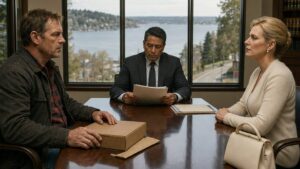
Inside the office, Charles cleared a stack of receipts from a plastic chair. Angela did not sit. She held the appraisal sleeve flat on the counter while he leaned over it without touching.
“Mary Scott signed this,” he said.
“Yes.”
“And this policy language—Angela, this is…” He stopped, as if naming the amount out loud would make his office too small for it.
“It’s why I told him not to touch it.”
Charles looked through the window at the empty bay. “I believe you.”
Angela should have felt relief.
Instead her phone buzzed.
She ignored it.
It buzzed again. Then again. A cluster of sounds, each one sharp as a pebble against glass.
Sarah stood just outside the office door, looking down at her own phone with a face gone pale.
Angela turned hers over.
The video had already found her.
The frame showed her hand clamped around Jason’s wrist. The next cut jumped to the can crushing in her fist, liquid bursting across the concrete. Jason’s caption sat beneath it, clean and brutal.
CAR WASH PSYCHO DESTROYS MY DRINK BECAUSE I CALLED HER JUNKER OLD.
Chapter 4: The Clip That Lied By Cutting
Angela watched the clip with the sound off first.
She stood in her garage with the phone propped against a socket tray, one finger hovering over the screen, the old car behind her under a soft gray cover. The video showed Jason’s smile, her wet sleeve, the ugly angle of her hand around his wrist. Then came the cut.
One frame: Jason’s body close to the fender, his belt buckle just out of view.
Next frame: the can crushing in Angela’s fist.
The missing seconds were so cleanly removed that anyone who had not been there would never feel the absence.
She played it again.
This time with sound.
Jason’s caption pulsed beneath the video, and his voice came through polished and wounded. “I called out a junk car, and this woman lost it.”
Cut.
Aluminum cracked in Angela’s hand. Liquid sprayed. The camera dipped as if Jason had stumbled back from danger.
Angela paused the clip on the frame before the jump. She enlarged it until the pixels broke apart. There, at the edge of the image, was a thin flash of silver near his waist. Not enough. Not to someone who wanted not to see it.
She set the phone down harder than she meant to.
The car beneath the cover looked like a sleeping animal. Only the lower edge of one tire showed, dark and still. Angela had brought it home as soon as Charles let her leave through the side exit, avoiding the pair of teenagers near the vacuums who had already begun pointing their phones at her.
She should have spoken in the bay.
She should have said the whole thing cleanly, early, before Jason built a stage out of her silence.
Instead she had protected the car the way she always had: by narrowing the world around it until only her hands and its surfaces existed.
Her phone buzzed again.
A message from an unknown number contained only the video and a laughing symbol.
She turned the phone face down.
On the workbench beside her lay the appraisal packet, wiped dry and weighted at the corners with two clean microfiber cloths. The number inside it meant nothing to her in the way it meant something to Jason. It was not a prize. It was a warning label. A way of telling insurance people, transport people, show people, careless people: do not improve this, do not polish this, do not fix what you think is wrong.
Her garage smelled of cotton, oil, and old paper. A framed production still hung on the back wall, half hidden behind a shelf of labeled bins. The car in the photo was not gleaming there either. It had been built to look bruised, fast, stubborn. Its fender caught a white slash of movie light along the same curve Jason had leaned on.
Angela took her keys.
Charles Green’s car wash was only twelve minutes away, but by the time she pulled into the lot in her pickup, the building looked different. Not physically. The same blue awning, the same vending machine, the same four bays rinsing soap into the drains. But the office window had three fresh smears where someone had slapped wet palms against it, and a small paper sign taped inside read: SECURITY RECORDINGS ARE NOT PUBLICLY AVAILABLE.
Charles opened the office door before she reached it.
“I was going to call you,” he said.
“That video is edited.”
His face folded. “I know.”
Angela stopped.
Charles glanced past her, toward a young man in Bay One filming the car wash sign from his open window. “Come inside.”
The office was too warm and smelled of printer toner. The tiny desk fan clicked with every turn. Charles had three phones on the counter: his own, the office landline, and a cracked old cell he used for payment alerts. All three had been busy enough to make the air feel crowded.
He locked the door after her.
“They’re leaving reviews,” he said.
“Who?”
“His people. Or people who saw his post. I don’t know. One-star reviews. Saying I let violent customers threaten tech creators. Saying the place is unsafe. One said we run a scam for junk cars.” He rubbed his forehead. “Someone posted my business address under the clip like it was a discovery.”
Angela looked at the black monitor mounted above the filing cabinet. Four camera feeds showed four bays from high angles. Bay Three was empty now except for a dark wet stain near the drain.
“You have the footage,” she said.
Charles’s eyes flicked to the monitor, then away. “I have cameras.”
“From the bay.”
“I have cameras,” he repeated, softer.
Angela placed both hands on the counter. “Charles.”
He looked older than he had that morning. The collar of his shirt sat crooked. Receipt paper curled out of the printer and hung to the floor because he had not torn it off.
“He sent an email,” Charles said. “Or somebody representing him did. Told me not to release anything. Said there may be legal action. Said if I distribute footage that damages his brand, I’m liable.”
“His brand.”
“I know how that sounds.”
“He leaned on the car.”
“I believe you.”
“Then show it.”
Charles opened his mouth and closed it again. He turned to the monitor. “You know what this place is worth? Not emotionally. Actually worth. Because I do. Every month. I know the water bill, the soap contract, the loan payment on the upgraded pumps. I know how many bad weekends it takes before I’m late.”
Angela said nothing.
That was the problem with fear. It made ordinary people sound like cowards when they were only trying not to drown.
Charles clicked the mouse. The camera view changed. Bay Three filled the monitor, empty, bright, wet. He opened a folder, then stopped with his finger resting on the mouse.
“I watched it,” he said.
Angela’s pulse moved in her throat.
“And?”
“It shows more than his clip.” Charles swallowed. “It shows him close to the fender. It shows you warning him. It shows the drink.”
“The buckle?”
“It’s high angle. Not perfect.”
“Does it show him leaning?”
“Yes.”
“Does it show the cut?”
“It shows the order. That’s all I can say without—”
“Without what?”
He looked at the locked door. “Without making myself the next clip.”
Angela stepped back from the counter.
For years she had liked Charles because he asked almost nothing. He kept the bays clean. He fixed the hose when it pulsed wrong. He let her bring her own bucket and cloths. She had mistaken his restraint for a kind of respect. Maybe it was. But respect that folded when threatened did not protect anything.
“I am asking for the footage,” she said.
“I can’t hand it over because you ask.”
“Then what do you need?”
“A formal request. Insurance. Lawyer. Police report. Something that gives me a reason on paper.” He winced. “I’m not saying no forever.”
“You’re saying no while his lie spreads.”
Charles did not defend himself.
That made it worse.
Angela’s phone buzzed against her palm. She had not realized she was holding it. A new message appeared from Mary Scott.
Call me now.
Angela stared at the words until the screen dimmed.
Charles saw the name. “Your appraiser?”
Angela lifted the phone to her ear before answering him.
Mary picked up on the first ring. Her voice was clipped, the way it got when emotion had been folded into procedure.
“Angela, tell me exactly what happened.”
“You saw it?”
“I saw his edited clip. So did the insurance contact.”
Angela turned toward the office window. In the reflection, the empty bays looked like surveillance footage already.
Mary continued, “They’re asking whether there was an altercation involving the vehicle.”
Angela closed her eyes.
Charles said her name quietly behind her, but she raised one hand to stop him.
Mary’s voice sharpened. “Angela, if there is potential damage to the original bodywork and a public video suggesting owner instability, this can become a documentation problem very quickly. Do not let anyone else define this first.”
Angela looked at the monitor above Charles’s filing cabinet. Bay Three waited in four silent corners of the screen, holding the angle she needed and could not yet touch.
Chapter 5: The Promise Under The Patina
“The scratch is not the only danger,” Mary Scott said.
Angela had the car uncovered in the garage, and Mary stood three feet from the front fender with a small inspection light in one hand and a face that made no room for comfort. She had arrived less than an hour after the call, wearing dark trousers, flat shoes, and the expression of someone who trusted documents because people were too easily edited.
The beam of her light crossed the aluminum lip in a slow white line.
Angela stood behind her, arms folded tight enough that her fingers pressed into her sleeves.
“If there is a new mark,” Mary said, “we document it. If there is not, we document that too. But if this becomes a repair discussion before the facts are clean, you invite questions no one should be asking.”
“What questions?”
Mary glanced over her shoulder. “Whether the current surface condition is stable. Whether prior marks were properly catalogued. Whether any conservation decision changes insured value. Whether the owner’s handling practices are suitable.”
Angela almost laughed. It came out as air.
“He leaned on it.”
“I know.”
“I told him not to.”
“I know that too.”
Mary moved the light lower. The car’s dull flank answered with uneven color: gray, brown, sun-faded red, old smoke-dark patches under the clear coat that was not clear anymore. The surface looked ruined to people who thought shine was proof of care. To Mary, it read like a ledger.
She crouched near the wheel arch.
Angela held her breath.
“There,” Mary said.
Angela stepped closer.
Near the seam where the fender rolled inward, a tiny bright mark caught the inspection light and vanished when Mary shifted her wrist. It was shorter than a grain of rice. It could have been old. It could have been a production scar. It could have happened that morning under Jason’s buckle with that soft little scrape Angela had felt in her teeth.
Mary did not touch it.
“Was that in the last condition file?” Angela asked.
“I need to compare.”
“You don’t know?”
“I know better than to pretend under garage light.”
Angela looked away first.
On the back wall, the framed production still waited behind the shelf. Mary saw it and followed her gaze.
“You still keep that half hidden,” she said.
“It fades.”
“It’s framed in UV glass.”
“It still fades.”
Mary stood carefully, knees popping once. “Angela.”
“No.”
“I haven’t asked yet.”
“You’re about to tell me to post everything.”
“I’m about to tell you privacy is no longer neutral.”
The words landed harder because Mary did not raise her voice.
Angela turned from the car and went to the workbench. The appraisal packet lay open now, its pages removed from the plastic sleeve so Mary could photograph the seal and signatures for the insurance file. Beside it sat a small brown envelope, softened at the corners, with no name written on the outside.
Mary did not ask about the envelope. She knew better. That made Angela want to speak and refuse at the same time.
“He hated shows,” Angela said.
Mary waited.
Angela picked up the envelope, then set it down again. “Not the film work. He loved the work. The shaping, the ugly fixes, the way they made something look like it had survived before it ever hit the screen. But after, when collectors started calling, he hated what happened. Everybody wanted the shine back. Wanted to take the story off because they thought value meant looking new.”
Mary’s face softened by one degree. “The caretaker.”
Angela nodded.
The former caretaker had not been her father, not exactly. Not family by blood. He had been the man two houses down who taught her how to hold a wrench without bruising her palm, who let her sweep his shop floor when she was fourteen, who showed her the difference between damage and history. Years later, when his hands went stiff and his voice thinned, he signed the car over with instructions more precise than any will.
Do not restore the truth out of it.
Do not let them make it pretty for applause.
Do not let anyone who only sees money decide what it is.
Angela had made the promise at a folding table with a pen that skipped.
Mary reached for one of the condition files. “Promises don’t survive if the records around them get poisoned.”
Angela’s phone buzzed on the bench.
Mary looked at it. “Again?”
Angela did not pick it up.
The screen lit with a notification from Sarah Lee’s account. Someone had reposted Sarah’s partial phone video. The thumbnail showed Angela’s hand crushing the can in perfect focus. No fender. No buckle. No Jason reaching. Just Angela, wet-haired and grim, destroying something in her fist while Jason’s voice shouted off-camera.
The caption above it read: SECOND ANGLE MAKES HER LOOK EVEN WORSE.
Angela picked up the phone.
Sarah had written beneath the repost: I was there. I didn’t see what happened before this. Just sharing what I caught.
The words were not cruel. That almost made them worse. They had the careful uselessness of someone trying to stand nowhere while standing exactly where harm needed her.
Mary read over Angela’s shoulder. “That will spread.”
“It already has.”
“Then stop hiding the only things that can answer it.”
Angela locked the phone. “You think I’m hiding because I’m embarrassed?”
“I think you’re hiding because you’re loyal to a dead man’s instructions in a situation he never had to face.”
Angela’s eyes moved to Mary’s.
Mary did not flinch, but she did look tired. “He didn’t want the car turned into a trophy. Fine. Then don’t turn it into one. But Jason already turned it into a prop. Your silence didn’t prevent that.”
The garage seemed to shrink around the car. Tools on pegboard. Cloth bins. Old photograph. Brown envelope. Appraisal pages under flat white light. All the ways Angela had built a quiet world around one fragile object, and all the ways that world had failed the moment someone brought a camera into it.
She went to the front fender and crouched where Mary had crouched.
The tiny bright mark appeared, disappeared, appeared again.
Angela could not tell if it was new.
That uncertainty felt like a theft all by itself.
“I didn’t tell him what it was,” she said. “I could have. Right there. I could have stopped him.”
“Maybe.”
“I thought saying the number would make me like him.”
“No,” Mary said. “Letting him lie makes him the only narrator.”
Angela stayed crouched.
Her reflection warped faintly in the dull paint, not clear enough to flatter or accuse. Just a shape bent over a surface she had promised to protect.
Her phone buzzed again. This time the alert came from the car wash’s business page. A flood of comments scrolled beneath the latest review. Someone had tagged Charles. Someone had tagged Jason. Someone had posted a cropped image of Angela’s hand and written, Would you let this woman near your car?
Mary placed the formal request template on the workbench.
“Send it,” she said.
Angela stood.
She looked at the brown envelope. Then at the appraisal. Then at the covered portion of the rear quarter panel where old smoke-dark paint still carried a scene most viewers had forgotten was real.
She picked up the pen.
The first line was easy. Her name. The date. The business address.
The next line asked for the reason.
Angela paused there longer than she should have.
Then she wrote: Preservation of evidence involving potential damage to a documented screen-used vehicle.
She photographed the request and sent it to Charles Green before she could decide silence was safer.
The typing bubble appeared beneath his name almost immediately, vanished, appeared again, and vanished once more.
Then his answer came through.
I need you to come in person.
Chapter 6: When The Full Camera Angle Arrived
The scrape sounded louder in Charles Green’s office than it had in the bay.
On the monitor, Jason Clark leaned back against the front fender in grainy high-angle footage, his posture casual, his camera stick raised, his mouth moving around words the security system did not care enough to preserve clearly. But the bay microphone caught the small metallic drag when his belt buckle shifted against the aluminum.
Angela heard Charles inhale.
Mary Scott stood beside her with a folder under one arm. Sarah Lee stood near the door as if she had not decided whether she had permission to be inside. No one spoke while Charles moved the playback bar back five seconds.
He played it again.
Jason leaned. Angela stiffened. Her mouth formed the word move. The scrape came again, thin and ugly, amplified by the cheap office speakers.
Sarah covered her mouth.
Angela did not look at her.
Charles paused the footage. The frozen image was not perfect, but it was enough. Jason’s belt buckle flashed at the curve of the fender. His weight was clearly on the car. Angela stood two feet away, one hand still holding the cloth, not touching him, not yelling, not lunging.
“I should have given you this yesterday,” Charles said.
Angela kept her eyes on the screen. “Yes.”
The word was flat, but Charles took it like a deserved blow.
He clicked forward. Jason pushed off. Angela’s warning. Jason circling. His hand lifting the energy drink can. The sticky tilt. Angela’s hand catching his wrist before the can reached the hood.
“Stop there,” Mary said.
Charles froze the frame.
Mary leaned closer. “That frame matters.”
On screen, the drop of liquid was visible at the can’s rim. A bright bead waiting to fall.
Sarah made a small sound.
Angela finally turned toward her. “Did you see that part?”
“No.” Sarah’s voice broke on the single syllable. She swallowed and tried again. “No. I started filming after he was already talking. I thought—” She stopped.
“You thought what everyone else thought,” Angela said.
Sarah looked down at her phone, gripped in both hands. “I posted mine because people were saying there was no second angle. I said I didn’t know what happened before. I thought that was fair.”
Mary’s tone was not unkind, but it was sharp. “A partial truth attached to a lie usually works for the lie.”
Sarah flinched.
“I know,” she said. “I know that now.” She lifted her eyes to Angela. “I can take it down.”
“It’s already everywhere,” Charles said quietly.
Sarah nodded once, ashamed. “Then I’ll post a correction. I’ll say I didn’t see the start. I’ll say his clip cut it.”
Angela looked back at the monitor. Sarah’s guilt was real, but guilt was not a rewind button. Still, it was different from Jason’s performance. Sarah had not wanted power. She had wanted distance, then fairness, then absolution. Each step had done damage.
Charles played the rest.
Angela watched herself take the can, crush it, throw it at Jason’s shoes. Seen from above, the action looked less explosive than Jason’s clip had made it. Hard, yes. Fast. But contained. She never moved toward him after the throw. Jason backed away on his own, camera dipping not because she advanced, but because he looked down at his sneaker.
Then came the part Jason had posted from his own angle: “You psycho. It’s a piece of junk.”
Charles let the footage run until Angela opened the glovebox. Until the appraisal packet appeared. Until Jason laughed. The security camera caught the shape of the packet, not the text, but Mary’s folder supplied what the lens could not.
Angela’s phone buzzed on the counter.
Jason had posted again.
The new video showed him seated in his EV, face composed, lighting perfect. A faint crease sat between his brows, just enough to suggest wounded reason.
“Update,” he said on the screen. “The woman from the car wash is now claiming her vehicle is some kind of priceless movie car. Convenient, right? After the clip goes viral, suddenly there’s an appraisal. Suddenly I damaged an artifact. I want to be clear: I did not touch her vehicle in any meaningful way, and I will not be intimidated by fake paperwork or aggressive behavior.”
Mary reached over and stopped the video.
For a moment the office held two frozen Jasons: one on Charles’s monitor, leaning into the fender; one on Angela’s phone, denying the weight of his own body.
Charles swore under his breath.
Sarah looked sick. “He knows.”
“Yes,” Angela said. “He knows.”
That changed the room. Until then, some small polite corner of it could have pretended Jason was careless, embarrassed, defensive. But the full footage sat on one screen while his denial waited on another. Not ignorance now. Choice.
Mary opened her folder and removed a clean copy of the appraisal summary. She had redacted the most sensitive identifiers, leaving the verification seal, the condition language, the valuation category, and the phrase original screen-used exterior condition intact.
“We release only what we need,” Mary said. “Not the full file. Not storage address. Not anything that invites hunters. The footage, the relevant appraisal page, and a statement.”
Angela stared at the redacted page.
The number was still there, not full and naked, but unmistakable in its scale. Enough for the world to do what it always did: gasp first, understand later.
“I don’t want them coming to my garage,” Angela said.
“They won’t get your garage.”
“I don’t want them making it about money.”
“They will try.” Mary slid the page closer. “So don’t lead with money.”
Charles turned from the computer. “I can give you a copy. Formally. Since you requested it. But if this comes back on the business—”
“It already came back on the business,” Angela said.
His face reddened.
She softened her voice by a fraction. “Charles, I know you were scared.”
He nodded, looking at his hands. “I told myself staying neutral was safest.”
Mary said, “Neutral helped the edited version.”
Charles did not argue.
Sarah stepped forward. “Use my correction too. Not as proof. Just—” She looked at Angela. “Just so people know I was wrong.”
Angela studied her for a second. “Were you wrong, or did you not know?”
Sarah’s eyes filled, but she held them open. “Both. I didn’t know, and I posted anyway.”
It was the first clean sentence Angela had heard all day.
Her phone buzzed again with comments beneath Jason’s latest denial. Fake appraisal. Staged. Lawsuit. Angry collector lady. Junk car scam.
Angela turned the phone face down.
In the monitor’s glow, the frozen fender looked pale and vulnerable. The patina that had protected the car from greed for years had made it defenseless against ridicule. Its disguise had worked too well.
Mary waited.
Charles waited.
Sarah waited.
Angela thought of the brown envelope in her garage. The skipped pen. The man who had made her promise not to let anyone pretty up the truth for applause.
He had not told her what to do when someone made the truth ugly for attention.
She reached for the USB drive Charles had placed on the counter. It was small, blue, ordinary. It held the angle Jason had not known he needed to fear.
“Send me the file,” she said.
Charles nodded and began copying it.
Mary opened a message draft on her tablet. “I’ll help shape the statement.”
Angela watched the progress bar crawl across Charles’s screen. Halfway. More than half. Almost done.
Her phone lit again.
Jason’s denial had crossed another threshold. More views. More comments. More people arriving after the lie had learned to stand.
The copy finished with a soft chime.
Charles ejected the drive and held it out.
Angela took it, feeling almost nothing in its weight.
Mary looked at her. “How much do you want to use?”
Angela looked once more at the security monitor, at Jason’s body leaning into the irreplaceable fender, at his mouth open around a laugh the microphone had not needed to understand.
“Use the part where he laughs,” she said.
Chapter 7: The Fake Car Guy And The Real One
“That is not rust,” the first expert comment said. “That is history.”
Angela read it three times before she understood it had not been written by Mary.
The full footage had been online for twenty-six minutes. Mary posted it through a small automotive preservation page with the statement trimmed to the bone: no drama, no insult, no invitation to hunt. Just the security angle, Jason’s original edited cut placed beside it, Sarah Lee’s correction, and one redacted appraisal page showing the verification seal and the phrase original screen-used exterior condition.
Angela had insisted the title not mention the insured value.
Mary had stared at her over the top of her glasses. “They will find the number.”
“Then at least don’t hand them the wrong reason to care.”
Now Angela sat in her garage on a metal stool while the comments climbed so fast her phone warmed in her hand. Behind her, the car waited half covered. She had uncovered only the front fender, as if the rest of the body deserved privacy while strangers argued about the part Jason had touched.
At first the replies were what she expected.
Fake.
Old junk.
Why is everyone pretending this matters?
Then the car people arrived.
Not the loud ones first. The careful ones. The people who paused the footage and circled trim details. The people who knew old body lines and production scars, who asked why the rear quarter had that smoke-dark patch, who recognized a non-factory seam near the nose. Someone posted a still from the film, the same angle Angela kept framed on her garage wall, and put it beside the security footage.
The two fenders matched.
The comment thread changed shape.
Wait.
No way.
Is that the car?
The actual one?
Mary called, and Angela almost did not answer.
“You need to see this,” Mary said.
“I’m seeing enough.”
“No. The collector accounts have picked it up.”
Angela closed her eyes.
Mary’s voice softened, which was rarer than anger from her. “They’re defending the car, Angela. Not the price. The car.”
Angela opened her eyes and refreshed the page.
A preservation group had posted a breakdown of the footage. Not Jason’s face. Not Angela crushing the can. The fender. The belt buckle. The bead of energy drink forming at the rim. The dull old paint under the wash bay lights.
The caption read: This is why original surfaces matter. What looks dirty to the uninformed can be the only untouched evidence left.
Angela set the phone down.
The garage felt too small for the sudden crowd outside it. Even unseen, they pressed close: screens, opinions, praise, hunger. She had spent years making sure the car did not become a destination. Now it was everywhere and nowhere at once.
The phone buzzed again.
Charles Green.
“They stopped,” he said when she answered.
“What stopped?”
“The reviews. Or they turned around. I don’t know. One minute I was getting called a danger to customers, now people are leaving five stars because my camera angle ‘saved automotive history.’ Somebody wrote a paragraph about my bay lighting.”
Despite herself, Angela pictured Charles reading that in his cramped office under the buzzing fluorescent tube.
“I’m glad,” she said.
“I should have helped sooner.”
“Yes.”
“I know.” A pause. “Thank you for not making me the villain in the statement.”
Angela looked at the uncovered fender. “You weren’t the one who leaned on it.”
“No. I was just the one afraid to say who did.”
That honesty sat between them, awkward and useful.
Before she could answer, another notification slid down. Jason’s name appeared in a repost. She tapped before she could stop herself.
His latest video had already been swallowed by the correction. People had taken the moment his grin faded as Angela pulled out the appraisal packet and looped it with sound effects, captions, arrows, slow zooms. One clip froze his face beside the words FAKE CAR GUY DETECTED. Another put his confident denial next to the security footage of his belt buckle on the fender.
Angela did not laugh.
She had wanted truth, not a carnival.
But she could not pretend the reversal was not clean.
Jason’s own followers were arguing in his comments. Some defended him, saying old cars were still stupid, that no object justified “aggression.” Others had turned sharply. They quoted his words back at him. My EV costs more than this whole thing. Junk car. Fake value.
Someone had found his older posts bragging about “heritage design cues” in luxury products he promoted. Someone else noted that his supposedly owned EV had dealer plates in three different videos. The internet, having chosen a new direction, now moved with the same cruelty it had aimed at Angela.
Mary texted: Do not engage with Jason directly.
Angela typed back: I know.
A new message arrived before she could set the phone down.
It came from an account with a verified check and a profile full of rare vehicles behind ropes. The wording was polite, professional, hungry.
We would be honored to invite you and the car to our community preservation display this weekend. Strict no-touch rules. Controlled entry. Your terms.
Angela stared at it until the letters blurred.
No.
The answer formed instantly. It came from the same place that made her avoid shows, avoid clubs, avoid conversations that began with What’s it worth? She could see it already: phones over ropes, whispers, people trying to catch the angle from the film, people saying the number under their breath as though price were a prayer.
She locked the phone and stood.
The tiny bright mark near the fender seam still waited under the inspection tape Mary had placed beside it. Mary had compared the older condition images and refused to call it new yet. Refused to call it old. Refused to give Angela the comfort of certainty.
Angela crouched before it.
“Everybody wants to see you now,” she said quietly.
The car did not answer, which was one of the things she trusted about it.
A knock sounded on the garage door frame.
Angela turned fast.
Sarah Lee stood outside the open side door, hands visible, phone tucked into her back pocket like a weapon she had agreed not to draw.
“I’m sorry,” Sarah said. “I know I shouldn’t just come here. Charles told me you might be—” She stopped. “No. That sounds like an excuse. I came because I didn’t want my correction to be the only apology.”
Angela did not invite her in.
Sarah stayed on the threshold. Her eyes moved once to the uncovered fender and away, as if looking too long would repeat the first mistake.
“My clip hurt you,” she said. “I told myself I was being careful because I wrote that I didn’t see what came before. But I still posted it when I knew people would use it.”
“Why?”
Sarah’s answer came after a hard swallow. “Because I wanted to be useful without being involved.”
Angela felt the sentence land somewhere old. She knew that impulse. Different shape, same hiding place.
“People do that a lot,” Angela said.
“I know.”
“No,” Angela said. “Most people know after.”
Sarah accepted that with a nod.
Angela expected her to ask to see the car. To apologize her way into a reward. She did not.
Instead Sarah said, “They’re saying you should go on camera. Explain everything. Show the paperwork. Tell Jason off.”
“They would like that.”
“Are you going to?”
Angela looked back at the fender. “I don’t know.”
Sarah’s voice lowered. “For what it’s worth, the correction didn’t feel like enough until I stopped trying to make myself look fair.”
Angela glanced at her.
Sarah shrugged, ashamed but steadier than before. “Maybe speaking isn’t the same as performing. Not if you’re careful who it’s for.”
After Sarah left, Angela stood in the garage until the automatic light clicked off and the car disappeared into shadow except for the pale curve of the fender.
Her phone lit the room again.
The invitation waited.
Mary had sent a second message beneath it: If you do this, make rules. Make them honor the car, not consume it.
Angela opened the old brown envelope on the workbench. The paper inside smelled faintly of dust and machine oil. The handwriting was uneven, the pressure too heavy where the pen had skipped.
Do not restore the truth out of it.
Angela traced the sentence without touching the ink.
Then she turned the page over and, on the blank back, wrote three lines.
Unpolished.
Unrestored.
Behind a rope.
She took a picture and sent it to Mary, then to the collector account, before her silence could talk her out of it.
Chapter 8: The Fender Still Carries The Light
The crowd went quiet for the wrong reason first.
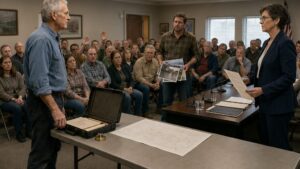
Angela could feel it happen in the small community hall, a ripple of disappointment moving through people who had arrived expecting a jewel and found the same battered car from the video. It sat behind a simple rope line under soft portable lights, unpolished, unrestored, still carrying every dull patch, old scrape, smoke-dark stain, and uneven seam that had made Jason Clark laugh.
For three seconds, nobody seemed to know what to do with it.
Then an older man near the front took off his cap.
Not dramatically. Not for show. He simply removed it, held it against his chest, and leaned forward to see the front fender without crossing the rope.
The silence changed.
Angela stood beside Mary Scott with her hands folded in front of her. She had refused a microphone at first. Mary had allowed that refusal to live for five minutes, then placed the microphone on a stand anyway, within reach but not in her hand.
“Only if you need it,” Mary had said.
Across the hall, Charles Green stood near a folding table with printed display rules. No touching. No flash close to the surface. No leaning over the rope. He had volunteered to help without being asked, arriving early with stanchions borrowed from a theater and a box of paper towels he never used because Mary brought proper cloth barriers.
Sarah Lee stood farther back, not filming.
Angela appreciated that more than another apology.
People moved slowly around the rope line. The car’s roughness made them careful once they understood it was not neglect. A collector with a careful voice explained to a teenager that the faint discoloration near the rear quarter matched a stunt sequence. Someone else pointed out the hand-formed fender and then stopped pointing, lowering their hand as if even pointing too close felt rude.
No one mentioned the full number where Angela could hear it.
That had been one of her conditions. No valuation placard. No auction estimate in the display copy. The redacted appraisal sat under glass on a side table, opened to the verification seal and condition notes, not the amount. The production still was there too, the one from Angela’s garage wall, but reproduced smaller, with the fender visible in a slash of movie light.
A child slipped under the rope.
Angela moved before anyone else did, not sharply, not loudly. She stepped into the child’s path and crouched. The child froze with both hands tucked under their chin.
“Almost,” Angela said.
The child’s eyes widened. “I wasn’t gonna touch.”
“I believe you.”
The child looked past her at the car. “Why didn’t you fix it?”
The question cut through the hall more cleanly than any insult had.
A few adults turned, embarrassed on the child’s behalf. Angela was not.
Children asked the plain version of what adults hid under jokes and prices.
She looked at the car before answering. The portable lights fell across the front fender differently than the car wash fluorescents. Softer. Warmer. The tiny inspection tape was gone now; Mary had documented the bright mark and left it undecided, neither surrendered to panic nor erased by wishful thinking.
“Because some marks are part of what happened,” Angela said.
The child frowned. “But it looks old.”
“It is old.”
“And that’s good?”
Angela almost looked to Mary. She did not.
“That’s true,” she said. “Good is something else. True matters first.”
The child considered that with grave suspicion, then ducked back behind the rope where a relieved adult took their shoulders.
Mary’s eyes flicked toward the microphone.
Angela shook her head once.
But ten minutes later, when she heard a man near the back whisper, “That’s the one from the meme,” she stepped to the microphone before anger could decide for her.
The hall settled slowly.
Angela rested one hand on the stand but did not remove the microphone from it.
“I’m not here because the car is expensive,” she said.
The first sentence surprised her by coming out steady.
“I know that is the part people repeated. It’s the easiest part to understand from far away. A big number makes a simple headline.” She looked at the car, not the crowd. “But the number is only there because some things can’t be replaced by making them shiny again.”
No one interrupted.
“This surface is original to the car’s screen use. The worn paint, the dull places, the marks people mistook for neglect—those are part of its record. They tell where it has been better than fresh paint would. My job is not to improve that story. My job is to keep from erasing it.”
She stopped before it became a speech.
There was no applause at first, and she was grateful. People simply looked back at the car with a different kind of attention.
Then, from somewhere behind her, a phone played a sound too loudly.
Jason’s voice, clipped into a short loop: My EV costs more than this whole thing.
A few people laughed before catching themselves. On the screen, Angela saw his face frozen in that now-famous moment when the appraisal packet appeared and his certainty drained. The meme had grown past him. It would keep growing without her.
She turned away before the clip finished.
Mary noticed. “You all right?”
“Yes.”
And she was, almost.
Not because Jason had been humiliated. Not because strangers had decided the car mattered. Those things were loud, temporary weather. What settled deeper was the fact that Angela had spoken without selling the car to them. She had given the truth a shape and kept the rest protected.
By late afternoon, the hall had emptied. Charles helped take down the rope line. Sarah gathered abandoned paper cups from the back row and threw them away without being asked. Mary packed the appraisal copy into a hard folder and handed Angela the production still last.
“You did not betray him,” Mary said.
Angela took the still. “I know.”
This time, she meant it.
Near sunset, Angela drove back to the community car wash.
Bay Three was empty.
The place looked smaller after the hall, stripped of drama, back to tile, hoses, coin slots, drains. Charles had left the bay clean. The security dome under the awning watched without opinion.
Angela parked slightly crooked again.
She fed quarters into the machine and filled her bucket. The hose hissed. Water struck plastic. Soap smell rose around her, ordinary and sharp.
Near the drain, faintly, was a sticky stain the morning rinses had not fully removed. Yellowish at the edge. The last ghost of Jason’s energy drink, flattened can long gone.
Angela unfolded a clean cloth.
She began with the roof, straight lines, no circles. Then the hood. Then the careful seam near the front fender.
When she reached the curve Jason had leaned on, she slowed.
The dull surface caught the late light from the open end of the bay. For a moment the fender held a thin bright line, not shine exactly, not polish, but something quieter: light resting on everything that had not been erased.
Angela rinsed the cloth, wrung it gently, and laid it against the aluminum.
Water ran down over the patina, over the old marks, over the place that might or might not have been new, and carried the last of the sticky stain toward the drain.
The story has ended.