The Noon Shadow in Sarah Moore’s Front Yard Proved Everyone Had Judged Her Too Soon
Chapter 1: The Stones That Made the Whole Street Slow Down
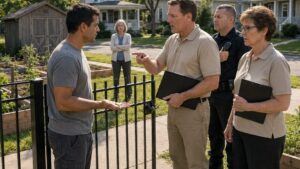
The two women stopped so abruptly at the edge of Sarah Moore’s lawn that the dog between them kept walking and snapped the leash tight.
For one second, nobody moved.
The women stared at the front yard. The dog stared at a squirrel. Sarah, crouched beside a half-buried slab of limestone with a level in one hand and mud on both knees, stared back at all three of them.
One of the women lowered her sunglasses.
“Is that supposed to be permanent?” she asked.
Sarah looked over her shoulder at the circle.
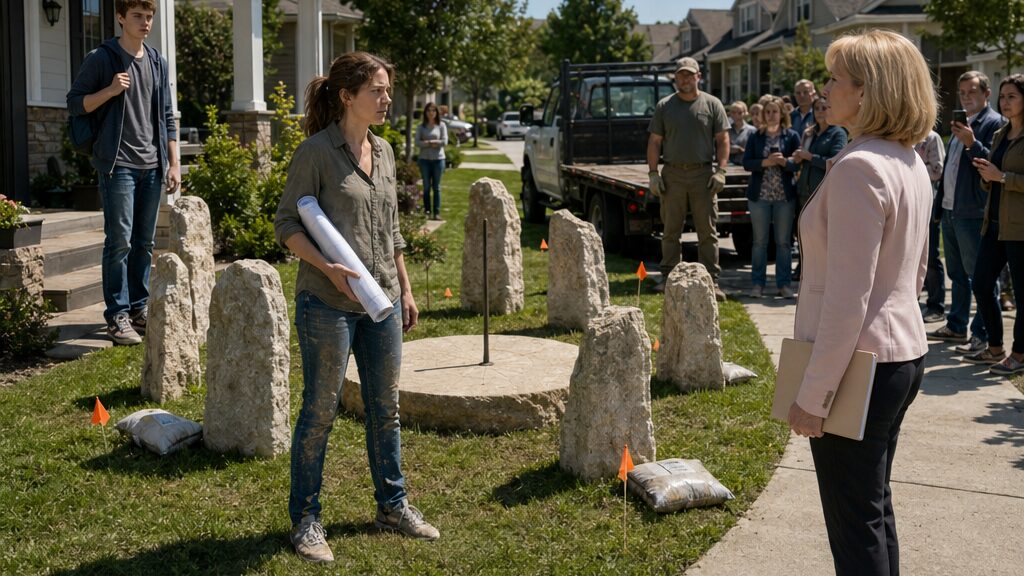
Nine upright stones stood across the grass in a rough ring, each one taller than a mailbox and pale against the trimmed lawns of Willow Creek Estates. Three more lay flat near the center, where a steel post rose from a circular stone base. The whole thing looked unfinished because it was unfinished. Two bags of gravel leaned against the maple tree. A string line ran from the post to the outer stones. Orange marking flags dotted the lawn like warning signals.
From the sidewalk, Sarah knew what it looked like.
It looked like she had tried to build Stonehenge between a hydrangea bed and a two-car garage.
“It’s a measured installation,” Sarah said, keeping her voice even.
The second woman gave a polite laugh that did not reach her face. “In the front yard?”
Sarah pressed the level into the soil and stood. Her back ached. She had been out there since seven, trying to finish the eastern stone before her ten-thirty class at the community college. She had already moved the slab twice because the base had settled wrong by a quarter inch.
“Everything is inside the setback,” she said.
The women exchanged a look. The kind of look people used when they had already decided not to argue because the story would be better later if they simply repeated it to someone else.
Across the street, Stephanie Allen had come out onto her porch holding a coffee mug. Two houses down, a garage door paused halfway open, then reversed, as if the person inside had forgotten whether they were leaving or watching.
Sarah wiped her palms on her jeans and looked at the center post. The sun had not yet climbed high enough. The shadow cut across the grass at a long slant, missing the stone base entirely.
Not yet.
The first warning from the HOA had come three days earlier, printed on cream paper and taped to her door in a plastic sleeve. Unapproved exterior modification. Possible violation of community appearance standards. Submit architectural review materials immediately.
Sarah had submitted the site sketch, the material list, the anchoring detail, and the drainage note. She had not submitted the one page that mattered.
She had not submitted the page with her grandfather’s handwriting.
A white SUV slowed at the curb.
Sarah knew before the window rolled down who it was. Laura White had the kind of car that looked clean even during pollen season, and she drove through Willow Creek at ten miles under the limit whenever a mailbox was repainted, a basketball hoop stayed out overnight, or somebody’s mulch crossed the border from brown into red.
Laura stopped beside the driveway and stepped out with her phone already in her hand.
She wore a pale pink zip-up jacket, dark leggings, and the expression of someone who had planned not to be dramatic and was disappointed that circumstances might require it.
“Sarah,” she said.
“Laura.”
Laura’s eyes moved from the upright stones to the steel post, then to the flags, the gravel bags, the string lines, the wheelbarrow, and finally Sarah’s muddy knees.
“I was hoping,” Laura said, “that the first notice would be enough to pause construction.”
“It’s not construction. It’s landscaping.”
Laura lifted the phone and took a photo.
Sarah felt the small click in her chest before she heard the digital shutter. “You could ask before photographing my yard.”
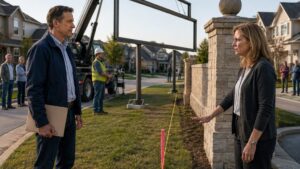
“I’m documenting an active violation from a public sidewalk.” Laura took another picture, this time angled toward the center post. “You’re still adding to it.”
“I’m stabilizing what’s already here.”
“That is not a meaningful distinction under the guidelines.”
Sarah looked toward Stephanie’s porch. Stephanie quickly raised her mug as if she had only been admiring the morning. More curtains had shifted along the street.
Laura stepped closer to the sidewalk edge but did not cross onto the grass. “The architectural review committee has not approved this.”
“They have my drawings.”
“They have incomplete drawings.”
Sarah’s fingers tightened around the level. “The dimensions are complete. The materials are listed. The drainage path is marked.”
“The purpose is not.”
The word landed harder than it should have.
Sarah glanced at the center post again. The shadow had shortened, but it still lay uselessly across the grass. She had learned, over the last week, how slowly a morning could move when everything depended on the sun reaching a line.
“It’s functional,” Sarah said.
Laura waited.
Sarah knew the next sentence. She had rehearsed it in the kitchen, in the garage, in bed at two in the morning while Justin slept down the hall with his phone playing videos too softly to hide them. She had imagined saying: It’s a sundial. My grandfather designed it. Noon matters because—
Instead she said, “You’ll see.”
Laura’s face cooled. “That’s exactly the problem.”
A laugh came from the sidewalk. One of the walkers covered it with a cough. The dog, bored now, sniffed one of the orange flags.
Sarah stepped between the dog and the line before it could pull anything loose. “Please keep him off the yard.”
The woman tugged the leash back. “Sorry. He’s just curious.”
“Everyone is,” Laura said.
There it was. Soft enough to deny, sharp enough to carry.
Sarah looked down the street. A child on a bike had stopped near the corner. A delivery driver was leaning from his open door. A man in a baseball cap across the way pretended to sort recycling while watching over the bin lid.
The stones had made the whole street slow down.
For weeks, while Sarah had hauled each piece into place, she had imagined the yard finished and quiet. The circle would settle into the grass. The neighbors would get used to it the way they got used to solar panels, rain barrels, and the one approved porch swing on Juniper Court that everyone had hated for six months. Justin would stop walking past it with that wounded impatience on his face. And on Sundays, when noon arrived, the shadow would touch the center line exactly where it was supposed to.
She had not imagined Laura photographing it like evidence.
Laura lowered her phone. “I need you to stop work immediately.”
“I can’t leave the eastern stone unanchored.”
“Then lay it flat.”
“That defeats the measurement.”
“Sarah.” Laura’s voice turned patient in a public way. “This neighborhood has rules. You agreed to them when you bought the house.”
“I know what I signed.”
“Then you know exterior changes require approval before installation.”
Sarah swallowed. She could feel a dozen small eyes and half a dozen adult judgments on her back.
“My grandfather started the drawings before I ever moved here,” she said.
Laura hesitated, but only for a breath. “That may be personally meaningful, but it does not create approval.”
Sarah regretted saying even that much. The words had come out too naked and still not enough.
From the garage, Justin appeared with one earbud in and a school backpack hanging off one shoulder. At sixteen, he had perfected the art of looking both half-asleep and deeply offended by the world. He stopped when he saw Laura, then looked at Sarah.
“Is she making us take it down?”
“Go to school,” Sarah said.
Justin did not move. His eyes shifted to the stone circle. He knew which one was still wrong. He had spent Sunday holding the string line while Sarah adjusted it, pretending not to care until the post shadow slid across the chalk mark and his whole face changed.
Laura noticed him. Her expression softened by one degree, which somehow made Sarah more defensive.
“This does not need to become unpleasant,” Laura said.
“It’s already unpleasant,” Justin muttered.
“Justin.”
He looked at the ground.
Laura tucked the phone into her jacket pocket. “The committee meets Thursday. If the submission is still incomplete, the board can authorize corrective action.”
Sarah heard the phrase for what it was. Not a suggestion. Not a warning. The sound of a machine finding its gear.
“I’ll complete the submission,” she said.
“Good.” Laura glanced once more at the stones. “But understand this clearly. If this remains unapproved, it will have to be removed.”
Sarah lifted her chin. “When?”
Laura opened her car door, then paused long enough for Stephanie, the walkers, the delivery driver, and Justin to hear.
“By Friday noon,” she said. “It comes down.”
Chapter 2: The Rolled Plans No One Wanted to Read
Sarah unrolled the plans across the kitchen table that night and four small stones fell out of the curl of paper like they had been waiting years to be heard.
Justin caught one before it hit the floor.
Neither of them spoke.
The plans were too large for the table, so the edges hung over the sides, weighted down by a saltshaker, Sarah’s laptop, Justin’s unopened history book, and the chipped blue mug their grandfather used to drink coffee from whenever he came over to fix things no one had asked him to fix. The paper had softened at the folds. Pencil lines crossed the page in clean arcs, each marked with numbers, dates, and small notes in a slanted hand.
Noon line true after post set.
Check summer angle.
Teach them why shadows move.
Sarah moved the mug over that last sentence before Justin could read it again.
He saw anyway.
“You should just show them all of it,” he said.
“I’m showing them what they need.”
“That’s not the same thing.”
Sarah picked up the smallest stone from the table. It was a flat piece of limestone, smooth on one side, marked with a faint pencil X on the other. Their grandfather had kept samples in coffee cans, labeled by yard, weight, and weathering. He had been a man who believed anything worth building deserved a system, and anything worth remembering deserved a mark.
“The HOA needs measurements,” Sarah said. “Not a family scrapbook.”
Justin leaned back in his chair. “It’s not a scrapbook.”
“I know what it is.”
“Then stop acting like it’s embarrassing.”
Sarah looked at him. His face changed at once, defensive closing over hurt. He reached for the history book and shoved it into his backpack with enough force to bend the cover.
“I have to finish the packet,” she said.
“Right,” he said. “Because if the forms are perfect, nobody has to know why you care.”
He left the kitchen before she could answer.
Sarah stood alone with the plans and the little stones.
At eight the next morning, she took the packet to the HOA office near the neighborhood entrance, a brick building attached to the pool restrooms and a small fitness room nobody used after January. A laminated sign on the counter read: Please allow 30 days for architectural review requests. Sarah had three.
Laura White was already there, seated behind the counter with a tablet, a stack of folders, and a travel cup that said Board Volunteer, Not Miracle Worker.
Sarah set the rolled plans down first.
Laura looked at them as if Sarah had placed a live animal on the counter.
“I brought the revised submission,” Sarah said.
“Did you email it?”
“I brought full-size drawings.”
“We still need a digital copy.”
“I emailed the PDF at six-thirty.”
Laura tapped her tablet. “I have the site plan and the materials list. I don’t see the project purpose statement.”
“It’s a functional stone installation.”
Laura waited. Behind Sarah, someone entered the fitness room and the door clicked shut.
“That is the purpose,” Sarah said.
“It’s not a recognized category.”
“Then call it a garden feature.”
“It exceeds height limits for decorative yard features.”
“It’s not decorative.”
“Then we’re back to the missing category.”
Sarah felt heat rising in her neck. She unrolled the first sheet enough to show the circle, the center post, the distances. “The stones are placed by solar measurement. They’re not random.”
Laura’s eyes flicked over the page. For the first time, Sarah saw a small interruption in her certainty. Then Laura pressed the paper flat and found the empty box on the form.
Purpose / community impact.
Blank.
“You didn’t complete this.”
“It doesn’t impact the community.”
Laura looked past Sarah through the glass door toward the entrance monument, where cars slowed beneath the Willow Creek Estates sign. “Half the community has already asked me about it.”
“That’s curiosity, not impact.”
“That’s not how the board will see it.”
Sarah rolled the plan with more force than necessary. “Are you refusing to accept it?”
“I’m telling you it is incomplete.”
“You haven’t even read the drawings.”
“I can’t review a submission with missing required fields.”
A door opened behind them. Paul Harris came in carrying a pool key card and an envelope. He was in his seventies, tall but slightly stooped, with a careful way of walking that made every step seem measured before taken. He paused when he saw the plans under Sarah’s hand.
“That your yard project?” he asked.
Sarah almost said no out of reflex.
“Yes.”
“Mind if I look?”
Laura’s lips thinned. “Architectural review materials are not for general review at the counter.”
Paul raised both hands. “Then I won’t touch. But I saw the north stone from the street yesterday. Either you got lucky or you know what you’re doing.”
Sarah looked at him for the first time fully. “Why?”
“The spacing.” He nodded toward the roll. “People putting up decorations don’t fight that hard for angle.”
Laura shifted in her chair. “Paul, this is a pending compliance matter.”
“I figured.” He slipped his pool envelope into the drop box, then looked back at Sarah. “Solar?”
Sarah hesitated.
The room seemed to narrow. The paper under her hand felt suddenly old and alive.
“Yes,” she said. “Solar.”
Paul’s expression changed, not into approval exactly, but recognition. “That explains the post.”
Laura said, “The post is also unapproved.”
Paul gave her a mild look. “Most useful things are before someone writes a rule for them.”
“That attitude is why rules become necessary,” Laura said.
The words came out sharper than the conversation required. Paul noticed. Sarah noticed. Laura noticed that they noticed and straightened the folders in front of her.
Sarah took the packet back. “What happens now?”
Laura opened a calendar on the tablet. “If the submission remains incomplete by Thursday’s committee review, the board can authorize removal. Given that work continued after notice, I’m recommending a landscape crew be scheduled for Friday morning.”
Sarah stared at her. “You already called them.”
“I requested availability.”
“That’s not the same thing?”
“It becomes the same thing if you don’t complete the application.”
Sarah thought of the eastern stone, now anchored. The center line. The chalk mark Justin had traced with his thumb Sunday afternoon when the shadow came close but not close enough.
“What do you want me to write?” she asked.
“The truth would help.”
The word hit with such clean force that Sarah hated Laura for using it casually.
She slid the packet into its tube. “You’ll have the rest before Thursday.”
Outside, the morning had brightened. Paul held the door for her but did not follow immediately. Sarah was halfway down the sidewalk when he called after her.
“Sarah.”
She turned.
“If it’s what I think it is, don’t let them call it yard art.”
She wanted to be grateful. Instead she only nodded.
At the neighborhood entrance, a landscaping truck passed in, towing an empty flatbed trailer. It did not turn down her street, but Sarah watched it until it disappeared.
When she got home, Justin was standing in the garage doorway with the old blue mug in his hand.
“You took the plans,” he said.
“I took copies.”
“Not the letter.”
Sarah froze.
Justin’s fingers tightened around the mug. “You know there’s a letter, right?”
She said nothing.
His mouth twisted, young and wounded and angry. “Are you ashamed of Grandpa’s work, or are you ashamed that you can’t finish it without telling people why he made it?”
Chapter 3: Friday Noon Brought the Truck Before the Truth
The landscaping truck parked in front of Sarah’s house at 10:42 Friday morning, and the sound of its backup alarm brought neighbors out faster than any invitation could have.
Sarah stood on the porch with her keys still in her hand.
The truck was white, unmarked except for a small company decal on the door, with a flatbed trailer carrying straps, a pallet jack, orange cones, and two men in work gloves who looked as if they had expected shrubs, not standing stones. Behind it, Laura White’s SUV stopped at the curb with the calm precision of someone arriving exactly when she meant to.
Justin came out behind Sarah. “They’re early.”
“They’re not touching anything.”
“You said that like you believe it.”
Sarah looked at the yard.
The stone circle stood completed now, or as close to completed as she had dared. The eastern stone was anchored. The center post rose clean from the circular base. The outer stones were uneven in shape but deliberate in their placement, each one tied to a measurement she had checked until her back burned and her hands blistered. The grass around them was scuffed and patched with soil. It did not look polished. It looked fought for.
The sun was still too high east. The post’s shadow lay short and angled, not yet touching the line carved into the center stone.
Not yet.
Laura stepped from her SUV holding a folder. The landscaping crew supervisor approached her first, and they spoke quietly near the curb. Sarah could not hear the words, but she saw the supervisor glance toward the stones with growing reluctance.
Across the street, Stephanie Allen came out with her phone in one hand and a worried look she tried to disguise as casual interest. Two children on bikes slowed near the corner. A garage door opened. Then another. The street began to gather itself into an audience.
Sarah walked down the porch steps before Laura reached the driveway.
“Good morning,” Laura said.
“No,” Sarah said.
Laura stopped.
The word had come out too bluntly, but Sarah did not take it back.
Laura’s expression tightened. “I’m here on behalf of the board.”
“The committee met yesterday?”
“Yes.”
“And?”
“The application remains incomplete.”
“I sent the safety details.”
“You did.”
“The anchoring diagram.”
“Yes.”
“The drainage note.”
“Yes.”
Sarah waited.
Laura opened the folder. “You did not provide an acceptable purpose statement, and the structure remains outside approved categories. The board authorized corrective action if voluntary removal did not begin by today.”
“It’s not noon.”
The sentence carried strangely across the yard. Stephanie looked up from her phone. One of the crew members paused beside the trailer strap.
Laura glanced at her watch. “The notice said by Friday noon.”
“It’s not noon,” Sarah repeated.
Justin moved closer to the steps. “She told you that.”
Laura looked past Sarah at him. “Justin, this is between the homeowner and the association.”
“I live here.”
“Justin,” Sarah said quietly.
He went still but did not go inside.
The crew supervisor cleared his throat. “Ma’am, we’re just here to do the work order.”
“You don’t have permission to enter my property before noon,” Sarah said.
Laura looked down at the folder. “The authorization allows preparation.”
“On the sidewalk, maybe. Not on my lawn.”
A neighbor murmured something. Another phone came up.
Sarah hated the phones most. She could handle Laura’s folder and the crew’s equipment and the board language that made destruction sound like maintenance. But the phones made her yard into a scene. They flattened everything into a clip someone could send with a laughing caption.
She folded her arms to keep from rubbing her palms against her jeans.
Laura noticed the phones too. A shadow of irritation crossed her face. “Everyone, please give us room.”
Nobody moved.
Paul Harris appeared at the edge of his driveway, wearing a tan cap and holding a tape measure as if he had brought it by accident. He did not come closer. He watched the post.
Laura lowered her voice. “Sarah, you are making this harder than it needs to be.”
“I asked for one thing.”
“You asked everyone to wait because you refuse to complete an application.”
“I completed it.”
“You avoided the part that required explanation.”
Sarah looked at the stones. The shadow had moved, but not enough. Her grandfather’s old note flashed in her mind: Do not chase the line. Let the sun arrive.
“Wait until noon,” she said.
Laura exhaled. “This is not a performance.”
“No. It isn’t.”
The answer seemed to unsettle Laura more than anger would have.
Time turned thick.
The crew placed cones near the curb but stayed off the grass. The supervisor made a phone call from beside the truck. Neighbors pretended to discover reasons to be outside. Someone asked Stephanie what was happening, and Stephanie whispered back with the confidence of a person who knew half the story and wished she knew less.
Justin sat on the porch step, elbows on knees, eyes fixed on the center stone.
At 11:36, Laura said, “If this is about proving it has some function, it still won’t answer the approval issue.”
Sarah said, “I know.”
Laura frowned. “Then why insist?”
Because Justin had looked at her all week as if she were burying their grandfather a second time. Because the plans smelled faintly of garage dust and pencil graphite. Because noon had been a phone ringing every Sunday when they were younger, their grandfather asking what they had learned that week as if the world could be survived by naming one true thing at a time.
Because Sarah was terrified the shadow would miss.
She said none of that.
At 11:49, the crowd had grown large enough that a car slowed and then continued, the driver craning to see. Laura stepped toward the curb and spoke to the crew supervisor again. Sarah heard the words liability and schedule.
At 11:55, Paul finally crossed the street.
Laura saw him and stiffened. “Paul, please don’t interfere.”
“I’m not interfering,” he said. “I’m observing the sun.”
One of the children giggled. Justin did not.
Paul stood at the edge of the driveway, careful not to step onto the lawn. His eyes moved from the post to the center stone. “Close,” he said.
Sarah’s throat tightened.
Laura checked her watch again. “Five minutes.”
The words rippled through the neighbors.
Justin stood.
“Stay on the porch,” Sarah said.
“I can see from here.”
The shadow crept across the stone base, slow enough to seem still until Sarah looked away and back again. It touched the outer edge of the circular slab. The tip sharpened, dark against pale limestone. The steel post, ugly to everyone else, became suddenly exact.
Laura glanced from her watch to the stone.
11:58.
A phone camera clicked.
Sarah wanted to tell them to stop. She wanted to cover the whole yard with a tarp. She wanted one private minute with the line.
Instead she stood where everyone could see her and did not move.
At 11:59, the shadow reached the carved groove but sat just off center.
Justin made a small sound.
Laura closed the folder. “Sarah—”
“Wait,” Paul said.
Laura looked at him.
The shadow shifted.
It was not dramatic. No bell rang. No light flashed. The neighborhood did not gasp all at once. It simply happened: the narrow dark line from the metal post settled into the carved noon mark and ran straight across the center stone toward the aligned outer stones, clean as a ruler drawn through the circle.
Justin stepped off the porch before Sarah could stop him.
“There,” he said, pointing. His voice cracked, then strengthened. “Look. It points to time.”
Stephanie lowered her phone. “Wait. Is it—”
“It’s a sundial,” Justin said.
The word passed through the street like a door opening.
One of the crew members leaned sideways to see. The supervisor removed his cap. Paul’s mouth curved, barely. Stephanie walked two steps closer and stopped at the lawn edge, as if the grass had become part of something she should not trespass on.
Laura did not speak.
Sarah kept her eyes on the shadow because if she looked at Justin, she might lose the last of her control.
“It works,” he said, softer now.
“I know,” Sarah answered.
But she had not known. Not fully. Not until the line held.
Someone behind Stephanie said, “That’s actually kind of amazing.”
Another neighbor asked, “So all the stones mean something?”
Paul answered before Sarah could. “If she set them the way I think she did, yes.”
The crew supervisor looked at Laura. “You still want us to proceed?”
The question snapped the moment back into the world of orders and liability and paid time.
Laura looked at Sarah, then at the folder, then at the watching phones. Her face was controlled, but the certainty had drained from it, leaving something more complicated and less public.
“The function doesn’t change the approval status,” she said.
Justin turned. “Are you serious?”
“Justin,” Sarah said, but there was no strength in it.
Laura’s voice stayed even. “I am saying the board has a process. A working unapproved structure is still unapproved. In some ways, function makes the review more important, not less.”
Stephanie’s eyebrows lifted. Someone muttered, “Come on.”
Sarah finally looked away from the noon line.
The shadow had proved what the stones were. It had not proved why she had built them. It had not filled the blank box on Laura’s form. It had not said anything about the Sunday calls, or the promise, or the envelope Sarah had refused to open.
Laura handed the folder toward her.
Inside was the board authorization, signed and dated.
Sarah did not take it.
Laura held it there anyway. “The sundial may work,” she said, quietly enough that only the front row heard, “but it was still never approved.”
Chapter 4: The Rulebook Had No Place for Grief
By the time Sarah reached the HOA community room that afternoon, someone had already uploaded a video of the noon shadow.
She knew because three different people stopped looking at their phones the moment she walked through the parking lot.
No one smiled.
No one apologized.
They simply looked at her differently.
The room where the architectural review committee met was smaller than most people imagined. There was no polished courtroom atmosphere, only folding chairs, framed neighborhood maps, and a long table where volunteers sorted papers after work instead of spending evenings with their families.
Laura was already there, arranging binders by agenda number.
She glanced toward Sarah, then back at the stack.
“You can leave the additional documents with the clerk.”
“I’d rather hand them to you.”
Laura hesitated before extending her hand.
Sarah placed a folder on the table.
Inside were revised engineering notes, anchoring calculations, drainage sketches, and photographs taken while each stone footing had been poured.
Laura flipped through them quietly.
“They’re thorough.”
“They always were.”
“You understand this doesn’t automatically resolve the issue.”
“I know.”
Laura closed the folder.
“The board isn’t questioning whether the structure functions anymore.”
“No.”
“They’re questioning whether a functional structure belongs in a front yard.”
Sarah almost laughed.
A week earlier people had mocked the stones because they looked pointless.
Now they wanted them removed because they worked.
Across the room, board members filtered inside carrying coffee cups and legal pads.
One of them looked at the viral clip paused on a phone.
“So that’s the sundial.”
“It’s not viral,” Laura answered before Sarah could.
“Maybe not nationally,” another board member replied. “Half the subdivision has watched it.”
The meeting began without ceremony.
Routine landscaping requests passed first.
Fence paint.
Mailbox replacement.
A pergola.
Sarah listened to discussions about beige versus gray stain while her own file sat at the bottom of the stack like something everyone wished would disappear.
Finally Laura opened it.
“Item fourteen,” she said. “Unapproved stone installation at the Moore property.”
Every chair shifted.
Laura summarized the history without embellishment.
Initial complaint.
Site inspection.
Incomplete application.
Friday observation.
Verified functional solar alignment.
She never once used the word Stonehenge.
Sarah appreciated that more than she expected.
One board member leaned forward.
“So…it actually tells time?”
“It appears to.”
Paul Harris raised one hand from the audience seating.
“With permission?”
Laura nodded.
Paul stood.
“I’m a retired civil engineer.”
“We know,” one board member smiled.
“I inspected nothing formally,” Paul continued. “I simply observed the installation.”
“And?”
“The workmanship is considerably better than many retaining walls already approved in this neighborhood.”
Laura remained expressionless.
Paul continued.
“The footings appear stable.”
“The spacing is intentional.”
“The central alignment is mathematically consistent.”
“The project deserves technical review rather than assumptions.”
He sat.
For the first time since Friday, Sarah felt someone had defended the work instead of defending her.
There was a difference.
One board member adjusted his glasses.
“If it’s safe, why are we still discussing removal?”
Laura answered before Sarah could.
“Because approval standards aren’t only about safety.”
She stood and walked toward the display board.
“This neighborhood has architectural consistency requirements.”
She placed Sarah’s original application beside the revised drawings.
“The project purpose field remained blank.”
Another member frowned.
“Sarah?”
Sarah stood.
“I believed the engineering spoke for itself.”
“It doesn’t.”
“No.”
Silence stretched.
Laura surprised everyone by speaking more softly.
“A working structure creates more precedent than decorative landscaping.”
“If we approve something simply because it’s impressive…”
“…the next homeowner expects equal treatment.”
One of the older members nodded.
“That’s fair.”
Sarah understood something then.
Laura wasn’t protecting herself from Sarah.
She was protecting herself from every request that would come afterward.
That didn’t make her right.
But it made her human.
Another board member asked,
“What exactly is its purpose?”
Sarah’s throat tightened.
She had rehearsed dozens of versions.
Every one stopped at the same place.
“It’s…”
Her voice disappeared.
Laura waited.
“So?” the chairman prompted.
“It’s functional.”
“We know.”
“It measures solar noon.”
“We know.”
“And why?”
Sarah looked down.
Because my grandfather—
No.
Not here.
Not like this.
“My family built it.”
The room stayed quiet.
One board member sighed.
“That isn’t a project purpose.”
Laura closed her binder.
“There it is.”
Sarah looked up.
“What?”
“The reason I marked the application incomplete.”
The words weren’t cruel.
They were tired.
“You kept asking us to approve something you wouldn’t explain.”
Sarah felt heat rise into her face.
She had spent days believing Laura simply refused to listen.
Instead…
Laura had been asking the same question over and over.
Why?
And Sarah had answered with measurements.
The chairman folded his hands.
“The board isn’t prepared to order immediate removal today.”
Relief flashed through the room.
“…however…”
The word landed harder.
“…before reconsideration we require a written statement explaining the intended purpose of the installation.”
Sarah stared at the table.
A written statement.
Exactly the page she had refused to write.
The meeting adjourned twenty minutes later.
Neighbors drifted into small conversations.
Some congratulated Paul for speaking.
Others quietly admired the engineering photographs.
Stephanie approached Sarah near the doorway.
“I thought once they saw it worked…”
“So did I.”
Stephanie hesitated.
“I’m sorry.”
“For what?”
“I talked about it.”
Sarah smiled sadly.
“So did everyone.”
Outside, Paul caught up beside her.
“You did well.”
“I didn’t answer the only question that mattered.”
“No.”
He looked toward the parking lot.
“But you finally realized that.”
She drove home without turning on the radio.
The garage smelled faintly of limestone dust.
The rolled plans rested exactly where she had left them.
She stared at them for a long time before reaching toward the shelf above.
Her fingers brushed an old wooden box.
Inside lay tape measures…
A rusted compass…
And an unopened envelope with her name written in familiar handwriting.
She froze.
Justin appeared quietly behind her.
“I found it yesterday,” he said.
The envelope rested between them.
Across the front, in faded pencil, were only three words.
For Sarah Only.
Chapter 5: The Envelope Sarah Refused to Open
Justin placed the envelope on the kitchen table and folded his arms.
“I’m not putting it back.”
Sarah didn’t touch it.
The paper had yellowed around the edges, the flap still sealed with brittle adhesive that had somehow survived years in the garage. Her grandfather’s handwriting was unmistakable—steady, patient, deliberate.
She had seen it on workshop labels, grocery lists, birthday cards, and every page of the sundial plans.
She had never seen it addressed only to her.
“I wasn’t hiding it,” she said.
“You weren’t opening it.”
“That’s different.”
Justin shook his head.
“No, Sarah.”
“It isn’t.”
He pulled out a chair but remained standing behind it.
“You’ve been acting like if nobody knows why you built the sundial, nobody can judge Grandpa.”
Sarah stared at the envelope.
“That’s not what I’m doing.”
“Then what are you doing?”
She searched for an answer and found only silence.
Justin’s voice softened.
“You promised we’d finish it.”
“I know.”
“You promised we’d finish it the way he wanted.”
“I know.”
“And now you’re trying to save it without telling anyone why it exists.”
Sarah finally reached toward the envelope.
Her fingertips rested on the paper.
She could still remember the afternoon they carried the first stone into the yard. Justin had laughed because it was heavier than either of them expected, and their grandfather had only smiled.
“You don’t wrestle a stone,” he had said. “You persuade it.”
At the time, Sarah had thought he was talking about leverage.
Now she wondered whether he had been talking about people.
She broke the seal.
Inside was a single folded letter.
A smaller sheet followed, covered with familiar sketches of the center post.
Sarah unfolded the letter carefully.
Justin waited.
She began reading silently.
Halfway through, she stopped.
“What?”
She swallowed.
“He knew.”
“Knew what?”
She handed the page to Justin.
Together they read.
If you’re reading this, I probably didn’t get to finish the circle with you.
That’s all right.
The stones aren’t the important part.
People will always notice the stones first.
If they stay long enough, they’ll notice the shadow.
If they stay even longer, they’ll ask why.
Don’t answer too quickly.
Some people only hear explanations after they’ve seen something true with their own eyes.
Justin looked up.
“Keep reading.”
Sarah did.
The noon line isn’t about time.
It’s about keeping a promise.
Every Sunday at noon we found each other again, no matter how busy life became.
One day that job will belong to you.
Teach Justin how to read the shadow.
Teach him that time isn’t something you chase.
It’s something you meet honestly.
Sarah lowered the page.
She hadn’t realized she was crying until one tear landed on the margin.
Justin quietly sat beside her.
“He made it for us.”
She nodded.
“He knew.”
Sarah laughed through the tears.
“He always knew.”
The second page contained measurements, but one sentence had been written across the bottom.
Leave room for change.
Every generation adjusts the outer stones.
Never move the noon line.
Justin stared at that sentence.
“He expected we’d change it.”
Sarah wiped her eyes.
“I thought changing anything would ruin it.”
“Maybe that’s why he wrote that.”
They carried the letter outside.
The sun had nearly set.
The shadow from the center post stretched across the grass in the opposite direction now, long and soft.
Sarah stood inside the circle.
“I’ve been afraid,” she admitted.
Justin looked at her.
“Afraid of what?”
“That if I explained it…”
“…people would pity us instead of understanding him.”
Justin considered that.
“I don’t need pity.”
“I know.”
“I just need them to stop trying to tear it down.”
Sarah laughed quietly.
“So do I.”
He looked at the stones.
“You know what’s funny?”
“What?”
“The shadow worked.”
“It did.”
“Grandpa was right.”
Sarah smiled.
“He usually was.”
Justin reached into his pocket.
“I wrote something.”
He handed her a folded notebook page.
It was a rough draft.
A speech.
Not polished.
Just honest.
“If you won’t tell them,” he said, “I will.”
Sarah read only the first paragraph before folding it closed.
“No.”
Justin sighed.
“So we’re back where we started.”
“No.”
She looked toward the house.
Toward the kitchen table where the letter still rested beneath the evening light.
“No,” she repeated.
“I think we’re finally somewhere different.”
She pulled out her phone.
Laura answered after the third ring.
“This is Laura.”
“It’s Sarah.”
A pause.
“Yes?”
“I’d like a full hearing.”
Another pause.
“This isn’t about engineering anymore.”
“I know.”
Laura’s voice softened almost imperceptibly.
“Are you prepared to explain the purpose?”
Sarah looked back at Justin.
He nodded once.
For the first time since the first warning notice appeared on her door, she answered without hiding.
“Yes.”
Chapter 6: Laura White’s Perfect Rules Started to Crack
Laura stood alone on the sidewalk early Sunday afternoon with a tape measure in one hand.
She checked twice to make sure no one had seen her park a block away.
The street was quiet.
Sarah’s house looked ordinary again until her eyes reached the front yard.
The stone circle waited in complete silence.
Laura walked only to the property line.
She would not step onto private grass without permission.
Still…
She measured the distance from the curb to the first standing stone.
Then from the stone to the center post.
She opened the engineering photographs Sarah had submitted.
The numbers matched.
Exactly.
Laura sighed.
“I was hoping they wouldn’t.”
“You talking to the stones?”
Laura turned sharply.
Stephanie Allen stood across the street holding a grocery bag.
“I was…”
Laura stopped.
There was no believable excuse.
Stephanie smiled gently.
“Checking the measurements?”
Laura lowered the tape measure.
“I needed to verify something.”
Stephanie crossed carefully to the sidewalk.
“I thought you only photographed violations.”
Laura looked back at the circle.
“I used to.”
Stephanie followed her gaze.
“My kids keep asking if we’re getting one.”
Laura almost smiled.
“Please don’t.”
Stephanie laughed.
“I won’t.”
The laughter faded.
“You know,” Stephanie said quietly, “people aren’t talking about how strange it looks anymore.”
“They’re talking about whether we were unfair.”
Laura felt the sentence settle heavily.
She drove home with the tape measure still lying on the passenger seat.
Her home office was filled with neatly labeled binders dating back almost ten years.
Fence Requests.
Roof Colors.
Landscape Appeals.
Variance Decisions.
She opened one binder she had not touched in months.
Temporary Garden Structure.
Three years earlier.
Approved.
Six months later the structure had doubled in size, blocked drainage, and sparked lawsuits between neighbors.
Laura had signed that approval.
The board had never let her forget it.
One mistake.
Years of rebuilding trust.
That was why every incomplete application bothered her.
Rules were not simply paperwork.
Rules were memory.
Monday morning brought another board work session.
One member tossed Sarah’s file onto the table.
“We should just remove it.”
Laura looked up.
“The engineering is sound.”
“So?”
“So demolition isn’t automatically reasonable.”
The member frowned.
“You’ve changed your tune.”
“No.”
“I’ve changed my information.”
Another board member crossed his arms.
“If we bend now, everyone wants an exception.”
Laura nodded.
“Which is exactly why the hearing has to be complete.”
“You think she’s going to cry about her grandfather?”
Laura looked directly at him.
“I think she’s finally going to answer the question we should have asked before scheduling a truck.”
Silence followed.
The chairman leaned back.
“So you’re recommending another hearing.”
“I’m recommending we hear the whole application.”
After the meeting Laura drove past Sarah’s street once more.
Sarah was adjusting one of the outer stones with Justin.
Neither noticed her.
Justin laughed at something Sarah said.
For the first time Laura saw not a stubborn homeowner…
…but two people trying to finish something someone else had begun.
She parked near the mailbox.
Sarah looked up.
Neither woman spoke for a moment.
Finally Laura said, “The hearing is tomorrow.”
“I’ll be there.”
“Bring the letter.”
Sarah’s expression changed instantly.
“You know about it?”
“I guessed.”
Laura looked toward the center post.
“The board can argue measurements all day.”
She met Sarah’s eyes.
“But if you leave that page blank again…”
She paused.
“They’ll bury this in procedure.”
Sarah held the rolled plans against her chest.
For the first time since the dispute began, neither woman sounded like they were arguing.
They sounded tired.
Laura returned to her car.
In the mirror she watched Sarah standing beside the stones while Justin quietly unfolded the old letter once more.
Laura drove away wondering whether protecting rules had slowly taught her to stop looking for the people those rules were supposed to protect.
Chapter 7: The Hearing Where Sarah Finally Named the Shadow
The removal contract sat on the HOA table with a yellow signature tab still attached.
Sarah saw it before she saw Laura.
It lay beside the agenda packet, clipped to a copy of the authorization order, its first page facing upward like it had been placed there deliberately. The contractor’s name was printed in bold. The service line below it read: removal and disposal of unauthorized stone installation.
Disposal.
Sarah stood in the doorway of the community room with the rolled plans under one arm and her grandfather’s letter in a clear folder pressed flat against her chest.
Justin bumped her shoulder lightly.
“You good?”
“No.”
He nodded. “Me neither.”
They went in anyway.
The room was fuller than it had been at the committee meeting. Stephanie sat in the second row with two other neighbors. Paul Harris had chosen a seat near the aisle, his old tan cap resting on his knee. A few board members whispered over coffee cups. At the back, someone held a phone but lowered it when Sarah turned.
Laura sat at the long table, not in the center but not hiding either. She wore a navy cardigan instead of the pink jacket, and her hair was pulled back more loosely than usual. When Sarah entered, Laura looked once at the letter folder, then at Sarah.
Bring the letter, or they’ll bury this in procedure.
Sarah had brought it.
That did not mean she knew how to use it.
The chairman tapped the table.
“Next item: Moore property appeal and revised application.”
The room settled.
Sarah walked to the small lectern. It wobbled when she set the rolled plans on it. Justin sat directly behind her, close enough that she could hear him breathing.
The chairman adjusted his glasses.
“Ms. Moore, before we begin, you understand tonight’s hearing concerns approval status, safety review, and whether the board will proceed with removal.”
“Yes.”
“And you understand the board is not obligated to consider emotional context unless it relates to use, maintenance, or community impact.”
Sarah glanced at the contract.
“I understand.”
Laura’s pen paused.
The chairman nodded. “You may begin.”
Sarah unrolled the first plan.
The paper curled at both ends. She weighted one side with her phone and the other with the blue mug she had brought from home before realizing how strange it would look in a hearing. It was too late now. The mug sat there, chipped and ordinary, holding down one corner of her grandfather’s careful measurements.
A board member looked at it.
Sarah almost moved it.
Then she didn’t.
“The structure in my yard is a working horizontal sundial,” she said. “The upright stones are not decorative markers. They align with solar measurements from the center post. The central stone includes a noon line. Last Friday, the shadow from the post crossed that line exactly at noon.”
A murmur went through the room.
Someone whispered, “We saw.”
Sarah kept her eyes on the plan.
“The stones are anchored below grade in concrete footings. They sit inside the front setback. The drainage path runs away from the sidewalk and neighboring properties. The revised plan includes reflective markers at ground level and a low planting border so children don’t run through the circle.”
She heard herself sounding like she had at the counter.
Safe.
Technical.
Useful.
Far away.
Justin shifted behind her.
Sarah touched the clear folder.
“And that is not the whole answer.”
The room changed.
Not dramatically.
Just enough.
She took out the letter but did not unfold it yet.
“I left the purpose box blank because I thought the engineering should be enough.”
Laura looked down.
“It wasn’t,” Sarah said. “Not because the project isn’t real, but because I was hiding the part that made it real to us.”
She heard Justin inhale.
“My grandfather drew these plans before he died. He was not famous. He wasn’t an architect. He fixed things. He measured twice, then measured again because he didn’t trust the first two measurements.”
A few people smiled faintly.
Sarah looked at the center of the plan.
“When our family became smaller than it used to be, he called us every Sunday at noon. Same time, every week. He said if people couldn’t control everything that happened to them, they could at least learn when to show up.”
Her voice caught.
She stopped before it broke.
No one hurried her.
Not even the chairman.
Sarah unfolded the letter.
“He wrote that people would notice the stones first. Then the shadow. Then, if they stayed long enough, they might ask why.”
She looked up at the board.
“I didn’t answer because I was angry that I had to. I thought explaining grief to a room full of people would make it smaller. I thought if I kept it private, I was protecting him.”
Justin’s chair creaked.
Sarah looked back at him.
“I was wrong.”
He stared at the floor, but his jaw trembled.
She turned back to the board.
“The sundial is a memorial, but it is also a teaching tool. I teach design part time. Justin and I built this to finish something our grandfather started and to understand it the way he wanted us to. I am not asking the neighborhood to accept a random monument. I am asking you to review a measured, safe, functional landscape feature that happens to carry meaning.”
A board member flipped through the packet.
“Why not put it in the backyard?”
Sarah had expected the question.
The answer still hurt.
“Because the noon line only works from that location with the open southern exposure. He marked the front yard before I owned the house. He knew the lot. He knew where the shade fell. He drew it for this place.”
“Before you bought the property?”
“He helped me choose it.”
The room grew still again.
The chairman leaned back.
“Ms. White, you reviewed the revised materials?”
Laura straightened. “Yes.”
“And?”
“The original application was incomplete.”
Sarah braced.
Laura continued.
“The revised materials address safety more fully. The installation appears to be within setback limits. There are still concerns regarding height, precedent, and appearance standards.”
One board member nodded as if relieved.
Laura turned a page.
“However, I need to correct the record.”
Sarah looked at her.
Laura did not look away.
“At the counter on Tuesday, Ms. Moore presented full-size drawings. I declined to review them because the form was incomplete. That was procedurally defensible.”
She paused.
“It was not sufficient.”
The room was very quiet.
Laura placed Sarah’s original plan beside the revised packet.
“The measurements were there. The function was at least implied. I focused on the blank box and treated the rest as nonresponsive. That contributed to the escalation.”
The board member who had wanted demolition leaned back sharply.
“So you’re saying the violation is your fault?”
“No,” Laura said. “I’m saying our process moved faster than our understanding.”
Sarah felt the words move through her before she fully understood them.
A process could do harm without anyone shouting.
A rule could be followed and still miss the person standing under it.
The chairman folded his hands.
“What is your recommendation?”
Laura looked at the removal contract.
“I recommend suspending removal pending conditional approval.”
The room stirred.
“Conditions?” the chairman asked.
Laura slid a page forward.
“Lower the two outer stones nearest the sidewalk. Add a low planting border. File an annual maintenance agreement. No lighting. No signage without review. And the central noon line may remain unchanged.”
Sarah closed her eyes for half a second.
Justin stood behind her.
“Lower the outer stones how much?” he asked.
The chairman frowned. “This is not open discussion from minors.”
Sarah turned.
“It’s okay.”
Justin looked at her as if it was very much not okay.
The board member answered anyway. “Enough to reduce visual mass from the street.”
“That changes the circle.”
Sarah knew he was right.
She also knew what the letter said.
Leave room for change.
Every generation adjusts the outer stones.
Never move the noon line.
She looked down at the plans. Her grandfather’s pencil arcs remained steady, but the outer ring had notes in the margins where he had already considered alternate heights.
He had left her a system, not a cage.
Sarah faced the board.
“I’ll lower the two outer stones nearest the sidewalk.”
Justin’s face fell.
“But I won’t remove the noon line,” she said.
Laura looked at her.
“And I won’t replace the center post with something decorative just because people understand flowers faster than shadows.”
A few neighbors smiled.
The chairman looked at Laura.
Laura nodded once.
The board conferred in low voices.
The removal contract remained on the table, yellow tab bright under the fluorescent lights.
When the chairman finally spoke, his voice had less ceremony in it.
“Conditional approval will be drafted for board signature. Removal is suspended. Final approval depends on completion of the listed safety modifications.”
Sarah gripped the lectern.
Justin whispered, “So it stays?”
Sarah looked at the plans, the letter, the mug, the contract, and Laura’s careful face.
“It changes,” she whispered back. “And it stays.”
After the meeting, people did not crowd her.
That helped.
Paul touched the brim of his cap as he passed. Stephanie squeezed Sarah’s shoulder and said only, “I didn’t know.”
Sarah nodded.
Neither of them said the obvious thing: she had not let them know.
At the table, Laura gathered the unsigned removal contract and slid it into her folder.
Sarah approached her.
“Thank you for correcting the record.”
Laura closed the folder.
“I should have read the drawings.”
“Yes,” Sarah said.
Laura accepted that without flinching.
Then she looked toward the clear folder in Sarah’s hands.
“He wrote a good letter.”
Sarah held it tighter.
“He wrote annoying letters.”
Laura’s mouth twitched.
“That too.”
Justin was waiting by the door, arms crossed, eyes still troubled.
As Sarah walked toward him, he said, “Grandpa said never move the noon line.”
“I know.”
“And you won’t?”
“No.”
“But the circle won’t be exactly his.”
Sarah looked back once at the room where the contract had nearly become final.
“No,” she said. “It’ll be ours.”
Justin did not answer.
He walked beside her into the parking lot, but there was enough space between them for the question to stay alive.
Chapter 8: At Noon, the Neighborhood Stood Quiet This Time
The same landscaping crew returned two weeks later, but this time the flatbed carried mulch, border plants, and two smaller limestone pieces instead of removal straps.
Sarah watched from the porch with both hands wrapped around the blue mug.
For a moment, her body did not understand the difference.
The truck door opened. The crew supervisor stepped out, saw her, and lifted one hand.
“Morning,” he called. “We’re here to reset, not remove.”
“I know,” Sarah said.
Still, she did not move from the porch until Justin came out behind her with the rolled plans under one arm.
“You’re doing that thing again,” he said.
“What thing?”
“Standing like somebody’s about to take your lunch money.”
She almost smiled.
“Very poetic.”
“I passed English.”
“Barely.”
“Still counts.”
He walked past her down the steps and crossed the yard to meet the crew. He had grown possessive of the plans in a new way, not as if they belonged to him alone but as if he finally understood they could be touched without disappearing.
Sarah followed more slowly.
The crew supervisor pointed to the two stones nearest the sidewalk.
“These are the ones we’re lowering?”
“Yes,” Sarah said.
Justin unfolded the revised drawing.
“Not lower than this mark.”
The supervisor looked at him, then at Sarah.
Sarah nodded.
“Not lower than that mark.”
The work took most of the morning.
The sound of stone shifting was different when it wasn’t a threat. Still heavy. Still final in small ways. The two outer stones were eased out, trimmed into lower settings, and reset with wider bases. A low border of native grasses curved along the sidewalk edge, softening the view without hiding the circle.
Stephanie Allen came by around ten with a cardboard tray of coffee.
“I brought peace offerings,” she said.
Sarah accepted one.
“For me or the stones?”
“Both.”
Two children trailed behind Stephanie, stopping at the edge of the new border.
“Is it really a clock?” one asked.
Justin looked at Sarah.
She shook her head slightly. “Not yet.”
The child frowned. “When?”
“Noon,” Justin said.
The answer carried across the yard.
Noon again.
But this time the word did not sound like a deadline.
Paul arrived with a folding chair and set it on his own side of the sidewalk, as if formal observation had rules. He inspected the lowered stones from a distance, then gave Sarah a single nod.
“Still true,” he said.
Sarah felt the words settle.
Still true.
At eleven-thirty, Laura White arrived.
She parked at the curb without blocking the crew, stepped out, and carried a slim folder instead of the thick binder or the old removal authorization. For a second, conversation thinned. People noticed her because they had learned to notice what arrived in her hands.
Sarah met her by the driveway.
Laura opened the folder and removed a signed approval document.
“Conditional approval,” she said. “Final inspection satisfied as of this morning.”
Sarah took it.
The document was exactly as procedural as she expected.
Property address.
Approved modification.
Maintenance conditions.
No lighting.
No added structures.
No signage without review.
At the bottom, beneath the official signature line, someone had written in pen:
I’m sorry the process moved before the listening did.
No initials.
It did not need them.
Sarah looked up.
Laura’s expression was composed, but her hands were not. One thumb pressed against the folder edge hard enough to bend it.
“Thank you,” Sarah said.
Laura nodded.
“I still expect the maintenance agreement annually.”
“I know.”
“And if the grasses spread into the sidewalk—”
“I’ll trim them.”
“And if someone else asks to build a twelve-foot lighthouse in their front yard, I am blaming you.”
Sarah laughed before she could stop herself.
Laura’s face softened.
Only slightly.
But enough.
Stephanie approached with the two children still hovering behind her.
“Sarah,” she asked, “would you mind explaining it to them when it’s time?”
Sarah looked toward the center post.
The shadow had begun its slow approach across the stone base. It was not yet close to the noon line. The circle, even altered, held its shape. The lowered outer stones changed the silhouette from the sidewalk, but from inside the yard the geometry remained legible.
Justin stood beside the center stone with the plans tucked under his arm.
He had been quiet since Laura arrived.
Sarah walked to him.
He kept his eyes on the lowered stones.
“Do you think we failed him?” he asked.
There it was.
The question that had followed them out of the hearing and through two weeks of permit emails, crew scheduling, revised sketches, and small, careful conversations neither of them finished.
Sarah looked at the two changed stones.
Then at the noon line.
Then at the letter folded safely in a clear sleeve beside the plans.
“No,” she said.
Justin’s jaw tightened.
“It’s different.”
“Yes.”
“He drew them taller.”
“He also wrote that every generation adjusts the outer stones.”
Justin looked down.
“You kept saying that.”
“Because I needed to hear it too.”
A crew member raked mulch around the border. The sound was soft and repetitive.
Sarah touched the center stone.
“I thought the best way to honor him was to freeze everything exactly how he left it.”
“And now?”
“Now I think he left us something that could survive being lived with.”
Justin was quiet for a long moment.
Then he unfolded the plans and pointed to the penciled sentence at the bottom.
Never move the noon line.
“We didn’t,” he said.
“No.”
The children edged closer.
Stephanie whispered something to them about staying outside the border. Paul checked his watch and then put it away, as if remembering that was no longer the point.
Laura stood near the sidewalk with the folder held at her side.
At 11:57, the yard grew still.
No one announced it.
No one counted down.
The phones stayed mostly in pockets this time.
The shadow from the post sharpened across the center stone, creeping toward the carved groove that had survived every argument, form, meeting, and compromise. Sarah felt Justin move closer until his shoulder almost touched hers.
“Do you want to explain?” she asked.
He looked surprised.
“To them?”
“To us first.”
He swallowed.
Then, when the shadow touched the outer edge of the line, he crouched beside the center stone and spoke to the children.
“The post makes the shadow,” he said. “But the line is what tells you whether you’re looking carefully.”
One child frowned seriously.
“So it’s noon when the shadow goes there?”
“Here, yes,” Justin said. “Not everywhere. Just here.”
Sarah closed her eyes for a heartbeat.
Just here.
That was the part she had missed.
The meaning had never needed to belong to everyone in order to be real.
It only had to be true where it stood.
The shadow settled into the carved noon line.
No gasps this time.
No one shouted that it worked.
The neighborhood simply stood quiet while the dark line crossed the pale stone.
Sarah pictured her grandfather sitting at the kitchen table, pencil behind his ear, pretending not to watch while she checked his math. She pictured the old Sunday phone ringing at noon. She pictured Justin younger, feet not touching the floor, holding the receiver with both hands.
And then she opened her eyes.
“Every Sunday at noon,” she said, not loudly, but clearly enough for those near the circle to hear, “our grandfather called us. When he started drawing this, he said shadows were honest because they never tried to arrive early. They just arrived when the light was right.”
Stephanie wiped at one eye with the heel of her hand and pretended it was allergies.
Paul looked toward the street.
Laura did not move.
Sarah continued.
“I didn’t want to explain that because I thought people would turn it into a sad story. But it isn’t only sad.”
She looked at Justin.
“It’s a way to keep showing up.”
Justin’s face changed then, not into happiness exactly, but into something steadier.
The younger child pointed at the line.
“So next Sunday it’ll do it again?”
“Yes,” Justin said.
“And the Sunday after?”
“Yes.”
The child considered this.
“Can we come see?”
Justin glanced at Sarah.
Sarah looked at the circle, the approved border, the altered stones, the preserved line, and the neighbors who had finally learned to stand still long enough to ask instead of assume.
“From the sidewalk,” she said.
The child nodded solemnly, accepting the rule as part of the wonder.
Laura stepped forward then, only to the property line.
“It’s a good rule,” she said.
Sarah looked at her.
Laura glanced at the border.
“Some rules are.”
The words did not fix everything.
They did not erase the first notice, the phones, the truck, the folder held out like a sentence. They did not make Laura a friend or the HOA suddenly gentle. They did not undo the days Sarah had spent mistaking silence for strength while Justin waited for her to say their grandfather’s name.
But they made room.
That was enough for noon.
The crew packed up after the shadow passed. Stephanie gathered the coffee cups. Paul carried his folding chair back across the street. Laura drove away with no folder left behind.
By one o’clock, the block had returned to lawn mowers, garage doors, children’s bikes, and ordinary errands.
Sarah and Justin remained in the yard.
He rolled the plans carefully.
She picked up the blue mug from the center stone.
“You really think kids will come every Sunday?” he asked.
“Maybe for two weeks.”
“Then forget?”
“Probably.”
He nodded.
Then he smiled a little.
“Grandpa would say two weeks is still data.”
Sarah laughed.
It came easily this time.
Justin tucked the plans under his arm and started toward the house. Halfway there, he stopped and looked back at the circle.
“Next Sunday,” he said, “I’ll explain the summer angle.”
Sarah raised an eyebrow.
“You understand the summer angle?”
“No,” he said. “But I have a week.”
He went inside.
Sarah stayed a moment longer.
The lowered stones cast shorter shadows now, but the center post still held its line. The circle was not exactly what her grandfather had drawn. It was marked by review conditions, compromise, and the hands of people who had almost misunderstood it out of existence.
But the noon line remained.
Sarah stepped outside the circle and looked from the sidewalk, where everyone else had first seen only something strange.
From there, the stones no longer looked like a challenge.
They looked like a question.
And for the first time, Sarah did not mind if people asked.
The story has ended.