The HOA Sent A Crew To Tear Out The Bridge His Wife Needed
Chapter 1: The Red HOA Truck At The Bridge
The red truck came too fast for a ranch road.
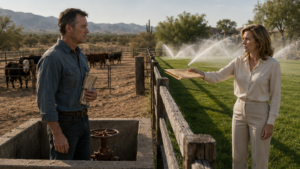
Thomas Hill heard it before he saw it, the hard rattle of tires over washboard dirt, the engine pushing through the valley like it belonged there. Dust rolled over the sheep path and drifted through the slanting afternoon light. Three ewes lifted their heads from the grass beside the water crossing. One of the lambs startled and stepped sideways toward the unfinished bridge.
Thomas set down the drill.
The truck came around the bend below the pines, bright red against the green pasture, with white block letters painted on the side: HOA.
For a moment, Thomas just stared at it.
He had lived on that ranch for twenty-eight years. He had seen county trucks, feed trucks, fire trucks, ambulances once, and a sheriff’s cruiser when a hunter got lost on the ridge. He had never seen an HOA vehicle throw dust across his sheep as if the valley were a paved cul-de-sac.
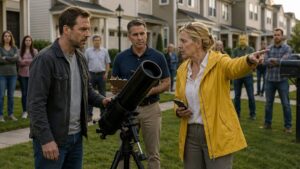
The truck stopped so close to the bridge that its front bumper hung near the orange caution rope Thomas had tied between two posts. The driver’s door opened. A man in a dark blazer stepped down carefully, avoiding the mud as if it had been placed there to inconvenience him. Sunglasses. Polished shoes. Clipboard tucked under one arm.
Thomas knew him before the man spoke.
George King, president of the Pine Valley Ridge Homeowners Association, though Thomas still had trouble putting those words beside the land around them. Pine Valley Ridge was mostly a line of homes along the county road above the valley, built after the old ranch parcels were divided. Thomas’s cabin and lower pasture sat at the end of an older access easement, folded awkwardly into the association years before anyone thought to ask whether a sheep ranch fit under rules written for mailboxes and driveway lighting.
George looked at the half-repaired bridge, then at the fresh lumber stacked near the bank.
“You need to stop work immediately.”
Thomas wiped his hands on his jeans. “Afternoon to you too.”
“I’m serious, Mr. Hill.” George lifted the clipboard. “This structure is under enforcement review.”
Thomas glanced at the bridge. It was not a structure in the way George meant. It was the only way from the cabin to the ranch road when the creek was high. Spring runoff had eaten under the old supports, leaving the deck tilted enough that a person using a cane had to lean into the rail and trust it. Two days earlier, Anthony Campbell had helped Thomas pull the rotten boards and set new posts. They still needed to widen the middle span and fasten the handrail before the storm came over the western ridge.
“It’s a bridge,” Thomas said. “Same bridge that’s been here longer than your bylaws.”
George walked to the edge of the crossing without stepping onto the deck. His eyes moved over the newly set posts and the wider planks Thomas had laid out. “It is now an exterior modification visible from the association road.”
“The association road is up there.” Thomas pointed toward the ridge. “This is my access.”
“It is still within the covenant review area.” George slid a yellowed paper from a folder and unfolded it with the care of a man producing evidence. “Section nine, paragraph two. No alterations, additions, exterior structures, railings, fences, or access features shall be built or modified without written approval.”
Thomas looked at the paper, then at George’s polished fingers holding it above the bridge rail as if the creek itself should obey.
“That paper older than half the fence posts on this place?”
“It is recorded.”
“So is my deed.”
“Your deed is subject to covenant restrictions.”
A ewe stepped onto the near edge of the bridge, then backed away from the gap where the old side board had been removed. Thomas moved one boot, and the animal turned into the grass. George watched the sheep with thin patience.
“You’re blocking livestock movement as well,” George said. “That’s another liability issue.”
Thomas almost laughed, but there was no humor in him. “You parked across the crossing.”
“I parked where I needed to park to serve notice.”
Thomas saw the word before George said it. Notice. There it was on the clipboard, clipped under a plastic sheet, printed in bold at the top. The same clean language people used when they wanted to make harm look tidy.
“I filed the repair request,” Thomas said.
George’s face did not change. “You filed an exterior improvement request.”
“I filed bridge stabilization after runoff damage. Your office got it three weeks ago.”
“And the board reviewed the materials provided.”
“Then you know why I’m doing it.”
George’s eyes flicked to the lumber. “You requested replacement boards. What you began installing is a widened deck with an extended rail system. That is not a like-for-like repair.”
“It has to be wider.”
“Then you should have requested approval for widening.”
“I requested repair because that’s what it is.”
George folded the old covenant halfway, then paused as if deciding whether Thomas deserved another explanation. “Mr. Hill, the association cannot allow every owner to interpret emergency necessity however they wish. Once unapproved work begins, we have to act. That is the only way standards mean anything.”
Standards.
Thomas looked past him to the cabin across the creek. Its porch faced the valley, and the low sun hit the windows just enough that he could not see inside. Elizabeth would be at the kitchen table by now, with her tea cooling beside the pill case she hated looking at. She had asked that morning whether the rail would be solid by tomorrow. He had said yes because he meant to make it true.
“How many board members came down to look at it?” Thomas asked.
George’s jaw tightened. “The submitted photos were sufficient.”
“Photos don’t show the bank washing out under the north sill.”
“The issue is not the bank. The issue is unauthorized modification.”
“The issue is whether my wife can cross safely.”
For the first time, George hesitated.
Only for a second.
“There was no medical accommodation request included in your submission,” he said.
Thomas felt the sentence hit harder than he expected. He had not included one. He had opened the folder twice, looked at the doctor’s letter, then put it back in the desk. Elizabeth had spent two years fighting not to become a condition people discussed in rooms she wasn’t in. Thomas had told himself the bridge could be handled as a repair. Same crossing. Same place. Better rail. No need to put her name on a form.
George took the silence as permission to continue.
“You are hereby instructed to cease all work pending review. If additional boards, posts, rails, concrete anchors, or other materials are installed after this notice, the association may remove the noncompliant addition and assess costs to your account.”
Thomas took one step closer, slowly enough that George could not call it threatening. “You’re telling me you’ll tear out my bridge?”
“I’m telling you the association has enforcement authority.”
“Over a bridge I need to get from my house to the road?”
“Over unapproved exterior modifications.”
The creek moved under the open planks, brown from the last rain, louder than it should have been for that time of year. Thomas could smell wet cedar, sawdust, diesel from the red truck, and the sharp wool smell of sheep waiting to cross.
He held out his hand. “Give me the denial in writing.”
George placed the notice on top of the stacked lumber instead of handing it to him. “It was mailed.”
“I didn’t receive it.”
“That is not grounds to continue work.”
“Who signed the denial?”
“The board.”
“Names.”
George put his sunglasses back on though the sun had dropped behind the ridge. “You can request meeting minutes through the office.”
Thomas picked up the notice. The paper was clean, uncreased. Not mailed. Not weathered. Not even folded.
George turned toward the truck. “I strongly advise you not to make this more expensive than it needs to be.”
“For who?”
“For everyone,” George said. Then, after opening the truck door, he looked back at the bridge. “If one more board goes on that crossing, Mr. Hill, a crew will be here in the morning.”
Thomas stood beside the unfinished rail until the red truck reversed hard, swung around, and climbed the dirt road in a cloud of dust.
Only when the engine faded did he look down at the notice.
The date printed at the top was yesterday.
The delivery line was blank.
Chapter 2: The Repair Request Nobody Read
“Why are the bridge lights still on?”
Elizabeth’s voice came from the kitchen before Thomas had both boots off. Not worried yet. Not fully. Just sharp in the way she got when she had counted the time between his steps and found something missing.
Thomas left the notice folded in his back pocket.
“Had to clean up late,” he said.
She sat at the kitchen table with her cane hooked over the chair beside her. The lamp over the stove made the room look smaller than it was. A cup of tea rested near her left hand. Her right hand, the weaker one, lay against the table edge, fingers curled slightly inward. She had spent months learning how not to look at it. Thomas had spent months learning how not to look away too quickly.
“You said Anthony would finish the rail tomorrow,” she said.
“He still might.”
“That isn’t an answer.”
Thomas opened the drawer where he kept invoices, fence staples, and old receipts he meant to file someday. He took out a flashlight instead of the folder he needed, then shut the drawer.
Elizabeth watched him. “Thomas.”
He turned.
She did not raise her voice. She rarely had to. “What happened?”
He pulled the notice from his pocket and placed it on the table, smoothing it once with his palm. Elizabeth read the first line. Then the second. Her face did not collapse. That almost made it worse. It set.
“They denied it?”
“They say they denied it.”
“You didn’t get a letter.”
“No.”
“You checked the box?”
“Every day.”
Her eyes moved toward the window, though the bridge was hidden by darkness. “And now?”
“Now I find the paperwork.”
He went to the narrow desk in the corner, the one he had built when the ranch still made enough to justify a desk just for ranch things. In the top drawer was a folder labeled Bridge in his own blocky handwriting. Inside were printed photographs of the washed-out bank, Anthony’s estimate, a receipt for treated lumber, and the application form he had filled out three weeks earlier.
Elizabeth pushed herself up before he could tell her not to. She used the table first, then the cane. The sound of the rubber tip against the wood floor made him turn.
“I can bring it over,” he said.
“I know.”
“I just meant—”
“I know what you meant.”
He stayed quiet.
She came to the desk slower than she wanted to. He could see it in the set of her mouth. Every step was a negotiation she hated losing in public, even with only him watching. When she reached the chair beside him, she lowered herself with care and held out her hand.
“Show me what you sent.”
Thomas gave her the application.
The first page was simple enough. Property owner. Address. Parcel number. Proposed repair. He had written: Stabilize existing bridge after spring runoff damage. Replace unsafe boards and add support to rail.
Elizabeth read the line three times.
“You didn’t write why.”
“It says unsafe.”
“For anyone. Not for me.”
“It didn’t need to be about you.”
“Apparently it did.”
He closed his jaw.
She looked at him then, not angry in the loud way. Worse. Hurt and tired. “You had the doctor’s letter.”
“In the file.”
“Did you send it?”
“I thought if I sent it, they’d make it a medical case.”
“It is a medical case.”
“It’s our bridge.”
“It is my way out of this house.”
Thomas looked at the desk. A pencil had rolled against the old brass drawer pull. He picked it up and put it down again.
Elizabeth softened by half an inch, but not enough to save him. “I know what you were trying to do.”
He wished she didn’t.
“You thought you could fix it without making me the reason,” she said.
“I thought I could keep them from putting your name on every email they send around.”
“And now they’re putting a crew on the bridge.”
He took the medical letter from the back of the folder. The paper was still in the envelope from the clinic, creased where he had opened it and folded it again. It stated, in careful medical language, that Elizabeth Hill required stable, level access with continuous hand support between residence and vehicle route due to post-stroke mobility impairment. It recommended widening the existing crossing and installing a code-compliant handrail.
Continuous hand support. Vehicle route.
Words that made their life sound like an inspection checklist.
Thomas set the letter beside his vague application. The two pages accused him without raising their voices.
“I’ll call the office,” he said.
“At this hour?”
“I’ll leave messages until somebody answers.”
The HOA office line went to a recorded greeting twice. On the third try, he pressed the number for maintenance emergencies, then another number for enforcement. He did not expect a human voice, but a woman answered in a thin, tired whisper.
“Pine Valley Ridge Association.”
“This is Thomas Hill, lower ranch parcel. I need to speak with someone about an enforcement notice.”
A pause. “Mr. Hill, the office is closed.”
“Then why did you answer?”
Another pause. “Because the line forwards when there’s an active enforcement file.”
Elizabeth leaned against the desk, eyes fixed on him.
“Are you Karen Wilson?” Thomas asked.
“Yes.”
“Good. I submitted a bridge repair request three weeks ago. George King came out today saying it was denied. I never got a denial.”
“I can’t discuss board decisions after hours.”
“You can tell me whether the request was received.”
Paper shifted on the other end. Or maybe Thomas imagined it because he wanted proof to have a sound.
“It was received,” Karen said.
“When?”
“May third.”
“And how was it logged?”
The silence that followed was not long, but it changed the room.
“Mr. Hill—”
“How was it logged?”
“As exterior road improvement. Visual alteration to common-view access area.”
Elizabeth closed her eyes.
Thomas leaned one hand on the desk. “That’s not what I wrote.”
“That is how the form was coded.”
“By who?”
“I process intake. The enforcement chair assigns review category.”
“George.”
“I didn’t say that.”
“You didn’t have to.”
Karen lowered her voice further. “Your file did not include medical accommodation documentation.”
“I have it.”
“It needed to be submitted with the request.”
“I didn’t know the bridge had to become my wife’s medical record before anybody would read the words unsafe boards.”
“I’m not arguing with you.”
“No, ma’am. I don’t think you are.”
He heard her breathe in. “There is an emergency board notice scheduled for tomorrow afternoon. If you have additional documentation, you can submit it by ten.”
“George told me a crew comes in the morning.”
“That can’t be right.”
“It is right because he said it standing on my bridge.”
Karen did not answer.
Thomas stared at the medical letter. Beside it, his own application looked smaller and more foolish by the second.
“If a crew comes before the board meets,” he said, “who authorized that?”
“I would have to check the file.”
“Check it.”
“I don’t have access from home.”
“Then you better hope George does.”
He hung up before anger made him say something useless.
Elizabeth was quiet for a while. The lamp hummed above them. Outside, one of the sheep knocked against a gate, a dull metal sound carrying through the dark.
“You should send the letter,” she said.
“I will.”
“All of it.”
He nodded.
“I mean it, Thomas.”
“I said I will.”
“No.” Her voice sharpened enough to make him look up. “You will send it because it is true, not because you’ve been cornered into using me as evidence.”
He swallowed. “I never wanted that.”
“I know.” Her eyes shone, but she did not let the tears move. “But sometimes you hide me so carefully it feels the same as shame.”
He had no answer that would not sound like defense.
So he scanned the letter. He sent it to the HOA office with the repair request, Anthony’s estimate, photos of the washout, and a short message that took him twelve minutes to write because every sentence wanted to become anger.
At 4:47 a.m., Thomas woke in the chair beside the desk.
At first he thought the sound was thunder.
Then it came again, closer, mechanical and steady, grinding up the ranch road before sunrise.
He stood so fast the chair hit the wall.
Through the kitchen window, beyond the dim shape of the pasture, headlights moved toward the bridge.
Chapter 3: The Crew Started Before The Notice
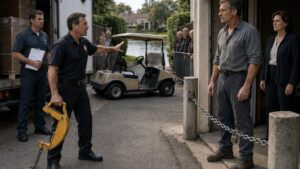
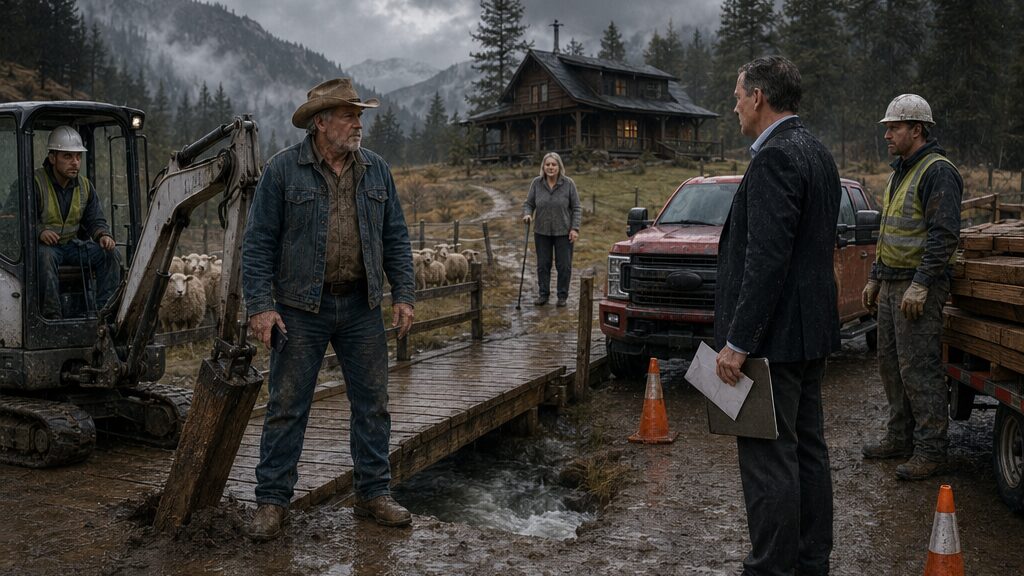
The mini-excavator was already running when Thomas reached the bridge.
Its arm hovered over the new rail posts like a hooked finger. Orange cones had been set along the dirt road. A flatbed truck blocked the far side of the crossing, and two workers in reflective vests were stacking Thomas’s lumber as if they had found it abandoned. Sheep crowded along the pasture fence, confused by the engine and the men standing where the morning feed route should have been.
Thomas stopped at the edge of the road and took out his phone.
He started recording before he spoke.
“Who authorized you to be on my property?”
The nearest worker froze with one of the new cedar posts in his gloves. The mini-excavator operator looked toward a man in a hard hat holding a clipboard. The hard hat looked past Thomas.
The red HOA truck sat behind the flatbed.
George King stepped out wearing the same dark blazer, though the morning air was cold enough for breath to show. He carried a white envelope this time.
“Mr. Hill,” George said, “you were instructed to stop work.”
Thomas kept the phone raised. “I asked who authorized this crew.”
“The association issued an enforcement order.”
“Show it.”
George walked toward him, stopping outside arm’s reach. “This notice confirms removal of unapproved modifications begun after denial.”
Thomas looked at the envelope. “You mean the denial I never received?”
“You were served notice yesterday.”
“You placed a paper on my lumber yesterday after threatening me.”
“And you continued to maintain an active work site.”
“No board went on after you left.”
George glanced at the bridge. “The association is not required to wait for escalation.”
The excavator engine idled, rattling through the planks. Thomas could feel the vibration through the soles of his boots. One of the ewes bleated from behind the fence, and another answered from the far pasture. They wanted across. The bridge had always been a routine, and now routine had a machine parked on top of it.
Thomas moved closer to the worker holding the cedar post. “Put that down.”
The worker looked at George.
George said, “Proceed.”
“Put it down,” Thomas repeated, still calm.
The worker lowered the post halfway but did not release it. The hard-hat supervisor stepped in. “Sir, we’re contracted for removal.”
“By who?”
“Association.”
“Name.”
The supervisor looked uncomfortable. “I don’t have to—”
“You’re standing on my bridge with my materials in your hand. Name.”
“Crew supervisor,” the man said, giving no more.
Thomas turned the phone toward George. “George King, are you directing this crew to remove materials from my property before I have signed or received any written removal order?”
George’s mouth tightened. “You are being served now.”
“Now,” Thomas said. “Not before the machine started.”
George held out the envelope. “Take it.”
Thomas did not lower the phone. “Put it on the hood of your truck.”
“Refusal to accept service will be noted.”
“Good. Note that the crew was already here.”
For the first time, George’s expression showed irritation not covered by procedure. “Mr. Hill, you are making this adversarial.”
“You brought an excavator to my wife’s bridge before breakfast.”
George’s eyes moved, just once, toward the cabin. “This is not a permitted medical accommodation.”
“I sent the medical letter last night.”
“After enforcement was issued.”
“Because your office never read the repair request correctly.”
George shook his head. “You cannot create an emergency after being denied.”
Thomas almost stepped toward him then. He did not. He stood still until the heat in his chest moved down into his hands and out through his grip on the phone.
The mini-excavator arm dropped. Its clamp closed around the first new rail post, the one Anthony had set square beside the approach plank. The wood groaned as the operator pulled. Dirt broke around the base. The sound was not loud, but it cut through Thomas worse than a shout.
“Stop that machine.”
The operator paused. Again, every worker looked at George.
George’s voice was clipped. “Continue.”
Thomas stepped onto the bridge and placed himself in front of the next post.
The supervisor raised both hands. “Sir, you can’t stand there.”
“I can.”
“This is an active work zone.”
“It became one when you made it one.”
George moved to the foot of the bridge. “If you interfere with enforcement, the association may pursue additional costs.”
Thomas looked at him over the top of the phone. “Do you have a court order?”
George blinked. “We have HOA enforcement authority.”
“That is not what I asked.”
“The covenant allows corrective action.”
“Do you have a court order?”
George did not answer directly. “You agreed to association governance when you bought—”
“No.” Thomas’s voice stayed low, but one of the workers looked up sharply. “I bought a ranch parcel before your association changed its signs and painted that truck red. I agreed to maintain safe access. That’s what I’m doing.”
The supervisor shifted his weight. “Mr. King, maybe we should pause until—”
“Removal continues,” George said. “That is what we were authorized to do.”
A second vehicle came down the road, slower than the first. Anthony Campbell’s old white pickup bounced over the ruts and stopped short of the cones. He got out wearing work pants and a sweatshirt, hair still wet as if he had left home fast.
“What in God’s name are you doing?” Anthony called.
“Stay out of it,” George said.
Anthony ignored him and came to the bridge. His eyes went straight to the loosened post, then to the stacked lumber on the flatbed. “Those posts aren’t cosmetic. They’re carrying the new rail.”
“They are unapproved modifications,” George said.
“They’re keeping somebody from falling into the creek.”
George lifted the clipboard. “Mr. Campbell, are you licensed for work inside association jurisdiction?”
Anthony stopped.
Thomas saw the change. Not fear, exactly. Calculation. A man with a small business, two employees, and bills waiting in a drawer. George saw it too and pressed.
“Because participating in unapproved construction after formal denial could require the board to report the matter to the county licensing office.”
Anthony looked at Thomas, apology already forming before he spoke. “I thought you had approval.”
“I filed.”
“I know. I mean—” Anthony looked at the crew, then at the machine. “Tom, I can’t get tangled in a license complaint.”
Thomas nodded once. It cost him more than he let show. “I understand.”
“I’ll come back when this is straightened out.”
George seemed satisfied. “Wise decision.”
Thomas turned the phone on him again. “Say that part too.”
“What part?”
“That you threatened his license to keep him from repairing a bridge your crew already started tearing apart.”
George stared at the lens. For a second, Thomas could see not cruelty but panic dressed as control. George needed the morning to go cleanly. Crew arrives. Posts removed. Notice served. File closed before anyone made the bridge into something human.
But the bridge was already human.
The cabin door opened across the creek.
Thomas heard it, or thought he did, under the excavator’s idle. He looked past George, past the cones, past the opened gap in the rail.
Elizabeth stood on the porch.
She had one hand on the frame and the cane in the other. Her sweater was buttoned wrong at the top, and her hair was still loose from sleep. She must have dressed in pieces, leaning where she could, refusing to call out because calling out would make everyone turn her into a spectacle.
But everyone turned anyway.
She stepped from the porch onto the small path that led toward the bridge. The distance from the cabin to the crossing was not far for a healthy person. For Elizabeth, with the ground uneven and the morning damp in the grass, it was a series of risks.
Thomas lowered the phone without stopping the recording.
“Elizabeth,” he called. “Stay there.”
“I need to see what they took,” she said.
Her voice carried cleanly across the creek.
George glanced at the workers, then at Thomas. Some of the confidence had left his face, replaced by the uncomfortable awareness of being watched by the person the paperwork had not named.
Thomas stepped off the bridge toward her, but stopped at the gap where the rail should have guided her hand from the slope to the deck. The first post lay loose in the dirt. The second had mud cracked around it where the machine’s clamp had started to bite.
Elizabeth reached the edge of the porch path and stopped.
There was no continuous handhold. No widened middle span. No safe line from the cabin to the road. Just boards, cones, men, an idling machine, and the morning light catching the red HOA letters on the truck.
Thomas turned back to George.
“That,” he said, pointing not at the paper, not at the bridge, but at his wife standing alone on the far side, “is what you’re removing.”
George said nothing.
Behind him, the machine kept running.
Chapter 4: The Board Called It A Liability
Thomas walked into the HOA meeting room and saw his broken bridge on the wall.
Not the whole bridge. Not the creek bank washed hollow beneath it. Not the slope Elizabeth had stopped on that morning with her cane planted in damp grass. Just one close, bright photograph of the widened rail posts, projected behind George King in a way that made the lumber look like evidence from a case.
A caption underneath read: Unauthorized Exterior Modification — Lower Ranch Access Area.
Thomas stopped inside the doorway with his hat in one hand and the removed cedar post in the other. Mud still clung to its lower end. He had pulled it from the dirt after the crew left, after the supervisor finally shut the mini-excavator down and told George he would not continue with a resident standing on the bridge. The crew had taken two boards, one post, and most of the morning.
That had been enough to make the crossing unsafe.
George stood at the front table in his dark blazer, one hand resting beside a folder of papers. Susan Martinez sat to his right, a calculator and thick binder in front of her. Karen Wilson sat at a smaller side table with a laptop open, her eyes dropping the moment Thomas entered.
A few board members shifted in their chairs. No one looked at the post in his hand for long.
“Mr. Hill,” George said, “you may place any materials outside. This is a board meeting, not a construction site.”
Thomas crossed to the empty chair set near the end of the table and leaned the post against the wall beside him. “It was part of my bridge this morning.”
George’s jaw worked once. “We’ll maintain order.”
Thomas sat.
The meeting room smelled of coffee, carpet cleaner, and paper warmed by the projector. It was the kind of room where decisions sounded harmless because no one had to stand in the mud while making them. On the wall, his bridge remained frozen in the photograph, cropped tight so the cabin and sheep were missing.
George clicked a remote. The next slide showed the old covenant, paragraph highlighted in yellow.
“As the board can see,” he said, “the lower ranch parcel is subject to exterior alteration review. The owner was denied approval for expansion of an access structure in a common-view corridor and proceeded with unauthorized work.”
“I didn’t proceed after denial,” Thomas said.
George did not look at him. “Please wait for the comment period.”
Susan raised her pen. “George, before we go further, was proof of delivery entered for the denial notice?”
Karen’s fingers paused above the keyboard.
George turned a page in his folder. “Notice was mailed in accordance with standard procedure.”
“That’s not what I asked,” Susan said.
A faint shift moved through the room.
Thomas looked at her more carefully. Susan was not warm. Her gray suit was as severe as George’s tone, and she had the pinched look of someone who had spent too many evenings making numbers behave. But she was looking at the file, not at George.
Karen cleared her throat. “The denial letter was generated. I don’t have certified delivery attached.”
“Because it wasn’t mailed,” Thomas said.
George’s gaze snapped to him. “Mr. Hill.”
Thomas held up both hands, palms open. “I’m waiting for comment period. But don’t call a thing mailed if nobody can show it left the office.”
Susan looked at Karen. “Was there a medical accommodation packet in the review materials?”
Karen’s face tightened. “Not in the original packet.”
“There is now,” George said. “Submitted after enforcement.”
Thomas leaned forward. “Because your office categorized a bridge repair as a road improvement.”
George clicked again, hard enough that the remote made a plastic sound. A new slide appeared: photos of the crossing from the HOA’s angle, the widened middle span circled in red.
“The issue is not whether Mr. Hill prefers a safer bridge,” George said. “Everyone prefers safe structures. The issue is process and liability. The association has received repeated warnings regarding owner-built structures near drainage and water crossings. If we allow unapproved expansion on a shared-view access area, and someone is injured, our carrier may treat the board as negligent.”
The word carrier changed Susan’s expression. She looked down at the binder.
George opened another folder. “Last month, our insurance representative advised us that inconsistent enforcement could expose the association to increased premiums or loss of coverage.”
A board member muttered, “We can’t afford that.”
Thomas heard it. So did George.
There it was: the fear underneath the clean language. Not hatred. Not even personal spite, at least not entirely. Money. Liability. Precedent. Men and women at a table imagining every homeowner building whatever they wanted and leaving the association to pay for it.
Thomas understood fear. He just hated what they had decided to fear first.
Susan looked at the projection again. “Where is the county drainage review?”
George’s shoulders stiffened. “Pending.”
“You told us the work created an unapproved drainage risk.”
“It does.”
“Has the county said that?”
“The county has not issued clearance.”
Thomas took the folded medical letter from his folder and laid it on the table. “The county didn’t tear the post out. You did.”
George’s voice stayed even. “The crew paused because you obstructed removal.”
“My wife couldn’t cross because you started it.”
For the first time, several board members looked directly at him.
Thomas felt the old reflex rise in him: stop there. Say no more. Keep Elizabeth out of this room, away from the notes, the emails, the sympathetic tilts of heads. He gripped the edge of the folder until the paper bent.
Susan reached for the medical letter but did not open it. “Mr. Hill, why wasn’t this included with your original application?”
That question was fair. He hated that it was fair.
“Because I thought existing bridge repair would be read as existing bridge repair.”
Susan waited.
Thomas looked at Karen. She looked down.
He made himself continue. “Because my wife’s medical condition is not a paint color. I didn’t think I had to submit her private clinic letter to replace rotten boards and add a handrail.”
George folded his hands. “The board cannot evaluate information it does not have.”
“No,” Thomas said. “But it can read the words unsafe bridge before sending machinery.”
The room went quiet except for the projector fan.
Karen touched the corner of her laptop. “There was a note in the intake email.”
George turned. “Karen.”
She swallowed. “Mr. Hill wrote that the bridge was the only safe vehicle access to the residence during high water.”
“That’s not a medical accommodation,” George said.
“No,” Karen said. “But it was a safety note.”
Susan’s pen stopped moving. “Was that note included in the board packet?”
Karen did not answer quickly enough.
Thomas felt something small and dangerous open in the room. Not victory. A crack.
George closed the folder. “We are getting distracted. The motion before the board is temporary authorization to remove unapproved modifications and secure the crossing pending county review and proper resubmission.”
“Secure it how?” Thomas asked.
George looked at him. “By removing the widened elements and restoring the prior condition.”
“The prior condition is unsafe.”
“The prior approved condition.”
Thomas almost laughed. “You hear yourself?”
Susan looked at the photo again, then at the medical letter under her hand. “George, I’m uncomfortable authorizing full removal before county review.”
“We already paused once. Delay increases exposure.”
“For who?” Thomas asked.
George ignored him. “If the storm forecast holds, the association must show it acted to prevent unsafe unauthorized work in the drainage area.”
Susan’s face closed around the arithmetic of risk. Thomas could see her weighing premiums, dues, reserves, angry owners. George had not convinced her that he was right. He had convinced her that not acting could be expensive.
The vote passed by one.
Temporary removal authorization. Pending county review. Costs reserved for assessment.
Thomas stood slowly. The room blurred at the edges, not from tears, but from the effort of not saying what would let George dismiss him as unreasonable. He picked up the cedar post.
Karen’s laptop chimed. Then Thomas’s phone vibrated in his pocket.
He stepped into the hallway before looking.
A voicemail notification from the county drainage office.
He played it with the phone pressed hard to his ear.
“This message is for Thomas Hill regarding the lower ranch crossing. We reviewed the parcel map and prior easement notes you sent. Based on what we’re seeing, the HOA may not have jurisdiction over emergency repairs to an existing private access crossing. Call us first thing. Do not let anyone remove structural supports until we clarify the record.”
Thomas turned back toward the meeting room door.
Through the narrow window, George was gathering the covenant papers into his folder as if the matter had been settled.
Chapter 5: The Covenant Did Not Cover The Crossing
“The line stops here,” the county drainage inspector said, tapping the map with the back of a pencil.
Thomas leaned over the counter. The map was wide, old, and creased under a sheet of clear plastic. Parcel boundaries ran in faded black. Easement notes sat in cramped blocks near the margins. The inspector’s pencil rested on a thin line that followed the ridge road, crossed the upper turnout, and stopped well before the creek bridge at Thomas’s lower pasture.
Thomas stared at the stopping point.
“That’s the association review corridor?” he asked.
“That’s the recorded common-view exterior control area from the amended covenant.” The inspector slid another page over. “It follows the shared road. Your bridge sits inside a private access and drainage maintenance easement. Different thing.”
“The HOA president said the covenant covers railings, access features, exterior structures.”
“Near the common-view corridor, yes.”
“Their truck was on my bridge.”
The inspector looked up. “Truck can drive anywhere. Paper can’t.”
Thomas almost smiled, but his mouth would not hold it. He had slept two hours, maybe less. The red mark left by his hat band sat deep across his forehead, and his hands still smelled faintly of cedar from the post he had carried into the board meeting like a piece of evidence no one wanted to touch.
The inspector turned the map so Thomas could see both pages together. “Emergency stabilization of an existing crossing after runoff damage is usually a maintenance issue, provided you don’t alter the creek channel or increase obstruction.”
“We widened the deck twelve inches.”
“For handrail clearance?”
“Yes.”
“Did you change the water opening?”
“No.”
“Set concrete in the channel?”
“No.”
“Then county’s concern is structural safety and drainage flow, not whether the rail offends somebody’s design guidelines.”
Thomas breathed out through his nose.
It was not relief. Relief would have meant the bridge was whole. This was something thinner, sharper. A tool he had not had before.
“Can I get that in writing?” he asked.
The inspector gave him a look that said everyone asked for that when trouble had already arrived. “I can issue a preliminary note. Not a full permit clearance today.”
“I don’t need pretty. I need true.”
“That I can do.”
While the inspector typed, Thomas looked through the glass door toward the county parking lot. Beyond it, clouds were thickening over the ridge, not black yet but heavy enough to make the morning feel late. His phone buzzed twice. Elizabeth. He had told her he would call once he knew something. He had not told her he feared knowing something would make yesterday worse, not better.
The inspector’s printer started.
“I should mention,” the man said, not looking up, “this isn’t the first call we’ve had about that crossing.”
Thomas turned back. “From who?”
“Association office. A few days ago.”
Thomas’s hand tightened around the counter edge. “George King?”
“I don’t recall if he gave a first name. Board president, maybe. Asked whether lower ranch bridge repairs required association approval or county review.”
“What did you tell him?”
“Same thing I’m telling you. County cares about drainage and safe access. HOA authority depends on recorded boundaries. I said from memory that the lower crossing might not be in their exterior review strip and he should pull the parcel map before enforcement.”
Thomas heard the words, but for a second they did not arrange themselves.
George had known enough to ask.
George had known enough to be warned.
“Was that in writing?” Thomas asked.
“I sent a follow-up email with the map reference.”
The inspector tore the printed note from the machine and set it on the counter. “I can’t get involved in HOA politics. But if they remove supports from an existing access bridge before a storm, and that blocks residential access, that becomes a safety problem.”
Thomas took the paper.
Preliminary County Drainage Note.
Existing private access crossing. Emergency stabilization. No confirmed HOA jurisdiction over structural maintenance pending record review. Removal of supports not recommended before inspection.
The words did not fix the bridge. But they changed the shape of the fight.
On the drive back, Thomas kept the paper on the passenger seat inside a folder, weighted by his phone so the truck’s heater wouldn’t lift it. The county road climbed through pines and then dropped toward the valley. From the ridge, he could see his pasture, the silver thread of creek, the cabin roof, and the small broken line where the bridge should have been whole.
The red HOA truck was not there.
That absence did not comfort him.
At the crossing, the damage looked uglier in daylight than it had when he left. One rail post gone. The dirt around another loosened. Two boards missing from the widened section, leaving a gap a boot could turn in. The sheep had worn a restless half circle into the grass where they had gathered and been turned away.
Thomas crouched and touched the raw hole where the post had been. It was just a hole. Mud, splinters, one torn edge of grass.
But he saw Elizabeth standing at the porch path. He saw her cane tip held steady while the rest of her had to negotiate uncertainty. He saw all the ways he had tried to make her life easier by not naming what had changed.
His phone rang.
Elizabeth.
“What did they say?” she asked.
He looked at the bridge. “The covenant may not cover the crossing.”
“May not?”
“The county says emergency stabilization is different from exterior modification. George called them before the enforcement.”
She was silent.
Thomas stood. “He was told to check the map.”
“And didn’t?”
“Didn’t tell the board if he did.”
“That matters.”
“It does.”
“Are you coming home?”
“In a minute.”
“That usually means you’re standing by the bridge deciding whether to do something foolish.”
He looked toward the cabin. “I’m deciding whether to call Anthony.”
“Is the bridge safe enough for him to work?”
“Not until the order is lifted.”
“Then don’t hand George the mistake he wants.”
There it was again: Elizabeth seeing the shape of things faster than he did when pride got in the way.
He put the county note back into the folder. “I should have sent your letter the first time.”
“Yes.”
No softening. No rescue.
“I thought I was protecting you.”
“I know.”
“I didn’t want them passing your name around.”
“I know that too.”
The wind moved over the grass, and the sheep shifted as a group, looking for the crossing that had always told them where to go.
Elizabeth’s voice came quieter. “But you also didn’t want to say out loud that I need it.”
Thomas closed his eyes.
“I didn’t want you reduced to it,” he said.
“I am not reduced by what I need.”
He had no answer.
The first drops began to strike the brim of his hat, widely spaced but cold. He looked up. The ridge had disappeared behind a darkening curtain.
“The storm warning got upgraded,” Elizabeth said. “Emergency alert came through after you left.”
“How bad?”
“Flash flood watch for the creek basin by morning.”
Thomas looked at the loosened rail post. If the creek rose hard, water would push debris against the old supports. Without the new rail secured and the deck braced, crossing could become impossible. Not inconvenient. Impossible.
“I’m calling Susan,” he said.
“Good.”
“And Karen.”
“Good.”
“And if they don’t move?”
“Then I go to the meeting.”
Thomas turned toward the cabin. He could see her shape through the kitchen window now, small behind glass, upright in the chair.
“No,” he said.
“Yes.”
“You don’t need to sit in that room while they—”
“While they what? Look at me? Hear my name? Understand I live here?”
“Elizabeth.”
“No, Thomas. If you keep hiding behind paperwork, I will come explain what the paperwork is about.”
He gripped the phone. “I’m not hiding.”
“You are. You’re just doing it politely.”
The line stayed open between them, filled by wind and the first hard patter of rain on his hat.
Then Elizabeth said, “You promised me I could stay in this house. Not stay in it like a trapped thing. Stay in it as mine.”
Thomas looked at the bridge, then at the county note in his hand.
“I’ll speak,” he said.
“All of it?”
He watched a sheep step toward the broken crossing and stop.
“All of it.”
Chapter 6: The Woman Behind The Repair
Thomas set the ripped-out bridge post on the HOA table, and every conversation in the room stopped.
Mud flaked from the base onto the polished wood. A thin strip of torn grass still clung to one side. The post lay between George King’s folder and Susan Martinez’s binder like something dragged in from a place their rules had never pictured clearly.
George stood halfway from his chair. “Remove that.”
“No,” Thomas said.
His voice was not loud. That was why the room heard it.
Elizabeth sat beside him in her wheelchair, one hand resting on her cane across her lap. Getting her into the building had taken two neighbors, a temporary board over the muddy edge of the bridge, and twenty minutes of careful anger. She had not complained once. That made Thomas feel worse than if she had cursed him the whole way.
Susan’s eyes moved from the post to Elizabeth, then to the stack of papers Thomas placed beside it: the original repair request, the medical letter, the county drainage note, photos of the washed-out bank, and a printed screenshot from his phone video showing the excavator arm clamped around the first rail post.
George looked at the board members. “This emergency session was called to address drainage and liability, not to stage a display.”
Thomas pulled out the chair and sat. “That post is the display you authorized.”
Susan closed her binder. “Let him speak.”
George turned toward her. “Susan, we have an agenda.”
“We also have a storm warning and a resident whose access bridge is partly dismantled.” She looked at Thomas. “Speak.”
Thomas had rehearsed on the drive. Dates. Times. Received request. Misclassification. County note. Enforcement before service. No speeches. Facts first. Anger last, if at all.
Then he looked at Elizabeth.
She did not look fragile under the fluorescent lights. Tired, yes. Pale from the effort of getting there. Angry enough to sit straighter than her body wanted. But not fragile. Not the secret he had tried to keep safe by keeping her out of the file.
He began with the bridge.
“Spring runoff undercut the north sill. The old deck had a lean. The rail flexed under weight. I submitted a request to stabilize the existing bridge because that bridge is the only vehicle access between my house and the road during high water.”
He placed the first page forward.
“Your office received that request May third. It was logged as exterior road improvement.”
Karen Wilson sat at the side table, hands folded so tightly her knuckles blanched.
George said, “The owner’s description was incomplete.”
Thomas did not look at him. “It was incomplete because I made it incomplete.”
That surprised the room more than denial would have.
“I did not include my wife’s medical letter. I thought I could keep her name out of a process that should have recognized unsafe access without needing her diagnosis attached.”
Elizabeth’s hand tightened on the cane.
Thomas continued before he could retreat. “That was my mistake. Not because the bridge wasn’t necessary without it. Because I gave people who wanted a smaller problem the chance to call it one.”
George opened his mouth, but Susan spoke first. “Karen, was the safety note from Mr. Hill’s email included in the review packet?”
Karen stared at her laptop.
“Karen,” Susan said, softer this time.
“No,” Karen said.
George’s face hardened. “The packet included the application.”
“The email note said the bridge was the only safe vehicle access during high water,” Karen said.
“Why was it omitted?” Susan asked.
Karen’s eyes flicked once toward George. “The file was categorized before packet assembly. Safety notes outside the form field were not included.”
Thomas heard Elizabeth breathe out beside him.
Susan looked at George. “Who categorized it?”
George adjusted one paper in front of him. “As enforcement chair, I assigned the review track based on the submitted description and visible work.”
“Before or after calling the county?” Thomas asked.
George went still.
The room seemed to lean toward the question.
Thomas slid the county note forward. “The drainage inspector told me the association contacted him before enforcement. He told the caller the lower crossing might not be in the exterior review corridor and to check the parcel map before acting.”
Susan took the paper and read it. Her mouth tightened, but not in Thomas’s direction.
George said, “A preliminary conversation with county staff does not override recorded covenants.”
“No,” Thomas said. “But it should have stopped you from bringing a machine to my bridge before giving me notice.”
George’s face flushed. “We were facing a liability exposure. The carrier warned us about inconsistent enforcement around owner-built structures. If we allow unapproved expansion near drainage, every owner—”
“This is not every owner,” Elizabeth said.
Her voice was not strong, but it cut clean.
Everyone looked at her. Thomas felt the old instinct rise again, to shield her from their eyes. He forced himself not to move.
Elizabeth lifted her chin. “My husband did not build a deck for parties. He did not widen that bridge because he wanted it prettier. He widened it because after my stroke, I cannot cross that slope safely without continuous hand support.”
George’s expression shifted into something careful. “Mrs. Hill, no one disputes your situation.”
“You disputed it by removing the rail.”
“The board had no proper accommodation request before enforcement.”
“You had a man standing in front of you telling you why it mattered.”
“That was after—”
“That was while your machine was pulling out the post.”
Silence.
Thomas looked at her, and the room disappeared for a second. He remembered the hospital hallway two years before, Elizabeth asleep under a thin blanket, his hands smelling of sanitizer, his promise whispered against the rail of the bed. Home. I’ll get you home and keep you there. At the time, he had meant the cabin, the pasture, the kitchen window facing the ridge. He had not understood that home could become a place someone was trapped if the path out was broken.
“I should have said more sooner,” Thomas said.
Elizabeth turned toward him.
He did not look away. “I thought if I kept your name out of it, I was preserving your dignity. But I was also preserving my comfort. I didn’t want to sit in a room and tell strangers what the stroke took from you. I didn’t want to admit a bridge I used to cross without thinking had become the line between you and the rest of your life.”
Elizabeth’s eyes filled, but her voice stayed steady. “It did not take my life.”
“No,” Thomas said. “And I’m sorry I let them treat the repair like it did not protect one.”
Susan pushed back from the table. “I move that enforcement be suspended immediately, that the removal order be withdrawn pending full review, and that the bridge repair be reconsidered as emergency access and accommodation.”
A board member across from her raised a hand slowly. “Second.”
George stared at Susan. “You can’t be serious.”
“I am.”
“Our insurance exposure—”
“Our exposure is worse if we knowingly remove residential access after receiving medical documentation and a county note warning against removing supports.”
George leaned over the table. “You are reacting emotionally.”
Susan’s face went cold. “I am reacting to a file you did not present completely.”
The words landed harder than any shout.
Karen spoke without being asked. “The original request arrived before the denial. The safety note was omitted. The medical letter arrived before the crew completed removal. The service notice was generated the morning the crew went out.”
George turned on her. “Karen.”
She flinched, but did not take it back.
Thomas watched her hands tremble above the keyboard. There was no triumph in it. Only a woman choosing, late and frightened, not to keep making a wrong thing easier.
George gathered his papers. “If this board withdraws enforcement without carrier approval, I will not sign off on association liability.”
Susan held up the county note. “Then sign a limited withdrawal based on emergency access pending final review.”
“No.”
Elizabeth rolled her chair slightly forward. The movement was small, but every wheel sound in the room was clear. “Mr. King, do you understand what happens if the creek rises tonight?”
George did not answer.
“My husband can carry me over a lot of things,” she said. “He has. More than I wanted. But if that bridge goes, and emergency services cannot reach the house, your paragraph will not carry anyone.”
George looked at the old covenant paper in front of him, then at the muddy post on the table. For a moment, Thomas thought he might yield.
Instead, George said, “The board will need final wording before any vote is valid.”
Susan exhaled sharply. “We can draft it now.”
The lights flickered.
Everyone looked up.
A second later, every phone in the room sounded at once, emergency alerts shrieking from purses, pockets, and the side table. Thomas grabbed his.
Flash Flood Warning. Creek basin. Immediate risk. Avoid low crossings.
Then Anthony Campbell’s name appeared on the screen.
Thomas answered before the second ring.
Anthony’s voice came through rough with wind. “Tom, the lower road just washed over by the bend. Water’s taking the shoulder. If that bridge isn’t braced before this hits harder, you may not have a crossing by morning.”
Thomas looked at George, at Susan, at Elizabeth, and finally at the muddy post lying across the table.
Outside, rain hammered the meeting room windows so hard it sounded like gravel.
Chapter 7: The Bridge They Could Not Call Decorative
Thomas reached the bridge expecting George King’s red truck to be blocking it again.
Instead, Susan Martinez stood in the rain beside the loosened rail post, holding a plastic document sleeve against her chest while water ran off the brim of a borrowed ranch hat that did not fit her. The red HOA truck was parked farther up the road, not across the crossing. Its tires sat in the mud like it had been told, finally, to stay out of the way.
The creek had risen overnight.
It moved brown and fast under the bridge, carrying twigs, pine needles, and the torn foam from someone’s old cooler. The lower bend of the ranch road was washed soft at the shoulder, exactly where Anthony had warned him. The sheep had gathered against the fence again, restless and loud, their bodies pressing one another toward the crossing they knew but could not trust.
Thomas stopped his truck short of the cones.
Susan stepped toward him before George did.
“I have a signed withdrawal,” she said.
Thomas did not take the sleeve. “Signed by who?”
“The board majority. George signed receipt and non-opposition.”
“That isn’t the same as approval.”
“No,” Susan said, rain running down the side of her face. “So I also have emergency conditional authorization for access stabilization. County safety compliance required. No aesthetic enforcement until drainage review is complete. No removal costs assessed to you.”
Thomas looked past her.
George stood near the red truck with his arms folded, collar turned up against the rain. He was not wearing sunglasses. Without them, he looked older and less certain, but not sorry enough to trust.
Thomas held out his hand.
Susan gave him the sleeve. Inside were three pages: withdrawal of violation, suspension of removal order, emergency access repair authorization. George’s signature was at the bottom of one page, tight and small, as if he had tried to write as little of himself into it as possible.
Thomas read every line.
Susan waited.
The rain thickened, then eased. Anthony’s white pickup appeared over the rise with lumber strapped in the back and two workers sitting silent in the cab. He pulled in slowly, eyes moving from Susan to George to Thomas before he opened his door.
“I heard there was paper,” Anthony said.
“There’s paper,” Thomas said. “Maybe enough.”
George walked closer. “The association is not accepting liability for owner-performed work outside approved specifications.”
Thomas kept reading.
Susan said, “George.”
“I’m clarifying.”
“No,” Thomas said without looking up. “You’re trying to put the bridge back into the same fog you used to tear it apart.”
George’s face tightened. “Mr. Hill, the board has acted in good faith based on available information.”
Thomas finally looked at him. “Your crew started before the notice was served.”
George looked toward the creek.
Susan said, “That will be corrected in the record.”
“Corrected how?” Thomas asked.
Susan opened her binder, protecting the pages from rain with her coat. “The minutes will reflect that the safety note was omitted from the review packet, that medical documentation was received before removal was completed, and that county jurisdiction was unresolved at the time enforcement began.”
George’s mouth pressed flat. “The language is still under review.”
“It was voted on,” Susan said.
Thomas studied her. She looked exhausted. Not heroic. Not transformed into a friend. Just a woman who had opened the file and found herself inside the wrong decision.
Anthony came up beside Thomas. “Creek keeps rising, we need to brace that middle span before noon.”
Thomas nodded, but he did not move.
“Before a tool touches that bridge,” he said, “I want the conditions stated on the record. Written approval for the widened deck. Written approval for continuous handrail. Written statement that the removed materials are mine and will not be assessed as violation costs. Written note that emergency access comes before exterior appearance until county review.”
George gave a short, humorless breath. “You want the association to write that appearance does not matter.”
“I want the association to write that my wife can leave her house.”
The creek roared under the silence that followed.
Susan took out a pen. “I’ll amend the authorization by hand and scan it when we get back.”
“Now,” Thomas said.
She nodded. “Now.”
She placed the document on the hood of Thomas’s truck, shielded it with the plastic sleeve, and wrote while the rain spotted the ink at the edges. Anthony watched the creek. George watched Susan. Thomas watched George.
When Susan finished, she signed first. Then she turned the page toward George.
He stared at the pen.
“George,” she said quietly, “sign it.”
For a moment Thomas thought he would refuse out of nothing but pride. Then the creek slammed a branch against the bridge support, hard enough to make the deck shudder.
George took the pen.
His signature looked even smaller this time.
Anthony’s crew moved fast after that. They reset the torn post first, the same cedar post that had lain on the HOA table the night before. Mud clung to it until Thomas scraped the base clean with his pocketknife. He held it steady while Anthony checked plumb and one worker drove the brace into place.
No one spoke much. There was no room for it. Boards had to be set. Bolts tightened. The widened section had to be made solid before the creek rose another inch. Thomas worked until his shoulders burned and his hands went numb in the cold rain. Every so often, he checked the papers tucked under the seat of his truck, as if words might vanish if not watched.
George stayed by the red truck.
Once, when Anthony called for another rail section, George stepped forward as if to object to the height. Susan looked at him, and he stopped.
By early afternoon, the worst of the rain had moved east. Light broke unevenly through the clouds, silvering the wet pasture and turning every fence wire bright. The creek was still high, but the bridge no longer trembled underfoot. The new handrail ran from the cabin path to the road side in one continuous line, simple and sturdy, its fresh wood pale against the old weathered deck.
Thomas crossed it first with a wrench in his hand.
Then Anthony.
Then one of the sheep, impatient and bold, slipped through the opened gate and trotted onto the bridge before anyone could stop her. She crossed, hooves tapping the boards, and the rest followed in a tight woolly stream, as if the argument had never belonged to humans at all.
Elizabeth came to the porch while the last ewe crossed.
Thomas saw her before anyone called out. She wore her gray sweater and held her cane in her left hand. Her right hand rested against the porch rail, fingers curled but steady. She looked at the bridge for a long time, then at Thomas.
He started toward her.
She lifted one finger. Wait.
So he waited.
Elizabeth came down the path slowly. The ground was wet, and the cane sank slightly in the softened dirt. Thomas wanted to go to her. Every part of him wanted it. Instead, he stood at the near end of the bridge and kept his hand on the new rail, not reaching, not rushing, not turning her crossing into rescue.
At the first post, she shifted her cane, placed her hand on the rail, and tested it.
The rail did not move.
She took one step. Then another.
Halfway across, she stopped beside the place where the post had been torn out. Her palm rested on the new wood. She looked down at the creek moving hard beneath her, then up at Thomas.
“You made it too smooth,” she said.
His throat tightened. “I’ll rough the grip if you want.”
“I want you to stop looking like you’re about to apologize for the bridge.”
He let out a breath that almost became a laugh and almost became something else.
George approached only after she reached the road side. He held a folder close to his coat, the old covenant paper visible inside.
“Mrs. Hill,” he said, “the board regrets the confusion in process.”
Elizabeth looked at him until the sentence had nowhere to hide.
“Confusion is when you misplace a form,” she said. “You removed the thing I needed to leave my home.”
George lowered his eyes. “The record will be corrected.”
“It should be.”
He turned slightly toward Thomas. “Mr. Hill, the association will review emergency access procedures.”
Thomas nodded once. “Do that.”
There was no handshake. George did not offer one. Thomas was grateful.
When the red HOA truck finally backed up the road, it did so slowly. It did not throw dust this time. The mud would not allow it, and neither would the people watching.
Susan stayed long enough to hand Thomas the final copied pages from the portable scanner in her car. “I should have asked more questions sooner,” she said.
“Yes,” Thomas said.
She accepted that without flinching. “I will now.”
After she left, Thomas and Elizabeth stood at the bridge while Anthony’s crew packed up. The valley smelled of wet pine, raw cedar, and creek mud. The sheep spread into the far pasture as if some old order had been restored.
Thomas pulled the folded covenant copy from his coat pocket. The paper had softened in the damp, its highlighted paragraph blurred at one corner. For days it had been held over his bridge like a verdict.
Elizabeth watched him.
He folded it once, then again, not carefully, and put it away in the back of the truck under the signed withdrawal.
Then he offered Elizabeth his arm.
She looked at it, looked at the rail, and chose the rail first.
Together, at her pace, they crossed after the sheep.
The story has ended.