The Contractor Kicked Out an Old Squatter and Cost the Neighborhood Its Hilltop
Chapter 1: The Fire Above the Waking City
The removal notice had been nailed through Patrick Mitchell’s boundary marker.
The paper was bright orange, too clean for the weathered cedar post, and the steel nail had split the old wood directly through a faded survey notch. Patrick stood beside it with a dented kettle in one hand and read the block letters twice.
UNAUTHORIZED OCCUPANT.
CLEARANCE PENDING.
Forty-eight hours had been written across the bottom in black marker.
Patrick set the kettle on the ground. He gripped the nail with a pair of pliers from his back pocket and eased it free without widening the split. Whoever had posted the notice had hammered hard enough to bend the point against the iron pin hidden inside the marker.
They had not known the pin was there.
Most people did not.
Patrick folded the paper once and tucked it beneath his arm. Then he pressed the loose halves of the cedar together, measured the damage with his thumb, and looked down the narrow road that wound through the trees toward the neighborhood below.
Fresh tire tracks crossed the damp soil.
Wide tires. Heavy vehicle.
The summit had been quiet when he went to sleep.
Behind him, his weathered RV caught the first pale light above the city. Its cream-colored paint had faded unevenly, and one rear panel bore a repaired seam Patrick had sealed himself years earlier. A folding chair sat beside a low ring of dark stones. Inside the ring, last night’s ash held one red ember.
Patrick crouched and fed it two thin pieces of cedar.
The fire returned without smoke.
Janet had laid the first stones there before the road below had a name. She had rejected Patrick’s neat circle and shifted three stones outward because, as she told him, fires should look invited, not engineered.
He had never corrected them.
A loosened stone tilted near the western edge. Patrick lifted it, cleared away grit, and reseated it firmly. Then he placed the kettle over the flame and opened the old hardback book waiting on his chair.
He had read less than a page when voices rose along the access road.
Six residents appeared between the trees, walking in a tight group. Virginia Moore led them in a quilted vest and polished walking shoes unsuited to the muddy slope. Behind her came two couples Patrick recognized from the lower streets and a man he had never seen before.
The stranger did not look at the view.
He looked at the road width, the tree line, the grade beside the RV.
He carried a laser measure.
Virginia stopped several yards from the fire. “Patrick, we need to speak.”
He closed the book around one finger. “You already posted something.”
Her eyes flicked toward the folded notice beneath his arm. “The association didn’t post that.”
The stranger raised a phone and photographed the RV.
Patrick looked at him. “Don’t photograph my windows.”
The man lowered the phone only after taking another picture.
Virginia drew a breath. “There have been complaints. Smoke. Garbage. People sleeping up here.”
“No one sleeps here but me.”
“That’s part of the problem.”
Patrick waited.
The city spread beyond the trees below them, towers catching sunlight while whole neighborhoods remained in shadow. For years, residents had climbed the path at dawn, brought children at dusk, and parked along the overlook on summer nights. Patrick had repaired washouts after storms, cleared fallen limbs, and carried out bags left beside the trail.
No one had ever asked who paid for the gravel.
Virginia gestured toward the RV. “Property values are affected by appearances. The summit is becoming a concern.”
“Whose property?”
A few of the residents glanced at one another.
“The entire neighborhood,” she said. “This overlook serves everyone.”
Patrick looked past her toward the man with the measure. “Who is he?”
The stranger stepped forward before Virginia answered. He was broad through the shoulders, younger than Patrick by nearly thirty years, and dressed in a fitted work jacket without dust on it.
“Brian Walker. Walker Contracting.”
Patrick had seen the name on excavators near the southern development.
Brian offered no hand. “I’m preparing the summit for authorized clearance.”
“Authorized by whom?”
“The parties responsible for the future of this land.”
Patrick’s expression did not change. “That isn’t a name.”
Brian smiled as though the answer had amused him. He unrolled a glossy rendering across the hood of a resident’s parked utility vehicle. The picture showed the summit stripped of trees and divided by a curving paved road. Tall houses faced the city. A landscaped viewing platform occupied the place where Patrick’s RV stood.
Residents moved closer.
“There will be managed green space,” Brian said. “Safe paths. Lighting. Proper drainage. This hill has been neglected long enough.”
Patrick studied the drawing.
The houses were new. The retaining walls were new. But the site map beneath them was not.
A drainage line curved around the eastern slope in a shape no modern engineer would use. Patrick had drawn that curve himself on tracing paper thirty-four years earlier, before a rock survey forced him and Janet to move the neighborhood’s main line farther south.
Only three copies of the obsolete plan had existed.
One had gone to the city archive.
One had remained in the development office.
The third was inside Patrick’s RV.
Brian tapped the proposed overlook. “This improves access for everyone.”
“You copied an old plan.”
Brian’s smile tightened. “It’s the registered planning base.”
“It was abandoned before the first foundation was poured.”
Virginia looked from one man to the other. “You know the plans?”
Patrick rolled the rendering closed.
Brian caught the edge. “That isn’t yours.”
“Neither is the hill.”
The words silenced the group, but only for a second.
Virginia’s face sharpened with hope and suspicion. “Are you saying you own it?”
Patrick looked at the split boundary marker.
He could have answered. The correct answer required one word.
Instead he held out the orange notice. “Whoever posted this damaged a survey point.”
Brian laughed softly. “That rotten stake?”
Patrick tore the notice down the center, then again, and dropped the pieces into his coat pocket.
The residents watched as though he had destroyed an official order.
Brian let the rendering snap closed. “You have forty-eight hours before the RV is removed.”
“You bring a tow truck onto this road, it stays here.”
“Is that a threat?”
“It’s a fact about the road.”
Brian stepped close enough for Patrick to smell mint on his breath. “You’re sitting on land worth more than you understand.”
Patrick glanced toward the city. “I understand exactly what it is worth.”
Brian backed away with a contemptuous shake of his head. Virginia followed him down the road, though she looked over her shoulder once at Patrick and the little fire.
The group disappeared through the trees.
Patrick waited until their voices faded. Then he took a shovel and walked the western boundary, checking each marker as he had after every heavy rain for more than twenty years.
The first cedar stake stood crooked.
The second was gone.
So was the third.
At the fourth position, the earth had been freshly disturbed. A rectangular hole remained where the marker and iron pin had been pulled together by machinery.
Patrick knelt and touched a crescent-shaped tread pressed into the mud.
The missing markers had not rotted.
Someone had removed them before posting the notice.
Chapter 2: A Complaint Becomes an Official Story
The police cruiser blocked the private road before Patrick finished replacing the first marker.
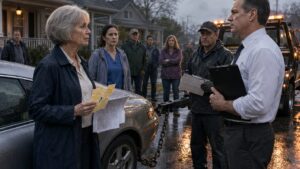
Its blue lights were off, but the vehicle sat crosswise between two stone posts, forcing three resident cars to stop behind it. Brian stood beside the hood speaking loudly enough for everyone gathered at the entrance to hear.
“The eviction has begun,” he said.
Patrick carried the recovered cedar stake over one shoulder. Mud stained his trousers to the knee. He walked past the waiting cars and stopped near the cruiser.
Officer Catherine Hall stepped from the driver’s side with a tablet in one hand.
She had visited the summit twice before—once when teenagers lit fireworks in dry grass, and once after a cyclist broke an ankle on the lower trail. On both occasions, Patrick had given her water, answered only what she asked, and declined to explain why an elderly man in an old RV possessed keys to every gate on the hill.
Her gaze moved from the stake on his shoulder to Brian’s rolled documents.
“Patrick,” she said. “I need you to stay here.”
“I was here first.”
“I know.”
Brian opened a folder. “Officer, this individual tore down a lawful removal notice this morning and continues occupying a designated project site.”
Patrick lowered the marker beside the original hole. “He removed three survey points.”
“I removed debris,” Brian said.
Catherine raised a hand. “One at a time.”
Virginia and several residents had gathered beside their cars. Some held phones. Others stood with arms crossed, wearing the sober expressions of people who wanted official confirmation of what they had already decided.
Brian produced a petition bearing signatures and a municipal document stamped across the top.
Catherine read the first page. “What is this supposed to authorize?”
“Site access, hazard mitigation, and clearance.”
“That wasn’t my question.”
Brian pointed to a paragraph. “The city approved preliminary work near the summit drainage line. The neighborhood association requested removal of the unauthorized encampment.”
“Encampment?” Patrick said.
Brian indicated the RV, fire ring, and two garbage bins near the clearing. “The condition speaks for itself.”
Patrick lifted the marker again and fitted its iron pin into the empty hole.
Brian scoffed. “You’re really doing that now?”
Patrick packed earth around the base with his boot. “It was here before your company.”
Catherine crouched to inspect the exposed survey notch. “This is an old boundary stake.”
“It’s rotten lumber,” Brian said.
“It has an iron pin.”
“Could mark anything.”
“It marks line seven,” Patrick said. “From the western monument to the road easement.”
Catherine looked up at him. “How do you know that?”
Patrick pressed the soil flat. “Because that is where it goes.”
Brian handed her another page. “He has no identification connecting him to the registered owner. We checked. The parcel belongs to Summit Ridge Development Holdings, an inactive company with no public office.”
A murmur passed through the residents.
Catherine tapped at her tablet. “The county database does show the company.”
“And he is not the company,” Brian said.
Patrick wiped his hands on a cloth.
Catherine faced him. “Can you prove you have authority to occupy the land?”
“Yes.”
“Do you have the proof with you?”
“Yes.”
Brian gave a short laugh. “Then this should be easy.”
Patrick looked up the road at the RV. Through its rear window he could see the edge of the sealed metal document case beneath the table.
He had carried deeds, engineering records, access agreements, and Janet’s notebooks through three office moves and one flood. The case contained more proof than anyone at the gate needed.
It also contained her handwriting.
Once opened, it would not stay private. Not with phones raised and residents waiting to learn whether his grief had market value.
Patrick reached into his coat and removed a folded tax receipt.
Catherine read it. The paper was yellow at the edges and dated more than a decade earlier.
“This shows a payment made by Summit Ridge Development Holdings,” she said.
“My payment.”
“It doesn’t show that.”
“It shows the account.”
“It does not show who controls the account now.”
Brian spread his hands toward the residents. “Exactly.”
Patrick took the receipt back.
Catherine’s voice lowered. “You told me before that paperwork existed.”
“It does.”
“Then bring it down.”
“Not for him.”
“This is no longer only about him.”
That landed harder than Brian’s threats. Patrick looked at the line of vehicles waiting on his road. A child watched from a back seat while an adult filmed through the windshield.
Catherine turned to Brian’s municipal notice again, reading the fine print rather than the bold heading. Her eyes slowed near the bottom.
“This permit is for drainage inspection.”
“It includes site preparation.”
“It allows soil testing within fifteen feet of an existing culvert.”
Brian pointed uphill. “The culvert serves the summit.”
“It does not authorize removal of a vehicle, an occupant, a fire ring, trees, markers, or anything else.”
“The association petition—”
“Is not a property-owner authorization.”
Virginia stepped forward. “We were told the city needed community consent.”
“For an inspection,” Catherine said. “Not an eviction.”
The residents’ certainty began to loosen.
Brian’s face did not. “The owner is unreachable. This man cannot establish a legal right. The RV presents a health and safety risk.”
Catherine handed back the papers. “Then you pursue the proper process. You do not invent one.”
She turned so the whole group could hear.
“No towing will take place today. No equipment goes beyond this gate without verified consent from the owner or a court order specifically authorizing removal.”
Brian stared at her. “My crews are scheduled.”
“Unschedule them.”
“This delay has financial consequences.”
“That is not police authority.”
For a moment Patrick saw something beneath Brian’s control: a flicker of panic, quickly buried.
Brian gathered the documents. “Fine. We’ll resolve ownership.”
He signaled to the residents, and several began returning to their cars.
Catherine waited until they had moved away. “Patrick, open the case.”
“No.”
Her jaw tightened. “You could end this.”
“I could end this morning.”
“What does that mean?”
“It means he will find another paper. Another complaint. Another person who thinks access equals ownership.”
“Then give me enough to stop him while the title search is completed.”
Patrick looked at the marker he had reset. “You told me once to put signs at the gate.”
“I did.”
“I didn’t want signs.”
“And now someone is using that absence against you.”
Patrick said nothing.
Catherine studied him for several seconds, disappointment replacing patience. “Silence is not evidence.”
She returned to the cruiser and began a formal title request.
Near the last resident car, Brian caught Virginia by the elbow and drew her beyond Catherine’s hearing. Patrick could not make out every word, but the road carried enough.
“Saturday,” Brian said. “The investors come Saturday. If they see that RV, they walk.”
Virginia glanced uphill. “You said the contract was secure.”
“It will be secure when the site is clear.”
“And if it isn’t?”
Brian folded the false authority papers beneath his arm.
“Then the entire project disappears before anyone learns what this land could have been.”
Chapter 3: The Contract Hidden Inside the Rumor
The bulldozer woke Patrick before sunrise.
Its engine ground against the quiet below the RV, then settled into a low mechanical pulse. Through the window, amber work lights flashed between the trees where the private road widened near the lower bend.
The machine had stopped just beyond the marker line.
Brian had learned enough to keep its tracks off the disputed parcel.
For now.
Patrick dressed, took a steel mallet from the storage compartment, and opened Janet’s old survey notebook on the folding table. Her pencil marks filled the margins around his measurements—tree species, sight lines, places where children might cut across slopes, one note reminding him not to make every path straight simply because he could.
He turned to the summit agreement.
The page was gone.
A narrow ragged edge remained at the binding.
Patrick ran one finger along it. The removal was old, not fresh. He remembered Janet taking papers to a neighborhood planning meeting during the final construction year. He did not remember whether that page had ever returned.
Outside, the bulldozer revved once.
Patrick closed the notebook.
By seven, Brian’s temporary staging area occupied the public shoulder below the gate. Folding tables held coffee, petitions, and glossy renderings. A sign promised HOMES, TRAILS, AND A PUBLIC SUMMIT PARK.
Residents stood in small groups while Brian spoke beside the bulldozer.
Patrick ignored them and carried two replacement cedar stakes along the western line.
At the second missing point, he set a compass against the notebook, measured from the surviving iron monument, and drove the new pin until metal met stone below the soil.
“You can’t alter a disputed site.”
Brian’s voice came from behind him.
Patrick struck the pin again. “I’m restoring what you removed.”
“You can’t prove my crew touched those.”
“Your tread pattern is in the holes.”
“Half the contractors in the county use those tires.”
Patrick aligned the cedar stake over the pin.
Brian watched him work. “You know, there’s a version of this where you leave with compensation.”
“Compensation for what?”
“The inconvenience.”
“You mean the land.”
“I mean relocating your vehicle while ownership gets resolved.”
Patrick drove the final blow. “You already promised land you don’t control.”
Brian’s face remained still, but his eyes shifted toward the staging area.
That was answer enough.
At the meeting, Virginia stood near the table with the petition in front of her. Brian spoke of housing demand, jobs, erosion control, and public safety. He had refined the story since the day before. Patrick was no longer called a squatter. He was an “unverified occupant obstructing emergency preparation.”
The change sounded more reasonable and meant the same thing.
Patrick walked past the edge of the group toward the third missing marker.
Virginia followed him.
“Brian says the development includes a public overlook,” she said.
“He says many things.”
“You could settle this by showing the deed.”
Patrick kept walking.
“Do you have one?”
“Yes.”
She stopped. “Then why are we standing here?”
“Because none of you asked until someone wanted me removed.”
“We have asked who you are.”
“You asked when I would leave.”
Virginia looked back at neighbors gathered around the drawings. “People are frightened of losing access.”
“You had access yesterday.”
“And tomorrow?”
Patrick faced her. “That depends on what you do today.”
The answer unsettled her more than a threat would have.
At the staging table, a young towing operator in a dark work shirt examined Brian’s paperwork. Patrick had seen him with a flatbed on the lower streets. Jacob Carter. Careful driver. Always placed wheel blocks before touching a winch.
Jacob pointed to the bottom of a form.
“There’s no owner signature.”
Brian kept his voice low, but Patrick was close enough to hear.
“We have association authorization.”
“That isn’t the property owner.”
“It establishes community standing.”
“For a tow?”
“For removal.”
Jacob frowned. “My company needs a release.”
“You’re subcontracting under mine.”
“That doesn’t change liability.”
Brian leaned closer. “You want work next month?”
Jacob glanced at the bulldozer, then at Patrick’s RV above the trees.
“I want the right paper.”
“You have it.”
Brian pulled the form from his hands and placed it beneath the petition.
Patrick continued to the marker hole, but the exchange stayed with him. Brian was no longer misunderstanding authority. He was asking others to accept his risk.
Near midday, the wind lifted one corner of the development rendering. Virginia caught it before it blew from the table. A second sheet beneath it showed the interior street plan and projected sales values.
She read for several seconds.
Then she carried the sheet to Brian.
“Where is the mixed housing?”
He glanced at the heading. “That’s a preliminary revenue model.”
“There are twenty-six homes. Every one is listed as premium.”
“Those sales finance the park.”
“The park is half an acre.”
“There are trails.”
“Along the drainage easement.”
Brian took the sheet from her. “Public benefits evolve during design.”
“You told us families priced out of the neighborhood would have options here.”
“I told you development increases supply.”
Virginia’s mouth tightened. “That is not the same promise.”
Around them, residents had begun listening.
Brian lowered his voice. “Without a profitable first phase, nothing happens. No trails. No overlook. No road repairs. You want guarantees before there is even a project.”
“I want to know what I signed.”
“You signed support for clearing an unsafe site.”
She glanced up toward Patrick.
For a brief moment, he expected her to withdraw the petition.
Instead she said, “Do not show this sheet at the investor visit.”
Brian blinked.
“Not until access to the overlook is guaranteed in writing,” Virginia continued. “If residents discover you changed the plan, they will turn against you.”
Patrick felt something settle inside him.
Virginia had learned the truth and chosen delay, not refusal.
Her fear was not false. She loved the overlook. She had brought grandchildren to the eastern ledge, organized trail cleanups, and called Catherine when fireworks threatened the dry grass.
But fear of losing a gift had made her willing to help take it.
Patrick returned to the RV in the afternoon and placed the survey notebook beside the sealed case. He rested his hand on the latches.
Opening it would stop some of what was coming.
It might also place Janet’s letters in reports, hearings, and association meetings. People would speak of her as though they had known her. Brian would call her promise an easement. Virginia would call it community history. Lawyers would reduce it to intent.
Patrick removed his hand.
Below, a truck door slammed.
Brian climbed onto the bulldozer’s track and addressed the remaining crew.
“The title search won’t be complete until tomorrow afternoon,” he said. “That is too late for us.”
Jacob folded his arms. “Too late for what?”
“For the site deadline.”
“You said we weren’t towing without verification.”
Brian looked toward the RV, then toward the city beyond it.
“The truck arrives at dawn,” he said. “We clear the obstruction before the paperwork catches up.”
Chapter 4: When the Stones Were Kicked Apart
The tow chain snapped tight beneath the RV before Patrick reached the door.
Metal struck metal under the floor with a violent crack. A cup jumped from the counter and shattered beside his boots. The rear suspension dipped, and the whole vehicle shifted half an inch toward the road.
Patrick caught the table before the sealed document case slid from it.
Outside, a diesel winch growled.
He opened the door.
Dawn had barely cleared the eastern trees, but Brian’s crew had already filled the clearing. The tow truck stood behind the RV with its amber lights flashing. A chain ran from its boom beneath the rear frame. Two workers waited near the road. Jacob crouched beside the hitch assembly, one hand raised toward the winch operator.
“Hold it,” Jacob called.
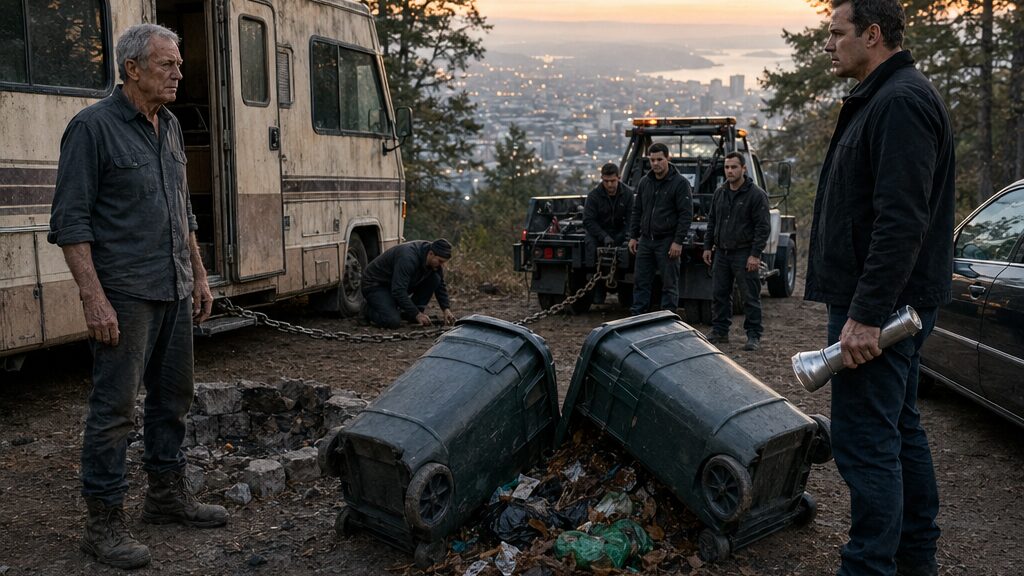
Brian stood near Janet’s fire ring, drinking coffee from a paper cup. A heavy aircraft-aluminum flashlight hung from his right hand. It was too large for the growing daylight and held too loosely to be only a tool.
Patrick descended the steps.
“You attached that while I was inside.”
Brian looked at his watch. “The removal period expired.”
“No order was issued.”
“We have authority to clear the obstruction.”
“You were told not to tow without ownership consent.”
Brian gestured toward the workers and machinery. “Ownership is being resolved. Safety cannot wait.”
Patrick walked to the rear of the RV. The chain had been looped around a crossmember behind the bumper, then angled upward toward the boom. He studied the position of the hook, the slope of the ground, and the distance between the rear wheels and the stone edge of the clearing.
“Release it,” he said.
Brian smiled. “You can ride down in the cab if you cooperate.”
Patrick pointed beneath the RV. “That crossmember is not a towing point.”
“It’s steel.”
“It supports the rear floor. Pull from that angle and it twists before the wheels move.”
Jacob leaned closer beneath the bumper.
Patrick continued. “The left bracket has an old repair plate. The chain is bearing against its edge. Another foot of tension and it shears.”
Jacob looked toward the winch operator. “Back off two turns.”
Brian lowered his coffee. “Do not touch that control.”
Jacob stood. “He may be right.”
“He lives in it. Of course he wants you to think it’ll fall apart.”
“It will not fall apart,” Patrick said. “It will roll toward him when the bracket fails.”
He pointed to Jacob.
The young operator stepped away from the rear wheel.
Brian crossed the clearing. “You’ve delayed this project long enough.”
“There is no project.”
“There will be. Homes. Jobs. A maintained public overlook instead of an old trailer and smoke.”
Patrick looked toward the tables set up below the gate. Several residents had come uphill to watch. Virginia stood at the edge of the clearing, arms folded tightly against herself.
“You promised them land you do not own,” Patrick said.
“I promised them progress.”
“You promised your investors control.”
Brian’s jaw hardened.
Patrick saw the truth in the pause. The bulldozer, the dawn tow, the papers assembled from unrelated permits—none of it was designed to establish authority. It was designed to create a photograph. A cleared summit. Machinery on the land. An apparent fact Brian could show before anyone finished asking whether it was lawful.
Brian lifted the flashlight and struck the RV’s bumper.
The aluminum body produced a deep, ugly clang.
“Last warning,” he said. “Move away.”
Patrick’s hands remained at his sides. “Do not strike it again.”
“What happens if I do?”
“You become harder to defend.”
For the first time, one of the workers looked away from Brian.
Brian swung the flashlight once more, but stopped before contact. He turned toward Jacob instead.
“Tighten the line.”
Jacob did not move.
“You heard me.”
“The hitch point isn’t safe.”
“I’m paying you to tow it.”
“You’re paying my company for a lawful recovery.”
Brian stepped close to him. “You think another contractor will hire you after you walk off my site?”
Jacob’s face tightened. He looked at the chain, then at the men watching from the road.
Patrick crouched beside the rear frame. He picked up a fallen branch and used it to show the line of force.
“The boom is high and left. The ground falls right. When that bracket tears, the chain will whip across this space. Anyone standing here gets hit before the operator can stop it.”
Jacob followed the branch’s path.
Then he reached for the winch remote and released enough tension for the chain to sag.
The RV settled back onto its suspension.
Brian slapped the remote from his hand.
It struck the dirt.
“You’re finished,” Brian said.
Jacob stared at him. “Then I’m finished.”
A murmur moved through the residents.
Patrick straightened. The immediate danger had passed, but Brian’s face had changed. The controlled contractor who spoke of permits and public benefits had vanished. What remained was a man watching a deadline collapse in front of witnesses.
Brian turned toward the campfire.
The small flame had burned low inside Janet’s ring. Patrick had lit it before bed from the previous evening’s coals, as he had done on cold nights for years.
Brian walked to it.
Patrick knew what he intended before his boot lifted.
“Don’t.”
Brian drove his heel through the ring.
A stone rolled free. Ash burst into the air. Burning cedar scattered across the dirt, and sparks struck Patrick’s boots. Brian kicked again, sending two more stones tumbling toward the road.
The fire hissed beneath his sole.
No one spoke.
Patrick looked down at the broken ring.
He remembered Janet kneeling in that same place, turning one stone flat-side upward because she wanted somewhere to rest the kettle. He remembered her laughing when his first fire smoked. He remembered the final winter when she could no longer climb the slope without leaning on his arm.
Brian had not known any of that.
But he had been told not to touch the ring.
That was enough.
Patrick lifted his gaze.
“Stop the tow,” he said.
Brian spread his arms. “Or what?”
“Or I stop it.”
A worker near the front of the RV began unhooking a safety line. Brian saw him and shouted, “Leave it attached.”
The worker froze.
Brian strode to the two large garbage bins beside the clearing. Patrick used them for trail waste collected after weekends. One was nearly full from a recent cleanup.
Brian seized the first handle and overturned it.
Plastic bottles, food wrappers, wet leaves, and spoiled bags spilled across the ground.
Virginia stepped forward. “Brian, that has nothing to do with the RV.”
“It all goes,” he said.
He kicked the second bin onto its side, then looked at two crewmen.
“Clear him out.”
Neither man moved.
Brian shoved one bin himself.
Its wheels caught the slope and began rolling toward Patrick, gathering speed. He sent the second after it. The heavier bin veered left, bouncing across the ruts with its lid flapping.
Patrick stood between the bins and the RV steps.
Behind him, the loose tow chain lay across the ground. Stepping back risked catching his heel. Moving right placed him in the path of the heavier bin. Moving left opened the RV door to Brian.
The first bin struck a stone and tipped forward.
Patrick shifted his weight.
His right foot met the lower corner as it rose. He did not kick through it. He redirected it, using its own momentum and the slope. The bin spun sideways and shot back across the clearing.
Brian’s eyes widened.
The second bin came faster.
Patrick planted his left foot, turned his hips, and drove the sole of his boot against the axle housing. Pain flashed through his knee, but the angle held.
The bin changed direction.
The first crashed into the side of Brian’s black luxury car, denting both doors and spilling garbage across the roof.
The second struck the hood with a metallic boom, rolled up the windshield, and collapsed against the roofline. Rotten waste burst from beneath the lid. A bag split across the glass, coating it in gray liquid and leaves.
The car alarm erupted.
Brian stared at the wreckage.
Then blue lights flashed between the trees.
Catherine’s cruiser entered the clearing as the alarm continued shrieking. She braked beside the broken fire ring and stepped out with one hand near her belt.
Brian ran toward her, pointing at Patrick.
“He attacked me,” he shouted. “He destroyed my car. Arrest him.”
Chapter 5: The Deed That Proved Too Little
“Put your hands where I can see them.”
Catherine’s command cut through the car alarm.
Patrick raised both hands slowly.
Brian stood beside his trash-covered vehicle, one sleeve stained with wet refuse. Behind him, the overturned bins lay against the car. The tow chain remained looped beneath the RV. Janet’s fire ring was broken open between Patrick and the cruiser.
“He assaulted my crew and wrecked my property,” Brian said. “You saw the bins.”
“I saw the last few seconds,” Catherine replied. “Everyone stays where they are.”
She ordered the car alarm silenced, separated Brian from Patrick, and directed the workers toward the road. Jacob remained beside the tow truck, watching the loose chain.
Catherine approached Patrick first.
“Did you kick those bins?”
“Yes.”
“At Brian?”
“At the car.”
“That was not my question.”
“He rolled them at me.”
Brian shouted from across the clearing. “They were empty containers. He launched them like weapons.”
Catherine looked at the garbage spread over the hood. “They were not empty.”
“He could have moved.”
Patrick glanced behind him at the chain across the ground and the RV steps. “Not safely.”
Catherine followed his gaze. She crouched near the tow assembly, then examined the damaged rear crossmember where the chain had bitten into old metal.
“Who authorized this connection?”
Brian stepped forward. “My company did.”
“I told you yesterday that no towing was permitted without verified consent.”
“We obtained additional authorization.”
He pulled folded papers from his jacket. Catherine took them but did not read immediately.
“Patrick,” she said, “you told me you had documents.”
He lowered his hands. “Inside.”
“Bring them out slowly.”
Patrick entered the RV.
The broken cup still lay on the floor. He stepped around it and lifted the sealed metal case from beneath the table. His fingers rested on the latches.
For years he had opened the case only when paying taxes, renewing insurance, or checking the condition of Janet’s notebooks. The documents inside had survived long after the office that created them was demolished.
Outside, Brian was telling the residents that Patrick had staged the entire confrontation.
Patrick opened the latches.
The smell of old paper rose from the case.
He removed the deed packet, the corporate records, the access maintenance ledger, and a stamped injunction prepared months earlier after survey crews entered the eastern slope without permission. Janet’s letters remained beneath them.
He closed the case before carrying it outside.
Catherine spread the documents across the cruiser’s hood, using her notebook to hold down one corner.
The stamped injunction drew Brian’s attention first.
“That doesn’t name me,” he said.
“It prohibits unapproved construction entry, removal, grading, and interference with possession across the listed parcels,” Catherine replied.
“Based on whose claim?”
She turned to the deed.
The first page established Summit Ridge Development Holdings as purchaser of the summit acreage, access road, and adjoining recreational land. Attached maps showed the boundary lines Patrick had been restoring.
Virginia moved closer.
“The road too?” she asked.
Patrick did not answer.
Catherine traced the ownership chain. The initial acquisition was clear. Later corporate filings were less so. One transfer page referenced a controlling-interest amendment that was not included in Patrick’s portable packet.
She looked at him. “Where is the amendment?”
“In the county archive.”
“You don’t have a copy here?”
“The office copy was damaged in a flood.”
Brian leaned over the hood. “So this proves an old company bought the property. It does not prove he owns that company now.”
Catherine turned on him. “Step back.”
“He could be a former employee. A caretaker. Anyone.”
Patrick’s jaw tightened.
Brian had found the weakness Patrick had created for himself. The company had no public office, no active website, and no sign at the gate. Patrick had maintained its registration through an accountant and allowed almost everything else to disappear.
Catherine picked up Brian’s papers.
At first glance, the top page resembled an official removal authorization. Municipal letterhead appeared above references to hazard mitigation and drainage inspection. But the page numbers did not follow. The signature block belonged to a different department. A photocopied association petition had been attached beneath a contractor work form.
Catherine separated the sheets.
“This approval authorizes soil inspection near the lower culvert,” she said. “This paragraph about removal comes from a private work proposal. And this signature certifies receipt of a neighborhood complaint, not consent from an owner.”
Brian’s voice stayed controlled. “The documents were assembled by my office.”
“They were assembled to appear as one authorization.”
“That is your interpretation.”
“It is printed in three different typefaces.”
Several residents lowered their phones.
Catherine turned toward the crew. “Who connected the tow line?”
Jacob raised one hand. “I did.”
“On whose instruction?”
“Brian’s.”
“Did you see owner consent?”
“No.”
Brian stepped toward him. “You were told the petition established authority.”
Jacob looked at the chain. “I asked about the missing signature.”
“And I answered.”
“You said it was covered.”
“It was.”
Catherine interrupted. “Why was the winch released?”
Jacob hesitated.
Patrick did not look at him. The young man had followed too far before stopping, and whatever he said now might cost him work for years.
“He warned us the frame connection would fail,” Jacob said. “I checked the angle. He was right.”
“Did Brian know?”
“He heard the warning.”
“And then?”
“He told us to pull anyway.”
Brian’s face darkened. “Because the old man was bluffing.”
Jacob pointed toward the missing markers. “He wasn’t bluffing about those either.”
Catherine looked sharply at him.
Jacob swallowed. “Brian had two of the crew pull them yesterday. Said markers could create confusion during the investor visit. We dropped them near the staging area.”
Virginia covered her mouth.
Brian laughed once, without humor. “Now he is protecting himself.”
“I’m telling what happened.”
Catherine called for another unit and requested photographs of the tow assembly, fire ring, bins, car, RV bumper, and boundary holes.
Then she returned to the title search on her tablet.
Brian paced beside his damaged car. “Even if my paperwork was incomplete, there is still no verified owner. An inactive company cannot give consent. It cannot deny consent either.”
“The company is active enough to pay taxes,” Patrick said.
“Then why hide behind it?”
The question struck closer than Brian intended.
Patrick looked at the road below, at residents who had walked it for years without seeing a gate closed against them.
“Because I did not want anyone coming up here to ask what I would sell,” he said.
Brian spread one hand toward the RV. “So you made yourself look like a trespasser.”
“I made no claim about how I looked.”
“You let everyone believe the land had no owner.”
Patrick’s eyes shifted to the broken stones.
That was not true.
But it was not entirely false.
Catherine had told him to post signs. The accountant had urged him to transfer the title into a modern trust. Janet’s missing page should have been replaced. He had postponed each decision because formalizing the land meant reopening choices he preferred to consider settled.
His silence had not caused Brian’s conduct.
It had made room for it.
“I kept the structure obscure,” Patrick said. “That was my decision.”
Virginia stared at him. “You could have told us.”
“You could have asked before signing a removal petition.”
She looked away.
Catherine’s tablet chimed.
She read the returned title record, then enlarged the corporate filing attached to it. The clearing grew quiet except for the ticking engine of the tow truck.
“The controlling-interest amendment was digitized last year,” she said.
Brian stopped pacing.
Catherine read the listed name once, then looked directly at Patrick.
“The surviving controlling officer of Summit Ridge Development Holdings is Patrick Mitchell.”
Chapter 6: The Promise Beneath the Private Road
Patrick closed the hilltop gate at two seventeen that afternoon.
The chain had hung unused around one stone post for more than twenty years. Rust flaked beneath his fingers as he drew it through the iron loop and fitted the padlock.
On the other side, residents stood along the shoulder.
No one argued while the lock clicked.
A second police unit had taken statements and escorted Brian from the clearing for formal questioning. His damaged car remained uphill until a recovery vehicle could remove it. The tow truck was gone. Jacob had driven it away after photographing every connection point.
Patrick tied a temporary sign to the gate.
PRIVATE ROAD CLOSED PENDING ACCESS REVIEW.
Virginia read it twice.
“How long?” she asked.
Patrick pocketed the key. “Until I decide.”
He walked back up the road without inviting her to follow.
She followed anyway.
At the clearing, the fire was gone. Only gray ash remained between the scattered stones. Patrick began gathering them one at a time.
One stone had cracked when Brian kicked it. Patrick placed the two pieces together near the original western edge. Another had rolled beneath the folding chair. He brushed dirt from it with his sleeve.
Virginia stopped several feet away.
“I signed the complaint,” she said.
“I know.”
“I believed the health concerns were exaggerated.”
Patrick lifted another stone.
“I knew Brian’s public-park promise wasn’t guaranteed,” she continued. “Not at first. Later.”
He set the stone beside the others.
“I thought if we challenged him before access was protected, he might abandon the project. Then you might close the hill anyway.”
“So you helped remove me first.”
Her face tightened. “I told myself the company owned it. That you were refusing to cooperate because you wanted a settlement.”
“You never asked.”
“You rarely answered anything.”
Patrick looked at her then.
The words were not a defense of what she had done. They were also not wrong.
Inside the RV, the metal case sat open on the table. Catherine had returned the deed packet but retained copies of the relevant pages. Patrick placed the recovered survey notebook beside it and searched through Janet’s planning files.
The missing summit page was not there.
He found an older folder instead, thin and soft at the corners. Janet’s handwriting appeared across the cover.
PUBLIC USE—IF WE KEEP THE TOP.
Patrick sat.
Virginia remained outside until Catherine arrived an hour later. The officer entered only after knocking on the open door.
“You are allowed to tell people to leave your own property,” she said.
Patrick opened the folder. “That was not what you came to say.”
“No.”
Catherine set a printed summary beside the deed. “The injunction is valid. Brian had no authority to enter for removal, and the way those papers were assembled may support fraud-related charges. The assault, property damage, attempted unlawful towing, and marker removal are being documented.”
“And the workers?”
“Different levels of involvement. Jacob stopped the winch and cooperated. Others say they believed the authorization was valid until this morning.”
Patrick nodded. “I don’t want charges pushed against the ones who stopped.”
“That will be considered. It is not entirely your decision.”
“I know.”
Catherine looked through the RV window toward the locked gate. “A permanent closure would be lawful.”
Patrick took a blank access revocation form from the case.
“But?” he said.
“But the association may challenge the history of public use. The city could face pressure to pursue an easement or acquisition if residents organize around losing the overlook. They may fail. They may not. Either way, you spend years defending what clear written rules could protect now.”
Patrick began filling in the parcel numbers.
Catherine watched him. “Closing the road today was sensible.”
“I am not asking permission.”
“No. You have avoided that problem consistently.”
He stopped writing.
Her tone was not mocking. That made it harder to dismiss.
Virginia appeared in the doorway. “May I say one more thing?”
Patrick did not answer, but she entered.
“Not everyone treated this place like a right,” she said. “The lower trail washed out last spring. Four residents brought gravel and rebuilt the edge. People remove litter after holiday weekends. The eastern path has been cleared by volunteers for years.”
Patrick knew.
He had found their tool marks, their new drainage cuts, the neatly stacked deadfall. Because no one left names, he had allowed himself to think of the work as something the hill simply received.
Virginia placed a small ledger on the table. “We kept maintenance dates for insurance purposes. I should have shown you.”
Patrick opened it.
Entries listed trail repairs, brush clearing, litter removal, and first-aid supplies stored near the lower gate. The work did not erase the petition. It changed its shape.
He returned to Janet’s folder.
The first pages were old sketches of the summit: no houses, no paved overlook, only the RV clearing, walking paths, and the stone ring marked by a small circle. Near the back, a sheet of yellow paper had been folded into quarters.
Patrick opened it.
Janet’s handwriting ran diagonally across the top.
If informal use ever becomes confused with ownership, write the rules down.
Below it, she had listed conditions in abbreviated form: no commercial use, no development, daylight access, fire restrictions, maintenance shared, closure permitted, permission revocable for damage.
At the bottom she had written one final line.
Do not punish the view because people forget to say thank you.
Patrick read it again.
For years, he had remembered only the simpler promise: keep the summit unbuilt and let people see the city. He had treated the details as something they would manage together later.
There had been no later.
He looked at the total revocation form beneath his hand. Every line was complete except his signature.
Brian had wanted the hill converted into a product.
Closing it forever because of Brian would still allow him to determine what it became.
Patrick tore the form in half.
Virginia inhaled, but said nothing.
He tore it again and placed the pieces beside the deed.
Then he drew a clean sheet from the case.
At the top, he wrote TEMPORARY ACCESS ORDER.
Brian Walker, Walker Contracting, its agents, investors, subcontractors, and development partners would be permanently barred from the summit parcels and private road. Commercial surveying, promotion, construction entry, and equipment staging would be prohibited.
For residents, access would remain suspended until permits, hours, maintenance duties, liability terms, and revocation conditions were accepted in writing.
Catherine read over his shoulder. “That will be harder than locking the gate.”
“Yes.”
“People will complain.”
“Yes.”
“You will have to speak to them.”
Patrick’s pen paused.
Outside, the broken fire ring waited in the cooling ash.
He signed the order.
Then he began writing the rules he should have written years before.
Chapter 7: The Kindness That Returned With Boundaries
Brian arrived without his crew, his black car, or the fitted work jacket he had worn on the morning of the tow.
He came through the locked gate on foot beside Catherine, carrying a thin folder under one arm. The bruised pride had not left his face, but the confidence that once filled the road ahead of him was gone.
Patrick stood beside the restored boundary marker, tightening the final bolt on a new metal sign.
PRIVATE LAND
PERMITTED ACCESS ONLY
NO COMMERCIAL ENTRY
Beyond him, several residents rebuilt Janet’s fire ring under his direction. The cracked stone had been set at the western edge with its broken side turned inward. The ring was not perfectly round.
Patrick had left it that way.
Brian stopped before the sign.
“I need five minutes,” he said.
“You have Catherine.”
“I need you.”
Patrick set down the wrench.
Catherine remained several paces away, close enough to hear but not to crowd the exchange. Her presence made clear that this was not a private negotiation, whatever Brian wanted to call it.
Brian opened the folder. Inside were letters from a lender, a notice regarding suspended contracts, and a statement from his insurer.
“My company may not survive this,” he said.
Patrick looked at the documents but did not take them.
“Thirty-two people depend on the work.”
“The ones who came here?”
“Some of them.”
“The ones who stopped are not part of my complaint.”
Brian’s mouth tightened. “Your complaint is not the only problem. The footage, the police report, the city review—everything is frozen.”
“You assembled false papers.”
“My office assembled them badly.”
“You gave the order.”
“I believed the association petition gave us standing.”
“You were told it did not.”
Brian looked toward Catherine, then back at Patrick. “I made decisions under pressure.”
“So did Jacob.”
“That is different.”
“He was afraid of losing work. He still stopped the winch.”
Brian closed the folder. “Call it a misunderstanding. Say tempers rose on both sides. Your property is secure now. The road is closed. You have won.”
Patrick glanced uphill.
At the clearing, Virginia was showing two residents how the larger stones had originally been placed. No one had lit a fire. Patrick had made that condition clear.
“This was never about winning,” he said.
Brian let out a strained breath. “Then what do you want?”
“For you to tell the truth without asking what it buys you.”
Brian’s eyes hardened briefly. The old reflex returned, then faded.
“You think I came here because I’m sorry?”
“No.”
“I came because there may still be a way to keep the company alive.”
“I know.”
Brian looked down at the folder in his hands. “The summit project would have saved us. I bought equipment after the investors said the site was nearly certain. When the title problem appeared, I thought clearing the RV would prove the land was available.”
“You knew it would prove nothing.”
“It would have shown control.”
“Control you did not have.”
Brian said nothing.
Patrick lifted the new sign and fixed it against the marker.
“I should have posted this years ago,” he said.
Brian looked up.
“I should have modernized the company records. I should have told the neighborhood that access was permission, not ownership. My silence helped confusion grow.”
Brian seized on the admission. “Then you understand.”
“I understand my mistake.”
Patrick tightened the bolt.
“It does not become your excuse.”
Catherine stepped closer. “The investigation will distinguish between confusion and deliberate acts. The removed markers, altered documents, ignored safety warning, damaged property, and orders to continue are not erased because the landowner was private.”
Brian’s face went pale beneath the morning stubble.
Patrick picked up the wrench. “You should go.”
Brian stared at the hill beyond the gate, at the land he had described to investors as a future site.
Then he walked back down the road beside Catherine.
No one watched him leave for long.
By late afternoon, the new access rules were posted at the gate and at the trail entrance. Residents would need annual permits. The road would open only during designated hours. No commercial vehicles, fires, overnight parking, construction surveys, or organized events would be allowed without written approval. Users would share maintenance duties and report damage. Patrick retained the right to close the hill during fire danger, storms, repairs, or violations.
The summit parcels would be transferred into a conservation trust once the documents were completed. Commercial development would be permanently prohibited.
Several residents objected before Patrick finished reading the terms.
“A permit to walk a road we’ve used for twenty years?” one man said.
“And closing at dusk?” another added. “The city lights are the whole reason people come.”
A woman near the trail sign held up the maintenance schedule. “You expect volunteers to repair private land?”
Patrick folded the pages in his hands.
Virginia stepped away from the restored fire ring.
“You were allowed to use it,” she said. “That did not make it yours.”
The complaints quieted.
She faced the group rather than Patrick.
“We signed a petition against a man whose road we drove, whose trails we walked, and whose land we assumed would remain open because it always had. These rules are inconvenient. Inconvenience is not oppression.”
No one answered.
Virginia looked toward the overlook. “The view was never ours to demand.”
Patrick studied her for a moment, then unlocked the gate.
He opened it only wide enough for people on foot.
The first residents entered slowly. Some signed the maintenance register without speaking. Others read every line of the permit. A child carried a small bag of litter collected from the roadside before reaching the clearing.
Jacob arrived near sunset, not in a tow truck but in his own pickup. He placed two recovered cedar markers beside Patrick’s chair.
“These were still at the staging area,” he said.
Patrick inspected the iron pins. One was bent.
“Can it be fixed?” Jacob asked.
“Yes.”
Jacob nodded toward the fire ring. “Do you need help?”
Patrick handed him a shovel.
Together, residents packed soil around the restored markers and cleared the last scraps of garbage from beneath the trees. Patrick directed the work without raising his voice. When someone placed a stone incorrectly, he showed them where Janet had wanted it, flat side upward for the kettle.
The city lights appeared one district at a time below the hill.
At the gate, Patrick hung the final copy of the access rules beside the original marker Brian’s notice had split. The repaired cedar showed a narrow seam through the old survey notch, but it stood straight.
He returned to the clearing with a handful of dry cedar.
No one applauded or moved closer.
Patrick knelt inside Janet’s ring and arranged the kindling. For a moment his hand rested on the cracked western stone.
Then he struck a match.
The flame caught, small and steady.
Behind him, the gate remained open.
The story has ended.