The Neighbor Who Painted Over The Boundary Never Expected Four Cameras To Be Watching
Chapter 1: The Woman Watching From Above The Fence
William Hernandez heard the camera shutter before he saw the face above the fence.
He looked up from the small engine clamped to his workbench. Patricia Lewis stood three feet higher than she should have been, balanced on a silver ladder behind the wooden boards separating their properties. Only her head, shoulders, and raised phone were visible.
The engine idled between William’s hands, its casing trembling against the rubber mounts.
Patricia took another picture.
“Could you stop photographing my garage?” William asked.
She lowered the phone just enough to look at him over it. “I’m photographing my property.”
William reached for the throttle and shut the engine down. The sudden quiet made the late-afternoon neighborhood sounds feel exposed: a mower several houses away, a delivery van turning at the corner, one loose fence board clicking in the breeze.
His open garage stood entirely on his side of the driveway. He knew that because he had measured it. He had also paid a licensed surveyor to measure it.
Patricia pointed past him toward the concrete apron in front of the garage.
“That corner crosses the line,” she said. “You’ve been using part of my lot as a workshop.”
William followed her finger. She was pointing toward an imaginary line that would have cut diagonally through his driveway and stopped just inside his garage door.
“No,” he said.
“That isn’t an answer.”
“It’s the answer.”
Patricia lifted the phone again. She photographed the workbench, the engine hoist, the rolling cabinet, and the dark stain where William had cleaned a carburetor that morning.
He disliked being photographed. More than that, he disliked the way she moved the phone slowly, cataloguing objects as if she had already been invited inside.
“What are you doing with those pictures?” he asked.
“Building a record.”
The words landed harder than her usual complaints.
Patricia had criticized the noise before, though William never ran equipment early or late. She had complained about delivery trucks, oil odors, cardboard boxes, and the reflection from the garage’s metal shelves. Once, she had told him the sight of mechanical parts lowered the tone of the street.
He had treated each complaint as something that would disappear if he refused to feed it.
Now she was building a record.
“For what?” he asked.
“For when somebody finally makes you put things back where they belong.”
William wiped his hands on a cloth and stepped out of the garage.
A narrow strip of grass ran beside the driveway, disappearing beneath the fence farther back. Somewhere under that grass was the metal property marker pin. He knew its position within an inch: forty-two inches from the driveway edge, aligned with the rear survey point behind his shed.
Patricia pointed again, farther onto his side.
“The old line ran there,” she said. “My husband maintained all of this.”
“Maintaining grass doesn’t change a recorded boundary.”
“You didn’t live here then.”
“The survey did.”
Her expression tightened. It was not confusion. It was offense.
William had seen that look before, usually when facts arrived without apology.
He went back into the garage and opened the shallow drawer beneath his desk. Under receipts, parts invoices, and equipment manuals lay a plastic folder containing a certified survey copy. He removed it but did not carry it outside.
The page showed the lot clearly. The fence had been built several inches inside Patricia’s property years ago, leaving a narrow strip on the outer side that she and her late husband had apparently mowed. The driveway, garage apron, and workshop all remained within William’s recorded lot.
He traced the coordinate where the front marker should be.
Then he looked toward the monitor mounted above his desk.
Four camera feeds divided the screen. One covered the garage interior. One faced the driveway. One watched the side yard. The last followed the fence line from a bracket under the eave.
Patricia’s ladder did not appear fully on any of them.
Her upper body showed clearly. The phone showed clearly. But the ladder’s feet sat in a narrow wedge hidden behind the fence corner and the branches of an overgrown shrub on her side.
William leaned closer to the screen.
She had not placed the ladder there by accident. Two feet to either side, the cameras would have captured her entire approach.
He looked back outside.
Patricia was still above the fence, scanning the garage.
“You moved that hoist,” she said.
“It has wheels.”
“It was farther in last week.”
William said nothing.
“I notice things,” she continued. “That’s why people can’t take advantage of me.”
He returned the survey to the drawer.
It would have taken less than a minute to carry the document outside and show her the measurements. It would have taken another minute to tell her, plainly, to stop climbing ladders and photographing his property.
Instead, he picked up the cloth and wiped a clean section of the workbench.
He told himself documents mattered more than arguments.
Years earlier, before he moved to this house, someone had entered a rented workshop and destroyed an engine William had spent six months restoring for a client. A broken window, smashed housings, bent shafts, sand poured into open cylinders.
The police officer had asked whether he had cameras.
William had not.
The insurance investigator had asked whether anyone had threatened him.
No one had, not in writing.
The claim became a dispute over proof. The client stopped calling. William paid for the lost work himself.
After that, he recorded everything.
Patricia climbed down at last. The ladder scraped against the fence, then vanished from view.
William watched the empty boards for several seconds.
That evening, after he had locked the garage and washed the grease from his hands, he carried the kitchen scraps outside. The light above the side door reached only partway across the grass.
Something large and dark sat near the fence.
One of Patricia’s heavy trash cans had been rolled around the end of the fence and positioned on William’s narrow grass strip. Its wheels pressed deep into the damp soil.
William set down the scraps.
He walked to the can and looked at its placement, then at the driveway edge.
Forty-two inches.
He crouched and touched the grass beneath the center of the bin.
The property marker pin was directly under it.
Chapter 2: The Line Buried Under Wet Grass
Patricia was waiting beside the trash can when William stepped outside the next morning.
She stood with her arms folded, one shoe planted on the grass as if she had been guarding the bin through the night.
“Don’t move that,” she said.
William stopped on the side step. “It’s on my property.”
“There you go again.”
The trash can leaned slightly toward his driveway. Mud clung to its wheels. Patricia had dragged it through wet grass from her side and placed it with more precision than anyone used for ordinary garbage.
William walked toward it.
Patricia moved in front of him. “I said don’t touch it.”
He met her eyes. “Move.”
For a moment, she seemed surprised by the firmness of the word.
Then she stepped aside, but only half a pace.
William gripped the handle and rolled the can onto the concrete. Beneath it, the grass was flattened in a round dark patch. He knelt and pressed his fingers through the wet blades.
The metal pin did not show at first. Soil and dead roots covered the head. He cleared them with his thumb until a dull circle appeared.
Patricia inhaled sharply.
“You planted that.”
William looked up at her.
“You heard me,” she said. “You put that there to make your survey match.”
“The pin predates both of us.”
“You expect me to believe a piece of metal proves anything?”
“You placed the can exactly over it.”
“I put my can on my land.”
William brushed more dirt from the head. A small stamped mark became visible along the edge.
Patricia took out her phone.
“Record all of it,” William said.
Her thumb paused.
He could have left the marker exposed. He could have photographed it beside a tape measure and sent Patricia a written warning before breakfast.
Instead, he pressed the loosened earth back around the pin.
The gesture came from the same instinct that had kept him from carrying out the survey the day before: reduce the scene, remove the provocation, let the record speak when it had to.
Patricia watched him hide the metal again.
“That’s what I thought,” she said.
William stood. “The can stays off my side.”
“We’ll see.”
At the municipal records office, the air smelled faintly of toner and old paper. William waited beneath a row of fluorescent lights while Rachel Davis studied the survey on her monitor.
She had helped him obtain the first certified copy months earlier, when Patricia’s complaints had still sounded like irritation rather than preparation.
Rachel enlarged the front corner of the recorded plat.
“The marker is here,” she said, tapping the screen. “The driveway edge is here. Your garage is here.”
“All inside my lot.”
“Yes.”
“And the fence?”
“Inside the Lewis parcel.”
William leaned forward.
Rachel drew a line with the cursor. “It looks like the fence was installed roughly nine inches inside their boundary at the front and slightly more toward the rear.”
“So the grass outside their fence—”
“Still belongs to them, technically. But that does not move your line farther into your driveway.”
“Patricia says her husband maintained the strip.”
Rachel took off her glasses. “Mowing, trimming, placing a bin, none of that overrides the recorded boundary by itself.”
“By itself?”
Her expression shifted into the careful neutrality of someone accustomed to disputes.
“Property conflicts can become expensive even when the legal line is clear. Access, use, old improvements, competing claims—people turn simple facts into long arguments.”
“She’s putting things over the marker.”
“Have you given her written notice?”
William looked at the certified copy on the counter.
“No.”
“Have you filed a complaint?”
“No.”
“Have you asked for a formal boundary restaking?”
“The existing pin is still there.”
Rachel folded her hands. “Then you have strong evidence. But evidence works better when you use it before somebody escalates.”
William felt the mild sting in the sentence because it was accurate.
Rachel printed a fresh certified copy and embossed the lower corner. The paper left the machine warm.
“This confirms the recorded lot,” she said. “It doesn’t give either of you permission to enter the other person’s property or damage anything. Send her a copy. Put your objection in writing.”
William slid the survey into a document envelope.
Outside, he sat in his truck with the engine off.
He drafted a message on his phone.
Patricia, the certified survey confirms the driveway, garage apron, and marker location are within my recorded property. Do not place bins, ladders, vehicles, or other objects across the boundary.
He read it twice.
The wording was plain. It accused her of nothing beyond what she had already done.
His thumb hovered above Send.
He imagined her replying immediately, forwarding the message to neighbors, claiming he had threatened her. He imagined her standing on the ladder again, phone raised, delighted that he had finally reacted.
William deleted the draft.
At home, he placed the new survey beside the old one in the garage drawer.
He told himself he had preserved the option of formal action without inflaming the situation.
The explanation sounded thin even in silence.
That night, an alert from the driveway camera woke the monitor on his desk.
William opened the footage.
Patricia entered the frame carrying a tape measure and a can of marking paint. She hooked the tape to the wrong fence post, stretched it diagonally toward William’s driveway, and bent to place a small painted dot on her concrete.
Then another.
Then another, each one closer to his garage.
She paused near the hidden marker pin but never uncovered it.
Instead, she measured past it.
On the fourth camera, William saw her step back and study the trail of dots as if she had created a fact.
Chapter 3: Four Cameras And One Missing Warning
The restored machine missed Patricia’s van by less than the width of William’s hand.
He felt the rear tire of the equipment cart bump the driveway lip and stopped pulling at once. Behind him, the blue side panel of Patricia’s van filled the open garage entrance.
It had not been there twenty minutes earlier.
William set the cart brake and squeezed between the machine and the van. Patricia had parked diagonally across the lower half of his driveway, leaving the rear bumper close enough to block a straight path from the garage.
Two trash cans stood beyond it like posts.
Patricia watched from her front steps.
“You’re blocking my access,” William said.
“I’m parked in front of my house.”
“You’re across my driveway.”
“The disputed part.”
William looked at the painted dots she had added during the night. In daylight, they formed a bright broken line from the wrong fence post toward the garage.
“You made those measurements yourself.”
“I corrected them.”
“With what?”
“Common sense.”
William pulled out his phone and photographed the van, the cans, and the visible driveway edge.
Patricia gave him a thin smile. “Building a record?”
He disliked hearing his own method returned as mockery.
“Move the van.”
“I will when I’m finished unloading.”
There was nothing in the van to unload. The rear doors remained shut.
William considered calling parking enforcement. He considered calling the nonemergency police line. He considered handing her the certified survey and reading the written warning aloud.
Instead, he locked the equipment cart inside the garage and waited.
Patricia moved the van forty minutes later.
Over the next three days, the obstructions changed shape but not purpose.
A trash can appeared six inches over the driveway edge. Then twelve. Yard clippings covered the grass where the marker pin lay. The ladder leaned against the fence in the same camera blind spot. Patricia’s van returned each afternoon, angled slightly farther across the concrete.
William recorded each placement.
He saved still images into folders labeled by date and time.
On the fourth evening, he opened the camera archive to prepare a complete timeline.
The first video showed Patricia’s bin barely touching the grass strip.
The second showed it over the pin.
The third showed the van’s tire crossing the driveway edge.
The fourth showed the tire farther over.
He moved backward through the days and watched the pattern assemble itself.
None of the intrusions was large enough alone to seem urgent. Together they looked like a slow test.
Patricia would place something across the boundary, wait, then move it farther after William removed or avoided it.
And every time, the footage also showed William noticing.
In one clip he paused beside the bin, looked directly at it, and walked away.
In another he maneuvered a mower around the van rather than speaking to her.
In another he uncovered the marker pin, stared at it, then pressed soil back over the metal.
The archive proved Patricia’s pattern.
It also proved his.
William sat before the monitor with the certified survey on the desk and felt less protected than he had expected.
He had believed patience made him reasonable.
On the screen, patience looked almost like permission.
He opened the camera configuration panel. Camera four covered the fence line, but the shrub and eave angle left too much hidden. William took a ladder from his garage, mounted the camera lower, and turned it several degrees toward the driveway entrance.
From the new position, the lens captured the marker area, the fence corner, and the exact point where a person entering from Patricia’s side would cross onto his grass.
He tightened the bracket.
“What are you pointing that at?”
Patricia stood below him on her side of the fence.
“The property line.”
“You mean my yard.”
“The camera doesn’t see beyond the fence.”
“It sees me.”
“When you stand above it.”
Patricia’s voice rose. “You cannot surveil a woman in her own home.”
“I’m recording my driveway.”
“You’ve been waiting for me to make one mistake.”
William climbed down.
“No,” he said. “I’ve been waiting for you to stop.”
A neighboring door opened somewhere across the street. Patricia glanced toward it, aware of an audience even when she could not see one.
Then she lifted her phone and began recording.
“Say that again,” she demanded.
William folded the ladder and carried it toward the garage.
“You think cameras make you right,” she called after him. “You think because you collect papers and videos, you can take whatever you want.”
He turned.
For one instant, the anger in her face gave way to something less controlled. Fear, perhaps. Not fear of him. Fear of losing ground she believed she could not afford to lose.
“My husband took care of that strip for twenty years,” she said. “We kept this place respectable before you turned your garage into a junk shop.”
William glanced at the neat shelves, cleaned tools, and restored machine waiting inside.
“It isn’t a junk shop.”
“It is to buyers.”
The last word came out too quickly.
Patricia seemed to hear it after she said it. She lowered the phone.
William noticed, but she recovered before he could ask what buyers had to do with the boundary.
“You’ve lowered the value of everything around you,” she said. “And tomorrow, I’m putting the real line where everyone can see it.”
“What does that mean?”
“You’ll see.”
“Patricia.”
She wheeled one of the trash cans toward her gate.
“Do not enter my property,” William said.
It was the warning he should have given days earlier. Spoken aloud, it sounded late.
Patricia stopped but did not look back.
“You should have objected before now,” she said.
Then she pulled the can through the gate and closed it behind her.
Chapter 4: The Morning The Garage Filled With Water
The stream struck the live power strip hard enough to flip it against the concrete.
William heard the snap before he saw the water.
A blue-white spark flashed beneath the restoration bench. The strip skidded through a widening sheet of water, still tethered to three plugged-in tools. One cord jerked tight against the leg of the bench.
William dropped the wrench in his hand.
The water came from outside, driven low and fast through the open garage. It swept grit, loose washers, and a folded rag toward the back wall.
He moved for the emergency cutoff.
Another spark cracked near the bench.
“Patricia!”
The red shutoff lever was six steps away. Water spread across four of them.
William caught the edge of the rolling cabinet and used it to steady himself as his boots slid. He reached the cutoff, wrapped both hands around the insulated handle, and pulled.
The garage went dark.
The compressor wound down. The work light died. The small fan above the bench stopped mid-turn.
For a moment, only the hiss of pressurized water remained.
William stepped outside.
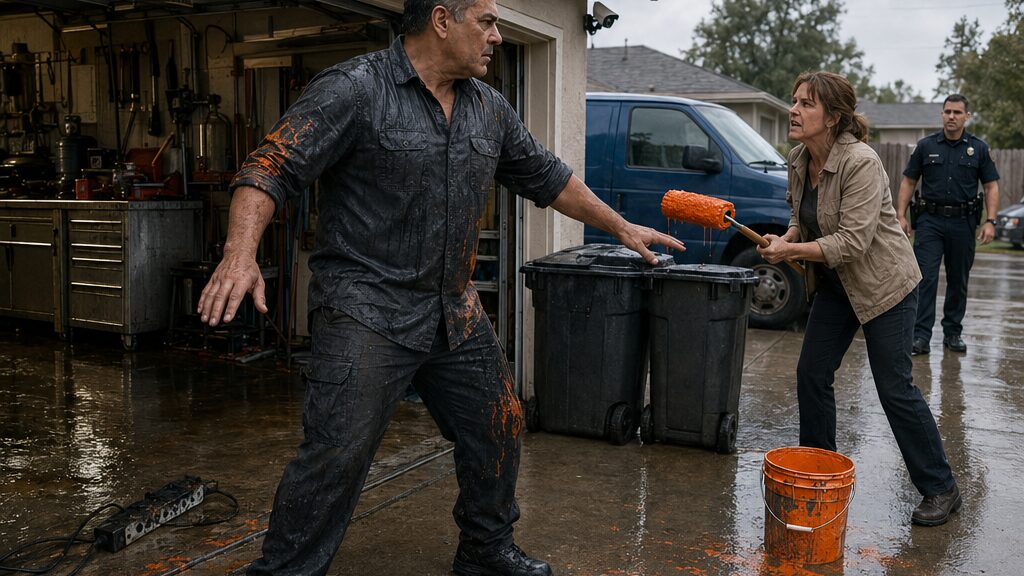
Patricia stood halfway up the driveway with both hands around the nozzle of a high-pressure garden hose. The hose ran behind her, over the grass, and through the open gate beside her fence. She had adjusted the nozzle to a narrow jet and aimed it directly into the garage.
Her van blocked the lower driveway at an angle.
Two heavy trash cans stood between the van and the garage, narrowing the only dry path out.
“Turn it off,” William said.
Patricia shifted the stream toward a stack of plastic parts bins. Water hammered against them, knocking one from the shelf.
“You were warned,” she said.
William crossed the driveway.
The jet struck his trouser leg, cold and forceful enough to make him turn his hip. Patricia swept it upward. Water hit his shirt and face.
He raised an arm.
“Turn it off.”
“You built on my side. I’m cleaning my property.”
“This is not your property.”
“You don’t get to decide that.”
William reached for the nozzle. Patricia stepped backward, dragging the hose across the narrow grass strip. The water flattened the blades near the buried marker pin, exposing mud in a thin channel.
He caught the hose several feet behind the nozzle and bent it sharply.
The stream weakened.
Patricia pulled against him. “Let go.”
William folded the hose tighter until the pressure died. Then he twisted the nozzle closed and dropped it onto the concrete.
Patricia stared at him, breathing hard.
Behind her, the side door of the van stood open.
William could see a dripping bucket of neon orange paint on the floor. A large roller rested across its rim. Beside it lay a spool of bright measuring string and several printed photographs.
He stepped closer.
The photographs showed his driveway from different angles. In each one, Patricia’s painted dots had been joined by a line drawn in thick marker. The false line cut across the grass, through the concrete apron, and along the front wall of his garage.
“You planned this,” William said.
Patricia moved between him and the van. “I documented it.”
“You made your own boundary.”
“I restored the old one.”
William looked back toward the garage.
Water ran beneath the cabinets and around the legs of the disabled restoration bench. The sheet had reached the covered engine on the rear stand. A brown line of contaminated water crept through the dust beneath it.
He returned inside and began moving what he could.
The emergency cutoff had prevented the worst. No motor still ran. No cable remained energized. The power strip had scorched at one end, but the breaker panel was silent and intact.
He lifted the smaller tools onto the highest shelf. He dragged the covered engine stand away from the water. The casters resisted, trapped against grit and a shallow groove in the concrete.
Outside, Patricia reopened the van.
William heard the paint bucket scrape across the floor.
He stopped.
She lifted it with both hands and set it on the driveway. Neon paint dripped from the rim. The roller followed, heavy and saturated.
“What are you doing?” he asked.
“What you refused to do.”
She dropped the measuring string near one of her painted dots and pulled it toward the garage.
William walked out, soaked shirt clinging to his back.
“Do not touch the garage.”
Patricia stretched the string across the grass. It passed several inches beyond the hidden marker pin and continued over William’s driveway.
“This is the line my husband used,” she said.
“Your husband mowing grass did not move the lot.”
“He knew this place before you came here.”
“That doesn’t make this yours.”
Patricia looked toward her house. For a second, her grip loosened on the roller.
“He kept everything from falling apart,” she said. “The yard. The fence. The bills. All of it.”
Her voice changed on the last words. The anger remained, but something beneath it had cracked open.
William saw the open van again, the photographs, the string, the paint.
“Is this about selling the house?” he asked.
Her face hardened at once.
“This is about you taking what doesn’t belong to you.”
“You said buyers yesterday.”
“You hear whatever helps you.”
She dipped the roller deeper into the paint.
Neon orange slid over the sides and splashed onto the driveway.
William looked toward camera four. Its lens faced them directly now, covering the fence entrance, the grass strip, and the lower driveway.
“You are being recorded,” he said.
“Good.”
“All four cameras.”
“Then everyone will see you standing on my land.”
She pulled the roller free.
Paint streamed from it in thick ropes.
William stepped between her and the garage.
Patricia lifted the handle as if it were a staff and pointed the dripping roller over his shoulder.
“Move.”
“No.”
“You shut the power off. You’re done here.”
“I shut it off because you flooded an active workspace.”
“You should never have had equipment there.”
The roller lowered toward the concrete.
William did not move.
Patricia advanced one step.
The smell of paint mixed with wet metal and the sharp burned-plastic odor from the garage.
Behind William, water continued creeping under the cabinets.
Behind Patricia, the van and trash cans sealed the driveway.
She raised the roller again, this time toward the garage wall.
“Move off my side,” she said.
Chapter 5: The Crash Against The Van Door
The first drop of neon paint landed on William’s garage threshold.
It spread into the water like a bright wound.
Patricia pushed the roller past his shoulder.
William caught the wooden handle with one hand.
She pulled back hard. “Don’t touch me.”
“I’m touching the roller.”
“It’s mine.”
“The wall isn’t.”
Patricia twisted the handle, trying to wrench it free. The saturated roller swung sideways and struck the front of a metal cabinet. Orange paint smeared across the gray door, then dragged over William’s sleeve as he turned.
He tightened his grip.
Patricia leaned her weight into the handle. “You’re assaulting me.”
“Let go.”
“You let go.”
For several seconds they stood locked around the roller while paint dripped between them.
William could hear the cameras’ faint cooling fans under the eave. He knew how the scene might look without the beginning. Two adults struggling over a long handle. His size against hers. Her van already in the driveway. Water everywhere.
He released one hand and stepped aside rather than pulling her toward him.
Patricia stumbled forward.
The roller clipped the edge of the threshold and left a diagonal stripe across the concrete.
She looked down at it.
Then she smiled.
Not with satisfaction. With recognition.
“There,” she said. “Now it’s visible.”
William stared at the stripe.
“You think paint creates ownership?”
“It creates a record.”
The phrase was his, returned again.
Patricia lifted her phone from her pocket and photographed the line.
William took the roller from her before she could raise it again. He turned the handle away from her body, carried it to the grass, and placed it beyond the driveway.
Paint rolled off the cylinder and pooled near the hidden marker pin.
Patricia followed him. “You destroyed my evidence.”
“You made the evidence.”
“You admitted the boundary was disputed.”
“I said your claim was false.”
“You never objected.”
“I told you yesterday not to enter my property.”
“Yesterday,” she repeated. “After months.”
William looked at the garage. A plastic parts bin floated on its side near the rear wall. The restored machine he had tried to move the day before sat behind the disabled cart, with water reaching the lower frame.
He needed to get it out.
He released the cart brake and pulled.
The front wheels rolled. The rear wheels caught at the lip where the driveway narrowed between Patricia’s trash cans.
“Move these,” he said.
Patricia stood beside the paint bucket with her phone raised.
“They’re on my side.”
“They are blocking emergency access.”
“You damaged nothing important.”
“You do not know what is in that garage.”
“I know what it looks like.”
William pulled the cart at an angle. One wheel struck the first trash can and stopped. The machine shifted on its mounts.
He froze.
Another hard pull could tip it.
“Move the cans,” he said again.
Patricia kept filming. “Say please.”
Water continued flowing out of the garage, carrying a faint orange tint from the painted threshold.
William set the cart brake.
He walked to the first can and gripped it below the rim.
It was heavy, packed with yard waste and household trash. Mud held one wheel in place.
He lifted and heaved it sideways.
The can struck the concrete, bounced once, and slammed into the van’s side door.
The impact sounded like a metal drum collapsing.
A deep dent appeared beneath the handle.
Patricia’s phone dropped several inches.
William grabbed the second can.
“Don’t you dare,” she said.
He pulled it clear of the cart’s path and hurled it toward the lower driveway.
The lid flew off.
The can crashed into the van beside the first dent, scraping across the blue panel before falling onto its side. Bags and clippings spilled beneath the rear wheel.
Silence followed.
Even the hose had stopped moving.
William stood with his hands open, chest rising and falling.
He had cleared the path.
He had also damaged the van.
Patricia looked from the dents to him.
For a brief moment, her face showed genuine fear. Then the fear changed.
Her mouth tightened into a small, deliberate smile.
She raised the phone and framed only the van.
“Do that again,” she said.
William did not answer.
She stepped closer to the damaged panel, keeping the camera pointed at him.
“Look what he did,” she said into the recording. Her voice trembled now, but the tremor was controlled. “He threw those at my vehicle. He threatened me.”
“I did not threaten you.”
“You came at me.”
“You flooded my garage.”
She turned the phone toward herself. Water had splashed her trousers. A small orange mark stained one wrist.
“He grabbed my equipment,” she continued. “He destroyed my property.”
William looked up at camera four.
It had recorded the hose crossing the marker. It had recorded the paint. It had recorded her blocking the driveway.
It had also recorded him lifting both cans and throwing them.
The context existed.
So did the violence of the image.
Patricia tapped the screen and made a call.
William returned to the cart. He rolled the machine into the driveway now that the path was open and set it on dry concrete near the side wall.
Behind him, Patricia’s voice sharpened.
“Yes, I need police immediately. My neighbor attacked me.”
William stopped moving.
“He damaged my van,” she said. “He threw heavy containers at it while I was standing right there.”
She listened, then looked directly at him.
“Yes,” she said. “I’m afraid he’ll do worse.”
William glanced at the orange stripe across his threshold, the flooded garage, the hose lying over the grass, and the dented van.
From the street, the van was the largest and clearest piece of damage.
Patricia ended the call and held the phone against her chest.
“They heard everything,” she said.
“No,” William replied. “They heard you.”
Chapter 6: What The Loudest Complaint Left Out
“Turn around and keep your hands where I can see them.”
The patrol officer’s command came before William had finished explaining who owned the driveway.
Tyler Brown stood beside the damaged van with one hand raised between William and Patricia. His gaze moved from the two deep dents to the overturned trash cans, then to the orange paint on William’s sleeve.
William faced the garage and placed his hands behind his head.
Patricia stood several yards away, wrapped in a towel she had brought from her house. Her phone remained in one hand.
“He threw them at me,” she said.
Tyler did not look at her. “Stay where you are.”
“He’s been unstable for months.”
“I said stay where you are.”
The second instruction quieted her.
Tyler approached William from the side. “Any weapons on you?”
“No.”
“Did you throw those cans?”
“Yes.”
Patricia made a sound of vindication.
William continued. “They were blocking access to a flooded garage.”
Tyler looked past him. Water covered much of the floor. A scorched power strip lay near the bench. Neon paint marked the cabinet and threshold.
“Who caused the flooding?” Tyler asked.
“She did.”
“That is not true,” Patricia called. “The hose got away from me.”
William turned his head slightly.
Tyler’s voice hardened. “Face forward.”
William did.
“Did you touch her?”
“No.”
“He grabbed the roller while I was holding it.”
“I took it away from the wall.”
Tyler stepped back. “All right. Hands down. Don’t approach either of us.”
William lowered his arms.
The officer walked toward Patricia and listened while she described a boundary dispute, an aggressive neighbor, and property damage. She showed him a video beginning with the first trash can striking the van.
The clip had no flooding. No roller. No blocked driveway.
Only William lifting a heavy container and hurling it.
Tyler watched twice.
Then he approached William again.
“That looks bad,” he said.
“It is incomplete.”
“Do you have footage?”
William pointed beneath the eaves. “Four cameras.”
Patricia folded the towel tighter around herself. “They illegally record my home.”
“They cover my property,” William said.
Tyler glanced at the camera nearest the driveway. “Can you show me the recording from today?”
“Yes.”
Inside the garage, William stopped at the edge of the water.
“The monitor is at the rear. The power is off.”
“Can it run independently?”
“Backup battery.”
William took the dry strip along the wall, with Tyler following. The monitor glowed above the desk, divided into four views.
Patricia remained outside where the officer could see her through the open door.
William opened the first camera file.
The angle faced the garage interior. It showed the sudden rush of water, the power strip flipping, and William reaching the cutoff. Patricia herself remained mostly outside the frame.
Tyler leaned closer.
“You can’t see who aimed the hose,” he said.
“Not from this angle.”
Patricia heard him.
“I told you,” she called. “It slipped.”
William opened the second file.
This camera faced the driveway, but the van blocked much of the lower view. Patricia appeared beside it, partially hidden. The hose could be seen running toward the garage, though the nozzle was obscured.
Tyler looked at William. “You said four.”
William opened the third.
It showed the fence line from above. Patricia crossed through the gate with the hose, but the shrub concealed her hands for several seconds. The picture confirmed entry, not where she aimed the water.
Patricia stepped closer to the garage opening.
“This is ridiculous,” she said. “He’s trying to make normal yard work look criminal.”
Tyler raised a hand without turning. “Stay outside.”
William opened camera four.
The new angle filled the screen.
Patricia entered through the gate carrying the nozzle. She stepped over the narrow grass strip, directly across the buried marker pin, and dragged the running hose behind her.
Then she raised the nozzle with both hands and aimed the jet into the garage.
The footage showed William emerge, close the hose, and point toward the van. It showed the paint bucket, the roller, the measuring string, and the photographs inside the open side door.
Tyler’s posture changed.
“Back that up,” he said.
William replayed the crossing.
The marker pin itself was hidden beneath grass, but the certified survey gave its location. Camera four showed Patricia stepping over that exact point.
Tyler watched the paint sequence next.
Patricia’s voice came clearly through the camera microphone.
I’m marking the real boundary.
Then William’s warning.
You are being recorded. All four cameras.
Good.
Tyler looked toward Patricia.
Her face had lost color.
“The sound is altered,” she said.
William did not respond.
Tyler watched her swing the roller past William and smear the cabinet. He watched William take it away without striking her. He watched the cart stop against the trash cans and William tell her twice to move them.
Then came the impacts.
On the wide camera angle, the cans struck the van with the same force shown in Patricia’s clip. But now the blocked access, flooded garage, and disabled equipment remained visible around the action.
Tyler paused the video.
“Why didn’t you call us before throwing them?” he asked.
William looked at the still frame. His body appeared rigid, one can already leaving his hands.
“I should have.”
“That isn’t what I asked.”
“The equipment needed to come out. The garage was flooded. She refused to move them.”
“You could have waited.”
“I could have.”
Patricia seized on the admission. “There. He admits it.”
Tyler ignored her. “How long has this dispute been happening?”
“Several weeks.”
“Any prior reports?”
“No.”
“Written notices?”
William glanced at the desk drawer where the survey lay.
“No.”
Tyler studied him. “You have four cameras and weeks of footage, but you never called anyone?”
William felt the old workshop return in fragments: shattered housings, sand in the cylinders, the investigator asking for proof he did not have.
“I thought if I documented it, she would stop before it became serious.”
“That usually isn’t how people stop.”
“No.”
The word came quietly.
William opened the archive.
He showed Tyler the bins over the marker, the van moving farther across the driveway, the ladder positioned near the blind spot, and the painted dots.
He did not skip the clips where he noticed and walked away.
Tyler watched one of them twice.
“You saw this happening.”
“Yes.”
“And said nothing.”
“Not enough.”
Patricia stood outside with her arms crossed, no longer pretending to tremble.
“She never believed the line was real,” William said. “She was trying to create something that looked real.”
“Based on what?”
William opened the final recording from that morning.
The camera microphone had captured their conversation beside the paint bucket.
Patricia’s voice came through first.
There. Now it’s visible.
Then later, clearer than William remembered:
Once the stripe is in the photographs, the bank and the buyers will have to deal with it.
Tyler replayed the sentence.
Patricia moved toward the garage. “Turn that off.”
The officer faced her.
“What bank?” he asked.
She stopped.
“What sale?” he added.
Patricia looked at William, not Tyler.
For the first time that morning, she had no accusation ready.
Chapter 7: The Price Of Crossing A Fixed Line
“The pin was planted,” Patricia said as Rachel Davis stepped out of her car carrying a sealed records envelope.
Tyler Brown stood between the driveway and the street. Another officer remained near Patricia’s van, photographing the dents, the spilled trash, and the hose stretched across the grass.
Rachel paused beside the curb.
Patricia pointed toward William. “He put a piece of metal in the ground and built this whole story around it.”
Rachel looked at Tyler. “You asked me to bring the certified property record?”
“Yes.”
She held up the envelope. “This is the recorded survey and monument reference for both parcels.”
Patricia moved toward her.
Tyler blocked the path with one arm. “Stay where you are.”
“I have a right to see it.”
“You’ll get that opportunity.”
Rachel’s gaze passed over the flooded garage, the orange stripe across the threshold, and the roller lying in the grass. Whatever she had expected from an ordinary boundary complaint, it had not been this.
William stood near the garage entrance with water still dripping from his sleeve. He felt tired enough that every object seemed unnaturally sharp: the silver clasp on Rachel’s envelope, the broken lid beside the van, the black scorch on the power strip.
Rachel opened the record on the hood of Tyler’s patrol car.
“The front monument is here,” she said, indicating the marked point. “The driveway is entirely within the Hernandez parcel. The fence is set inside the Lewis parcel.”
Patricia leaned forward. “That fence has been there for years.”
“Yes,” Rachel said. “Its location does not move the recorded boundary.”
“My husband maintained everything outside it.”
“That does not make William’s driveway yours.”
Patricia stared at the page as if waiting for it to change.
“He changed the yard,” she said. “After my husband died, he started bringing machines in. Trucks came. Buyers came through and saw all of it.”
William understood then that she had not meant buyers in some distant, hypothetical way.
“You were already trying to sell,” he said.
Patricia’s eyes shifted toward him.
Rachel closed the folder slightly. Tyler noticed.
“What sale?” he asked.
Patricia pressed both hands against the towel around her shoulders. “That has nothing to do with this.”
“It may explain why you said the bank and buyers needed to see the painted line.”
Her face tightened.
For a few seconds, she looked less like the woman who had stood over the fence with a phone and more like someone cornered by numbers she had been refusing to read.
“The house was appraised lower than it should have been,” she said. “Because of him.”
William looked toward his garage.
The shelves were orderly. The equipment remained inside except when moved for delivery. He kept the driveway clean. The noise stayed within daytime hours.
Patricia continued before anyone could answer.
“The appraiser mentioned the workshop. The condition of the fence. The view from the side yard. Every time I tried to explain that he had taken part of the lot, they said I needed proof.”
“So you created proof,” Tyler said.
“I restored what was there.”
“With paint?”
“With a visible line.”
“Across property you had already been told was not yours.”
Patricia looked at Rachel. “You people make everything sound simple because you don’t have to live with the consequences.”
Rachel did not answer immediately.
When she did, her voice remained measured.
“I told William the dispute could become expensive if neither of you handled it formally. I should have been clearer about the marker. But you were not entitled to enter his garage or damage his property.”
Patricia’s expression flickered. She had expected procedure from Rachel, perhaps distance. Not that.
Tyler asked Patricia to turn around.
She did not move.
“I was protecting my home,” she said.
“You are being arrested for trespassing and criminal mischief. The final charges will depend on the damage assessment and review of the footage.”
Her shoulders dropped.
“What about my van?”
“That will be documented too.”
“He admitted throwing those cans.”
“Yes.”
Patricia turned toward William. “You did this.”
William looked at the orange paint drying across his threshold.
“No,” he said. “I let it go too far. That part is mine.”
The answer seemed to disturb her more than denial would have.
Tyler guided her hands behind her back. The cuffs closed with a small mechanical click.
There was no crowd. No applause. Only the scrape of the patrol door opening and the sound of water dripping from William’s garage into the gutter.
Later, Tyler walked through the damage with him.
The officer photographed the scorched strip, swollen cabinet panels, wet boxes of parts, stained concrete, contaminated tools, and the orange smear across the metal cabinet.
“List everything affected,” Tyler said.
William looked at the engine stand near the rear wall.
Some components could be cleaned. Others might corrode later. Several hand tools had been submerged only briefly. The easiest thing would have been to call them unharmed and avoid increasing Patricia’s losses.
He had seen the fear in her face when she spoke about the appraisal.
He had also seen her aim the hose.
William picked up a clipboard.
He listed the ruined power strip, damaged electrical tools, swollen storage bins, contaminated bearings, paint removal, inspection costs, and the labor required to disassemble the exposed engine.
He left off nothing provable.
He added nothing uncertain.
Tyler reviewed the page.
“This everything?”
“It’s what I can support.”
The officer nodded once.
Before leaving, Rachel helped locate the marker. William measured from the driveway edge while Tyler watched. He pressed a narrow probe through the wet grass until it struck metal.
They cleared the soil.
The pin emerged beneath a film of neon orange paint.
Patricia had rolled directly over it.
One week later, a real estate sign appeared in front of the Lewis house.
A smaller panel beneath it announced a reduced price.
William learned through a notice connected to the case that Patricia had already been behind on payments before the arrest. Legal costs, fines, restitution exposure, and the failed appraisal had narrowed her choices until the sale became immediate.
Her ruin had not begun with the dented van.
It had begun with losses she could not accept and blame she could not stop moving outward.
That knowledge did not erase what she had done.
It only made the silence afterward feel less triumphant.
William repaired the garage with the door open.
He replaced the damaged strip and inspected every motor before restoring power. He removed the orange paint from the cabinet but left one faint mark inside the threshold where only he would notice it.
Then he returned to the grass strip with a small brush, a cloth, and a circular metal marker cover.
He cleared the soil around the property pin completely.
For years it had remained buried, legally fixed but practically invisible. William had known exactly where it was and still chosen to hide it after every confrontation.
He dipped the cloth into solvent and wiped away the neon paint.
The stamped metal slowly reappeared.
Across the fence, movers carried boxes from Patricia’s house to a truck. No one spoke to him. The ladder was gone. The van had been taken away for repair.
William fitted the protective ring around the pin, leaving the metal head exposed above the grass. Then he placed two modest boundary markers along the recorded line, visible without being hostile.
The real estate sign stood beyond the fence.
William sat back on his heels and ran the clean cloth once more across the pin.
It gave a quiet metallic tap beneath his hand.
This time, he did not cover it again.
The story has ended.