The Eight Hundred Dollar Notice on Maple Ridge Lane Was Sent to the Wrong House
Chapter 1: The Notice Waiting Inside the Mailbox
The number was printed so cleanly that Nicholas Hall stared at it longer than he should have.
Amount Due: $800.00.
He stood at the end of his driveway with one hand still inside the open mailbox, the rest of the Monday mail pressed under his arm: a grocery flyer, a utility envelope, and a postcard from a roofing company that had circled the neighborhood twice that month. The last envelope had been thick, white, and formal, with Maple Ridge Homeowners Association printed in the corner in navy ink.
Nicholas did not belong to the Maple Ridge Homeowners Association.
He read the notice once, then again, because some part of him expected the words to rearrange themselves into something ordinary.
Notice of Assessment and Violation.
Property: 1148 Maple Ridge Lane.
Owner: Nicholas Hall.
Amount Due: $800.00.
Failure to remit payment may result in delinquency status, additional fees, and referral to the board.
His thumb tightened over the crease in the paper. He looked down the street, past the trimmed lawns and matching brick mailboxes, past the small sign at the entrance that said Maple Ridge Estates in curved lettering. His house sat at the bend where the sidewalk narrowed and the county road widened. It had the same street name, the same mail carrier, the same row of ornamental trees planted years before he moved in.
But at closing, the real estate agent had pointed at a folder and said, Almost inside the association, but not quite. You’ll want to keep that page.
Nicholas had kept it. Somewhere.
He folded the notice once, too sharply, and started back up the driveway.
“Mr. Hall?”
The voice came from across the street with the smooth certainty of someone who had been waiting for him to open the mailbox.
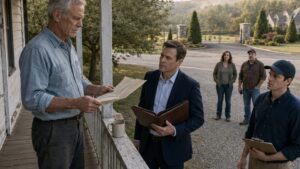
Kimberly Green stepped off her curb holding a paper in one hand and a travel mug in the other. She wore pale pink, spotless white sneakers, and the kind of expression that made politeness feel like a formality before a verdict. Nicholas had seen her twice at the neighborhood entrance changing seasonal wreaths on the sign, and once standing with a clipboard while a landscaping crew trimmed the hedges.
He stopped beside his car. “Kimberly.”
She smiled, but only with the lower half of her face. “I wanted to make sure you received the notice.”
Nicholas looked at the paper in her hand. It was a duplicate of his.
“You had a copy ready?”
“I’m the compliance chair,” she said. “Copies go through me.”
“I’m not in your HOA.”
The smile stayed. “That’s what you said when we sent the courtesy reminder.”
“I didn’t get a courtesy reminder.”
“You were mailed one.”
Nicholas glanced back at his mailbox, as if the empty metal box could defend him. “Then it didn’t arrive.”
Kimberly gave a small sigh. Not rude enough to call rude. Just enough to suggest he had already begun disappointing her. “The board can’t control the postal service. But we can control accounts before they become a problem.”
“Accounts,” Nicholas repeated.
“Your property has been receiving the benefit of Maple Ridge maintenance.”
“My property?”
“The entrance landscaping, neighborhood signage, uniform curb appeal, common-area lighting.” She tapped her copy. “The assessment includes unpaid contribution and a violation fee for noncompliance.”
Nicholas unfolded his notice again. “Violation of what?”
“Nonparticipation after notice.”
“That’s not a violation. That’s you sending me a bill for something I didn’t sign.”
Her eyes sharpened. “Every property on Maple Ridge Lane is expected to contribute.”
“Expected by who?”
“By the association.”
“I’m not in the association.”
A garage door opened two houses down. Nicholas heard it grind upward, then stop. Someone had decided not to pretend they were not listening.
Kimberly lowered her travel mug. “I understand you’re new.”
“I’ve lived here eight months.”
“That’s new for Maple Ridge.” Her tone softened in a way that made him more irritated. “There are systems here. People before you understood them.”
“The people before me sold me a house outside your HOA.”
“Then bring your paperwork to the board.”
“I don’t need to bring paperwork to prove I don’t owe you money.”
Kimberly’s expression changed then. The pleasant surface thinned, revealing something less neighborly beneath it. “You do if you want this resolved before delinquency status.”
Nicholas felt heat move up his neck. He had promised himself when he bought the house that he would not become the kind of person who fought with neighbors over grass height and trash bins. He had left enough arguments behind him already: a family split, a shared apartment full of boxed-up silence, months of sleeping on a friend’s couch while banks and inspectors turned his life into signatures.
This place was supposed to be quiet. His porch. His mortgage. His name on the deed.
Now Kimberly Green stood on his driveway telling him he was already in someone else’s system.
“I’m not paying eight hundred dollars,” he said.
“No one asked you to pay it this second.”
“The notice literally says amount due.”
“It also says you can attend the meeting.”
He looked from her copy to his. “What meeting?”
“The regular board meeting tomorrow evening.” She tucked her paper under her arm. “Your account review has been placed on the agenda.”
“My account doesn’t exist.”
“It does now.”
The words landed harder than they should have.
The neighbor two houses down rolled a trash bin to the curb with unnecessary slowness. Across the street, a curtain shifted. Nicholas could feel the street beginning to understand the shape of the story without knowing any of the facts: new guy refuses to pay, HOA lady has paperwork, board meeting tomorrow.
He folded the notice and made himself keep his voice level. “You need to remove my name.”
Kimberly tilted her head. “The board will decide that.”
“No. A boundary decides that. Deed restrictions decide that. County records decide that.”
“Then bring them.”
“I shouldn’t have to.”
For the first time, her smile disappeared completely. “Mr. Hall, I’m trying to keep this from becoming more embarrassing than it needs to be.”
Nicholas gave a short laugh before he could stop himself. It was not loud, but it was sharp enough to make her blink.
“Embarrassing for who?”
Kimberly’s fingers tightened around her travel mug. “For anyone who thinks moving onto Maple Ridge Lane means enjoying the neighborhood without carrying any of the responsibility.”
There it was. Not a bill. A judgment.
Nicholas looked past her at the street sign, at the decorative stone base he had never asked for, at the clipped hedges around it. He had not chosen the subdivision name. He had chosen the house because it was small, solid, and barely within his loan approval. Because the backyard had an old maple tree and the kitchen got morning light. Because when he first unlocked the front door, the silence inside had felt like permission.
“I don’t owe you eight hundred dollars,” he said.
Kimberly took one step back, as if the conversation had moved exactly where she expected. “Then I’ll see you tomorrow.”
“I didn’t say I was coming.”
“You should.” She lifted her copy of the notice. “Because if you’re not there, the board can only review what’s in front of it.”
Nicholas stared at her.
She turned toward the street, then paused as though remembering one last neighborly kindness. “Seven o’clock. Clubhouse conference room. And Mr. Hall?”
He said nothing.
“Bring whatever you think proves your point.”
She crossed back to her side of the street, her white sneakers silent on the asphalt.
Nicholas stood in his driveway until she reached her porch. Only then did he look down again at the notice, at his name printed beneath an association he had never joined, at the clean black line that made the whole thing feel official.
Behind him, his house waited with all its lights off.
He walked inside, dropped the grocery flyer and roofing postcard on the counter, and laid the HOA notice by itself in the center of the kitchen table. For a moment he only looked at it. Then he opened the junk drawer, moved batteries, takeout menus, a tape measure, and a screwdriver, searching for the folder from closing.
Nothing.
The folder was not in the drawer, not on the shelf by the back door, not in the stack of documents he had meant to organize after moving. Each empty place made Kimberly’s voice sound more reasonable than it was.
The board can only review what’s in front of it.
Nicholas stopped in the hallway, breathing through his nose, and looked back toward the front window. Across the street, Kimberly’s porch light was on. Her silhouette moved behind the glass.
His phone buzzed on the kitchen counter. Unknown number.
He let it ring.
A voicemail appeared seconds later.
Nicholas pressed play.
A woman’s recorded voice, formal and flat, filled the kitchen. “This is a courtesy message regarding the Maple Ridge Homeowners Association board agenda for Tuesday evening. Property owner Nicholas Hall, 1148 Maple Ridge Lane, has been added for account review under delinquency and compliance matters.”
The message ended with a click.
Nicholas lowered the phone.
The notice on the table looked less like a mistake now and more like the first move in something already underway.
Chapter 2: The Street Where Everyone Could Hear
The bright orange sticker on the neighbor’s trash bin read VIOLATION in letters large enough to be seen from the sidewalk.
Nicholas noticed it before he noticed Kimberly.
The bin sat crooked at the curb Tuesday morning, one wheel in the gutter, the sticker slapped across the lid like a warning label on a chemical drum. A man in a robe stood in the driveway beside it, reading the notice with the tired expression of someone who knew arguing would only create more paper. Two houses farther down, Kimberly Green stood with her clipboard, talking to Brian Wilson.
Brian saw Nicholas first.
The conversation stopped.
Nicholas had stepped outside only to retrieve the closing folder from a storage bin in the garage. He had not found it before midnight. He had woken early, irritated with himself, and spent twenty minutes opening boxes marked TAXES, TOOLS, and MISC before remembering one final plastic tote beside the lawn spreader.
Now the garage door was halfway open behind him, and the street had already formed an audience.
“Morning,” Brian called.
Nicholas gave a nod and kept walking toward the trash cans by his side yard.
“Got a second?”
He did not, but stopping felt less suspicious than retreating. “What’s up?”
Brian crossed the sidewalk with the wary friendliness he usually reserved for discussing lawn equipment. He was broad-shouldered, clean-shaven, and wore a polo with his company logo on it. Nicholas had borrowed a socket wrench from him in the spring. Brian had told him which pizza place delivered fastest and which roofing company overcharged after storms.
Now his eyes flicked toward Kimberly’s clipboard.
“Kimberly mentioned there was some confusion about dues,” Brian said.
Nicholas looked past him. Kimberly had not moved, but she was close enough to hear.
“There’s no confusion,” Nicholas said. “I’m not part of the HOA.”
Brian pressed his lips together. “Yeah, that’s the part people are trying to understand.”
“People?”
“I’m not trying to start anything.” Brian lowered his voice, which somehow made the whole thing feel more public. “But you use the entrance like everybody else. Same sign, same road, same landscaping. I mean, we all pay into that.”
“I use a county road to get to my house.”
“That sign helps property values.”
“I didn’t ask for the sign.”
Brian gave a small shrug. “None of us asked for half the stuff we pay for.”
The man with the orange-stickered trash bin rolled it back toward his garage, pretending not to listen while listening with his whole body.
Nicholas felt the familiar urge to end the conversation with the fewest words possible. He could have explained the boundary. He could have said there was a note in his closing documents. He could have said his deed was different. Instead, the old habit rose up: say less, let them think what they want, do not hand strangers pieces of your life.
“I’m not paying a bill I don’t owe,” he said.
Brian’s expression cooled. “Nobody loves paying bills.”
“That’s not what this is.”
“Then show the board.”
Nicholas glanced at Kimberly. She was watching him now, not hiding it.
“I don’t need a board to tell me where my property line is.”
Brian gave a humorless laugh. “That’s a pretty convenient position.”
Nicholas turned back to him. “Convenient?”
“Come on, man. You moved onto Maple Ridge Lane. You knew what it looked like.”
“What it looked like isn’t the same as what it legally is.”
“Maybe. But from where everybody else stands, it looks like you want the neighborhood without the neighborhood cost.”
The words landed worse coming from Brian than from Kimberly. Kimberly was a system with a clipboard. Brian had been the guy who waved from his garage, who asked if Nicholas needed help carrying a bookshelf off the back of his truck. Brian was inside the HOA, yes, but he had never seemed like the kind of person who cared who trimmed what hedge.
Nicholas could feel himself closing off. “Then everybody else is wrong.”
Brian studied him. “You know how that sounds, right?”
“Accurate?”
The answer came out too fast.
Brian stepped back half a pace. His face did not change much, but something did. A small door shut.
Behind him, Kimberly approached.
“Nicholas,” she said, using his first name now as if that made the conversation softer. “The board is willing to hear you informally before tonight if you’d like to call in at noon.”
“No.”
Brian looked at him. “Why not?”
“Because I’m not going to argue my property rights over a lunch-break conference call arranged by someone trying to bill me.”
Kimberly’s cheeks colored. “That’s not a fair characterization.”
“You were waiting outside yesterday with a duplicate notice.”
“I was trying to be transparent.”
“You were trying to make sure the street saw it.”
Silence spread wider than his voice had.
A garage door across the lane stopped moving. The man with the trash bin had disappeared, but his side door had not fully closed. Nicholas realized, too late, that he had done exactly what Kimberly wanted: turned a paperwork dispute into a scene.
Kimberly held her clipboard against her chest. “This is why the board needs to address it formally.”
Brian looked away.
Nicholas hated himself a little for the heat in his voice, but not enough to apologize. “Good. Address it formally.”
Kimberly gave a tight nod. “Seven o’clock.”
He turned and walked back into his garage before either of them could say more.
Inside, the air smelled like cardboard and motor oil. Nicholas dragged the plastic tote into the kitchen and snapped open the lid. Old bank statements. Inspection report. Home warranty pamphlet. Closing disclosure. A blue folder with a real estate company logo.
He set it on the table beside the HOA notice.
For several seconds, he did not open it.
The folder looked ordinary, almost harmless, but touching it brought back the conference room where he had signed until his wrist hurt. It brought back the silence after his father declined to co-sign, then sent a two-sentence text three days later: Hope it works out. It brought back the humiliating calculation of every dollar, every inspection credit, every small concession that made the house possible.
He had bought the house because it was his. Not theirs, not a family compromise, not a place someone could threaten to take away in an argument.
Now a neighborhood board had put his name under delinquency.
Nicholas opened the folder.
The first pages were useless. Loan terms, insurance, disclosures, signatures. He flipped faster, then slower. A stapled packet near the back had a sticky note from the real estate agent: Keep for HOA question.
His pulse kicked once.
The top page was a copy of an email chain. Below it was a small survey image, poor quality, with a boundary line drawn along the inner edge of the subdivision.
A sentence had been highlighted in yellow.
Subject property appears adjacent to, but not subject to, Maple Ridge Estates Association covenants.
Appears adjacent.
Not subject.
Nicholas exhaled through his teeth. It was something. It was not enough. The scan was blurry, the copied line faint. Kimberly would hold it up in front of the room and say appears. Dennis Jackson would say the board needed proper records. Brian would hear only that Nicholas had come armed with an old page instead of a real answer.
His phone rang again.
This time the caller ID read Maple Ridge HOA.
Nicholas let it ring twice. He imagined a calm voice offering the noon call. He imagined himself being asked to explain while Kimberly listened from somewhere with her duplicate copy. He imagined saying the wrong thing, sounding defensive, giving them another phrase to repeat.
He declined the call.
A minute later, an email appeared.
Mr. Hall,
We attempted to reach you regarding today’s informal account review option. As we were unable to connect, the matter will remain on tonight’s formal agenda.
Please be advised that failure to participate may result in the board making a determination based on available records.
Maple Ridge Homeowners Association
Nicholas read it standing at the kitchen table, one hand on the blue folder.
Available records.
He looked down at the fuzzy survey copy, then at the $800 notice beside it. The two papers seemed to argue with each other without needing him at all.
By late afternoon, he had made three calls: one to the real estate agent, who had not answered; one to the title company, which routed him to voicemail; and one to the county records office, where a recorded message said property records were available in person until five.
He was still deciding whether to drive there when a truck stopped in front of his house.
The mail carrier stepped out carrying a flat cardboard envelope that required a signature.
Nicholas opened the door before the carrier reached the porch.
“Certified for Nicholas Hall.”
He signed on the small screen. The envelope was from Maple Ridge Homeowners Association.
He did not wait until he was inside. He tore the strip open on the porch.
The letter inside was shorter than the first notice.
Account Status: Delinquent Pending Board Review.
Board agenda item scheduled for Tuesday, 7:00 p.m.
Failure to provide satisfactory documentation may result in continued assessment, administrative fees, and collection action.
Nicholas stood under his porch light though the sun had not gone down yet.
Across the street, Kimberly’s curtains were open.
This time, he was certain she saw him read it.
Chapter 3: The Line Hidden in the Closing Papers
The phrase not subject to association covenants looked weaker every time Nicholas read it.
By Tuesday afternoon, the highlighted sentence had begun to feel less like proof and more like bait. It sat on the copied page in faded yellow, trapped beneath phrases that softened everything around it: appears adjacent, preliminary review, buyer to verify. Nicholas had circled the sentence twice, then stopped because circling it did not make it more official.
The board meeting was in less than five hours.
He spread the closing papers across the kitchen table until the $800 notice was half-buried under inspection reports and title disclosures. The blue folder lay open like something emptied and exhausted. He found the real estate agent’s card tucked into a pocket and called again.
Voicemail.
“This is Nicholas Hall at 1148 Maple Ridge Lane,” he said after the beep. “I need the HOA boundary documentation from closing. The association is trying to bill me. If you have anything clearer than the scanned copy, call me back today.”
He ended the call and immediately disliked the message. Too stiff. Too needy. Too late.
The county records office was twenty-two minutes away if traffic behaved. Nicholas took the fuzzy survey copy, the certified letter, the original notice, and the entire blue folder because he no longer trusted himself to know which paper mattered.
The county building sat behind a strip mall and a dentist’s office, low and beige, with a flag out front and a parking lot full of people handling problems they wished could have stayed online. Inside, fluorescent lights hummed above a row of service windows. A sign told visitors to take a number.
Nicholas pulled 42.
The screen showed 36.
He sat between a contractor with rolled plans and an older woman holding a property tax bill. Every few minutes, someone at a window said the word parcel. Nicholas watched the clock on the wall and tried not to imagine Kimberly arriving at the clubhouse early, placing his invoice at the center of the table.
“Forty-two.”
He stood too quickly, papers sliding in his folder.
The clerk at the window glanced up. Her nameplate read Maria Ramirez. She had tired eyes, a calm face, and the practiced stillness of someone who had learned not to absorb every emergency brought to her counter.
“I need a certified boundary record for my property,” Nicholas said.
Maria looked at the stack in his hands. “Address?”
“1148 Maple Ridge Lane.”
Her fingers moved across the keyboard. “Maple Ridge Estates?”
“That’s the problem.”
She paused, not dramatically, just enough for him to notice. “What kind of problem?”
“The HOA says I’m inside. My closing papers say I’m not. They have a board meeting tonight and an eight-hundred-dollar bill with my name on it.”
Maria held out a hand. “Let me see what you have.”
Nicholas slid the fuzzy survey copy under the glass. Maria read the highlighted line. Her expression did not change, but she looked at the page longer than he expected.
“This is from a title review,” she said.
“Is it enough?”
“For an argument? Maybe. For a board that wants to ignore it? Probably not.”
Nicholas let out a breath that was almost a laugh. “That’s honest.”
“County records usually are. People are the complicated part.”
She typed again. The printer behind her clicked, then stopped. She frowned slightly at her monitor.
“What?” Nicholas asked.
“Your parcel sits on the old subdivision edge.” She turned the screen a few inches, not enough for him to read private records, but enough to show a map with blocks and lines. “Maple Ridge Estates has a recorded plat from the original development. Then there were later parcels along the county road that kept the street name but weren’t all annexed into the association.”
“That sounds like me.”
“It may be.”
“May be?”
Maria pointed with a pen toward the screen. “This line here is the association boundary from the recorded covenants. This line here is the parcel boundary. On the county plat, your lot appears outside the association line. But the HOA may be using its own management map.”
“Can they do that?”
“They can use whatever map they want for mailers. That doesn’t mean it controls your deed.”
Nicholas leaned closer to the counter. “Can I get a certified copy?”
“Yes.”
“Today?”
Maria looked at the clock. “Certified plats are handled by the records supervisor. She leaves at four-thirty unless someone is already in the queue.”
“It’s four-ten.”
“I know.”
Nicholas gripped the folder. “I’m already in the queue, right?”
Maria looked at him for a moment. He saw the boundary between what she was allowed to do and what she wanted to do. Then she took the survey copy and stamped a small intake mark on a request form.
“You are now.”
He almost thanked her too loudly.
She handed him a form. “Fill this out. Parcel number if you have it. If not, I’ll pull it. Certified copy fee is twelve dollars. If you need the association covenants too, that’s another certified record.”
“I need whatever makes them stop.”
“That would be a judge,” she said dryly, then softened it with the smallest smile. “But a certified plat is a good start.”
Nicholas filled out the form on the counter, his handwriting worse than usual. Maria disappeared through a side door with his request. While he waited, he watched the clock hit 4:18, then 4:23. A man at the next window argued about a driveway permit. The contractor behind him muttered into his phone. Nicholas tried the real estate agent again.
No answer.
Maria returned at 4:31 with two large folded sheets and a smaller packet.
“The supervisor signed before leaving,” she said.
Nicholas stared at the raised seal near the bottom of the top sheet. It was just paper, but it felt heavier than the whole blue folder.
“This is the recorded plat. This is the covenant boundary page. And this—” she tapped the smaller packet “—is a prior inquiry scan attached to your parcel record.”
“Prior inquiry?”
“Someone asked about the same boundary question before.”
Nicholas looked up.
Maria hesitated. “I can provide public records. I can’t interpret motive.”
“Who asked?”
She turned the packet so the top page faced him. “It’s an old administrative note. Not a formal ruling.”
The scan showed a date from three years earlier, before Nicholas bought the house. A question had been typed into a form: Edge parcels on Maple Ridge Lane—confirm HOA inclusion? Beneath it was a brief reply from the county: Parcel 1148 appears outside recorded association boundary; verify with covenants.
At the bottom, beside Received by, were two initials written in blue ink.
K.G.
Nicholas felt the room narrow around the page.
“That could be someone else,” he said, though he did not believe it.
Maria’s eyes flicked to the HOA notice in his folder. Kimberly Green’s typed name appeared under Compliance Chair.
“It could,” Maria said carefully.
Nicholas picked up the packet. “Was this sent to the HOA?”
“It was attached to the inquiry record. The requester received a copy.”
He thought of Kimberly in his driveway with the duplicate notice. Kimberly telling him to bring whatever he thought proved his point. Kimberly saying, People before you understood them.
His anger came back, but different now. Less hot, more precise.
“Can you certify this too?”
Maria shook her head. “The scan can be printed with the records stamp, but it’s not the same as a certified plat. Use it carefully.”
“Carefully?”
“Being right and proving someone knew you were right are two different fights.” She slid the stamped copy into his folder. “Don’t mix them up before you have to.”
Nicholas looked at her, then at the clock. 4:39.
The meeting was at seven.
He paid the fee, gathered the folded plat, the covenant page, and the inquiry scan. The folded boundary map resisted lying flat in his hands, springing slightly open each time he tried to tuck it into the folder.
At the exit, his phone buzzed.
A voicemail from the real estate agent finally appeared.
Nicholas pressed it to his ear as he walked into the parking lot.
“Hey, Nicholas, got your message. I remember that property. You’re right, it was outside the association line as far as title showed. But listen, Maple Ridge was always touchy about that bend in the road. If this is going to the board, don’t just tell them. Make them put their map on the table next to yours.”
The message ended.
Nicholas stood beside his car, the certified plat under one arm and Kimberly’s initials in the folder.
For the first time since opening the mailbox, he knew he had proof.
He also knew Kimberly might have known before the bill was ever sent.
Chapter 4: The Meeting Where the Map Was Opened
Nicholas entered the clubhouse conference room and saw his invoice projected on the wall before anyone said his name.
It was enlarged above the folding tables, his address and the eight-hundred-dollar amount stretched wide enough for the second row of chairs to read without squinting. The projector washed the paper in pale blue light. Beneath it, someone had typed Account Review: 1148 Maple Ridge Lane.
He stopped just inside the doorway with the certified plat under his arm.
Kimberly Green stood near the front table in a white blazer, speaking quietly to Dennis Jackson. She did not look surprised to see him. Dennis, a gray-haired man with reading glasses low on his nose, glanced toward Nicholas and gave a careful nod, the kind that welcomed attendance without promising fairness.
A dozen residents sat in rows of metal chairs. Brian Wilson was near the aisle, elbows on his knees, hands clasped. He looked at the folder under Nicholas’s arm and then away.
Nicholas took a chair in the back, not because he wanted to hide but because every seat closer to the front felt like a stage. He placed the folded map across his lap and kept one hand on it.
The meeting began with minutes, landscaping updates, and a complaint about holiday decorations left up too long. Nicholas heard almost none of it. His invoice stayed projected on the wall even while Dennis discussed mulch bids. Every time someone looked up, Nicholas felt his name being read again.
Finally Dennis cleared his throat.
“Next item,” he said. “Account review for 1148 Maple Ridge Lane.”
Kimberly rose before he finished the sentence. “Thank you, Dennis. As everyone can see, the association issued a notice for unpaid assessment and nonparticipation after prior contact. The property is located on Maple Ridge Lane and has historically been considered within the community benefit area.”
Nicholas’s grip tightened on the map.
Dennis looked toward him. “Mr. Hall, you’ll have a chance to respond.”
Kimberly slid a paper to the center of the board table. “The amount currently due is eight hundred dollars, which includes assessment contribution and administrative violation fee. I’m asking the board to record the account as delinquent pending payment or satisfactory proof of exemption.”
The word delinquent moved through the room without anyone speaking it aloud. A woman in the second row crossed her arms. Someone behind Nicholas whispered, “That’s the new guy.”
Dennis adjusted his glasses. “Mr. Hall?”
Nicholas stood. His chair scraped the floor too loudly. He carried the folder and folded plat forward, each step making the room feel longer.
“I’m not part of the Maple Ridge Homeowners Association,” he said.
Kimberly’s mouth tightened as if she had expected something more elaborate and was disappointed by the lack of it.
Dennis folded his hands. “Do you have documentation?”
“Yes.”
Nicholas set the closing-folder copy on the table first, then stopped himself. The blurry page was not enough. He removed the certified plat, still folded, and laid it beside the invoice.
Kimberly reached for it.
Nicholas kept one hand on the paper. “I’d like the board to look at both maps.”
A board member to Dennis’s left leaned forward. “Both?”
“The association’s map and the county plat.”
Kimberly gave a small laugh, almost gentle. “We don’t need to turn this into a survey hearing. His address is Maple Ridge Lane.”
Nicholas looked at Dennis. “Then say the address into the record.”
Dennis’s eyebrows lifted. “Excuse me?”
“Ask her to say the property address. Then ask where the HOA boundary ends.”
The room shifted. It was a tiny movement, people straightening because a routine agenda item had begun to feel less routine.
Dennis turned to Kimberly. “For clarity, please state the property address.”
Kimberly looked annoyed now. “1148 Maple Ridge Lane.”
“And the association boundary?” Nicholas asked.
Kimberly opened a binder. “Maple Ridge Estates includes Maple Ridge Lane and related community-facing parcels.”
“That’s not a boundary,” Nicholas said.
Dennis held up a hand. “Let’s keep this orderly.”
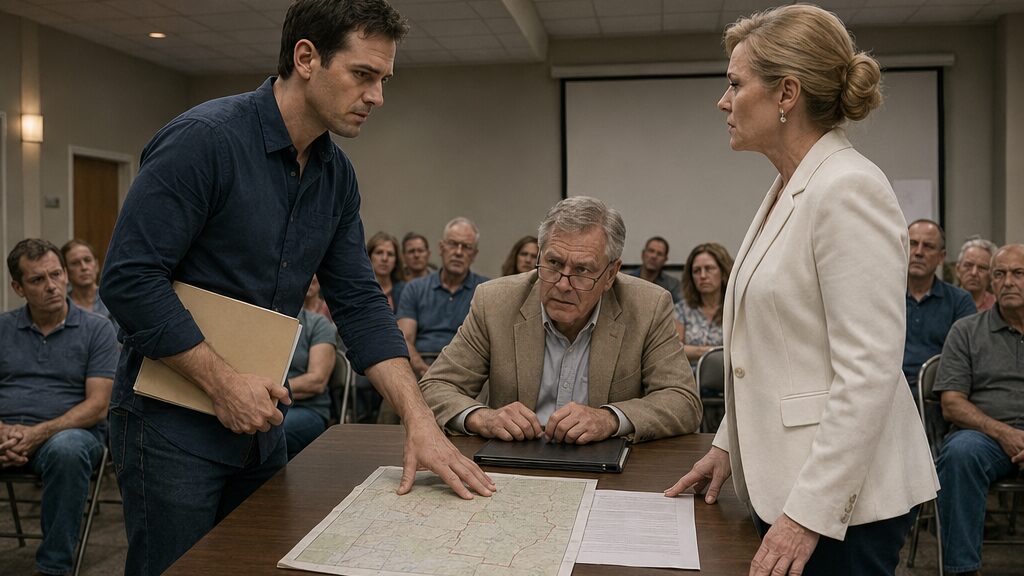
Nicholas swallowed the next sentence before it came out too sharp. He unfolded the certified plat once, then again. The paper was large enough to cover part of the invoice. Creases rose like ridges, resisting the table’s flatness.
Dennis leaned over it. The board member beside him shifted her glasses onto her face. Kimberly remained standing, arms crossed.
Nicholas pointed to the stamped corner. “County recorded plat. Certified today.”
Dennis looked at the seal first. Then his eyes moved to the lines.
“The covenant boundary is here,” Nicholas said, tracing with his finger. “Maple Ridge Estates Association boundary follows this curve, then stops at this lot line. My parcel is here.”
He moved his finger to the small rectangle marked 1148.
It sat beyond the line.
For a moment nobody spoke.
The projector hummed. The invoice still glowed behind them, but the room’s attention had moved to the paper on the table.
Dennis took off his glasses, wiped them with a cloth, and put them back on. “Kimberly, can you bring the association map?”
She did not move immediately.
“Kimberly,” Dennis repeated.
She opened the binder and pulled out a laminated map. It was smaller, cleaner, and easier to read than the county plat. It also showed a thick green boundary line that swept generously around the bend of Maple Ridge Lane, enclosing Nicholas’s house without much precision.
Nicholas placed the certified plat beside it.
The difference was obvious.
The HOA map used the street like a net. The county plat used property lines.
Dennis pressed his finger to the laminated map, then to the certified one. He traced slowly, starting at the entrance sign, moving past the common lighting, past three marked lots, then stopping before Nicholas’s parcel.
Brian stood from the second row. “So is he in or out?”
Dennis looked at the board member beside him, then at the treasurer, who had gone pale and silent.
“Based on the certified county plat presented,” Dennis said carefully, “it appears 1148 Maple Ridge Lane is outside the recorded association boundary.”
A low murmur moved across the room.
Nicholas did not sit down. He did not smile. The vindication felt too unstable to trust.
Kimberly stepped closer to the table. “Appears is not a final determination.”
Dennis looked at her. “It’s a certified plat.”
“It doesn’t address benefit use.”
“It addresses jurisdiction.”
“It addresses one line on one document,” she said, and her voice had lost its polish. “That property uses the entrance. It uses the Maple Ridge name. It benefits from the association’s work.”
Nicholas turned to her. “Your work doesn’t move the boundary.”
A few heads turned toward him. The sentence came out quiet, but it landed harder than if he had raised his voice.
Kimberly’s eyes flashed. “And your refusal to contribute doesn’t make you a victim.”
Nicholas felt the old anger rise, the urge to say something that would make the room turn on her the way she had tried to make it turn on him. He saw the inquiry scan in his folder, the initials at the bottom. K.G.
He could put it on the table now.
He could ask her when she first saw the boundary note.
Instead, Maria’s warning returned: Being right and proving someone knew you were right are two different fights.
Nicholas kept the page in the folder.
Dennis tapped the table. “The board will pause any delinquency action pending review of the county records.”
“Pause?” Nicholas said.
Dennis faced him. “We need time to verify with counsel or the management company.”
“You have a certified county plat in front of you.”
“And we have association records that appear to conflict with it.”
“They don’t conflict. Yours is wrong.”
The treasurer spoke for the first time. “Mr. Hall, there are financial implications if the community benefit area has been misunderstood.”
Nicholas looked at her. “Financial implications for who?”
She did not answer.
Brian was still standing. “Wait. If his lot isn’t in, what about the other ones near the bend?”
Kimberly turned sharply. “This agenda item is for 1148.”
“But it’s the same bend,” Brian said. “My dues went up last year.”
A second board member murmured something to Dennis. Dennis nodded once, then straightened.
“We are not deciding other parcels tonight,” he said. “The account for 1148 Maple Ridge Lane will be placed under review. No collection action will be taken until the board completes that review.”
Nicholas stared at him. “So you’re not cancelling the invoice.”
“Not tonight.”
The room had shifted again. Moments earlier, Nicholas had been the man refusing to pay. Now he was the man who had opened a question the board did not want open.
Kimberly gathered her papers with tight, efficient movements. “And during review,” she said, “the board should also consider what services have been used without contribution. Entrance maintenance. Lighting. Landscaping. Signage. Community value.”
Nicholas turned toward her slowly.
“You’re still trying to charge me.”
“I’m asking the board to examine fairness.”
“No,” he said. “You’re asking them to find another name for the same bill.”
Dennis rapped his knuckles lightly on the table. “That’s enough for tonight.”
Nicholas looked at the certified plat still open across the invoice. The boundary line stopped exactly where he said it did. The truth was lying in front of them, stamped and sealed, and still the invoice was not dead.
He folded the plat carefully, lining up each crease.
No one spoke while he did it.
At the doorway, Brian caught his eye, then looked away again. Kimberly stood by the front table, already whispering to the treasurer.
Nicholas stepped into the evening with the map under his arm and the board’s words following him out.
Paused, not cancelled.
Behind him, through the clubhouse window, Kimberly’s voice rose just enough for him to hear one sentence.
“The board still needs to review what he’s been using without paying for.”
Chapter 5: The Pause That Wasn’t an Apology
The new letter did not say cancelled.
Nicholas read it standing barefoot in his kitchen Wednesday morning, one hand still damp from rinsing a coffee mug. The envelope had been slipped through the mail slot early, before he heard the truck. It was thinner than the first notice, only one page, but somehow colder.
Account Review Continued.
Dear Mr. Hall,
At the Tuesday meeting, the board voted to pause delinquency action pending further review of boundary documentation and community benefit usage. No collection action will proceed during the review period. This pause does not constitute waiver, cancellation, or admission of error by the association.
Nicholas lowered the page.
Pause. Review. Usage.
Not one sentence admitted the county plat had shown his lot outside the boundary. Not one sentence said the $800 invoice should never have been sent. They had taken the word delinquent off the table and replaced it with something softer, something with rounded edges that could still cut.
He set the letter beside the folded map. The map looked different now. Less like protection, more like evidence in a case no one had agreed to dismiss.
His phone buzzed.
A message from Brian Wilson.
Can we talk before this gets uglier?
Nicholas stared at it. His first instinct was to ignore it, the same instinct that had made him decline the informal board call and sit in the back of the meeting until his name was called. But ignoring things had not kept them from multiplying.
He typed: I’ll be outside in ten.
Brian was waiting near the neighborhood entrance when Nicholas walked down. The Maple Ridge Estates sign sat inside a bed of fresh mulch, lit even in daylight by small black landscape fixtures. The hedges had been trimmed into careful curves. Nicholas had passed it every day without thinking much about who paid for it.
Brian stood with his hands in his pockets, looking at the sign instead of Nicholas.
“You got the letter?” Brian asked.
“Did everyone?”
“No. Kimberly mentioned there’d be further review.”
Nicholas gave a short laugh. “Of what I’ve been ‘using.’”
Brian rubbed the back of his neck. “That’s part of why I wanted to talk.”
Nicholas waited.
Brian looked uncomfortable, which made Nicholas trust him slightly more. “People are worried this turns into a bigger thing.”
“It is a bigger thing.”
“I mean money bigger. Dues bigger.” Brian nodded toward the sign. “The reserve fund’s thin. Landscaping contract went up. Insurance went up. Half the neighborhood wants nicer entrances, the other half wants lower dues, and nobody wants to sit through budget meetings. If they suddenly admit some houses don’t have to pay, or shouldn’t have been asked, that gap lands on the rest of us.”
Nicholas looked at the trimmed hedges, the ornamental grasses, the stone base. “So I should pay a bill I don’t owe because the HOA budget is bad?”
“No.”
“It sounds like no with a but.”
Brian’s jaw worked. “I’m saying people aren’t mad because they love Kimberly. They’re mad because they feel squeezed.”
“That doesn’t make me responsible.”
“I know.” Brian’s voice sharpened, then settled. “I know that. But you have to understand how it looks.”
Nicholas turned toward him. “That sentence has done a lot of damage this week.”
Brian exhaled. “Fair.”
For a moment they both watched a car slow at the entrance, turn in, and roll past them. The driver looked from Brian to Nicholas and then quickly back to the road.
Brian spoke lower. “There was another edge-lot owner a few years back. Older guy. I don’t remember his name. He paid something, I think. Not full dues, maybe a contribution. People said it was settled.”
Nicholas went still. “Which house?”
“Farther down, before your bend. He sold before you moved in.”
“Did the board bill him?”
“I don’t know. I just remember hearing he didn’t want trouble.”
Nicholas thought of the inquiry scan in his folder. Edge parcels on Maple Ridge Lane—confirm HOA inclusion?
“How many edge lots are we talking about?” he asked.
Brian shook his head. “I don’t know, man. Two? Three? Enough that if they start refunding people, somebody’s going to ask where the money comes from.”
Nicholas almost said, Maybe from the people who sent bills they had no right to send. But Brian was not defending Kimberly now. Not exactly. He was standing in front of a sign he had paid for, trying to admit fear without calling it fear.
“Thanks for telling me,” Nicholas said.
Brian nodded once. “For what it’s worth, I don’t think you should pay eight hundred dollars.”
Nicholas looked at him.
Brian added, “I still think the whole thing should’ve been handled before it got projected on a wall.”
That was as close to an apology as he was going to get. Nicholas accepted it with a nod because making Brian say more would only turn the moment into another fight.
When Nicholas got home, a voicemail waited from Dennis Jackson.
“Mr. Hall, this is Dennis Jackson with Maple Ridge. I’d appreciate a brief conversation today if possible. The board may be able to resolve your individual account through a private waiver while we review the larger mapping issue. Please call me.”
Nicholas replayed the message twice.
Private waiver.
His individual account.
The words were polished enough to sound reasonable. Cancel his bill quietly. Let the board keep breathing. Let Kimberly say the system worked. Let everyone else go back to assuming the line was wherever the HOA needed it to be.
He called Dennis back.
Dennis answered on the second ring. “Mr. Hall. Thank you for returning my call.”
“What does private waiver mean?”
A pause. “It means the board can choose not to pursue the current assessment while reserving its position on broader boundary questions.”
“So cancel mine without admitting the HOA was wrong.”
“I wouldn’t phrase it that way.”
“I would.”
Dennis sighed, not impatiently. More like a man choosing between bad chairs in a room he had arranged himself. “I’m trying to avoid unnecessary escalation.”
“The escalation was sending me a delinquency notice.”
“And we have paused that.”
“Paused isn’t cancelled.”
“No, it isn’t.”
Nicholas appreciated, despite himself, that Dennis did not lie.
Dennis continued, “There may be implications beyond your property. The board has a responsibility to review them carefully.”
“Did the board bill another edge-lot owner before me?”
The silence on the phone changed texture.
“I’m not prepared to discuss another owner’s account,” Dennis said.
“That’s not a no.”
“It’s a statement of what I can discuss.”
Nicholas looked at the folded map on his table. “And what about Kimberly?”
“What about her?”
“Did she know there was a boundary issue before she sent the notice?”
Another pause.
“Mr. Hall, I strongly recommend keeping this focused on your account.”
“That sounds like a yes you can’t say.”
“It sounds like a board president trying to keep a neighborhood dispute from becoming personal.”
“It became personal when my name went on a projector.”
Dennis was quiet for a moment. When he spoke again, his voice had lost some of its official smoothness. “I understand that.”
Nicholas believed him. That was inconvenient.
“Send me the waiver offer in writing,” Nicholas said.
“I can do that.”
“And send whatever map the association used to bill me.”
“That may require board approval.”
“Then get it.”
He ended the call before he could make the conversation worse.
For the next hour, Nicholas tried to work from his laptop and failed. Every email blurred into the same words: pause, waiver, review. He finally shut it and opened the folder Maria had given him.
The inquiry scan was still in the back.
He placed it on the table beside the new letter. The old note looked harmless at first: a dull administrative printout, a question, a response, a date. But the initials at the bottom drew his eye every time.
K.G.
He searched the rest of the packet more carefully now. Behind the inquiry was a faint cover sheet he had barely noticed in the county office. It listed the requester as Maple Ridge Compliance Committee.
Received by: K. Green.
Nicholas sat back.
Not just initials.
Not just maybe someone else.
Kimberly Green’s role was on the page.
He thought of her standing in his driveway, telling him people before him understood the system. He thought of her saying bring whatever you think proves your point. He thought of the board refusing to cancel an invoice even after a certified plat showed the line.
His anger sharpened into a decision.
He took a photo of the inquiry, then stopped before sending it to Dennis. Maria’s warning returned again, but it meant something different now. Being right and proving someone knew you were right were two different fights.
Maybe he had been trying to avoid the second one because it would make him visible.
Nicholas picked up the paper and held it under the kitchen light.
At the bottom of the old boundary inquiry, Kimberly’s name sat plainly beside the question she had claimed not to need answered.
Chapter 6: The Signature on the Old Boundary Note
“Be careful with that page,” Maria Ramirez said before Nicholas even sat down.
He had returned to the county records office Thursday morning with the old inquiry in a folder and a temper he had spent the drive trying to fold into something usable. Maria looked up from her window, saw his face, and gave him the kind of warning that sounded like it had been waiting for him.
Nicholas slid the paper under the glass. “You knew I’d come back.”
“I knew you’d read the second sheet eventually.”
“You could’ve pointed it out.”
“I did point it out.”
“You said use it carefully.”
“And I’m saying it again.” Maria adjusted the paper with two fingers. “Being right can still be handled badly.”
Nicholas almost answered too fast, then stopped. The records office was quieter than it had been Tuesday. No contractor, no arguing about permits. Just a man at the far window asking about a property tax exemption and the low hum of printers.
“She had this three years ago,” he said.
Maria looked at the page. “The committee had it.”
“Her name is on it.”
“Yes.”
“And she still sent me an invoice.”
Maria folded her hands on the counter. “Then the question becomes what you want corrected.”
“The bill.”
“That’s one thing.”
“The record.”
“That’s another.”
Nicholas looked down. “And her?”
Maria did not answer immediately. “That’s the one you should think about before you walk across the street.”
The words irritated him because they were fair. He had not come for legal advice; Maria would not give it anyway. But she had seen what he was trying not to admit. Part of him wanted Kimberly cornered in the open the way she had cornered him. Part of him wanted her name projected on a wall.
He hated that part enough to distrust it.
“What can you certify?” he asked.
“The plat. The covenants. Not her intention.”
“Can you print a clearer copy of the inquiry?”
Maria nodded. “With a records stamp. It proves the inquiry exists in the parcel file. It doesn’t prove what she understood.”
Nicholas gave a small, humorless smile. “You’re very good at making evidence less satisfying.”
“Evidence usually is less satisfying than anger.”
He looked at her then. Maria stamped the copy and slid it back to him. “If you want the board to fix the boundary issue, make them address authority. If you want to punish Kimberly, they’ll make it about tone, personality, neighborhood drama. People hide inside drama.”
Nicholas took the stamped inquiry. “What if it is about all of that?”
“Then choose the part that gets fixed first.”
By noon, he was standing on Kimberly Green’s porch.
He had not planned to go there directly. He had planned to email Dennis, attach the inquiry, request a special vote, and keep everything clean. But when he returned home, Kimberly had been outside pulling dead blooms from a planter beside her steps, her white blazer replaced by a navy cardigan, her clipboard nowhere in sight.
She saw him crossing the street and straightened.
“Nicholas.”
He stopped at the bottom step rather than coming closer. “I found the old boundary inquiry.”
Her face did not change enough for anyone else to notice. But Nicholas noticed. The smallest pause. The fingers tightening around a wilted flower stem.
“I don’t know what you mean.”
He removed the stamped copy from his folder and held it out.
She looked at it without taking it.
“You received this three years ago,” he said. “Maple Ridge Compliance Committee. Edge parcels. My address. County response saying the parcel appeared outside the recorded boundary.”
Kimberly set the dead flowers into a small paper bag. Her hands were precise, too precise. “That was not a final determination.”
“You keep saying that about every document that doesn’t help you.”
Her eyes lifted. “And you keep acting like one piece of paper explains years of community practice.”
“One piece of paper? I have the certified plat.”
“Your house still sits on Maple Ridge Lane.”
“My street name is not your jurisdiction.”
A car rolled by slowly. Nicholas lowered his voice. He did not want another sidewalk performance. Not this time.
“Why did you send the invoice after seeing this?”
Kimberly stepped back from the edge of the porch. “Because the association map includes that bend.”
“The association map is wrong.”
“The association map is what residents have relied on for years.”
“That doesn’t answer the question.”
Her face tightened. “You want a confession? Fine. I saw the note. I also saw the word appears. I saw verify. I saw unfinished records and an old question no one resolved. And I saw three homes using an entrance everyone else paid for while dues kept rising and people called me every week about weeds, lights, signs, drainage, trash cans, everything.”
“So you decided to bill me.”
“I decided to apply the policy consistently.”
“There is no policy that reaches outside the boundary.”
“You say that like boundaries are the only thing communities run on.”
Nicholas looked at her, thrown for half a second by the strain in her voice. This was not the polished compliance chair from the meeting. She looked tired. Angry, yes, but not only angry.
“Who made the association map?” he asked.
Kimberly’s lips pressed together.
Nicholas waited.
“My father helped assemble the homeowner packet when the development expanded,” she said finally. “He was on the first board after the entrance was rebuilt.”
Nicholas glanced toward the stone sign at the end of the street.
“He believed those edge homes should have been included,” Kimberly continued. “He said everyone used the same face of the neighborhood, so everyone should share the cost. There were discussions. Drafts. Then the developer moved on, people sold, records got messy.”
“Your father believing something doesn’t make it recorded.”
“I know that.”
The admission came quietly enough that Nicholas almost missed it.
Kimberly looked down at the paper in his hand. “But every time someone questioned it, the board kicked it forward. Nobody wanted to deal with refunds, dues, lawyers, angry residents. So yes, when your account came up, I pushed. Because if I didn’t, everyone would say compliance only matters when it’s easy.”
Nicholas held the stamped inquiry between them. “You made me the problem because the records were inconvenient.”
“I made you follow the process.”
“No. You put my name on a projector before checking a line you already knew was disputed.”
Her face flushed. “You think I enjoyed that?”
“I think you were confident until the map opened.”
Kimberly looked away toward the street. For a moment, Nicholas saw not victory but the outline of something smaller and sadder: a woman guarding a broken system because admitting it was broken meant admitting the person who taught her the system had been wrong too.
It did not excuse the invoice.
It made the next words harder.
“You need to correct it,” he said.
“I can’t unilaterally correct association records.”
“You could recommend it.”
“I could.”
“Will you?”
She looked back at him. “Not unless the full board votes.”
Nicholas stared at her. “Even now?”
“Especially now. If I do it alone, it becomes Kimberly made a mistake. If the board votes, it becomes a record correction.”
“You did make a mistake.”
Her jaw tightened. “So did everyone who let the map sit there for years.”
“That’s not a defense.”
“No,” she said. “It’s why I’m not going to be the only person carrying it.”
For the first time, Nicholas understood her strategy completely. She was wrong, and she knew enough to be afraid. But she was not going to step into the center alone.
He folded the inquiry page slowly. “Then I’ll ask the full board.”
Kimberly’s voice softened, but not kindly. “Be sure you know what you’re asking for. If the edge lots are excluded, the reserve fund changes. If prior payments are questioned, homeowners will want answers. You may win your invoice and still have half the street blaming you.”
Nicholas looked at the houses around them, the trimmed lawns, the watchful windows. “They already blamed me.”
“Not like that.”
He left without answering.
Dennis called at 5:12 p.m., just as Nicholas was laying the old inquiry beside the current plat on the kitchen table. The two maps looked like before and after pictures of the same mistake.
“I received your email,” Dennis said.
Nicholas had sent it after leaving Kimberly’s porch: the stamped inquiry, the certified plat, and a request that the board cancel the invoice and correct the association boundary records in writing.
“And?” Nicholas asked.
“I’m scheduling a special meeting for Friday evening.”
Nicholas closed his eyes briefly.
Dennis continued, “But you should understand what the treasurer is going to say. If the board acknowledges that edge parcels were improperly billed or solicited, even informally, there may be refund requests. The reserve fund is already below target.”
“That’s not my fault.”
“No. But it may become your decision whether to press for a public correction or accept a private resolution.”
Nicholas opened his eyes.
On the table, the folded boundary map had sprung partly open again, showing the line that stopped before his home.
“What happens if I press?” he asked.
Dennis’s answer came after a long pause.
“Then Friday’s vote won’t just be about your eight hundred dollars.”
Chapter 7: Where the Board’s Authority Ended
Dennis Jackson offered to cancel the invoice before Nicholas even sat down.
The special meeting had not officially started. The projector was off this time. The clubhouse conference room looked smaller without Nicholas’s name glowing on the wall, but the pressure in the room was heavier. The board sat at the front table with folders arranged in careful stacks. Kimberly Green sat to Dennis’s right, hands folded, expression composed enough to look rehearsed.
Brian Wilson was in the second row again. So were more residents than before.
Nicholas remained standing near the end of the table with the certified plat tucked under one arm.
Dennis lowered his voice. “Mr. Hall, before we begin, the board is prepared to remove the eight-hundred-dollar assessment from your account tonight.”
Nicholas looked at the folder in front of Dennis. “Remove?”
“Cancel, if you prefer the word.”
“I do.”
Dennis nodded. “Cancel. The board can do that as an individual resolution.”
Nicholas waited.
Dennis glanced at the other board members, then back at him. “In exchange, we would continue reviewing the broader boundary questions internally. No need to turn this into a public correction until counsel reviews every implication.”
There it was: the clean exit. The one Nicholas had wanted Monday evening when he first opened the mailbox. No bill. No delinquency. No more phone calls, letters, or neighbors looking at him as if his mortgage had come with a moral debt.
He could take it. Walk out. Frame nothing. Let the association keep its laminated map and its careful wording. Let Kimberly call it a misunderstanding after all.
Nicholas looked across the table at her.
Kimberly did not look away.
“Is this offer in the minutes?” Nicholas asked.
Dennis paused. “Not yet.”
“Then it isn’t an offer. It’s a hallway conversation in a room with chairs.”
A few residents shifted. Brian looked down at his hands.
Dennis sighed. “I’m trying to spare everyone unnecessary conflict.”
Nicholas placed the folded plat on the table. “So was I on Monday.”
The room quieted.
Dennis straightened, the board president returning to his face. “Very well. We’ll call the meeting to order.”
The formalities passed quickly. Dennis announced that the purpose of the special meeting was to review the boundary documentation for 1148 Maple Ridge Lane and related association records. The treasurer read a short statement about reserve funds, contract obligations, and the risk of “unplanned adjustments.” She did not say refunds at first. When someone in the back asked what unplanned adjustments meant, she said it then, and the room tightened around the word.
Kimberly spoke next.
“The compliance committee acted under the association map available at the time,” she said. Her voice was steady, but Nicholas noticed she kept one thumb pressed against the side of her folder. “That map has been used for years to determine community benefit participation along Maple Ridge Lane.”
Nicholas watched her carefully. She was not lying exactly. She was choosing a hallway narrow enough to walk through without touching the walls.
Dennis turned to him. “Mr. Hall, you may present your documentation.”
Nicholas unfolded the plat himself.
He did it more slowly than he had on Tuesday, not for drama, but because the paper deserved care. It opened along the creases, wide and stubborn, covering the center of the table. The raised county seal caught the overhead light.
Beside it, he placed the $800 notice.
The two documents sat together: demand and limit.
Nicholas set the old inquiry scan beside them but kept his fingers resting lightly on its edge. Not yet.
“This is the certified county plat,” he said. “This is the recorded association boundary. This is my parcel.”
He traced the line once. He did not rush. He let the board follow. He let the room see what he had seen: the boundary ending before his lot began.
“My question tonight is not whether the entrance looks better when everyone pays for it,” he said. “It is not whether landscaping is expensive. It is not whether Maple Ridge sounds like one neighborhood when you say the name out loud.”
He looked at Dennis, then Kimberly, then the residents.
“My question is where your authority ends.”
No one interrupted.
Nicholas had expected his voice to shake. It did not. The steadiness surprised him, and beneath it he felt the shape of the week behind him: the mailbox, the duplicate notice, Brian’s accusation, Maria’s counter, Kimberly’s porch. Each moment had tried to make him defend his character. The map only required him to defend a line.
Dennis leaned forward. “The board accepts that the county plat shows your parcel outside the recorded boundary. The question before us is what action follows.”
Brian raised his hand from the second row, awkwardly, as if he were still in school.
Dennis nodded. “Yes?”
Brian stood. “I’m not on the board, so maybe I’m out of line. But if he’s outside, then he’s outside.” He glanced at Nicholas, then away. “I don’t love what that means for dues. I really don’t. But I’d rather know what we’re paying for than pretend a line is somewhere it isn’t.”
A murmur followed, not agreement exactly, but recognition.
Kimberly turned slightly in her chair. “Brian, nobody is pretending.”
Nicholas picked up the old inquiry scan.
Kimberly saw it and went still.
“This was in the county record,” Nicholas said. “Three years ago, the Maple Ridge Compliance Committee asked about edge parcels. The county response said my parcel appeared outside the recorded boundary and should be verified with covenants.”
He laid the page flat.
“At the bottom,” he said, “it was received by Kimberly Green.”
The room’s attention moved to her so fast it almost felt physical.
Kimberly’s face colored, but she did not collapse into apology or anger. She sat straighter.
“I saw that inquiry,” she said.
Dennis turned sharply toward her. “Kimberly.”
She held up a hand, not to silence him, but to stop the moment from running away without her. “I saw it. It was not a final legal opinion. It was a note attached to an unresolved question, and at the time the association packet showed the community benefit area extending around the bend.”
Nicholas said nothing.
Kimberly looked at the residents now. “My father helped assemble those packets when the entrance was rebuilt. He believed the edge homes were supposed to be included. The board after him treated them that way. I followed the map I inherited.”
The word inherited changed the room. Not enough to absolve her, but enough to make the mistake older than one woman with a clipboard.
Then she added, quieter, “I should have checked the recorded boundary before sending the notice.”
Nicholas had imagined that sentence sounding like victory.
It did not.
It sounded like something dragged across gravel.
Dennis removed his glasses. “Why wasn’t this disclosed Tuesday?”
Kimberly looked at him. “Because I did not want an old unresolved inquiry treated as proof that I knowingly billed outside authority.”
Nicholas’s anger stirred again. “But you did bill outside authority.”
“I did,” she said, and for the first time there was no polish on it. “And I was wrong to send the notice before verifying the line.”
The treasurer’s pen stopped moving.
Brian sat back down slowly.
Dennis looked older than he had on Tuesday. “The board needs a motion.”
One of the board members cleared her throat. “I move that the association cancel the assessment and violation notice issued to 1148 Maple Ridge Lane, remove any delinquency status or pending review language attached to that property, and update association records to reflect that the parcel is outside the recorded HOA boundary unless future legal documentation proves otherwise.”
The treasurer shifted. “What about other edge parcels?”
Nicholas felt the room turn again, toward the money.
Dennis looked at him, and Nicholas understood the unspoken offer still existed. Take your correction. Leave the rest alone. Let everyone else fight later.
Nicholas looked at Brian, who looked worried but did not look away this time. He looked at Kimberly, whose face had settled into something tired and guarded. He looked at the open map.
“I’m not asking the board to bankrupt itself tonight,” Nicholas said. “I’m asking you to tell the truth in writing. If there are other edge lots, notify them. Audit the records. Stop calling informal payment requests the same thing as authority.”
The treasurer opened her mouth, then closed it.
Kimberly looked down at the old inquiry. “That would need to include the history of the map.”
“Yes,” Nicholas said.
“And the board decisions after my father’s time.”
“Yes.”
Her jaw tightened, but she nodded once. “Then it should.”
Dennis watched her for a long moment, then turned to the table. “Amendment: The board will conduct an audit of edge-lot records and issue written clarification to affected properties within fourteen days. No collection or benefit-use assessment will be pursued against 1148 Maple Ridge Lane during or after that review absent recorded legal authority.”
The treasurer looked unhappy. One board member looked relieved. Another asked that counsel review the letter before mailing. Dennis allowed it, but kept the fourteen-day deadline.
Then he called the vote.
The motion passed.
Not unanimously. The treasurer voted no. Kimberly abstained, after a pause long enough for everyone to notice.
But it passed.
Nicholas remained standing while Dennis signed the meeting notes and wrote CANCELLED across the copy of the invoice in block letters. Not removed. Not paused. Cancelled.
Dennis slid the paper across the table.
Nicholas looked at it but did not pick it up immediately.
He had wanted that word for five days. Now that it was there, it felt less like a trophy than a receipt for something he had been forced to spend: time, privacy, trust, the thin comfort of being unknown.
Brian approached after the meeting adjourned.
“For what it’s worth,” he said, “I’m going to ask for a budget review.”
Nicholas almost smiled. “That’s probably overdue.”
“Yeah.” Brian glanced at the map. “I still hate that dues might go up.”
“I know.”
“But I hate the other thing more.”
Nicholas nodded. “Me too.”
Across the room, Kimberly gathered her papers. For a second, she looked toward Nicholas as if she might speak. Then the treasurer said something to her, and the moment passed.
Nicholas folded the map for the last time that night, but not as tightly as before. A corner remained slightly open, showing the boundary line.
Outside, the clubhouse lights cast long rectangles across the parking lot. Nicholas walked to his car with the cancelled invoice in one hand and the open question of his street waiting beyond the entrance sign.
Chapter 8: The Mailbox After the Vote
The HOA envelope was waiting in the mailbox two weeks later, and Nicholas almost left it there.
His hand stopped halfway inside the metal box. The envelope sat on top of a grocery flyer and an electric bill, the same navy Maple Ridge lettering printed in the corner. For a second, his body remembered the first notice before his mind could remind it that the vote had already happened.
He stood at the end of the driveway, listening to a lawn mower somewhere down the street, and let the mailbox door rest against his wrist.
Then he took the envelope out.
It was thinner than the first one. Not sharp with threat. Not thick with accusation. Just a letter.
Nicholas walked back to the house before opening it. He set it on the kitchen table beside the folded boundary map, which had been living there for two weeks like a guest no one knew how to ask to leave.
The letter began with his name.
Dear Mr. Hall,
Following review of recorded county plats, association covenants, and board records, Maple Ridge Homeowners Association confirms that 1148 Maple Ridge Lane is outside the current recorded association boundary.
The assessment and violation notice issued to your property has been cancelled. No delinquency status applies. No payment is due.
The association will issue written clarification to all potentially affected edge-lot properties and will update internal maps to reflect recorded boundaries.
Dennis Jackson had signed at the bottom.
Nicholas read it twice. Not because it was unclear, but because clarity had taken so much work that his eyes did not trust it on the first pass.
No payment is due.
He placed the letter beside the map. The first notice had made the kitchen table feel like hostile ground. This one made it look like a place where things could be sorted, stacked, understood.
A knock came at the open front door.
Nicholas looked up.
Brian Wilson stood on the porch holding a folded sheet of his own. He did not step inside.
“Bad time?”
Nicholas glanced at the HOA letter. “Depends what you’re holding.”
Brian gave a short, embarrassed laugh. “Not a bill.”
Nicholas walked to the door.
Brian unfolded the page. “Budget meeting notice. They’re doing the review next Thursday. I figured you might’ve gotten one.”
“I’m not in the HOA,” Nicholas said.
The words came out before he could soften them.
Brian nodded once, accepting the edge in them. “Right. I know.”
Nicholas leaned against the doorframe. “Sorry.”
“No, you’re allowed that one.” Brian looked down at the page. “I came because I’m going to ask about the landscaping contract and the reserve fund. Not the edge lots. The actual spending.”
“That’s probably a better question.”
“Yeah.” Brian shifted his weight. “Took me long enough to get there.”
Nicholas did not make him say more. The old version of himself might have stood silent until Brian filled the space with apology. The older habit was still there, offering him the satisfaction of making someone else uncomfortable. He let it pass.
“Good luck,” Nicholas said.
Brian nodded toward the kitchen table. “You got the correction?”
“I did.”
“Good.”
They stood there for a moment with the screen door between them, both looking toward the entrance sign down the street. The hedges had grown a little uneven since the last trim. Once, Nicholas would not have noticed. Now he noticed and understood the cost of noticing too much.
Brian tapped the folded budget notice against his palm. “For what it’s worth, people are quieter now.”
“Quieter good or quieter bad?”
“Both.” He gave a half shrug. “Some are mad at the board. Some are mad at Kimberly. Some are mad at you because it’s easier than reading documents.”
Nicholas smiled faintly. “Sounds like a community.”
“Unfortunately.”
Brian started down the steps, then paused. “You know, you can still come to the budget meeting. Public comment.”
Nicholas shook his head. “Not this one.”
“Fair.”
Brian walked back across the street, and Nicholas closed the door without locking it.
Later that afternoon, he found a plain envelope tucked under the edge of his doormat.
No Maple Ridge letterhead. No return address.
Inside was a single sheet of stationery, folded once.
Mr. Hall,
The invoice should not have been sent before the boundary was verified. I should have checked the recorded line.
Kimberly Green
No apology beyond that. No explanation about her father. No request that he understand. No promise to change. Just two sentences that stopped short of warmth but did not hide behind procedure.
Nicholas stood on the porch holding the note.
Across the street, Kimberly’s house was quiet. Her planters had been cleared. The porch looked less staged without the bright flowers.
He thought about walking over. He imagined thanking her, or telling her the note was not enough, or asking whether she had signed the updated map. Every version felt like trying to force an ending the street was not ready to give.
So he folded the note and brought it inside.
He placed it in the blue closing folder, behind the certified plat and the correction letter. The original $800 notice stayed outside the folder for a while. He picked it up, read the amount one last time, and then wrote CANCELLED across the top in his own handwriting, smaller than Dennis’s but firmer.
The house was quiet around him. Not empty. Quiet.
For months after moving in, Nicholas had treated the place as something fragile, something he had to defend by keeping everyone at a distance. He had mowed at odd hours to avoid conversations. He had declined cookout invitations with work excuses that were sometimes true. He had told himself privacy was the same thing as peace.
But the week of the invoice had shown him the weakness in that kind of silence. Facts mattered. Boundaries mattered. So did showing up before someone else explained you to the room.
At dusk, Nicholas took the folded map from the kitchen table and opened it on the floor by the front door. The creases were deeper now. The paper resisted him less. He smoothed the county seal with the side of his hand and traced the boundary line once, stopping before his parcel.
There. The line ended.
His home began.
The next day, he bought a simple frame from a store near the county building. Nothing decorative. Black wood, plain glass, wide enough for the plat to sit unfolded. He trimmed nothing. Covered nothing. The creases remained visible beneath the glass.
He hung it in the small entryway, just inside the front door.
Not in the hallway where guests would be forced to ask about it. Not hidden in a drawer where he would have to search for it again. Near the door, where he would pass it when he left and see it when he came home.
A week later, the Maple Ridge entrance sign was still there. The hedges still needed trimming. Brian still waved from his driveway, a little awkwardly but without looking away. Kimberly passed once in her car and lifted two fingers from the steering wheel, not quite a wave, but not nothing.
Nicholas returned the gesture.
Then he opened his own front door and stepped inside.
The framed map caught the afternoon light. The boundary line was clear, but it no longer felt like a wall. It looked like what it should have been all along: a record of where one thing ended and another was allowed to begin.
The story has ended.