They Billed Him for the Lake Damage Before Learning the Cabins Were on His Land
Chapter 1: The Bill Waiting on the Dock
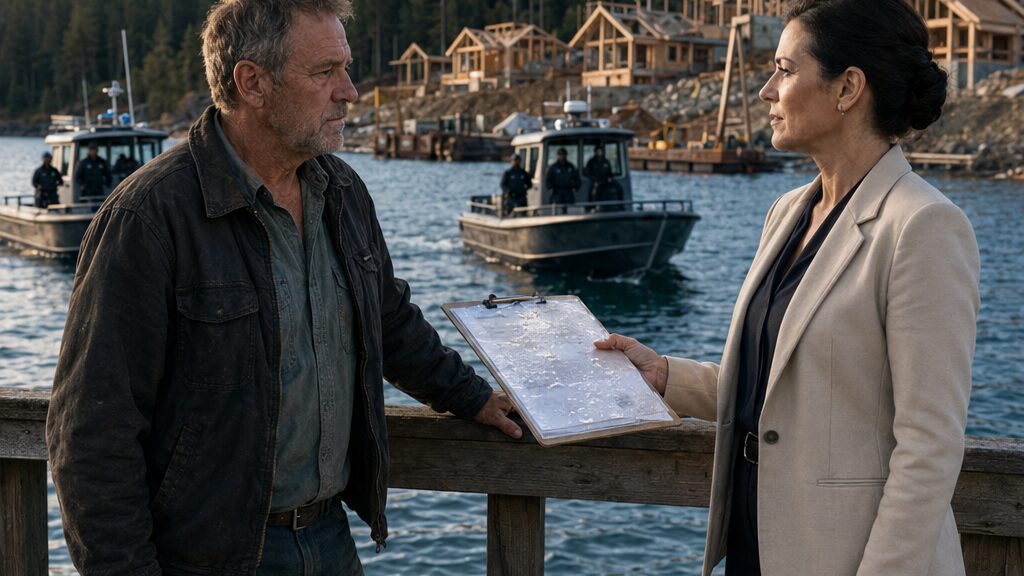
Stephanie Moore was standing on Michael Taylor’s dock with a wet repair estimate clipped to a contractor’s board, and two county marine patrol boats idled behind her like she had brought witnesses to a crime.
Michael stopped halfway down the slope from his house.
The dock below him was old cedar, silvered by years of sun and lake wind, patched in two places where he had replaced boards himself. Beyond it, the lake opened clean and blue between two arms of evergreen shoreline. Across the water, Stephanie’s development had torn a raw brown scar into the trees. Timber frames rose where the ridge used to be dark with pine. Trucks sat near the waterline. A floating construction barge nudged against a temporary marina dock. Orange safety fencing flashed between trunks like warning tape.
Stephanie lifted one hand, not quite a wave. Her jacket was dark, her shoes wrong for a dock, her hair pinned back so tightly the wind couldn’t loosen it.
“Michael,” she called. “We need to settle this before the inspector gets here.”
Settle.
The word put a small, hard weight under his ribs.
He came down the last few steps slowly, not because his knees hurt, though they did some mornings, but because people mistook hurry for guilt. He had learned that when he worked permits at the county office years ago, back when he carried folders for men who liked to say they remembered every line on every map.
“What’s this?” he asked, though he could see enough from ten feet away.
Stephanie turned the clipboard toward him.
The top page had a letterhead from a shoreline repair contractor, a claim number printed beneath it, and a total boxed in black near the bottom.
$48,600.
The number sat there with the calm cruelty of a thing already decided.
“The water damage came from your dock,” Stephanie said. “The erosion under our temporary access. The washout by the marina cribbing. The contractor’s report says the failure originated from this side.”
“This side,” Michael repeated.
“Your side.” She kept her voice level. “I’m not trying to make this uglier than it has to be.”
Behind her, one of the patrol boats rocked in the wake from a passing barge. The officer inside looked toward them, then away, as if he had been told this was not his conversation yet.
Michael looked past Stephanie to the construction site. Yesterday morning, the air over there had been full of hammering. Today, only one saw whined and stopped. Half-built cabin walls stood open to the sky. Tyvek flapped loose on a frame nearest the shore.
“You brought patrol boats for a conversation?” he asked.
“They’re here for shoreline compliance. Not for you.” She paused just long enough for the correction to feel like a warning. “But the claim is already in motion.”
Michael reached for the clipboard. Stephanie did not let go at first. Her fingers tightened around the metal clip, then released.
The pages were damp at the corners. Not soaked, just speckled from lake spray. He turned the first sheet. There were photographs printed in color: muddy water around a temporary dock post, a collapsed edge of gravel, exposed roots, a crack running through fresh fill, the corner of his old dock visible in one frame.
He knew how it looked. Anyone would.
Old dock. New damage. Easy line to draw.
Stephanie watched him read.
“The claim is not personal,” she said. “The project is carrying delay costs every day we can’t use that access safely. My insurance carrier needs a responsible party identified. If you sign the acknowledgment, they can process it without a drawn-out dispute.”
“Acknowledgment,” Michael said.
“That you accept responsibility for the originating condition.”
He turned another page.
There it was again. His dock in the background. The same lean of cedar rail. The same rust stain below the cleat where his late wife used to tie the canoe too tight and laugh when he complained.
His thumb stopped on a photo near the middle of the packet.
At first it was nothing. A smear of orange near the left edge, barely visible behind a clump of grass and disturbed gravel. A survey flag, maybe. Or a torn ribbon. The kind workers used when they marked corners they didn’t want to lose.
Michael tilted the page closer.
Stephanie misread the movement. “The contractor highlighted the source area in the next image.”
“I see it.”
“Then you understand why this can’t wait.”
He looked at her. “No.”
A flicker crossed her face. Not anger first. Surprise.
“No?” she said.
“I’m not signing this.”
The dock shifted under Stephanie’s weight as she stepped closer. “Michael, I don’t think you’re hearing me. If this goes through formal channels, you could be looking at an insurance subrogation claim, association penalties for unsafe shoreline conditions, and possibly a lien recommendation if the board determines your property created a hazard.”
“The board hasn’t determined anything.”
“The board has seen the photographs.”
“The board has seen what you showed them.”
Her mouth tightened.
Across the lake, a truck bed slammed. The sound carried over water, sharp and final.
Michael had let Stephanie’s crew use the outer cleat once, two months earlier. A delivery barge had come in crooked because of wind, and Ryan Lopez, the foreman, had shouted across the water asking if they could tie off for ten minutes. Michael had waved. Ten minutes had become forty. He had not written it down. He had not complained.
Peace, he had told himself.
The lake had enough noise now.
Stephanie tapped the page. “This is not about blame. This is about cost allocation.”
“It always sounds cleaner when someone else has to pay it.”
“I’m offering you a path that avoids escalation.”
“You’re offering me your bill.”
“It is not my bill. It is the repair estimate.”
“For damage I didn’t cause.”
“Your dock is in the photographs.”
“My dock existing is not proof.”
Stephanie’s gaze moved past him, up toward the house. The old blue-gray siding needed paint. The side porch sagged at one corner. A coil of hose lay by the steps where he had left it three days ago. He saw her inventory all of it: age, neglect, quietness, a man alone.
“Michael,” she said more softly, “I understand this property may be a lot to manage by yourself. But refusing to deal with conditions doesn’t make them disappear.”
His face warmed. Not enough to show, he hoped.
“That what you told your insurance carrier?”
“I told them what the contractor documented.”
He turned back to the photo with the orange flag. The shoreline angle was wrong. He knew the lake like other people knew the rooms of their house. That photo had been taken from low on the north cove, facing south toward his dock. Not from Stephanie’s side. Not from the temporary marina.
His hand moved to the dock rail.
For a moment, he nearly said too much. He nearly told her about the old property line, the missing survey pins, the county map nobody had pulled since before the cabins were imagined. He nearly said the sentence that had been sitting in him since the first excavator crossed the ridge.
Instead he slid the packet back under the clip.
“I want a copy of every page,” he said.
“You already have the claim summary.”
“Every page.”
Stephanie exhaled through her nose. “Fine. But the clock doesn’t stop because you want to review paper. If you don’t sign by tomorrow afternoon, the carrier proceeds without your cooperation noted. The association meets in two nights. I’ll have to report your refusal.”
“My refusal to pay your contractor?”
“Your refusal to accept responsibility for damage originating on your property.”
Michael looked again at the boats, the exposed frames across the lake, the raw gravel track cutting through the trees where no track had been last spring.
Then he turned the packet around and held the photo up between them.
The orange flag was tiny, almost nothing. But once he had seen it, the whole picture changed.
Stephanie glanced at it, impatient. “What?”
Michael tapped the corner of the image.
“That picture wasn’t taken from your side of the lake.”
Chapter 2: A Photograph With the Wrong Shoreline
Michael laid Stephanie’s estimate beside a twenty-year-old photograph and saw the same cedar stump leaning out of the same bank, half-dead even then, its roots gripping Michael’s shoreline like old fingers.
The kitchen light hummed above him.
Outside the window, the lake had gone black except for the work lamps across the water. The development glowed through the trees in hard white squares. Every few minutes, a backup alarm chirped, stopped, chirped again. Even after sunset, they were moving equipment.
Michael pressed the old photograph flat with his palm.
In it, the cedar stump was younger, the bank higher, the lake lower. His wife stood near the dock in a faded sweatshirt, one hand shading her eyes, the other holding a coffee mug. The orange canoe floated behind her. The date was printed in the lower corner: August 14, 2004.
He tried not to look at her face too long.
The repair estimate photo showed the same stump from a lower angle. The same fork in the root. The same granite stone half-buried near the water. A person could mistake it for Stephanie’s cove if they did not know the shoreline. Michael could not.
A truck pulled into the gravel outside. Headlights crossed the kitchen wall, washed over the old file cabinet, then disappeared.
His son came in without knocking, the way he had when he was twelve, except now John Ramirez filled the doorway with adult shoulders and worry he tried to disguise as irritation.
“You didn’t answer your phone,” John said.
“I was here.”
“That’s not answering.”
Michael picked up the estimate packet and handed it over.
John read the first page standing. His expression changed before he reached the amount. It tightened at the letterhead, then at the claim number, then stopped cold at the total.
“Forty-eight thousand six hundred dollars?” he said.
“That’s what she handed me.”
“Is this real?”
“It’s paper.”
“Dad.”
Michael took back the packet and set it beside the old photograph. “She wants me to sign responsibility.”
“For what?”
“Shoreline washout. Temporary dock damage. Delay costs.”
John looked toward the window, where the construction lights flickered through branches. “From her project?”
“From my dock, according to her.”
John moved to the sink, then back to the table. He had his mother’s habit of walking when anger had nowhere to go. “You need to call someone.”
“I’m looking at the records first.”
“You need an attorney.”
“I need to know what she’s claiming.”
“You know what she’s claiming. She’s claiming you owe almost fifty thousand dollars.”
Michael said nothing.
That silence had saved him from arguments for years. It had also made people talk over him. He knew both things and still reached for silence first, like an old coat by the door.
John pulled out a chair but did not sit. “What happens if you don’t sign?”
“She said insurance proceeds. The association meets in two nights. She mentioned a lien recommendation.”
“On the house?”
“A recommendation isn’t a lien.”
“It becomes one if you let them build a file while you’re sitting here with old pictures.”
Michael’s hand flattened on the photograph again, harder this time. “These old pictures matter.”
John leaned over the table. “I’m not saying they don’t. I’m saying they may not matter enough. If they push this through and your insurance company decides you didn’t cooperate—”
“I didn’t cause it.”
“I believe you.”
“Doesn’t sound like it.”
“I believe you,” John said, lower. “I also know being right doesn’t keep companies from sending bills.”
The words landed because they were true.
Michael opened the estimate packet again. The pages smelled faintly of lake water and printer ink. He turned to the photo with the orange flag and placed it beside the old picture.
“Look here,” he said.
John bent reluctantly.
“This stump,” Michael said. “This rock. This line of brush. That’s my north edge. Not Stephanie’s access.”
“Could be similar.”
“It isn’t.”
“Dad.”
Michael stood too quickly, his chair scraping. He crossed to the file cabinet in the corner. It was metal, pale blue once, now scuffed gray at the handles. The bottom drawer stuck unless lifted while pulled. His wife used to kick it with her heel and call it the stubborn one.
He opened it and removed a blue survey folder tied with a cloth band.
John watched him bring it back.
“I kept every shoreline notice,” Michael said. “Every dock repair receipt. County maps. Permit letters. Photos after storms. Your mother said it was too much paper.”
“She was right about most things.”
“She was right about people forgetting what they agreed to.”
John sat then.
Michael untied the folder. Inside were sleeves of photographs, old tax maps, repair receipts, letters from the lake association, a dock inspection notice from eleven years ago, and yellowed copies of shoreline setback guidelines. He found the receipt for the 2010 dock brace repair. The 2013 storm cleanup invoice. The printed email approving replacement boards after ice damage.
John lifted one photo from a plastic sleeve. “You took pictures of everything.”
“Not everything.”
“You took a picture of a stump.”
“Your mother liked that stump.”
That quieted them both.
Outside, across the lake, a machine started. Its engine growled through the glass. Michael looked at the estimate photo again. The orange mark near the corner bothered him more than the number now. If it was a survey flag, it had been placed close to his shoreline. If it appeared in Stephanie’s evidence, someone from her side had been there.
John touched the estimate. “Even if that photo is your side, it doesn’t prove they caused the damage. It just proves somebody took a picture from there.”
“It proves the claim isn’t clean.”
“That’s not the same as winning.”
“I’m not trying to win tonight.”
“You should be trying not to lose.”
Michael looked up.
John’s voice softened, but that made it worse. “Paying a settlement might cost less than fighting this. I hate saying that. But if this turns into insurance, inspection, board penalties—”
“I didn’t cause it.”
“I know.”
“Then why are you asking me to pay?”
“I’m asking you to survive it.”
Michael closed his eyes for one second. Behind them came a memory of his wife at this same table, sliding a stack of envelopes toward him after the county sent a confusing dock notice. Keep the boring things, she had said. One day boring things save you.
He opened his eyes and reached deeper into the folder.
“There’s a map,” he said. “North cove access. Original subdivision line. It should show whether that gravel strip was ever common access.”
John rubbed his forehead. “And if it does?”
“Then we start there.”
Michael sorted through the sleeves. Tax map. Storm record. Dock permit. Old association minutes. A shoreline sketch with faded pencil. Another receipt. Another photo.
The folder grew thinner.
He reached the back pocket and stopped.
There was a tab labeled NORTH COVE ACCESS, written in his wife’s hand. Behind it was a single torn reinforcement ring clinging to the prongs. No page.
Michael stared at the empty place.
John noticed. “What?”
Michael lifted the folder and checked beneath it, then the floor, then the drawer he had already closed. He searched too quickly, papers slipping sideways, breath shortening despite himself.
“What’s missing?” John asked.
“The map.”
“Maybe it’s somewhere else.”
“It was here.”
“When did you last see it?”
Michael could not answer.
He remembered showing it to a neighbor years ago during a dispute over boat trailers. He remembered bringing it to the association once. He remembered his wife smoothing tape over the edge because the fold had started to tear.
He did not remember putting it back.
Across the lake, the work lights glowed over the half-built cabins, bright and patient.
Michael held the blue folder open to the empty tab while John stood beside him, and the missing page looked less like lost paper than a door someone had quietly closed.
Chapter 3: The Contractor Clipboard Changes Hands
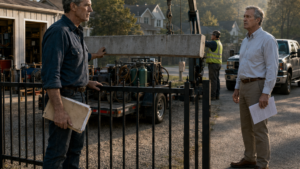
A flatbed truck was unloading lumber beside the new gravel strip when Michael stepped into the access road and forced the driver to brake hard enough that the stacked boards thudded against their straps.
The driver leaned out. “You can’t stand there.”
Michael did not move.
The road had not existed last spring. It cut from the higher ridge down toward the north cove in a pale gray slash, gravel pressed over roots and clay. On one side, brush had been scraped away. On the other, fresh silt ran in narrow fans toward the lake. Beyond the trees, the cabin frames stood in rows, their open windows staring out over water they had not earned yet.
A worker shouted for Ryan Lopez.
Michael kept his boots planted at the edge of the gravel. He had brought Stephanie’s estimate packet in a plastic grocery bag, folded once under his arm. The blue folder stayed locked in his truck. He was not ready to show anyone the missing page.
Ryan came down from the site with a hard hat pushed back and a pencil behind his ear. He looked younger than Michael remembered and more tired than a man wanted to show in front of his crew.
“Michael,” Ryan said. “You need to be off the active road.”
“Is it active road or temporary staging?”
Ryan stopped two steps away. His eyes flicked to the truck, then the workers, then the packet under Michael’s arm. “It’s a permitted access route.”
“Permitted by who?”
“Developer.”
“That’s not an agency.”
Ryan’s jaw moved once. “Stephanie cleared it.”
“With me?”
“I’m not handling property agreements.”
“You’re handling the road.”
The flatbed idled behind Michael. Diesel heat crawled against his back. He knew how this looked: old man blocking work, angry about progress, making a scene because the lake had changed around him. He hated that Stephanie had made the obvious version of the story so easy to believe.
Ryan lowered his voice. “Look, I’m not trying to get crosswise with you. But if you hold up delivery, that becomes a delay issue. I have a crew waiting and equipment rented by the day.”
“There’s already a delay issue. Stephanie handed it to me yesterday.”
Michael pulled the estimate from the bag and opened to the photo.
Ryan’s face changed only a little. Enough.
“You’ve seen this,” Michael said.
“It’s part of the shoreline assessment.”
“That assessment says damage originated from my dock.”
“I didn’t write the claim language.”
“Did you take the photo?”
“No.”
“Who did?”
Ryan looked over his shoulder. One worker pretended not to watch. Another did not bother pretending.
“Contractor took site photos,” Ryan said. “Multiple people. We document everything.”
“Then you have a log.”
“We have daily reports.”
“I’d like to see the daily report for the day this was taken.”
“That goes through Stephanie.”
“Because it’s her report?”
“Because she’s the client.”
Michael nodded, as if that answered more than Ryan intended.
The truck driver honked once, short and impatient. Ryan raised a hand without looking back.
“The estimate says the crack started on your property,” Ryan said. “I’m telling you what’s in front of me.”
“Then you won’t mind a second inspection.”
Ryan’s expression tightened. “We already had an assessment.”
“From the contractor trying to keep your access open.”
“The shoreline contractor is independent.”
“Paid by Stephanie.”
“That’s how projects work.”
“That’s how claims get shaped before anyone asks the person being billed.”
Ryan looked down at the photo. Michael watched him notice the orange flag, or remember it. The foreman’s gaze touched the corner and moved away too fast.
“What was that marking?” Michael asked.
“What?”
“The orange flag.”
“Could be utility. Could be silt fence. We flag a lot of things.”
“Was it there before the gravel?”
Ryan did not answer immediately.
The lake wind moved through the exposed cabin frames and made the house wrap snap. The sound carried like someone shaking a sheet in another room.
Michael stepped out of the truck’s path but not off the road. “I’m not stopping your delivery. I’m asking whether your crew used this strip before the date on Stephanie’s claim.”
Ryan rubbed the back of his neck. “We staged materials in north cove before the temporary marina was stable.”
“When?”
“I don’t know off the top of my head.”
“You have daily reports.”
“They’re on the tablet.”
“Then look.”
Ryan stared at him, and for a moment Michael saw the argument behind his eyes. Contractor to homeowner. Client to paycheck. Truth to liability. Ryan was not Stephanie. He did not have her polished certainty. He had work boots caked with the same gravel Michael stood on, and a man’s practical fear of making one sentence cost him a contract.
Finally Ryan pulled a tablet from his truck.
He tapped through screens with his thumb. Michael waited. The flatbed engine rumbled. A worker muttered something Michael did not catch.
Ryan stopped scrolling.
“North cove staging,” Michael said, reading upside down.
Ryan tilted the screen away by instinct.
Michael had seen enough. “Date?”
Ryan hesitated. “Three weeks before the washout report.”
“Before the date Stephanie’s estimate says my dock condition caused the damage.”
“I said staging. Not damage.”
“What did you stage?”
“Lumber. Temporary matting. Some gravel. Nothing heavy at first.”
“At first.”
Ryan’s eyes hardened. “Careful, Michael.”
“I am being careful.”
“No. You’re standing in an active access route implying my crew caused a shoreline failure.”
“I’m asking why Stephanie’s evidence photo was taken from my side after your crew used north cove.”
Ryan closed the tablet cover. “You want records, request them properly. I’m not handing over client documents in the road.”
“Is there written permission from me for this access?”
“Stephanie said the strip was developer-controlled.”
“Did you see a survey?”
“She had plans.”
“Plans aren’t pins.”
Ryan looked toward the gravel beneath their feet. For the first time, his certainty thinned into irritation that looked almost like worry.
A worker carrying a coil of orange marking tape came down from the slope. He stopped when he sensed the conversation had gone quiet.
Ryan snapped, “What?”
The worker shifted the tape to his other hand. “They need the north line remarked before the inspector comes. The old flag’s gone.”
Michael turned toward him.
Ryan said, too quickly, “Go back up.”
But the worker, already regretting that he had spoken, added, “I mean the one by the cedar. The one pulled before the gravel went down.”
The road seemed to still under Michael’s boots.
Ryan’s face went flat.
Michael looked from Ryan to the gravel strip, then toward the lake where the cedar stump leaned out from the bank, its roots half-buried under fresh stone.
“The orange flag,” Michael said.
No one answered.
The flatbed engine idled behind them, waiting to move forward over whatever had been marked and buried.
Chapter 4: The Meeting Where His Silence Cost Him
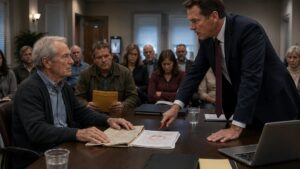
Michael walked into the lake association room and saw his dock projected on the wall.
Not the clean side of it, not the handrail he had sanded last summer, not the end where the old cleat still held. The image Stephanie had chosen filled the white screen behind the folding table: gray boards, stained posts, muddy water, exposed roots, and the corner of his cedar rail angled like an accusation.
People turned before he reached the back row.
Some looked away too quickly. Others stared with the solemn interest of neighbors who had already heard a version of the story and were waiting to see whether the man in it matched the damage.
John was beside him. “Maybe we should sit near the door.”
Michael kept walking.
Stephanie stood near the projector in a cream blazer, one hand resting on the table beside a neat stack of copied packets. Ryan Lopez sat three chairs away from her with his arms folded, his hard hat under the seat. He looked at Michael once, then down.
At the front of the room, the association chair cleared his throat. “We’re adding the north shoreline issue before general maintenance. Given the inspection schedule and pending insurance matter, Ms. Moore requested time.”
Michael stopped at the aisle.
On every third chair, Stephanie had placed a copy of the estimate packet.
His bill had become community reading.
He took one from a chair as he passed. The pages were no longer wet. They were crisp now, copied clean, the $48,600 total just as black and calm as before. His dock photo sat behind the summary page. The orange flag in the corner had nearly disappeared in the copy, flattened by the machine into a faint blur.
That was when he understood the danger of waiting. Every hour he had spent being careful, Stephanie had spent making the story easier to repeat.
He sat in the second row. John sat beside him and leaned close.
“Don’t say anything unless you have to.”
Michael looked at the screen.
“I mean it,” John whispered. “If you don’t have the missing map, don’t stand up and make them think you’re guessing.”
Stephanie began before Michael could answer.
“I want to be clear,” she said, facing the room. “No one is here to attack a neighbor. We are here because unsafe shoreline conditions affect all of us. Our lake, our insurance relationships, our access agreements, and our property values.”
A few people nodded at property values.
Michael watched her work the room with the steady restraint of someone who knew panic looked unprofessional and had chosen concern instead.
She clicked to the next slide. A photograph of the washout appeared. Then the temporary marina post. Then Michael’s dock again.
“The contractor’s assessment identifies the originating condition along the adjoining shoreline,” Stephanie said. “I offered Mr. Taylor a cooperative path to resolve the repair cost before it became an association and carrier issue.”
Cooperative.
John shifted beside him.
Michael held the copied packet in his lap and found the image with the stump. The orange mark was almost gone. Without the original, without the old photo, without the missing map, it looked like what Stephanie said it was.
The association chair looked over his glasses. “Mr. Taylor, did you refuse to sign the acknowledgment?”
Michael felt the room gather around the question.
“Yes,” he said.
A rustle moved through the chairs. A woman in the back whispered something. Ryan looked up.
Stephanie did not smile, but her stillness changed.
The chair asked, “Would you like to explain?”
John’s hand closed around Michael’s forearm under the table. Not hard. Pleading.
Michael looked at his son’s fingers. John was afraid. Not ashamed of him. Afraid for him. That distinction mattered, and it hurt anyway.
“I didn’t cause the damage,” Michael said.
Stephanie’s eyes lowered briefly, as if disappointed.
The chair waited.
Michael could have said more. He could have said the photo angle was wrong, that Ryan’s crew had staged in north cove weeks before the claim date, that a worker had mentioned a pulled flag. But each fact had a hole in it. Each hole was large enough for Stephanie to step through.
So he stopped.
The room disliked the silence. People trusted speech when it came in complete paragraphs, signed forms, printed packets. Silence looked like confusion.
Stephanie turned one page on her table. “Mr. Taylor was also offered a partial settlement option. That offer remains available until Friday at five. It reduces his immediate responsibility to twenty-two thousand dollars while the carrier completes review.”
John inhaled sharply.
Michael looked at him.
“That’s new,” John said under his breath.
Stephanie continued, “If he declines, the claim proceeds as disputed and the board will need to consider whether ongoing refusal to address the unsafe condition places association shoreline compliance at risk.”
“Just pay before they put a lien on the house,” John whispered, and the words came out with a desperation he had meant to keep hidden.
Michael did not look away from the screen. “I didn’t cause it.”
“Dad—”
“I’m not teaching them that a bill makes a lie true.”
The whisper was too loud. The woman in front of him turned. So did the chair. Stephanie heard it too. Her chin lifted a fraction.
From the end of the row, Nancy Clark leaned across an empty chair.
“Michael,” she said quietly. “May I see that copy?”
He passed it without asking why.
Nancy was small, white-haired, and severe in the way retired county clerks often were, as if decades of handling other people’s mistakes had trained her face not to waste motion. She had lived three coves down since before the association had a website. Michael knew she had once worked records, but he had never asked which department. He had not wanted to be the kind of neighbor who only remembered someone’s past when he needed it.
She turned the pages with narrow fingers. The chair was asking Stephanie about insurance escalation. Michael caught phrases: common exposure, adjacent responsibility, cooperation deadline.
Nancy stopped on the copied estimate photo.
Her finger tapped a pale line beneath the image. Not part of the photo. A reference number printed small in the contractor’s caption.
“Where did they get this?” she asked.
“From Stephanie’s packet.”
“No. This number.”
Michael leaned closer.
The caption read: NORTH COVE DAMAGE ORIGIN / REF. NC-17A.
“I had a map page,” Michael whispered. “North cove access. It’s missing.”
Nancy’s eyes sharpened. “NC-17A wasn’t an access road.”
“What was it?”
She closed the packet halfway and looked toward the front of the room. Stephanie was now telling the chair that her investors had already absorbed weather delays and could not continue carrying preventable losses.
Nancy lowered her voice. “It was a boundary reference from the old shoreline adjustment survey. Late nineties. Before they renumbered lake lots.”
Michael felt the room narrow.
“Do you know where that record is?”
“County archive, if they didn’t misfile it during digitizing. But Michael—” She touched the photo again. “If that reference number is attached to this image, somebody used an old boundary label in a new damage claim.”
“Meaning?”
Nancy looked at the projected dock photo, then back to the copied packet.
“Meaning this isn’t just a bad photograph.”
At the front, Stephanie clicked off the projector. The room brightened. Faces returned from the wall to Michael.
“Mr. Taylor,” the chair said, “the board strongly encourages you to consider the partial settlement before the offer expires.”
Michael stood.
John’s hand dropped from his arm.
“I’ll consider the records,” Michael said.
Stephanie’s expression cooled. “The offer is not open-ended.”
“No,” Michael said. “I’m starting to understand that nothing about this was.”
A murmur went through the room. He walked toward the door with John behind him and Nancy moving faster than he expected for someone her age.
In the parking lot, beneath the yellow light by the entry, Nancy handed the copied packet back to him.
“If that reference number is what I think it is,” she said, “that gravel road is on the wrong side of the line.”
Chapter 5: The Survey Pin Under Fresh Gravel
Michael scraped fresh gravel away with the edge of a garden trowel while a loaded truck waited ten yards behind him and Ryan Lopez stood with both hands on his hips, pretending he was not worried.
The metal cap appeared slowly.
First a dull edge under dust. Then a circle no wider than a silver dollar. Then the faint cross notch at its center, packed with grit. Michael brushed it with his thumb and felt the old stamp beneath the dirt before he could read it.
Nancy crouched beside him with her phone held low for a photograph.
“Don’t pry it,” she said. “Just clear around it.”
“I know.”
Ryan looked back toward the line of trucks. “You can’t excavate in the access road.”
Michael did not look up. “I’m uncovering what your access road covered.”
“It’s gravel, not concrete.”
“It was enough to hide the marker.”
The morning air smelled of diesel, damp clay, and cut pine. The lake was visible through the trees below them, a strip of blue flashing between trunks. Across the cove, Michael’s dock sat quiet in the sun, small from this angle, exactly where the repair estimate had placed it.
Exactly where Stephanie said the damage began.
Nancy took another photo. “There should be stamped letters.”
Michael brushed harder.
N C.
Then a worn dash.
17A.
He stopped.
For two days the reference had been a small printed code in a copied packet. Now it was metal in the ground under Stephanie’s road.
Ryan stepped closer despite himself. “What does that prove?”
Nancy stood with effort. “It proves this is not developer-controlled access unless the developer owns Mr. Taylor’s boundary marker too.”
“That’s not how site plans work,” Ryan said, but the force had left his voice.
Michael looked down the gravel strip. Lumber trucks had been rolling over the cap. Workers had walked over it. Stephanie’s evidence photo had been taken from just beyond it, near the cedar stump. The old orange flag had not marked a utility line. It had marked the thing they needed not to see.
Ryan rubbed a hand over his mouth. “I was told this strip was cleared.”
“By Stephanie?”
“By her site package.”
“Did you see a survey?”
“Plans had access marked.”
“Plans drawn after the line was assumed,” Nancy said.
Ryan shot her a look. “I’m not a surveyor.”
“No,” she said. “But you know when a crew pulls a flag before gravel.”
He looked toward the worker who had spoken the day before. The worker was not there now.
Michael stood and brushed dirt from his knees. “The estimate photo was taken from past this pin.”
Ryan said nothing.
Michael pulled Stephanie’s packet from under his arm and opened the page. He held the photo up beside the view toward the lake. The angle aligned with a precision that made his chest tighten. Cedar stump. Granite stone. His dock rail. Orange flag near the lower corner. The photographer had stood within the disputed strip, maybe on Michael’s side of it.
Not proof of everything. Not yet.
But proof that Stephanie’s clean story had mud under it.
Ryan stared at the photo. “I didn’t file the claim.”
“But your reports helped it.”
“My reports said north cove staging.”
“Before the washout.”
“Yes.”
“With equipment?”
Ryan glanced at the trucks again. His crew was watching openly now. Every minute cost someone money. Michael knew that pressure. It was the same pressure Stephanie had tried to put on him, only Ryan wore it in sweat and dust instead of a blazer.
“At first it was matting and hand-carried material,” Ryan said. “Then gravel. Then small equipment.”
“How small?”
“Skid steer. Compact loader.”
Nancy made a small sound.
Ryan pointed toward the slope. “The marina side was soft. We were losing time. Stephanie said this strip had historical access rights and the old markers were outdated.”
“Did she say uncertain?” Michael asked.
Ryan’s eyes flicked away.
There it was. Not a confession. Not rescue. A man deciding which word he could afford.
“She said not to slow the job over an old lot-line question.”
Nancy’s phone lowered.
Michael folded the estimate page carefully. His hands wanted to shake, but he would not give the trucks, the workers, or Ryan the satisfaction of seeing it.
“Will you put that in writing?” he asked.
Ryan laughed once, without humor. “You know I can’t just do that.”
“You can tell the inspector.”
“If I start accusing my client—”
“I’m not asking you to accuse her. I’m asking you not to let her accuse me with your records.”
Ryan looked toward the half-built cabins. “You think I don’t have my own exposure here? If that access is wrong, every delivery we ran through here becomes a problem. My company gets dragged in. My crew gets sent home. People don’t get paid because a line on a map nobody flagged clearly enough becomes a fight.”
“The flag was clear enough until somebody pulled it.”
Ryan’s face hardened again. “Careful.”
“No,” Michael said, surprising himself with the steadiness of it. “That word keeps coming up when people want me quiet.”
A white SUV came down from the construction ridge, too fast for the gravel. It stopped behind the lumber truck, and Stephanie stepped out before the dust settled.
She wore boots this time. Expensive ones.
Her eyes took in the waiting trucks, the workers, Nancy’s phone, the trowel in Michael’s hand, then the exposed metal cap at his feet.
For the first time since she had stood on his dock, Michael saw her composure arrive a half second late.
“What are you doing?” she asked.
“Finding what your road covered,” he said.
Stephanie looked at Ryan. “Why is work stopped?”
Ryan’s mouth tightened. “There’s a marker.”
“There are old markers all over this lake.”
Nancy lifted her phone. “This one matches the reference number in your damage packet.”
Stephanie turned to her. “Nancy, this is an active construction site. You shouldn’t be here.”
“I’m on a road that may not be yours.”
“It is permitted access.”
Michael held up the estimate photo. “Then why was your damage evidence taken from past my boundary marker?”
Stephanie stepped closer, lowering her voice so the workers would not hear. “Michael, this is exactly why the board was concerned. You are interfering with repair and safety work.”
“I’m interfering with being billed for your access problem.”
Her eyes flashed. “You allowed our barge to tie off at your dock.”
“Once.”
“Without objection.”
“For forty minutes.”
“You understood the project needed temporary lake access.”
“I understood a man in the wind asked for help.”
“That help created reliance.”
Michael almost answered too quickly. His old habit caught him: avoid the fight, preserve peace, do not say the thing that makes tomorrow harder. He had lived by that on this lake. He had waved at barges, ignored tire tracks, let chainsaws start too early, let Stephanie call disruption improvement because he did not want to become the old man everyone avoided.
Now his silence had been copied, stapled, and priced at $48,600.
“No,” he said. “Your project created reliance on my silence.”
Stephanie’s expression shifted.
Ryan looked away.
A truck door opened. The driver stepped down. “Are we unloading or not?”
Stephanie turned sharply. “Wait in the truck.”
The driver got back in, slowly enough to make his opinion clear.
Stephanie faced Michael again. “The lien recommendation goes out at nine tomorrow morning unless you sign the settlement by sunset. I have given you every chance to keep this manageable.”
“Manageable for who?”
“For everyone. You, me, this association, the contractor, the insurer. If this turns into a boundary challenge, you won’t like what county inspection starts asking about your dock either.”
Michael felt Nancy glance at him.
Stephanie saw it.
Her voice softened in a way that made the words sharper. “You have old repairs, don’t you? Replacement work? Maybe all properly documented, maybe not. Be careful opening doors you don’t have to open.”
There it was: not just money now. Exposure.
Michael thought of the blue folder in his truck. The receipt for the brace repair. The approval email for boards. The page with a coffee stain that did not clearly mention the outer support he had replaced after ice lifted the corner years ago. He had meant to follow up. Then his wife got sick. Then the dock stood, and no one asked, and the lake stayed quiet.
Nancy said, “That has nothing to do with falsely assigning the washout.”
Stephanie kept her eyes on Michael. “Everything has to do with compliance once the county is involved.”
Ryan shifted. “Stephanie—”
She cut him off with one look.
Michael bent and picked up the trowel. He cleaned the dirt from its edge with his thumb. The small domestic tool looked foolish in his hand beside trucks and timber and legal threats. But it had found what the machines had buried.
“I’ll be at my dock at sunset,” Michael said.
Stephanie’s face closed. “Good. Bring a pen.”
Michael looked down at the exposed survey cap, then at the estimate packet under his arm.
“I’ll bring the folder.”
Chapter 6: The Boats Came Back for the Wrong Reason
The marine patrol boats returned at sunset, and this time the county shoreline inspector asked Michael for his dock records before he asked Stephanie a single question about the washout.
Michael stood on the dock with the blue survey folder under one arm and the repair estimate packet under the other. The lake was gold at the surface, dark beneath, and the half-built cabins across the water caught the last light in their empty frames. A week ago, he would have called the view beautiful and meant it. Now every reflection looked like something trying to hide its edge.
Stephanie arrived from the construction side in a small utility boat with Ryan behind her and two workers seated forward. She stepped onto Michael’s dock without asking permission.
Michael noticed that this time she did not bring the clipboard.
The inspector came last, tying the county boat to the outer cleat with practiced care. He wore a faded cap, carried a waterproof case, and had the calm, inconvenient face of a man who knew everyone wanted him to miss something.
“Mr. Taylor?” he asked.
Michael nodded.
“I understand there are competing claims about shoreline damage, temporary access, and dock-related conditions. I need to start with your property file.”
Stephanie’s eyes moved to Michael’s folder.
Michael had expected anger from her, maybe another deadline. He had not expected the first official question to turn toward him. For a moment, the old shame rose fast and hot. His dock. His incomplete page. His years of telling himself that good enough was different from hidden.
He opened the blue folder on the dock rail.
“These are the records I have,” he said. “Photographs, receipts, association notices, county letters, and old survey materials.”
The inspector put on reading glasses and began with the dock file.
Stephanie stood three feet away, silent but alert. John had come too and waited near the shore steps, arms folded, looking as if he wanted to pull Michael out of the scene by force. Nancy stood beside him with her own copy of the county archive printout she had managed to obtain that afternoon.
The inspector turned one page. Then another.
“This brace repair,” he said. “Was this part of the original permitted structure?”
Michael felt the question strike exactly where Stephanie had aimed.
“I replaced the brace after ice damage,” he said. “I notified the association. I have the receipt and an email about board replacement. I don’t have a separate county confirmation for the brace.”
Stephanie looked at him with something close to satisfaction.
John closed his eyes.
The inspector marked a note. “That may require correction.”
Michael’s throat tightened. “Correction meaning?”
“Possibly an after-the-fact compliance review. Possibly a minor correction if dimensions didn’t change. I won’t know today.”
Stephanie stepped in. “So there are unresolved conditions on Mr. Taylor’s dock.”
“There may be unresolved paperwork,” the inspector said. “That is not the same sentence.”
Michael kept his hand on the folder.
He could still remove the page. Not literally; the inspector had seen it. But he could minimize. He could argue. He could do what Stephanie had done and shape uncertainty toward himself.
Instead he took out the stained email, the receipt, and the photograph of the old brace exposed during the repair.
“This is everything I have on it,” he said. “If I need to correct it, I will. But that repair did not cause the washout in her claim.”
The inspector looked at him for a long moment, then took the papers.
Something in John’s posture changed on the steps. Not relief. Recognition.
Stephanie crossed her arms. “The carrier’s concern is originating condition.”
“Then we should look at origin,” Michael said.
He opened the repair estimate packet to the photo with the orange flag. The original, not the copy. The flag burned bright near the edge now that everyone knew where to look.
Nancy stepped forward and placed her county archive printout beside it. “NC-17A,” she said. “Old shoreline adjustment reference. The marker is under the gravel access road. We uncovered and photographed it this morning.”
The inspector took both pages.
Ryan watched the water.
“Mr. Lopez,” the inspector said, “your daily reports show north cove staging prior to the washout date?”
Ryan’s head lifted slowly. He looked first at Stephanie, then at Michael, then at the inspector.
“I’d need to check exact wording.”
The inspector waited.
Ryan exhaled. “Yes. We staged in north cove before the washout report.”
“Equipment?”
“Light material at first. Then gravel. Then compact equipment.”
Stephanie turned. “Ryan.”
He did not look at her. “That’s what happened.”
“Under whose authorization?” the inspector asked.
Ryan’s mouth tightened. “The access was provided in the site package.”
“Provided as developer-controlled?”
“Yes.”
“Did you verify boundary markers before gravel placement?”
Ryan looked down at the dock boards.
“No.”
The word sat between them, small and heavy.
Stephanie spoke quickly. “The site package was prepared from the plans available to us. Any ambiguity in old shoreline records predates this project.”
The inspector looked at her. “Did you know there was an old boundary question before filing the claim against Mr. Taylor?”
“No formal boundary challenge had been presented.”
“That’s not what I asked.”
The lake moved against the dock posts. Water slapped, withdrew, slapped again.
Stephanie’s professional stillness held, but Michael saw the strain at the edge of it. Not collapse. Calculation.
“There were discussions,” she said. “Informal. About historical access.”
“With whom?”
“Contractors. Association members. Prior owners had treated that strip as shared.”
Michael felt his hand close around the dock rail.
“I never signed shared access,” he said.
Stephanie did not turn to him. “You allowed temporary use.”
“Once. For a barge in wind.”
“You didn’t object afterward.”
“No,” Michael said. “I didn’t. That was my mistake.”
The admission surprised even him.
Stephanie looked over then.
Michael kept going, not louder. “I thought keeping peace meant not making everything a fight. I let trucks pass once. I let noise start early. I let your crew tie to my dock because I didn’t want to be the neighbor who made trouble. But silence is not permission to bill me for what your project did.”
No one spoke.
The inspector looked from Michael to the estimate photo, then to Ryan. “I need the daily staging logs.”
Ryan nodded. “I’ll provide them.”
Stephanie said, “Through counsel.”
The inspector’s expression did not change. “Through whatever channel gets them here by morning.”
He stepped off the dock onto the narrow gravel edge where the bank had been disturbed. Michael followed with the folder. Stephanie came after them, then Ryan, then Nancy and John from the steps.
At the north cove, the inspector crouched over the exposed survey cap. He compared it to Nancy’s printout, then to Michael’s old photo with the cedar stump, then to the estimate image. The lake was dimmer now. One of the patrol officers held a flashlight over the ground.
The beam caught the metal cap.
NC-17A.
The inspector aligned the photo with the shoreline, turning the page slightly until the cedar stump, granite stone, and dock rail matched the real view.
Michael held his breath.
The inspector looked at Ryan. “Your crew placed gravel over this?”
Ryan’s answer was quiet. “Yes.”
“Before or after the damage photo?”
Ryan swallowed. “Before.”
Stephanie said, “That doesn’t establish causation.”
“No,” the inspector said. “It establishes that the claim photograph’s stated origin point is unreliable.”
He flipped to the contractor’s summary page, then back to the image. His finger rested beside the orange flag.
“The evidence packet identifies the damage as originating from Mr. Taylor’s dock-side condition,” he said. “But the photograph was taken from the disputed access strip, after construction staging began, over a boundary marker tied to his shoreline record.”
Stephanie’s face had gone pale in the flashlight’s edge.
Michael felt no triumph. Only the exhausted weight of how close he had come to signing because the paper had looked official.
The inspector closed the folder halfway and turned to Stephanie.
“This claim has the wrong origin point.”
Chapter 7: What the Lake Kept Marked
The corrected insurance notice arrived in Michael’s mailbox folded behind a grocery flyer, as if a piece of paper that had nearly cost him his house belonged with coupons for tomatoes and motor oil.
He stood at the road with the metal door hanging open, reading the first page once, then again, while a delivery truck slowed near Stephanie’s gravel entrance and turned away without unloading.
The claim number was the same.
The amount was gone.
The words that mattered sat in the middle of the page, plain and almost small: liability determination revised pending corrected site-origin report. No payment due from Michael Taylor.
No payment due.
Michael folded the notice along its crease and looked across the lake. The construction site was quieter now. Yellow caution tape crossed the north-cove access road where the survey cap had been uncovered. A compact loader sat abandoned halfway up the slope, bucket lowered into the gravel as though it had been told to stop and had obeyed better than people had.
John pulled up while Michael was still standing by the mailbox.
He got out fast. “Did it come?”
Michael handed him the notice.
John read it without speaking. His eyes moved down the page, then jumped back to the middle. The relief crossed his face first. After it came something harder to name.
“You don’t owe them,” he said.
“No.”
John lowered the paper. “Dad.”
Michael waited.
“I was wrong to tell you to pay.”
“You were scared.”
“I was still wrong.”
Michael took the notice back, careful not to crumple it. “Both can be true.”
John looked toward the lake. “They could’ve gotten away with it.”
Michael thought of the packet on the dock, Stephanie’s hand on the clip, the black total boxed at the bottom. He thought of every chair in the association room holding a copied version of his supposed responsibility. He thought of how close his own silence had come to finishing what Stephanie started.
“They nearly did,” he said.
The lake association reconvened that evening in the same room where his dock had been projected on the wall. This time there was no projector. No copied packets waited on the chairs. People spoke quietly in clusters and stopped when Michael entered, but the stopping felt different now. Less accusation. More discomfort.
Nancy Clark sat near the aisle with a manila envelope in her lap. She gave Michael a small nod, not triumphant, just steady.
Stephanie was already at the front table.
She looked tired in a way her careful clothes could not hide. Her blazer was buttoned, her hair pinned, her folder stacked square before her. But the clean certainty that had carried her through the first meeting had thinned. Ryan stood against the side wall, arms crossed, eyes on the floor. He had submitted the staging logs that morning. Michael knew because the inspector had copied him on the receipt.
The association chair cleared his throat. “We have a brief update on the north shoreline matter.”
No one looked at the screen. There was nothing on it.
“The insurance carrier has revised its preliminary liability position,” the chair said. “Based on county review, contractor staging logs, and boundary documentation, no current payment obligation is assigned to Mr. Taylor.”
A murmur passed through the room, softer than the one that had followed his refusal.
Michael did not look around to see who reacted. He kept his eyes on the notice in his hands.
The chair continued, “The association will not pursue lien recommendation related to the shoreline damage claim. The north-cove access route remains under review, and construction use of that strip is suspended pending clarification.”
Ryan shifted against the wall. Stephanie’s jaw tightened, but she did not interrupt.
Then the chair looked at her. “Ms. Moore asked to address the room.”
Stephanie rose.
For a moment, Michael wished she would not. He had not come for apology. Apologies in public had a way of becoming performances, and he did not want to be made into the generous old man who absolved everyone so the room could feel clean again.
Stephanie placed both hands on the table.
“I relied on contractor access assumptions and preliminary site materials that were not complete,” she said. “The claim should not have proceeded against Mr. Taylor in the form it did.”
Not I was wrong.
Not I accused him.
Not I saw the uncertainty and filed anyway.
But more than nothing.
She looked at Michael then. “I regret the pressure created by the timeline.”
Michael heard John breathe beside him.
Stephanie’s eyes held his for one controlled second, then moved back to the room. “My team will cooperate with the county and carrier to correct the origin report.”
The chair thanked her as if the words had settled everything. They had not.
A neighbor near the back raised a hand and asked whether common insurance rates would be affected. Another asked whether the construction delay would reduce association dues expected from the new cabins. The room turned quickly, almost gratefully, toward money that belonged to everyone instead of blame that had belonged to one man.
Michael sat through it until the meeting ended.
As chairs scraped and people stood, Ryan came over.
“I should’ve said more sooner,” he said.
Michael looked at him. “Yes.”
Ryan nodded once, accepting the plainness of it. “I thought it was a paperwork fight above me. Then it became your bill.”
“It was always somebody’s bill.”
Ryan’s mouth tightened. “They pulled us off the north road. We’re using barge access until the county sorts it.”
“From my dock?”
“No.” Ryan almost smiled, then didn’t. “Not from your dock.”
Nancy joined them and slipped the manila envelope under Michael’s arm. “Archive copy. NC-17A and the old adjustment sheet. You should keep it with the blue folder.”
“Thank you.”
“Don’t thank me too much. I should’ve spoken up when the road first went in.”
Michael looked at her. “I should have too.”
That was the sentence that stayed with him after the meeting, after John walked him to the truck, after Stephanie passed within three feet of him in the parking lot and gave a small, stiff nod neither of them pretended was peace.
At home, the lake was dark except for the moonline trembling between the dock posts. Michael carried the corrected notice, the withdrawn estimate, and Nancy’s archive copy into the kitchen.
The repair estimate packet lay where he had left it, no longer damp, no longer powerful. Across the first page, the insurance adjuster had stamped WITHDRAWN in blue.
John stood at the table while Michael opened the blue survey folder.
“You still have to deal with the dock review?” John asked.
“Yes.”
“How bad?”
“Maybe paperwork. Maybe a repair. Maybe a fine if they decide the brace needed separate approval.”
John winced. “After all this?”
“After all this.”
“That doesn’t seem fair.”
Michael slid the withdrawn estimate into a new plastic sleeve. “It’s mine to correct. That’s different.”
John was quiet.
Then he said, “Mom would’ve kept three copies.”
“She would’ve labeled them better.”
“She would’ve told you not to wait so long.”
Michael looked up.
John gave him a tired half smile. “She told both of us that about everything.”
Michael touched the old cloth band attached to the folder. For years he had treated the blue folder like a box of weather: records of things that had passed, storms survived, repairs made, lines people used to respect. But it was not memory alone. It was a tool. A quiet one, but a tool all the same.
He took a blank tab from the drawer.
His handwriting was slower than his wife’s had been, heavier at the corners.
Lines We Should Have Kept.
He placed the tab behind the withdrawn estimate, the NC-17A record, the old photograph of the cedar stump, and the corrected notice that said he owed nothing.
Outside, across the water, Stephanie’s unfinished cabins stood black against the ridge. They would probably be finished someday, by a corrected route, under stricter review, with permits nobody could pretend were informal. People would still wave from boats. Some would wave smaller. Some would not wave at all.
Michael could live with that.
He closed the folder and tied the cloth band around it. Then he carried it to the file cabinet, opened the stubborn bottom drawer, and set it inside where the missing map had once been.
This time, he did not close the drawer all the way.
The story has ended.